It was about marketing:
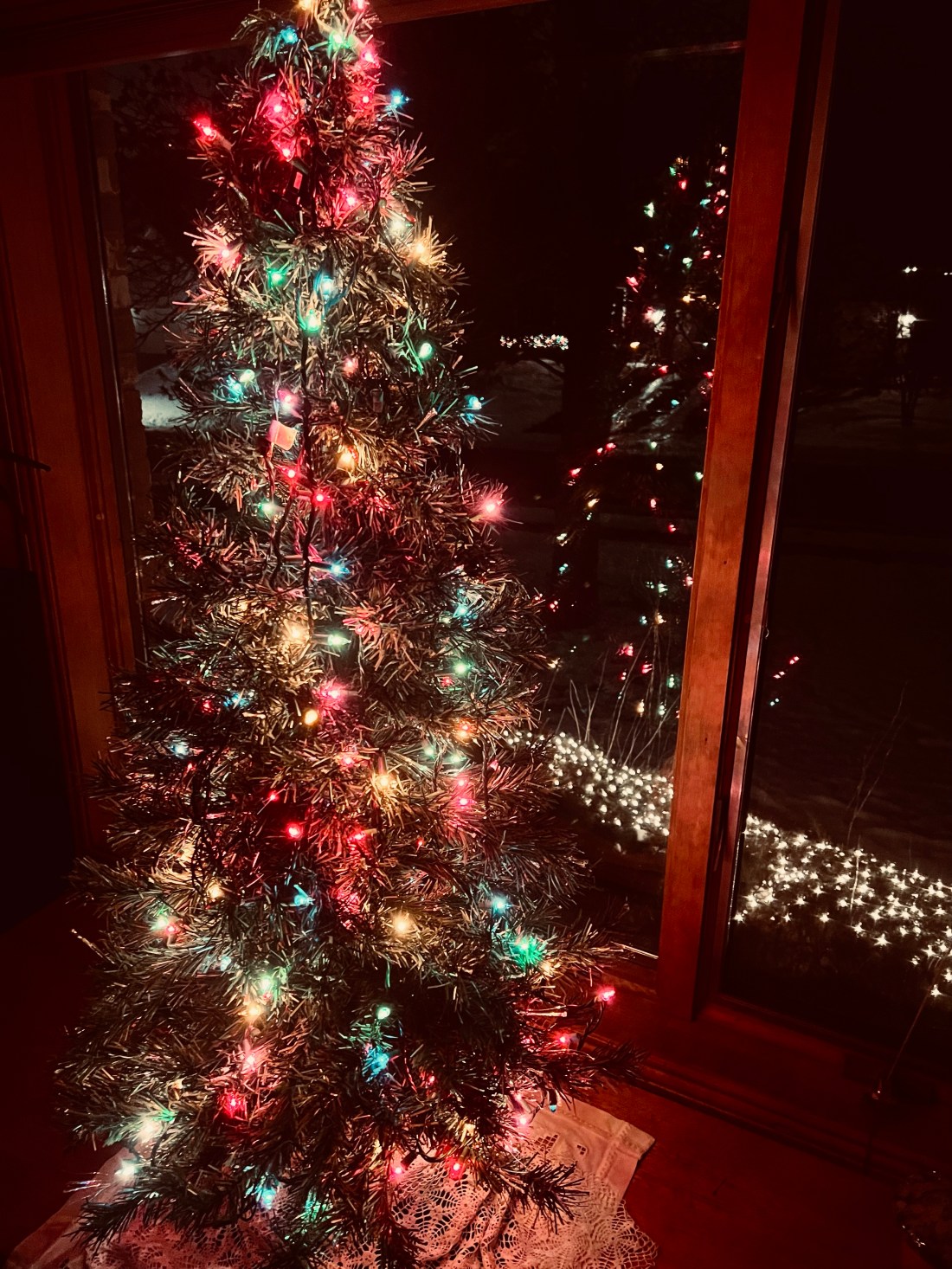
Over at the Edison shop, Johnson saw an opportunity. Setting up a tree by the street-side window of his parlor, Johnson hand-wired 80 red, white and blue light bulbs and strung them together around it, and placed the trunk on a revolving pedestal, all powered by a generator. Then he called a reporter. “At the rear of the beautiful parlors, was a large Christmas tree presenting a most picturesque and uncanny aspect,” wrote W.A. Croffut, a veteran writer for the Detroit Post and Tribune. “It was brilliantly lighted with…eighty lights in all encased in these dainty glass eggs, and about equally divided between white, red and blue….One can hardly imagine anything prettier.” The lights drew a crowd as passers-by stopped to peer at the glowing marvel. Johnson turned his stunt into a tradition; he also pioneered the practice of doing more each year: An 1884 New York Times article counted 120 bulbs on his dazzling tree.
Johnson’s lights were indeed ahead of their time—electricity was not yet routinely available—and they weren’t cheap. A string of 16 vaguely flame-shaped bulbs sitting in brass sockets the size of shot glasses sold for a pricey $12 (about $350 in today’s money) in 1900. But in 1894 President Cleveland put electric lights on the White House tree, and by 1914, a 16-foot string cost just $1.75. By the 1930s, colored bulbs and cones were everywhere.
Today an estimated 150 million light sets are sold in America each year, adding to the tangled millions stuffed into boxes each January. They light 80 million homes and consume 6 percent of the nation’s electrical load each December. And though the contagious joy of these lights has been co-opted orange at Halloween and red at Valentine’s Day, it all started with Johnson’s miracle on 36th Street.
Smithsonian Magazine