Charlotte Mew, a poet you never knew

Monsieur Qui Passe

A purple blot against the dead white door
In my friendโ€™s rooms, bathed in their vile pink light,
I had not noticed her before
She snatched my eyes and threw them back to me:
She did not speak till we came out into the night,
Paused at this bench beside the klosk on the quay.
 
God knows precisely what she saidโ€”
I left to her the twisted skein,
Though here and there I caught a thread,โ€”
Something, at first, about โ€œthe lamps along the Seine,
And Paris, with that witching card of Spring
Kept up her sleeve,โ€”why you could see
The trick done on these freezing winter nights!
While half the kisses of the Quayโ€”
Youth, hope,-the whole enchanted string
Of dreams hung on the Seineโ€™s long line of lights.โ€
 
Then suddenly she stripped, the very skin
Came off her soul,-a mere girl clings
Longer to some last rag, however thin,
When she has shown you-well-all sorts of things:
โ€œIf it were daylight-oh! one keeps oneโ€™s headโ€”
But fourteen years!โ€”No one has ever guessedโ€”
The whole thing starts when one gets to bedโ€”
Death?-If the dead would tell us they had rest!
But your eyes held it as I stood there by the doorโ€”
One speaks to Christ-one tries to catch His garmentโ€™s hemโ€”
One hardly says as much to Himโ€”no more:
It was not you, it was your eyesโ€”I spoke to them.โ€
 
She stopped like a shot bird that flutters still,
And drops, and tries to run again, and swerves.
The tale should end in some walled house upon a hill.
My eyes, at least, wonโ€™t play such havoc there,โ€”
Or hersโ€”But she had hair!โ€”blood dipped in gold;
And there she left me throwing back the first odd stare.
Some sort of beauty once, but turning yellow, getting old.
Pouah! These women and their nerves!
God! but the night is cold!

And Paris, with that witching card of Spring Kept up her sleeve,โ€”why you could see The trick done on these freezing winter nights! While half the kisses of the Quayโ€”

Food deserts, and other not so silly sayings

The term food deserts is about as silly as affordable housing; both try to capture the notion of a thing instead of the understanding of a system.

A food desert is an area that has limited access to affordable and nutritious food, in contrast with an area with higher access to supermarkets or vegetable shops with fresh foods, which is called a food oasis.

The idea goes something like this. People who live in high poverty areas, which often- if not always- are high crime areas, have fewer choices in grocery shopping. Hence it is the obstacle of getting to a supermarket which causes a poor diet and resulting health problems such as obesity. The policy solution thus is to bring a product, fresh fruits and vegetables, to the neighborhoods. Problem solved!

In time of yore, or my grandmother’s generation, farm families across rural Minnesota spent the winter without access to fresh food. It isn’t until June that early lettuce comes in and can be eaten from the garden. Most vegetables are harvested July through early September. Of course strawberries are plentiful in late June, but the apple tree branches don’t bend with fruit until fall.

Tomatoes are still canned (the process of storing produce in a jar with an airtight lid for use through the winter) by many today who enjoy the fruits from their gardens for things like salsa and pasta sauce. And cabbage is converted in some mysterious process to sour kraut. The Red Wing Stoneware Company produced crock pots of various sizes for winter storage in cool cellars.

The point is that many people across the world find ways to store the makings of a balanced diet for consumption through out the year. Eating from a healthy menu depends on a process of accumulating, storing, preparing and eating. Home economics, as it was taught in school a half a century ago, was designed to address this topic.

One of the classroom experiences was to make simple meals like a hamburger goulash. A pound of ground beef, elbow macaroni noodles, a can of tomato soup are its readily available ingredients which are easy to store. You can even purchase such items at many convenience stores.

Now, it seems, we don’t want to teach lifelong skills. Problems are deemed to be the lack of a product, a purchase, a consumable good. And if the government simply puts that good in the hands of the poor, then all will be solved. Or not.

How does that verse go? ย “Give a man a fish, and you feed him for a day. Teach a man to fish, and you feed him for a lifetime.” Mathew 4:19.

PBS’s Unforgotten – Series Review

After I wrapped up Bosch, the story of a crusty police detective who hits the streets of LA to secure justice for the victims of crime, I was at loose ends for a replacement. I needed a new setting and a new protagonist. We had switched streaming choices recently which opened BBC up for viewing. That’s how I came across Unforgotten: Unforgottenย is the critically acclaimed British crime drama series starring Nicola Walker and Sanjeev Bhaskar.ย 

Instead of the old-shoe-leather-worn-beat-policeman made detective, the protagonist is a mid-aged woman whose brain clicks through every clue and its potential like the wheels on a slot machine. She knows the odds are low for bringing to light the violent offender responsible for the skeletal bones under an old boarding house, but press on she does.

Her lighter step and softer expression is a nice contrast to the scowl of a graying cop who has seen more corruption than he cares to claim. Her compassion toward the mother of the lost son is displayed through action and not just words. She is interesting. She is sincere.

The story line is strong. Like any good mystery, part of the reason the audience cannot predict the outcome is because they are being denied information. But the plot in Unforgotten has you noodling right along with DCI Cassie Stewart and her partner DI Sunny Khan. They’re a good pair, contrasting yet supportive.

There’s a freshness about discoveries made due to new technologies or abilities, like pulling apart and refurbishing a diary. Although buried under a body for forty years, a little of this, a little of that, and the scientists are able to read the entries. And there is a dash of corruption to be sure there are plenty of gangsters in the mix.

Overall the series has everything I could ask for: interesting characters, thought provoking plot, sympathy to the victims (to take the edge off the violence), and super actors from across the pond. I recommend watching.

Architect/Builder in Kenya says:

Here are some comments from an architect/builder, Sacrinos. (@dnahinga), in Kenya regarding the obstacles to building housing for the average Kenyan. Interesting throughout, especially the land use comments:

The pricing model in Kenya's Construction Sector/Real Estate is Colonial and Punitive.

It is akin to trophy pricing. All clients become as pricey as elephant tusks.

Let us reason together.

Short Thread 1/n.

After the Colonists grabbed Land and the Means, they quickly put up roadblocks to Home Ownership.

One being approvals for Self Expression

A house is the most express image of the Builder. Thus his native language

It was no longer possible to just build

2. Now if you have lost acres of communal and individual land, it is virtually impossible to Express your wealth as a fraction of the same Assets you lost.

You do not have the wherewithal.

So, it is a scorched earth where everyone must rebuild their wealth from scratch.

3. As the First Gatekeepers would have it, it's professional #misconduct to charge unprescribed fees.

A board has all powers to make laws, "for the scale of fees to be charged by architects and quantity surveyors for advice, services, and work done."
AQS Cap 525 (f)

Walk with me.

This is the formal housing cost structure in Kenyas #RealEstate.

So, the Colonists became the Levites in the sector. Basically taking a tithe from everyone that wishes to Build or be Adviced to Build.

What is the market effect? Facebook and Quacks* step in.

These powers need to be returned to the Free Market Mechanism.

This does not in any way encourage anti-competition but allows for competence, supply and demand to calibrate the lowest and highest prices people are willing to pay.

Intellectual Assets do not need Price Fixing.

Price Fixing of Intellectual Assets makes the Consultants unable to offer their services to the people below a Certain Wealth Threshold.

It also ensures and guarantees a thriving Black Market for Unprofessional Services.

It stifles growth in the Sector. We need to ReThink it

The current Top Down Board Sanctioned Pricing Model assumes all people who want to build have all the money.

All the Consultant has to do is to check a schedule and prescribe a % Fee.

It treats housing as a Noun and not a Verb.

Unfortunately, the next generation of Home Owners are:

1. Struggling with Savings.
2. Have practically little to no Assets to extract a %.
3. Can successfully build incrementally.
4. All the insider knowledge is NOT with the Gatekeepers. How will you stop people from building?

Reality Check.

Colonial Natives are now Digital Natives.

We innovate or die.

It is time to let the market mechanism allow for creation of an efficient, profitable way to serve the less affluent so we can stop looking forward to building towers only.

Set Architecture Free!

Dear Architect, Engineer, QS et al.,

Q. Have you lost clients because you tried to charge prescribed fees?

Dear Client. Have you lost a Professional because the prescribed fees was Impossible?

Let us see.๐Ÿ™๐Ÿฟ๐Ÿก๐Ÿ˜๐Ÿ”จ

If the 1933 Pricing Model was followed, Real Estate consultants would be controlling between 5% to 10% of all value created from their Consultancy Work.

Hypothetically, every 11nth Client would make the Consultant wealthier than any of the previous 10.

Project Value being K.

Originally tweeted by Sacrinos. (@dnahinga) on August 19, 2021.

Nobody likes the outsider

This morning we had our weekly exceptional properties meeting at a nice two story home in Plymouth. It is similar to the Tuesday morning meeting realtors have with their sales offices in that there is networking of the inventory coming to market, and buyer needs. There is also conversation around what agents are seeing in the market.

The brisk activity has driven prices to new heights at all price points. Normally the entry levels homes are pushed up fastest as more buyers can afford these, and the momentum ricochets upwards stalling out in the higher price bracket. The discussion this morning centered around the numbers that indicate the luxury market surge is outpacing the entry level homes.

Here is the most recent data from the Minneapolis Area Association of Realtors comparing the Twin Cities’ Average home price increase to that of the Lake Minnetonka Area.

Lake Minnetonka is a twenty-two square mile nautical playground for wealthier Minnesotans. The story goes that these folks have benefited from swelling stock portfolios over the last fourteen months and are not shy about showing up with cash offers for lakeshore dwellings in the $1-2-3 million range. Hence the price increases here are up 21.9% over last year, almost double the increase over the whole metro.

But here’s the kicker- one agent complained that the last few homes her clients bid on in multiple offers, have all gone to Californians. Then another agent quipped that prices here are nothing to them (which is true!). And another confirmed such fact findings.

It reminded me of an article I read a few years ago in the South China Morning Post: Chinese buyers abandon Australiaโ€™s housing market, still get blame for rising prices. Even when foreign buyers had fallen by 80%, the public was still blaming rising prices on the outsiders.

Gentrification sums up these same negative impulses. Someone from the outside, who has more money (or is willing to spend more money) than me on real estate in my back yard is creating a cost burden. In most cases, when the analysis is done, the one event– a few Californians purchasing Lake Minnetonka shoreline- isn’t enough to drive the prices. The discomfort might have more to do with stranger danger than statistical facts.

Negative numbers

Historically, efforts towards social amelioration fall into a category of charity or gift giving. It’s optional. It’s nice. Thus devoting time or resources to such things can only provide positive results.

So if your ambitions are to save a life, there is no possible negative outcome from your action. Whether your efforts are to curb climate change or to shelter the homeless or to raise funds for education, the number system only allows for a net positive social conclusion.

Living with the Corona virus has debunked such primitive thinking. The cautious trepidation at drug approval, intended to save lives, has most probably taken lives. The closing of schools intended to save lives, may have led to the rise in teens carjacking and in turn their tragic deaths when their joy ride collided with a street light.

Perhaps in the time before Covid it was more difficult to think abstractly about the positive as well as the negative outcomes. Perhaps it was too intangible to think that activism towards one cause, say gay rights, in fact squeezed out activism for addressing abuses in the criminal apprehension and persecution for petty drug crimes.

What the virus has done is lay bare at our feet the reality that it is not just in business matters that resources are limited, outcomes are interconnected, and well intended efforts can produce negative outcomes.

Negative numbers were not always accepted by mathematicians.

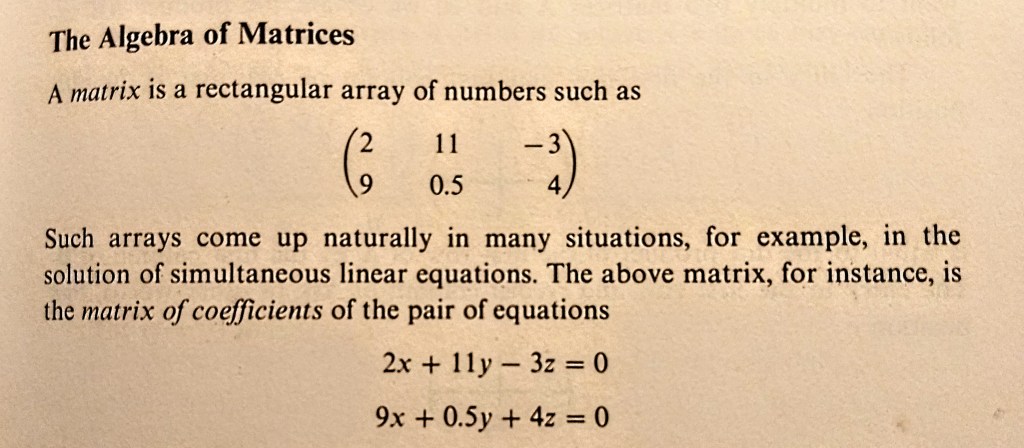
Thus, “modern” algebra is not so very modern, after all! To what extent is it abstract? Well, abstraction is all relative; one person’s abstraction is another person’s bread and butter. The abstract tendency in mathematics is a little like the situation of changing moral codes, or changing tastes in music: What shocks one generation becomes the norm in the next. This has been true throughout the history of mathematics.

For example, 1000 years ago negative numbers were considered to be an outrageous idea. After all, it was said, numbers are for counting: we may have one orange, or two oranges, or no oranges at all; but how can we have minus an orange? The logisticians, or professional calculators, of those days used negative numbers as an aid in their computations; they considered these numbers to be a useful fiction, for if you believe in them then every linear equation ax + b =0 has a solution (namely x = -b/a, provided a 0). Even the great Diophantus once described the solution of 4x + 6 = 2 as an absurd number. The idea of a system of numeration which included negative numbers was far too abstract for many of the learned heads of the tenth century!

A Book of Abstract Algebra, Charles C. Pinter

Although rationally it is accepted that there are tradeoffs in these choices between social interests, we don’t act like we know there are tradeoffs. We don’t do analysis like there are tradeoffs. We don’t approve funding like there are tradeoffs. There simply doesn’t appear to be an acceptance of the abstract concept that the allocations of time and resources function as an economy and not a charity.

Housing as a system not a product

I’m really looking forward to this paper, “The Effect of New Market-Rate Housing Construction on the Low-Income Housing Market”, by Evan Mast. Here’s the abstract:

I illustrate how new market-rate construction loosens the market for lower-quality housing through a series of moves. First, I use address history data to identify 52,000 residents of new multifamily buildings in large cities, their previous address, the current residents of those addresses, and so on for six rounds. The sequence quickly reaches units in below-median income neighborhoods, which account for nearly 40 percent of the sixth round, and similar patterns appear for neighborhoods in the bottom quintile of income or percent white. Next, I use a simple simulation model to roughly quantify these migratory connections under a range of assumptions. Constructing a new market-rate building that houses 100 people ultimately leads 45 to 70 people to move out of below-median income neighborhoods, with most of the effect occurring within three years. These results suggest that the migration ripple effects of new housing will affect a wide spectrum of neighborhoods and loosen the low-income housing market.

I checked at the Hennepin County Library, my resource for such things, only to notice on the National Affairs posting says that it is forthcoming in the Journal of Urban Affairs.

What is exciting about the author’s approach is that it illuminates the idea of housing, not as a one time purchase product, but as a system through which people cycle over the course of time. You would no longer have any interest in your student housing, for instance, but it was entirely adequate at the time you lived there.

To look at housing as a system acknowledges that people have different housing needs at different stages of life. Migration is a positive activity, to achieve better circumstances. This counteracts the politically popular concept of “building affordable housing” which is an oxymoron as new construction is the most expensive form of housing.

With this understanding of a system, the efforts to improve people’s lives maybe implemented at each stage by matching them to the community which offers the best support for their interests. By viewing housing as a system of placement within a community, more people can become community workers, and traders of services which benefit the group.

Thinking of our foreign service families in Afghanistan

If you’ve been away from the news lately, there is a tragedy unfolding in Afghanistan. Below is a summary of the events leading up to the situation in Kabul.

It was a preferred posting for U.S. diplomats until 1979 when Amb. Adolph Dubs was kidnapped then killed by pro-Soviet police. The Peace Corps & USAID were sent home, and the U.S. mission greatly diminished to just dozens of people.

https://smallwarsjournal.com/jrnl/art/the-day-embassy-kabul-forever-changed

(2/11)

Ten months later, when the Soviets invaded Afghanistan, the embassy was reduced to being a โ€œlistening and reporting post.โ€ On Jan 31, 1989, with the Soviets gone and civil war imminent, it was evacuated on newly-sworn-in SecState Bakerโ€™s order.

https://www.washingtonpost.com/archive/politics/1989/01/27/us-embassy-in-kabul-to-be-evacuated-closed/b6b168c0-0931-4058-9d37-93ca39bd5e6d/?no_nav=true

(3/11)

That day, Marine Sec Guard James Blake left in the chancery a note with a U.S. flag. It read: โ€œTake care of it. For those of us here, it means a lot; for those of you yet to enter Kabul, it could mean a lot to you. We Kabul marines endured, as I'm sure you will.''

(4/11)

For 12 years, 60 Afghan colleagues took turns watching and taking care of the embassy grounds. They tended to the gardens and ensured the chancery was left alone. They were frequently jailed and rocketed. (More in this @amywaldman @nytimes story)

https://www.nytimes.com/2001/12/18/world/a-nation-challenged-kabul-unsealing-time-capsule-at-the-american-embassy.html?referringSource=articleShare

(5/11)

In Oct 2001, the Taliban tried to break into the chancery, firing into the front doors' bullet-proof glass, but they never got inside. After the Taliban fell, Marines entered the chancery again and found a place frozen in time — and the flag and note from Blake.

(6/11)

That flag was raised at the Dec. 18, 2001 embassy re-opening. I was sworn in at the same flagpole two years later. Some of my colleagues had also served in the 70s & 80s, eager to return to Afghanistan, to do all possible for a new U.S. diplomatic and development mission

(7/11)

We worked grueling hours, driven by a deep belief that our work was essential, buoyed by so many gains, even though the bullet-ridden chancery front doors reminded us of the Taliban threat. The embassy grew dramatically in capacity and size the next decade.

(8/11)

In 2003, we were roughly 100 ppl. By 2010, with the civilian surge, it swelled to roughly 1,500. Thousands of Americans have served at this embassy. Many colleagues served repeated tours the last 15 years, by choice. Thousands of Afghans have worked side by side with us.

(9/11)

I can't imagine the stress at the embassy today. I can't imagine the terror our Afghan friends, colleagues who believed in us, watched over us & our sacred embassy space must feel. That flag has meant everything to us. Please keep thinking of them, thank them, don't forget them

#EvacuateNow

A clarification. The U.S. must get our Afghan colleagues and allies out. The mission the last 20 yrs wouldโ€™ve been nothing without them. #EvacuateNow = everyone: the U.S. officials, yes โ€” but also scores of Afghans who supported the U.S. mission needing SIVs

And Afghans needing other emergency visas because of their commitment to advancing democracy & civil society through journalism, NGOs, human rights, more. Them & their families. Grateful to former colleagues trying to make this happen #AfghanLivesMatter
#SaveAfghans #HelpAfghans

Originally tweeted by Katherine Brown (@_KatherineBrown) on August 15, 2021.

Choosing is part of the deal

When we travel, I’m usually the one who figures out all the logistics. A direct flight to a not so distant destination is easy to plan. After weighing the various departure times and prices, and taking into account the shuttle service to the hotel or condo, the choice is relatively apparent. The type of trip can add considerations, like a ski trip includes extra luggage and a drive up to the ski hill.

Juggling a more complicated journey with multiple flights and modes of transport, requires further evaluation. This is especially true if you are toting along your kids whose complaints from discomfort can grate on you like finger nails on a chalkboard. So the analysis then insures extras like timely food availability and total travel time.

I’ve been having quite a time finding viable air travel to Kauai for our trip over the Thanksgiving holidays. I’m not sure how far west you have to go before Hawaii becomes a popular sunny destination. But Minnesotans generally go south to places like Cabo or Cancun, the Dominican or Costa Rica. It is even much easier to fly to Europe than to Hawaii. As a result the connections to the Aloha State are either quite irregular or considerably more expensive.

At every thought of my offsprings’ (and spouse’s) objections to waiting out layovers in the likes of Phoenix or Las Vegas, the dollars I was willing to spend for one versus two connections kept mounting. Then it occurred to me that they really needed to be in on the choosing. Since all the choices are middling to poor, we would have a more favorable experience if everyone decided on the deal.

It’s so easy to take something on and make the decisions. But to deny others the overview of choices is to deny them the ability to process two layovers and fourteen hours of travel. If the choice is made for them, and all the choices are subpar, then they will be dissatisfied no matter what.

It is similarly easy for elites, or politicians, or heads of non-profits to make choices for the vulnerable people they serve. Many times these choices are from a selection of far from ideal circumstances. But when the recipients are denied the ability to make a choice, they are denied the practicality of seeing how the result is still incrementally better than another option.

North by Northwest- a Movie Review

I finally was able to talk my husband into watching a classic film with me, and it was a success. Hitchcock’s unparalleled skill at maintaining suspense throughout the two hour tale proved to my spouse that old can be good, very good indeed.

You do have to overlook (or maybe find endearing) the painted scene backgrounds and the dubbed in film running in the windows of a taxi in motion. The music however is delightful and enhances the mysterious mood. But the caliber of photographic images captured by the camera lens throughout the movie are exemplar.

Cary Grant is of course a dream. Eve Marie Saint treads along that fine line of goddess-like blond and the self-sufficient female. It’s not surprising she won best supporting actress for the role. It was also delightful that she was not the solo female amongst a bevy of strapping men. The mother of Grant’s character is quite a character herself, and there is grumpy German housekeeper to boot.

I loved all the iconic 50’s (the film was produced in 1959) architecture. There are plenty of floor to ceiling windows, wood beaming and stone facades. The UN building’s oblique skyscape is instantly recognizable. But the barebone gravel road infrastructure in rural Indiana was a good reminder of how much has been built in the last half a century.

Hitchcock the master story teller outdid himself. The film is a work of art.

There’s no ‘i’ in housework

Aussie household are in turmoil after their census included this simple request.

โ€œIn the last week did the person spend time doing unpaid domestic work for their household?โ€ the ABS asked.

Perth Now

I mean seriously, is there a better dog whistle to get couples yapping at each other over the perennial debate about who does what around the house?

โ€œInclude all housework, food/drink preparation and clean-up, laundry, gardening, home maintenance and repairs, household shopping and finance management.

The ABS asked Australians to estimate the amount of hours theyโ€™d spent on such unpaid work, offering five options ranging from none to more than 30 hours.

Social media was alight with debates on who gets credit for what in the ongoing partnership of domesticity. But I question if sorting by individual is more useful to a national government than sorting by household.

Call me nostalgic but I remember when people used to comment: “The Johnsons, they do so much for the community.” There was a time when couples were considered as a unit. And when you think about such things as unpaid work, a longer time frame, one that would allow each person to perform different duties at different times, makes more sense.

I know of several men, now in the twilight years of life, who were completely preoccupied with work-for-money jobs in their younger years, but are now fulltime caregivers to their spouses. There was a time when they would have been disdained for doing nothing within the household. Now they devote a majority of their time to enabling their household to stay together.

From the government’s point of view I would think this is the interesting unit of analysis: the household. How much time in unpaid labor is required to nourish a household? to educate, to retain good health, to keep in secure mental balance? These household averages could be quite useful.

Instead the census question seems to be provoking some fudging of the numbers.

Since last night, there have been countless reports of family rows over who spends the most time on chores โ€” from who does the bulk of the cooking to whether putting your own dishes away can be used to bump up your โ€œunpaid employmentโ€ tally.

But maybe more importantly it reinforces the ‘i’ in an arrangement that is about the ‘we.’

Neither a borrower nor a lender be~

In Shakespeare’s Hamlet, Polonius instructs his son not to get involved in the borrowing or lending of money from friends. This bit of advice has given commercial banks and credit unions a bit of a boost in fulfilling the need for third party credit. Which in turn provided me with one of my first jobs as a lender behind a banker’s desk in the lobby of a local bank.

Back some three decades ago, before electronic magic of all sorts, we used to take applications by handwriting the information into neat little squares on a paper application form. Whether the applicant sat across the oversized dark wood desk or we talked over the phone, the interaction also served as a time to discuss the customer’s ambitions, the time frames and mechanics of the process. This was something called customer service.

The bank advertised car loans and home equity loans, reserves on checking accounts that would advance when the account was overdrawn, or unsecured lines of credit. Over the course of a week it wasn’t uncommon to look at 80-120 applications. These required information on employment history, wages and asset and liabilities statements. So as you can imagine, one starts to get a sense of the earning potential from a variety of employments. And where people spent their money.

Having been raised in a private school type of environment, I was unfamiliar with the whole segment of society that fell outside the professional class. Socially I was only familiar with families whose parents earned a living as a result of a higher level of education. And, of course, was steered to going to college to attain a similar standing. Imagine my surprise when I took an application from the service manager at a midsized car dealership in town. He earned twice what the average attorney made.

Granted this was during an era when there were an abundance of attorneys achieving their Juris Doctor. But still. A service manger, or any one wielding a wrench under a vehicle was not suppose to rise even to the lower edge of the white color professional crowd. This was the first crack in the veneer encasing an implied class and resource structure.

Come to find out there were whole neighborhoods of folks who worked in the trades at all sorts of income levels. They didn’t drive jaguars, they drove trucks with carried similar price tags. Their hunting dogs needed kennels so they lived in cities that were not only pet friendly, but didn’t mind a fifth wheel parked on the concrete pad along side the oversized double garage which was sheet rocked, heated and had a TV sitting area.

I had no idea of the social depth or financial variation of such folk. They weren’t simply a group, a class. They were a whole ecosystem with pecking orders and special interest subtleties.

Two Races

I SEEK not what his soul desires. 
  He dreads not what my spirit fears. 
Our Heavens have shown us separate fires. 
  Our dooms have dealt us differing years.
Our daysprings and our timeless dead 
  Ordained for us and still control 
Lives sundered at the fountain-head, 
  And distant, now, as Pole from Pole.
Yet, dwelling thus, these worlds apart, 
  When we encounter each is free 
To bare that larger, liberal heart 
  Our kin and neighbours seldom see.
(Custom and code compared in jest-- 
  Weakness delivered without shame-- 
And certain common sins confessed 
  Which all men know, and none dare blame.)
E'en so it is, and well content 
  It should be so a moment's space, 
Each finds the other excellent, 
  And--runs to follow his own race!

by Rudyard Kipling

When math is not your friend

Let’s say everything in your life, that was summed up by numbers, did not add up in your favor. It would be like being on the team that always had to be the good sport and loose to all the other teams. At first the players might simply be happy to be on a team, out practicing and attending games. But then the scores keep starkly representing the loosing side, and it is harder and harder to keep up moral.

Or maybe you’ve tried to learn the game of golf. There’s the mulligan on the tee off shot. Then you loose your ball in the long grass. Ooops– one plops in the stream cutting across the fairway (after a dramatic twelve foot bounce off the boulder rip rap). As you approach the green there’s hope for a two put finish. But it is not to be. A couple of chip shots over and back. But who’s keeping score anyway?

Now what if everything in your life was like that. Your parents struggled when the numbers didn’t add up in their favor when it was time to pay the monthly bills. There was concern at school when the numerical representation was not favorable for your school work. How do you think you would feel about math?

Math shouldn’t be out of reach for so many of our students. God’s gifts are sprinkled around throughout a population and not divvied up by socio economic designations. If a whole group is coming up short of math majors we should really try to figure out why. It will effect their whole lives. It will make our educational system subject to the grifters who filter in when there is demand for a service and yet no supply.

Rain Day

A clap of thunder around 6am this morning was a welcome sound as we have had an incredibly dry summer. The drops on the roof seemed like a foreign sound and when they petered out after only a brief prelude, I was quickly disappointed. But the clouds circled back upon themselves and wrung out a nice soaking. I sat on my front porch under the overhang just to enjoy the clatter.

When the rain let up around noon I made a trip to the nursery, bought a few new plants and went to work. If soil is dry it turns to concrete. No point in tugging on weeds as the stems break leaving the roots in the ground. A moist soil is much more cooperative. So out went the weeds and in went some blue stem prairie grasses and a red leafed spirea shrub. Some variegated hosta were split and some burgundy glow ajuga moved to a high traffic spot.

Was Rome’s expansion due to an understanding of platters?

My most underrated source of interesting books come from estate sales. You never know what you might come across, which is part of the fun of it. But you can be sure to see books that are not on the front tables at the bookstores. And you can actually stand there as long as you want sifting through them creating two piles: ‘maybe’ and ‘definitely.’

It’s a treat to come across a collection of philosophy books. Partly because people’s shelves often hold various genres of novels, but fewer homes house books on thoughts. I brought home a bundle a few weekends ago which included a Cornell University Press soft cover on the expansion of Rome. Chester G. Starr Jr notes:

If we are to understand the significance of Roman history and the reasons for the expansion of Rome, it is worth stop ping a moment to investigate this Roman character, as revealed in traditions and in religious beliefs. The traditions, which were preserved mainly in the family and so passed from father to son for generations, were often tied intimately with landmarks about the city; points such as the Tarpeian Rock, the Lake of Curtius, the Sister’s Beam, and others each had its tale pointing some patriotic virtue. Together, these traditions reveal a patriotic people who were above all else obedient to established, legal authority–the family, the state, and the gods.

The Emergence of Rome, As Ruler of the Western World by Chester G Start, Jr

When writers use the word tradition in this setting I really think they are referring to the work of the family, which ends up being in large part the work of women. The guys are off leading, soldiering or earning money. The women are maintaining the traditions. But note how clearly the groupings by mutual objectives are stated: family, state and gods.

Did the Romans understand better than anyone in their day that each of these obligations created an economic ecosystem or platter? That the mission of Rome could be an overarching ambition which left the families and their local cities free to pursue their priorities?

It appears that the Romans expanded across territories with a clear deal on the wind. Give us a few of your good men and you will be protected under the umbrella of the Empire. Other than that, we won’t tax you and you are free to go about your business.

As they advanced, the Romans opened up roads along strategic routes and established colonies of Roman and Latin families as permanent garrisons at key points. Land hunger certainly must not be discounted as a reason for the expansion of Rome; it has been estimated that conquered states on the average lost one-third of their land for the benefit of Roman settlers. Otherwise the defeated were not unduly penalized. They yielded control of their foreign affairs, they entered a permanent alliance with Rome by which they agreed to furnish a set number of men to the Roman army, but they paid no taxes and retained autonomy in their local affairs.

Furthermore the Roman infrastructure of roads, bridges and aquafers benefited the general public. The Romans understood how to give in public goods so that could gain what their warring faction desired, an army of the most physically able. A balance of exchange was struck between the multiple groupings of the public and the private.

Circus Maximus, Rome

Paul Erdos~ couch surfing problem solver

Paul Erdos was of my grandmother’s generation, born in the same year, 1913, yet half a world away in Budapest, Austria-Hungary. His genius revealed itself early on. “By the time he was 20, he had found a proof forย Chebyshev’s theorem.[14]ย In 1934, at the age of 21, he was awarded a doctorate in mathematics.”

Erdล‘s published around 1,500 mathematical papers during his lifetime, a figure that remains unsurpassed.[6]ย He firmly believed mathematics to be a social activity, living an itinerant lifestyle with the sole purpose of writing mathematical papers with other mathematicians. Erdล‘s’s prolific output with co-authors prompted the creation of theย Erdล‘s number, the number of steps in the shortest path between a mathematician and Erdล‘s in terms of co-authorships.

https://en.wikipedia.org/wiki/Paul_Erd%C5%91s

Paul Erdos committed his life almost exclusively to the mathematics community. For his own reasons he chose not to have a family of his own. Although allowed to travel at will to his country of birth, he chose not to settle there, (until his death as he buried next to his parents “in grave 17A-6-29 atย Kozma Street Cemeteryย inย Budapest.”)

… Paul Erdล‘s, became perhaps the most notorious mathematician of the 20th century. Erdล‘s spent nearly his entire life crashing on other mathematiciansโ€™ couches and subsisting on the small sums he received for giving talks at universities around the world. He also had a fondness for devising math problems and offering bounties to anyone who could solve them.

https://www.quantamagazine.org/cash-for-math-the-erdos-prizes-live-on-20170605/

So dedicated to his pursuit of mathematics, he used cash prizes to lure others into joining him in its unraveling. By providing a private incentive he wished to enrich the public he enjoyed so much. His prizes still survive today.

Erdล‘s continued that tradition. Over the course of his lifetime he offered rewards for hundreds of problems that he himself dreamed up. Amounts ranged from $25 into the thousands, depending on how challenging he thought the problem was. Today Graham controls a small fund left by Erdล‘s, who died in 1996, for the purpose of making good on those bounties.

In 1974 Erdล‘s paid off his first major sum: $1,000 to the Hungarian mathematician Endre Szemerรฉdi for a problem Erdล‘s had posed some years earlier. Szemerรฉdi tackled the problem because โ€œhe said he could certainly use the money,โ€ said Graham. Decades later Szemerรฉdi would win the Abel Prize, commonly regarded as the Nobel of mathematics, for work that stemmed primarily from his solution to this Erdล‘s problem.

https://www.quantamagazine.org/cash-for-math-the-erdos-prizes-live-on-20170605/

For most people, their primary or first degree community is their immediate family; those housed under the same roof. This mathematician cared not for real estate. His community thrived on the images of abstract notions brought down to earth in formulaic representation, sketched out on paper.

In full disclosure of the Bees

The real estate market has been moving so fast and furious lately that some buyers are opting to waive the right to have an inspection on the home. This way the seller knows the negotiations are done once the papers are signed. A couple out in Pennsylvania also forewent an inspection when they came across a hard to find parcel in their preferred school district.

Weaver bought the 1872 farmhouse in Skippack, about 30 miles northwest of Philadelphia, in December and told CNN the seller’s disclosure mentioned there were bees in the wall. But since the couple bought the home in the winter, she said the bees didn’t seem to pose much of a threat at the time of purchase.

“On the seller’s disclosure it said ‘bees in wall’ and that was it and I think because one, we didn’t see them and two, we were just so floored that we actually found land in the (school) district that was within our price range that I didn’t really ask any questions about those bees. I didn’t think it would be that big of an issue. It didn’t even cross my mind but when spring arrived that’s when we started to see them.”

https://www.cnn.com/2021/08/02/us/pennsylvania-honeybee-removal-trnd/index.html

The seller is obliged to disclose. If you are in doubt whether to mention the bat you found on your front stoop, write it down. It can’t hurt. The buyer is obliged to investigate any concerns prior to writing their offer, or during an inspection contingency. It is better for everyone to know what is exchanging hands.

In this case the package included 450,000 bees which had created a home for themselves within the wall framing over a thirty-five year period. It’s not uncommon to see a bee around the ridges of clapboard siding or hovering at the soffits, selecting a site for a hive. Perhaps that is what came to mind for these buyers. (Although it is hard to see how they missed the honey dripping down the wallpaper inside.)

In any event we need the bees! And it is great they were able to find a professional who knew what to do.

Over the span of a week, Lattanzi removed each and every tile on the portion of the home the bees occupied, treading carefully to not harm the bees and find the queen, which he found Friday.

I like to plants flowers to promote the bee population. They seem to like my tea roses the best.

Tunnels in Norway

Subterranean roundabout– Norway

A few years ago we visited Norway as a family, retracing a few familial heritage sites. It was great fun as we had done a similar trip some forty years earlier. This time we were working off research my cousin had done through Ancestry.com and thus had honed in on additional family farms throughout the Oslo to Bergen area.

One memory from stepping off the plane back in the 70’s was that all the kids were blond and tall like me. After living much of my childhood in Asia and Africa, this was delightful. Similarly, on the more recent trip I kept having feelings of deja vu, when the waitress was slightly sarcastic like my cousin or the viking haired checkout guy nodded and chuckled in repressed good humor. Returning to an ancestral home can be a reflection back upon one’s self and one’s family. For me there was undeniable comfort in my surroundings.

Back when my ancestors left the country in the mid 1850’s most all travel was through the fjord system as the mountainous landscape makes for difficult road construction. The ferry system is still a significant player in the transportation infrastructure as it was in the 70’s. We drove along narrow roads with stunning vistas across fog filled fjords. But there are many more tunnels through the mountains now. In fact Norway boasts the longest tunnel in the world.

At an astonishing 15 miles (24.5 km) long, the Lรฆrdal Tunnel is the worldโ€™s longest. Costing 1 billion Norwegian kroner to build (that’s about USD $110 million) the tunnel connects the small communities ofย Lรฆrdalย and Aurland.

Its design is admired all around the world, as it incorporates features to help manage the mental strain on drivers. Every 6km there is a cave to separate sections of road.ย The lighting varies throughout the tunnel and caves to break routine and provide a varied view.

https://www.lifeinnorway.net/norway-facts/

Public good pricing by personality

Public goods affect the price of housing– but not always in the same way. Here’s a list of the good and its special influence.

Most mercurial: crime. Public safety is a clear deal breaker for consumers. If residents fear for their personal safety, they will move. News of this nature travels fast. And the result is that people react quickly with an inverse correlation to price.

The master delineated: school districts. The influence of public goods can hang loosely around an area, such as the effects of being near an arts district. But the opposite is true when it comes to school districts. The home is either in or out. The selection of schools makes for bold dividers in the search for homes.

Uniformly utilitarian: transportation infrastructure. Commuting distance to work and distance from family and/or support groups is very much a part of the home selection process. So time to and from major employment hubs effects pricing, as well as marketability in a downturn markets. But people are not passionate about transportation, it doesn’t bring forth a feeling of any sort. It is simply a useful fact of daily life.

The most hidden: status. People don’t like to admit it’s part of the deal. It is communicated in hushed tones that so and so politician raised his family one street over, three houses up. The name of a famous writer who own the book store in the quaint brick store front across from the park and elementary school slips into the conversation. Status is made known in an understated yet clearly revealed parlance.

The most emotional: historical districts.

Most long lasting: parks. Once parks are made part of the city grid they are there to be enjoyed for generations. Nature in its wisdom is seasonally consistent with it lessons of growth and beauty, change and renewal.

Romancing Infrastructure

City Union Bridge spanning the River Clyde, Glasgow, Scotland

River Clyde

The Glasgow people do take pride
In their river both deep and wide,
In early times the youth and maid
Did o’er its shallow waters wade.

But city money did not grudge,
And dug it deep with the steam dredge,
And now proudly on its bosom floats
The mighty ships and great steamboats.

No wonder citizens take pride
For they themselves have made the Clyde,
Great and navigable river,
Where huge fleets will float forever.

Dunbarton’s loftyย castleย rock
Which oft’ has stood theย battle’s shock,
The river it doth boldly guard,
So industry may reap reward.

But more protection still they deem
Is yet required so down the stream
Strong batteries are erected,
So commerce may be safe protected.

Old ocean now he doth take pride
To see upon his bosom ride
The commerce of his youngest bride,
The fair and lovely charming Clyde.

James Mcintyre

Stories with Family Trees

A millennial in our family is a natural story teller. He captures the room, and doesn’t disappoint. The yarn maybe local or from abroad, it may include self-ridicule and human foibles, but it will always tease out laughter from the crowd. There are the words of course, but the delivery is timed, the pauses on point, the gestures and facial animation delightful.

He’s not one of those center-of-attention people either. The ones who propel themselves forward on a wave of egocentricity. So I was a little surprised when he started ribbing his dad over his style of narration. “It’s just that you and R always dive deep into the whole relations thing. This person was related to that, then they were divorced, and those two are second cousins to this that and WHATEVER.”

“Get to the story,” the middle aged man lamented. What’s the purpose of all these relations?

His father and uncle would mull, hesitate and then correct themselves as they identified each individual, who happened into their story, by clan. And quite often there was an off-shooting telling of why they lived on this farm and no longer lived on that one, or who they were married to way back when.

This wasn’t Christmas after all, so why replicate Matthew, Chapter 1?

For people like his uncle, who had lived his entire life in a community, knowing the relations is part of the story. It fills in an understanding that otherwise leaves questions unanswered. It tallies up and equals out exchanges that only make sense against a backdrop of community history.

The urban youth has no sense of such lingering ties, except perhaps in his own immediate family. But to live in a small town is to carry a ledger of chits and repayments.

Which real estate technology companies will survive?

The following infographic compares total venture funding in Real Estate Technology to the number of companies in each category. ย Which Real Estate Technology categories do you think have the most traction and potential for growth? At Venture Scanner, we are currently tracking over 642 Real Estate Technology companies in 9 categories across 46 countries, with a total of $9.5 Billion in funding. To see the full list of 642 Real Estate Technology companies, contact us using the form on http://www.venturescanner.com.

Venture Scanner

Since Zillow and Trulia became part of the real estate experience over a decade ago there has been an onslaught of technology companies attempting to disrupt the business.

Yet realtors and clients are, for the most part, going through the same processes in a move as they did in generations past. Was technology more about how information is delivered than about a new means of moving (in the purchase and sale of real estate)? Is technology providing a means of communicating and marketing instead of fundamentally changing the real estate transaction?

Maybe more on point is which of these technology companies will survive by providing a superior service and which will go to the wayside.

Chaucer’s henpecked husbands

The husbands portrayed by Chaucer are uniformly unromantic and pathetically unheroic. Rarely in literature have males been so roundly ridiculed, so easily cajoled, and so blandly cuckolded. Chaucer’s married men are regularly henpecked, humiliated, beaten, betrayed, and exhibited as objects of defenseless servility. In a few rare instances-“The Knight’s Tale” and “The Franklin’s Tale” are two of them-Chaucer allows that marriage and love can flourish in the same bed. But the poor husband is at peace only if he relinquishes the role of master and remains a servant to his termagant spouse.

Lives of the Poet’s, Louis Untermeyer

Apparently the macho male, master of his family, is a more modern creation. From the 1300’s to today, something changed in the power structure of marriage. Domestic power in the Middle Ages swilled around the women. And Chaucer didn’t mince words on how its influence appeared in the fairer sex.

Women as women, however-and, in particular, women as wives were terrible realities. They were not merely shrewish but shameless, garrulous, greedy, disloyal, and licentious. Worse, they were united in an un written but universally recognized conspiracy to subject their husbands to every possible indignity. The husband of Philippa cannot be definitely identified with the creator of The Canterbury Tales, but it is unlikely that a happily married author would speak so scurrilously of the marital state and take obvious pleasure in so many humiliating incidents, grimly detailing the triumphs ofSo wifehood and the ignominious capitulation of the woman’s miserable partner.

In the 600 years since Chaucer is thought to have wrote The Canterbury Tales (around 1380) household power dynamics made a mighty shift. Now that women have come back into their own, maybe it’s time to be on the watch once again for the hen pecked husbands.

Miguel- painter extraordinaire

Our 33 year old home needed a complete repaint. We had painters out over the years to paint south and east side. I’d tackled the bits in the front around the brick facia. But a color change and some wood repair were in order.

This wasn’t the first year the birds had hollowed out one of the old knots in the cedar siding to nestle in a hatch of their young. The downy woodpeckers had interrupted my work day last fall and would only fly away to the nearest branches when I leaned out the window and banged on the wood.

This spring brought new visitors. Squirrels leapt from our ash tree to the roof and pried open a bit of the bargeboard to let themselves in. “That’s it!” I declared to my husband, “there are more critters living in our siding than people under this roof.” Finally, I had won the argument.

Diligently I called out three painting contractors, walked the perimeter of the home with them discussing color change, no color change and all that is paint related. The bids came in and, as often is true, there was a fair span in the numbers. The one we chose was the most economical but, perhaps more importantly, they were the only ones who did wood repair in house.

After a bit of a wait (three months- there is a shortage of workers in our fair metropolitan area) Miguel appears as a one man show. He has an extensive collection of aluminum ladders. His supplies and tools are neatly laid out on tarps. And he’s got a little paint splattered radio that belts out classic rock.

Now our house is two story on the street side dropping to two and a half in the back. I’ve been up on a ladder only three quarters of the way up, feeling sway of the rungs as I progress upward, the earie nothingness of being up in the air. Not Miguel. He’s moving up and down those metallic stepper machines. There’s at least three of them leaning against the house at any one time.

It was not always peace and Orlando and Dawn, however. One morning he I could hear the ladder knocking the side of our home as I imagine he was struggling to get the draw cord to extend it upward. “Puta!” he yelled at it more than once. Did I mention he was from Costa Rica?

Much of the time the tunes were drowned out by the pressure washer or the power saw cutting up repair pieces, or the shop vac as he vacuumed up the paint chips from off the landscape rock. The paint sprayer droned away as it coated the whole caulked up, primed over, cedar clapboard encasement. “Twenty-Seven gallons,” he bragged to me, “the wood just kept soaking in the paint!”

The guy was amazing. He was so focused on the task at hand I thought if I interrupted him it might throw his momentum. When he had pretty well wrapped things up he stood back a house away, arms folded, and took in his work from the sidewalk. It did look fantastic.

My brother stopped in from out of town the following week. As he came to the front door, he touched the siding and said, “this is what we need to do, get new siding.” Yes– Miguel had made the whole exterior feel new again.

To be angry at someone

Doesn’t it seem like people prefer to be angry at someone rather than at a situation? People want a person to blame not a set of unfortunate circumstances. There’s a need to create an visage to be on the receiving end of wrath.

Maybe it’s the awful boss instead of a mismatch of work tasks to worker. Maybe it’s the spouse who is irritating rather than an outside stress on a marriage. Maybe it’s the politician instead the vexing insatiability of social needs.

It must be more satisfying to the point the finger at a person, to shake one’s fist at them.

I suppose the desire to embody the frustration in a person, is that it makes for an easy solution. Separate from the person, and voila! the source of the rage is removed. Except it is not.

Placing the burden of anger at a person’s feet the easy. Understanding and seeking solutions to larger problems is complex and denies a quick solution.

Keep your comments to your spheres

This came across my LinkedIn feed today.

A few posts ago I mentioned the necessity to discipline ourselves a bit more before we share our opinions in public spaces.

There’s a time to be outspoken and a time to get along. This sign is requesting a ‘get along’ mindset before entering their building.

Standardized Reporting

There’s an internal posting at our company for local non-profits who are looking for volunteers or resources. Here are the first several entries:

This is one way to get the word out, connecting suppliers with those in demand. I just realized where I can take some left over dog food that I’ve had in the house for a while.

But if I had my druthers, I think it would be useful to have a standardized non-profit snapshot. The information I would like to see as an investor would capture a quantification for the number of hours and dollars flowing through their system. Then it would be nice to see a rating for delivery effectiveness. Some sort of measure representing how much of the time and resources donated goes toward the services accomplished. Then there could also be a few other stats like size of paid workforce, total volunteer hours, length of time in business, service area.

A site connected to a data base with this type of information could be useful to donors and public funders alike.

In fair Verona

It seems like July is vacation month based on the photos spanning Martha’s Vineyard to the Black Hills popping up on social media. Lots of quips about time with the family, delivered with various innuendos. Aspirations of time alone to read proffered as acceptable time off activity.

Personally, I’m dreaming of Northern Italy. Fly into Milan. Check out the fashion culture with my daughter. Find Da Vinci’s Last Supper mural painting at theย refectoryย of the Convent ofย Santa Maria delle Grazie. Relocate to Verona. Bike around Lake Garda. It looks feasible to plan a day hike in the mountains just to the north.

Cap the trip off with a tour of Venice. Check out Piazzo Saint Marco, the bridges, the canals. The art. And reflect in the gold mosaics’ on the Basilica that it was the free flow of people and their goods which are responsible for the still lingering wealth.

The Butterfly

The Butterfly

byย Alice Freeman Palmer

I HOLD you at last in my hand,
โ€” Exquisite child of the air.
Can I ever understand
โ€” How you grew to be so fair?

You came to my linden tree
โ€” To taste its delicious sweet,
I sitting here in the shadow and shine
โ€” Playing around its feet.

Now I hold you fast in my hand,
โ€” You marvelous butterfly,
Till you help me to understand
โ€” The eternal mystery.

From that creeping thing in the dust
โ€” To this shining bliss in the blue!
God give me courage to trust
โ€” I can break my chrysalis too!

Cherishing free speech

As a young adult I couldn’t figure out why my other liberal arts college friends rejected Wal-Mart for the more upscale Target for their basic shopping needs. Prices were better at the first (at least back then) and after living abroad where open air markets and shops with expired grocery items were common, lights, electricity and working refrigeration seemed luxury enough.

I was standing in line for the cash register one evening, after a long day at work, when it became clear. A few customers back in line, a mom taunted her toddler’s bad behavior with something intended to be discipline. Predictably, a wail spewed forth from the chunky cherub who was probably as tired as the rest of us. (It isn’t necessarily the big red carts which roll noiselessly over polished floors that make the bullseye more pleasant.)

Or, most of us have been at a social gathering where a couple simply can not contain the anguish currently residing between them. One throws an upper cut in the form of a small quip. The other gives an eye roll or swallows a guffaw. Their negative energy swills around the party on commentary and off the cuff remarks.

When I was at college we never framed each other up by political orientation. Well– almost never. There were a few jokes at the expense of the president of the Young Republicans (very ardent!). And the sandal wearing, longhaired hippy whose clothes billowed out marijuana odors might have been the butt of a joke or two. But nothing remotely similar to the angst experience on campus prior to Covid.

A mom is free to reprimand her child in public, but I’m not sure it is as productive as waiting until they get back to a quiet one-on-one setting. A couple is free to duke it out at a social gathering, but will find themselves alone with their problems once at home. Students can sign petitions, and march and jeer at the opposing parties. And here, I am sure they are ruining part of the experience that is called college.

All the hoopla around advocating for one’s political opinions has not proven to be all that productive either. If the taking of a knee, the shouting through a bull horn, the waiving of a flag is not advancing the cause, then it’s only being profitable to the petitioner. It’s really a privatization of a public concern.

Freedom of speech is precious and should be cherished. An audience can be receptive to the grifters who use it provocatively, or we can gently suggest a more appropriate place for personal conversations.

Are homes infrastructure?

WASHINGTON (July 15, 2021) โ€“ A top official from the U.S. Department of Housing and Urban Development joined policy experts from the National Association of Realtorsยฎ on Thursday to discuss solutions for the nation’s historic housing supply shortage. The virtual policy forum went in depth on research commissioned by NAR and authored by the Rosen Consulting Group, which found that the U.S. is in the midst of an “underbuilding gap” of around 6 million housing units dating back to 2001. The report,ย Housing is Critical Infrastructure, has taken center stage in national conversations on housing policy, particularly after President Joe Biden last week reiterated his administration’s focus on housing as part of its broader infrastructure push.

https://www.nar.realtor/newsroom/once-in-a-generation-housing-inventory-crisis-in-focus-at-realtor-policy-forum

There is definitely a shortage of homes. Are they infrastructure? By definition infrastructure is a good which is shared by many– and for this reason it is inclined to be a public good. Bridges could all be fee based private goods with a toll booth taking up collection at either end. But they are provided in an open public manner because their nature lends itself to public consumption.

Homes lend themselves to private consumption. Every effort toward public housing has failed. Which leads us to pursue homes in a private goods market. The role of the public is to assist those who find themselves in need, by supplementing their ability to obtain housing in the neighborhoods which provide the greatest access to amenities which match their needs. Hopefully, with the long term goal of self sufficiency.

As far as the public’s role in fanning the coals on housing production, that is done by rolling back restrictions and costs involved in the home building process. The mumbled language of infrastructure and rehabbing unit dances around the two actions which would improve the lives of those without adequate shelter.

The 70’s weren’t all bad

I was showing houses to a couple in the 90’s and the area they were fond of was full of split entry and bi-level homes. Abruptly Mr. Buyer spits out, “Nothing good came out of the 70’s. Not homes, nor music.” Partly he was referring to the floor plans, but the construction materials also had changed quite a bit from the plaster walls and hard wood floors of the 50’s and 60’s. Early sheetrock was not too pretty and plywood in far from hardwood.

Split entry homes have since cycled back into fashion. Pottery Barn helped out with their glossy representations of living spaces with heavy brown beams. These were standard fare in the vaulted living room ceilings of the 70’s. The dark trim thundered back into demand to edge out the new walnut stained floors. Golden oak was put to the door after a long run in the 80’s and 90’s.

I had heard the criticism of the splits before, but that my buyer would trash a decade of music all in one blow. I mean, this was the decade I received an electronic clock radio with flaps that clicked over every minute. It could wake me up for school with a song! Seasons in the Sun crooned non-stop that summer out of that little machine.

We were living abroad when someone brought Elton John records out to us. Who couldn’t like Bennie And The Jets, Rocket Man, Don’t go Breaking My Heart? I think the Boston album with a space ship on the cover was in that care package as well. What was it’s title? It’s More Than A Feeling. I don’t think I heard the Eagles until later that decade, but Hotel California is still a favorite.

By the end of the 70’s ABBA and the BEEGEES had created a whole new sound. Olivia Newton John and John Travolta brought the romantic musical to a new generation. I was in french boarding school at the time and everyone wanted a translation to You’re The One That I Want. I did what I could with the first verse:

I got chills. They’re multiplyin’. And I’m losin’ control. ‘Cause the power you’re supplyin’, it’s electrifyin’!

The words got a little easier after that.

A marketer and a mission

Rodney Smith Jr has appeared in my twitter feed on more than one occasion. His tag line is: Making a difference one lawn at a time. He mows the grass that need to be mowed. A seemingly small thing, to mow a neighbor’s yard. But not only do they benefit, the neighbors benefit too.

I have no way of checking up on Rodney but he has 118K followers and his account reports over 9000 tweets. His posts are similar to the one above. Sometimes there’s a wave from the fortunate homeowner in the vicinity of Huntsville Alabama, his home location.

You might say he is the sales and promotion arm of the institution called neighborliness. There’s a story on every block of the neighbor who shovels the widow’s driveway, or clears the sidewalks before they ice over. Rodney not only has made a name in mowing, he has taken it to a new level. He created a 50 lawn challenge, and his followers are posting up and showing how they are playing along.

Two girls from Kentucky raised enough money for a trailer and advertise as You Mow Girls. A youth from Kansas signed up for the challenge and shows off his new T-Shirt. Another from Mississippi posts a photo of his first lawn. Kids from Oklahoma, South Carolina and Dayton Ohio are also in his feed, and that’s just in the last two days.

This guy is the Starbucks of lawn care. He’s taken a basic necessity and stepped up production across these wonderful United States. He’s connected with workers and their natural inclinations to help out. Rodney is handy enough with social media to show them the recognition that no one asks for, but certainly doesn’t mind getting.

There’s demand out there for more Rodney Smith Jr’s.

Fenced In

Lack of progress is often addressed with the ‘we can do better’ call to action. Things will get better if we just man the boat and check the weather. There is an assumption that everyone is sailing on the same winds. When in fact, there are people in the boat tacking against the wind or dropping the sails completely.

The naysayers can have the best intentions in mind. The naysayers can further the direction of the journey by making others fight for it, define it even further than they had originally considered. The naysayers help refine decisions. But sometimes the naysayer simply sink the ship.

Fences, a play written in 1985, is set in a familial scene where a father naysays his son’s ambitions of becoming a ball player. It didn’t work out so well for him, he reasons, so success will elude his son as well. He will save him the pain. Or will he? Does a father use his power as an adult out of faithfulness to old anguishes, or is he truly acting to cushion his progeny from life’s hardships?

The playwright, August Wilson, doesn’t render judgement.

But anyone who has been around a decade or more knows, to misuse a position of power is to tread away from progress not towards it. In this story, father derails a chance at a football career, so son leaves home and makes good in a military life. You might say he overcame his naysaying father, but at the expense of any further family support through early adulthood. You might say son was better off without them, but at the expense of their greater community.

Wilson, who wrote this Pulitzer prize winner while living in St. Paul, provides more examples of how social exchanges can fence in a family. In business, once the money runs out, no one shows up for work. The business shuts down. In family, chits and obligations can continue to pile up. When left outstanding others must step up to pay the bills. And then possibly others still.

Hedonic approach vs user frequency, which is better?

The paper, Recreational and Resource Economic Values for the Peconic Estuary System, by James J. Opalueh, Thomas Grigalunas, Jerry Diamantides, Marisa Mazzotta, and Robert Johnston was written in 1999 as a study of the value of the Peconic Estuary system on the eastern end of Long Island. They used four methods to estimate value, but let’s compare just the first two: the hedonic pricing method using home values as the dependent variable, and a travel cost study. Here’s their introduction:

I.B. 1. Introduction and Overview


No single method can capture the value of the variety of services provided by the natural assets of the PES. Recognizing the many uses of PES natural resources, we designed and implemented a suite of four non-market valuation studies in order to provide estimates of the value of particular services:


(1) A Property Value study examines the contribution of environmental amenities to the market price of property. Using the Town of Southold as a case study, the Property Value study was designed to measure values of amenities to residents living in the immediate vicinity.


(2) A Travel Cost study uses original survey results to estimate outdoor recreational uses in the PES and the economic value that users have for four, key PES outdoor recreation activities: swimming, boating, fishing, and bird and wildlife viewing. This study also examines the impact that (A) water quality has on the number of trips and the value of swimming and (B) the effect of the catch rate on recreational fishing, important recreational uses of the estuary and activities much affected by water quality and resource abundance.

page 11.

Now this report looks at a fairly significant natural amenity, but isn’t the idea that residents place value on any public open space going to be subject to the same analysis? Whether a park with playground equipment, a lake with a swimming beach or a ravine with hiking trails; all these open spaces are valued both by homeowners who live in close proximity as well as others who come just for a visit.

The first approach the authors use to estimate a value of the public amenity is to calculate the portion of the home sale prices which can be attributed to the proximity of the natural resource. The idea behind the process is, if you could have exactly the same home, how would the value of the home change as it moved away (or toward) the public amenity.

We apply economic methods using the property value (or “hedonic” method) to a database comprised of all Southold real estate transactions in 1996 and GIS parcel coverage data for the town. Briefly, the analysis estimates correlations between property values and levels of valued environmental attributes, including open space.

page 27

Here is a further explanation on how the regression model works:

The Property Value technique is based on the assumption that a relationship exists between the market value of a property, and the characteristics of the property. The Property Value method uses a statistical technique called “multiple regression” to assess the impact of each characteristic on the market value of the property. The technique simultaneously compares a large number of properties with different prices and different levels of each characteristic. The method establishes which characteristics are associated with higher values, which are associated with lower values, and which have no significant impact on values. The model also estimates the dollar magnitude of these impacts–that is, it estimates how large an impact is likely to be caused by a specific level of a specific characteristic. Using this technique, the impact of different environmental amenities on nearby property values can be estimated.4 The technical details of the property value model (or hedonic technique) are presented in Appendix A.

page 16

Please read further through their paper for the statistical details, but what I would like to focus on is the equity, or capital, which is captured in each home due to its association with a public amenity. Buyers and sellers in a well functioning marketplace are bidding on the homes and thus determining what the market will bare for this infrastructure (not sure why it is considered a non-market approach). There is a premium in the offer price for greater access, hence they are pricing out the desirability of the public good.

In addition to what the authors derive as dollar figures for the market value retained by residential properties, they also note that there is value to people who use the estuary from a distance. This value is derived by a second process in step two. It is done by estimating number of visits, or trips made to use the open space. In a sense it is a user fee estimation.

I think they go awry by shifting from a capital perspective to a user perspective. We pay our water bills on a user based system but that does not represent the value of having the pipes in place to pump fresh water to all residents. And certainly metro user fees do not equate with the cost of installing mass transit. Analyzing visits more appropriately syncs with management issues such as how many lifeguards to have on duty, how often the trash bins need to be emptied and so on.

I offer a platter perspective for the inclusion of the value to the greater public who use the estuary. The residents adjacent to the estuary, who enjoy a view over an open space and a walking trail out their back yard, enjoy one level of access. The group of people who live in the local town have another relationship. And people who visit from across the county may derive yet another coefficient in front of the data which represents access to natural amenities within their reach.

At each level exists in an eco system- or platter– and a data set representative of the value of these public goods.

Sludge Audit

Far and away the biggest obstacle blocking first time buyers from owing a home is fear. There are two types. Fear of the house. And fear of a poor decision.

The purchase of a home is one of the bigger commitments the average guy or gal makes in their life. And the product is a large, multifaceted, multi-mechanical type of a thing. Most people lack a thorough understanding of all that exists behind the sheetrock walls, the workings of the appliances or what exactly is, or is not, connected at the street.

But sign the papers they do. Nod at the inspector as he or she prattles off a variety of flaws in the property. It isn’t any specific understanding of a home that makes buyers secure in knowing everything will be alright. It’s that they most probably have parents and siblings who own a homes, and since they do it– hey it can be done!

When you don’t have that family background of assurances, you don’t have that same sense of security about the whole thing. If a landlord was always the one to fix something, or a management company ‘sent someone over’ then a whole bunch of conversations about ‘what do we do when this happens’, ‘what’s the best way to handle things when that happens,’ and ‘good grief we don’t call a plumber for that, do you now how expensive they are?” went missing.

And if you’ve never eavesdropped on such an analysis, then fear fills up and grows in this void, the void left by not knowing who exactly to call when this beast of a thing called a house has an issue.

Then there is fear number two. The fear of making the wrong choice and having everyone else in on the mistake besides you! For some reason there is frequently a large audience in on home buying conversations. Said audience has plenty of opinions, even when they themselves have not been in the market for over a decade. And these are generously and gratuitously provided.

Many buyers can get caught up in the moment of an objection presented in a workplace conversation, but after further vetting the issue with other homeowners they often right themselves back to an even keel. Those who have few homeowners within their networks are pressed to gather enough information. They don’t know who to trust. There are disparate levels of confidence.

Although the classic policy response to getting more renters into homes is pecuniary, my sludge audit reveals that it is social, as opposed to financial, support which is lacking.

Home buying and hedonic regressions

Here’s a fun game you can play if you are presently in the market for a home. One could consider a variety of home characteristics, but if you are in the market for a school district, the pricing lines should be very crisp. And you must be in the market for your own family. Speculating on what others will do just isn’t the same.

If you are not familiar with hedonic regressions, it is a mathematical process where given a set of data, which is subjected to an equation built with defining characteristics, the numbers reveal the various levels of importance of each feature. If we are looking at housing prices, the coefficient in front of the school district data will tell how much of the home price was dedicated to that selection.

But you don’t have to be a math geek with access to a bunch of data to come up with a result! I’d say any buyer who is seriously evaluating this choice can shoot from the hip (after looking, bidding and seeing the values the properties commanded at close). Ideally you want to be considering two school districts which both contain similar homes to choose from within their school boundaries– say a 90’s built two story with four bedrooms up and a nice yard for the kids.

Even non-number types of buyers will be able to discern the differences when their money is in play, or their abilities to access other ideal features. School districts can swing a home value price as much as 15%, so on a home of $450K, a $67K difference. That’s noticeable. And consistent opinions about districts, which affect a great number of buyers, filter out in the numbers.

Buyers do not need regression models to calculate the price of other features. The distance to job centers, for instance, or the premium for a prestigious neighborhood. People will pay to be closer to work in order to spend less time in the car. They will also pay for neighborhoods with corner restaurants, quaint historical business crossroads and neighbors with recognizable names. The numbers here are large enough so that no pointy pencil needs to scratch out a calculation.

But there are hundreds of neighborhood features which are priced out in the offer on a home. And many of these could be better understood with the help of a little math.

Robert Louis Stevenson weighs in on Shadows

I have a little shadow that goes in and out with me,
And what can be the use of him is more than I can see.
He is very, very like me from the heels up to the head;
And I see him jump before me, when I jump into my bed.

The funniest thing about him is the way he likes to growโ€”
Not at all like proper children, which is always very slow;
For he sometimes shoots up taller like an india-rubber ball,
And he sometimes gets so little that there’s none of him at all.

He hasn’t got a notion of how children ought to play,
And can only make a fool of me in every sort of way.
He stays so close beside me, he’s a coward you can see;
I’d think shame to stick to nursie as that shadow sticks to me!

One morning, very early, before the sun was up,
I rose and found the shining dew on every buttercup;
But my lazy little shadow, like an arrant sleepy-head,
Had stayed at home behind me and was fast asleep in bed.

Source: The Golden Book of Poetry (1947)

The Quiet American – A review

I happened to pick up this novel by Graham Greene at a recent visit to an estate sale (an excellent source for interesting books). I’m sure my hand fell on it as it reminded me of so many books that floated around my childhood home. Bindings with the likes Le Carre, Mitchener, and Follett printed on the spine, littered our book shelves.

I had read a Greene book before, and enjoyed it, but the fact that I can’t recall its title is proof that it left little more of an impression. This one is a different story. It does not surprise me that BBC News listed The Quiet American in the top 100 most influential novels.

I always like a puzzle, and the first pages tell of a murdered American. But this intrigue quickly falls to the background behind group ambitions. The CIA has its objectives, the British journalist his, the French colonist theirs and the Vietcong their own. Each character acts as one but is representative of many.

And each tells of their domestic obligations. The focal point of this angle of the story is the rivalry for the affections of the beautiful Phuong. Guided by her sister’s advice, the young goddess pursues a marriage contract over loyalty, highlighting the traditional stringent norms of the Brits versus the immature brashness of the Americans.

Post world war two spy novels are one of my favorite genres. They are old fashioned now and carry a very male dominant perspective, but the international settings and inter-country conflicts will always hold my interest.

Mirror, mirror

You know how you feel the same as you did when you were twenty years younger, or thirty-five years younger? The thoughts you carry are often the same, or slightly developed. So this leads us to think our physical appearance, or age, may just as well be the same too. The shock only sets in when, for example, a newscaster on the nightly news looks to be about twelve. That’ll make you straighten up.

This isn’t the only thing in life we fool ourselves about. For some inexplicable reason we all are blinded to many of our own flaws. For that matter we don’t always see our strengths very well either. As good as the mind can be at analysis and observation of others, being frank with ourselves is out of reach.

This can be a problem. Perhaps we don’t realize our potential. Perhaps we pursue the wrong things. Perhaps we get ourselves into trouble by telling ourselves we’re really not doing the things we are in fact doing.

It should be as easy as looking into a mirror. And in a way it can be. Most of you have probably noticed how we carry similar traits as our families. I didn’t grow up in close proximity to my cousins, but when we get together our phrasing can sing out the same tone and emphasis. In addition to physical traits, families carry interactive traits. And in observing these we can fit ourselves into the potential of similar activities. We can learn from it.

So when you see your families tomorrow for your Fourth of July celebration, appreciate that they are all reflecting little mirrors back at you. Take it in. Make the information useful. And thank them for this subtle unobtrusive feedback.

Bayesian understanding and the Bible (speculative)

In probability theory and statisticsBayes’ theorem (alternatively Bayes’ law or Bayes’ rule; recently Bayesโ€“Price theorem[1]:44, 45, 46 and 67), named after the Reverend Thomas Bayes, describes the probability of an event, based on prior knowledge of conditions that might be related to the event.[2] For example, if the risk of developing health problems is known to increase with age, Bayes’ theorem allows the risk to an individual of a known age to be assessed more accurately (by conditioning it on their age) than simply assuming that the individual is typical of the population as a whole.

https://en.wikipedia.org/wiki/Bayes%27_theorem

What the Reverend Thomas Bayes came up with three hundred years ago has proven very useful as it allows predictions for future events based on a history of past events. Later on the concept was formalized by Pierre-Simon La Place as The Central Limit Theorem. Its statistical applications are used widely in medicine, pharmacology and finance.

But that’s not the part I find most interesting.

What we don’t know is Bayes’ philosophical aim in the hours he must have spent whittling away at untruths to reveal what endures. We have more insight into the thoughts of Richard Price, the man who shepherded Bayes’ manuscript to the Royal Society after his friend’s death.

What probably motivated Price to work on Bayesโ€™ manuscript were the theological implications that Price perceived in the result. At this time in his life, Price was deeply immersed in theological and philosophical study. Price notes in Bayes (1763a) that Bayes had written an introduction to the paper; but Price did not include Bayesโ€™ introduction and instead supplied his own. In other manuscripts of Bayes that I have seen (Bellhouse, 2002), Bayes typically gives no motivation for the mathematical results that he presents. The same may be true for his essay on probability. Price only says of Bayes that:


โ€ฆ his design at first in thinking on the
subject of it was, to find out a method
by which we might judge concerning the
probability that an event has to happen,
in given circumstances, upon supposition
that we know nothing concerning it but
that, under the same circumstances, it has
happened a certain number of times, and
failed a certain other number of times. He
adds, that he soon perceived that it would
not be difficult to do thisโ€ฆ .

Later in the introduction to Bayes (1763a), Price states that:


Every judicious person will be sensible
that the problem now mentioned is by no
means merely a curious speculation in the
doctrine of chances, but necessary to be
solved in order to a sure foundation for all
our reasonings concerning past factsโ€ฆ .

Further on in the paper, after discussing de Moivreโ€™s work, Price states:


The purpose I mean is, to shew what reason
we have for believing that there are in the
constitution of things fixt laws according to
which events happen, and that, therefore,
the frame of the world must be the effect of
wisdom and power of an intelligent cause;
and thus to confirm the argument taken from
final causes for the existence of the Deity.


What motivated Price to work on this paper was that to him the result provided a proof of the existence of God. Price came back to this theme in his theological work Four Dissertations (Price, 1767), which is mentioned by Morgan in the context of refuting Hume. A discussion of Priceโ€™s argument was given by Thomas (1977, pages 133 and 134).

The Reverend Thomas Bayes DR Bellhouse

Both Thomas Bayes and Richard Price were ministers and thus it is safe to assume they found truth in the teachings of Christianity. We might even speculate further that Bayes’ was trying his hand at a logical representation of the existence of the Holy Spirit among men; that Christians should trust one another to act in the ways of Jesus without the need for an immediate tally of deeds done.

For instance, consider a case of twelve neighbors living along a road; one might go to the effort of picking up the stray garbage; one neighbor may call the police at the sight of an intruder; one might petition the town to install a stop sign for safety. It really doesn’t matter which neighbor did which deed in consideration of the benefits to the street.

Such acknowledgements of individual skills, yet participation toward the work of a group, also appear in the Bible. Consider the passage in first Corinthians, Chapter 12 (King James Bible)

1 Now concerning spiritual gifts, brethren, I would not have you
ignorant.

2 Ye know that ye were Gentiles, carried away unto these dumb idols,
even as ye were led.

3 Wherefore I give you to understand, that no man speaking by the
Spirit of God calleth Jesus accursed: and that no man can say that
Jesus is the Lord, but by the Holy Ghost.

4 Now there are diversities of gifts, but the same Spirit.

5 And there are differences of administrations, but the same Lord.

6 And there are diversities of operations, but it is the same God which
worketh all in all.

7 But the manifestation of the Spirit is given to every man to profit
withal.

8 For to one is given by the Spirit the word of wisdom; to another the
word of knowledge by the same Spirit;

9 To another faith by the same Spirit; to another the gifts of healing
by the same Spirit;

10 To another the working of miracles; to another prophecy; to another
discerning of spirits; to another divers kinds of tongues; to another
the interpretation of tongues:

11 But all these worketh that one and the selfsame Spirit, dividing to
every man severally as he will.

12 For as the body is one, and hath many members, and all the
members of that one body, being many, are one body: so also is
Christ.

Don’t get caught up in the Christianity part, especially if you are not of the Christian faith. The understanding of the group is what is important. Everyone in the group is an individual with a variety of skills. When working on behalf of a joint mission, however, they become an indistinguishable member of the body. Like a drop of water in a river.

This is not the same as political socialism where a few at the top decide everyone is equal and push down resources in a fashion they deem equal. The starting point here is that everyone is blessed with differences, and can employ those differences and contribute them to a larger group. Once given, the reward is to each member equally. Just as each neighbor on the street benefits from living on a cleaner, safer street.

This is what I speculate Rev Bayes was trying to prove.

Housing Bubble?– maybe not

The cost of a home to a consumer is greatly influenced by the cost of mortgages. As the chart below shows, the monthly payment hasn’t really changed that much on the median priced home between 2006 and today.

The data also shows a how housing prices are catching up to a long term trend rather than accelerating into a bubble.

Both graphs provided by Minneapolis Area Association of Realtors

Markets and Emotions

Cloudy day on Lake Minnetonka

The old school way of thinking about markets was that anything traded with money was a rational exchange. Any trades involving domestic issues- family, health and well being and so on- were emotional. The world of men was based on pecuniary calculation. The world women was based on the heart. Thankfully such views are considered old fashioned.

Markets are the culmination of thousands of choices, but sometimes the people behind them are reacting with emotion. Take the corn and soybean market this spring as reported in Successful Farming:

The corn and soybean markets have had a tumultuous last three months. A significant rally in both was followed by a sell-off, then a recovery to challenge highs and then, another sell-off.

Each of these moves has been more than the markets have rallied or dropped in over five years. Corn futures peaked on May 7, rallying more than $1 in three weeks. Dry conditions affected the second crop corn in Brazil, otherwise known as safrinha crop. This was on top of a rally of more than $1 since fall. Just as quickly, December futures lost $1.38 on good U.S. planting progress. They then rallied sharply for the second time, with futures peaking at $1.28, as dry weather in the U.S. became a growing concern.

Farmers have the option to pre-sell their crop through the spring and summer. And often this is done in segments, so it is not a one and done decision. Needless to say, following worldwide ag conditions and gleaning insights into pricing can be stressful.

All this volatility can become exhausting, leading one to believe there is no real way to figure out markets and, therefore, perhaps the best thing to do is nothing.  While understandable, this can be an expensive perspective.

When December corn futures rallied and traded above $5.50, it was a price that hadnโ€™t been seen in seven years. When prices peaked at $6.38, this was even better, and farmers who did not sell at $5.50 were happy. Yet, in a very short time, prices dropped from $6.38 to $5.00.

For over a year and a half, the strong sellers’ market in housing has forced buyers to bid on homes in multiple offers. The listing price is set, but there is no way to know what other parties are bidding. In addition to offer price, closing date and terms come into play. Through the experience of making an offer, and failing to secure the winning bid, buyers learn what it takes to be successful.

What never gets dull is watching how the bulk of the buyers will bid within a relatively small variance. Independ of each other, without knowing more than a list price, out of eight bids on a house, five are likely to be within 2% of each other. It’s the bid from the buyer who has had enough, who has looked enough, or who wants it bad enough, which will reach high and secure the home.

The emotion for the farmers and home buyers is over fleeting opportunities, one for annual income and the other for the place they plan to live out their lives. But emotion doesn’t mean markets aren’t working. Emotion is just another feature. Just like the sentiment that goes into owning a Crist Craft, like the one in the photo, to splice through the waves on Lake Minnetonka.

Timing a move

People move households a variety of times throughout their lives for a variety of reasons. Depending on your data source, Americans move every 7-9 years, with more frequent moves in young adulthood and more sedentary behavior in later life.

This makes sense. As folks move through different stages of life, both from an income stand point and a lifestyle standpoint, they want a different combinations of neighborhood amenities. These are not questions of ‘good’ things versus ‘bad’ things. These are simply mixtures of choices.

When you are young you may want to live near entertainment and restaurants. Once there are kids in the household, going out to shows and restaurants quickly takes a back seat to prioritizing daycare, schools, and after school activities. Stability of residence can be important at this stage as rearing children benefits from consistency.

If the norm is to move, to seek out new living arrangements that better suit new objectives, than wouldn’t incentives that lock people into a location be holding them back? Financial incentives such as rent control do exactly that. It discourages mobility.

And I’m not saying people who need help shouldn’t still receive help. I’m saying that paying people to live in the same set of living circumstance through all stages of their lives goes against the norm. Which leads one to believe it is a drawback in the long run, for a perceive protection in the short run.

Facts about SW light rail

I happen to be by the Blake Rd light rail stop today and snapped a few phone pictures. It is really something how concrete is poured into suspended molds. The MSP area has been reluctant to put money into this sort of infrastructure– and there is plenty of money involved. But once a line is up and running, the fans show up and hop on board. It will be interesting to see how the need for commuting evolves as corporations entertain employment at a distance.

Southwest LRT at a Glance:

The approximately 14.5-mile route (PDF) will serve the growing communities of Minneapolis, St. Louis Park, Hopkins, Minnetonka, and Eden Prairie.

16 new stations with connections to streets and trails will be built, attracting new residential and commercial development.

In 2014, there were approximately 64,300 jobs within ยฝ mile of the proposed stations and 126,800 jobs in downtown Minneapolis. By 2035, employment is expected to grow to 80,900 within ยฝ mile of the proposed stations and 145,300 in downtown Minneapolis โ€“ a 18% increase in employment.

In 2014, there were about 35,800 people within ยฝ mile of the proposed stations and 16,400 residents with access to the 5 shared stations in downtown Minneapolis. By 2035, the population within ยฝ mile of the proposed stations is expected to grow by 56 percent to 55,800, and the population of downtown Minneapolis is expected to grow by 117 percent increase to 35,600.

The total project budget is $2.003 billion, funded by a combination of federal, county, state and local sources.

Construction began in 2019.

An estimated 7,500 construction workers will be needed to build the line, with $350 million estimated construction payroll.

The total project cost is $2.003 billion. Committed funding sources for the Southwest LRT:

Hennepin County: $591.4 million

Counties Transit Improvement Board (CTIB): $218.9 million (provided funding until dissolution in 2017)

Hennepin County Regional Railroad Authority (HCRRA): $199.5 million

State of Minnesota: $30.3 million

Other local contributions: $26.4 million

Eden Prairie Town Center Station: $7.7 million ($6.14 million CMAQ, $1.54 million Eden Prairie)

The Federal Transit Administration (FTA) will provide $928.8 million through the New Starts program with a Full Funding Grant Agreement which was signed in September 2020.

The Metropolitan Council

Carbon Credits for Me, more work for Thee

The title Minnesota Farmers: Cashing in on the carbon bank, fighting climate change? says a lot about the direction this article takes. Farmers in the Mankato area are taking advantage of a new Biden initiative towards climate change.

President Joe Biden said he wants American farmers to be the first in the world with net-zero greenhouse gas emissions. How they might achieve that goal is still unclear โ€” but one idea getting a lot of attention involves paying farmers to store carbon in the soil.

Itโ€™s called carbon banking, and some see it as one way to reduce the level of carbon dioxide in the atmosphere. While the concept has been around for decades, itโ€™s still finding a foothold in ag-heavy states like Minnesota.

The mechanics of this deal goes something like this. When farmers extend the extra effort to bury carbon in the soil, they get paid for their work from corporations. In exchange for the dollars given to the farmers, the corporation receives a credit which allows them to pollute. Net result: the farmers don’t pollute but the corporations do.

Lilliston agrees that the work and money farmers like A.J. Krusemark invest to store carbon will have long-term benefits for the environment. But he argues that all that work won’t do much to help mitigate climate change if big companies are then allowed to buy those carbon credits to offset their own pollution.

This arrangement probably won’t last for long as the farmers are going above and beyond their compensated efforts, while the corporate credit purchasers are not. One group is working toward a mission, one is buying their way out of the mission. The incentive signals are all wrong. Furthermore, the groups are poorly delineated. We all have an interest in global climate change, but voluntary cooperative efforts seem to work better when the players are closer and can see progress.

Skeptics of carbon banking practices say that, in order for it to have real climate impact, the carbon storage must come in tandem with reductions in greenhouse gas emissions โ€” not as a replacement for that pollution.

Advice on bridging group relations, from Sidney

I work with a lot of younger people who I find lazy and self-absorbed. When I try to give them advice, they donโ€™t seem to listen and want to do things their own way. The other day one of them said to me โ€œOK, Boomerโ€. What am I doing wrong?

I am a Gen X, and I am going to give it to you straight. The fact that you find your younger colleagues lazy and self-absorbed is disrespectful and reveals more about you than them. If you want to feel any respect from your colleagues, you will need to respect them first.

โ€œOK, Boomerโ€ย is not a term of endearment and perhaps demonstrates the challenges your colleagues have relating to you. Good working relationships take effort from both sides, so it might be time to try a little harder with them. Should โ€œOK, Boomerโ€ come up again, why not ask your younger colleagues if something isย cheugyย and see how that conversation goes!

As one of the more experienced employees, you have a responsibility to cultivate a workplace of inclusion. Rather than feeling threatened by younger members of your team – who bring much welcome energy, ideas and diversity to work โ€“ I would encourage you to seek to understand them. Consider asking your workplace to set up a reverse mentoring plan where you can get to know some of your younger colleagues on a deeper level so you can learn from them and feel able to work more cooperatively together.

The Sidney Morning Herald might be pointing out the obvious here– but can’t this bit of advice be applied to just about any two groups lacking compatibility? Divide them up by generation, race, occupation, income…we like to hang with our own. Hence it is a sacrifice of time, an expenditure of effort, a potential loss in some way, to ‘see it from their point of view’ and fill in the gap in order to bridge a cultural divide.

The journalist goes onto say that “good working relationships take efforts from both sides.” Too true for a public of two, or an organization, or a city. One side may have to initiate interaction but the other must also be receptive. The exchange requires more effort. This effort is called work.

The interesting measure is the capacity of the organizational group to do the work necessary to bridge the subgroups into one.

Walking in the trees

Walking is not only good exercise but is a way to touch nature. Ho Hum you say– but not so fast. Even on a well trodden path around Fish Lake Regional Park you can play the “identify the tree game.” Disclose your guess. Take a photo of the leaf. Then have google lens look it over, and “voila!” You have a winner.

The two on the left are the Norway Maple and below the Red Maple. In the middle, coming at the tips of wonderfully craggy branches, are the Red Oak and the Gambel Oak. And to the right top is the American Elm– really hard to find the elms as they were taken down by Dutch Elm Disease And below the White Poplar, which look to have canopies of coins jingling in the sky when the trees grow enormously tall.

Still not impressed? Nature shows us how to sort. How to see things that are similar and things that are slightly different. And then we have to give them names so we can talk about them. This is useful.

Then you can see how other things have properties in common, and see their differences. Take 1. Midwest men laid off after jobs went abroad, 2. Renters resisting gentrification 3. Proponents of environmental reviews. All three are (were) caught (fear being caught) out by the greater group accepting an exchange that will leave their situation worse off.

When America agreed to trade away manufacturing jobs, workers were left unemployed and unable to regroup. When a deteriorating neighborhood gleans the interests of redevelopment, those without the foothold of ownership face higher monthly expenses. When a mine in Northern Minnesota opens, the fear is that it will pollute and damage the environment.

In the first case the damage was done and the fallout was deemed to be larger than first anticipated. The thought was that workers would be able to adjust, take on new employment, and carry out their lives. Note to self: cash derived from private employment is only one aspect of a job, other social aspects include status, stage of life, relationship to others in family.

In the second case, renters are organizing to stop improvements and redevelopments in their area as they feel they will not benefit in any way. They feel that they will loose by either having to move to another area within their price range or face higher rents justified by the neighborhood improvements. Given the lack of understanding of the complete package of social implications and costs in 1., there must be a better calculation for the compensating factors for renters while still proceeding with neighborhood rejuvenation goals in 2.

Environmental reviews appear to have become a political way to slow down a project to the point where investors simply move on. The best way to discourage business– just keep requesting more stuff. If the community has standards, as all of them do, then enforce the standards and be done. It’s up to the business to take the risk. They will be the ones shutting down if they can’t.

All three scenarios involve transactions between public groups and private interests at multiple levels. Each scenario describes a little piece of a very large system. The conflicts and aggravating conversations around such issues stem in part from a lack of enumeration of the various tradeoffs at play. Striving for a proper sorting of what is public and what is private will contribute to being able to count it all out.

The Wire– a review

If you prefer drama to comedy I can recommend the HBO series The Wire. The first of five seasons came out in 2002 when the TV in our house was featuring Barney and Dora the Explorer. A crime drama portraying the grisly conflict between law enforcement and the (mostly drug) criminals wasn’t in the cards.

The story lines hold their own with intrigue and surprise, along with character development. Every season probes a new scheme, a new crew of gangsters, while bringing along the established cast and story threads from past seasons. From Wikipedia:

Set and produced inย Baltimore, Maryland,ย The Wireย introduces a different institution of the city and its relationship to law enforcement in each season, while retaining characters and advancing storylines from previous seasons. The five subjects are, in chronological order: theย illegal drug trade, theย seaportย system, the city government and bureaucracy, education and schools, and the print news medium. Simon chose to set the show in Baltimore because of his familiarity with the city.[4]

What holds up so well is the consistency of the norms, whether they are those which the criminals obey or the ones the mainstream players abide. Each side has heroes and crooks, has chivalry and villainy. Each side has bad luck and good fortune. Each side has weakness and substance abuse. A few try to pass from one side to the next.

The Wireย is lauded for its literary themes, its uncommonly accurate exploration of society and politics, and its realistic portrayal ofย urban life. Although during its original run, the series received only averageย ratingsย and never won any major television awards, it is now widely regarded as one of the greatest television shows of all time.

The Wire – Wikipedia

You will also realize how far technology has come in the last twenty years. The primary tool used to capture the drug dealers is “by getting up on their phone,” or getting court authority to tap phones. When the first season opens these are pay phones on the corners of the gritty streets of Baltimore.

As long as you can tolerate a little violence, it’s well worth a watch.

Laughter

I think people would agree that humor is difficult to translate. If you find yourself outside your native tongue, there a chance that more than once you’ve looked blankly around a table of laughing smiles wondering what you missed. “Ah– you must understand the politics,” one French house mother told me as I looked to her for answers. Or at least you must understand the inside joke at hand.

At a basic level, comedy provokes a laugh even when the trip-and-fall is predictable, or the bonk on the head likely. But anything more sophisticated pulls the audience onto an inside turn on a speedway, straining the limit between jest and tastelessness. Comedy depends on a dupe. And this can only be alluded in order to preserve decorum.

That’s how inside jokes develop by profession. If you are a nurse anesthetist, for example, there are bound to be comical events to be shared amongst coworkers, without insensitivity intended. But when is the boundary crossed and who should have access to the ditties that are sung at the end of a tough day’s work?

I’ve always admired people with a good sense of humor. Ones who can tease out a good laugh from an audience without going too far. Maybe in part because humor is still a mystery to me. Maybe because a belly laugh does everyone a bit of good.

With political correctness taking so many topics off the table, laughter is being squelched into small, tight groups. Just when I think we all deserve a little time to be light-hearted.

Muzzling

I wish I would stumble across a history of the use of tax incentives as a means of financing affordable housing (google?). When I first heard about the various tax rebate methods, including tax increment financing (TIF), it felt a little back door. And it probably was. I suspect political appetite for funding housing, which is hands down the largest tranche of a family budget, was chronically weak.

While looking into the Four Seasons Mall project, I discovered that Low Income Housing Tax Credits (LIHTC) have become fungible. This means non-affiliated C-Corporations invest equity by purchasing the credits. In return they receive a reduced tax obligation into the future. Give up cash today and receive a stream of money through the forgiveness of an obligation into tomorrow.

On the one hand I salute the effort to generate more financing partners by detaching the credits from the project. (Originally the real estate developer received the credits in order to make the numbers work despite lower rents on the affordable units.) At the same time, by detaching the credits and allowing a C-Corps to purchase them, the mission motive is eliminated and transformed into a pecuniary one.

Furthermore, the successful projects are decided by a bureaucratically designed scoring system. Projects are given points based on a list of objectives. The scoring may or may not actually prioritize the weighted demands, nor the quality of the potential social outcomes. I have no doubt that the Four Season Mall site was passed over as the pecuniary assessments of income (or lack there of). It’s hard to imagine the complex outcomes from residents interacting with higher quality schools, transit, and associational groups can be condensed into a few points on a scorecard.

An alternative to scoring and progressive tax plotting is for mission focused folks to be the equity partners in on the project. This is what happened at Cranberry Ridge. Construction just started on the three story building on May 25th.

The development by Beacon Interfaith Housing Collaborative (Beacon) features 45 apartments for families who earn less than $52,000 a year for a family of four. Twelve of the homes will be for families who make less than $31,000 a year for a family of four.ย 

The Plymouth Housing and Redevelopment Authority (HRA) and Metro HRA each awarded 10 rental assistance vouchers to ensure the homes will remain affordable for future residents with the lowest incomes. Capital funders include the local nonprofit Outreach Development Corporation, Minnesota Housing, Hennepin County, Wayzata Community Church, Plymouth HRA, Greater Minnesota Housing Fund, and Wells Fargo. General contractor Shaw-Lundquist, architect BKV Group, and civil engineer Loucks have worked on the planning and development. Many individual donors provided seed funding to support the planning, organizing, and technical work to get Cranberry Ridge approved and fully financed.

The key component in this potpourri of interested parties is Interfaith Outreach (and Community Partners–IOPC), a very successful faith-based social service provider. With forty years of experience helping families in crisis, they are a mainstay in serving those in need. In a sense Cranberry Ridge brings their clients to them, to the neighborhood, making it that much easier to do what they do best.

I much prefer to see the money and the mission be served up in combination. Incentivizing C-Corps to avoid taxes, instead of support the spirit of community, is counter productive. It allows corporations to bypass a progressive tax code. It also gives a general audience a reason to view corporations as tax evaders. Making it all about money is the motivation in the private market, but this is a public good.

And I hesitate to be critical as I realize that “the Low-Income Housing Tax Credit (LIHTC) program is the most important resource for creating affordable housing in the United States today.”ย However, one result of the process is that the numbers work out more favorably in mixed use projects. This means that more units are built for the moderately poor instead of the desperately poor.

The Interfaith Outreach folks think this is a mistake. The thought is to house to the most vulnerable first and then work up to nicer housing for the less poor later. They want money to be used more efficiently. Here is a statement from the organization made to the Minneapolis city council which summarizes this view, and expresses recent disappointment in the city council’s lack of interest in taking up the conversation.

Housing is expensive and we will always need to provide shelter to those who can’t provide for themselves. It seems we’ve outgrown the need for a back door approach. Matching the appropriate investors with projects, and residents with neighborhoods could further long term objectives.

The complexity of being affordable

Cracked crumbling asphalt is an unusual site in the more affluent suburbs of the Twin Cities. In fact the number of areas that would be considered distressed across the metro is pretty slim in relation to its size. So it’s a bit of a puzzle why the Four Seasons Mall in Plymouth, a relatively wealthy third tier suburb, has been left unused for the past twelve years.

First Wal-Mart purchased the site, but the neighbors said ‘no.’ It would draw too much traffic off the well traveled State Highway 169 which connects the Minnesota River Valley with the far northern points of the state, where the outfitter town of Ely serves as a portal to the boundary waters. That whole thing took a handful of years.

Then the city spent some time on getting a mixed use project approved on the sixteen acre site which included upwards of several hundred affordable units. Not bad for a fairly wealthy area of town. Here’s a news clip Plymouth Approves Four Seasons Mall Redevelopment – CCX Media explaining the project, and here is a commercial real estate synopsis on the site.

Just recently the whole project came apart because the tax credits were allocated to another project by the Fed’s scoring system. Two years after the community said ‘yes’ to welcoming a housing product that is often rebuked, a chart put together by bureaucrats says ‘no.’ Although I’ve been unable so far to find out where the subsidies were put to use, the feeling seems to be that the funding went to an area with greater need. Which I assume means an area with a higher density of people living in poverty.

Sure enough, according to a study on Low Income Housing Tax Credit, by the Urban Institute:

The program structure can promote the concentration of units in poorer places. Although the program only requires that 40 percent or more of the total units in the property be set aside as affordable, most properties are developed with affordability restrictions on all units to maximize the equity investment because only the affordable units qualify for tax credits. The allocation structure also provides an incentive to build in low-income communities designated as Qualified Census Tracts or Difficult Development Areas.

On the one hand political units like the Metropolitan Council maintain pressure on the greater metro to come up with their fair share of affordable housing unit, on the other hand the means of financing such rehabilitation and new construction can by politically allocated to neighborhoods already carrying more than their share of disadvantaged citizens.

If I were to house people who needed a little extra help in life, I would make the argument that it is sensible to do so in a community with a little extra time and expertise on their hands to help out. But I can’t choose where to house folks as I am not able to purchase tax credits along with friends and neighbors of similar minds.

The process simply isn’t that simple. Here’s a visual that is helpful.

Needless to say the multiple layers of bureaucracy add cost to the process.

LIHTC is an economically inefficient method for producing affordable rental housing. The process
of allocating and awarding tax credits is time consuming and complex. A study produced by the State of Washington found that it frequently takes twice as long to put together a LIHTC-financed project than one that is market rate, in turn contributing to higher legal and other transaction costs (Keightley 2017; Mitchell et al. 2009). Costs are also driven by the complexity of some LIHTC deals. A GAO (1997) study found that the process of syndication (pooling resources from multiple investors) can claim between 10 and 27 percent of project equity. LIHTC projects also have few incentives to keep costs low because reducing development costs would result in not using the full tax credit issued for the project (Mitchell et al. 2009).

From what I gather, low income tax credits are sold to any corporation who wants to invest in them. There is no mission, there is no sense of service. It is a pointy penciled transaction sketched out by a corporate CPA. Does it make more sense that a scoring system by the Federal government with a tongue twisting list of acronyms (CDBG,HOME,AMI, and 60% of this and 30% of that) be the mechanism for matching supply with demand rather than a neighborhood saying yes to affordable housing?

Honestly– the serpentine system seems to be more about keeping people out of the conversation than in it.

Walking the Lakes

For whatever reason walking suits me. It’s good exercise. Conversation always flows, so a companion is a good idea. And you never know what you might stumble across. This evening is was a doe and a fawn traipsing up from the shore of Medicine Lake and meandering through the lawns as if the neighbors didn’t mind.

I’m in good company. William Wordsworth was a walker too, in his Lake District.

Sweet was the walk along the narrow lane
At noon, the bank and hedge-rows all the way
Shagged with wild pale green tufts of fragrant hay,
Caught by the hawthorns from the loaded wain,
Which Age with many a slow stoop strove to gain;
And childhood, seeming still most busy, took
His little rake; with cunning side-long look,
Sauntering to pluck the strawberries wild, unseen.
Now, too, on melancholyโ€™s idle dreams
Musing, the lone spot with my soul agrees,
Quiet and dark; for through the thick wove trees
Scarce peeps the curious star till solemn gleams
The clouded moon, and calls me forth to stray
Throโ€™ tall, green, silent woods and ruins grey.

Sweet Was the Walk: A Poem by William Wordsworth

Now to learn to write poetry!

Rank your favorite public good

If there were a ranking for ‘the best’ public goods– how would it go?

A public good here at home-economic is a good which a group makes available to everyone in that group. For the purposes of this list, let’s extend that delineation to the political boundaries of the US. What are the public goods here in the United States that promote a service to its constituents, while maximizing individual freedom?

I’d have to say the winner is our road system. Most all roadways in the US are open to anyone’s use. Except for a handful of toll roads, there is no charge to the user, and little restraint in their availability. Furthermore there is timely efforts to keep them clear of obstacles.

I started with drinking water, but many people in the US use private wells. And then there was that problem in Flint and the complete absence of water in a number of spots in California.

Then I thought personal safety– which is the oldest public good. Here again, the variance in quality provision of protection varies too much across the states to say that it is consistently available.

Education is meant to be…but we all know the pitfalls here. Even though we do it much better than most.

Nope– it’s definitely the roads. More people have access to the open highway than other pubic good.

But what say you?

Mysteries around Google Maps

I started posting my photos to google maps about four years ago, undoubtedly because some AI trick prompted a friendly message onto my screen encouraging me to do so. As I became more familiar with maps, and the cooperative efforts of people around the world to share what they were seeing on the ground, I began to value the service. Which led to more postings.

For instance, I was going through childhood travel pictures and family members could not recall the location of this fortification.

Google Lens was helpful, but it suggested more than one fortified option. The choices spanned destinations from the Punjab to Egypt and in between. Fort Attock Khurd looked the most promising so I went to Google Maps and found it sitting beautifully overlooking the River Indus.

Then I paged through the photos posted by recent visitors to the area. With a little adjustment for perspective, the ramparts, curved walls, the river all came into focus. It’s truly (I’m going to show my age!) spectacular that I can access vacation photos from someone on the other side of the earth. It allows for such ease in piecing together a road trip taken half a century ago.

So now I am asking my AI friend, if he/she is listening: Explain the mystery of why some of my photos get so many views and some not. For example, this park is located in a sleepy little suburb and the park itself is nice but not as heavily used as others. The numbers under the playground equipment are particularly strong– it doesn’t seem like the best photo to me out of the group. Why so many views?

I wrote about this DQ about three weeks ago and the views on it have taken off. I guess it is ice cream season. And people often search for food and restaurants. Still it seems like a lot in comparison to other photos of equal quality.

I liked the shot of the Minneapolis skyline from under the I94 Bridge. Maybe I’m biased because we had such a nice bike ride along the river. The river flats area is famous for being the low income housing area of a century ago.

My all time high views is of a beautiful beach at Fish Lake Regional Park in Maple Grove. I do love that park. In addition to the beach, there are walking trails, you can rent a variety of water craft and there is a dog park. We have an extensive regional park system in Hennepin County, and maybe the numbers reflect the number of patrons planning visits.

Still– if AI big sister is listening: Please explain the variance in views!

Recognizing Structure

Human perception, as well as the “perception” of so-called intelligent machines, is based on the ability to recognize the same structure in different guises. It is the faculty for discerning, in different objects, the same relationships between their parts.

The dictionary tells us that two things are “isomorphic” if they have the same structure. The notion of isomorphism of having the same structure is central to every branch of mathematics and permeates all of abstract reasoning. It is an expression of the simple fact that objects may be different in substance but identical in form.

A Book of Abstract Algebra

Avian Objections

“There’s Wilson’s warbler, and Swainson’s warbler, and Kirtland’s warbler,” lists Kenn Kaufman, author of several birding field guides.

“You’ve got Nuttall’s woodpecker, and Cassin’s vireo, Cassin’s auklet, and then there’s Botteri’s sparrow, and Bachman’s sparrow,” he says.

Monuments and Teams have changed names as America reckons with racism.

Of all the names listed above there is one which is objectional to inclusive activists. Can you pick it out? Can anyone pick it out, regardless of their background? You’ll have to read the article to find out which one symbolizes oppression. In my mind, if no one can select the offender, than no offense has been done.

This whole renaming thing comes across as people on a mission (not the right kind of mission) to create a story where they get to play the knight in shining armour. A search for misdeeds. Uncover and disclose them! Then become the agent who sets the whole thing straight.

Some may say, ‘What’s the harm in it?’ If changing names makes just one person more comfortable than it is a win. Yet, there are only so many hours to devote to things. NPR can only run so many stories. There are only so many resources available to rectifying a wrong. If you gear everyone up to work on the ones which produce little results, than disappointment is all that will follow.

And anger–eventually.

If activists engage people in work that makes no contribution to the mission, than aren’t they involved in some sort of taking? Those hours of work can only be spent once. You can change a bird’s name or perhaps they could be spent being a big brother-big sister, working a job fair, teaching English as a second language classes, finding someone a place to live. Changing the name of the Wilson Warbler to the little warbler with a cap wouldn’t be something I’d tweet about.

Can houses be made anew?

Speculating on innovation in housing is harder than you would think. I’m not sure if we take the basics elements of the structures as givens, or if they are fundamentally difficult to innovate. Here’s a new listing I have coming on the market at the end of the month– what could we do better?

The single family home on a plot of its own is still the most preferred housing option outside of the densely populated mega cities. According to statista, “as of September 2020, there were 213.3 million single-family dwelling units in the United States and only 38 million multifamily units.”

This one is above average in square footage, and about double the median priced property in the metro, but it still has the same structure as most single family homes: lot, dwelling, garage. The city provided infrastructure for utilities determines the type of mechanicals which service the property. In this part of the country natural gas is the established solution for heating and electricity runs the lights and air conditioning.

One innovation which is more visible around town than ever before is solar panels. One can see them glistening on more and more roof tops. But the breakeven point for installation is still out about 7-9 years, which makes it a difficult purchase. There are no heating solutions more friendly than natural gas on the horizon. The only other efficiencies toward energy conservation can be achieved through additional insulation and careful review of appliances.

Perhaps innovation will be more about how we use the space within homes rather than the structure itself. More complexity to household formation, particularly in the mixing of generations, could bring down the square footage per person ratio, leading to less utility consumption. Using the space in a single family home as a home office will keep cars off the roads.

Innovation in the near future may well be about usage and not structure.

Platters of yesteryear

Robert Putnam, a sociologist from Harvard, is probably best known for his seminal book, Bowling Alone: The Collapse and Revival of American Community. From wikipedia:

Putnam surveys the decline of social capital in the United States since 1950. He has described the reduction in all the forms of in-person social intercourse upon which Americans used to found, educate, and enrich the fabric of their social lives. He argues that this undermines the active civil engagement which a strong democracy requires from its citizens.

Putnam outlines at length the waning of voluntary associations.

Putnam noted the aggregate loss in membership and number of volunteers in many existing civic organizations such as religious groups (Knights of ColumbusB’nai Brith, etc.), labor unions, parentโ€“teacher associationsFederation of Women’s ClubsLeague of Women Voters, military veterans’ organizations, volunteers with Boy Scouts and the Red Cross, and fraternal organizations (Lions ClubsBenevolent and Protective Order of ElksUnited States Junior ChamberFreemasonryRotaryKiwanis, etc.).[1] Putnam used bowling as an example to illustrate this; although the number of people who bowled had increased in the last 20 years, the number of people who bowled in leagues had decreased. If people bowled alone, they did not participate in the social interaction and civic discussions that might occur in a league environment.[1]

In my mind what is being tracked here are the platters where exchanges took place, and not the actual amount of work or resources engaged in production of a shared asset. The bowling leagues provided the venue for friends and neighbors to gather, extend a hand, overhear who needed a job, step-up if someone passed. But as the clubs of father’s or grandfather’s became out of date it is just as feasible that younger generations found new places to gather and organize.

But why then are the number of volunteer hours reported in the American Community Survey lower? Perhaps people were engaged in informal volunteer work, unpaid work to help a friend or member of the community, without being associated with a formal organization.

Consider American life from the 70’s up to the writing of this paper in 1995 (followed by the book in 2000).

The observations in the book coincide with two decades of increasing divorce rates in the US, of households being split apart. Moving homes is time consuming enough, then there are the additional logistics of separating both financially and emotionally when the cause is a divorce. This closing out of marital arrangements can easily last a year or more.

Furthermore the schedule of a single person with children is bound to be quite different from a married couple. Whereas there may have been an easy agreement of, ‘you get to golf, I get book club, you handle sports leagues, I’ll manage PTA,’ everything gets a little trickier to plan when you no longer share a household.

There are a variety of reasons why marriages came apart and people preferred to dedicate resources to undoing their marital bonds rather than hanging in for the golden anniversary. There was a reckoning with this institution that may still be in play. But the reality remains that there are only so many out-of-paid-work hours to devote to family and community. If those are being devoted to a reassessment of marriage, then they will not show up on the American Community Survey under volunteer hours.

Platters III

The image of platters is useful in visualizing where the economic implications of culture plays out within groups. The exchanges, trades, evaluations of mission-minded individuals transpire on platters, whether it is in the support of a university, a corporation, a hobby, or a tight knit community.

In a recent conversation, we speculated about how remote work will inhibit culture. When professors no longer reside in the same small town as their college, the social activities of years gone by will never materialize. When judges no longer have offices in the same building, they can no longer stroll down the hall and run a scenario past a colleague. If corporate employees only engage over zoom there are no casual exchanges post meetings to develop an ease of interaction.

These are examples of how physical distance renders exchanges of ideas and resources difficult. Trade is muted as the agora, the platter, evaporates on the electronic mechanisms.

In contrast, there are situations where platters are nested, and the appropriate level of control is opaque. Authority at the local level is generally preferred. At some point, however, the effects of parochial rules can create negative outcomes for the larger platter. Zoning, for example, can restricts housing to the point of increasing housing costs regionally. Than there is an argument for the rules to be made over a larger platter. If public safety of a city gets to the point that places of shared institutions such as universities, convention centers and so on are experiencing extraordinary crime, than impositions of safety measures by the greater group seem justified.

The mission morphs to various compositions of platters depending on the demands to meet the mission. And then, when demand subsides, the dynamics relinquishes trade and interaction back down to the most basic level.

Math thought of the day

It’s reunion season and even though we were unable to have an official reunion, some of us got together last evening. Math was and is a popular major at St. Olaf, and it was fun to reconnect with some old classmates. I happen to have my Abstract Algebra book and nostalgia probably tugged it off the shelf for me today.

Come to find out the author wrote super interesting prologues to each chapter. Of course I couldn’t have been bothered with such unnecessary consumption of my time back when I was twenty. Getting the problem sets done was my minimal obligation! Now stories of Euclid and Niels Abel and Evariste Galois are the bits I want to hear about.

Education is wasted on the young!

Algebra today is organized axiomatically, and as such it is abstract. Mathematicians study algebraic structures from a general point of view, compare different structures, and find relationships between them. This abstraction and generalization might appear to be hopelessly impractical but it is not! The general approach in algebra has produced powerful new methods for “algebraizing” different parts of mathematics and science, formulating problems which could never have been formulated before, and finding entirely new kinds of solutions.

Such excursions into pure mathematical fancy have an odd way of running ahead of physical science, providing a theoretical framework to account for facts even before those facts are fully known. This pattern is so characteristic that many mathematicians see themselves as pioneers in a world of possibilities rather than facts. Mathematicians study structure independently of content, and their science is a voyage of exploration through all the kinds of structure and order which the human mind is capable of discerning.

A Book of Abstract Algebra by Charles C. Pinter

Steinbeck the economist

When I picked up Steinbeck’s In Dubious Battle it was to ensure a certain caliber of writing. Only good luck would have it that farm workers, activists and landowners struggling over resources was the subject matter. Steinbeck sets up the social and economic dynamics of which I speak. Now I’m only a couple dozen pages into The Winter of our Discontent (1961), and I’m realizing that this is his thing. Take this passage where the protagonist Ethan is trying to describe to the Mr. Baker, the banker, his frame of reference around investing his wife’s money.

Ethan started an angry retort- Course you don’t under stand; you’ve never had it-and then he swept a small circle of gum wrappers and cigarette butts into a pyramid and moved the pyramid toward the gutter. “Men don’t get knocked out, or I mean they can fight back against big things. What kills them is erosion; they get nudged into failure. They get slowly scared. I’m scared. Long Island Lighting Company might turn off the lights. My wife needs clothes. My children-shoes and fun. And suppose they can’t get an education? And the monthly bills and the doctor and teeth and a tonsillectomy, and beyond that suppose I get sick and can’t sweep this goddam sidewalk? Course you don’t understand. It’s slow. It rots out your guts. I can’t think beyond next month’s payment on the refrigerator. I hate my job and I’m scared I’ll lose it. How could you understand that?”

“How about Mary’s mother?”

“I told you. She sits on it. She’ll die sitting on it.”

“I didn’t know. I thought Mary came from a poor family. But I know when you’re sick you need medicine or maybe an operation or maybe a shock. Our people were daring men. You know it. They didn’t let themselves get nibbled to death. And now times are changing. There are opportunities our ancestors never dreamed of. And they’re being picked up by foreigners. Foreigners are taking us over. Wake up Ethan “

The banker is trying to talk Ethan into being a risk taker, an investor. Ethan doesn’t have the stomach for it anymore. He lost ownership of the family grocery store, and it was more than a pecuniary loss. He lost social standing, he lost piece of mind, he lost dreams of his children’s future, and most dear to him, he feels he has lost his wife’s admiration. The slow process of exchanges that led to his financial demise was ‘the erosion’ that killed his spirit.

As history will have it, this played out during the more recent great recession, when everyday people were taken up short by the reality that they were going to loose their house through foreclosure. The evidence was there for anyone showing foreclosed properties to witness.

For the most part bank owned homes are in rough shape. An extended period of tough financial times results in missing cabinet hardware, water stains where a leak was left to drip, flooring worn right through to the subfloor. Foreclosures were a mixed bag in 2010. Frequently the properties were neat as a pin. Vacuum marks still tracked in the carpet. Appliances were clean and left intact. Sellers maintained pride in their home until they had to leave the keys on the counter and lock the door behind them.

But the strain of the situation, the erosion of spirit, kept people out of homeownership well past the three to five year waiting period as required by credit considerations. It’s a pretty safe bet that not only were their ambitions of ownership curtailed but also those of their siblings and people in their close circles. People who supported them emotionally through the process. The homeownership rate for Millennials is only 43%, well below any other cohort. And I don’t believe it is all about student debt.

But back to The Winter of our Discontent. The banker wants an investor and looks first to a man who comes from a family with experience. He makes an assumption that his best candidate comes from the pool of past business buddies. I’ll have to keep reading to find out how it all shakes out for Ethan and Mr. Baker.

But what I think we should take away from all this is that the emotional draw or drawback from participating in transactions whether for a house, or a police force or a business venture is much more dear and lingering than we acknowledge. And it cannot be ignored. The compensating factors to pull people back into those markets are perhaps partly pecuniary, but mostly something else. The need for a new entrepreneurial spirit may be harder to incentivize in the old pool and easier to energize in a new one.

What we need is to be better accountants of all the social implications of our pecuniary endeavors.

Sparks

A little over a year ago, around 8pm, a my phone dings as one of my tenants texts the photo in the lower right corner of the tweet below. In the twenty foot side yard a car had spun around and was pointing at her as she sat by her dinette window. As it turns out a couple of ne’er-do-wells had held up a CVS pharmacy a mile or two down the road and ended up in a high speed chase.

As the twosome sped north bound along a residential through road, they left the intersection one house prior to mine, hit a berm in the neighbor’s yard (which slowed them down a bit and changed their trajectory so they missed my building), flew through a hedge, slammed into a fifty foot pine which whirled them around to my tenant’s kitchen window view.

It was the talk of the neighborhood in these first weeks of Covid lockdown. I went to inspect the following morning and an assortment of neighbors strolled over to tell what they had heard and seen. The only evidence left for me to see were the black tire marks indicating the car’s departure from the city road, a large assortment of car parts and a whole bunch of broken branches from the hedge the car had taken out in its 180 degree spin.

The police had actually done a great job of getting most of the debris and large branches off the property. I just had one follow-up call for part of the traffic pole and a muffler or some odd car part. But the mess motivated me to tackle getting rid of the rest of the scraggly old hedge that had sat on the lot line all these years. Ignored. Overgrown.

Pretty soon I’m cleaning up the yard all along that side of the building, roots and all. Picking up more plastic car parts in the process. The neighbor starts to do the same. It’s contagious. One person makes it a bit nicer, the other tackles something else. Before you know it all the brush is gone, the ground regraded, new grass seed sprouting, a house painter is called, another tree comes down.

After fourteen months of hardship and struggle we are all at a stage of putting life back together. Now is the time to be on the alert for those who will motivate and be motivated by continued improvement. These situations can be leveraged. Let’s leave the great stagnation behind.

(Epilogue- I heard from the pine tree neighbor today that one of the rogues got 14 months. The other is still awaiting sentencing.)

When the mission has exhausted its purpose

PETA finds offense in the naming of Ham Lake, a sleepy small town about a half hour north of the Twin Cities. It’s the type of town that when you call city hall with a question you actually get through to the person you need to talk to and he or she is more than willing to spend some time answering your inquire and filling in any background as needed. There is a minimum lot size of an acre which preserves the rural feel of a settlement on the outskirts of a major metro.

And who are these fine folks roofed in the hamlet of Ham Lake offending ? — Pigs, apparently.

โ€œPigs are smart, sensitive, wonderful individuals, so if we have a heart, weโ€™ll leave their legs alone and choose yams over hams,โ€ says PETA President Ingrid Newkirk. โ€œPETA envisions a new โ€˜Yam Lakeโ€™ that promotes kindness and healthy eating.โ€

https://www.peta.org/media/news-releases/peta-yams-it-up-with-name-change-proposal-for-ham-lake/

There’s a lot going on in the world right now for attention to be devoted to a swine’s feelings, detectable or not. If an animal advocacy group can come up with nothing better than recommending name changes to small towns in Minnesota, perhaps they have out lived their cause.

In a family group, the demands of a sick child, or a temporary bout of unemployment, may have the group suspending other activities so as to devote all resources to the emergency at hand. The natural mechanism is to continuously reassess resource allocation as the need for advocacy subsides. Thus ensuring a mission expires once past its usefulness.

In large organizations such as PETA, which has 6.5 million members and supporters worldwide, the reassessing goes to the wayside. The mission perseveres. Ham Lake must see the err of its way and morph into Yam Lake. It’s for the pigs!

Who else cares about a Canadian Goose?

My love affair with the internet has been uneven. First there was the amazement at reconnecting with childhood friends long left behind at destinations around the world. Then there was the aggravation at the dismantling of established business norms which guided professional behavior. But then there is all the upside of discovery and learning and connecting with very specific groups of people.

The MN Gardeners is one such group. The postings here will inevitably make my day.

Costs of ownership

Summer fun MN style

As spring closes out and June opens up upon the North Star state we prep for summer of fun. Going to the lake is a communal affair. Those priced out of the metro area lakes like Lake Minnetonka, Prior Lake or White Bear, spread out to the thousands of properties in outstate Minnesota. People of all walks of life load up the family vehicle on Fridays and after a weekend up north, drift back in slow traffic Sunday evening.

For some the setting is a rustic cabin under a canopy of old growth trees banked on an environmental lake– one that accommodates canoes and kayaks. If you are into water sports you’re looking for an 800 acres lake, minimum, to have a long enough run for the water skiers and wake boarders. Tubers are pulled behind power boats or even jet skis if the passenger is not too big.

When I was growing up we didn’t have access to a speed boat much to my brother’s dismay. My grandpa was a fisherman who grew up poor so it was an aluminum boat with three bench seats and 15 HP motor which was tied up to our dock. At the time us kids couldn’t figure out why a little bit bigger boat was out of reach.

Of course there was the cost of it, the craft and the engine. But honestly that didn’t seem to be the issue. And it turns out it wasn’t. In order to maintain a speed boat, you need a lift. The lift needs a canopy (unless you want the barn swallows to make a mess of it). The dock and the lift go into the water in the spring and come out of the water in the fall. It’s a day’s job bookending the summer season.

And then there is fuel and maintenance. Five gallon red plastic gas cans need to be filled and emptied. There’s the trailer to transport the boat from the lake’s public access to its winter storage destination. Caring for a boat, and all its entrapments, make it a viable vehicle for fun and fishing– and requires time and work.

People are so quick to point out others who own this or own that, but they never consider the work that ownership demands. A boat might cost 30k, with a lifespan of twenty years that’s $1500/yr. This is less than the other costs associated with it’s ownership.

My grandpa did the math. That’s what made him perfectly happy with his Lund fishing boat.

Thoughts about voice

Voice is a necessary component of the societal feedback loop. But lately the dynamics across social medium has been to divide and isolate; keep groups of varying opinions at bay, isolate and maintain only the voices which resonate your cause. And the echo is deafening.

It feels like a hang over from the 70’s feminists who learned all too dearly the lessons of being shut out of the conversation. First, it’s hard to be heard when you’re not even in the room, nor on the playing field. The decision makers met at men’s clubs and in their notorious dark paneled boardrooms. Men played tennis, golf or shot a few hoops. Women were accused of various gender infractions if considered to be too sporty.

Second, there’s the awkward silence of being completely ignored after taking advantage of an opportune moment to get one’s opinion out in the public sphere. Even as recently as 2017 the minority leader of the MN House, Melissa Hortman, called out the gaggle of men who had decided a card game was a better use of their time than listening to a female legislators expound on a budget bill.

“I hate to break up the 100 percent white male card game in the retiring room but I think this is an important debate,” she said, referring to a private room off the House floor.

https://www.mprnews.org/story/2017/04/04/house-dfl-leader-hortman-slams-white-make-card-game

So is it really that surprising that the job of voice-protectorate immerged to avenge the thoughtless and disrespectful behavior of a certain generation? I’ve run into voice-protectorates. Their strategies are remarkably similar to the ones men were known to employ: exclude, ignore, shun and intimidate any supporters with group expulsion.

Fortunately (or maybe unfortunately) the protectorates inevitably leave the realm of honest discussion since being a protectorate has power appeal. (Life so easily turns into a Lord of The Rings saga). The prestige and fear a dedicated voice-protectorate can infuse is so alluring that it becomes their intoxicant. And hence their downfall.

Sure they hide out in a large group of similar voices. It might be hard to identify them at first. But so were the mob guys in the Italian communities of years ago. Then you realize they are not carrying through with the work of the mission at hand. They are more about drawing lines and including or excluding people. Then you know they are about the power and no longer about the mission.

What to do about them is the same as with any imposter. Expose if you can. Count on their obsession with control to show what they are all about. The group will catch on. Then, at least for a time, we can all be regular folk again hammering out the complex nature of life.

Incentives for vaccines

Even as Covid-19 cases plummet, the MN Governor is not resting until more Minnesotans are vaccinated. Approximately 54% of the population has received one dose, and 45% is fully vaccinate. Eligibility for those in the 12-18 year old group just opened up last week. In order to boost the rates, the following incentives are being offer up (KSTP news):

The first 100,000 Minnesotans who get their first shot between May 27 and June 30 can choose a reward of their preference from a list of options, including:

  • Great Lakes Aquarium Pass โ€” Eligible for one entrance to the Great Lakes Aquarium in Duluth. Valid until July 1, 2023. The Minnesota Department of Health will provide recipients’ contact information to the Aquarium which will mail tickets to Minnesotans who select this option.
  • Mall of America Nickelodeon Universe Pass โ€” Eligible for a 30-point ride pass at Nickelodeon Universe that can be redeemed through September 1, 2021. The Minnesota Department of Health will provide recipients’ contact information to Mall of America who will send information to redeem the pass.
  • Minnesota Fishing License โ€” Eligible for one individual Minnesota resident annual fishing license effective through February 2022. Must be redeemed by July 30, 2021. Recipient must be eligible to hold a Minnesota fishing license. The Minnesota Department of Health will provide recipients’ contact information to the Department of Natural Resources which will reach out to Minnesotans to complete their fishing license application.
  • Minnesota State Parks Pass โ€” Eligible for one Minnesota State Parks annual pass. Minnesotans will receive the pass in the mail from the Department of Natural Resources. The Minnesota Department of Health will provide recipients’ contact information to the Department of Natural Resources which will mail the State Parks pass.
  • Minnesota Zoo Admission โ€” Eligible for one adult admission at the Minnesota Zoo through September 8. The Minnesota Department of Health will provide recipients’ contact information to the Minnesota Zoo which will email information in order for Minnesotans to redeem their admission.
  • Northwoods Baseball League Tickets โ€” Eligible for one reserved ticket to attend a Northwoods League baseball game during the 2021 season. The Minnesota Department of Health will provide recipients’ contact information to the Northwoods League and Minnesotans will call the ticket office of the team they select and provide their full name and address for verification to reserve their ticket. Tickets are based on availability at the time of calling. Participating teams include the Rochester Honkers, Willmar Stingers, Mankato MoonDogs, St. Cloud Rox and the Duluth Huskies.
  • State Fair Tickets โ€” Eligible for two admission tickets to the 2021 Minnesota State Fair. The Minnesota Department of Health will provide recipients’ contact information to the State Fair which will email tickets no later than July 16, 2021.
  • Valleyfair Single-Day Admission โ€” Valid for one Valleyfair admission ticket and the chance to purchase additional tickets for the same date at a discounted rate during the 2021 season. The Minnesota Department of Health will provide a unique code via email in order for Minnesotans to redeem this offer.
  • $25 Visa Card โ€” Eligible for a $25 Visa Card to be used anywhere Visa is accepted. Minnesotans will receive the cards by mail or email from the Minnesota Department of Health or a State of Minnesota Vendor.

“We believe this is a good way to get some excitement back in it,” the governor said in response to a question about incentives in other states. “We did talk about that and continue to say ‘You know, are there other things we can do?’ I just think this one you’re not in a lottery. Like in those states it’s all or nothing. Somebody might get a million but there’s going to be a 100,000 getting nothing. Here in Minnesota, everybody is getting something.”

Minnesotans can verify their first dose and indicate their preferred reward online.

In this file photo dated Wednesday, April 14, 2021, a pharmacist fills a syringe from a vial of the Moderna COVID-19 vaccine in Antwerp, Belgium. Moderna and vaccine promoter Gavi have announced Monday May 3, 2021, the pharmaceutical company will provide up to 500 million coronavirus vaccine doses for the U.N.-backed program for needy people in low- and middle-income countries by the end of 2022.
Some might think that the folks who rolled up their sleeves for their shots first missed out on internalizing these public incentives. Who wouldn’t want tickets to the MN State Fair or the Zoo? They should have waited. But more than likely the people who lined up first felt they were the most at risk, or that they engaged with people who were are risk. The Minnesotans who lined up first also privatized a benefit by getting vaccinated promptly.

It would be safe to assume that those who have yet to be vaccinated are less fearful of the virus. Maybe they are in an age group which has suffered few casualties. Maybe they themselves have few health concerns. The effort to schedule and go in for a shot has not seemed worth it to them.

Yet the public still gains when the vaccination rate climbs above 70%. So using the incentives listed above to pull these vaccine free bodies in for their shots provides a statewide benefit. And paying out incentives is actually balancing out the benefits received by the firsters.

Nesting, Public Goods and Price signals

Public goods often exist in a nested structure. The household, the neighborhood, the ward, the city, the state. The classroom, the elementary school, the district, the states’ Department of Education. At what point is it clear that a rung on the ladder needs help in its delivery of the good?

Earlier in the month it was reported that a charter school, Cedar Riverside Community School, would be closing. It serves a neighborhood of high rise subsidized housing nestled between downtown and the University of Minnesota. Lauded as culturally sensitive in its delivery of education to a mostly Somali immigrant community, it has been plagued with threats of closure due to poor performance for more than a decade.

There are many good intentions, hopes and aspirations at the ground level for these types of grass roots public goods to be successful. But when are the price signals strong enough to cause the rung up the ladder to engage, and supplement the production of the good. When is the loss great enough to tip the efforts away from the local level and demand services from a superior level?

With the bright flood lights of the world stage focused on our metro and its racial disparities, it’s hard not to imagine that the closure comes in the wake of last year’s events. It seems pretty costly and inefficient to wait for a crisis to fess up to the fact that these kids were not being served by their neighborhood school.

Maybe the better question is what are the powers in play which dampen or misalign the the signals of lost public good delivery? What stops the natural interactions of feedback and improvement that occur through the system elsewhere?

I can only speculate from afar, but it seems to boil down to two components: structure of (for pay) jobs and positions of power. An enterprise, whether a company or a school is composed of an interlocking group of paid employees. These are entities composed of W2 workers whose livelihoods depend on keeping the boat afloat. A company will sink if it fails to attracts consumers. As long as a school has a pool of students within its attendance boundaries, it will receive funding.

In a typical neighborhood, people with school age children will leave the neighborhood if they feel the schools are inadequate, while others would-be-buyers into the neighborhood will look to settle elsewhere. The dynamics is a little different in a neighborhood like Cedar Riverside as many of the residents are tied to their housing through subsidies. The lack of mobility creates a type of monopoly on the residents both for their support of the school as well as the political structure.

The end result is that the price signals–the signs that the pupils are failing to receive the public services which inevitably are an expense to them and their communities later in life–are muted. They are not able to exit. Their presence in the group is taken for granted by those in paying jobs and those with political power.

Skin in the game

Skin in the game is a phrase mostly understood in a business context where the potential investors look to how much the CEO has anted up before throwing their cash in the pot. The potential of future profits are dickered over, but it’s what will be lost if things go awry which indicates a certain confidence level in the project. Apparently people are more adverse to loosing what they have, than gaining in the future.

Corporations offer incentives to employees to invest in their the company’s stock 401K based on this premise. A matching corporate contribution is thought to be money well spent, as employees have a reason to care about the future of the company. Tying their retirement fund to the company dollar sets up a scenario where they could loose, which then spurs them to adopt custodial duties over and above their cube and highbacked chair.

These two scenarios are pretty easy to peg as they are demarcated by the flow of dollars between employees, investors and the corporation. But what about skin in the game in the production of public goods, street safety for instance? How do the subgroups get divvied up and who has something to loose on which street corner?

The skin in the game problem here is that members don’t realize what they have to loose, they don’t realize that they are players in services that greatly impact their lives and the potential for loss is real. They think, because they have been told to think, that public goods are something provided to them. If anything the problem in public goods has been described as one of free riding- which is mostly irrelevant. It is skin in the game that matters.

When encouraged to turn on the illegal element in a neighborhood, the individual actor’s calculus is that there is more to loose by going to the cops. Yesterday a $30,000 reward was posted for information leading to the arrest of individuals responsible for the death of a six year old by a stray bullet. We’ll see if that’s the right number to buy out the loss, perceived or real, and remove one tax on safety.

But street safety is not the only public arena where skin in the game lacks proper account. If citizens could truly see what they loose over their lifetime by failing to put some of their efforts in the production of public goods, I think their dispensation of time and resources would change. And for that reason lack of approachable role models at all levels of neighborhood public goods is the skin in the game we are all missing.

Fun facts about DQ

Dairy Queen – Golden Valley, MN

This DQ is not far away, in a neighboring suburb. It is one of the few left which is solely a walk-up ice cream shop. Built in 1964 it remains plopped in the middle of a 100 ft by 134 ft asphalt covered lot, surrounded by customer parking. In normal years there are tables and chairs within the white lined rectangle in front of the building where hot sweaty kids sit with their parents and enjoy their treats.

DQ was a mainstay of summer back when we would come back to the Midwest between tours abroad. And continues to be the first choice for where to take the team after a big game. Although headquartered in the Minneapolis area, there are 4455 franchise locations in the US and 6800 worldwide. That’s a lot of real estate devoted to ice cream.

This building is a classic. I hope it never is torn down.

Whose on title- does locality matter?

After the great recession, which put countless people unexpectedly out of their homes, large investors showed up and bought up single family homes. Since you can only buy what is for sale, and many of these distressed properties were in challenged neighborhoods, the large investors are well represented there. But is that a problem?

On the face of it, the answer should be no. Large builders like Lennar build homes all over the US. Commercial real estate is often owned by non-local entities. But when an LLC from Georgia owns over 240 single family homes in the Twin Cities, you might wonder why.

Property management is a very hands on endeavor, especially when there are problems. You might want to think of owning from a distance as an extra carrying cost. Then the question becomes, what are the benefits which counter the cost.

Pro-renter advocates will say it is to jack up the rents and sluff off on repairs. But for as often as I hear that, or see it referenced in print, the claim is never followed up with any documentation. If there are studies showing that out of town landlords have more complaints registered against them, more legal battles, more licensure problems, I haven’t seen the data.

I’d be more curious about the sequence of title changes and debt registered against these properties. Perhaps it’s normal for an LLC to sell the asset to another LLC with one letter changed in the name. Perhaps there’s nothing suspicious in the escalating debt on the property. Perhaps there’s nothing illegal going on.

But I’d be curious to know.

People who doubt markets

For as much as the US is associated with markets you would think that its citizens would have a pretty good feel for what they entail. But most Americans are removed from the mechanics of haggling in their daily lives as most of their consumer purchases are priced and on the shelves of the shops (virtual or in person) of their liking.

Americans actually don’t like to bargain that much. They simply don’t have that much experience. Even at markets that resemble the one pictured above, prices are honored. Every five years or so, in order to purchase a car, there maybe some uncomfortable bartering. Still many will doubt whether they got a good deal. And no one likes to feel they’ve been played the fool.

It’s a shame too, because it leaves a portion of the population disassociated from the moving impersonal parts of large groups of buyers and sellers weighing options and landing on agreeable arrangements. Traders know what it is. Auctioneers. But if anything a whole gaggle average people associate markets with the negative outcomes in some market transactions.

And since they dismiss markets as a mechanism, one that shuffles through a bunch of decisions made by their peers as they weigh options, they feel they best route is to pick arbitrary numbers and set floors. You can hear it in the rationalizing for rent control or minimum wage. We’ll fix the market!

They’re not fixing anything. They are interfering with a market. Which of course will resonate elsewhere in the system, resulting in the ever tiresome and now clichรฉ– unintended consequence.

Arguments for cooperation

If you’ve shopped for a house you’ve probably heard the acronym MLS. It stands for multiple listing service and exists as a database of information around the marketing and sales of real estate. Real estate companies, or brokers, cooperate and share information about the transactions their agents complete on behalf of their clients.

In the old days, the listings were printed in big books, published and distributed. I think it was in the 1990’s when the transition was made to a database with terminal access. In the old days, every region had their set of information with norms that governed its quality and input. This kept agents in their own backyards as they only had access one multiple listing service.

There are still corners of the state where local realtor associations choose not to participate in a shared system. They feel that sharing local data will rob them of their livelihoods. Keeping their market proprietary obliges buyers and sellers, who want to do business in their county, to seek out local agents.

This short video clip is from the CEO of Northstar MLS, the largest multiple listing service in the upper Midwest region. He makes the case to smaller associations to relinquish their private control of the data and share it in a cooperative fashion with all 22,000 of Minnesota’s realtors. His strategy is to tell a story of how Northstar chose to make a portion of code- the add/edit function- an open source item.

The issue arose when the software vendor failed to provide enhancements needed to allow agents to add and edit the listing information. Being a timely and key feature, the board approved additional funding so Northstar was able to develop the code inhouse. They were successful to the point of being approached to make this improvement available for sale. Instead, they chose to put the code out in an open source model.

Note how he talks of selling the technology for a fee, that it ‘wasn’t what they were about.’ Note too that although there is no monetary fee for the add/edit code, there is an implied long term partnership in growing the technology together. As the new user of the code develops it further, they incur the obligation to reciprocate and share their improvements.

Some might say this is foolish, to turn something of value loose, and trust competitors and peers to simply share on their honor. But the public, or the group who can benefit from this piece of code, is a limited group. It might not be limited to the extent that everyone is on the same speed dial, but players in an industry of like products tend to overlap in hiring, purchasing, and other workplace transactions. The pressure to conform to a standard exists in order to minimize the risk of being left out in the cold, especially in times of need.


In economic terms one could say that Northstar chose to provide a positive externality within their public sphere of industry peers by making a segment of code accessible in an open source model. To make it a public good. Financially they reasoned that their technology cost was already well spent as it achieved the desired goal. Furthermore, to keep it a private good and sell it would change the nature of their business. An evaluation of the public group to which it was made available was determined to be tight enough to indenture a sharing of progress in the code’s development.

What Northstar lost in potential income from the sale of the code was valued less than what they speculate to receive in converting it to a public good. Meanwhile, the public sphere gained an asset.

More of that please

I listened in on a rent stabilization presentation today (another name for rent control) as it is an issue that is being brought before Minneapolis voters this fall. The Center for Urban and Regional Affairs did a nice presentation covering the issues.

Minneapolis’ population has gone from 382K in 2010 to an estimated 430K today, for an increase approaching 48,000 residents. Given all the gloom and doom around the decline of center cities back twenty years ago, this should be reason enough to celebrate. This growth was also achieved without substantial rent increases.

But the most optimistic data came from this slide.

Look at the income increases amongst the BIPOC population. Doesn’t it look like an increase of in excess of 25% between 2017 and 2019? Nice. Though as fantastic as that is, there is more work to do to bring those numbers even further along (and celebrate along the way).

I say–more of that please.

More about masks

On Friday, Governor Walz lifted the statewide mask mandate for those who have been vaccinated. His announcement coordinated with the CDC’s announcement to do the same. It took local politicians off guard, however, who turned around and extended the mandate in their cities. The claim is the risk is too great as the disparity gap is still too large.

The latest numbers show the counties in the metro are all hovering around 70%, which is the target number for herd immunity. But even out in the greater metro people at stores are wearing masks. I noticed this yesterday when I was picking up stuff for my garden. I asked at the first store and the clerk said they will continue with the policy “until everyone is vaccinated.”

Of course there are cascading stories on social media about how people are acting and how people should be acting. Discourse which battles the personal liberties versus public responsibilities debate is a national pastime– or at least a way some people need to process change in their lives. Talk it out.

But who is responsible for getting their constituents vaccinated? It’s hard not to question whether the local politicians crying fowl on disparities will be eating crow for how badly they’ve delivered safety to their constituents. Vaccines were first made available by special designation. Now they are easy to get everywhere- the state, pharmacies, community centers, health providers. If a local pol can’t handle the coordination of a free and vastly available public good, then– what?

It sets off the bat vibes that these leaders are primarily power players, and not practical cogs in the boring denouement of public life. And for sure we need power players now and again, but only, now and again. Excessive attachment to power, when pols see themselves above the nuts and bolts of public life, inevitably leads to the need for more masking.

The best take on why people aren’t showing face so far was from my daughter. “They don’t want to loose the mask because then people will think they are Republicans.”

La Fontaine

There were a lot of things I liked about going to French schools as a youth, but one that stands out is the discipline of recitation. A student prepares a poem and delivers it in front of the class. You were graded on tone and inflection, on cadence and emphasis. The French take their language seriously, and you are to deliver the words just so.

Scratchy pencil markings on Le Rat de ville et le Rat des champs show where to slow down, where to come to a full stop. Scribbled in are indications of the rhythms. While holding the little book in front of my peers, I most likely kneaded my sweaty fingers into the cover as I plied back the binding. The activity may have alleviated some trepidations of being front of a crowd.

It is delightful to say the words just right, to have them tumble out and be heard amongst an audience. It is not the same as reading the text in one’s head, in the same way as reading a play falls short of a production. It’s really a shame that the US school system lacks this emphasis on performance and language. Completely contrary to saying there is only one way to get one’s tongue around the words, as perhaps the French do, it is about how words are articulated to add meaning. The delivery is a disclosure of more than the words themselves.

Fables, whether by Aesop or by La Fontaine or La Fontaine’s version of Aesop, are subtle in their meaning. Some might say Straussian. There are of course the sweet little creatures having adventures. The Tortoise and the Hair, or the Lion and the Mouse. Creatures not like each other interacting to tell us that outcomes are sometimes unexpected. That we should not presume to know everything.

La Fountaine along with his contemporary Moliere were well known for cloaking messages, designed to instruct without offense. Both were successful in their lifetime for although their subject matter thrived on human foibles, the ruse of concealment let each audience member interpret the piece as they desired.

Tweets about Work

Mike Bird is always providing great information. This time it’s a paper written by Nicholas Crafts, Professor of Economics and Economic History at the University of Warwick.


Quite neat – not just measured relative to 1931 life expectancy either, but to what demographers might reasonably have expected C21st life expectancy to be. So we have the same sort of balance of work/life that a 15hr week would have achieved, it's just very unevenly distributed

Originally tweeted by Mike Bird (@Birdyword) on May 14, 2021.


Craft does something cool. He adjusts the framing of what Keynes was after by taking into consideration how the understanding of the components has changed over time. When Keynes made his prediction about work hours, they were compensation in exchange for labor. There was no consideration for the work we do to maintain or improve our health, for example, which prolongs life expectancies.

By taking a new view on labor and stretching it out over a lifetime, Craft shows how Keynes wasn’t far off in his prediction. There is also an acknowledgement of work outside of paid work. (Although calling it non-market will result in the same confusion as use of irrational for choices made outside the traditional economy.)

Establishing something called ‘non-market’ work means that we can talk about what that is, and how it works. If it is done outside the paid-for work, shouldn’t we know where it lives? In a different sphere perhaps. It is not leisure, but if cash does not change hands where is the value in it? What are the tradeoffs individual make within their own choice matrix to perform such work and how can it be cashed out?

Maybe there are more lessons to learn from the NFT’s whose value only exists within their crypto space.

All that make markets go around

The concerns about inequality have been out there for several decades now, and I still don’t get it. Global markets were blown wide open through technology and timing. Those first to market have reaped incredible sums. But there are historic precedents to such things. If anything I think it is very favorable that this wealth is generated 80% of the time from work and not investments.

As Raghuram Rajan points out in chapter six of The Third Pillar (Page 188)

The increase in top incomes is not because countries are dominated by the idle rich. Even for the richest 0.01 percent of Americans toward the end of the twentieth century, 80 percent of income consisted of wages and income from self-owned businesses, while only 20 percent consisted of income from financial investments. (35. Piketty and Saez, “Income Inequality”) This is in stark contrast to the pattern in the early part of the twentieth century when the richest got most of their income from property. The rich are now more likely to be the working self-made rich rather than the idle inheriting rich.

The wealth is the result of people producing stuff that other people want. This is a good thing that we want more of. Tremendous financial incentives are the fuel to get the motors running, to get people to take a risk and go all in on a business idea. These aren’t people who just tumbled into a fluke situation, their firms also run more efficiently then their competitors.

The majority of top earners receive business income, and tend to be owners of single-establishment, skill intensive, midsized firms in areas like law, consulting, dentistry, or medicine. These firms tend to be twice as profitable per worker than other similar firms, and the rise in incomes appears to be driven by greater profitability rather than an increase in scale. The study finds owners typically are at an age where they take active part in the business. The premature death of an owner cuts substantially into profitability, suggesting their skills are critical to income generation. The authors conclude the working rich remain central to rising top incomes even today. (Piketty, Capital)

The private market is supposed to be propelled by private incentives.

This is not how the public market works, which is fueled by other incentives. And fortunately many of the individuals who happen into the windfalls of private wealth are susceptible to those incentives as well, and frequently fold their wealth back into society.

Fraud, or tricking people into thinking they are doing business in one market when they are really playing in the other is the culprit to root out. These are the people, or groups of people, who profess to work for the pubic while internalizing benefits; or the private enterprises who finesse their commercial power to press particular public objectives. It’s the cloaking, aggregating, and averaging, that can cause setbacks like the great recession.

In two generations

Kids of Norwegian immigrants circa 1920(s?)

The history lesson yesterday had me digging through my grandmother’s photo collection. Ethel with her straight blond hair is pointed out at the top with a pencil mark. She is clustered here with her classmates. I’m not seeing a lot of wealth or power, but rather a collection of homemade dresses and hand me down overalls.

Happy Birthday Minnesota

Minnesota became a state on May 11th, 1858, making today her 163rd birthday. Perhaps it is hard to believe, but the Scandinavian countries weren’t wealthy back then so a great many Swedes and Finns and Norwegians boarded boats in ports off their fjords and ventured to the land of ten thousand lakes which reminded them of their motherland. A bunch of Germans headed this way as well. And then there were the French Canadian trappers pulling furs out of the back country.

In more recent times the leading immigrant group harkened from the Horn of Africa, but now the top country of origin is Mexico. The state has received a nice cluster of Hmong, Indian and then in smaller numbers Chinese, Russian, and Liberian immigrants. The increasingly multicultural population matches up to the international reach of many Minnesota based companies. Best know abroad are probably 3M, Cargill, and General Mills, which are three of the 16 fortune 500 companies based here. Medtronic is a local creation, only moving its headquarters abroad recently for tax reasons.

Minnesota is a high tax state. A strong communitarian spirit emerged out of its agricultural origins and persists to various degrees throughout the population. The state offers generous social services, safety nets and (even prior to Obama Care) universal health coverage. The University of Minnesota is a leading research institution, founded in 1851. In addition to a network of branches, the U funds our nationally recognized arboretum (truly something to visit if you ever make it out this way).

It’s a popular place for small liberal arts colleges. Best known by east coasters is probably Carleton College, established in 1866 in the bucolic town of Northfield, about an hour south of the metro area. Its notable graduate, Thorstein Veblen, coined the phrase Conspicuous Consumption– so you see the realization that consumers pay extra for things like social status is not new around here.

We have had our share of super stars like Judy Garland, Prince and Bob Dylan, Vince Vaughn, Winona Rider and Jessica Lang, to name just a few. Life isn’t really that much different than portrayed in the film Fargo, written by Ethan Coen. The Coen brothers, as they are known, went through St. Louis Park schools around the same time as Senator Al Franken and writer/commentor Thomas Friedman. Can you imagine how they must have tormented their middle school teachers in the late ’60’s–yikes!

I could go on about how we elected a former All Star Wrestler for governor in order to tune out the same-old same-old banter from the established parties. I could try to explain Scandinavian humility which keeps brashness in check but morphs into passive aggressive behavior. I could warn you that you will be inundated with casseroles if you experience a family tragedy, and that no one will take the last piece of a cake at an office potluck.

But mostly, on this 163 anniversary of Minnesota, I wanted to share more about our state than the view of the Minnesota State Seal during the now infamous trial of a former police officer.

Mothers, do they Work?

Seems like a silly question, right? Especially on Mother’s Day (one day late as yesterday was an event filled day). We celebrate mom’s and all they do. Whatever that is, love, nurturing, caring, there is an unsaid insistance at not distilling it down to a currency calculation.

Nor should it be. Kind of. As long as it is understood as a public good, one that fulfills the mission of a seventeen year investment in a child– work done to form a member of society who is both able to achieve their inner purposes while contributing in ways to those around them. It is nature’s ultimate public good transacted between the giver of life and her offspring.

But for the sake of practicality, for ease of conversation, wouldn’t it be nice to be able to quantify some of the efforts towards these ends? Researchers such as James S Coleman tied mother’s education level to child’s performance, but as far as I know he did not draw a present value of those future earnings back to the mother and say, voila, her life’s work was worth $xxx.

Perhaps the aversion to equating mother’s work to dollars is that cash is fungible and moms are not. You can hire babysitter to look after a child, but that just buys you care enough to keep the child out of harm’s way. It doesn’t buy all the extra on-demand services, or the supplementary nurturing, or the tradeoff evaluations between off-spring and what would be best for them at that particular point in time.

Even the courts agree that only under dire circumstances should a child be removed from their mother. After forays into such social interventions, it quickly became clear that even if they are of meager means and abilities, moms are still the most likely to serve their child’s interests. You see, because the labor of motherhood is not replaceable with paid work, it is non-fungible.

And similarly, just as the mother is poorly substituted in the paid marketplace, the care and education passed from parent to child is also non-fungible. A child cannot package it up like their Nike shoes or favorite baseball cards an sell them to classmates. The value of the transaction clings tightly to those in the relationship.

These are not straight out gifts in most cases. There is a payment, whether said or unsaid. Mostly the implication is that what a parent does for a child, the child is expected to pay it forward to the next generation. The reciprocity isn’t back to the individual who did the work. Time does not allow for that. The reciprocity is to another in the group who will in due course have a need.

But what about the group: Mothers? Are they an aggregate of individual mothers each making the best decision for their individual child, or are they grouped as mothers, celebrated on Mothers’ Day, altogether going through such metering out a list of jobs? Well, that depends

At the primary level every player is an individual. But there are instances, compelled by a common pursuit, say a Little League Team, that mothers may start behaving as a group. They become known as The Baseball Moms. Although each mom is still keeping their individual commitments to their children, the interest in winning the League championship, persuades them, as a group, to cooperate for all things baseball.

These might be making sure all the kids get to practices, organizing their eligibility paperwork, bringing snacks and water, mending and cleaning uniforms, tag-teaming on sibling care. It doesn’t matter which one of the individual moms do exactly which chores. It only matters how much they do sum total. And in that way their individuality vanishes.

Even though the mom are still making choices and acting individually, the only measure that matters is how the group of moms keep their pitchers, basemen, shortstops, catchers and outfielders in the game. Their work is spontaneous and just-in-time, as well as divided into jobs. To add each individual’s hours or contributions matters little–it’s the sum total or their capacity that matters.

Mom’s are independent contractors who forge alliances with groups in the schools, extra-circular activities and places of worship to advance many missions. Far from a socialistic model of a group performing based on equal allocations of obligation, the individual choice making is done through granular comparisons on where it is best to spend one’s time and energies.

It makes no sense to hand out 1099’s for this type of non-fungible work. Value is accumulated and retained. In the public sphere, choices are made as individuals, but the work is evaluated based on the outcome of the group. So in order to make any sense of measures, it is vital to know how to sort.

How to value Works

This morning I’m sitting in this waiting room while my car gets an oil change. The mechanics here are prefer to work on Audis and Porches but they’ve done other repairs for me, so they let me sneak in for an oil change. The shop is in my suburb, whereas the dealer is eight miles away across town. They charge more here, but I don’t have to drive through traffic.

Which brings up all the extra surcharges we pay for convenience and what that means. Aren’t we really paying to keep our time? Because an hour of our time is worth more to us than the $40 surcharge. Doesn’t that make whatever I substitute in for that hour of my time worth $40/hr?

In the case of a busy mom that might be stopping at the grocery store or being available to run the kids to sports activities. Or someone may have elderly parents that need a lift to a medical appointment. Even if the hour is spent at happy hour with work colleagues, more than likely the time is being used towards a social connection and not the profession at hand.

Since we don’t keep track of this type of work specifically, it’s hard to track how people are making these tradeoffs. But if we started taking the time to calculate the surcharges we pay and then looking into the activities that are substituted in during the recaptured time, we could get a glimpse at what is most important to us.

Who pays for lot remediation?

There’s a commercial development underway nearby, consisting of a four story apartment building and a medical office building. The structures will replace a garden center on a lot which needs $1.4 million in environmental cleanup. The developer petitioned the city to submit the bill for “excavation, soil handling, segregation, treatment and haul-off and replacement of contaminated soils, and remediation of buried onsite debris” for repayment from grant funds.

The city council approved the developer’s petition for the funds on a close 4-3 vote amongst the mayor and six council members. One councilmember ‘stressed that the grant would amount to the privatization of the profit and socialization of the public cost.’ I would rephrase that the funding allows the internalization of public funds to a private benefit.

So who usually pays for remediation? It depends.

Take the case where a neighborhood becomes ill from industrial contaminants seeping into the soil or drinking water. Three years ago 3M settled for $850 million in a suit brought against the corporation for having dumped “millions of pounds of excess toxic chemicals in areas east of St. Paul beginning in the 1950s.” The corporate headquarters is in this area.

Following this norm, the clean-up would fall to the seller. But whether sellers have to prep for market (unless specifically regulated) really depends on market conditions. With housing inventory tight, sellers of single family homes are putting very little effort or investment into obtaining a well qualified buyer. The garden center is in a position to deny any interest in remediation as they are located in an affluent area.

The council members in favor of allowing the developer to tap countywide and statewide funds for remediation express their own philosophy on the matter. Whereas the dissenters imply a gifting of public funds to private enterprise, the yes-voters are relinquished to ‘that’s the way the system works so let them ask for the money.’ Their view of the grant money is that, it has been collected, and set aside, so use it.

I’ve come across this ‘you should ask for benefits’ view before. When my kids were young, the daycare workers were pushing parents to fill out forms to pay for the meal programs (there are income limits but the idea was not to have folks self censure). Instead of putting it on the recipients to ask, the marketing of the state funded program was pushed from the supply side. I didn’t care for the approach then, and although some may be shy to admit they are in need of help, pushing benefits on people still goes counter to the natural momentum of things.

Back to remediation. Once the city gives the green light, the petition goes to the MN Department of Employee and Economic Development, the Metropolitan Council, and Hennepin County for various levels of approval. Since there are multiple demands on the public funds for a variety of projects some comparative pricing will occur. But wouldn’t it be cool if there were some type of ticker tape spitting out the price and or return on this type of investment? And in that representation one could compare the demand for environmental clean-up versus subsidies for housing versus sewer line replacement and so on.

Pricing out the demand sends public money chasing highest value projects. With that type of information we could better make sense how public funds are being internalized into private projects, and what if any, public externalities are generated per dollar or associational work hour in subsequent time-frames. Then we could better analyze the market.

Matching like to like–cohort addition

Framing up the data around issues can highlight one view while smothering another. All the numbers are correct, it is the sorting and comparing which is all a kilter. Take for instance the topic of home ownership. Here are the rates by state provided by FRED. Minnesota looks great!

Now let’s look at how homeownership rates broken down by county. You will notice that the highest homeownership rates are in out-state Minnesota and the lowest rates in the counties which make up the Twin Cities metropolitan area–outlined in purple.

Also taken from FRED

Since the rural communities tend to be older, it will be no surprise that homeownership is also highest amongst the middle to late middle age population. The Millennials, until just recently, have taken lack of interest in homeownership. Whereas 77-80% of the Boomers or Silent generation live in their own home, only 43% of those under 35 years of age have chosen buy a home. Younger folks are more likely to be attracted to the metro area.

To review, the data shows that as a state we have a high homeownership rate. Overall Minnesotans are confident in their ability and desire to own real estate and pay relatively high (ranked 19th) property taxes. Homeowners trust the cities, counties, school districts and, (for a smaller portion) the state in the use of the funds to provide services. The youngest group of adults, however, are running well below this rate, but in line with the national average.

No tricks or mirrors so far.

But what about these headlines? Are they accurate? Racial inequality in Minneapolis is among the worst in the nation – The Washington Post, Homeownership gap plays a huge part in race inequities – StarTribune.com, Why Black Homeownership Lags Badly in Minneapolis – WSJ

Each article frames the data in the same way. Minnesota is a horrible place to live for African Americans as exemplified in the homeownership gap of 51%, which is the worst in the nation.

In the Minneapolis metro area, 77% of white residents own homes, compared with 25% of Black residentsโ€”a 52-percentage-point difference, larger than in any other major U.S. city, according to an analysis of census and survey data by the Minnesota State Demographic Center, a state agency.

WSJ

What’s interesting is the black population in Minnesota has increases by more than 36% in the past ten years.

Between 2010 and 2018, the fastest growing racial group in Minnesota was the Black or African American population, which grew by 36%, adding more than 96,500 people. Second fastest was the Asian population, which grew by 32%, adding 69,800 people, followed by the Hispanic or Latin(x) population, which grew by 24%, adding 59,000 people. (Black or African American and Asian race groups are that race “alone” and not Hispanic or Latin(x)).

Data by Topic: Age, Race & Ethnicity / MN State Demographic Center

So if things are so bad, why all the in-migration? Maybe there is a need to look at the numbers a little more closely. Consider the breakdown of Minnesotans by age. You will note that people of color skew strongly to Millennials or younger.

Homepage | MN Compass

So wouldn’t the proper framing be to compare Minnesota’s homeownership rates by age cohort? I don’t have access to the numbers by generation, nor the time a journalist could devote to such calculations, but it seems erroneous to ignore variance between the groups. It seems flat out wrong to calculate rates of ownerships for African Americans who simply don’t live in our state. It’s true, that even with such an adjustment, there is still a gap. The spread is in the 18% (43%-25%=18%) range instead of the noteworthy gap of 51%.

Perhaps it is useful to use the inflated figure in order to get people’s attention. I believe ownership is the answer to extending trust between citizens and all the public endeavors in a neighborhood. I’ve also devoted many hours of unpaid labor with that mission in mind. But there are negative outcomes from fooling with the numbers too.

They discredit the built up capital that hundreds of people have devoted to the cause in good faith.

The Wild West that was Amy Klobuchar’s childhood home

Multiple public safety agencies went into action to chase this SUV through St. Paul, Minneapolis, Golden Valley and then Plymouth, where they were apprehended on a county highway not far from my house. Hopefully the efforts were initiated from an inside source as constituents realize that public safety is an ongoing interaction between the community and the official forces in charge (and called upon) to apprehend criminals.

Thankfully no one was hurt.

Crime Report

My son’s home from the U and the news is that robberies are regular occurrences, armed robberies that is. At what point do people decide to support law enforcement?

Here are some updates from Twitter, if there are any doubts about the need for public safety.

First mow of the season

With the mowing season upon us, let’s take a moment to reflect upon the subtle pressures in play which keep the block looking shipshape. Our pediatrician and I bantered around such stories, years ago when my then toddler kids were having a yearly wellness check. He lived in a tony part of town where buffed-up two stories sit on manicured postage stamp lots edged with crisp sidewalks.

A discarded bike in the grass would provoke an arched eyebrow. A creative chalk drawing colorfully leading up to the foot of the round top front door would cause a yoyo effect, as the pedestrian’s eyes followed the artwork up and back. An offensive pile of unattended fall leaves would cause the dog walker to yank the poor creatures nose as they hurried off.

Whether you are more casual about your yard work, or dig out each objectional dandelion at first sight of their jagged leaves amongst the soldier straight grass blades, it is something to consider at time of home purchase. Just how much time you are comfortable devoting to trimming hedges and potting geraniums can determine the admiration or wrath of your nearby neighbors.

To err on the tiptop side will mean an injurious sniff every time a green thumber strolls their pooch down the sidewalk. Err too casual, and you’ll cringe every time you approach your drive and note the massive brambling tea roses full of deadwood. You don’t want to turn into ‘that neighbor’ who inadvertently comments, or pulls a face, or displays some sort of other gesture of disapproval.

There aren’t specific standards on these things. A city may have an ordinance in place to regulate the maximum length of the grass. But it is usually pretty lenient– in the mid-calf to knee range. Even though you own your property, your neighbors have a say in its outward appearance, both through nudging and formal recourse.

Hiding in Plain Sight

One thing that is as clear as a spring blue sky day is that there are wolves lurking amongst the sheep on both sides of the most pertinent issues in America today. With all that has happened it’s hard to deny the rogues in the public safety business. It’s also hard to deny those, who would fundamentally change America’s way of life, mingling blissfully amongst the progressives.

United Renter’s for Justice is an organization pushing locally for rent control and tenant’s right-of-first refusal should their landlord take their apartment building to market. Members think along the lines that one individual owning more than one property is some form of injustice. (Not sure how that adds up for housing those who are not in a position to house themselves).

The new angle on leveling the American playing field isn’t to be progressive about income taxes, nor to understand how to leverage opportunity, but seems now to be focused on shifting capital. The reasoning appears to be no different than that of many revolutionary governments of yesteryear: “We don’t think you acquired your capital in an appropriate fashion, so we will take it, and redistribute it ‘fairly’.”

These folks need to read history, as there is yet to be a successful outcome from such reasoning.

The capital gains tax proposal shimmers a bit from this implied sense of justice-through-acquisition. Or, we have the power to take so we will. This type of authoritarian strong arming is not very popular in a country built by people who fled from governance by arbitrary taking.

But maybe there is some truth to ponder here, that the increased value of some assets are due, in some portion, to a wider public than simply those who own the assets. It is part of the pro-tenant people’s argument. Tenants participate in local civic activities. These activities contribute to the desirability of the neighborhood, which in turn increases demand for property, putting upward pressure on property prices. Despite their lack of direct ownership in real estate, do renters participate in some community work which is left unaccounted for?

That is an excellent question. And if the answer is yes, where in other capital ownership has there been public involvement that could be offset when an owner decides to internalize profits and sell their asset?

You do Math, you do

A lot of people say they can’t do math. With a shake of the head, “No, I’m not good with numbers.” But they’re just being shy.

When you go to the grocery store and decide what goes in the cart and what stays on the shelf, you are doing math. With the background knowledge that money going out on fruit, milk, and meat has to come close to how much money is coming in, that’s a balancing act. There’s an equation in play, an equality.

You are doing math when you solve puzzles like Suduko or play strategy games like Sequence. Or when you have to meet someone across town. You are doing math when you calculate your drive time, including parking time. Maybe there is a risk of a traffic delay. Then you’re calculating the probability of an event and adding time accordingly. You have your givens: when you are suppose to be there, the speed limit, your route choices. The equation solves for how much time to allow.

The risk portion is a little more complicated. Probability is a fun one when it comes to betting on your poker hand, or figuring out the cards in your bridge partner’s hand. There’s a whole discipline devoted to probabilities. In statistics probabilities determine the likelihoods of events replicating historical data. If we know the past, we can be pretty sure about the future, to a certain probability.

There’s this weird rule called the Null Hypothesis. In Statistics for Social Data Analysis by David Knoke, the author asks: “What is the probability that the relationship observed in the sample data could come from a population in which there is no relationship between the two variables?” (the two things you are interested in comparing). You see, if you can show that this is false, or null, then voila–you’ve proven your point. Seems backwards, right? To prove a relationship, you disprove that there isn’t one.

Whether you think of it as doing math, you are in fact calculating (shrewdly I might add) every time you buy or sell a home. Buyers and sellers weigh all the features they value, do some internal calculating and sum it up to one final number: the figure they are willing to either pony up to purchase, or, exchange for a signed warranty deed. As buyers and sellers do this over and over and over again, the numbers can start to tell you things about what they prefer.

A statistician can work the data over to glean some insights, but it’s the consumers who are doing the math.

Mn political news

The first surprise this morning was that Minnesota did not loose a congressional seat as feared. It appears we kept our seat whereas New York lost one. Our population keeps on growing despite the cold winters temperatures!

The second bit of surprise news is the large field of right leaning candidates in the Minneapolis city council race. All thirteen councilpersons are up for reelection this fall. The council president has chosen not to seek office.

Here are a few non-fungible things

With Non-Fungible Tokens (NFT) -digital artwork- making headlines in the art world by commanding sales of $69 million, I thought it would be interesting to ferret out other non-fungible things. Remember the NFT works of art are not retractable from the crypto space as their unique identifiers are encoded in blockchain.

Take the the Crown Jewels of England, protected safely in the Tower of London. Wikipedia says the owner of the collection of a bejeweled crown, two sceptres, an elegant orb and a ring is Elizabeth II. But can she sell them? Perhaps technically she could– but not really. They are not tradeable, hence non-fungible. So if they cannot not be exchanged for cash, does it follow that they are not worth cash?

Take another example closer to home. Say you are dividing out the belongings from your parents home and one of the possessions is grandma’s Limoge china, a place setting for twelve with serving dishes. Your brother says it’s quite valuable, so you can have it and he will take the mutual fund account. The thing is, you wouldn’t sell grandma’s china because it is part of your family history. In this sense it is not worth cash, and hence is non-fungible.

What about activities instead of objects. Say you have two people and one eats three square meals a day while the other stuffs down the occasional bar food between beer and cigarettes. By late middle age the former exercises regularly and is feeling good. The later is sporting the wrinkles of someone twenty years his senior and the voice of two packs a day. The results of choices on how to treat one’s body is non-fungible. A health condition, whether good or bad, can not be separated, traded or sold off.

You would think currency is the ultimate fungible product. It floats around through computer screens with the ease of electricity. But consider this example. You’re on a beach vacation and you offer to pay the knickknack vendor in USD or in their local currency. She opts for US cash. If you can offer both in equal value, why should that be? The strength US currency, and hence the fact that it is widely accepted as a form of payment, is non-fungible. And makes it more desirable. Even currency has portions of its value assigned to non-fungible qualities.

Have any examples of your own? Leave them in the comments!

Don’t prop up wages–combine households

Biden’s infrastructure plan includes $400 Billion to fund home based care for boomers so they may age in their homes. Several aspects of this expenditure strikes me as errant. Borrowing money to pay salaries is not infrastructure, it is a subsidy. It seems about as unwise as mortgaging your house to pay your gas bill. At some point your heat gets turned off and you loose your house.

Part of the plan is to extend care provisions to less wealthy people. I don’t find this problematic. It’s the part where in home care givers wages are supplemented. These folks are paid in the $12/hour range as the work is simply about oversight, and basic needs. The administration does not feel this is an adequate life wage for a worker, and for that reason it should (the moral imperative should) to be augmented with tax dollars.

Although all home care workers care in some capacity for the elderly and disabled, workers vary widely in their training and educational level. The $12 an hour wage cited in the Biden job plan refers to workersย also known asย home health aides, nursing assistants, and personal care aides, whose work does not require education beyond a high school diploma.ย 

https://www.businessinsider.com/bidens-400-billion-for-home-care-wages-will-affect-the-fragmented-industry-2021-4

Creating a working wage job that does warrant being a working wage job takes on a shine of a planned economy.

Let’s consider another scenario. What if the home health workers raised their wages, and charged more to the boomers for their services. Families of the elderly may decide it’s not worth having grandma and grandpa live alone in a 3000 square foot home, and every month pay the utilities to basically store a lifetime of possessions. At this new rate of care, maybe it would be best if the eldest daughter(or the youngest son, or whoever is best suited) took in mom and dad. More than likely, when these now octogenarians were children, some lived in multigenerational homes.

Think of what happens as households combine. We have many more single family homes available to sell and the price of housing stays within reach of the moderate middle class. Instead of spending infrastructure money on salaries, spend it on helping families retrofit their homes to accommodate intergenerational living. Instead of keeping houses off the market and driving up housing costs, release the boomer’s single family homes back out into the market.

Feed the troops

Always keep healthy food around was a pact we made to ourselves when my college roommate and I talked into the night on our lofted mattresses. It keeps a family together. It’s simple and it works.

Mealtime is a cattle call when the troops show up because they are hungry. Yes the TV is on, and people are checking their phones. But does that matter as much as everyone coming together at a designated point in the day? –I say no.

Spending time in the kitchen caught a bad rap in the ’70’s. Lurking about the measuring cups, blenders and double ovens had a status problem, it appears. I find it to be a great place, a refuge. A creative place where every year you learn how to make something new, like potstickers. Or discover how to rework the leftover pork tenderloin into a sweet and sour soup.

Then there is baking. The smell of cinnamon seeping through the house, whether from oatmeal raisin cookies, pecan rolls, or apple pie, it incapsulates the feeling of home. Why producers of such aromas were scorned for being “barefoot in the kitchen” is a bit of a mystery.

Fortunately it’s a bit passรฉ to taunt women who choose to feed people for being weak and pathetic. In fact, women of the kitchen have linked to millions through the window of the internet. This cooker proudly entitles her site with 1500 recipes, Barefoot in the Kitchen. Thanks to technology the homey profession commands a private income as well as a familial service.

Even abroad women know the power of culinary expertise. This sweets chef has over 1.4 million subscribers and the video for a fancy treat of fine bread dough wrapped decoratively around a nut stuffing, all soaked in syrup, has 3.3 mil views. It was posted a month ago.

It appears there are many paths which lead to power and wealth.

An instance vs a life-time

The world of Twitter and Instagram promotes the power of a snapshot. It’s a small-package delivered to pack a punch. Not only is it how a lot of information is disseminated to audiences in the millions (in small frame, limited view, no historical placement setting) but has also become the most popular vehicle of public debate, or hollering.

Recently there has been lot of admonishing of our north star state with data claiming Minnesota has the largest achievement gap between majority and minority populations. Let’s consider how this datagram could mean something good instead of assuming it means something bad.

If Minnesota abruptly welcomed a large group of immigrants with no English language skills to the state, the state would be celebrated as humanitarian and good. But of course, for a number of years (how many? ten? a generation?) Minnesota’s numbers for minority education performance would be affected, as not knowing a language is a serious impediment to learning. That makes Minnesota a bad place for minorities.

Minnesota also achieves very high performance amongst children with long time residency, which makes Minnesota is a good place to live. But of course this exacerbates the difference between scores with those who have come more recently, less well equipped, which once again makes Minnesota a bad place for disparities.

It is like the comic strip with an angel and devil on each shoulder whispering their arguments in each ear. Each little creature gesticulating wildly while the face between them looks comically confused.

Raj Chetty is an economist at Harvard who studies, among other things, equality of opportunity over time and place. After all, what we want is a culmination of activity to produce a result. One time snapshots capture a measure at a particular time. A piece of information. They are woefully barren of any wisdom.

His research shows that the Minneapolis area is in the lead among large cities in cultivating the greatest income growth for children of poor families, by age 26.

Brookings

The issue of time and setting must be made part of any half intelligent conversation about these issues. The public goods a city provide can’t possibly be evaluated in moment-in-time snapshots. And people who to try to navigate this path are more likely activists out to promote one point of view, not for a public benefit, but for their private initiatives.

What’s with the birds?

I realize a lot of people wonder about bird watchers and what exactly they are up to. How can it be that interesting to catch a glimpse of an avian creature? So here are some things to consider.

Where’s Waldo has been in print for over thirty years delighting fans all over the world in finding the little man in red and white stripes. Birdwatching beats Waldo any day. First off, it can be done outside anytime, any season without any printed materials. And there are a lot more variations to look for than stripes of two colors.

Walking about in nature is pleasant in and of itself, but add to that the possibility of coming upon a devoted couple of Hooded Mergansers can make any day special. The elaborate head plumage on the drake is bright white even from across the pond. While the hen can barely be distinguished from her surroundings. Sometimes you only get a quick glance before a bird takes flight, so stand-out features are a definite plus.

Hunting is part of the fun. But the distinguishing is the real skill. You might only get a few seconds, half a minute to make some critical observations before the subject at hand flutters off to a higher limb or across the tall prairie grass. In that precious time your eyes need to take in the size, plumage markings, beak thickness and any other mannerisms that may help you with identification.

With experience, an observer can collect an impression and plop it between a range of sizes, colors and markings, then scroll the memory banks for the best possibility of what it it that flies ahead. But that’s where it gets tricky. Once out of view, the memory becomes foggy. Was it a gross beak? Was the cap black and a black bar across the wings? You learn to look for defining features.

Before you know it, your trained eye see the Flicker on the hallowed tree by the driveway, and the Orioles making their way up for the summer months, and the Crested King Fishers down by the water. Life is richer, more varied and better understood.

Now if I could only spot those darn owls.

Information, Knowledge, Wisdom

When Zillow and various other tech companies decided to upend the real estate industry more than a decade ago, their tool of choice was information. With all their money and data skills, tech companies were able to thread together rigorous findings on every homesite. They took the mortgage data and the house features data and the tax data and the school data and wove it into a twinkling tapestry of particulars.

The public was mesmerized for years by the shiny fabric. It glistened and glowed and gave them more information than they could imagine. Like the ‘pre-foreclosure’ status, which delicately made public which one of the neighbors was behind on their payments. A little flag went up on the map to grab a scrollers attention. Many consumers interpreted this to mean that the house was for sale, and went up to the owners to inquire.

The wealth of information posted in one electronic capture was impressive. But it was only information. It was neither knowledge nor wisdom. Let me see if I can describe the differences with an analogy.

The weather is harsh in Minnesota with temperature swings from twenty below to over one hundred degrees Fahrenheit. For this reason most single family homes are built on a full basement, so the footings are below the frost line. In addition to the temperature fluctuations we have quite a bit of water. Have you heard of the land of ten thousand lakes? That’s us!

You’re most probably familiar with basements. It’s where the utility room is located, housing the furnace, hot water heater and water softener. There is probably an electrical panel on one of the walls where the service is controlled by breaker switches. And if it is an older home, the washer and dryer are most likely in a laundry room along side a utility sink where the wash water drains.

Now all this information about what’s in a Minnesota basement might be evolving past some of you. The vague sense of the utilities being in that area is known, but identifying each of the mechanicals is becoming as shadowy as the utility room before you find the string cord and give it a yank to turn on the bare bulb light. You definitely can’t tell the difference from a security panel and the electrical, or where the main water shut-off is located. You have information but you don’t have knowledge.

Say there is a bunch of water on the floor. This is a problem. If left, it could cause mold and unpleasant odors. If there is chronic seepage into the big hole that is a basement, then there can be damage to the foundation walls. The seasonal pushing of water on the concrete blocks creates movement. You have information on what is in the basement. You may even have knowledge. But it takes the wisdom of knowing how the whole structure works.

The water pipes could be culprit, or the water heater may be leaking from its bottom. The drain under the 1950’s concrete laundry sink may have cracked beyond retightening. Or maybe the wall right behind the sink is experiencing seepage because the exterior gutter is plugged and overflowing with spring rains. This last one can get nasty over time. A seemingly innocent horizontal line will darken between the cinder blocks. Then widen. And if a decade goes by, you’ll notice a definite bowing of the wall.

You can only acquire wisdom over time. Information is flat. Wisdom has dimension. Zillow will never be wise.

Platters II

There’s another aspect to the platter system which deserves a little thought. The rules put into play at the higher, overarching levels need to be the most useful to the most people. If they are too specific, they set the lower platters, or ecosystems of exchange, a kilter, setting up rules to counter act the rules.

Take a subway system as an example. The governance and maintenance of the infrastructure is managed as a system for a large population. The NY subway handles over 3 million rides a day. So in terms of setting user fees, the calculation is done with inclusivity in mind, pricing so as to be accessible to the most people, in this case of upwards of 20 million residents

User fees work well in carrying the cost of water delivery, but come up short in paying for sewer line replacement. User fees in subway systems are also insufficient in maintaining the physical structure. In sewer lines it is easy to assign the replacement cost to each dwelling. In metro stops it is less clear who should pay.

As different locations benefit to different degrees from their proximity to the subway stop and the line, who benefits the most from a particular piece of the system is more difficult to identify. But those who enjoy its use the most, are also those who are most likely to be agreeable to paying a surcharge in order to preserve its use.

Similar to the example of waste water removal, the daily patrons at any metro stop are the most likely to realize a tangible benefit. Another way to put it is the people who use the property, apartment towers, businesses, shoppers, office complexes, realized a benefit and hence receive an increased value in rents, level of employee employee satisfaction, and so on. Wouldn’t it be great is there were price signals to tell us how much they would be willing to pay?

Being able to price out the maintenance expense would realize another mid-level platter efficiency. The building owners who do not value the proximity to the subway, and hence would find the maintenance assessment a burden, would be incentivized to leave the property. There maybe ten other desirable aspects to their building keeping them in place. Hence they stay put neglecting the benefits of mass transit.

But if the market value expense of subway maintenance were great enough, the building owner may move five blocks away from the subway line where some combination of the ten other features would maximize their needs. By not have to pay for the line, which they don’t value, they voluntarily relinquish that space to others who value it more.

When new construction goes in, the cost of putting in sewer lines, roads, curbs, and so on are built into the price of the purchase. Developers are only able to go forward with a project if there are buyers who would pay for the package– including infrastructure costs. Last time I checked, these ran around $25-30K per household in Minnesota.

If all the decision making is done at the largest, most encompassing level of cooperative agreements, then then there is a glossing over of the pockets where the benefits are compounded. Infrastructure is an amenity to an entire city, and those who travel to see it. But to afford such a significant amenity, the details of all the various levels of users and daily riders could be better understood.

Spring sports

It was a beautiful evening to enjoy this first game of spring sports over at the high school. I wasn’t raised in a sports family so for many years American’s obsession with football and baseball and basketball was a mystery to me, and even a little amusing.

As a young loan officer I worked mostly with men who each fancied their favorite sport. A very young Shaq O’Neil was scheduled to be at the Metrodome in the early ’90’s and the bunch of guys I worked with in downtown Minneapolis were excited to watch him practice. Their hearts’ pulsed visibly beneath their grey suit jackets.

Slowly I came to understand that many of them knew the histories of the final four teams; they knew statistics and coachs; they had a long term relationship with the sport. Watching the game is just one of many facets of being a sport’s fan.

In the spring, when the warmer temps are just barely taking the edge off still dormant ground, I can’t wait to climb up the metal bleachers to take in a game. It took a lot of youth sports to teach me the rules, and to understand the plays, but I have gradually grown into fan stature. Actually both my husband and I have.

Come to find out, sports are more fun to consume with someone else. When the Twins won the World Series in ’86 it was easy to jump on board as a fair weather fan and bask in the ticker tape parade through Minneapolis. But sitting on a couch comparing memories of past plays or relishing the last 90 minutes of a toe-to-toe basketball game, is also more enjoyable with a buddy.

A sport’s audience is bound in a communal relationship. People from all parts of a city can strike up a conversation with a simple, “How about them T-Wolves?” There aren’t many ways strangers can break through the social dampeners that keep people on their platter. Sports provides that venue.

The beauty of Math

The best thing about math is that it is reliable. Numbers don’t change, they don’t have nuance or inflated expectations. You can’t disappoint them. They make you think of Horton the Elephant with a little redirect, “they say what they mean and they mean what they say, numbers are faithful 100%.”

Some people find them inconvenient for that reason. They want to tell their own story and numbers get in the way. So there are all sorts of tricks to distort the numbers. Graphs that don’t start at zero, or graphics where the bars are enlarged, to imply an unsubstantiated claim. The number sits on its axis, seemingly blushing under its inflated image.

All the more reason to keep people thinking about math. I was just reviewing the statewide scores by public school district and the math scores have the greatest spread between neighborhoods. Yet I don’t think math talent divides out that way. God given gifts ignore social-economic concerns. We just don’t know how to tap that talent-yet.

But we do know a lot about mathematical relationships. There are theorems and proofs as ancient as the Greeks. Some of us who desire some concreteness in the world, find this comforting. And even if it is not your thing, the applications of their relationships have been leveraged to give us a life enhanced by science and technology.

This alone should garner respect from even those with aversions to numbers. And even when the numbers aren’t giving us the feedback we want, they will most likely represent the reality we need to hear.

Platters

A few days ago I wrote an interpretation of a notion using an analogy to juggling plates. On the cover of Raghuran Rajan’s book, The Third Pillar, a disc is supported by three pillars. Think of these platters as holding political/economic ecosystems. The people on the plates are there voluntarily. But the more layers of plates, the easier it is to jump between them. If there is one plate up in the clouds and a bunch of plates jiggling away down by the parkay flooring, then people can only jump sideways, not upward.

On the cover of Raghuran Rajan’s book, The Third Pillar, a disc is supported by three pillars. Think of these platters as holding a political/economic ecosystem. The people on the plates are there voluntarily. But the more layers of plates, the easier it is to jump between them.

With this structure in mind, it is easier to see how societal systems require competent political figures at all levels, in turn providing greater freedom of movement between the platters. (And if you should imply from this mental drawing that those closer to the ground are somehow simpletons, you are not in my portrait, yet. Many people choose a simple rural life, for instance, regardless of their intellectual makeup)

There is, however, a natural nesting of authority, as all the plates are spinning in the same environment. So when decisions are made of an overarching nature, they come from the upper platters. A neighborhood does fine sorting out it’s dog park and garbage collection, but needs a city to set up sewers and water service. Then the county takes over with the county roads and the state with the freeways. What if there were no levels of government between caring for your own driveway and the interstate?

Here’s an example given by Raghuram Rajan in The Third Pillar.

Therefore, for example, they want him to procure a birth certificate for their child, who was delivered in their shack in a village far away from any medical clinic. The birth certificate is essential for the child to be admitted to the free government school, and no government officer will provide it with out suitable gratification, because he has no official document to rely on. The poor do not have the money to bribe so they plead for a call from the MP’s office, which will set the wheels of bureaucracy rolling. Once the child is in the local school, the child becomes the MP’s responsibility. When she gradu ates from high school, the MP has to find a college that will admit the student if her grades are modest, and when she gets a degree, he has to persuade some government office to give her a respectable secure job. And when she gets married, he will be invited to the wedding and be expected to give a suit able gift.

In a society where the typical government civil servant is neither civil nor a servant to the poor, the MP is the intermediary who will help the poor navigate the treacherous world. While the poor do not have the money to “purchase” public services that are their right, they have a vote that the politician wants. The politician does what he can to make life a little more tolerable for his poor constituents-a land right enforced here, subsidized medical services honored there. For this, he gets the gratitude of his voters, and more important, their vote. Tied to their MP via patronage, they do not really care about how the MP will vote on the bigger issues of the day, whether he supports tax-evading liquor barons, illegal miners, or industrial polluters, so long as these do not intrude directly in their already-hard lives.

The missing plates between the poor in this story and the MP causes a couple of errors in the system. Those who should be receiving support through a combination of reciprocal work and engagement have nothing to offer the person in authority but an unconditional vote. The vote contains no value in evaluating the higher level issues which do not effect their lives.

If the vote was going to an intermediary plate authority, one who could actually trade in meaningful services for the poor, social exchanges would be tested and evaluated and remediated through the system. A successful local politician, say at the city council level could become a candidate for state or county level responsibility. The omission of mid-tier ecosystems eliminates that possibility, allowing for private actors to step in and capture the needs at those levels, in fraudulent manners.