The best time to succeed at fraud is when the decision makers are fooling themselves.
Searching for value
The best time to succeed at fraud is when the decision makers are fooling themselves.
Gandalf notes: “Some believe it is only great power that can hold evil in check, but that is not what I have found. It is the small everyday deeds of ordinary folk that keep the darkness at bay.”

It’s been hard to read all the opinions about our fair state lately. Most people get some of it or all of it wrong: the groups, the geography, the factions, and the issues. In a post yesterday at The American Mind, Ayaan Hirsi Ali delivered the most insightful piece I’ve read so far. If you are from the West, you might want to read her book Infidel first as it best explains the depth and commitment of tribal society. The article, Minnesota’s Post-Assimilation Realty, details a concoction of groups moving together to create a powerful incentive package for what will probably be the largest theft of Federal dollars in US history.
Let’s pull apart the components of human action. Hirsi Ali introduces the first player.
Somali society is organized around the clan. Loyalty is not abstract, nor is it civic. It is biological and binding. The individual exists only insofar as he serves the group. Protection, marriage, honor, silence, and punishment are governed by this code. Obligations flow inward, sanctions flow downward. The clan precedes the individual and outlives him.
Instead of assimilating into the various groups of civic life, their group remains closed. Their action is based on internalizing benefits to themselves and keeping outsiders at bay.
Extract what can be extracted, and when the host weakens, move on. This is adaptation in its purest form. But it is fundamentally incompatible with modern civic life, which depends on social trust rather than blood ties.
Edward Banfield called this phenomenon “amoral familism.” Loyalty inward, indifference outward. Where it dominates, corruption is not a deviation from the system. In truth, it is the system. Public institutions become spoils to be captured, law becomes negotiable, and accountability vanishes.
But no group, in a country as large as the US, can operate solo. There are great over-arching institutions at play where activities will collide in action and deed. So who else is clearing an open path from other conflicting objectives?
Minnesota hosts a dense network of Islamic councils and advocacy groups dominated by Somali leadership. Nationally, the pattern is expanding. Each success is framed as inclusion, which is insulated from scrutiny by the language of civil rights. And each success advances a narrow, disciplined agenda that is deeply anti-modern.
The Democratic Party completes the triangle. Immigration shifted from policy to identity. Enforcement became immoral, and illegality was reframed as victimhood. The result is an unmistakable pattern of activists obstructing federal officers, officials retreating from their duties, and a party increasingly reliant on ethnic blocs it cannot discipline without alienating its base.
The common man (and woman) also has a role to play. In fact, they are now playing a role in the unraveling of this decade-long taking. But for so many years, the workers in Health and Human Services, the neighbors who noted empty daycare centers and so on, were silenced by political pressure. When the choice came between being a whistleblower and maintaining their social or workplace position, they chose to stay the course. Perhaps because they felt it would all be for naught. And perhaps they were right.
Read the whole piece. And all the while think about the structures, both in terms of people and their actions, and think about where liberalism was derailed.
Time and again, it turns out that those who reject math models are those without math skills.

Sometimes I run a piece through Claude to see how it appears as an AI revision. It’s always much better. The one below is a rewrite of yesterday’s post. But I sometimes miss my unusual word choice and structure.

Victoria Wilson
August 11, 2025
US Attorney General Joe Thompson’s recent assessment of Minnesota’s fraud crisis cuts to the heart of a systemic failure. As he told the Star Tribune: “This fraud crisis didn’t come out of nowhere. It’s the result of widespread failure across nearly every level of leadership in Minnesota: Politicians who turned a blind eye. Agencies that failed to act. Prosecutors and law enforcement who didn’t push hard enough. Reporters who ignored the story. Community leaders who stayed silent. And a public that wanted to believe it couldn’t happen here.”
Thompson is describing something profound: the collapse of state capacity through a thousand small abdications of responsibility.
At every decision point—what scholars call the “locus of discretion”—someone could have acted. The architecture of prevention was already in place; what failed was the will to use it.
Politicians possessed both influence and institutional knowledge. Any number could have quietly removed a questionable contractor from consideration or flagged suspicious applications. Career bureaucrats, masters of administrative friction, could have deployed their expertise differently—slowing suspicious applications rather than legitimate ones, demanding additional documentation, or simply doing their jobs by visiting the nonprofit distribution sites that journalists later discovered were empty storefronts.
But the machinery of oversight had been recalibrated around different priorities.
Law enforcement and prosecutors had internalized a new philosophy. Years of concern about overcharging and mass incarceration had created an institutional bias toward restraint. The progressive approach—emphasizing rehabilitation over punishment, empathy over enforcement—had become orthodoxy. This wasn’t necessarily wrong in principle, but it created blind spots in practice.
When the prevailing wisdom holds that harsh enforcement causes more harm than good, the institutional reflexes that might catch sophisticated fraud schemes atrophy. The very skills and instincts that prosecutors once relied upon were now viewed with suspicion, even by the prosecutors themselves.
Perhaps most puzzling was the media’s delayed response. Major fraud schemes leave trails—suspicious contracts, questionable nonprofits, patterns of payments that don’t match claimed activities. These stories don’t require deep investigative resources so much as basic skepticism and persistence.
Yet for years, the story went untold. What accounts for this collective editorial blind spot? The same social and ideological currents that affected other institutions likely influenced newsrooms as well. When the dominant narrative emphasizes compassion over skepticism, reporters may unconsciously avoid stories that complicate that narrative.
The community leaders Thompson mentions—board members, nonprofit executives, civic figures—faced their own constraints. In professional networks where certain viewpoints signal virtue and sophistication, dissent carries social costs. The cocktail party circuit that shapes elite opinion had settled on particular truths about criminal justice, social services, and community empowerment.
Raising uncomfortable questions about fraud prevention or accountability could mark someone as unsympathetic, backward, or worse. When career advancement and social standing depend on maintaining good relationships within ideologically coherent networks, the incentives point toward conformity rather than vigilance.
This case illustrates a peculiar modern phenomenon: system-wide failure despite individual competence. None of these actors were incompetent or malicious. Politicians understood governance, bureaucrats knew their procedures, prosecutors understood the law, reporters could investigate, and community leaders cared about their communities.
The failure occurred because everyone was optimizing for their immediate institutional and social environment rather than the system’s overall integrity. Each actor made rational decisions given their constraints, yet the collective result was irrational—a massive fraud that continued for years despite numerous opportunities for intervention.
Thompson’s critique suggests something uncomfortable: that the very social and ideological consensus meant to create a more just society may have created new vulnerabilities. When preventing harm becomes conflated with avoiding enforcement, when empathy becomes synonymous with credulity, the institutions meant to protect public resources become unable to protect them.
This doesn’t argue for a return to punitive excess, but rather for institutional cultures capable of holding multiple values in tension—compassion and accountability, reform and vigilance, trust and verification.
The Minnesota fraud case reveals what happens when that balance is lost, when the locus of discretion at every level points in the same direction: away from the uncomfortable work of saying no.
What is being described in the following passage?
“This fraud crisis didn’t come out of nowhere. It’s the result of widespread failure across nearly every level of leadership in Minnesota: Politicians who turned a blind eye. Agencies that failed to act. Prosecutors and law enforcement who didn’t push hard enough. Reporters who ignored the story. Community leaders who stayed silent,” he told the Star Tribune recently. “And a public that wanted to believe it couldn’t happen here.”
That’s from US Attorney General Joe Thompson as reported in the Minnesota Reformer.
Isn’t he talking about state capacity? At every level, at each locus of discretion, action could have been taken to deter the fraudsters. Politicians are powerful and familiar with the levers of influence. Many could have bumped a potential n’er-do-well from the contract they pursued. Bureaucrats are very familiar with slow walking. Anyone in the chain of processing payments could ask for more information, lose pieces of the application, or demand more verifications. Heck, they could have even done they’re job and gone looking for the non-profits’ distribution sites, which, as the reporters later discovered, were vacant shells.
Prosecutors and law enforcement were busy working the other side of the justice spectrum. Anxious about overcharging instead of undercharging, they were busy releasing those who in past years would have received sentences. It’s been avant-garde to look the other way and anticipate a return to the law-abiding citizenry due to this empathetic understanding. (If you haven’t been au courant, this has not been successful.)
The reporters have finally come through five or six years into this monumental fleecing of the public purse. But where or where were they a few years ago? Four years ago? Six years ago? Who’s been persuading them to look away when such a tale was left untold? And the community leader, how about you? At the same parties, I’m sure. Drinking the same cocktails. Talking the same talk of empathy for the wayward results in reduced recidivism. Even though there is no track record. But the fashion of the day prevails. And social circles are heavily influenced by the fear of being left off the invite list for the next big event.
So there you have it. A big state capacity flop. At every level, the few who might have shoved the right disclosing email on the right desk, or talked a bit too much at a party to get the right word in the right ear, all muted. All cloaked down by the desire, no, the need, to be in with the crowd du jour.


I thought the US Census was a factual thing. It is meant to report data, not succumb to opinion. This headline, however, which is being used nationwide as a rally call against housing markets, is a product of capture.

The census people want us to believe that nearly half of renters are in financial straits.
How did they get this number, and why does it seem high when you look around in your life and don’t see that half of the people you know or come into contact with are shouldering the pressure of a cost-burdened housing expense? The threshold used to determine financial distress occurs when a household spends more than 30 percent of its income on housing expenses. It is said that this is an industry norm– meaning lenders of all stripes rely on this benchmark when determining creditworthiness.
That’s not to say that lenders do not approve borrowers with a higher debt-to-income level. They do. In fact, they will lend up to 50% in situational circumstances. Note that up to these levels, the financial institution is still anticipating that the loan will be repaid. Delinquencies are not the objective in the lending business. (Here’s a post on debt-to-income ratios from a few days ago.)
But that’s not what this headline implies. According to the census, 30-50% of the population is ‘burdened.’ Perhaps one could let that go to semantics. Only the ratio calculated in this case differs from the industry norm. This ratio includes utilities as a monthly expense, where the industry standard does not. So, how does the added cost of heating bills, electricity, water, and possibly internet (I’m not sure what the American Community Survey includes) adjust the threshold and push a larger share of the population over the 30% threshold?
The first thing to know is how a debt-to-income ratio is calculated. Take an average rental cost of $1300 a month. The monthly income amount for a 30% debt-to-income ratio is $4333/mo. If you add $139 in utility costs, everyone adjusts up 3%. An added monthly cost of $200 (say the respondent includes all their streaming options), then the debt-to-income ratio rounds up another cohort by 5%. It’s safe to say that the census is no longer using an industry standard by calculating ratios with additional monthly obligations.
Is the renter who likes streaming services cost-burdened or simply choosing an entertainment option? Is the renter who elects to pay a larger portion for rent to live on a metro line, forgo the cost of a car payment, and net out a lower monthly expense as a result, cost-burdened? Is the renter who selects a living option close enough to an ex-spouse to share custody and not pay child support cost burdened or cost savvy?
People arrange their monthly budgets all the time with savings and benefits that may not be readily apparent to the outside world. That’s the beauty of choice. As long as a market is loose enough for people to navigate to their best circumstances, they arrive at a combination that works in their best interest, reflecting all facets of their lives.
College students will undoubtedly pay more for rent than their income would seem to allow. That’s the reality of their stage of life. Seniors also fall into a different category of consumer than working adults. Many could be at a stage where their monthly living expenses may include food and care, while their monthly income may just be one source in their retirement plan for covering expenses at the end of life. Are these students octogenarians, cost-burdened, or simply living their lives as planned?
Affordability is a subjective measure. I question the Census’s objectives in publishing opinions on affordability in the housing markets. What’s next? Will we be told we can’t afford to take a vacation or to take the summer off to be with our kids? Or should the Census return to the way it was– a fact provider?
It’s tough to see the compensation figures for Thrivent Financial for Lutherans and think- Oh the executive team is working for the good and not for the profit. Not that there’s anything wrong with profit. Just call a spade a spade.
The best part about using AI is being able to request information in various ways. In the process of thinking up the question, a new angle on the issue can open up further probing. Say you start with something you only know a bit about, like property rights in Africa. You might think it is all about wealth. If GDP is high, then laws must be in place for such things as the enforcement of property rights. And these two things seem connected to political stability.
So you ask. And this is what you get.

(Unfortunately, Ethiopia was cut off. Property rights are entirely controlled by the governement.)
Surprisingly, GDP does not appear to be connected to securing property rights. The legal enforcement column raises various issues: whether there is a process for recording ownership, whether there is a mechanism to resolve disputes, and finally, whether there is political power to take even with these two features in place.
Of course, the level of political control is of interest. But it’s hard not to believe that even in countries where the story is that the government controls all, informal institutions do not play out in everyday lives. Governments do not have the manpower or interest, I would think, to dictate who gets what dwelling when such and such happens. And directing who has a pecking order over whom. These societies more than likely barter in their own off-the-record way to say who gets what.
Yet uncertainty is costly for everyone.
There are all sorts of claims about housing floating around the electronic media world. It’s nice to know where to look for reliable information. The Eviction Lab (Princeton) is one of those sources.
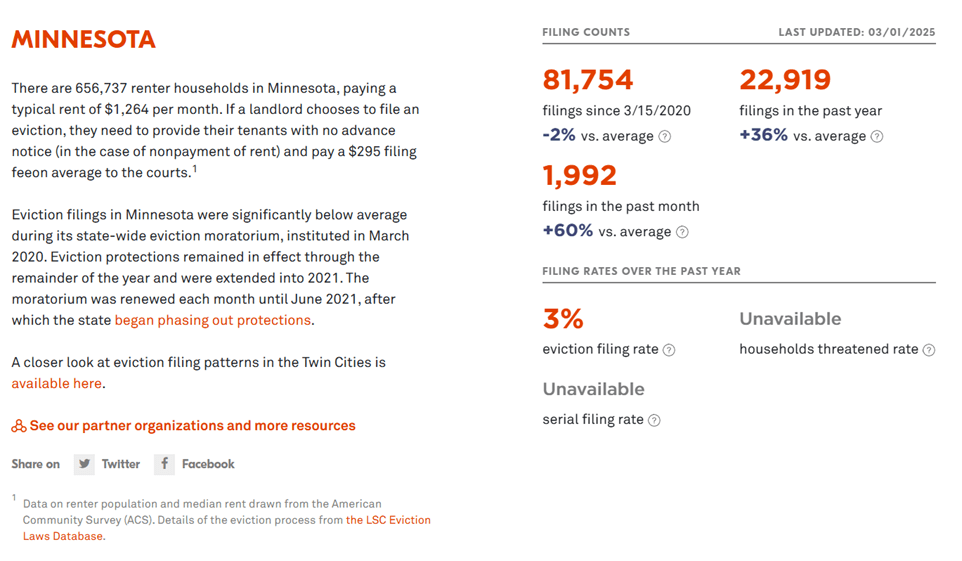
There are local politicians, for instance, drumming up the need for ‘protections’ when, in fact, renters in our area are not showing any signs of stress. One measure would be to consider the rate at which tenants are evicted. The information below shows a low rate of 3%. Only Wisconsin is at the same range in this sample.
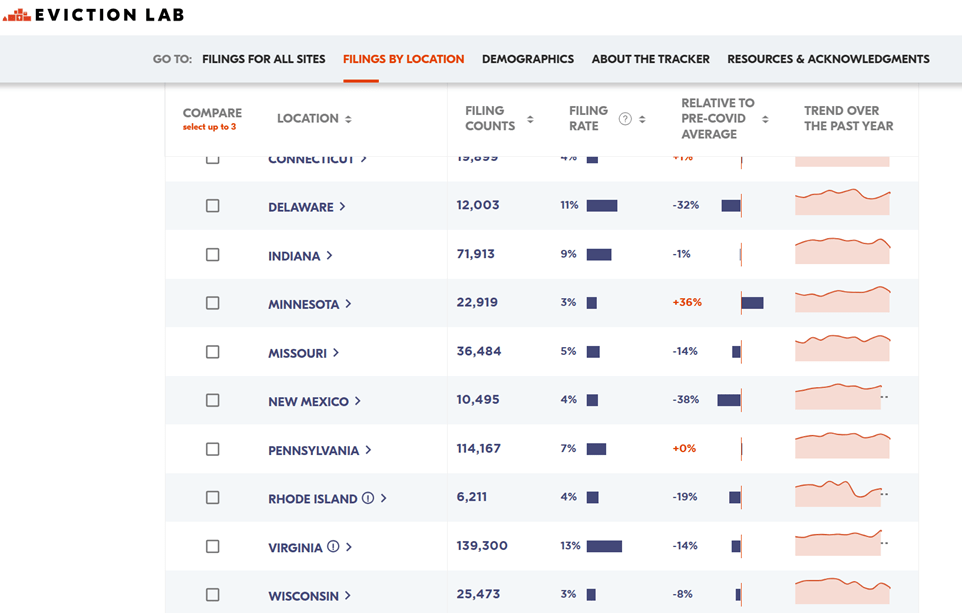
There has been an increase in the number of filings since the COVID years, as tenants were protected during the pandemic. Landlords went months without rent. Nor was any assistance provided for lost income. Still– an increase from 1% to 3% hardly implies the type of hardship that some voices in the public sphere are trying to have you believe around housing.
I thought this was interesting too.
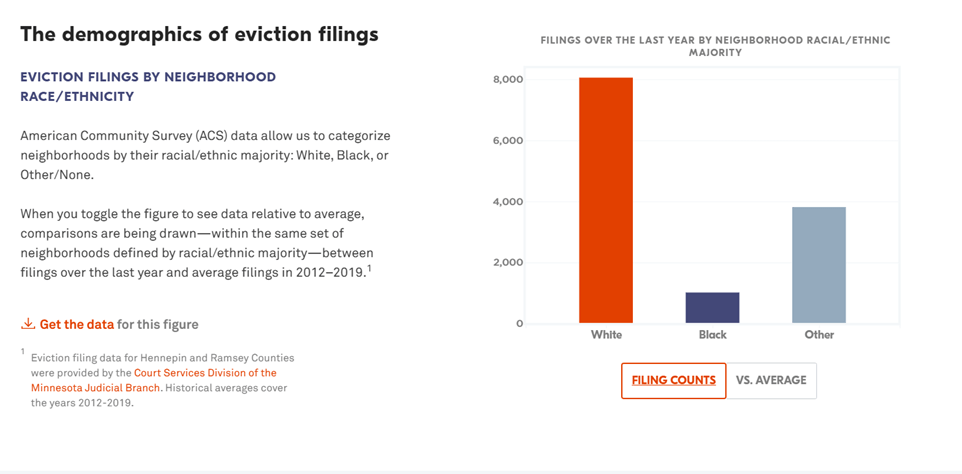
Conclusion: There is no housing crisis. There are housing needs that continually need to be looked after. And that is all.
They say some things you can’t buy. Or maybe some things are more conducive to pecuniary transactions than others. Take the Violence Interrupters. By the summer of 2020, the community wanted to try a new angle on crime prevention, as an article from September explains.
MINNEAPOLIS (WCCO) — The city of Minneapolis is sending members of the community into the streets to prevent violence that is plaguing the city.
They are called the Violence Interrupters, and they’re tasked with stopping shootings by mediating conflicts in the community, and following up with individuals to decrease retaliatory violence.
Jamil Jackson and his group of interrupters are on the move.
“Our mantra is engage, relationships, resources,” Jackson said. “We’re teachers, we’re business owners, we’re city employees, we’re park employees, we’re just individuals who came to the call and had a desire to come out here and change.”
Their bright-orange shirts stand out, so they can walk in and use their relationships within the community to stop the shootings before they happen
The idea was that if responsible people in the neighborhood could step in on demand when they saw an event unfolding, interacting with police would be avoided entirely. Neighbors helping neighbors have the advantage of, in many cases, a clearer view of the issues at hand.
Others have written about this very thing, extolling the benefits of an active community busy engaging with each other across the sidewalks and parks of a neighborhood. Here’s what Jane Jacobs wrote in The Death and Life of Great American Cities.
The first thing to understand is that the public peace the sidewalk and street peace-of cities is not kept primarily by the police, necessary as police are. It is kept primarily by an intricate, almost unconscious, network of voluntary controls and standards among the people themselves, and enforced by the people themselves.
With good intentions, an office of violence prevention was created and funding was carved into the city budget to pay people in the neighborhood to step in and prevent an incident from escalating. So what happened? Fast-forward to this week in 2025.
Some Minneapolis City Council members say the city’s Neighborhood Safety Department (NSD) has been too riddled with mismanagement to continue overseeing violence intervention programs. On Thursday, three council members proposed that more than $1.1 million be allocated to Hennepin County to temporarily take over two intervention programs.
For more than a year, council members have routinely flagged concerns over the department that administers violence interruption programs. Several violence interruption groups reported contracts that had lapsed or gone unpaid last year, which council members say shrunk safety services in parts of the city. A 2023 lawsuit also alleged the department arbitrarily awarded millions of dollars in contracts without adequate oversight.
Things have gotten so bad that the council people, who are most vocal against professional police, no longer want to be responsible for this new form of neighborhood quieting. But why didn’t it work? It has the right components.
It’s the money.
The eyes-on-the-street people, who help keep the peace, are many and are often never called on to intervene in any way. To meter out the job to an individual is resource misallocation as it takes a large group, a whole neighborhood, of people to monitor and, through small actions, or phone calls, or gestures, alter the course of events. There isn’t enough of a job for just one person.
When resources don’t have a direct draw against them, they become ripe for fraud. Those in charge of the money have to put it somewhere. Opportunists realize this and create a demand where none exists.
Community policing is a group thing. It does not jive with the division of labor or hourly wages. Whoever is available when the car crashes into a pole and is set on fire, whoever happens to be passing by and has the will and capacity to help, are those who step up voluntarily in times of need. For that they receive an award.
If you run the provision of public goods like private goods, are you missing the structure of things?
Excellent use of images (poor choice of outcome emphasis).
There were very, very few minority neighborhoods in the area in 1947. Hence, 98% of displaced people were plain-Jane everyday folk. Here are the demographic numbers for the time that the Interstate was built.

When you can do something this cool with data, why not stick to it and skip the drama?
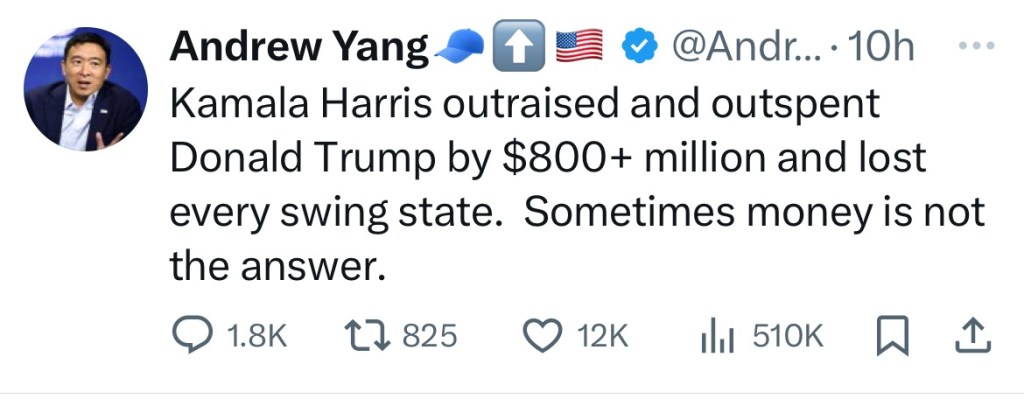
Andrew Yang points out that money won’t always purchase what you want to buy. Despite outspending her competitor handsomely, Harris lost.
You see this in social services too. Money can be poured into some of the most deserving causes: care centers, autism learning, culturally specific food without comparative results.
In fact, the less the objective is tied to a cash response, the more likely the cash flow will be highjacked by fraudsters.
So what is the factor which better represents a price paid for results?
Crisis [ˈkrīsəs], noun, a time of intense difficulty, trouble, or danger.
Let’s consider a few housing facts to see if the state of our housing needs rise to that level in MN:
It seems that many Minnesotans can afford to own homes. Few are having difficulty maintaining their ownership positions. Crisis of homeownership averted in the far north.
That’s not to say that there may be housing issues for non-homeowners. Princeton University tracks evictions. Minnesota is third from the bottom on their list, at 4%. So renters don’t seem abnormally stressed or in crisis.
For those undergoing foreclosure or eviction, there is a crisis. Thus, they should receive the appropriate support to help them navigate their way to a solution to reestablishing shelter.
There is a crisis. It’s a crisis of wasteful regulation. So, call that out and make efforts for reform where needed.

Last week, a local real estate brokerage settled with the state attorney general’s office over allegedly deceiving clients about the performance of a $540 home warranty. The product is offered to both buyers and sellers on an optional basis. Every client who does business with the broker signs a disclosure about the affiliated nature of this business, as well as other businesses such as mortgage providers, title company services, and so forth.
The settlement was for $3.5 million. A paltry amount when it comes to engaging the legal profession. The option of going to court to be exonerated from such a ridiculous claim would cost the brokerage a figure in the multiples of this, and the continued press coverage predictably tilted as anti-business. Take for instance, this quote from the attorney general:
“Today’s settlement will put this money back in the pockets of Edina’s customers who were misled into purchasing HSA warranties without ever being told that Edina was being paid handsomely to promote these problematic home warranties,” Attorney General Ellison said.
Explain how a spiff off a $540 home warranty can be considered handsome in the total expense to purchase a home. Even the full $540 falls, perhaps between .1-.2% of the average total home sale cost. The spiff might be a tenth of that- hardly a game changer for any worker in the chain of events.
There’s more from the Bring Me the News article. There’s the part where government makes claims about consumers’ abilities to determine value:
The investigation by the AG’s office also alleged that HSA “confused consumers” into believing its home warranty was a valuable product that contained benefits that it didn’t actually have.
Many consumers purchase warranty products through utility providers and home warranty insurance providers to have the peace of mind that if the mechanicals in question fail, they have some sort of repair or replacement coverage. I’m not sure how offering an accepted open-market product at a relevant point of another transaction confuses the general public.
Maybe the government is confused, and consumers are actually much more intelligent than they are.

People expect their government, or governing bodies, to protect them. It’s the most basic and oldest public good. Band together in a cave or behind fortifications and put the physically strongest in charge of fending off harm. For better or worse, this placed the physically strong in high-status positions for more than several millennials.
But what does that mean to keep you safe? And here is the sticky part. There is a broad spectrum upon which the answers to that question may fall. In some cultures, women are safe when clothed from head to toe and sequestered out of the public eye. Most people and women find this a violation of individual liberty. It is not up to the group to seek a safety goal so that it impinges excessively on one or a whole section of society’s liberties.
One story in the news yesterday tells of a mom in Georgia arrested for negligence when her ten-year-old was seen walking home on a rural road. The police were notified by a neighbor. They then showed up at the family’s home and cuffed the mom in front of her kids. Last month, there was a story in the news of another ten-year-old in another part of the country who was finally detained when he drove a stolen car through his neighborhood playground. This ten-year-old had been released on numerous occasions for auto-related theft to a mother who was never held responsible in any way.
Of course, there are many more mundane questions about what is safe. How many smoke detectors does a house need? How many inches does a metal vent need from a combustible floorboard? Will that tenth detector be the one that alerts the family of smoke in the house? Can a wood rafter really catch on fire from metal only exposed to air heated to seventy degrees? Someone thought so. How high does a standard need to be to be safe enough? I’m not sure. But I expect that no one wants to be the regulator who, after a death from a fire, is thought to have been too lax.
The thing is that too much regulation can kill, too. At least, that’s the argument for those who feel there are too many restrictions in the drug industry. Failure to approve causes people to die from lack of access to a cure. Lengthy approval processes cause people to die, too. Just like too many building codes add an undue burden to housing expenses. Without housing, some people are severely disadvantaged and may even die on the streets.
So– what to do? What level of protection is requested when the people go to the government and ask? It seems like the answer would be some expected norm of the group.
If you raise the standards above the norm, people are restricted from liberties they would have enjoyed. Plus, more than likely, some people will disregard the regulation as they feel it is not worthwhile. Before you know it, the mayor of some town is caught at a party without a mask when all other good city dwellers have been putting up with the stinky things. A non-conformist attitude can then carry over to different areas, like permits for home repair. And people start getting their brother-in-law, who’s ‘handy’ to connect a gas line. Here the permit and ensuing inspection is beneficial.
Walking the fine line between setting regulations and meeting people’s expectations for safety is a balancing act worth figuring out.

I checked out Francois Furet’s book (yesterday’s post) from our nationally recognized Hennepin County Library. It’s a great service to have unusual, high quality books locally available.
I was startled to find the pages profusely underlined in black ink. Throughout the whole book. And every time Furet explains a downfall of the communist system there is a sidebar note: No!

Does the defacer of a publicly owned book not see the irony in treating the volume as their own? That the blatant disregard for the fine-tuned implications of ownership is where precisely where the communist project gets ripped to shreds?
In a swift and unusual action, a worker was fired. Perhaps people are finally fed up.
Here’s the photo of the offense.
The vivid image of a press secretary managing one’s self-image from the real world is the best part of Robin Hanson’s (and Kevin Simler’s) book The Elephant in the Brain. The theory goes that humans trick themselves into altering the world around them by obfuscating their true intentions as they go about their daily lives. Whether it is to avoid unpleasant traits like jealousy or greed or to feel better about oneself through public displays of charity, the authors give many examples to convince us that we write our own story and stick to the script.
A little man in a suit with a press secretary badge stands at a podium, dolling out PR for all your actions. It is a great visual. It reminds me of the Devil and the Angels on shoulders graphics whispering advice to an undecided listener. But now it is a Rolex watch has been purchased, and instead of taking Veblen’s view that it is conspicuous consumption, the new owner’s press secretary justifies the expense in light of the machine’s mechanical prowess.
The power to deny the nature of one’s impulses exists also among groups. It can be set up as self-defense rather than rejecting an unattractive impulse. When hard decisions are at hand, it is helpful, even comforting, to have the support of a social norm to fall back upon. For example, whether to offer aid to those nearby or those in more desperate need further away is a moral question. Guidance of what is acceptable is often shaped by family and friends, neighbors, and parishioners. The guidance gives people a means of acting decisively while allowing the press secretary to vouch for your level of response.
Here’s more from Robin Hanson. A most interesting polymath.
Say there’s been a lot of local advertising lately about universal free school lunch for children who attend public schools between kindergarten to twelfth grade. A casual observer would think this is worthwhile, admirable in fact. Now what if the statement was broken down to reflect various groups in the public schools. Disadvantaged kids whose families earn below a certain income have received free school lunch (as well as added meals like breakfast) since the 1940s. In 1946, Harry S. Truman signed into law the National School Lunch program.
The qualifications for who qualified for the subsidy has undoubtedly been expanded. But the group of children who received subsidized free lunch and those whose families were sending in checks every month to the lunch ladies were not the only two sets. There was another group of kids who were always on the verge of being turned away from eating in the cafeteria. This group belonged to the families who didn’t qualify for free and reduced lunch yet did not choose to pay for their children’s food, leaving their student in an awkward position over the lunch hour.
Occasionally, a wealthy parent or a coach would cover a bunch of unpaid lunch tabs. But universal free lunch definitely takes the plight of the cafeteria workers versus the delinquent parents off the table.
Still, to promote a policy without a proper definition of the groups is misleading. To then claim the moral high ground as if the policy were the first to feed those who are truly disadvantaged is a bit much. It’s an accounting trick. Now, rich families get free lunch too.
Group disclosures please.

If people can’t handle the truth (as Jack Nicholson is known to have said) then what will the new standards be? When will the slip up, the mispoke, be called out as a flat out lie?
It is not uncommon for people to misspeak. In thinking about the next thing to say, instead of “blue” you say “red”, or instead of “east” you say “west”. Few will object to a proper slip-up. It’s unintentional. It’s sloppy but harmless. But what about slipping up twice on the same word, or twenty times? When does the use of an incorrect title which embellishes one’s position and stature in a hierarchical system become more than an oops?
There should be some rules to such things. After all, you can’t go around calling out “liar, liar, pants on fire.” Nor is it always appropriate to blurt out a truth. It’s like the spouse who steers clear of the question, “Honey, do I look fat in this outfit?” Here a white lie gets you through the moment of insecurity and lets the evening proceed without an analysis about what one should do about a few extra pounds. Here no one gets hurt, in fact the couple is better off.
So is that the new rule? If no one gets hurt, letting a deception fall to the wayside is not a big deal? Who would care if your twelve year record in the girl scouts was real? Well, if you were making decisions about the future of the scouts, people in the audience may place more value on your opinion given a long-standing relationship with the organization. That’s how people make decisions. They gather information from reliable sources before taking action. Most feel firsthand knowledge is more reliable than outside opinion, so a long-standing interactive relationship lends credibility to a point of view.
It’s a theft in a way. People rely on product information before they make a purchase. They take action based on the material attributes of the product. If people are choosing their public goods, they should have access to a similar level of product information to a degree of reliability. Where the public will settle on the acceptable level of truth-telling is yet to come.

I’m getting a kick out of the weird word. Being weird is not that hard to do, especially when people give you bad advice. Like, always tell the truth. The truth in business is often not what your boss really wants to hear. Nor is it what the local politicians want written on the front pages of the paper. They want the narrative, whether it is the one that makes the boss look good or the politician. They need the narrative.
Asking for an explanation is also not popular. People do not want to explain why they do what they do or they prefer what they prefer or they feel inclined toward a certain outcome. It’s simply understood.
I like the whys. I’ve spent my life asking why. Here I am at a young age looking for a response from a nice lady in red. My one brother sings ‘la-la-la-la’ so he doesn’t feel the discomfort of the lady grasping her ever-tightening hands. My other brother looks off, cute as aways, playing the knave. Undoubtedly the lady in blue is thinking, ‘she’s an odd little girl.’

I don’t regret being weird for a minute. Looking for answers is the most interesting pastime.
How would that work exactly, an efficiency commission? In the business world, when the system is open and monopolies aren’t gumming up the flow of things, new entrants keep prices lean by undercutting the legacy companies, while maintaining a high enough price so as not to go bust. This tension is how people trust that they are paying a competitive price.
When groups or governments come up with pledges to jointly pay for goods and services, the obligation to purchase distorts a more fluid and flexible exchange. It also can set up a fictitious demand, as in the Feeding our Future Fraud case. The knowledge that the funds would arrive gave a financial incentive to fabricate the hungry kids who demanded the meals.
Another inefficiency appears in the form of joint missions, also known as mission creep. For instance, a government acquires a property in poor condition. Instead of bringing it up to the standard that most of the nearby residents would do if it were their home, the government entity goes over and above, not by a little but perhaps by three times the expense of average expectations. “Because it is the right thing to do.”
There are two counting mechanisms that could help an efficiency commission discuss examples such as these. The first is to count the population of the end recipients or receivers of service. A simple demographic count of the kids meant to be served would have immiediately revealed the fraud that led to the theft of $250 million from Federal subsidies. The state demographer has those numbers. It’s not hard to add.
The second example requires a comparison to the average typical repair for the area. Many home repairs and services vary in price. Should a homeowner go with the highest efficiency model, or is 80% high enough? It seems that the likely answer lies with the community of like-minded folks and not the bureaucrat. Wouldn’t it make most sense to spend the money in the fashion that a conscientious owner in the neighborhood would choose to do? After all, they’ve gone through the scheme of pricing and comparing.
Those in charge of public dollars should be vigilant to avoid being taken for a ride, as well as in line with the spending expectations of their constituents.
Here’s a wonderful short movie about Tank Man was produced by Robert Anthony Peters.
My grandmother would tell a story of giving in their rural Iowa community. Word would get out after a Sunday service at Holmes Lutheran Church that a family was in need. A gathering of kids’ clothes or staple food supplies would be left in a neutral pickup area, maybe at the end of a driveway. Then the mother in need would later pick it up. Poverty was shameful, you see. Direct contact in the transference of aid would be a disrespectful slight on their condition.
The evolution of social welfare has come a long way since the happenings along the gravel roads squaring off sections of farmland. Provision of resources funnels through formal government channels instead of being left solely to the church aid societies of the 50s. Efforts to detach stigma from acceptance of aid are ongoing. The evolution of food stamps is a credit card with funds for the purchase. Free lunches are provided in all school buildings so there is no distinguishing between families that qualify for aid and those who don’t.
It’s hard to see how public humiliation in the face of unforeseen circumstances is profitable. However these control mechanisms were developed as a means of discouraging group members from taking more out of the communal pot of resources than needed. It was a social metering of loosely held assets. Back-up reserves are not attached to one specific individual in the group. They are intended to meet the shortfalls of the worse off.
Scolding looks are used in other ways to keep up shared appearances, When the neighbor grass is getting knee high they may feel the scorn of dogwalkers as they pass on the sidewalk. Pushing and nudging with looks, back turns, and low whispers are simply how it’s done in society when it’s thought necessary to get the word out about control of shared space.
There’s a two-fold reason these norms are swept away in the face of dire poverty. The unkindness is too harsh as the victims are too vulnerable. And furthermore who wants to discourage, in any way, a mother from taking food for their child? The desire for stigma-free acceptance of benefits for kids is simply a long-term win for the group. Healthy kids make for healthy adults.
There are those who, however, may come to an erroneous conclusion about the tapping of public benefits without those disdainful social guardrails. Some will pursue as many benefits as they can find available to them with no personal calculation of need. And others still take the pursuit of public benefits as a business model. They dreamt of being an entrepreneur, they say. This claim is being made in defiance of accusations of fraud.
When public goods and resources are formalized through government metering, then funny things happen. They no longer have the appearance of a common pool resource but rather they take on a more private form under the guise of a ‘program.’ Gone are the nuances of need-based use. Instead, they are peddled and appropriated in a coin-counting manner.
Perhaps an ingredients label is required. This is a one-hundred percent publically funded resource. It is fraudulent to transact outside its intended mission.

they rebel:
Westminister Church has a wonderful town hall forum that hosts interesting visitors in a its beautiful nave. Today’s guest was Keyu Jin whose book, The New China Playbook, Beyond Socialism and Capitalism, was recently published. I was not familiar with this professor from the London School of Economics but the title of the talk drew me in.

After the half hour talk, Prof Jin took questions from the audience. Tane Danger, the host, looks through the cards in order to group similar topics together.
One audience member asks about the nuts and bolts of the k-12 education system in China. She responded that the party originally was responsible for education and it was free to all. But the one child policy in conjunction with fierce competition to vie for the best spots in the work force, led couples to hire tutors. A high score on placement exams guarantee economic and social advancement. Thus, in response to demand, a large industry of private education providers was spawned. This led families of limited means to expend, according to Jin, as much as a quarter of their income on supplemental instruction.
Prof Jin saw this as a negative outcome to capitalism. People’s hopes and fears for their children’s success were being exploited by a private entrepreneurial spirit.
Which brings us back to a favorite topic here at Home Economics. The theory is that certain endeavors are better suited to cooperate efforts of resource providers, while others respond favorably to incentives. In the first instance, the common goal is achieved through public governance and provisions, whether informally within a group or formally via a state structure. Public education has positive impacts from all angles in a society which is undoubtedly why it was established and is still maintained as a public good in the US.
Prof Jin provides a counterfactual. When the state fails to prioritize education, private entrepreneurs jump in and fill the gap. In her example, their success in combination with the high stakes creates an inefficiency.
What’s interesting about this post by psychologist Kaidi Wu is, that in debunking the myth that American are solely independent and eastern cultures are solely communal, she exposes the reality that people in general act with both types of action in mind.
So the trick to organizing our actions really revolves around acknowledging which endeavors generate the best results through competition, and which ones sort more readily to a communal response.
Some of these are easy to spot. The sales of a tangible widget is best left to competition. Once the market is saturated and the object is no longer of use, resources will stop flowing in that direction. Services which save people from harm, like firefighters, are best provided by a community.
But Kaidi Wu is absolutely correct that the historically popular criticism that Americans are solely interested in the self is simply in err.
Albert O. Hirshman is known for a treatise on the connection between loyalty, voice, and exit. What he describes is an ebb and flow in people’s actions. Whether people interact in the public sphere and use their voice to signal a challenge, or whether people remain loyal to a brand while they nudge for changes using voice in the private sphere, both possible scenarios indicate that, before leaving a relationship, most people will try to talk through change.
In a free and open society, all voices should be heard. No questions there. But some folks are more able to broadcast their voice than others. So, it seems it would be useful to have some sense of evaluating the various impacts of the topics at hand.
The possible negative outcomes of giving the societal floor, for monopolizing the social audience ready and in attendance to react with resources to causes, are as follows.
Wouldn’t it be useful to track three items when a topic gets brought to the elevated status of statewide attention? Wouldn’t it be helpful to see the numbers of all who are harmed, or affected in some way? Does this group command more, or less the same number of resources as many others who also have legitimate claims? Are the public officials in charge of bringing forward certain voices proportional to their representative groups? Or are they heard due to their proximity to core functions? Are the restrictions placed on people in sync with the risk of missing out?
It seems that a better matrix of analysis could be done before some voices are raised above others.

As we say here at Home Economic, context is important. Recently I heard the figure of twenty homes as a sweeping number with respect to an impact on a neighborhood. In order to evaluate an impact, it is necessary to know how many homes total constitute a typical neighborhood.
A standard city block with a sidewalk out front and an alley to the back generally has twelve to fourteen homes per city block. So if you were to think that your neighborhood was your block and two to the north, two to the east, two to the south, and then two to the west – you would have about 230 homes in total. In this case, twenty homes is about ten percent. If all these homes were in poor repair, for instance, this could be noticeable and have a negative effect on the outward appeal or from the street view.
Neighborhoods are quite a bit bigger than a cluster of two blocks to either side. Here’s a neighborhood map of Minneapolis, for example.

The USPS offers a useful tool for direct marketers which calculates the number of residential mail stops on mail carrier route (it’s called Every Door Direct Mail). We can use it here to help estimate the number of households by neighborhood. The first map is for the Armatage neighborhood. The number of homes comes in at 2620. Since the routes overlap into Fulton, let’s use a number of 2400. In this case twenty homes in the Armatage neighborhood makes up 0.83% of the total.

The Fowell neighborhood on the other side of town is know for having a larger share of corporate owned rental housing. Here, our USPS tool tells us that the neighborhood contains 2182 properties. Again rounding down is appropriate as the one route that runs on the west side of the cemetary is in the Victory neighborhood. Let’s use 2000 homes, in which case twenty porperties is 1% of the total.

It’s hard to see where one percent of a total number can have an effect on quality of life issues.
When a raw number gets tossed into a conversation as if it were a grenade ready to explode, always ask for context.
Is this claim about Minneapolis renters correct? Is paying 30% of monthly income toward housing a distressed situation?
Lenders often extend the debt-to-income ratios to 30% for all types of loans.
This claim is false. It is the result of shifting standards for political posturing.
Words are so easy, so fluid. People with a silver tongue can have an audience rich in the information of their choosing. Pursuasive people are often great with rhetoric.
But what if the words don’t match the realty.
This airline spokeswomen is paid to stand up and deliver a positive report. And the objective reports as to whether the airline is on time, whether they loose baggage or whether they cancel flights inconveniencing their customers is realitively easy to com by.
But what about political claims?
Will the sports stadium really bring in that much out of state spending? Will the program really propel people out of poverty? Will the light rail trasit be used to justify its expense? Some of those questions are more difficult to prove of disprove.
Although audiences have their way of calculating their personal benefits and observing the outcomes of others. They don’t need a camerman to pan upwards to the delayed flight arrival board to get a gut reaction to a politican’s claim.
It would just be nice to have earlier benchmarks to at least tighten up the projections before plunging forward with some of these joint ventures.
Talking about methods, I noticed one method pop up on Twitter around the value of providing free school meals (breakfast and lunch) to all school children. There has always been provisions to feed children in poverty at schools across the state of Minnesota. So about 12% of school age children’s families were not charged and 88% were billed by the school. Or moms prepared lunchs and sent them out in backpacks.
In actions reflective of an exuberant majority, the law makers passed a bill to cover meals for all children. (We feed kids instead of banning books! was a slogan this year) On the face of things it sounds like a wonderful thing to do. In the world of constraints it shouldn’t be a surprise anyone that the cost of the program is bulging well past the initial number. Listen to little onion.
Is it valid to compare the cost of free meals to the cost of police misconduct settlements? On the one hand government decided to pay food bill for families who could afford to buy their kids lunch. On the other hand there’s a number for mismanagement of a police force and the subsequent fallout. One is for sustenance, the other is for public security. The only thing to grab onto here is that taxpayer money settles the tab. Method Grade: F-.
Here’s another method to present whether the cost of increasing the school meal tab to cover all students is justified.
We note a pattern here between those who support free lunch- they value it more than funding the police. Public safety is a concern for all. Lunches are covering less than 20 percent of the population. Lack of public safety results in a loss of some kind to all citizens. Lack of school meals, in this case, means a few more PB&J’s and carrots sticks for some families. As a method, these comparisons, well, are weak. Method Grade: F-.
The Gov thinks the program is worth it since a mom wrote to him and said she appreciated not having to pack lunchs ever morning for her three kids.
At least in this method a politician was listening to a constituent. Method Grade: F+.
I have a new reading rule. If I bend back the bind of a non-fiction book, read ten pages, and fail to find even one whisper of a tie back to a real world concern, I shelve it.
It’s hard to devote time to all the right phrases: institutional (a wobbly word itself), intangible, synergies, norms, soft infrastructure, R&D, yahdi yah. And not one practical eample. The use of so many imperative phrases and descriptions aimed at thin air calls into question where all that is being described is professed to reside. Because if the authors are finding it difficult to relate instances back to the world we live in, then what they writing is a work of science fiction.
HG Wells, Jules Verne and LeGuin all provided keen insights into what is to come. Science fiction is a popular and well read genre. I suggest these policy types devote their efforts in this manner as well. Once they find they are writing on air, they just need to conjur up a little fantasy destination and some sympathetic characters. People love a good story.
Look at how CS Lweis drew everybody into The Lion, the Witch and the Wardrobe without anyone realizing they were being taught a thing or two about Christianity.
Yesterday’s post describes a coming to terms between some neighbors over a paving project. It might seem like a one-off situtation because of how the properties were arranged along the road. And it is true that many blocks of homes are developped together and hence laid out with conformity. But when you think about it, the sheer number of miles of road make non-comforming layouts pretty common as well.
Which suggests that a bartering of tax payment in exchange for a road improvement happens frequently. You might say there is a matrix of possible solutions to who pays what based on some combination of property ownership and use-value. There could be other interesting variables as well like how much social time had to be contributed to initiate the process, and shepard it through, and even how much time went toward diplomacy so the individuals who thought things weren’t fair would still go along with the project.
And this is all assuming that the folks, as in the story, know enough about each other and their general alikeness to foster a degree of trust.
Things can get more complicated quickly when some parcels are owned by commercial entities and some by individuals. There can be divergence in the income levels of the various parties involved which contributes to an evaluation of who could carry the burden better. In other words the players can be grouped. In doing so an order may emerge that shows the bartering results in consistent outcomes.
Knowing some of these results could be helpful. It could help with planning, to be able to know in advance the most typical way the numbers all shake out. It could save some upfront hastles for those just starting out on a project. It also could help prevent fraud when the groups need to be subsisdized. In this situation the bartering is done by a bureaucracy which tends to take some teeth out of the trades.
There could be some benefit in knowing the final settling of cooeperative projects. As there isn’t just one mile of country road. There are millions.

The pro-pollinator people have gained further traction in preventing cities from undermining their wildflower gardens. A few years ago, in the SW Minnesota city of Mankato, a court ruled in favor of the homeowner to maintain the usually tall and gangly plants that the Monarchs and the Eastern Tiger Swallow or Red Admirals like to float over. The city said it was a public nuisance. The courts said no- the owner could save the bees.
A pollinator friendly article by Christopher Ingraham (the Washington Post journalist who critized northern MN and then moved his family there when he realized it was better for his kids) ran in the Minnesota Reformer. He explains, “new language requires cities to allow homeowners to install and maintain a managed natural landscape.”

Not every neighbor is thrilled with a relaxed yard which often looks unruly. Most cities have a restriction on how high the grass can grow before being declared a nuisance. Where some people see vivacious boulevard greenery, others fear bees and flying weed spores.
The private property rights people should rejoice. Owners are now protected in their ability to choose alternative landscaping. But you’d be surprised how quickly people turn on a dime when a rule is one they favor rather than oppose. Lots of people feel neighbors have some ownership in the view from the road. Whether it means you have to store you garage containers out of site, or keep the clip of your turf tight to the ground. Neighbors care!
The question becomes which level of governance is the right one to best address neighborhood expectations. As you can imagine the folks who are OK with dog kennels and RV’s sitting on a driveway all winter can hold different expectations than other metro dwellers. So shouldn’t this be a local decision?And who really gets to decided how many butterflies is the right number of butterflies?
It seems odd to me that this type of provision shows up in the state government finance bill. Wouldn’t something like this fit into the parks and trails type of category. Minneapolis Parks alone manage 6084 acres of land. Three River Parks, which covers an area mostly in Hennepin County, provide access to 27,000 acres of nature and wildlife to metro residents. Then of course local cities look after the local parks. The city of Plymouth for instance grooms 1855 acres. If state level politicians wanted to finance something for the butterflies and the bees, they could have given seed money to to one or all of these land stewards.

Years ago I worked at a medium-sized financial institution. Every four years or so a back room clerk would be caught skimming a bit of money out of general ledger accounts and diverting it into a personal one. The sum total stolen were relatively minor $20-$40K. The typical way their ruse was discovered was when they left their desk and their actions while on vacation. As long as they were at their desks and did what needed to be done everyday, the accounts looked right side up. Once a fill-in employee took over for an extended period of time, some of the accounts showed themselves to be upside down.
The point is that even in the fulfillment of simple jobs, it is not easy to see flaws in the system from the outside. This is the reason why fraudulanet activity often gets so out of hand before being discovered. Unless- there is a whistleblower. But who really wants to take on that job? It is personally taxing both emotionally and often financially as, at least for a period of time, one’s employment may be suspended. The risks are high. And so most everyone prefers to turn away and let someone else deal with it. Not my job! They’d say.
In this story involving Movement Mortgage and the FHA/VA programs, the alleged conduct occurred in 2008. “Federal prosecutors said Thursday their investigation was triggered by a whistleblowers’ lawsuit from two former Movement Mortgage workers. They will receive $4 million of the settlement.”
Think a moment why a whistleblower might step forward. First off, it may be an individual who feels compelled to point out behavior which violates laws and norms. If the actions at hand hold their personal careers back in some way (they refuse to go to the line that others will to get paid) then their motivation may have a factor of private gain. I think it is fair to say that it is less likely they are galvanized by the prospects of a reward or settlement.
Certainly it is a public service if the whistleblowers are succesful in bringing the theft to a halt. When the cost of doing business goes up due to fraud, then all consumers pay through higher pricing.
So to review, a whistleblower may choose to use feedback loops to expose theft. Most probably they are animated by exposing something that ‘just isn’t right’. If sucessfull the cost and risk they bear is a benefit to all those in the consumer group. They may gain privately as well.

The Hennepin County prosecutor has never hidden her activism. Supported by many, there is a view that African American youth are incarcerated too quickly, and too young, which destines them to a life of crime and prison. And holding good to her beliefs, following her election last fall, her office has been extemely light handed in pursuing this group with legal action.
The thing is, the results have been problematic. My son lives down by the U an area fraught frequent and sometimes violent criminal activity. He said the best story he’s heard so far is a kid getting taken in for a mugging only to be arrested a second time, for the same crime, later in the evening. Once released on the first charge he didn’t go home and think through life decisions. The police are busy apprehending the same youth twice in the same night for the same crime.
Needless to say after hundreds of reports of cars filled with youths as young as twelve joyriding, even the most forgiving citizens are coming to the realization that no response to crime except ‘we believe in you’ and back out on the street you go, is not generating a beneficial outcome. At a news conference few days ago, the county prosecuter announced several collaborations to put a good face on further efforts.
The collaboration with law enforcement has three parts, including meetings in which agencies will come together to identify youth in need of intervention. Social workers will also be in contact with families to connect them with needed services. Families that accept services will be connected to the county’s Family Response and Stabilization Services, along with school-based and community resources, the HCAO says.
MSN
My only question is what does this have to do with the prosecutor’s office? Isn’t it their job to make a case against criminals according to the law and fulfill their obligations to the public whom they serve? The job of connecting people with social service resources and other response services in the event of mental crises etc is fulfilled through another county department. If you want to work in the social service side of public service, then work there. Be successful there. Reach out and make a difference in people’s lives in that capacity.
As of right now, the results are in. Not prosecuting criminals is encouraging a life of crime not discouraging it.
I think it was on Twitter today that someone said that using a social contract as an argument was a cop-out. But using efficiency as an argument was valid as it required an explanation of how the optimal outcome was being achieved. Somehow efficiency is tied to numbers and not norms, so it’s more difficult to spell out.
If you want to claim a social contract, though, I think you have to show who is involved in the contract and how it’s unfolding. People always talk in broad strokes- crime is up! crime is down! Sweeping statements are not very useful as within the purview of the speaker there are more then likely people who are isolated from crime even if crime is rising, and those who continue to experience crime even when a generalist can legitimately claim crime is down.
So the first hurdle in the usage of social contract as an explanation is to be able to isolate the groups held to the agreement. Who are the givers, and who are the benefactors? And besides the two to the party, there are a more general group of observers, or what I like to call the audience.
The CEO of LuluLemon recently made a show of a social contract when a handful of youths shoplifted from one of the retail stores. The benefactor from this leader’s contract of people of property were the shoplifters who faced no charges of breaking the law. The losers in this arrangement were the employees who lost their jobs as they were fulfilling the social contract they had been raised with, theft is bad and should be reported, instead of the social contract supported in a LuluLemon employee manual. The audience is the rest of us judging these interactions and evaluating how we would act should this scenario present itself.
If one is looking for efficiencies, one would have to take a closer look at the intersection of the employee’s behavior visa vie the CEO’s. If employee policy is so counter-intuitive to pre-existing social arrangements, ones that have been trained and maintained with most people since childhood, will it be efficient to expect the average worker to go against such impulses and look the other way at blatant theft? It seems there will be a brewing of backlash- or those pesky unintended consequenses.
On the other hand, if the store decides to hire a host of people who can easily ignore stealing and have no issues with criminal activity, then perhaps the social contracts between the CEO, gangster youth, and employee will be groovy. Except….if your employees feel it’s legit to operate as crooks, eventually they’ll be stealing from you themselves. And that truly can’t be very efficient.
You see, arguing optimal outcomes using social contracts requires some persuasion.
The last book we tackled in the No Due Date book club was Do Markets Corrupt our Morals by Virgil Storr and Ginny Choi. I really appreciate the way the book is laid out. Instead of referencing the work of others in an offhand way, expecting the reader to know the inferences intended, the authors pulled lengthy quotes. Then there is further clarification of the material. To make it even easier to follow up, bibliographies are listed at the end of each paragraph.
This makes for a useful book. One worth hanging onto.
One of the questions the book seeks to answer is why there exists an ongoing criticism of capitalism when the data seems to indicate that open and free economies generate positive returns for societies. No need for uncertainty here. If nothing else, the authors confirm through thoughtful data and analysis that economies consisting of open and free trade, with higher levels of transparency and clear property rights, out perform every other system. And yet, the nasty, opportunistic men and women of the market live out vivid roles in the minds of the public.
Storr and Choi start off Chapter 4 with a virtuous market story. An enslaved person, Boatswain, is a skilled craftsman. His owner is progressive enough to allow him to market his skills in the greater Bahamian marketplace and for Boatwain to retain some of his earnings. Here, market forces encourage the relinquishing of a social norm so that the greater community benefits, Boatswain internalizes profits and undoubtedly his owner is relieved of some maintenance expense. All parties win.
Let’s look at a few not-so-appealing market stories. Bernie Madoff was a financier of considerable skill. He also had access to individuals with large amounts of resources with seemingly no direct demands upon them. So Mr. Madoff creates a story to draw those funds out and into his pyramid scheme. Perhaps hubris kept him going. Perhaps he began to believe his own deception. Regardless of the human foibles that perpetuated the deception, when he fell, the destruction was deadly.
But also let’s consider the market for public funds. The state of Minnesota has an 18 billion dollar surplus at the moment. There is talk of large amounts of money being directed into non-profits in a disadvantaged part of the metro area. The fear is that the dollars will not have a sufficient market disbursal system and there will be pressure on the 501c3 people to internalize the liquid assets.
Or consider a situation where two markets exist in close geographic proximity. When a group of ex-pats from a wealthy country takes up residents in a country of substantially less means, it is not long before a submarket is created. Members of the host country develop surcharges on goods in open markets. There are fees imposed at gatekeeping opportunities. This extraction of funds from one group to the next is called corruption. But could it be that this is a market force for the wealthy to support the less wealthy?
Bernie Madoff was simply a sophisticated thief. But he used a network, not simply business means, to accomplish his ruse. The demand for public money in the second scenario is justified, but the mechanisms for distribution are lacking. On many past occasions, this scenario has ended with an appropriation of funds. The last situation generates the example of a secondary market, or a black market, springing up when two distinct groups, with divergent standards of living, coexist nearby.
So I agree with the authors that the Bernies of the world get an outsized airing in the media. People love a good scandal. But I also would like to suggest that some other scenarios which appear to be theft are the result of weak, unidentified, or poorly implemented markets.

Most objections to markets of private goods are that, in their exuberance, they roll on by some social concerns. The industrious plant pollutes; the labor market does not support all families; the tech firm runs the table to accelerate advancements in their field. It’s thought that markets allow the power of the purse to trample on the wants of the people.
So– the people make rules.
And that is where you see the counterarguments to the objection to markets. Even though we don’t think about it, marketplaces are formed by rules. Markets are a combination of people taking action, the objects in trade, and the marketplace where it all occurs.
New rules mean a new marketplace. And in that new marketplace, with either informal norms or formal rules around the social concerns mentioned above, a new set of prices evolve. In a bubbling and ever-unfolding process, the markets renew to the will of the consumers.
The morals of some groups will keep their marketplaces at arm’s length. The Amish live a lifestyle that remains separate from mainstream America. Some people will never buy crypto or derivatives as their uncertainty about the products gives rise to a fear of being duped. Others may only allow family members to care for their children.
But the argument that the combination of people, with all their human inclinations, along with the variety of goods and services they wish to voluntarily exchange, and the meeting place where buyers and sellers are brought together is inherently a moral abyss seems unsubstantiated.

I don’t know this Henrick guy, but I’m a fan. He gives his wife credit for helping him flourish.
There was a time many moons ago (or about 50 years) when men were obliged to take credit for all and any efforts their wives made on their behalf. To be generous would be to say that the men’s world was so competitive they had to take credit to beef themselves up next to their peers. Another view would be to say that since the man’s job brought home the financial means of support, then he deserved credit for the job while the stability of family life went to the spouse.
The thing is, no one likes to be underappreciated. Most everyone wants to feel a little warmth from the spotlight. And failure to bring the spouse on stage when credit deserved sharing led to a furious few to dismantle the marriage contract.
This researcher with the Institute of Economic Studies has some interesting findings. When he and his colleague looked into road quality across cities, they found that the quality of road repair was not tied to the wealth of the neighborhood.
This indicates that the cities do a uniform job in maintaining the roads and are not subject to capture from a particular group. A bureaucracy that works fairly. I speculate that this is because there is nothing particularly intriguing about asphalt. The potential social media controversies or any other profile-rising awareness is simply not going to be generated by the extent of millwork overlays in a year.
Now if there were only more indicators for consistency in city services, then it would be easier to spot the politicians who are simply going after political intreague instead of routine work.


Yesterday in the NYT Ross Douthat makes the case for ineffective altruism. Prompted by the recent demise of, what a new follow on Twitter amusingly called the bushied hair young man, Douthat compares the utilitarian goals of the EA folks to other philanthropists in his region of the US.
Now that it seems the bushied hair young man had less than honest intentions in aligning himself with the EA movement and used their goodwill as a cover for his very selfish motives in the creation of his crypto space, it’s easy to see where some would question who the objectives of these do-givers.
Part of Bankman-Fried’s fame lay in his proselytizing for a particular theory of philanthropic moralism — effective altruism, or E.A., an ideology with special appeal in Silicon Valley that’s reshaped the landscape of getting and giving in the past several years.
People who came into a bunch of money through technology are given a seemingly analytical means of redistributing some of their good fortunes to those in need of malaria nets and clean water. And these are worthwhile philanthropic activities. But cynicism can creep in.
The global perspective implied by E.A. analysis can create a Mrs. Jellyby temptation, where “telescopic philanthropy” aimed at distant populations is easier than taking on obligations to your actual neighbors and communities. (Picture effective altruists sitting around in a San Francisco skyscraper calculating how to relieve suffering halfway around the world while the city decays beneath them.)
Douthat talks a lot about the value of the various types of donations he uses in his article. The Harkness family were heirs to a great fortune which they distributed to three main causes in the early twentieth century. They supported the fine arts, health care, and educational institutions. Certainly, all these fields provide public goods where positive outcomes can be measured over generations.
No doubt an especially zealous analyst could trace the benefits of Harkness’s medical donations in positive “utiles” for people treated for disease over the past century. But the most visible monuments to his philanthropy are beautiful buildings, libraries, dormitories and the like, in cities and college towns across the Northeast — some connected to art for art’s sake, others connected to his interest in the proper formation of educated elites.
But then one family member is thought to be eccentric to have directed most of her good fortune to the ballet. How inefficient of her! Or was it? If this woman had devoted her life to ballet, had seen how devotion to a fine art builds confidence in young dancers, and witnessed the benefits of a community of performers, it makes perfect sense that she would direct resources to this tight-knit group. Perhaps she did not have talent or time, why wouldn’t she make use of the fact that she had money?
And perhaps it does make sense that the youthful somewhat transient super-rich from Silicon Valley would prefer to support causes in exotic destinations than the homeless they drive past on the way to work. If they acknowledge the raggedy guy on the corner, then they may feel they have to donate their time and do something for him or her. Perhaps they should join the city council. But they don’t have time for that. They don’t even have time to have their own family. So sending greenbacks across the globe is a better fit for their resources.
Who’s to say why the Harkens selected their passions. But there is probably a story there that created a need they wished to fill. If you divvy out each of these philanthropic pursuits to occur in a platter of social activity the demand and calculation of value do make sense. The resource transfer is useful to a greater public. Except for bushied hair guy. He was internalizing it all for himself.

A few posts ago I used the example of a catalytic converter to distinguish between the use of an object and its function. This automotive accessory is used to remove particulates from emissions from the combustion exhaust. In 1975 it became a mandatory car feature and hence functioned as a political solution to pollution reduction.
Recently catalytic converters have been the target of local criminals who brazenly remove them from cars left out at night. Through a network exchange the stolen item is easily traded for cash. Fortunately there’s been a recent ‘takedown’ of nationwide catalytic converter theft ring included seizures in Minnesota.
The DOJ announced the successful operation on Wednesday, saying it is seeking the forfeiture of $545 million in the case, as well as the arrest and charging of 21 people from five states in connection with the scheme.
Bring me the News
The network across states allowed a teenager in the Twins Cities to swipe the apparatus, sell it to a fence who passed it along to “a trio of family members who ran an unlicensed business from their home in Sacramento, California, buying stolen catalytic converters from thieves and shipping them to an auto shop in New Jersey for processing.”
The number that I think would be interesting to know is how much the kid on the street is getting for breaking the law. What type of gain is needed for a youth to be tempted into illegal activity? All they give us is:
RXMechanic reports the scrap value of more valuable catalytic converters ranging from $300 and $1,500, with the DOJ saying that depending on the vehicle and the state, they can fetch around $1,000 on the black market.
The market price for youth conversion to criminal activity seems like a useful number. What share of that would be necessary to keep the kid on the right side of the law through some type of employment? Many argue that the lack of policing and consequences for illegal activity has also encouraged theft. But how do we know without keeping track of these numbers?
When a catalytic converter functions as unfettered cash to an urban teen, what is the buyout to preserve the innocence of youth?

Supply of public funds without demand is the simplest way to attract profiteers to the public trough. Whether aid is given freely overseas, or in Minnesota, if specific recipients are not identified, the money is readily diverted to real estate, expensive trips, fast cars and lots of luxuries that poor children will never enjoy.
Today’s report from the US Department of Justice’s website:
The Department of Justice announced today federal criminal charges against 47 defendants for their alleged roles in a $250 million fraud scheme that exploited a federally-funded child nutrition program during the COVID-19 pandemic.
“These indictments, alleging the largest pandemic relief fraud scheme charged to date, underscore the Department of Justice’s sustained commitment to combating pandemic fraud and holding accountable those who perpetrate it,” said Attorney General Merrick B. Garland. “In partnership with agencies across government, the Justice Department will continue to bring to justice those who have exploited the pandemic for personal gain and stolen from American taxpayers.”
“Today’s indictments describe an egregious plot to steal public funds meant to care for children in need in what amounts to the largest pandemic relief fraud scheme yet,” said FBI Director Christopher Wray. “The defendants went to great lengths to exploit a program designed to feed underserved children in Minnesota amidst the COVID-19 pandemic, fraudulently diverting millions of dollars designated for the program for their own personal gain. These charges send the message that the FBI and our law enforcement partners remain vigilant and will vigorously pursue those who attempt to enrich themselves through fraudulent means.”
“This was a brazen scheme of staggering proportions,” said U.S. Attorney Andrew M. Luger for the District of Minnesota. “These defendants exploited a program designed to provide nutritious food to needy children during the COVID-19 pandemic. Instead, they prioritized their own greed, stealing more than a quarter of a billion dollars in federal funds to purchase luxury cars, houses, jewelry, and coastal resort property abroad. I commend the work of the skilled investigators and prosecutors who unraveled the lies, deception, and mountains of false documentation to bring this complex case to light.”
What is more egregious yet is the local woke protected the plunderers. When the good employees at the Minnesota Department of Education (MDE) tried to cut off the non-profits from obtaining further funding, they were sued for discrimination and excessive oversight. And it worked! Funding resumed.
When MDE attempted to perform necessary oversight regarding the number of sites and amount of claims being submitted, Bock and Feeding Our Future gave false assurances that they were monitoring the sites under its sponsorship and that the sites were serving the meals as claimed. When MDE employees pressed Bock for clarification, Bock accused MDE of discrimination and unfairly scrutinizing Feeding Our Future’s sites. When MDE denied Feeding Our Future site applications, Bock and Feeding Our Future filed a lawsuit accusing MDE of denying the site applications due to discrimination in violation of the Minnesota Human Rights Act.
There is little outrage amongst a certain party regarding this announcement today, as far as I can tell. Perhaps they are being good party participants and keeping their opinions on the qt. But surely they can’t think this outcome is helpful for race relations.

Recent payouts by the federal government whether during the COVID pandemic or more recently via student loan forgiveness, feel a little bit like a lottery system. In a wild spree of funding the feds have been savvy to include a wide net of beneficiaries. As long as everyone is getting a taste, there are fewer objections to the outlays of cash.
I remember reading how one single mom was genuinely grateful as she was planning on spending her COVID money on passports for herself and her children. She explained that the $130 per person fee was otherwise a luxury she couldn’t justify. But with the windfall, she would find a way to take her kids on a trip abroad. As a steadfast supporter of travel, I admire her decision. Her kids will learn more through travel than through many other educational venues.
People also spent their dollars on home improvements. Appliances are still on backorder, depending on what country they originate from. Another couple I know excavated their aging sewer line. These are all great purchases. When you improve your home you are partly just transferring money from a savings account to an equity-in-my-home account. The other portion, not retained in your home’s value, you will appreciate every day when the whisper of your new Bosch dishwasher does not interfere with your favorite NetFlix series
The lottery system creates mad money- you won’t starve without passports or silent dishwashers, but they sure are nice to have.
But this leads us to question whether the American people are really that bad off in the first place. That’s what we are being told. Many voice excessive rents, struggles, and need. But if the need was that great, wouldn’t there be a desire to get desperate funds to desperate people? Wouldn’t the power players try to direct the most funds away from those who can and towards those who have none?
I’m not here to minimize the fact that in America we have people who are destitute. We do. And we should help them. I just think we are being oversold on the level of need. And the proof is in the papering of ‘relief’ funding across all age groups and income levels. People who earn 100K are not needy. If you want to run policy like a lottery- just call it what it is.
Frederic Bastiat is known for a set of essays, the most recognized is entitled, What is Seen and What is Not Seen. At time of writing, the french nineteenth-century statesman and philosopher is in the latter part of his life and is inspired to record some economic thoughts in a wry and witty manner. The language is vivid and descriptive and the text takes on many forms including dialogue and LaFontaine-like fables. He playfully names his actors M. Prohibant, M. Jacques Bonhomme, and M Blockhead.
His objective is to open the eyes of his fellow statesmen to take into account of the entire cycle of economic impact in the system; to note what is seen but also what is unseen. Much of his inspiration comes from the waste he sees in a heavily bureaucratic tariff industry which seems to have sprung up at crossovers between countries or every city gate. This gross abuse of skimming a bit off the top of every transaction, and the bloated civil service that supports such things, is easily exposed as inefficient.
The Collected Works of Bastiat is over 500 pages, so, for as much as there is to say about the restraints of free trade, it is only a segment of the entirety. It might be the portion that free traders have used to identify the author as their own. But the boy from the Paye Basque offers so much more. In fact, it is against his professed philosophy to pluck out but one section of the analysis and not look under the cushions for the rest of the loose change.
Bastiat does not deny the core services of government “the army, the navy, law and order, public works, the university, the national debt, etc..”(pg43) He decries all abuses of taking private profits whether through commercial fraud or abuse in the public sphere (pg123) or through the church (pg123). He denounces the fraudulent taking in any sector as “Plunder!” It is not simply across the custom’s desk that he sees waste in the system.
Through the volume and variety of writing he devotes to flushing out various aspects of exchanges, he seems to want to expose much more to the systems he sees than simply the revulsion of protectionism. For instance, he talks about the different natures of work. There is work where the value is determined in the end product, not the hours spent. For that reason ‘make work’ by the government is unproductive and should be replaced by unemployment insurance (pg160). He opposes postal rates which vary by distance, which suggests that he feels postal service is a public good to be provided at a reasonable cost no matter where you are, as told in the story of the Salt, the Mail and the Customs Service.
We could talk more about how he describes the various levels of markets (not ‘your’ market, ‘our’ market he tells the paysanne!) There are markets off the rail stops, there is the vaste city market of Paris, there are the other European markets, and just bursting on the scene is the market in Algiers which is a net loss, as it is pulling taxes out of the system (184).
Bastiat has a lot to say. His text deserves a more thorough read. He is trying to locate the whole elephant and would like everyone to stop advocting for the one angle he or she is clinging to.

It’s a great word. It has panache and motion. It is much better than corruption which is the word I use in Categories Explained. But I think I’ll switch to plunder, as Bastiat uses it in the way I do, and he got there first.
In the second series of Economic Sophisms, he devotes the first chapter to “The Physiology of Plunder.” Here he states that “Plunder consists in banishing by force or fraud the freedom to negotiate in order to receive a service without offering one in return.” But I am most interested in the plunder of a fraudulant nature, the theft that occurs when moving resources from one sphere to the other.
He has a lot to say about the extraction of services by the church in return for a designated spot in heaven. He acknowledges that the priest who is the instrument of religion will be “gentle, tolerant, humble, charitable…” And yet some priests are “turned in many ways so as to draw the greatest benefit for themselves.” Representatives of the public good are privately pilfering from group resources, so it would seem.
There is plunder in the commercial sector when flawed products are sold, or measures shortened. Lawyers and doctors can skim off the public goodwill by offering “disastrous advice.” And he spends a lot of time navigating the ins and outs of plunder in the name of the government.
I look forward to reading further to see how he parses all these transactions out into a structure.
The National Association of Counties is offering a matchmaking tool which helps link housing strategies to governments based on their situations.
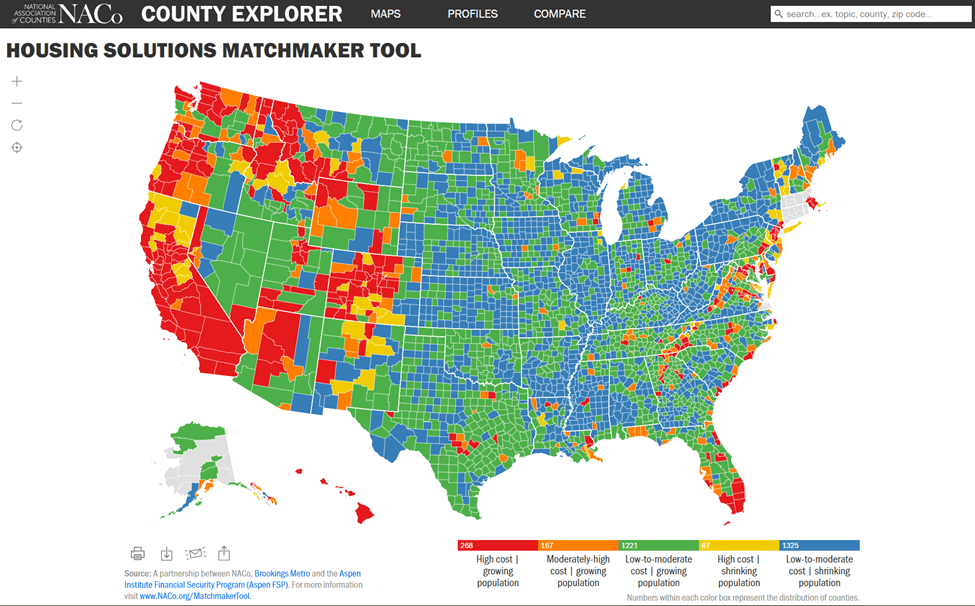
This joint effort between the Brookings Institute and the Aspen Insitute Financial Program looks promising. But what I wanted to note here is the category of the cost that is attributed to housing in the core counties of the Minneapolis-St. Paul metro. Both Hennepin and Ramsey counties are highlighted in green which is labeled as low-to-moderate cost. I agree with this representation.
Ten days ago the New York Times ran an article entitled The Housing Shortage Isn’t Just a Coastal Crisis Anymore. For this article the shortage of housing is scarlet hot red.
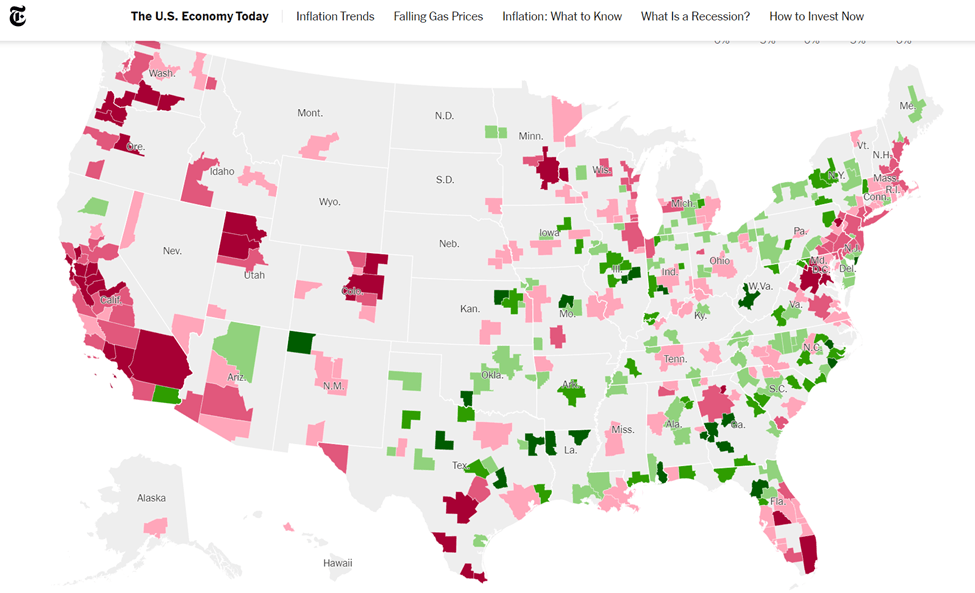
Since scarcity and prices are tied together, one of these two representations is inaccurate. The New York Times article relied on data from and organization UpforGrowth.org. I scoured the site for background on how they calculated their underproduction of housing but was unable to locate a reference to methods.
It just seems like there should be a reliable count of the number of dwellings in a city consisting of those in use, minus those being demolished plus those near completion. Otherwise, it seems that data generators are being hijacked for political reasons.
The last two years have seen two events where the actions of citizens have drawn worldwide attention. At the end of May two years ago the killing of George Floyd ignited protests in Minneapolis which lasted for three days. Before the National Guard was engaged to end the violence, three miles of businesses were vandalized and burned, and spotty destruction occurred elsewhere in the metro area. Everyday people who typically abide by the rules were looting and pillaging while others stepped to the side, let it happen, and even cheered it on.
What led people to normalize violent behavior in a city which has enjoyed a low crime rate?
More recently the west has been energized by the Ukrainian people’s passionate self-defense in their David and Goliath story. When the Russian military advanced on their territory experts assumed the government would fold and the people submit to a new rule. Yet the heroism of the people continues still today as they have successfully stalled the super power from further territorial gains.
In both cases, the citizens were underestimated. In one scenario the norm to preserve order and support the enforcement of rules or laws was subverted. In the other, a people found reserves of courage, commitment, and where with all to engage in military operations. Despite worldwide attention, I have seen little analysis as to how the capacity to fail to act or to act was stockpiled.
More has been written about the history of the conflict in Ukraine. Since 2014 when Russia invaded and successfully secured Crimea, the Ukrainians have had eight years to regroup. But since none of the foreign policy experts expected the strength of their patriotism, there must have been more happening on the ground to store away a united ambition to fight.
Similarly, in the years leading up to a teenage girl filming the death of a man under the knee of a police officer, it’s hard not to wonder what dynamics were put into play to allow law-abiding people to support and empathize with the subsequent action of thugs burning and looting businesses. Although the aspirations couldn’t be more different between patriotic fighting and protestors gone wild, the lack of outward signs of the build-up of such reserves is similar.
So how is it done? It seems like important information to know.
Should fulfilling social goals tend more toward the push system or the pull system? Half a century ago less advantaged people were often ashamed of their poverty and were reluctant to ask for help. In a small town community, there was a shuffling of donations so that they would appear discretely at the home of those in need. This momentum of first demonstrating a need and then delivering some supplies to the designated beneficiary was done on the pull system.
Complete definition[edit]
There are several definitions on the distinction between push and pull strategies. Liberopoulos (2013)[5] identifies three such definitions:
1. A pull system initiates production as a reaction to present demand, while a push system initiates production in anticipation of future demand.
2. In a pull system, production is triggered by actual demands for finished products, while in a push system, production is initiated independently of demands.
3. A pull system is one that explicitly limits the amount of WIP that can be in the system, while a push system has no explicit limit on the amount of WIP that can be in the system
Wiki
In today’s world, it is common to hear those who work with the poor deny the necessity for those who come to a food shelf, say, to demonstrate a need. It is thought to be disrespectful. The intermediary agencies, whether the county, the food shelf, or the Department of Ed (school lunch) are responsible for determining demand. This is a bureaucratic push system.
There are advantages and disadvantages to both. The pull system is more efficient, but some families may refuse to come forward and others feel shame. The push system is bound to attract theft. If a push system becomes elaborate over a long periode of time, then it may become its own little economy (we could call it a platter).
Nellie Bowles has an article in the Atlantic, How San Fransisco Became a Failed City, which illustrates such an economy in her hometown of San Fransisco.
On a cold, sunny day not too long ago, I went to see the city’s new Tenderloin Center for drug addicts on Market Street. It’s downtown, an open-air chain-link enclosure in what used to be a public plaza. On the sidewalks all around it, people are lying on the ground, twitching. There’s a free mobile shower, laundry, and bathroom station emblazoned with the words dignity on wheels. A young man is lying next to it, stoned, his shirt riding up, his face puffy and sunburned. Inside the enclosure, services are doled out: food, medical care, clean syringes, referrals for housing. It’s basically a safe space to shoot up.
Not only are material services provided in abundance to any addict who shows up in this iconic American city- but advice is also spun out free of charge.
She recognized him (a homeless man) as someone who regularly slept outside in the neighborhood, and called 911. Paramedics and police arrived and began treating him, but members of a homeless advocacy group noticed and intervened. They told the man that he didn’t have to get into the ambulance, that he had the right to refuse treatment. So that’s what he did. The paramedics left; the activists left. The man sat on the sidewalk alone, still bleeding. A few months later, he died about a block away.
A whole bouquet of social service agencies has sprung into action. In some sort of warp incentive system, the services attract addicts, which in turn attract services.
Here is a list of some of the organizations that work with the city to fight overdoses and to generally make life more pleasant for the people on the street: Street Crisis Response Team, EMS-6, Street Overdose Response Team, San Francisco Homeless Outreach Team, Street Medicine and Shelter Health, DPH Mobile Crisis Team, Street Wellness Response Team, and Compassionate Alternative Response Team. The city also funds thousands of shelter beds and many walk-in clinics.
In the 90s there were stories of social workers in Chicago giving the needy bus tickets to Minneapolis as they knew there were services available upon arrival. If there is migration of those in need to an area simply due to the known availability of welfare, then the push is pushing too hard.
This thread is from a month ago or so, but the data is still valid. There has been a precipitous drop in new construction permits in St. Paul since last fall’s election put rent control in place.
This thoughtful article on rents in the Minneapolis and St. Paul area confirms that rents have only been easing up until 2020. The author believes rents have been on the decline since then.
The actual advertised median rents for one- and two-bedroom apartments are lower — in actual dollars — in 2022 than they were in late 2018. Three-bedroom rents went up 2 percent over the four years, while inflation went up 11 percent over the same time. These shifts started more than a year before the pandemic. “Post” pandemic increases look big due to the atypical and extremely low rents during summer 2020. But trends show that Minneapolis rents have simply returned to pre-pandemic levels.

This data is in high contrast to the inflammatory, high-rent-evil-landlord hype that was circulating prior to the elections. And despite this lengthy and analytical exposition of a responsive system, there is a parroting of the party line:
We also need more tenant protections, like just-cause eviction and rent stabilization. We need to ensure that every person has the income to afford a home whether from increased wages, making housing subsidy an entitlement or social housing. Minneapolis minimum wage hasn’t yet reached $15 per hour, and $15 is a long way from the NLIHC-calculated $17.27 housing wage needed to afford just a studio apartment in the Twin Cities.
Unfortunately, there is an audience for such questionable logic.
A few weeks ago, John McWhorter appeared on a talk hosted by St. Olaf’s Institute for Freedom and Community. It was entitled Antiracism as a Religion. He’s not the only public intellectual drawing lines between the needs of the woke and the services of religious communities. But he did write a book about it, Woke Racism: How a New Religion Has Betrayed Black America.
Edmund Santurri, the moderator, a philosophy professor at the college on the hill, seemed genuinely offended that McWhorter aligned a practice imbued with a holy sacrament with secular activism. And I see his point. Although the faith aspect of religious identity is only a portion of a relationship to a church. Many people attend worship in congregations where they do not agree with the entire catechism. The church going families I know participate in the church for the wide breath of community interactions both between congregants and with the greater public.
In a recent Bloomberg column, Tyler Cowen theorizes that this natural desire to be part of shared interests is what drives many tech workers to the Woke.
Wokeism does. In fact, this semi-religious function of woke ideology may help explain what many people perceive as the preachy or religious undertones to woke discourse.
You might wonder why this shared culture is left-wing rather than right-wing. Well, given educational polarization in the U.S., and that major tech companies are usually located in blue states, it is much easier for a left-leaning common culture to evolve. But the need for common cultural norms reinforces and strengthens what may have initially been a mildly left-leaning set of impulses.
Developing such a common culture is especially important in tech companies, which rely heavily on cooperation. The profitability of a major tech company typically is based not on ownership of unique physical assets, but on the ability of its workers to turn ideas into products. So internal culture will have to be fairly strong — and may tend to strengthen forces that intensify modest ideological proclivities into more extreme belief systems…
Marginal Revolution
All of this goes to support the theory behind this site. In the same way there is a human tendency for greed, there is also a tendency for compassion.
When people are isolated in their daily lives from those who could benefit from their good works– such as in the scenario of a company full of affluent highly educated workers– they are left with services that have no destination. It is plausible to say there can even develop a sense of unease about how much has come their way when well aware of the plight of many others. When denied that weekly outlet of giving that a church could provide, the wealthy workers may seize up with guilt.
And of course, it is all good and well that people should get involved with many of the non-religious associational affiliations like professional associations and company sponsored non-profits. It is recommended! Unfortunately, these can seem mundane. So when activists come along with promises of REAL CHANGE at revolutionary tempos, it’s all very appealing.
It won’t take much googling to find out about the recent dust-up around Ilhan Omar’s illusion of quasi-universal American racism against Muslims. Instead of being distracted by the inflammatory nature of the post and reposting by a competitor for her seat for office, think about the mechanism she is using and how, in the past, it worked to her advantage.
First, you’ll need to know a little background information about the place where she grew up. As MPR reports, “Minnesota is home to the nation’s largest Somali population, numbering 74,000 with 46,000, or about 62 percent, estimated to be born outside the country.” But it wasn’t always that way. Omar arrived with her family in the mid-’90s. By 1999 only 3% of the state’s population was of African American heritage and 8% of minority background. In the latest census, over 20 percent of Minnesotans are considered non-white.
The average Minneapolitan is politically blue- but many people have supported immigrants from the start. Church groups sponsored and supported families coming from Asia as well as Africa. But an increase in such a great number is bound to upset some taken-for-granted norms and expectations. The remedy for this is to advocate tolerance for that which you do not know. But how can you know what you do not know?
This is where the trick comes in. If you don’t know how people on an airplane will react to Muslims praying in an airplane, then you can be led to believe the worst in people by the expert local politician. Furthermore, a Minnesotan with little exposure to being abroad may feel obliged to go along with the outrage and turn on themselves (mysteriously the same people who nurtured the immigration process to start). This I’m-going-to-tell-you-how-horrible-you-are strategy has worked in a naive crowd who could in fact find a few horrible people to point to.
Things have changed. People are remembering that there are a lot of good people out there- in fact, most people are kind and decent. Ilhan seems to have lost her touch with reading the room. It will no longer be enough to be the beautiful rebel, sword in hand a la Jean d’Arc, on a quest against any evil human monster she chooses to pursue.
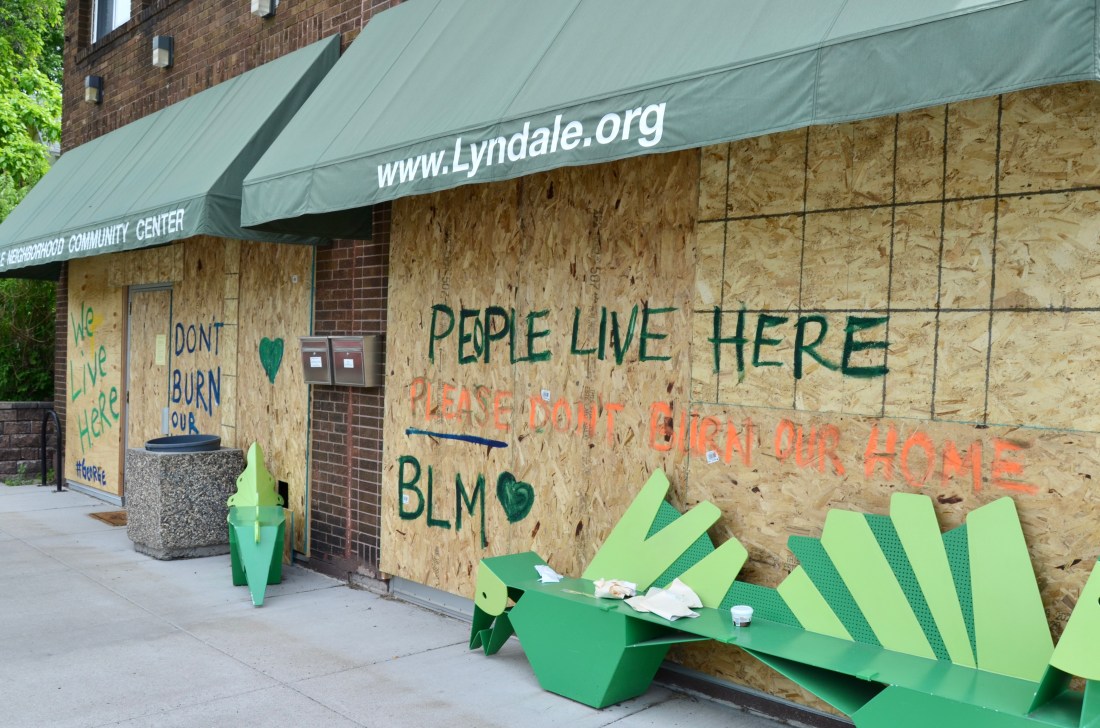
I doubt it is a surprise to anyone that Black Lives Matters cannot account for $60 million of the $90 million they received in donations following the death of George Floyd. A recent purchase of a 6500 square foot mansion with pool, studio and many other flashy features drew attention to the organization’s finances.
The report has further fueled questions about BLM’s finances barely a year after it released the first look into its finances. The foundation said it collected over $90 million in 2020 alone and committed $21.7 million in funding to various BLM chapters and grassroots organizations. With its operating budget set at $8.4 million, more than $60 million was unaccounted for.
Black Lives Matter purchases $6 million property with donation money
The group didn’t always attract large sums of money. It started as a hashtag #Blacklivesmatters in 2013. The call to arms took hold and grew into the rally call for protests following detrimental treatment of black Americans by the police and justice system. For many years the work involved organizing protests following the deaths of Trayvon Martin, Michael Brown, and Eric Garner.
If the social product is to reset conduct toward a minority group in and around criminal activity, BLM is the marketing arm of the industry.
In 2020 social media drew world-wide attention when a teenage girl filmed the death of a black man while a police officer held a knee to his neck. The dramatic unfurling of anger, protests, outside influence, sabotage, precinct burning, national guard intervention were all branded by the Black Lives Matter hashtag. When people (consumers) wanted to respond to unfair treatment to fellow human being, as the natural human response leads them to do, they sent their resources to BLM. But this is the same as sending money to the advertisers who create TV ads (sorry I’m old!) instead of paying the company in question directly and receiving a good in return.
BLM is an activist organization, a group that wants to shed light on an issue. The $90 million went to the advertisers not to actors within the system which needs correcting. And since they are not in a position to really change anything within the police/justice schematic, the money is too easily grifted.
Most people have a pretty good grasp on theft. An object belongs to one person and someone else takes it. There’s an ownership issue and a transference of the item or cash to another without knowledge or permission. For instance, a few weeks ago the news carried a story of an employee at Yale stealing electronic equipment. She ordered equipment over and above what was needed, sold the surplus, and pocketed upwards of $40Million. That’s a lot of cash.
One can only assume that she was able to get away with the scam for that long because she was in a position of trust. The status of employees was beyond reproach and hence normal protocols of employees taking at minimum a week’s vacation were waved away. This last part is social theft. It’s distinct from material theft.
Let’s take another example. Bernie Madoff plead guilty in 2009 to running the largest Ponzi scheme in the world and was sentenced to 150 years in prison. Taking people’s money and not giving it back to them is old-fashioned theft. The social component of Madoff’s scheme was to rely on his community ties to feed his graft. Wikipedia calls it affinity fraud.
Madoff targeted wealthy American Jewish communities, using his in-group status to obtain investments from Jewish individuals and institutions. Affected Jewish charitable organizations considered victims of this affinity fraud include Hadassah, the Women’s Zionist Organization of America, the Elie Wiesel Foundation and Steven Spielberg‘s Wunderkinder Foundation. Jewish federations and hospitals lost millions of dollars, forcing some organizations to close. The Lappin Foundation, for instance, was forced to close temporarily because it had invested its funds with Madoff.[109]
When an actor internalizes a benefit received by being a member of a public group and then steals, the deceit is double.
As for many professions, Minnesota Realtors are required to complete fifteen hours of continuing education per annum to maintain their license. This coursework may cover a variety of issues, and some of it can be unexpectedly helpful. The required modules are often redundant or heavy on regulatory dates and descriptors. This year it revolves around discriminatory covenants written on deeds from the 1920s-to 1940s. These are reprehensible in their blatant racism toward non-Caucasians.
I think revisiting this history is important. We should be reminded that nice people, perhaps even relatives of local realtors, don’t always do nice things. That said, I think it is important to tell the story accurately. A portion, perhaps 20-25% of the lots, had exclusionary covenants. The portion of non-white residents in Minnesota at that time was less than 1% of the population.
I guess what I’m trying to point out is that just because a portion of a population can be criticized for what always should have been unlawful behavior, doesn’t mean that everyone behaved poorly. You don’t need an entire population to be in your home court to lead a happy and productive life. And to set that expectation will only lead to disappointment.

We’ve heard a lot about housing lately, in the press and from public policy types, but I’ve never thought the issue to be as dire as it is being portrayed. As a baseline, I thought it would be helpful to know just how many housing units are available for occupancy. The US census gives us this information.

I was surprised to see how stable the state’s profile has been over the last decade. In percentage terms, there has been little movement between the categories. We are well above the national average on the owner-occupied unit at just under 72%.
The population count for the state was just reported at 5.7 million. With an average household size of 2.6, the state needs 5.7 divided by 2.6, or 2.19 million homes. These can be townhomes or single-family, rentals, or mobile homes. Fortunately, the census shows that the state has 2.458 million units or 268,000 more units than reported by the US census workers.
There are all sorts of reason why units maybe empty. There will always be vacancies caused by folks in transit between residents. Some of the properties are second homes. But even with a vacancy rate of 10%, that still leaves 22,000 properties up for grabs.
I only point this out to suggest that there is a bit of slack in the system. How to get these units in use and available will only alleviate some of the pressures on housing demand.
I think the numbers above also allude to this sector being pretty stable over the last decade. Stories of fractures and implosions may have been overblown.
In Minnesota real estate agents are required to give clients an Agency Disclosure at first substantive contact. The commerce department’s concern is that salespeople, being all friendly and personable, hide who they are really working for in the transaction. A buyer’s rep sitting in a Parade of Home’s model, for instance, is working for the builder. Their agency is to secure the best price and terms for the contractor. A buyer who walks through the door may think they are working for them.
It is important for consumers to know the structure of representation. But not only in a real estate transaction. People hide their representation all the time. Take the on-going Minneapolis teachers’ strike. The message pouring out through social media is that ‘it is for the kids.’ (Thirty thousand in total who have not been in school since last week.) Yet the head of the teacher’s union reveals her true agency is to fight the patriarchy and capitalism.
Her intentions are misrepresented. In fact, one relative calculus might show that her actions are at the expense of the kids.
She is not the only organizer whose primary sphere of action is at odds with the cause they claim to represent. John Steinbeck’s novel In Dubious Battle depicts the organizers of a strike for farm laborers as separate, even outsiders, those they claim to represent. The (communist) party members’ objective, or their agency, isn’t to the workers but to the destruction of the power players, the Fruit Growers Association.
It might seem like a fine distinction, but through their actions one can see that it is not. The organizers in Steinbeck’s novel have no compassion for laborer who get hurt, or whether, in the end, they will be better off. The leader of the strike does not care that the school children, many of whom were already behind in their learning, are once again out of school. Their only objective is to unseat the power structure.
Perhaps the commerce department should oblige these organizers to pass out agency disclosures. Because the cost of their action is costly to our communities.
I think it would be hard at this moment to refute the notion that there is a social side to price. The ongoing conflict in eastern Europe provides ongoing evidence for the incorporation of both pecuniary and communal aspects of trade in a free market economy. It is clear that a barrel of oil at x price is not simply a barrel of oil at x price.
As countries who support a liberal world order scramble to reorient their trading partners for their energy needs, Americans in particular will see themselves underwriting this institution at the gas pump. The price paid for Russian oil was too low as no thought was given to the risk of dealing with people who blow up children’s hospitals. No accounting set aside a reserve.
This isn’t the first revelation of this kind in the last few years. Covid made clear the added expense of relying on overseas markets for things like protective wear and pharmaceuticals. The cost of a drug is cheap until your foreign supplier cuts you off. Then, as the commercial goes, it’s priceless. I think it’s plain to see there is some other equilibrium. And this includes a social cost component of price.
Just to further dig into the structure of my theory, let’s get back to oil and how there came to be a dependence on an unsavory trading partner. Although the US is capable of being energy self-sufficient, there are pressures for climate activists to halt pipelines and oil drilling operations. What’s wrong with that is they are advocating to solve a public problem in the wrong public. Climate change effects the globe and the public is the human race. Hence the economic implications are also global.
To isolate one country and feel good about cutting off their production while still consuming the good, just sourcing it from another country is, an aberration of a solution. And as most people who follow these things can point out, to force an inappropriate solution, simply means you pay elsewhere.
Tragically, this exchange is paying for the tanks and the bombs and the shells which are falling in Ukraine. Let’s become better accountants.
For quite a few years now the vertically integrated messaging apparatus has cut off their political opponents by selecting an identity group to support (whether requested or not) and cancelling those who objected to their activism. The feminist claimed they spoke for all women and those who didn’t support their agenda were against female aspirations. End of story.
Some good things came of this. A few workplace creeps were set ablaze by societal spotlights and had to scuttle away like coach roaches looking for the shadows. But recently it’s been clear that the ploy is mainly used to acquire power and not solve for a balance of resources amongst causes in a fair society. Those who have learned to turn the levers of control enjoy it so much they’ve forgotten the end game.
But how is it that a few can engage an army of not particularly political types to align with the interest du jour? Enter the woke. If you want to maintain your membership in the fashionably intellectual (dare I say elite?), then your conversation, your nodding and humming all must follow the woke agenda. Any lack of compassion for the latest identity group, any attempt to point out degrees or harm or beneficence, any suggestion that the support of one group would imply a detraction from another, ejects you from the cozy cocktail party with a scarlet letter and a do-not-invite notation in a communal address book.
I’m hopeful COVID has changed all this. The latest banter on a Facebook group conversation certainly suggests as much. A school district had just announced that children would no longer be required to wear masks at school. Inevitably there is the lazy parent who posts something about poor communication from the school board– which warrants a response in all caps: IF YOU TOOK THE TIME TO READ THEIR COMMUNICATION YOU WOULD GET IT. Then the activist pipes up. She can’t possibly imagine how people expect her child with health issues to attend a school lacking the necessary protection.
This accusation of putting a child at any risk would have been woke enough to silence any crowd- pre COVID that is. Twenty-four months of isolation and alternative schooling methods has generated a list of other grievances which come along with mask wearing. The settling of resources can no longer be pulled to the most aggrieved. People are evaluating trade-offs on albeit serious issues of health and education.
People are thinking for themselves again. A potential health concern is no longer the trump card it once was. There is a spectrum of tradeoffs concerning health. Let’s hope that reality makes its way into our regulatory bureaucracies.

TEIRESIAS:
You are the madman. There is no one here
Who will not curse you soon, as you curse me.
OEDIPUS:
You child of total night! I would not touch you,
Neither would any man who sees the sun.
TEIRESIAS:
True: it is not from you my fate will come.
That lies within Apollo’s competence,
As it is his concern.
OEDIPUS:
Tell me, who made
These fine discoveries? Kreon? or someone else?
TEIRESIAS:
Kreon is no threat. You weave your own doom.
OEDIPUS:
Wealth, power, craft of statesmanship!
Kingly position, everywhere admired!
What savage envy is stored up against these,
If Kreon, whom I trusted, Kreon my friend,
For this great office which the city once
Put in my hands unsought-if for this power
Kreon desires in secret to destroy me!
He has bought this decrepit fortune-teller, this
Collector of dirty pennies, this prophet fraud
Why, he is no more clairvoyant than I am!
And a bit further on the blind guy goes on.
TEIRESIAS:
You are a king. But where argument’s concerned
I am your man, as much a king as you.
I am not your servant, but Apollo’s.
I have no need of Kreon’s name.
Listen to me. You mock my blindness, do you?
But I say that you, with both your eyes, are blind:
You can not see the wretchedness of your life,
Nor in whose house you live, no, nor with whom.
Who are your father and mother? Can you tell me?
You do not even know the blind wrongs
That you have done them, on earth and in the world
below.
But the double lash of your parents’ curse will whip you
Out of this land some day, with only night
Upon your precious eyes.
Your cries then-where will they not be heard?
What fastness of Kithairon will not echo them?
And that bridal-descant of yours-you’ll know it then,
The song they sang when you came here to Thebes
And found your misguided berthing.
All this, and more, that you can not guess at now,
Will bring you to yourself among your children.
Be angry, then. Curse Kreon. Curse my words.
I tell you, no man that walks upon the earth
Shall be rooted out more horribly than you.

I have to say I’ve never read Don Quixote but the drawing of a slender man holding a spear, sitting astride a horse, with a windmill on the horizon quickly comes to mind. A one-line plot synopsis goes something like this: “Don Quixote is a middle-aged gentleman from the region of La Mancha in central Spain. Obsessed with the chivalrous ideals touted in books he has read, he decides to take up his lance and sword to defend the helpless and destroy the wicked.”
As the self-appointed knight goes looking for a fight he runs into all sorts of ruffians and ne’er-do-wells. He brings trouble upon himself and accomplishes little on behalf of the needy. So- here’s the question. Do high morals come first and then the search for those in need? Or is it best if those in need show themselves, so that their situations can be rectified? Perhaps Cervantes was trying to tip his hand indicating cards in favor of the later not the former.
Indeed, there is a story breaking in the Twin Cities right now that indicates if supply of funds is made available with lofty intentions, the criminals show up for the taking. And take they do. The Sahan Journal reports:
Between 2018 and 2021, Feeding Our Future accessed $244 million of federal child nutrition money. The FBI alleges that little of this money actually went to feed children. In a series of search warrants, the agency lists tens of millions of dollars allegedly redirected toward personal spending, including luxury cars, expensive property, and high-end travel.
Part of the quarter of a billion dollars went to fourteen properties including $2.8M for a Minneapolis mansion, $500K for a fourplex, $500K for an apartment in Nairobi, $2.5M for a commercial space on Lake St, $1.1M for two lake lots in Prior Lake, $575K for a home in Savage, $14K on lawn care, $87K on vehicles, $49K to travel agencies and the list goes on….
And what was it the non-profit professed to be doing in order to access those federal dollars? They claimed to feed 60,000 children in November of 2021 out of a small one-story building. Did the logistics of how all those children were descending on that location not occur to those in charge of dispersing funds?
It was just back in 2015 that a similar con was discovered involving fictitious daycare provision in the same community. The restitution at that time was reported at $4.6M but there were allegations that $100M had been funneled out of the country. Yet instead of calling out criminality, this is how the politician representing that the district responded.
State Rep. Ilhan Omar, DFL-Minneapolis, said she’s troubled by the reports of childcare fraud, but notes that the fraud investigations wouldn’t be possible without communication between DHS and the Somali community.
“Vilifying an entire community — as stories like this often do — does not serve justice or get results. Collaboration does,” said Omar in a statement responding to the Fox 9 story.
It seems to me that when administrators go looking for a cause they create a market which someone steps in and fills with a demand. Want a woke endeavor but can’t find one? – We can fix that! And sure enough. That kind of cash flow will find a pocket to line. I hope they realize Don Quixote was a bit mad.
Let’s speculate on reasons for the lack of trust brewing in the non-profit sector at the moment.
Cash- A notable seismic shift in philanthropy since the onslaught of apps and everything social is the ability to tap anyone’s good will. Set up a GoFundMe and boom- thousands of dollars appear. Lots of money on the move with little firsthand knowledge of how those dollars are being distributed is bound to give fodder to conspiracy theorists.
Case in point- GoFundMe recently refunded almost 10million to donors supporting the trucker rally in Canada after eligibility of purpose is scrutinized. Which leads to the next trust buster. The short synopsis which accompanies the funding request often lack a complete flushing out of context (which I hear is in scarce supply these days). The public gets caught up in the cause of the moment and then has donator remorse when they realize that perhaps they didn’t quite understand organization’s mission.
But to be fair, the replies to David Fahrenthold’s tweets range from medical fraud to mega churches, from patriotic themes like Wounded Warriors to AARP of all things. The gist seems to be that the feedback loops on the not-for-profit are waving in the wind like those crazy inflatable advertising men.
Say you lived in a small rural community. Maybe there is one main grocery store in town and three churches of various denominations. All grades k-12 are taught in one building, with the younger ages on one side of the building complex. The senior high kids get the classrooms closest to the gym and the middle schoolers fill the classrooms sandwiched in between. Busses bring in kids from rural route addresses.
Now imagine one family is experiencing financial difficulties and the couple is separating. The land they farm came down through her family, so she is staying on the site to try to make a go of it. Eighteen months in, the past due notices are piling up and she comes to terms with the reality of having to sell. Normally this productive land is swept up by competing farmers wanting to increase their holdings. The nearby owners are usually particularly interested as the expense to move large farm equipment like combines is expensive. But the sale stalls- why?
In a small, isolated community there are only so many social activities, through church or the school sports or maybe a community center. When you run into someone at the high school basketball game or service on Sunday you don’t want to read across your neighbor’s face that they think you took advantage of their misfortune. When the idea is to get out and enjoy a round a golf or relax over a beer at the VFW, you don’t want to run into the lady who may feel like you stole her inheritance.
The paradox is that community is meant to be there for each other when times are bad. But in this case the aversion of being accused of profiteering is damaging to those who need help the most. And this is how an outsider can step in, easily appraise a favorable situation and finalize the purchase. The cost of social stigma is not felt by the outsider.
This a corruption of some kind. The community breaks its own rules and allows a profit to leave the group for another. A sense of loss remains. People turn on the outsider. They are the profiteer! They are not to be trusted.


A couple weeks have gone by since the trillion dollar infrastructure bill was signed by President Biden. The bipartisan consensus for the deal appears to have been truly representative of public opinion as there has been little bickering or negative chatter since the announcement. However, politicians are balking at the Build Back Better plan.
I think the difference between the two forms of public investment is at the crux of why one is a yes and the other a no. The first package supports just about every form of durable infrastructure in the US today: roads, bridges, rail, airports, public transit, water, broadband. It is basically bonus bucks for all the things we have approved and used for decades. All notably in need of refurbishing. The dollars will leave the public sphere, and pay private contractors to pave the roads, install broadband, and beef up the power grid.
The second bill is not about durables. The second proposal is centered around the work that is done to provide public services such as child care, understanding and reducing environmental damage, health and wellness objectives, and the work to supervise who’s paying how much for what. The problem with agreeing to pay for such things is that we have little or no tracking which lends an understanding the return on the requested inputs. Call the American public a good consumer for wishing to be clear on their purchase before laying their cash out on the table.
The other haziness which obscures the ability to picture the second bill’s outcomes is the crude lumping of groups of people together by income. How children are raised in their younger years is accomplished through many different family arrangements and objectives- despite income. I think the fear is that throwing money around without discerning the work in play will at minimum be wasteful. And often when the dynamics of work is not understood, bad actors show up to ride the seams and take advantage of the ignorance.
The work to stay healthy and use health care dollars wisely, or to minimize pollution, or the work necessary to keep businesses on the up and up with tax payments, all of this type of work occurs in systems. There are groups with goals; there are incentives; and there is a dynamics to it. And to propose launching a whole bunch of cash at systems without understanding them makes for uncertain consumers.
On the one hand people worry that improving disadvantage neighborhoods will cause the evils of gentrification:
Now planners are trying to figure out how best to weave through north Minneapolis on the way to the northwest suburbs. But many people along the route fear real estate speculation and increased investment will render their neighborhoods less affordable. Hennepin County hired the University of Minnesota to study potential gentrification impacts and recommend anti-displacement strategies along the route—a first in Minnesota transit history.
Sahan Journal email newsletter
On the other hand there’s dismay that property values do not increase in disadvantaged neighborhoods. Here’s a headline and intro paragraph to an article in todays New York Times:
Wouldn’t it be ironic if the same forces against gentrification were perpetuating poverty in neighborhoods they thought they were protecting?

Dictionary.com is my go to for spelling and definitions. I get their word of the day in my email box and amuse myself (as time permits) taking their quizzes. Today they had a click bait section on the different names for Satan.
Perhaps the most well-known name for the Devil is Satan. This name appears repeatedly in the Bible, such as in Luke 22:3 when the Devil is blamed for Judas Iscariot’s betrayal of Jesus Christ: Then entered Satan into Judas surnamed Iscariot, being of the number of the twelve.
The name Satan is recorded in English before the year 900. The English word comes through the Greek Satán from the Hebrew word śātān meaning “adversary.” Whatever name he goes by, the Devil is said to be the adversary of God: the Devil is out to destroy God’s work or to tempt humanity into turning away from God toward evil.
Many of the references come from the Christian tradition, but fear not. A similar nefarious force appears across cultures.
Of course, the Devil appears in Muslim scripture as well. Ash-Shaytān comes from the Arabic al-Shaytān and is etymologically connected to the English Satan. The “ash” or “al” indicates that one is talking about the Devil (with a capital D) as opposed to a devil or demon.
The name Ash-Shaytān has several different variants in Arabic, including Shaytan, Shaitan, and Sheitan.
https://www.dictionary.com/e/s/devil-names/#1
I bring this up only because when people write about failed institutions the fall guy or gal is always a leader of some sort. The blame is laid at the feet of some the top banker, bureaucrat, general or prominent figure. I can’t really see how institutions fail due to one individual, powerful or not. The implementation of services and work following the guidance of norms rests with all the hundreds of individuals who partake in the activity.
Institutions can fail because humans are subject to weaknesses. Whether it is a Jinn sitting on a shoulder, or a dark force rustling through the trees, the inclination for each and every person to be tempted into a corruption large or small is real. Do you know of a teacher who has marked down a grade because they found the student arrogant? Or a banker who omitted to waive some promotional fees because the customer had been a you-know-what?
These are small corruptions. But they are real. The great recession of 2008 was a pyramid of small to progressively large corruption at every level of the mortgage industry; from the loan processors all the way up to packaging of the investment portfolios. Sure everyone wants to go after the high buck Wall Street guys, but $40/yr title closers were prosecuted for fraud as well.
Maybe due to my Christian background it is easy for me to accept that temptations are present and real. That human weakness is part of the deal. But it seems like the way the story is often told is that the average person is neutral to good, and only those with a lot to gain or loose can be tempted. It is erroneous in the the same way that the gift of charity is only considered a plus on the spread sheet of social accounting.
Whatever framework is used for the mechanics of institutional production, it must allow for negative numbers. For as dictionary.com reminds us today, there are evil forces everpresent amongst us.

Here’s a story about skin in the game.
I was a little irritated with the library folks during the whole Covid thing. I felt the restrictions on library access carried on well past the point of other ‘returning to normal’ trends. The buildings were completely closed to traffic for over a year and when they did reopen, patrons were allowed 15 minutes to retrieve their materials and leave. Finally, in recent months the branches have been open (with masks) for people to linger.
I had swung into a branch with tall airy ceilings and well spaced furniture to review a book that had popped into one of the blogs I follow. Skimming a book can give me a pretty good indication of whether I’ll want to devote time for the full read. In this case, I simply wanted to re-shelve it but given the sensitivity to the virus, I walked it back to the entrance area and book return.
I approached the lady peeking out from behind a large pump bottle of sanitizer gel (if I never smell sanitizer again it will be too soon), rubber gloved hands folded over each other just below her sky blue mask, with seemingly nothing to do. She pointed over to the book return conveyor belt. But next time, she said, I should go ahead and shelf the book myself. The protections, it seems were just for her. Protecting the next patron from virus germs I could have left on the book, did not rise to her concern. Gels, masks, gloves were for some show, but not the one that protects the public.
In order to reveal how people really feel on an issue, calculate what they will give up, if anything, to achieve their ideal.

Taken from the Confessions of Saint Augustine:
But having then read those books of the Platonists, and thence been taught to search for incorporeal truth, I saw Thy invisible things, understood by those things which are made; and though cast back, I perceived what that was which through the darkness of my mind I was hindered from contemplating, being assured “That Thou wert, and wert infinite, and yet not diffused in space, finite or infinite; and that Thou truly art Who art the same ever, in no part nor motion varying; and that all other things are from Thee, on this most sure ground alone, that they are.” Of these things I was assured, yet too unsure to enjoy Thee. I prated as one well skilled; but had I not sought Thy way in Christ our Saviour, I had proved to be, not skilled, but killed. For now I had begun to wish to seem wise, being filled with mine own punishment, yet I did not mourn, but rather scorn, puffed up with knowledge. For where was that charity building upon the foundation of humility, which is Christ Jesus? or when should these books teach me it? Upon these, I believe, Thou therefore willedst that I should fall, before I studied Thy Scriptures, that it might be imprinted on my memory how I was affected by them; and that afterwards when my spirits were tamed through Thy books, and my wounds touched by Thy healing fingers, I might discern and distinguish between presumption and confession; between those who saw whither they were to go, yet saw not the way, and the way that leadeth not to behold only but to dwell in the beatific country. For had I first been formed in Thy Holy Scriptures, and hadst Thou in the familiar use of them grown sweet unto me, and had I then fallen upon those other volumes, they might perhaps have withdrawn me from the solid ground of piety, or, had I continued in that healthful frame which I had thence imbibed, I might have thought that it might have been obtained by the study of those books alone.

A friend and I met for dinner recently. As we sat on the outdoor patio with a woven fence providing a nice block from the concrete urban surroundings, we caught up on family and old acquaintances. Once those topics had run their course, the conversation turned to current events in the city. It’s hard for even the ardent supporters of liberal progressivism not to observe the denouement of crime around them. As cycles go, the recent swing has whipped the curve right off the edges of the paper.
“Jxx’s mom once told me that the best of intentions in excess, often mutate into the worst of outcomes.” She said, a forkful of Tuna Poke Bowl suspended midway between her plate and mouth.
Not just intentions, I thought later as our dinner conversation replayed, but those rallied by excessive analysis of history, and primed like a bonfire on the Fourth of July with the venom of anger unaddressed. No wonder Lake Street had been set ablaze.
History is a recall of the past, as a reminder of both the good, the bad, the productive, the detrimental, and how all of it came to be. History is to learn from, to recognize and to account for. To use the cognitive qualities of our brains, (those useful tissues which separate us from other mammals) to grow into something more than we were before.
I question who it helps to replay the worst of things again and again. Gnashing through history seems counter productive, erodes confidence amongst those who need their confidence rebuilt. Taking a group’s worst of times and displaying it on a jumbotron for all to relive, is, maybe even hurtful. And the motivation for those who rally such action may be spurred on by some inner and other anger.
Anger can turn a story into a saga. It may soothe one but create a burden on another, one of a younger generation, one in the audience. History isn’t meant to assuage miscellaneous anger, sending out sideway messages. History isn’t meant to be a tool to those who only wish to transfer their personal suffering onto a greater audience for their own peace.

There’s been a volleyball match all week in the courts to determine the destiny of a ballot question for Minneapolis voters. The issue at hand is the reporting structure of the Minneapolis Police Department, requiring its lead officer to be accountable to the mayor as well as the city council people. Presently the chief of police reports only to the mayor.
On Monday, Jamie Anderson, a Hennepin County Judge struck down the question for the second time in seven days. “The court finds that the current ballot language is vague, ambiguous and incapable of implementation, and is insufficient to identify the amendment clearly.” I think she even implied that it was deliberately misleading, but the quote eludes me now.
In the summer of 2020, eight of the thirteen city council people of Minneapolis stood on stage in a public park and made a pledge to Defund the Police. It turns out the pledge was the easy part. Little progress has been made in the crafting and architecture of a program that would replace traditional policing with something better.
Meanwhile crime has escalated citywide. Violent crimes are up about 20 percent. The police force is down twenty percent.
Two of the council members from this heady period are not seeking reelection, including the City Council President, Lisa Bender, citing family reasons. Still- an organization called Yes 4 Minneapolis plunders forward with a political answer to the city woes when a utilitarian one proves elusive.
One benefit of the bruhaha is that it has shown a spot light on the cleverly worded proposal meant to sound reasonable and caring. It has also risen to a loud enough public status that the Governor, and several state Senators have felt the need to weigh in against the city charter change.
Just a few hours ago, at the end of the work day, the Supreme Court of MN overturned the lower court ruling and granted the ballot question’s legitimacy. Just in time for early voting which starts tomorrow.

Someday I’ll have an academic explain how a study can be written and published when right in its text it admits that the concept in question fails to be validated. In the case of (US) food deserts:
Perhaps because of the wide variety of measures used and places examined,
Characteristics and Influential
study results have not reached a consensus on the characteristics of areas
that lack access to healthy food. Studies have produced conflicting results as
to the correlation among race, income, and access to healthy and affordable
food. Many researchers have concluded that neighborhoods consisting
primarily of minorities—in particular, African Americans—with low
incomes have fewer supermarkets than wealthier, predominantly White
neighborhoods (Berg and Murdoch, 2008; Powell et al., 2006; Block et al.,
2008; Larson et al., 2009). Others, however, have found either no correlation,
or that minority and low-income neighborhoods have a greater number of
grocery stores and are closer to these stores than wealthier areas (Alwitt
and Donley, 1997; Moore and Diez Roux, 2006; Opfer, 2010; and Sharkey
and Horel, 2008). These mixed results may not be surprising because these
studies are of localized areas. However, results from the two national-level
studies are also inconclusive. Powell et al. (2006) found that ZIP Codes with
more minorities and lower income populations had fewer chain supermarkets
but more nonchain supermarkets. USDA (2009) found that, on average,
low-income and minority populations were closer to supermarkets than
higher income individuals and non-Hispanic Whites.
Factors of Food Deserts, by Paula Dutko
Michele Ver Ploeg
Tracey Farrigan
I don’t get it.
Are there truly so few good ideas that we have to pursue those which have no backing? Are we such a wealthy country that we can afford to throw money at inconclusive results?
Or do we want so badly to offer an answer, that a corruption is better than nothing at all?

As a young adult I couldn’t figure out why my other liberal arts college friends rejected Wal-Mart for the more upscale Target for their basic shopping needs. Prices were better at the first (at least back then) and after living abroad where open air markets and shops with expired grocery items were common, lights, electricity and working refrigeration seemed luxury enough.
I was standing in line for the cash register one evening, after a long day at work, when it became clear. A few customers back in line, a mom taunted her toddler’s bad behavior with something intended to be discipline. Predictably, a wail spewed forth from the chunky cherub who was probably as tired as the rest of us. (It isn’t necessarily the big red carts which roll noiselessly over polished floors that make the bullseye more pleasant.)
Or, most of us have been at a social gathering where a couple simply can not contain the anguish currently residing between them. One throws an upper cut in the form of a small quip. The other gives an eye roll or swallows a guffaw. Their negative energy swills around the party on commentary and off the cuff remarks.
When I was at college we never framed each other up by political orientation. Well– almost never. There were a few jokes at the expense of the president of the Young Republicans (very ardent!). And the sandal wearing, longhaired hippy whose clothes billowed out marijuana odors might have been the butt of a joke or two. But nothing remotely similar to the angst experience on campus prior to Covid.
A mom is free to reprimand her child in public, but I’m not sure it is as productive as waiting until they get back to a quiet one-on-one setting. A couple is free to duke it out at a social gathering, but will find themselves alone with their problems once at home. Students can sign petitions, and march and jeer at the opposing parties. And here, I am sure they are ruining part of the experience that is called college.
All the hoopla around advocating for one’s political opinions has not proven to be all that productive either. If the taking of a knee, the shouting through a bull horn, the waiving of a flag is not advancing the cause, then it’s only being profitable to the petitioner. It’s really a privatization of a public concern.
Freedom of speech is precious and should be cherished. An audience can be receptive to the grifters who use it provocatively, or we can gently suggest a more appropriate place for personal conversations.

You know how you feel the same as you did when you were twenty years younger, or thirty-five years younger? The thoughts you carry are often the same, or slightly developed. So this leads us to think our physical appearance, or age, may just as well be the same too. The shock only sets in when, for example, a newscaster on the nightly news looks to be about twelve. That’ll make you straighten up.
This isn’t the only thing in life we fool ourselves about. For some inexplicable reason we all are blinded to many of our own flaws. For that matter we don’t always see our strengths very well either. As good as the mind can be at analysis and observation of others, being frank with ourselves is out of reach.
This can be a problem. Perhaps we don’t realize our potential. Perhaps we pursue the wrong things. Perhaps we get ourselves into trouble by telling ourselves we’re really not doing the things we are in fact doing.
It should be as easy as looking into a mirror. And in a way it can be. Most of you have probably noticed how we carry similar traits as our families. I didn’t grow up in close proximity to my cousins, but when we get together our phrasing can sing out the same tone and emphasis. In addition to physical traits, families carry interactive traits. And in observing these we can fit ourselves into the potential of similar activities. We can learn from it.
So when you see your families tomorrow for your Fourth of July celebration, appreciate that they are all reflecting little mirrors back at you. Take it in. Make the information useful. And thank them for this subtle unobtrusive feedback.
If you prefer drama to comedy I can recommend the HBO series The Wire. The first of five seasons came out in 2002 when the TV in our house was featuring Barney and Dora the Explorer. A crime drama portraying the grisly conflict between law enforcement and the (mostly drug) criminals wasn’t in the cards.
The story lines hold their own with intrigue and surprise, along with character development. Every season probes a new scheme, a new crew of gangsters, while bringing along the established cast and story threads from past seasons. From Wikipedia:
Set and produced in Baltimore, Maryland, The Wire introduces a different institution of the city and its relationship to law enforcement in each season, while retaining characters and advancing storylines from previous seasons. The five subjects are, in chronological order: the illegal drug trade, the seaport system, the city government and bureaucracy, education and schools, and the print news medium. Simon chose to set the show in Baltimore because of his familiarity with the city.[4]
What holds up so well is the consistency of the norms, whether they are those which the criminals obey or the ones the mainstream players abide. Each side has heroes and crooks, has chivalry and villainy. Each side has bad luck and good fortune. Each side has weakness and substance abuse. A few try to pass from one side to the next.
The Wire is lauded for its literary themes, its uncommonly accurate exploration of society and politics, and its realistic portrayal of urban life. Although during its original run, the series received only average ratings and never won any major television awards, it is now widely regarded as one of the greatest television shows of all time.
The Wire – Wikipedia
You will also realize how far technology has come in the last twenty years. The primary tool used to capture the drug dealers is “by getting up on their phone,” or getting court authority to tap phones. When the first season opens these are pay phones on the corners of the gritty streets of Baltimore.
As long as you can tolerate a little violence, it’s well worth a watch.

PETA finds offense in the naming of Ham Lake, a sleepy small town about a half hour north of the Twin Cities. It’s the type of town that when you call city hall with a question you actually get through to the person you need to talk to and he or she is more than willing to spend some time answering your inquire and filling in any background as needed. There is a minimum lot size of an acre which preserves the rural feel of a settlement on the outskirts of a major metro.
And who are these fine folks roofed in the hamlet of Ham Lake offending ? — Pigs, apparently.
“Pigs are smart, sensitive, wonderful individuals, so if we have a heart, we’ll leave their legs alone and choose yams over hams,” says PETA President Ingrid Newkirk. “PETA envisions a new ‘Yam Lake’ that promotes kindness and healthy eating.”
https://www.peta.org/media/news-releases/peta-yams-it-up-with-name-change-proposal-for-ham-lake/
There’s a lot going on in the world right now for attention to be devoted to a swine’s feelings, detectable or not. If an animal advocacy group can come up with nothing better than recommending name changes to small towns in Minnesota, perhaps they have out lived their cause.
In a family group, the demands of a sick child, or a temporary bout of unemployment, may have the group suspending other activities so as to devote all resources to the emergency at hand. The natural mechanism is to continuously reassess resource allocation as the need for advocacy subsides. Thus ensuring a mission expires once past its usefulness.
In large organizations such as PETA, which has 6.5 million members and supporters worldwide, the reassessing goes to the wayside. The mission perseveres. Ham Lake must see the err of its way and morph into Yam Lake. It’s for the pigs!
Public goods often exist in a nested structure. The household, the neighborhood, the ward, the city, the state. The classroom, the elementary school, the district, the states’ Department of Education. At what point is it clear that a rung on the ladder needs help in its delivery of the good?
Earlier in the month it was reported that a charter school, Cedar Riverside Community School, would be closing. It serves a neighborhood of high rise subsidized housing nestled between downtown and the University of Minnesota. Lauded as culturally sensitive in its delivery of education to a mostly Somali immigrant community, it has been plagued with threats of closure due to poor performance for more than a decade.
There are many good intentions, hopes and aspirations at the ground level for these types of grass roots public goods to be successful. But when are the price signals strong enough to cause the rung up the ladder to engage, and supplement the production of the good. When is the loss great enough to tip the efforts away from the local level and demand services from a superior level?
With the bright flood lights of the world stage focused on our metro and its racial disparities, it’s hard not to imagine that the closure comes in the wake of last year’s events. It seems pretty costly and inefficient to wait for a crisis to fess up to the fact that these kids were not being served by their neighborhood school.
Maybe the better question is what are the powers in play which dampen or misalign the the signals of lost public good delivery? What stops the natural interactions of feedback and improvement that occur through the system elsewhere?
I can only speculate from afar, but it seems to boil down to two components: structure of (for pay) jobs and positions of power. An enterprise, whether a company or a school is composed of an interlocking group of paid employees. These are entities composed of W2 workers whose livelihoods depend on keeping the boat afloat. A company will sink if it fails to attracts consumers. As long as a school has a pool of students within its attendance boundaries, it will receive funding.
In a typical neighborhood, people with school age children will leave the neighborhood if they feel the schools are inadequate, while others would-be-buyers into the neighborhood will look to settle elsewhere. The dynamics is a little different in a neighborhood like Cedar Riverside as many of the residents are tied to their housing through subsidies. The lack of mobility creates a type of monopoly on the residents both for their support of the school as well as the political structure.
The end result is that the price signals–the signs that the pupils are failing to receive the public services which inevitably are an expense to them and their communities later in life–are muted. They are not able to exit. Their presence in the group is taken for granted by those in paying jobs and those with political power.
A few days ago I wrote an interpretation of a notion using an analogy to juggling plates. On the cover of Raghuran Rajan’s book, The Third Pillar, a disc is supported by three pillars. Think of these platters as holding political/economic ecosystems. The people on the plates are there voluntarily. But the more layers of plates, the easier it is to jump between them. If there is one plate up in the clouds and a bunch of plates jiggling away down by the parkay flooring, then people can only jump sideways, not upward.

On the cover of Raghuran Rajan’s book, The Third Pillar, a disc is supported by three pillars. Think of these platters as holding a political/economic ecosystem. The people on the plates are there voluntarily. But the more layers of plates, the easier it is to jump between them.
With this structure in mind, it is easier to see how societal systems require competent political figures at all levels, in turn providing greater freedom of movement between the platters. (And if you should imply from this mental drawing that those closer to the ground are somehow simpletons, you are not in my portrait, yet. Many people choose a simple rural life, for instance, regardless of their intellectual makeup)
There is, however, a natural nesting of authority, as all the plates are spinning in the same environment. So when decisions are made of an overarching nature, they come from the upper platters. A neighborhood does fine sorting out it’s dog park and garbage collection, but needs a city to set up sewers and water service. Then the county takes over with the county roads and the state with the freeways. What if there were no levels of government between caring for your own driveway and the interstate?
Here’s an example given by Raghuram Rajan in The Third Pillar.
Therefore, for example, they want him to procure a birth certificate for their child, who was delivered in their shack in a village far away from any medical clinic. The birth certificate is essential for the child to be admitted to the free government school, and no government officer will provide it with out suitable gratification, because he has no official document to rely on. The poor do not have the money to bribe so they plead for a call from the MP’s office, which will set the wheels of bureaucracy rolling. Once the child is in the local school, the child becomes the MP’s responsibility. When she gradu ates from high school, the MP has to find a college that will admit the student if her grades are modest, and when she gets a degree, he has to persuade some government office to give her a respectable secure job. And when she gets married, he will be invited to the wedding and be expected to give a suit able gift.
In a society where the typical government civil servant is neither civil nor a servant to the poor, the MP is the intermediary who will help the poor navigate the treacherous world. While the poor do not have the money to “purchase” public services that are their right, they have a vote that the politician wants. The politician does what he can to make life a little more tolerable for his poor constituents-a land right enforced here, subsidized medical services honored there. For this, he gets the gratitude of his voters, and more important, their vote. Tied to their MP via patronage, they do not really care about how the MP will vote on the bigger issues of the day, whether he supports tax-evading liquor barons, illegal miners, or industrial polluters, so long as these do not intrude directly in their already-hard lives.
The missing plates between the poor in this story and the MP causes a couple of errors in the system. Those who should be receiving support through a combination of reciprocal work and engagement have nothing to offer the person in authority but an unconditional vote. The vote contains no value in evaluating the higher level issues which do not effect their lives.
If the vote was going to an intermediary plate authority, one who could actually trade in meaningful services for the poor, social exchanges would be tested and evaluated and remediated through the system. A successful local politician, say at the city council level could become a candidate for state or county level responsibility. The omission of mid-tier ecosystems eliminates that possibility, allowing for private actors to step in and capture the needs at those levels, in fraudulent manners.
Whether intended or not, whether considered or not, the copyrights holders of Suess’ life work have realized a windfall. We can’t look into the hearts of men to know if they strategized for the money. Since Ted Geisel had no children of his own, we do know that these people are not his blood relatives.
I don’t think they expected the cash. They probably were horrified by the thought that they could be earning money off of anything of a systemic nature, and more than likely move in circles who feel the same way. Removing the books was a public service, a response, a tangible action.
Buyers thought otherwise. Some might say the buyers who pushed up the prices are part of ‘the problem.’ But I think most realize this is a group of people who feel this judgement-from-on-high of a beloved author is a miscarriage of cultural perspicacity. It follows a long list of similar actions that have yet to prove useful in tempering or solving this High-Stakes-Social-Issue (HSSI).
The fact remains that by withdrawing the product from the market, demand rose, and a pot of gold was found at the end of the rainbow. Indeed– signaling occurred. A signal to others who understand the social component of price and will now look for other opportunities to leverage and create their own pot of gold. It’s happened before. People were steered, profits were realized. Others found their nest egg fleeced.
My husband and I finally stumbled onto a movie last night that didn’t have me flicking the exit button after fifteen minutes. Netflix’s I Care a Lot twisted and turned enough to hold our attention.
It’s a battle between a nouveau riche con-woman and an established class con-man. But the story is kept au current by setting it in the middle of the how-to-care-for-aging-boomers dilemma. The portrayal of a nursing home as a lockdown facility is terrifyingly real, especially in times of covid when there has been strict control over who enters and exits through the magnetically locking entrance doors.
The protagonist is a bad ass feminist. She’s driven to out smart and out bully anyone in her path to success. She’s out to demonstrate how the work which usually falls to the domestic in a household, can instead be externalized into a lucrative business. Get the right doctor to assess memory loss and the right judge to legitimise her stewardship, and poof! She builds a portfolio of guardianships. Bend the rules a bit more, and it’s a cash cow bonanza.
The plot riffs off the ever too real issues simmering through many families. As mom and dad age, when do they become too forgetful (because being a little forgetful reaches well down into middle age)? Who gets to decide when an adult, a person of authority for decades, must forego their independence and turn everyday decisions over to another. An error of commission causes unhappy holiday gatherings. An error of omission invites scammers of all sorts to prey on the elderly.
Ezra Klein: San Francisco is about 48 percent white, but that falls to 15 percent for children enrolled in its public schools. For all the city’s vaunted progressivism, it has some of the highest private school enrollment numbers in the country — and many of those private schools have remained open. It looks, finally, like a deal with the teachers’ union is near that could bring kids back to the classroom, contingent on coronavirus cases continuing to fall citywide, but much damage has been done.
Eighty percent of my motivation to write commentary was due to folks like the ones described above. There was one in particular, who loved to call everyone a racist. But where did he send his kids to school?
So I guess I’m indebted to them.
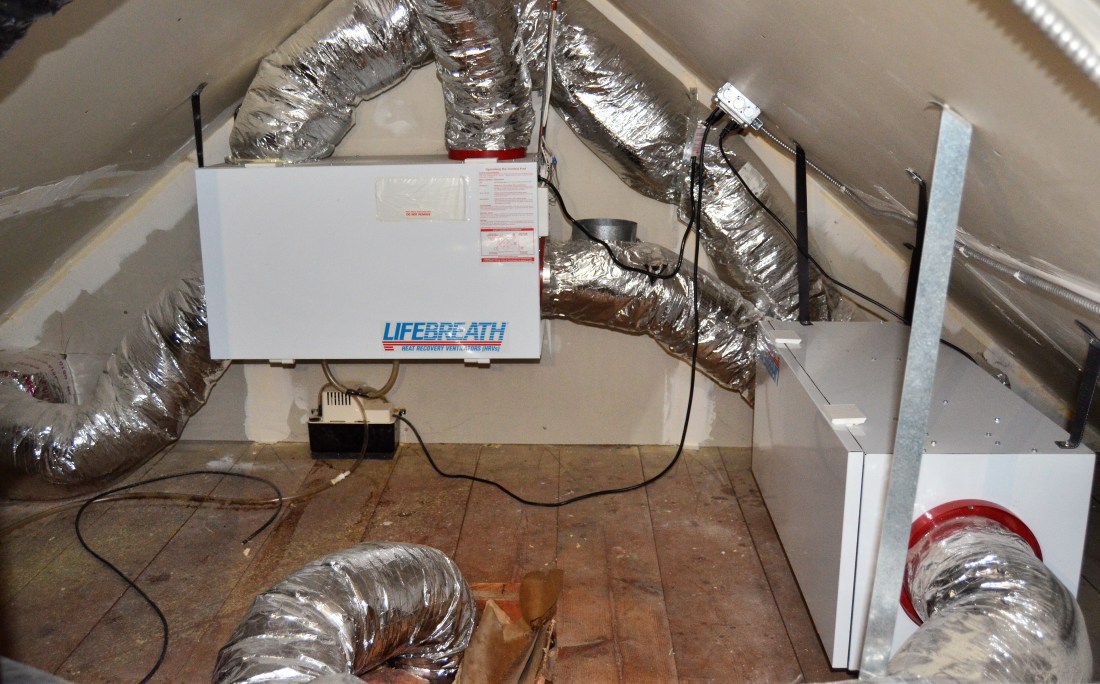
Say an individual, Bob, is concerned about a public good, like the environment. He decides to make a new year’s resolution to do something about it. Over a two to three year period, he activates others in his industry to legislate a testing requirement that costs the consumers, say, $200 on average per transaction. Note that this organizing and petitioning and writing communications and attending meetings was all done outside of the pay-check sphere of life.
One of the objectors to the added commission-for-the-public-good points out that, other than providing information, the testing will not give rise to any tangible reductions in green house emissions. Bob and his cohorts respond that doing something is better than doing nothing. Is he right?
Now let’s say that instead of doing the testing one could give the $200 to the client to not use their personal vehicle for a month, or to not take an airplane trip. In both scenarios there would be a measurable and immediate impact on green house emissions. Given these choices, it’s fair to say that there are other ways to spend $200 which would result in a greater impact on the goal to reduce global warming.
Numbers must be run so the public has a means of comparison. While everyone is working on (lobbying for, debating in favor of) one idea, other more valuable ideas are neglected, omitted from the realm of public consideration. Even though no one received payment for their time, the capacity of a community to engage and respond was tapped. So despite Bob’s sincere interest in climate change, doing nothing is, in fact, better than advocating for an unsubstantiated claim.
Now let’s say Bob was particularly talented at organizing and galvanizing folks around a cause. And due to this success he continued to seek approval and status through this type of work. The impetus for action transforms to status seeking, increasing Bob’s private persona, versus the stated tangible impact to any group concern. Now, in an error of commission, a form of corruption, starts to germinate.
The answer is not to stop the Bobs of the world. Hardly. The intent of this blog is to encourage the meaningful enumeration of choices; to clarify the resources used as inputs and record the increases in public capacity and capital; the intent is to provide the information necessary to steer Bob’s ambitions to the most productive choices.
The word systemic keeps getting worked into the conversation these days. Like when kale was in fashion. Some healthy new food that all of a sudden is made part of every dish but you’re not really sure what you think about it. Systemic–it’s put out there in a more or less free standing sort of way without any follow-up examples or stories to prop-up exactly what the speaker means by it. What we are dished up is a description of a (negative) social outcome, one that occurred due to systemic issues.
Dictionary.com offers this: [səˈstemik] ADJECTIVE. 1. relating to a system, especially as opposed to a particular part. It seems we need to understand more about systems. A system is not the sum of its parts. Here is what Lebanese born author Nassim Taleb offers from his book Skin in the Game:
The main idea behind complex systems is that the ensemble behaves in way not predicted by the components. The interactions matter more than the nature of the units. Studying individual ants will never (one can safely say never for most such situations), never give us an idea on how the ant colony operates. For that, one needs to understand an ant colony as an ant colony, no less, no more, not a collection of ants. This is called an “emergent” property of the whole, by which parts and whole differ because what matters is the interactions between such parts.
from Skin in the Game
So this Thing, that is socially detrimental, happens across a system. But what exactly? What happens that lies beyond the responsibility of one individual, and that echoes within a larger group of activity, that culminates into whatever it is being voiced as systemic? The gist is the Thing is a series of inter-related activities erupting into the highly objectional scenario at hand.
But why settle for gists and innuendo? Why not name this Thing? Why not fully flush out what it is that stair steps its way through households and into communities, through vendors and corporations, through bureaucracies and governments?
Take the Enron Corporation story for example.
At the end of 2001, it was revealed that Enron’s reported financial condition was sustained by an institutionalized, systemic and creatively planned accounting fraud, known since as the Enron scandal. Enron has since become a well-known example of willful corporate fraud and corruption. The scandal also brought into question the accounting practices and activities of many corporations in the United States and was a factor in the enactment of the Sarbanes–Oxley Act of 2002. The scandal also affected the greater business world by causing the dissolution of the Arthur Andersen accounting firm, which had been Enron’s main auditor for years.[2]
There’s that word systemic again. At this (formally) worldwide energy company, accountants at all levels could have called out questionable practices but did not. Through failure to act the organization was complicit at all levels of covering up fraudulent accounting practices.
A contrarian might say, is that really fair? The employee’s contract is to fulfill their job description for a bi-weekly check. Today, in the bright of day, the deceit is clear. But in the rush of the workday was it muddled? When did the private contract between employer and employee take on a public obligation? If an employee calls out their supervisor, the writing is on the wall and the pink slip is in their in-box.
The systemic promoters are talking about failure within an entire organization. They’re saying that a weighting of choices throughout an energy company, or a government agency, or a group of neighbors, have social implications. That the cascading of choices of each ant in the system can allow for a horrific result. That each actor has a varying degree of control, of an ability to say no, of the choice to turn on the group and change its course.
So let’s name that little portion of something that could be done to stop a social ill, let’s call it work. The employee enters into a private contract for employment but carries a public obligation to disrupt actions which are contrary to established social compacts. The portion of obligation is tied to the level of ability to have an impact (you can’t really do much as a first year junior accountant). This is also work–it is work in the pubic sphere.
These systemic issues not only occur within private work life, but also the time we devote to our families and communities. When insufficient attention is paid to the elderly, we hear of abuses in nursing homes. When insufficient resources are paid to depression, there are suicides. These too are due to a piece-by-piece failure within the entirety to respond. These too are systemic.
The Thing is work, or housework if you prefer. Not the type of inflammatory action that the cancel culture takes to achieve their thoughts on their social need du jour. The work of stopping over and taking your depression prone niece out for a daily bout of fresh air; the work of maintaining the ballfields for the little leaguers; the work of staying late one day to scrutinize the accounting that seemed awry but you had to really take a few minutes to double check for inconsistencies. It’s the small bits of work by hundreds (of millions) of employees and community members to maintain a certain standard of established norms.
It’s fine to start the conversation with, “All these xyz bad things happened and it’s Systemic!” But we can’t exactly tackle the correcting measures without understanding where and how in the system work can be done to achieve a better future.
Alex Tabarrok recognized the passing of WV Judge Richard Neely on his blog site today. He credits the judge’s candor with getting his first paper published in 2003 in a good journal. His paper, written with Eric Helland, argued:
We argue that partisan elected judges have an incentive to redistribute wealth from out‐of‐state defendants (nonvoters) to in‐state plaintiffs (voters). We first test the hypothesis by using cross‐state data. We find a significant partisan effect after controlling for differences in injuries, state incomes, poverty levels, selection effects, and other factors. One difference that appears difficult to control for is that each state has its own tort law. In cases involving citizens of different states, federal judges decide disputes by using state law. Using these diversity‐of‐citizenship cases, we conclude that differences in awards are caused by differences in electoral systems, not by differences in state law.
But it is the judge’s very own words that confirm his economic motivation in his rulings.
As long as I am allowed to redistribute wealth from out-of-state companies to injured in-state plaintiffs, I shall continue to do so. Not only is my sleep enhanced when I give someone’s else money away, but so is my job security, because the in-state plaintiffs, their families, and their friends will reelect me. (Neely 1988, p. 4).
So what does this have to do with a post I recently wrote about Embrace, a women’s shelter in Wisconsin? The shelter’s director set up a GoFundMe page after she alienated local police by prominently advertising BLM signs around the facility. The goal was to replace $25K in funding that was pulled by the county. As of this morning the kitty is over $100K with a stated goal of $112K. I’m not sure how she picked that number, if there has been some sort of marketing strategy, to keep ratcheting up the goal as long as donors respond.
What I want people to see is the structure of the groups and the motivations for the economic activity between them. (It’s all about the group) In both cases there is a greater federal group. In both cases there is a smaller group; for judge Neely it was comprised of the citizens of WV, for the shelter it is the community which is within their service area. Both the judge and the director are extracting money from the larger group. One is unabashedly leveraging the law for the benefit of his constituents.
I question whether the other is providing full disclosure about the economic transaction that is still underway. Is there an assumption on the part of the greater public that their dollars are supporting an organization which serves a public effected by the concerns of BLM (whereas only a fifteenth of one percent of the population in this county is African American)? Or does the greater group understand they are funding a director who simply shares a similar ideology but has no power to actively contribute to the welfare of BLM?
In order to detect deceit or inefficiencies one must delineate the groups. One must also acknowledge the public nature of the motivations which drives the activity within the group–that anyone within the group receives access to the benefit. The judge, for example, rules in this way for all his constituents who found themselves in a similar conflict. That the services of the shelter are open to anyone within its service area.
Neither the judge nor the director evaluate whether the taking of resources from the greater group harm or diminishes services in some way to other members of the greater group. Their pursuit for funds is fulfilled under the nature of a private transaction, no different than how a corporation pursues funds for their services. This mode of competitive behavior happened recently when states bid against each other for PPE’s in the early days of the covid-19 crisis. Although they work as agents for a public, their obligation for such is only to the inner group.
Judge Neely was one of those confident individuals who scoffed at the traditional method of holding group norms behind a cloak of anonymity. For this we can be thankful, as his words confirm this social economic group structure and the motivation that drives its behavior.
The question of the day is what is the nature of work. Not work for which you receive a salary, but the work necessary for public production. Bill Green, professor of history at Augsburg College ponders this question in an interview with Cathy Wurzer of MPR. Here, the topic at hand is the toppling of a statue of Christopher Columbus. But it is his inquiry into determining whether such activity counts as work or whether there is some other commitment which is required to, in this case, neutralize the negative historical impact on minorities, which is interesting.
Without a definition, the wild west of interpretation has been unleashed. The loudest claimants promote their version: You must march on Washington! You must forego your police force! You must forego your career (as in the case of senator Al Franken). But did any of these three events materially contribute to the advancement of a single minority or woman? Or could we equate them more readily to exposing, hence a marketing of sorts, of the issues.
Why even does it matter whether we give work some shape, outline its boundaries? Let’s take the Women’s march on Washington in early 2017. It is reported that 470,000 people showed up in our nation’s capital. Many more across all the states. But we can assume that say 400,000 in Washington traveled to get there. So let’s say the whole weekend took 48 hours of their lives. Now say the median hourly wage in the US is $18.5/hour. So for two days of work these folks contributed the equivalent of $296 x 400,000=$118.4million. Use your own numbers, but it is a lot of cash.
The women marching in the photos don’t look destitute or oppressed. They are not themselves in need. They are there on behalf of others. And I believe their intentions were sincere. They undoubtedly felt this was work towards their cause. It just seems like they could have better used the $118.4 million to secure housing for a single mom and her elementary school child, for instance. Or part of that $118.4M could have guaranteed vocational training and mentorship for girls coming out of a foster home setting. There are so many gaps in the chain of needs.
It reminds me of the foreign aid packages from years gone by. They were intended to feed the poor, but the poor rarely saw a trace of it. The work done in a public sphere requires the parties to touch, to interact, to engage in a transaction of a public nature. All this cancelling and marching and firing is just drumming up a bunch of grandstanding.

For those who follow the blog you know that I’ve been harping on the distinction between public and private, club and common goods, here, here and here. In my view goods are not sorted in this manner. A hammer is a hammer. If it is used to fix my deck it is in service to me privately, if it is used build a Habitat for Humanity house it is providing a public service to house the unsheltered.
The reason it is necessary to resort this understanding is because it is how we can see corruption. Corruption is not just up to politicians. A system can be corrupt and individuals, small groups and so on. When a set of rules are put into play, but then through cloaking and shading people (or groups of people) pursue other objectives, there is corruption.
Take the case of Embrace, a domestic violence shelter, that’s been in the news. The local police in Barron’s County Wisconsin objected to the posting of BLM posters around their building. And felt this posting calling out police violence, discredited their service. As a result public funding for the shelter was revoked. Here are the Huffington Post, Wisconsin Public Radio and the Washington Post articles.
Embrace states their core mission
To end violence, inspire hope and provide unwavering support to all people affected by domestic and sexual violence by engaging our community in safety, equality and partnership.
Now remember domestic violence persists when the normal social catches fail. When there are no close family members to pull their daughter, son or elderly parent out of an abusive situation. When there are no neighbors who notice excessive bruising and quietly offer the victim a way out. Domestic violence requires a formal force intervention because no other means of social exchange has worked or been available. And from what I understand, these types of calls are frequent and precarious for the police.
Given the necessity of the police to intervene in order to get the abused to their doorstep, you would think the shelter would consider this public agency as a core part of their workplan. As to why the shelter declined to remove their signs, Katie Bement the shelter’s executive director told the Huff Post:
“We were approaching it from an accessibility standpoint,” she told HuffPost over Zoom on Thursday. “We needed to show that we’re safe for those communities of color.”
Yet Barron county’s black population is .14% (a fifteenth of 1 percent) of all residents. I’m not sure how many of those 62 people would be drive by the shelter first before making a call for help or finding them on-line. I don’t have the statistics from police response rates or the shelter’s service records, but I suspect the demographics of those receiving aid lines up with the 97%.
As much as the shelter would like to merge the work they do in Barron County with the objectives of BLM the demographics seems to deny them this reality. The group they provide services to are overwhelmingly, if not completely unaffected by the concerns of BLM. In fact the two missions are at odds with one another as the later has diminished the abilities of police to provide security nationwide. Which is undoubtedly why the county pulled funding.
Now back to corruption.
Within a day of the Huffington post article being run, a GoFundMe page was set up for the shelter. Before dinnertime they had surpassed their $25K goal. As of this morning (screen shot included) the page is reporting a kitty of over $69K. Would the shelter have been able to raise this funding without the BLM story behind it? By accepting these donations has the shelter’s mission changed?
If you publish one set of objectives yet acquire funding for another, it seems that you are at odds with your group. It’s not that groups can’t change their rules or objectives, its just that you have to be clear about them so people know what they how their resources are being invested.
Personal safety is a deal breaker for most residents. If they do not feel safe in their own home do to gun violence, car jackings and even break-ins, they will move.
It’s all in the comments. Here are just a few from this post.


The enforcement of norms is an everyday event. Whether through disapproving looks across a bin of oranges at the grocery store in response to a parent’s disciplining techniques, or the scoff of disbelief at your friend’s new beau’s use of culturally insensitive language, or showing up to work with a card and flowers for a co-worker who recently lost a spouse. The behavior of shaping, criticizing or supporting of each other is judged and metered out with eye movements, gestures, and offers to help.
Once an infraction is deemed serious, it is made a law- you shall be prosecuted if you leave your toddler in a hot car while you shop. There is a lot of ground covered, a lot of degrees of severity and risk in parental actions, between scolding a toddler over a pyramid of piled up produce and locking someone up for child endangerment. But everyone can agree that we are all better off by formally acknowledging a certain threshold of acceptable behavior and enforcing persecution against those who cross over.
We are all better off knowing we can drink tap water from the faucet and that our houses won’t crumble overhead, and we can feed our kids hotdogs from the concessions stands at the Little League games. Accepting these standards and counting on a system, comprised of a series of reportings and enforcements, will maintain the freedom to move in and between communities safely. This is a social advantage we often take for granted.
It can also be shown that at some point there are diminishing return to regulations as their burdens cause detriments that are costly. Most of these arguments set up a discord revolving around health and safety (often tied in with the environment) versus the ability to supply families with income from a job. But this source of monetary capital also affects a person’s ability to lead a healthy safe life. You end up with this big teeter-totter where on one side all the variables set to maximize production of industry are weighted, and on the other, all the variables set to maximize social concerns piled up. What we want to find is at what point where the board finds balance.
Since this topic will be the question of this century, let’s start with a wide angle view in considering the use of regulation to keep the teeter-totter level.
Regulations for commercial enterprises seem to ratchet-up more freely than to release and reevaluate. There are many indications that the systems in place which regulate commerce, (often bureaucracies like Departments of Commerce and Federal Administrations, but cities as well) are not getting the feedback necessary to properly account for all the downsides to their actions. Things at the city and county level work fairly well. Yet, I propose that in the case of big business the intended beneficiaries of the regulation are removed from the system. They do not receive an accurate evaluation of the issues nor a proper accounting. And except to become activists at times of tragedy, they fail to regularly communicate with the regulating agencies.
For purposes of contrast, first consider water quality which is administered at the city level. Complaints about the water filter up through the city council and can be voiced at open city council meetings. Elected officials respond to constituents, especially those who show up. Even city staff feel the pressure when the seats are all taken in the normally hushed city council chambers. Other than the very notable example of Flint MI (and undoubtedly a few under-reported incidents) potable water is successfully provided to 331 million people in the US.
Take hot dogs at a concession stand. The county public health people have the power to decide the cleanliness of the two-windowed, wood clad concession stand with its pretzel warmer and popcorn popper and slushy machine. It is in their power to have it to meet the same standards as a science lab, of they so choose. But the regulator, who is more than likely a part of the community, knows that if the rules checklist becomes too long, making the workload too great for the already tapped, completely volunteer workforce to handle, it will shut down. No concessions, no extra money. No extra money, no new uniforms or dugouts, or pitcher mounds. Do ballfield concession stands or Rotary pancake breakfasts really need to be run at restaurant level standards of cleanliness to keep people safe? Or is there some other level that is ‘good enough’ that won’t squelch to whole endeavor?
Regulation of businesses, however, are missing the community tie-in. Commercial enterprises are regulated by bureaucracies, where people develop careers and other monetary incentives to successfully develop and implement regulations. It’s their job. The purpose of the position is to protect the consumer, where more protection always seems better.
This system removes the citizens that show up at the council meeting both in favor and against city action from the system. The bureaucrats judge and evaluate. They search for evidence to justify their position, not from the public, but from other detached experts. The consumer who can best express the complete picture of tradeoffs for their particular lot in life, has no routine forum. The next closest party to the transaction is the business person who hears and tries to comply with the requests of the consumers. Yet he/she is considered tainted by a money motive, and hence regarded with suspicion or often disregarded.
With the absence of a consumer evaluator, there is no system wide continual assessment of the costs and benefits of the regulation. There is no dynamic information being provided to determine when the regulation has gone too far and is causing too great of a burden.
So what to do? One solution is to consider how people live, by considering their revealed preferences. Testing, if you will, where the new standards are in relation to what the population expresses as their acceptable risk level. For instance, say you have a city that imposes a rental property review based on a scoring system comprised of a four page list of items. Missing smoke detector 5 points, missing receptacle plate 2 points, no furnace tune-up in the last year 5 point, ripped window screen 1 point, etc.. When the property scores 20 or more the renters must vacate the property as it is deemed inhabitual.
Now let’s say the assessment is used on the other 23 homes on the block. If 75 percent of them failed then it seems that the review checklist is too stringent. The regulator are basically saying to its own constituents that their standard of house maintenance are inadequate and they must move. (How do you think that would go over?)
Think of how this came about. The property regulators were trying to do right by the tenants, trying to get rid of the slumlords. They developed a tool that would allow them to put a handful of bad actors out of business. They get little community objection. Even very acceptable landlords are going to stay quiet when heavy handed regulation is in the mix as they are fearful of retaliation. But by setting a standard well above the average accepted living conditions, the regulators have raised the cost of providing housing. Since cost is reflected in rents, this causes undo pressure on affordable rentals.
Indexing off a general-population-standard may not be the end-all-be-all, but it would provide a starting point for the group. If analysis showed reasons for regulators to require more out of a subgroup (rental property), than at least this could be publicly discussed and agreed upon. But forcing the landlords to provide housing units at a higher standard than the average, and hence places undue costs on the provision of housing, avoids a proper accounting. This leads to endless circular discussions about the lack of affordable housing and whose to blame and whose to pay.
Furthermore when regulations don’t match the populations expectations, people resort to go-arounds until the formal rules are disregarded entirely. The highway speed limit debate that started in the early seventies left the public conversation once States set their driving limit to how fast motorists tended drive.
As a part of the system, development, implementation and enforcement of regulations need to be influenced by all actors. When a bureaucracy takes on an agency of their own, which allows them a power position which in effect rebuffs feedback from the general population. Using an indexing method for the group would at least reveal an average standard. It would provide an initial means of analysis. Ideally, even in situations of complex issues there could be a greater transparency with all the costs at hand. And in this way the average citizen could participate in a continual feedback loop while they assess their costs. Without this participation we are simply creating a power void ready to be filled by bureaucratic czars.
We’ve lost track of regulation by allowing it to jump out of the mechanics of the entire system. Lack of transparency and convoluted agency keep any meaningful accounting of the tradeoffs. In the same way that the business community’s opinion of the issues at hand are tainted by the money motive, so are the bureaucrats. They are incented to build their agencies, find new safety concerns, beat back business with zeal. So why are we surprised when they do so?

 Home Economics