Can you guess where?


Give it a try and put your guesses in the comments.
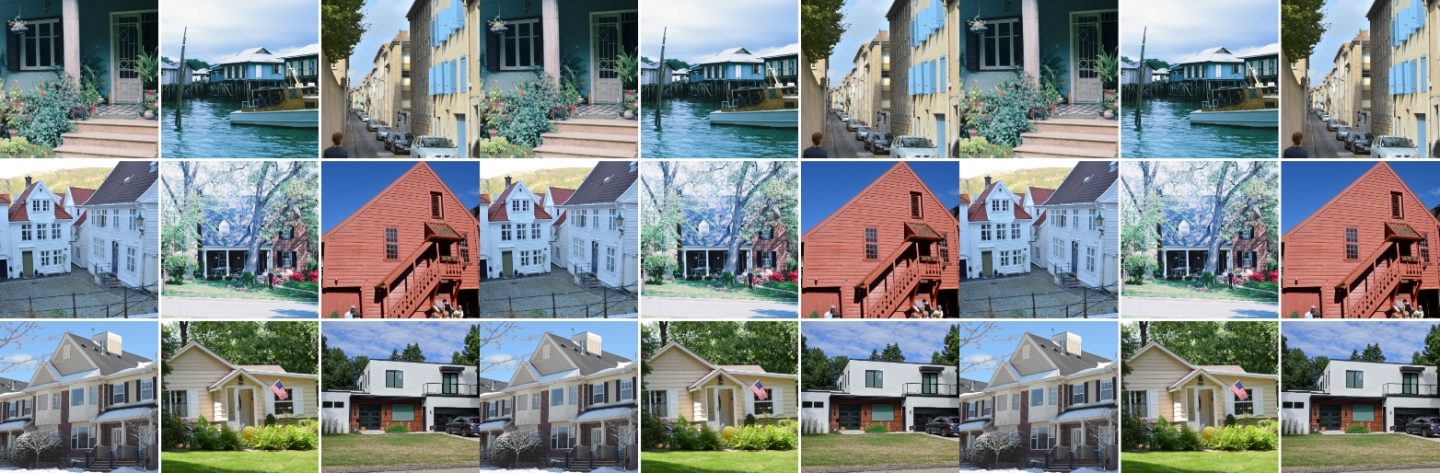
Searching for value
Can you guess where?
Give it a try and put your guesses in the comments.
After dabbling in a few more recent series and being disapointed, I decided to go way back to 1993 and try a classic. NYPD Blue was broadcast before TEVO or streaming so I’m sure I’ve only seen a handful of the episodes. It’s interesting to see how standards have changed in the last thirty years. Some issues are spot on the same.
The writing is much sharper and less predictable than most series. The characters have more depth. But then, that’s why it had a 12 season run.

I’m really enjoying this textbook on price theory by Deirdre Mccloskey. The explanations are lively and interesting. The book is available on-line at no cost.
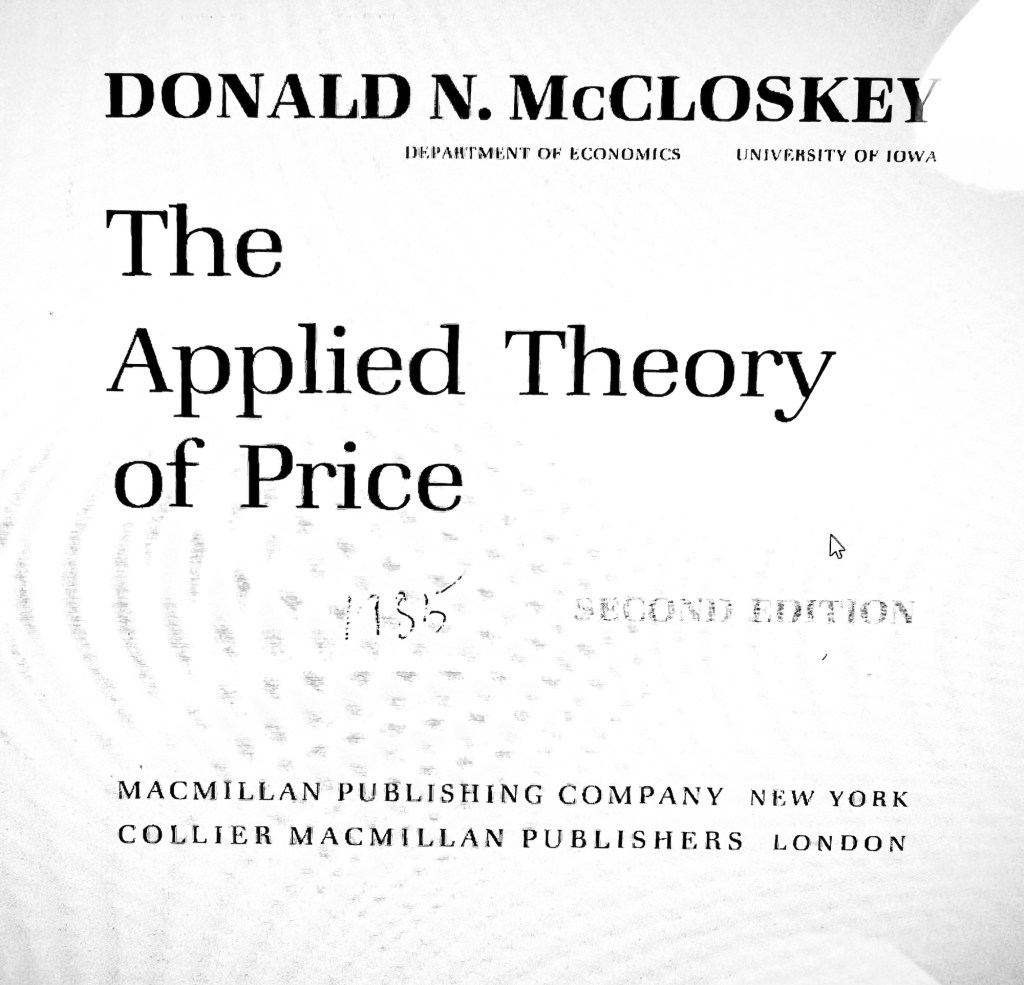
As mentionned in yesterday’s post, knowledge of bargaining techiniques for a good being transacted in the marketplace is valuable to market participants. McCloskey provides this example.
But economists have not discovered very much about what constitutes exceptionally subtle bargaining. There are profound reasons why this is so. Suppose that some bargaining technique were known to be useful when employed by the Soviets-such as threatening to abandon bargaining altogether in a week if the Germans do not accede by then to the terms demanded. The Germans would come to understand this. The Germans would use it themselves. Its usefulness to the Soviets, therefore, would vanish. In general, any knowledge that the analyst of the situation acquires can be expected to be acquired by the participants. They will alter their strategies in view of the knowledge, making the knowledge obsolete. The Soviet bargainers make a “last” offer. The German bargainers know that the offer is insincere (that there are quotation marks around “last”‘) and ignore it, making their own “last” offer. But the Soviets know that the Germans know that the Soviets “last'” offer is insincere and prepare a “real” last offer. But the Germans know that the Soviets know that the Germans know that the Soviets’ “last” offer is to be replaced by their “real” last offer, itself insincere. And so forth.
Chapter 5 – Trade, page 95
In the real estate world, transactions can take several months to come together. There is a shopping period, which is, at minimum, a few months even if a client has thought through the main parameters of their search like price points and physical attributes of the home. Then there is the waiting time for a seller with a home with just the right combination of features to put it on the market. If the first bid process is successful, the next delay is from time of signing the contract and doing a house inspection to closing. This is typically six weeks give or take.
It is not until a property closes, with a seller signing over a warranty deed and a buyer handing over a bag of cash, does the information about the transaction get revealed to the market at large. So the lague time from shopping for a home to having access the sales prices of similar properties is often half a year.
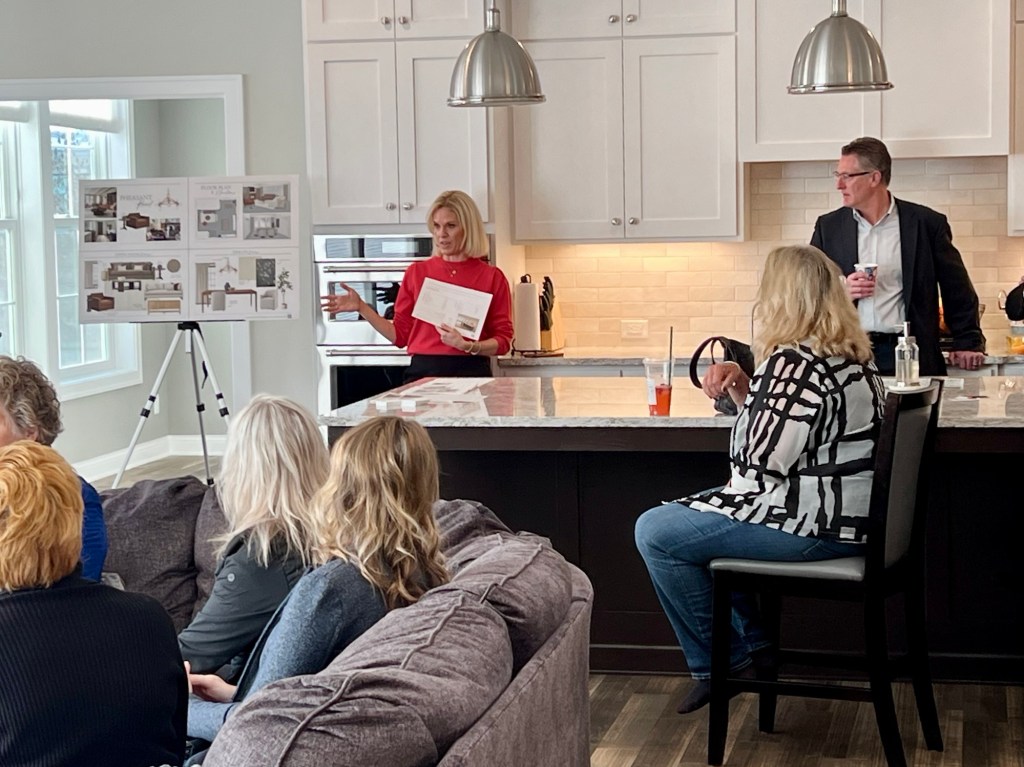
Agents that work with a large broker have the advantage of gather in meetings such as the one in the photo. Here people discuss in general terms the feel of the market. It’s useful to sense who has the upper hand in what sub-markets through antidotal evidence. Although specifics are never given out the tempo and general pace of activity is helpful.
Spring will come early this year.

The state legislative bodies just went back to work for the season. One item they are working on involves land use regulation. The libertarian in you mught thing, ugh more rules. Maybe that’s too quick a judgement. Maybe there’s more liberty than restraint in this case.
If an issue has risen to the attention of state politicians, than it’s possible it impacts all Minnesotans. Let’s call it the greater group or G-group. From Peter Callaghan’s tweet it sounds like the rules envolve restaints at the city level. Let’s call these groups C-groups. And then let’s keep households in the story and they’ll be H-groups.
So the line of reasoning goes, that due to land use restrictions at the local level, insufficient housing is being built. Since real estate is sold in an ever adjusting market, low supply rises prices for all participants. One might even argue that low supply is gumming up the market as single, older folks are sitting in large 3-4 bedroom homes as they have no where to go. So the opportunities for new buyers and move-up buyers to navigate to a new port-of-call is slowed. While those that would prefer to give up their large home, as they are no longer using but a quarter of it, are not finding appropriate options. Hence many participants in the H-group are not feeling very free.
The C-group is responsible for, over long periods of time, formalized language on the books to prevent hither dither building. This was all done to preserve the liberty of the H-group, at those points in time. The H-group had a certain idea of what their neighborhood was meant to be. It wasn’t meant to abutt a bowling alley, or a five story apartment building. The H-group wanted to drive down tree-lined streets past other single family homes just like theirs. They wanted consistency. They wanted tranquility. And with all the other options just a bit further out, their desires did not interfere with others in the G-groups
A few generations go by, and the metro area triples in population. The spacial relations evolve to something different. Those who were newlyweds hoping for a family now are elderly with low maintenance needs. The formal regulations set out be the C-group, which made perfect sense at the time, is putting a dam in a dynamic system. Instead of transforming itself under new demands, new needs are blocked at every turn.
And so the greater group is making a rule to take out the rule that is holding back the market. Call it a liberty rule instead of a regulation. For it is through transformation of the land to new uses that allows the C-group to arrive back at a balance of the greatest freedom for the best price.

Burnsville is a suburb of the Mpls/St Paul metro just over the Minnesota River from Hennepin County. In the early morning hours, two police officers and one first responder were shot and killed while negotiating with a homeowner who held his family of seven children captive in the property. This is the heartbreaking reality which may befall these civil servants.
Let’s honor their profession. Everyday.
People often conflate cooperation with doing good or what is right. The thought goes that is everyone just gets along and cooperates, than it’s a win for everyone. And getting along is exactly what those nice churchy people do when they reach out into the community with a helping hand to those in need. Out of a sense of duty to our fellow person, an altruist will act to augment the welfare of others.
And this is true. But there are other examples of cooperation that have not a thing to do with do-gooders in their Sunday best.
We’ve been reading David Skarbek’s book The Puzzle of Prison Order. It’s a thoughtful book of comparative analysis. By looking at various prisons, both their physical structures and their management structures, the author elucidates the emergence of a variety of levels of self-governence throughout the convict community. In South America, prisoners maybe responsible for virtually all necessities behind their wardens’ wall. While in Norway the prisoner to guard ratio is virtually one-on-one creating little need for the captive take on any duties.

From the case studies it is clear that where few services are provided, prisoners organize to allocate housing, maintain safety standards, and supplement the meager amount of food provided to them.
In San Pedro prison, governance emerges in the political realm (in the form of housing associations), in the commercial realm (markets and exchange with the outside world), and in civil society (as with the parents association).
Whereas in Bolivia the time invested by the inmates is extensive, in a small Californian prison for the gay and trans population only one position was necessary to be the intermediary between the prison population and the guards. A House Mouse takes on the duties of go between with the prison staff. Skarbek’s examination of the various spontaneous arrangement throws light on the various levels of investments demanded of the convicts. Depending on the need for governance, individuals rise to the occasion and donate their labor hours to the endeavor (one might say the socially necessary amount of labor hours, but that’s for another post).
But wait. It’s easy to forget that these are criminals who have been removed from civil society. Their emerging cooperation is forced upon them as a result of immoral behavior against their countrymen and women. They are not do-gooders. They are not altruists- at least not to the outside. Altruism delivered through self-organization is to noone’s benefit but them and theirs. And the moral behavior is dictated by their own set of rules.
Cooperation is a descriptor for a type of societal action. It’s the act of foregoing a bit of freedom to be apart of a group. Cooperation is a technique to attain an aim for an ingroup while withholding it from an outgroup. Cooperation has no moral compass. Resulting outcomes can either be good or bad depending on which wall surrounds you.
It is not equivalent to altruism. Altruism is a gift for which no duty or repayment is required.
After devoting time to some movie duds, it was a delight to watch a comedy with a clever plot line. The film does a good job of contrasting the frivolity of distant social relationships versus the itimacy of the family. And in doing so says something about the value of the work necessary for such things.
The cast is impressive as well. But most of all I appreciated the laugh out loud moments.
Here’s a toast to the singular holiday that honors couples, the essential cornerstone of society.

Rent control is counter productive. From the Federal Reserve Bank of St. Louis:
Weighing Trade-offs
Economists generally have found that, while rent-control policies do restrict rents at more affordable rates, they can also lead to a reduction of rental stock and maintenance, thereby exacerbating affordable housing shortages. At the same time, the tenants of controlled units can benefit from lower costs and greater neighborhood stability—as long as they don’t move.4
For policymakers considering rent control, economics can help them anticipate possible effects and may even inform policy design for those who decide to pursue such policies. Given the trade-offs, policymakers must balance maintaining affordability for those with rental housing, while possibly shrinking the stock of affordable housing for others, especially when such housing is already in short supply.
What Are the Long-run Trade-offs of Rent-Control Policies?
Targeting a pecuniary benefit to a low-income group seems like an easy solution. The shift of funds from the property owners to a social value, however, promotes undesireable long-term social shortfalls. These include the convesion of rental property to owner occupied housing as the incentives cause landlords to exit the market. Or a deterioration in the quality of rental housing as, again over a longer time frame, long term maintenance becomes more difficult to fund.

by Emily Dickinson
They put Us far apart—

As separate as Sea

And Her unsown Peninsula—

We signified "These see"—


They took away our Eyes—

They thwarted Us with Guns—

"I see Thee" each responded straight

Through Telegraphic Signs—


With Dungeons—They devised—

But through their thickest skill—

And their opaquest Adamant—

Our Souls saw—just as well—


They summoned Us to die—

With sweet alacrity

We stood upon our stapled feet—

Condemned—but just—to see—


Permission to recant—

Permission to forget—

We turned our backs upon the Sun

For perjury of that—


Not Either—noticed Death—

Of Paradise—aware—

Each other's Face—was all the Disc

Each other's setting—saw—
In Chapter 3 of An Economic Theory of Democracy, the Anthony Downs suggests government services delivered to neighborhoods be measured by their utility.
All citizens are constantly receiving streams of benefits from government activities. Their streets are policed, water purified, roads repaired, shores defended, garbage removed, weather forecast, etc. These benefits are exactly like the benefits they receive from private economic activity and are identified as government-caused only by their source. Of course, there are enormous qualitative differences between the benefits received, say, from national defense and from eating mince pie for dessert. But no matter how diverse, all benefits must be reduced to some common denominator for purposes of allocating scarce resources. This is equally true of benefits within the private sector. The common denominator used in this process we call utility.
What he goes onto say is interesting as well. The reliability of government services in policing your streets, delivery your mail or making sure that potable water is shows up in your pipes should be thought of as a flow of utility income.
Using this broad concept of utility, we can speak of a utility income from government activity. This income includes benefits which the recipient does not realize he is receiving. It also includes benefits he knows he is receiving but the exact source of which he does not know. For example, many citizens are probably not aware that the water they drink is inspected by a government agency. If inspection were discontinued, they might not realize their utility incomes had fallen until they received polluted water. Even then, not all of them would know that a cessation of government activity had caused this drop in income.
He goes on to spell out a whole bunch of utility functions. But I am still back thinking about this flow of income to neighbors. Where is a the asset value that backs this benefit?

The colliding of NFL fans and the Swifties may not bring political harmony, but they sure are pushing up the prices for tickets to the big game tomorrow.
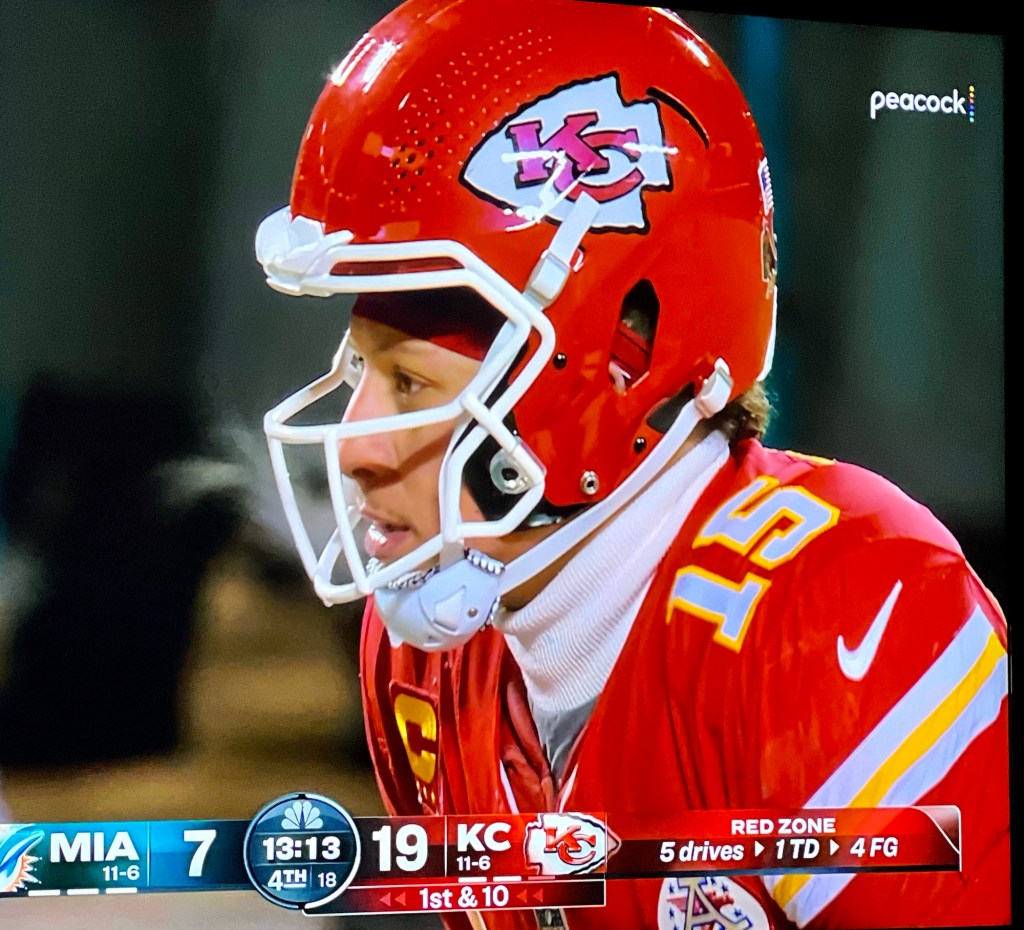
But then again it would be unusual to not see evolving sympathies between the camps. It’s just not as easy to pull out their price proxies.
During all the centuries of her life the church has made great use of art, but she has learned nothing from the artists. There was never an artist who did not know that he could not paint his picture or compose his music by thinking out the laws of beauty. If the church had seen the way to her truth as clearly as they did the way to theirs, there would have been no trouble and no defeat. Science never had any quarrel with artistic truth, and the artists never concerned themselves with what the scientists said was true. The painters and the poets and the musicians know that there is an order of reality in which intellectual assurance plays no part and the reason is unimportant.
And further along in Witness to the Truth:
Definitions and analyses and all such contrivances of the classifying mind were never of any importance to the poets. Aesthetic dogmas might come and go. They never touched poetry. If a man of saintly life disagreed with the churchmen’s rules, he suffered, in the so-called Ages of Faith, very painfully indeed. Not so in art. Aristotle’s Poetics was long the critics bible, but when Shakespeare was lined up against its rules and came out badly, it was not Shakespeare that suffered, but the rules.
Edith Hamilton

Anything in the news today?
Lots of publications put out their version of the ‘best’ cities. The best cities to raise a family. The best cities for bicycles or parks and trails. What’s a little humorous is the lack of consensus when it comes to the best cities for renters. Forbes’ picks has little interplay those of USA Today.
USA Today did something different, though. Here’s the results for their worst cities to be a renter list.

As Chat GPT explains:
In Chapter 2 of “An Economic Theory of Democracy,” Anthony Downs introduces the concept of dual rationality, which he suggests characterizes individuals’ decision-making processes, particularly in economic and political contexts. This dualism reflects the idea that individuals often consider not only their narrow self-interests but also broader social concerns when making choices.
Here’s a breakdown of the dual rationality concept as outlined by Downs:
Downs argues that individuals exhibit this dual rationality in both economic and political spheres. While they may prioritize their narrow self-interest in many situations, they also incorporate social considerations into their decision-making process. This dualism reflects the complexity of human motivations and the interplay between individual and societal concerns.
By acknowledging this dual rationality, Downs provides a more nuanced understanding of decision-making processes in both economics and politics. He highlights the importance of considering not only individual self-interest but also broader societal implications when analyzing human behavior in various contexts.
I can recommend this slim volume by Edith Hamilton for anyone interested in the Bible yet not interested enough to pull out the King James version they received in Sunday school and start at “ In the beginning, God created the heavens and the earth.”
Hamilton is masterful at providing a considerable amount of fodder in a condensed format without losing you, the reader. All those famous events that you’ve seen references over the years show up in an ordered format. You get to know the apostles instead if simply reading their version of Christ’s story.

Also, new to me yet the second time I’ve read about it lately, is the demonstration that the roots of Christian thought find their way back to Socrates. As in this section.
He believed with an unshakeable conviction that goodness and truth were the fundamental realities and that every human being had the capacity to attain to them. All men had within them a guide, a spark of the true light which could lead them to the full light of truth. This was Socrates’ basic belief, in the words of the Gospel of John, “The true Light which lighteth every man that cometh into the world.” His own mission he believed was to open blind eyes, to make men realize the darkness of their ignorance and evil and so to arouse in them a longing for the light; to induce them to seek until they caught a glimpse of the eternal truth and goodness “with-out variableness or shadow of tuming” which underlay life’s confusions and futilities.
Edith Hamilton was a late bloomer. She took up writing as a second career and her first book was publish when she was a spry woman of 62.
Because Chapman is delighted by the audience’s reaction to her. And Combs is delighted to perform with one of his idols. Sincerity is priceless.
A good does not have a value because it has a price, as people suppose, but it has a price because it has a value.
Commerce and Government Considered in Their Mutual Relationship, Etienne Bonnot, abbe de Condillac- 1776

A few days ago Time magazine posted an article entitled Millions of Americans Spend Half Their Paycheck on Rent. Here Are Median Rental Prices by State. The research used in the analysis was generated by the Joint Center for Housing Studies at Harvard. And the intent is (seemingly) to draw readers to an alarming conclusion- that there is a large underclass in America who can’t afford a place to live.
But let’s pull apart the numbers in this claim that half of rental households and who that puts in dire straights.
In Minnesota three quarters of the population own a their home. That leaves one quarter of the population living in rentals. So half of those who rent are approximately twelve percent of the population.
In Minnesota just under ten percent of the population is known to live in poverty. Let’s use an even number of ten so that we cover the homeless as well. I don’t think it is surprising that this population pays a disproportionate amount of the income in housing expenses. And it should also be noted that support for people in poverty is not categorized as income, but arrives in different categories such as child tax credits, SNAP, and renter credits.
That leaves two percent of the population unaccounted for in this observation by the Joint Center for Housing Studies at Harvard. Could there be an explanation for the remaining few who pay a large share of their montly income to rent? College and grad students come to mind. For a brief time individuals work summer jobs, take out loans and yet still must pay for housing. Many of these folks are back stopped financially by family. The policies however for student loans and financial aid give advantage to individuals with lower income. And thus kids come off their parent’s returns and file individually.
In additional to students, the elderly could fall in this category. Say someone was living out their last years in a care facility with high rental fees for comprehansive services. Maybe they are even spending down a large retirement portfolio- because that what they saved it for in the first place. Their ratio of montly expense toward rent versus income will still be high. That was planned, not unexpected.
Here are some reasonable explanations for the breakdown in how housing expenses filter through the population. None of it is worthy of a hair-on-fire headline. And diverting attention to one market can do damage elsewhere. As people who need assistance are ignored.

When Obamacare was in the works I remember crossing words with someone who proclaimed, indignantly- Everyone should have the right to healthcare! I suggested that everyone in the US did have access to care. They simply had to show up to the emergency room of a public hospital, and the code of conduct would require the medical staff to provide care.
It’s nice to hear that confirmed by an expert, Amy Finkelstein, in this interview. What she says is that there are certain products and services a society will offer based on a social contract of civility. For starters, fellow human being will not be allowed to die in the street. Action will be taken to provide the frail, the vulnerable, or the simply irresponsible, with care.
What I said back fourteen years ago, and what she says now, is that it was never whether people would get care, it was how it would be paid for. People with insurance rely on the coverage to payout. People without insurance, according to her calculations paid around twenty percent of the tab. The rest was picked up by the hospitals or the public purse.
No matter the overarching accounting system that ends up allocating resources to health expenditures, this obervation once again confirms that some products are supported by social contracts. And thus they have more efficient outcomes when the group (society, neighborhood,…) devotes some concern to the cause. If you help with kids sports, you are contributing to a reduction in child obeisity. When you taxi an elderly neighbor to their routine doctors appointments, you are preventing them from requiring more expensive treatments later.
Insurance companies understand groups from an underwriting standpoint. And that’s one way to think about it. But what I’m referring to is the time and energy people devote to the habits and actions of folks they touch on a day to day bases. This energy, if you will, squarely supports (or detracts) from public goods such as health, or safety, or family cohesiveness, or local governance. This energy is the energy behind institutions.

Social means can be more powerful at keeping people away from public goods than money.

It’s been a while since I’ve written a ‘what is public and what is private’ post. The premise is that goods and services fall into varying degrees of uses but what is important to note is the dynamics for their supply and demand differs.
Consider the shift from funding for higher education. Several generations ago parents were the main financiers of their childrens college education. Some kids could put themselves through school with scholarships and work programs, but those kids were particularly driven. In an effort to open higher education up to those who did not have the support of a family, the governement got into the student loan business.
Pretty soon norms shifted. No longer did parents see it as their responsibility to pay school. Kids became comfortable with taking out loans. And institutions of higher education saw a means of obtaining extra dollars for their operating expenses. And that is how we got to the point of kids graduating with large amounts of debt and schools having far more administrators on the payroll than professors.
Just to review. It used to be that kids had access to the public good education through their tribe. No kin, no school. Then government said- no here’s a way to make education public for all kids who wish to go. The outcome to this, however, was to have kids retain a private debt once they were done. Some kids under the old system may have come out debt free or with far less debt.
What maybe wasn’t considered at the time was this government intervertion not only created a demand among students but also demand from Universities and Colleges via the students. This is because the later group, although a non-profit and seemingly public in nature, is respondong like a private entity to incentives. We have expenses, here’s a source of revenue that we must pursue.
But did it work as intended? Did more kids that would not have gone to college end up getting a degree? It’s funny that no-one declares victory here. Was the public objective achieved?

Is this claim about Minneapolis renters correct? Is paying 30% of monthly income toward housing a distressed situation?
Lenders often extend the debt-to-income ratios to 30% for all types of loans.
This claim is false. It is the result of shifting standards for political posturing.
These are the grand national and social forces which have come into existence since the time of the Communist Manifesto, and have nullified what otherwise might have been accurate predictions of that Manifesto. For Karl Marx had based his calculations upon the purely mechanical, economic evolution of machinery, of tools, of markets, of supply and demand. He had not weighed these spiritual and psychological forces which have revolutionized the modern world. He had not seen beneath the economic forces. He had not seen the power of patriotism by virtue of which the divers classes of these different nations would finally unite. He had not seen the movement of trade unionism through which laborers learned to organize, learned self-control, learned to negotiate with em-ployers, learned that they need not fall back into the pauper condition that Marx predicted, but that by negotiation, by arbitration, they might make an agreement with the capitalists, that they might come to terms with the capitalists and divide the product between them.
The spirit of trade unionism, instead of being that of class struggle, is the spirit of partnership. The trade union movement looks upon itself, not as the irreconcilable opponent of capitalism, but as & member of the family. Being a member of the family it is entitled to have a row with the head of the family, and to live apart for a time, but it has not yet taken out a divorce. Trade unionists do not presume, as Karl Marx did, that the members of the family can do without the head of the family. Trade unionism is based upon that principle of partnership which we see in & different way in the home. Consequently here we have a spiritual movement which has not attacked family, religion, and property, as Karl Marx had done, but has organized itself to get a larger share of profits by negotiation, by agreement, by strikes.
Industrial Goodwill, John R Commons 1919
Why didn’t the Austrians appreciate John R Commons?

On a trip to Manhattan a few years ago, my son and I noticed boarded-up store fronts along the best sidewalk shopping in the city. From the layers of flyers pasted on the brick wall and the thickness of dust perched on the window ledge, it was apparent that this state of disuse was a longterm thing. It didn’t make sense. What would make an owner prefer to leave a space empty instead of collecting rent from a desireable tenant looking for a desireable location?
If you were to think of this interms of a model, one might say, what are the negative implications of renting a storefront that zero out the benefit of incoming revenue from a tenant? What circumstances cause a property owner to be more interested in sitting on a vacant portion of a building rather than maximizing profit?
I say a portion of the building because the street level space of a NYC building is most always a small percentage of the entire building.

When an investor is looking to acquire new property there’s a lot of calculating to evaluate its prospects. The price of the building is mostly determined by how much cashflow the structure can generate. The lender (as in most cases there is financing involved) is also interested in the return their borrower will receive. This determines their comfort level in receiving payment on the debt.
With this in mind, a seller will often take action, prior to going on the market, to make the property attractive not only to the buyer but to all other parties involved in the transaction. For instance, an inspector will most probably make some rounds and look for mechanical flaws. The easy fixes are best done up front. Often there is a target renter in mind for the property and enhancement will be made to their structural preferences.
When a property goes for sale, there are lots of incentives to shine the place up and present it in its best light. Any salesperson will tell you this is how to generate the best offer.
Now fast forward twenty years, or thirty years, and the young investor with ambitions to build a portfolio has done exactly that. He or she is wealthy. There is a nice amount of equity in the property and the stress to recover every dollar in rent in order to pay the bank, the insurance company, the regulatory agencies and do repairs has eased. If the property is in a strong location, it is garnering a nice return year-in-year out. Often, it is better than other investments can offer.
Now, let’s consider the rental transaction for the storefront. It’s been a couple of decades since the property has had a full upgrade. Perhaps the paint is looking a little faded. Perhaps the interior tile work has more chips in the tile than some deem acceptable. A new younger set of folks want just that much more than what was available before. So for a bit more money in rent the owner is dealing with a lot more in either managing expectations or renovations. Renovations almost always means interacting with a regulatory entity as well. Once on the property, other issues may be brought to light.
There are two factors that go into the cost-benefit calculation of securing the lease. The rent received. And another important factor which we will call the engagement factor. When the owner takes on a new tenant they are agreeing to engage with their expectations, their payment and request idiosyncrasies. It’s not just the dollars. In the same way an insurance claim is not just about getting reimbursed for the repair work. You have to deal with the insurance rep, meet three contractors to get bids, and supervise the work. There’s an engagement factor. The street level activity also has an engagement factor. If the public has become more truant, than property damage or security issues create a cost on the owner’s time.
It gets to the point that the hastle of interacting with others starts to draw down the marginal benefit of the extra rent. Throw in a potential tax implication and that little benefit could shrink to almost nothing. An empty unit creates a tax write-off. A rented unit throws off income that is now taxed at higher rates, as many deductions have run their course.
The store fronts could be collecting dust because the engagement factors are simply too expensive.

It is difficut to jump right into a conversation around real estate topics. Have you ever noticed when opinion makers writeup their latest takes on what should happen with rent control or land taxes or zoning how incredibly broad a field they lay out before their readers? This is as helpful as coming up with a policy for diabetes on a worldwide scale. Someone who must cope with this disease has wide ranging opportunities for care, access to drugs and simply inside knowledge of norms and practives depending on where they live. One insight can’t possibly have a global impact.
In order to talk real estate one must select a starting point. For years, following the great recession, the analysis focused on why homeowners lost their homes. Other people are obsessed with real estate developers in the same way Swifties demure on whether she will make it to the next Kansas City Chiefs game. Still others love to banter about city councils and figure out how many votes it will take to tweak zoning from single family to multi-family. And what is to be done about parking?
This is TMI. Way too much.
I find the most fruitful place to start is at the time of transaction. When I was a loan officer decades ago we called it ‘the deal.’ Our manager, a plump Napoleon-type who loved to give you a hard time late on a Friday afternoon so you would think about him throughout the weekend, said the term was off the table. Too tacky (unlike him). From then on, as we sat behind oversized wooden desks that would make Matlock proud, we were to call every loan we closed a transaction.
So at home-economic we will always come back to the deal that was made when two people shook hands and exchanged a good or service for something of value.

Say you wanted to set up an analysis of tenant/landlord relationships. The starting point would be the lease. The written agreement that is signed between the parties prior to occupancy outlines the terms of the agreement including the monthly obligation and the landlord’s responsibilities. Simple right? Nada- there is much more nuance. And the configurance of renters and landlords (because there are many varieties of these actors) can cause all sorts of imblances that are not fully flushed out in the contract. But the parties to the deal and the agreement they reach is where to start.
More noodling on models to come.
With fertility rates falling across the wealthier countries, people are asking what can be done to encourage a new generation to have more children. Some think financial incentives are the way to go. Others like the idea of protecting a women’s career path while she takes extended maternity leave. Some focus on subsidizing daycare.
I say- make a mom cool again.

Scroll through the top sitcoms over the last thirty years and name one maternal figure that is not only relevant to the story line but revered in some way. I’ll start. In the 90’s the maternal roles were Rozanne Barr in Roseanne and Peggy Bundy in Married with Children. Both ladies are terribly funny. Does that mean to be a mom is to be funny? Full House did away with the mom role altogether- so I suppose there’s that.
In the 2000’s TV only one show cast starring mothers. Modern Family has us entertain by Claire Dunphy who plays a supportive and nurturing mother. Even Sophia Vergase is nurtuing with a voluptuous swagger. The rest of the shows, Friends, Scrubs, The Office, Will and Grace, Reno 911, My Name is Earl, have nothing to offer in motherly caring of her kin and community.
Hollywood seems averse to letting it slip that some mothers are over joyed with their role in life. Perhaps June Cleaver symbolized a compromise that women who wished to work could never promote. So when make believe won’t make motherhood glamorous, who can?
Well- reality TV of course!
The Kardashians put their children front and center. The matriarch, Kris Jenner, raised six children from two marriages. So far she has twelve grandchildren. And her two youngest girls are only in their mid-twenties. The Kardshians don’t hide their kids. They show them off. They make it look fun.
Perhaps the Kris, Kourtney, Kim, Khloe, Kylie, and Kendall are making a contribution to elevating the status of motherhood. Are you?
No! I say. Although, part of me says yes.
So I doubled up on entertainment and read a worn but intriguing paperback while watching the Chiefs steal superbowl dreams away from the Buffalo Bills.

Javier Milei is the recently elected president of Argentina. He is a vocal libertarian and critic of socialism. He gave a speech this week at the World Economic Forum (WEF) in Davos Switzerland where all those with lots of money, or political power, or both, go to mull over global issues.
Here are some reactions on Twitter.
This view of the State vs. the Market seems a little old fashion. Does anyone really believe that one entity, the bureaucracy paid for through taxation, provides all public goods to all citizens? Often the media acknowledges the role of non-profits, like the Red Cross, stepping in with services in countries under siege. The western countries are set apart in their degrees of social democracy, implying that the decision to draw lines between state provision of benefits and the private sector vary depending on the will and the customes of the people. The concept of a dichotomy between two centers of power, the State and Big Business, is so twentieth century.
Here’s an example of two people hearing the same speech and yet not registering the same intake of information. Rodrik says Milei denounces neoclassical economics as another brand of collectivism, empowering the state through the doctrine of market failure.
Here’s the section of Milei’s speech this Havard professor is referring to:
The problem with Neoclassicals is that the model they fell in love with does not map reality, so they put down their mistakes to supposed market failures rather than reviewing the premises of the model.
Under the pretext of a supposed market failure, regulations are introduced. These regulations create distortions in the price system, prevent economic calculus, and therefore also prevent saving, investment and growth.
This problem lies mainly in the fact that not even supposed libertarian economists understand what the market is because if they did understand, it would quickly be seen that it’s impossible for there to be market failures.
President Javier Milei’s WEF speech at Davos 2024
I don’t hear Milei saying neoclassical economics is a brand of collectivism. The neoclassical model, although powerful and useful, does not always represent of the entire economic picture under analysis. Instead of addressing why that could be and re-evaluating the premises of the model, hands have been thrown in the air and the following conclusion reached: “It’s not the model! It’s a failure in the marketplace itself. Players in the market are not rational when it comes to certain things. Hence, there is no market for these items.”
Who is called to shepard the irrational? The steadfast hands of the politicians who in turn hand off their mandates to the bureaucrats. This is the opportunity for collectivism, in the under utilization of the model. Even with the best intentions, a pencil pusher is not a player in the transaction. And this artificial involvement with the pricing system causes the mess. Barriers are erected. Transparency turns opaque and then solid. Consumers are dubious of outcomes and become cynical of efforts.
What President Milei is suggesting is that the underlying components and conceptual structure of markets has not been fully flushed out. Part of the driving force behind decisions are either taken for granted, ignored or simply not significant in a particular transaction. Once people digest how men and women search for meaning, how they are compelled to act on desires for freedom, a better life, and in support for the health and well being of the ones they love- then there will be an understanding. An interpretation of a market failure is the result of the failure to properly identify the players to the transaction, their objectives and how all this plays out.
And then there’s this guy. I’m using his post mainly because he has the best clip of the speech. Yet what he says is interesting as it is so man-of-the-street in its political orientation. If you object to a government intervention then you support fat cat Wall Street types. Sadly, excessive regulation mainly hits small business and the least skilled. They don’t have the capital required to navigate the new rules and regulations. And so, it becomes easier for them to work for others, loosing their freedoms, security and access to property.

I just found this series thanks to a friend’s social media post. It’s fun and funny. There’s depth of character and intrigue.
I haven’t yet regretted any of the couch time invested so far.

Mid-century modern homes have a decisive following. This home threw off the compartimental feel of the 40’s one-and-a-half story bungalow. Which meant more open and flowing plans. Large open windows brought nature in through the glass. Endless wood panels made the indoors feel like the woods. Beams crossed the vaulted ceilings. Roman brick created an elongated modern look at the focal point of the living spaces. The more geometric angles and the cleaner the lines, the better.
This is a great example of a home that needed little updating as the original plan was preserved all these years.
For all the joy the physical features of the fifties rambler can bring, there are compromises. The floor plans will reflect the acceptable arrangement of its time, including the lack of a master bath. In today’s busy world, some people may not care for all the lawn care necessary for the oversized lots that often surround these structures. And the municipal infrastructure, now seventy years old, may require some attnetion.
Houses are like that . One thinks only of what is between the walls and under the roof. But intrinsic to the property is a bunch of informal and formal superstructures.
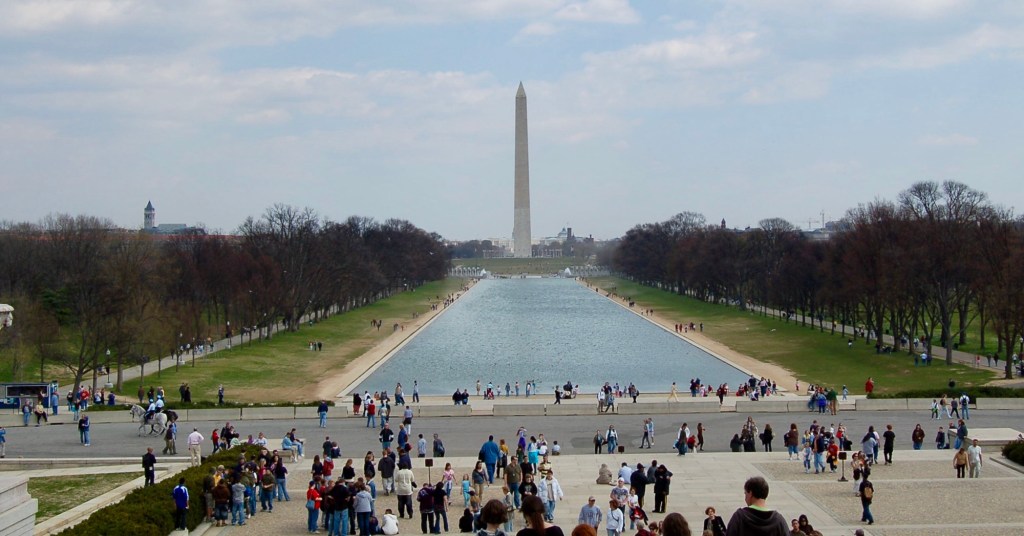
The Rev King delivered his I Have a Dream speech while gazing along this same view. Yet it was different. The times were different. The crowds were part of the scene at this celebrated event. They covered every inch and corner of asphalt, concrete and sprig of grass. The atmosphere must have been electric- a far cry from the casual spring break feel capture in the above photo.
The reason we celebrate Martin Luther King Junior is because the words he spoke did not depend on the view. He is one of those rare individuals who can time and again find phrases which are not time stamped. He doesn’t short change the suffering. He acknowledges its presence. And yet can remain hopeful and trusts in the propects for Americans.
Freedom is a tricky endeavor. There must be a notion of the possibility of a peaceful coexistance, or of the essential desire for peace. For people to defer to the freedom of others, they must trust in an optimal outcome. They must trust others with their own freedom.
Dr King had a dream.
Words are so easy, so fluid. People with a silver tongue can have an audience rich in the information of their choosing. Pursuasive people are often great with rhetoric.
But what if the words don’t match the realty.
This airline spokeswomen is paid to stand up and deliver a positive report. And the objective reports as to whether the airline is on time, whether they loose baggage or whether they cancel flights inconveniencing their customers is realitively easy to com by.
But what about political claims?
Will the sports stadium really bring in that much out of state spending? Will the program really propel people out of poverty? Will the light rail trasit be used to justify its expense? Some of those questions are more difficult to prove of disprove.
Although audiences have their way of calculating their personal benefits and observing the outcomes of others. They don’t need a camerman to pan upwards to the delayed flight arrival board to get a gut reaction to a politican’s claim.
It would just be nice to have earlier benchmarks to at least tighten up the projections before plunging forward with some of these joint ventures.
Now that the Vikings are done for the season I’ve shifted my allegiances to the Kansas City Chiefs. Their quarter back Patrick Mahones is so fun to watch. This evening, their game against the Miami Dolphins holds the dubious distinction of being played in the coldest temps in NFL history. It’s minus seven in the third quarter. Yet Mahones is keeping it together and just lead his team to another touchdown bringing the score to 26 Chiefs 7 Dolphins.
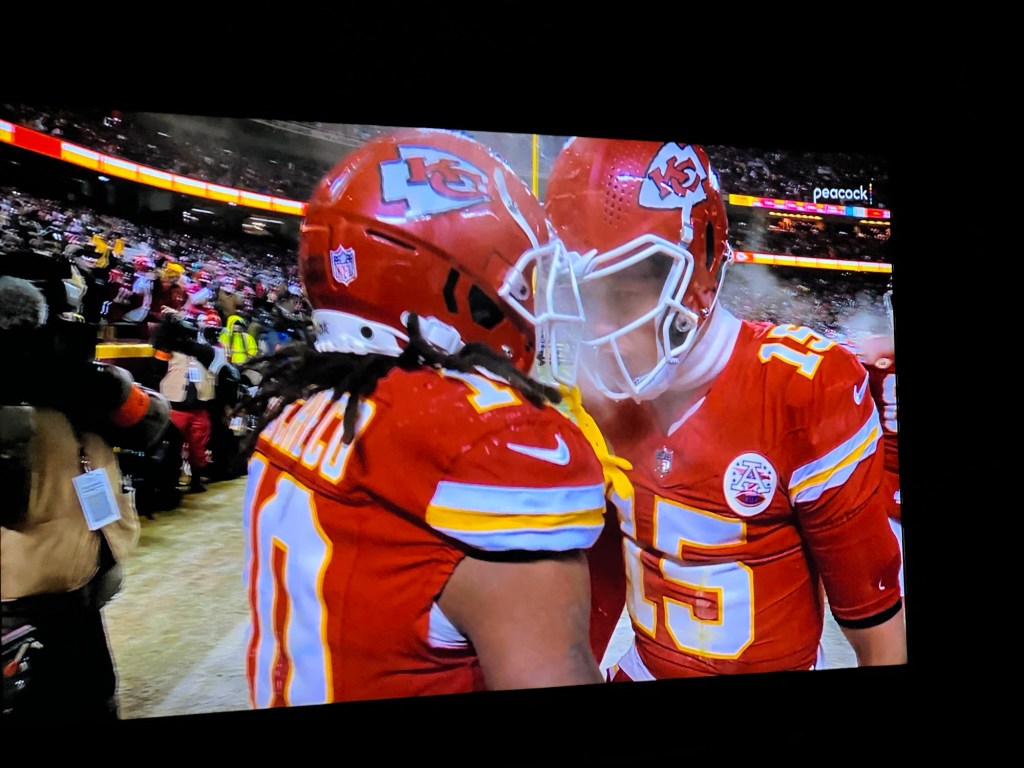
A chilly environment is sometimes created by other factors than a north winter wind. I don’t think it was the same type of cold that Emily Dickinson is referring to in poem #538 below. The commentators say the feel of the football is not the same in the frigid temps. In the same way a greeting or expression of concern can be passed on heavy fumbling words.
538
‘Tis true — They shut me in the Cold —
But then — Themselves were warm
And could not know the feeling ’twas —
Forget it — Lord — of Them —
Let not my Witness hinder Them
In Heavenly esteem —
No Paradise could be — Conferred
Through Their beloved Blame —
The Harm They did — was short — And since
Myself — who bore it — do —
Forgive Them — Even as Myself —
Or else — forgive not me —
I really enjoyed this girl-power sisterhood movie. It was humorous, entertaining and endearing.
The enthusiasm of the two sisters, played by Priya Kansara and Ritu Arya, is contagious and contrasts nicely with the controlled reserve of their Pakistani parents. The supporting actors are distinctive and play well to the ruse.
There are lots of laugh out loud moments. Some are old school slap stick. Some play off colorful facial expressions. Some mock all the slow mo clips from action films. There are lots of occasions to let out a guffaw.

We’ve missed you.
These handy loooking-glasses will identify the subject upon which you gaze. No more running back to your birdbook, thumbing through the pages while trying to remember the details of the beak, wing markings and approximate size. Presto. AI will give you an answer amongst the 9000 entries in its data.
Now if I can only justify the nearly $5K price tag.
But the smallest unit of the institutional economists is a unit of activity–a transaction, with its participant.
Every choice, on analysis, turns out to be a three dimensional act, which, as may be derived from the issues arising in disputes, is at one and the same time, a performance, an avoidance, and a forbearance. Performance is the exercise of power over nature or others; avoidance is its exercise in one direction rather than the next available direction; while forbearance is the exercise, not of the total power except at a crisis, but the exercise of a limited degree of one’s possible moral, physical or economic power. Thus forbearance is the limit placed on performance; performance is the actual performance; and avoidance is the alternative performance rejected or avoided all at one and the same point of time.
And lastly, this finally.
Consequently the final social philosophy, or “ism”- which is usually a belief regarding human nature and its goal towards which institutional economics trends is not something foreordained by divine or natural “right,” or materialistic equilibrium, or “laws of nature” it may be communism, fascism, capitalism. If managerial and rationing transactions are the starting point of the philosophy, then the end is the command and obedience of communism or fascism. If bargaining transactions are the units of investigation then the trend is towards the equality of opportunity, the fair competition, the equality of bargaining power, and the due process of law of the philosophy of liberalism and regulated capitalism. But there may be all degrees of combination, for the three kinds of transactions are interdependent and variable in a world of collective action and perpetual change, which is the uncertain future world of institutional economies.

Let us consider what we call vicious luxury. No gratification, however sensual, can of itself be esteemed vicious.
A gratification is only vicious, when it engrosses all a man’s expence, and leaves no ability for such acts of duty and generosity as are required by his situation and fortune.
Suppose, that he correct the vice, and employ part of his expence in the education of his children, in the support of his friends, and in relieving the poor; would any prejudice result to society? On the contrary, the same consumption would arise; and that labour, which, at present, is employed only in producing a slender gratification to one man, would relieve the necessitous, and bestow satisfaction on hundreds.
…To say, that, without a vicious luxury, the labour would not have been employed at all, is only to say, that there is some other defect in human nature, such as indolence, selfishness, inattention to others, for which luxury, in some measure, provides a remedy; as one poison may be an antidote to another. But virtue, like wholesome food, is better than poisons, however corrected.
Of Refinement in the Arts, David Hume

I’ve been rereading Hemingway’s Farewell to Arms which rekindled an interest in the history of WWI. The story’s debut is based on the author’s experience in the war as he drove an ambulance for the International Red Cross. After serious injury from mortar fire, he returned home unlike his lead character, Lt Frederic Henry.
While clicking around to find out more about the Italian campaign, I came across this excellent article in Vox: 40 maps that explain WW1. I find visuals so useful. There is far more information indicated by shadings, lines and labels within the four boundaries of a map than a writer can pound out on a keyboard . Although this passage sums up pretty well how devasting the war was.
One hundred years ago today, on August 4, 1914, German troops began pouring over the border into Belgium, starting the first major battle of World War I. The Great War killed 10 million people, redrew the map of Europe, and marked the rise of the United States as a global power. Here are 40 maps that explain the conflict — why it started, how the Allies won, and why the world has never been the same.
VOX
Hemingway cites enough geographic references to encourage the reader to look up exactly where his ambulance was called into service. Or, at least, I’m curious enough to look up Gorizio where he returns to base camp before he is sent on to Caporetto. In the passage about the retreat, as the Germans advance into Italy, Lt Henry’s goal is to reach Udine.
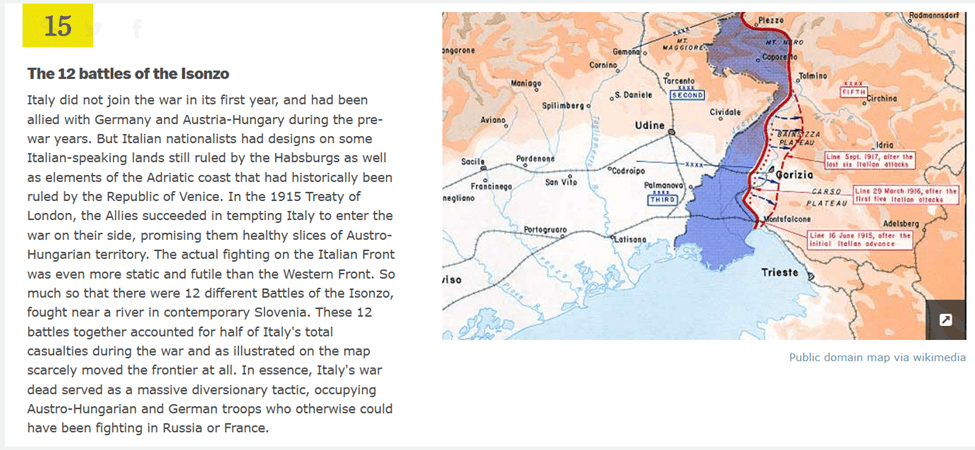
Further on in the book, Lt Henry and his sweet Catherine must flee to Switzerland in a row boat. The journey takes them along the coastline of the famous Lake Como. The porter who helps arrange their escape assures them the winds will be at their backs pushing them along the 35 kilometer journey.
Wartime stories have so much to offer. There’s conlict and suspense. There’s heartbreak. But most interestingly is the sudden change in circumstances creates a back lighting to social arrangements, making their properties just that much more apparent.
Minnesota has always been home to ice hockey supporters. But it’s just in the last dozen years that support for the fairer sex has come on strong. Tonight’s turnout for a 3-0 shutout win against Montreal sailed past the last attendance record of 8318 in Ottawa.
You can’t hit a record if you don’t have a stadium. Here some deets about the Xcel Center.
Xcel Energy Center is regarded as one of the finest arenas in the world. The one-of-a-kind, multi-purpose facility is home to more than 150 sporting and entertainment events and approximately 1.7 million visitors each year.
- Location: Saint Paul, Minnesota, USA – Located on six acres in downtown Saint Paul on the former site of the St. Paul Civic Center
- Owner: City of Saint Paul
- Operator: Saint Paul Arena Company (SPAC), an affiliate of Minnesota Sports & Entertainment (MSE)
- Architectural Firm: HOK Sports Facilities Group
- Construction Cost: $170 million
- Opened: September 2000
- Home Teams: NHL’s Minnesota Wild
- First Event: Minnesota Wild vs. Mighty Ducks of Anaheim (3-1 win, preseason) – Sept. 29, 2000
- Largest Concert Crowd: 20,554 – Shania Twain – Oct. 28, 2003
- Most Sellouts In A Row By An Artist: 3 – Prince – June 16-18, 2004; Taylor Swift – September 11-13, 2015
When a city is proposing to build the next sports palace, the objections run high and low, long and loud. The price ticket of $170 million seems like a bargain today. But twenty-three years ago it was a pretty penny. People write op-eds about how the money could be spent in a so much more deserving fashion.
So that begs the question, how many people have benefited from events at the stadium in the last two hunderd and seventy-six months? Is there a social bounding which occurs when strangers reminess about attendence records and concert remories? Are people drawn to living close to a mega venue?
The Minneapolis Fed created a housing dashboard and set three regional housing goals in 2020. Apparently, things are going well.
Article Highlights
Twin Cities Meets Ambitious Housing Goals fro Second Year
- Twin Cities region met goals in new housing, new affordable housing, and Black homeownership
- Housing in Twin Cities region remains affordable relative to peer regions
- Continued progress requires policies that support housing production
Whereas people in power are often capable of swaying voters by rhetoric, tangible goals help keep track of things.

It’s important ot note early on in the quest-for-the-best house (an on-going project in 2024 at Home Economic) a few types of homes will be quickly eliminated. To qualify to be the best home to take to market, it must be an attractive home to a bunch of people. Like hundreds of thousands of people.
The inclination to become nostalgic and nominate the turn-of-the-century home of relatives several generations back, simple won’t do. The market for sentimentality exists only between a tight group of people.
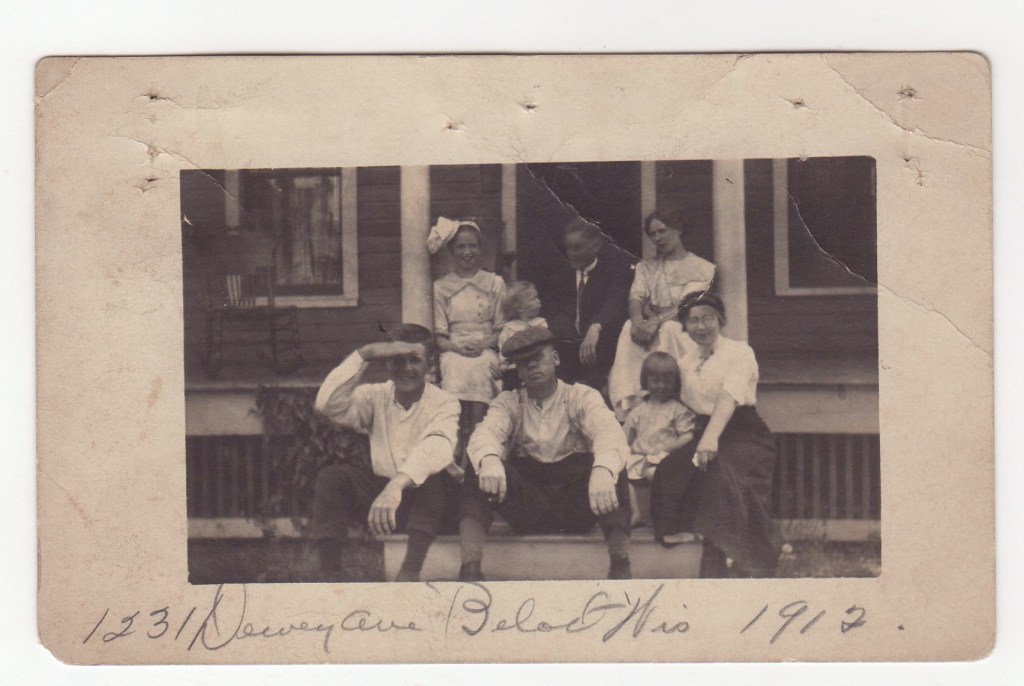
Other factors attract only a slim pool of buyers. I once took the Empire Builder from Minneapolis to West Glacier in Montana. After leaving Minnesota the tracks run through North Dakota and Montana skirting the Canadian border by forty miles. Trains are wonderfully spacious which allows people to circulate. A woman from Devil’s Lake or Lakota or Epping explained that Amtrack was her best bet for travel. Bismark was hours away and air travel wouldn’t take her to her relatives, a day’s journey down the tracks by rail.
Property in remote areas may offer privacy. The views from a log cabin at the foot of the Grand Tetons are unique and spectacular. A two hunderd acre ranch in the Bitteroot Valley maybe a haven for horse lovers. Whereas movie stars a celebrities might relish the distance this keeps between them and their fans, most buyers would struggle to make a life in extremely rural conditions.
Historic homes, iconic homes, or those with sentimental ties are not qualifiers for the best-of-the-best. Nor are propeties in remote locales. Simply too few can make those work.
Talking about the best of the best when it comes to houses, here’s a vote for Alamo Heights in San Antonio, TX from X.
Let’s consider his priorities.
Lot size is cited at a third of an acre. For comparison, a typical city lot from the 40’s on tree lined, sidewalk fringed street is about a fifth of an acre. So a third of an acre is more generous, yet by no means expansive.
Next Girdley mentions easy access to the beach. Parks, trails, and outdoor recreation areas are popular amenities for many homeowners. Several overlapping groups take advantage of the outdoors for excercise, sports, and leisure.
Ease of circulation is important to most everyone. If you are not commuting to a job, you still need to get out and shop, or get your family here and there, or drive to medical appointments, and so on. Note here that transport by car is assumed. If the writer meant public transit, it would be mentioned.
Schools- this public amenity affects a lot of households. Although there are generalized winners and loosers, the rating systems for districts stem from subjective opinions. He likes the schools in Alamo Heights.
Lastly he mentions access to another form of transit, air travel. This note may be a nod to an airport nearby, or to the geographic distance to California. It’s hard to know if it is an infrastructure issue or a natural circumstance.
To summarize, Gridley votes Alamo Heights as an optimal bundle of building site, access to nature, road infrastructure, public schools and air travel.
Are there other factors that people use to judge their optimal real estate package? That’s what we will be exploring. Stay tuned.

On occasion I will be asked what type of house I like best. People see the role of a realtor as a door opener. We give people a tour of all the possible dwellings in our marketplaces. So this seems like a reasonable question to someone with access like this.
The truth is that the question is far more complex than most would imagine. There are subtle compromises to that nostalgic 1920’s Craftman’s with the wide-plank oak baseboard. That mid-century sprawling one-level maybe sitting on a oversized too-much-maintenance lot. And even those dwellings which fall in the tippy top price ranges may not have it all.
The first day of a new year is compelling me to layout a plan. It is time to seek an answer to the question of which house stands head and shoulders above the rest. So as the weeks ahead unfold, you will see much more house talk. Which seems appropriate for a site about home economics.

Thank you to all the visitors from around the world who have stop by this page for a visit. I appreciate all of you.
And here is wishing you the freedom to “Climb Ev’ry Mountain” in 2024!
Rereading the classics at a later stage of life is a bit of a detective story. Was The Good Earth by Pearl Buck a breakthough because stories from China were new to the West? Did My Antonia strike a chord with its lucid portrayal of the nascent qualities of pioneer life? But then again why wasn’t Edith Hamilton’s The Way of the Greeks given more notice in the past when today it sells at Target in a combo package with The Roman Way? Could it be that making difficult subjects facile was not women’s work?
As I started through Hemingway’s A Farewell to Arms I couldn’t give much extra credit for the subject matter of an American at the Italian-Austrian front. The prose is of high quality, of course. But then I hit this show stopper passage. A conversation is written up as if by an easedropper on the hosipital ward took notes of a farewell visit from a handful of friends.
The tickets are very expensive. I will draw a sight draft on my grandfather, I said. A what? A sight draft. He has to pay or I go to jail. Mr. Cunningham at the bank does it. I live by sight drafts. Can a grandfather jail a patriotic grandson who is dying that Italy may live? Live the American Garibaldi, said Rinaldi. Viva the sight drafts, I said. We must be quiet, said the major. Already we have been asked many times to be quiet. Do you go tomorrow really, Federico? He goes to the American hospital I tell you, Rinaldi said. To the beautiful nurses. Not the nurses with beards of the field hospital. Yes, yes, said the major, I know he goes to the American hospital. I don’t mind their beards, I said. If any man wants to raise a beard let him. Why don’t you raise a beard, Signor Maggiore? It could not go in a gas mask. Yes it could. Anything can go in a gas mask. I’ve vomited into a gas mask. Don’t be so loud, baby, Rinaldi said. We all know you have been at the front Oh, you fine baby, what will I do while you are gone? We must go, said the major. This becomes sentimental. Listen, I have a surprise for you. Your English. You know? The English you go to see every night at their hospital? She is going to Milan too. She goes with another to be at the American hospital. They had not got nurses yet from America. I talked to-day with the head of their ri-parto. They have too many women here at the front. They send some back. How do you like that, baby? All right. Yes? You go to live in a big city and have your English there to cuddle you. Why don’t I get wounded? Maybe you will, I said. We must go, said the major. We drink and make noise and disturb Federico. Don’t go. Yes, we must go. Good-by. Good luck. Many things. Ciaou. Ciaou. Ciaou. Come back quickly, baby. Rinaldi kissed me. You smell of lysol. Good-by, baby. Good-by. Many things. The major patted my shoulder. They tiptoed out. I found I was quite drunk but went to sleep.
A Farewell to Arms, Hemingway
What a fabulous stream of words. For the passage to be a success, it needs to occur at a point in the story where the reader knows enough about each participant to identfy their voice. Nothing else is feigned. It is a magical transport to a time and a place and a grouping of friends somewhere in the Dolomites.
The effects of the 2008-2009 downturn were still very much in play when this movie came out in 2011. And the overall greed is bad and Wall Street is all about greed themes hang heavy throughout this film. Still, I enjoyed reviewing what a day in 2008 meant to a firm full of traders. It must have been dramatic if not confusing.
There were many angles to the socio-economic inputs which resulted in the claoking of mortgage back securities as viable market instruments. This film steps in at the moment of realization that people – many more people than blue suited Wall Street types – had been swimming in a pool of self-deception. What unravels is directed by the actions of those who stay on message and continue to choose the cash over conscience. They sell off the firm’s entire portfolio by noon.
It is nothing but self-indulgent to pin the motivation-by-money blame on these worker bees. As if they only respond to monetary incentives. Yet each actor from Demi Moore to Zachary Quinto (who plays the calm savant rather well) to Kevin Spacey utter the words “I did it for the money.”
Overall the film is about an interesting event which is played out by excellent actors. One just needs to be prepared for all the messaging.
Trading Economics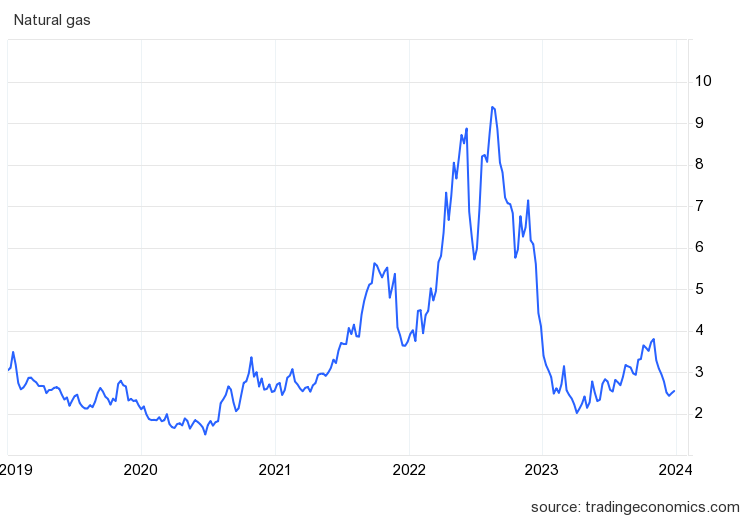
Taking a look at the natural gas markets, you can see that we have rallied a bit early during the trading session again on Thursday. Not really a big surprise considering that we had plunged so drastically over the last couple of months, but at this point we have to ask what’s left of winter. There might be a storm or two that could cause a spike in the price of natural gas, but it’s easy to see that natural gas has been a major bust this winter.

Christmas trees were hard to come by in Addis in 1974.
We make men without chests and expect of them virtue and enterprise. We laugh at honour and are shocked to find traitors in our midst. We castrate and bid the geldings be fruitful
The Abolition of Man
How would the quote go if it had women in mind?

The table is cleared except for the fancy placemats. The dishes are stacked precariously high on the drying rack, The counters are wiped down and tomorrow morning’s coffee is set to brew at 6:45 am. A curtain of contentment is closing down the house. Someone is snoring in front of the droning TV; someone is investgating a new toy; another is plotting which outfits will be worn in what order. Another holiday is in the books.
It often starts with the cutting of the tree.

There are lights and decorations. And there is shopping for the lights that have died and the decorations that need refreshing. And then there is food planning and gift lists. To which we get back to more shopping in the mega grocery stores and the funky coops. On it goes around and around for three weeks or so. Hits and misses on where to go for what. A tally of presents reveals that one has more than the other which is a serious violation of the holiday fairness rule. So back out to the stores you go.
Some will try to convince you that cash is better than a gift. I’m not against cash. Lots of people will greatfully accept a Christmas check. It’s just not the same. You can’t socially leverage cash, it’s just currency. If you give someone cash they still won’t pay the money for the thing they really want yet feel it’s a bit too much. Cash won’t pay for the lost opportunity that a gift giver had at an antique shop when they spotted the last piece of china that would make a complete set.
With a little effort and a lot of listening, a gift giver can easily provide a value over and above cash. Which leads to a very peaceful end close to the holiday where everyone in the house feels a little bit richer.

Luther made good on his intentions to craft congregational songs in the German language, and this legacy is preserved in these facsimile editions, but moreso it is preserved in Lutheran churches and hymnals, where Luther’s corpus of hymns is still performed via carefully curated translations. Baptist hymnal compilers and worship leaders have generally limited themselves to “The battle hymn of the Reformation,” but this year’s grand anniversary is an opportunity to explore the greater breadth of Luther’s hymn writing.
Luther’s final collection was published in 1545, the year before his death. Geystliche Lieder Mit einer newen vorrhede, printed by Valentin Babst, contained 120 German hymns, 35 of which were by Luther, with his final revisions. Among the newer pieces were Luther’s two Christmas hymns, the longer “Vom Himmel hoch da komm ich her,” known in English as “From heaven above to earth I come” by Catherine Winkworth, and the shorter hymn, “Vom Himmel kam der Engel Schaar,” translated as “To shepherds as they watched by night” by Richard Massie.
By Chris Fenner
From Walter Russell Mead’s 2012 Yule Tide Blog:
Christianity like many world religions has often been less than fair in its treatment of women. But at the heart of historic Christianity there has always been the idea that one young single woman’s faithful choice gave God the opening he used to save the whole human race. Christmas is a feminist holiday, a feast that celebrates the free choice of an autonomous woman. As Christianity has risen to become the largest and most widespread religion in the world, women are coming into their own. It cannot be otherwise; Christianity of all the world’s great religions owes its origin to the choice of a woman to cooperate with God.
God didn’t send Jesus into the world because he was satisfied with the status quo. God sent him here because things needed to change — and right at the top of the list of the things God wanted to change was the position of women. The change didn’t happen overnight, and even today we haven’t seen the full consequences of giving half the world its rightful due, but from the day that Mary answered Gabriel a new force has been at work in the world, and what we see today is the blossoming of a tree that was planted a very long time ago.

Talking about methods, I noticed one method pop up on Twitter around the value of providing free school meals (breakfast and lunch) to all school children. There has always been provisions to feed children in poverty at schools across the state of Minnesota. So about 12% of school age children’s families were not charged and 88% were billed by the school. Or moms prepared lunchs and sent them out in backpacks.
In actions reflective of an exuberant majority, the law makers passed a bill to cover meals for all children. (We feed kids instead of banning books! was a slogan this year) On the face of things it sounds like a wonderful thing to do. In the world of constraints it shouldn’t be a surprise anyone that the cost of the program is bulging well past the initial number. Listen to little onion.
Is it valid to compare the cost of free meals to the cost of police misconduct settlements? On the one hand government decided to pay food bill for families who could afford to buy their kids lunch. On the other hand there’s a number for mismanagement of a police force and the subsequent fallout. One is for sustenance, the other is for public security. The only thing to grab onto here is that taxpayer money settles the tab. Method Grade: F-.
Here’s another method to present whether the cost of increasing the school meal tab to cover all students is justified.
We note a pattern here between those who support free lunch- they value it more than funding the police. Public safety is a concern for all. Lunches are covering less than 20 percent of the population. Lack of public safety results in a loss of some kind to all citizens. Lack of school meals, in this case, means a few more PB&J’s and carrots sticks for some families. As a method, these comparisons, well, are weak. Method Grade: F-.
The Gov thinks the program is worth it since a mom wrote to him and said she appreciated not having to pack lunchs ever morning for her three kids.
At least in this method a politician was listening to a constituent. Method Grade: F+.
In many cases, mortgage companies require an appraisal on a property before lending money against it. This involves a professional appraiser touring the property, taking many measurements, and then compiling a report which is often a dozen pages in length.
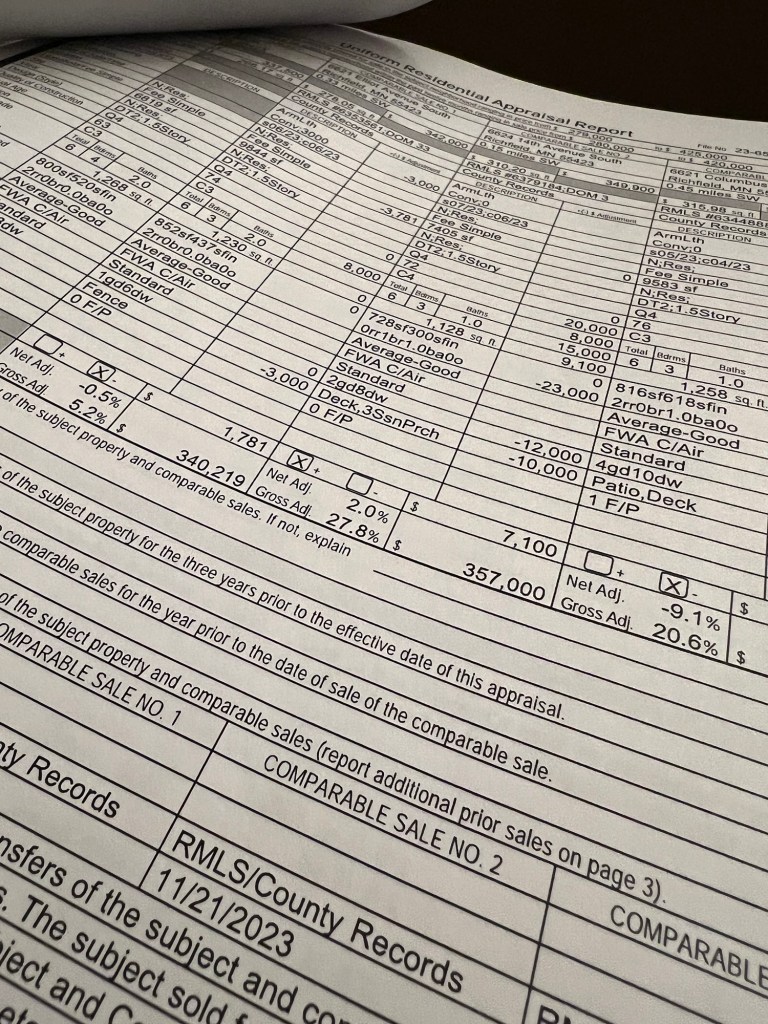
Although there are three methods listed as options to determine value, the most prevalent one by far is the use of comparables. The income approach, which, as the name implies, relies on backing a value out of the stream of income from rents. But a single family residential is purchase for owner occupants rather than investors, so that method doesn’t make as much sense. Nor does the cost approach. If one were to estimate the cost to build a 70’s split or a 1920’s craftsman, the differentiators quickly make the analysis impractical.
Thus the method du jour is to find three near-by properties of similar size and imporvements which have sold within the last six months. A tabular comparison is done as seen in the photo to make adjustment for variances. A deck was worth a $10K swing. Footage, bedrooms, baths, condition and so are tweaked up and down the columns. Once the number are in place, a tally at the bottom gives a range which justifies the buyer’s purchase price and allows the lender to happily lend against the home.
As long as the property is in a fairly large area of similar homes, this approach works well. But when there are none close-by which resemble the one in question, things get stickier for the appraiser. The one significant factor taken for granted in the comparison method is that the area is the same. Change areas, and foundational assumptions are out the window.
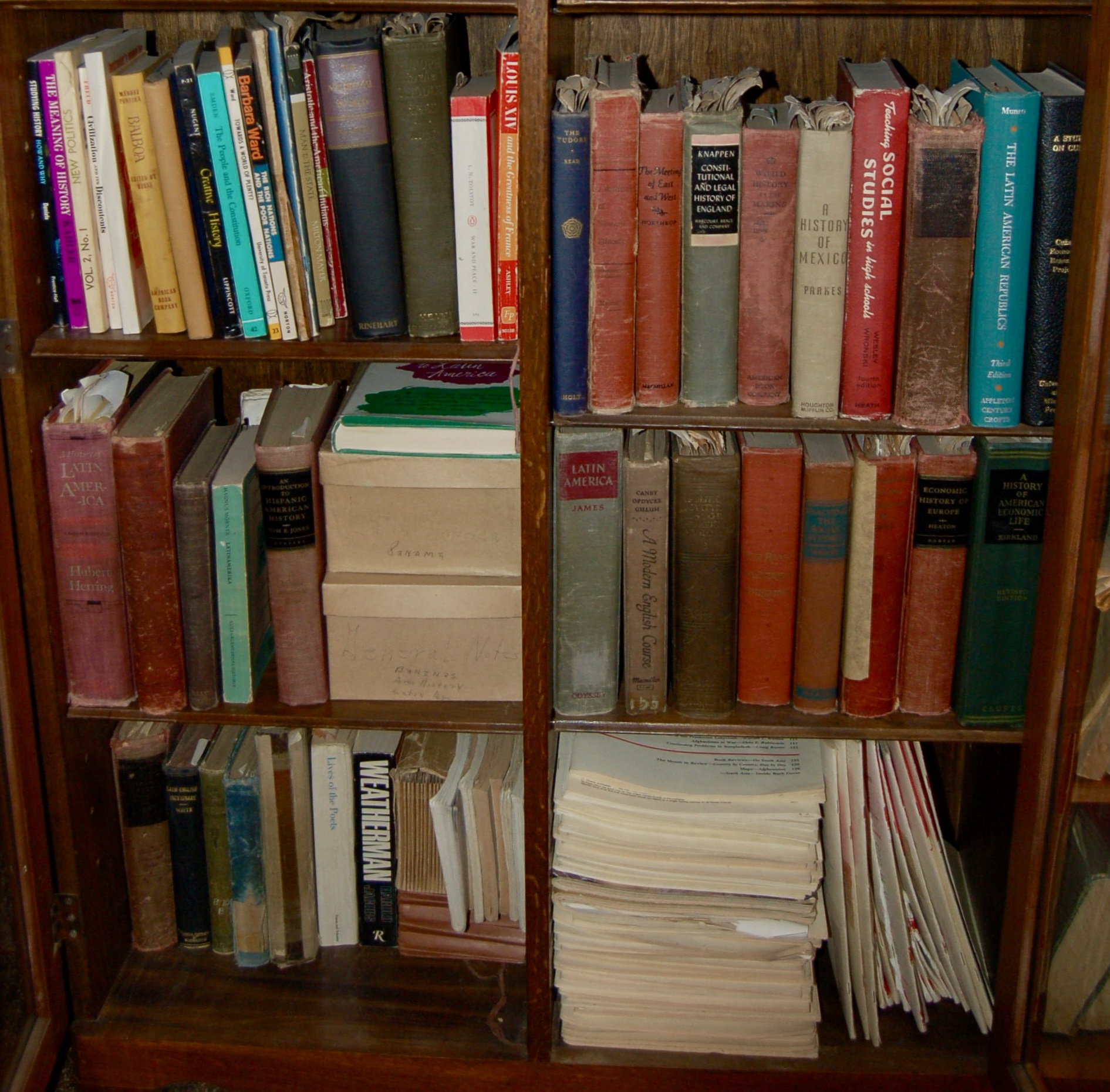
I don’t think most people bother reflecting on their ontological commitments. They are taken for granted like the piped water and public education. This is what I was born into, and since everyone else is running on the same plane of knowledge, I’ll go along for the ride.
Life is certainly simpler that way. There’s a lot of ground to cover if one were to try to get down to the very building blocks of the better life. To explain why things are done when and for whom. Dr. Arthur Holmes does a good job of giving you a tour of the history of philosophical thought, if you have the time and inclination to follow along.
In this clip he’s talking about contribution from Pythagorus and Heraclitus. Both were interested in the dual nature of things. Both worked with the concept of change through time. Heraclitus is most noted for having pointed out that one never steps in the same river twice. By the time you dip your toe back below the cool substance, the water that was there will have washed down stream replaced by a fresh liquid.
But first, Dr. Holmes tells us that both thinkers were interested in the thought that all things have two sides, each of which is equally important. There is a double aspect to all things depending on the view from which you gaze.
For instance, a sound barrier wall is erected along side a highway- hurray! The neighboring homeowners view it as a benefit as the roar from the freeway is muted to a background buzz. The shop owner, however, is penalized as the thousands of eyes that used to see Tip Top Auto Body as they drove to up and back can no longer be reminded of its presence hidden behind the wall of timbers. The same wall provides to one group a benefit and to another a penalty.
As the two aspects of things cause some to seek one solution and others to seek another, there is change. Which brings us back to Pythagorus, the mathematician, and Heraclitus who insisted there are two aspects to everything. On the one hand everything seems to be in the process of change, on the other hand there is order. When a road is enlarged, a large group of commuters benefit. But the homes along the road endure more noise. A large group benefits; a smaller group internalizes an expense. One road. Two perspectives.
Dr Holmes explains these two pre-Socratic thinkers were confident that despite the fluidity in the system, despite the ongoing change, nature seeks out an order. In a reaction to the noise, a wall is built. And on it goes. Two perspectives, a change, and a return to order.

There are some houses that are better known than others. I bet 99% of the US population could identify the White House in a line up.

There’s the house that so dismassed Jimmy Stewart in It’s a Wonderful Life. The turn of the century home has aged over the years and Stewart finds the on-going maintenance a dispointment. Also from the silver screen is the gorgeous Home Alone Chicago residence of the McCallisteer family. Kevin (McCauley Culkin) is ingenious at rigging it up with all sorts of traps for the goofey thieves.
From the small screen, the Brady Bunch house- a cool 70’s split home comes to mind. How many times do those floating stairs carry the six kids up and down? The California suburban build’s features are a constant reminder that father Mike Brady is a hip architect. From sitcom comedy there’s Archy Bunkers house on All in the Family, and Roseanne Barr’s family spend a lot if time on the livingroom couch in Roseanne.
One of my favorites from earlier childhood was the log cabin in the big woods- home to Ma, Pa, Mary, Laura and Carrie Ingalls. Built by hand; heated with a wood stove. Family time was all the time in the one room structure with a loft. The scenes often would spill out into the barn just to keep some conversations private.
What about you? Which homes hover in your memory?
I finally got around to watching The Big Labowski and can see why it is a cult classic. The depth and variety of special characters in this film make it delightful and funny. But if it weren’t for Jeff Bridge’s hard-to-place ability to maintain a running continuity through a sequence of unpredictable events, the film could have been a wreck.
It’s not just the characters. The filming, especially the portraitures, is magnificent. Granted there were a lot of interesting faces to capture, but in addition to framing, music added flare, timing was spot on. It really does need to be watched several times to see just how the directors and cameramen/women worked the magic.
The Coen brothers grew up one suburb over, educated in the public schools there. It’s a nice thought that their creativity was nurtured just down the road.
I don’t know what prompted my mother to show up with an armful of Alice Munro books one visit. There are at least seven standing shoulder-to-shoulder on the teak bookcase in the living room. From the penciled prices on the inside cover one can surmise that these were purchased across several used book shops. There was a hunt involved in this curation.
The Canadian writer had received a prize or an award (one of many). It was most likely the Nobel Prize in Literature. Now presented with a starter kit of her work, I felt obliged to dig in and read through them. And I tried. Several times. But man, she talks about adultery as if the characters reside in two apartments rather than one. At one moment I’m over here, now I’m over there. It’s it a fairweather day, n’est pas?
Yet when trajedy strikes, a big beam of light is shown on the hurt and meaness and dismay all jostling about between the pages. I’ve known others to be fascinated with gore. They’ll interrupt the flow of conversation to inquiry whether you heard about the toursit who was mauled by a grizzly. “Can you imagine?” and in questioning drawing your mind to do exactly that. “Walking along in the stunning Rockies one moment and then batted about by a three hundred pound beast. Can you imagine?”
Munro’s writing is like that for me. She dwells in the bleak interactions of unhappy people. She’s intent on bringing her readers to trajedy’s door and then have them be torn in two by betrayal or blistered from disappointment.

But here’s why you should revisit a writer who once didn’t suit you. Because now I know her plan. So I can scroll through the tumbling words, at the ready to deflect the hurtful human behavior; I can appreciate how she strings those words, and phrases, peppered with timely punctuation, into a lovely text.
This nice video clip from Bloomberg takes place in Portugal- but it’s a common story which is replicated again and again. An area of town, a city, a region develops a draw for new residents. As the population grows, housing becomes more scarce which pushes prices of dwellings upwards.
The motivation to relocate to the area can vary. In this case it is easy to measure as the tax incentives were given to a specific and trackable group- foreign arrivals. The tax revenue thus is also easy to measure. The negative implications of higher prices for local new -comers to the housing market is being held up as the disadvantageous outcome. But why now? After nearly two decades?
What is not measured is the additional equity all the present owners have in their properties. Early in the process, sellers undoubtedly appreciated the extra appreciation upon the sale of their homes. As time goes on, the group of buyers needing homes and facing higher prices, grew to exceed the number of willing sellers reaping rewards from the inflated house gains. What was a positive is now outweighed as a negative.
The nesting equity in homes is of less concern to those who are not in a position to sell. Their use value of the property as lodging is on their minds more than its market price. Yet younger people coming into their household forming years find themselves at a disadvantage. Still- it seems like this is a mismanagement of housing stock problem rather than a tax policy problem.
Minnesota winters are chilly. We also get a lot of snow. The white stuff is pretty and all when it gently drifts down from a starry sky. But at some point, someone has to clear the roads and sidewalks so people can safely walk and drive to their destinations. Last season, winter played us a tough round.
Depending on how far back you go in the data, it was either the wettest or second-wettest meteorological (December-January-February) winter for the Twin Cities. Records back to 1893 are considered the most reliable, and in that case this winter was No. 1. (The winter of 1880-1881 measured a whopping 9.58 inches of precipitation.)
…
For the Twin Cities, our seasonal snowfall total, which includes the fall, is up to 71 inches. That’s 80 percent more than normal. In Duluth the total is up to 93.3 inches, 41 percent more than normal.
MPR
To keep the proper perspective, 71 inches is just under six feet of snow. Had it fallen all in one go, the banks would be taller than most of the population. However, it doesn’t snow all at once. But when it snows more than a couple of inches, someone needs to get out with a shovel or a snowblower to work away at the sidewalks whole the city and state trucks clear and salt the thoroughfares.
Lots of people had a hard time keeping up. In the denser cities centers, the need for clearing is even more acute as people need to cross sidewalks to get to bus stops or depend on their neighbors to tackle the alley so they can drive into their garages. There’s a lot more shared space. The issue of snow removal reached a feverous pitch as snow removal undone causes coatings of ice. People proposed that the city should clear the sidewalks as well as the roads. That is, until the estimates were tallied up by the budget departments.
Others offered their solutions of self-reliance from sections of concrete alleyways hither and yone. A guy with a snowplow would do it, some would say. My dad used to organize the snow plow schedule, piped up another. Fast forward six months, with the winter weather easing in around windows frames and under the door sweeps, and there’s a call put out on twitter to ask about that thing called “organizing.”
Barack Obama was the first legit person I heard use the term neighborhood organizer as a job description. It’s actually quite apt for spontaneous social labor. A job needs to get done across some jointly held property or responsibility, and someone’s got to do it. The push and pull of participation and gratitude are part of the dynamic, and then there are the leaders that keep track, and, like Bill Lindeke, there are the advertizers or communicators keeping the clan informed on how to keep the tradition going, in case a break in the chain has defrayed the tacit knowledge.

With Christmas around the corner, it’s time to start pulling together some gifts for the family. Both sites I purchased from today gave me the opportunity to donate to a cause before checkout. This isn’t a new idea. McDonalds has had their change bin outside the drive-through window for ever. Grocery stores allow the local schools to bag purchases in exchange for a donation. But today it was two for two. And this shop gave me four options for giving.

Years ago a friend said it’s easier to extract money from people when money is on the move. Too true, too true.
Scandinavian humility was a mainstay thread throughout Garrison Keilor’s forty-year run of A Prairie Home Companion. The radio variety show ran weekly on Minnesota Public Radio to a large and devoted audience. Later the show was held at the Fitzgerald Theater in St. Paul and more than once I was unable to get tickets to a sold-out show when an out-of-town guest suggested we attend.
His material centered on the slow pace in a rural community, the Lutheran way of life and a matter of fact sensibility. He ended every show with: “That’s the news from Lake Wobegon where all the women are strong, all the men good looking and all the children above average.”
This same type of virtue of modesty appears here is a Viking poem:
On little shores and little seas
live people of little sense;
everyone has equal wisdom
where the world is half as wide.

Moderately wise a man should be-
don't wish for too much wisdom;
the men who live  the fairest lives
know just a number of things.

Moderately wise  a man should be-
don't wish for too much wisdom;
a man's heart  is seldom happy
if he is truly wise.

Moderately wise a man should be-
don't wish for too much wisdom;
if you can't see far into the future,
you can live free from care.

Flames from one log leap to another, fire kindles fire;
a man learns from the minds of others,
a fool prefers his own.

Get up early if you are after another man's life or money;
a sleeping wolf will seldom make a kill
nor a warrior win lying down.

Get up early if you have few men, and attend to your tasks yourself;
much slips by while you lie in bed-
work is half of wealth.
Taken from the Viking Poem: Sayings of the High One
Often times, a type of housing is popular amongst a particular demographic. Retirees are drawn to one-level detached townhomes. Young couples want the single family home on a tree lined street in a neighborhood they can afford. The single fervent worker-type loves the glass clad downtown condo. What’s interesting about these townhomes is that they are home to the whole spectrum of homeowners.

This has a lot to do with location. The 86 unit complex of attached homes with underground heated parking were built twenty years ago in a first tier suburb. The homes right across the road from this sidewalk are modest 1940’s built properties. There’s a cute little park at the corner yet the rest of the neighbors are commercial spaces like Applebees and Costco. And just to the other side of the Courtyard at Marriott is a main thoroughfare: I394.
What developers need is land, a buyer, and a price point the buyer can afford. Land prices in older areas are tricky. Opportunity strikes when a rundown commercial area is underused. Then there is the potential for redevelopment. At this transitional spot between residential and commercial, an urban looking row house turned out to be a great fit.
Since land acquisition is tricky in older areas, the availability of a relatively new home becomes a premium feature. Buyers are attracted to the open floor plan, the tall ceilings, large closets and underground parking. This option has ten minutes access to downtown and yet is outside the hubbub of the urban core. It is close to a major transport artery, and easily accessible to friends and relatives in the western suburbs. All this at a price point just slightly above the average house price.
Young professionals like it. Retirees with kids in the city like it. Kids of families in the ultra wealthy suburbs to the south like it. Single parents with an adult child fit in nicely. These 86 town homes work well for a variety of household dynamics. That’s unusual.
When developpers have to make a bet on a project and speculate on who will show up with the funds to buy them, they often are more focused in their expectations. Zoning changes allow them to proceed, but it is the conception of the buyer that drives the constuction. Because, in the end, they get reimbursed for their efforts by the consumer, not the city planners.
Claim: 40% of the MN population are exposed to excessive radon in their homes.
Yet death from lung cancer attributed to anything other than smoking runs about 2%(?) of total mortality in the state.
Forty percent of the population highly exposed. Two percent die.
Something doesn’t square. Or I can’t add.
Actually, Minnesotans have a lower risk of death from cancer overall, when compared to other states (lunger cancer is 29%of total cancer with 85% of that total attributed to smoking tabacco). This is from the CDC:

But the interesting question isn’t about radon, or testing for radon, or installing a radon mitigation system, or all the subsequent industry that has sprung from radon concerns.
The interesting question is what social norms and investments make our health indexes better than average?
Some felt the State of Mn needed a little rebranding. Here’s the new state seal.
I think it is a nice combination of symbolism with a bit of formal style. The dark royal blue looks snappy in conjuction with the the taupy silver.
The finalists for the state flag are a bit perplexing. New yes. Stately? Distinguished? Enduring? Not so sure.
I mean, they all look like the start of a quilting project. Large blocks of color. Geometric designs. What is suppose to regally flutter in the wind atop stately buildings looks like it should lie quietly spread across a queen size bed edged by a collection of blue and yellow shams.
Sometimes it is nice to do a refresh on a state symbol. But I think we can do better than flying quilt squares in the air.

Came across an excellent selection of books, with a penchant for the old Norse at a recent estate sale.
When the new rent control policies were being stirred up under the name of rent stabilization, I thought the policy types were trying out some new branding. But Arthur Okun’s essay The Agenda for Stabilization show the term well in use before 1970. The idea that government would influence pricing in the name of a stable economy isn’t a new idea.
At least Okun, who was the Chairman of the Council of Economic Advisers, proposes that private industry take heed of guidance to voluntarily adjust their pricing expectations.
Second, the appeal for restraint must be based on some set of ground rules that spell out what private decision makers are being asked to do. “Drive carefully” is not an effective substitute for a posted speed limit. Speed limits on wages and prices will inevitably share some of the imperfections of those on the highways. They will contain an element of arbitrariness, just as a fifty-mile speed limit is arbitrary in the sense that it is not demonstrably superior to forty-nine or fifty-one. Just as a passing lane is needed on the highways, so a “passing lane” must be provided for wages and prices, allowing relative shifts over time in response to the signals of the market. Just as some speeders will escape the eyes of the traffic patrol, so some violators of the price and wage standards will not be identified.
Despite their imperfections, speed limits on the highways serve the nation well and so can those on prices and wages.
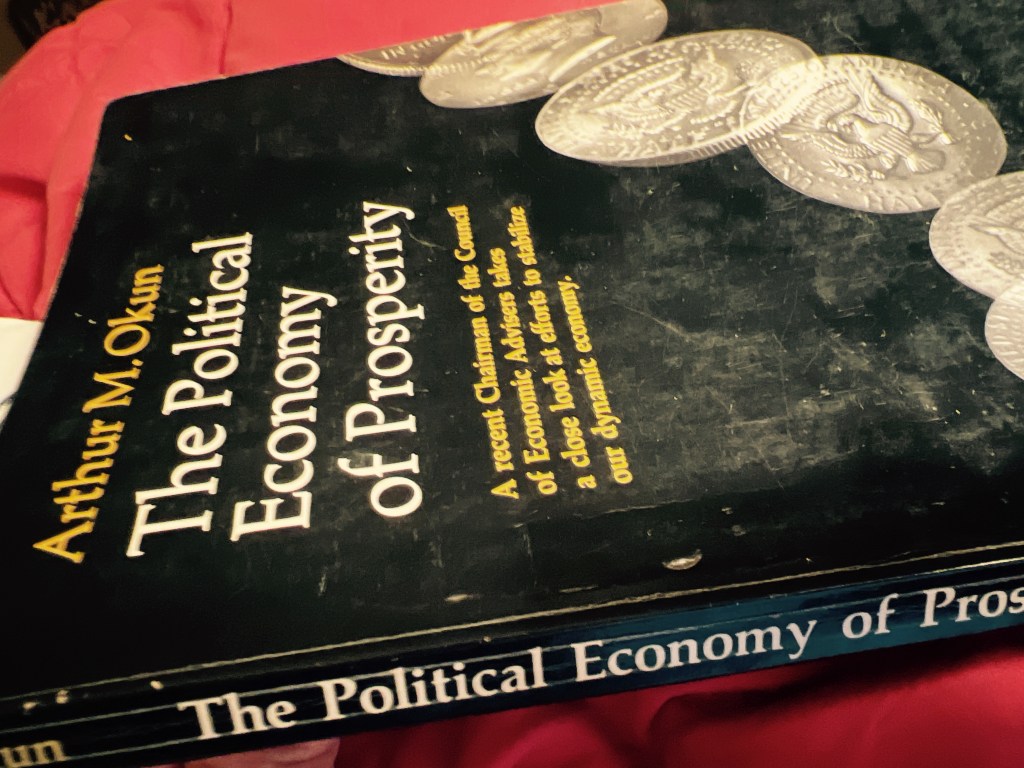
I tell my secret? No indeed, not I:
Perhaps some day, who knows?
But not to-day; it froze, and blows, and snows, And you're too curious: fie!
You want to hear it? well:
Only, my secret's mine, and I won't tell.

Or, after all, perhaps there's none:
Suppose there is no secret after all, But only just my fun.
To-day's a nipping day, a biting day;
In which one wants a shaw,

A veil, a cloak, and other wraps:
I cannot ope to every one who taps, And let the draughts come whistling through my hall;
Come bounding and surrounding me, Come buffeting, astounding me,
Nipping and clipping through my wraps and all.
I wear my mask for warmth: who ever shows His nose to Russian snows
To be pecked at by every wind that blows?
You would not peck? I thank you for good will, Believe, but leave that truth untested still.

Spring's an expansive time: yet I don't trust
March with its peck of dust,
Nor April with its rainbow-crowned brief showers, Nor even May, whose flowers
One frost may wither through the sunless hours.

Perhaps some languid summer day,
When drowsy birds sing less and less, And golden fruit is ripening to excess, If there's not too much sun nor too much cloud,
And the warm wind is neither still nor loud,
Perhaps my secret I may say,
Or you may guess.

Rates are back to where they were at the beginning of September.

The owners of Cup Foods along with other business owners in George Floyd Square are suing the city of Minneapolis and Mayor Jacob Frey over alleged lost business.
Bring me the news
I think this is an interesting match-up: social justice vs. neighborhood grocer. If it goes to a jury will they simpathize with a city’s effort to designate space to an internationally recognized event, or the corner store who served a disadvantaged neighborhood deligently?
They seek over $1.5 million in damages, claiming the city and the mayor were negligent in violating the city’s nuisance ordinance and charter.
The damages don’t even seem that high. But let’s look at the claims.
The claims revolve around two issues: the blockades halted business traffic and secondly the complete lack of police presence encouraged excessive crime. I can’t imagine anyone coming up with a strong rebuttal.
Perhaps the courts will be successful where the city was not in making it politically feasible to dismantle what has become hallowed ground for those who place social justice activities in the forefront of their lives.

A philosopher is someone who engages in the study of philosophy, which is the rational inquiry into fundamental questions about reality, knowledge, values, reason, mind, and existence. Philosophers seek to understand the nature of the world and the human experience through critical analysis, reasoned argumentation, and reflection. They explore questions that may not have definitive answers and often address topics such as ethics, metaphysics, epistemology, aesthetics, and logic.
Philosophers examine the underlying assumptions of beliefs, explore the principles that govern different domains of human life, and contemplate the nature of reality itself. The methods employed by philosophers include logical reasoning, conceptual analysis, and the examination of fundamental principles. They may also draw on insights from other disciplines, such as science, psychology, and history.
Philosophers have contributed significantly to the development of ideas and intellectual traditions throughout history, with famous figures including Socrates, Plato, Aristotle, Immanuel Kant, Friedrich Nietzsche, and many others. The field of philosophy encompasses a wide range of sub-disciplines and approaches, making it a diverse and dynamic area of intellectual inquiry.

But you will regret ignoring it.
It has cooled off in the North Star state with temps these past few days hovering around freezing. Add a little breeze to the mix and while out on your evening walk with your dog you will wonder why you didn’t grab the parka instead of the peacoat.
The weather people have been trying out the ‘feels like’ factor for quite a while now, to give their audience a sense of how your senses will respond to the air currents. I’m not convinced. The wind is not the same as the air temp. You can’t see it, but it has a variety of features. A north wind is not the same a south breeze. Are we talking an easy going 5 miles per hour or a snappy 15? That’s why I was excited to find this detailed graphic on my weather ap:
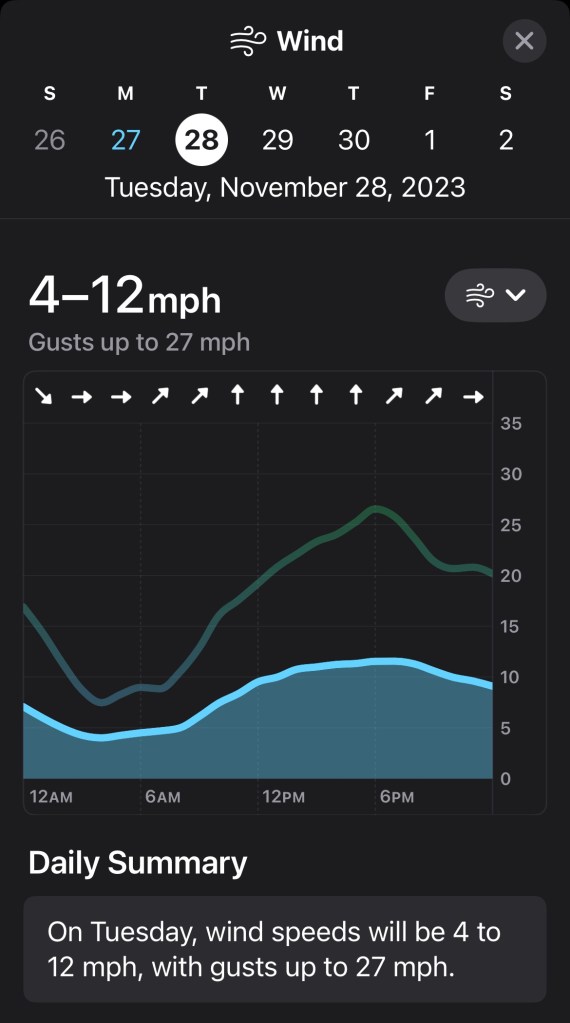
Tomorrow the wind will be coming from several directions. Good to know before selecting the walk for the day. Better to start facing the wind and then return with it on your back, pushing you along. The gusts really pick up mid-afternoon. This is the signal to get out and about early or add a layer of warmth.
Wouldn’t it be great to have a schematic like this for all the forces in one’s life one can’t see? With estimated timing on the gusts and the direction from which they come?
All that these things now tell us is, that human labour-power has been expended in their production, that human labour is embodied in them. When looked at as crystals of this social substance, common to them all, they are— Values.
We have seen that when commodities are exchanged, their exchange-value manifests itself as something totally independent of their use-value. But if we abstract from their use-value, there remains their Value as defined above. Therefore, the common substance that manifests itself in the exchange-value of commodities, whenever they are exchanged, is their value.
Capital Vol 1, Karl Marx
Marx clearly had an agenda. He tried to peel back the onion on the theory of capitalism in order to prove his class struggle theory. He was looking for answers to the frictions of his time. Still- it feels like he missed a more wholistic conception by pegging his ephemeral sense of Value, which permiates and settles throughout the sytem, to the average hour of socially necessary labor time.
There’s something to dedicating one’s time to one’s passions. It’s an expression of interest to give to a cause through one’s labor. Yet- Values can be supported by other resources as well. They can also be neglected leading to negative Values.
What Marx does best here is throw some talcum dust on unseeable efforts so as to fingerprint what Values people are working towards when they make exchanges out in the market. Surging and ebbing through the system of market prices, groups of people express what they care about and what they neglect. Here’s to searching out Value, even if it is not tied to the Labor Theory of Value.

The word networking made be cringe for years because all the aspiring business people kept top of mind. Networking over coffee, affinity groups, let’s get together, bring your friends, and on it went. It seemed so self-serving. Get out there and meet people to see what they can do for you.
But now I’m finding that the best way to find people with compatible interests is to mine the networks of those I favor. I’m a fan of Norah Jones. So naturally I find the guests on her new podcast, Playing Along, particularly interesting.
The benefit of networking isn’t always to see what action you can draw out of the relationship. Sometimes the benefit is simply to introduce you to a whole new set of people with shared interests. People you never would have run into otherwise. Take this icelandic singer Laufey.
Yesterday was Thanksgiving in America, a holiday which originated when the Pilgrims gave thanks for a bountiful harvest. The strife of the first immigrants to North America is well documented. Many died from harsh conditions and lack of food. And even when the first settlers turned the earstern settlements into thriving towns and cities, the subsequent settlers dealt with similar challenges as they progessed westward.
Fast forward to the 1980′ and 1990’s. The memory of ancestral strif had been displaced by how one could survive Thanksgiving dinner with an assortment of relatives. Hollywood had annual offerings along this theme portrayed in films like Home for the Holidays, a 1995 release starring Jodie Foster. These films were followed-up with the ‘it’s-OK-to-spend-the-holidays-with-friends versions. Which it is.
But there are still people who aspire to live a life where two people marry, have children, and are able to celebrate a few days of giving thanks each year. Year in and year out. This takes time. Time to ferret out people’s concerns. Time to plan for the extra shopping and cleaning and prep. It takes time to communicate with everyone. It takes time to circle back and confirm. It takes time to get along.
This year I give thanks for family time.

The economists in our universities and research institutions toil in the field of values as well as that of fact and theory.
Arthur M. Okum

It’s a gritty looking thing, isn’t it? Nestled into the concrete floor of a basement shoulder to shoulder to the hot water heater. But that teal cap, covered in years of grime, needs to be twisted off the main stack in order to have a look-see into the drain and out to the street.
This home was built in 1960, and who knows if the the lid has ever been lifted. The sewer scope guy wouldn’t touch it. Said it looked like it would splinter if a guy threw some weight behind a wrench to twist it off. And you can’t exactly leave a house with the main drain wide open. He’d be stuck.
A sewer scope inspection is a relatively new add on to the inspection process in the sale of a home. Homeowners are responsible for the line which transport all the waste products from the pipes from the home to where it connects to the city infrastructure. So if tree roots have dug into it and it weeps waste product into the soil, then the owner is required to do the repair. This can entail digging up the front yard and replacing the pipe or running a liner pipe through the damaged area. It’s on the more expensive side of a home repair.
Some cities of predominantly 40-60’s built homes require the line be scoped prior to sale. This envolves accessing the drain and sending a camera at the end of a line down through the pipes. The guy today said that typically it takes 80 feet to hit the connection. The city then determines whether the property needs work.
The one in the photo isn’t located in a city with a point-of-sale ordinance concerning waste lines. The sewer scope guy was there on behalf of a buyer. The seller suggested he run the camera through the laundry drain pipe instead, yet alas, that pipe’s diameter is too small. So a sewer repair guy was supposed to come out to the house, but he couldn’t on short notice. Instead, a few days later, a contractor who was familiar with the house went over and installed a new cap.
Today the inspector guy was successful. His footage showed the buyer that all was well until the 60ft mark at which point a bundle of debris was causing a blockage. No real concerns, he said. Just need a Rotter Rooter type out to clear the path.
All this is to point out one small part in the massive collection of parts that comprise a home. When it wasn’t in working order a scurry of others had to swirl around to but it back right. No issues, no problem. An issue, possible delays. Sometimes none of the parts are of concern. But when there are issues, a person with comprehensive experience is going to keep the transaction on track. They’ll know who to call when. And that’s why people hire a professional. Because they add value through their knowledge.
To think that a POTUS would make a joke about how a US economic policy is somehow similar to an expecting mother is hilarious.
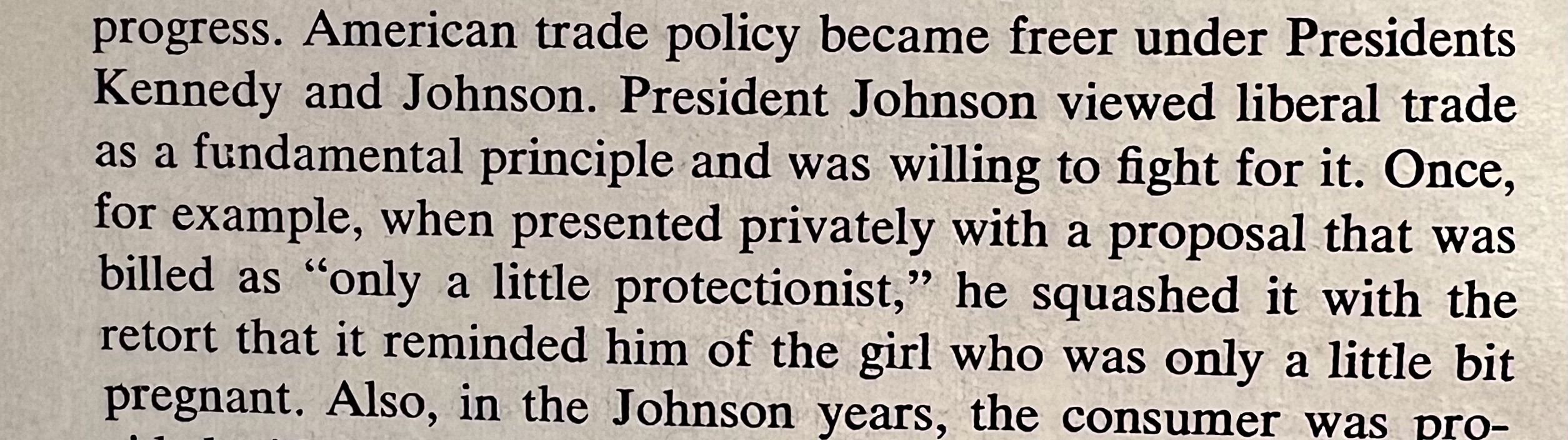
The surprise here is that Kennedy and Johnson were free traders. Or I’m showing off my lack of historical knowledge.
Segment taken from The Political Economy of Prosperity by Authur M. Okun.
I have a new reading rule. If I bend back the bind of a non-fiction book, read ten pages, and fail to find even one whisper of a tie back to a real world concern, I shelve it.
It’s hard to devote time to all the right phrases: institutional (a wobbly word itself), intangible, synergies, norms, soft infrastructure, R&D, yahdi yah. And not one practical eample. The use of so many imperative phrases and descriptions aimed at thin air calls into question where all that is being described is professed to reside. Because if the authors are finding it difficult to relate instances back to the world we live in, then what they writing is a work of science fiction.
HG Wells, Jules Verne and LeGuin all provided keen insights into what is to come. Science fiction is a popular and well read genre. I suggest these policy types devote their efforts in this manner as well. Once they find they are writing on air, they just need to conjur up a little fantasy destination and some sympathetic characters. People love a good story.
Look at how CS Lweis drew everybody into The Lion, the Witch and the Wardrobe without anyone realizing they were being taught a thing or two about Christianity.
Pulls his Beamer over the curb on a suburban road, takes a chainsaw out of the trunk and starts sawing up the wood fall edging the sidewalk.

One can never have enough dry wood for winter time fires.
Yesterday’s post describes a coming to terms between some neighbors over a paving project. It might seem like a one-off situtation because of how the properties were arranged along the road. And it is true that many blocks of homes are developped together and hence laid out with conformity. But when you think about it, the sheer number of miles of road make non-comforming layouts pretty common as well.
Which suggests that a bartering of tax payment in exchange for a road improvement happens frequently. You might say there is a matrix of possible solutions to who pays what based on some combination of property ownership and use-value. There could be other interesting variables as well like how much social time had to be contributed to initiate the process, and shepard it through, and even how much time went toward diplomacy so the individuals who thought things weren’t fair would still go along with the project.
And this is all assuming that the folks, as in the story, know enough about each other and their general alikeness to foster a degree of trust.
Things can get more complicated quickly when some parcels are owned by commercial entities and some by individuals. There can be divergence in the income levels of the various parties involved which contributes to an evaluation of who could carry the burden better. In other words the players can be grouped. In doing so an order may emerge that shows the bartering results in consistent outcomes.
Knowing some of these results could be helpful. It could help with planning, to be able to know in advance the most typical way the numbers all shake out. It could save some upfront hastles for those just starting out on a project. It also could help prevent fraud when the groups need to be subsisdized. In this situation the bartering is done by a bureaucracy which tends to take some teeth out of the trades.
There could be some benefit in knowing the final settling of cooeperative projects. As there isn’t just one mile of country road. There are millions.

It’s unclear to me why some stories from one’s youth stay with you and some don’t. I must have keyed into my grandmother feeling self-concious about a financial sparsing of the cost to pave over the county road which serviced their home. Whenever there are costs and people and public goods, there is bound to be a bunch of judging on who is doing what and whether it is enough.
My grandparents lived on a gravel road on the outskirts of a small town. They also owned the farmland along their side of the road. Across the thoroughfare the land had been parceled into perhaps twenty homesites. For many years a gravel surface was considered adequate, despite the layer of dust left on a car going to and from and despite the washboard effect that eventually appeared and made the vehicles tremor as the wheels caught the dirt ridges.
At some point, enough neighbors got together and decided it was time to make a request to the township to pave the road with asphalt. This takes a bit of work. There’s a process. Enough of the residents need to be interested to start a government agency’s wheels in motion. The cost of the improvement shows up as an assessment where, in many cases, the cost to the homeowner is based on the number of feet of frontage to the road.
At least that’s the standard setup.
But in this case my grandmother objected. Her theory was if they all got the same use out of the road, then that is what should determine how the expense should be covered. Afterall, they don’t expect people from Bemidji to pay, even though in theory anyone from Bemidji can use the road. The residents on the road each come and go with a similar frequency, and fair would be to say those who use it split it equally.
My grandmother was savvy enough to know that property ownership would play into her final bill for this public amelioration. But she didn’t think she should have to pay 20 times more than the folks across the road simply because her farmland abutted the pavement. Furthemore, she realized that her lack of support for the project could endanger it from going forward.
I’m not sure where the numbers settled exactly. The road has been paved ever since. What is interesting is that this story is an example of a bartering in order to come to a cooperative solution to community improvement. All these neighbors were of similar standing. It would be difficult for any of the others to call out two educators as evil landowners. It was just a group of neighbors, in a small town arriving at a balance between use-value, property ownership and resources.

His eyes widened.
The vision of the two hats, identical, broke upon him with the radiance of a brilliant sunrise. His face was suddenly lit with joy. He could not believe that Fate had thrust upon his mother such a lesson. He gave a loud chuckle so that she would look at him and see that he saw. She turned her eyes on him slowly. The blue in them seemed to have turned a bruised purple. For a moment he had an uncomfortable sense of her innocence, but it lasted only a second before principle rescued him. Justice entitled him to laugh. His grin hardened until it said to her as plainly as it he were saying aloud: Your punishment exactly fits your pettiness. This should teach you a permanent lesson.
Everything That Rises Must Converge, Flannery O’Connor

People don’t associate wells with metropolitan homes. Wells are a country thing. When there is distance between homes, putting in infrastructure like water lines or gas lines or internet connections is more difficult to justify in the money sense.
When you do run into a well issue in the city it is usually to do with an old abandoned well. There is always a time when every housing development was new. The post WWII baby boom pushed demand for housing before all the infrastructure was figured out. So many homes in the first tier suburbs were serviced by a well. The well room was located under the front stoop (steps to front entrance) and housed the pump and holding tank.

Ten years go by and many municipalities start catching up on their water main infrastructure. A rule is passed that no well can be dropped once municipal water is available in the road. A generation goes by and the pumps start to fail. Perhaps the owners had been using the well water to water their gardens, but this use doesn’t warrant the cost of a new pump. So there it sits in the damp well room, under the front steps.
Eventually people realize that hundreds of unsealed wells could cause a public health concern. The monitoring and tracking to wells is turned over to the Health Department. A disclosure is required at time of sale to indicate the status and location of any well on the property. But people think there is no harm in continuing to do what they always have done. They don’t want to bear the expense of an additional regulation.
Another generation goes by and many of the wells have been properly sealed. Those who worked in city utilities departments and at the health department and with well sealing companies have graduated onto retirement. A younger generation looks at the quaint cellar under the steps, see a clear floor, and can’t think why a well would ever have been stationed in such a spot. The pipe end protruding slightly above the concrete means nothing to them. It doesn’t take long before things are forgotten.
The tacit knowledge held by that older generation as a lived experience is gone. And those who never knew are convinced there must be some mistake. And thus, for infrastructure of a certain level of social benefit, a central regulating agency is desireable.
I read somewhere this past week that ‘everyone would want to live in a mansion in the Hamptons.’ But I’m not buying it. I sit and wonder how many more years I have to hang onto my kids’ childhood home to keep them happy. Because I personally would prefer to downsize and have less to care for. A mansion? Can you imagine not only the maintenance expense but the time-burn everyday of caring for a beast of a building with a showcase yard? No- not everyone wants to live in a mega-home.
It kind of reminds me of the thought that workers want a meaningful connection to their work. I don’t see that. I think most workers are very content to get their piece of the work done (in a competitent and self-satisfying way no-doubt) but once it receives the stamp of approval, the commondity needs to mosey itself onto the next person. The deal was to receive a rate of pay completeing one section of a process.
Can you imagine if every transaction you participated in could be in some way tied back to you; that there was never closure, forever the potential of reworking what was meant, what the deal included, whether there sufficient oversight and care. I can’t. And I don’t think anyone wants these lingering warranties.
I’m not exactly sure what Marx meant about inalienable. But it certainly seems to work best if everyone investigates the commodities in question, but once traded, workers indeed alienate from their products.


Fall is a popular time of year for Galas. People get dressed up in fancy clothes and meet at ballrooms venues to be served fancy food and asked to bid on an assortment of items. There are weekend getaway trips or theme baskets full of goodies, there are NBA basketball tickets or a signed jersey from a baseball star.
The bidding gets started before the presenters give the audience an update on the progress for the cause at hand. Participants watch their phones for updates on which items they are getting bumped off by a higher bid. But it is only the final minutes of the bidding that matter. That’s when you want to be the one to bump with a higher bid, right before the auction stops.
So you end up paying $20, $30, or $50 over face value for those Timberwolves tickets. What is the premium called? The face value of the tickets seems to be its use value- or what anyone would pay for the use of the ticket. But the surcharge, acheived in the ambiance of the evening could simply be a value, a social value for the cause at hand.
In this way it is easy to see the breakdown of exchange value, use value and value.
We’re getting a new flag. Lawmakers decided last session that an emblem with a pioneer tilling the soil and a Native American on horseback was uncouth. So the competition has started.
There are over 2500 entries so far that one can peruse. Lots of blocky colors. Lots of loons- our state bird. Some mosquitos, haha. But no people.
I say nothing says Minnesota like the smile on a face that has hauled a catch out of our sky blue waters.


In the first three chapters of Capital Vol 1 Marx throws down his founding priciples of capitalism under the premis that labor time is the ubiquitous unit of measure. He does conceed that the quality of labor time, and hence its ability to be productive, is influenced by other factors.
The value of a commodity would therefore remain constant if the labour-time required for its production also remained constant. But the latter changes with every variation in the productiveness of labour. This productiveness is determined by various circumstances, amongst others, by the average amoun of skill of the workmen, the state of science, and the degree of its practical application, the social organisation of production, the extent and capabilities of the means of production, and by physical conditions
Capital Vol 1- Karl Marx
Think about this list. 1.The skill of the workmen 2. State of Sciene 3. degree of practical application 4. social organization of production 5. capabilities of means of production 6. Physical condition.
Couldn’t this list be 1. Quality of public education available to workforce 2. Technology 3. Vo-tech adaptation of technology 4. Governance of plant 5. Degree of logistical support including maintenance and transportation 6. The environment.
No matter what specifics came to Marx’s mind as he wrote this list- the list appears to point to what we now call public goods. The productivity of the labor hours invested depended on the quality of the public goods inplay at the plant.
.


My grandpa was an outdoorsman. Practically orphaned as a teenager he fled to the camps in Northern Mn and survived off hunting and fishing. He would never fail to bring my grandmother enough fish for dinner and she would never fail to cook it to his contentment.
He was also a history professor who subscribed to the Nation to cultivate his far left inclinations. But he was happiest in the outdoors.
Everyone’s heard it- capitalism is bad because it caters to people who are greedy. It’s all about money, greenbacks, bills. And in this way converts every human activity into a monetary accounting.
But that’s often not the case. The timing of an event or an aquisition often has a large impact on the desire to trade. Take travel. Families with kids want to catch a plane to grandma’s house when the kids are off school. If they were greedy, than they would save the dollars and pull the kids from class. The airlines respond to the demand at the holidays by increasing fares. So they must be greedy. Whereas, the price increase just encourages those who are not beholden to a school schedule to pick a different day; the price system encourage them to free up their seat so a kid can head to Grandma’s for Thanksgiving.
Timing has been a key feature in the Amazon Prime business. It’s not just that you can find what you want on line at a price you feel is acceptable, but you can get it tomorrow. The item is nore valuable to you since you can use it quicker.
Timing also plays into what typ a store you shop at. Pay a little more and shop at the smal exclusive grocery instead of the large box store with better prices. I know economists call this opportunity cost, but for some it’s different than substituing your labor time. It’s a luxury to walk in and walk out with the item you want. It makes you feel special.
Timing is a key motivator in personal transactions. I bet it features up there second only to price.

However, every technical advance leads to a further complication of the economic framework, to new factors, new connections that the masses are at first unable to comprehend. And so every leap of technical progress brings with it a relative intellectual regression of the masses, a decline in their political maturity. At times it may take decades or even generations before the collective consciousness gradually catches up to the changed order and regains the capacity to govern itself that it had formerly possessed at a lower stage of civilization. The political maturity of the masses can therefore not be measured in absolute numbers, but always only relatively: namely in relation to the developmental stage of any given civilization.

Based on a true story, this tale of flamboyant lawyer taking on the mega corporation on behalf of the small businessman is entertaining on many dimentions. Jamie Foxx plays a selfmade courtroom powerhouse who loves to win. But he does it by sliding into the seam in society where there is empathetic recompense waiting for a subpopulation who has been sectioned away from the better parts of life in this country.
Granted his client in this tale is a white small town businessman in his later years of life. But the jury, who ultimately decides the outcomes in trials, has a more cohesive background. You could say Foxx is a type of entrepreneur. He sees in groups. There are the large corporations who ‘got the bank.’ These folks have no issues with taking their wares to the high poverty areas where they depend on a general lack of poor support infrastucture to corner the market. The consumers are not educated in ways to hold a business to its advertizing; they don’t have the means to drive across the county looking for better deals; they are unable or uwilling to follow up on a consumer complaint.
They are the perfect consumer group to mess with, and as the lawsuit shows, they are taken for a ride.
But is it a misscarriage of justice that the award goes to the one plaintiff? Out of a group wronged, should one individual benefit? No- that is just how it works. It only takes one individual in a group to save a drowning child. Yet that one individual would do it for anyone. When a discovery is made, one individual gets credit eventhough many were working toward the same goal. But eveyone benefits from the invention. And everyone in the disadvataged community benefits when huge claims are made against corporations for predatory activities. It’s the voice of it that matters.
I must say, though, that my favorite scene in the courtroom where Jurnee Smollett cries out: “The hypocrasy! The hypocracy!” This seems to be the director Maggie Betts talking directly to the audience.
Oct 31 (Reuters) – A U.S. jury on Tuesday found the National Association of Realtors and some residential brokerages, including units of Warren Buffett’s Berkshire Hathaway (BRKa.N), liable to pay $1.78 billion in damages for conspiring to artificially inflate commissions for home sales.
Reuters
For more than fifteen years, Silicoln Valley has tried to lure customers away from Realtors and have them buy direct. VC has the money, they have the technology, they have the consumer’s attention. Yet when it comes to the transaction the customers keep realtors on their team.
Why can’t market oriented people accept what the open market is saying?
Marx has a lot of interesting things to say in Capital which have nothing to do with revolutions and red flags. In the first three chapters of Vol 1 he sets out a structure for commercial intereaction before, during and after a transaction. He is particulary interested in the concept of value- who creates it, how it moves through the system and thus who should reap rewards from it.
Marx ran aground focusing on labor value as the defining characteristic of economic production. All else should fall under the measure of a man’s labor turned out not to be. But in his efforts to justify this theory he sketched out a structure which is interesting and useful. Value is an internal component to a product. Price represents some reflection of the value it contains. If a commodity has no use in the parketplace than it has no value.
Spending labor time on something that is not useful, then bcan be described as simply engaging in a hobby. It’s a leisure time activity. If you dig out in the yard and grew somebeautiful dahlias, but not to sell, than you are engaging in a avocation. It’s important to have a way of distinguishing between unpaid work activities. Caring for a child is useful and hence has value. In this way Marx lays the groundwork for a scientific approach to appreciating those activities not represented by prices.
Regret emerges from a sense of loss. It’s an emotion that some think of as melancholic, sad, dismal. Yet in truth it is an emotion which helps to keep our choices in check.
One may be regretful because they failed to act.
One may be regretful because they failed to appreciate what was offered to them.
One may be regretful because the market changed while they were focused on other things
One may be regretful because they misjudged their circumstance.
If one experienced a sense of loss because they waited on the sidelines while the market took off, then they will be a more serious player the next time around. If one experienced a loss after they turned down an offer to engage in the market, then they will take the next offer more seriously. If one experiences a loss because the market changed when they were not paying attention, then they become better at watching their surroundings. If one experiences a loss because they were over confident (or under confident) about their personal circumstances thus leading to a mismatch, then they maybe more realistic the next time around.
Having regrets is a means of becoming.

Public Spirit shou’d engage us to love the Public, and to bear an equal Affection to all our CountryMen; not to hate one Half of them, under Colour of loving the Whole.

Say what?
I was triggered on Twitter. (oops X). I saw a post that vilified suburban sprawl as ‘we all subsidize’ it. It’s been a while since I’ve heard that rally cry against the natural course of a metro area to seek out inexpensive growth. The claim, which is never followed up with any data or research, implies that the public costs to the outward growth of a city drains public resources.
But all growth or redevelopment is subsidized. Developers receive tax benefits and incentives for work in urban areas as well as suburban areas. Roads are built and maintained with funds at the local level, the county level, the state level and even the Feds drop a few bucks for the interstate system. Since employers are located all across a metro area, there is no guarantee that a city dweller commutes less than suburban dwellers, they just travel in a different direction.
The old dichotomy of the urban versus the suburban is so passe. First tier suburbs are now appraoching 80 years old, which is about how old the core city was in the 60’s when this whole vilify the middle class folks who simply wanted a nice little 1800 sqft one-and-a-half-story on a .14acre with a sidewalk lot started.
Let’s put to rest the image of a cool (yet always suffering) urban core that needs to be cherished, protected and preserved by fighting courageously against the nasty exclusionary suburbs. Instead, envision a dynamic, interesting and ever-changing melange of housing choices that serve as the dwellings for the several million people who want to cluster in a large metro area.


