Non-profit housing provider speaks the truth

In a recent article, Aeon’s Laura Russ offers insightful takeaways from this unique market on what operators face today in the Multi-Housing News, Laura Russ lays out the uncomfortable truths.

  1. Rent control works against capital improvements. “The strict rent control policy enacted in St. Paul, coupled with the eviction moratorium and the overall economic volatility that followed the post-pandemic boom, have all made it harder for Twin Cities multifamily operators to manage their properties, particularly for those active in the affordable housing arena.”
  2. Managment of affordable housing is the long haul pull, as opposed to the initial heady deal making. “I think, in general, there is an underappreciation of the management and operation of affordable housing. The fee structure incentivizes getting the deal done over the long-term success of the property as an ongoing community.”
  3. Crime in a rental community acts as a tax. “For example, security issues are a big topic at many of our properties right now. Essentially this adds a ‘tax’ onto our properties because of the increased spending required. Some local policies have made it harder for us to remove residents who have engaged in dangerous behavior which is sometimes required in order to protect the rest of our residents.”
  4. Administrative overhead caused by detailed laws takes money away from keeping property affordable. “Again, these types of policies have a lot of unintended impacts. The main one is that it is taking a lot of time and money for lawyers and accountants to understand and interpret the rules that are not well understood often even by the cities themselves. This takes away from what we would rather be doing which is producing and running housing.”

Read the whole article.

Emerging words

A friend of mine once said that once a writer puts a work out into the world, it takes on a life of its own. The words are on the pages. The pages are bound. The stiff cover boards keep them all orderly and together. But the intent of the work, how people wrap their thoughts around it, who quotes it to make what type of argument– all that shapes the work into something new.

You might say that the work is emergent. It is a becoming.

Of course, many things that are written for fleeting entertainment won’t gain significant independence. But those words that stay true, that trigger some type of response in the face of reality; those words that inspire the reader to share something they feel valuable. Those are the books which gain a following, are massaged for all their meaning and evolve into something new again.

All levels of trade

The Haj by Leon Uris is a book full of political economy and social trades. I bought it years ago from Bev’s Book Nook in town but have never gotten around to thumbing through its pages.

The author hooks you in early and the text is easily absorbed. In other words it’s a perfect long weekend read.

One caution though- you do need to tamper down an obvious bias.

Business and Social Pressures

Target is not so woke anymore. The popular retailer closed a store in the Uptown area in response to crime. Recently, the company also removed some of its LGBT garments from its stores in response to hostility from some shoppers. In both cases, the Minneapolis-based chain said its first responsibility is first to the safety of its workers. Loyalty to company first, greater society second.

Target was the first retailer to rebuild (in record time) its store on Lake St. The structure was looted and burned during the riots three years ago. Local residents disproportionately benefit from discount stores. But as the shoplifting continues and vitriolic reactions from various factions have become the norm, it seems the business is wearing thin on taking moralizing stances.

In the 1950s firms incorporated a social angle into their business. A good-paying job with benefits was designated to male employees as it was assumed that those salaries funded the needs of a family. Paid family leave wasn’t necessary as it was understood that the second adult in the family was available to care for children or aging family members- at least in theory.

A paid family leave bill just passed in MN placing the burden of family support on businesses of all sizes. This model of giving paychecks directly to workers who choose to care for family in lieu of work will have pros and cons. Instead of being part of a family unit where one person provides caregiving and the other(s) focuses on earning wages, you can ‘have it all’ as they like to tell working women.

The disadvantage to atomizing this process, of detaching it from the family unit, will be the absence of feedback loops. Through a filtering system of interaction with other group members, and a give-and-take on who gets the support when a balance of aid is achieved so it is dispensed to those who need it most. Setting up formal rules eliminates the judging and metering of volunteer care. If the benefit is there, the logic is to take it.

Businesses can and do get involved in social trade. But where they excel is at unfettered trade to promote mutual well being.

Different skills, different pay

On our walk yesterday we caught a crew doing some aerial work. A helicopter transported a worker to a spot on the power lines to install a colorful ball, presumably for visibility. Dealing with heights, leaning out of a moving aircraft, and touching power lines isn’t an everyday activity. Some people might like the adrenalin of it all, but most would agree that this job deserves bonus pay.

Activists like to paint a simple picture. There are rich people, think corporate types, who are greedy and make a bundle. Then there is a mass of inadequately, poorly treated people who don’t earn enough to pay their bills. With only two groups to consider, it’s an easy call to impose taxes on the former in order to strategically (there are incentives for e-bikes!) tranfer money to the later.

The thing is, life isn’t that simple. There are hundreds if not thousands of jobs that deserve more pay because only a few people are crazy enough to ride helicopters up to power lines. These guys still wear steel-toed shoes and most likely hang out at the same water holes as the rest of the crew. They are not greedy. They found a special talent- and thank goodness for that because we all benefit from the colorful balls which keep the lines up and running.

A simple Taxi/Uber model

Once there was a service called a taxi. For a fee, passengers could hire a ride from here to there. This was an organized commercial venture with firms and drivers and passengers arriving at an acceptable balance of profits, fares, wages, and benefits. There was a govorning role in place as well, one developed over time.

Then came the internet and individuals outside the taxi service business could offer people rides. Without the formal structure and regulation, thus fares were considerably cheaper. This was good for the consumer, especially those of modest means. This internet-based method of connecting those with cars to those who needed rides seemed like a win-win for everyone.

Then drivers (who did this for a living instead of simply being in the neighborhood) found they needed better working conditions. The conditions that were most probably in place in the taxi industry that was disrupted. Labor activists jumped in to help guide a political process. Drivers donated extra voluntary time. Paths were forged with local politicians. A bill is written and passed. The celebration that followed looked like this.

But the stark numbers reality of the push to revert back to the original model has been ignored in favor of winning. The old model is considerably more expensive to the consumer. Without a need for the internet service, Uber and Lyft claim they will leave the market. Should the drivers prefer the original taxi model, that is fine. But it is a mistake to ignore the reality of the other parties. The Governor overrode the unanimous preference of his party in order to study the matter further.

I’ve got to give the Gov credit for putting economics over politics on this one. Or did he? If the ones being hurt by the labor regulations had been higher-income folks, I’m sure he would have signed off.

Warhol’s taking from a Prince

A photographer comes out ahead in this story of copyright infringement.

Andy Warhol’s posters of Prince, some shaded purple and others orange, may have been works of art, but they infringed the copyright of the photographer who captured the original image of the musician, the Supreme Court ruled Thursday.

LA Times

It’s nice to see a win for photography over other forms of art. Often it feels as if taking a photo is something anybody can do. And thus it is a maiden-in-waiting to the fine arts. But capturing a framing, a look, or a feel is what differentiates a snapshot from something interesting. Warhol took advantage of Goldsmith’s perception of our famous Minnesotan.

Have a look and you be the judge:

Sooty air

Come night, come darkness, for you cannot come too soon, or stay too long, by such a place as this! Come, straggling lights into the windows of the ugly houses; and you who do iniquity therein, do it at least with this dread scene shut out! Come, flame of gas, burning so sullenly above the iron gate, on which the poisoned air deposits its witch-ointment slimy to the touch! It is well that you should call to every passer-by, ‘Look here!’

Bleak House- Charles Dickens

Thinking In Space

People think differently. I don’t mean they think about an issue differently. What I’m getting at is how brains navigate concepts and concerns differently.

Some people have photographic memories and can picture a page out of a book. When they want to think of a definition or the historical background on an issue- poof- the image appears to aid them. But this is not the same as a visual way of thinking. For some people, their thoughts can capture events and spaces in real-time, as they transpire. Take the skills necessary to be an air traffic controller (pre-computers), This type of mind is skilled at keeping track of moving objects in three dimensions. Pretty cool.

It’s really noticeable how differently people think if you are using a map to navigate a city. A linear thinker takes directions one turn at a time. There is no overlay of the cityscape into quadrants to have a general sense of where one should be. As long as they follow explicit directions, all is well. But improvising or getting back on track after an error is too difficult without help.

At the same time, a sense of distance and duration is simply missing. Offhand comments which imply a schedule can be met or a stop can be worked in (it’s the anything is the possible world!) can be aggravating for the minds which navigate in three dimensions. It’s better if those with a sense of direction take the wheel.

What shapes the nature of a good?

How many ways are there to determine whether an action or good is public or private?

  1. By ownership. If the good is owned by a community, like a park, then it is public. If it is owned by an individual, as a homeowner owns their home, then it is private.
  2. By its use. If the park is used by drug traffickers, and the average citizen is too afraid to use it, then the park is owned by the criminals. If an owner of a car rents it out on Turo and pockets the funds then the car is privately owned.
  3. By a moral standard. A worker has a private claim to a product their hands helped to create. It is a public good to pay parents-workers to stay home on paid leave with their infants.

Are there more?

Publicized goods

A publicized good is any whose ‘public’ character results only from a policy decision to make some (otherwise private) good freely and universally available. This fact poses complications for the PGA, insofar as the set of possible publicized goods is quite extensive indeed.

Concerning publicized goods (or, the promiscuity of the public goods argument)

I thought people had come to the realization that just about every good can be made private in the sense that others may be excluded from its use. So to develop a new term to explain that the good which could be private is now going to be called publicized to indicate it is provided by a government entity seems a bit roundabout.

What about goods provided by NGOs? Or non-profits? Or associations?

It seems more orderly to identify a good’s nature by how it is used. THis of course would need to be accompanied by a descriptor of who in the group has access to it. I think this would enhance analysis as it would start to delineate ingroups and outgroups in the analysis.

Different Platters, Different Rules

The political types down at the state capital are scrambling to finish the bills they want signed before the end of session. One such document involves a mandate for hospitals to form boards of nurses who in some way dictate the required staff levels in Minnesota hospitals. The largest hospital in MN, and most famous, said not so fast. Mayo Clinic threatened to take a sizable investment elsewhere should this come to be.

Last week, I predicted here that this wrinkle would be ironed out.

But what’s interesting is the justification that the speaker of the house used to explain why Mayo is getting a carve-out in the bill. In an interview yesterday Hortman tells Esme Murphy that the hospital operates at a different level than others in the state as they cater to famous dignitaries from around the world. The implication is that the demands of competing worldwide for care are a valid substitute for regulatory intrusion from a board of nurses.

I wish this type of platter identification (the medical provision at a worldwide level, versus a metro level, versus an outstate level, to give a few possible divisions) was used more widely in the analysis and provision of public goods.

Work that gives and Work that takes

You know how in different parts of your life you interact with people differently? When you are settling in with your kid to go over homework you have a different approach than when you go over an employee review at work. Or, how you resist and then conceed to taking an older parent to their doctor’s appointment, whereas at work you would fear that taking on a coworker’s responsibilities would lead to a pattern of being taken for granted.

One might say that the different types of work we do– depending on whether it is driven by public needs, like caring for a family, or done for private ambitions like earning a paycheck– have different traits. I think we’ve come along far enough to acknowledge both are work, paid or unpaid. Both generate value. But the workers who perform the various acts become accustom to the various formats.

A few days ago, Arnold Kling wrote on his substack In My Tribe

But I would like to see women better assimilate to the institutional values that are worth preserving. A few years ago, I wrote

1. The older culture saw differential rewards as just when based on performance. The newer culture sees differential rewards as unjust.

2. The older culture sought people who demonstrate the most competence. The newer culture seeks to nurture those who are at a disadvantage.

3. The older culture admires those who seek to stand out. The newer culture disdains such people.

4. The older culture uses proportional punishment that is predictable based on known rules. The newer culture suddenly turns against a target and permanently banishes the alleged violator, based on the latest moral fashions.

5. The older culture valued open debate. The newer culture seeks to curtail speech it regards as dangerous.

6. The older culture saw liberty as essential to a good society. The newer culture sees conformity as essential to a good society.

7. The older culture was oriented toward achievement. The newer culture is oriented toward safety. Hence, we cannot complete major construction projects, like bridges, as efficiently as we used to.

I agree that a worker should take on the role that the job requires. But before judging the new culture too harshly, let’s see how the traits of the new culture fit into another activity. Say the work done to have a successful Little League team.

  1. The old way of doing things was to say winning the game was all that mattered. The proof of performance was simply in the W’s. The new way is to point out that when a stronger league plays a weaker league and always wins, then perhaps it would be better for everyone is the leagues were redrawn.
  2. The old culture was to say if X neighborhood Little League wins because they have the best coaches, better parent turnout, and reliable transport to practice and games, then their success is just the way it should be. The new way might be to say, it would be more interesting if the other neighborhood leagues could beef up their competency a bit and challenge the stronger leagues. Can they get some sponsors? Who can be put in touch with who to strengthen the network and bring the others along?
  3. The older culture thought that promoting one or two-star players on a team was all that mattered. The new culture wants to rotate the player a bit to build exposure to the kids as they age. Building up one or two shining lights might make the other kids quit.

I think you get where this is going. There is a type of work where workers are always shoring up the weaker players on a team or in a league to make the sport more interesting. Some people think developing a deep set of players means the teams will be able to compete more broadly in the long run. But you really need both. You need the individuals to want to be the superstars and enjoy and thus work hard to get to the tippy top. And you want to do activities that help a broader public.

It’s just that women were brought up and trained to be the latter type of worker. So it shouldn’t be surprising when they show up in the private sphere with some of those traits. As the reshuffling of workers continues to transition from separating workers by domestic obligations to partitioning based on professional ambitions, these inherited work traits should dissipate.


Song of hope

Hope is the Thing with Feathers
Emily Dickinson

“Hope” is the thing with feathers -That perches in the soul -
And sings the tune without the words

-And never stops - at all -

And sweetest - in the Gale - is heard -
And sore must be the storm -
That could abash the little Bird
That kept so many warm -

I’ve heard it in the chillest land -And on the strangest Sea -
Yet - never - in Extremity,
It asked a crumb - of me.

Top-down money vs Bottom-up

This exchange on Twitter is provocative. Here the implication is that top-down money is bad and bottom-up money is good. When an overlord government pushes an ambition down onto a community things will go sideways. When a community builds up the aspirations from the bottom everything will come up gardens and rose beds.

I’ve been living here for years and unfortunately I can confirm this process as I saw it as it developed. Unfortunately a large part is also due to the bad policies where a lot of stuff is handled by the state rather than local, which prevented Rome to develop as an alternative commercial hub outside tourism. Today in Rome you have a delude of top-down money (coming from the EU) to transform it even more in a Museum, and very little bottom-up money (local commerce outside tourism). With the consequence that locals are getting pushed more and more outside the city (as they can’t afford it any longer due to price spikes due to touristification) and local communities are getting slowly dismantled (new local towns are rising well outside the city).

·

I guess it’s easy to think of examples of both. When the freeway system was developed, thick swaths of housing, usually disadvanteged housing, were taken down and paved over. This top down money destroyed communities. Yet it is common for the bottom up money to restrict any building other than the status quo.

Maybe the good and the bad of top-down and bottom-up money can be more clearly seen if we divide up the player into different groups. The freeway system was and is an undeniable benefit for a great number of people. The ability to travel more efficiently for work and recreation continues to be a boon for many people. Yet for the small communities which were crushed, the creation of the roadways was definitely bad.

Similarly, when a community consistently maintains a certain level of housing through construction restrictions it is good for them. They are in fact reacting in a way that many would want to react for the small cluster above who were poorly impacted when the freeway system went through. Yet here it is viewed as negative because as they protect their nook in a greater metropolitan area, density is disproportionately falling to nearby neighborhoods.

I would argue that there’s a balance in there where the private needs of a small community are blended with the needs of the more expansive overarching community. Whether action is taken through top-down money or bottom-up money, there is a calculation that steers towards a balance in the obligations.

What money can’t buy

Thanks to the Beatles we all know that money can’t buy you love. Money can motivate a salesperson to sell a few extra units. Money can persuade a road crew to finish a paving project ahead of schedule. Money can motivate a team in getting their product design finished and into production. But for as well as money does at motivating some things, it isn’t great at moving the needle on others.

People aren’t that interested in money when it comes to losing weight. Nor does it turn a drinker into a teetotaler. And I dare say it does not ebb the urge of a bully to be kind.

Somethings people must decide they want for themselves and then take the initiative to set themselves on that course. How the people around them behave, however, has a direct impact on how all this works out. Reminders of tradeoffs, actions to eliminate possibilities, and support when on the right course may all factor into how the company one keeps makes life a little easier.

Oddly, even though money is ill-suited as an motivator, the final outcome of success aided by community support does generate increased financial well-being. When people around you work at helping you be your best, the benefits realized can be financial. Better health through weight reduction translates into less time off work. Killing an addiction eliminates the bill to buy product.

The flow can be from cash to capital or capital to cash.

Book shopping at Estate Sales

My grandmother introduced me to junk sales (her term). She loved to erratically make a turn off a country road following the direction indicated by a garage sale sign. She had all sorts of rules. As we’d walk up the gravel driveway she’d coach- “You always want to find something you can buy. They’re trying to get rid of things after all.” She was in pursuit of old furniture mostly. When everyone had gone home from weekends at her lake place, she’d set herself up with a refinishing project. The pleasure of seeing the knotty grain of oak under twenty layers of paint gave her immense satisfaction.

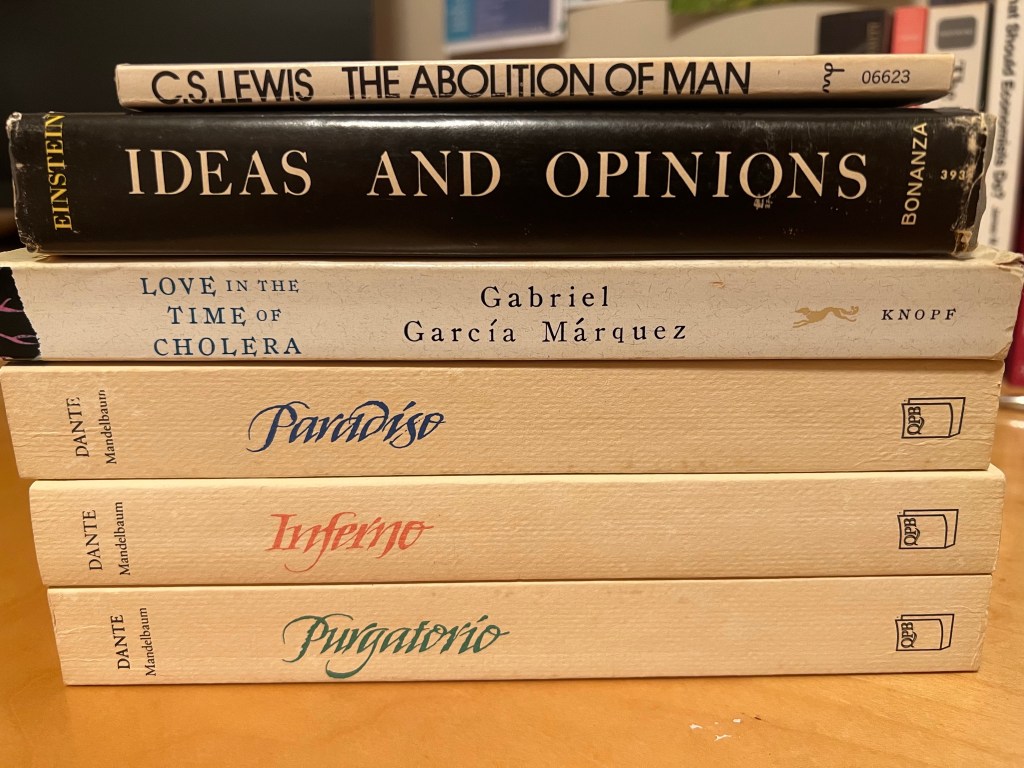
Estate sales work a bit better with today’s technology. Estate companies post pictures of the finds to be had so at least you know in advance what is on the property. I love to go to the ones with books. Sometimes it’s a bust, but often there are interesting finds. Old copies of the classics can even be rewarding. This set of Dante’s Devine Comedy was illustrated by Barry Moser. Not only are the drawing nifty, but I learned he is well known for his illustrations of Alice in Wonderland.

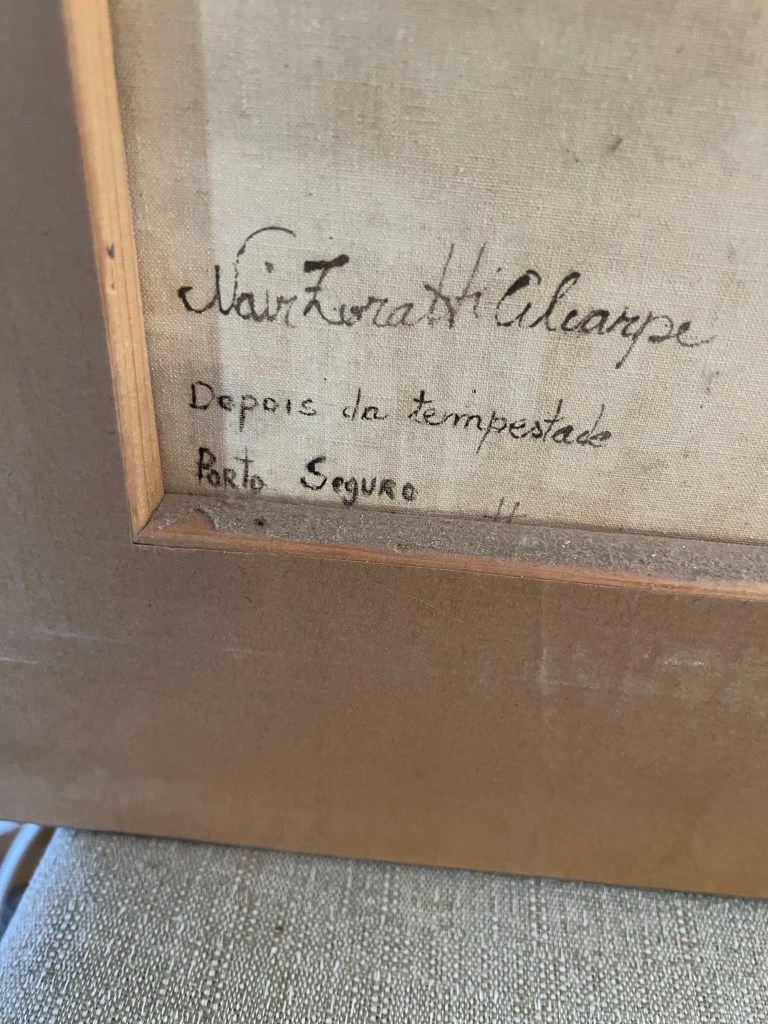
Some homes have quite a bit of original art. Since there are few art galleries in our area, this is a casual way to get up close to originals. Google Lens helps identify pieces. This is necessary when signatures are little more than scribbles. I quite liked the green abstract which is an engraving by a Brazillian artist Arthur Piza. He wasn’t too hard to find as he had a long career which resulted in a large portfolio.

I’m still working on the original oil of the white-washed buildings. I thought I had it narrowed down to another Brazilian modernist, but now I can’t find the links. If there’s anyone out there who can lend a hand, jump in on the comments.

People doubt Exit- they shouldn’t

The Mayo Clinic, the state’s largest private employer, put its foot down on Friday over legislative overreach at the MN state capital.

In an email to DFL legislative leaders and Walz’s office on Wednesday, a Mayo Clinic executive said the non-profit is reconsidering its plans for new facilities and infrastructure that are “four times the size of the investment in U.S. Bank Stadium” — a $1.1 billion project. And their decision is “time sensitive” and will be made in a matter of days.

“Because these bills continue to proceed without meaningful and necessary changes to avert their harms to Minnesotans, we cannot proceed with seeking approval to make this investment in Minnesota. We will need to direct this enormous investment to other states,” Kate Johansen, vice chair of external engagement, wrote in an email obtained by the Reformer.

Minnesota Reformer

Throughout the spring legislative leaders have been warned that continuing to push a progressive agenda, where the expense from social arrangements is sloughed off business, will cause people and entities to exit the state. This letter provides a tangible example.

Mayo is a powerhouse in MN and thus it is unlikely that this flare-up will go unresolved. But what about all the little businesses and people who decide they’ve had enough and pack their bags? It would be handy to pin down some indicators for people’s movement. Ones that are representative but not alarmist.

Advice to Students from Albert Einstein

TEACHERS AND PUPILS

A talk to a group of children. Published in Mein Weltbild, Amsterdam: Querido Verlag, 1934.

MY DEAR CHILDREN:

I rejoice to see you before me today, happy youth of a sunny and fortunate land.

Bear in mind that the wonderful things you learn in your schools are the work of many generations, produced by enthu siastic effort and infinite labor in every country of the world.

All this is put into your hands as your inheritance in order that you may receive it, honor it, add to it, and one day faithfuls hand it on to your children. Thus do we mortals achieve in-mortality in the permanent things which we create in common.

If you always keep that in mind you will find a meaning in life and work and acquire the right attitude toward other nations and ages.

Ideas and Opinions by Albert Einstein 1954

Daycare math

I’m really having a hard time with the math behind current policies around daycare. If you’ve ever paid for care so you can work a forty-hour week, you know it’s a bundle. Yet there’s a push to have care workers unionize because they are paid too little, making that bundle turn into a load. And to divert that from circling back to being a burden on the working mother there will be a credit for the child which will come out of some tax to the people. Which all sounds like a double surcharge in administrative fees so someone else can care for a child of another who is paid a similar wage, all of whom are deemed to be paid too little.

The Night Agent- Series Review

I’ve had a dry spell in finding a series that holds my attention. I like to take in a show during that time of the evening, right after dinner, when you just want to relax and not think about much. But you need a story, some intrigue and some action. The Night Agent is coming through on all accounts.

Sure the power structure is familiar. And the who’s-the-good-guy and who’s-the-bad-guy back and forth is a staple. But the characters are engaging. The two lead actors have strong rapport which is important. Instead of just one assassin with a gun, there is a couple (a twofer). Washington DC as a back drop is sympathetic.

It’s a little heavy on the women-in-power theme. Thankfully not enough to make me look elsewhere for an hour of intertainment.

Do store closures matter?

There have been some notable retail store closures this year in the metro. On May 15th the Target on Lake St in Uptown is shutting its doors. This is one of their smaller stores and the housing nearby is quite affluent. I’d peg this loss more as an inconvenience than a hardship.

A few weeks ago the large Wal-Mart in Brooklyn Center closed. The corporation cited safety concerns for their workers but undoubtedly the rampant theft which has festered in this commercial node for quite some time was also a factor. Let’s assume that this last point has been aggravated by the failure to prosecute youth shoplifting. The recent philosophy here seems to look the other way on small crimes to stop the school-to-prison pipeline.

Pushing the costs of theft off onto corporations is simply a social tax. To save some wayward youth from entering the system, retail stores like Walmart take a little hit.

The problem with this occurs when the business removes itself from the mix. By choosing to exit the market, now it is the customers of the store who suffer a loss. According to the US Census, the per capita income in Brooklyn Center is just under $26K. Some were interviewed when the store announced its closure. Wal-Mart’s lower prices will be a greater loss to them in relative terms. So the calculation changes. The expense of higher crime is privatized across neighbors who don’t have a lot to start with.

The poor get poorer.

Shifting social costs through mandates onto business is precarious. Not because the costs are not real. Not because the businesses don’t have funds. The reason is that the nature of creating and maintaining value in social circles is different than in business. You don’t run your family like a business. Businesses are not the most efficient mechanisms for fulfilling social demands.

(Just for fun let’s think in terms of publicness and privateness. If the flow of benefit is Pub-to-Priv use this term, or Priv-to-Pub for the other way around. Changes in the judicial process give a Pub-to-Priv flow to youthful delinquents. Businesses internalized the public cost as a private expense. Then, at a certain point, exits do to the high costs.

Now the Pub-to-Priv transfer can be described as the loss of public safety transfer at a private cost by all the shoppers who now pay a surcharge at more expensive stores. To solve this, we would need to have some idea of the long-term benefits to the wayward youths. Lifelong criminals are an expense. Does this strategy work and is the benefit of keeping the youth out of a life of crime greater than more expensive groceries?)

Mises talks of publicness and privateness

In fact, however, the case is quite otherwise. Liberalism is not a policy in the interest of any particular group, but a policy in the interest of all mankind. It is, therefore, incorrect to assert that the entrepreneurs and capitalists have any special interest in supporting liberalism. Their interest in championing the liberal program is exactly the same as that of everyone else. There may be individual cases in which some entrepreneurs or capitalists cloak their special interests in the program of lib-eralism; but opposed to these are always the special interests of other entrepreneurs or capitalists. The matter is not quite so simple as those who everywhere scent “interests” and “interested parties” imagine. That a nation imposes a tariff on iron, for example, cannot “simply” be explained by the fact that this benefits the iron magnates. There are also persons with opposing interests in the country, even among the entrepreneurs; and, in any case, the beneficiaries of the tariff on iron are a steadily diminishing minority.

Liberalism, The Classic Tradition

Do politicians owe us their time?

So many political debates are about who is getting what and at whose expense. Last week, a change in charges on government-insured mortgages went viral. Buyers with high credit scores were scheduled to pay more in fees and those with poor credit scores pay less. Even if the most qualified buyer paid less overall, it felt like a redistribution from those who have played by the rules to those who haven’t.

Some issues are not financial but legal. Abortion became a pivotal issue in the last election and Minnesota politicians addressed revisions to state laws in the first round of their term’s decision-making. But how many people are affected by this issue? Here is some data from the CDC.

In 2020, 620,327 legal induced abortions were reported to CDC from 49 reporting areas. Among 48 reporting areas with data each year during 2011–2020, in 2020, a total of 615,911 abortions were reported, the abortion rate was 11.2 abortions per 1,000 women aged 15–44 years, and the abortion ratio was 198 abortions per 1,000 live births.

From 2019 to 2020, the number of abortions decreased 2%, the abortion rate decreased 2%, and the abortion ratio increased 2%. From 2011 to 2020, the number, rate, and ratio of reported abortions decreased 15%, 18%, and 9%, respectively.

CDC

The percent of women between the ages of 15-44 who choose this action is 1.14%. What is that, roughly .23% of the total state population? I realize this is a galvanizing issue for a core group of voters, but how much time should be spent on a (very) small group of constituents?

When politicians work to provide goods and services to one group they are using their publicness to transfer assets (including rights) to small constituencies who then privatize those benefits. This is a good thing when it is balanced. Is it out in right field that the total number of hours worked in a state capital building shuffling out resources in some way should square with the demands, to different degrees, of the whole? There is a publicness and privateness to every action a legislature enacts. Parsing out who, what and time frames is the trickier part.

It seems like AI would be ideal at keeping track. It’s a counting function’s dream to scan through texts and pull and sort by topics. The harder part will be to determine the first, second and teriary impacts. But nothing can be worse than the reactionary, cater to the loudest-activist, system of legislation that seems so popular today.