Professor’s presidential challenge

On Fareed Zakaria’s show, GPS, this morning, guest Mai Hassan throws down a Trumpian challenge.

Finally, hundreds of civilians were massacred this week in Sudan’s Darfur region, a brutal escalation of the ongoing war in that country. Mai Hassan, a political science professor at MIT, sat down with Fareed to discuss how it got to this point. 

She suggests that the US president has the power and influence to bring a peaceful solution in Sudan. At the margin, this conflict offers a better chance at that elusive Scandinavian prize.

Public says no Payment for rescuing Private parties

Usually actions to shore up safety are drawn from the public purse. But sometimes private actions pull this obligation out of the public sphere.

A Snowstorm Blew Over Mt Washington. More than 20 Hikers were trapped

More than 20 hikers needed to be rescued from the flanks of Mount Washington in New Hampshire after wintry conditions swept across the famed peak on Saturday, October 25.

…..

“Multiple people have arrived at the summit the last few days very unprepared for winter and required assistance. Be ‘wildly Responsible’ and please do some research on current higher summits weather and bring everything needed to hike in winter conditions or just hike another day,” writes the New Hampshire State Park on Facebook.

Personal responsibility in this case means personal repayment.

The New Hampshire fines stem from a piece of legislation called RSA 206:26-bb, which states that “any person determined by the department to have acted negligently in requiring a search and rescue response by the department shall be liable to the department for the reasonable cost of the department’s expenses for such search and rescue response.”

Single Issue Groups vs Pluralistic Partnerships

Two recent articles by prominent housing policy voices reveal a shared concern about the structural limitations of the YIMBY movement’s traditional approach. Both Chris Elmendorf’s “YIMBYism started as a single-issue movement. It’s time to think bigger” and Matthew Yglesias’s “The power of a single-issue group” examine how YIMBY organizations have operated as focused advocates for increased housing density, but each author suggests that this narrow framework may need evolution to achieve lasting success.

The Competitive Model of Single-Issue Advocacy

Both authors describe YIMBY groups through a similar structural lens: as collections of people united around the singular goal of increasing housing density through land use reform and community lobbying. This approach has positioned YIMBY organizations as competitors in the arena of local politics, where they must vie against other community interests—from neighborhood character preservation to parking concerns—to secure favorable outcomes.

This competitive dynamic has been YIMBY’s strength. As Elmendorf notes, “The signal advantage of one-issue groups is that they can work with almost any legislator. By not taking stances on peripheral issues, they avoid making enemies.” Similarly, Yglesias emphasizes that “the strength of YIMBYism over the past 10-15 years has largely derived from its single-issue orientation during a time of relentless political polarization.” The movement has achieved bipartisan success across diverse political landscapes precisely because it hasn’t alienated potential allies by taking controversial positions on unrelated issues.

However, both authors identify a fundamental limitation in this competitive approach. When YIMBY groups operate as single-issue advocates, they inherently position themselves in opposition to other legitimate community concerns rather than as partners in comprehensive neighborhood improvement.

The Case for Pluralistic Collaboration

The articles converge on a crucial insight: sustainable support for housing density may require YIMBY groups to embrace a more pluralistic approach that considers multiple public goods simultaneously. Rather than competing against other neighborhood priorities, they could collaborate to address the full spectrum of urban challenges.

Elmendorf argues that this shift is not just strategically wise but empirically necessary. His research reveals that “people who feel good about big cities want existing cities to become more canonically city-like.” This finding suggests that support for density depends heavily on broader urban quality of life—including schools, transportation, public safety, and cultural amenities.

Yglesias acknowledges the value of this broader approach while defending the continued importance of single-issue organizing. He recognizes that multi-issue coalitions can offer something valuable to skeptical neighbors: addressing their concerns about construction impacts by simultaneously improving schools, transit, and safety.

Beyond Zero-Sum Thinking

The structural shift both authors envision moves beyond zero-sum competition toward collaborative problem-solving. Instead of viewing neighborhood concerns as obstacles to overcome, a more pluralistic YIMBY approach would treat them as legitimate issues requiring integrated solutions.

This doesn’t mean abandoning the core mission of increasing housing supply, but rather embedding that mission within a broader framework of neighborhood improvement. As Elmendorf suggests, such an approach could offer community members a compelling trade-off: “You may not like all the buildings, but you’ll love the great schools, safe streets, fast transit, and thriving business that we’ll deliver.”

The Challenge of Multiple Public Goods

Both authors acknowledge the complexity of this transition. Weighing multiple public goods requires sophisticated political judgment and potentially controversial prioritization decisions. A group focused solely on housing can avoid taking positions on education funding or transit investment; a multi-issue coalition cannot.

Yet this complexity may be precisely what sustainable urban policy requires. Rather than treating housing, transportation, education, and public safety as separate domains competing for attention and resources, effective urban governance demands understanding their interconnections and potential synergies.

Conclusion

While Elmendorf and Yglesias differ on whether YIMBY organizations should fully embrace multi-issue coalition building or maintain some single-issue focus, they share a recognition that the movement’s competitive, narrow approach has structural limitations. The path forward likely involves both preserving the strategic advantages of focused advocacy while developing new organizational forms capable of the pluralistic collaboration that sustainable urban development requires.

The evolution from single-issue competition to multi-issue partnership represents more than a tactical shift—it reflects a deeper understanding that creating livable, dense communities requires addressing the full spectrum of residents’ concerns rather than simply winning narrow victories on housing policy alone.

Floorplans, Voila

Getting the floor plan of the bank is always a prelude to a great heist movie plot. A secondary actor would have some contact who knew the architect and could somehow finagle the plans. The thieves would then strategize on how to rob the bank.

Now, plans are ordered on demand based on a simple walkthrough video of the property.

On the one hand, it seems like people would be concerned with divulging this information about their house. On the other hand, home buyers find it very useful.

Beyond the Numbers: The Hidden Social Triggers Behind Arizona’s SB 1070

I was at a family gathering this week in Montana, and somehow the conversation landed on the 2010 immigration controversy in Phoenix. Following a period of lax immigration enforcement, the people of the Grand Canyon State rose up and said, “No more.” They passed the most restrictive immigration legislation, SB 1070. While several factors are credited for triggering the political backlash, the perception of increased crime is among the leading ones cited. Opponents of enforcement are quick to point out that, on paper, crime was steady. But does that tell the whole story?

While official statistics showed no dramatic rise in crime prior to the passage of Arizona’s SB 1070, it’s a mistake to assume that public concern over disorder was baseless. The real story lies in the rise of unreported, low-level disruptions and the erosion of civic reciprocity—factors that rarely appear in data but deeply affect social life.

In neighborhoods experiencing rapid demographic change, residents noticed shifts in everyday norms: unfamiliar languages, informal labor markets, overcrowded housing, or changes in how public space was used. These behaviors weren’t necessarily illegal, but they violated shared expectations around cleanliness, quiet, parenting, or neighborliness. What was being felt wasn’t crime in the strict sense—it was a breakdown in social trust.

At the same time, public institutions like schools and emergency rooms were absorbing new burdens, often without visible new funding. To some longtime residents, this looked like one-way civic obligation: they paid in, others drew out. Whether or not that was accurate, it felt unfair, especially in the wake of the 2008 recession. That resentment built a political appetite for laws like SB 1070—not just to target undocumented immigrants, but to restore boundaries between insiders and outsiders, contributors and perceived free riders.

Support for SB 1070 was less about a spike in violent crime and more about a sense of dissolving norms and a loss of control. The law functioned as a signal: that the state would step in to defend social order where federal and informal mechanisms had, in many people’s eyes, failed.

Chris Arnade’s city terms

Chris Arnade is a city walker and a people watcher. He recounts his impressions on his Substack, Walking the World. Recently, he participated in a conversation on Conversations with Tyler, which is well worth listening to for those who travel to learn and love to travel.

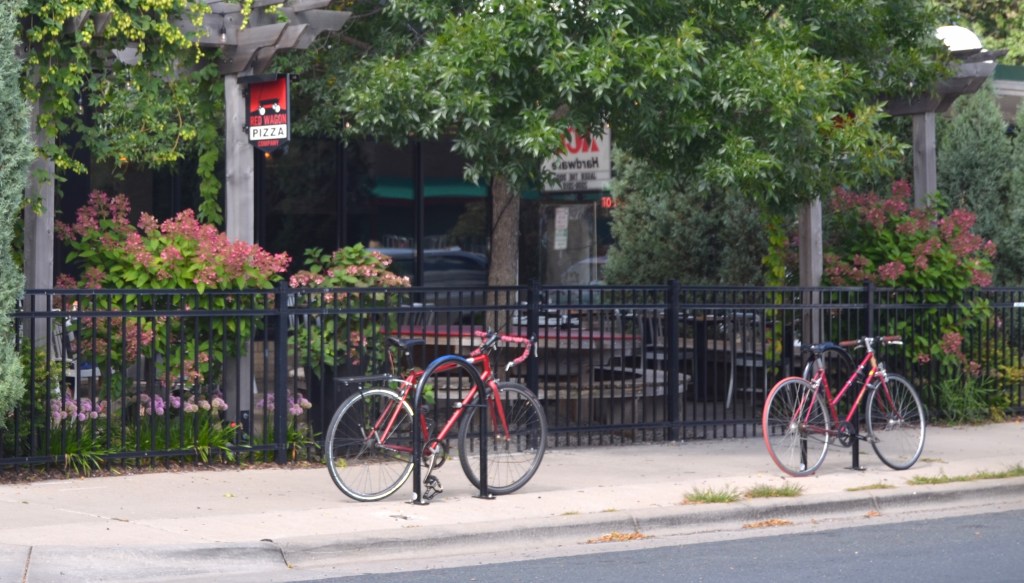
There were several terms in the conversation which I will be using more frequently in references to city life. The first one is best described in a photo.

  1. Organic Street Life
  2. Localized Distribution- “Meaning there’s always a shop somewhere.”
  3. The Normal Experience- As in this passage:

Then I started saying, “Well, I should . . .” When I was in Brooklyn, I walked the entire length of the New York subway system above ground. I’ve always been into walking, and I just realized, “Hey I can just . . .” I think I was looking at a table that about 1.5 billion people live in massive cities that we really don’t know the names, these big sprawling Jakartas. I’m like, “I would like to see that.”

COWEN: Yes, agreed.

ARNADE: That’s the normal experience for most people, and so I just started. I booked a trip to Jakarta and just started walking Jakarta.

The normal experience is where all the cool data is. What’s to be done with extraordinary events? They simply are not that interesting except for daily fodder.

Largest Manhunt

It’s been a Fargo-esque few days in the North Star State. For those few of you who may have been out of social media’s reach, a lone gunman, impersonating a police man, entered the homes of two local politicians in the early morning hours of June 14th, putting one couple in the hospital with multiple gunshot wounds, and leaving the other couple deceased. It’s tragic. It still does not seem real. Story.

The suspect was apprehended in a rural area yesterday evening and is now behind bars. The landscape is a mix of fields and woods. One Twitter account claimed that the hundreds of law enforcement officers scouring the land on foot were tipped off by a hunter’s deer cam. These handy devices are motion-triggered and designed to give sportsmen an idea of what is clamoring around the woods at night.

This time, the prey was up on two feet. And fortunately, surrendered peacefully to law enforcement.

Household formation and Jane Jacobs

Guest post by Stella Ross

In The Uses of City Neighborhoods, Jacobs explores how urban neighborhoods and districts, including Greenwich Village in New York City and the North End in Boston, function and interact. Using these cities as examples, she examines how effective districts empower residents to advocate for improvements in their neighborhoods. Additionally, Jacobs delves into the conceptual principles that make urban areas successful. These principles include self-governance in street neighborhoods and districts, the importance of continuous networks between street neighborhoods, the role of time in fostering stability, and the necessity of a functional identity to unify a district.

At the smallest level in urban areas, street neighborhoods consist of the residents along a single road or small section of a district. To be beneficial to their residence, Jacobs argues that these neighborhoods must prioritize walkability, and interconnectedness with surrounding streets. When neighborhoods become isolated or “island-like,” they lack the size and influence needed to effectively advocate for public improvements and services, often leaving them underserved by city administrators. These isolated neighborhoods often consist of distinctive ethnic groups. Although, while they may be ethnically cohesive, these neighborhoods are not necessarily socially or politically cohesive. Without a strong functional identity and broader connections to the city, isolated neighborhoods risk instability, particularly in urban areas where racial and economic disparities are deeply entrenched. 

Effective districts are one of the most important components to urban living. These districts bridge the gap between street neighborhoods and the larger city, allowing residents to leverage the public power of votes. According to Jacobs, an effective district is built upon three key elements: a starting point, physical area, and time. Like street neighborhoods, districts should not be isolated by physical barriers such as large parks or highways. In her opinion, districts are always naturally shifting its boundaries as these obstacles not only disrupt natural boundary shifts but also hinder economic stimulation from outside visitors. 

Jacobs emphasizes time as a crucial factor in districtdevelopment, describing it as a substitute for self-containment, and an indispensable element of urban stability. Over time, districts cultivate both strong and weak social ties through hubs such as churches, PTAs, political clubs, and fundraising committees. These social networks create what Jacobs calls the hop and skip phenomenon, allowing individuals from self-contained settlements to connect with others through special-interest groups and bring those relationships back to their own districts. As well, time fosters trust and cooperation, enablingindividuals to gain the confidence needed to voice concern about local public issues. 

The city as whole is essential, serving as the hub for administrative and policy decisions. It is the primary channel for public funding, distributing resources from state and federal coffers for the benefit of the entire urban population. Jacobs also highlights the city’s role as a center for culture, employment opportunities and political action, including protests against unjust initiatives. Her message to city planners is to foster livelystreet networks that seamlessly connect street neighborhoods, design parks as communal destination rather than physical barriers, and cultivate strong functional identities within districts. Further research on Jacobs’ sociological theories should explore how societal changes have influenced her ideology. For example, Jacobs wrote her work in the early 1960s, a time when women were largely expected to stay home and care for their families, and before the political climate became as polarized as it is today.

A key question to investigate is: How do modern factors, such as families with two working parents and the increasing complexities of racial tensions, affect Jacobs’ vision of lively integrated streets?

Spot Light on Street Lights

Academics continue to prove that simple improvements to street lighting reduce crime. In a new paper, Can Enhanced Street Lighting Improve Public Safety at Scale?, the authors examine a large-scale enhancement of street lighting in Philidelphia. In honor of new technology shining through on an old idea, here’s some background on the humble street lamp.

A Brief History of Street Lighting: Purpose, Progress, and Payment

The history of street lighting is deeply intertwined with the growth of cities and the need for safety, security, and functionality after dark. From ancient torches to modern LED systems, the evolution of streetlights reflects technological advancements and shifting urban priorities.

The Early Days: Fire and Flame

In ancient Rome and Greece, rudimentary street lighting consisted of torches and oil lamps, primarily used to guide travelers and deter crime. During the Middle Ages, European cities relied on lanterns carried by watchmen or hung outside homes. However, these systems were inconsistent, often dependent on individuals rather than citywide planning.

The Rise of Public Street Lighting

By the 1600s, cities like Paris and London began formalizing street lighting. Residents were required to hang lanterns outside their homes, creating a patchwork of illumination. In 1667, King Louis XIV ordered the installation of thousands of public lanterns, making Paris one of the first cities with structured street lighting.

Gaslight and Electricity: A New Era

The 19th century saw a revolution in street lighting with the advent of gas lamps. First introduced in London in 1807, gas lamps quickly spread to other major cities. These lights significantly improved nighttime visibility and were maintained by lamplighters who manually lit and extinguished them each day. By the late 1800s, electric arc lamps began replacing gas lighting, offering brighter and more reliable illumination. Cleveland, Ohio, was among the first cities to install electric streetlights in 1879, setting the stage for the widespread adoption of incandescent bulbs in the early 20th century.

Who Pays for the Light?

As street lighting became essential, cities had to find ways to fund it. Early efforts relied on:

  • Resident Contributions (1600s): Homeowners were required to provide their own lighting.
  • Taxation (1700s-1800s): Municipal governments introduced street lighting taxes, often targeting businesses and property owners who benefited most.
  • Gas Company Contracts (1800s-early 1900s): Cities partnered with private gas companies, paying for services through public funds or direct utility fees.
  • Municipal Ownership (1900s-Present): Cities took over the operation and maintenance of electric streetlights, funding them through general budgets, local taxes, and utility surcharges.
  • Modern Innovations (2000s-Present): With the rise of LED technology and smart lighting, cities are using efficiency grants, state funding, and public-private partnerships to offset costs. Some municipalities lease streetlight poles to telecom companies for 5G infrastructure, generating additional revenue.

Lighting the Future

Today, smart streetlights with sensors and adaptive brightness are transforming urban landscapes, reducing energy costs while improving safety and sustainability. The journey from candle-lit lanterns to intelligent lighting networks reflects a broader evolution of cities—constantly adapting to new technologies and the needs of their residents.

Unpopular Opinion

This bill is a shame. As if our school districts aren’t already reeling to keep up with mandates under strained budgets.

Of the 49.6 million school age children in the US, according to the article, 22 thousand experience a cardiac arrest while away from a medical facility. That’s less than a half of one percent of children.

This plan would require the district to have a designated cardiac emergency response team. Those teams would, as the bill is written, be required to do a simulation 30 days before the school year begins. Coaches would also have to be CPR and automated external defibrillator trained.

It feels like a lawmaker trying to get a bill passed more than a community need clamoring for attention. Feels like a resume builder.

And yet time, regulation and responsibility is going to be mandated down across 331 school districts in MN. It turns educators into medical care providers.

The bill would also require schools to make response plans available and accessible both on the school website and in paper form. It proposes offering $3 million to schools to assist and fund these efforts.

CCX Media

This bill shouldn’t pass the use of public funds and efforts efficiency test.

What is public, What is private

The Minnesota Court of Appeal recently made an interesting ruling. The court concluded that a car’s interior may be a public space if it sits atop a public road.

The Minnesota Supreme Court ruled Wednesday that the interior of a vehicle is a “public place” if it is driven on public roads, in a case involving a criminal charge over a BB gun found under a driver’s seat. MSN

We at Home-Economic.com like to think through public and private spaces. Typically, what is considered public is defined by access. If anyone can stroll into a park, it is a public space. If you can walk through the doors of the public library, have a seat in a nice armchair, and read for a couple of hours, then it is a public space.

Wayzata Library is part of the Hennepin County Library System. Great views of Lake Minnetonka!

So, is public transit public in the same way? One might argue it is not. You can board the bus if you pay a fee. It is more of a service subsidized by the public and charged at a reduced rate. Is the interior of the bus a public space? In the sense that the buses are owned, usually by a metropolitan community, then it is public to the municipality. Yet- to board a passenger still needs to come up with the fee. Thus, there is a bit of the private side of life to the transaction.

In looking for perspectives on how to consider the interior space in a privately owned vehicle, the court considered this:

In trying to clearly define what exactly is a public place in relation to a person’s vehicle, McKeig’s opinion focused first on Minnesota legal statute concerning the transportation of firearms, explaining how the law allows for legal firearm possession in a vehicle: “A person may only transport a firearm in a motor vehicle under certain conditions, including in a gun case, unloaded and in the closed trunk of the vehicle, or with a valid permit.”

It seems a little unusual to me to look for the lines between what is private and what is public in a law regarding the use of firearms. But far be it for me to judge! I have no legal training.

It just seems that if a car is privately ownedand can be contained and controlled by its owner, it should be considered entirely private, even if it sits on a public road.

How’s the up-zoning going?

Not so well, according to Dr. Carol Becker. Here’s a photo excerpt from The failure of the Minneapolis 2040 plan to boost housing:

Although it is fair to keep in mind, or rather it is essential, to keep in mind that many other factors could contribute to the drop off in new housing permits in the city. If you can think back to the last time you made a housing decision, what were the core attributes of your new place to live? Perhaps safety. Crime is up in the city. What else? Perhaps schools. School performance and attendance rates are down. Perhaps proximity to work. Many employment situations went with a remote model, leaving the downtown core empty, reducing the premium to be close-in.

There are many variables that contribute to or detract from the desirability of living situations. Zoning has an impact, but it is way down the list of the core features that impact people’s daily lives.

Cash is not always the answer

They say some things you can’t buy. Or maybe some things are more conducive to pecuniary transactions than others. Take the Violence Interrupters. By the summer of 2020, the community wanted to try a new angle on crime prevention, as an article from September explains.

MINNEAPOLIS (WCCO) — The city of Minneapolis is sending members of the community into the streets to prevent violence that is plaguing the city.

They are called the Violence Interrupters, and they’re tasked with stopping shootings by mediating conflicts in the community, and following up with individuals to decrease retaliatory violence.

Jamil Jackson and his group of interrupters are on the move.

“Our mantra is engage, relationships, resources,” Jackson said. “We’re teachers, we’re business owners, we’re city employees, we’re park employees, we’re just individuals who came to the call and had a desire to come out here and change.”

Their bright-orange shirts stand out, so they can walk in and use their relationships within the community to stop the shootings before they happen

The idea was that if responsible people in the neighborhood could step in on demand when they saw an event unfolding, interacting with police would be avoided entirely. Neighbors helping neighbors have the advantage of, in many cases, a clearer view of the issues at hand.

Others have written about this very thing, extolling the benefits of an active community busy engaging with each other across the sidewalks and parks of a neighborhood. Here’s what Jane Jacobs wrote in The Death and Life of Great American Cities.

The first thing to understand is that the public peace the sidewalk and street peace-of cities is not kept primarily by the police, necessary as police are. It is kept primarily by an intricate, almost unconscious, network of voluntary controls and standards among the people themselves, and enforced by the people themselves.

With good intentions, an office of violence prevention was created and funding was carved into the city budget to pay people in the neighborhood to step in and prevent an incident from escalating. So what happened? Fast-forward to this week in 2025.

Some Minneapolis City Council members say the city’s Neighborhood Safety Department (NSD) has been too riddled with mismanagement to continue overseeing violence intervention programs. On Thursday, three council members proposed that more than $1.1 million be allocated to Hennepin County to temporarily take over two intervention programs. 

For more than a year, council members have routinely flagged concerns over the department that administers violence interruption programs. Several violence interruption groups reported contracts that had lapsed or gone unpaid last year, which council members say shrunk safety services in parts of the city. A 2023 lawsuit also alleged the department arbitrarily awarded millions of dollars in contracts without adequate oversight. 

Things have gotten so bad that the council people, who are most vocal against professional police, no longer want to be responsible for this new form of neighborhood quieting. But why didn’t it work? It has the right components.

It’s the money.

The eyes-on-the-street people, who help keep the peace, are many and are often never called on to intervene in any way. To meter out the job to an individual is resource misallocation as it takes a large group, a whole neighborhood, of people to monitor and, through small actions, or phone calls, or gestures, alter the course of events. There isn’t enough of a job for just one person.

When resources don’t have a direct draw against them, they become ripe for fraud. Those in charge of the money have to put it somewhere. Opportunists realize this and create a demand where none exists.

Community policing is a group thing. It does not jive with the division of labor or hourly wages. Whoever is available when the car crashes into a pole and is set on fire, whoever happens to be passing by and has the will and capacity to help, are those who step up voluntarily in times of need. For that they receive an award.

Regulation vs Market Clearing–Knob and Tube Edition

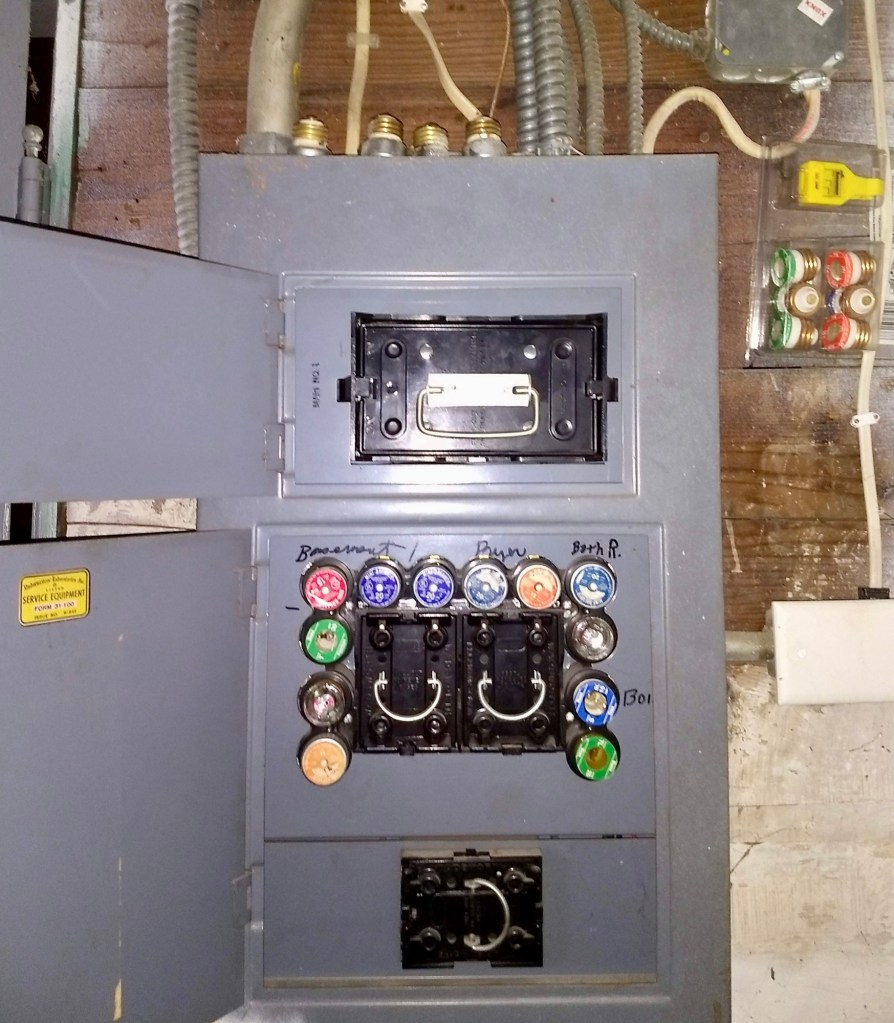
A few months ago, I wrote about an investor who bought a property with an old style of electrical wiring called knob and tube. Their post was an example of the complexity of a rehad project. The price of the building was undoubtedly part of their decision-making. But you don’t always know what you are buying. Inspections are done to determine all the variables upfront; when it comes to real estate renovations, there are bound to be some unexpected costs. The expense of rewiring a nine-unit building was a downstroke against their profit.

Homes have so many features, which leads people to make different choices depending on their skills, what they value, and their tolerance to risk. Some homeowners, for instance, will not purchase a home with a tuck-under garage. The thought of the amount of energy loss every time the twenty-foot double garage door goes up in the winter when it is below zero makes them cringe. The energy inefficiency of this floor plan makes the home unacceptable in their eyes.

Over time, particularly when mechanicals or construction processes improve, old systems like knob and tube wiring make their way out of the market. First, the market starts to reject the item, so sellers, in preparation for sale, determine they would be best off making the improvement before going on the market. Sometimes, the insurance company will influence the market by making it more expensive to insure certain features, which provides incentives for replacing those items. Eventually, the old way of doing things becomes obsolete and unacceptable to buyers.

This process may take a couple of decades or a quarter century. Old-timers grumble about replacing perfectly feasible mechanicals, wasting funds that could be spent elsewhere. A long time ago, a local electrician advised that as long as the cylindric glass fuses supported the current demand, then all was well. When one insurance company refuses coverage, other smaller companies may step in. And around it goes until the verdict changes and most homes have been converted.

Consider this method versus a regulation. Once an empowered authority draws a line and publishes a restriction, the market no longer has the ability to evaluate this change in contrast to all the dozens of other upgrades and improvements that can go into a home. The burden falls most heavily on the more dated homes, which are often owned by people who have gotten on in years and are not keeping up on things or those of lesser means who patch and plug problems as that’s the best they can do.

A decree from above creates an acute demand for that one mechanical, which, in my experience, causes opportunistic behavior and price inflation. The market system is the kinder and gentler way to transition from one set of norms to another.

Slum Clearing- Gateway Edition

Is the Housing Act of 1949 the reason today for the hyper-local control of housing and real estate decisions? It’s hard to say. But the slum clearance, financed by the federal government, was significant enough to still be recognized today.

Judith A Martin, professor and director at the University of Minnesota, was a prominent figure in the local urban lore. This is an extract from her paper: Past Choices/Present Landscapes: The Impact of Urban Renewal on the Twin Cities

THE GATEWAY PROJECT
City planners assumed that the Gateway area, the old core of downtown Minneapolis, would qualify for federal urban renewal assistance when they proposed clearing and reconstructing about one-third of the entire downtown in the mid-1950s. Beginning in 1956, federal renewal officials raised serious questions about the size of the project: was what was proposed too big for the local real estate market? In 1957 a group of civic and government leaders, led by Mayor P.K. Peterson, went to Washington, D.C. to convince federal renewal officials that Minneapolis needed a project this size. They were successful, and returned with a commitment for the money.

Not everyone found favor with the proposed redevelopment however. Several owners of condemned property tried to stop the Gateway plan. They sued the HRA, claiming that the condemnation action was “arbitrary and unreasonable.” They also challenged the legality of the overall development plan. The owners did not win any of these suits, nor did the preservationists who sued to stop the destruction of the Metropolitan Building (formerly the Guaranty Life Building). This last suit made it as far as the Minnesota Supreme Court, which upheld the HRA’s right to condemn the Metropolitan Building. This decision essentially reaffirmed the “greater good” argument about eminent domain (Buildings 1961 b).

The 1956 Highway Act worked with the Housing Act by sometimes forging the interstate system through poor, dilapidated neighborhoods. While I suspect only the most dedicated automobile haters would argue against a national network of roads, the lamentation of housing being leveled still lingers today. And petitions are underway to return the freeway to neighborhood streets. (Although, most recently removed from the planning process.)

What is the balance between hyper-local governance—where people want to take out a freeway for residential streets—and an all-encompassing federal project? In the end, who owns the land?

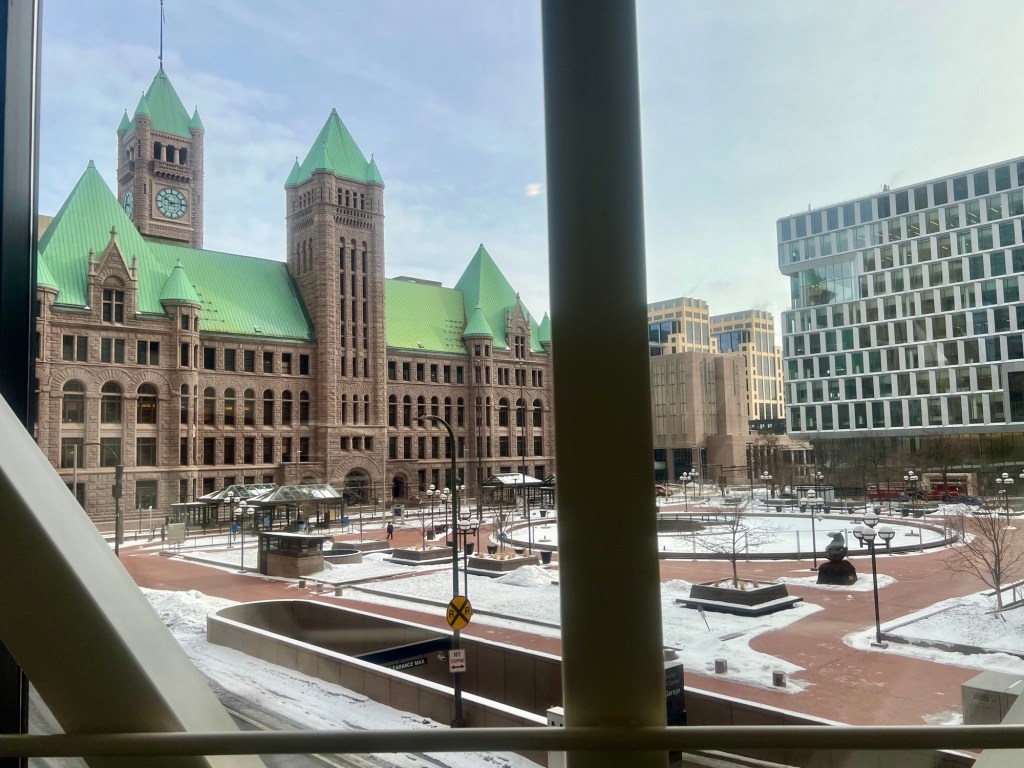
The downtown library sits in the old Gateway district.

To Your Health

If you google ‘health determinants, ‘ a bunch of stuff scrolls out in the feed, but none of it is exactly the same. For example, the World Health Organization‘s (WHO) site reports:

Determinants of Health

Many factors combine together to affect the health of individuals and communities. Whether people are healthy or not, is determined by their circumstances and environment. To a large extent, factors such as where we live, the state of our environment, genetics, our income and education level, and our relationships with friends and family all have considerable impacts on health, whereas the more commonly considered factors such as access and use of health care services often have less of an impact.

The emphasis is on a person’s situation in life more than on their genetic make-up or even access to health care services.

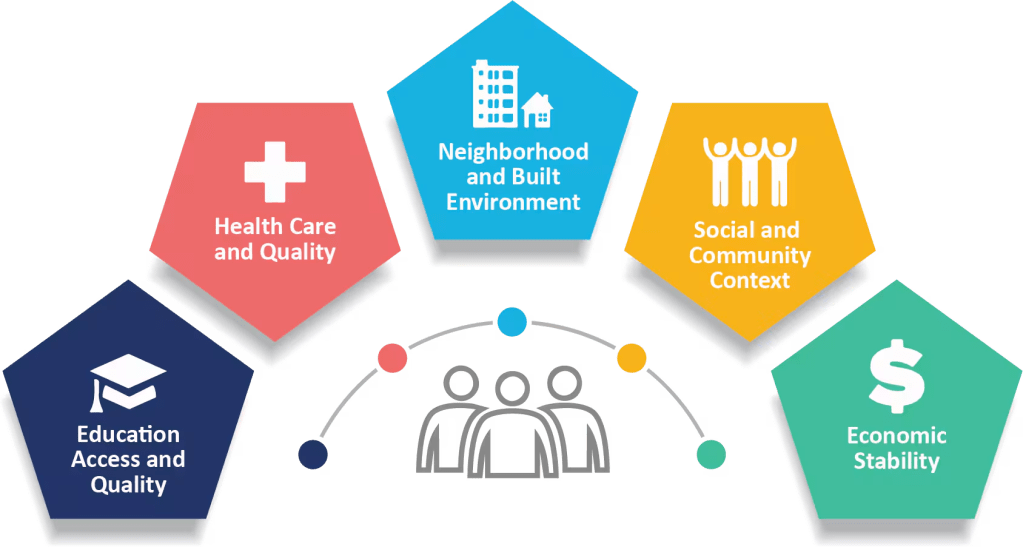
The US Center for Disease Control (CDC) offers a helpful graphic to describe their social determinants.

If you look at the hexagon you might note that the categories remind one of public goods. These goods are provided at large as they are thought to generate a universal effect that benefits everyone. If people are more educated, they will understand how to stay home with a virus so as not to pass it along to others. The availability of health care and clinics provide ease of treatment. The built environment includes transportation routes for ambulances and fire trucks to speed up a person in need. People fare better in safe communities enhanced through public provisions police services.

These categories line up nicely with the categories at Home Economics. Because the social determinants of health are also the determinants of a stable and vibrant neighborhood.

What isn’t provided at either of the sites are details. When one drills down to the street level, what can one measure that represents safety? Is it the number of pedestrian fatalities? Homicides? Or carjackings? Which number best represents safety?

Numbers meant to quantify school performance are subject to manipulation. Is the highest performer in a medium school really better off if they become a slightly above-average performer at a high-performing school? In the first instance, the student may evolve into a leader, one who expects more from themselves. Whereas in the second scenario they shrug off the duty to perform as there are so many better students in the lead. Yet competitive parents are expected to seek out the ‘top’ schools for their child- folklore says they are the best predictors of educational success.

Another factor that seems to be omitted is the level of dedication an individual, family, or community has to contribute to health issues. It’s one thing to live near a dentist, but if you never take off work to make sure your kids get in for a check-up, it does little good. Do the kids get on the school bus so they don’t trundle in late and disrupt the class? Does a neighbor ensure the octogenarian across the street gets in for their monthly treatments? How much work is going into these public health projects?

Neighborhoods are a rich source of social determinants. Combine that with a bit of information about volunteerism and who knows where that could lead us?

Russian Doll model of public safety

Some goods are best produced privately, and some perform better in the public goods market. Production in the former is enhanced by the division of labor, whereas in the latter, crowdsourcing is vital. The recent high-profile apprehension of a person of interest in the death of a local CEO is illustrative.

Let’s break down the Russian Dolls. The largest doll is the level of law enforcement, which is officially put in place by the government and funded through taxation. These forces fall under territorial boundaries. Since the attack against the healthcare executive took place on the sidewalk in front of the Hilton in Manhattan, the NYPD is in charge of the case.

These uniformed professionals went to work and quickly found the getaway route the suspected assailant took leaving the scene. He fled on foot and then jumped on an e-bike. He went through Central Park and ended up at a bus station. The officers were fortunate to find out the suspect had spent the night at a local youth hostel (Time).

A senior law enforcement official is quoted as telling the Times that the person of interest photographed used a fake New Jersey identification to book a room at a hostel, checking in on Nov. 24 after arriving in the city via bus. He then checked out of the hostel on Nov. 29, before checking back in the next day.

The real breakthrough from this local contact was a photo of the normally masked man who had been snapped in the hostel lobby. He showed his features at the friendly receptionist’s request. A citizen can contribute to an investigation simply by following the rules of their employment.

As the manhunt continued into other states, the following levels of Russian Dolls were engaged. Even though the NYPD remained in charge of the official investigation, it depended upon the work and resources of many other branches across state lines. These details remained in their reporting realm. While the media activated public interest in the case, they kept the general public interested in the pursuit.

This brings us to the McDonald’s worker who noticed a similar-looking young man in his restaurant. He could have looked the other way. Now we are down to the last Russian doll. Not everyone at this level will engage. How many others saw the perp, became suspicious, and stayed quiet? There’s a potential cost of reporting, and not everyone is willing to take the risk.

Fortunately, the greater society doesn’t need everyone to report. Only one person needs to step up. This is not pay-by-the-hour employment; it is a job one does under the influence of a shared vision when the duty shows up on the other side of your counter at McDonald’s.

Public goods respond well to this blended model of paid personnel in conjunction with a more significant population of people who follow the norms, like the youth hostel receptionist, and those willing to take risks and report. But I do hope the McDonald’s worker gets a bonus.

The Thing about Regulation

People expect their government, or governing bodies, to protect them. It’s the most basic and oldest public good. Band together in a cave or behind fortifications and put the physically strongest in charge of fending off harm. For better or worse, this placed the physically strong in high-status positions for more than several millennials.

But what does that mean to keep you safe? And here is the sticky part. There is a broad spectrum upon which the answers to that question may fall. In some cultures, women are safe when clothed from head to toe and sequestered out of the public eye. Most people and women find this a violation of individual liberty. It is not up to the group to seek a safety goal so that it impinges excessively on one or a whole section of society’s liberties.

One story in the news yesterday tells of a mom in Georgia arrested for negligence when her ten-year-old was seen walking home on a rural road. The police were notified by a neighbor. They then showed up at the family’s home and cuffed the mom in front of her kids. Last month, there was a story in the news of another ten-year-old in another part of the country who was finally detained when he drove a stolen car through his neighborhood playground. This ten-year-old had been released on numerous occasions for auto-related theft to a mother who was never held responsible in any way.

Of course, there are many more mundane questions about what is safe. How many smoke detectors does a house need? How many inches does a metal vent need from a combustible floorboard? Will that tenth detector be the one that alerts the family of smoke in the house? Can a wood rafter really catch on fire from metal only exposed to air heated to seventy degrees? Someone thought so. How high does a standard need to be to be safe enough? I’m not sure. But I expect that no one wants to be the regulator who, after a death from a fire, is thought to have been too lax.

The thing is that too much regulation can kill, too. At least, that’s the argument for those who feel there are too many restrictions in the drug industry. Failure to approve causes people to die from lack of access to a cure. Lengthy approval processes cause people to die, too. Just like too many building codes add an undue burden to housing expenses. Without housing, some people are severely disadvantaged and may even die on the streets.

So– what to do? What level of protection is requested when the people go to the government and ask? It seems like the answer would be some expected norm of the group.

If you raise the standards above the norm, people are restricted from liberties they would have enjoyed. Plus, more than likely, some people will disregard the regulation as they feel it is not worthwhile. Before you know it, the mayor of some town is caught at a party without a mask when all other good city dwellers have been putting up with the stinky things. A non-conformist attitude can then carry over to different areas, like permits for home repair. And people start getting their brother-in-law, who’s ‘handy’ to connect a gas line. Here the permit and ensuing inspection is beneficial.

Walking the fine line between setting regulations and meeting people’s expectations for safety is a balancing act worth figuring out.

There are no regulations against garage door decorating.

Seriously?

One- that this is news. Two- that actions speak far louder than words. Three- that this is considered a solution.

Minneapolis City Council committee has approved a proposal to add two people who are currently or were previously unhoused to join its housing advisory board. (Bring Me the News)

Off-setting Data

Homelessness in Minnesota is tracked once a year by the Wilder Foundation.

Homelessness is a difficult issue to quantify, but for more than three decades the Wilder Foundation has been trying to do just that through the Minnesota Homeless Study.

It’s a statewide count taken on the last Thursday in October every three years.

“We know there are more folks on any given night that are homeless and we can’t find, but it is a really comprehensive effort. We have a lot of people working to find as many people as we can on that particular night,” Michelle Decker Gerrard, Senior Research Manager/Co-Director of the Minnesota Homeless Study, said.

The latest study completed in 2023 found 10,522 Minnesotans were experiencing homelessness — down 7% from a record high in 2018 — but still, the second highest since the study started in 1991.

In an ideal world, everyone would find themselves under a roof and between four walls after dark, so they could lay down for a rest as darkness closes in. What proportion of Minnesotans are lacking this amenity? With a state population of 5.7 million, the homeless comprise less than a fifth of one percent. And shouldn’t we expect some homelessness for those who have just fled an abusive situation, for those traveling through, or for those who simply choose to remain in the open air?

One source puts the number of religious organizations in Minnesota at just under six thousand. Matching this to the homeless population, each faith group would just need to care for about one or two individuals who find themselves without shelter. Lining up the numbers in this way is insightful. It seems that the homeless people who are in need of a service, and those who are mandated to provide it, are fairly well aligned.

Yet policy types want to point ot affordable housing as the issue here, as seen in the comment in the article. “”It points to a lack of affordable housing for those communities and barriers for getting into housing,” Decker Gerrard said.”

But I don’t think the data supports this conclusion. The data suggests that these are folks in need of services and support. The catch-all ‘affordable housing’ rant is a talking point. Meanwhile the cause for people on the run goes unchecked.

Policy Thought of the Day

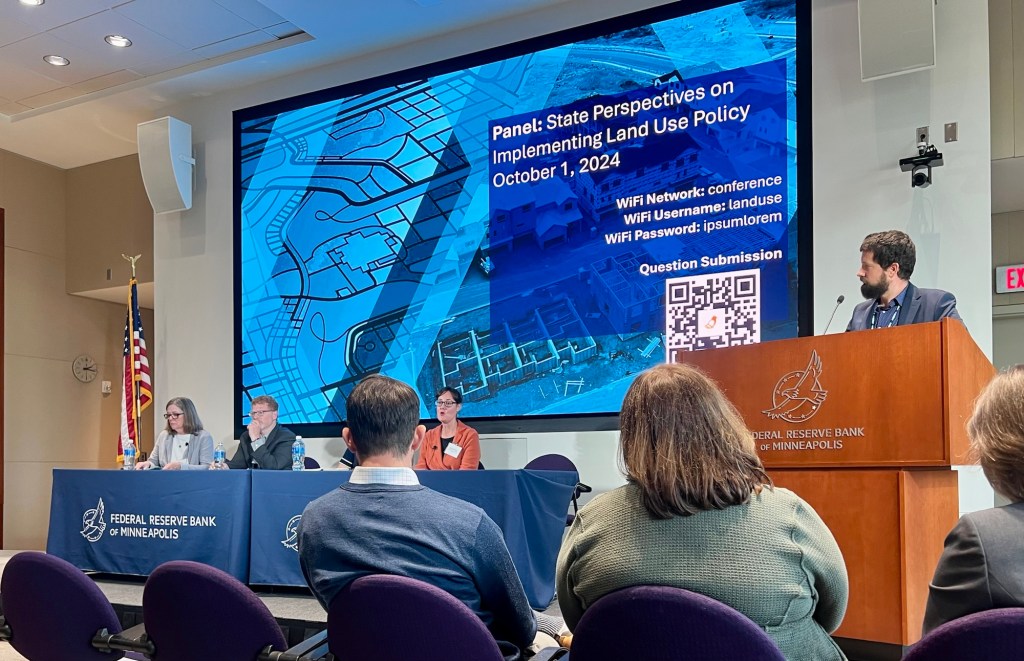
I sat through an interesting presentation today at the Federal Reserve Bank of Minneapolis—a striking glass and steel building on the edge of the Mississippi River. The commentators all shared angles on the ambitions for affordable housing in their respective areas of the country. The very pragmatic Jenny Schuetz with Brookings is speaking here.

One of her messages is to pick a reasonable goal, such as downsizing parking requirements, and get that passed. Massive bills packed full of ideas are interesting only in theory.

With simplicity in mind, here’s a product idea meant to steer resources in the right direction. A few days ago I panned the idea of swaying behavior through signage- Will Signs Work? The lack of incentives is what is missing here.

Let’s think of it as a model. The man in the middle, we’ll call MN1. After all, the driver of all intentions in this endeavor is MN1. This is the person we desire to receive resources. Without this person, there is no need for the non-profit to exist to come to their aid. Without MN1, the drivers would not be tempted to pull to the side at a busy intersection and pass a few dollars through the window. The model takes the perspective of MN1.

What does MN1 want? In the news clip, the panhandler said he hoped to earn $20-30 from a day on the curb. Now we know the amount of incentive necessary to show up. What do the motorists want? They wish to satisfy their impulse to come to the aid of a fellow human in need. To give directly is very satisfying. What do the non-profits want? They wish the panhandlers would come to their sites for the services they are trying to administer. Their livelihood is based on attracting MN1’s.

If the motorists could purchase a voucher for $50 which the MN1s could redeem at the non-profits, all actors achieve satisfaction. The motorists pass aid directly into the hands of the panhandler. The cash incentive should drive MN1s to contact the non-profit. This allows face time to sell their services. Furthermore, for vouchers lost or unclaimed, the non-profit earns the face value of the donation.

The MN1 folks are able to come away with cash and hopefully additional avenues to services that alleviate their plight. The motorists appease their need to help while donating a nice amount to the local non-profit of their choice, a choice with the added benefit of a screening process. The non-profit has customer leads showing up at their door while receiving additional donations.

What should the voucher be called? A Twenty-Bucker?

Ownership Issues: Parking vs Water

This post draws a comparison between charging for parking on city streets versus charging for water through city pipes. The thought process is that people willingly pay to have potable water at the turn of the tap but object to renting a spot on a city road to leave their car.

It really comes down to ownership issues. It’s clear who owns the water system infrastructure. The cities maintain the lines in the street to the hook-ups. The property owners maintain the pipes through their front yards and their properties. Water is delivered and metered so that people pay based on their usage. But no one owns the water. People pay for the maintenance of the public system and the purification process.

On the other hand, city roads are publically owned. They are free to use by everyone. They are paid for by residents. So to exclude people from use by imposing a payment signals a change in ownership structure.

People often gather together to share on-going utilties. That’s the idea behind home owners associations. Individuals who no longer wish to mow their lawn and look for a roofer when the time comes, enjoy sharing those expenses and management with others. Whether to pay for clean water, garbage pickup or electric bills, the monthly useage payments is the sensible means of pecuniary support.

When it comes to the use of shared land like public parks, trails and streets, it is difficult to determine a proper amount to meter out on a monthly bases, and it is abrasive to be exclusionary.

Vacant Land Registries

Vacant properties are not popular with municipalities. Cities create a vacant land registry to keep a running log of properties that do not host residents. Here are directions from the town of Brookhaven New York.

There is no longer a requirement to submit a notarized application or payment through the mail – it is all available online. The cost to register is $360 for the year and can be paid through our secure online platform.

Please be advised, that any owner, or agent of an owner acting on behalf of the owner, who fails to register a vacant building or to pay any fees required to be paid pursuant to the provisions of Chapter 87, within 30 days after they become due, shall constitute a violation punishable upon conviction thereof by a fine in the amount of not less than $1,000 nor more than $15,000 for each failure to register, or for each failure to pay a required vacant building registration fee.

The amount of the fine implies that full buildings are of value to the hamlet. Perhaps, in part, this is due to the services a resident will take up once they walk up their sidewalk every day to their front door. Perhaps having people come and go in the neighborhood keeps everyone more secure. Here are the benefits as expressed by the bureaucrats.

Registrant’s point of contact will be notified by phone and/or email of issues that may arise such as:

  • Property maintenance (tall grass, litter on property, etc.)
  • When the Town is notified by law enforcement of unauthorized occupancy
  • If property becomes unsecure.

When properties are registered, the Town will have contact information and will have the opportunity to notify the owner/property manager to correct any issues before taking action. This will save the property owner money.

The city of Miami goes one step further and requires the owners post a no-tresspassing sign and authorize their police force to enter the property should a need for their services become apparent.

Install No Trespassing Sign

Once you’ve submitted your forms, you’ll need to install a No Trespassing sign on the property (this can be any sign purchased any where).

Although it may never cross your mind, your comings and goings every day in your neighborhood and place of business are a public service.

Midwest Sites

Grain elevators are as prevalent in towns across the Midwest as the corner bar, the grocer, and the three local churches (Lutheran, Catholic, and Presbyterian), or at least in towns on the railroad lines. As the open prairie became home to new arrivals, farmers broke open the soil and turned it into grain fields. Upon harvest, they took their product to the elevators until it was shipped down to the grain exchanges.

This one isn’t as rustic looking as some. The interior wood planking has been covered with a shield of aluminum siding. The structures are known to burn. As they have been decommissioned, local firefighters have set them ablaze for training purposes. Once their original use was replaced by larger shiny cylinders of metal, their new purpose served the community. For one last dramatic day, the flames leap and lick at the side walls as trainees in the safety business try to tame their destructive nature.

Five Minute Real Estate

In this five minute video clip, Frederick Melo with the St. Paul Pioneer Press refers to a number of important real estate outcomes. He was invited to the weekly PBS show, Almanac, due to a recent announcement that a portfolio of commercial buildings, including the iconic First National Bank Building, is being listed for sale.

The collection of buildings are owned Madison Equities. Long time real estate developer, Jim Crockarell died in January and his heirs are not interested in being landlords. Building owners can gain emotional attachment to their properties as appears to be the case here. Some of them were half empty and some completely empty. Significant vacancies do not happen on the turn of a dime. Commercial leases are multi-year and companies have an investmest in their locations. So this recent announcement reflects activity which has been brewing for a while.

Well known architectural firm, TKDA, is also moving. They are relocating to Bloomington to keep workers happy. After 100 years, the downtown devotees are succumbing to practical desires for free parking. An added feature is scenic vistas over the Minnesota River. To attract workers back into the built environment, they are seeking out new surroundings in the third largest city in the state.

US Bank is also stepping away from downtown yet still staying in St. Paul. Workers here also say no to the densest part of the city. Melo reports that the building has had ghost leases for years. While technically under contract, the one-employee-per-floor occupancy has been a long-time indicator of what the future held.

What to do with all these vancant buildings is the question of the day. The solution under proposal is converting the office space to living space. But conversions are very expensive and the demand for residential in the capital city is not as strong as next door neighbor in her sister city. It’s a tough place to live.

Grants and tax increment financing are being proposed as public interventions. Is this a good idea? I’m not so sure. The mayor is quiet letting a non-profit alliance offer investment strategies. Their approach is to focus on one street at a time. One street a downtown does not make.

Cathy Wurzer brings in the ringer of a topic just at the end. Crime and personal safety. These are real issues that have been muted in the last four years. People don’t want to have to worry about being carjacked at knife-point when they’ve got a head full of kid’s programming and an armful of work manuals. Proximity to violence is a deal breaker for many people.

I had not heard of the study the Downtown Alliance had done around the DT Greeters pre and post pandemic. Within a district where a tax was collected to support the greeter program, quality of life crimes decreased by 40%. Whereas in the adjacent Lowertown area (where the St. Paul Saints stadium is located) crimes increased by 20%. Jim Crockarell, the real estate developer, opposed the district. This is speculation, but I’m guessing he thought greeting people and being busy maintainers of sidewalk safety was meant to be organic. It was the civic thing to do. Yet here is concrete data that an organized effort to deter crime, a significant motivator, was successful with subsidized labor.

In review, we were told about multiple exits to the city core. Be careful to note this was not a sudden occurance. We heard about emotional attachments beyond the pull of financial prudence. We heard about consumer driven needs for parking and easy access. We heard about the impracticality of retrofitting the built environment (file under why so many old buildings come down). We heard about public subsidies that will fall woefully short of the task. We heard about the big driver, safety, which is often kept on the QT so as not to implicate an area.

That’s a lot in five minutes

Three duties

Adam Smith closes out Book Four, Of Systems of Political Economy, of Wealth of Nations by telling us the duties of the sovereign.

According to the system of natural liberty, the sovereign (Commonwealth) has only three duties to attend to; three duties of great importance, indeed, but plain and intelligible to common understandings: first, the duty of protecting the society from the violence and invasion of other independent societies; secondly, the duty of protecting, as far as possible, every member of the society from the injustice or oppression of every other member of it, or the duty of establishing an exact administration of justice; and, thirdly, the duty of erecting and maintaining certain public works and certain public institutions, which it can never be for the interest of any individual, or small number of individuals, to erect and maintain; because the profit could never repay the expence to any individual or small number of individuals, though it may frequently do much more than repay it to a great society.

Wealth of Nations, Adam Smith

We no longer have sovereigns, but we can see those duties in our local governance. And thus we can expect citizens to evaluate each of them in turn.

Produce, two girls and a firefighter

I overheard an exchange between a mom, her two girls and a West Metro firefighter today while shopping for produce. It started all fuzzy and in the background, as I scanned the vegitables trying to recall what we’d be having for dinner. The request was quiet but the man with the large lettering across his dark navy jersey said his partner would be right back.

“One for my cousin too,” said a young voice. “We want to be fire fighters.” He replied with encouragement and said it was the best job you could have. That they would be great at it.

As I saw another uniform approach I pivoted to have a look at the voices. An athletic man was handing over stickers and hats for the girls in the shopping cart. The mom looked on. There were two communities here that have had some rough patches. It was so nice to see them getting on.

In memory of fallen heros

A beautiful service was held today in Eden Prairie for three public servants. Grace Church hit its capacity limit of 7600 people and Prince of Peace in Burnsville also hosted a viewing session. The two police officers and a paramedic were shot in the early hours of Sunday February 18th while trying to seperate seven children from a madman. Three men went to work and did not return home to their families.

I found this eulogy particularly poignant.

No matter how hard a day most people have at work, few of us face this risk.

Images from today. The story from the Associated Press.

Burnsville, Mn- Trending

Burnsville is a suburb of the Mpls/St Paul metro just over the Minnesota River from Hennepin County. In the early morning hours, two police officers and one first responder were shot and killed while negotiating with a homeowner who held his family of seven children captive in the property. This is the heartbreaking reality which may befall these civil servants.

Let’s honor their profession. Everyday.

Commons says Marx missed Institutional Forces

These are the grand national and social forces which have come into existence since the time of the Communist Manifesto, and have nullified what otherwise might have been accurate predictions of that Manifesto. For Karl Marx had based his calculations upon the purely mechanical, economic evolution of machinery, of tools, of markets, of supply and demand. He had not weighed these spiritual and psychological forces which have revolutionized the modern world. He had not seen beneath the economic forces. He had not seen the power of patriotism by virtue of which the divers classes of these different nations would finally unite. He had not seen the movement of trade unionism through which laborers learned to organize, learned self-control, learned to negotiate with em-ployers, learned that they need not fall back into the pauper condition that Marx predicted, but that by negotiation, by arbitration, they might make an agreement with the capitalists, that they might come to terms with the capitalists and divide the product between them.

The spirit of trade unionism, instead of being that of class struggle, is the spirit of partnership. The trade union movement looks upon itself, not as the irreconcilable opponent of capitalism, but as & member of the family. Being a member of the family it is entitled to have a row with the head of the family, and to live apart for a time, but it has not yet taken out a divorce. Trade unionists do not presume, as Karl Marx did, that the members of the family can do without the head of the family. Trade unionism is based upon that principle of partnership which we see in & different way in the home. Consequently here we have a spiritual movement which has not attacked family, religion, and property, as Karl Marx had done, but has organized itself to get a larger share of profits by negotiation, by agreement, by strikes.

Industrial Goodwill, John R Commons 1919

Why didn’t the Austrians appreciate John R Commons?

Objections to spontaneous public spaces

The owners of Cup Foods along with other business owners in George Floyd Square are suing the city of Minneapolis and Mayor Jacob Frey over alleged lost business.

Bring me the news

I think this is an interesting match-up: social justice vs. neighborhood grocer. If it goes to a jury will they simpathize with a city’s effort to designate space to an internationally recognized event, or the corner store who served a disadvantaged neighborhood deligently?

They seek over $1.5 million in damages, claiming the city and the mayor were negligent in violating the city’s nuisance ordinance and charter.

The damages don’t even seem that high. But let’s look at the claims.

The claims revolve around two issues: the blockades halted business traffic and secondly the complete lack of police presence encouraged excessive crime. I can’t imagine anyone coming up with a strong rebuttal.

Perhaps the courts will be successful where the city was not in making it politically feasible to dismantle what has become hallowed ground for those who place social justice activities in the forefront of their lives.

Marx thought a lot about capitalism

In the first three chapters of Capital Vol 1 Marx throws down his founding priciples of capitalism under the premis that labor time is the ubiquitous unit of measure. He does conceed that the quality of labor time, and hence its ability to be productive, is influenced by other factors.

The value of a commodity would therefore remain constant if the labour-time required for its production also remained constant. But the latter changes with every variation in the productiveness of labour. This productiveness is determined by various circumstances, amongst others, by the average amoun of skill of the workmen, the state of science, and the degree of its practical application, the social organisation of production, the extent and capabilities of the means of production, and by physical conditions

Capital Vol 1- Karl Marx

Think about this list. 1.The skill of the workmen 2. State of Sciene 3. degree of practical application 4. social organization of production 5. capabilities of means of production 6. Physical condition.

Couldn’t this list be 1. Quality of public education available to workforce 2. Technology 3. Vo-tech adaptation of technology 4. Governance of plant 5. Degree of logistical support including maintenance and transportation 6. The environment.

No matter what specifics came to Marx’s mind as he wrote this list- the list appears to point to what we now call public goods. The productivity of the labor hours invested depended on the quality of the public goods inplay at the plant.

.

David Harvey has an excellent YouTube series on Capital

Pro-corporate pillage is anti-mobility & anti-unfortunate

We’ve seen this movie before. Make a monster and pursue with the fervor of Joan of Arc. The problem is, they are slaying the wrong dragon.

How crime is priced

Dick’s also said its second-quarter results were affected by “inventory shrink,” which refers to the loss of inventory due to factors such as employee theft, shoplifting, and others. The company’s merchandise margin declined by 2.54 percentage points—one third of that was because of shrink, the company said.

“The biggest impact in terms of the surprise for Q2 primarily came from shrink,” said Navdeep Gupta, chief financial officer. “We thought we had adequately reserved for it. However, the number of incidents and the organized retail crime impact came in significantly higher than we anticipated.”

Barrons

What makes us stop instead of go

Throughout the day you can keep doing the same ‘ol thing or you can try something new. New is hard. Nagging questions sing song along. Will I just waste my time? Will I try and be unsuccessful? Will I be lead down a dubious or even dangerous path?

Take trying out a new trail as an example. The map maybe unreliable and our walk cut short as the stated connection is but a fictitious line. Or the section of trail meanders through an industrial area which starts to feel a little spooky. The grind of machinery and the pound of steam being released sets a scene of foul play and stashed dead bodies.

Trying segments in small sections can be one way of tricking ourselves to press on instead of holding back. Picking moments where the risk of a setback doesn’t feel so dear. Engaging a reliable partner (one with fur and fangs is nice) also works well.

But in the end it could be the joy from unexpected pleasure at experiencing something new that drives us forward.

Core services continue to be most important, with walkability too

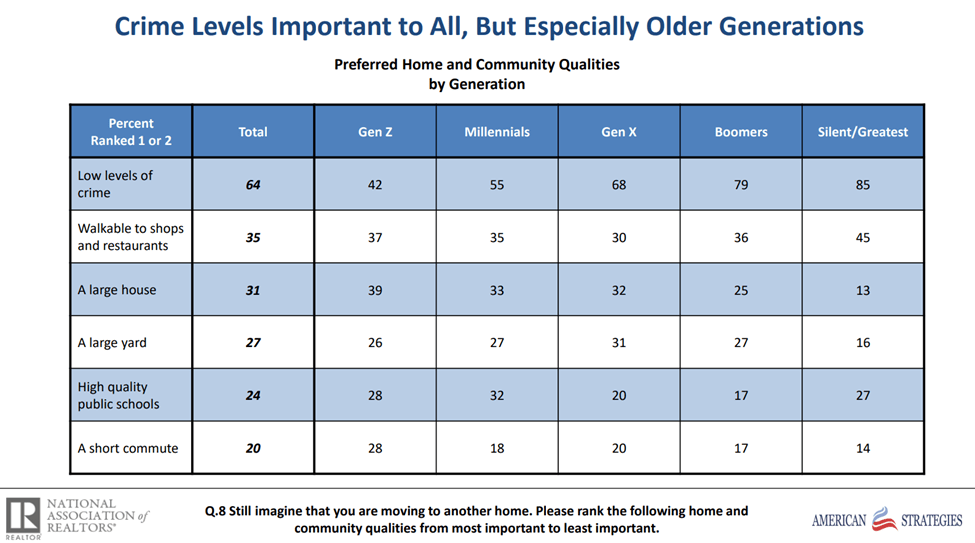
The National Association of Realtors conducts a poll every three years around community preferences about their neighborhood and transportation. Here is the Executive Summary from the last report which was just released:

Results from the 2023 Community and Transportation Preferences Survey generally continue the trends from previous surveys. Residents in the top fifty metropolitan areas remain split on what they look for in a neighborhood. One noticeable difference is a modest uptick in measures of importance of walkability.

In general, people in the largest 50 MSA’s are satisfied with the quality of life in their communities – as they have been in each of our previous surveys. If they were deciding where to live today, they would place high importance on low levels of crime, sidewalks and walkability, as well as short commutes and easy access to the highway.
In terms of priorities for their state and local governments, about three-quarters of residents place the highest priority on maintaining and repairing roads, highways, freeways and bridges. A number of other issues are in the second tier, with half placing a high priority on building more roads, expanding public transportation, providing alternatives to driving, and developing more walkable communities.
Most Americans continue to agree that they like to walk and drive, while almost half agree that they like to ride a bike and in an uptick from previous years, 44 percent like to take transit. The things that keep people from doing more walking are places being too far away to walk and the need for a vehicle for work or school.

I think there can be problems with stated preferences, as it is only when one must choose that one realizes where their preferences lie. That said there is a lot of interesting information in the report. Note first that personal safety will never go out of style. It will always stand well above other priorities.

The surprising number in this chart, one I would challenge, is the relatively low importance of schools.

Core issues such as road maintenance continue to be a need voiced by all generations.

If you thumb through all the slides you will see that the gas tax is not popular.

Doing other people’s jobs

The Hennepin County prosecutor has never hidden her activism. Supported by many, there is a view that African American youth are incarcerated too quickly, and too young, which destines them to a life of crime and prison. And holding good to her beliefs, following her election last fall, her office has been extemely light handed in pursuing this group with legal action.

The thing is, the results have been problematic. My son lives down by the U an area fraught frequent and sometimes violent criminal activity. He said the best story he’s heard so far is a kid getting taken in for a mugging only to be arrested a second time, for the same crime, later in the evening. Once released on the first charge he didn’t go home and think through life decisions. The police are busy apprehending the same youth twice in the same night for the same crime.

Needless to say after hundreds of reports of cars filled with youths as young as twelve joyriding, even the most forgiving citizens are coming to the realization that no response to crime except ‘we believe in you’ and back out on the street you go, is not generating a beneficial outcome. At a news conference few days ago, the county prosecuter announced several collaborations to put a good face on further efforts.

The collaboration with law enforcement has three parts, including meetings in which agencies will come together to identify youth in need of intervention. Social workers will also be in contact with families to connect them with needed services. Families that accept services will be connected to the county’s Family Response and Stabilization Services, along with school-based and community resources, the HCAO says.

MSN

My only question is what does this have to do with the prosecutor’s office? Isn’t it their job to make a case against criminals according to the law and fulfill their obligations to the public whom they serve? The job of connecting people with social service resources and other response services in the event of mental crises etc is fulfilled through another county department. If you want to work in the social service side of public service, then work there. Be successful there. Reach out and make a difference in people’s lives in that capacity.

As of right now, the results are in. Not prosecuting criminals is encouraging a life of crime not discouraging it.

Do store closures matter?

There have been some notable retail store closures this year in the metro. On May 15th the Target on Lake St in Uptown is shutting its doors. This is one of their smaller stores and the housing nearby is quite affluent. I’d peg this loss more as an inconvenience than a hardship.

A few weeks ago the large Wal-Mart in Brooklyn Center closed. The corporation cited safety concerns for their workers but undoubtedly the rampant theft which has festered in this commercial node for quite some time was also a factor. Let’s assume that this last point has been aggravated by the failure to prosecute youth shoplifting. The recent philosophy here seems to look the other way on small crimes to stop the school-to-prison pipeline.

Pushing the costs of theft off onto corporations is simply a social tax. To save some wayward youth from entering the system, retail stores like Walmart take a little hit.

The problem with this occurs when the business removes itself from the mix. By choosing to exit the market, now it is the customers of the store who suffer a loss. According to the US Census, the per capita income in Brooklyn Center is just under $26K. Some were interviewed when the store announced its closure. Wal-Mart’s lower prices will be a greater loss to them in relative terms. So the calculation changes. The expense of higher crime is privatized across neighbors who don’t have a lot to start with.

The poor get poorer.

Shifting social costs through mandates onto business is precarious. Not because the costs are not real. Not because the businesses don’t have funds. The reason is that the nature of creating and maintaining value in social circles is different than in business. You don’t run your family like a business. Businesses are not the most efficient mechanisms for fulfilling social demands.

(Just for fun let’s think in terms of publicness and privateness. If the flow of benefit is Pub-to-Priv use this term, or Priv-to-Pub for the other way around. Changes in the judicial process give a Pub-to-Priv flow to youthful delinquents. Businesses internalized the public cost as a private expense. Then, at a certain point, exits do to the high costs.

Now the Pub-to-Priv transfer can be described as the loss of public safety transfer at a private cost by all the shoppers who now pay a surcharge at more expensive stores. To solve this, we would need to have some idea of the long-term benefits to the wayward youths. Lifelong criminals are an expense. Does this strategy work and is the benefit of keeping the youth out of a life of crime greater than more expensive groceries?)

MN Quality of Life

Ever since Governor Wendell Anderson appeared on the cover of Time holding a (only one?) northern on a stringer, Minnesotans have carefully monitored the good life in Minnesota. Sure the winters are brutal, but we know how to make the most of things and live well.

Minnesota Compass, a data compilation service run by The Wilder Foundation, came out with a 2023 report this month entitled, More quality of life indicators trend worse than better in Minnesota.

Some of the insights are not surprising. Student achievement at the 3rd grade level is down whereas obesity is up. These seem easy to tie to the lockdowns. But a larger share of babies were born at a low birth weight is a bit distressing.

Violent crimes are at the highest level in a decade- there’s been plenty of coverage of this as it mainly involves youth. Youth volunteerism is reported as down whereas the homeless numbers are on the rise.

On a positive note the homeownership gap is closing. And this is a good thing.

How daring should you be on your first day at work?

Mike Thompson, the new cartoonist for the Start Tribune, was undoubtedly testing his employer’s tolerance for disruption. His Sunday cartoon was all the twitter this weekend. Racist! Was a common refrain. Offensive! For those more atuned to definitions.

The truth is harder on some than others, was another retort.

No announcement of his eminent demise- so hopefully he will get to keep his freedom of carricature.

Claims without substance?

This tweet garnered bicycle enthusiasts’ expected collective (scornful?) sigh. The Prof is out of touch and out to maintain the status quo. The activists are on the right side of history and will ride in on mechanical transportation, victory torches ablaze. But in the article, both parties are guilty of obstructed views.

First, consider the professor’s opinion that emissions increase when traffic quieting and bike lanes are installed. One would think there is research on this. It makes sense that when vehicles take longer to arrive at their destinations they emit additional pollutants. But intuition is not a substitute for facts. Even a report from taxi drivers verifying additional time taken to deliver passengers through said areas would be helpful. I judge claim number one as a fail. It makes sense to me but no proof is offered.

There is an indirect claim in the number of emails generated for support of bike lanes. The coalition is noted to have sent out a total of 93,000 emails. I’m not buying that there is a live citizen behind each of these carpings to elected officials. I have an inkling that a scan of the electronic documents would reveal automated generation. For claim number 2 in the matter of mobilized residents I give a fail. Spamming of office holders also takes their time away from other issues.

Another pressing issue that falls in the same interest group of concern for the climate is the decrease in transit ridership. The serious drop in locals who use light rail and busses is real and documented. It’s all green lights for claim number 3. And hence this would be one of the areas that should attract time and attention.

Safety is always on the top of people’s priorities. I’m not sure I follow the cliams being made about mortality and walkers. Pedestrian deaths were at an all time high in 2021 but compared to what and are the numbers still quite small? That said I’ve seen and heard about a lot of accidents regarding older riders in particular and their road experiences. Encouraging recreational weekend cylists to tackle roadsharing with four thousand pound chunks of metal seems a bit precarious. Claims about safety strong but not intirely thorough.

I know people who bike to work year around. They love it. It gets their day started with a vigorous activity that gives off energy throughout the day. It can’t possibly be that difficult to track two-wheeled commuters. A city can also use counters to enumerate the activity on trails and roadways at times to give estimates. The demand for bike lanes can be measured in better ways than spam. An same goes for pollution. Reader at intersection in before and after scenarios is easy enough.

If officials want to make sensible decisions they’ll need to look to everyday folks. Will a core group utilize the infrastructure or is it an appeasement to people who want to feel they are making a difference?

Up goes the apple cart

The political hot potato this week involved a county attorney, two teenagers, and the death of Zaria McKeever. Mary Moriarty lived up to her campaign promises and cut a deal with two teenage brothers in their involvement in the murder of a young woman from a northern suburb of Minneapolis. She felt that trying the 15 and 17-year-old as adults would lead to a traumatic prison experience. Instead, they would serve two years.

The family of Zaria felt otherwise. And fortunately has the where-with-all to exert political pressure. After appealing to the attorney general, the Governor stepped in and had the case taken away from Moriarty.

The county attorney has never shied away from her view that criminals are the victims of societal pressures. And that was a popular view a few years back. But now that the victims are in front of her, real, alive and and in no way superior- maybe she’ll see the harm that was done to them.

No groceries nearby

We will soon be hearing about food deserts (once again) due to three grocery stores vacating a segment of the city. The latest to close is the Wal-Mart in Brooklyn Center.

Walmart’s decision to leave, another blow to a neighborhood with a large Black population,  comes on the heels of Aldi closing a store in North Minneapolis and a nearby Walgreens closing shortly afterwards.The Brooklyn Center location, which has been in operation since 2012, is one of 10 stores nationwide the retail giant is closing, according to USA TODAY.

Sahan Journal

A shopper asks:

“Why are they closing a Walmart in a Black neighborhood?” Kennedy said as she loaded rolls of paper towels and laundry detergent into her minivan.

She works in a group home close to Walmart and shops there for the low prices and wide array of products.

“I bring them here, it’s closer to the home and reasonable,” Kennedy said.

The Sahan Journal did not cover the reasons for the departure from this location but other news sources did.

Brooklyn Center police said Walmart made 6,177 calls for services in the last five years. That’s double the number of calls compared to surrounding businesses like Super 8 and Cub Foods with 3,270 and 3,038 calls, respectively. All three businesses top the city’s list for calls for services.

For further context, police say just six miles away, the Walmart in Brooklyn Park had 1,679 calls for services in the last five years.

KSTP

City officials vow to fill the anchor store with another merchandiser. But wouldn’t it make more sense if the municipality focused on public safety and let the stores focus on business?

It’s the car manufacturers fault

Yesterday the mayors of both Minneapolis and St. Paul, Frey, and Carter, stood up with attorney general Ellison to demand that two car manufacturers recall their vehicles. Why? Because they are not contributing to the public good.

In the past few years, the public’s peace of mind has been greatly unsettled by the propensity of young folk to steal cars. Carjacking they call it. Usually, the roughians just flat-out taking the keys off a mark. The Minneapolis crime map conveys the message.

Crime map Minneapolis for the last 7 days

The mayors are responding to a terrific increase in the number of car thefts in 2023.

In a message released Friday, the police department said there were more than 700 car thefts in January, along with 33 carjackings and “260 Thefts from Motor Vehicle.”

Bring Me the News

And then the politicians called on Kia and Hyundai to recall all their vehicles that do not have anti-theft technology. Because- “They have an obligation to keep people safe. I have an obligation to people in this city,” said Frey.”

I think both mayors have congratulated the capitalist system in a backhanded way. Manufacturers, in the process of reading their consumers, voluntarily introduced anti-theft technology to their products. Since business is a competitive process, this will undoubtedly become a standard feature.

Markets solve the problems people demand from them. They work for the public good as well as the private good.

I didn’t know this about beautiful British Columbia

British Columbia is the epicenter of a crisis that has seen more than 10,000 overdose deaths since it declared a public health emergency in 2016. That represents about six people dying each day from toxic drug poisoning in the province of five million people, topping COVID-19 deaths at the onset of the pandemic.

CBS NEWS

The action taken to mitigate this tragedy:

Ottawa — A Canadian province on Tuesday decriminalized the possession of small amounts of cocaine, heroin, fentanyl and other hard drugs in a radical policy shift to address an opioid overdose crisis that has killed thousands. Adults found with up to 2.5 grams of these drugs, rather than face jail or fines, will be provided with information on how to access addiction treatment programs.

Police will also not seize their drugs.

I hope it works. But addiction is a powerful force.

The cost of maintenance

As mentioned yesterday, regular maintenace is necessary to keep up on the friendly agreements we all like to benefit from. I think the saying goes: Fredom isn’t free.

Unfortunately, lots of people at the top don’t want to think about it. It’s more interesting to be the first to the top of the mountain, not the sherpa keeping food stocked at base camp. For a more precise cost to such obtuse thinking look no further than the US invasion of Iraq.

Mark Danner writes:

Three years and eight months after the Irag war began, the secretary of defense and his allies see in Irag not one war but two. One is the Real Irag War – the “outright success” that only very few would deny, the war in which American forces were “greeted as liberators,” according to the famous prediction of Vice President Dick Cheney, which he doggedly insists was in fact proved true: “true within the context of the battle against the Saddam Hussein regime and his forces. That went very quickly.” It is “within this context” that the former secretary of defense and the vice president see America’s current war in Iraq as in fact comprising a brief, dramatic, and “enormously successful” war of a few weeks’ duration leading to a decisive victory, and then . .. what? Well, whatever we are in now: a Phase Two, a “postwar phase” (as Bob Woodward sometimes calls it) that has lasted three and a half years and continues. In the first, successful, Real Iraq War, 140 Americans died. In the postwar phase, 2,700 Americans have died – and counting. What is happening now in Iraq is not in fact a war at all but a phase, a non-war, something unnamed, unconceptualized – unplanned.

Iraq-The War of the Imagination

Men of action like actionable things. Keeping up the place isn’t a thing. But it’s costly: 2700 lives if someone is counting. Whether housekeepers or peacekeepers, gardeners ot garrison- name these jobs and give them their value.

Westminister Town Hall welcomes Chris Blattman

There’s a beautiful church on the edge of downtown Minneapolis called Westminister Presbyterian. The nave is more of a square than a rectangle and the ornate stained glass windows are all around. It was built over a century ago and wraps you in old world craftsmanship.

I don’t attend service here but I do take advantage of their Town Hall forums which take place through the fall. It must have been five years ago when David Brooks made an appearance that filled all the chairs and pews. Minneapolis is often forgotten on book tours and such- some stay away from the nasty weather. But Chris Blattman, an economist from the University of Chicago, said today that he feels most at home in our state. He was raised in Ottawa and there is something familiar about the north country.

Blattman is on a book tour for his new release Why We Fight. Before he provided an overview of his thesis, he elucidated that for the most part people don’t fight. A detent is preferred so all sides may reap the rewards of a peace dividend. War is nothing but an expense. But under roughly five circumstances, an often erroneous calculation ignites a war.

The first part of the talk focused on global conflicts especially Putin’s invasion of Ukraine. Large-scale events are often easy to refer to because people have read about recent events, know the leaders, and a bit of the history.

A local Ukranian band opened up the talk.

Blattman also spoke about his work in reducing local violence in neighborhoods. He has extensive experience in Columbia both with gangs who commit violence and those who hold the peace. This last one is a maintenance type of work. You keep up on balancing out the little power struggles, cool down the hot heads and monitor for possible failures in the system. If you think about it maintenance is a part of most social commitments.

After speaking for about twenty-five minutes, questions on index cards were passed to the front. The very last one was practical. What does he suggest the audience can do to fight violence? (A real issue in present-day Minneapolis). He said to work at the margin. Step in and do small things. Do maintenance.

New construction improves a neighborhood w/out price increase to entry rentals.

This is so obvious to anyone who watches real estate or is in a real estate-related industry. Renewal of a nook of a city due to capital improvements helps- not hurts- everyone down the line.

When I was in a planning session, I was taken aback when a person of just these qualifications was nodding her head that new development hurt affordable housing. If this person, who I thought well of, had this view, what was I missing?

A Theory of Baselines

I think what happens is standards are elevated and in that process, those on the lower end of the scale continue to feel left out. Real estate development and change happen slowly, over three, five, and even ten years to transform an area.

In the fifties, skid row was where affordable housing was located. Then the sixties brought about urban renewal, including bulldozing all these decrepit buildings. Without much research, I can guarantee that the housing provided to people today is far better than that in the 50s. Yet it is a far cry from standard mainstream housing.

With all public goods, there must be a baseline to measure progress. Otherwise, those who are not achieving in school or housing or health will always feel worse off than the average. But are they better off than yesteryear?

Snow MN Style

The first big snowfall of the season brings a sense of delight and dread. The white flakes make all the Christmas lights sparkle a bit brighter. Walking in the light fluffy stuff is playful. And the thought of sledding and crosscountry skiing rekindels found memories and enrgizes new ambitions.

But man the roads were bad. One car was stranded on the center median, perpendicular to the flow of traffic, little tires spinning freely above the surface of the road. Another cluster of vehicles was bunched up on an incline unable to gain enough traction to make the climb. One SUV was simply sitting in the left-hand lane with hazards flashing.

Winter driving rules are simple: Go slow. Stay alert. Don’t follow the sand trucks or the plows.

Why we work without pay and give without immediate exchange

To date, one of the most viewed posts on this site is The Crafter, The Contributor and The Covid Tracker. The three examples show how people are willing to devote their labor to causes and groups which they value.

Similarly, we are prompted to give resources in the same manner. Advertisements from all sorts of worthy enterprises show up in the mail. This calendar has been floating up and down through the mail in my home inbox. A convenience return envelope is provided at the seam. Which begs the question: When do people feel compelled to donate to an organization?

More than likely regular donors have a personal connection to the non-profit or public service provider. Perhaps their family members were firefighters and thus there is an inside knowledge of the vital need for a capable response to, in this case, a raging fire. These networks of individuals extending out and away from an organization also have a sense of the character of the people who are involved in such missions, their intent, and their dependability.

It just so happens we had a terrible drought in Minnesota this past summer. Un-irrigated lawns are brittle and brown. My dog Pépé loves hunting through the dry broken stalks of grass. He posed on our walk yesterday at the edge of a corn field.

The wind was incredible today gusting up to thirty miles an hour. Its blustery force lifted top soil right off the harvested fields creating a silty thickness in the air. Bits of hay swirled all around. When a white pickup stormed up behind me on the two-lane country road I eased over to the shoulder and slowed to make it easy to pass. A half a mile along on scenic county road 35 I caught up to an firetruck running its flashing lights.

Only a few more wide turns in the road and the object of concern revealed itself. A thick grey cloud of smoke pealed away from, what at first, seemed like a homesite. Another curve brought a new perspective. The dancing flames were feeding off tall dried grass in the acreage between the asphalt road and a smattering of buildings. Two fire trucks had already arrived. A few of the firefighters, geared up in protective wear, were busy with their equipment. The wind was fanning the mounting flames.

The road led me past the grass fire. At least four more fire trucks passed me as I drove on. Needless to say, I’ll be sending in my donation to the local fire department, staffed by community workers who show up when needed on a windy day.

use, function, design, and lower crime

When I was out walking the pup today, I was thinking about things in terms of use, function, and design. Take for instance a park bench. You can sit on it, stand on it, or lie down across it. But its function, when used as a seat on a beautiful fall afternoon, is to enjoy the oranges and reds of the fall foliage. It may also function as a platform if there was a concert in the park and one wanted to see it over people’s heads. Lastly, it may function as a place to take a rest, especially for the homeless.

Now think about a catalytic converter. Its use is to reduce airborne pollutants produced by gas fueled vehicles, that could be harmful to people and the environment. In 1975 its function was a decisive step toward a cleaner environement as it enabled compliance with the EPA’s new mandates. Today, as the tweet below indicates, its function is currency for youth who have learned how to remove and trade them.

When the public surrounding a park decided to discourage the homeless from sleeping on park benches, they tackled the issue with design. And came up with this.

Isn’t it the function which determines an objects value? A bottled beverage at the check out at a grocery store may run you $2.25 even though right down the aisle you could grab a six pak for $4.59. The function of the first one is a refreshment.

The function of the stolen catalytic converters is a fungible commodity. I think Rev Christopher is asking for an economic design that would break up the market so that his youth would no longer have incentives to carjack and steal. Who’s up for the challenge?

Mn reports crime

This thread, from a former east coast journo who moved to MN to raise a family, has a lot of good information yet lacks some important details.

In this first map visualization, we see the measure is listed in increments of 100 violent crimes/100k people. The top level, 400, is denoted in black. Ingraham observes that two of the four top counties are in outstate MN as opposed to the Twin Cities metro area. However, if you look at the data you’ll notice that Hennepin and Ramsey counties are reporting over 500 violent crimes per 100K (ie they should have their own category) and the spread between the leader and Mille Lacs county is 25%. That’s a lot.

One negative point for visual misrepresentation. Playing on the general public’s weakness with numbers is not nice.

A few other observations that Ingraham highlights appear more oriented toward a political message than supporting his thesis that there is more nuance to crime than the urban areas have it and outstate doesn’t. A more thoughtful approach might be to point out that some of the higher rates of crime are in countries with larger cities like Duluth, St. Cloud, and Morehead. Or that the Iron Range has desperately needed jobs from mining and the lack thereof has placed a community into a slow slide to desperate times.

The best item of news in this thread is that Minnesota takes crime reporting seriously.

This story was only possible because Minnesota does some of the best crime data collection in the country. Serious thanks to@MnDPS_DPS and all the local agencies responsible for that.”

The threat of personal injury is, for most people, the most important factor in helping to navigate their choices on where to live, work and recreate. Accurate data which could be used to compare people’s choices, given levels of crime, is very valuable.

Commissioner of Community Safety

MPR reports:

“We’ve been talking for two and half years about reimagining public safety, creating a continuum of public safety, bringing all aspects of our public safety responses together in one department, and today that has happened,” Jenkins said. “After much consternation and vitriol, we have reached that day.”

MPR

I like Andrea Jenkins, who is now President of the Minneapolis City Council. In some ways this trans woman is the most conservative amongst the group of thirteen. She has also held consistent views over the past two years.

Cedric Alexander will be the first ever Commissioner of Community Safety. Here’s where he accentuates the necessity of public participation in the work if keeping the streets safe:

“We need to move policing forward and rebuild relationships in the community,” Alexander said. “We need to redesign our approach to public safety so everyone is working together.”

TicToc shows Trucker saving the day

There’s got to be a better name for this than civic duty. Work for the community, work for free but not for nothing, work to the embetterment of my neighbors? Work3? Something?

It appears this trucker may have had a hand in stopping a pursuit of carjacking suspects a short tiime ago in north Minneapolis 👇

Got a Tok, too, if that’s your thing:

@crime_mn

Trucker pins suspect vehicle in Minneapolis pursuit! The four kids book it from the car but were all eventually apprehended. #pursuit #trucker

♬ News Report Two – SMUSICBOX

Originally tweeted by MN CRIME | Police/Fire/EMS (@MN_CRIME) on August 4, 2022.

Why aren’t people studying capacity?

The last two years have seen two events where the actions of citizens have drawn worldwide attention. At the end of May two years ago the killing of George Floyd ignited protests in Minneapolis which lasted for three days. Before the National Guard was engaged to end the violence, three miles of businesses were vandalized and burned, and spotty destruction occurred elsewhere in the metro area. Everyday people who typically abide by the rules were looting and pillaging while others stepped to the side, let it happen, and even cheered it on.

What led people to normalize violent behavior in a city which has enjoyed a low crime rate?

More recently the west has been energized by the Ukrainian people’s passionate self-defense in their David and Goliath story. When the Russian military advanced on their territory experts assumed the government would fold and the people submit to a new rule. Yet the heroism of the people continues still today as they have successfully stalled the super power from further territorial gains.

In both cases, the citizens were underestimated. In one scenario the norm to preserve order and support the enforcement of rules or laws was subverted. In the other, a people found reserves of courage, commitment, and where with all to engage in military operations. Despite worldwide attention, I have seen little analysis as to how the capacity to fail to act or to act was stockpiled.

More has been written about the history of the conflict in Ukraine. Since 2014 when Russia invaded and successfully secured Crimea, the Ukrainians have had eight years to regroup. But since none of the foreign policy experts expected the strength of their patriotism, there must have been more happening on the ground to store away a united ambition to fight.

Similarly, in the years leading up to a teenage girl filming the death of a man under the knee of a police officer, it’s hard not to wonder what dynamics were put into play to allow law-abiding people to support and empathize with the subsequent action of thugs burning and looting businesses. Although the aspirations couldn’t be more different between patriotic fighting and protestors gone wild, the lack of outward signs of the build-up of such reserves is similar.

So how is it done? It seems like important information to know.

What’s it called when a bystander stops a guy with a gun?

When police stop an active shooter they are doing their job. They are paid a salary to respond and resolve the conflict at hand.

We don’t really have a name for what it is called when a bystander interferes with the gunman (or woman). Perhaps they are doing their civic duty. But this word implies an obligation to react. I don’t think must people *expect* bystanders to put themselves in harms way.

Furthermore the bystander receives no monetary compensation. It’s not like there’s a standing bounty for anyone to grab if they stop a crime. When ordinary citizens give their time, skills and efforts to reduce public safety, what do they get?

Because whether a bystander or the police stop an active shooter the benefit to the nearby neighbors is the same. So you’d think we’d have a name for something so valuable.

Roundabouts

Roundabouts are becoming popular in the Twin Cities. The city of Minneapolis has a list of seventeen mini ones on the docket. But it is not only in the center cities- they are popping up everywhere. The Ridgedale Mall area in suburban Minnetonka has feathered in two full-fledged traffic circles on the south side of the shopping area.

I remember the first time one slowed me down in Woodbury, located on the eastern edge of the metro. We had spent the afternoon at a large athletic playfield complex and were trying to get home for dinner and rest. The sun was low in the sky to add to the irritation that the car in front had come to a complete stop. Unprepared for this new fangled road feature, the late middle-aged driver had to assess her choices. In proper Minnesota fashion, we sat in passive aggressive limbo while she sorted out her confusion.

As people have become familiar with the concept it is less likely to stop entirely. Although drivers are hesitant, the setup works as intended with a continuous flow of traffic. In the area shown above, the quieting will most probably discourage hot-rodding and get-away cars. Thus there is safety to be gained from several areas of social activity.

Lawn games vs. the Government

It’s the Memorial Day long weekend here in the US, a time when people get together with family and friends to visit and recreate. French Park, a regional park on the north side of Medicine Lake was full of folks today. Most were gathered in clusters around a set of picnic tables, grills cooking, and people chatting. The beach had some activity, as did the volleyball pit. Forty years ago, you may have seen people throwing lawn darts- metal darts with a pointed tip and aerodynamic fins. But they’ve long been banned in the US (Still legal in Europe).

Bag toss is a very popular activity at picknicks in the lakes area.

In April 1987, seven-year-old Michelle Snow was killed by a lawn dart thrown by one of her brothers’ playmates in the backyard of their home in Riverside, California, when the dart penetrated her skull and caused massive brain trauma.[9] The darts had been purchased as part of a set of several different lawn games and were stored in the garage, never having been played before the incident occurred.[9] Snow’s father David began to advocate for a ban on lawn darts, claiming that there was no way to keep children from accessing lawn darts short of a full ban,[9][10] and, partly as a result of Snow’s lobbying, on December 19, 1988, the U.S. Consumer Product Safety Commission introduced an outright ban on lawn darts in the U.S.[11] In the previous eight years, 6,100 Americans had visited hospital emergency rooms as the result of lawn-dart accidents. Of that total, 81% were 15 or younger, and half were 10 or younger. During the week when the commission voted to ban the product, an 11-year-old girl in Tennessee was hit by a lawn dart and fell into a coma.[9]

Wiki

Not to diminish the tragedy of a child’s death but forever labeling an artifact a weapon following one incidence of loss of life is surely government overreach. And then to add this numerical representation of 6100 hospital visits over 8 years without any reference points is so weak. According to the CDC, there were 130 million emergency room visits in 2018. So– 6100 divided by 8 taken as a fraction of 130,000,000— or basically an extremely trivial amount.

The lack of bracketing of relative impact on health and safety issues is mind-boggling. It takes one tragedy and a loud voice to create a law which forever bans an object. Meanwhile, knives kill people, hammers go bang upon the head, and if Hart to Hart is to be trusted as a reliable source, a marble paperweight or carved bookend can do just fine as well.

Sometimes it feels like people need answers- Why did the parents not give proper instruction to the children? How could the friends have been so careless? Why do innocent children sometimes die expectantly? People want to take action so as to make these questions go away. They demand something be done.

Common sense says that sometimes these are not questions for government and legislators. These are questions to be discuss within the religious community of your choice.

Why do people prefer the suburbs?

Like dueling twin cities, there is an ongoing feud between those who love the city versus those who prefer a suburb. Here are a few reasons why people move out to the burbs. I present these in no particular order other than how they come to mind.

  1. Many buyers desire privacy. They want their own space and don’t really want to feel obliged to interact with their neighbors. It’s not to say that they don’t greet the resident across the street with a cheery hello- it’s just that they want to be able to retreat behind their four walls if they so desire. There is a little more elbow room on a .25-.31 of an acre lot which is standard in the burbs, than on a city lot which runs about half the size.
  2. Less drama. That’s how an acquaintance explained it long ago. When you pull back your front shades and see a guy sleeping in his car in a pile of refuge, you wonder if you should go investigate. It’s not that he is causing you any harm, but you feel like you should go check on him. This happens far less out in the burbs.
  3. Many suburbs offer reliable transit access to a central city around business hours. It is a myth that dwellers in the urban core do not require a vehicle whereas suburbanites do. I make this claim through observation, but I’d love to see statistics that prove me wrong.
  4. The core cities indeed have many more restaurants. But the burbs have a greater selection of grocery and big box type of shopping all with easy access. Any store that needs space, Ikea, car dealers, REI, and Best Buy, will find space in less dense areas.
  5. In Minnesota both the burbs and the city value parks and trails. But there are more lots in the outer areas which have views onto nature areas, marsh lands, and waterways. Since people find happiness in nature, this also edges the suburban options up a nudge from the city.

There’s a lot to love in all areas of a metro area. Luckily everyone likes a slightly different combination. It is a bit silly to poke fun at one area over the other when it’s clear that there are plusses and minuses to all options.

Say cheese- you are on camera

Thanks to tech everything is on camera these days. Police cameras pick up the granular details of a traffic stop. Ring doorbells identify car jackers. And Russian soldiers are captured stuck in an Ukranian elevator.

In the throes of a rally or a protest laced with property damage or a war, it’s sometimes hard to see who will be celebrated and who will be condemned. One thing is certain, the likelihood of being fingered has gone way up. Take this guy. He’s meme material.

History might not laugh along with the field officers who carried out orders to open fire on civilians evacuating on pre-determined routes. And should the final analysis not support your story, it will be more and more difficult to find safe haven in this world of facial recognition and mass media.

Watch out for moms with weapons

MINNEAPOLIS (FOX 9) – A 53-year-old woman and Minneapolis homeowner is claiming self-defense, and protection of property in a deadly shooting in her yard last week……The homeowner who pulled the trigger claims, she fired several warning shots. But the man advanced towards her.

Fox9 News

She told detectives she first fired four warning shots into the air with a handgun, but when he advanced and appeared to reach into his waistband, she eventually shot him with a rifle.

What’s in a house price

All we’ve heard for the last several years is how the price of housing is going up. Up. UP! And for the most part that is true. Whether it is because Millennials are finally getting on their feet and need a place to have their own families, or whether the baby boomers are not moving to the lower priced condos and giving up their family homes, there is no doubt that there is a housing squeeze.

But seriously, for as long as I can remember, except in deep recessions, people have thought housing is expensive. Because it is! It is the largest portion of people’s monthly budget. And this distraction about the cost of a home is the most uninteresting fact one can take away from home prices. House prices are a rich reflection of the revealed preferences of a community.

An economist in the early part of the twentieth century by the name of Paul Samuelson came up with the idea that when consumers chose different products, they reveal what best suits their needs. This differed from theories up to that point which placed the burden on policy makers to decide which goods provided the greatest utility to consumers.

Samuelson’s relationship with economics is lengthy. This excerpt paints the broadest brush of his brilliance. “In receiving the Nobel Prize in 1970, Mr. Samuelson was credited with transforming his discipline from one that ruminates about economic issues to one that solves problems, answering questions about cause and effect with mathematical rigor and clarity.”

One economist, his junior by twenty years, heard the clarion call for greater mathematical representation of economic theory. Zvi Griliches contributed to a publication called Economic Statistics and Econometrics published in 1968. In a paper called Hedonic Price Indexes for Automobiles: An Economic Analysis of Quality Change, Zvi pulled apart the prices for automobiles so that he could show how much consumers were paying for improved engines or length of the vehicle or other features. By comparing the components of the cost of vehicles he distinguished between inflation and consumers revealing a preference for higher quality provided by advanced technology.

But back to real estate. The economist credited for using this statistical method (taking the price of a complex product and using data to divvy out the weighted values of its various components) was Sherwin Rosen in his 1974 paper Hedonic Prices and Implicit Markets: Product Differentiation in Pure Competition. Now this is exciting! The price of a house can tell you how much one school district is favored over another. It can tell you the value effects of violent crime, or proximity to mass transit.

The implicit prices tell us that we trade in public goods as well as private goods. We shop for city services and good roads, for youth programming and parks, as well as for good schools and safe streets. The implicit prices tell us how groups of people choose bundles of public goods. Real estate prices are incredibly rich with feedback.

So can we stop with the “They are so expensive.”

A cure for car jackings?

The last two years have seen a terrific rise in carjackings in the Twin Cities. Loose numbers for the trend in the city of Minneapolis come in at 84 for 2019, 388 and 610 in 2020 and 2021 respectively. Whereas the crime was mainly centered in the city, now offenders are venturing out into the suburbs. Whereas the perpetrators were mostly unarmed, now they are mostly armed and often inflicting bodily injury.

Out of the 610 incidents there are certainly a portion inflicted by career criminals. But at our holiday potluck last week the conversation focused on the number of juveniles involved in the activity. One story concerned a recent incident in a wealthy third tier suburb carried out in broad daylight. When the car was apprehended later in the day, all the occupants were under fifteen years of age. Here are a few other reports which follow the same lines.

The day after Frey’s press conference (12/16), two teens pleaded guilty to multiple carjackings across the Twin Cities; in a separate incident, a pair of juvenile suspects were arrested in association with violent attempted carjackings outside two Lunds & Byerlys locations. One suspect is still at large. 

Bring Me the News

As it has progressed to a larger geography, residents have organized to express their concern. Just over a week ago a community crime prevention meeting drew three hundred participants in a suburb abutting the city of Minneapolis. The mayors of five western suburbs compiled a statement and action list to address the issue. The role of the county attorney was questioned.

“We think the message being sent to criminals is you can commit this (kind of) crime this afternoon and be out by this evening,” he said. “From what I understand from the police officers, that is not far from the truth. I think we want the county attorney’s office to relook at that.”

https://www.eplocalnews.org/2021/12/18/suburban-mayors-meet-to-develop-response-to-
increasing-crime/

We’ve come full circle. The county attorneys had loosened penalties for low level crime in response to demands for social justice. Kids from disadvantaged neighborhoods get in the system, the reasoning went, and then they are hindered from progressing up through the regular channels of entry level jobs and on up the chain to self-sufficiency. Take formal charges off the table, and the balance will be set right. Unfortunately, releasing the penalty for low level offences has increased the number of kids getting into the carjacking business 6-fold, not decreased it.

Perhaps Minneapolitans would tolerate this increase in crime and see it as a penalty paid in order meet their social justice ambitions. But it is already clear that there is little appetite for such things further afield. More importantly, the loss of life amongst these budding ne’er do wells has been tragic.

Two teens are dead and three others in the hospital Thursday morning after Robbinsdale police say a reportedly stolen SUV crashed in Minneapolis.

The incident first began around 6 p.m. Wednesday (12/8) night, when a Mercedes SUV was stolen in an armed carjacking near the area of 12th Avenue North and Fremont Avenue in Minneapolis. ….

Police said five people were inside the fleeing SUV, all of them teens. One occupant was declared dead at the scene of the crash, and the other four were taken to nearby hospitals, where Robbinsdale police confirm that a second person died. Robbinsdale police captain John Kaczmarek told KARE 11 that the other three suffered significant injuries but are “up and talking” in the hospital.

MSN

As people puzzle over this escalating situation many of the same solutions are bantered about. But I say look to those suffering the greatest loss. To raise up a child to fifteen or sixteen years of age and then see them, on a whim, end up in a car which veers off the road and takes their life, must be a serious blow. These are the folks with the most to lose. A group of parents who have recently lost a child to this nonsense must have ideas on how different circumstances could have pulled their loved one in a different direction.

Scuba diving is an underwater stroll

With the help of a vest and air source, a diver can sink to the ocean floor and have a look around. Instead of walking a trail and spotting robins and blue jays, the reefs spit out the whitespotted Toby, or the devil scorpion fish (my favorite), or the coffee table sized sea turtles.

Scuba diving is an enjoyable hobby which has gotten more and more popular in recent years. PADI, the Professional Association of Diving Instructors, reports that they hold certifications for 28 million underwater strollers worldwide. A certification is the end result of passing a course and an open water swim exam.

PADI® (Professional Association of Diving Instructors®) is the world’s largest ocean exploration and diver organization, operating in 186 countries and territories, with a global network of more than 6,600 dive centers and resorts and over 128,000 professional members worldwide. Issuing more than 1 million certifications each year, and with over 28 million certifications to date, PADI enables people around the world to seek adventure and save the ocean through underwater education, life-changing experiences and travel. For over 50 years, PADI is undeniably The Way the World Learns to Dive®, maintaining its high standards for dive training, safety and customer service, monitored for worldwide consistency and quality.

From either the PADI linked page or FB page

The organization was started in 1966 by a couple of guys who didn’t like the status quo and wanted to do something better. Given its worldwide reach, one can’t help but wondering how they got established and grew into the association of choice.

This isn’t a situation of government setting up a bunch of rules and allocating a means of enforcement. This is associational work. Why people choose this certification process would be something to consider.

The Addis I Knew

Addis skyline in 1974 from the Hilton Hotel

Our posting to Addis was one of the longest in my childhood, so naturally I have many memories from our time there. We arrived in September, at the end of the rainy season. Since our housing wasn’t ready, we lived temporarily at the Hilton Hotel. This photo was taken from one of the upper floors. I believe that is Menelik II Ave rising up on the right side of the photo. If you google present day photos of Addis, you can see how the city has been transformed.

We were fortunate to have traveled across the country during our time. From the Awash valley, to Djibouti, to Lake Langano, up into the Rift Valley, and to trout fishing in the Bale Mountains.

I hope some day to travel there again. But the news update below isn’t encouraging. So for now, US travel is it has to be!

We are seeing the crisis/death of 2nd generation constitutions: Ethiopia with its diversity-sensitive constitution, federalism & self-determination clauses, mirrored in the angst and twitches in South Africa 2/7

Ethiopia reminds us of the limits of the “modernisation” (read big infrastructure ) model that “brings” development and nurtures cohesion through satisfied stomachs. It was rising until it fell 3/7

It also demonstrates that African dysfunction can’t always be attributed to the colonial experience. Ethiopia wasn’t colonised and led a highly storied war against the Italians 4/7

It shows that the existence of a large foreign presence in a country – a regional hub – is no inoculation against state collapse 5/7

Ethiopian conflict proves what has been observed in conflict literature: the best predictor of war in a country is a prior experience with war. Once you break your “peace virginity”, just expect more children down the line 6/7
📸EPA

Last, on a light note, having a Nobel winner ( PM Abiy & Wangari Maathai in Kenya) and great Gold-winning runners (Haile Gebrselassie or Eliud Kipchoge) is no guarantee of peace 7/7

Originally tweeted by Charles Onyango-Obbo (@cobbo3) on November 5, 2021.

Yes to the incumbent Mayor, No to power to the Council

Minneapolis voters on Tuesday soundly rejected a proposal to replace the Minneapolis Police Department, crushing the hopes of supporters that outrage over the killing of George Floyd would translate into one of the nation’s most far reaching experiments in transforming public safety.

https://www.startribune.com/minneapolis-voters-reject-plan-to-replace-police-department/600112156/

To hire a Mayor

In about a week elections will be held here in the US. The presidential spot won’t be on a ballot for another three years, but there are still some important races in the works. Like the Mayor of Minneapolis.

With the largest commercial center in the state also home to many government service centers, public institutions like the University of Mn (home to 60,000 students) and sports and entertainment centers, it’s sometimes hard to get your head around the fact that only the residents of Minneapolis vote on core services like who is in charge of public safety. (The city proper has about 420K residents whereas the entire metropolitan area has a population of 3.65 million people.)

The city of Minneapolis has been engaged in a very vocal discussion around this issue and in the following video clip you can get a feel for how the political positions have shaken out. The incumbent mayor has risen in his position since the death of George Floyd had him numb and silent. He is more confident and more assured about the path ahead and his contribution to the journey.

There are three other candidates in the conversation. One represents the left/Marxist progressive angle, then there is a the center progressive/climate action candidate, and lastly a very articulate representative of the immigrant community. All in all the clip is worth watching as it pulls apart some common themes seen across the democratic party more generally.

Minneapolis also uses rank choice voting, and the moderator raises the question of whether collaborative efforts on the part of two of the candidates fulfills the intentions of this form of democratic determination.

Jump to minute 17 to get right to the debate section of the hour long public affairs show.

Defund the Police- Update

There’s been a volleyball match all week in the courts to determine the destiny of a ballot question for Minneapolis voters. The issue at hand is the reporting structure of the Minneapolis Police Department, requiring its lead officer to be accountable to the mayor as well as the city council people. Presently the chief of police reports only to the mayor.

On Monday, Jamie Anderson, a Hennepin County Judge struck down the question for the second time in seven days. “The court finds that the current ballot language is vague, ambiguous and incapable of implementation, and is insufficient to identify the amendment clearly.” I think she even implied that it was deliberately misleading, but the quote eludes me now.

In the summer of 2020, eight of the thirteen city council people of Minneapolis stood on stage in a public park and made a pledge to Defund the Police. It turns out the pledge was the easy part. Little progress has been made in the crafting and architecture of a program that would replace traditional policing with something better.

Meanwhile crime has escalated citywide. Violent crimes are up about 20 percent. The police force is down twenty percent.

Two of the council members from this heady period are not seeking reelection, including the City Council President, Lisa Bender, citing family reasons. Still- an organization called Yes 4 Minneapolis plunders forward with a political answer to the city woes when a utilitarian one proves elusive.

One benefit of the bruhaha is that it has shown a spot light on the cleverly worded proposal meant to sound reasonable and caring. It has also risen to a loud enough public status that the Governor, and several state Senators have felt the need to weigh in against the city charter change.

Just a few hours ago, at the end of the work day, the Supreme Court of MN overturned the lower court ruling and granted the ballot question’s legitimacy. Just in time for early voting which starts tomorrow.

Timing a move

People move households a variety of times throughout their lives for a variety of reasons. Depending on your data source, Americans move every 7-9 years, with more frequent moves in young adulthood and more sedentary behavior in later life.

This makes sense. As folks move through different stages of life, both from an income stand point and a lifestyle standpoint, they want a different combinations of neighborhood amenities. These are not questions of ‘good’ things versus ‘bad’ things. These are simply mixtures of choices.

When you are young you may want to live near entertainment and restaurants. Once there are kids in the household, going out to shows and restaurants quickly takes a back seat to prioritizing daycare, schools, and after school activities. Stability of residence can be important at this stage as rearing children benefits from consistency.

If the norm is to move, to seek out new living arrangements that better suit new objectives, than wouldn’t incentives that lock people into a location be holding them back? Financial incentives such as rent control do exactly that. It discourages mobility.

And I’m not saying people who need help shouldn’t still receive help. I’m saying that paying people to live in the same set of living circumstance through all stages of their lives goes against the norm. Which leads one to believe it is a drawback in the long run, for a perceive protection in the short run.

The Wire– a review

If you prefer drama to comedy I can recommend the HBO series The Wire. The first of five seasons came out in 2002 when the TV in our house was featuring Barney and Dora the Explorer. A crime drama portraying the grisly conflict between law enforcement and the (mostly drug) criminals wasn’t in the cards.

The story lines hold their own with intrigue and surprise, along with character development. Every season probes a new scheme, a new crew of gangsters, while bringing along the established cast and story threads from past seasons. From Wikipedia:

Set and produced in Baltimore, MarylandThe Wire introduces a different institution of the city and its relationship to law enforcement in each season, while retaining characters and advancing storylines from previous seasons. The five subjects are, in chronological order: the illegal drug trade, the seaport system, the city government and bureaucracy, education and schools, and the print news medium. Simon chose to set the show in Baltimore because of his familiarity with the city.[4]

What holds up so well is the consistency of the norms, whether they are those which the criminals obey or the ones the mainstream players abide. Each side has heroes and crooks, has chivalry and villainy. Each side has bad luck and good fortune. Each side has weakness and substance abuse. A few try to pass from one side to the next.

The Wire is lauded for its literary themes, its uncommonly accurate exploration of society and politics, and its realistic portrayal of urban life. Although during its original run, the series received only average ratings and never won any major television awards, it is now widely regarded as one of the greatest television shows of all time.

The Wire – Wikipedia

You will also realize how far technology has come in the last twenty years. The primary tool used to capture the drug dealers is “by getting up on their phone,” or getting court authority to tap phones. When the first season opens these are pay phones on the corners of the gritty streets of Baltimore.

As long as you can tolerate a little violence, it’s well worth a watch.

Skin in the game

Skin in the game is a phrase mostly understood in a business context where the potential investors look to how much the CEO has anted up before throwing their cash in the pot. The potential of future profits are dickered over, but it’s what will be lost if things go awry which indicates a certain confidence level in the project. Apparently people are more adverse to loosing what they have, than gaining in the future.

Corporations offer incentives to employees to invest in their the company’s stock 401K based on this premise. A matching corporate contribution is thought to be money well spent, as employees have a reason to care about the future of the company. Tying their retirement fund to the company dollar sets up a scenario where they could loose, which then spurs them to adopt custodial duties over and above their cube and highbacked chair.

These two scenarios are pretty easy to peg as they are demarcated by the flow of dollars between employees, investors and the corporation. But what about skin in the game in the production of public goods, street safety for instance? How do the subgroups get divvied up and who has something to loose on which street corner?

The skin in the game problem here is that members don’t realize what they have to loose, they don’t realize that they are players in services that greatly impact their lives and the potential for loss is real. They think, because they have been told to think, that public goods are something provided to them. If anything the problem in public goods has been described as one of free riding- which is mostly irrelevant. It is skin in the game that matters.

When encouraged to turn on the illegal element in a neighborhood, the individual actor’s calculus is that there is more to loose by going to the cops. Yesterday a $30,000 reward was posted for information leading to the arrest of individuals responsible for the death of a six year old by a stray bullet. We’ll see if that’s the right number to buy out the loss, perceived or real, and remove one tax on safety.

But street safety is not the only public arena where skin in the game lacks proper account. If citizens could truly see what they loose over their lifetime by failing to put some of their efforts in the production of public goods, I think their dispensation of time and resources would change. And for that reason lack of approachable role models at all levels of neighborhood public goods is the skin in the game we are all missing.

The Wild West that was Amy Klobuchar’s childhood home

Multiple public safety agencies went into action to chase this SUV through St. Paul, Minneapolis, Golden Valley and then Plymouth, where they were apprehended on a county highway not far from my house. Hopefully the efforts were initiated from an inside source as constituents realize that public safety is an ongoing interaction between the community and the official forces in charge (and called upon) to apprehend criminals.

Thankfully no one was hurt.

Crime Report

My son’s home from the U and the news is that robberies are regular occurrences, armed robberies that is. At what point do people decide to support law enforcement?

Here are some updates from Twitter, if there are any doubts about the need for public safety.

The winds, they are a-changing

The mayor of Brooklyn Center has navigated a superb response to the on-going crisis. His feed is specific, situational and gives clear direction.

This approach appears to have general pubic support. As you read through the comments, an expression of outrage is followed by an explanation. Other voices are spelling out the agenda.

Mayor Mike Elliott on Twitter: “Daunte Wright’s death will not be exploited. Some outside elements may be planning to show up to infiltrate peaceful protesters and cause mayhem, we will not allow that. We ask folks to protest peacefully then please go home before the curfew goes into effect this evening.” / Twitter

So far the extensive military force present around the city seems to be deemed appropriate to the level of potential threat. A far cry from last years repeated bolstering of the protestors, allowing the grievers “express” themselves. The sweet naivete has been swept away on winds of change.

From the Inferno

Our metropolitan area is being tested by dark forces. To have a senseless tragedy occur midway through the legal proceedings of former police officer Chauvin feels like the doings of evil seeping up from a subterranean inferno.

Events are unfolding differently from last May. The top political figures are out front and center. The mayor of Brooklyn Center, Mike Elliot, posted a video statement in the middle of the night and today held a press conference. (We didn’t see the Mayor of Minneapolis last year until five days after the event.) The Governor also has made public statements along with John Harrington Minnesota’s commissioner of public safety.

The looting started last night so there is a four county curfew tonight from 7pm until 6am. The top politician voiced stern rhetoric against violators of the curfew and stated in no uncertain terms that they would be arrested. The national guard has been activated. So much for woke empathy.

We all received several alerts, like amber alerts, on our phones to remind us to stay home. Since it is rainy and 40 degrees outside, this won’t be much of a sacrifice. The news did show clips of businesses back out putting plywood over their windows. Someone Twitter quipped, “where’s the closest Target?”

Throughout the day newspapers and citizen journalists were out capturing bits of information and promptly posting them to social media, but it feels different. Less surprised outrage when a journalist gets hit by a rubber bullet. More disbelief that a firearm could be confused with a taser. Maybe because the officer is female, the “militarization of the police” image doesn’t quite materialize.

Lastly, this incident is different because the victim’s mother and older brother are very much of Caucasian descent. And so far the brother has acted as the family spokesperson. Whereas the TV news has found young African American talent to be the lead reporters from the streets. It’s nice to see their fresh faces report on an important issue.

There are similarities too. Both men had cause to be apprehended. Both struggled or resisted arrest. Both ended up dead at the hands of our law enforcement officers.

Now how are we going to solve this problem?

Building a case

Watching a trial is interesting as you follow the threads left as the attorneys build their case. The witnesses are called to tell their part of the story to the jury, or contribute their expert opinion. Yet it is the attorney’s precision in introducing information to the jury that can be the difference between clarity and confusion.

Questioning the witnesses is a fine-tuned skill. There is timing and emphasis. A dance of words swirl around the courtroom, meant to land in the right order, with the right emotion. When the witness’ response chimes in agreement with the argument, the defense attorney looks down as if to review his notes. But he’s not. He’s waiting. Waiting for the sounds to resonate in the chambers a little bit longer. He wants the words to settle in each of the juror’s ears.

We all resist seeing, hearing, knowing things, especially when they tug our brains to venture down a yet unexplored path. “Stay on the rutted course” it directs us, “it’s easier, safer.”

The trial is a slow version of what happened. The process requires a review of what led up to the event. Persons from a sobbing passerby, to the off duty firefighter, to the boxer, tell what they saw, what they heard, what emotion was left on the pavement. The store clerk who called out the forged bill is shown at the curb holding his hands to his head

But just when the evidence seems irrefutable, that there is only one verdict to be had, the video footage from five other cameras is cut, reviewed, spliced into side-by-side viewings. The viral clip hides the activity behind the squad car. The body cams tell that story. The police officials discuss policy; the trainers discuss procedures; the famous pulmonologist discusses breathing.

There are diagrams, charts and examples. But caution! An exaggerated comparison might be rewarded by a nervous chuckle from the witness. The clearing of tension from the room might be appreciated, temporarily. On the redirect, facts may lay it out, hollow, a dud, a bridge too far. One point gained, two points lost, net score is negative one.

What the jurors are asked to judge is intangible. There was no decisive gun shot or stab wound through the heart. There were no marks or bruising from strangulation or force. A man’s heart and lungs stopped. An enlarged heart serviced by obstructed arteries, was supporting life to a body which had recently experienced Covid and was harboring a concealed tumor and some level of meth.

The jurors, who are thankfully out of the scrutiny of TV cameras, are responsible for the verdict. A tremendous responsibility! At least the members of the court are doing their utmost to present every possible angle of this case, thoroughly examined, through a variety of framings.

Trials in an age of body cams

The Derek Chauvin trial has been very distracting! There are several outlets for the live stream including the NYT and Court TV. What makes it so engaging is all the high quality video footage from multiple street cameras and police body cams.

With witnesses filling in context, there seems to be little room for Perry Mason like attorney tricks trying to sway whether someone could really see what they saw, whether someone said the menacing words, whether a bystander was really belligerent. Maybe for this reason the unfolding of events as told by the witnesses over the past few days has been relatively uncontested between the two legal teams.

At one point today the prosecutor was leading Chauvin’s supervisor to proclaim a judgement call on the event prior to having fully investigated all the evidence. Upon objection by the defense, the jury was asked to vacate the chambers so the judge could be convinced of his reasoning. Judge Cahill then allowed the prosecutor one question in this regard. The defense responded with a thorough and methodical cross examination.

The paramedics were on the stand in the afternoon along with a captain of the Minneapolis Fire Department. If you thought firefighters only put out flames, you would be as wrong as I. About 80 percent of their calls, it was testified, are support calls for EMT’s. The speed with which they responded, in minutes, has to be recognized as well above average.

Since a police officer entered the ambulance, the court was shown several still photographs from his body cam. It was all very real TV to see the photographs and then hear the paramedic’s testimony of the attempts to revive the victim who appeared to be in cardiac arrest. Only minutes later, Chauvin’s supervisor, who also activated his body cam, gave the court a look at the halls of Hennepin County Medical Center.

This trial must contain more video footage of any other yet to be presented to a jury. It’s fascinating. I’m sure I’ll get sucked into more viewing hours in the coming days.

Chauvin Trial Update

The Derek Chauvin trial starts two weeks from today, and from all the prep that is going on, it appears that folks are nervous. Concrete dividers, fencing and barb wire have joined plywood at the entrance doors of the Hennepin County Government Center building in downtown Minneapolis.

For those readers who were busy in a blow pipe making class in PNG last summer, Derek Chauvin is the former Minneapolis police officer who held his knee on George Floyd’s neck for eight minutes. With his face inches from the pavement, Floyd expressed concerns about not being able to breath before he died in police custody. This happened on a Tuesday. Protests were in full gear by Wednesday evening. Riots led to the burning of a police precinct Thursday. It wasn’t until Saturday evening that the National Guard, in full combat gear, patrolled the streets with pellets guns to keep them clear for the curfew. Black smoke from Batteries Plus and other commercial spaces hung over the Lake Street section of South Minneapolis through Sunday morning. Protestors burned or damaged upwards of 700 buildings, housing many minority owned businesses as well as national chains.

Estimates are that the Minneapolis Police Department has lost 200 of its 600 police officers to disability claims and early retirements since last year. The city council continues to hammer on the department, denying funding requests while attempting to shift responsibilities from the police department to social workers. This strategy is not garnering a lot of support outside the city limits.

In an unusual move, the speaker of the Minnesota house, Melissa Hortman (D-Brooklyn Park), brought a bill to the floor of the (DFL majority) house which, apparently, had not been vetted for votes. The governor’s proposal to create a statewide fund intended to pay for security during the trial failed as a handful of democrats voted with the GOP. It appears there is a shuffling up of groups, as who do or do not support Minneapolis’ move to reimagine public safety, and they are not all falling along party lines.

The Minnesota House rejected a bill Thursday that seeks to create a state fund to reimburse police departments from outside Minneapolis if they’re called in to help prevent civil unrest around the upcoming trial of Derek Chauvin.

Security funding plan for Chauvin trial fails in Minnesota House | MPR News

One comment that was made was that outstate Minnesotans aren’t necessarily as supportive of the MPD, as they are appalled at how the police have been treated. There is a difference. The media, however, is cradling protestors sympathetically, as in this recent headline in the Minneapolis Star and Tribune. (Hollywood ready little girl in his arms et all)

The trial will be televised, but it seems like the drama already has its verdict. Just in case, there will be a lot of manpower on the ground to keep the peace.

Yesterday, a birdwatcher saved a life

A little after two, yesterday afternoon, my phone made that intentionally obnoxious noise to signal an Amber Alert in our area. A grandma of nine had also gotten the notice. She happened to be watching a Jeep, through her front picture window, idling across the street. Grabbing her birding binoculars, she verified that the license plate number matched the one on her Amber Alert notice. She then called her daughter to confer, then the police.

Only 35 minutes elapsed between the alert going out and the one year old being found in an abandoned vehicle on a brutally cold day. Here’s a timeline of the events. A local journalist was in the area and was able to catch this senior on the move for an impromptu interview. (so sweet)

One might label this a one-off call to action, being in the right place at the right time sort of activity. Shrug it off as happenstance instead of recognizing it as work. But you’d be wrong.

A community, a group of people who share a public safety interest, need these types of eyes-on-the-street workers. Not everyone. Just enough to have capacity around to engage as needed. As annoying as they can be to those young first-time homeowners, the older retired types, just like our grandma here, make excellent neighborhood watchers.

Note that this work didn’t require a valedictorian or a particular muscular prowess or any technical expertise; this work is done by being present and caring enough to act. There can be misunderstandings and errors in interpretations, hence it is good to check with your direct sphere, which she did when calling her daughter.

Note that the motivation here is not political or monetary or for glory. Often it is done because we would want someone to do the same for us. And we become part of groups for this reciprocal reinsurance.

The Amber Alert counts on it. Sending a message out to everyone who owns a device spreads the word, looks to reach the ears of those who are in the right place and circumstance to engage these sentiments. The system doesn’t expect any one person, just someone in the group.

If the Amber Alert hadn’t gone out with the vehicle’s description. If the birdwatcher hadn’t grabbed her field glasses to verify the license plates. If her advisor hadn’t reinforced the proper course of action in calling the police. What would have happened to a twelve month old child in the back of a white Jeep in weather where exposed skin freezes in a matter of minutes?

It just takes one out of the group. But you can only help if you are close enough to touch. This isn’t a federal public good, nor a state public good, it telescopes in further than that. But this public good, the provision of public safety, relies on eyes-on-the-street workers.

Peace

Years ago I called my stock broker all in a flutter as I had noticed one stock in my portfolio had taken a tumble. In a steady and calm voice he asked me to hold on, so he could bring up my account. Then he proceeded to run through the statistics which verified that, although the recent downturn in value was a setback, overall my purchase was fairing quite well.

The uniformity in his voice, one acquired from handling calls like mine a hundred of times before, undoubtedly contributed to bringing me around. But the numbers took a moment-in-time piece of information and stretched it over a larger framework. They provided some concrete reference points to mollify an emotional response.

A plunge in the value of an investment can raise one’s blood pressure, but does not compare in anyway to the response following the loss of a human life. Still– looking at loss of life as a statistic spread out over other scenarios and situations is a worthwhile endeavor when trying to subjectively evaluate a variety of circumstances.

The department of Labor and Statistics keeps track of how many workers suffer a loss of life while on the job.

Frobes: In 2018, 5,250 people sustained fatal injuries at work. To put that into perspective, an estimated 609,640 Americans died of cancer in 2018, 116 times as many as who died as a result of a workplace accident. Of those 5,250, 40% were killed as the result of a transportation accident, most of which involved roadway collisions. The second-largest category of fatal injury in 2018 was “Violence and other injuries by persons or animals” with 828 deaths, displacing 2017’s No. 2, “Fall, slip, trip.” The increase in workplace violence was driven by workplace suicides rising from 275 in 2017 to 304 in 2018. In 2011, there were 250 workplace suicides.

People also die when receiving services. The statistics for how many patients die while being treated by the medical profession are all over the place. A study by a John’s Hopkins’ team from 2016 claims the number is a quarter of a million a year, but other estimates put the number closer to ninety thousand. Given the cost and concern around malpractice insurance, the number of fatalities in the public health sector must be significant.

Now lets look at fatalities in the public safety sector. According to the Washington Post, 41 unarmed people died at the hands of the police in 2020. Not 250,000 in the care of physicians. Not 5,250 in work related accidents. 41. And let’s keep that in mind in the coming months when evaluating the service the police provide to our communities everyday.

Labor Wedge

Some words or phrases latch onto you like thistles while walking through blooming prairie grasses. They tag onto your pant leg until you notice them and pluck them off for a closer look. Labor wedge has such a nice visual, a separation between what a model is predicting and the empirical data, I think that’s how it wedged its way into my thoughts.

It seems to be a fairly new macroeconomic term, defined at the start of a paper by Loukas Karabarbounis, University of Chicago, as:

Do fluctuations of the labor wedge, defined as the gap between the firm’s marginal product of labor (MPN) and the household’s marginal rate of substitution (MRS), reflect fluctuations of the gap between the MPN and the real wage or fluctuations of the gap between the real wage and the MRS? For many countries and most forcefully for the United States, fluctuations of the labor wedge predominantly reflect fluctuations of the gap between the real wage and the MRS.

https://www.nber.org/system/files/working_papers/w19015/w19015.pdf

At different time periods, American households have found it advantageous to substitute out paid work for something else. They preferred to spend their time, perhaps at home, performing valued activities for their families. Or perhaps the value was found in associational life of another nature. De Tocqueville said years ago that Americans are apt at associational life.

More interesting are the measuring questions. How do we categorize where people have the opportunity to perform duties which build capital for themselves and, most probably, their communities? Where are they exerting energies in lieu of showing up for a paycheck?

Sorting by their economic benefit seems sensible. If the ambitions fall under health related activities (staying out of the workforce to care for an aging parent) then the credit goes to pubic health. If education (during these Covid times people are staying out the workforce to supervise their children’s education) is the goal then shuffle those hours to the public education column of the ledger. If governance (people are choosing to spend their time on park boards or citizen commissions instead of working) is where the hours are spent, then register the tally under civics, and so on.

A better understanding of these motives and ventures will smooth out the prickly problem of labor wedges.

Lean into the slope

Matthew Yglesias writes in his newsletter yesterday:

Defunding the police is a bad idea that, wisely, the voters and political system have rejected.

But it was so thoroughly successful as a slogan that a situation has emerged online in which a willingness to embrace it is widely seen as the key sign of one’s commitment to taking complaints about police misconduct seriously.

The reality is just the opposite.

True statement: the reality is just the opposite. As crime has increased this year, the need for resources devoted to public safety has increased, not decreased. The Minneapolis City Council didn’t get the memo. They are working off another economic model as they continue to entertain agendas which weaken the ability of the mayor, the police chief (who is now on a short list for a job in California) as well as the police force to do their job. MPR reports on January 15th.

The Minneapolis City Council on Friday took steps — again — toward trying to get a proposal on the ballot this year that would allow the city to replace its Police Department with a new public safety agency.

Their model appears to motivated by the need to subdue an ever present and ever impounding anger. The anger at the memory of, for example, the sound of thick soled heavily polished black shoes across the high gloss middle school floors, the glint off the handcuffs, the roughness of the shove as the uniform twists a best friend’s arm around and behind his back, before the jangle down the halls as the officer and youth depart through the heavy wood doors, to the back seat of the squad car.

Anger still simmering some three decades on. Like a clip on auto replay. A disturbing removal of a 12-13-14 year old from their place of learning. I have no doubt that every activist who seeks to dismantle the police, relives (and perhaps fosters) a simmering wrath against an established societal structure or symbol thereof.

Regardless of whether the activist’s personal case-by-case experience has merit, the model they pursue and the action it initiates will not result in productive outcomes. It is a model that seeks to break apart established norms, as opposed to working with them.


Yglesias seems confident that the greater group (it’s all about the group) does not follow the logic of diverting police funding to social workers, despite the catchy slogan. And as the cost of not being able to travel freely around the city without concern of being car jacked, or jumped to make a Venmo transfer, the public’s sympathy for those wronged by past interactions with the police appears to be waning.

Yet there is still a concern about errant police, as there should be. The inability of police chiefs to dismiss the truly bad apples, as Ygelsias calls them, the acceptance by the profession to let them back in, to reinstate them, has outsiders thinking outside intervention is necessary. We are right to step in when the police can’t police themselves!

Perhaps it’s time to step back, (further back) to take in a new view, to change-up the framing. Let’s start with some basics. 1. Police officers are no more good, or bad, than the general population. 2. Nor are they any more good or bad at evaluating themselves and their performance. Good. We’ve established that we are dealing with basically a decent group of people who show up for work with the intentions of doing their jobs. Since the pay isn’t great, we have to assume there is also some sort of personal sense of honor in the position.

The dicey work police officers do is risky not only because the threat of physical violence is undoubtedly present, but also because they are stepping into some social interaction gone awry. When they are called to a domestic dispute, they have to assess the conditions which led to an escalation in a marriage. When they are called to a corner drug deal, their survival can depend on assessing the players on the street. The police are called into restore safety to a highly charged marketplace of social interaction.

So is it surprising that this basically decent group of people will always choose the perspective of one of their own in that assessment? Or that they band in support of each other to the bitter end? They endure criticism and penalties at the hands of their black sheep members, yet on the whole they hold fast. That is how untrusting they are of an outside world assessment of their workplace situations.

And I wouldn’t assume a lack of methods to get the bad apples out of the barrel. Sometimes opportunities present themselves, and as a group, they find a way. Certainly that is true in other groups. Could more opportunities be made available for the black sheep of the group to be pushed out? Most probably. But that is an internal matter.

To be honest, I’ve read a lot of lists of horrible things the police have done, but you rarely hear of these as a percentage over the whole group. Or as a percentage of all the work tasks they perform. The only way to gauge the group is to take their numbers in that identity. Pulling out the one completely unacceptable incident as a representation of the profession is measuring oranges to apples.

When you start with the assumption that the group as a whole is as decent as the rest of us, it’s hard to get to “they are all inhumane idiots who are abusive beyond control.”

Years ago someone gave me some advice when I was learning to downhill ski. “Fear,” he said, “makes you want to sit back on your heals. But this is exactly what you don’t want to do. Lean down the hill, keeping your weight centered over your feet. That’s the way to tackle the slope.” The police need to lean into policing where most of the violent crime has been occurring. Despite resistance and lack of cooperation, they need to get those cases solved. To make believers and reliable partners out of a population who needs their support.
Inciting Violence?

MINNEAPOLIS (AP) — Some Minneapolis City Council members are preparing a new plan that seeks to replace the city’s police department in the wake of George Floyd’s death.

Phillipe Cunningham, Steve Fletcher and Jeremy Schroeder are working on a proposal to create a new public safety department that removes the police department as a standalone department from the city charter.

The three are still working on their plan and expect to release it by the end of January, the Star Tribune reported. It would require voter approval.

Cunningham told the newspaper that the proposal might place oversight of the new department on par with many other city departments, giving the council legislative authority while the mayor would retain executive authority.

Minneapolis council to try again with plan to replace police (apnews.com)

MN comes in at #2 to raise a family

According to research by Wallet Hub, here are the top five states in order:

RankStateScore ‘Family Fun’ ‘Health & Safety’‘Education & Child Care’ ‘Affordability’ 
1Massachusetts60.889103621
2Minnesota60.571458115
3North Dakota60.103372141
4New York59.802216547
5Vermont59.164015274

Raising a healthy, stable family sometimes requires moving to a new state. And the reasons for moving are often similar: career transitions, better schools, financial challenges or a general desire to change settings. Wants and needs don’t always align in a particular state, though. For instance, a state might offer a low income-tax rate but have a subpar education system. However, families do not need to make these kinds of tradeoffs. They can avoid such problems by knowing which states offer the best combination of qualities that matter most to parents and their kids.

The column on the far right is title ‘Social Economics.’ The full report is here.

Probability title deed

In South Africa a start-up called Bitprop is helping with affordable housing by building and securing tenants for backyard rental units (in return for a percentage of the income stream from the rentals for a set number of years).

Our duties include locating investors, drawing up professional building plans, sourcing reliable local builders, and enforcing good environmental practices. Furthermore, we work with the homeowner to develop landlord, financial and entrepreneurial skills. 

How micro property development could transform townships in a big way | OUR FUTURE CITIES

It is estimated that 30 million people in South Africa do not have formal property titles to their homes. So a significant outcome of the process is securing a recordable claim to the property for the owner.

Bitprop works to “Enable micro property development at a macro scale”. We want to prove that previously ‘invisible’ property assets, which are not recognised by normative legal or financial institutions, can be developed into valuable investment opportunities. We do this by taking each homeowner that we work with through the process of securing their title deed.

How micro property development could transform townships in a big way | OUR FUTURE CITIES

The focus is on generating income from the renters. But property ownership does more for homeowners including incentivizing repairs and improvements. Perhaps, more importantly, the titling process enables people to buy and sell their property more freely should their circumstances warrant a change. If Bitprop is as successful as they wish to be, they will create a valuable public good.

Our dream is that we do this so well—because we have the commercial incentives to do it well because if we do, the risk in our property investment goes down—that we, on a voluntary, private basis, start mapping land, step by step, and then we get the council to acknowledge this as a low-cost, digital- and- technology-based title deed.

20 Minutes With: Carl Sammeli, C0-Founder of Bitprop | Barron’s

This is a story to follow.

Cool gadgets for the home

There were a handful of gadgets clients talked about this year that are worth mentioning. (note: I don’t mean to endorse any one model–there are several choices in all cases.)

Garage Door Sensors: Ever leave on a road trip and worry that you left your garage door gapping ajar? Now your smart garage door opener will notify you, and allow you to close it en route.

Control, secure and monitor your garage door from anywhere and receive real-time notifications when your garage door is opening or closing.

You can also have it on a timer to always close by a certain hour of the evening. Super handy especially if you can’t see your garage door from a window view in your home.

Security Cameras: Little nubby camera heads have been around for a number of years but either the price point has dropped or folks are more comfortable with the technology, as they’ve become much more prevalent. They sit inconspicuously on the fireplace mantle with the thick candles or amongst the books on the wall of bookcases. Many have both audio and video capabilities.

Thermostats: Most homeowners don’t replace their thermostat until their furnace dies, which on average is every 15-17 years, so you might not know of the progress made in their construction. Wi-fi enabled thermostats allow you to track your homes temperature from afar, warming it back up as you arrive at the airport, for instance, after a long trip to the beach. One agent told me that when her in-laws visit they always crank up the heat. With her new thermostat, she just hops on her phone and resets the temp (so much for being nice to the baby sitters!). The monthly reports of energy tracking and usage are also very popular.

Lighting: You no longer have to stumble around in that back storage room or wish you had undermount lights in your kitchen. There are many LED lighting options which are bright and convenient to install. No more florescent glass tubes, no more undermount lights heating up your cabinets. One variety comes on a rope with an adhesive backing for easy installation. Ceiling mount LED’s are flat as there is no additional casing. You can light up your place or tone it down.

Keeping your garage door closed and lights on is the best way to promote safety in your neighborhood. Maintaining low temperatures in your home when you are away will save energy. Each of these gadgets are small steps towards better use of natural resources, and a more safe and secure home.

Money & Safety

On Friday the Minneapolis City council voted 7-6 to fund hiring outside police from the Hennepin County Sheriff’s department to assist with the crippling crime increases within the city. This pecuniary decision to support the MPD is the first since the defund announcement in June. The discussion between the council members and Chief Medaria Arradondo was tense. You can find a recording of the full meeting here.

Fortunately, reporter Mark Vancleave with the Star Tribune, reduce the two hour meeting down to a 9min video clip of highlights:

The council members come at the discussion for approving the funds from a variety of viewpoints. The strongest defund voices place all the work of street safety at the policeman’s door. Money is raised through taxes, salaries are paid to cops, crime statistics measures their performance. The deterioration in safety is all on the police so there is no economic reason to purchase more of a failing service.

The mid-road view is best expressed by Lisa Goodman. She provides several examples of her constituents being assaulted and carjacked and being afraid to leave their homes. She mentions some of the extenuating circumstances following George Floyd’s death including the riots and the retirement of a large segment of the force. In her view, they are purchasing more police power for better response times and general police work.

The wholistic view of policing is voiced by Andrea Jenkins (8min). She maintains that the community must engage with the police force. That the community is also involved in the work to maintain order and safe streets. She is probably the only one who could have voiced this view when put at odds with the defunders.

This view isn’t new. Back in the 1960’s Jane Jacob’s spoke to eyes on the street. Although it is accepted informally that community participation makes a difference, there is no accounting for this type of work. National night out, block watch groups and such are one of those ‘oh isn’t that neighborly’ things that people do. Not a hard cash-in-your-hand transaction.

If public safety was accounted for not only by city budgets to pay officers, precincts, detectives and administrators, as well as by public participation, prevalence of criminal elements, then we would have a universal accounting of the forces that contribute to safety. We would not only want to considered the time people put into surveillance but also the losses people incur when they go back on their group and turn in a criminal.

Instead, some council members are accused of being disingenuous for trying to deny this very real system. They deny it in order to advance another objective which lays beyond their power. But whilst they hijack one economic process in order to engender a social outcome elsewhere, Minneapolitans are getting shot.

Fire Station 2

Our fire station, Fire Station 2, is getting a brand new building next year. The thirty-five year old building is being razed, so new beefed-up accommodations can better respond to calls and better house the firefighters. There’s been a shift change, from shorter 3-6 hour ones to overnighters which necessitates a dormitory.

Firefighting is an entirely voluntary service in some cities. We have a paid-on-call system where active time (training, call response, equipment maintenance…) is paid at an hourly rate. We’re not talking a lot of money, the present range is from $12-15/hour–about half of the per capita income.

So what’s that called, that missing $12/hour? What accounts for the difference in what the firefighter could earn and their paid-on-call wage? Here’s how Ron Roy, the division chief for Douglas County Fire District #2 in East Wenatchee, Washington, put it:

So why do we do what we do? It is about our communities and the hometowns in which we have elected to live and raise our families. We should care about all of those around us and recognize their needs. When they are having health issues, mow their lawn, shovel their snow, or take out their trash. We are the lifeblood that makes it a community. We all need to step up and provide some of our time and talents to help make our community a better place. Sometime, somewhere, you or a loved one will need the services provided by community members.

What he is describing is a just-in-time system of providing services to neighbors who unexpectedly find themselves in need. There is no chit system, there is no direct tit-for-tat. It’s an all-on-your-honor type of deal. This is work in the public sphere.

But back to the missing $12/hr. It doesn’t just vanish. It is a measure of the city’s capacity to respond, in this case, to extinguishing fires, and in doing so saving lives and property. City capacity measures the on-call storehouse of the residents’ ability to step up and provide some of their time and talent in order to advance a public objective.

Buildings that walk and roll

In Shanghai a five story primary school building walked to its new location some 200 meters away.

Back in 1985 the Fairmount Hotel was moved in San Antonio. The clip is 17:47 minutes in length but contains lots of details including a two week halt to dig up artifacts from the Battle of the Alamo, maps, bridge crossing, groups involved ( and great 80’s theme music!). Take a look at the renovated Fairmont Hotel.

I remember when the Schubert Theater was relocated, lifted and rolled, in downtown Minneapolis in 1999. It took twelve days to move the 5.8 million pound structure, originally built in 1910. But it took a decade more and upwards of 38 million dollars (not all public), to transform it into the Cowles Center for Dance and the Performing Arts. How a city comes to terms with spending that kind of money involves achieving multiple objectives. The Star Tribune explains:

Meanwhile, restoration of the Shubert will create 150-plus construction and permanent jobs, bring tens of thousands of dance patrons downtown, complete the performing-arts vision for the successful Hennepin theater district and alleviate a loitering and crime problem that has moved from busy Block E to the lonely stretch of the avenue on which sit the Shubert and the Hennepin Center for the Performing Arts. At least that’s the official pitch. The cops and the new urbanists say having people on the street trumps crime. The arts crowds frequent local bistros and they don’t make trouble.

In 1995 Minneapolis was nicknamed Murderapolis after the New York Times wrote a story pointing out that the city had a higher murder rate per capita than New York. This particular spot in downtown struggled with crime. The jobs were also successfully filled by minority tradespeople.

CEO Louis King of Summit Academy OIC on the North Side, which trains dozens of young minority folks for good-paying jobs in the construction trades, is near agreement with McGough Construction and the city. Up to one-third of the workers on the Shubert project will be women, minority apprentices and skilled minority craftsmen. The jobs will pay $18.50 to $40 an hour for months. That’s a good thing.

Wouldn’t it be interesting to see some sort data estimate and geographic tie-in to how the public investment performed? What proportion of the presence of a renovated and vibrant building on that section of the block helped with crime reduction? Did the minorities and women who worked the jobs progress in their profession? Is there an index to say x- proportion of the investment was preservation, and x-amount inflated into other community value?

Put me in title

In the is-it-private-or-is-it-public game, I agree that a home is a private good. The event which makes you a home owner is a closing, which in Minnesota, is usually held at a title company. On the chosen day the buyers and sellers sit down (pre-Covid) and the buyers sign up for a mortgage to finance the purchase while the sellers sign over a warranty deed. Done deal. No take-backs. The fees include a little state tax and filing fees so the documents are filed publicly in the county recorders office.

The process almost seems trivial but it so powerful. This singing over of a title and its public recording in a government office is the most significant feature of private wealth in the US system.

Interestingly, there are a whole assortment of local norms and customs revolving around closings across the United States. Most states either close at the table or over an escrow period. In Wyoming, however, real estate agents conduct the closings. Also specified and unique to almost every state is a foreclosure process. Most weigh heavily on consumer protection. And here is an interesting table breaking down all the nit picky processes and fees.

Owning a home is a staple of the American dream. Owning a home ties you to a community where you participate in measure of all public venues: public safety, pubic schools, public transportation, parks trails and the environment, governance and civic pride.

How are things going in Minneapolis?

Personal safety is a deal breaker for most residents. If they do not feel safe in their own home do to gun violence, car jackings and even break-ins, they will move.

It’s all in the comments. Here are just a few from this post.

What is Public- National Defense edition

National defense is the most common example cited as an economic public good. It is certainly the oldest public good, harking back to the times of kings and round tables, and even before. Allegiances were made, city walls built. But let’s see if it always meets the economists’ definition of providing a service that is non-excludable and non-rivalrous.

The name alone gives away that it is already a different something than, say, sunlight. Right off the bat the precursor ‘national’ tags the defense to a nation. So it is a service to one nation, excluding all outsiders. In this case being non-excludable really means the service cannot exclude citizens of the nation in question.

However, there also seems to be all sorts of exceptions to this rule. Take the Japanese Americans that were locked up during WWI. Around sixty-two percent of the internees were US citizens and yet a global conflict thrust them at odds with their nation. Recently Mike Pence criticised the President Obama Administration for not rescuing ISIS hostage Kayla Mueller. The claim being that this US citizen did not receive the protections of national defense that she and her family deserved.

Like any definition it only takes one counter example to throw the statement into question. Let’s consider whether the good is non-rivalrous: that the use of it by one consumer does not diminish the use of it by another. This seems right. Everyone in Philadelphia received the same protections against terrorism when Navy Seals took out Osama Bin Laden, as folks in Albuquerque. This mastermind of evil would do harm to any American which means his demise makes all Americans safer.

Yet, our history is riddle with military involvement in countries in efforts to preserve business interests abroad. In the early part of the twentieth century the US defense forces were repeatedly used in Nicaragua to protect business interests. Declarations against such activities include objecting to the use of a national resource to benefit a sub-group, the business community. (excludable) And since the military is run on a budget, the occupation of Nicaragua from 1912-1933 undoubtedly took away from expenditures on other national defense initiatives. The end goal of defending all citizens is rivalrous as there is always a menu of possible national pursuits that could drain the national purse.

It seems to me that there are no such things as goods that are solely for the public benefit. There are only goods, or rather goods and services. And those goods and services can be used by individuals or groups, for private or public objectives. Some goods, by nature, are more prone to be shared within groups. Some are more productively produced while strongly preserving private property rights. Groups with shared interests decide how to employ goods and services, where the groups can be as large as the human race all the way down to a couple.