State Rebranding

Some felt the State of Mn needed a little rebranding. Here’s the new state seal.

I think it is a nice combination of symbolism with a bit of formal style. The dark royal blue looks snappy in conjuction with the the taupy silver.

The finalists for the state flag are a bit perplexing. New yes. Stately? Distinguished? Enduring? Not so sure.

I mean, they all look like the start of a quilting project. Large blocks of color. Geometric designs. What is suppose to regally flutter in the wind atop stately buildings looks like it should lie quietly spread across a queen size bed edged by a collection of blue and yellow shams.

Sometimes it is nice to do a refresh on a state symbol. But I think we can do better than flying quilt squares in the air.

Okun and passing lanes

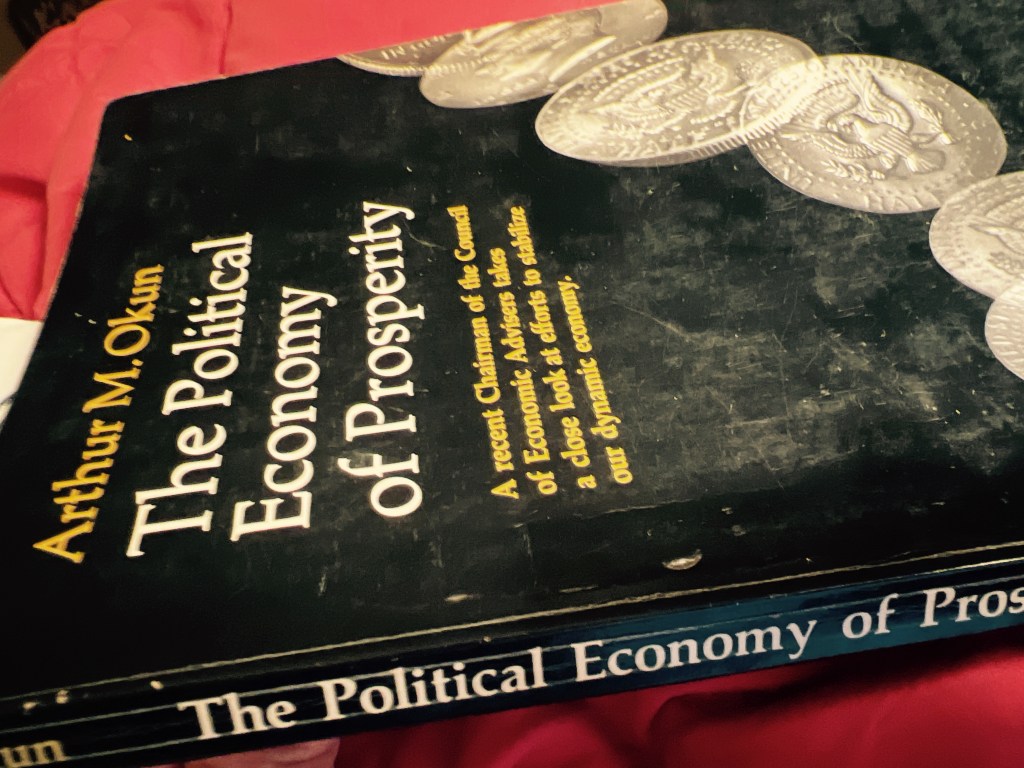
When the new rent control policies were being stirred up under the name of rent stabilization, I thought the policy types were trying out some new branding. But Arthur Okun’s essay The Agenda for Stabilization show the term well in use before 1970. The idea that government would influence pricing in the name of a stable economy isn’t a new idea.

At least Okun, who was the Chairman of the Council of Economic Advisers, proposes that private industry take heed of guidance to voluntarily adjust their pricing expectations.

Second, the appeal for restraint must be based on some set of ground rules that spell out what private decision makers are being asked to do. “Drive carefully” is not an effective substitute for a posted speed limit. Speed limits on wages and prices will inevitably share some of the imperfections of those on the highways. They will contain an element of arbitrariness, just as a fifty-mile speed limit is arbitrary in the sense that it is not demonstrably superior to forty-nine or fifty-one. Just as a passing lane is needed on the highways, so a “passing lane” must be provided for wages and prices, allowing relative shifts over time in response to the signals of the market. Just as some speeders will escape the eyes of the traffic patrol, so some violators of the price and wage standards will not be identified.

Despite their imperfections, speed limits on the highways serve the nation well and so can those on prices and wages.

Winter: My secret


I tell my secret? No indeed, not I:
Perhaps some day, who knows?
But not to-day; it froze, and blows, and snows, And you're too curious: fie!
You want to hear it? well:
Only, my secret's mine, and I won't tell.

Or, after all, perhaps there's none:
Suppose there is no secret after all, But only just my fun.
To-day's a nipping day, a biting day;
In which one wants a shaw,

A veil, a cloak, and other wraps:
I cannot ope to every one who taps, And let the draughts come whistling through my hall;
Come bounding and surrounding me, Come buffeting, astounding me,
Nipping and clipping through my wraps and all.
I wear my mask for warmth: who ever shows His nose to Russian snows
To be pecked at by every wind that blows?
You would not peck? I thank you for good will, Believe, but leave that truth untested still.

Spring's an expansive time: yet I don't trust
March with its peck of dust,
Nor April with its rainbow-crowned brief showers, Nor even May, whose flowers
One frost may wither through the sunless hours.

Perhaps some languid summer day,
When drowsy birds sing less and less, And golden fruit is ripening to excess, If there's not too much sun nor too much cloud,
And the warm wind is neither still nor loud,
Perhaps my secret I may say,
Or you may guess.

Christina Rossetti (1830-94)

Objections to spontaneous public spaces

The owners of Cup Foods along with other business owners in George Floyd Square are suing the city of Minneapolis and Mayor Jacob Frey over alleged lost business.

Bring me the news

I think this is an interesting match-up: social justice vs. neighborhood grocer. If it goes to a jury will they simpathize with a city’s effort to designate space to an internationally recognized event, or the corner store who served a disadvantaged neighborhood deligently?

They seek over $1.5 million in damages, claiming the city and the mayor were negligent in violating the city’s nuisance ordinance and charter.

The damages don’t even seem that high. But let’s look at the claims.

The claims revolve around two issues: the blockades halted business traffic and secondly the complete lack of police presence encouraged excessive crime. I can’t imagine anyone coming up with a strong rebuttal.

Perhaps the courts will be successful where the city was not in making it politically feasible to dismantle what has become hallowed ground for those who place social justice activities in the forefront of their lives.

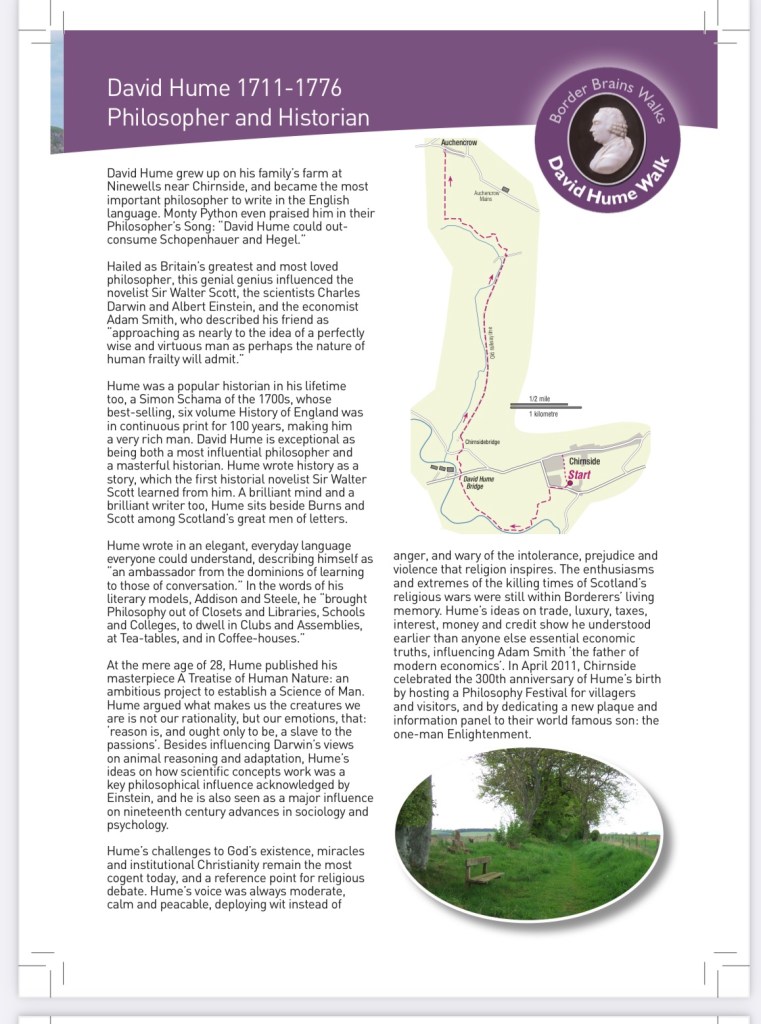
Asked Chat about philosophers

A philosopher is someone who engages in the study of philosophy, which is the rational inquiry into fundamental questions about reality, knowledge, values, reason, mind, and existence. Philosophers seek to understand the nature of the world and the human experience through critical analysis, reasoned argumentation, and reflection. They explore questions that may not have definitive answers and often address topics such as ethics, metaphysics, epistemology, aesthetics, and logic.

Philosophers examine the underlying assumptions of beliefs, explore the principles that govern different domains of human life, and contemplate the nature of reality itself. The methods employed by philosophers include logical reasoning, conceptual analysis, and the examination of fundamental principles. They may also draw on insights from other disciplines, such as science, psychology, and history.

Philosophers have contributed significantly to the development of ideas and intellectual traditions throughout history, with famous figures including Socrates, Plato, Aristotle, Immanuel Kant, Friedrich Nietzsche, and many others. The field of philosophy encompasses a wide range of sub-disciplines and approaches, making it a diverse and dynamic area of intellectual inquiry.

You can’t see the wind

But you will regret ignoring it.

It has cooled off in the North Star state with temps these past few days hovering around freezing. Add a little breeze to the mix and while out on your evening walk with your dog you will wonder why you didn’t grab the parka instead of the peacoat.

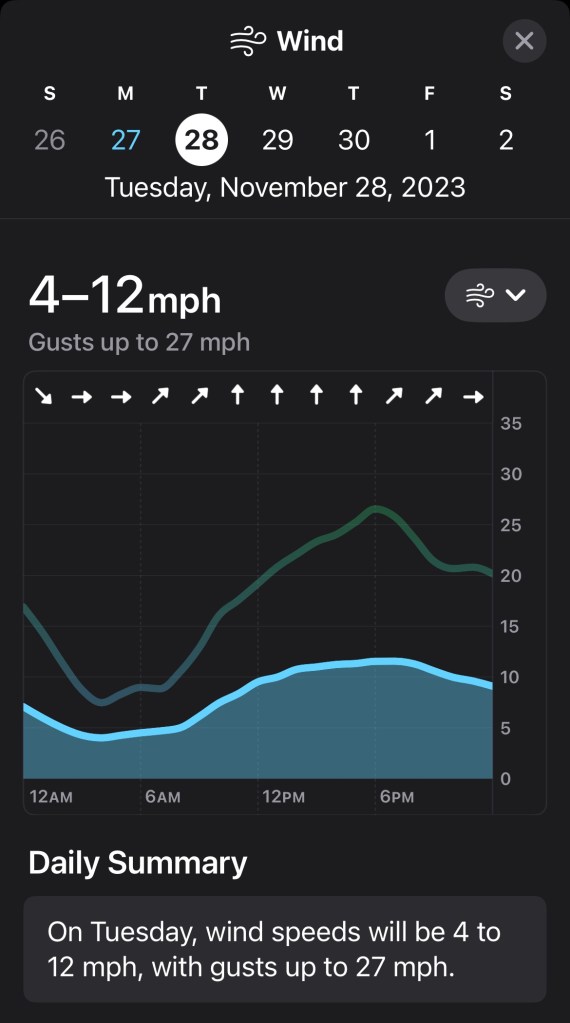
The weather people have been trying out the ‘feels like’ factor for quite a while now, to give their audience a sense of how your senses will respond to the air currents. I’m not convinced. The wind is not the same as the air temp. You can’t see it, but it has a variety of features. A north wind is not the same a south breeze. Are we talking an easy going 5 miles per hour or a snappy 15? That’s why I was excited to find this detailed graphic on my weather ap:

Tomorrow the wind will be coming from several directions. Good to know before selecting the walk for the day. Better to start facing the wind and then return with it on your back, pushing you along. The gusts really pick up mid-afternoon. This is the signal to get out and about early or add a layer of warmth.

Wouldn’t it be great to have a schematic like this for all the forces in one’s life one can’t see? With estimated timing on the gusts and the direction from which they come?

More from Marx on Value

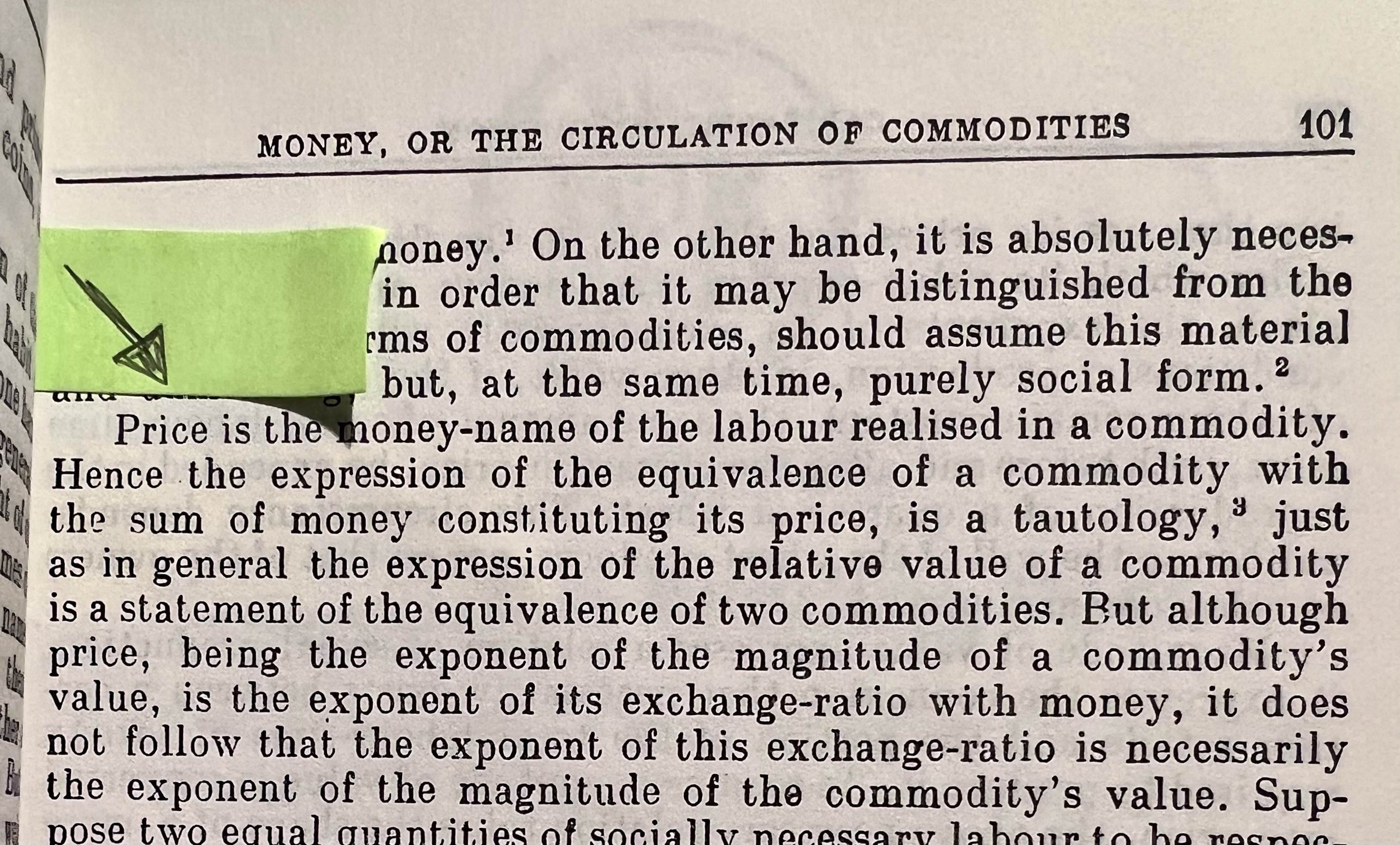
All that these things now tell us is, that human labour-power has been expended in their production, that human labour is embodied in them. When looked at as crystals of this social substance, common to them all, they are— Values.

We have seen that when commodities are exchanged, their exchange-value manifests itself as something totally independent of their use-value. But if we abstract from their use-value, there remains their Value as defined above. Therefore, the common substance that manifests itself in the exchange-value of commodities, whenever they are exchanged, is their value.

Capital Vol 1, Karl Marx

Marx clearly had an agenda. He tried to peel back the onion on the theory of capitalism in order to prove his class struggle theory. He was looking for answers to the frictions of his time. Still- it feels like he missed a more wholistic conception by pegging his ephemeral sense of Value, which permiates and settles throughout the sytem, to the average hour of socially necessary labor time.

There’s something to dedicating one’s time to one’s passions. It’s an expression of interest to give to a cause through one’s labor. Yet- Values can be supported by other resources as well. They can also be neglected leading to negative Values.

What Marx does best here is throw some talcum dust on unseeable efforts so as to fingerprint what Values people are working towards when they make exchanges out in the market. Surging and ebbing through the system of market prices, groups of people express what they care about and what they neglect. Here’s to searching out Value, even if it is not tied to the Labor Theory of Value.

Start with who you know

The word networking made be cringe for years because all the aspiring business people kept top of mind. Networking over coffee, affinity groups, let’s get together, bring your friends, and on it went. It seemed so self-serving. Get out there and meet people to see what they can do for you.

But now I’m finding that the best way to find people with compatible interests is to mine the networks of those I favor. I’m a fan of Norah Jones. So naturally I find the guests on her new podcast, Playing Along, particularly interesting.

The benefit of networking isn’t always to see what action you can draw out of the relationship. Sometimes the benefit is simply to introduce you to a whole new set of people with shared interests. People you never would have run into otherwise. Take this icelandic singer Laufey.

Time for Them

Yesterday was Thanksgiving in America, a holiday which originated when the Pilgrims gave thanks for a bountiful harvest. The strife of the first immigrants to North America is well documented. Many died from harsh conditions and lack of food. And even when the first settlers turned the earstern settlements into thriving towns and cities, the subsequent settlers dealt with similar challenges as they progessed westward.

Fast forward to the 1980′ and 1990’s. The memory of ancestral strif had been displaced by how one could survive Thanksgiving dinner with an assortment of relatives. Hollywood had annual offerings along this theme portrayed in films like Home for the Holidays, a 1995 release starring Jodie Foster. These films were followed-up with the ‘it’s-OK-to-spend-the-holidays-with-friends versions. Which it is.

But there are still people who aspire to live a life where two people marry, have children, and are able to celebrate a few days of giving thanks each year. Year in and year out. This takes time. Time to ferret out people’s concerns. Time to plan for the extra shopping and cleaning and prep. It takes time to communicate with everyone. It takes time to circle back and confirm. It takes time to get along.

This year I give thanks for family time.

How many people does it take to do a sewer scope?

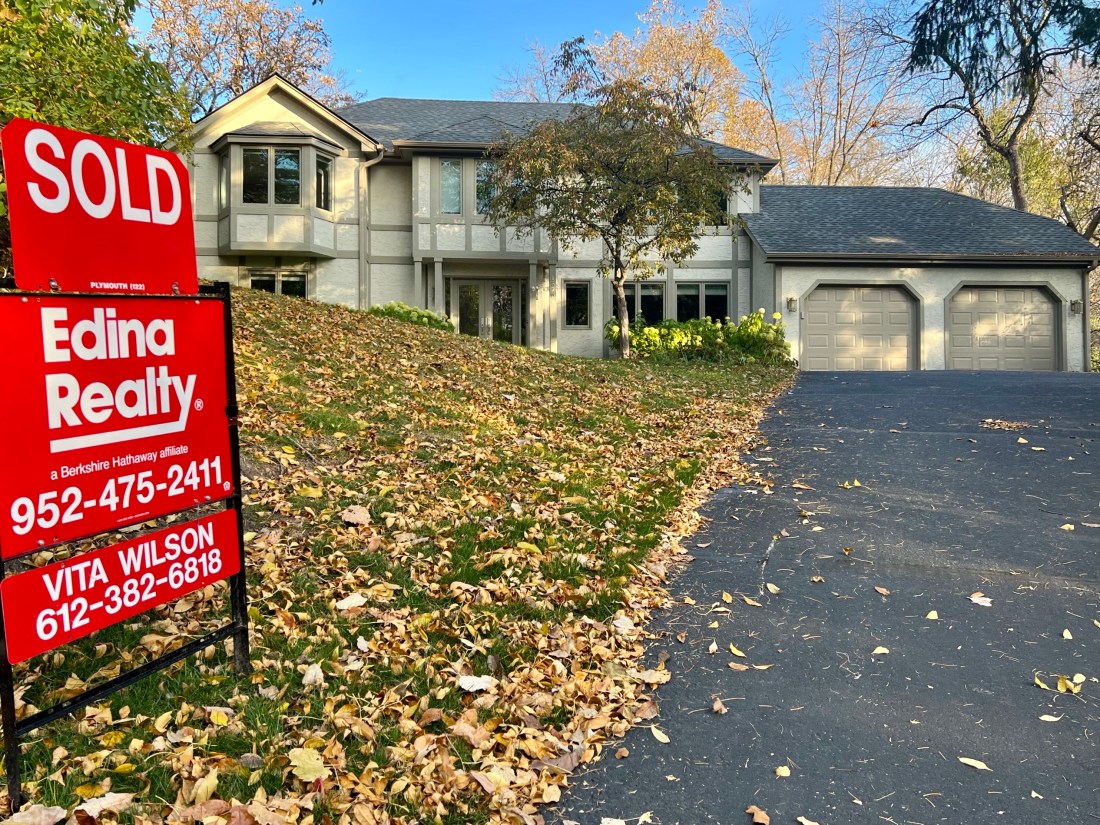
It’s a gritty looking thing, isn’t it? Nestled into the concrete floor of a basement shoulder to shoulder to the hot water heater. But that teal cap, covered in years of grime, needs to be twisted off the main stack in order to have a look-see into the drain and out to the street.

This home was built in 1960, and who knows if the the lid has ever been lifted. The sewer scope guy wouldn’t touch it. Said it looked like it would splinter if a guy threw some weight behind a wrench to twist it off. And you can’t exactly leave a house with the main drain wide open. He’d be stuck.

A sewer scope inspection is a relatively new add on to the inspection process in the sale of a home. Homeowners are responsible for the line which transport all the waste products from the pipes from the home to where it connects to the city infrastructure. So if tree roots have dug into it and it weeps waste product into the soil, then the owner is required to do the repair. This can entail digging up the front yard and replacing the pipe or running a liner pipe through the damaged area. It’s on the more expensive side of a home repair.

Some cities of predominantly 40-60’s built homes require the line be scoped prior to sale. This envolves accessing the drain and sending a camera at the end of a line down through the pipes. The guy today said that typically it takes 80 feet to hit the connection. The city then determines whether the property needs work.

The one in the photo isn’t located in a city with a point-of-sale ordinance concerning waste lines. The sewer scope guy was there on behalf of a buyer. The seller suggested he run the camera through the laundry drain pipe instead, yet alas, that pipe’s diameter is too small. So a sewer repair guy was supposed to come out to the house, but he couldn’t on short notice. Instead, a few days later, a contractor who was familiar with the house went over and installed a new cap.

Today the inspector guy was successful. His footage showed the buyer that all was well until the 60ft mark at which point a bundle of debris was causing a blockage. No real concerns, he said. Just need a Rotter Rooter type out to clear the path.

All this is to point out one small part in the massive collection of parts that comprise a home. When it wasn’t in working order a scurry of others had to swirl around to but it back right. No issues, no problem. An issue, possible delays. Sometimes none of the parts are of concern. But when there are issues, a person with comprehensive experience is going to keep the transaction on track. They’ll know who to call when. And that’s why people hire a professional. Because they add value through their knowledge.

Delightfully inappropriate

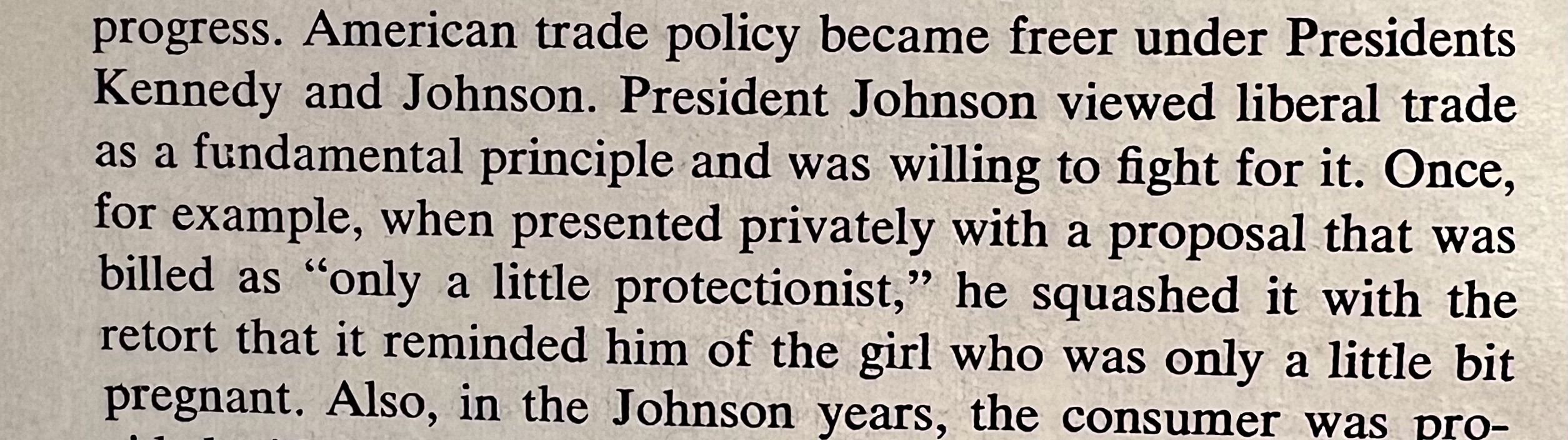
To think that a POTUS would make a joke about how a US economic policy is somehow similar to an expecting mother is hilarious.

The surprise here is that Kennedy and Johnson were free traders. Or I’m showing off my lack of historical knowledge.

Segment taken from The Political Economy of Prosperity by Authur M. Okun.

Utopian talk vetted as real world

I have a new reading rule. If I bend back the bind of a non-fiction book, read ten pages, and fail to find even one whisper of a tie back to a real world concern, I shelve it.

It’s hard to devote time to all the right phrases: institutional (a wobbly word itself), intangible, synergies, norms, soft infrastructure, R&D, yahdi yah. And not one practical eample. The use of so many imperative phrases and descriptions aimed at thin air calls into question where all that is being described is professed to reside. Because if the authors are finding it difficult to relate instances back to the world we live in, then what they writing is a work of science fiction.

HG Wells, Jules Verne and LeGuin all provided keen insights into what is to come. Science fiction is a popular and well read genre. I suggest these policy types devote their efforts in this manner as well. Once they find they are writing on air, they just need to conjur up a little fantasy destination and some sympathetic characters. People love a good story.

Look at how CS Lweis drew everybody into The Lion, the Witch and the Wardrobe without anyone realizing they were being taught a thing or two about Christianity.

Country road con’t

Yesterday’s post describes a coming to terms between some neighbors over a paving project. It might seem like a one-off situtation because of how the properties were arranged along the road. And it is true that many blocks of homes are developped together and hence laid out with conformity. But when you think about it, the sheer number of miles of road make non-comforming layouts pretty common as well.
Which suggests that a bartering of tax payment in exchange for a road improvement happens frequently. You might say there is a matrix of possible solutions to who pays what based on some combination of property ownership and use-value. There could be other interesting variables as well like how much social time had to be contributed to initiate the process, and shepard it through, and even how much time went toward diplomacy so the individuals who thought things weren’t fair would still go along with the project.

And this is all assuming that the folks, as in the story, know enough about each other and their general alikeness to foster a degree of trust.

Things can get more complicated quickly when some parcels are owned by commercial entities and some by individuals. There can be divergence in the income levels of the various parties involved which contributes to an evaluation of who could carry the burden better. In other words the players can be grouped. In doing so an order may emerge that shows the bartering results in consistent outcomes.

Knowing some of these results could be helpful. It could help with planning, to be able to know in advance the most typical way the numbers all shake out. It could save some upfront hastles for those just starting out on a project. It also could help prevent fraud when the groups need to be subsisdized. In this situation the bartering is done by a bureaucracy which tends to take some teeth out of the trades.

There could be some benefit in knowing the final settling of cooeperative projects. As there isn’t just one mile of country road. There are millions.

A mile of country road

It’s unclear to me why some stories from one’s youth stay with you and some don’t. I must have keyed into my grandmother feeling self-concious about a financial sparsing of the cost to pave over the county road which serviced their home. Whenever there are costs and people and public goods, there is bound to be a bunch of judging on who is doing what and whether it is enough.

My grandparents lived on a gravel road on the outskirts of a small town. They also owned the farmland along their side of the road. Across the thoroughfare the land had been parceled into perhaps twenty homesites. For many years a gravel surface was considered adequate, despite the layer of dust left on a car going to and from and despite the washboard effect that eventually appeared and made the vehicles tremor as the wheels caught the dirt ridges.

At some point, enough neighbors got together and decided it was time to make a request to the township to pave the road with asphalt. This takes a bit of work. There’s a process. Enough of the residents need to be interested to start a government agency’s wheels in motion. The cost of the improvement shows up as an assessment where, in many cases, the cost to the homeowner is based on the number of feet of frontage to the road.

At least that’s the standard setup.

But in this case my grandmother objected. Her theory was if they all got the same use out of the road, then that is what should determine how the expense should be covered. Afterall, they don’t expect people from Bemidji to pay, even though in theory anyone from Bemidji can use the road. The residents on the road each come and go with a similar frequency, and fair would be to say those who use it split it equally.

My grandmother was savvy enough to know that property ownership would play into her final bill for this public amelioration. But she didn’t think she should have to pay 20 times more than the folks across the road simply because her farmland abutted the pavement. Furthemore, she realized that her lack of support for the project could endanger it from going forward.

I’m not sure where the numbers settled exactly. The road has been paved ever since. What is interesting is that this story is an example of a bartering in order to come to a cooperative solution to community improvement. All these neighbors were of similar standing. It would be difficult for any of the others to call out two educators as evil landowners. It was just a group of neighbors, in a small town arriving at a balance between use-value, property ownership and resources.

Life lessons all around

His eyes widened.

The vision of the two hats, identical, broke upon him with the radiance of a brilliant sunrise. His face was suddenly lit with joy. He could not believe that Fate had thrust upon his mother such a lesson. He gave a loud chuckle so that she would look at him and see that he saw. She turned her eyes on him slowly. The blue in them seemed to have turned a bruised purple. For a moment he had an uncomfortable sense of her innocence, but it lasted only a second before principle rescued him. Justice entitled him to laugh. His grin hardened until it said to her as plainly as it he were saying aloud: Your punishment exactly fits your pettiness. This should teach you a permanent lesson.

Everything That Rises Must Converge, Flannery O’Connor

Tacit knowledge about wells

People don’t associate wells with metropolitan homes. Wells are a country thing. When there is distance between homes, putting in infrastructure like water lines or gas lines or internet connections is more difficult to justify in the money sense.

When you do run into a well issue in the city it is usually to do with an old abandoned well. There is always a time when every housing development was new. The post WWII baby boom pushed demand for housing before all the infrastructure was figured out. So many homes in the first tier suburbs were serviced by a well. The well room was located under the front stoop (steps to front entrance) and housed the pump and holding tank.

Ten years go by and many municipalities start catching up on their water main infrastructure. A rule is passed that no well can be dropped once municipal water is available in the road. A generation goes by and the pumps start to fail. Perhaps the owners had been using the well water to water their gardens, but this use doesn’t warrant the cost of a new pump. So there it sits in the damp well room, under the front steps.

Eventually people realize that hundreds of unsealed wells could cause a public health concern. The monitoring and tracking to wells is turned over to the Health Department. A disclosure is required at time of sale to indicate the status and location of any well on the property. But people think there is no harm in continuing to do what they always have done. They don’t want to bear the expense of an additional regulation.

Another generation goes by and many of the wells have been properly sealed. Those who worked in city utilities departments and at the health department and with well sealing companies have graduated onto retirement. A younger generation looks at the quaint cellar under the steps, see a clear floor, and can’t think why a well would ever have been stationed in such a spot. The pipe end protruding slightly above the concrete means nothing to them. It doesn’t take long before things are forgotten.

The tacit knowledge held by that older generation as a lived experience is gone. And those who never knew are convinced there must be some mistake. And thus, for infrastructure of a certain level of social benefit, a central regulating agency is desireable.

Alienation

I read somewhere this past week that ‘everyone would want to live in a mansion in the Hamptons.’ But I’m not buying it. I sit and wonder how many more years I have to hang onto my kids’ childhood home to keep them happy. Because I personally would prefer to downsize and have less to care for. A mansion? Can you imagine not only the maintenance expense but the time-burn everyday of caring for a beast of a building with a showcase yard? No- not everyone wants to live in a mega-home.

It kind of reminds me of the thought that workers want a meaningful connection to their work. I don’t see that. I think most workers are very content to get their piece of the work done (in a competitent and self-satisfying way no-doubt) but once it receives the stamp of approval, the commondity needs to mosey itself onto the next person. The deal was to receive a rate of pay completeing one section of a process.

Can you imagine if every transaction you participated in could be in some way tied back to you; that there was never closure, forever the potential of reworking what was meant, what the deal included, whether there sufficient oversight and care. I can’t. And I don’t think anyone wants these lingering warranties.

I’m not exactly sure what Marx meant about inalienable. But it certainly seems to work best if everyone investigates the commodities in question, but once traded, workers indeed alienate from their products.

Gala events and use values

Fall is a popular time of year for Galas. People get dressed up in fancy clothes and meet at ballrooms venues to be served fancy food and asked to bid on an assortment of items. There are weekend getaway trips or theme baskets full of goodies, there are NBA basketball tickets or a signed jersey from a baseball star.

The bidding gets started before the presenters give the audience an update on the progress for the cause at hand. Participants watch their phones for updates on which items they are getting bumped off by a higher bid. But it is only the final minutes of the bidding that matter. That’s when you want to be the one to bump with a higher bid, right before the auction stops.

So you end up paying $20, $30, or $50 over face value for those Timberwolves tickets. What is the premium called? The face value of the tickets seems to be its use value- or what anyone would pay for the use of the ticket. But the surcharge, acheived in the ambiance of the evening could simply be a value, a social value for the cause at hand.

In this way it is easy to see the breakdown of exchange value, use value and value.

Minnesota’s new flag

We’re getting a new flag. Lawmakers decided last session that an emblem with a pioneer tilling the soil and a Native American on horseback was uncouth. So the competition has started.

There are over 2500 entries so far that one can peruse. Lots of blocky colors. Lots of loons- our state bird. Some mosquitos, haha. But no people.

I say nothing says Minnesota like the smile on a face that has hauled a catch out of our sky blue waters.

MN day-after-elections headlines

Marx thought a lot about capitalism

In the first three chapters of Capital Vol 1 Marx throws down his founding priciples of capitalism under the premis that labor time is the ubiquitous unit of measure. He does conceed that the quality of labor time, and hence its ability to be productive, is influenced by other factors.

The value of a commodity would therefore remain constant if the labour-time required for its production also remained constant. But the latter changes with every variation in the productiveness of labour. This productiveness is determined by various circumstances, amongst others, by the average amoun of skill of the workmen, the state of science, and the degree of its practical application, the social organisation of production, the extent and capabilities of the means of production, and by physical conditions

Capital Vol 1- Karl Marx

Think about this list. 1.The skill of the workmen 2. State of Sciene 3. degree of practical application 4. social organization of production 5. capabilities of means of production 6. Physical condition.

Couldn’t this list be 1. Quality of public education available to workforce 2. Technology 3. Vo-tech adaptation of technology 4. Governance of plant 5. Degree of logistical support including maintenance and transportation 6. The environment.

No matter what specifics came to Marx’s mind as he wrote this list- the list appears to point to what we now call public goods. The productivity of the labor hours invested depended on the quality of the public goods inplay at the plant.

.

David Harvey has an excellent YouTube series on Capital

Outdoorsman

My grandpa was an outdoorsman. Practically orphaned as a teenager he fled to the camps in Northern Mn and survived off hunting and fishing. He would never fail to bring my grandmother enough fish for dinner and she would never fail to cook it to his contentment.

He was also a history professor who subscribed to the Nation to cultivate his far left inclinations. But he was happiest in the outdoors.

Motivated by Timing

Everyone’s heard it- capitalism is bad because it caters to people who are greedy. It’s all about money, greenbacks, bills. And in this way converts every human activity into a monetary accounting.

But that’s often not the case. The timing of an event or an aquisition often has a large impact on the desire to trade. Take travel. Families with kids want to catch a plane to grandma’s house when the kids are off school. If they were greedy, than they would save the dollars and pull the kids from class. The airlines respond to the demand at the holidays by increasing fares. So they must be greedy. Whereas, the price increase just encourages those who are not beholden to a school schedule to pick a different day; the price system encourage them to free up their seat so a kid can head to Grandma’s for Thanksgiving.

Timing has been a key feature in the Amazon Prime business. It’s not just that you can find what you want on line at a price you feel is acceptable, but you can get it tomorrow. The item is nore valuable to you since you can use it quicker.

Timing also plays into what typ a store you shop at. Pay a little more and shop at the smal exclusive grocery instead of the large box store with better prices. I know economists call this opportunity cost, but for some it’s different than substituing your labor time. It’s a luxury to walk in and walk out with the item you want. It makes you feel special.

Timing is a key motivator in personal transactions. I bet it features up there second only to price.

The ebb and flow

However, every technical advance leads to a further complication of the economic framework, to new factors, new connections that the masses are at first unable to comprehend. And so every leap of technical progress brings with it a relative intellectual regression of the masses, a decline in their political maturity. At times it may take decades or even generations before the collective consciousness gradually catches up to the changed order and regains the capacity to govern itself that it had formerly possessed at a lower stage of civilization. The political maturity of the masses can therefore not be measured in absolute numbers, but always only relatively: namely in relation to the developmental stage of any given civilization.

The Burial- Movie Review

Based on a true story, this tale of flamboyant lawyer taking on the mega corporation on behalf of the small businessman is entertaining on many dimentions. Jamie Foxx plays a selfmade courtroom powerhouse who loves to win. But he does it by sliding into the seam in society where there is empathetic recompense waiting for a subpopulation who has been sectioned away from the better parts of life in this country.

Granted his client in this tale is a white small town businessman in his later years of life. But the jury, who ultimately decides the outcomes in trials, has a more cohesive background. You could say Foxx is a type of entrepreneur. He sees in groups. There are the large corporations who ‘got the bank.’ These folks have no issues with taking their wares to the high poverty areas where they depend on a general lack of poor support infrastucture to corner the market. The consumers are not educated in ways to hold a business to its advertizing; they don’t have the means to drive across the county looking for better deals; they are unable or uwilling to follow up on a consumer complaint.

They are the perfect consumer group to mess with, and as the lawsuit shows, they are taken for a ride.

But is it a misscarriage of justice that the award goes to the one plaintiff? Out of a group wronged, should one individual benefit? No- that is just how it works. It only takes one individual in a group to save a drowning child. Yet that one individual would do it for anyone. When a discovery is made, one individual gets credit eventhough many were working toward the same goal. But eveyone benefits from the invention. And everyone in the disadvataged community benefits when huge claims are made against corporations for predatory activities. It’s the voice of it that matters.

I must say, though, that my favorite scene in the courtroom where Jurnee Smollett cries out: “The hypocrasy! The hypocracy!” This seems to be the director Maggie Betts talking directly to the audience.

NAR looses lawsuit

Oct 31 (Reuters) – A U.S. jury on Tuesday found the National Association of Realtors and some residential brokerages, including units of Warren Buffett’s Berkshire Hathaway (BRKa.N), liable to pay $1.78 billion in damages for conspiring to artificially inflate commissions for home sales.

Reuters

For more than fifteen years, Silicoln Valley has tried to lure customers away from Realtors and have them buy direct. VC has the money, they have the technology, they have the consumer’s attention. Yet when it comes to the transaction the customers keep realtors on their team.

Why can’t market oriented people accept what the open market is saying?

Use value and leisure time

Marx has a lot of interesting things to say in Capital which have nothing to do with revolutions and red flags. In the first three chapters of Vol 1 he sets out a structure for commercial intereaction before, during and after a transaction. He is particulary interested in the concept of value- who creates it, how it moves through the system and thus who should reap rewards from it.

Marx ran aground focusing on labor value as the defining characteristic of economic production. All else should fall under the measure of a man’s labor turned out not to be. But in his efforts to justify this theory he sketched out a structure which is interesting and useful. Value is an internal component to a product. Price represents some reflection of the value it contains. If a commodity has no use in the parketplace than it has no value.

Spending labor time on something that is not useful, then bcan be described as simply engaging in a hobby. It’s a leisure time activity. If you dig out in the yard and grew somebeautiful dahlias, but not to sell, than you are engaging in a avocation. It’s important to have a way of distinguishing between unpaid work activities. Caring for a child is useful and hence has value. In this way Marx lays the groundwork for a scientific approach to appreciating those activities not represented by prices.

Regret

Regret emerges from a sense of loss. It’s an emotion that some think of as melancholic, sad, dismal. Yet in truth it is an emotion which helps to keep our choices in check.

One may be regretful because they failed to act.

One may be regretful because they failed to appreciate what was offered to them.

One may be regretful because the market changed while they were focused on other things

One may be regretful because they misjudged their circumstance.

If one experienced a sense of loss because they waited on the sidelines while the market took off, then they will be a more serious player the next time around. If one experienced a loss after they turned down an offer to engage in the market, then they will take the next offer more seriously. If one experiences a loss because the market changed when they were not paying attention, then they become better at watching their surroundings. If one experiences a loss because they were over confident (or under confident) about their personal circumstances thus leading to a mismatch, then they maybe more realistic the next time around.

Having regrets is a means of becoming.

Suburbia is Subsidized?

I was triggered on Twitter. (oops X). I saw a post that vilified suburban sprawl as ‘we all subsidize’ it. It’s been a while since I’ve heard that rally cry against the natural course of a metro area to seek out inexpensive growth. The claim, which is never followed up with any data or research, implies that the public costs to the outward growth of a city drains public resources.

But all growth or redevelopment is subsidized. Developers receive tax benefits and incentives for work in urban areas as well as suburban areas. Roads are built and maintained with funds at the local level, the county level, the state level and even the Feds drop a few bucks for the interstate system. Since employers are located all across a metro area, there is no guarantee that a city dweller commutes less than suburban dwellers, they just travel in a different direction.

The old dichotomy of the urban versus the suburban is so passe. First tier suburbs are now appraoching 80 years old, which is about how old the core city was in the 60’s when this whole vilify the middle class folks who simply wanted a nice little 1800 sqft one-and-a-half-story on a .14acre with a sidewalk lot started.

Let’s put to rest the image of a cool (yet always suffering) urban core that needs to be cherished, protected and preserved by fighting courageously against the nasty exclusionary suburbs. Instead, envision a dynamic, interesting and ever-changing melange of housing choices that serve as the dwellings for the several million people who want to cluster in a large metro area.

Only with tags on

It’s the time of year when small coalitions are formed to answer the call for gifts for the needy. Turkeys for Thanksgiving. Toys for Christmas. And warm weather gear for the low temps which inevitably blow in from the likes of Calgary and Saskatoon.

It was quite a while ago, perhaps before the aught years, that a coat drive requested new coats only. ‘Come again?’ my grandmother, whose spending habits were forever dampened by the depression years, would have asked. I even feel self-conscious writing it out now. Standards have changed so much that it is unacceptable to donate a gently worn, yet perfectly acceptable winter coats to those in need.

But that’s what happens over time. Standards change. Donations must be store bought with the tags attached. Co-workers and the like dutifully enforce the new code with smiles, nods, eye rolls or shoulder turns. Afterall, used clothes can be gifted to the thrift store for anyone to purchase on their dime. One doesn’t need be in need to be a thrifter.

Back when I was a girl (yes a long time ago) the concern was about maintaining the recipients pride while still funnelling items to their family. The openess to receive was communicated probably through the church. But delivery was descrete and distanced, so the one neighbor did not have to acknowledge the charity from the other.

A new generation, a new mode of giving. For the times will always be a changing.

Motivated by weather

As the beautiful fall days come to a close and the forecasts include temps in the 30’s, consumers are wrestled from their automated routines and think, “I must get xyz done before the snow flies!”

Changes in temps are a definite factor in the real estate business. I suppose it is self-interest, in a way. A seller is better off to take the time to finally put an extra coat of paint on their front door, and tuck the garden hoses in the garage, and clear the gutters of all those golden leaves. A seller will be looking after themselves when they go to put their home on the market in March as the door will be a cheery greeting to a prospective buyer, and the hozes won’t look odd all covered in snow, and there won’t be an ice dam where the leaf debris would have clogged the gutters.

Buyers are also nudged along by the changing seasons. The cool crisp air reminds them that they thought they’d be in their new place before the end of the year. The passing of time draws their thoughts back over what they’ve seen so far in the market. Perhaps they regret passing on a purchase. Perhaps they realize that their demands are quite steep. Perhaps a little reflection reveals just what it is that has been holding them back.

Changing season can be the motivator to put in a little extra effort to prep a home prior to the arrival of winter winds. Or talk of Halloween candy and Thanksgiving dinner can encourage a buyer to revisit what he has learned so far about the market. In either instance, a driving rain from the north not only strips the autumn color from the trees but also plays a part in the home buying process.

Hangin with smart people

One of the best things about reading with acedemics about acedemics is they use all these complicated words that are useful. Like heterogenious. I don’t know how many times I’ve looked that one up. Diverse in content or character, says the short definition. This seems to be lacking nuance given how it is used by those in the know. It’s a categorizing word decribing how something is made up. And the subparts seem to be unlike groups of things, or people, or parts. And then there is this angle: “incommensurable through being of different kinds, degrees, or dimensions.”

My latest favorite word that I must look up to remind myself (learn when you are young as the stickiness of the the brain declines with age) what it means is taxonomy. Any word with an x is a bonus for those of us who enjoy Scrabble. But the x doesn’t make it easier to remember. According to Merriam-Webster, taxonomy is the study of the general principles of scientific classification. It refers to the orderly classification of plants and animals according to their presumed natural relationships.

But it’s not just for biologist. Here’s an example from the web offered by Merriam.

The exhibition catalogue includes a taxonomy of her techniques, co-authored by Mary Broadway and Katrina Rush.—Sebastian Smee, Washington Post, 11 Oct. 20 23

So when Marx spend the first three chapters of Capital Vol 1 defining all the working part to an economy, he is playing taxonomist. He’s labeling a bunch of the moving parts to a large, dynamic and spontaneous sytem of trade.

At least that’s what I think taxonomist means.

Spy Game- movie review

I mean, how can you go wrong with a match-up of Robert Redford and Brad Pitt both sporting shaggy 70’s hair and aviator glasses? Redford still has the same twinkle as he did in The Sting even if his features are more rugged. And Pitt looks rediculously boyish. They both pull off the action scenes beautifully.

But interestingly enough this is an ode to the man of action versus the bureaucrat. It’s a tribute to those in the game, taking risks, collecting information and then proceeding on the next move. It doesn’t sugar coat the pitfalls. The wins are often not pubically celebrated. Acting under the radar and with superior efficiency, those who perform push the story along.

Addendum (10/26/23) The scenes from the situation room in the film keep rolling back through my memory. The director, Tony Scott, was truly masterful in the staging. Here are the bureaucrats, all dressed in outfits, encased in a steel and glass conference room. Through the glass, we are shown a control room with blipping computer screens and underlings running hither and yon. The bureaucrats have everything at their disposal: computer power, people power, resources.

Redford is part of the group yet not. He plays by their rules. Yet he has his means of reaching beyond the room for help. He is nimble, and independent, but never arrogant. He knows how to use the yearning of being included to motivate others to help him. He knows who to pull social levers and leaves the power levers to those in the control room sitting in their three piece suits.

Tony Scott is clever in showing off the workings of Redford by spotlighting him in the situation room.

Einstein, a socialist?

It seems so from words written in the 1949 essay Why Socialism?

1 am convinced there is only one way to eliminate these grave evils, namely through the establishment of a socialist economy, accompanied by an educational system which would be oriented toward social goals. In such an economy, the means of production are owned by society itself and are utilized in a planned fashion. A planned economy, which adjusts production to the needs of the community, would distribute the work to be done among all those able to work and would guarantee a livelihood to every man, woman, and child. The education of the individual, in addition to promoting his own innate abilities, would attempt to develop in him a sense of responsibility for his fellow-men in place of the glorification of power and success in our present society.

Ideas and Opinions, Albert Einstein

Wait, wait, wait. The very next paragraph he catches himself up short. Socialism, he fears, has no means of constraining the state.

Nevertheless, it is necessary to remember that a planned economy is not yet socialism. A planned economy as such may be accompanied by the complete enslavement of the individual. The achievement of socialism requires the solution of some extremely difficult socio-political problems: how is it possible, in view of the far-reaching centralization of political and economic power, to prevent bureaucracy from becoming all-powerful and overweening? How can the rights of the individual be protected and therewith a democratic counterweight to the power of bureaucracy be assured?

And thus he lands back with the rest of us, navigating reality instead of some vision of what should be.

Fed rate hikes are dampening real estate markets

But not house prices. These continue to rise as fewer sellers are putting their homes on the market. So even though there are fewer buyers in the market who can bear the higher cost associated with higher interest rates, the lack on inventory still provides sellers with a competitive market price.

A number of industries, furniture sales and home improvement stores for example, depend on the turnover of housing. Let’s hope the Fed doesn’t drag out the anti-inflationary methods more than necessary. A 16% drop in the volume of home sales will take a toll not only on lenders, title folks, realtors but all the other services associated with new home purchases.

Claims about Govt Giveaways

When government imposed restrictions are lifted on a property, does it automatically result in the property owner being better off? If a developer can has more leeway for a new project there is a sense that would create a positive income.

Say the new rules allowed for things like tightly stacked mobile homes and low-slung light industrial; neighbors that not everyone welcomes. Even without a formal acedemic review, it is possible to imagine that the neighborhood as a whole would drop a bit in value. It is even more believable should the nearby suburbs still exclude this type of land use in their geographic purview. Buyers choose the area that protects their lifestyle over the one that doesn’t and thus reducing price in the undesireable and increasing price across the city border.

And even if local government loosened some restrictions on development there is still the possibilty that the neighbors will fight a new project. In fact, it could be argued that changing the status quo is likely to drive up the prep and presentation costs for a developer. The more uncertainty, the more likely it will take longer to get through the approval process. No one likes not knowing.

What is relevent about the above tweet is that zoning rules, parking restrictions, turn around time for approvals all affect the cost of doing business and thus the value of the property in question. The rights of the those representing the public share a portion of the underlying value of real property which is then represented in money-form in the final sales price of the parcel.

Prices at the market

For the most part it feels like prices at the grocery store are back in the pre-covid range. Eggs are no longer over $5 a doze and you can get a package of chicken breast for 2$/pd as long as you by the large tray. Just when it feels like the stickers have settled, you reach for a bottle of your favorite shampoo only to see that it will set you back just under $13. Geez. That used to be the low end price for the fancy shapoos at the stylist’s shop.

It’s just a reminder that pricing mechanisms are fluid and always on the move. The is best able to maneuver through with proper knowledge of those items you purchase most, and nimble enough to switch to substitutes or other vendors when new opportunities arise.

Property taxes and house sales

Of all the dozens of features buyers look for in a home purchase, property taxes barely bubble into the conversation. Must haves are things like number of bedrooms, bathrooms and garages. A property tax rate of xx% is never a delineating factor. In part that is because people have already processed the pro’s and con’s of the various areas that attract their attention. Indirectly, the cost of property taxes has already been judged as one of the many components of a city’s attributes.

One sees property tax comparisons much more frequently in this type of format. Here it is presented as a bragging point for the city which included it in its newsletter.

Pairing payment with interests

As in many professions, there is a continuing education requirement to maintain a real estate license in Minnesota. Today I learned a little more about sewer line scopes (fancy tech) and blockage (not nice). It was an informative hour hosted by an inspector who knows a lot about the physical aspects of homes.

Over the years various piping products have been used for sewer lines. Old is replaced by new usually for higher durability at lower cost. But what triggers the upgrade?

Older cities struggle with this question as no one wants to leakage to seep out of cracking pipes and into the ground a half of a dozen feet below the grassy lawns. Some cities have tried to encourage voluntary assessment and replacement through public messaging. I’m told this isn’t effective. The excavation expense of replacement is quite costly, ranging at a similar price point of a new roof. (And by that comparison it’s a bargain as the waste line, which runs from the exit point of the home to the street main drain connection, typically has a lifespan of 70-90 years. A roof, maybe 25.)

But as is often the case with shared property, everyone wants to be on the receiving end of the transaction and not the paying end. Residents, especially those who do not intend a long ownership period, feel like they are getting stuck with a cost that benefits many different parties over the infrastructure’s lifetime. To them, it makes more sense for a city to tackle the project section by section in the city, collect revenue, and perform the work for replacement.

The counterargument to that process is that sections of functional pipe will be replaced which is wasteful (no pun intended). Those who feel that a public bureaucracy is unable in its structure to obtain the best pricing see an inefficiency in performance here as well. Most of all, an across-the-board tax increase is always politically unpopular. The public pushes back. The project is kicked down the road. And aging pipes get wrecked by tree roots seeking out water and nutrients.

And this is why the point-of-sale solution is put into play. The party with the most to gain from a brand new piece of city infrastructure is a new buyer. A seller is required to comply in order to move forward with their plans. If they are unhappy with city council, oh well! They are out the door. This puts two parties to the transaction in favor of sewer scope inspections upon the sale of a property and one against. This is a positive momentum to get needed upgrades completed.

The downside is that there’s still considerable uncertainty to the extent of failing piping amongst the homes that do not go to market. Instead of a method which tackles the oldest first, the selected repairs are directed at those properties which happen to sell. And that’s not a very big number, maybe 4% of a city’s dwellings. It is also concerning that that it may be enough of an impediment to stop a seller from proceeding, which has negative effects in a market.

Still- it is interesting to note that by combining payment with interests, the likelyhood of infrasturcture repair increases.

Marx is undersold

These quantities (of commodities) vary continually, independently of the will, foresight and action of the producers. To them, their own social action takes the form of the action of objects, which rule the producers instead of being ruled by them. It requires a fully developed production of commodities before, from accumulated experience alone, the scientific conviction springs up, that all the different kinds of private labour, which are carried on independently of each other, and yet as spontaneously developed branches of the social division of labour, are continually being reduced to the quantitative proportions in which society requires them. And why? Because, in the midst of all the accidental and ever fluctuating exchange-relations between the products, the labour-time socially necessary for their production forcibly asserts itself like an over-riding law of Nature. The law of gravity thus asserts itself when a house falls about our ears. The determination of the magnitude of value by labour-time is therefore a secret, hidden under the apparent fluctuations in the relative values of commodities. Its discovery, while removing all appearance of mere accidentality from the determination of the magnitude of the values of products, yet in no way alters the mode in which that determination takes place.

Capital- Vol 1, Chapter 1 Commodities

How much work do group members have to put in to maintain the social structures that enable private exchanges? Seems like an interesting question.

Someone said YouTube is undervalued

And they are right!

YouTube as a teaching tool is amazing. Don’t know how to get your fancy dryer with all sorts of buttons that light up to just spin out your laundry? Ask YouTube. Not sure you have the experience to tackle patching a piece of ripped linoleum? Watch three clips to be sure you know what you are getting into before putting exacto knife into vinyl. Practical tips from handy people make life easier. They reduce the risk of getting in over your head on a simple repair.

Recently I’ve mosied into collegiate level material. This guy from the U of Chicago was informative, but also very entertaining. As someone raised in a different generation, it’s mind-blowing to be as good as in the classroom at a U that I could never have accessed.

All that stuff is fun and immediately useful. If YouTube weren’t around, it is information one could have gotten from a neighbor or at a leadership course. But there is more. The video hosting site gives you a key to difficult ideas as shared through people as passionate about them as their authors. I found David Harvey as I’ve never known much about Marx. And when I went looking all I ran into were those clinging to revolutionary impulses and socialist utopias. Harvey tells you that’s not really what Marx was about. Harvey will read the book Capital with you. Harvey won’t let you get sidetracked by politics because he wants you to understand the essence of what Marx had to say.

This will be my dog-walking media of choice, at least through Vol 1.

Happy to know Don Lavoie

We are pouring over Lavoie’s book Rivalry and Central Planning this month and it is a pleasant surprise that the text is gentle on the eyes. No squinting. No twisted eyebrows. He writes in a pleasant and forthright manner.

This page is worth reproducing as it overrides so much of what is taught in standard economics classes, the ones with the supply and demand curves settling sweetly on a set price. There is one price! And the consumer wants to know what it is. Yet…how do you tell them then that, it depends. On what? Well- one what is in the air at the moment of the transaction.

Markets exist in a fluid and dynamic system. Prices are representative of what has happened in the past. Thus they provide a guide to the future. But it is the participants of the moment who then again come to settle the new prices. And on it goes.

The French Connection (1971)- Movie Review

This film needs no introduction. Nominated for eight Academy Awards, it is considered by some to be the best movie of all time. I finally got around to watching it and it does indeed outshines current films.

Here is are a few aspects to the film that struck me as very well done.

  1. The chase scenes through gritty NY streets are about one human hunting another. The most suspenseful cat-and-mouse chase occurs when Hackman is dogging Frog #1 through to the subway. This also foreshadows who wins in the end. (Best Director, Best Actor)
  2. So often, the lens frames the characters in what could be a spectacular still shot. (Best Cinematography)
  3. The camera picks up supporting characters long enough to tell a little story. There are two little boys in the window of the apartment building, for example, as Hackman edges around its foundation to stay clear of the snipper. They are having a grand time watching the action unfold. (Best Director)
  4. The music. The orchestras used in the 70’s are superior to most contemporary film music. The sound is a strong contributor to suspenseful scenes. (Best Sound Mixing)

This is a movie I will probably watch again. There is so much quality in it, one can find new ways to enjoy it on a second go around.

Socratic Method at a Brew Pub?

In a recent Zoom conversation, a participant mentioned that he liked to organize gatherings for those interested in the Socratic Method. Most people have an idea about the ancient philosopher, Socrates, but many might not be aware of the manner in which he promoted the inquiry into ideas. So here is a summary provided by Tobias Weaver in an article entitled The Socratic Method: Think for Yourself.

The Socratic method, also known as dialectic, is a technique of philosophical investigation that emphasizes the use of conversation and inquiry to explore difficult ideas and concepts. The Socratic approach involves participants in a process of critical thinking and self-examination as opposed to providing knowledge in a simple or didactic manner. Socrates would lead his interlocutors to examine their own presumptions, convictions, and values through a series of probing inquiries, frequently exposing contradictions or inconsistencies in their thinking.

From what I gather, the idea is to ask questions. And in doing so the audience must search out what they believe to be true. Instead of shouting people down with your ideas, ask the right questions and see where they lead the conversation.

Just for fun, I decided to give it a try. John McWhorter, a linguist from Columbia, recently posted a clip about the voice of an NPR reporter. If are not familiar with John he has a popular podcast called Lexicon Valley (check it out- you will never think of language in the same way). Members of his audience had contacted him with a query. If they did not care for the voice and language of a radio reporter, a voice with a distinctive race identity, did that make them racist?

And that is exactly what I floated across the table of seven of us as we sat on the patio nibbling on Korean tacos and Cajun chicken over pasta. It was met with a thoughtful pause. Then there were a few clarification questions as to what an ethinic voice entailed. John played clips from the NPR show which I couldn’t do so I had to settled for descriptive words. A new pause. A few words wandered in one direction and then circled back before rendering any opinion at all.

I think it worked! No one dropped the hammer on any particular nailhead because one answer is not obvious. Of course, you do not have to enjoy every broadcaster’s voice. That does not mean you reject a whole race associated with manner of speaking. But it does make you question if there are underlying biases. And thus it is worth considering.

The method makes people wonder. It makes them reconsider. It draws their thoughts through their own experiences to process them for credibility. It was fun! I think I will try the Socratic Method again sometime.

One MN politician says age matters

Our US Rep, Dean Phillips, is willing to say it out loud. Abilities based on age should be a factor in evaluating the performance of duties for public office. He recently encouraged his party to look for a new presidential candidate instead of endorsing someone who keeps loosing track of his speeches. He’s willing to say Biden is too old for the job.

This week Senator Diane Feinstein of California died while serving in office at age 90. She had recently been ushered in and out of the chambers in a wheelchair looking old and confused. Perhaps Philips was influenced by her recent passing when he stepped down from a party leadership role today. Perhaps he is trying to gin others up to say out load what everybody knows to be true. Age matters.

Local Market Update

September has been showdown month between buyers and sellers. Not much is going under contract. I think most people expected mortgage interest rates to edge down due to the improving news on inflation. Then mid-month the Fed doubled down and rate went the other direction. They hit a 22 year high.

People are looking over their sholders trying to figure out where the recession is in this economy. People have jobs. Unemployment is low. Present home owners for the most part have equity which gives them flexibility to make decisions. The increases in food prices have taken a chunk out of people’s monthly budgets but that is easing off not escalating.

Higher rates do price some folks out of a purchase. But for the rest of the buyers out there, I anticipate they’ll get used to the new normal. At some point, the reason for wanting a different home will lure them into a decision. Hopefully, they will also appreciate that the bargaining power of having the upper hand. Because as soon as rates turn, there will be a new influx of competition for homes taking us back to the days of multiple offers.

Pro-corporate pillage is anti-mobility & anti-unfortunate

We’ve seen this movie before. Make a monster and pursue with the fervor of Joan of Arc. The problem is, they are slaying the wrong dragon.

Mystery messages

I’m very grateful to a cousin who has sufficient interest in ancestry and sufficient patience with ancestry.com to have archived a trunk full of family documents into digital format. There’s a youthful picture of my great grandfather in overalls, rolled up at the knee, holding a teather to a gigantic draft horse. There’s a long wooden table of picnickers dressed in cotton up to their necks. And the new development feel to a photo of children playing on the grass between turn-of-the-century homes reminds one that what is old was once new.

And the smattering of postcards have a touch of mystery to them. First off, all one needs is a name and a town for accurate delivery. Even now the population of Lodi, WI, is only about 3,000. Back at the beginning of the last century, when this postcard arrived from Brookings SD, it was a third of that. A manageable number for the postmaster or mistress to keep track.

On the front side of the card we see workers out in the fields. Many worker were needed in the Dakotas in the summer months. Aunt Lettie wanted to know if great grandma recognized one of the crew.

Let’s take a closer look at that crew (and machinery!) It doesn’t seem reasonable to expect any of them to be recognizable. For as carefully the USPS kept track of its mail recipients, one can see that disappearing into the American West was certainly an attainable goal.

Beautiful Spaces

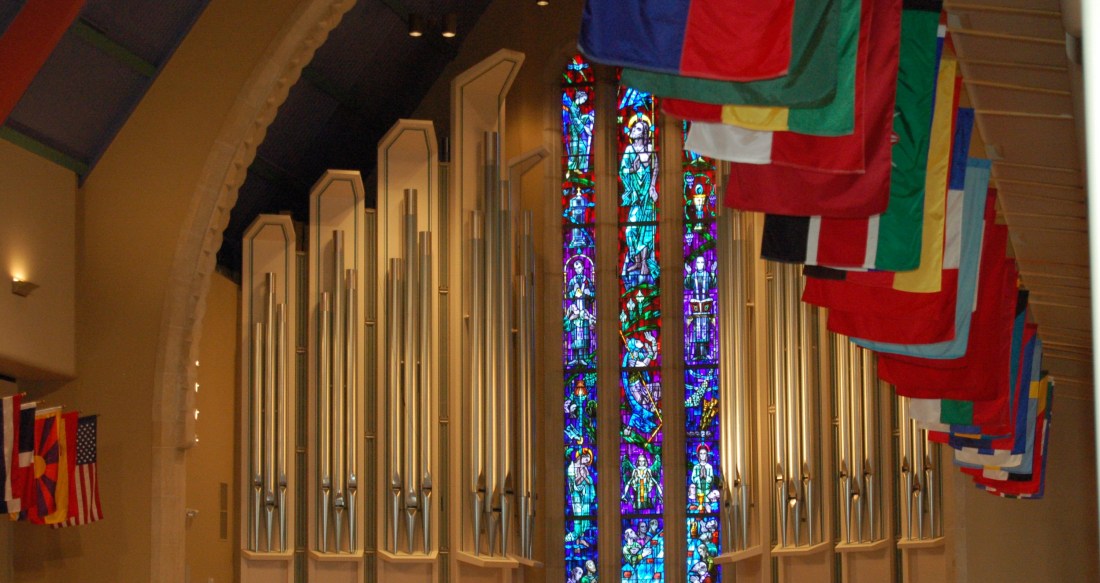
Hands down, my most visceral experience with art was walking into La Sainte-Chapelle on a sunny day in 1985. One can’t help but think they’ve walked into the interior of the most magnificent jewel as the nearly 6500 square feet of stained glass windows filter the reds and blues into the holy space. Trimmed out with gilding and adorned with beautifully sculpted figures from the Bible, the intimate space encircles you with grace.

Sainte-Chapelle, Paris

I returned with my kids more recently, yet alas the sun wasn’t shining quite so brightly. It is still an incredible space.

Econ in Fiction- Raymond Chandler Edition

I happened to be at the Minnetonka Government building getting my tabs renewed when I couldn’t help but swing into the library for a new read. I was looking for something easy and entertaining. Raymond Chandler came to mind and The High Window was sitting there nicely on the five-high shelving.

I’ve been a fan of Chandler since my twenties but am just getting around to figuring out why. First- he is a master at geographic descriptions. Not only in painting out the physical details but layering in thick colors to depict the social situation of the residents. There’s quite a long passage that I thought would be a bit much to reproduce here. So instead, here is how the author takes you to Idle Valley in just a few opening lines of chapter seventeen.

About twenty miles north of the pass a wide boulevard with flowering moss in the parkways turned towards the foothills. It ran for five blocks and died without a house in its entire length. From its end a curving asphalt road dove into the hills. This was Idle Valley.

The High Window by Raymond Chandler

The author’s real savoir-faire, however, is sliding in difficult valuations of social activity at just the right moment. Take his explanation to his haughty client, Mrs. Murdock, of the expense he would bear through mediating institutions should he keep her story to himself instead of coming clean to the police.

I got up and walked around my chair and sat down again. I leaned forward and took hold of my kneecaps and squeezed them until my knuckles glistened.

“The law, whatever it is, is a matter of give and take, Mrs. Murdock. Like most other things. Even if I had the legal right to stay clammed up- refuse to talk and got away with it once, that would be the end of my business. I’d be a guy marked for trouble. One way or another they would get me. I value your business, Mrs. Murdock, but not enough to cut my throat for you and bleed in your lap.”

She reached for her glass and emptied it.

It makes you wonder, as a reader, what came first for Raymond Chandler. Did he write the detective novels for the pleasure of his audience? Or did he write to lay out a landscape where he could fold in the types of ideas that stay with you and play in your head?

Grateful

I rummaged through my sources of poetry and quotes looking for an expression of gratitude and came up empty. Nada. Gratitude is an important acknowledgment. It gives form to those around us who support and direct us. It’s surprising find so few who wish to say thank you.

Until you look to the church. The Lutherans know how to write a hymn or two.

American Sniper- Movie Review

American Sniper is an older (2014) movie that I failed to see when I was busy with my kids. I’m glad a little bit of time has passed and the Iraqi war effort is well behind us. It makes one appreciate even more how balanced this film is given the precarious nature of Americans at war abroad.

I’m not surprised to find out that Clint Eastwood directed it as he is a veteran at holding an audience while they navigate the conflicting emotions of violence and self-protection. There are depictions of violence but it only gets gruesome for short stints. There is male camraderie without the overblown chest bumping or creepy macho masculinity.

Bradley Cooper deserved all the praise he seems to have gotten. It was probably around this time that he was the latest name in Hollywood and I was trying to catch up and figure out who he was. In this film, he seems to be carrying a little bit fat compared to his lean look today. His preformance as a military man or a floudering husband are both well done.

I’m not a big fan of war movies. I have yet to see Saving Private Ryan, Full Metal Jacket, or Dunkirk. But I have no regrets about having spent two hours on this powerful and well-performed film

Does competition constrain the State?

Many people rightly worry about the growth of government. Once programs and bureaucracy to administer them are in place, it is difficult to walk back the services as people have become dependent upon their economic benefits. So what does constrain a State (here the term State refers to any geographically described governance such as counties or cities)? Here are some instances of decline through norms, amenities, fraud and over regulation.

  1. Negative public perceptions. Police departments across the state of MN are having a difficult time recruiting and maintaining officers of the law. The money is there for the salaries but the workforce is plying their trade elsewhere. The defubd movement didn’t hit their target yet they set enough negative energy out into neighborhood block parties and family reunions, that more and more peace keepers no longer want wear blue.
  2. Competition with other States. If towns on the edges of corn and bean fields can’t figure out a way to keep their residents, then the towns diminish until they become a cluster of buildings at a rural crossroads. Municipalities large and small are always in the hunt to keep up their business community for an employment base, their core services so residents can be comfortable, and their extra amenities which makes them stand out. Although being more efficient with what you have is not necessarily an indication of size, it is a measure of more stuff per bureaucrat.
  3. Interest in Exposing Fraud. In decades gone, by the existence of pork projects was a source of conversation but not outrage. Creating or exagerating a need and assigning funding through the political process is an ongoing vehicle for fraud. Mechanisms and analysis to identify missappropriations is another form of constraint.
  4. Regulations send builders elsewhere. A city takes the energy and interest in new housing developments to collect a few extra fees or seed money for parks and trails. At some point, the builders say no more. Not too long ago, one suburb in the metro found that they were overcharging in when they lost a large housing development to an adjacent community.

The Mushroom

by Emily Dickinson

The mushroom is the elf of plants,
At evening it is not;
At morning in a truffled hut
It stops upon a spot

As if it tarried always;
And yet its whole career
Is shorter than a snake’s delay,
And fleeter than a tare.

‘T is vegetation’s juggler,
The germ of alibi;
Doth like a bubble antedate,
And like a bubble hie.

I feel as if the grass were pleased
To have it intermit;
The surreptitious scion
Of summer’s circumspect.

Had nature any outcast face,
Could she a son contemn,
Had nature an Iscariot,
That mushroom, — it is him

Study finds commitment to a beneficial way of life increases with numbers

The authors of this Danish study- Willem R.J. Vermeulen, Mioara Zoutewelle-Terovan, Niels Kooiman and Aart C. Liefbroer- sum up some of their findings in their wrap-up of the paper.

For married couples, we found that, when all other couple characteristics are the
same, religiously affiliated couples are less likely to divorce than religiously unaffiliated
couples. Moreover, religiously affiliated couples who visit religious gatherings are less
likely to divorce than those who visit religious gatherings less regularly. These findings
support the traditionalist model: The more religious couples are, the more they adhere to
traditional norms of the uniqueness of marriage. As we reasoned in H1, there is a couplelevel effect: More religious couples are less likely to divorce than less religious couples.

Religion and union dissolution: Effects of couple
and municipal religiosity on divorce and
separation

Although Lyman Stone, in his tweet, attributes the success of marriage in religious communities to social support mechanisms, the authors do not. They only note:

We can think of two main explanations for this finding. First,
couples who are more integrated into a religious community may experience higher levels
of social control (external pressure). Second, a self-selection effect may be present.

It’s odd to me that people default to power and control versus economics. I’ll bet if they looked just a wee bit into the lives of the religiously affiliated they would find that their daily routines, their weekly commitments which undoubtedly incorporate others from the church community, run somewhat smoother. And if a system of living makes you better off, you are more likely to nurture it and stay committed to it.

Plz bring customer service back

Am I the only one who notices?

More than a generation of people have lived their lives communicating digitally. To call the water department and ask for their billing statement requires note-taking. They do not know how to intereact, to ask questions, to field responses and to , yes, ask more questions.

Talking to people is useful. It provides information that you may have been looking for, and other information that may even be better yet. Plz talk to people again.

And be courteous enough to pop back a simply friendly reply when someone responds to your request.

When a city promises shelter

New York City is obliged to provide shelter to those in need due to the Callahan v. Carey consent decree created 42 years ago. Originally thought to act as a safety net catching a few transient men, it has ballooned into an enormous expense.

It eventually grew to a $2-billion-a-year industry housing all comers — and is likely to cost the city $4 billion this year and ahead, as long as influx of illegal immigrants doubles the shelter population.

New York Post

If all large cities floated the same offering, perhaps NYC wouldn’t feel the burden of this right to shelter. As it stands it, the city is particularly attractive to migrants.

Without question, the “right” is the central reason New York is spending far more per migrant than any other large city — nearly $40,000 a head here, vs. under $3,000 in Los Angeles and less than $7,000 in Chicago.

The mayor of the Big Apple is rightly going to adjust the benefits flowing out of the city coffers. As situations change, as population groups change, as the intentions for the support changes, government has an obligation to reassess the overall distribution of funds versus obligations.

The scenario is also a reminder that public funds, through programs, create a market. If one city creates laws to favor certain population groups, these groups will show up. In creating a new law, the intent might only be to help the few in town who clearly have a need. But once it is established as a formal offering, others are bound to migrate, incentivized by the above market public program.

What’s with birthdays

My kids got a pile of gifts on the breakfast table every year on the anniversary of their birth. It’s fun to surprise and impress them. For a brief moment, you get to be a magician conjuring up exactly what brings them joy. Everyone wins. Until they get older and their expectations are not as easily met- so there are discussions about gratitude and the thought of being recognized. Which often doesn’t compensate for the now-missing anticipated pleasure.

But kids aside, I don’t get the tradition of recognizing the birthdays of work associates, clients, or even famous people. You lived one more year- OK. What else? Is it just that it is easy to have a designated day every year to give someone a little extra TLC. I suppose that’s nice.

There are so many other things to recognize and doing so would encourage others to act in tandem. Give credit to those who help out other parents with kid duty or coaching or scouts. Acknowledge those who support the local civil servants like the firefighters, libraries, or police.

Publically expressing gratitude to those who give their time is nice for the recipient of the praise but also advertises to the public the jobs that are performed daily on their behalf. It tells how people get involved and how their contribution keeps all the wheels of the neighborhood in motion.

Next time you post a birthday wish on social media, consider thanking someone else you know whose putting their two cents in for everyone else.

Bureaucrats work under informal rules it seems

De Jasay takes his thesis to State Capitalism.

The most interesting implication of the “ownership is not control” thesis, however, is the support it gives to the belief in our fate being largely a matter of the mores and moods of the office-holders above us. Whether a social system is acceptable or awful, whether people are on the whole contented or miserable under it, depends very much on the variable personal traits of members of the bureaucracy. When the civil service is arrogant or corrupt or both, the managerial elite stony-hearted, the media mercenary and the “technostructure” soullessly specialist, we have the “unacceptable face of capitalism.” When those in charge genuinely want to serve the people and respect its “legitimate aspirations,” we get the Prague Spring and “socialism with a human face.” It is not so much systems of rule, configurations of power which are conducive to a good or bad life, but rather the sort of people administering them. If the bureaucracy is not “bureaucratic,” the corporate executive is “socially minded” and “community-conscious and the party apparatchik “has not lost contact with the masses,” private or state capitalism can be equally tolerable.

The State by Anthony de Jasay

What about the smoke?

That’s what municipalities are asking now it is legal to possess cannabis in the state of MN. If there are no policies regarding smoking in public places such as parks and playgrounds, there will be shortly. And it has been a bit of an oversight. Once cigarette smoke became unfashionable the smokers had to find places twenty feet away from building entrances to keep the air at entries free from smoke. If it is no to tobacco, it follows that it is no to weed as well.

According to the park workers, however, some users are not appreciative of being asked to quit smoking in the open air of the park. Maybe that was the aim, to make it socially acceptable. But as it turns out, norms can be stronger than laws.

Matching model with Migrants

Timothy Taylor at the Conversable Economist shed a nice warm light on a model the World Bank used in their most recent World Development Report (WDR) Migrants, Refugees, and Societies.

The World Bank suggests that one framework for thinking about these issues from the standpoint of the receiving country is the “match-motive matrix.” When immigrants are a good match for pre-existing needs in the receiving country and, the receiving country as a whole will gain. When the match is poor, as when the migrants do not have skills needed in the receiving country and perhaps are refugees seeking only to escape persecution, then the costs for the receiving country may exceed the benefits.

First, the model looks at groupings by what the migrants have to offer and what their lives will demand. Then the model suggests a type of dual consciousness, one that includes the consideration of the private skills the people can bring, such as caregiving for example. And includes a recognition of a need to match groups with a host country with the capacity of an appropriate level of protection, for example.

The Consumer Price Index report also came out today. In contrast, you will note that this index isn’t about grouping people but about grouping commodities and their prices. Is it more important to know what things cost or which groups of people interact with those prices? Most people are looked at in groups of income: poverty level, lower middle class, middle class, and so on. But some low-wage individuals are students and will soon become middle class; there are low-wage seniors who are actually very wealthy in terms of assets; there are many more interesting groups of people than a linear representation of income would indicate.

Tim Taylor seems to recognize this as well as he asks the most excellent question: Isn’t this a grouping model one we could use across society?

Here, I’ll just close with a broader theme: rules about migration are in many ways similar to rules that affect society as a whole. For example, how can we support children from families with low incomes and limited educational background to realize their potential as adults contributing to society? How do we support people of diverse backgrounds in living side by side? 

This is nuts!

One important feature of technological development is enhanced communication, regardless of distance, and in this case, regardless of language.

At the car show, those interested show

There were numerous beautiful cars at the car show we went to today. Most of us do not have the opportunity to come up close to a Lamborghini or Bugatti. An Audi is not uncommon, but that Audi in red and black is exotic.

A local car shop that organizes the event. They have sponsors and keep the admittance free of charge. This keeps the lines long and the viewers skewed towards under twenty and male. It’s a lot of fun to see them all photograph a Ferrari as it revved by. Some were all geared up with video cameras and mikes.

I loved that there were old classics like the red jaguar, stuffy Bently’s, Porschs, Vipers, and many more I can’t remember.

I even found one that I thought would suit me just fine.

Chicago Public Schools- Tiebout edition

When you start to sense that the people in charge expect something of you that they don’t expect of themselves, then be on the alert. Poor intentions are often a sign that type of fraud is at hand.

Chat Gpt explains de Jesay’s idea of Mutual Consent

Anthony de Jasay’s views on mutual agreement, or mutual consent, are grounded in his broader philosophical perspective, particularly his emphasis on voluntary interactions and individual autonomy. While he didn’t provide a formal definition of mutual agreement, his writings suggest several distinguishing features of such agreements according to his viewpoint:

  1. Voluntary Consent: Mutual agreements, as understood by de Jasay, must be based on the voluntary consent of the parties involved. In his view, individuals should be free to make choices and enter into agreements without coercion or external interference.
  2. Absence of Force or Fraud: For de Jasay, genuine mutual agreements exclude any element of force, fraud, or coercion. The parties must be free from threats, deceit, or manipulation that could undermine the voluntary nature of the agreement.
  3. Reciprocal Benefit: De Jasay often stressed the idea that mutual agreements should be mutually beneficial. In other words, each party to the agreement should perceive that they gain something of value from the arrangement. This aligns with his broader economic thinking about voluntary exchange in market transactions.
  4. Private Autonomy: Mutual agreements are rooted in individual autonomy and the right to make decisions about one’s own life and property. De Jasay believed that individuals should be free to set the terms of their agreements and contracts as long as they do not harm others.
  5. Enforceability: While de Jasay advocated for the minimal role of government, he recognized the importance of having a legal framework to enforce contracts and protect property rights. In a society based on mutual agreements, there should be mechanisms in place to resolve disputes and uphold the terms of agreements.
  6. Consent-Based Governance: De Jasay’s thinking extended to the realm of political philosophy, where he argued for forms of governance that are based on the consent of the governed. He believed that individuals should not be subjected to a government’s authority without their consent.
  7. Avoidance of Imposed Agreements: De Jasay was critical of government policies and regulations that imposed agreements or conditions on individuals without their consent. He preferred a system where individuals had the freedom to choose the agreements and associations they entered into.

It’s important to note that Anthony de Jasay’s views on mutual agreement are closely tied to his broader philosophical stance, which emphasizes individual liberty, limited government, and the primacy of voluntary interactions. His work often challenged the legitimacy of coercive authority and sought to establish a framework in which individuals could exercise their autonomy through mutual agreements and contracts while enjoying protection from fraud and force within a legal system.

Excerpts from Your Dog Owns Your House by Anthony de Jasay

Anthony de Jasay’s book The State may be his most recognized work, but it is not an easy read. So I went looking for more material to get a quicker fix on what he is all about. About twenty years ago he wrote about his house and his dog. It was a way to point out that the household members have a special claim on the home that outsiders do not. I like to think that the contenance and use of the home is a public good to its residents, dogs included.

De Jasay goes a step further to point out that others could possibly have claims to the home based on the neighborhood activities. The firefighters provide safety and the city infrastructure pipe in water and pipe out waste. Here again we have public goods being provided but instead of the line for insiders and outsiders being at the exterior walls of the home they are in a ring around the city or suburb or municipality.

More thought is needed fully to unravel the question of who owns your house, and indeed the question of who owns anything. If there were no fire brigade, the whole street might have burned down and your house would no longer stand. The fire brigade has contributed something to its value, and some figure ought to be put against their name. The utilities should not be forgotten, for how would you like to live in a house without running water, electricity and so forth? Some tentative numbers had better be credited to them. Surely, however, you cannot just ignore the builder who erected the house, the lumberman, the brick factory, the cement works and all the other suppliers without whom the builder could not have erected it. They too must have their contribution recognized, even if it must be done in a rough-and ready fashion.

But the best part of what de Jasay has to say is that the settling of accounts occurs at time of transaction.

Once this is understood, we can move on to the major point. All contributions of others to the building of your house have been paid for at each link in the chain of production. All current contributions to its maintenance and security are likewise being paid for. Value has been and is being given for value received, even though the “value” is not always money and goods, but may sometimes be affection, loyalty or the discharge of duty. In the exchange relation, a giver is also a recipient, and of course vice versa.

Winter Tax aside, MSP is a bargain

On Labor Day- consider unpaid labor

Stephanie Murray wrote a piece in the Atlantic about telework and how it benefits workers who engage in a caregiver roll at home. The time saved from a daily commute- perhaps an hour and a half to two hours with parking and entrance to work building- can go toward domestic duties instead of transit wear and tear. And it’s not only the time itself but when the time can be deployed. Once at home, one can manage the day, and jump in as needed to deliver kids to piano or make sure mom gets her meds.

One point she makes here is that not only may telework provide an immidiate benefit to those who presently provide services to their families, but it also may entice others to consider the possibility of combining a day of paid work with unpaid care.

Needless to say a career has always been evaluated to a certain extent in terms of how it affects family life. Those young accountants who were hired by Arthur Anderson Consulting were congratulated for their high wage, yet everyone knew that their personal life would suffer. Often at the transistion from young-unwed-professional to starting-a-family the worker would start to quip about the company’s lack of work/life balance. I don’t know where this term originated, but it should be work/work balance. Work for pay in the labor market or work for family and community in the neighborhood.

One of my children’s elementary school teachers had left a job in mortgage banking to teach. Her new life allowed her to share the same schedule with her children and spend the summers together. There is not only emotional value here but tangibel value is cost of care savings. Before and after school care as well as endless summer camps adds up.

And it is not just a ledger calculation of the dollars coming in as wages and the dollars going out as care. It is an efficiency issue as well. Unless the care is for an infant, much of the work has an on-demand component. Elderly people often don’t need a companion sitting by their side the entire day. At times there’s a need, some days more than others. It’s a job best suited to someone who cares and will be there at important times but also knows when an absense is Ok. It’s best suited to a family member who is not paid by the hour.

This type of labor supports the public sphere and is described in the Categories Explained tab.

Childhood homes

It’s hard to say why certain memories stay with you more than others. Childhood homes for instance. Remembrances of playing in the back yard or after school snacks in the kitchen. What room lay behind each of those windows. A sting from a bee by the pear tree. The special treat of watching Hee Haw on TV in the lower level rec room.

Clips from our childhoods pop into daily life unexpectedly, as if to remind us of the impacts from those early years.

State Capitalism according to de Jasay

Completing mastery over civil society in maximizing discretionary power can be seen as a chain of corrective moves, each one being aimed at making the social system both amenable to the state’s purpose and internally consistent, although these two requirements are not necessarily or even probably compatible. Each corrective move is consequently capable of creating some new systemic inconsistency and of necessitating other corrective moves. This sequence drives in the political dynamics, such as it is, of state capitalism.

The State by Anthony de Jasay

ChatGPT and want ads

Even years ago I would read employment ads and wonder what exactly the words referred to. If you are not in an industry then you are not privy to the latest diction. This can be frustrating for the job seeker and a little mystifying for the idly curious. But have no fear, ChatGPT is here!

I was helping an entry-level computer programmer applicant and couldn’t follow the list of preferred prerequisites listed in the job description. Turning the text loose on Chat generated a plain language description of SEO and AWS technologies and many more mysterious terms. Asking further for examples of Core Web Vitals or cross-browser functional testing led to more specific, easy-to-read, applications.

Part of the job was to adjust or test for whether web content through browser windows matched with what a user views on a phone screen. And then I knew part of what that job was all about. Chat had bridged a knowledge gap. And was very pleasant about it too.

Is it sad people care?

I can never follow this type of reasoning. Is it sad when Little Leaguers want to win their game? Because that means another team must be considered loosers. Is it sad when people spend all their time in a lab and ignore their family while developping a life saving drug? Because for those few years they probably failed at parenting. Is it sad that someone is willing to take less salary to support a cause they believe in?

It isn’t sad.

Working in a position that not only provides some financial support in the form of a paycheck, but also an outlet for directing resources to a cause one supports is simply part of the mechanisms. Note that I am not saying that taking advantage of someone, or bullying someone into, or misleading people as to the cause they are supporting is alright. Those are examples of fraud.

But that people figure out ways to combine their time and resources to advance their private needs and public causes, literally everyday that they breath and walk on this earth, is simply how we all live.

Trying new things

Last year I decided to give our apple trees a haircut. The apple orchard tree idea had started out as my husband’s project, but after a handful of years, the trees still weren’t producing. With a little help from a youtube video, I took a clippers to them and snipped away. My flowering bushes love to have their branches trimmed after their blooms have faded. So the apples trees should too.

And it worked! The trees brimmed with blooms in the spring and the branches became weighted down with fruit by late summer. Funny how even plants respond to a little attention.

The large apples were easy to use in a crisp. But these little ones are difficult to peel. My brother who was visiting made a plug for apple butter. Apple butter? I too had never heard of it. Once you get the seeds out and slice and dice the little fruit you turn the chunks loose in a slow cooker (with some sugar and cinnamon) for ten hours. The fragrance is as fall as pumkin pie.

A compote forms which needs to be run through a blender to smooth it all out. It’s tasty and tangy even if its appearance is questionable.

You just never know what little piece of work is waiting to be done to reap well deserved rewards.

The Moon

Robert Louis Stevenson

1850 –1894

The moon has a face like the clock in the hall;
She shines on thieves on the garden wall,
On streets and fields and harbour quays,
And birdies asleep in the forks of the trees.

The squalling cat and the squeaking mouse,
The howling dog by the door of the house,
The bat that lies in bed at noon,
All love to be out by the light of the moon.

But all of the things that belong to the day
Cuddle to sleep to be out of her way;
And flowers and children close their eyes
Till up in the morning the sun shall arise.

Does locking up the gangsters work?

The Feds have been busy cracking down on crime in the Twin Cities. Three gangs in particular have been targeted by the attorney general first with an arrest of 45 members of the Highs, the Lows, and the Bloods in May. A few weeks ago, another fourteen members were charged under the RICO, a law originally intended to curb Mafia activity.

The short term results are good.

“There have been 127 fewer families who’ve had a loved one affected by gun violence this year compared to last,” O’Hara said. “Despite having the lowest number of sworn members in the MPD in decades, the level of gun violence in Minneapolis this summer is dropping to near pre-pandemic levels.”

At the news conference, O’Hara stood beside a chart that showed a big spike in the number of shooting victims in the city in mid 2020 — 111 of them that June alone. There were smaller spikes in 2021 and last year.

By June of this year, the number of reported gunshot wound victims in the city had fallen to 35. Homicides are also down, and carjackings fell by half compared to this time in 2022.

But will it last? Will residents be able to get back to watching their kids play ball without having to duck from stray bullets from gangsta’s in cars? Many wish they had the answer, and I certainly can’t say I know. But here is where I’d look for information: in groups.

The attorney general said that since 2020 local criminal activity coalesced and became more organized. From this one could infer that replacements for the 45-60 indicted criminals are in the wings, ready to take over their new positions in each respective gang. Law enforcement does their job, builds a case, and locks up the ne’r-do-wells only to open up new spots for fledging criminals in the pipeline.

Perhaps if there is stress in the organization there is an opportunity to detect the strength of the hold the delinquents have on associated groups. For instance, are they still able to recruit the youth? Or can this group be bought out of the interaction with other types of youth programming? What about the neighbors in general- are they doing as they are told to do or being subversive? Another group to watch are the informants. Are they staying loyal to their criminal friends or providing more information than usual?

In loose terms one might be looking for variables that represent how these groups are open to exiting the relationship, willing to voice their objections, or, a measure of the degree of loyalty they have to the gangsters.

How to find the capacity

One thing you notice, after you have lived in a home for more than one stage of life, is that at different times people have a little more time on their hands than at others. Take tending to the front lawn. Most people care at least a bit about how their home presents itself to the street. It’s the public side of the property.

Even the most fastidious of lawns can be seen with a dandelion or two when the owners are in the throes of elementary school children. It’s tough to get out and do the extra fertilizing when there is a baby to bathe, school lunches to make, and homework time. The crabgrass is green after all, so does it really matter that it is flouncing its long legs over the tender shoots of Kentucky bluegrass?

If you were trying to figure out the level of public capacity a neighbrohood had in its reserves, you might want to stroll the neighborhood and see if residents are pulling through on commonly expected maintenance. If the sidewalks are not shoveled in the winter it maybe because the residents are not home enough to make it happen. Or it might be because many of the residents are elderly or disabled.

Delve a bit more into a neighborhood and you might hear of complaints that an intersection is dangerous and ‘they’ haven’t done anything about it. Perhaps they don’t know how to get to a city council meeting and register a request to consider a stop sign at the intersection. Perhaps the they that do know how to get to the city council meetings are communiting across twon and are not around enough to work it into their schedule. It takes different they skills to keep all the different neighborhood amenities tuned up.

Answering some of these questions would help to determine why the store of reserves to perform typical neighborly duties is going missing. It’s always easier to identify the lack of state capacity than the abundance of it.

Air – Movie Review with Econ too

If you lived through the 80’s you will appreciate the references to a decade slowly sliding out of sight of the rearview mirror. Both Affleck and Damon came of age in this decade and it’s as if they sat around and brainstormed a long list of all their memories and refused to leave one out. The nostalgia was appreciated by this viewer. Along the same vein is the pleasure of being filled in on the back story of the cosmic celebrity launch of Michael Jordan’s career.

The prize for most charismatic performance goes to Chris Tucker who plays a co-worker, Howard White, at Nike. His vocabulary and gestures are emphatic without excess. He is really entertaining and effective. He interfaces with a lot of the athletes’ families and, along with Viola Davis, does justice to the racial component of the times.

There is a lot of fun economic type of stuff in this film. The blind bidding for example. All the players want to know what the other parties are up to. They ferret around for information. Then they return to their own base and try to get the team on board. There’s a lot of disbelief and eye-rolling. Can it be true? No not that much! Blind bids are hard on buyers. They have one shot at being the winner, so they want to push the price without reaching for more than they need to.

The relationship side(s) to deal-making runs throughout the movie. The agent to the athlete. The company’s closer to the sports agent. The talent scout to the CEO. This has been played out on the big screen before and doesn’t cover new ground as much as meter out all the different angles and ties and degrees of trust.

Matt Damain’s character Sonny wins over the Jordans through action, not words. He shows up at their doorstep, risking his job and position in the field, to demonstrate his belief in the lanky, composed, freshman. Through his knowledge of all the past games he shows he’s put in the time to understand the players’ game. In fact, it is by pointing out to Deloris Jordan that the competing companies are all words and not action that he builds her trust.

A lot of people talk about trust as if it is something that appears or can be bestowed. But trust is the result of seeing how people act and then basing an expectation of the future on the actions of the past.

How crime is priced

Dick’s also said its second-quarter results were affected by “inventory shrink,” which refers to the loss of inventory due to factors such as employee theft, shoplifting, and others. The company’s merchandise margin declined by 2.54 percentage points—one third of that was because of shrink, the company said.

“The biggest impact in terms of the surprise for Q2 primarily came from shrink,” said Navdeep Gupta, chief financial officer. “We thought we had adequately reserved for it. However, the number of incidents and the organized retail crime impact came in significantly higher than we anticipated.”

Barrons

No tech substitution in Real Estate?

The National Association of Realtors has been around for more than 100 years. Three of the founding boards were in Minnesota: Minneapolis, St. Paul and Duluth.

The National Association of REALTORS® was founded as the National Association of Real Estate Exchanges on May 12, 1908 in Chicago. With 120 founding members, 19 Boards, and one state association, the National Association of Real Estate Exchanges’ objective was “to unite the real estate men of America for the purpose of effectively exerting a combined influence upon matters affecting real estate interests.”

Before this professional organization coined the word, Realtor, the people who helped facilitate the buying and selling of real property were called land agents and then real estate agents. They pop up as characters in books like the ones written by Ivan Doig about settling Montana.

NAR sets and maintains standards for the industry which brings unity to the profession. Today there are more than 1.5 million members nationwide making it the largest trades union in the country.

When Zillow launched its website in 2006 many predicted the demise of the Realtor position in the transaction. Everything would occur online! Look at the home, contact a lender, order the title work, and close on the property without viewing it! Done. This narrative permeated the market for at least ten years before it started to ebb ever so slightly.

It has now been 17 years since the entry of big tech into the real estate business and Zillow is still losing money. In 2022 real estate disrupter lost $101 million. I don’t know how venture capital works, but where does all this money come from to float unprofitable companies for decades?

The long and the short of it is that Realtors are still out helping buyers and sellers come together and make a trade. The job really hasn’t changed in any substantial way since 2006, except that advertising occurs via the web instead of print media. There are a variety of arrangements available to clients from basic services to full service. Perhaps ironically, since the age of social media, there has been a shift away from for sale by owners.

It’s pretty clear that there is a place in the market for this type of work. If you’ve had a poor experience in the past maybe the solution is to take a little extra time in selecting your realtor next time around. There are as many styles and personalities in the business as there are clients. You just need to find the right match.

Notes from the local paper

Cannabis. There’s a long article in the local paper about new rules around the use of Marijuana. The long and the short of it is that even though the state made it a legal substance, it can’t be enjoyed in any public spaces. Apparently weed isn’t as main stream as people thought.

Bees. I don’t really understand the fascination with tending to a hive of bees. The swarm seems to show up and disappear at will. But the thought of a mass of buzzing insects with stingers does make a mother worry. However- the bees got the thumbs-up vote. Residents are free to be beekeepers.

Green Step. An association has been circulating recruiting cities to join their organization which tracks and scores municipalities on compliance to preset environmental goals. Seems like a lot of signaling to me. Plus extra work for city employees. But the pressure group won, and Plymouth will become a Green Step city.

Mental Illness. If the number of words were a measure of importance, this topic is woefully under-represented. A two and a half inch space advertized a September meeting to talk about this very important issue.

Nice quote from the St Olaf Econ page

Economics is a study of humankind in the ordinary business of life; it examines that part of individual and social action which is most closely connected with the attainment and with the use of the material requisites of well-being. Thus it is on the one side a study of wealth; and on the other, and more important side, a part of the study of humanity.

Alfred Marshall, Principles of Economics
St Olaf College

Historic Minneapolis

I just listed a condo in a brick brownstone built in 1917. The stately building looks over Powder Horn Park. The three-level buildings line up along the sidewalks, high over the baseball diamonds, playgrounds, and trails around the lake. There is a public bike rack right out front as a reminder that there is no need to fret over the lack of garages as the bike infrastructure in the city is an adequate substitute.

The most significant differences between this one-hundred-year-old structure and one built today lay inside and out. An all-brick exterior is prohibitively costly. This is really too bad because not only is the exterior beautiful it requires very little maintenance. On the inside the units are efficiencies or one bedrooms. Even though there are many households of one, these two configurations are the least likely to appear in new construction. And then everyone complains about the price of things.

Below is the plat map from 1914 and shows the lots between 14th Ave and 12 Ave on the NE corner of the park as undeveloped.

Mpls Fed and Housing Data

Minneapolis Federal Reserve Building 1972-1997

The Minneapolis Fed’s recent article about housing in MN provides data supporting some positive trends. If you’ve lived in the state for a while, and know people who’ve moved away to other similar cities and then returned, you have firsthand points of reference to the favorable cost of living we have here. Mid-sized cities like Denver, Portland, and Dallas are more expensive than the Minneapolis-St Paul metropolitan area. Here’s a chart from the article which says as much:

This is not to say that everyone within our territorial boundaries has adequate shelter. And thus it is fortunate that the Fed is putting some shape around the goal of increasing the number of homes available. Because, of course, more supply translates into better pricing. From their analysis, it appears that the region is on track so far.

I was in a meeting of realtors once where a peer did not readily accept that more units meant better pricing. And, although not voiced specifically in this manner, I think what she was getting at is that if the structures don’t match the need of the households, then there may not be an increase in supply. No increase in inventory—no better pricing.

This points to the benefit of being able to match segments of the market. How many shelters have a physical structure which matches the need of this type of household? Do those inventories line up or are they disjointed?

It’s no wonder data is valuable. There’s always more data necessary to understand our world.

There’s more to it

Have you ever noticed that there is often more to an issue at hand than you first realize?

Consider the preparation of land for home construction. Those big machines just go on into the staked-off space and move dirt around until it is pretty level- and voila! It’s ready for a new home. But then people start talking about cutting and filling. And schematic alarm bells start ringing right above the curved arch of your pinna. If there is vocabulary to learn than there is undoubtedly a whole segment of the process still to understand.

Luckily there’s YouTube to fill in the gaps.

As you can imagine, there may be outcomes from shifting around a bunch of dirt. Erosion is a typical concern. But changing a terrain effects drainage as well. So it shouldn’t be too surprising that this type of activity requires supervision by goverment in efforts to monitor the interests of the greater group.

On the flip side, a bureaucracy can really slow things down. The process. Rules are metered out in a checklist fashion instead of a dynamic response to uncovered circumstances. A centrailzed approval process is costly.

Do Divas need TLC?

In all seriousness- it is great to see all the concert goers post pictures on social media. The days of the virus are over.

Tiebout competition leads to markets for ties

The voluntary nature of consenting to a particular pirate ship’s constitution facilitated what economists call “Tiebout competition” between pirate crews. Tiebout competition is the process whereby governments compete for citizens, so-named for the economist who first articulated this process, Charles Tiebout. The idea is a simple one. If citizens can “vote with their feet,” governments must be more responsive to what citizens want. They must offer lower tax rates, better public services, and refrain from preying on citizens, or citizens will move to another jurisdiction that does. Governments care about this because their ability to raise tax revenues requires a tax base. And if citizens move out of one jurisdiction to another, in the jurisdiction citizens are fleeing from the tax base shrivels up. Pirates’ voluntary governance structure means they didn’t in have governments. But the principle of Tiebout competition applies as much to their floating societies as it does to competition between governments.

The Invisible Hook, The Invisible Economics of Pirates by Peter T. Leeson

Dead To Me- Series Review

Business is often slow in August for lenders and realtors. People are distracted with plans; those they committed to months ago like weddings and family reunions, those in the moment like work golf outings and those hastily snuck in as the end of summer draws near. It’s not a productive time to hop on the phone and try to bring peoples’ attention back to business.

Which explains the extra TV time.

I gave this series a shot out of curiosity to see an older Christina Applegate. The actress gets kudos for creating a distinct persona for her performance as Kelly Bundy in Married With Children. Some of those sassy characteristics and hard edges appear here too. They are familiar, like an old friend, without being distracting to her new role Jen, the grieving widow.

Applegate is well-matched with Linda Cardellini who plays Judy Hale. They have contrasting personalities and traits providing moments of humor and sympathy. The story line puts the women on a rollercoaster ride. At times the audience is let in on parts of the secrets lurking in their lives. At times the audience is misinformed.

There is a nice range of female characters in the show. The police detective who is handling the hit-and-run case is quite humorous. The mom who lives across the street from Christina. The realtor’s mother-in-law. But it’s not just a chick flick. There is the handsome Steve Wood, the respectable Christopher Doyle, and quirky Pastor Wayne.

Like many sitcoms, there is redundancy and sometimes the action is slow. But overall, I’ve enjoyed the first season and plan to continue binging on the 30-minute episodes. Happy Summer!

Group slippage

When I was growing up the 70’s feminists were ruffling a lot of feathers. What was hard to swallow is that, as a group, they assumed all women supported their efforts. After all, activists like Betty Friedan, Gloria Steinem, and Kate Millett believed they were working on behalf of all women. But just because they believed it so doesn’t mean it was.

In Matt Ridley’s book, How Innovation Works, the author suggests that it is a group of inventors most often working on a new technology. He cites the light bulb as an example. As many as twenty inventors may have been the first to produce a successful prototype. And Ridley feels that if one or two of the leaders had fallen away, then it would have just been a matter of time before another from the group would have succeeded. The way he describes groups of people with a common ambition reminds me of types of legions, all walking in step and yet replaceable.

I’d suggest that this no harm no foul quality of group members is one way to distinguish who is on a team and who is not. It’s a good way to test for slippage. That way in policy conversations it is easier to keep track of whether the actors are appropriately portioned off.

A thoughtful new conversation between Russ Roberts and Daron Acemoglu was released last week on Econ Talk. They mull through the good and the bad impacts of technology since the start of the Industrial Revolution (IR). And they list off many different groups which makes for a fun review. Here are the ones I tracked in just the first bit of the show. (times are approximate)

2:49 We. This appears to refer to present-day dwellers. And rightfully true, everyone on earth has a greater standard of living from something that stemmed out of the IR.

4:30 Innovators. This group refers to the individual who successfully laid claim and also ownership to a piece of new technology. I’d say this is a bit of slippage as not everyone working as an innovator gets paid. In fact, many toil with no reward. So this is slippage.

4:59 Replaced Worker. I think this group is rightly described when talking in such general terms. Upon the implementation of a new way of doing things, there will be changes to job structures. If the conversation were focused closer to a particular event, then more details on the various levels of impact would be necessary to keep the members of each group interchangeable.

7:00 Peasants. There are a number of points made in the conversation that rely on social and class status versus wage and monitary status. I think this is a type of slippage.

The circumscribing of these first four groups differs in quality. The general big group WE allows for a sweeping claim. Yet the sheer size of it makes its delineation only interesting as a starting point to a conversation.

The loose use of INNOVATORS is problematic. Most people will assume that all parties to the group extracted a tidy sum. Yet so many people work on new ideas at their expense and never are reimbursed. This leads the public to believe that entrepreneurs are greedy as they expect so much for not more than a sure thing. A more accurate group notation here would avoid that misunderstanding.

Part of whether the grouping makes sense is based on the context of the conversation. In this talk, there was mention that the REPLACED WORKER in the US only lost out on a good-paying job for a portion of his career. Whereas in the UK, history shows that technological innovations sometimes depleted worker opportunities for several generations. So it seems here the term is too general to make a worthy representation of the group in one of the two scenarios.

There were several references to groups that describe a class rather than a worker. PEASANTS, lords, and ladies, the Abbotts. To me, this switches the analysis from activity that generates objects bought and sold in a market, to life outcomes of both workers and their families based on social status. It switches from an unfettered exchange of some form of monetary compensation to reflections on health, access to food and supplies, voice and power within a community.

There are a lot of reasons to name a group correctly. But the best reason is to do no harm to those too busy with life to speak up and object.