Bayesian understanding and the Bible (speculative)

In probability theory and statisticsBayes’ theorem (alternatively Bayes’ law or Bayes’ rule; recently Bayes–Price theorem[1]:44, 45, 46 and 67), named after the Reverend Thomas Bayes, describes the probability of an event, based on prior knowledge of conditions that might be related to the event.[2] For example, if the risk of developing health problems is known to increase with age, Bayes’ theorem allows the risk to an individual of a known age to be assessed more accurately (by conditioning it on their age) than simply assuming that the individual is typical of the population as a whole.

https://en.wikipedia.org/wiki/Bayes%27_theorem

What the Reverend Thomas Bayes came up with three hundred years ago has proven very useful as it allows predictions for future events based on a history of past events. Later on the concept was formalized by Pierre-Simon La Place as The Central Limit Theorem. Its statistical applications are used widely in medicine, pharmacology and finance.

But that’s not the part I find most interesting.

What we don’t know is Bayes’ philosophical aim in the hours he must have spent whittling away at untruths to reveal what endures. We have more insight into the thoughts of Richard Price, the man who shepherded Bayes’ manuscript to the Royal Society after his friend’s death.

What probably motivated Price to work on Bayes’ manuscript were the theological implications that Price perceived in the result. At this time in his life, Price was deeply immersed in theological and philosophical study. Price notes in Bayes (1763a) that Bayes had written an introduction to the paper; but Price did not include Bayes’ introduction and instead supplied his own. In other manuscripts of Bayes that I have seen (Bellhouse, 2002), Bayes typically gives no motivation for the mathematical results that he presents. The same may be true for his essay on probability. Price only says of Bayes that:


… his design at first in thinking on the
subject of it was, to find out a method
by which we might judge concerning the
probability that an event has to happen,
in given circumstances, upon supposition
that we know nothing concerning it but
that, under the same circumstances, it has
happened a certain number of times, and
failed a certain other number of times. He
adds, that he soon perceived that it would
not be difficult to do this… .

Later in the introduction to Bayes (1763a), Price states that:


Every judicious person will be sensible
that the problem now mentioned is by no
means merely a curious speculation in the
doctrine of chances, but necessary to be
solved in order to a sure foundation for all
our reasonings concerning past facts… .

Further on in the paper, after discussing de Moivre’s work, Price states:


The purpose I mean is, to shew what reason
we have for believing that there are in the
constitution of things fixt laws according to
which events happen, and that, therefore,
the frame of the world must be the effect of
wisdom and power of an intelligent cause;
and thus to confirm the argument taken from
final causes for the existence of the Deity.


What motivated Price to work on this paper was that to him the result provided a proof of the existence of God. Price came back to this theme in his theological work Four Dissertations (Price, 1767), which is mentioned by Morgan in the context of refuting Hume. A discussion of Price’s argument was given by Thomas (1977, pages 133 and 134).

The Reverend Thomas Bayes DR Bellhouse

Both Thomas Bayes and Richard Price were ministers and thus it is safe to assume they found truth in the teachings of Christianity. We might even speculate further that Bayes’ was trying his hand at a logical representation of the existence of the Holy Spirit among men; that Christians should trust one another to act in the ways of Jesus without the need for an immediate tally of deeds done.

For instance, consider a case of twelve neighbors living along a road; one might go to the effort of picking up the stray garbage; one neighbor may call the police at the sight of an intruder; one might petition the town to install a stop sign for safety. It really doesn’t matter which neighbor did which deed in consideration of the benefits to the street.

Such acknowledgements of individual skills, yet participation toward the work of a group, also appear in the Bible. Consider the passage in first Corinthians, Chapter 12 (King James Bible)

1 Now concerning spiritual gifts, brethren, I would not have you
ignorant.

2 Ye know that ye were Gentiles, carried away unto these dumb idols,
even as ye were led.

3 Wherefore I give you to understand, that no man speaking by the
Spirit of God calleth Jesus accursed: and that no man can say that
Jesus is the Lord, but by the Holy Ghost.

4 Now there are diversities of gifts, but the same Spirit.

5 And there are differences of administrations, but the same Lord.

6 And there are diversities of operations, but it is the same God which
worketh all in all.

7 But the manifestation of the Spirit is given to every man to profit
withal.

8 For to one is given by the Spirit the word of wisdom; to another the
word of knowledge by the same Spirit;

9 To another faith by the same Spirit; to another the gifts of healing
by the same Spirit;

10 To another the working of miracles; to another prophecy; to another
discerning of spirits; to another divers kinds of tongues; to another
the interpretation of tongues:

11 But all these worketh that one and the selfsame Spirit, dividing to
every man severally as he will.

12 For as the body is one, and hath many members, and all the
members of that one body, being many, are one body: so also is
Christ.

Don’t get caught up in the Christianity part, especially if you are not of the Christian faith. The understanding of the group is what is important. Everyone in the group is an individual with a variety of skills. When working on behalf of a joint mission, however, they become an indistinguishable member of the body. Like a drop of water in a river.

This is not the same as political socialism where a few at the top decide everyone is equal and push down resources in a fashion they deem equal. The starting point here is that everyone is blessed with differences, and can employ those differences and contribute them to a larger group. Once given, the reward is to each member equally. Just as each neighbor on the street benefits from living on a cleaner, safer street.

This is what I speculate Rev Bayes was trying to prove.

Housing Bubble?– maybe not

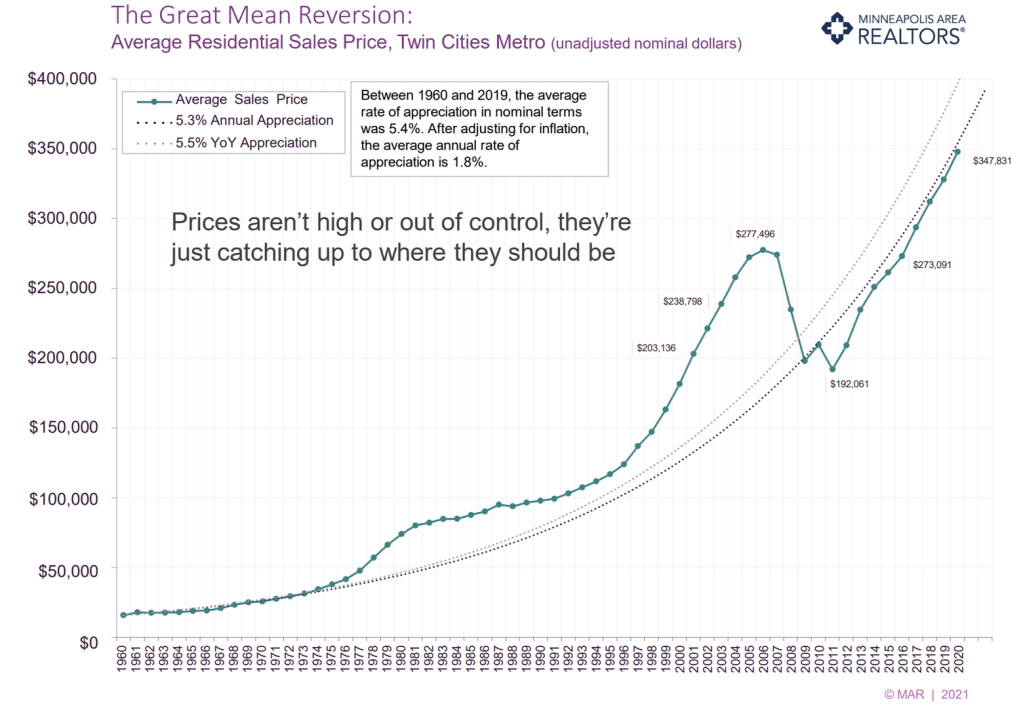
The cost of a home to a consumer is greatly influenced by the cost of mortgages. As the chart below shows, the monthly payment hasn’t really changed that much on the median priced home between 2006 and today.

The data also shows a how housing prices are catching up to a long term trend rather than accelerating into a bubble.

Both graphs provided by Minneapolis Area Association of Realtors

Markets and Emotions

Cloudy day on Lake Minnetonka

The old school way of thinking about markets was that anything traded with money was a rational exchange. Any trades involving domestic issues- family, health and well being and so on- were emotional. The world of men was based on pecuniary calculation. The world women was based on the heart. Thankfully such views are considered old fashioned.

Markets are the culmination of thousands of choices, but sometimes the people behind them are reacting with emotion. Take the corn and soybean market this spring as reported in Successful Farming:

The corn and soybean markets have had a tumultuous last three months. A significant rally in both was followed by a sell-off, then a recovery to challenge highs and then, another sell-off.

Each of these moves has been more than the markets have rallied or dropped in over five years. Corn futures peaked on May 7, rallying more than $1 in three weeks. Dry conditions affected the second crop corn in Brazil, otherwise known as safrinha crop. This was on top of a rally of more than $1 since fall. Just as quickly, December futures lost $1.38 on good U.S. planting progress. They then rallied sharply for the second time, with futures peaking at $1.28, as dry weather in the U.S. became a growing concern.

Farmers have the option to pre-sell their crop through the spring and summer. And often this is done in segments, so it is not a one and done decision. Needless to say, following worldwide ag conditions and gleaning insights into pricing can be stressful.

All this volatility can become exhausting, leading one to believe there is no real way to figure out markets and, therefore, perhaps the best thing to do is nothing.  While understandable, this can be an expensive perspective.

When December corn futures rallied and traded above $5.50, it was a price that hadn’t been seen in seven years. When prices peaked at $6.38, this was even better, and farmers who did not sell at $5.50 were happy. Yet, in a very short time, prices dropped from $6.38 to $5.00.

For over a year and a half, the strong sellers’ market in housing has forced buyers to bid on homes in multiple offers. The listing price is set, but there is no way to know what other parties are bidding. In addition to offer price, closing date and terms come into play. Through the experience of making an offer, and failing to secure the winning bid, buyers learn what it takes to be successful.

What never gets dull is watching how the bulk of the buyers will bid within a relatively small variance. Independ of each other, without knowing more than a list price, out of eight bids on a house, five are likely to be within 2% of each other. It’s the bid from the buyer who has had enough, who has looked enough, or who wants it bad enough, which will reach high and secure the home.

The emotion for the farmers and home buyers is over fleeting opportunities, one for annual income and the other for the place they plan to live out their lives. But emotion doesn’t mean markets aren’t working. Emotion is just another feature. Just like the sentiment that goes into owning a Crist Craft, like the one in the photo, to splice through the waves on Lake Minnetonka.

Timing a move

People move households a variety of times throughout their lives for a variety of reasons. Depending on your data source, Americans move every 7-9 years, with more frequent moves in young adulthood and more sedentary behavior in later life.

This makes sense. As folks move through different stages of life, both from an income stand point and a lifestyle standpoint, they want a different combinations of neighborhood amenities. These are not questions of ‘good’ things versus ‘bad’ things. These are simply mixtures of choices.

When you are young you may want to live near entertainment and restaurants. Once there are kids in the household, going out to shows and restaurants quickly takes a back seat to prioritizing daycare, schools, and after school activities. Stability of residence can be important at this stage as rearing children benefits from consistency.

If the norm is to move, to seek out new living arrangements that better suit new objectives, than wouldn’t incentives that lock people into a location be holding them back? Financial incentives such as rent control do exactly that. It discourages mobility.

And I’m not saying people who need help shouldn’t still receive help. I’m saying that paying people to live in the same set of living circumstance through all stages of their lives goes against the norm. Which leads one to believe it is a drawback in the long run, for a perceive protection in the short run.

Facts about SW light rail

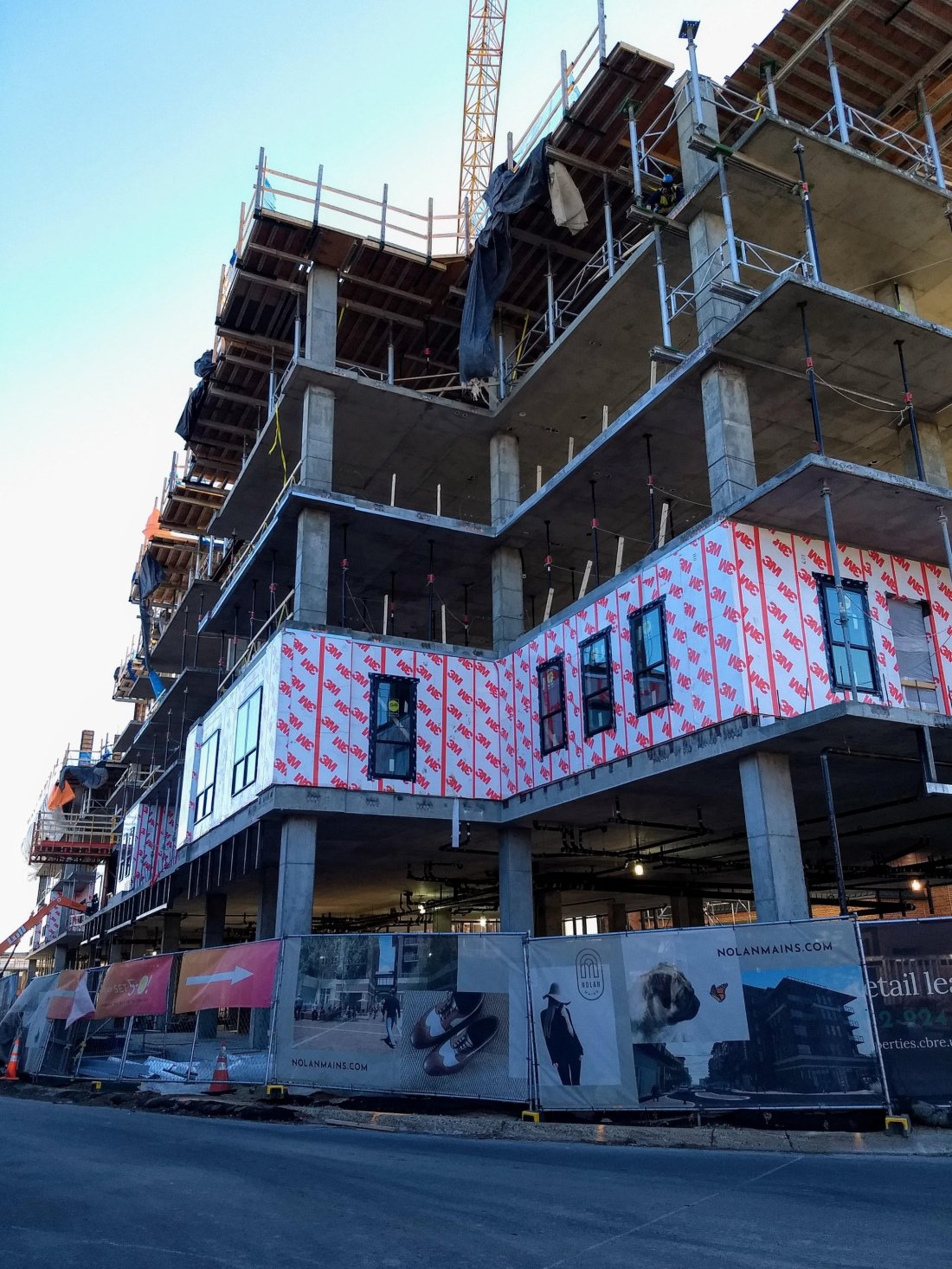
I happen to be by the Blake Rd light rail stop today and snapped a few phone pictures. It is really something how concrete is poured into suspended molds. The MSP area has been reluctant to put money into this sort of infrastructure– and there is plenty of money involved. But once a line is up and running, the fans show up and hop on board. It will be interesting to see how the need for commuting evolves as corporations entertain employment at a distance.

Southwest LRT at a Glance:

The approximately 14.5-mile route (PDF) will serve the growing communities of Minneapolis, St. Louis Park, Hopkins, Minnetonka, and Eden Prairie.

16 new stations with connections to streets and trails will be built, attracting new residential and commercial development.

In 2014, there were approximately 64,300 jobs within ½ mile of the proposed stations and 126,800 jobs in downtown Minneapolis. By 2035, employment is expected to grow to 80,900 within ½ mile of the proposed stations and 145,300 in downtown Minneapolis – a 18% increase in employment.

In 2014, there were about 35,800 people within ½ mile of the proposed stations and 16,400 residents with access to the 5 shared stations in downtown Minneapolis. By 2035, the population within ½ mile of the proposed stations is expected to grow by 56 percent to 55,800, and the population of downtown Minneapolis is expected to grow by 117 percent increase to 35,600.

The total project budget is $2.003 billion, funded by a combination of federal, county, state and local sources.

Construction began in 2019.

An estimated 7,500 construction workers will be needed to build the line, with $350 million estimated construction payroll.

The total project cost is $2.003 billion. Committed funding sources for the Southwest LRT:

Hennepin County: $591.4 million

Counties Transit Improvement Board (CTIB): $218.9 million (provided funding until dissolution in 2017)

Hennepin County Regional Railroad Authority (HCRRA): $199.5 million

State of Minnesota: $30.3 million

Other local contributions: $26.4 million

Eden Prairie Town Center Station: $7.7 million ($6.14 million CMAQ, $1.54 million Eden Prairie)

The Federal Transit Administration (FTA) will provide $928.8 million through the New Starts program with a Full Funding Grant Agreement which was signed in September 2020.

The Metropolitan Council

Carbon Credits for Me, more work for Thee

The title Minnesota Farmers: Cashing in on the carbon bank, fighting climate change? says a lot about the direction this article takes. Farmers in the Mankato area are taking advantage of a new Biden initiative towards climate change.

President Joe Biden said he wants American farmers to be the first in the world with net-zero greenhouse gas emissions. How they might achieve that goal is still unclear — but one idea getting a lot of attention involves paying farmers to store carbon in the soil.

It’s called carbon banking, and some see it as one way to reduce the level of carbon dioxide in the atmosphere. While the concept has been around for decades, it’s still finding a foothold in ag-heavy states like Minnesota.

The mechanics of this deal goes something like this. When farmers extend the extra effort to bury carbon in the soil, they get paid for their work from corporations. In exchange for the dollars given to the farmers, the corporation receives a credit which allows them to pollute. Net result: the farmers don’t pollute but the corporations do.

Lilliston agrees that the work and money farmers like A.J. Krusemark invest to store carbon will have long-term benefits for the environment. But he argues that all that work won’t do much to help mitigate climate change if big companies are then allowed to buy those carbon credits to offset their own pollution.

This arrangement probably won’t last for long as the farmers are going above and beyond their compensated efforts, while the corporate credit purchasers are not. One group is working toward a mission, one is buying their way out of the mission. The incentive signals are all wrong. Furthermore, the groups are poorly delineated. We all have an interest in global climate change, but voluntary cooperative efforts seem to work better when the players are closer and can see progress.

Skeptics of carbon banking practices say that, in order for it to have real climate impact, the carbon storage must come in tandem with reductions in greenhouse gas emissions — not as a replacement for that pollution.

Advice on bridging group relations, from Sidney

I work with a lot of younger people who I find lazy and self-absorbed. When I try to give them advice, they don’t seem to listen and want to do things their own way. The other day one of them said to me “OK, Boomer”. What am I doing wrong?

I am a Gen X, and I am going to give it to you straight. The fact that you find your younger colleagues lazy and self-absorbed is disrespectful and reveals more about you than them. If you want to feel any respect from your colleagues, you will need to respect them first.

“OK, Boomer” is not a term of endearment and perhaps demonstrates the challenges your colleagues have relating to you. Good working relationships take effort from both sides, so it might be time to try a little harder with them. Should “OK, Boomer” come up again, why not ask your younger colleagues if something is cheugy and see how that conversation goes!

As one of the more experienced employees, you have a responsibility to cultivate a workplace of inclusion. Rather than feeling threatened by younger members of your team – who bring much welcome energy, ideas and diversity to work – I would encourage you to seek to understand them. Consider asking your workplace to set up a reverse mentoring plan where you can get to know some of your younger colleagues on a deeper level so you can learn from them and feel able to work more cooperatively together.

The Sidney Morning Herald might be pointing out the obvious here– but can’t this bit of advice be applied to just about any two groups lacking compatibility? Divide them up by generation, race, occupation, income…we like to hang with our own. Hence it is a sacrifice of time, an expenditure of effort, a potential loss in some way, to ‘see it from their point of view’ and fill in the gap in order to bridge a cultural divide.

The journalist goes onto say that “good working relationships take efforts from both sides.” Too true for a public of two, or an organization, or a city. One side may have to initiate interaction but the other must also be receptive. The exchange requires more effort. This effort is called work.

The interesting measure is the capacity of the organizational group to do the work necessary to bridge the subgroups into one.

Walking in the trees

Walking is not only good exercise but is a way to touch nature. Ho Hum you say– but not so fast. Even on a well trodden path around Fish Lake Regional Park you can play the “identify the tree game.” Disclose your guess. Take a photo of the leaf. Then have google lens look it over, and “voila!” You have a winner.

The two on the left are the Norway Maple and below the Red Maple. In the middle, coming at the tips of wonderfully craggy branches, are the Red Oak and the Gambel Oak. And to the right top is the American Elm– really hard to find the elms as they were taken down by Dutch Elm Disease And below the White Poplar, which look to have canopies of coins jingling in the sky when the trees grow enormously tall.

Still not impressed? Nature shows us how to sort. How to see things that are similar and things that are slightly different. And then we have to give them names so we can talk about them. This is useful.

Then you can see how other things have properties in common, and see their differences. Take 1. Midwest men laid off after jobs went abroad, 2. Renters resisting gentrification 3. Proponents of environmental reviews. All three are (were) caught (fear being caught) out by the greater group accepting an exchange that will leave their situation worse off.

When America agreed to trade away manufacturing jobs, workers were left unemployed and unable to regroup. When a deteriorating neighborhood gleans the interests of redevelopment, those without the foothold of ownership face higher monthly expenses. When a mine in Northern Minnesota opens, the fear is that it will pollute and damage the environment.

In the first case the damage was done and the fallout was deemed to be larger than first anticipated. The thought was that workers would be able to adjust, take on new employment, and carry out their lives. Note to self: cash derived from private employment is only one aspect of a job, other social aspects include status, stage of life, relationship to others in family.

In the second case, renters are organizing to stop improvements and redevelopments in their area as they feel they will not benefit in any way. They feel that they will loose by either having to move to another area within their price range or face higher rents justified by the neighborhood improvements. Given the lack of understanding of the complete package of social implications and costs in 1., there must be a better calculation for the compensating factors for renters while still proceeding with neighborhood rejuvenation goals in 2.

Environmental reviews appear to have become a political way to slow down a project to the point where investors simply move on. The best way to discourage business– just keep requesting more stuff. If the community has standards, as all of them do, then enforce the standards and be done. It’s up to the business to take the risk. They will be the ones shutting down if they can’t.

All three scenarios involve transactions between public groups and private interests at multiple levels. Each scenario describes a little piece of a very large system. The conflicts and aggravating conversations around such issues stem in part from a lack of enumeration of the various tradeoffs at play. Striving for a proper sorting of what is public and what is private will contribute to being able to count it all out.

The Wire– a review

If you prefer drama to comedy I can recommend the HBO series The Wire. The first of five seasons came out in 2002 when the TV in our house was featuring Barney and Dora the Explorer. A crime drama portraying the grisly conflict between law enforcement and the (mostly drug) criminals wasn’t in the cards.

The story lines hold their own with intrigue and surprise, along with character development. Every season probes a new scheme, a new crew of gangsters, while bringing along the established cast and story threads from past seasons. From Wikipedia:

Set and produced in Baltimore, MarylandThe Wire introduces a different institution of the city and its relationship to law enforcement in each season, while retaining characters and advancing storylines from previous seasons. The five subjects are, in chronological order: the illegal drug trade, the seaport system, the city government and bureaucracy, education and schools, and the print news medium. Simon chose to set the show in Baltimore because of his familiarity with the city.[4]

What holds up so well is the consistency of the norms, whether they are those which the criminals obey or the ones the mainstream players abide. Each side has heroes and crooks, has chivalry and villainy. Each side has bad luck and good fortune. Each side has weakness and substance abuse. A few try to pass from one side to the next.

The Wire is lauded for its literary themes, its uncommonly accurate exploration of society and politics, and its realistic portrayal of urban life. Although during its original run, the series received only average ratings and never won any major television awards, it is now widely regarded as one of the greatest television shows of all time.

The Wire – Wikipedia

You will also realize how far technology has come in the last twenty years. The primary tool used to capture the drug dealers is “by getting up on their phone,” or getting court authority to tap phones. When the first season opens these are pay phones on the corners of the gritty streets of Baltimore.

As long as you can tolerate a little violence, it’s well worth a watch.

Laughter

I think people would agree that humor is difficult to translate. If you find yourself outside your native tongue, there a chance that more than once you’ve looked blankly around a table of laughing smiles wondering what you missed. “Ah– you must understand the politics,” one French house mother told me as I looked to her for answers. Or at least you must understand the inside joke at hand.

At a basic level, comedy provokes a laugh even when the trip-and-fall is predictable, or the bonk on the head likely. But anything more sophisticated pulls the audience onto an inside turn on a speedway, straining the limit between jest and tastelessness. Comedy depends on a dupe. And this can only be alluded in order to preserve decorum.

That’s how inside jokes develop by profession. If you are a nurse anesthetist, for example, there are bound to be comical events to be shared amongst coworkers, without insensitivity intended. But when is the boundary crossed and who should have access to the ditties that are sung at the end of a tough day’s work?

I’ve always admired people with a good sense of humor. Ones who can tease out a good laugh from an audience without going too far. Maybe in part because humor is still a mystery to me. Maybe because a belly laugh does everyone a bit of good.

With political correctness taking so many topics off the table, laughter is being squelched into small, tight groups. Just when I think we all deserve a little time to be light-hearted.

Muzzling

I wish I would stumble across a history of the use of tax incentives as a means of financing affordable housing (google?). When I first heard about the various tax rebate methods, including tax increment financing (TIF), it felt a little back door. And it probably was. I suspect political appetite for funding housing, which is hands down the largest tranche of a family budget, was chronically weak.

While looking into the Four Seasons Mall project, I discovered that Low Income Housing Tax Credits (LIHTC) have become fungible. This means non-affiliated C-Corporations invest equity by purchasing the credits. In return they receive a reduced tax obligation into the future. Give up cash today and receive a stream of money through the forgiveness of an obligation into tomorrow.

On the one hand I salute the effort to generate more financing partners by detaching the credits from the project. (Originally the real estate developer received the credits in order to make the numbers work despite lower rents on the affordable units.) At the same time, by detaching the credits and allowing a C-Corps to purchase them, the mission motive is eliminated and transformed into a pecuniary one.

Furthermore, the successful projects are decided by a bureaucratically designed scoring system. Projects are given points based on a list of objectives. The scoring may or may not actually prioritize the weighted demands, nor the quality of the potential social outcomes. I have no doubt that the Four Season Mall site was passed over as the pecuniary assessments of income (or lack there of). It’s hard to imagine the complex outcomes from residents interacting with higher quality schools, transit, and associational groups can be condensed into a few points on a scorecard.

An alternative to scoring and progressive tax plotting is for mission focused folks to be the equity partners in on the project. This is what happened at Cranberry Ridge. Construction just started on the three story building on May 25th.

The development by Beacon Interfaith Housing Collaborative (Beacon) features 45 apartments for families who earn less than $52,000 a year for a family of four. Twelve of the homes will be for families who make less than $31,000 a year for a family of four. 

The Plymouth Housing and Redevelopment Authority (HRA) and Metro HRA each awarded 10 rental assistance vouchers to ensure the homes will remain affordable for future residents with the lowest incomes. Capital funders include the local nonprofit Outreach Development Corporation, Minnesota Housing, Hennepin County, Wayzata Community Church, Plymouth HRA, Greater Minnesota Housing Fund, and Wells Fargo. General contractor Shaw-Lundquist, architect BKV Group, and civil engineer Loucks have worked on the planning and development. Many individual donors provided seed funding to support the planning, organizing, and technical work to get Cranberry Ridge approved and fully financed.

The key component in this potpourri of interested parties is Interfaith Outreach (and Community Partners–IOPC), a very successful faith-based social service provider. With forty years of experience helping families in crisis, they are a mainstay in serving those in need. In a sense Cranberry Ridge brings their clients to them, to the neighborhood, making it that much easier to do what they do best.

I much prefer to see the money and the mission be served up in combination. Incentivizing C-Corps to avoid taxes, instead of support the spirit of community, is counter productive. It allows corporations to bypass a progressive tax code. It also gives a general audience a reason to view corporations as tax evaders. Making it all about money is the motivation in the private market, but this is a public good.

And I hesitate to be critical as I realize that “the Low-Income Housing Tax Credit (LIHTC) program is the most important resource for creating affordable housing in the United States today.” However, one result of the process is that the numbers work out more favorably in mixed use projects. This means that more units are built for the moderately poor instead of the desperately poor.

The Interfaith Outreach folks think this is a mistake. The thought is to house to the most vulnerable first and then work up to nicer housing for the less poor later. They want money to be used more efficiently. Here is a statement from the organization made to the Minneapolis city council which summarizes this view, and expresses recent disappointment in the city council’s lack of interest in taking up the conversation.

Housing is expensive and we will always need to provide shelter to those who can’t provide for themselves. It seems we’ve outgrown the need for a back door approach. Matching the appropriate investors with projects, and residents with neighborhoods could further long term objectives.

The complexity of being affordable

Cracked crumbling asphalt is an unusual site in the more affluent suburbs of the Twin Cities. In fact the number of areas that would be considered distressed across the metro is pretty slim in relation to its size. So it’s a bit of a puzzle why the Four Seasons Mall in Plymouth, a relatively wealthy third tier suburb, has been left unused for the past twelve years.

First Wal-Mart purchased the site, but the neighbors said ‘no.’ It would draw too much traffic off the well traveled State Highway 169 which connects the Minnesota River Valley with the far northern points of the state, where the outfitter town of Ely serves as a portal to the boundary waters. That whole thing took a handful of years.

Then the city spent some time on getting a mixed use project approved on the sixteen acre site which included upwards of several hundred affordable units. Not bad for a fairly wealthy area of town. Here’s a news clip Plymouth Approves Four Seasons Mall Redevelopment – CCX Media explaining the project, and here is a commercial real estate synopsis on the site.

Just recently the whole project came apart because the tax credits were allocated to another project by the Fed’s scoring system. Two years after the community said ‘yes’ to welcoming a housing product that is often rebuked, a chart put together by bureaucrats says ‘no.’ Although I’ve been unable so far to find out where the subsidies were put to use, the feeling seems to be that the funding went to an area with greater need. Which I assume means an area with a higher density of people living in poverty.

Sure enough, according to a study on Low Income Housing Tax Credit, by the Urban Institute:

The program structure can promote the concentration of units in poorer places. Although the program only requires that 40 percent or more of the total units in the property be set aside as affordable, most properties are developed with affordability restrictions on all units to maximize the equity investment because only the affordable units qualify for tax credits. The allocation structure also provides an incentive to build in low-income communities designated as Qualified Census Tracts or Difficult Development Areas.

On the one hand political units like the Metropolitan Council maintain pressure on the greater metro to come up with their fair share of affordable housing unit, on the other hand the means of financing such rehabilitation and new construction can by politically allocated to neighborhoods already carrying more than their share of disadvantaged citizens.

If I were to house people who needed a little extra help in life, I would make the argument that it is sensible to do so in a community with a little extra time and expertise on their hands to help out. But I can’t choose where to house folks as I am not able to purchase tax credits along with friends and neighbors of similar minds.

The process simply isn’t that simple. Here’s a visual that is helpful.

Needless to say the multiple layers of bureaucracy add cost to the process.

LIHTC is an economically inefficient method for producing affordable rental housing. The process
of allocating and awarding tax credits is time consuming and complex. A study produced by the State of Washington found that it frequently takes twice as long to put together a LIHTC-financed project than one that is market rate, in turn contributing to higher legal and other transaction costs (Keightley 2017; Mitchell et al. 2009). Costs are also driven by the complexity of some LIHTC deals. A GAO (1997) study found that the process of syndication (pooling resources from multiple investors) can claim between 10 and 27 percent of project equity. LIHTC projects also have few incentives to keep costs low because reducing development costs would result in not using the full tax credit issued for the project (Mitchell et al. 2009).

From what I gather, low income tax credits are sold to any corporation who wants to invest in them. There is no mission, there is no sense of service. It is a pointy penciled transaction sketched out by a corporate CPA. Does it make more sense that a scoring system by the Federal government with a tongue twisting list of acronyms (CDBG,HOME,AMI, and 60% of this and 30% of that) be the mechanism for matching supply with demand rather than a neighborhood saying yes to affordable housing?

Honestly– the serpentine system seems to be more about keeping people out of the conversation than in it.

Walking the Lakes

For whatever reason walking suits me. It’s good exercise. Conversation always flows, so a companion is a good idea. And you never know what you might stumble across. This evening is was a doe and a fawn traipsing up from the shore of Medicine Lake and meandering through the lawns as if the neighbors didn’t mind.

I’m in good company. William Wordsworth was a walker too, in his Lake District.

Sweet was the walk along the narrow lane
At noon, the bank and hedge-rows all the way
Shagged with wild pale green tufts of fragrant hay,
Caught by the hawthorns from the loaded wain,
Which Age with many a slow stoop strove to gain;
And childhood, seeming still most busy, took
His little rake; with cunning side-long look,
Sauntering to pluck the strawberries wild, unseen.
Now, too, on melancholy’s idle dreams
Musing, the lone spot with my soul agrees,
Quiet and dark; for through the thick wove trees
Scarce peeps the curious star till solemn gleams
The clouded moon, and calls me forth to stray
Thro’ tall, green, silent woods and ruins grey.

Sweet Was the Walk: A Poem by William Wordsworth

Now to learn to write poetry!

Rank your favorite public good

If there were a ranking for ‘the best’ public goods– how would it go?

A public good here at home-economic is a good which a group makes available to everyone in that group. For the purposes of this list, let’s extend that delineation to the political boundaries of the US. What are the public goods here in the United States that promote a service to its constituents, while maximizing individual freedom?

I’d have to say the winner is our road system. Most all roadways in the US are open to anyone’s use. Except for a handful of toll roads, there is no charge to the user, and little restraint in their availability. Furthermore there is timely efforts to keep them clear of obstacles.

I started with drinking water, but many people in the US use private wells. And then there was that problem in Flint and the complete absence of water in a number of spots in California.

Then I thought personal safety– which is the oldest public good. Here again, the variance in quality provision of protection varies too much across the states to say that it is consistently available.

Education is meant to be…but we all know the pitfalls here. Even though we do it much better than most.

Nope– it’s definitely the roads. More people have access to the open highway than other pubic good.

But what say you?

Mysteries around Google Maps

I started posting my photos to google maps about four years ago, undoubtedly because some AI trick prompted a friendly message onto my screen encouraging me to do so. As I became more familiar with maps, and the cooperative efforts of people around the world to share what they were seeing on the ground, I began to value the service. Which led to more postings.

For instance, I was going through childhood travel pictures and family members could not recall the location of this fortification.

Google Lens was helpful, but it suggested more than one fortified option. The choices spanned destinations from the Punjab to Egypt and in between. Fort Attock Khurd looked the most promising so I went to Google Maps and found it sitting beautifully overlooking the River Indus.

Then I paged through the photos posted by recent visitors to the area. With a little adjustment for perspective, the ramparts, curved walls, the river all came into focus. It’s truly (I’m going to show my age!) spectacular that I can access vacation photos from someone on the other side of the earth. It allows for such ease in piecing together a road trip taken half a century ago.

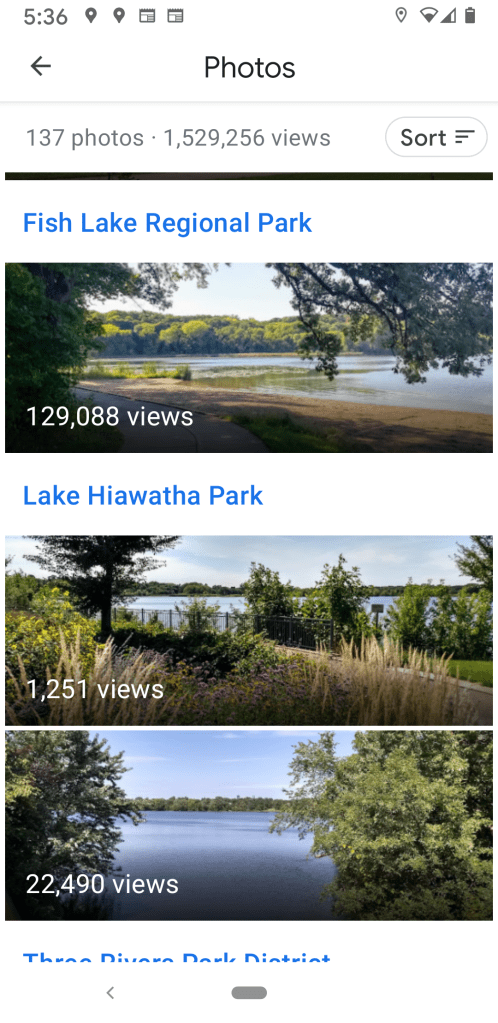
So now I am asking my AI friend, if he/she is listening: Explain the mystery of why some of my photos get so many views and some not. For example, this park is located in a sleepy little suburb and the park itself is nice but not as heavily used as others. The numbers under the playground equipment are particularly strong– it doesn’t seem like the best photo to me out of the group. Why so many views?

I wrote about this DQ about three weeks ago and the views on it have taken off. I guess it is ice cream season. And people often search for food and restaurants. Still it seems like a lot in comparison to other photos of equal quality.

I liked the shot of the Minneapolis skyline from under the I94 Bridge. Maybe I’m biased because we had such a nice bike ride along the river. The river flats area is famous for being the low income housing area of a century ago.

My all time high views is of a beautiful beach at Fish Lake Regional Park in Maple Grove. I do love that park. In addition to the beach, there are walking trails, you can rent a variety of water craft and there is a dog park. We have an extensive regional park system in Hennepin County, and maybe the numbers reflect the number of patrons planning visits.

Still– if AI big sister is listening: Please explain the variance in views!

Recognizing Structure

Human perception, as well as the “perception” of so-called intelligent machines, is based on the ability to recognize the same structure in different guises. It is the faculty for discerning, in different objects, the same relationships between their parts.

The dictionary tells us that two things are “isomorphic” if they have the same structure. The notion of isomorphism of having the same structure is central to every branch of mathematics and permeates all of abstract reasoning. It is an expression of the simple fact that objects may be different in substance but identical in form.

A Book of Abstract Algebra

Avian Objections

“There’s Wilson’s warbler, and Swainson’s warbler, and Kirtland’s warbler,” lists Kenn Kaufman, author of several birding field guides.

“You’ve got Nuttall’s woodpecker, and Cassin’s vireo, Cassin’s auklet, and then there’s Botteri’s sparrow, and Bachman’s sparrow,” he says.

Monuments and Teams have changed names as America reckons with racism.

Of all the names listed above there is one which is objectional to inclusive activists. Can you pick it out? Can anyone pick it out, regardless of their background? You’ll have to read the article to find out which one symbolizes oppression. In my mind, if no one can select the offender, than no offense has been done.

This whole renaming thing comes across as people on a mission (not the right kind of mission) to create a story where they get to play the knight in shining armour. A search for misdeeds. Uncover and disclose them! Then become the agent who sets the whole thing straight.

Some may say, ‘What’s the harm in it?’ If changing names makes just one person more comfortable than it is a win. Yet, there are only so many hours to devote to things. NPR can only run so many stories. There are only so many resources available to rectifying a wrong. If you gear everyone up to work on the ones which produce little results, than disappointment is all that will follow.

And anger–eventually.

If activists engage people in work that makes no contribution to the mission, than aren’t they involved in some sort of taking? Those hours of work can only be spent once. You can change a bird’s name or perhaps they could be spent being a big brother-big sister, working a job fair, teaching English as a second language classes, finding someone a place to live. Changing the name of the Wilson Warbler to the little warbler with a cap wouldn’t be something I’d tweet about.

Can houses be made anew?

Speculating on innovation in housing is harder than you would think. I’m not sure if we take the basics elements of the structures as givens, or if they are fundamentally difficult to innovate. Here’s a new listing I have coming on the market at the end of the month– what could we do better?

The single family home on a plot of its own is still the most preferred housing option outside of the densely populated mega cities. According to statista, “as of September 2020, there were 213.3 million single-family dwelling units in the United States and only 38 million multifamily units.”

This one is above average in square footage, and about double the median priced property in the metro, but it still has the same structure as most single family homes: lot, dwelling, garage. The city provided infrastructure for utilities determines the type of mechanicals which service the property. In this part of the country natural gas is the established solution for heating and electricity runs the lights and air conditioning.

One innovation which is more visible around town than ever before is solar panels. One can see them glistening on more and more roof tops. But the breakeven point for installation is still out about 7-9 years, which makes it a difficult purchase. There are no heating solutions more friendly than natural gas on the horizon. The only other efficiencies toward energy conservation can be achieved through additional insulation and careful review of appliances.

Perhaps innovation will be more about how we use the space within homes rather than the structure itself. More complexity to household formation, particularly in the mixing of generations, could bring down the square footage per person ratio, leading to less utility consumption. Using the space in a single family home as a home office will keep cars off the roads.

Innovation in the near future may well be about usage and not structure.

Platters of yesteryear

Robert Putnam, a sociologist from Harvard, is probably best known for his seminal book, Bowling Alone: The Collapse and Revival of American Community. From wikipedia:

Putnam surveys the decline of social capital in the United States since 1950. He has described the reduction in all the forms of in-person social intercourse upon which Americans used to found, educate, and enrich the fabric of their social lives. He argues that this undermines the active civil engagement which a strong democracy requires from its citizens.

Putnam outlines at length the waning of voluntary associations.

Putnam noted the aggregate loss in membership and number of volunteers in many existing civic organizations such as religious groups (Knights of ColumbusB’nai Brith, etc.), labor unions, parent–teacher associationsFederation of Women’s ClubsLeague of Women Voters, military veterans’ organizations, volunteers with Boy Scouts and the Red Cross, and fraternal organizations (Lions ClubsBenevolent and Protective Order of ElksUnited States Junior ChamberFreemasonryRotaryKiwanis, etc.).[1] Putnam used bowling as an example to illustrate this; although the number of people who bowled had increased in the last 20 years, the number of people who bowled in leagues had decreased. If people bowled alone, they did not participate in the social interaction and civic discussions that might occur in a league environment.[1]

In my mind what is being tracked here are the platters where exchanges took place, and not the actual amount of work or resources engaged in production of a shared asset. The bowling leagues provided the venue for friends and neighbors to gather, extend a hand, overhear who needed a job, step-up if someone passed. But as the clubs of father’s or grandfather’s became out of date it is just as feasible that younger generations found new places to gather and organize.

But why then are the number of volunteer hours reported in the American Community Survey lower? Perhaps people were engaged in informal volunteer work, unpaid work to help a friend or member of the community, without being associated with a formal organization.

Consider American life from the 70’s up to the writing of this paper in 1995 (followed by the book in 2000).

The observations in the book coincide with two decades of increasing divorce rates in the US, of households being split apart. Moving homes is time consuming enough, then there are the additional logistics of separating both financially and emotionally when the cause is a divorce. This closing out of marital arrangements can easily last a year or more.

Furthermore the schedule of a single person with children is bound to be quite different from a married couple. Whereas there may have been an easy agreement of, ‘you get to golf, I get book club, you handle sports leagues, I’ll manage PTA,’ everything gets a little trickier to plan when you no longer share a household.

There are a variety of reasons why marriages came apart and people preferred to dedicate resources to undoing their marital bonds rather than hanging in for the golden anniversary. There was a reckoning with this institution that may still be in play. But the reality remains that there are only so many out-of-paid-work hours to devote to family and community. If those are being devoted to a reassessment of marriage, then they will not show up on the American Community Survey under volunteer hours.

Platters III

The image of platters is useful in visualizing where the economic implications of culture plays out within groups. The exchanges, trades, evaluations of mission-minded individuals transpire on platters, whether it is in the support of a university, a corporation, a hobby, or a tight knit community.

In a recent conversation, we speculated about how remote work will inhibit culture. When professors no longer reside in the same small town as their college, the social activities of years gone by will never materialize. When judges no longer have offices in the same building, they can no longer stroll down the hall and run a scenario past a colleague. If corporate employees only engage over zoom there are no casual exchanges post meetings to develop an ease of interaction.

These are examples of how physical distance renders exchanges of ideas and resources difficult. Trade is muted as the agora, the platter, evaporates on the electronic mechanisms.

In contrast, there are situations where platters are nested, and the appropriate level of control is opaque. Authority at the local level is generally preferred. At some point, however, the effects of parochial rules can create negative outcomes for the larger platter. Zoning, for example, can restricts housing to the point of increasing housing costs regionally. Than there is an argument for the rules to be made over a larger platter. If public safety of a city gets to the point that places of shared institutions such as universities, convention centers and so on are experiencing extraordinary crime, than impositions of safety measures by the greater group seem justified.

The mission morphs to various compositions of platters depending on the demands to meet the mission. And then, when demand subsides, the dynamics relinquishes trade and interaction back down to the most basic level.

Math thought of the day

It’s reunion season and even though we were unable to have an official reunion, some of us got together last evening. Math was and is a popular major at St. Olaf, and it was fun to reconnect with some old classmates. I happen to have my Abstract Algebra book and nostalgia probably tugged it off the shelf for me today.

Come to find out the author wrote super interesting prologues to each chapter. Of course I couldn’t have been bothered with such unnecessary consumption of my time back when I was twenty. Getting the problem sets done was my minimal obligation! Now stories of Euclid and Niels Abel and Evariste Galois are the bits I want to hear about.

Education is wasted on the young!

Algebra today is organized axiomatically, and as such it is abstract. Mathematicians study algebraic structures from a general point of view, compare different structures, and find relationships between them. This abstraction and generalization might appear to be hopelessly impractical but it is not! The general approach in algebra has produced powerful new methods for “algebraizing” different parts of mathematics and science, formulating problems which could never have been formulated before, and finding entirely new kinds of solutions.

Such excursions into pure mathematical fancy have an odd way of running ahead of physical science, providing a theoretical framework to account for facts even before those facts are fully known. This pattern is so characteristic that many mathematicians see themselves as pioneers in a world of possibilities rather than facts. Mathematicians study structure independently of content, and their science is a voyage of exploration through all the kinds of structure and order which the human mind is capable of discerning.

A Book of Abstract Algebra by Charles C. Pinter

Steinbeck the economist

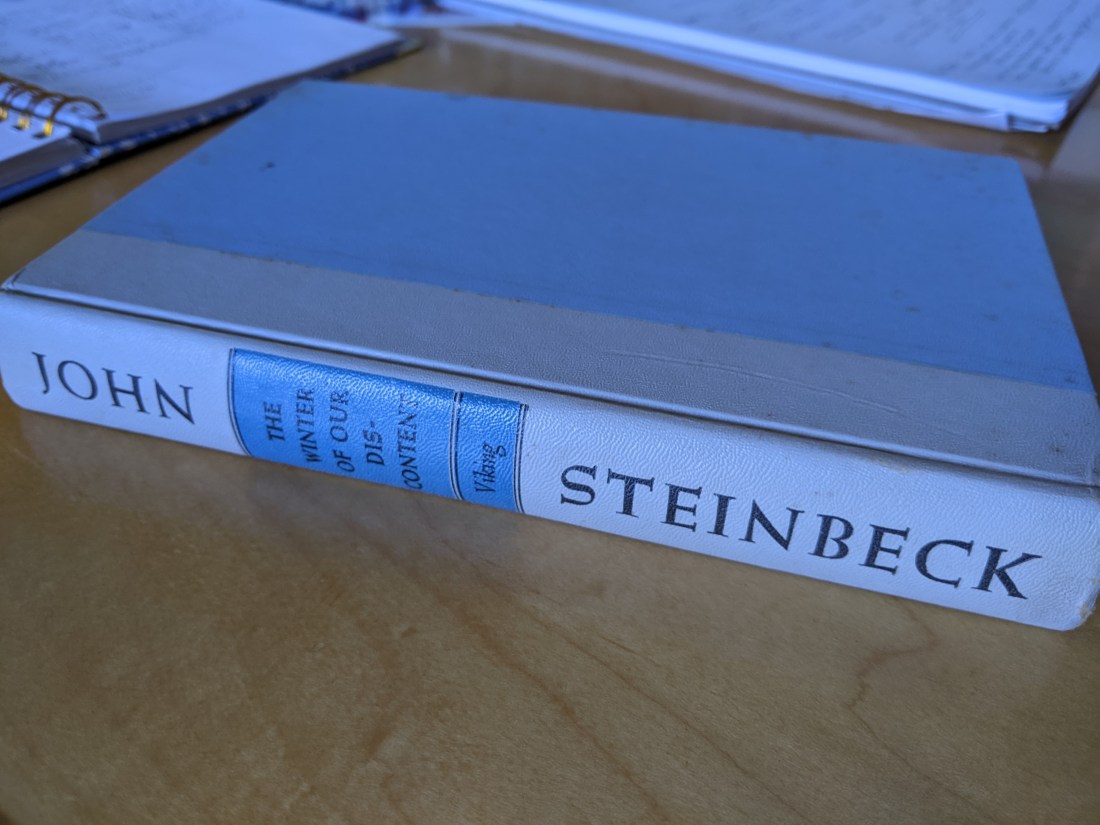
When I picked up Steinbeck’s In Dubious Battle it was to ensure a certain caliber of writing. Only good luck would have it that farm workers, activists and landowners struggling over resources was the subject matter. Steinbeck sets up the social and economic dynamics of which I speak. Now I’m only a couple dozen pages into The Winter of our Discontent (1961), and I’m realizing that this is his thing. Take this passage where the protagonist Ethan is trying to describe to the Mr. Baker, the banker, his frame of reference around investing his wife’s money.

Ethan started an angry retort- Course you don’t under stand; you’ve never had it-and then he swept a small circle of gum wrappers and cigarette butts into a pyramid and moved the pyramid toward the gutter. “Men don’t get knocked out, or I mean they can fight back against big things. What kills them is erosion; they get nudged into failure. They get slowly scared. I’m scared. Long Island Lighting Company might turn off the lights. My wife needs clothes. My children-shoes and fun. And suppose they can’t get an education? And the monthly bills and the doctor and teeth and a tonsillectomy, and beyond that suppose I get sick and can’t sweep this goddam sidewalk? Course you don’t understand. It’s slow. It rots out your guts. I can’t think beyond next month’s payment on the refrigerator. I hate my job and I’m scared I’ll lose it. How could you understand that?”

“How about Mary’s mother?”

“I told you. She sits on it. She’ll die sitting on it.”

“I didn’t know. I thought Mary came from a poor family. But I know when you’re sick you need medicine or maybe an operation or maybe a shock. Our people were daring men. You know it. They didn’t let themselves get nibbled to death. And now times are changing. There are opportunities our ancestors never dreamed of. And they’re being picked up by foreigners. Foreigners are taking us over. Wake up Ethan “

The banker is trying to talk Ethan into being a risk taker, an investor. Ethan doesn’t have the stomach for it anymore. He lost ownership of the family grocery store, and it was more than a pecuniary loss. He lost social standing, he lost piece of mind, he lost dreams of his children’s future, and most dear to him, he feels he has lost his wife’s admiration. The slow process of exchanges that led to his financial demise was ‘the erosion’ that killed his spirit.

As history will have it, this played out during the more recent great recession, when everyday people were taken up short by the reality that they were going to loose their house through foreclosure. The evidence was there for anyone showing foreclosed properties to witness.

For the most part bank owned homes are in rough shape. An extended period of tough financial times results in missing cabinet hardware, water stains where a leak was left to drip, flooring worn right through to the subfloor. Foreclosures were a mixed bag in 2010. Frequently the properties were neat as a pin. Vacuum marks still tracked in the carpet. Appliances were clean and left intact. Sellers maintained pride in their home until they had to leave the keys on the counter and lock the door behind them.

But the strain of the situation, the erosion of spirit, kept people out of homeownership well past the three to five year waiting period as required by credit considerations. It’s a pretty safe bet that not only were their ambitions of ownership curtailed but also those of their siblings and people in their close circles. People who supported them emotionally through the process. The homeownership rate for Millennials is only 43%, well below any other cohort. And I don’t believe it is all about student debt.

But back to The Winter of our Discontent. The banker wants an investor and looks first to a man who comes from a family with experience. He makes an assumption that his best candidate comes from the pool of past business buddies. I’ll have to keep reading to find out how it all shakes out for Ethan and Mr. Baker.

But what I think we should take away from all this is that the emotional draw or drawback from participating in transactions whether for a house, or a police force or a business venture is much more dear and lingering than we acknowledge. And it cannot be ignored. The compensating factors to pull people back into those markets are perhaps partly pecuniary, but mostly something else. The need for a new entrepreneurial spirit may be harder to incentivize in the old pool and easier to energize in a new one.

What we need is to be better accountants of all the social implications of our pecuniary endeavors.

Sparks

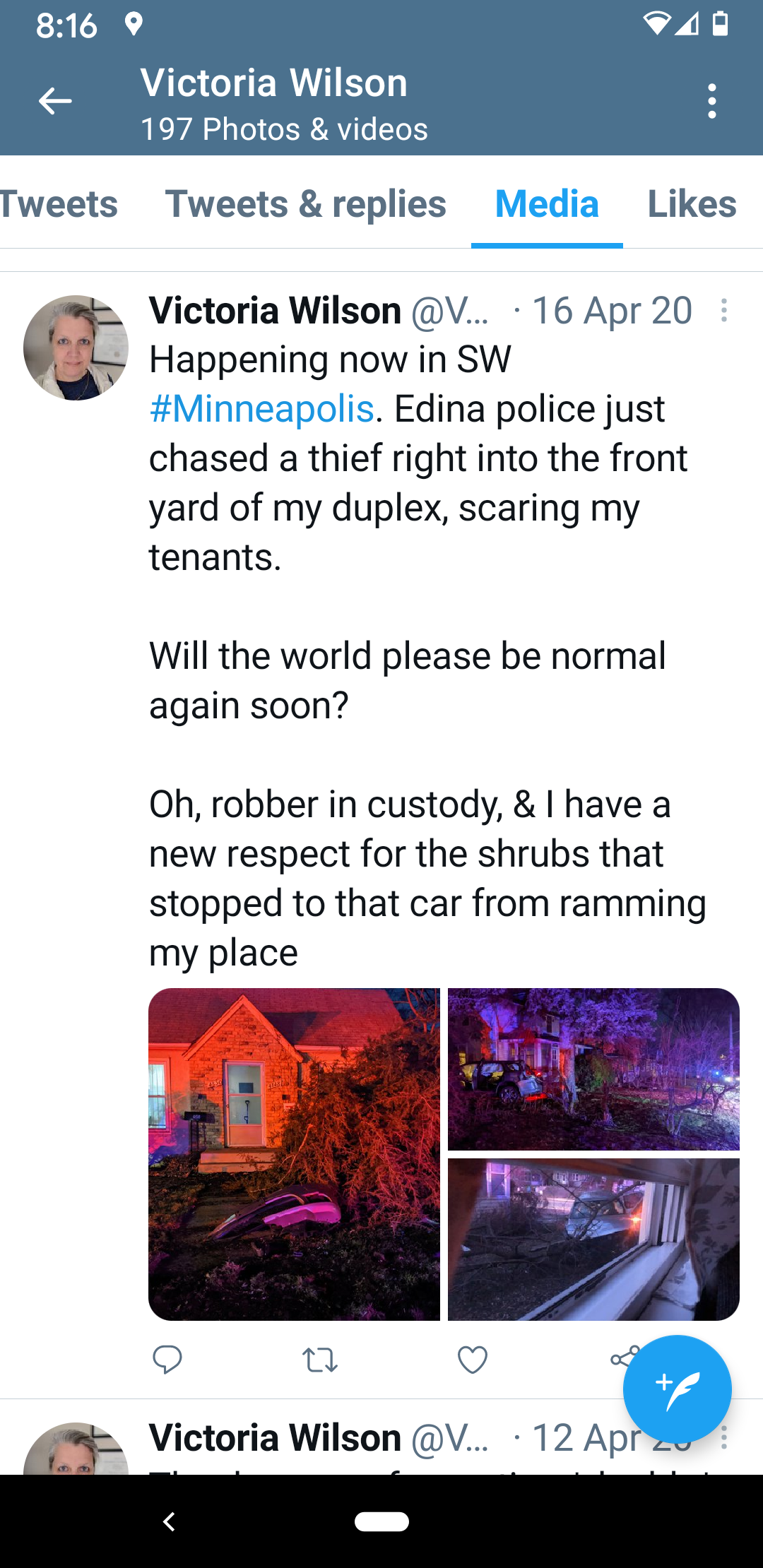
A little over a year ago, around 8pm, a my phone dings as one of my tenants texts the photo in the lower right corner of the tweet below. In the twenty foot side yard a car had spun around and was pointing at her as she sat by her dinette window. As it turns out a couple of ne’er-do-wells had held up a CVS pharmacy a mile or two down the road and ended up in a high speed chase.

As the twosome sped north bound along a residential through road, they left the intersection one house prior to mine, hit a berm in the neighbor’s yard (which slowed them down a bit and changed their trajectory so they missed my building), flew through a hedge, slammed into a fifty foot pine which whirled them around to my tenant’s kitchen window view.

It was the talk of the neighborhood in these first weeks of Covid lockdown. I went to inspect the following morning and an assortment of neighbors strolled over to tell what they had heard and seen. The only evidence left for me to see were the black tire marks indicating the car’s departure from the city road, a large assortment of car parts and a whole bunch of broken branches from the hedge the car had taken out in its 180 degree spin.

The police had actually done a great job of getting most of the debris and large branches off the property. I just had one follow-up call for part of the traffic pole and a muffler or some odd car part. But the mess motivated me to tackle getting rid of the rest of the scraggly old hedge that had sat on the lot line all these years. Ignored. Overgrown.

Pretty soon I’m cleaning up the yard all along that side of the building, roots and all. Picking up more plastic car parts in the process. The neighbor starts to do the same. It’s contagious. One person makes it a bit nicer, the other tackles something else. Before you know it all the brush is gone, the ground regraded, new grass seed sprouting, a house painter is called, another tree comes down.

After fourteen months of hardship and struggle we are all at a stage of putting life back together. Now is the time to be on the alert for those who will motivate and be motivated by continued improvement. These situations can be leveraged. Let’s leave the great stagnation behind.

(Epilogue- I heard from the pine tree neighbor today that one of the rogues got 14 months. The other is still awaiting sentencing.)

When the mission has exhausted its purpose

PETA finds offense in the naming of Ham Lake, a sleepy small town about a half hour north of the Twin Cities. It’s the type of town that when you call city hall with a question you actually get through to the person you need to talk to and he or she is more than willing to spend some time answering your inquire and filling in any background as needed. There is a minimum lot size of an acre which preserves the rural feel of a settlement on the outskirts of a major metro.

And who are these fine folks roofed in the hamlet of Ham Lake offending ? — Pigs, apparently.

“Pigs are smart, sensitive, wonderful individuals, so if we have a heart, we’ll leave their legs alone and choose yams over hams,” says PETA President Ingrid Newkirk. “PETA envisions a new ‘Yam Lake’ that promotes kindness and healthy eating.”

https://www.peta.org/media/news-releases/peta-yams-it-up-with-name-change-proposal-for-ham-lake/

There’s a lot going on in the world right now for attention to be devoted to a swine’s feelings, detectable or not. If an animal advocacy group can come up with nothing better than recommending name changes to small towns in Minnesota, perhaps they have out lived their cause.

In a family group, the demands of a sick child, or a temporary bout of unemployment, may have the group suspending other activities so as to devote all resources to the emergency at hand. The natural mechanism is to continuously reassess resource allocation as the need for advocacy subsides. Thus ensuring a mission expires once past its usefulness.

In large organizations such as PETA, which has 6.5 million members and supporters worldwide, the reassessing goes to the wayside. The mission perseveres. Ham Lake must see the err of its way and morph into Yam Lake. It’s for the pigs!

Who else cares about a Canadian Goose?

My love affair with the internet has been uneven. First there was the amazement at reconnecting with childhood friends long left behind at destinations around the world. Then there was the aggravation at the dismantling of established business norms which guided professional behavior. But then there is all the upside of discovery and learning and connecting with very specific groups of people.

The MN Gardeners is one such group. The postings here will inevitably make my day.