Attn Geographers

My brother told me today that Minnesota was one of the first in the game of GIS mapping. Hence, the state offers a wealth of geospatial data at Minnesota GIS and Maps.

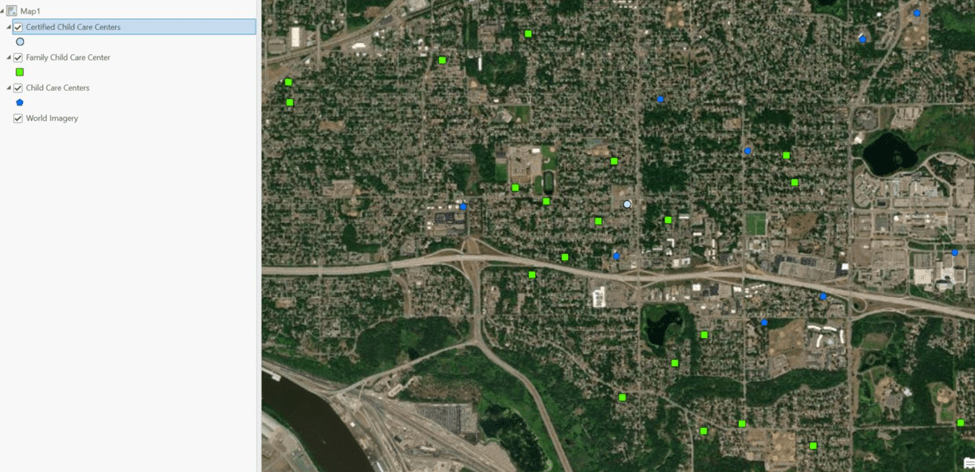
Here’s a sample of their data on daycare providers.

This dataset is a collection of records that communicate the locations of child care, family child care and certified child care centers in Minnesota. It was created by downloading licensing information from the Minnesota Department of Human Services (DHS), geocoding the spreadsheet records and converting them to a spatial format. The approximately 10,000 records are combined into one layer, which can be queried to separate by license type. This version focuses on a smaller set of core attributes than can be found on DHS’s Licensing Information Lookup Page; see that page for all the attributes: https://licensinglookup.dhs.state.mn.us/

There’s a section called What’s in My Neighborhood?

The MPCA’s What’s in My Neighborhood contains a wide variety of environmental information about your community. This includes potentially contaminated sites, permits, licenses, registrations, inspections, and closed enforcement activities.

Potentially contaminated sites: Since the early 1980s when major federal and state cleanup programs were created, the MPCA has been aggressively searching for and helping to clean up contaminated properties, from very small to large. This website contains a searchable inventory of those properties, as well as sites that have already been cleaned up and those currently being investigated or cleaned up.

Environmental permits and registrations: This Web application also contains a searchable inventory of businesses that have applied for and received different types of environmental permits and registrations from the MPCA.

Getting cash to those in need

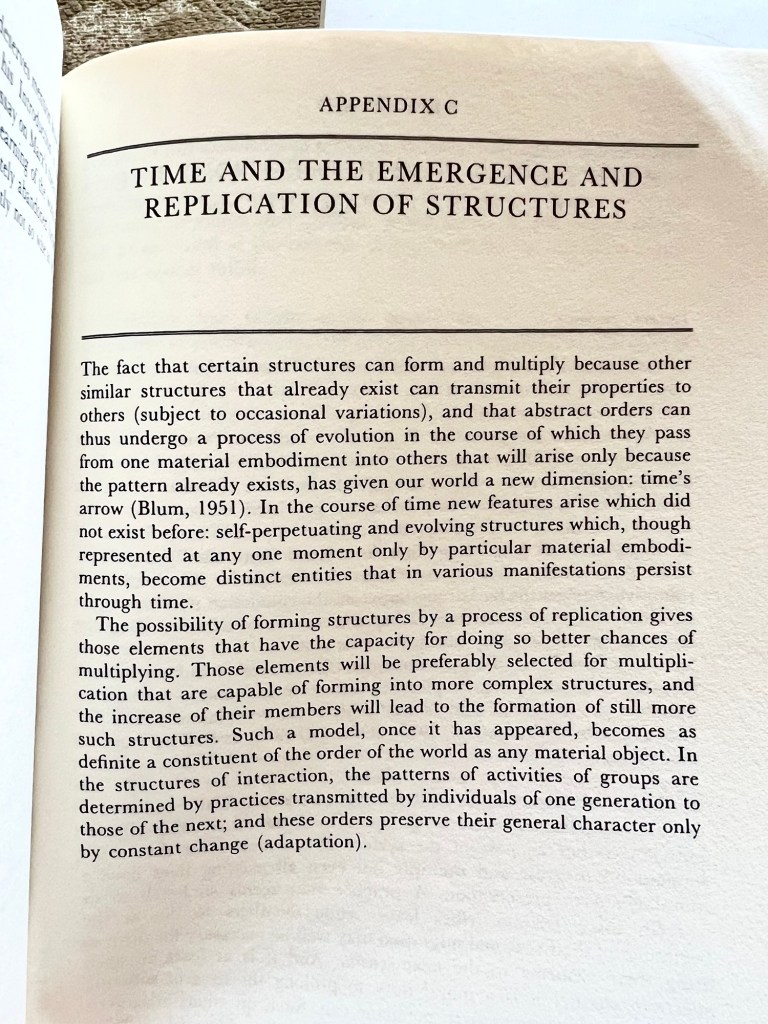
Viviana Zelizer’s sociological classic, The Social Meaning of Money, is full of historical examples of the conveyance of time and resources to those in need. The author also depicts the evolution of aid from charities to pensions from the state, from controlled expenditures to variations of individual freedom to choose how to spend.

What sort of money, then, was this new charitable cash? Rejecting the model of dole, wage, or insurance, pensions appropriated instead the forms of the middle-class domestic economy; or, more precisely, they replicated women’s housekeeping cur-rencies. Considering that most recipients of public pensions and a large number of those receiving or at least managing private cash allowances were women, charitable cash was easily transformed into a special category of domestic currency, a sort of collective pin money. Notice the vocabulary: the term “allow-ance” comfortably echoed the familiar income of middle-class wives. Pensions, of course, had been legitimized as a dignified payment by the enormously successful federal program of Civil War payments for veteran soldiers. But there was also a long tradition of pensions as a substitute income for husbandless women. And it was middle-class women who, for the most part, ran this feminized currency exchange; not only did women’s organizations become the strongest supporters of mothers’ pensions but mostly female social workers supervised both public and private forms of cash relief.

Zelizer is one of the few academics who speaks of the poor as worthy to choose. Furthermore, she repeatedly illustrates how participating in systems of trade serves to educate the participants, gives them standing, allows them to be role models to their children, and so on. Instead of the standard starting point that the poor will simply be happy to receive, Zelizer paints out in broad relief the full benefits of market participation to this group of modest means.

Stories

This video is tremendously underrated, with only 166K views in fourteen years. Filters, messes, too simple, good versus evil, a big accident, human action, uh oh, get tough, easily grasped, conflicting purposes, nudge, sway, blink, seduced, talisman, outsiders, bias, patterns are all parts of thinking in stories.

What stories thread through your lives?

Intellectuals’ fascination with the foreign

I do not understand why people look abroad when we have the best institutions right here. Secure property rights underpin the entire real estate industry. No one does it better. And yet.

Beleive the explanation and move on. Nothing to see here.

The Value of Dirt

Iowa is an agricultural state home to more pigs than people. The deep, dark topsoil which coats the landscape is one of the richest in the world. Its topography is ideally suited for large machinery to work across acres of flat open spaces.

Ratings are given to the productivity of each site and tracked by Iowa State University. Land rents and sales prices are also posted and often used in commerce.

Policy Thought of the Day

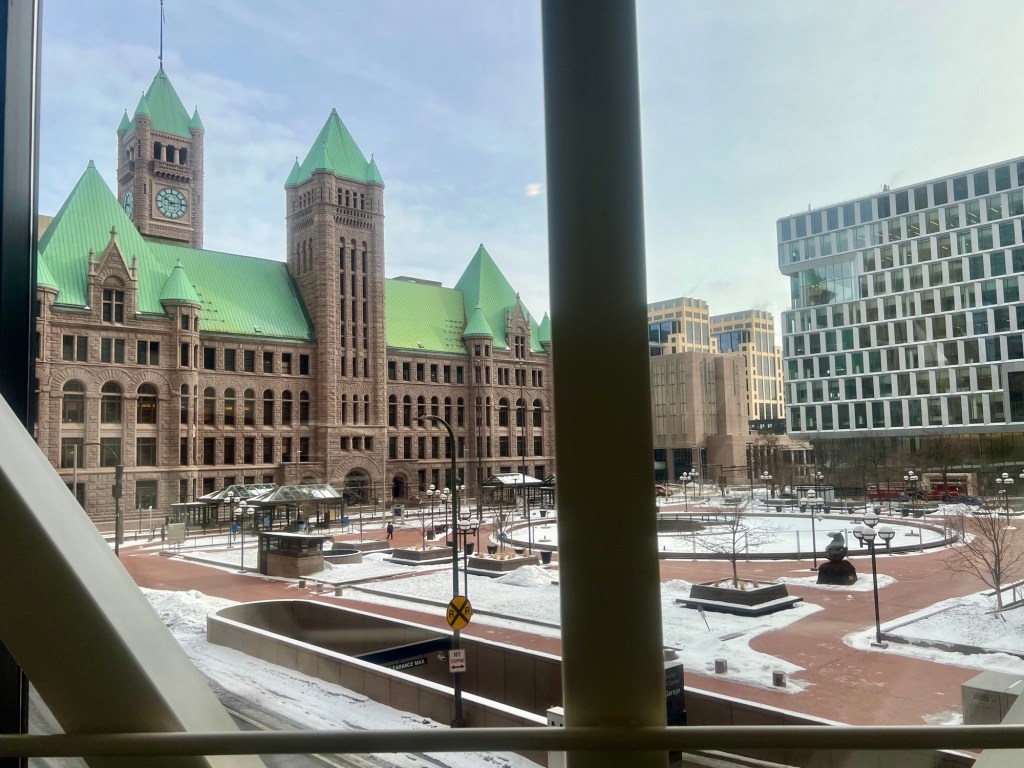
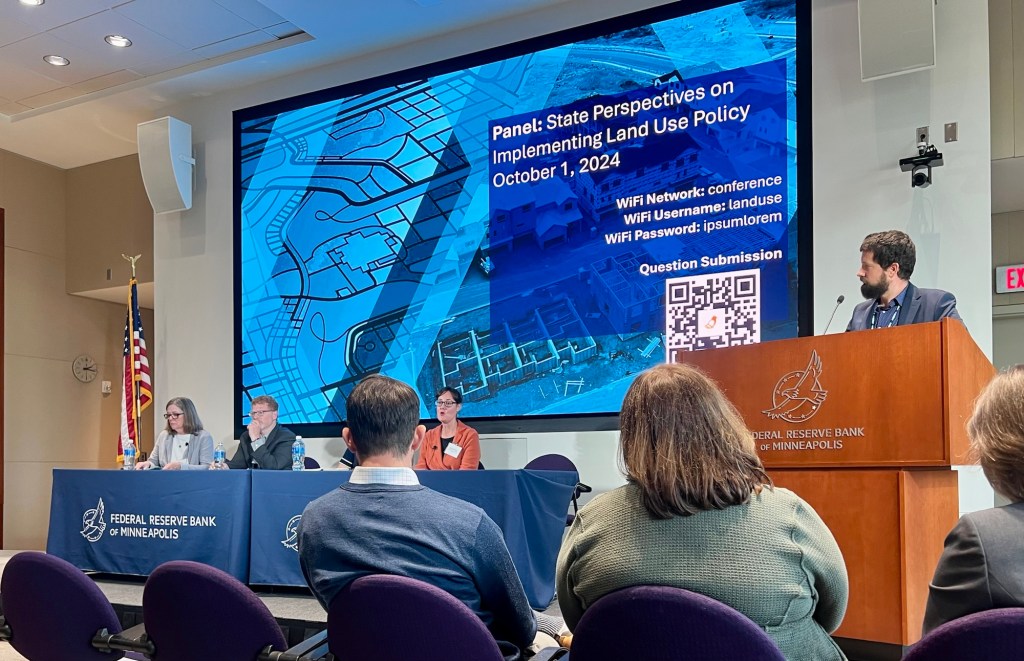
I sat through an interesting presentation today at the Federal Reserve Bank of Minneapolis—a striking glass and steel building on the edge of the Mississippi River. The commentators all shared angles on the ambitions for affordable housing in their respective areas of the country. The very pragmatic Jenny Schuetz with Brookings is speaking here.

One of her messages is to pick a reasonable goal, such as downsizing parking requirements, and get that passed. Massive bills packed full of ideas are interesting only in theory.

With simplicity in mind, here’s a product idea meant to steer resources in the right direction. A few days ago I panned the idea of swaying behavior through signage- Will Signs Work? The lack of incentives is what is missing here.

Let’s think of it as a model. The man in the middle, we’ll call MN1. After all, the driver of all intentions in this endeavor is MN1. This is the person we desire to receive resources. Without this person, there is no need for the non-profit to exist to come to their aid. Without MN1, the drivers would not be tempted to pull to the side at a busy intersection and pass a few dollars through the window. The model takes the perspective of MN1.

What does MN1 want? In the news clip, the panhandler said he hoped to earn $20-30 from a day on the curb. Now we know the amount of incentive necessary to show up. What do the motorists want? They wish to satisfy their impulse to come to the aid of a fellow human in need. To give directly is very satisfying. What do the non-profits want? They wish the panhandlers would come to their sites for the services they are trying to administer. Their livelihood is based on attracting MN1’s.

If the motorists could purchase a voucher for $50 which the MN1s could redeem at the non-profits, all actors achieve satisfaction. The motorists pass aid directly into the hands of the panhandler. The cash incentive should drive MN1s to contact the non-profit. This allows face time to sell their services. Furthermore, for vouchers lost or unclaimed, the non-profit earns the face value of the donation.

The MN1 folks are able to come away with cash and hopefully additional avenues to services that alleviate their plight. The motorists appease their need to help while donating a nice amount to the local non-profit of their choice, a choice with the added benefit of a screening process. The non-profit has customer leads showing up at their door while receiving additional donations.

What should the voucher be called? A Twenty-Bucker?

Fact of the Day

How much US cash is held out of the country? A lot. Christopher Neely at the St. Louis federal Reserve explains:

The U.S. dollar has been the most widely used international currency since 1945.1 The dollar is the most traded currency on international financial markets, dollars comprise 60% of official reserves (i.e., foreign exchange reserves), and many traded goods, such as oil, are commonly invoiced in dollars. In addition to these commercial uses of the dollar and dollar-denominated assets, individuals in many parts of the world hold U.S. currency, i.e., paper money, both as a store of value and as a medium of exchange.2 This blog post3 explains the widespread use of U.S. currency and provides some simple, back-of-the-envelope calculations on the size of some of the benefits to Americans.

The rest of the world holds a great deal of U.S. currency, i.e., cash. Although the amount can’t be precisely tracked, the Federal Reserve Board of Governors recently estimated that foreigners held $950 billion in U.S. banknotes at the end of the first quarter of 2021, or about 45% of all Federal Reserve notes outstanding, including two-thirds of all $100 bills. Overall holdings of U.S. currency have grown rapidly, however, and overseas holdings of Federal Reserve notes would now be worth closer to $1.1 trillion if such holdings are still half of all U.S. currency.

Psalm 11

CS Lewis explains in Reflections on the Psalms, “What must be said, however, is that the Psalms are poems, and poems intended to be sung: not doctrinal treatises, nor even sermons. Those who talk of reading the Bible “as literature” sometimes mean, I think, reading it without attending to the main thing it is about; like reading Burke with no interest in politics, or reading the Aeneid with no interest in Rome. That seems to me to be nonsense. But there is a saner sense in which the Bible, since it is after all literature, cannot properly be read except as literature; and the different parts of it as the different sorts of literature they are. Most emphatically the Psalms must be read as poems; as Lyrics, with all the licences and all the formalities, the hyperboles, the emotional rather than logical connections, which are proper to lyric poetry.”

Will signs work?

I say no.

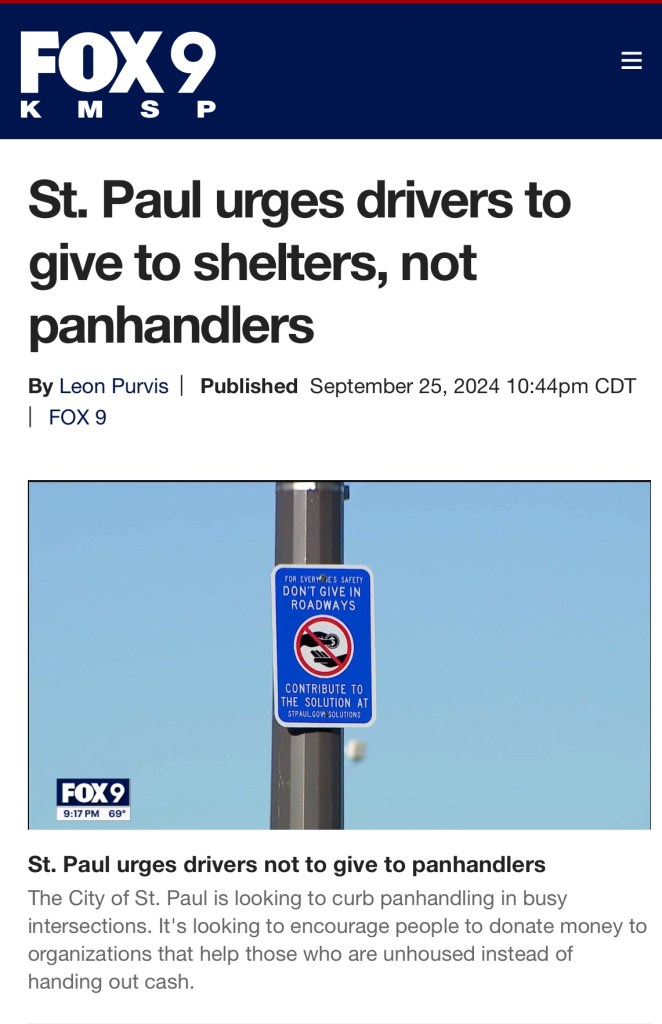
The City of St. Paul is looking to curb panhandling in busy intersections. It’s looking to encourage people to donate money to organizations that help those who are unhoused instead of handing out cash. FOX 9

City leaders say they’re doing it for public safety reasons. It’s putting signs up at intersections to bring awareness to drivers on how to help those who are unhoused. 

This is so Minnesotan. If we simply ask nicely, the good people of St. Paul will listen and do as we say! Let’s ignore incentives and inclinations.

There are two groups and two forces at work. The well enough to do in their cars are compelled at the sight of the need to fulfill an urge to act. Their instincts are crying to lend a helping hand. This is so easily accomplished by reaching into a wallet for a few dollars and rolling down a window. Searching for a reputable organization to direct funds to is tedious and not very rewarding. When you send in a check, you just get a thank you but no human touch.

Incentives for Group 1: Sign 0 Direct Give 1

The second group is the panhandlers. They have a need and are working to externalize cash from motorists’ desire for mutual aid. Although public policy types may rationalize that these folks really need this, and really need that, and it’s all because of X, does not eliminate the clear immediate need for cash. That’s their mission. The solution in the sign does not meet this need.

Incentives for Group 2: Sign 0 Direct Give 1

The sign idea does not work. If vouchers were given to motorists who want to reach out and touch someone to make a difference, and the panhandler could take said voucher to the organization for cash, among other things, then you would meet the incentives for both Groups 1 and 2. The organizations would also have a shot at ‘selling’ the panhandlers on their other services. If successful, the panhandlers would no longer need to hit the curbs with their stools and cardboard signs.

Tomato Basil Soup

This time of year, the farmer’s markets are full of fresh produce. Most of the suburbs in our area have their day when a collection of vendors pitch tents in parking lots and sell their products to all who try to stop in. It’s hard to pin down the appeal of the ancient agora. Grocery stores of every stripe nearby are open at just about any hour, so it’s not about convenience. It’s not about variety, as minivans can only transport so many items. It’s not about bargaining- the people meandering by the stalls pay whatever is asked of them.

I say it’s about inspiration. The thought of all those plump tomatoes made me want to try making tomato basil soup- which I adore.

Maybe others bring home too many choices and thus force themselves to find inspiration in what they brought home. Perhaps a conversation over the bushy fresh dill led to Grnadma’s pickle recipe being pulled out and put to use.

Experiences stay with us. They teach us, and we go back to them again and again.
Sensory Rooms

Busy public spaces are now setting aside a room for quiet time. People who suffer from anxiety or overstimulation can recluse themselves from the packed community center on a Saturday and shut out the activity in a sensory room until calm returns to them. These are lovely spaces. Muted colors, sound buffering panels all serve to quiet the environment.
Come to find out the airport has included this design element in their terminals.

My only question is, how are they going to keep people out?

Disaster! Price

As long as prices are ticker taping along with typical elan, most people are happy to know that the amount they would give for a good or service is agreed to spontaneously, but many others. Sure, people will complain when a touch of frost ruins the citrus crop in Florida, leading to higher prices for grapefruit, lemons, or oranges. Little fluctuations make the dinner table news but are not show-stoppers in the ever-churning commerce between vendors and consumers.

The vibe changes when a typhoon rolls into the Sunshine State. Proclamations against price gouging come from the political power at hand. Every four-by-eight piece of plywood is needed to cover glass windows. However, the market system is no longer viewed as the desirable mechanism for distribution. Profit at the hands of disaster makes people uncomfortable.

Insurance alleviates the restraints of fears for the suddenly disadvantaged. When a hail storm comes through, insurance replaces all damaged vehicles or roofs. No one cries, ” Price gouging!” Everything is all right as long as it’s on the insurance company’s tab. Insurance coverage didn’t take the repairs out of the market system, but it did change the size of the risk group.

This happened with masks during COVID. In the early days of the virus, state health departments were desperate to get masks for essential personnel. As the prices soared, administrators realized every state was bidding up the price from foreign suppliers. Changing the buyer group from the state to the federal level, tampered down the bids.

Disasters are shared concerns over more extensive groups of people. The market system is not in error; it just needs regrouping.

Prices have Personalities

The War on Prices, How Popular Misconceptions About Inflation, Prices, and Value Create Bad Policy is a compilation of essays edited by Ryan A. Bourne. The twenty-four entries are organized into three sections: Inflation, Prices, and Price Controls and Value. Bourne steers the way with introductory comments.

What I like best about the book is the variety of stories in which price plays a leading role. You start to notice that the numerical representation tallied at the time of transaction in the exchange of a good or service has its own flare—a price personality.

George Mason economist Alex Tabarrok is known for describing price as ‘a signal wrapped up in an incentive.’

Here, we’re looking at the action price- a very popular one indeed. It is the price that will cause the actors in the market to take charge and make a deal. Action price is the number most serious sellers want to post to attract buyers and move some merchandise.

But there are many others. Take Chameleon Price. In the West Needs Water story, we hear about the city of LA going out into the country in search of water rights. The early Californian farmers had secured water rights, which were now more valuable in the quickly growing urban area. When the Water Board went to the rural farmers with money in hand, they wanted to purchase the land at a price derived from its agricultural value. Soon, sellers realized that they were not selling farmland; they were selling water rights and demanded a price linked to the increased property values on the receiving end of the water.

At first glance, the object in the transaction takes on one appearance only to change to another hue at a new price.

More price talk to come.

Ownership Issues – Water out West

Water is a slippery issue. You can pump water from the ground if you have your own well. It costs you the electric bill. As an owner of the lot, you have rights to the water swelling through the subterranean substrate.

The farmers who arrived first in the West have rights to the water in rivers through the first possession doctrine— a similar principle to land and mineral rights. Under this doctrine, historical patterns of water use give rise to de facto property rights. Specifically, whoever historically has diverted water and put it to beneficial use gains a legal right to continue diverting water for beneficial use in the future. Farmers diverted flows from rivers and streams through dams and irrigation ditch networks. Projects by the Bureau of Reclamation, part of the U.S.

Department of the Interior, augmented these systems and after 1926 would contract only with irrigation districts for water delivery. The fact that farmers have rights to and use vast quantities of water in an arid region is not a problem, in theory, if those water rights could then be traded to urban users who might value them more. But the history of water trading in the West offers a cautionary history about how difficult it can be, in practice, to facilitate true markets and arrange trades through property rights. (The West Needs Water Markets, but Achieving That is Tough, Peter Van Doren)

When you pay a water bill in an urban area to your local municipality, you are paying for the infrastructure to pipe the water to your home, as well as the water treatment process. Private property rights determine the type of access: well, municipal, irrigation ditches… The value of the water shows up as capital in the plot of land with access rights.

To obtain Owens Valley water for the aqueduct, the Los Angeles Water Board purchased over 800 farms and the water rights that came with them. Negotiations were difficult because of bilateral monopoly. The board was the only buyer and was under pressure to buy because Los Angeles was in a drought in the early 1920s. Large farmers formed pools to collude as sellers. Sellers wanted the surplus from the increased land values in Los Angeles arising from the water availability. The city’s board offered compensation based on agricultural revenue from the farms.

The LA people wanted to buy out agricultural land based on farm use. The farmers realized they were selling access to water. Thus they based their price on the value increase of the properties receiving their water rights in LA. This makes sense.

But then there can be no complaints when the agricultural land can no longer be farmed. The property’s use value transformed, and the transaction compensated the sellers at market value.

Pilfering at the non-profits

Shoe-string organizations run valuable community services. Most employment is provided on a volunteer basis. The positions are usually stretched, leaving a few core people to bear most of the responsibility. Thus, a lot of trust is placed in the hands of folks who have just shown up for the job.

It isn’t uncommon to hear people joke about so-and-so or such-and-such, keeping a few extra concessions in their garage or pocketing some cash from the till. You wouldn’t think there would be much money in it, but a basketball tournament weekend would draw in a net of $25K back ten years ago when I ran them. That said, these thefts are typically small stuff that is not worth pursuing—except once in a while, a whale is caught.

Investigators found that she began making unauthorized withdrawals less than two months after she assumed the role of treasurer. 

 “The PTO debit card was also used in hundreds of personal purchases, including childcare expenses, student loan payments, groceries, and takeout food purchases,” the criminal complaint read. “The unauthorized transactions included checks written out to [McMullin] and deposited into her personal bank account. Once in [McMullin’s] personal bank account, the money was used for mortgage payments, bills, and other personal expenses. [She] also withdrew cash from the PTO bank or from ATMs. At various points, Defendant did make some nominal deposits from her personal bank account back to the PTO account.”

But only a portion of the actual loss is in the dollars pilfered. Stealing from the social side of life is a strike against shoring up losses; it’s an attack on moving people forward. Kids’ programming can set youth on the right track with competition and discipline. Kids’ programming keeps young folks doing physical activity that is known to promote long-term health. Kids’ programming puts mentors in touch mentees for guidance throughout formational years.

Fraud within the industry is a drag on participation. People tend to give up their time when they trust a system and share the ethos of the work. Suspicions of theft encourage people to take their support elsewhere.

Bike Ride

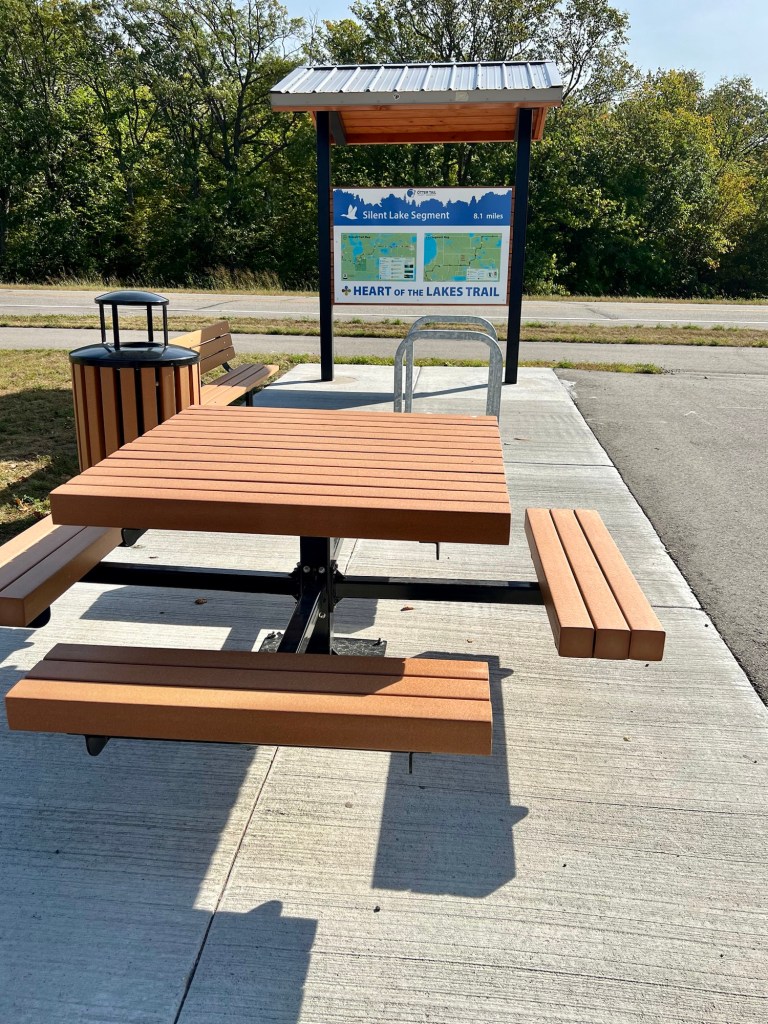
Few things are more enjoyable than meandering on a bike trail or cruising through a state park on a beautiful sunny day. Fortunately, communities share this ethos and support the continued development of public trails.

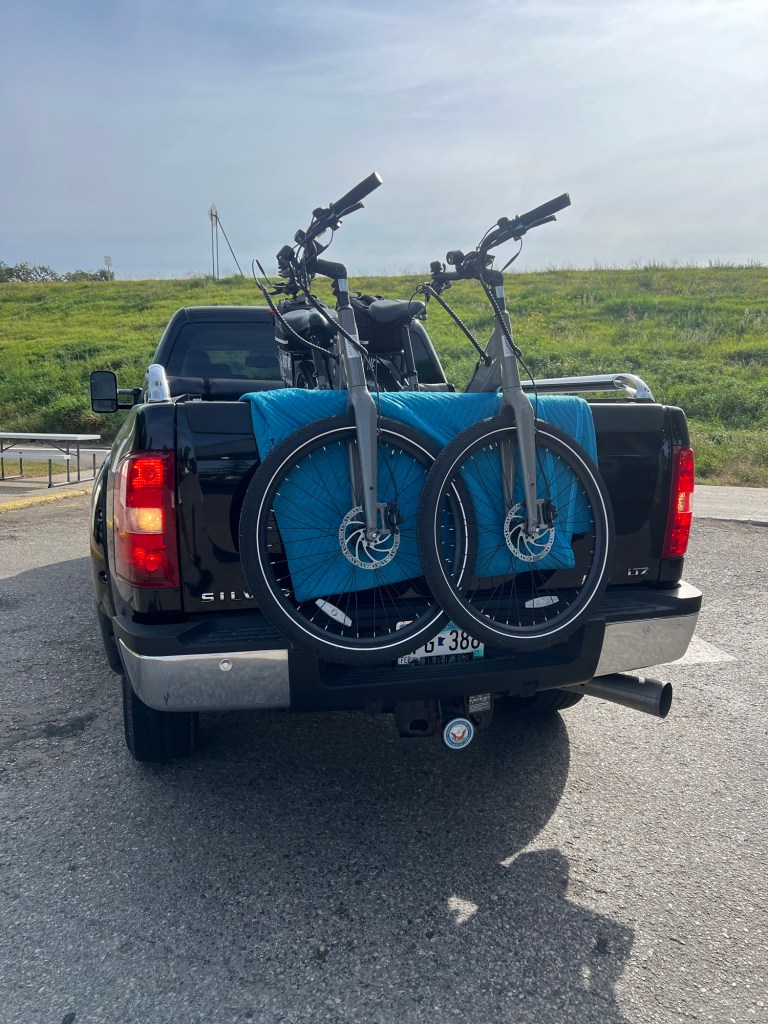
Today’s ride followed some of the new Heart of the Lakes Trail. It doesn’t show up on all the maps yet, so it’s essential to do some research to map out the route. There are excellent services along the way, like mile markers, benches, and trailheads for parking. With a plan in hand we set out for Lakes E-Bikes to pick up our rentals.

The operation runs out of a family-owned RV dealership. A third-generation member pitched the idea of selling e-bikes with an expectation of making twenty sales or so a year. His brother informed us while helping to load the cycles into the back of the pickup, and this year, he watched 250 go out the door. Hitting the market right can make all the difference.

If you haven’t tried an e-bike yet, I highly recommend it. It’s not really biking; it’s more of a scooter. But it takes you to the most wonderful places, and that’s what matters.

Thank goodness for all those who devoted countless hours in county board meetings to make it all happen.

Cracking the kid’s question

My husband and I both come from families with five kids. Even then, ours were larger families, as the average US woman bore 3.6 children. Big families were those with ten or more children. A college friend with twelve siblings scored top prize in the mega family category.

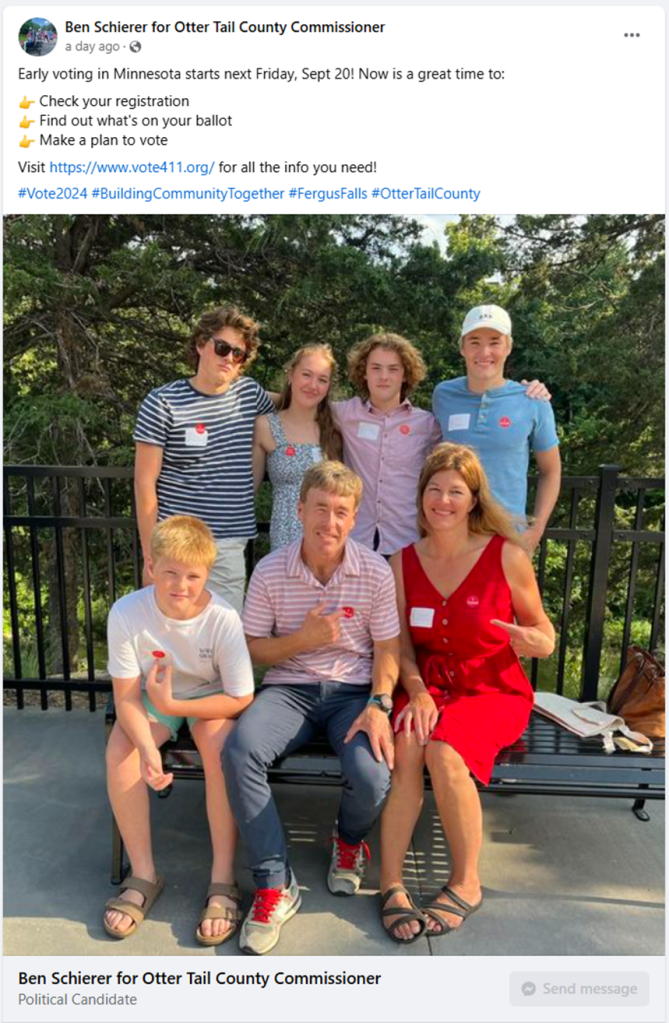
Today’s fertility rates are not even up to replacement numbers. So, what can be done to make large families fun again? One approach may be to consider them in election choices. Here’s a father of five kids running for a county commissioner position. People who live a lifestyle conducive to a gaggle of kids are bound to favor programs and support services geared that way.

Most people want similar things, such as personal safety, good schools, and adequate health care, all within the reach of decent employment. However, a large families’ focus is undoubtedly skewed to their preferences. Safety means kids can navigate city roads to and from schools and parks without harm. In contrast, a family with a musical prodigy may be perfectly willing to buffer themselves against some urban crime so their child can be within reach of the top ballet school. One wants ubiquitous small town the other wants access to specific cultural activities.

Good schools, for instance, mean good public schools in the large family scenario. It can also mean a school that isn’t too elite so that their kids have a chance to dabble in varsity sports or theater or debate without being squeezed out by intense competition. Large families form a buying group of public services. Figuring out how to match the most likely who desire a large family with the mix of services that enriches their lives is the best way to grow the population.

A little project

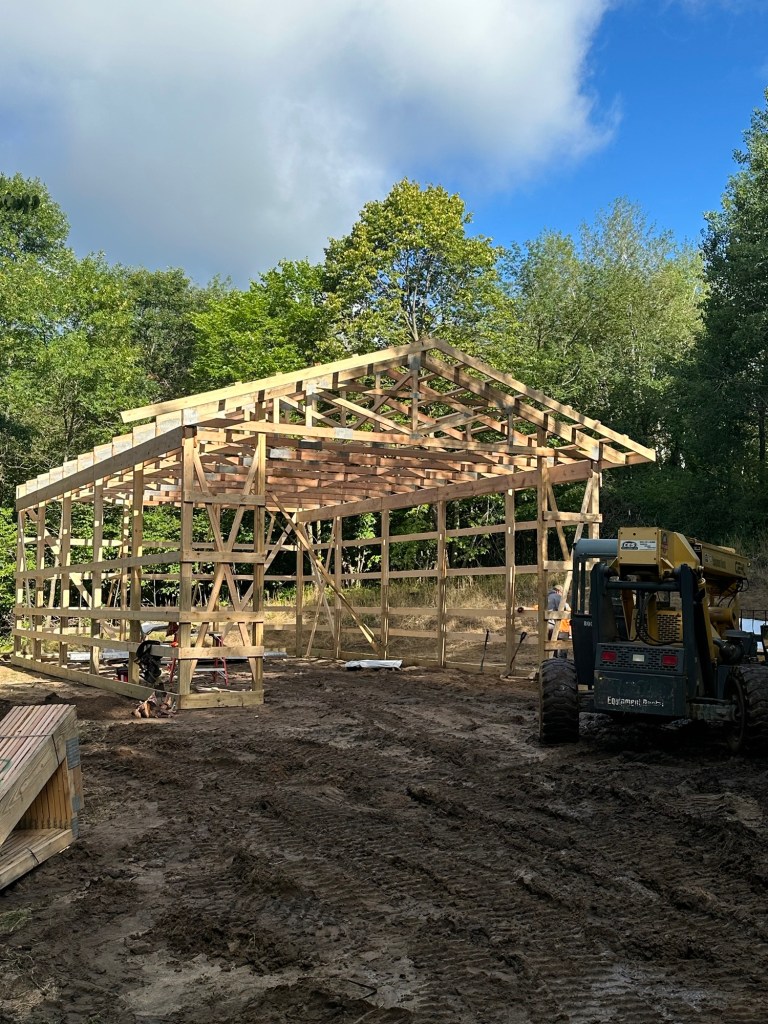
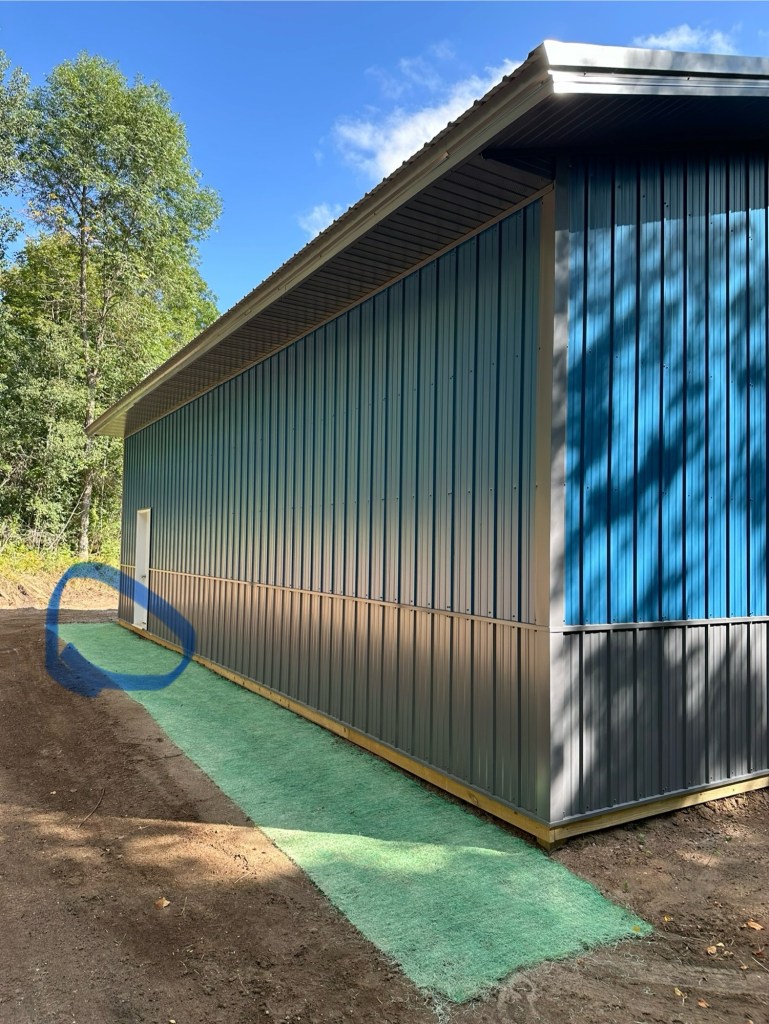
Building a new structure is a process!


Even a small project like this shed involves: structure permit, earth moving permit, excavator, township road approach approval, deliveries, the builder’s crew, garage door guy, electrician, concrete guy, and state electrical review.

All in for what you see (excluding land cost) $63K.

Artificial price Alteration

A few people were talking in the office the other day about how small their electric bills were due to the use of solar panels. One gentleman disclosed that the bill on his home in Arizona was barely above what would be typical for running standard kitchen appliances. This was when his air conditioner was continuously running to beat the hot desert sun. The Minnesota home was squeaking by with being charged an electrical bill that was less than most streaming services. These are wonderful endorsements for an eco-friendly real-estate-related energy application.

A group of realtor types don’t think word-of-mouth stories like these are enough to spread the word about eco-friendly energy use. They want the dollars saved through higher efficiency and more environmentally positive energy use to show up in the numbers. If a home has a certain level of insulation or a particularly efficient set of appliances, then the market should bear a higher price for that property, they reason. So instead of trying to find it in the price determined by buyers and sellers in a meeting of the minds, they suggest appraisers add a tweak post-sale. When in doubt- fudge it, I guess.

The reality is that the benefits of newer mechanicals and construction are featured in price. The reduced electric bill from solar panels is in there, too. It’s just not as standout noticeable as some people want. Therefore, I suggest they spend their efforts on another end to this issue. The focus should be on hyping up those communities where the ethos of the problems is alive and well. More people will be on board if they feel the acceptance of the norm by others. Start in the middle and work out.

I’m not sure utility bills and insulation thickness are the lowest-hanging fruit. Proper disposal of all the old appliances, depleted mechanicals, and construction debris seems much more problematic. Think of the rusty wall heater in the basement or the moldy knotty pine paneling from fifty-odd years ago. Face it, people are bad about staying on top of clutter; part of this is disposal.

Start a movement- clean out your house!

Popular history

Plymouth MN’s historical Town Hall

Our parks board meeting was held at the historic Plymouth town hall this evening. The building had been decommissioned in 1960 (when everything old was out), neglected for decades and then rescued in recent time by a bunch of friends with civic spirit. Around six years ago they turned the project over to the city, their age pushing them onto another phase of life.

It’s been a huge project. The structure’s exterior was in need of significant repair. On the interior worn plank flooring, wainscoting and an elevated lectern were as thick in dust as in appeal. It was hard to see the details past the moving boxes stacked high and low. Apparently donations to the society were not turned away, nor sorted for local interest.

A fine historian has been busy for the past year doing a lot of house keeping. The walls are crisp and the flooring swept clean. There are historical vignettes throughout. The enclosed back porch is set up as a research area and study- a pleasant and inviting space. Professional cabinets hold artifacts in the lower level. He’s really brought the project forward.

He relayed the most frequent question people bring them is regarding the history of their property in Plymouth.

Data Point of the Day

OMG

The presidential debate has actually been worth watching.

The moderators are doing a good job. The candidates are acting fairly presidential. They dodge the questions equally. They preach from their notes a fair amount. But there is still new information being talked over. There are glancing insights to new angles of old problems.

This is a definite improvement over politics in the past ten years.

Ownership Issues: Parking vs Water

This post draws a comparison between charging for parking on city streets versus charging for water through city pipes. The thought process is that people willingly pay to have potable water at the turn of the tap but object to renting a spot on a city road to leave their car.

It really comes down to ownership issues. It’s clear who owns the water system infrastructure. The cities maintain the lines in the street to the hook-ups. The property owners maintain the pipes through their front yards and their properties. Water is delivered and metered so that people pay based on their usage. But no one owns the water. People pay for the maintenance of the public system and the purification process.

On the other hand, city roads are publically owned. They are free to use by everyone. They are paid for by residents. So to exclude people from use by imposing a payment signals a change in ownership structure.

People often gather together to share on-going utilties. That’s the idea behind home owners associations. Individuals who no longer wish to mow their lawn and look for a roofer when the time comes, enjoy sharing those expenses and management with others. Whether to pay for clean water, garbage pickup or electric bills, the monthly useage payments is the sensible means of pecuniary support.

When it comes to the use of shared land like public parks, trails and streets, it is difficult to determine a proper amount to meter out on a monthly bases, and it is abrasive to be exclusionary.

Bloodlines

Ayaan Hirsi Ali starts her life learning about her tribe. (From her book Infidel)

My grandmother nods, grudgingly. I have done well, for a five-year-old.

I have managed to count my forefathers back for three hundred years the part that is crucially important. Osman Mahamud is the name of my father’s subclan, and thus my own. It is where I belong, who I am.

Later, as I grow up, my grandmother will coax and even beat me to learn my father’s ancestry eight hundred years back, to the beginning of the great clan of the Darod. I am a Darod, a Harti, a Macherten, an Osman Mahamud. I am of the consort called the Higher Shoulder. I am a Magan.

“Get it right,” my grandmother warns, shaking a switch at me. “The names will make you strong. They are your bloodline. If you honor them they will keep you alive. If you dishonor them you will be forsaken.

You will be nothing. You will lead a wretched life and die alone. Do it again.”

The importance of knowing one’s family lineage becomes a life-and-death matter about midway through the memoir. The country is falling apart. People in flight gather at Somalia’s border with Kenya in hopes of crossing to safety.

To be tied by blood is to be part of a large safety net. There is an obligation to aid and rescue. There is an obligation to support single women and provide housing. It’s a group thing.

Goosing the Group

Say there’s been a lot of local advertising lately about universal free school lunch for children who attend public schools between kindergarten to twelfth grade. A casual observer would think this is worthwhile, admirable in fact. Now what if the statement was broken down to reflect various groups in the public schools. Disadvantaged kids whose families earn below a certain income have received free school lunch (as well as added meals like breakfast) since the 1940s. In 1946, Harry S. Truman signed into law the National School Lunch program.

The qualifications for who qualified for the subsidy has undoubtedly been expanded. But the group of children who received subsidized free lunch and those whose families were sending in checks every month to the lunch ladies were not the only two sets. There was another group of kids who were always on the verge of being turned away from eating in the cafeteria. This group belonged to the families who didn’t qualify for free and reduced lunch yet did not choose to pay for their children’s food, leaving their student in an awkward position over the lunch hour.

Occasionally, a wealthy parent or a coach would cover a bunch of unpaid lunch tabs. But universal free lunch definitely takes the plight of the cafeteria workers versus the delinquent parents off the table.

Still, to promote a policy without a proper definition of the groups is misleading. To then claim the moral high ground as if the policy were the first to feed those who are truly disadvantaged is a bit much. It’s an accounting trick. Now, rich families get free lunch too.

Group disclosures please.

Time Segments

Has a claim in a post ever held you up as false, so you take a closer look and realize the starting and ending spot on the x-axis of the graph is a carefully curated time segment? Take crime reduction, for instance. Most people would say crime is still up. Then the claim comes around that no-no-no, it is, in fact, down thirty (or some dramatic number) percent. A closer peek at the graph shows tracking starting at a peak level of crime following the 2020 riots. This seems like one of many mis-speaks floating around these days. It’s up to the public to be wary of their sources of information and look a bit closer at the graphics.

Other than being misleading, different time increments can convey a message with an undenial punch. A ‘then and now’ approach provides a magnitude which could get lost in averages. Then segmenting the population between two groups in the ‘now’ leverages hope of a future in the making.

Sarah Paine, a war historian and strategy professor at the Naval War College, infers another use of time. (For those interested, I suggest you watch all of her videos.) This one is interesting as she names this time element of a strategy “half-court tennis.”

By imposing tariffs on foreign goods coming into the country, there is a lack of consideration of the ensuing response from other nations. The analysis happens in time segment 1, and by time segment 2, a very different outcome results.

So what are the proper uses of time segments in presenting and evaluating outcomes? Is there a natural cycle that needs to be observed? Or a disclosure of some type? Do all defence strategies need full courts? What about evaluating social indicators like health and education?

Plight of the Peasant

Tolstoy spends more pages telling us about the Russian aristocracy than the serfs, but when he does describe them at work in the fields it is some of his most beautiful writing. Being the curious type, I did a little digging and found this excellent paper on the micro economy of the time. Micro-Perspectives on 19th-century Russian Living Standards provides a widespread overview of the prices in the years following the emancipation of the serfs.

Their finances weren’t great- but according to this paper their income was sufficient to purchase enough food and basic living utensils. What messed things up for this class of people which constituted eighty percent of the population, was the failure under land reform to allow private ownership.

Historians of this period have come to very different conclusions regarding the impact of these social and economic changes on rural living standards. A long tradition in Soviet and Western scholarship views the emancipation and land reforms as re-imposing constraints on the peasantry that amounted to a new form of serfdom. Peasants were assigned formal membership in land communes, which continued to be characterized by collective control over property rights and joint liability for land and tax obligations. According to this literature, the external burdens
placed on peasant communities remained exceptionally high and even exceeded those imposed under serfdom. Tied to such obligations and subject to the whims of communal decision-making, peasants were unable to improve agricultural productivity, freely dispose of their land, or leave agriculture for industrial work. These restrictions kept living standards low and led the agrarian economy into crisis by the 1890s.

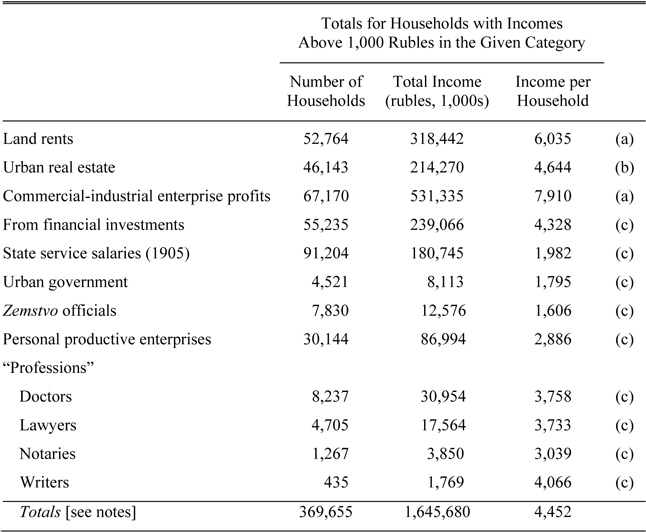
This paper, Russian Inequality on the Eve of Revolution, focuses on inequality in Russia. There is plenty to talk about. The chart I liked best from the paper is this one which shows that writers made as much as doctors and professionals. At least that seems like an admiral priority.

The demand is there

Now consider the supply of a residence hall with services. Looking for a location with uptapped capacity. See the arguements here, here, here, and here for the use of this site.

Clashing Commitments

I’m really enjoying Ayaan Hirsi Ali’s memoir Infidel. In part because I also spent the early 70s in the Horn of Africa and remember the turmoil she describes. I can visualize her and her siblings playing within the compound of the home. Stories of soldiers showing up at homes to question people or haul them off to jail were part of the news the house workers would share when they reported for duty in the morning. It was an unsettling time.

Her parents’ story is daring. After many years being held as a political prisoner, her father was aided in a successful prison break. He fled to Ethiopia. Her mother then went to work at securing false passports for herself and her three children. When asked where she wanted to reunite the family, she chose Saudi Arabia.

My mother didn’t want to move to Ethiopia, because Ethiopians were Christians: unbelievers. Saudi Arabia was God’s country, the homeland of the Prophet Muhammad. A truly Muslim country, it was resonant with Allah, the most suitable place to bring up children. My mother had learned Arabic in Aden; more important, she also imbibed a vision that Islam was purer, deeper, closer to God in the countries of the Arabian peninsula. Saudi Arabian law came straight from the Quran: it was the law of Allah. Inevitably, the life of our family, reunited in Saudi Arabia, would be predictable, certain, and good.

Although their life in Somalia wasn’t sophisticated, they had many freedoms. And thus the move to Mecca and then Riyadh was oppressive.

But as soon as we left the mosque, Saudi Arabia meant intense heat and filth and cruelty. People had their heads cut off in public squares. Adults spoke of it. It was a normal, routine thing: after the Friday noon prayer you could go home for lunch, or you could go and watch the executions. Hands were cut off. Men were flogged. Women were stoned. In the late 1970s, Saudi Arabia was booming, but though the price of oil was tugging the country’s economy into the modern world, its society seemed fixed in the Middle Ages.

Women were not to leave the home without male companionship. Yet she did. There was shopping to do and kids had to be taken to school. Thus she was heckled by neighbors and degraded. Yet she still persisted with the choice to give up liberties in order to feel she was leading the good life.

I think there were times when she was happy: cooking in the evenings, her family around her. But how many of those evenings did she have? Sometimes, at night, I would hear my parents talking, my mother listing all the ways my father had failed her, her voice tense with rage. Abeh would tell her, “Asha, I am working to give us a future in our own country.” Or he would say, “These things wouldn’t happen if we were living in a normal country.” Abeh never liked Saudi Arabia and always wanted us to move to Ethiopia with him. But my mother wouldn’t do it: Ethiopians were unbelievers.

Clips

Clips are great. They are short portions of a longer piece which give you just a taste of the interview, usually with a punch, which makes them fun to name. This segment from Dwarkesh Patel’s interview with historian Sarah Paine could be titled: Dealing with a Double Downer

Or this one with geneticist David Reich: Isolation is to Elimination what Integration is to Transformation,

Dwarkesh is a super interesting host.

Klute- Movie Review

I hadn’t heard of this 1971 movie with Donald Sutherland and Jane Fonda. The neo-noir thriller is a movie of its time. The blocky framing in the cinematography provides a modern backdrop, while the lens still captures striking panoramas of skylines. Words like “freak” and “square” stand out in their use, which has been commonplace. Whereas when Fonda says, “It’s important to be able to let it all hang out.”

The cuts to Fonda’s counseling sessions with her psychologist are interesting in framing women’s issues of the time. Baby-faced Jane explains that prostituting herself is the only way to feel she is in control (over a man). The ease with which the actress becomes the activist face of women’s issues in the US is easy to understand.

Donald Sutherland is fantastic in this film. Fonda got the award nomination, but I doubt it would have happened without his strong performance. The scene where the two make some purchases at a fruit and vegetable stand is so well done. They feel like a couple.

On a sidenote, Ann Roth is responsible for the costumes.

A game called Ownership Issues

There are times when its seems necessary to ask the question: ‘Who owns that?’ Owners are the ones who hold the keys of entrance and admission as well as how something is used. So, for instance, if a local gang has taken over a city park, they have taken a grab at ownership privledges without the paperwork. Hence it reasonable for the residents of the city or their police force to remove the gang. But the way some stories are told, or some policies are made, make it difficult to determine, who owns that.

For example, when a portion of the federal interstate is up for reconstruction in the coming years, residents who live near the traffic artery use political activism to voice opposition to additional lanes. Do folks who live near a freeway, train track, or airport have disproportionate ownership rights over the rest of the public, which makes their voice disproportionately louder? What share of the project is allocated to the federal purpose of connecting all states by a freeway system and what portion is to be shaped by the opinion of local residents, if any? Who owns the road?

Calling out ownership versus voice will be an ongoing game: Ownership Issues.

Price Signals

There’s a local story circulating through the press about increasing the daily per diem for jury participation. Blois Olson writes an informative daily newsletter, Fluence Media, and here is his explanation:

The daily rate is too low to be competitive against even the minimal paid job, so it’s difficult to follow the logic that more money would be enough of an impact to draw in this segment of the population. After all, the others who show up aren’t happy to be there either. Some have delayed more than once to avoid the inconvenience to their daily lives.

So why do people show? Somewhere along the way, people who are meaningful to them impose it as a duty to support an existing system. You have duties to your family, for instance, like visiting the elderly in care homes. You have duties to a level of civic decency in your neighborhoods, like not playing your Elton John albums at full volume while lounging on your deck. You have duties to your workmates and so on. You give to generate a pool of goodwill which eventually comes back around.

Jury duty meets an even higher standard for some, as they are live participants in a system that affects their lives. Perhaps that is why they shy away from it. They don’t want to be asked uncomfortable questions. Yet, it is through participation that their input is recorded. Showing up is how the game works, and that is the message, not pricing, that needs to be sent out.

Bald Eagles

A majestic bird that is easily identified by its size and how the light causes a flash of white on its head or tail feathers.

Choices between time

One word that distinguishes the periods is intertemporal. Here’s a straightforward definition:

Then there’s the distinction of choosing between different time periods and thus enhancing the time span with the outcomes of a choice which one might infer comes from action.

Whereas Wiktionary’s definition keeps the specifics loose and says intertemporal includes any relationship between time periods.

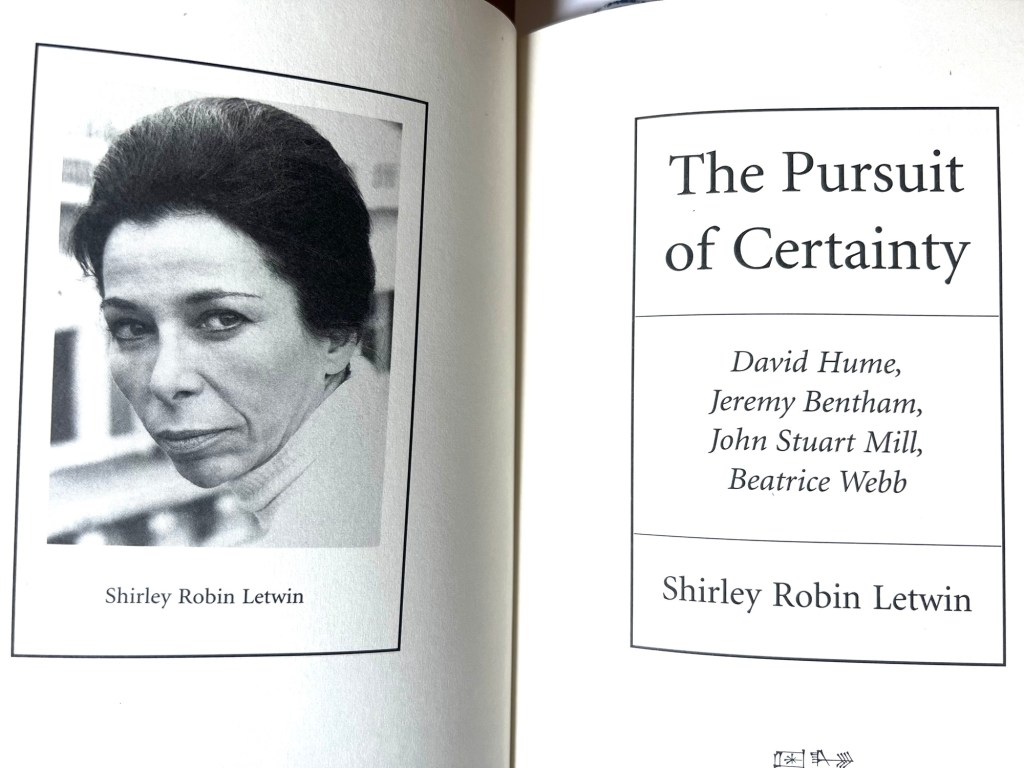
Letwin talks of David Hume

David Hume, a member of the Scottish Enlightenment crew and good friend to Adam Smith, was a practical sort of guy. Perhaps it was his good sense that kept him out of the universities and engaged with a broader, more genial audience. He wrote on many topics. Fortunately, people like Letwin parse through the material to pull out interesting bits like this one.

But if the politician had to be in a way mediocre, he had also to be thoroughly civilized. Civilization was not the same as morality. Hume refused to divide men into good and bad; in the history he rounded off each portrait with a neat balance of virtues and vices, that fails utterly to give a picture of a living man, but makes it clear that he was neither saint nor villain. For Hume would allow no character to be “wholly bad or good; tho’ the prejudices of party make writers run easily into the extremes of both panegyric and of satire.”

So often people are painted as all evil or all angel when we all know, as David Hume tells us, there’s at least a bit of both in most everyone. Then what should we look for in evaluating the political performance of public servants who are apt to be swayed in both directions?

The political morality Hume demanded is in a way far more difficult to observe than the extremest puritan austerity. For it is easy either to follow some set of rules absolutely or to ignore moral qualms altogether. It is easy also to try to establish a perfect city, come what may. But the man who tries to adapt himself to circumstances and yet preserve his integrity, to recognize new problems without destroying law and order, has an endless task. He is eternally obliged to balance one thing against another, to distinguish and compromise, and all this without falling into moral indifference. Perhaps most difficult of all, Hume’s politics assumes great personal resources, an ability to find meaning in life for oneself, and to require from the state nothing more than a convenient setting for private enthusiasms.

A Joy Barometer

You know how you just stumble into a good situation sometimes? I’ve had the good fortune of reading Anna Karenina with a bunch of smart people. The conversation has left more questions unanswered than answers securly rendered. Which leads to the most lovely contemplation throughout the day.

One continuing thread of inquiry over the four weeks has been around the feelings, aspirations, and fulfillment of joy in the rich selection of characters in the novel. How the characters are able, or how they fail, to pursue their best lives. What brings them pleasure and satisfaction versus what brings them torment and madness.

Some in the group have observed that joy bubbles up as part of process of search, discovery and consumation. Kitty, for example may not have felt much joy when a suitor she desired, Vronsky, turned his affections toward Anna. In fact she made herself sick with shame and dismay to the point that her parents whisk her away to an overseas location. A joy meter would register below zero for Kitty at this point in the story. Yet later on in the novel she too finds love.

Is a joy to be measured in the instant? Or over a period of time? Is joy to be measured in stages of life?

Anna was joyful in her first marriage until she met true love. Her passion was all she needed as long as she and Vronsky could steer clear of the judging eyes of greater society. She clung to the joy in the steady state part of the relationship, making every attempt in her personal appearance and ambitions to be attractive. But in her isolation from female companionship and social interactions she looses touch with reality and is driven mad.

Is this the moment where the measure on her joy barometer is the best representation of her life?

Main Street

I swung through Sauk Centre recently and took a picture of the birthplace home of writer Sinclair Lewis (1885-1951). It’s hard for us to imagine how popular his books, Main Street, Babbitt, and others were back at the beginning of the twentieth century. They were immediate hits, turning the small-town boy into a millionaire.

He was born to a doctor and his wife in 1885 in this home in a town which then was home to about sixteen hundred residents.

The detail work on the structure is notable for a home of this period. The balustrade along the porch roof, a frieze below its eaves, the dentil work, and scrolled corner brackets. The windows are topped with a cornice and sided by shutters. One must wonder if immigrant labor from the old country was put to work in creating such ornate structures. The timber most likely arrived on the railroad tracks which ran through town less than three blocks away. The rail bed is now a regional bike trail facilitating a different type of traffic.

It’s a handsome home. At the time it was built, there was no electricity. That would have come later. The roads were dirt, and in the back stands a structure more attuned to a small barn, most likely designed for a carriage. The turn of the century brought all sorts of technological improvements from plumbing, to windows, and lighting. Foundations changed from dugout cellars to functional deeper spaces. But whenever I see the attention to artistic accents on the Victorian era homes, I have to think there was an extra pleasure in their creation.

The town is only three times the size it was back when Lewis exposed the stifling discomforts of small-town life. In a way, he is similar to his peer Zora Neale Hurston (1891-1960), who wrote about her youth community in Florida, telling of insights some would prefer not be exposed. Norms are meant to be understood and followed but not openly discussed in good company.

How Will I Know?

In 1986, a young Whitney Houston captivated audiences with another breakout hit, How Will I Know. Before she gives in to her passionate feelings for the object of her desire, she wants reassurance. She wants to be sure the love in her heart is not leading her astray.

In the refrain, she tells us, ‘Don’t trust your feelings.’ Apparently, the moment of passion is not always a reliable barometer for stormy weather. ‘Love can be deceiving.’ When triggered by a natural impulse, the urge to rush in may lead one off course.

Following your heart, or your passion, is a tricky business. The natural inclinations to react in an altruistic manner may also lead to misgivings. How do we know who should step in when a family is in turmoil? Should it be presumed that a vagabond would be happier in a group home? How do we know who truly needs help and who is an opportunist?

The video tells us more. There’s a moment when all Whitney’s peeps are on the phone. I assume she’s calling her gal pals for advice on the object for her affection. She asking them, how will she know? And I think she is on the right track. Most people look to their peer group to decide how they know who needs help and who’s fine in the moment.

Is MN a He**Ho*e?

This seems to be a popular question these days in light of the new US VP candidate. Those who would like to stress the decline in the quality of life in Minnesota post photos of homeless tents cropping up on vacant forty-foot lots in the city. The chaos, litter, and disorder represent a decline in street life since the summer of 2020 following the riots. The images are current. There is an ongoing whack-a-mole operation underway as neighbors have become tired of the issues around tents in their communities. The city moves them from one location only for them to relocate ten blocks away.

Those who like to stress the beauty of Minnesota post this type of image:

This portrait of a city framed in greenery, wildflowers, and water is not at all unusual or hard to come by. The Mississippi runs through the city, and twenty-two lakes lie within its boundaries. One hundred and eighty parks surround water features, old-growth trees, or grassy play fields, and fifty-five miles of walking and biking trails connect the system. The over seven thousand acres of public space started in 1856 with the donation of Murphy Square.

But here’s the argument that the recent unrest is unsettling. What people point to as the best features are those which were initiated over one hundred and fifty years ago. These whispers and aspirations took decades to initiate, then decades more to shape and form, then decades more to maintain and develop into a system for perpetual use. The photo exemplifies consistent and long-term commitment to this support.

Posting an image of an urban amenity that was decades in the making is an argument against the recent tolerance for civic destruction and unrest. There’s only so much public capacity. If it is drained in one area, then eventually, over time, other public amenities will fall to the wayside and deteriorate.

A New Standard

If people can’t handle the truth (as Jack Nicholson is known to have said) then what will the new standards be? When will the slip up, the mispoke, be called out as a flat out lie?

It is not uncommon for people to misspeak. In thinking about the next thing to say, instead of “blue” you say “red”, or instead of “east” you say “west”. Few will object to a proper slip-up. It’s unintentional. It’s sloppy but harmless. But what about slipping up twice on the same word, or twenty times? When does the use of an incorrect title which embellishes one’s position and stature in a hierarchical system become more than an oops?

There should be some rules to such things. After all, you can’t go around calling out “liar, liar, pants on fire.” Nor is it always appropriate to blurt out a truth. It’s like the spouse who steers clear of the question, “Honey, do I look fat in this outfit?” Here a white lie gets you through the moment of insecurity and lets the evening proceed without an analysis about what one should do about a few extra pounds. Here no one gets hurt, in fact the couple is better off.

So is that the new rule? If no one gets hurt, letting a deception fall to the wayside is not a big deal? Who would care if your twelve year record in the girl scouts was real? Well, if you were making decisions about the future of the scouts, people in the audience may place more value on your opinion given a long-standing relationship with the organization. That’s how people make decisions. They gather information from reliable sources before taking action. Most feel firsthand knowledge is more reliable than outside opinion, so a long-standing interactive relationship lends credibility to a point of view.

It’s a theft in a way. People rely on product information before they make a purchase. They take action based on the material attributes of the product. If people are choosing their public goods, they should have access to a similar level of product information to a degree of reliability. Where the public will settle on the acceptable level of truth-telling is yet to come.

Bad advice

I’m getting a kick out of the weird word. Being weird is not that hard to do, especially when people give you bad advice. Like, always tell the truth. The truth in business is often not what your boss really wants to hear. Nor is it what the local politicians want written on the front pages of the paper. They want the narrative, whether it is the one that makes the boss look good or the politician. They need the narrative.

Asking for an explanation is also not popular. People do not want to explain why they do what they do or they prefer what they prefer or they feel inclined toward a certain outcome. It’s simply understood.

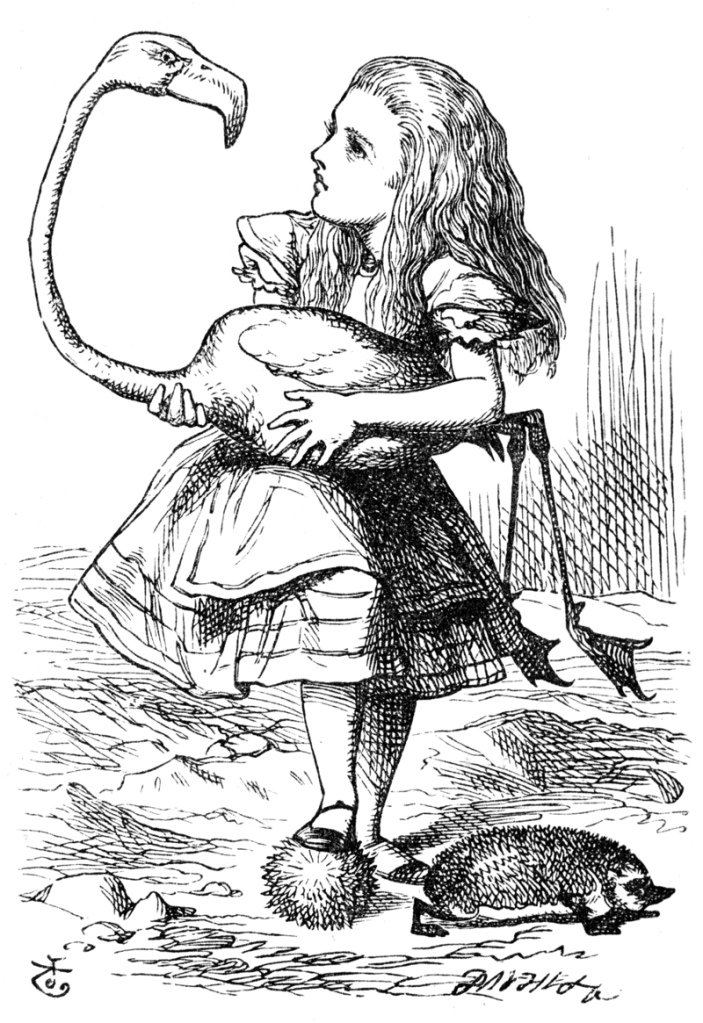
I like the whys. I’ve spent my life asking why. Here I am at a young age looking for a response from a nice lady in red. My one brother sings ‘la-la-la-la’ so he doesn’t feel the discomfort of the lady grasping her ever-tightening hands. My other brother looks off, cute as aways, playing the knave. Undoubtedly the lady in blue is thinking, ‘she’s an odd little girl.’

I don’t regret being weird for a minute. Looking for answers is the most interesting pastime.

Elon wants an Efficiency Commission

How would that work exactly, an efficiency commission? In the business world, when the system is open and monopolies aren’t gumming up the flow of things, new entrants keep prices lean by undercutting the legacy companies, while maintaining a high enough price so as not to go bust. This tension is how people trust that they are paying a competitive price.

When groups or governments come up with pledges to jointly pay for goods and services, the obligation to purchase distorts a more fluid and flexible exchange. It also can set up a fictitious demand, as in the Feeding our Future Fraud case. The knowledge that the funds would arrive gave a financial incentive to fabricate the hungry kids who demanded the meals.

Another inefficiency appears in the form of joint missions, also known as mission creep. For instance, a government acquires a property in poor condition. Instead of bringing it up to the standard that most of the nearby residents would do if it were their home, the government entity goes over and above, not by a little but perhaps by three times the expense of average expectations. “Because it is the right thing to do.”

There are two counting mechanisms that could help an efficiency commission discuss examples such as these. The first is to count the population of the end recipients or receivers of service. A simple demographic count of the kids meant to be served would have immiediately revealed the fraud that led to the theft of $250 million from Federal subsidies. The state demographer has those numbers. It’s not hard to add.

The second example requires a comparison to the average typical repair for the area. Many home repairs and services vary in price. Should a homeowner go with the highest efficiency model, or is 80% high enough? It seems that the likely answer lies with the community of like-minded folks and not the bureaucrat. Wouldn’t it make most sense to spend the money in the fashion that a conscientious owner in the neighborhood would choose to do? After all, they’ve gone through the scheme of pricing and comparing.

Those in charge of public dollars should be vigilant to avoid being taken for a ride, as well as in line with the spending expectations of their constituents.

Emotional response to the Nat’l Anthem

Basketball player Brittney Griner spent ten months in a Russian penal colony for being caught at the Sheremetyevo airport with e-cigarettes with cannabis oil in her luggage. The experience may be the reason for her emotional response to the playing of the national anthem while on the podium at the Olympics.

It’s easy to take for granted what is so familiar to us. Coming into contact with dire regimes across the world most often causes people to appreciate the standard of living in the US, despite the problems here. When it doesn’t, be wary.
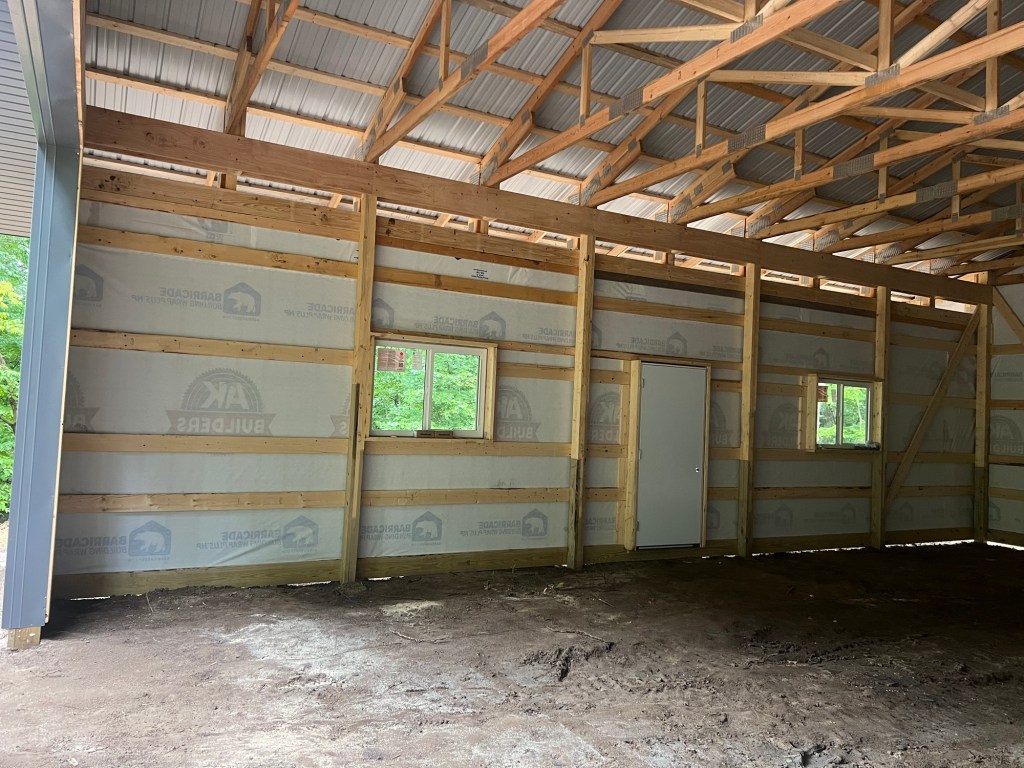
I hope all goes well in the primaries tomorrow.

Absolute Power- Movie Review

I really enjoyed this movie, and it’s been a while since I’ve hit on a winner. Full disclosure, I’m a Clint Eastwood fan and found it by searching his large portfolio of films. I also like Laura Linney, who did a fine job. Gene Hackman, Ed Harris, and Judy Davis all came through in their performances as well.

The story is based on a book by David Baldacci and will keep your attention. I also appreciated the balance of enough show and tell to make a point without overt violence or gore. A little can be a lot, and certainly enough.

The Neighbors- Hospital repurpose con’t

The most valuable aspect of the Fergus Falls Hospital is the apparent lack of objection by the community to being neighborly with a spectrum of individuals under the auspices of mental illness. For over a century, the facility housed a tenth of the town’s population.

Imagine, for the purposes of conversation, that returning the hospital to a newly renovated in-patient treatment facility would allow for a capacity of five hundred residents. Now imagine the alternative. How much time would be required at city council meetings to obtain neighbors’ approval to house five hundred residents in group homes of fifteen residents, or thirty-three sites. It’s mind-boggling, as more often than not the site will not pass the NIMBYs, and thus the process would start over and over again.

The stories told during the tour of the historic complex included tales of interaction in the town of Fergus Falls. Some residents simply walked off the campus and were not pursued. Some residents were gregarious in their interaction with visitors on the long grassy lawn in front of the entrance of the building. But there they coexisted, the residents who lived in the facility over one hundred and twenty-five years and the townspeople of fifteen thousand.

I overheard bits of conversation after the tour guide had wrapped up his talk. A nurse who had started working at the hospital in 1977 was relating some of her memories to a cluster of silver-haired women. A man of a similar generation shared that he had lived on site in his youth. The reality of people’s stories is never as frightening as what is envisioned by a neighborhood asked to become host to this group of society. The reality is far more banal and empathetic.

It’s hard not to believe that the hospital brought many a profession or at least a stable job with a pension. Although not near a bustling metropolis, the area has many beautiful natural features in its lakes and open spaces. For those interested in the outdoors, hunting and fishing, there isn’t a better place to be. For those who enjoy a nestled small town atmosphere or space that acreage living affords, this is where you can find both. A housing and professional facility for those who now live under bridges and in tents on concrete curbs could bring solace to the residents and an income for local residents.

The town not doubt has a mix of good memeories, humorous memories, and undoubtedly some bad ones. But never has it been said or implied that the hospotal closed under pressure from the nieghbors.

Use values for a historic hospital

Before rehabbing a structure, most owners consider how the building will be used. With high vacancies in the downtown business districts, some folks are suggesting the commercial buildings be converted to residential units. It doesn’t take much imagination to understand the impracticality of changing around floor plans from acres of cubicles to one thousand square foot residences with a couple of bathrooms, a kitchen, and outward-facing windows. It’s not impossible to change the use from office space to living space, yet a momumentous task.

The hospital housed the patients, so it is more akin to residential use. The buildings are grand.

There are historic photos of wards lined with beds, which would no longer be acceptable. Instead of 1900 residents, perhaps the space could accommodate 500 in order to comply with modern standards for living space. This would still be a sizeable project. I’m wondering though if the building would appeal to the mainstream population? It seems people would have a difficult time shaking off thoughts of the mental illnesses formerly contained within its walls. Although the structures look like dormitories in a liberal arts college, details like bars on the windows are reminiscent of past occupants.

It seems like the best use for the complex would be for housing folks who are presently suffering from homelessness and mental illness. It’s quite a step up from the tent encampments being dismanteled daily in the core cities.

Local media bias?

There’s been a debate in MN for the past six years around media bias in favor of the Governor and his party. With national and international focus on our fine state, the debate may be settled, or at least fine tuned.

The topic of the day centered around implied combat service by the Governor. Those types of aggrandizements would not have been called out by local media. Now we see full coverage such as this report by CNN.

https://amp.cnn.com/cnn/2024/08/07/politics/tim-walz-military-record-vance-attack

What will tomorrow bring?

Fergus Falls Hospital (con’t)

In a rural county seat, two and a half hours northwest of the Twin Cities, is an arc-shaped building complex that housed mentally ill patients for a century and a quarter. The state hospital was decommissioned in 2007. It is owned by the city of Fergus Falls and now sits vacant, waiting for news of its destiny.

Although the buildings were maintained as long as they were used, a building of that age requires on-going maintenance. Older buildings often are more expensive to keep up as one project leads to another and the standard products and sizes which were used at time of construction are now special orders and customs fits.

Infrastructure, like pipes, electrical and safety measures also age out of their useful life. Take the orange column in this photo.

It reminds me of those chutes they set up in high-rise buildings when they are remodeling. But no, it is not a trash chute. The guide on our tour of the site said there are slides inside those rusty tubes so residents could slip out and evacuate in the event of a fire. Somehow, I’m not sure if they would still meet code.

Renovations cost money. New construction costs even more money. Here’s a project in Austin with no historical appeal (those roof lines are very unpopular in MN!). The project still costs $600K per unit.

The long and the short of it is that the material condition of the buildings does not unduly affect their commodity value, if you will. The age of the structures should not deter a redevelopment in and of itself. The numbers will most likely fall in line with other residential redos.

MN Mental Health update

Here’s the first page of a snapshot review prepared for the MN Senate Committee on Health and Human Services.

This data is for children specifically, but I bet the message for other groups is the same. There is a need for more services. The flow, as with many socially supported endeavors, is the lack of coverage leads people to use more expensive services- in this case emergency room visits.

Do more today, to prevent expenses tomorrow.

What to do with an Asylum?

Not just any asylum – one that was built in the middle of a farm field in a small Minnesota town on the railroad line between St. Paul and Fargo. The last surviving Kirkbride Building that was designed by Dr. Thomas Kirkbride: a complex of four-story structures creating an arc to maximize light and hence health benefits. At 700,000 finished square feet (TPT), the Fergus Falls (formerly) State Hospital is a lot to take care of.

If footage is hard to visualize, here are some comparisons as listed by The Measure of Things. The facility is three fourths as big as Alcatraz (960,000), two times as big as the Lincoln Memorial Reflecting Pool (339,000), and half as big as the Pentagon (1,490,000). In addition to the main buildings, there was a power plant, a gymnasium, a workshop, maintenance buildings, a rehab center, a nurses’ quarters, and acres of cropland which sustained the facility.

On a recent tour I captured a few shots.

Over its one hundred and twenty-year history, there were good times and bad. Built before the turn of the twentieth century, at its peak, it housed 1800-2000 patients. The years of overcrowding led to criticism, which in turn was addressed. The tour guide from the Ottertail Historical Society narrated a balanced set of stories from personal experiences as written in journals, to newspaper articles, to reviews given to the facility from state inspectors.

State-run institutions became an unpopular means of managing mental health patients starting in the 1980s. The trend at the time was to return individuals back into the communities for care. The hospital’s population decreased until it was closed by the state in 2007. Shortly thereafter, the property was sold to the city of Fergus Falls, a community of 14,000.

The conundrum now is what to do with these structures? A commercial building on an acreage site would get bought out and redevelopped, as is underway at the Prudential Site. Even when the buildings are in decent shape, the value of the land makes the numbers work to pull down the structure and replot the acreage for further development.

Over a few posts, I’ll discuss why this scenario is different. Of course, the location in a rural area, an hour away from the Fargo airport is a factor. The condition of the buildings comes into play in redevelopment costs. The historical designation impacts the outcome. So what is it? What is the highest and best use for a historic asylum?

Tolstoy- the public and the private

Upon a recommendation from a friend, I’m delightfully plowing through Anna Karenina. I had yet to tackle the great Russian novelists, and now I see I’ve been missing out. Tolstoy wrote AK over a four-year period in the 1870s, with its first publication appearing in 1878. The title may lead one to think the story is only about a socialite who betrays her husband, but this is not the case. Over the nearly one-thousand-page book, Tolstoy touches all layers of Russian society and a great many facets of human nature. It is a remarkable book.

On more than one occasion the author distinguishes between private interests and public concerns. Levin is a country squire who is preoccupied with bringing agricultural pursuits to a new level. He contemplates all angles of farming. In particular, he expresses a need to invigorate the ambitions of the labor force. Tolstoy depicts various arrangements throughout the novel, including a family farm, hired workers, and leaseholders. It’s important to note that the emancipation of the serfs happened in 1861.

He is desperate to engage the workers for his estate, to key into their motivation. Here is how he frames his ambition:

I need only push on steadily toward my aim and I shall achieve it,’ he thought, ‘and it is worth working and striving for. It is not a personal affair of my own but one of public welfare. The whole system of farming, and above all the position of the people, must be completely altered: instead of poverty – wealth and satisfaction for all; instead of hostility-concord and a bond of common interest. In a word-a revolution bloodless but immense; first in our own small district, then throughout the province, throughout Russia, and the whole world-for a good thought must be fruitful. Yes, it is an aim worth working for! The fact that the author of it is myself, Constantine Levin,…

For Tolstoy, a combination of motive in the private and the public is possible.

Entrepreneurial Philanthropy

Government is really good at saying ‘no.’ Rule-making is all about saying “don’t do this” and “don’t do that.” Sometimes solving problems means saying yes. Like, yes, we can fix that stinky, polluting car. In steps the philanthropic entrepreneur, Environmental Initiative.

Launched in 2017, Project CAR works with local car repair shops to cover the cost of fixing emissions control and exhaust systems for qualifying lower-income Minnesotans. Nearly 600 cars have been repaired since the program began, eliminating 32 tons of emissions. Project CAR is focused on fixing the estimated 25% of passenger vehicles that cause 90% of vehicle air pollution in Minnesota.

Folks who are driving the car which contributes the most to declining air quality are also stretched by other priorities.

Cathy Heying, executive director and founder of The Lift Garage, an established partner of Project CAR, praised the program’s expansion, expressing enthusiasm for the collective impact such partnerships can generate. “Customers come in with all sorts of needs, and, often, environmental impact is not their top priority due to cost constraints. So, this program is amazing because customers want to do the right thing for the environment and this program allows them to do that while also improving their car’s functionality,” she said.

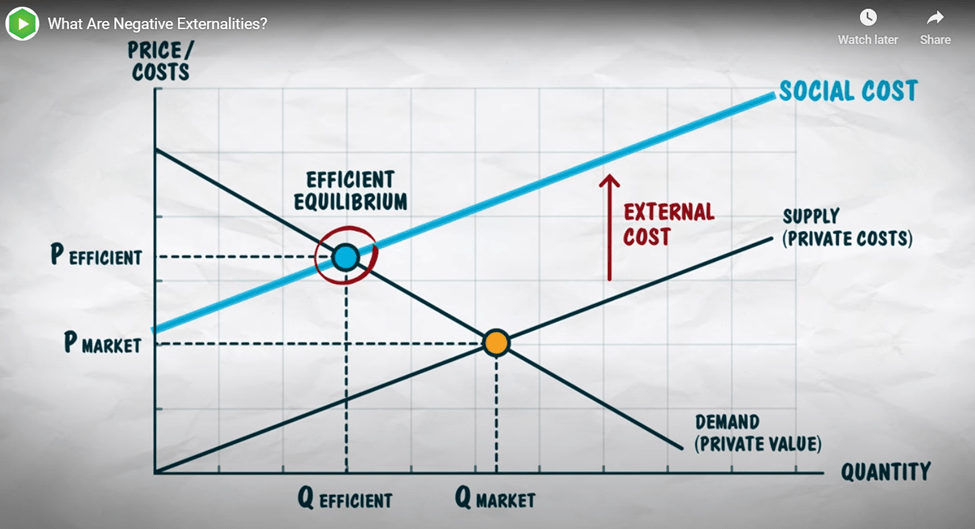
This non-profit ends up offering a two-for-one. They provide people with transportation to go about their daily lives and they reduce a negative externality to the local public. All this without interfering with the owners’ everyday flow of finances and obligations.

What other low hanging fruit are our there for the entrepreneurs to capture?

Max Pay for Political Types?

The Hennepin County Commissioners just voted to raise their pay by 49%. Sometimes this is justified, when the starting pay is unreasonably low. A large percent of a very small number is still a small number. But here the Commissioners were already at what people in this part of the US would consider a nice salary.

District 2 member Irene Fernando proposed the pay raise during Tuesday’s Administration, Operations, and Budget Committee meeting. The proposal would increase the current salary cap for commissioners from $122,225 to $182,141. 

According to Fred, this figure is double of the per capita income in the state.

The commissioners stated that this new amount brings their wage in line with other county executives. But is this a fair comparison? Should elected officials be motivated to serve and then draw an adequat salary? Or should the salary be the motivator to run for office?

The Governor chooses to take home only $127K a year. He seems to think that part of the prize is the job, not the wage.

A strong monetary motivation can also produce golden handcuffs. It’s commonly accepted that incumbent county officials (or city coucil people for that matter) rarely loose their position in an election. Their name recognition and familiarity with the constituents often secures their job. Is it a good idea to pay out a salary that would be tough to duplicate elsewhere and thus encourage someone to stick with it once they’ve lost interest in the spirit of the work?

When I was young, I often heard that jobs from teachers to government positions were done with a spirit of public service. That generation appears to have retired from the workforce.

Local Angle- Veep Speculation

Flow

Often, the merits of a transaction are given from the perspective of a single agent in the trade. An assembly line-worker lost their job when the plant was moved to another location. This is bad. The worker suffered a loss. Quickly, within sentences, the effect is generalized to all the workers in the plant, town or even region. The Experience of the middle aged white guy who is difficult to retrain and find meaningful work of the same quality is the catalyst for all sorts of feelings and demands for government intervention.

Do you see the slide? From a valid totaling up of wins and losses for one individual turned into a model involving segments of society.

It’s important to declare which model is in play as this dictates whether the players are individuals or groups, whether the tally of net benefit or loss is assigned to one or to many, and perhaps most interestingly the flow of reaction and counterreaction as value settles in the system. More interesting insights surface when consequential outcomes are looked at in a flow of events.

Think back to the time of the 2008 recession. Say one buyer purchased a home at the peak of the housing market with a three-year adjustable ARM. When the ARM recalculated in 2011, the buyer’s payment adjusted upwards to an amount beyond their ability to pay. Due to the recession, the value of the home had decreased below the mortgage balance. The buyer ends up in a familiar situation at that time and loses the property to foreclosure. This is a clear loss.

But say every other homeowner in the neighborhood had owned their homes for more than ten years. None of them were interested in selling until after 2015. These individuals realized no impact from the value changes during the recession expcept to see their assessed values decline resulting in lower property taxes. As a neighborhood the effects of the recession were uneventful.

In the plant closure story, there were most probably workers who ended up better off for the closure. Perhaps it encouraged them to return to school to achieve an updated skill. At the other end of work life, perhaps someone nearing retirement ended up with a more favorable retirement package. Getting people to think of workers as a mass might be useful for unions, but loses a finess of obeservation for analysis.

It seems, to have a profitable discussion, one must pick a playing field. If you want to pick a town, then the players are all the workers, their economic impact on local services, and the support available through the municipality’s local services. Who netted out what and where did the money settle in time periods 1, 2, and 3 following a plant closure. If there was a draw of support from a higher level of governance, maybe the playing field needs to be moved up a rung to the county level, or to the region within the state. The players then get expanded to blend in other economic agents and their positive and negative tallies.

Instead, the story is usually told like some mid-19th century Russian novel. The peasants were persecuted and the capitalists must be blamed! This is not helpful.

Home cooked food- does it matter?

I say, yes, without a doubt. Home-cooked food is worth pursuing.

I got wind of a family that was going through a rough time, so I dropped off dinner: a pan of chicken alfredo in penne pasta, Brussels sprouts, buns, and a pan of blond brownies (minus a test brownie to be sure it met grade). I wasn’t even out of their neighborhood before I received a thank-you text. And then I heard later through mutual friends that the food was deemed delicious.

An unexpected gift is often a delight. A gift of a meal just as one is getting hungry is bound to taste better than reheated leftovers. Still, I believe the appreciation for the food is in part because it did not arrive in takeout boxes.

If one is a careful counter of costs, then one will be impressed by the price difference between made-from-scratch and prepared foods. It is substantial. There are lots of financial incentives to spend a little time with the church ladies’ cookbooks and fine-tune a repertoire of family-friendly options. I’d guess, on average, the ratio is 1:3 or 1:4, even with substitutes like Subway. It’s simply so much cheaper to learn to cook!

I won’t sugar coat the drugery of the educational experience. The peppering of complaints from the kitchen table of a missing this or a what if you tried that can almost push one over the edge on the right day. The hang time is worth it, though. When they return from college campuses begging you for a home cooked meal you are blessed with one more affirmation that you did something right. Vindication comes in many forms.

An hour of your time for goodwill?

A local writer-comedian asks on X:

Here are some of the eighty-four responses which rolled onto the thread in just a few hours.

  • Compassionate Action for Animals
  • All About Family
  • MELSA for libraries
  • Minneapolis City Soccer org
  • People Serving People (Shelter)
  • Bridging (furnishings)
  • CommonBond Communities (Shelter)
  • Community Aid Network MN (Food)
  • Open Arms MN (Food for critically ill)
  • Planned Parenthood
  • Habitat for Humanity
  • Union Gospel Mission
  • Ronald McDonald House
  • Community Kitchen
  • Political Campaign
  • For Goodness Cakes (Foster Kids)
  • Sactuary Supply Depot (Mutual Aid for unhoused)
  • Animal Humane Society
  • Tool Library
  • Walker Art Ctr
  • CANMN (Mutual Aid with language barriers)
  • The Sheridan Story (Child Hunger)
  • Teen Center
  • Your Mom’s House
  • DC Silver Lining
  • The Crisis Nursery (Child Care Drop off)
  • International Institute of MN serving refugees
  • MN Women’s Prison Book Project
  • Listening House
  • Peace House
  • Minneapolis Animal Care and Control
  • Save a Bull Rescue (Dog rescue)
  • People’s Laundry
  • Second Harvest
  • Face 2 Face Health Counseling
  • Boneshaker Books
  • EMT at the University of MN
  • St Croix Trailblazers (Special Needs)
  • Volunteer Match dot Org
  • Local Elementary and Middle Schools
  • Extreme Noise
  • Southside Harm Reduction Center (Crisis Line)
  • The Bitty Kitty Brigade (Foster)
  • Feed my Starving Children
  • NorthPoint Health and Wellness
  • Minneapolis Institute of Art
  • Fairview Hospital
  • Second Harvest (Food Shelf)
  • Twin Cities Walk to end Alzheimers
  • Caring for Cats
  • Abbott Northwestern Hospital
  • Cardz for Kids
  • Junior Achievement
  • Meals on Wheels
  • Cedar Cultural Center
  • Darts
  • The Open Door
  • YouthLink
  • Pet Haven Mn

The benefit to volunteer hours is that at every donation an individual evaluates the worth of their time against the mission at hand. This anarchist form of dispensing goodwill will never exceed the need and hence avoids fraud. It also is given with the lowest possible overhead.

Zoning is optional

Zoning is not a taking by the government. Zoning is a means for a population to control the neighborhood where they live. Whether they bought into the single-family setting, or whether they zoned the corner bar out of their neighborhood, it’s the neighbors’ call.

There’s no shortage of desire for control. So accept zoning. It’s here to stay.

Philosophy for you and me

That’s what Michel de Montaigne thought about.

Montaigne was not pitying himself; rather, he was using the criticism of more ambitious contemporary works as a symptom of a deleterious impulse to think that the truth always has to lie far from us, in another climate, in an ancient library, in the books of people who lived long ago. It is a question of whether access to genuinely valuable things is limited to a handful of geniuses bom between the construction of the Parthenon and the sack of Rome, or whether, as Montaigne daringly proposed, they may be open to you and me as well.

Vacant Land Registries

Vacant properties are not popular with municipalities. Cities create a vacant land registry to keep a running log of properties that do not host residents. Here are directions from the town of Brookhaven New York.

There is no longer a requirement to submit a notarized application or payment through the mail – it is all available online. The cost to register is $360 for the year and can be paid through our secure online platform.

Please be advised, that any owner, or agent of an owner acting on behalf of the owner, who fails to register a vacant building or to pay any fees required to be paid pursuant to the provisions of Chapter 87, within 30 days after they become due, shall constitute a violation punishable upon conviction thereof by a fine in the amount of not less than $1,000 nor more than $15,000 for each failure to register, or for each failure to pay a required vacant building registration fee.

The amount of the fine implies that full buildings are of value to the hamlet. Perhaps, in part, this is due to the services a resident will take up once they walk up their sidewalk every day to their front door. Perhaps having people come and go in the neighborhood keeps everyone more secure. Here are the benefits as expressed by the bureaucrats.

Registrant’s point of contact will be notified by phone and/or email of issues that may arise such as:

  • Property maintenance (tall grass, litter on property, etc.)
  • When the Town is notified by law enforcement of unauthorized occupancy
  • If property becomes unsecure.

When properties are registered, the Town will have contact information and will have the opportunity to notify the owner/property manager to correct any issues before taking action. This will save the property owner money.

The city of Miami goes one step further and requires the owners post a no-tresspassing sign and authorize their police force to enter the property should a need for their services become apparent.

Install No Trespassing Sign

Once you’ve submitted your forms, you’ll need to install a No Trespassing sign on the property (this can be any sign purchased any where).

Although it may never cross your mind, your comings and goings every day in your neighborhood and place of business are a public service.

Claims about Prices and Income

BTW- National averages are less than helpful. The Great Recession taught us they can be outrightly deceptive.

Let’s talk Internalizing Externalities

All the cool kids are doing it. An externality occurs when an activity with a commercial goal creates a positive or negative impact on parties outside of the transaction. The classic example is the manufacturing plant polluting the water with their waste. The community downstream suffers a negative impact. Or consider a drug dealer taking up business alongside the playground at the local park. The neighbors no longer use the public park which is there for their use.

The plant and all those who benefit from its production internalize a gain from not properly disposing of their waste, which pushes out a cost to the people downstream. The dealer accesses a young group of clients internalizing a gain from his location while the neighbors suffer the loss. But what about the other way around? A small group forms a club to advocate literacy. They offer extra help in the local schools and give out scholarships to new high school graduates. They lose their time, which could have been spent on something else, so that the local youth may internalize the gain from extra tutoring. Perhaps a company agrees to locate to a small town under the condition the municipality brings in internet infrastructure. The townspeople internalize the benefit of the corporate relocation.

All this talk seems to suggest there are groups of people who are either on the inside or on the outside. The lines are porous, but exist. What if there were a group who had gotten a bad rap for an extended period of time – and it was considered beneficial to come to their aid in some way? Wouldn’t it make sense to place them in locations where other groups have the knack of externalizing benefits to others? That way, no direct interference messes with the balance in their lives. The positive externalities show up in the serendipitous manner of access.

Soft or Firm but definitely not Lumpy

When’s the last time you thought about your mattress? Probably when you were out looking to buy one. There are products like that. We are in the market for a new one so rarely that we forget they are a commodity. It turns out, mattress manufacturers are getting hit hard by the slowdown in real estate transactions.

It’s pretty common to hear about the effects of home sales on the home improvement industry. New buyers put around eighty percent of their upgrades into a new home within the first six months of ownership. No moves means no dissatisfaction with the status quo, which means far fewer trips to Menards, Home Depot, and Lowes.

As with many things, it’s a combinations of factors hitting the mattress makers. More and more buyers are purchasing on-line. Victoria Freeman at the Manhattan Institute (MI) writes:

Brick-and-mortar storefronts are suffering the most because mattress demand has recently shifted toward online sales. As shown below, the ‘mattress-in-a-box’ model has risen in popularity – while only 27% of consumers would purchase a mattress online in 2016, 47% would do so in 2020. Younger consumers, who tend to prefer online shopping, are driving this change.  

A change of shopping venue has given an edge to those who ship and are able to undercut price.

In particular, Chinese exporters often sell through Amazon rather than setting up a U.S. storefront because it minimizes the length of the supply chain, cutting costs. On Amazon, a Queen size mattress from China can thus sell for less than $175 – a marked bargain compared to the average price of around $1,000. The consequence of consumers’ savings on mattresses, though, is that domestic mattress producers are losing market share and hence cutting jobs. 

As someone who is often frustrated at not being able to touch and feel before I purchase, I wonder how this will go. If a mattress simply shows up at your home, will the consumer get what they want, or will the mattress be too firm or too soft? And what’s the deal with those inflatable or rather expandable mattresses? Do they really hold their shape long term?

Mostly it’s interesting to note the instigator of a shifting mattress market is the real estate sales slowdown. Markets are unpredictable, spontaneous, and fun to follow.

Wind from the Sea

by Andrew Wyeth, 1947

I find this painting captivating. How can one see what cannot be seen other than through the influences it creates on surrounding elements? The frail, sheer curtain tells us the strength of the breeze. Two tire treads show us the path it blows in from the sea. If you were able to reach into the frame and touch the white hot paint on the sill, it would be warm to the touch. Shadows and darkness show us a sun high in the sky, slightly to the front of the building, the voile catching glints of light well into the dingy room.

Can Regulation be a Mentor?

Disclosures are often used to inform consumers in the early stages of a transaction. They are especially popular when there is thought to be an imbalance of savoir-faire between the parties. The idea is that if the consumers really knew what they were in for, they would have made another decision. This conclusion might have been drawn under suspicion that the vendors are hiding material facts. Or one might think this is a bit haughty and judgy on the part of the regulator putter-togetherers. This implies that consumers cannot do a little research and inform themselves before making a decision. Either way, all other things equal, more information is better than less information, right?

Maybe.

Gathering information is part of any worthwhile transaction. Only after a review of alternatives can a purchasers feel confident that their decision best suits their needs. At the beginning of the process they may feel confident in their priorities only to have them challenged. They may walk in thinking they’re buying a sedan and drive out in an SUV.

In addition to supporting a spirit of investigation, it is to the consumers’ benefit to learn early on that to be vigilant in their interactions. A good shopper will ask questions and compare answers. An environment of abundant disclosures might lead people to believe that they will be told what is best for them. And everytime they feel they could have done better, they will wonder why no one was there to guide them.

Building Big

Imagine yourself as a living house. God comes in to rebuild that house. At first, perhaps, you can understand what He is doing. He is getting the drains right and stopping the leaks in the roof and so on; you knew that those jobs needed doing and so you are not surprised. But presently He starts knocking the house about in a way that hurts abominably and does not seem to make any sense. What on earth is He up to? The explanation is that He is building quite a different house from the one you thought of – throwing out a new wing here, putting on an extra floor there, running up towers, making courtyards. You thought you were being made into a decent little cottage: but He is building a palace. He intends to come and live in it Himself.

Mere Christianity, by CS Lewis

The Death of Stalin- Movie Review

The Death of Stalin, set in the Soviet Union in 1953, is endlessly funny, but more absurdist than those earlier works. The story spins off from real events. When Josef Stalin suffers a stroke and collapses, guards are so fearful of entering his room that he is left on the floor in a puddle of urine for hours. In the aftermath of his death, his closest ministers, who once trembled at his every glance, begin their scramble for power. As they do, Iannucci masterfully blends dark humour about an authoritarian regime and farcical comedy performed with perfect timing.   

BBC

Historic Designation Success

Milwaukee Avenue Historic District, Minneapolis

Chronology

1883

Real estate agent William Ragan purchases four blocks in Minneapolis to develop high-density housing for the growing numbers of immigrant workers coming to the city.

1890

Ragan’s development, along what comes to be known as 22 ½ Avenue, is completed.

1906

The residents of 22 ½ Avenue petition for the name of their street to be changed to Woodland Avenue. It changes to Milwaukee Avenue instead, perhaps because of the nearby Milwaukee Railroad.

1970

The houses of Milwaukee Avenue are run down due to suburban growth and disinvestment in city neighborhoods since the 1950s.

1970

The Minneapolis Housing and Redevelopment Authority plans to demolish most of the western portion of the Seward Neighborhood, including Milwaukee Avenue, as part of their urban renewal plan. This inspires citizens to organize to stop demolition.

1971

Activists who oppose the renewal plan gain control of the Seward West Project Area Committee.

1973

Tense negotiations between the PAC and MHRA motivate Jeri Reilly and Robert Roscoe of the PAC to form the Milwaukee Avenue Planning Team with Bill Schatzlein and Bob Scroggins of the MHRA to discuss how to advance the redevelopment plan.

1973

The Milwaukee Avenue Planning Team launches a study to determine the feasibility of rehabilitation.

1974

Milwaukee Avenue receives its designation from the National Register of Historic Places on May 2.

1974

The MHRA gives up on its demolition plan and begins to support the Milwaukee Area Planning Team’s recommendations for rehabilitation.

1975

Rehabilitation begins on three Milwaukee Avenue houses in October.

1975

The Minneapolis Heritage Preservation Commission designates Milwaukee Avenue a historic district.

2007

Milwaukee Avenue celebrates its thirtieth anniversary of rehabilitation with a self-guided walking tour of eight of the restored homes The Preservation Alliance of Minnesota organizes the event.

2015

The Milwaukee Avenue Homeowners Association (MAHA), sponsored by the Seward Neighborhood Group (SNG), receives grant money to install a bronze plaque on Milwaukee Avenue describing the district’s evolution and historic status.

Conflicting Use Values

I like Frederick Melo- Reporter. He knows how to sum up a message in a few words. Here are some captions from the public at a city council meeting.

Midwest Sites

Grain elevators are as prevalent in towns across the Midwest as the corner bar, the grocer, and the three local churches (Lutheran, Catholic, and Presbyterian), or at least in towns on the railroad lines. As the open prairie became home to new arrivals, farmers broke open the soil and turned it into grain fields. Upon harvest, they took their product to the elevators until it was shipped down to the grain exchanges.

This one isn’t as rustic looking as some. The interior wood planking has been covered with a shield of aluminum siding. The structures are known to burn. As they have been decommissioned, local firefighters have set them ablaze for training purposes. Once their original use was replaced by larger shiny cylinders of metal, their new purpose served the community. For one last dramatic day, the flames leap and lick at the side walls as trainees in the safety business try to tame their destructive nature.

Transaction action and Institutions

Does affordable housing vary in quality based on location? Or is it simply a category of housing no different than a category of a car or a type of breakfast cereal? If you can use the home to shelter a household whose income falls below an acceptable level, then the property adequately meets its intended value.

A group of black pastors, led by Dr. Alfred Babington-Johnson, thinks location does matter. They are suing Minnesota Housing, an agency responsible for the allocation of public funds to subsidized housing, for exacerbating a household’s access to success by predominantly building in areas serviced by weak institutions.

A prominent voice among Black Twin Cities ministers, Babington-Johnson sued Minnesota Housing and the Metropolitan Council last year, arguing that state and regional efforts to build affordable housing effectively have backfired, increasing racial segregation while concentrating poverty in poor neighborhoods.

“Whether that’s done with proven intentionality, the outcomes clearly indicate none of the disparities go away,” Babington-Johnson said in an interview Wednesday. “The educational gaps don’t close. The economic opportunities don’t materialize.”

In this quote, Babington-Johnson refers to two institutions: schooling and the workplace. Efforts to develop educated people are regarded as the path to improved employment. Yet when people reside in areas where 40-50% of the residents live below the poverty level, it is easy to imagine that the lack of informal networking and time resources available to nurture these institutions is not at hand.

The Minnesota Housing Commissioner counters:

In a letter to the state advisory committee last month, Minnesota Housing Commissioner Jennifer Ho wrote that “in the last several years, 63% of the new rental units in the Twin Cities metro area that have been awarded funds through the Agency’s Consolidated Request for Proposals have been in the suburbs while 37% have been in the central cities of Minneapolis and St. Paul.”

Which seems to contradict what people on the ground are feeling. My question, as a casual follower of the issues, is why are the numbers so hard to come by? Every time I’ve gone down the rabbit hole to try to nail down the numerical facts of these conversations, time has not allowed for a successful outcome. As public information, it seems they should be accessible. Attorneys for the pastor group put out these numbers.

Attorneys for Stairstep noted that in the Twin Cities, more than 23,000 affordable housing units received subsidies that began between 2017 and 2021. Of them, 56% — or 13,000 units — were subsidized by Minnesota Housing, the Met Council or another form of state funding.

Note the difference in verbiage between ‘new’ units versus all subsidized units. Two thirds of the new units may go to the suburbs. However, this clouds the issue, which is that most subsidies, by the structure of aid distribution, flow to neighborhoods of high poverty. The Housing Commissioner proposes work to be done to create the ideal institutions in place.

“For example,” she said, “the only avenue for lower-income parents of color to access well-resourced schools should not be making them move to a white, wealthy community, which may lack other opportunities that they value. Rather, we should invest in disinvested communities and ensure that all schools are well resourced, allowing people to achieve equity in place.”

The implications that folks could be giving up support groups in a move is a valid one. But who would be in the best position to provide voice to whether it is more feasible to relocate or to enhance institutions in high poverty areas? The pastors, or the residents if given the choice to move, or the government who holds monopoly on dictating where the housing units are located? Shouldn’t residents have a choice?

Show me the Market

I don’t think people will balk at the idea of dual choice, that with every transaction there are blended motivations to the self and to society. But what will be fun to pursue is the idea of a market for the social side of life. The price will set us free (or at least make a lot of decisions easier).

Sandra Peart talks about James Buchanan

“And it wasn’t until much later that when I had read more carefully and maybe had some people kind of point me in certain directions or whatever, that I came to realize that what Buchanan is struggling against is fundamentally important to how we think about economics. And he points to the fact that there are two ways of doing it, as he puts it, two methodologically distinct ways of doing economics. And he says in the first one, the economist sets up a goal for the economy and for the actors within the economy.”

“And that goal, he points to efficiency as one possible goal that could be presupposed. And here’s what’s important, is you then impose that on the model, I mean, it’s part of the model, and it’s imposed on the people who are in the model. And that, he says, in the 1960s, is very different from what he’s trying to do, which is a much messier kind of economics.”

“And maybe that’s why it’s, A, both difficult to do, and B, perhaps not as appealing to some economists, which is you don’t establish the goal, rapid growth, or, as I said earlier, efficiency, but instead, you let the people within the economy, private individuals, engage, as he puts it, in the continuing search for institutional arrangements upon which they can reach substantial consensus or agreement. So that’s a very different way of doing economics. And really, the book is about how the Virginia School, led by Buchanan in this respect, tried to have this second way of doing economics as an alternative, a methodological alternative.”

From The Great Antidote: Sandra Peart on Ethical Quandaries and Politics Without Romance, Jun 28, 2004

Lots of great stuff in this podcast with Juliet Sellgren.

https://podcasts.apple.com/us/podcast/the-great-antidote/id1530247318?i=1000660538062

Patriotic Choice

James Buchanan is renowned for charting a new direction in economic theory with the introduction of Public Choice Theory. This theory emerged from the realization that politicians are not solely altruistic public servants, but may also be swayed by self-interest in their political roles. It should follow then that when a politician takes action in the form of an exchange, it is possible that that behind the choices lie blended motives. And in general, people can use trades to general a gain for the self as well as the tribe.

After all, purely altruistic action is most commonly seen between parents and their children. When exerting effort during the trying toddler years of dependency or spending down savings for higher education, few formulate a cost-benefit analysis. Perhaps in the back of the parent’s consciousness there is a thought that a healthier, better-educated adult will be a kind caretaker to their elderly parent. This deep bond between parents and children often leads to countless unnoticed acts of selflessness, like a parent waking up in the middle of the night to comfort a scared child or a child sacrificing personal time to help a parent in need. These acts of love and sacrifice form the backbone of familial relationships and lay the foundation for a strong, supportive family unit. Over the years, the selfless actions of parents continue as they guide their children through life’s challenges, always putting their children’s well-being above their own. And as children grow older, they often reciprocate these selfless acts, showing love and care for their aging parents, thereby perpetuating the cycle of altruism within the family.

Blended motives are becoming increasingly prevalent in modern society, as individuals seek to align their personal goals with larger social or environmental causes. In the workplace, many employees are drawn to non-profit organizations, where they can pursue their professional ambitions while also contributing to a meaningful collective mission. Similarly, in the realm of leisure and tourism, the popularity of eco-tourism continues to grow, reflecting a desire to explore the world while supporting sustainable and environmentally friendly practices. Moreover, in the consumer market, there is demand for organic foods and battery-operated vehicles, driven by a dual concern for personal well-being and environmental responsibility. These diverse examples all underscore the complex interplay of individual and collective motivations in contemporary decision-making processes.

This holds true in institutional pursuits as well. Recently, a juror in our area promptly called the FBI instead of keeping a bag containing $120,000 in cash in exchange for an acquittal. This act of integrity serves as a testament to the essential role that individuals play in upholding the principles of justice and fairness in society. Where would we be if citizens didn’t react in a judicious and expeditious manner when confronted with such moral dilemmas? The swift and decisive action taken by this juror ensured that the would-be bribers were tracked down and held accountable for their actions. Such incidents underscore the pivotal role that individuals play in preserving the fabric of justice and upholding the rule of law.

This democracy is made up of individuals like all the ones who will share a 4th of July picnic around BBQs in backyards today. These are the folks who, in actions large and small, blend into thousands of choices made every year, work and contribute to the ever-evolving project of America.

Missing Middle

Philip Schwartz posts a nice example of the missing middle housing. Predictably, someone in the comments doesn’t find the color nice enough.

In 2023 there were 34 of these permitted in the city core. Year to date, another 4. In Hennepin county the total of 3-4 unit multi-family permitted in 2023 came to 78.

Bertrand Russell talks about Mill and Marx

The history of words is curious. Nobody in Mill’s time, with the possible exception of Marx, could have guessed that the word “Communism” would come to denote the military, administrative, and judicial tyranny of an oligarchy, permitting to the workers only so much of the produce of their labor as might be necessary to keep them from violent revolt. Marx, whom we can now see to have been the most influential of Mill’s contemporaries, is, so far as I have been able to discover, not mentioned in any of Mill’s writings, and it is quite probable that Mill never heard of him. The Communist Manifesto was published in the same year as Mill’s Political Economy, but the men who represented culture did not know of it. I wonder what unknown person in the present day will prove, a hundred years hence, to have been the dominant figure of our time.

Environmental reviews- Just a way to say NO?

In the latest round of environmental review versus the world (or do it my way legislation), the boxers are the almighty climate combatants versus those who request a road expansion. I should qualify. When I say ‘request,’ I mean demonstrated demand through usage. If the roadways are full, then it’s safe to say that the participants find travel along that freeway by car best suits their needs. Once vehicles come to a standstill on a commute, they are polluting an extra amount by idling. Managing the road system to facilitate flow keeps emissions lower.

A new law passed last year requires an environmental review before authorizing a roadway enlargement. Calculating a social cost at the time of the transaction, like a road installation, is an interesting thing to do. It should be done in conjunction with calculating of all the other benefits prompt and efficient transporation offers, such as getting the elderly to their doctors’ appointments or kids to their extra-circular activities, as well as getting commuters to their jobs.

Residents are dong that all the time. Cars cost money to own and maintain. Consumers will use them when they are their best option. Denying a population access to a road enlargement pushes them to substitute less desireable options. These are less attractive not because of their love affairs with the car, but most probably because they eat into their time and ability to achieve their other daily tasks.

If the goal is to reduce trip miles, then study populations who achieve success at all their goals while using the fewest miles. How is their matrix of choices allowing this to happen? What are their priorities and how did they achieve them. I can promiss one answer. It isn’t because a bureaucrat squeezed their road improvement project.

Convo with Stiglitz

I have been introduced to so many interesting (and famous!) people through Tyler Cowen’s podcast, Conversations with Tyler. This last one with Joseph Stiglitz is no exception. Tyler knows exactly the tempo to keep the clip of information at a perfect speed. The written follow-up provides links to referenced papers. It’s truly a wonderful service.

The breath of Stiglitz career leaves many areas open for further review. But this comment stumped me a little.

STIGLITZ: Today, the critical issue in trade policy is US CHIPS Act and the IRA. The CHIPS Act was, we had lost the ability to make chips. That meant that if anything happened to Taiwan or Korea, we were in a very vulnerable position. Markets don’t take into account that kind of defense concern, or even the resilience. That goes back to some of my earlier work that markets aren’t very good at assessing risk and pricing risk into the decision-making process.

How does he mean that the market does not take into account national defense? Undoubtedly the chips made in Taiwan are produced at a lower cost than in the US, hence the benefit from trade. But where is the documentation to show the accounting of that price drop? Surely people think that a portion of the discount is from the difference in state governance?

When US retailers buy from a textile plant in Bangladesh, they are aware of the different standards imposed (or not imposed) on the building facilities. Surely they factor that into the the price difference? The US retailers could choose to pay a bit more under the conditions that the building and machinery were held to a high standard, should they choose.

The dynanism of the market will adjust to new circumstances and knowledge as it surfaces under changing conditions.

Pruning advice

My tea rose bushes bloomed spectacularly this spring. A neighbor texted to say her husband needs advice as his plant looked meager in comparison. There are general weather conditions which contribute to the performance of garden plants. Blooms, however, are often the product of a little grooming. Rose bushs like to be trimmed back once the petals are falling into the landscape rock below.

Lilac bushes also enjoy a good haircut once their blooms have faded. Be agressive and cut the stems of the plant down by a foot. A few short weeks later you will notice multiple new off-shoots at every cut.

In eleven months each of these sprigs will be bending from the lilac blooms. A heavy scent will remind you of an elderly aunt with pressed powder make-up.

Shogun- Series Review

This is a great series. The clashing of European and Japanese customs are just one interesting twist in the struggle for power following the death of a great ruler. Another is the depth and power of the female characters. I can’t think of an english speaking war genre with a similar balance of captivating roles.

I remember the splash James Cavell’s novel Shogun made when it was published in 1975. We were also living abroad, and the depiction of cultural interaction was familiar. My brother remembers it as the first novel he could read straight through. The strength of the story lines holds the imagination of all ages, including that of a fourteen-year-old.

Even though a copy of his 1980 book Noble House stakes a spot on my bookshelf, I haven’t thought of James Cavell in years. His background is (perhaps predictably) adventurous.

Imprisoned in Changi[edit]

Shot in the face,[5] he was captured in Java in 1942 and sent to a Japanese prisoner of war camp on Java. Later, he was transferred to Changi Prison in Singapore.[6]

In 1981, Clavell recounted:

Changi became my university instead of my prison. Among the inmates there were experts in all walks of life—the high and the low roads. I studied and absorbed everything I could from physics to counterfeiting, but most of all I learned the art of surviving, the most important course of all.[5]

Prisoners were fed a quarter of a pound (110 g) of rice per day, one egg per week and occasional vegetables. Clavell believed that if atomic bombs had not been dropped on Hiroshima and Nagasaki he would not have survived the war.[5]

WIKI

I also did not realize he wrote The Great Escape, another favorite film from my childhood.

Watch on HULU with ads.

It’s not the structure-

Allison Shertzer takes issue with the headline’s cryptic economic message. If there is enough housing, then the price for occupancy should settle to the price each resident can afford. If there are fifty homes in a settlement and fifty households, then those who can pay the most pick first, and down the line, the pricing match shuffles until the last match of the least desirable to the household to those with the least resources. This simplified balance market omits nuances like how two homes are tied up when people transition from one property to another. Or that when major renovations are underway, it is difficult to live on the property, so it is vacant.

The basic premise, however, is that when there are sufficient structures to shelter every household, the price to live in those structures is pushed through the system to reflect consumers’ ability to pay. After all, even at the lowest end of the scale, it would be better for the property owner to receive some income from a less advantaged person than to let the property sit vacant.

Or is it?

It is refreshing to see a study confirming that dwellings are, in the big picture, available in
sufficient numbers. “The numbers showed that from 2010 to 2020, household
formation did exceed the number of homes available. However, there was a large
surplus of housing produced in the previous decade. In fact, from 2000 to 2020,
housing production exceeded the growth of households by 3.3 million units. The
surplus from 2000 to 2010 more than offset the shortages from 2010 to
2020.”

This article tries more than most to zero in on what is concerning. It’s not affordability in general. When ten parties are bidding on a house, that tells us there are plenty of households who find the price within their range of acceptability. When houses are selling, and apartments are rented, then folks have the funds to make those arrangements work.

What is of concern, and has always been of concern, is sheltering those at the very lowest of means. This brings us back to the question: If there are open units to occupy, is there a reason why they would be left vacant instead of settling for some cash flow? Yes, there is a reason. In some cases, the net monthly cash flow is negative. The issue is being talked about as if it concerns the building, but it’s really about the necessity of support services.

It would be even more refreshing if the conversation went in that direction instead of
hammering away about building affordable housing, which is another cryptic
economic fallacy.

Counting new homes

Some numbers are hard to find. The number of permits pulled to build homes, for instance, are shrouded in mystery. For all of you counting building starts, however, I have the link for you! The statistics can be found on the US Department of Housing and Urban Development. You can break it down to the county level.

According to HUD Minnesota’s total for building permits pulled in 2023 was 25,665.

A deal on the table

In the 1988 movie Working Girl, Sigourney Weaver has a dramatic entrance to a boardroom setting complete with a bevy of men in grey three-piece suits and heavy mahogany paneling.  Her hair is 80s height, her attire speaks a woman of means, and her use of crutches is both intimidating and explanatory as to why she wasn’t invited to the meeting. Weaver’s urgency to attend is due to, as she announces, “Gentlemen, we have a deal on the table.”

The coming together of parties to a transaction is often featured in cinema in this high-drama boardroom fashion. Tension is integral to two parties, each feeling the other is getting the best of them, and they stand off with their legal eagles at hand. Both benefit from the trade, or they would not be present. The pressure to settle is high.

Weaver is there to claim her stake in the transaction, as there are many participants in the successful execution of a trade. The close of deal-making is when each party comes away with either what they’ve given or what they’ve gotten. There is a settling of accounts.

Debussy on Wagner

Turns out he didn’t like him so.

This verdict, made up of love and hatred, was given once more by Debussy in more graphic, less definite terms which unite, whilst contrasting them, the names of Bach and Wagner: In conclusion, Wagner’s work suggests a striking picture: Bach as the Holy Grail, Wagner as Klingsor wishing to crush the Grail and usurp its place…. Bach shines supreme over music, and in his goodness he has reserved for our hearing words as yet unknown, of the great lesson he has bequeathed us of disinterested love of music. Wagner disappears into the background… He is fading away … a black, disturbing shadow.

In his final analysis Debussy’s chief grievance against the great artist who degraded symphony to the service of his tragedies was a lack of this passion-disinterested love of music. For Debussy was above all a musician, whilst Wagner was above all a dramatist.

Pottery

When my kids were young I tool them to a fund raiser called Empty Bowls. Participants crafted bowls from supplies laid out by volunteers. Then came back to glaze them. On the final day they returned to pick up the creations in exchange for a donation towards curbing hunger in the community. Little did I know at the time that this would launch my daughter’s pottery vocation.

She crafted this pot, sturdy enough to hold my orchid’s heavy blooms.

Pottery workshops are offered in various places all over the world. There’s Seagrove Potters in North Carolina, there’s Royal Delft pottery in the Netherlands, and there’s Stoke-on-Trent in Great Britain which claims to be the ceramics capital of the world.

Mostly I am happy to see her take a liking to a creative process.

A form seen in highlights

Albert Hirshman describes an economic motion in his book Exit, Voice and Loyalty (1970). Parties can withdraw if they do not care for a product or arrangement. They may attempt to impact the process by exercising their voice. Over time, loyalties develop, which influence the superstructure of relationships.

It seems Hirshman would agree with his contemporary, Milton Friedman, about the benefits of school vouchers. Should a family be displeased with a pedantic school district, they could collect a coupon for their tax dollar input and cash it in at another more vibrant district. Since schools are tied to geographies, consumers always have the choice to relocate their homes to attend elsewhere. Vouchers make the process more fungible.

Hirschman outlined the logic of the exit option and how noted how increased competition could improve government performance. But competition didn’t solve all problems, and the exit option had several important drawbacks. The freedom to exit was often used by the most ambitious, educated, or well-to-do users of a particular service, and once they exited, those remaining were even poorer, less educated, and less demanding. Moreover, Hirschman pointed out, the possibility of exit weakened the effectiveness of voice, that is, the ability to directly change the management’s behavior through feedback, discussion, and criticism. 

As Frank Fukuyama explains in his American Interest piece, Hirshman didn’t believe vouchers were the answer to improving a school system. Unlike other commodities, the departure of the stronger students from the classroom has a negative impact on the remaining students. This observation gives a new form to education. Casting the product in this light projects a little amber glow onto all members of the school community. The mission is to educate everyone. If not an educator or a student, the role may be to voice praise or criticism.

A school does not produce widgets on an assembly line, but a group process produces educated students. Changing the composition of the pool of players can have both positive and negative effects on the outcomes. And there are roles for an audience as well.

Commerce with World Vision

An associate asked if I’d consider a donation to World Vision, a philathropy dedicated to assisting children in poverty. I’m familiar with their work as they’ve been present in the developping world since I was a kid. Still- I did my due diligence and checked out their website: World Vision.

At the bottom of the web page the site offers linkes to organization which can vouch for their efficacy as a non-profit organization.

But I wanted to know the individual theoeries behind each on the tiles listed under the tab ‘Ways to Help.’ So I asked ChatGPT to break down an analysis.

Monetary Contributions:

  1. Research planned giving options:
    • Input: Donors contribute financial resources through wills, stocks, IRAs, or gift annuities.
    • Return: Theoretical support from Social Exchange Theory suggests that donors gain satisfaction, tax benefits, and a sense of legacy by supporting a cause, fostering a reciprocal relationship with the organization and society.
  2. Philanthropy:
    • Input: Christian philanthropists invest significant financial resources.
    • Return: According to Altruism Theory, the return is intrinsic satisfaction and fulfillment from helping others, along with potential social recognition and community status.
  3. Create your own fundraising page:
    • Input: Individuals invest time and social capital to raise funds.
    • Return: Prosocial Behavior Theory supports the idea that individuals receive social approval, increased self-esteem, and a sense of accomplishment from mobilizing resources for a good cause.
  4. Shop for a cause:
    • Input: Consumers spend money on products where proceeds support World Vision.
    • Return: Cause-Related Marketing Theory suggests consumers gain utility from purchasing needed items while simultaneously supporting a cause, enhancing their perceived personal value and satisfaction.
  5. Donate cryptocurrency:
    • Input: Donors provide cryptocurrency assets.
    • Return: The Theory of Planned Behavior implies that donors are motivated by perceived ease of donation, tax advantages, and the belief that their actions will significantly impact.
  6. Find donation-matching employers:
    • Input: Employees donate and leverage employer matching programs.
    • Return: Corporate Social Responsibility (CSR) Theory suggests that employees feel greater satisfaction and loyalty towards their employer, while employers gain enhanced reputation and employee engagement.

Volunteering Time and Effort:

  1. Volunteer at a warehouse:
    • Input: Volunteers invest time and physical effort.
    • Return: Volunteer Function Inventory (VFI) indicates that volunteers gain personal growth, social connections, and fulfillment from contributing to a meaningful cause.
  2. Host an event:
    • Input: Organizers invest time and resources to plan and execute events.
    • Return: Event Management Theory suggests organizers receive community recognition, personal satisfaction, and social networking opportunities.
  3. Run or walk for clean water:
    • Input: Participants invest time and physical effort in running or walking events.
    • Return: Health Belief Model supports that participants benefit from improved health, social interaction, and the satisfaction of contributing to a cause.
  4. Build kits with your group:
    • Input: Groups invest time and effort to assemble kits.
    • Return: Group Dynamics Theory posits that groups enhance cohesion, collective efficacy, and mutual support while achieving a shared goal.
  5. Knit blankets and sweaters:
    • Input: Individuals invest time and skill in knitting.
    • Return: Flow Theory suggests that engaging in this activity provides a state of flow, where individuals experience deep satisfaction and absorption in a meaningful task.
  6. Pray for those in need:
    • Input: Individuals invest time and spiritual energy in prayer.
    • Return: Spiritual Well-Being Theory indicates that individuals gain a sense of peace, purpose, and connection to a higher cause through prayer.

Corporate and Group Engagement:

  1. Explore corporate partnerships:
    • Input: Companies invest resources to engage employees in charitable activities.
    • Return: Stakeholder Theory supports that companies enhance their reputation, employee morale, and customer loyalty by demonstrating social responsibility.
  2. Ignite your Christian school:
    • Input: Schools invest in educational programs on poverty and injustice.
    • Return: Transformative Learning Theory suggests that students experience personal growth, increased awareness, and a commitment to social justice.
  3. Activate your church congregation:
    • Input: Congregations invest time and resources in community engagement.
    • Return: Community Engagement Theory posits that congregations strengthen community bonds, deepen spiritual growth, and enhance collective efficacy.
  4. Do the 30-Hour Famine:
    • Input: Students and participants invest time and experience temporary hunger.
    • Return: Empathy-Altruism Hypothesis supports that participants develop greater empathy, a deeper understanding of global hunger, and a stronger commitment to social action.
  5. Ask for a World Vision speaker:
    • Input: Organizations invest time and resources to host speakers.
    • Return: Narrative Theory suggests that audiences gain inspiration, motivation, and a deeper emotional connection to the cause through storytelling.

Advocacy and Voice:

  1. Tell congress what matters:
    • Input: Individuals invest time and effort to communicate with legislators.
    • Return: Civic Engagement Theory indicates that individuals feel empowered, experience increased political efficacy, and contribute to shaping public policy.
  2. Connect kids with sponsors:
    • Input: Ambassadors invest time and social capital to promote child sponsorship.
    • Return: Social Capital Theory suggests that ambassadors build networks, enhance their social influence, and experience fulfillment from facilitating connections that improve children’s lives.

Full circle from Fahrenheit 451

“People don’t talk about anything.”

“Oh, they must!”

“No, not anything. They name a lot of cars or clothes or swimming pools mostly and say how swell!

But they all say the same things and nobody says anything different from anyone else. And most of the time in the caves they have the joke boxes on and the same jokes most of the time, or the musical wall lit and all the colored patterns running up and down, but it’s only color and all abstract. And at the museums, have you ever been? All abstract. That’s all there is now. My uncle says it was different once. A long time back sometimes pictures said things or even showed people.”

Minimize the Rules

Too many rules:

  • Make it hard for well-intentioned people to find their way.
  • Are difficult to enforce.
  • And thus encourage people to do their own thing anyway.

Boettke sets up the situation

There was a presumption toward voluntarism in human affairs, but in recognition that our nature is divided between a cooperative nature and an opportunistic nature we must figure out a way to curb our opportunistic side if we hope to realize the fruits of our cooperative side. While our cooperative nature is reflected in our propensity to truck, barter and exchange (which no other species actually exhibits), our opportunistic side is revealed in the warring nature witnessed throughout human history. Political economy solved the puzzle by suggesting that we could sacrifice in a small way the presumption of voluntarism in order to create a government which will curb our opportunistic side and enable our cooperative side to flourish. Thus was born the argument for limited, but effective, government that was the core of classical liberal thought from John Locke, David Hume and Adam Smith to more contemporary writers such as Frank Knight, Ludwig von Mises, F.A. Hayek, Milton Friedman and James Buchanan.

How to find an infill lot

It’s not easy.

Clients who want to live in an old neighborhood have few choices. The open land is gone. Most homes that are in the neighborhood are in good enough shape to add value to the lot upon which they are perched. Ideally, the clients want to find a tear down, or a home is such rough shape that most everyone cannot see a renovation opportunity. But it doesn’t stop there. As this thread explains, there are more issues in play.

Soil testing and estimates for debris removal and site prep are easy numbers to come by. The tricky bits of information is whether the plan the clients have in mind will fit on the parcel and still comply with the building codes and municipal ordinances.

Lack of information results in uncertainty. Too much uncertainty and people do not want to move forward. That’s not progress!