Fireworks

In a recent post, which challenged whether national defense is a public good, I suggested that sunlight was a public resource. Then I got to thinking about height restrictions in new construction, and in particular about a luxury high-rise development that was squashed by neighboring residents. A few years ago plans were underway for two residential towers on the west side of Southdale Center which is in an up-scale suburb of the Twin Cities. When over 200 folks filed into the city council chambers, there were more opposed than in favor.

But dozens of residents spoke against the towers, listing issues with everything from its height to the shadows it would cast.

So you see sunlight can be privatized. The owners of the 50’s built one-level homes to the west argued that the new apartments would steal their sunlight. The two towers would privately claim the warm beams, leaving them in the shadows. In economic terms, the new high rise would externalize shade.

There is a cost to shade. If you sell condos you know that southern exposures are more desirable than northern (though thankfully some feel a south view is a tad too warm). Being that there is more demand for this exposure these condo garner a higher price than those pointed north.

Here’s my original post challenging the breakdown of goods into public, private, club and common. Today I’m challenging the idea that fireworks are a public good. One would think that no-one could be excluded from seeing the fireworks. At least, once you already assume that you really mean no-one who is already close enough in the first place, can’t be excluded. An assumption which in itself, makes it a private good when you live one county over.

Realizing it has this private good, say the city lures people to move to their downtown by advertising an amazing fireworks display on the Fourth of July, shot from a bridge over the Mississippi. By fall the new residents have moved into a beautiful condo overlooking the stone arch bridge which spans the mighty river. By the following summer, however, a new condo building has been built which blocks their view.

Mr. and Mrs. NewRes show up at City Hall hotter than a hornets nest and demand compensation for being denied their access to a public good. After all it was the city that approved the permit that allowed the building to steal their view of the fireworks.

Here’s where I say be careful to identify your public, be careful to know your groups. The fireworks are public to those who show-up in a public space within sight of them. And you say I am splitting hairs. But am I?

When we tell families their children have access to a uniform public education for grades K-12, are we offering fireworks that can’t be seen by everyone? We all know that there are different levels of school performance all across the districts. At least a portion of that performance can be attributed to work done in the neighborhoods which support the learners and the educators in ways that are not supported elsewhere. So when the state says all learners will be provided ‘the same’ public good, is the state committing to make-up for the difference in the neighborhood support? Because that would tally quite a hefty tab.

Is it so simple?

Nathaniel Rachman writes in Persuasion about how the simpleton manifestos originated in the 60’s and 70’s.

In their 1970 classic The Politics of Unreason, the sociologists Seymour Lipset and Earl Raab coined a word for this black-and-white thinking: “simplism.” They defined it as “the unambiguous ascription of single causes and remedies for multifactored phenomena.” 

He notes that these one line policy responses were clung to by the political extremes. Whereas now it is fashionable to reduce all policy to a slogan. In the same way that it is now fashionable to be an activist.

If I retell the last four years as a simple story, it would go something like this. America’s Heartland felt sold out and left behind so they hired Trump to shake things up to make fun of the sharply educated, networked and shined-up coastal internationalists. They demanded that the nation refocuse on the nation itself. As a counter-response the 60’s political types went into a high-gear-radical-simpleton response, unleashing their swarm of buzzing bees on all the social media electronic waves.

For months following the election an acquaintance on Facebook spewed like a fire breathing dragon, reposting every negative commentary topped off with an acidic remark. But her sphere was at odds recently when a well funded Melton-Meaux challenged incumbent Ilhan Omar in the primaries and lost. Suddenly her tone changed to high school counselor sorting out a cat fight in the hallway. This was as refreshing as a spritz of Evian water poolside at a Four Seasons Hotel (we can only dream about such things these days) and gave me hope that we’ve reached an exhaustion point on activism.

Have we finally stripped down the old ways so we can rebuild? Because there is evidence all around us that things are not so simple, that the system is complex. It relies on a vast network of interlinked groups freely interacting to produce value. For instance, the simple response to the virus is to lock everyone down, to deny them access to all the networks they rely on in the social structure of their lives. So high school kids are out carjacking cars and dying in high speed police chases, and suicides are on the rise, and who even knows what amount of domestic battery is going unreported.

As Nathan goes onto say in his piece:

Perhaps the greatest danger is that simplism feasts on its failures. Its ineffective policies will not solve America’s problems, so calls for radical action will intensify. In this mood of crisis, norms are obstacles rather than boundaries. Politics becomes two unshakeable poles, which paralyzes Congress and halts the passage of policy fixes. As long as simplism reigns, America’s problems will worsen—and so the process will repeat itself.

Understanding a more complex system, no relying on a more complex system is our path to a free society. The problem is that the old guard is not letting go. The very natural tendency to hold onto the prestige and power they’ve gained over the last fifty years, by fighting off opponents, has us stuck in a Ground Hog’s Day movie. Their implicit power makes it necessary for them to gracefully exit stage right. In the meantime we wait.

Who Killed Home Ec?

That’s the title of an article in Huff Post which pens some interesting history on the discipline. Go figure the first women admitted- Ellen Swallow Richards— to MIT is credited with generally credited with its development back in 1876.

Far from regressive the aim of the coursework is described here:

At the Women’s Laboratory, Richards turned her scientific attention to the study of how to make home life more efficient. According to the Chemical Heritage Foundation, “Richards was very concerned to apply scientific principles to domestic topics — good nutrition, pure foods, proper clothing, physical fitness, sanitation, and efficient practices that would allow women more time for pursuits other than cooking and cleaning.”

The categories under the umbrella of home economics today have expanded to seven: Cooking · Child Development · Education and Community Awareness · Home Management and Design · Sewing and Textiles · Budgeting and Economics · Health and Hygiene .

An enhanced understanding of these directly effect community engagement from health to housing, governance to safety. Such a shame to have lost fifty years of home focused education to a stigma.

How are things going in Minneapolis?

Personal safety is a deal breaker for most residents. If they do not feel safe in their own home do to gun violence, car jackings and even break-ins, they will move.

It’s all in the comments. Here are just a few from this post.

The Nobel Prize

Today the Nobel Prize in economics was presented to Paul Milgrom and Robert Wilson who developed auction theory and auction design. The Nobel Prize site provides an excellent background for understanding their work. Interestingly, this includes a differentiation between the common value of a good and the private value as a key feature. Where the definition of a private value is defined as one achieved when the bid decision is made independently of any other bidder in the auction.

The 1996 Laureate in Economic Sciences, William Vickrey, established auction theory in the early 1960s. He analysed a special case, in which the bidders only have private values for the good or service being auctioned off. This means that the bidders’ values are entirely independent of each other. For instance, this could be a charity auction for dinner with a celebrity (say a Nobel Laureate). How much you are willing to pay for such a dinner is subjective – your own valuation is not affected by how other bidders value the dinner. So how should you bid in this type of auction? You should not bid more than the dinner is worth to you. But should you bid lower, perhaps getting the dinner at a lower price?

The explanation goes on to describe the theory of common value.

Entirely private values are an extreme case. Most auction objects – such as securities, property and extraction rights – have a considerable common value, meaning that part of the value is equal to all potential bidders. In practice, bidders also have different amounts of private information about the object’s properties.

The portion of the bid that is devoted to the common value is based on a projection of what the bidder feels others will pay. Thus to have better knowledge is advantageous. Here the familiar diamond trader example if used.

Let’s take a concrete example. Imagine that you are a diamond dealer and that you – as well as some other dealers – are contemplating a bid on a raw diamond, so you can produce cut diamonds and sell them on. Your willingness to pay only depends on the resale value of the cut diamonds which, in turn, depends on their number and quality. Different dealers have different opinions about this common value, depending on their expertise, experience and the time they have had to examine the diamond. You could assess the value better if you had access to the estimates of all the other bidders, but each bidder prefers to keep their information secret.

Now if the diamond traders are from a tight knit community, say of the Jewish faith, than all those in the faith are included in the advantageous bidding environment. The information is public information within the group, private to those at the exterior. This type of diamond trader group is used by sociologist James S. Coleman in his famous treatise from 1988, Social Capital in the Creation of Human Capital.

Wholesale diamond markets exhibit a property that to an outsider is
remarkable. In the process of negotiating a sale, a merchant will hand
over to another merchant a bag of stones for the latter to examine in
private at his leisure, with no formal insurance that the latter will not
substitute one or more inferior stones or a paste replica. The merchandise
may be worth thousands, or hundreds of thousands, of dollars. Such free
exchange of stones for inspection is important to the functioning of this
market. In its absence, the market would operate in a much more cumbersome, much less efficient fashion.

Coleman stresses the benefits of assurances. Assurance which can be given due to the greater knowledge of the stones, their quality and source of origin. Coleman says:

Observation of the wholesale diamond market indicates that these close
ties, through family, community, and religious affiliation, provide the
insurance that is necessary to facilitate the transactions in the market. If
any member of this community defected through substituting other stones
or through stealing stones in his temporary possession, he would lose
family, religious, and community ties

Coleman concludes that there is value in this. His view is that value lies in the social ties, or the social network, which parties to the transaction are able to access.

Another more recent use of the Jewish diamond traders appears in a paper by Barack D. Richmond, How Community Institutions Create Economic Advantage: Jewish Diamond Merchants in New York. In this case the value retained by the group are derived from an ability to enforce contracts. Here’s an excerpt from the paper, bolding is mine:

The particularly interesting feature of this system is the economic role
of ultra-Orthodox Jews. The ultra-Orthodox provide critical value-added
How Community Institutions Create Economic Advantage 415
services that add significant efficiency to the system of exchange. They work
as skilled diamond cutters whose polishing increases the sale prices of stones,
and they play the essential role of middlemen brokers who match certain
stones with the buyers who most value them. Their unique credibility provides
the Jewish merchants with a comparative advantage over rival merchant groups
that lack such community foundations, and their role identifies limitations
to public contract enforcement that persist even in developed economies.

When courts fail, community institutions can arise to fill their place.

Here’s what we know from these three uses of the Jewish diamond traders example. All three feel the group has created some type of value—not to anyone individual but a blanket of value across the group. This value has something to do with how the group is connected, how the information flows through its membership. And that there is a commitment to maintain a standard of enforcement.

What is exciting about Milgrom and Wilson’s differentiation of private and common value is that there is a tie-in to price. An auction bring buyers and sellers into a marketplace. And the values that these two new Nobel Laureates observed reflect activity of a private nature and that of a common nature.

As pointed out in previous posts the categorizing of goods as either private or public (or club and common) is inadequate. My first post here introduces the idea that a haircut can have a public (common) component. And I also wrote a post about national defense as there are many examples of how this public good was used to the benefit (privately) of a sub-group. The long and the short of it is that goods are goods. It is how they are employed, by what types of groups, which determines the portion of their price derived from a private sphere and that derived from a public sphere.

A public of Two

When I was young 50th wedding anniversaries were common. The local golf course was the venue for gatherings and cake, and for testimonials from friends and relatives. Stories about the young couple’s meeting and courtship, and then marriage and the crazy baby years, were spun out over the white table clothed tables. Maybe there were even stories of difficult times and persistence. In today’s world an announcement about an anniversary surpassing the 30 year mark is commented upon, oddly with: WOW! Congratulations!!

This most basic public of two, (as the property they share is available to them both and actions of one effect the health, wealth and well-being of the other) continues to be threatened by a considerable risk of dissolution. “About 90% of people in Western cultures marry by age 50. In the United States, about 50% of married couples divorce, the sixth-highest divorce rate in the world. Subsequent marriages have an even higher divorce rate: 60% of second marriages end in divorce and 73% of all third marriages end in divorce.”

You would think the benefits of a longer life would be an incentive for all those folks to stick together. The CDC reports: “Previous studies have found that married persons have lower mortality rates than unmarried persons, attributable to either selectivity in entering marriage (i.e., healthier people are more likely to marry) or health-protective effects of marriage, or a combination of the two (1,2). ” Even in the COVID numbers we find “strong and stable families seem to be more resistant to the pandemic.”

Things only get worse as people age and live alone which leads to a crisis of loneliness. In Minnesota the total number of housing units is 2,477,753. With the total population at 5,639,632 the average number per household ends up at 2.49. So everytime you can think of a household made up of more than two people, there is someone living alone. The estimates I saw came in at 20-23% of the population. That’s a lot of singles.

So what gives when the advantages of coupling are out there for all to see. I’m starting a list:

  • With both parties in the work force, the short term transactional nature of business sub-plants the long term ambitions of a social contract.
  • Fear of being duped -don’t take it.
  • The transactional measure of giving ‘enough’ should be replaced by the social measure of giving their best effort.
  • Lack of celebrations that recognize couples in front of an audience.
  • No standards for friends and family to support or constructively comment.
  • Avoid failing at marriage by not getting married.

The data proves that marriage is good for us. So why folks don’t invest a little more work in staying together is odd to me.

What is Public- National Defense edition

National defense is the most common example cited as an economic public good. It is certainly the oldest public good, harking back to the times of kings and round tables, and even before. Allegiances were made, city walls built. But let’s see if it always meets the economists’ definition of providing a service that is non-excludable and non-rivalrous.

The name alone gives away that it is already a different something than, say, sunlight. Right off the bat the precursor ‘national’ tags the defense to a nation. So it is a service to one nation, excluding all outsiders. In this case being non-excludable really means the service cannot exclude citizens of the nation in question.

However, there also seems to be all sorts of exceptions to this rule. Take the Japanese Americans that were locked up during WWI. Around sixty-two percent of the internees were US citizens and yet a global conflict thrust them at odds with their nation. Recently Mike Pence criticised the President Obama Administration for not rescuing ISIS hostage Kayla Mueller. The claim being that this US citizen did not receive the protections of national defense that she and her family deserved.

Like any definition it only takes one counter example to throw the statement into question. Let’s consider whether the good is non-rivalrous: that the use of it by one consumer does not diminish the use of it by another. This seems right. Everyone in Philadelphia received the same protections against terrorism when Navy Seals took out Osama Bin Laden, as folks in Albuquerque. This mastermind of evil would do harm to any American which means his demise makes all Americans safer.

Yet, our history is riddle with military involvement in countries in efforts to preserve business interests abroad. In the early part of the twentieth century the US defense forces were repeatedly used in Nicaragua to protect business interests. Declarations against such activities include objecting to the use of a national resource to benefit a sub-group, the business community. (excludable) And since the military is run on a budget, the occupation of Nicaragua from 1912-1933 undoubtedly took away from expenditures on other national defense initiatives. The end goal of defending all citizens is rivalrous as there is always a menu of possible national pursuits that could drain the national purse.

It seems to me that there are no such things as goods that are solely for the public benefit. There are only goods, or rather goods and services. And those goods and services can be used by individuals or groups, for private or public objectives. Some goods, by nature, are more prone to be shared within groups. Some are more productively produced while strongly preserving private property rights. Groups with shared interests decide how to employ goods and services, where the groups can be as large as the human race all the way down to a couple.

Nosy Neighbors

  1. These States Have the Most Annoying Neighbors, According to a Study. Surprisingly (to me anyway) younger neighbors are the most likely offenders.

2. A cinematographers vision of nosy neighbor supreme.

3. Strategies to defend against nosy neighbors.

4. Nosy neighbor apparel and artwork

Never knew it was such a popular topic!

Changing Priorities in the Neighborhood

Crime has been on the rise since May of 2020. In Minneapolis more than 400 people have been shot and 64 killed so far this year. It’s common to hear residents say they know more people that have been carjacked in broad daylight than have contracted Covid-19.

One neighborhood is organizing to do something about it. When a building in their neighborhood was slated to become a Salvation Army run women’s shelter, the moms went into high gear. Their priorities had changed and the folks in Near North weren’t going to have bureaucrats telling them what they needed.

Residents were vigorously opposed. A Mother’s Love went door-knocking in a multi-block radius of the Gordon Center and found no one knew about the proposal. The Northside Residents Redevelopment Council—the official neighborhood association—filed an injunction to halt the process.

Council member Ellison showed up. Elected in 2017 on the promise “to imagine a future for the North Side authored by North Siders,” he apologized for poor public engagement and encouraged constituents to lay out their concerns. “I don’t at all take skepticism of this project as, like, an attack on homeless women,” he assured them.

Frustrated residents pulled no punches. There were already three homeless shelters within a mile of the Gordon Center, yet the North Side had been without a sanctuary for at-risk youth since the 1980s, they said. Many community-led proposals for the Gordon Center had been rejected over the years.

The residents, who were organizing on their own time, objected to the shelter not because they weren’t sympathetic to the cause. It’s just that in the ever changing landscape of neighborhood needs, the effect of increased crime was more damaging to the youth than the needs of the women.

“I’ve lived here for 43 years,” said Willard Hay resident Esther Adams. “I’ve seen kids shot on this corner, I’ve seen kids killed on this corner. We’re just trying to help the kids here.”

In addition to the granular differentiation of need, the resources necessary for a youth center is thought to be considerably less than the homeless shelter.

The Gordon Center (homeless shelter) will cost more than $4 million to convert into a shelter, but peace activists like Clemons’ group, A Mother’s Love, believe it would cost considerably less for a youth center because of the way the building is designed. For one, it already has a playground.

In this case the system worked. The neighborhood did the work to voice a preference between services for their group. It was close though. The building permit had already been approved for the homeless shelter. If the moms had been too busy to put in the time, or their council member too distance from his constituents or the county’s ambition too strong, there could have been four shelters and no youth center.

It just seems like there should be some general tracking of these things by neighborhood. A hospital wouldn’t go into an area with three other hospitals. Even a McDonald’s wouldn’t have four franchisees within a mile of each other. Some sort of indexing of the mix of services provided to not only serve residents, but also to be sure that various age groups and household formations are being supported.

The Ratcheting up of Regulation

The enforcement of norms is an everyday event. Whether through disapproving looks across a bin of oranges at the grocery store in response to a parent’s disciplining techniques, or the scoff of disbelief at your friend’s new beau’s use of culturally insensitive language, or showing up to work with a card and flowers for a co-worker who recently lost a spouse. The behavior of shaping, criticizing or supporting of each other is judged and metered out with eye movements, gestures, and offers to help.

Once an infraction is deemed serious, it is made a law- you shall be prosecuted if you leave your toddler in a hot car while you shop. There is a lot of ground covered, a lot of degrees of severity and risk in parental actions, between scolding a toddler over a pyramid of piled up produce and locking someone up for child endangerment. But everyone can agree that we are all better off by formally acknowledging a certain threshold of acceptable behavior and enforcing persecution against those who cross over.

We are all better off knowing we can drink tap water from the faucet and that our houses won’t crumble overhead, and we can feed our kids hotdogs from the concessions stands at the Little League games. Accepting these standards and counting on a system, comprised of a series of reportings and enforcements, will maintain the freedom to move in and between communities safely. This is a social advantage we often take for granted.

It can also be shown that at some point there are diminishing return to regulations as their burdens cause detriments that are costly. Most of these arguments set up a discord revolving around health and safety (often tied in with the environment) versus the ability to supply families with income from a job. But this source of monetary capital also affects a person’s ability to lead a healthy safe life. You end up with this big teeter-totter where on one side all the variables set to maximize production of industry are weighted, and on the other, all the variables set to maximize social concerns piled up. What we want to find is at what point where the board finds balance.

Since this topic will be the question of this century, let’s start with a wide angle view in considering the use of regulation to keep the teeter-totter level.

Regulations for commercial enterprises seem to ratchet-up more freely than to release and reevaluate. There are many indications that the systems in place which regulate commerce, (often bureaucracies like Departments of Commerce and Federal Administrations, but cities as well) are not getting the feedback necessary to properly account for all the downsides to their actions. Things at the city and county level work fairly well. Yet, I propose that in the case of big business the intended beneficiaries of the regulation are removed from the system. They do not receive an accurate evaluation of the issues nor a proper accounting. And except to become activists at times of tragedy, they fail to regularly communicate with the regulating agencies.

For purposes of contrast, first consider water quality which is administered at the city level. Complaints about the water filter up through the city council and can be voiced at open city council meetings. Elected officials respond to constituents, especially those who show up. Even city staff feel the pressure when the seats are all taken in the normally hushed city council chambers. Other than the very notable example of Flint MI (and undoubtedly a few under-reported incidents) potable water is successfully provided to 331 million people in the US.

Take hot dogs at a concession stand. The county public health people have the power to decide the cleanliness of the two-windowed, wood clad concession stand with its pretzel warmer and popcorn popper and slushy machine. It is in their power to have it to meet the same standards as a science lab, of they so choose. But the regulator, who is more than likely a part of the community, knows that if the rules checklist becomes too long, making the workload too great for the already tapped, completely volunteer workforce to handle, it will shut down. No concessions, no extra money. No extra money, no new uniforms or dugouts, or pitcher mounds. Do ballfield concession stands or Rotary pancake breakfasts really need to be run at restaurant level standards of cleanliness to keep people safe? Or is there some other level that is ‘good enough’ that won’t squelch to whole endeavor?

Regulation of businesses, however, are missing the community tie-in. Commercial enterprises are regulated by bureaucracies, where people develop careers and other monetary incentives to successfully develop and implement regulations. It’s their job. The purpose of the position is to protect the consumer, where more protection always seems better.

This system removes the citizens that show up at the council meeting both in favor and against city action from the system. The bureaucrats judge and evaluate. They search for evidence to justify their position, not from the public, but from other detached experts. The consumer who can best express the complete picture of tradeoffs for their particular lot in life, has no routine forum. The next closest party to the transaction is the business person who hears and tries to comply with the requests of the consumers. Yet he/she is considered tainted by a money motive, and hence regarded with suspicion or often disregarded.

With the absence of a consumer evaluator, there is no system wide continual assessment of the costs and benefits of the regulation. There is no dynamic information being provided to determine when the regulation has gone too far and is causing too great of a burden.

So what to do? One solution is to consider how people live, by considering their revealed preferences. Testing, if you will, where the new standards are in relation to what the population expresses as their acceptable risk level. For instance, say you have a city that imposes a rental property review based on a scoring system comprised of a four page list of items. Missing smoke detector 5 points, missing receptacle plate 2 points, no furnace tune-up in the last year 5 point, ripped window screen 1 point, etc.. When the property scores 20 or more the renters must vacate the property as it is deemed inhabitual.

Now let’s say the assessment is used on the other 23 homes on the block. If 75 percent of them failed then it seems that the review checklist is too stringent. The regulator are basically saying to its own constituents that their standard of house maintenance are inadequate and they must move. (How do you think that would go over?)

Think of how this came about. The property regulators were trying to do right by the tenants, trying to get rid of the slumlords. They developed a tool that would allow them to put a handful of bad actors out of business. They get little community objection. Even very acceptable landlords are going to stay quiet when heavy handed regulation is in the mix as they are fearful of retaliation. But by setting a standard well above the average accepted living conditions, the regulators have raised the cost of providing housing. Since cost is reflected in rents, this causes undo pressure on affordable rentals.

Indexing off a general-population-standard may not be the end-all-be-all, but it would provide a starting point for the group. If analysis showed reasons for regulators to require more out of a subgroup (rental property), than at least this could be publicly discussed and agreed upon. But forcing the landlords to provide housing units at a higher standard than the average, and hence places undue costs on the provision of housing, avoids a proper accounting. This leads to endless circular discussions about the lack of affordable housing and whose to blame and whose to pay.

Furthermore when regulations don’t match the populations expectations, people resort to go-arounds until the formal rules are disregarded entirely. The highway speed limit debate that started in the early seventies left the public conversation once States set their driving limit to how fast motorists tended drive.

As a part of the system, development, implementation and enforcement of regulations need to be influenced by all actors. When a bureaucracy takes on an agency of their own, which allows them a power position which in effect rebuffs feedback from the general population. Using an indexing method for the group would at least reveal an average standard. It would provide an initial means of analysis. Ideally, even in situations of complex issues there could be a greater transparency with all the costs at hand. And in this way the average citizen could participate in a continual feedback loop while they assess their costs. Without this participation we are simply creating a power void ready to be filled by bureaucratic czars.

We’ve lost track of regulation by allowing it to jump out of the mechanics of the entire system. Lack of transparency and convoluted agency keep any meaningful accounting of the tradeoffs. In the same way that the business community’s opinion of the issues at hand are tainted by the money motive, so are the bureaucrats. They are incented to build their agencies, find new safety concerns, beat back business with zeal. So why are we surprised when they do so?

Pop quote!

These are all matters of incremental trade-offs to find an optimal amount and kind of safety, in a world where being categorically safe is as impossible achieving 100 percent clean air or clean water. Incremental trade-offs are made all the time in individual market transactions, but it can be politically suicidal to oppose demands for more clean air, clean water or automobile safety. Therefore saying that the government can improve over the results of individual transactions in a free market is not the same as saying that it will in fact do so. Among the greatest external costs imposed in a society can be those imposed politically by legislators and officials who pay no costs whatever, while imposing billions of dollars in costs on others, in order to respond to political pressures from advocates of particular interests or ideologies.

Throw in your best guess! No cost to play and a grand prize awaits the winner. Hint. Extracted from a 2007 book where on the rear jacket cover the WSJ says, “Clear and concise…Among economists of the past thirty years, (your guess here) stands very proud indeed.”

Messing with Time

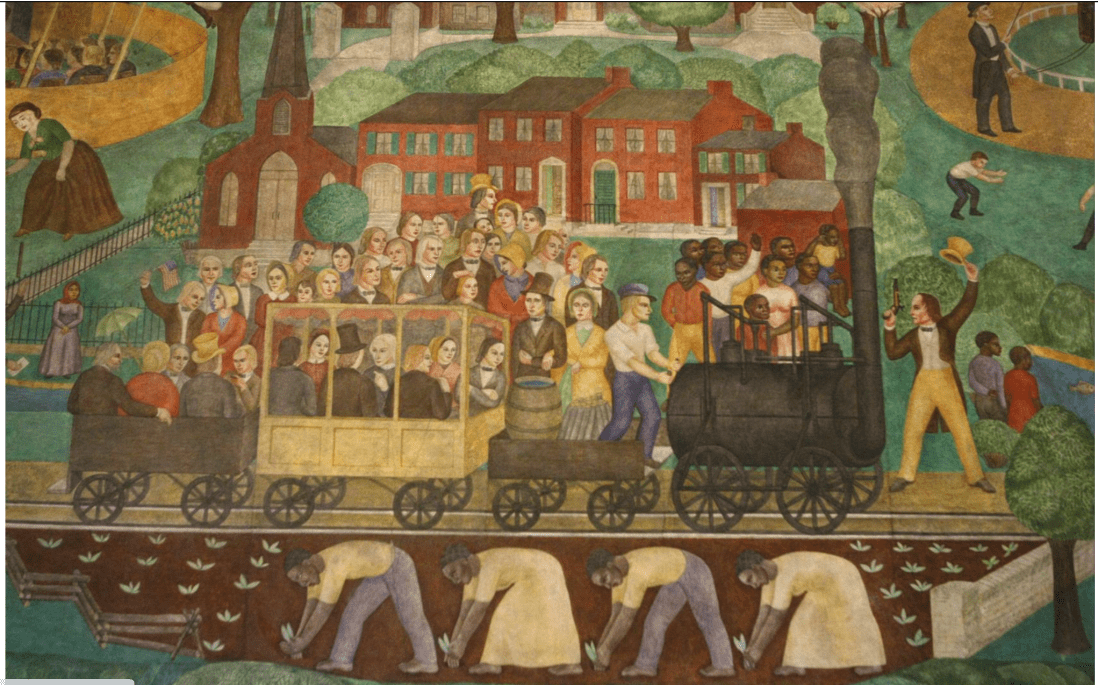
Such a long list of public statues have been pulled down, defaced, and parkways and buildings have been renamed, that the whole culturally sensitive activity has become banal. Standing in line to do their part are student activists at the University of Kentucky who have been demanding the removal of a mural from the 1930’s, one depicting the settling of the Commonwealth of Kentucky. But not everyone is sympathetic. Long time climate activist, writer and poet, Wendell Berry, is suing.

Now, Wendell Berry — the writer, farmer and longtime Kentuckian — is suing the university over its decision to remove the mural, arguing that because it was created through a government program, it is owned by the people of Kentucky and cannot be removed by the university. (Mr. Berry knew the artist of the mural through his wife, who is a niece of Ms. O’Hanlon. Mr. Berry’s wife, Tanya Berry, is also a plaintiff in the lawsuit.)

Perhaps it is time that the courts weigh in on the issue. The period where the passion of the moment, the outrage, perhaps has expired. Voicing a need for change is acceptable, it is desirable. The public square, whether physical or over electronic media, is part of the system. Yet at some point the voicing process is over. At some point destruction to emphasize the severity of the issue becomes destruction to feel powerful. At some point attention to the issue at hand starts to itself erode other worthy causes.

The Minnesota Court of Appeals recently issued an opinion regarding the appropriateness of alining time with the crime. Even if the law changes at a later date, it ruled that the perpetrator cannot be exonerated if the deed was unlawful at time of conviction.

A defendant is not exonerated within the meaning of Minn. Stat. § 590.11, subd.
1(c)(2) (Supp. 2019), when his conviction has been vacated based on a later clarification
of the law, when the conduct violated the law under existing precedent at the time the
offense was committed.

Shouldn’t it follow that the reverse should also not be allowed? That today’s cancel culture cannot convict based on revisions to laws dictating new standards which make historical actions unlawful? Those artists (in this case a woman-which in and of itself should be revered) and their subjects and the commissions which hired the work be done were operating within the guidelines of their time. Not some future reality yet to be conceived.

If anything these artifacts should be kept around because they are there to tell our story. Sir Bertrand Russell wrote an essay offering some ideas on what history should do for the general reader. Here is a section that points out that a history is needed precisely to address the ever changing nature of ‘human affairs.’ It appears in Portraits from Memory and Other Essays.

Our human story is ever evolving. We operate on a time continuum. Thus it seems, that if for no other reason than to avoid making complete fools out of ourselves, we must evaluate events under the conditions in which they occurred.

Is it Public or Is it Private?

Marginal Revolution University is an incredible source of economic knowledge. In addition to the course work there are videos and games. Here’s one designed to help distinguish between public goods, private good, common goods and club goods. At the end of the game there is a cheat sheet of how to classify these goods and services.

Pure Private Goods/Services (excludable, rival)
● Haircut
● Pizza
● Website design
● Table service at a restaurant
● Snuggie
● House


Club Goods/Services (excludable, non­rival)
● Netflix
● Amusement park
● Uncongested toll roads (highway)
● The movies
● YMCA membership


Common Goods (non­excludable, rival)
● Busy city street
● Hospital E.R.
● Tuna in the ocean
● The meadow where your sheep graze
● Wildlife
● Forests


Pure Public Goods/Services (non­excludable, non­rival)
● Wikipedia
● National defense
● Uncongested city street
● City fireworks
● Air to breathe
● Google
● Asteroid defense

To understand the economic arrangement I talk about in this blog, these categories have to be rearranged. I ask people to consider that there are two natures to every product: public and private. The nature is dependent upon who, or which group, has access to the goods.

Let me give you an example. A haircut seems like a pretty straightforward private good. The exchange is between two individuals where the customer clearly owns the hair. But what if the haircut was given to disadvantaged kids in an elementary school by a barber who was providing the service as a gesture of community involvement?

The purpose of the activity is to enhance a child’s self esteem and in doing so increase their productivity at school. The barbers work for free so no money is exchanged to make this a private transaction. There are no production reports, nor does this get measured as a part of GDP. This service is done as a public service not a private transaction. Mind you not just anyone can get the free haircut. Only the kids at the elementary school in question. Everyone else must pay. So the public nature has to be attached to that grouping: it is a public good for the elementary school kids.

This is the reason a haircut cannot be classified exclusively as a private service. In due time, I will sort through this whole list of goods and services to convert you to the new classifications of public and private! In due time.

Who is NOAH anyway?

It was three to four years ago when the acronym NOAH (naturally occurring affordable housing) started appearing in presentations and in print. The sale of a 698-unit apartment complex in Richfield, a modest first tier suburb adjacent to South Minneapolis, and the subsequent fallout from tenants having to relocate in light of the new owners’ ambitions to rehab the ailing structure, brought this situation into focus. The term emerged from the realization that there can be a time when both landlords and tenants benefit by rents low.

Analysts talk about housing like it is a static product. How many units are for rent, with how many bedrooms, and how many square feet. People talk about housing as if the most interesting thing about it is its physical parameters. But properties change over time. What is brand-new, mechanically up-to-date today, becomes tired and dated in the course of a dozen years. People change over time too. A single adult transitions into married life and a family changing their housing needs.

Housing structures have a cycle. New means no repairs but new also means (relative to comparable used properties) the most expensive. As properties age they can become dated and repairs can start to be overlooked. Usually used properties are supporting some mix of these two: the roof is new but the furnace midcycle; the counters are granite but the appliances from a decade gone-by.

Wear and tear and maintenance can also vary depending on the tenants. A drive around any large University campus will show off some student housing that is a little worse for wear. And some landlords are better than others at keeping up on property demands. It can be that the owners are at a later stage of their investment and are happy enough to keep doing repairs instead of replacements, and ignoring the dated carpet runners in the hallways. As long as their renters are happy with stable rent, all parties allow the property to age.

Keep in mind the economics of the lower rent. The owner, by letting improvements slide and just getting by on minimal repairs, has in effect allowed the building to decrease in value. The lower rent is a transfer of building value to the renters. The decreased building value in the open market attracts an investor who is then motivated to do the renovations. And with this the new investor attracts renters who can pay for them.

This most probably describes the evolution of the large apartment complex in Richfield. Other expenses can also impact an owner’s decision to sell.

Dickens sees NOAH threatened across the region, and said landlords get no choice when property values — and thus taxes — rise. Maintenance costs and upkeep also climb, with costs typically passed to tenants.

Is it not beneficial to the community or the renters for a building to deteriorate to the point of condemnation. So the process of an investor rehabbing an aging building in and of itself is a good thing. The reality is that structures depreciate over time, and repairs can only be ignored for so long. NOAH wasn’t a discovery of something new, it just revealed a situation in the open market where both the provider of the housing and the residents found an agreeable equilibrium. For a time.

The biggest takeaway from the acronym is that there is no secret money tree that will appear and save the most vulnerable from their housing burden. NOAH occurs as a situation where an investor tolerates some devaluing of property which is then reflected in lower rent to tenants. But it cannot be sustained without the building becoming a teardown. In the end, when people can’t afford their housing expense, some other group will have to cover the difference.

Wood Ducks

I often stop at local parks, especially when I’m in an unfamiliar part of town. First off it is an incentive to maintain a regular walking regime. And you can almost always glean some insights into a community from its parks and trail system.

Yesterday I stopped at one which featured Nature Center in its name. Yet there was no building next to the forty by forty spread of asphalt off a deadend road, perhaps a half-mile from the heavily used I694 loop around the cities. Only the entrance sign confirmed I was in the right spot.

The trail led under a gorgeous canopy tall oak trees. Through all the dead fallen wood you could see a pond down to the left covered in a thick coat of pea green.

The signage was ambitious, from the greeting sign and then a series of signs denoting stations along the walk, pointing out the flora and fauna along the circular path around the pond. They were faded, and the plastic coverings cracked and damaged.

As the path descended down toward the water the noise of ducks alerted one to a large grouping of fowl. I first spotted a nice looking mallard. Then, hacking through the brambles and low brush to get a better look, a gaggle of no less than thirty wood ducks came into view.

If you’re a bird watcher seeing a glimpse of just a pair of these birds, with their exotically detailed plumage, is exciting. This site caught me spellbound.

My first impression of this park led me to feel sympathetic for the folks who must have spent so much time getting this 24 acre green space established. How disappointed they would be by the overgrowth and neglected beamed steps cut into the hill bank, washout at points here and there.

But I’ve changed my mind. Those folks, having invested work into this vision would probably be delighted not disappointed. For here was a habitat in the middle of a three and a half million people metro, where families of wood ducks floated contentedly on a pond.

Reminder to self: don’t be too quick to judge someone else’s point-of-view.

Meet the Met

The Metropolitan Council was conceived a little over fifty years ago with the foresight that the Twin City Metropolitan Area of Minneapolis and St. Paul would benefit from a multi-county planning entity. Large infrastructure projects like transit and water/sewer in particular would be best coordinated regionally in lieu of by an aggregation of cities. The 17 member council serves at the pleasure of the sitting governor. Here is a nice fact sheet providing an overview of the council’s latest accomplishments.

The council wields a tremendous amount of power for an unelected body. Over the years objections to this structure have been voiced by champions of both the left and the right. But for the time being, it is a structure which continues to influence the growth of residential settlement through patterns of transportation provided by bus and light rail, and through the provision of city and water.

In a presentation last week, Charlie Zelle, the chair of the council stressed that his agency is responsible for planning. In light of this spirit, I would like to propose a new way to frame up some of the research.

There are two new infrastructure projects which will offer circulation options for residents. First off, a new interchange off interstate I94 will provide direct access to the city of Dayton, a third tier suburb. Dayton, with a population of 6,302, was bypassed for development and become donut hole to suburban expansion while the populations of neighboring communities grew: Maple Grove to 71k, Champlin to 25k and Rogers to the NW to 13K. The mayor of Dayton touts the economic potential that will be unlocked by the anticipated increase in vehicle traffic from the off ramp.

The second infrastructure project is the Southwest Light Rail which recently received its Full Funding Grant Agreement from the Federal Transit Administration. This transit option links the four SW suburbs of St. Louis Park, Hopkins, Minnetonka, and Eden Prairie to the City of Minneapolis.

Excitement around Southwest LRT in not just confined to transportation advocates, already the alignment has seen hundreds of millions of dollars of private investments along the line. From affordable housing to commercial centers, Southwest LRT is making an impact on the state’s economy a trend which will continue far into the future.

Both of these projects will allow a new pattern of circulation for residents. One will experience growth and transformation from rural low density to suburban. The other will allow a built community to circulate more readily to and from the downtown core.

Whereas commuters and businesses are often the focus of the benefits to transit, I would be interested in seeing how all pubic goods in these communities fare following the completion of these two projects. Are there effects to public safety? Are the public schools over-loaded or better-funded? Are people healthier due to better access to medical care?

Maybe part of the concern regarding representation within the Metropolitan Council is for this reason; for the need to voice both the positive and negative impacts of transit and water/sewer infrastructure (restrictions) on the suite of public goods underwritten by a city. Elected officials, especially mayors, manage a boutique of goods for their residents, and they are not seeing the Council take all of them into consideration

Notorious RBG

Like everyone else, I’ve been consuming the articles about the life and work of Ruth Bader Ginsberg who recently passed away after 27 year on the US Supreme court. I’ll admit that I didn’t know much about her until recently. But there are three things I will take away from how she lived her life.

After graduating from Cornell in 1954 she married her husband of 56 years. A few years later she followed him to Harvard Law School.

The law dean reportedly invited the nine female students in the class to dinner and asked, “How do you justify taking a spot from a qualified man?” Ginsburg said she gave “the answer he expected”: “My husband is a second-year law student, and it’s important for a woman to understand her husband’s work.”

She was willing to make the sacrifice of sucking up a personal assault if it’s that what it took to get where she wanted to go. What if she had stormed out and held a protest and rallied a march? Would women be better off today? Instead she bowed to the expectations of her time, in order to forge ahead. She was strategizing a war plan where emotion pull many people into a street fight.

After she graduated with a law degree from Columbia, she had a difficult time landing a job with a law office. It is apparent that claims of a meritocratic system was (and still is) constrained by social norms. But Ruth Bader Ginsberg must have looked at the employer pool as a group where not each and everyone had to want to employ her. She just needed one job, one employer. And that was a courtship with the U.S. District Court.

Once again, instead of being distracted by an individual or a small set of individuals that blocked her path, she had faith in the larger community. She kept looking for where she could trade her skills instead of trying to convert each objector. She was an optimist.

When it came time to converting opinions in the court room, where she had earned stature and prominence, she used perspective. She brought the claims before the male judges in the form of claims made by men, that way they would not be biased by gender. She wrote the story in a way that they could see the work for what it was.

There’s been some really interesting work done by the scholar Cary Franklin about the men Justice Ginsburg represented when she was at the ACLU, and how when she was bringing them before male justices, the male justices had trouble believing that these guys actually wanted to take care of their elderly mothers or their children, because it was so foreign to them. So in some ways what she was doing was quite challenging to them. But at the same time, being a canny strategist – showing that men had skin in the game, and that they too were harmed by gender inequality – enlisted a broader range of allies for her.

Ruth Bader Ginsberg was a women who played the long game. And it has paid off in spades for all women to benefit. She is a true feminist.

Here is a nice photo essay of her life.

Pop quote

Name the author, title and page number (if applicable) for pop quotes and you will receive a grand prize!

On my return home, as I passed the relatively genteel playground near where I live, I noted that its only inhabitants in the late afternoon, with the mothers and the custodian gone were two small boys threatening to bash a little girl with their skates, and an alcoholic who had roused himself to shake his head and mumble that they shouldn’t do that. Farther down the street, on a block with many Puerto Rican immigrants, was another scene of contrast. Twenty-eight children of all ages were playing on the sidewalk without mayhem, arson, or any event more serious than a squabble over a bag of candy. They were under the casual surveillance of adults primarily visiting in public with each other. The surveillance was only seemingly casual, as was proved when the candy squabble broke out and peace and justice were re-established. The identities of the adults kept changing because ferent ones kept putting their heads out the windows, and different ones kept coming in and going out on errands, or passing by and lingering a little. But the numbers of adults stayed fairly constant-between eight and eleven- during the hour I watched. Arriving home, I noticed that at our end of our block, in front of the tenement, the tailor’s, our house, the laundry, the pizza place and the fruit man’s, twelve children were playing on the sidewalk in sight of fourteen adults.

Fungible is more Fun

What does it mean for a transaction to be fungible, or non-fungible? Here’s the dictionary’s definition for the word when googled;

fun·gi·ble/ˈfənjəbəl/Learn to pronounce adjective LAW adjective: fungible

(of goods contracted for without an individual specimen being specified) able to replace or be replaced by another identical item; mutually interchangeable.”it is by no means the worlds only fungible commodity”

Wikipedia talks about fungibilty in this way:

In economicsfungibility is the property of a good or a commodity whose individual units are essentially interchangeable, and each of its parts is indistinguishable from another part.[1][2]

For example, gold is fungible since one kilogram of pure gold is equivalent to any other kilogram of pure gold, whether in the form of coins, ingots, or in other states. Other fungible commodities include sweet crude oil, company shares, bonds, other precious metals, and currencies. Fungibility refers only to the equivalence and indistinguishability of each unit of a commodity with other units of the same commodity, and not to the exchange of one commodity for another.

In the sense of a transaction being fungible or non-fungible I offer the following understanding. If you buy your gas at a Holiday station, whether it is on the corner leaving your neighborhood, or the one near your place of work or the one half way to your vacation destination, the transaction is the same. One purchases a indistinguishable commodity which is paid for with some form of currency of consistent value. The transaction starts and ends in a matter of minutes. It is fungible.

Now consider a different type of transaction, one that happens in a neighborhood. Every morning nine to ten kids gather at a bus stop to catch a yellow bus to the local elementary school. School starts at 9am and ends at 3pm. Most kids stay for after school programming so their parents have a chance to get home and pick them up before heading home to pull something together for dinner.

Now say it is mid January in a northern climate, and a mega storm develops predicting twelve inches of snowfall. The schools close at noon before buses full of children slide into the ditch and the roads are gridlocked as the snowplows can’t keep up with the descending flakes. Afterschool programming is cancelled leaving working parents in a bind.

One of the parents, call her Amanda R, works third shift at the hospital, and has the means to contact everyone as the families went through Baby-and-Me classes together at the community center. She lets them know she’ll be at the bus stop to collect the first-through-six-graders and let them hang out at her house. “Drive safe!” emphasises the text.

If the families would have taken personal time from work to the tune of four hours each, that would have amounted to thirty-two work hours. (With an average wage in Minnesota at $58K/yr, that comes to $892). Amanda R doesn’t expect payment for her offer. She knows that over the course of their elementary school experience there will be a track and field day, and the third grade band concert (which only a parent can appreciate) and the fifth grade science fair and the list goes on. There will be plenty of opportunities for parents to stand in for each other.

The work Amanda R did to allow parents to stay at their jobs while keeping their kids safe from harm was a non-fungible transaction. She won’t receive any immediate payment or exchange for her time. She can’t trade those hours with another neighbor down the block. What she’s betting is that she will receive assistance many times throughout her kids’ school experience.

Certainly it might be more fun to work for cash and spend it on concert tickets or new clothes or a trip. But the beauty of non-fungible transactions is that they are held within the group and often engaged when the stakes are high.

Internalize and Trade

Health care providers incorporate a variety of incentive methods to encourage healthy behavior.  Many HMO’s will pay $25/mo toward a gym membership fee if their member goes to workout twelve times in a month. In effect they are internalizing the externalities of poor future health by inducing members to live a healthier lifestyle. The numbers must indicate that $25 is both enough to change behavior and in doing so avoid future medical procedures.

This transaction all occurs within the same group, those covered by an HMO’s policy. The trade of cash towards a gym fee benefits the same people who will then incur fewer medical costs in the future.  But what about a hybrid trade that included beneficiaries outside the group?

Obesity in the US has been on the rise for a number of years. It is becoming a leading public health crisis as rates of obesity among Americans are running above 40% in all age groups. The CDC outlines a number of health effects that stem from carrying around excessive weight.

One remedy is weight-loss (bariatric) surgery.  There are several procedures that help you lose weight which lowers your risk of medical problems associated with obesity. The cost of weight loss surgeries can range from $14,000 to $23,000 and are being covered more frequently by health insurance.

Since there are also downsides to surgery in general, what if the HMO tried an incentive program to get the member to a healthy weight? Say the cost was determined to be $20,000 for the surgery, and the member was considered to be 80 pounds overweight. Say the sum of the surgery could be divided up over a five year time span where the member received a portion for every 20 pounds lost, the HMO retained a portion and, a single mom in a third world country received food subsidies for a year.

A recent contest found that the most compelling argument that resulted in the highest philanthropic donations was a scenario structured in a similar fashion. I describe this structure in the post Philosophy and Philanthropy. Perhaps a late middle aged mom has served her family diligently, and in the process lost site of her own needs. Perhaps she has gained a bunch of weight that she can’t seem to shake, at least not for herself. But if you gave her the option to feed a single mom with five kids, maybe she would see her way to bringing her own weight in line.

It’s all about the Group

Amy Finkelstein’s video for MRU about the economics of mammograms just popped into my email. She and her colleagues are wondering about the efficacy of the present policy for screening for breast cancer. The blurb following the video explains.

One in eight women will be diagnosed with breast cancer. The current recommendation is that women should receive annual mammograms starting at age 40. But who is actually following this recommendation, and does that affect the test’s efficacy? MIT’s Amy Finkelstein and two of her coauthors, Tamar Oostrom and Abigail Ostriker, explore this question in this video. This video is based on the following paper: Screening and Selection: The Case of Mammograms Liran Einav, Amy Finkelstein, Tamar Oostrom, Abigail Ostriker, and Heidi Williams https://economics.mit.edu/files/20062

Past studies suggested dividing women into two groups in order to tackle a public health response to cancer: those under age 40 and those over age 40. Once over forty years of age, women are considered at a higher risk and thus were encouraged to have mammograms on a regular basis. The Susan G Komen organization provides data on how screening has saved lives. “From 1989-2017 (most recent data available), breast cancer mortality decreased by 40 percent due to improved breast cancer treatment and early detection [60]. Since 1989, about 375,900 breast cancer deaths in U.S. women have been avoided [60].”

It wasn’t long, however, that the drawbacks of misdiagnosis became apparent. False positive tests were causing patients unnecessary mental and physical costs. The fear and treatment associated with a false positive took time, energy and resources away from women who were in fact not likely to acquire the disease.

Amy and her MIT colleagues found that grouping by age was not specific enough. They observed that women who comply, and get screened, share habits that actually make them less likely to be prone for a positive test. Based on information from the medical community, women who disregarded screenings were more likely to eventually experience breast cancer.

By regrouping the women in consideration of their norms and lifestyles, the MIT professors are acknowledging that the public health of women in regards to breast cancer is multidimensional. They do not propose a new public policy but rather further insight into how the topic should be considered. Tamar Oostrom voices in the video: “our paper brings an additional dimension” to the issue.

When you think of the nature of people who would follow the recommendations and comply with regular testing, they are probably folks who can afford to be tested, both in the sense of the medical services expense and in the time it takes out of their lives. They probably have access to transportation to be tested. They have the willpower and ability to prepare and eat a healthy diet and exercise. It’s interesting to note that many if not all of these activities are tied into access to other public goods.

This video confirms a couple of things. Putting public resources towards a problem reaches a point of no additional returns, and can cause additional costs to the targeted group. Secondly, solving for the optimal amount of screening involves an understanding of how to distinguish groups and there access to other public goods markets.

The Trick with Triplexes

A little over a year ago Minneapolis was getting a lot of attention for ending single family zoning which secured one family home for one lot in 70 percent of the city. Politco ran a headline with dramatic vivid language of strangleholds, and further reported on how activists were taking victory laps following the City Council’s 12-1 vote to reverse single family zoning across the city. The Atlantic ran an article. And the New York Times gave Minneapolis‘s story first consideration in their article.

Yet in this first part of 2020 their have only been, drum roll please, 3 permit requests to take advantage of this up-zoning. The reason being, according to the Government Affairs Director with the Minneapolis Realtor Association, Eric Meyers, “even though new zoning laws permit triplexes, the underlying code was still written with single-family homes in mind. Height restrictions are the same, as are setback requirements.” A seemingly simple request to increase the height of a garage peak by one foot drew an extensive and heated debate. 

Since demand for housing continues to be strong in Minneapolis –the median sale price has risen 5.5% over the last twelve months– and hence the need for more housing units is unwavering, one would think that the spirit of releasing the stranglehold of the single family home would make the process more forgiving.

Emily Hamilton at Bloomberg explains it best: Want More Housing? Ending Single-Family Zoning Won’t Do It. Regulations that have been built over years won’t be undone with that quickly. Think of this at step one. Now investors are reconvening to put together documentation on the obstacles that stand in the way of the envisioned housing option. They will spend time and resources to go back through the city process and seek approval for building conversions and new builds.

Some investors will call it quits and sit out this process as they fear it is too expensive. But it is in this back and forth between the private and the public that incremental changes are made in order to achieve the goal of more housing units. And in doing so lower the cost of homes.

.

Here’s the deal 101

Our local NBC news outlet recently ran a story about an elderly couple receiving help from neighbors after being criticized for not keeping up the exterior paint on their home. It totaled $67,000 worth of help. There is no name given to this transfer of money. When a private party helps themselves to $67,000 from their employer it is called embezzlement. When a politician helps themselves to $67,000 from their campaign fund it is called corruption.

The old school explanation for this activity is to denote it as a form of charity. But is it really a gift? Neighborliness is a term that shows up on surveys. But what does that mean? I see this exchange between the neighbors of Gloucester is the most basic transaction in a economy of groups. Let’s pull it apart.

It all started with an anonymous note left for the couple which read, “Please Paint Me! 😦 Eye sore – Your Neighbors. Thanks.” Although clearly written by one individual, the message is presented as a community concern. Signed, your neighbors. You’ve probably heard this type of chatter before. A house on a main road is dilapidated, or decorated with eccentric siding. Comments like, ‘I really wish someone would do something about that place.’ Or, ‘Some people are bringing down the neighborhood!’ So although one neighbor wrote the note, thoughts of this nature were undoubtedly mulled over by many a passerby.

A personal residence is deemed the bastion of private property, and property rights are a keystone feature of our economic system. But the note indicates that there is a hazy area not reflected in the legal deed, filed in the county records, which spells out the owners names. The area residents feel they have a right to demand that the exterior meet their expectations. This is not a novel idea. In fact cities even have ordinances which address the exteriors of properties regarding thresholds for debris removal and grass mowing.

The couples’ daughter took to social media to voice her response to the note. She points out that her parents had lived in community for the past 50 years. And that during this long history they had maintained their home, and hence contributed many years of service towards an acceptable streetscape. “My family for many years took care and maintained this house as best they could…” 

The reason for the disrepair could happen to anyone, it was an act of nature. The article reports that “Marilyn, 72, developed multiple sclerosis about 30 years ago and is mostly confined to her bed, and Jimmy, 71, recently recovered from a quadruple bypass…” Health concerns take time and resources away from the couples ability to comply with the norms of the neighborhood.

Once the word got out about the need, once demand for goods and services was established, a voluntary response from the community resulted in a $67,000 balance in a GoFundMe account. Currency is very liquid, yet these funds are not fungible. As the report confirms the money is “to be used for new siding on their home, new windows, roof and stairs.”

There is no reporting of free riding or extortion, even though funds are seemingly extracted from a greater group to a private party. Nor is this activity portrayed in a religious or moral sense. The voluntary transfer of resources to improve the exterior of the home is held together by a communal objective, one that the recipients contributed to over. This transparent and voluntary activity is the most basic transaction in economy of groups.

“People look out for each other in Gloucester,” he said. “If somebody needs some help, we just get together and do it. It’s all just very heartwarming.” What I hear him saying is that Gloucester is a town with a free an open economy. And yes, that is heartwarming.