John Cochrane looks for a new framing

I’ve been following John Cochrane’s blog, “A Grumpy Economist,” for a while now. I love the self-depricating title and, of course, the material. In a recent Substack post, he tackles the question of climate change, government subsidies, and the groups of people who win and lose.

In short, he is saying that the massive subsidies that all US taxpayers have been funneling into electric vehicles are not generating the intended return. Not at all. They are bills being scattered in the wind.

OK– but how? and why? And what else should be considered? In short, what is the new framing that would better capture the intentions, levers, and incentives to address this issue?

Consider first the who. There are the EV activists. They have provided voice to the issue of climate change. And have been successful in securing financial subsidies from US citizens at large. The population of the US is the greater group. They too care enough to syphon off funds for the cause. But John Cochrane points out that the who is really the global population. Climate change flows over political boundaries. Reductions of pollutants in California can easily be negated by activity elsewhere on the globe.

The implication here is that to solve the issue of climate change, the anchor of discretion lies in with global population. To have an impact, activity across this group must have a measurable effect. Otherwise, a small group of earnest adjusters will work and sacrifice (in the EV example, US taxpayer dollars) to no beneficial ends. Lots of effort. Lots of signaling. No results.

Lastly, Cochraine mentions time. The time frame over which the analysis is best observed is one hundred years. To bully and berate neighbors into small gestures in the name of climate change is counterproductive, he says. The perspective is global, marked over centuries, and thus requires intentions and drive measurable within that framework.

Is that Work?

If you follow this site, you know that it proposes activities that enhance and advance humans, fall into two buckets. There is private, unfettered activity that severs at time of transaction, free of social encumbrances or infringements. Then there is activity which supports the welfare of groups of people amongst whom there are typically numerous overlapping objectives. There is the private sphere where much of commerce lives, and there is the public sphere, kind to the nurturing of children, the prevention of crime, and the enforcement of norms sometimes formalized in into laws.

In the private sphere, people sell their time and talents. This is called labor. The public sphere is often dependent on what is termed volunteerism or unpaid labor. But I like to call it work. Below is a post from The Marginal Revolution site, which confirms that unpaid labor is more than helping an elderly person across the street or reporting a suspicious person in the alley. The number of hours contributed by this couple in civic engage prompted putting new technology to the task.

Start quote:

Solve for the NIMBY equilibrium?

by  Tyler Cowen November 12, 2025 at 3:08 am in 

We are just beginning to think these issues through:

The governmentโ€™s plan to use artificial intelligence to accelerate planning for new homes may be about to hit an unexpected roadblock: AI-powered nimbyism.

A new service called Objector is offering โ€œpolicy-backed objections in minutesโ€ to people who are upset about planning applications near their homes.

It uses generative AI to scan planning applications and check for grounds for objection, ranking these as โ€œhighโ€, โ€œmediumโ€ or โ€œlowโ€ impact. It then automatically creates objection letters, AI-written speeches to deliver to the planning committees, and even AI-generated videos to โ€œinfluence councillorsโ€.

Kent residents Hannah and Paul George designed the system after estimating they spent hundreds of hours attempting to navigate the planning process when they opposed plans to convert a building near their home into a mosque.

Here is the full story.  Via Aaron K.

Me again: The comments section is replete with the potential downside for using technology in this manner. But I say the powerful leverage lies in understanding how people work in their communities. Consider how many hours are required for all the multiple support programming in play, every day, in the USA.

A social model of Trick-or-Treat

Everyone laments the commercialization of the holidays. How tacky! How capitalistic! So why do these distasteful traditions continue to weave their way through our culture? Let’s investigate the social upsides to see if there are compensating factors.

First, it is necessary to identify the parties involved. There are the vendors of fun-size treats. These folks are unabashedly money-oriented organizations. There are parents who dutifully open their front doors and dig handfuls of treats out of their stash to parlay them into the bulging pillowcases or plastic pumpkins presented by the costumed youngsters yelping: Trick-or-Treat! These folks are subsidizers. They purchase the candy with no designs on a pecuniary return for their money. And then there are the kids. One might think they have no investment, but that’s not true. Their delight at the mystery of the evening, at the intrigue of mask-wearing, and at the innocent charm they exude is a draw to those around them.

For a proper evaluation, one must anchor the focus of discretion. This tracks which group is being considered in the balancing of accounts. Let’s start with the stores. They are commercial ventures, supplying items their customers demand in return for enough to pay their expenses and a little more. If Halloween went to the wayside, they would simply move on to something else. There seems to be very little to model here in terms of the social sphere.

Now, let’s anchor the view from the adult participants. They lay out the cash– so what do they get? They bring joy to their kids and perhaps a little to themselves. The event might rope in grandma and grandpa, a couple of worthy backstops in the activities of family life. Lastly, the business of activity on the streets brings out a Jane Jacobsian benefit. So, parents and adults can gain in private pleasure, family bonding, and community spirit.

Lastly, consider the kids. It might seem like a windfall for them. However, probably more than one parent keeps the incentives of a successful Halloween as a behavior modifier. So they too pitch in with a bit of work when it comes to supporting the holiday.

For the foreseeable future, the balance in favor of the social gains indicates a continued future for this spooky festivity.

Follow up on European homeownership rates

Taken from todayโ€™s Bloomberg letter.

Thereโ€™s a noticeable trend where countries with higher state capacityโ€”broadly understood as the ability of a government to effectively implement policies, provide public services, and maintain robust institutionsโ€”tend to have lower homeownership rates. This pattern, while not absolute, holds across several key countries when examining the most recent data (2023โ€“2024, primarily from Statista and Eurostat).

Market Failure was used as the signal– but what now?

In days of yore, there was the market and the state. Two separate spheres of activity coexisted. And when private industry did not come through for the people, in the way they thought it should, market failure was the name given to assign blame. When the market failed, it was up to the state to address the lack of supply in areas such as medical care, poverty alleviation, housing, and the like.

One of economist Tyler Cowen’s first books addresses this trigger for state action in a compilation of thoughts on The Theory of Market Failure: A Critical Examination. But he isn’t convinced. He seems to say that when you look so closely at a tiny segment of a large system, you don’t see anything at all.

Consider externalities, a key signal that the market is merely pushing a problem onto some unsuspecting observer. He claims that (nearly) every single transaction has a positive or negative external effect. And, if you think about it, it’s true. We are social creatures. Although many consumptions are deeply personal, in the end, we always touch the lives of others.

The scope of the externalities/nonexcludability issue is vast. Nearly every concern of economic policy, from environmental considerations to research and development, involves externality problems. No one would claim that every instance of an externality warrants state intervention. There is no doubt, however, that the existence of externalities is one of the most powerful arguments for public sector involvement in the provision of public goods.

This isn’t the proper trigger for government intervention.

What about when the price seems too high, as in housing, or too low, as in wages? Whether a good is mediated through the private or public sector, prices still carry the most valuable form of comparative value information.

As noted earlier, the theory of public goods and externalities implies that if a good is characterized by nonrivalrous consumption, allowing additional individuals to consume it entails zero marginal cost. Demsetz’s arguments (1964; 1970) imply that this is only true in the presence of perfect information. Otherwise, allowing additional individuals to consume a good free of charge results in the abandonment of the price system in that sphere of activity. Since the publication of Hayek 1945, the role of prices in communicating information has been well known. In the provision of public goods as well as private goods, sacrificing such information may entail significant costs.

Prices are the most critical form of encapsulation of what groups of exchangers say about an exchange. We may not always conduct a thorough analysis of prices. That might be where the problem lies.

For instance, the exchange might be telling something vital about a group of people that others are simply not attuned to. People join various clubs throughout their lives. And these associations create structures of value.

The next two selections in section 2 of this volume discuss the nature of local public goods. Because such goods, by definition, can be provided to only a segment of a nation or community, determining which individuals will receive them becomes part of the economic problem. Once club or community membership becomes endogenous, many of Samuelson’s conclusions do not hold.

When people leave or join a club, when they exit or stay loyal, they impact how much of a surcharge the group of people in the club can charge.

The Tiebout model avoids the preference revelation problem; an individual’s preferences are revealed by his choice of location. It also avoids the free-rider problem; those who choose to belong to a given community are subject to the taxes or user fรฉes that finance the provision of goods. Nor is pricing inefficiency a problem. If an individual is inefficiently excluded from the use of a public good or service, he can simply move to a community where that exclusion is not practiced.

The introduction written by Tyler Cowen is comprehensive. To the engaged observer, he dispels the dichotomy between industry and the state. There’s something pluristic out there. It’s big, messy, and complicated. It dovetails into many of the things people talk about under the titular of institutions. But it has structure– once you stand back and take a look.

That’s the project of the moment: a unified theory of price.

First Favorite

Let me introduce my first favorite public intellectual:

Iโ€™ve been a fan of Francis Fukuyama for a very long timeโ€” since I was in my teens. Heโ€™s the first intellectual who spoke non-biased speak and in doing so opened his intellectual pursuits to me. It wasnโ€™t just that he spoke without condescension, he always pulls together the most pertinent information and delivers it in a straightforward and understandable manner.

Methods- it’s always been there

This is an excerpt from my working paper which examines how contemporary economic realities challenge conventional price formation models. Traditional price theory, rooted in neoclassical equilibrium models, struggles to explain modern markets characterized by digital platforms, behavioral anomalies, and network effects. Rather than viewing prices solely as equilibrium outcomes, this section explores price as an information system and coordination mechanism shaped by institutional contexts and evolutionary market processes, proposing alternative approaches that better capture the dynamic nature of pricing in today’s economy.

III. Methodological Framework

A. Philosophical Methodology

This research engages with the critical realist tradition in economic philosophy (Lawson, 1997; Fleetwood, 2017) while incorporating elements of pragmatist inquiry (Dewey, 1938; Hodgson, 2004) to examine how social outcomes are intrinsically embedded within price mechanisms. By adopting this philosophical stance, the investigation transcends the positivistsโ€™ limitations that have dominated mainstream economic methodology and artificially separated social dimensions from market valuation processes.

Methodological Rationale and Research Design

The methodology employs a dual approach combining narrative explication and formal econometric analysisโ€”a mixed-methods design that aligns with what Downward and Mearman (2007) term “critical triangulation.” This approach recognizes that economic phenomena exist in open systems characterized by complex causality that cannot be adequately captured through purely deductive or inductive methods alone.

Narrative methodologies in economics have been increasingly recognized for their capacity to reveal dimensions of economic reasoning that formal models often obscure (McCloskey, 1990; Morgan, 2012). As Akerlof and Snower (2016, p. 23) argue, “Narrative economics provides a framework for understanding how stories that may have little grounding in reality nevertheless influence economic behavior.” This research employs narrative not merely as illustration but as a methodological tool to uncover how social dimensions are intrinsically incorporated into economic decision-making rather than treated as external considerations.

The research design progresses through three methodological stages:

  1. Narrative case analysis of micro-level economic decisions where social costs and benefits are endogenously incorporated into price mechanisms
  2. Systematic examination of market-level pricing phenomena that demonstrate social valuation integration
  3. Econometric analysis using hedonic pricing models to formalize and quantify the incorporation of purported “externalities” within price

This triangulated approach provides methodological robustness by examining the phenomenon across multiple scales and through complementary epistemological lenses.

Market Integration of Health and Productivity Benefits

Consider the small business owner contemplating providing flu vaccinations for all employees at a cost of $50 per person. This case exemplifies what Hodgson (2013) identifies as the “reconstitutive downward causation” between institutional structures and individual agency. Conventional economic framing, following Williamson’s (1979) transaction cost analysis, might characterize this as either addressing an externality or reducing monitoring costs. However, this framework artificially separates the transaction into discrete “economic” and “social” components.

Following Sen’s (1977) critique of the rational fool construct, we can observe that the business owner engages in a multi-dimensional calculation that already incorporates social costs and benefits into their decision-making process. The owner calculates that seasonal influenza typically results in X hours of lost labor annually, representing not only direct wage costs but also diminished productivity, potential transmission to other employees, and compromised service to customers.

This integration happens not through external regulatory mandates but through what Davis (2003, p. 974) terms the “socially embedded individual” making decisions that intrinsically incorporate both private and social dimensions. The methodological significance of this observation lies in recognizing that the rational economic actor has not abandoned self-interest but rather operates with what Etzioni (1988) terms “I & We” paradigm that transcends artificial boundaries between private and social benefits.

Consumer Valuation of Production Standards

The organic food market provides another methodologically significant case. When consumers willingly pay premium prices for organic products, conventional economics often characterizes this through what Vatn and Bromley (1997) identify as the “commodification of externalities.” However, this methodological framing imposes an artificial separation that does not reflect the actual valuation process.

Following Callon’s (1998) analysis of market devices and Zelizer’s (2012) work on valuation practices, we can recognize that consumers paying a surcharge for organic certification are expressing a valuation that inherently includes both private benefits and social benefits. The price differential between conventional and organic products represents what Anderson and Holcombe (2013) term “integrated social valuation”โ€”a comprehensive valuation where social dimensions are not external to the market but constitute an intrinsic component of the value proposition itself.

Methodologically, this challenges the ontological separation between “market values” and “social values” that has dominated economic analysis since Pigou’s (1920) formulation of externality theory. The organic certification standard operates as what Star and Griesemer (1989) identify as a “boundary object” that allows coordination between different social worlds without requiring consensus about precise meaningsโ€”a methodological perspective that permits more nuanced understanding of how social values become embedded in price mechanisms.

Natural Integration of Health, Environmental, and Safety Considerations

These examples illustrate a methodological approach to understanding markets not as fundamentally incomplete systems requiring external correction but as complex valuation mechanisms capable of incorporating multiple dimensions of value. This approach aligns with MacIntyre’s (1984) critique of compartmentalization in modern social thought and Polanyi’s (1944/2001) concept of embeddedness, challenging the philosophical premise that social costs and benefits exist outside market mechanisms.

This methodological perspective diverges from both neoclassical approaches that treat social factors as externalities and from heterodox approaches that reject market valuation altogether. Instead, it aligns with recent developments in socio-economics (Etzioni, 2003; Hodgson, 2019) that recognize the inherent integration of social and economic dimensions in human decision-making.

Formal Analytical Approach: Hedonic Pricing Models

The narrative understanding outlined above finds formal analytical complement in hedonic pricing models, following Rosen’s (1974) foundational work. This methodological approach decomposes price into its constituent value components without imposing artificial separations between “economic” and “social” factors.

Anderson’s recent study, “Wind Turbines, Shadow Flicker, and Real Estate Values” (2024), provides empirical evidence of how economic actors endogenously incorporate what conventional economics would term “externalities” directly into price mechanisms. The methodological significance of this approach lies in its capacity to quantify valuation components without presuming their ontological separation.

This research employs the hedonic pricing methodology with particular attention to what Heckman and Singer (2017) identify as “causal pluralism”โ€”recognizing that price adjustments for social factors represent not market failures but rather evidence of markets’ capacity to incorporate complex, multi-dimensional valuations. Following Mรคki’s (2009) discussion of models as isolations and surrogate systems, the hedonic approach allows us to isolate and examine specific components of valuation while recognizing their inherent integration within actual market processes.

Methodological Limitations and Reflexivity

This methodological approach is not without limitations. The narrative cases, while illustrative, cannot capture the full range of market behaviors, and there remains the potential for selection bias in the cases examined. The hedonic pricing models, while powerful, rely on assumptions about market efficiency and information availability that may not fully hold in practice (Bartik & Smith, 1987; Kuminoff et al., 2010).

Additionally, as Bourdieu (1990) emphasizes, researcher reflexivity must acknowledge that the conceptual frameworks we employ shape the phenomena we observe. The methodological challenge lies in distinguishing between artificially imposed conceptual separations and meaningful analytical distinctionsโ€”a challenge this research addresses through methodological triangulation and critical engagement with underlying philosophical assumptions.

In summary, this research employs a methodologically pluralist approach that combines narrative explication and formal hedonic pricing analysis within a critical realist philosophical framework. This approach enables a reconstruction of our understanding of how price mechanisms already incorporate social dimensions of value, challenging the artificial separation between private and social components that has dominated economic thought.


CB Strike- Series Review

This series is entertaining. The storylines have more depth than most shows. The two lead actors are new to me and have good chemistry. Of course, there is a passion building between them, but it has been well done thus far. And– the camera lens takes the viewers into all sorts of residences, large and modest. It’s fun to see how the average worker lives in London.

New Realtor Rules- Were they consequential for consumers?

CNN brings readers up to date on the antitrust lawsuit against the National Association of Realtors. The plaintiffs were granted $418 million last summer, not a small amount of cash. Once all the legal bills were paid, the 500 petitioners received an estimated $900.

So, did all that work and expense result in a new way of doing business?

โ€œPaperwork has changed, and I think some really good things have happened in the way most of us discuss commissions upfront with our buyers and sellers,โ€ said Brita Kleingartner, a Realtor in Los Angeles. โ€œBut I donโ€™t think that business has changed in any way.โ€

With mortgage rates hovering around 7% for the last six months and average home prices across the USย continuing to rise, the new rules, which took effect in August, had spurred hope that commissions paid to real estate professionals would plunge, making homebuying and selling less expensive for average Americans. Last year, TD Cowen Insights estimated that the new rules could cause fees paid to Realtorsย to fall by 25% to 50%.

Instead, commissions have remained largely unchanged since August, according to a study released this month by real estate platform Redfin. For relatively lower-priced homes that sold for under $500,000, Redfin found that the average commission has increased since the rules took effect.

As I predicted a year ago, how business is done has not changed. The lawsuit alleged a problem that did and does not exist. How do we know? Watch the consumers and what they do. If they choose not to employ two realtors (one to represent the seller and one to represent the buyer), if they decide to pay them at a different rate, then their pull in the market generates a change. If consumers, despite all the layer’s fees, publicity, and exposure, continue to desire representation by a professional licensed agent, then the market rate is being met in an open and non-coercive environment.

Is all this activism worth it? I wish someone would keep track. A legal battle of this size is expensive. Plus, the plaintiffs who were encouraged to participate spent valuable time on this versus other aspects of their lives. It tapped into some of their family capacity for civic participation. Could other causes within their immediate circles better deserve their efforts? Very possibly.

Many feel a moral superiority by fighting the good fight. But when the fight goes to show that the monsters were but mist off a lake on a cold fall morning, then one must count up the expense of it all and do an analysis.

An Example

Say you live in a high-density, well-frequented area where lots of people come and go to visit local amenities like ballparks, restaurants, and museums. At some point, you get tired of being unable to host book club because your friends can’t find parking in front of your home, or the noise of continual foot traffic along the sidewalk is plain annoying. You decide to do something about it. After all, this is your homeโ€”right?

The voluntary action taken to rev up the neighbors, petition your city council, and air your grievances across social media platforms can, in sum, add up. It is an opportunity cost to you. You’ve engaged in volunteering and spent some of your time and talents to improve your environment. In fact, you’ve done such a good job that there is now a team of neighbors- Team A- all on the same quest.

Traditionally, streets and sidewalks are open-access town amenities. It’s too inconvenient to block passage for those from afar and those nearby. Hence, most roadways in the US are public in the most generous sense of the term. The free flow of people circulates around for their various needs, whether it be for a commercial delivery, a commuter getting to and from work, or a family out and about doing what families do. People in the know might adjust their schedule and stay off the roads at rush hour or following a Taylor Swift concert, but otherwise, it is a free-for-all, first-come-first-serve type commodity.

Team A, in the neighborhood wants more control than the anything goes, and engage their city to intervene in the spirit of preserving their neighborhood. They make a material claim to the pavement outside their doors. In order to make it official, they need the blessing of an official body with authority. The constraints change once a sign goes up on the block limiting parking hours, or requiring a parking pass.

Imposing minor inconveniences like restricted hours, passes, or even meters might make street parking more orderly. It’s a way of relaying information. A restriction might be just what someone needs to make an effort to drive through the alley and put their car away in a garage. A small charge encourages people to walk further and park on a less busy street.

The time to take note is when a restriction pushes other groups to form. Then, there are more preferences to consider than simply those of the neighbors who want ownership benefits of the street spots in front of their homes. Take the recent change implemented for those who wish to drive into Manhattan. To listen to this guy, it’s all a great success to charge $9 and discourage entrance by vehicle. He appears to speak on behalf of the commuting group.

Screenshot

What other groups are in the mix? Shoppers who would come into the city, but now the surcharge discourages them? Small shop workers like home repair people? Tourists who decide against coming in for the day? What is the cost of their behavior in the face of this new constraint? It seems that retail shops and restaurants could see a decrease in business. Less competition for small-scale home repair services results in higher prices for homeowners. Fewer tourists, as pesky as they seem, weakens the arts and museum support systems.

Time will tell. But it seems that gaining a little bit of ownership of the asphalt might cost Team A more than the time it took to lobby for the change. Commuter Team B may benefit the most, as the $9 is a fraction of the income they earn in the city. And the othersโ€”workers, shoppers, and touristsโ€”all lose out. After all, there’s no free lunch. But more importantly, is this matrix of tradeoffs between various interest groups the desired outcome of implementing the surcharge?

Praise for Steinbeck

No writer yet has fully succeeded in bringing life together all in one piece. The good writer never stops trying, and he will be discovered, as Steinbeck has been, by the readers for whom he is writing, by those who recognize that he has carried, further than they have been able to carry, some of their own efforts to make life into an orderly pattern. This is what you will find in these short novels, along with much else-beauty (and ugliness), questions (and some answers), and always the high drama, the urgent flow, of fine storytelling. Which is to say you will see Steinbeck plain, and maybe your world, too, a little more plainly than you had before.

Joseph Henry Jackson – Berkley California – 1953

Honor and Respect

Vintage picture with Arlington Cemetery in the foreground and the Kennedy Center across the Potomac, through the trees.

Now it’s time to return to honoring the faithful, like the military personel who serve our country. Let’s hope for a while we can bring back recognition for most, instead of the few, who voluntarily support the many in lieu of the self. Let’s remember, through the year, at each holiday, to praise those tried and true workers who show up for others.

At odds

In an unusual move, the mayor of the state’s capital city is publically denouncing a ballot initiave. Voters from St. Paul be able to check yea or nay to dedicated funding of daycare through property taxes. The mayor says he will not follow with the program despite the outcome of the vote.

The funding would support a “last dollar” early childhood learning program that would plug the gap left after accounting for any state or federal child care aid, but would only support roughly 150 families in the first year, according to a projection put together by a consultant on the program. By its last year, more than 4,000 kids would benefit from the program annually.

The program will require a new department with city staffin one number I heard was seven new full-time positions. Perhaps it’s the surcharge which accompanies any program run by a bureaucracy that the mayor finds objectional.

The new special tax levy would bring in $2 million in the first year and scale up to $20 million by the tenth year of implementation for a total investment of $110 million over a decade. 

Perhaps the fear is that once in place, it will grow into an insatiable objective. Or perhaps it’s about asking voters to signal their preference in the distribution of one very specific piece of a system instead of the actors in play in the objective. Perhaps its about fairness when only 150 families benefit when there are perhaps 20,000 in a position to receive aid.

The Local View

In this recent episode of Econ Talk with Russ Roberts, Bryan Caplan discusses his publication about housing. One topic that is often discussed when tackling the issue of increased housing expenses is the community’s reaction to the relationship between building more inventory and prices.

Bryan Caplan: So, I am a public choice economist. I’m right here in the building–Center for the Study of Public Choice. There’s a very common view in public choice that it’s actually interest groups and not public opinion that really drives policy. One of the main things that I’ve been saying in my career is actually democracies pay a lot of attention to public opinion. It’s just that public opinion is so different from what economists assume it would be that they just have to start looking around for other possibilities. It can’t really be that normal people want to strangle the housing industry. Why would they? Can’t really be, for example, the tenants think that it’s bad to build stuff.

Yet, a lot of what I say in this book is, I go over actual empirical public opinion. And what economists assume people would have to think, is this wrong. People do believe just the craziest things. It really is true that it’s normal for tenants in the United States to oppose new construction. And, if you’re wondering, like: Why would tenants oppose new construction? Obviously they are the beneficiaries of new construction. They are the ones that are going to enjoy the lower prices. And the answer is: most people, first of all–most people deny that allowing more construction will just cause housing prices to go down.

So, first thing is: Basically if you just survey the U.S. public on what would happen if you allow a lot more construction, you roughly have one third saying prices will go down, one third saying no effect, one third saying prices will go up. So, if that’s what people think, then it’s no wonder that they don’t favor more construction because it actually might even make the problem of high housing prices worse.

How could that be? More inventory should lead to lower prices. Why don’t they see it?

A while ago, I was part of a group designated to come up with some answers to housing costs, and I was surprised to hear a real estate peer deny the tie-in with more buildings and lower costs. Those of us who work in the market daily are sensitive to the weight shift between the buy and sell sides and how that influences pricing. More houses means better prices for buyers. And if all the numbers are aggregated, that is what they would show.

However, this individual was voicing what she saw in her corner of the city. New construction is expensive, and thus, the rental projects are often centered in the hottest parts of town. Those areas are the ones with shops, restaurants, and fun entertainment. Single-family housing occurs in the fringes, where large swaths of land are easily converted into single-family plots. When there is a steady increase in the number of new people going to the metro, they will gravitate toward these projects. They are safe choices.

If all the lovely new stuff is gobbled up by more affluent newcomers, the low-to-mid-range properties simply remain in the same market stratosphere. There is no price break in this layer of the market. As a result, these city residents witnessed a lot of public effort to enhance and renew infrastructure for these new projects while still not being able to afford the move-up nor receive a price break from the increased inventory.

If one could say that every real estate market segment in a metro experienced new construction, then it would follow that all residents would experience downward pressure in real estate prices. But if you build up a whole bunch of luxury downtown condos, don’t be surprised if large groups of consumers do not tie a building boom to lower housing costs.

Sandra Peart talks about James Buchanan

โ€œAnd it wasn’t until much later that when I had read more carefully and maybe had some people kind of point me in certain directions or whatever, that I came to realize that what Buchanan is struggling against is fundamentally important to how we think about economics. And he points to the fact that there are two ways of doing it, as he puts it, two methodologically distinct ways of doing economics. And he says in the first one, the economist sets up a goal for the economy and for the actors within the economy.โ€

โ€œAnd that goal, he points to efficiency as one possible goal that could be presupposed. And here’s what’s important, is you then impose that on the model, I mean, it’s part of the model, and it’s imposed on the people who are in the model. And that, he says, in the 1960s, is very different from what he’s trying to do, which is a much messier kind of economics.โ€

โ€œAnd maybe that’s why it’s, A, both difficult to do, and B, perhaps not as appealing to some economists, which is you don’t establish the goal, rapid growth, or, as I said earlier, efficiency, but instead, you let the people within the economy, private individuals, engage, as he puts it, in the continuing search for institutional arrangements upon which they can reach substantial consensus or agreement. So that’s a very different way of doing economics. And really, the book is about how the Virginia School, led by Buchanan in this respect, tried to have this second way of doing economics as an alternative, a methodological alternative.โ€

From The Great Antidote: Sandra Peart on Ethical Quandaries and Politics Without Romance, Jun 28, 2004

Lots of great stuff in this podcast with Juliet Sellgren.

https://podcasts.apple.com/us/podcast/the-great-antidote/id1530247318?i=1000660538062

When the land is worth more

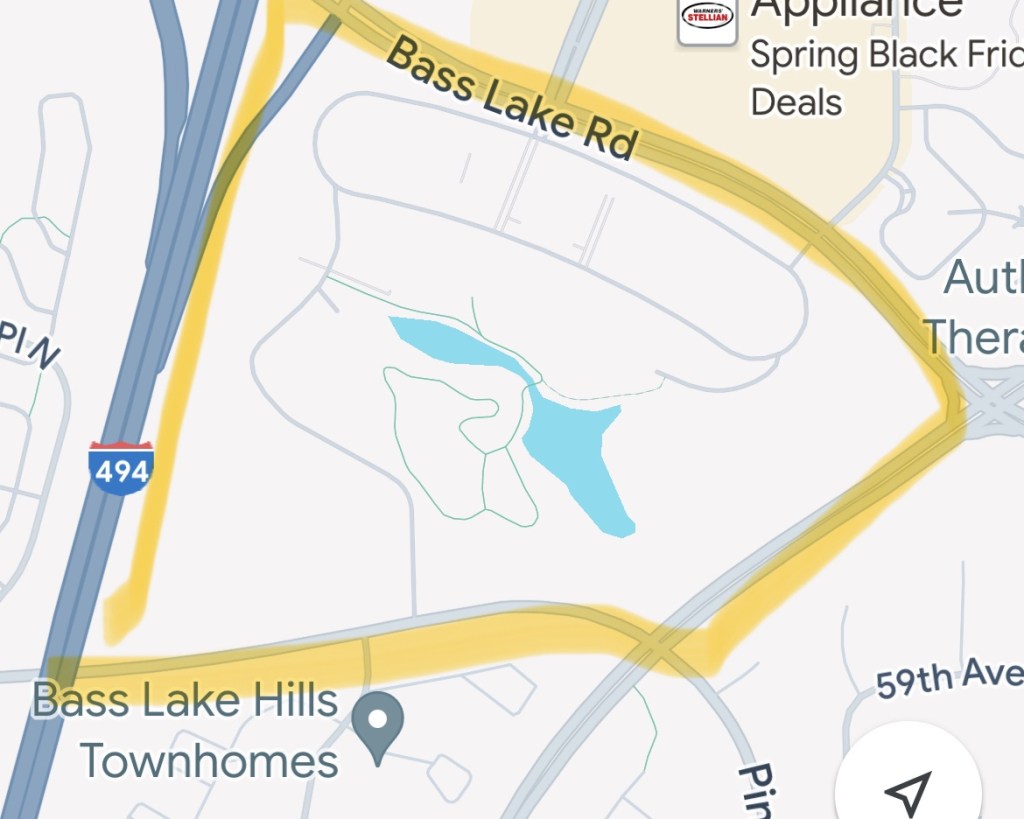
We were driving by an intersection nearby and my husband said, “I can’t see why they’re tearing down the Prudential building. It’s in such good shape.” True. The building that was the corporate headquarters for Prudential in Minnesota was only forty years old and still looked like an attractive structure. But the destruction has begun.

Although the building is still viable, it sits on 43.75 acres of land within the Hwy 494 loop around the Twin Cities. Perhaps a large corporation would still invest in a private campus of this size, but the likelyhood of a current buyer, with the money, and (perhaps most importantly) the compatibility with the structure, is improbable. Technology changes alone make a forty-year old commercial building sorely lacking.

But it’s really about the land.

In 1980, much of the surrounding land was undeveloped. There were scatterings of buildings and a few housing developments, but this was truly the outskirts of the metro area. Bass Lake Townhomes, for instances were built in 1990. The commercial strip mall across Bass Lake Road to the north was built in 2001.

Once the present use of the Prudential site changed, and the company no longer had value in it, then value became what an outside party could do with the parcel. And this is what is proposed.

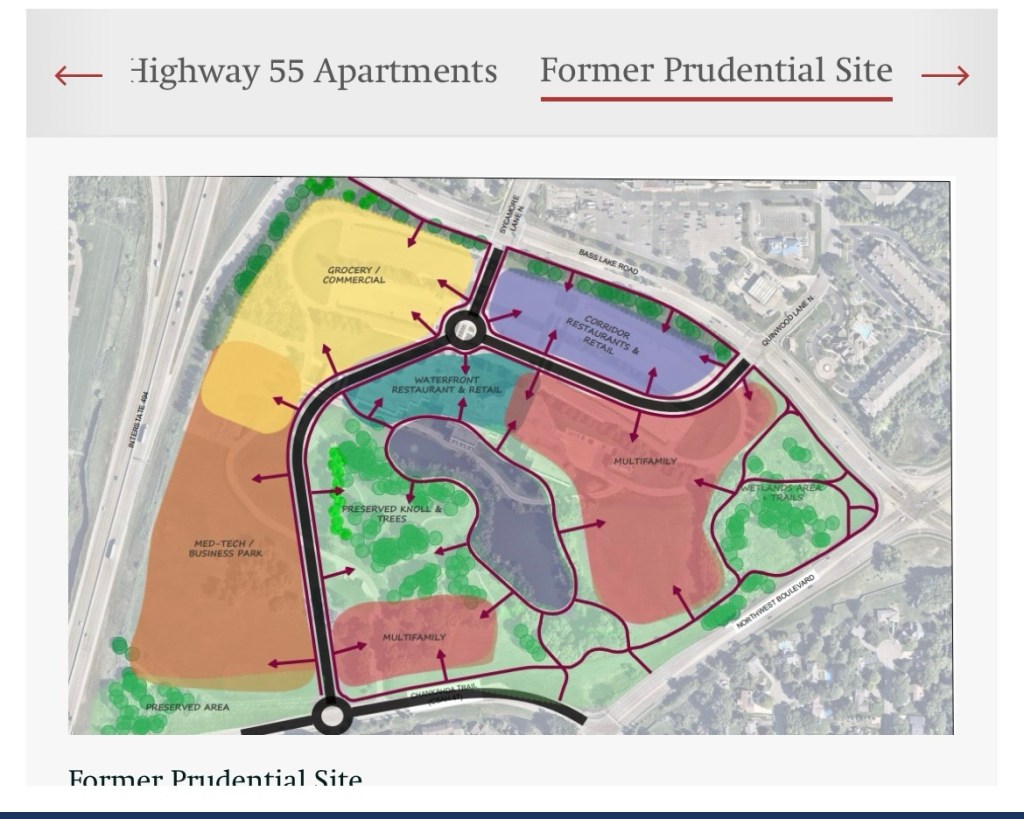
There are plans for two large apartment buildings. There is a retail and a grocery. There is space for restaurants and other commercial. The pressure to release this resource from a one-site parcel to a multi-use asset is tremendous. Thus the value of the large, seemingly viable, structure diminishes to nothing.

What’s interesting to note is that Prudential did nothing to make this happen. It occured because of neighbors.

When 1st world problems sound trite-maybe redirect to 3rd world?

With the politicians back to work in their respective capitol buildings, news of their work starts to trickle out onto the media sites. Some topics seem so tired, others seem combative and unnecessary. If politicians feel a calling to go to bat, why don’t they put their energies to places in the world that need the very basics? Over a quarter of the world’s population still does not have piped water into their home. And more than forty percent live in places with no sanitation.

Key facts from World Health Organization

  • In 2022, 73% of the global population (6 billion people) used a safely managed drinking-water service โ€“ that is, one located on premises, available when needed, and free from contamination.
  • In 2022, 57% of the global population (4.6 billion people) used a safely managed sanitation service.
  • Over 1.5 billion people still do not have basic sanitation services, such as private toilets or latrines.
  • Of these, 419 million still defecate in the open, for example in street gutters, behind bushes or into open bodies of water.
  • In 2020, 44% of the household wastewater generated globally was discharged without safe treatment (1).

It’s not a lie but…

People frequently make statements that, while technically true, lack the necessary surrounding context. Without this context, the claims can be, at the very least, misrepresented and, at worst, deceptive. Claiming context, however, maybe the responsibility of the the audience.

Consider an example.

During my highschool years, my family took advantage of me by giving me the responsibility of caring for a toddler and an enfant. I couldn’t broaden my experiences by participating in extracircullar activities or sports in highschool. I couldn’t earn my own money working at a fastfood restaurant. My family pocketed thousand of daycare dollars while I suffered a loss.

Now put context around the scenario to see if, as a member of a family, this claim is true.

  • Consider a farm family in the 1940s. People are still recovering from the great depression when thousands of farms were lost in bank repossesions. All the adults are preoccupied with the crops and livestock and feeding everyone in the household. Teenage boys sometimes leave school after eigth grade to work fulltime besides their fathers. Female family member from the old country may make the journey to help in domestic chores as an opportunity to make a new life in the US.
  • Consider a family in the 1970s. The women’s movement has championed women’s work outside the home. The parents have the financial capacity to put all their children through college. The also have the connections to mentor the kids about career choices and chanel their aspirations to people within their preferred industry. The children secure well paying jobs early in life.
  • Consider a famliy with a teenage foster child and three very young birth-children. The foster child is treated well in the household but at age eighteen is told to make it in the world by their own gumpshin.

I think most would say that the duties of the individual in the form of babysitting was matched by the duties given to her by the family in the first two scenarios. In the last scenario perhaps not so much. The point is that when a claim of retribution is made against a group, it is not possible to give an assessment until 1. the group is named 2. the context of the activity is described 3. a weighting of the benefits of being a member of the group is determined. Even then, it is often necessary to have a sense of a baseline of what social arrangements were typically acceptable for similar sets of people.

From here forward demand to know context. There is no way to assess a story without it.

Relearning self-governance

Minnesota winters are chilly. We also get a lot of snow. The white stuff is pretty and all when it gently drifts down from a starry sky. But at some point, someone has to clear the roads and sidewalks so people can safely walk and drive to their destinations.โ€‚Last season, winter played us a tough round.

Depending on how far back you go in the data, it was either the wettest or second-wettest meteorological (December-January-February) winter for the Twin Cities. Records back to 1893 are considered the most reliable, and in that case this winter was No. 1. (The winter of 1880-1881 measured a whopping 9.58 inches of precipitation.)

For the Twin Cities, our seasonal snowfall total, which includes the fall, is up to 71 inches. Thatโ€™s 80 percent more than normal. In Duluth the total is up to 93.3 inches, 41 percent more than normal.

MPR

To keep the proper perspective, 71 inches is just under six feet of snow. Had it fallen all in one go, the banks would be taller than most of the population. However, it doesn’t snow all at once. But when it snows more than a couple of inches, someone needs to get out with a shovel or a snowblower to work away at the sidewalks whole the city and state trucks clear and salt the thoroughfares.

Lots of people had a hard time keeping up. In the denser cities centers, the need for clearing is even more acute as people need to cross sidewalks to get to bus stops or depend on their neighbors to tackle the alley so they can drive into their garages. There’s a lot more shared space. The issue of snow removal reached a feverous pitch as snow removal undone causes coatings of ice. People proposed that the city should clear the sidewalks as well as the roads. That is, until the estimates were tallied up by the budget departments.

Others offered their solutions of self-reliance from sections of concrete alleyways hither and yone. A guy with a snowplow would do it, some would say. My dad used to organize the snow plow schedule, piped up another. Fast forward six months, with the winter weather easing in around windows frames and under the door sweeps, and there’s a call put out on twitter to ask about that thing called “organizing.”

Barack Obama was the first legit person I heard use the term neighborhood organizer as a job description. It’s actually quite apt for spontaneous social labor. A job needs to get done across some jointly held property or responsibility, and someone’s got to do it. The push and pull of participation and gratitude are part of the dynamic, and then there are the leaders that keep track, and, like Bill Lindeke, there are the advertizers or communicators keeping the clan informed on how to keep the tradition going, in case a break in the chain has defrayed the tacit knowledge.

Delightfully inappropriate

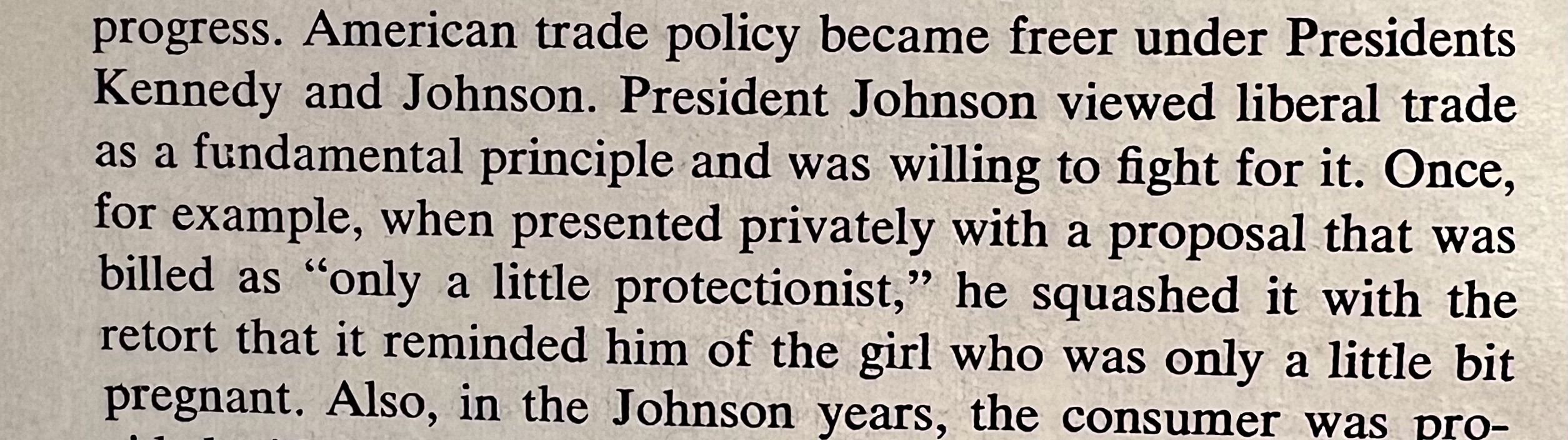
To think that a POTUS would make a joke about how a US economic policy is somehow similar to an expecting mother is hilarious.

The surprise here is that Kennedy and Johnson were free traders. Or I’m showing off my lack of historical knowledge.

Segment taken from The Political Economy of Prosperityย by Authur M. Okun.

Utopian talk vetted as real world

I have a new reading rule. If I bend back the bind of a non-fiction book, read ten pages, and fail to find even one whisper of a tie back to a real world concern, I shelve it.

It’s hard to devote time to all the right phrases: institutional (a wobbly word itself), intangible, synergies, norms, soft infrastructure, R&D, yahdi yah. And not one practical eample. The use of so many imperative phrases and descriptions aimed at thin air calls into question where all that is being described is professed to reside. Because if the authors are finding it difficult to relate instances back to the world we live in, then what they writing is a work of science fiction.

HG Wells, Jules Verne and LeGuin all provided keen insights into what is to come. Science fiction is a popular and well read genre. I suggest these policy types devote their efforts in this manner as well. Once they find they are writing on air, they just need to conjur up a little fantasy destination and some sympathetic characters. People love a good story.

Look at how CS Lweis drew everybody into The Lion, the Witch and the Wardrobe without anyone realizing they were being taught a thing or two about Christianity.

What’s with birthdays

My kids got a pile of gifts on the breakfast table every year on the anniversary of their birth. It’s fun to surprise and impress them. For a brief moment, you get to be a magician conjuring up exactly what brings them joy. Everyone wins. Until they get older and their expectations are not as easily met- so there are discussions about gratitude and the thought of being recognized. Which often doesn’t compensate for the now-missing anticipated pleasure.

But kids aside, I don’t get the tradition of recognizing the birthdays of work associates, clients, or even famous people. You lived one more year- OK. What else? Is it just that it is easy to have a designated day every year to give someone a little extra TLC. I suppose that’s nice.

There are so many other things to recognize and doing so would encourage others to act in tandem. Give credit to those who help out other parents with kid duty or coaching or scouts. Acknowledge those who support the local civil servants like the firefighters, libraries, or police.

Publically expressing gratitude to those who give their time is nice for the recipient of the praise but also advertises to the public the jobs that are performed daily on their behalf. It tells how people get involved and how their contribution keeps all the wheels of the neighborhood in motion.

Next time you post a birthday wish on social media, consider thanking someone else you know whose putting their two cents in for everyone else.

Tiebout competition leads to markets for ties

The voluntary nature of consenting to a particular pirate ship’s constitution facilitated what economists call “Tiebout competition” between pirate crews. Tiebout competition is the process whereby governments compete for citizens, so-named for the economist who first articulated this process, Charles Tiebout. The idea is a simple one. If citizens can “vote with their feet,” governments must be more responsive to what citizens want. They must offer lower tax rates, better public services, and refrain from preying on citizens, or citizens will move to another jurisdiction that does. Governments care about this because their ability to raise tax revenues requires a tax base. And if citizens move out of one jurisdiction to another, in the jurisdiction citizens are fleeing from the tax base shrivels up. Pirates’ voluntary governance structure means they didn’t in have governments. But the principle of Tiebout competition applies as much to their floating societies as it does to competition between governments.

The Invisible Hook, The Invisible Economics of Pirates by Peter T. Leeson

Summer lull

It feels like we’re in a news lull. Even the Fed increasing rates by .25% hardly registered on any of my social media feeds. No dire predictions about a recession or the inability to control inflation (which appears to be delicately restained for the time being). Houses are selling and prices are not going crazy. So what is there to talk about?

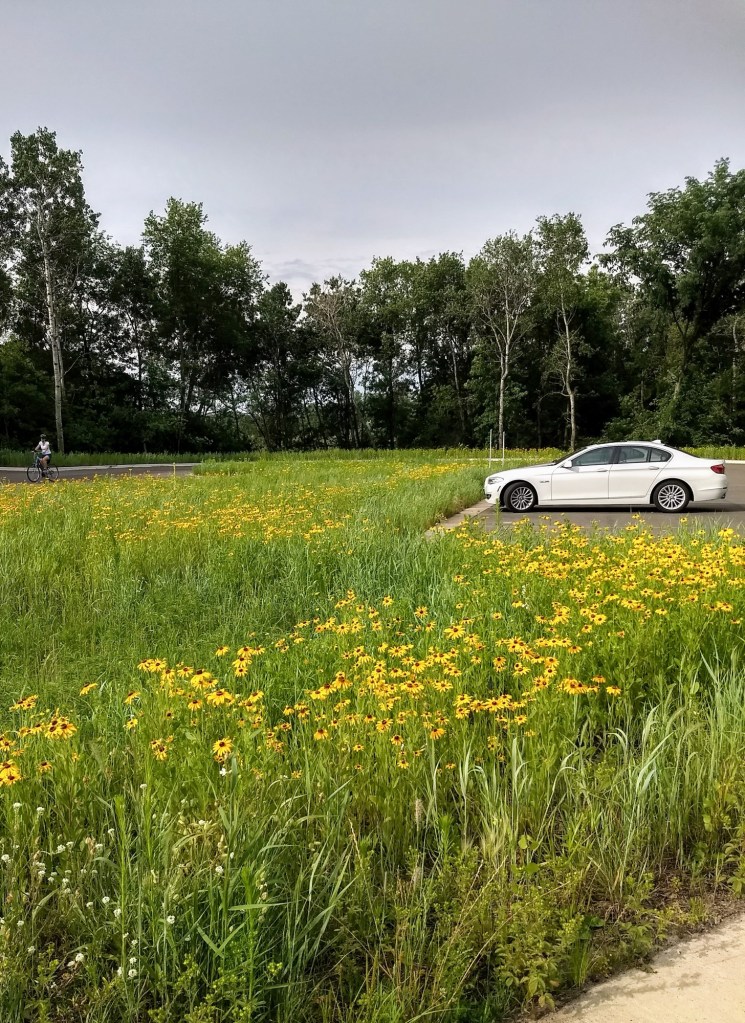
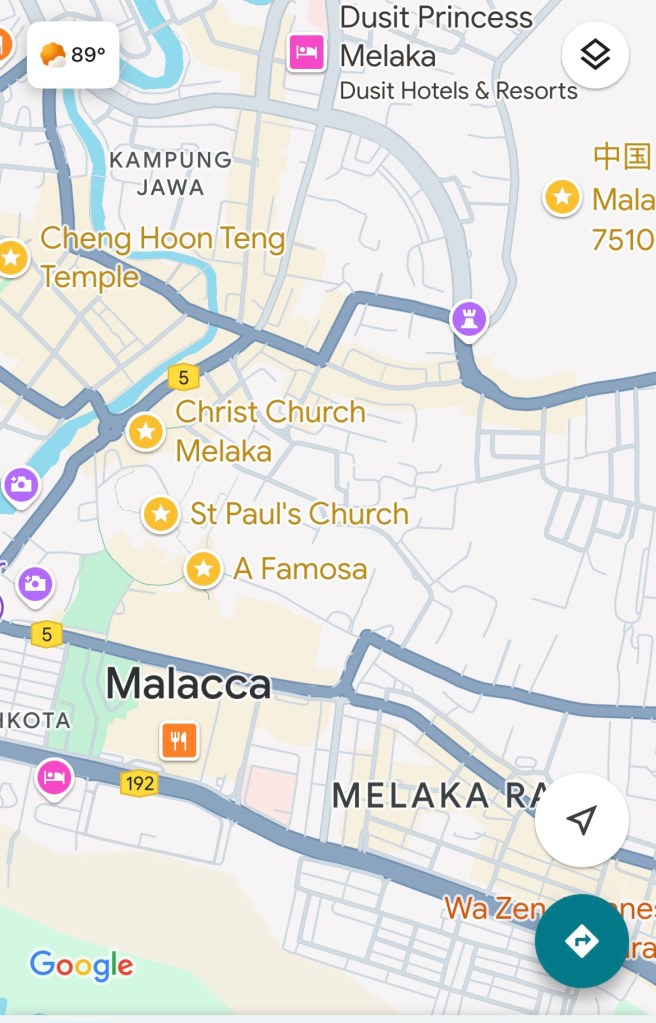
We found a new neighborhood walk that swirls between the backyards of some very nice homes and a large stand of trees that block a view of the railroad tracks. Along the way, the path runs up against wetlands edged in wildflowers. It’s in a newer area and as of yet the cyclist, joggers, and dog walkers have not discovered its pleasant ambiance. The trail isn’t fully inked in on Google Maps yet which may also contribute to its lack of use.

Mulch is on sale as we veer toward August. Many people spread out their shredded wood chips in the spring, but I find it helpful to wait for all the plants to be fully out of the ground to smooth in a new layer of the woodsy product. Right after a good rain works well. The weeds are easier to pull when the soil is moist. And the cedar mulch puts out a nice fragrance for ten days or more.

People are wrapping up their summer plans this time of year and will soon be busying themselves with getting their kids ready for school. There is only the Autumn Joy sedum left to bloom and that comes about around the first day of school. Then we’ll all be gearing up to fall activities. Homecoming Football games and parents’ weekends. Fall breaks and Halloween. Then the holidays- Thanksgiving onto Christmas.

So wander into that back garden. Take a pillow and have a nap on the outdoor sofa under the shade of a tree. Soon the summer heat will be swept out with the first frost and people will be a flutter preparing for the winter weather.

Lake home price on the move

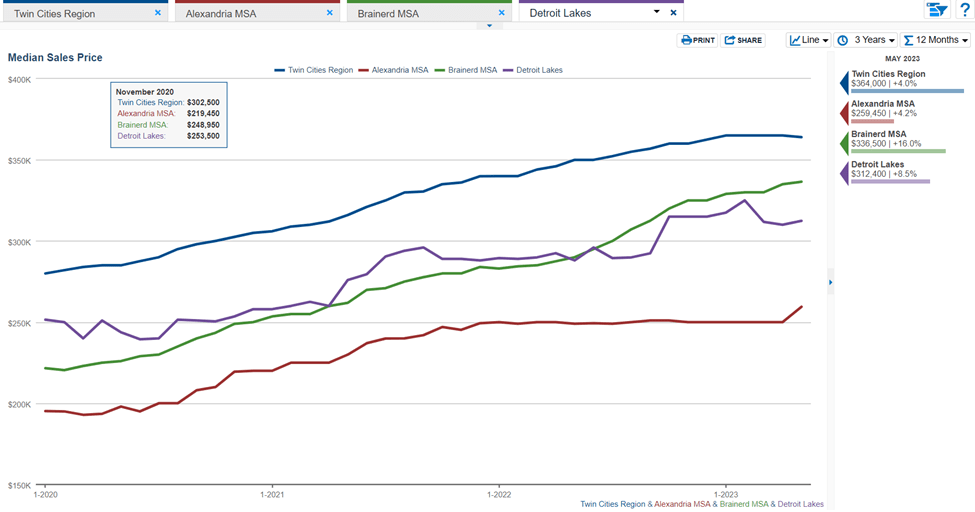
Our state is blessed with lots of lakes. They are well-liked for their recreational qualities as well as their aesthetics. For most people, the competition for a lake home in the metro makes this prospect unattainable. But there are many lakes at a few hours drive from the core MSA. And a collection of lakes attracts enough patrons of restaurants, retail and golf courses to produce lake districts.

Since many prefer to look out over a lake than a row of rooftops, it is not surprising that a surge of interest occurred following Covid. The work-from-home option gave people, at least for the moment, the option to live the rural life. As downtown real estate suffers the largest vacancy rates in years, pricing in Alexandria, Brainerd, and DL areas has surged above metro rates of increase.

This reversal of migration of more well-to-do people from the metro to the rural areas should also have implications in activating other types of community interests.

Thinking In Space

People think differently. I don’t mean they think about an issue differently. What I’m getting at is how brains navigate concepts and concerns differently.

Some people have photographic memories and can picture a page out of a book. When they want to think of a definition or the historical background on an issue- poof- the image appears to aid them. But this is not the same as a visual way of thinking. For some people, their thoughts can capture events and spaces in real-time, as they transpire. Take the skills necessary to be an air traffic controller (pre-computers), This type of mind is skilled at keeping track of moving objects in three dimensions. Pretty cool.

It’s really noticeable how differently people think if you are using a map to navigate a city. A linear thinker takes directions one turn at a time. There is no overlay of the cityscape into quadrants to have a general sense of where one should be. As long as they follow explicit directions, all is well. But improvising or getting back on track after an error is too difficult without help.

At the same time, a sense of distance and duration is simply missing. Offhand comments which imply a schedule can be met or a stop can be worked in (it’s the anything is the possible world!) can be aggravating for the minds which navigate in three dimensions. It’s better if those with a sense of direction take the wheel.

People doubt Exit- they shouldn’t

The Mayo Clinic, the state’s largest private employer, put its foot down on Friday over legislative overreach at the MN state capital.

In an email to DFL legislative leaders and Walzโ€™s office on Wednesday, a Mayo Clinic executive said the non-profit is reconsidering its plans for new facilities and infrastructure that are โ€œfour times the size of the investment in U.S. Bank Stadiumโ€ โ€” a $1.1 billion project. And their decision is โ€œtime sensitiveโ€ and will be made in a matter of days.

โ€œBecause these bills continue to proceed without meaningful and necessary changes to avert their harms to Minnesotans, we cannot proceed with seeking approval to make this investment in Minnesota. We will need to direct this enormous investment to other states,โ€ Kate Johansen, vice chair of external engagement, wrote in an email obtained by theย Reformer.

Minnesota Reformer

Throughout the spring legislative leaders have been warned that continuing to push a progressive agenda, where the expense from social arrangements is sloughed off business, will cause people and entities to exit the state. This letter provides a tangible example.

Mayo is a powerhouse in MN and thus it is unlikely that this flare-up will go unresolved. But what about all the little businesses and people who decide they’ve had enough and pack their bags? It would be handy to pin down some indicators for people’s movement. Ones that are representative but not alarmist.

Justify the supply

This comment confirms that it us still difficult to evaluate providers of public goods services. Why are there not more indicators? Why is the analysis kept under wraps? Where is the clearinghouse of market process that ruffles through the producers and shows the market who is getting business done?

Because without these feedback loops it is too tempting, as the Rev references, for people to privatize public funding.

Sensitivity about investor owned property

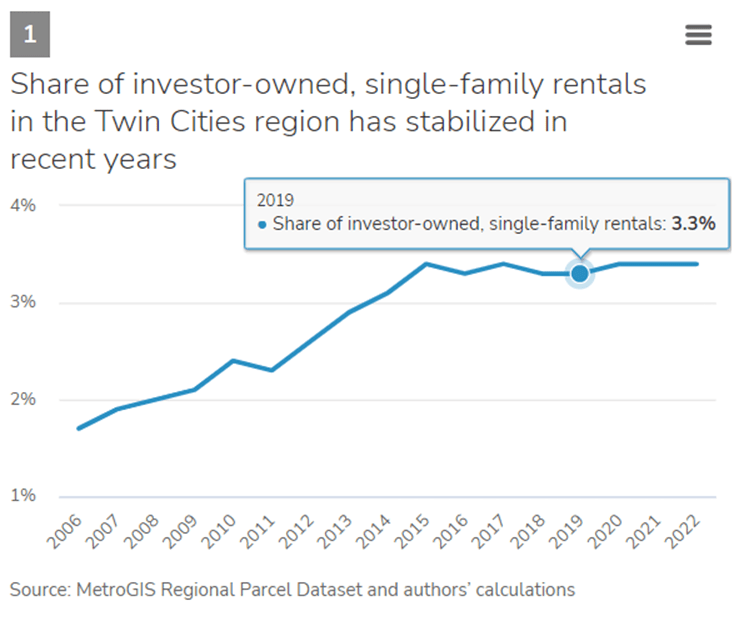
The Minneapolis Fed posted a thoughtful article about investor owned properties across the Twin Cities metro. Investor-owned homes ebb and flow in the Minneapolis-St. Paul region. The long and the short of it is that investor owned homes represents a small percent of the total housing stock. Prior to the recession it amounted to 1.9% of homes and has been stable at 3.3-3.4% for the past eight years.

It’s funny how the story changes. The recession of 2009 pushed so many homeowners out of their properties that vacant and abandoned properties were an issue. Cities aggressively tracked down banks (for they were holding most of the paper through foreclosures) to enforce newly created vacant property rules. Investors bought homes that no one else wanted or was maintaining.

Some people infer a nefarious angle to the larger percentage of investor-owned rentals in low-income areas. Isn’t it logical that when people cannot afford to buy a home they partner with an investor so they may still enjoy the benefits of single-family living? Also- people who are new to an area often rent until they find their way around a new city.

The portion of rentals in a neighborhood is a number to keep an eye on, but there are many others. What type of household formations are accommodated in the neighborhood? Are there enough extra hours for the residents to participate in civic activities? Are transportation options safe and provide the proper connections? The performance of core services affects the quality of a neighborhood to a greater degree than the percentage of investor owners.

How Mancur Olson talks about groups

Mancur Olson is known mostly for his first book published in 1965, The Logic of Collective Action, Public Goods and a Theory of Groups. An overly simplified version of his theory is to show that collective action becomes more and more difficult as group sizes grow. Here’s a portion of his analysis taken from Chapter One.

There are two things to determine in finding out whether there is any presumption that a given group will voluntarily provide itself with a collective good. First, the optimal amount of the collective good for each individual to buy, if he is to buy any, must be discovered; this is given when Fi(dV./dT) = dC/dT . Second, it must be determined whether any member or members of the group would find at that the individual optimum that the benefit to the group from the collective good exceeded the total cost by more than it exceeded the member’s own benefit from that collective good; that is, whether Fi > C/V.

The argument may be stated yet more simply by saying that, if at any level of purchase of the collective good, the gain to the group exceeds the total cost by more than it exceeds the gain to any individual, then there is a presumption that the collective good will be provided, for then the gain to the individual exceeds the total cost of providing the collective good to the group.

It’s a very individualistic point of view. If the participant in the collective extracts enough then they will agree to pay accordingly. There are metered goods for which this slicing and dicing of inputs and smattering out the expenses based on individual consumption works quite well. The provision of clean drinking water through most municipalities in the US follows a similar model.

But instead of thinking about the breadwinning individual as the only participant in the payment scheme, shouldn’t we think of every household as a group? Whether the service is brought to one or ten members, doesn’t that change the gist of the analysis? On the individual level of analysis, one individual could claim that she is paying a disproportionate about of the infrastructure costs. She is bearing the entire load of one home whereas the home in which an extended family enjoys the benefits of clean water across more beneficiaries.

Olson’s way of equating payment for the public good to an immediate withdrawal of a benefit seems different than how it is thought about with the delivery of a service such as clean water. The head of household is anticipating potable water for everyone in their home. And even beyond their residence as it is necessary to be able to drink from the tap at schools and in other public venues. Water is such a basic public good that, as opposed to a fee for service immediate exchange, the expectation by the individuals who pay the water bill is for everyone in their community to access drinking water.

The feel of this group seems more in line with how groups are broken down by Hayek, as I wrote about yesterday. His basic building block group was the assembly of folks who interact face to face. A group, not a bunch of individuals. Through a city or community, there is a desire for core services, such as water, to be accessible by everyone whether they are the ones earning a wage and writing the check for the water bill or not.

Westminister Town Hall welcomes Chris Blattman

There’s a beautiful church on the edge of downtown Minneapolis called Westminister Presbyterian. The nave is more of a square than a rectangle and the ornate stained glass windows are all around. It was built over a century ago and wraps you in old world craftsmanship.

I don’t attend service here but I do take advantage of their Town Hall forums which take place through the fall. It must have been five years ago when David Brooks made an appearance that filled all the chairs and pews. Minneapolis is often forgotten on book tours and such- some stay away from the nasty weather. But Chris Blattman, an economist from the University of Chicago, said today that he feels most at home in our state. He was raised in Ottawa and there is something familiar about the north country.

Blattman is on a book tour for his new release Why We Fight. Before he provided an overview of his thesis, he elucidated that for the most part people don’t fight. A detent is preferred so all sides may reap the rewards of a peace dividend. War is nothing but an expense. But under roughly five circumstances, an often erroneous calculation ignites a war.

The first part of the talk focused on global conflicts especially Putin’s invasion of Ukraine. Large-scale events are often easy to refer to because people have read about recent events, know the leaders, and a bit of the history.

A local Ukranian band opened up the talk.

Blattman also spoke about his work in reducing local violence in neighborhoods. He has extensive experience in Columbia both with gangs who commit violence and those who hold the peace. This last one is a maintenance type of work. You keep up on balancing out the little power struggles, cool down the hot heads and monitor for possible failures in the system. If you think about it maintenance is a part of most social commitments.

After speaking for about twenty-five minutes, questions on index cards were passed to the front. The very last one was practical. What does he suggest the audience can do to fight violence? (A real issue in present-day Minneapolis). He said to work at the margin. Step in and do small things. Do maintenance.

Debunking the Public and the Private

How can it be that back in 1985 Tyler Cowen debunked the definitions of public and private goods in a paper, PUBLIC GOODS DEFINITIONS AND THEIR INSTITUTIONAL CONTEXT: A CRITIQUE OF PUBLIC GOODS THEORY, written while at Harvard? That was, let’s see, thirty-seven years ago. And yet the old lighthouse is still being pulled out as an example of a public good.

He quite easily shows how every good may be excluded and hence economic goods do not sort by this idea of all of this being a public good and all of that being a private good.

As we shall later argue; โ€œpublicness” and “privateness” should not be considered per se attributes of economic goods. The purpose of this paper is to tinker with the definition of public goods and show that nearly every good can be classified as either public or private depending upon the institutional framework surrounding the good and the conditions of the good’s production.’

He goes on to show how within the shades of useage of a good. A park may start out open to all but then be taken over by a select group whether they be hoodlums or elitest. But maybe more importantly he points out that all goods are subject to resource constraints. A ballistic missile can only shield one set of citizens.

Traditional public goods such as national defense can be turned into private goods by a similar twist. Even if a nation’s entire nuclear umbrella may rightfully be considered a public good, a single anti-ballistic missile is far less public, for it can only service a limited number of individuals in a limited manner.*

I am taken aback that I am just coming across this now.

Real Estate Reporting

I feel bad for journalists who write about real estate. It must be so boring. Prices are going up. Prices are going down. Prices are going up a lot. Prices are going down a lot. In an effort to help invigorate their job, here are a few other aspects to real estate they could look into.

  1. The number of prospect buyers bidding on a property.
  2. The number of homes buyers consider beofre making a purchase.
  3. The amount of financing concessions being provided by sellers.
  4. Which party is getting priority pic on closing date.
  5. Is an inspection being performed.
  6. Amount, if any, of concessions following inspection.
  7. Which area in the local markets is performing the best.
  8. Is there a drop in activity as a certain ring suburbs- say the third tier subrubs.
  9. What type of activity versus inventory are second homes commanding.
  10. Cash versus financed buyers.
  11. Generational differences between structure preferences.
  12. Demand for townhomes versus single family versus townhome.
  13. The price spread between new construction and existing.

I could go on but I think you get the picture. There’s so much more interesting data to consider in real estate than aggregate prices across a country of 313mil people.

Predicting the Tip

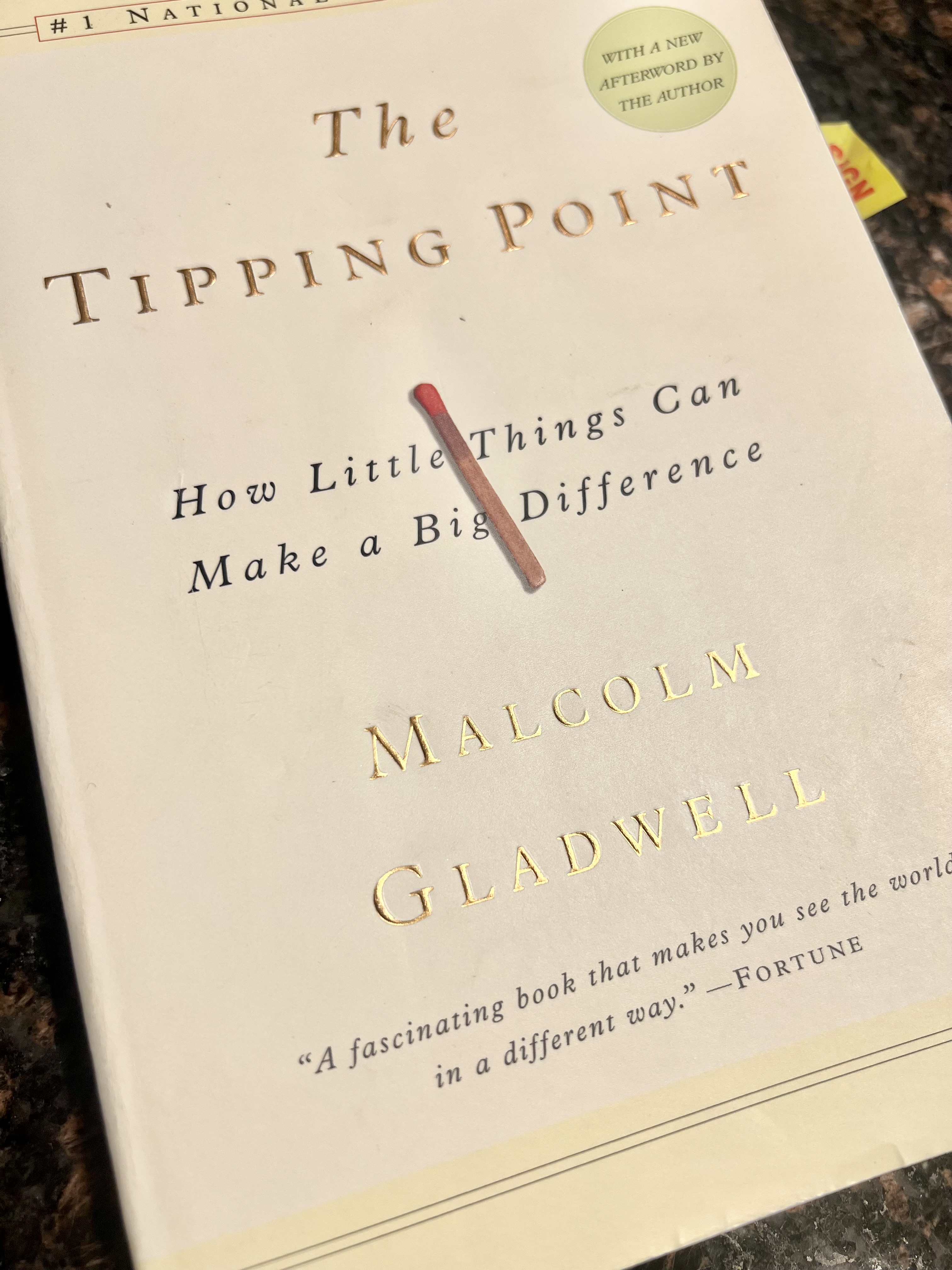
Over twenty years ago, Malcolm Gladwell became famous for elucidating tipping point scenarios. He showed us how trends become the rage, how neighborhoods fall to the criminals, and how suicides fester amongst the youth. He identifies some of the players who accelerate changes in social behavior: connectors, mavens, and salesmen. But he doesn’t come up with social indicators which would serve as signals for an up-and-coming tip.

Could there be the equivalent of a canary in a coal mine to prompt some warning? Last Wednesday the market thought FTX, the crypto giant, to be solvent. Ho hum, another day in the money. By Friday, bankruptcy proceedings eliminated large financial obligations. There’s a tip for you.

Is part of the problem that we wish not to see the signs? A neighborhood can be ignored as uninteresting, perhaps a little lower class, but fine for some. Some years go by and snarly graffiti, an assortment of tattered garbage spewing about and a gaggle of baggy clothed people around a bus stop trading something, make you turn your car around and drive right out of the area. You can’t nail down the date, but the neighborhood tipped right out of mainstream acceptable.

With so much on the line, whether billions managed by kids less than a decade into adulthood, or acres of real estate deemed unacceptable as affordable housing, you would think a set theory could ferret out some helpful indicators to warn of an impending tip.

Reading Bastiat

We are reading The Collected Works of Frederic Bastiat for the No Due Date book club, and it is quite a volume. The sheer size of the tome is daunting, and a translated text written a few centuries ago requires a careful read. Bastiat loves to reference which makes for a collection of footnotes (interesting to be sure) at the lower edge of every page. The pace is slow.

What makes it fun are the successive anecdotes which call out for a subtitle: The More Things Change, The More They Stay The Same. His primary objective in the first section is to point out the fallacies of protectionism. He talks of fears. The fear the rich will become richer and the poor will become poorer. The fear machines will replace workers. The fear workers will not receive their due for their labor. The fear that trade produces war, not peace.

There’s a section from chapter 22, Metaphores, where he discusses the impact of inflamatory language, in particular the use of the word ‘invasion.’

Take the word invasion itself.

A French ironmaster says: “May we be preserved from an invasion of iron from England.” An English landlord exclaims: “Let us reject the invasion of wheat from France!” And they propose that the barriers between the two peoples be raised. Barriers constitute isolation, isolation leads to hatred, ha tred to war, and war to invasion. “What does it matter?” say the two sophists, “is it not better to be exposed to the risk of invasion than to accept certain invasion?” And the people believe them and the barriers remain.

And yet, what analogy is there between an exchange and an invasion? What similarity can be established between a warship which comes to vomit shells, fire, and devastation on our towns and a merchant ship that comes to offer us the opportunity of exchanging goods for other goods freely and voluntarily?

Words that vomit misrepresentation. Too funny.

Bastiat (1801-1850) was born in Bayonne which is within ten miles of where this photo was taken.

Commissioner of Community Safety

MPR reports:

โ€œWeโ€™ve been talking for two and half years about reimagining public safety, creating a continuum of public safety, bringing all aspects of our public safety responses together in one department, and today that has happened,โ€ Jenkins said. โ€œAfter much consternation and vitriol, we have reached that day.โ€

MPR

I like Andrea Jenkins, who is now President of the Minneapolis City Council. In some ways this trans woman is the most conservative amongst the group of thirteen. She has also held consistent views over the past two years.

Cedric Alexander will be the first ever Commissioner of Community Safety. Here’s where he accentuates the necessity of public participation in the work if keeping the streets safe:

โ€œWe need to move policing forward and rebuild relationships in the community,โ€ Alexander said. โ€œWe need to redesign our approach to public safety so everyone is working together.โ€

Words for Wordle

There’s a fun little game to play when you need a fifteen-minute break from whatever has been eating away at your attention. It’s Wordle. The NY Times purchased the guessing game that went viral earlier this year. The player gets five guesses to solve for the word of the day. Clues are revealed by the tiles turning yellow (letter in the word yet not in right place) or green (correct letter in correct placement).

I like to go for as many correct letters as I can get in the first two attempts. Once you have three of four letters and perhaps the correct placement of at least one of them, my chance of a correct guess increases.

Some computer types with extra time on their hands tackled solving the puzzle in the least number of guesses. It turns out that the key is to pick a strong starting word. Here are some choices that should set you up for a three-try success: SLATE, SAUCE, SLICE, SHALE, TRIED, CRANE, and LEANT.

What’s your favorite Wordle strategy?

The word- nonmarket

I think it is unfortunate that economic literature adopted the phrase nonmarket valuation when using hedonic equations for securing a numerical value for public goods, or proxy thereof. The method of econometric calculation is used all over the world to secure numerical values for impacts of everything from wildfires to airplane noise to crime. You might notice that these are all goods which benefit (or detract) from the welfare of the public nearby.

Just to be clear- I’m referring to methods which involve the use of home sales values when properties are sold in an open and active market. There is no denying that the exchange of real estate for funds is a market transaction. Which is why I find it baffling that a component of a market generated price would be termed nonmarket.

Of course, buyers pay more for less airplane noise, or take a hit when a home is on a busy road. If it is a freeway instead of a through street with the occasional bus rolling by, the seller will need to take a bigger discount. Hundreds of buyers and sellers come up with these outcomes in a market. The discount of living in a flood plain or near a high-risk forest fire area or under the power line is derived by markets. The premium for the wooded lot or the view of the Rockies is determined by markets.

I think what is being drilled down on here is that the components cannot be separated from the bundles. And the features of the crime level or the subway or the quality of the schools are derived from efforts (or networks) of nearby participating neighbors. That makes these components of the total price non-fungible- they cannot be sliced off and traded.

But they are most definitely priced in a market environment. Nonmarket makes no sense.

The Lost Daughter- Movie Review

If you are an action/adventure film enthusiast I’m not sure if The Lost Daughter is right pick for your Saturday night viewing pleasure. Whereas James Bond movies open with a large landscape panning of a dramatic ski slope decent, this film meanders along an oceanside road for as long as it takes the sun to set. Whereas Bruce Willis navigates amongst hundreds of frantic bystanders taken hostage, this film has the camera angle so tight to the lead and her children that you can’t help but smell Johnson’s baby shampoo. Whereas the violence in action adventure is noisy, loud and explosive, the violence of the female sort is gut wrenchingly mean.

This is a movie about women. Women as mothers, as wives, as cheaters, as power brokers, as party goers, as needy. There are many layers to how all the players are set in motion. And of course, the femme fatale is a bushy bearded male who steals away the lead knowing she is easily baited by the public recognition he lavishes over her professional work.

On a first viewing I just want to enjoy the surface layer, with all the beautifully framed shots. But my subconscious is signaling there is more there to be seen, and to plan on a review at a later date. Though not heavy on action, there is intrigue. The movie starts slow but builds and with the help of an unreliable narrator, one discovers a need to learn more about Leda’s story.


Walking Around Money – Short Story Review

I started liking short stories when I first found Flannery O’Connor, probably because that was her preferred genre. Then I picked up The Best of American Short Stories because the volume had been edited by David Brooks- and then I was sold on short stories as a way of sampling a new author over an afternoon on the couch. The first selection in a volume called Transgressions (edited by Ed McBain) is Walking Around Money by Donald Westlake who is just one more prolific writer who was not familiar to me.

He’s a crime writer. This sixty-page caper is full of great language for his less than brilliant partners in crime. Take this description, for example.

Dortmunder and Andy Kelp and the man called Querk sat in silence (shoosh) a while, contemplating the position Querk found him self in, sitting here together on these nice wire-mesh chairs in the middle of New York in August, which of course meant it wasn’t New York at all, not the real New York, but the other New York, the August New York.

In August, the shrinks are all out of town, so the rest of the city population looks calmer, less stressed. Also, a lot of those are out of town, as well, replaced by American tourists in pastel polyester and foreign tourists in vinyl and corduroy. August among the tourists is like all at once living in a big herd of cows; slow, fat, dumb, and no idea where they’re going.

This is language I appreciate and enjoy. The plot is tight and fresh. Now that I’ve bumped into him, I’ll have to find more pages written by Mr. Westlake.

All work isnโ€™t the same

Jobs jobs jobs. Politicians love talking about jobs. But they might consider singing a slightly varied tune as 2021 has been the year of take-this-job-and-shove-it.

The Harvard Business Review reported:

According to the U.S. Bureau of Labor Statistics, 4 million Americans quit their jobs in July 2021. Resignations peaked in April and have remained abnormally high for the last several months, with a record-breaking 10.9 million open jobs at the end of July.

The great resignation should be some sort of indication to politicians that people are rethinking JOBS. The jobs where you are hooked to an employer and you have to do what they say and then you get a deposit into your checking account every two weeks. That kind of job. The kind of job that is referenced in the recently passed Infrastructure Investment and Jobs Act.

The greatest percentage of resignations come from mid-career professionals, people who probably have a lot on their plate. They are probably juggling kids and aging parents. And yet they are chosing to quit their jobs.

I think it would be worth the effort to figure out what other work they will be doing instead of the work-for-money job they just quit. Wouldn’t that be good to know? If a voluntary workforce was being formed to address delivery of health care, wouldn’t it be useful to track these efforts and the results that follow?

Or maybe it isn’t the joint goal of better health but instead the shared goal of furthering early education. I think is would be valuable to understand how many presently unaccounted hours support young children’s advancement in learning. Then in a decade we could all understand the results. Or maybe people are leaving their jobs to be present in the neighborhood and be vigilant in the deterrence of low level crime. Counting the number of working hours devoted to this cause, and the ensuing results, could draw some conclusions as to the capacity of an area to improve public safety.

You see I don’t believe people, in the prime of their lives, are quitting jobs to sit around on an overstuffed sofa and nibble on snacks. I believe they feel they have something more valuable to do with their time and efforts and expertise. Wouldn’t we all be better served if the government helped with a structure to channel those aspirations and in turn track the outcomes?

The old structure of government taking money from one side, arguing for two years before handing it off to the other side is getting boring. Why donโ€™t they think with a little more dynamism. Jobs don’t have to pay rolled. They can be mission based. Think of what could be accomplished with a little structure and an energized population wishing to do good.

Fall, Leaves, Fall


Emily Brontรซ

Fall, leaves, fall; die, flowers, away;
Lengthen night and shorten day;
Every leaf speaks bliss to me
Fluttering from the autumn tree.
I shall smile when wreaths of snow
Blossom where the rose should grow;
I shall sing when nightโ€™s decay
Ushers in a drearier day.

Maplewood State Park, Minnesota~October 2021

Interesting architecture

I showed a house this week which had floor to ceiling plate glass windows, sight line views out every window onto nature, and a Wolf gas range which would make any chef perspire gently at the brow. It was also priced twice as much, quite literally, than other home of comparable size with similar lot amenities.

The name of the architect as well as the brand of each notable feature in the home was listed out prominently in the comments. And the quality of the materials and construction were evident– from the tiled heated driveway to the reflecting pool. But what exactly should one pay for artistic features?

First off, to state the obvious, there will be those who will pay nothing. They will prefer to allocate the extra expenditure to square footage, and purchase a mini mansion in lieu of designer small. Right out of the gate, the buyer pool is a subset of all buyers. But more than likely the final bid will come from a select few who follow and appreciate the particular architect. Which explains why the name is featured so prominently in the marketing materials.

One could say that their is a community of buyers who find value in purchasing a property of such a design. And since that community would be trading property amongst each other, that extra premium could be said to be non-fungible to the community. It will always exist amongst them.

Now this concept could be a hard sell if it weren’t for the recent popularity of non-fungible tokens, or NFT’s. This new fangled art is available for purchase for all those who invest in crypto currency. The value to those outside the crypto community is, well, zero. And what would happen if the crypto community disbanded, lost interest in a form of currency that requires mega wattage to mine? Then the NFT’s would be worth zero.

In the NFT example it is easier to accept the non-fungible feature as the technology makes a clean line between those who can buy, trade and value the tokens, and those who cannot. A home built by a particular architect has residual value not tied to its design features. But the premium people pay is non-fungible. It’s tied to the community who support and value the artist in question.

Apples

Fall colors are creeping across the foliage here in the North Star state. Temps are dropping into the 50’s at night. And mums are appearing in planters snuggled up to front doors. This time of year families head to apple orchards for hay rides and hot cider.

Minnesota has a long history of cultivating varieties of apples. The sweet and tangy Honeycrisp still commands an extra $1-$1.5 a pound at the grocers. But if you’re wondering how best to use your apples, the Saint Paul Farmers Market has but together a flow chart for you.

Early learners find out that A is for apple. The apple has the dubious distinction of temping Eve into dragging all the rest of us into a world of lurking temptations. An apple was Newton’s famous inspiration. Apple Records was founded by the Beatles in 1968. Rene Magritte’s famous painting places a floating green apple in front of the face of a man in a dark grey suit. Now you can access your music through Apple i-phones. An apple a day keeps the doctor away.

Religion, science, the arts, technology, public health and education. The apple is well represented in the infrastructure of our lives.

9/11- Twenty years on

Twenty years ago, a blue sky day started the same as most days. With my infant child in his car seat behind me I drove the short distance to Golden Valley Lutheran where he attended daycare. He was four months old at the time and we had just started at the daycare, so I’m sure I was pre-occupied with the drop-off routine. As we walked in, with the car seat handle crooked in one arm and Aaron’s blankie in the other, I overheard a background conversation about a personal aircraft colliding into a skyscraper.

The sun was shining bright through the windows yet the atmosphere in the building was buzzing with electricity. I didn’t think much of it except to perhaps wonder about the level of concern in the air. Next stop my office. In that ten minute drive, the situation had unfolded. My office manager already had pulled out a TV in our conference room and other agents were gather around it on office chairs. The towers were on the monitor. One was smoking. People were trying to catch up to the story. We all sat mesmerized and the speck of a plane hit the second tower.

Now there was no confusion, only horror at the clarity of what was to become of all those people set up for their workday in Manhattan.

It gets fuzzy on how exactly the day went. One of my brothers made sure to call all of us, as we live in various locations across the US and Canada, to be sure everyone was OK. My husband worked in downtown Minneapolis at the time, and the employees were evacuated out of fear of cascading attacks. For several days following the event it was as if the ashes from the east coated our neighborhood with a quiet mourning. More homes flew American flags from their front porches.

I choke up even now at what happen to those folks. Their last phone calls to their loved ones. The doom that must have settled in as one building toppled.

Two years ago, for his graduation present, I took Aaron to New York City over a long weekend. We were on the upper level of the tour bus while going through Lower Manhattan when the fire trucks were called for a bomb threat. It was chaos. The fire engins could barely move through traffic. We were transfixed. The New York tour guy was thoroughly unimpressed. What his city had experienced twenty years ago will dwarf alarming incidents for decades to come.

Matching like to like–cohort addition

Framing up the data around issues can highlight one view while smothering another. All the numbers are correct, it is the sorting and comparing which is all a kilter. Take for instance the topic of home ownership. Here are the rates by state provided by FRED. Minnesota looks great!

Now let’s look at how homeownership rates broken down by county. You will notice that the highest homeownership rates are in out-state Minnesota and the lowest rates in the counties which make up the Twin Cities metropolitan area–outlined in purple.

Also taken from FRED

Since the rural communities tend to be older, it will be no surprise that homeownership is also highest amongst the middle to late middle age population. The Millennials, until just recently, have taken lack of interest in homeownership. Whereas 77-80% of the Boomers or Silent generation live in their own home, only 43% of those under 35 years of age have chosen buy a home. Younger folks are more likely to be attracted to the metro area.

To review, the data shows that as a state we have a high homeownership rate. Overall Minnesotans are confident in their ability and desire to own real estate and pay relatively high (ranked 19th) property taxes. Homeowners trust the cities, counties, school districts and, (for a smaller portion) the state in the use of the funds to provide services. The youngest group of adults, however, are running well below this rate, but in line with the national average.

No tricks or mirrors so far.

But what about these headlines? Are they accurate? Racial inequality in Minneapolis is among the worst in the nation – The Washington Post, Homeownership gap plays a huge part in race inequities – StarTribune.com, Why Black Homeownership Lags Badly in Minneapolis – WSJ

Each article frames the data in the same way. Minnesota is a horrible place to live for African Americans as exemplified in the homeownership gap of 51%, which is the worst in the nation.

In the Minneapolis metro area, 77% of white residents own homes, compared with 25% of Black residentsโ€”a 52-percentage-point difference, larger than in any other major U.S. city, according to an analysis of census and survey data by the Minnesota State Demographic Center, a state agency.

WSJ

What’s interesting is the black population in Minnesota has increases by more than 36% in the past ten years.

Between 2010 and 2018, the fastest growing racial group in Minnesota was the Black or African American population, which grew by 36%, adding more than 96,500 people. Second fastest was the Asian population, which grew by 32%, adding 69,800 people, followed by the Hispanic or Latin(x) population, which grew by 24%, adding 59,000 people. (Black or African American and Asian race groups are that race “alone” and not Hispanic or Latin(x)).

Data by Topic: Age, Race & Ethnicity / MN State Demographic Center

So if things are so bad, why all the in-migration? Maybe there is a need to look at the numbers a little more closely. Consider the breakdown of Minnesotans by age. You will note that people of color skew strongly to Millennials or younger.

Homepage | MN Compass

So wouldn’t the proper framing be to compare Minnesota’s homeownership rates by age cohort? I don’t have access to the numbers by generation, nor the time a journalist could devote to such calculations, but it seems erroneous to ignore variance between the groups. It seems flat out wrong to calculate rates of ownerships for African Americans who simply don’t live in our state. It’s true, that even with such an adjustment, there is still a gap. The spread is in the 18% (43%-25%=18%) range instead of the noteworthy gap of 51%.

Perhaps it is useful to use the inflated figure in order to get people’s attention. I believe ownership is the answer to extending trust between citizens and all the public endeavors in a neighborhood. I’ve also devoted many hours of unpaid labor with that mission in mind. But there are negative outcomes from fooling with the numbers too.

They discredit the built up capital that hundreds of people have devoted to the cause in good faith.

The beauty of Math

The best thing about math is that it is reliable. Numbers don’t change, they don’t have nuance or inflated expectations. You can’t disappoint them. They make you think of Horton the Elephant with a little redirect, “they say what they mean and they mean what they say, numbers are faithful 100%.”

Some people find them inconvenient for that reason. They want to tell their own story and numbers get in the way. So there are all sorts of tricks to distort the numbers. Graphs that don’t start at zero, or graphics where the bars are enlarged, to imply an unsubstantiated claim. The number sits on its axis, seemingly blushing under its inflated image.

All the more reason to keep people thinking about math. I was just reviewing the statewide scores by public school district and the math scores have the greatest spread between neighborhoods. Yet I don’t think math talent divides out that way. God given gifts ignore social-economic concerns. We just don’t know how to tap that talent-yet.

But we do know a lot about mathematical relationships. There are theorems and proofs as ancient as the Greeks. Some of us who desire some concreteness in the world, find this comforting. And even if it is not your thing, the applications of their relationships have been leveraged to give us a life enhanced by science and technology.

This alone should garner respect from even those with aversions to numbers. And even when the numbers aren’t giving us the feedback we want, they will most likely represent the reality we need to hear.

Can it be more than just about coin?

Biden’s 1.9 trillion relief plan is a little too enormous for me to get my head around. The magnitude of federal numbers just makes my eyes blur over the page. There is no anchoring the size of these things to my everyday life.

But if I can’t talk about magnitude, I can talk about structure. The goal of the bill is to engage the US economy as well as shore up people’s unexpected and uncontrolled loss of income; to keep their lives right side instead of upside down (which subsequently causes an economic drag on their greater groups). And then to get them back to employment where income can be feathered back in to the economic apparatus.

I’m all in favor of transfers for the first part. They work efficiently.

But I think there is a missed opportunity in the second part. Engaging idle labor from folks who are not destitute nor in need of transfers is low hanging fruit. As explained in this post about The Crafter The Contributor and The Covid Tracker, there are high skilled individuals available to donate labor if they are enticed by the objective at hand.

There are successful national service programs like AmeriCorps and the National Guard. Would it be so hard to have a property repair civil service? Ask any builder about the shortage of construction workers. What about a write-off for plumbers and sheet-rockers and electricians who’d be willing to have an apprentice tag along to fix a faucet at the local homeless shelter, sheetrock in a storage room at the food shelf, or replace all the gym lights with LED fixtures at the community gym?

A money transfer won’t teach a trade, nor will it make a connection between a potential employer and up-coming employee.

Pop quote!

These are all matters of incremental trade-offs to find an optimal amount and kind of safety, in a world where being categorically safe is as impossible achieving 100 percent clean air or clean water. Incremental trade-offs are made all the time in individual market transactions, but it can be politically suicidal to oppose demands for more clean air, clean water or automobile safety. Therefore saying that the government can improve over the results of individual transactions in a free market is not the same as saying that it will in fact do so. Among the greatest external costs imposed in a society can be those imposed politically by legislators and officials who pay no costs whatever, while imposing billions of dollars in costs on others, in order to respond to political pressures from advocates of particular interests or ideologies.

Throw in your best guess! No cost to play and a grand prize awaits the winner. Hint. Extracted from a 2007 book where on the rear jacket cover the WSJ says, “Clear and concise…Among economists of the past thirty years, (your guess here) stands very proud indeed.”