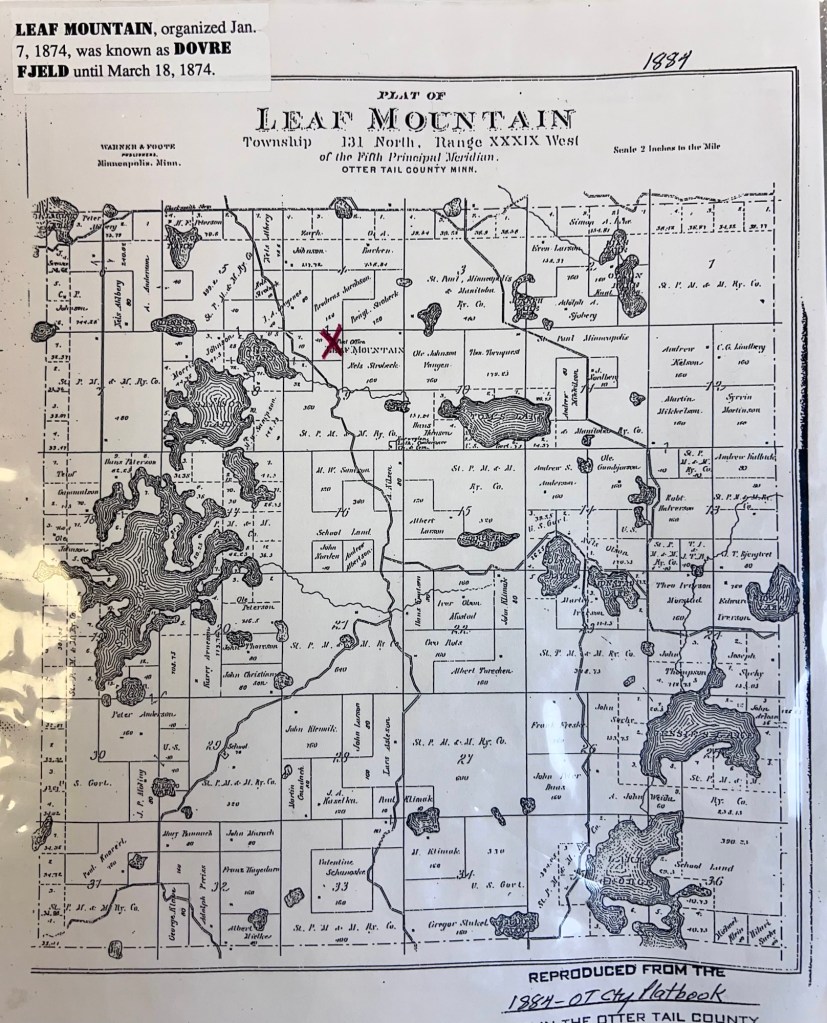
Plat map from 1884

I was digging around the county historical society lately because I thought it would be fun to find where my relatives made a land claim when they arrived in the US. Plat maps, which track ownership, were not updated on a routine basis in the days of primary forests and pioneer wagons. This one was done in 1884, and the next printed update didn’t get published until 1902. Even though the family of five children, all born in Norway, are said to have arrived in 1874, the family name has yet to appear here. It does in 1902.

What you do notice is the number of parcels denoted by St. Paul Minneapolis and Manitoba Ry Co. or St. P. M. & M. Ry Co. These parcels were owned by the railroad built by James J. Hill. The school land is also a major player. There were 168 schools in Leaf Mountain Township. The forty acre plots with no names listed, or US, are the ones open for homesteading. It seems the US government priorities rolled out in that order: transportation, education, and homesteaders to make it all work.

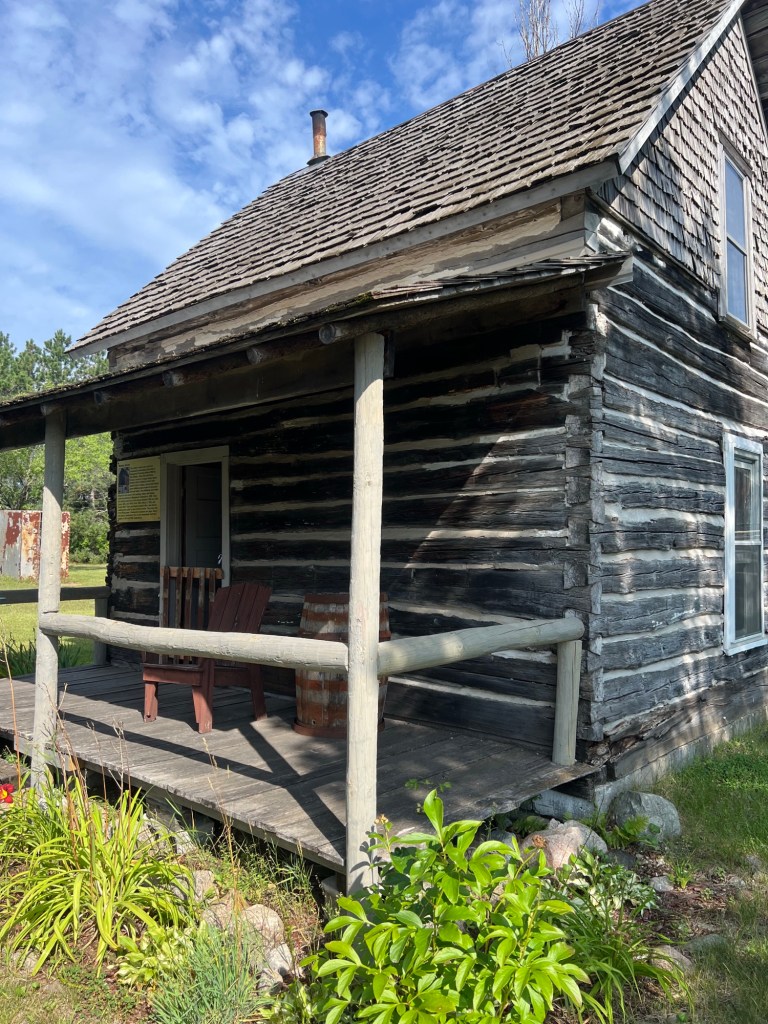
Cabin from nearby site built in 1890

Best Bird App

I love the Merlin ID app by Cornell Lab.

Everyone can make out a mallard or spot a majestic eagle, but this chirp identifier lets you identify all the smaller or lesser know creatures perched in your backyard foliage.

Just tap on the green arrow, and a recording starts. Every time a song is picked up, the bird ID flashes below.

Then you can replay the recordings to become familiar with all the different calls.

Another free educational service brought to you through new technology and the drive for data.

Discovery then and now

Before AI, you had to get up close and to see how things happened.

Now you just ask: Rubber cultivation from rubber trees involves planting the trees, allowing them to grow for several years, and then collecting latex from the bark. This latex is then processed into natural rubber. The process can be resource-intensive, and there are ongoing efforts to improve the sustainability of rubber production, including using degraded land for plantations and exploring more efficient extraction methods. 

Single Issue Groups vs Pluralistic Partnerships

Two recent articles by prominent housing policy voices reveal a shared concern about the structural limitations of the YIMBY movement’s traditional approach. Both Chris Elmendorf’s “YIMBYism started as a single-issue movement. It’s time to think bigger” and Matthew Yglesias’s “The power of a single-issue group” examine how YIMBY organizations have operated as focused advocates for increased housing density, but each author suggests that this narrow framework may need evolution to achieve lasting success.

The Competitive Model of Single-Issue Advocacy

Both authors describe YIMBY groups through a similar structural lens: as collections of people united around the singular goal of increasing housing density through land use reform and community lobbying. This approach has positioned YIMBY organizations as competitors in the arena of local politics, where they must vie against other community interests—from neighborhood character preservation to parking concerns—to secure favorable outcomes.

This competitive dynamic has been YIMBY’s strength. As Elmendorf notes, “The signal advantage of one-issue groups is that they can work with almost any legislator. By not taking stances on peripheral issues, they avoid making enemies.” Similarly, Yglesias emphasizes that “the strength of YIMBYism over the past 10-15 years has largely derived from its single-issue orientation during a time of relentless political polarization.” The movement has achieved bipartisan success across diverse political landscapes precisely because it hasn’t alienated potential allies by taking controversial positions on unrelated issues.

However, both authors identify a fundamental limitation in this competitive approach. When YIMBY groups operate as single-issue advocates, they inherently position themselves in opposition to other legitimate community concerns rather than as partners in comprehensive neighborhood improvement.

The Case for Pluralistic Collaboration

The articles converge on a crucial insight: sustainable support for housing density may require YIMBY groups to embrace a more pluralistic approach that considers multiple public goods simultaneously. Rather than competing against other neighborhood priorities, they could collaborate to address the full spectrum of urban challenges.

Elmendorf argues that this shift is not just strategically wise but empirically necessary. His research reveals that “people who feel good about big cities want existing cities to become more canonically city-like.” This finding suggests that support for density depends heavily on broader urban quality of life—including schools, transportation, public safety, and cultural amenities.

Yglesias acknowledges the value of this broader approach while defending the continued importance of single-issue organizing. He recognizes that multi-issue coalitions can offer something valuable to skeptical neighbors: addressing their concerns about construction impacts by simultaneously improving schools, transit, and safety.

Beyond Zero-Sum Thinking

The structural shift both authors envision moves beyond zero-sum competition toward collaborative problem-solving. Instead of viewing neighborhood concerns as obstacles to overcome, a more pluralistic YIMBY approach would treat them as legitimate issues requiring integrated solutions.

This doesn’t mean abandoning the core mission of increasing housing supply, but rather embedding that mission within a broader framework of neighborhood improvement. As Elmendorf suggests, such an approach could offer community members a compelling trade-off: “You may not like all the buildings, but you’ll love the great schools, safe streets, fast transit, and thriving business that we’ll deliver.”

The Challenge of Multiple Public Goods

Both authors acknowledge the complexity of this transition. Weighing multiple public goods requires sophisticated political judgment and potentially controversial prioritization decisions. A group focused solely on housing can avoid taking positions on education funding or transit investment; a multi-issue coalition cannot.

Yet this complexity may be precisely what sustainable urban policy requires. Rather than treating housing, transportation, education, and public safety as separate domains competing for attention and resources, effective urban governance demands understanding their interconnections and potential synergies.

Conclusion

While Elmendorf and Yglesias differ on whether YIMBY organizations should fully embrace multi-issue coalition building or maintain some single-issue focus, they share a recognition that the movement’s competitive, narrow approach has structural limitations. The path forward likely involves both preserving the strategic advantages of focused advocacy while developing new organizational forms capable of the pluralistic collaboration that sustainable urban development requires.

The evolution from single-issue competition to multi-issue partnership represents more than a tactical shift—it reflects a deeper understanding that creating livable, dense communities requires addressing the full spectrum of residents’ concerns rather than simply winning narrow victories on housing policy alone.


Two Parent Privilege and more?

Perhaps you’ve heard the term ‘two-parent privilege’ used lately. It seems to be in the air. The “two-parent privilege” refers to the socioeconomic and developmental advantages often associated with children raised in stable, two-parent households compared to those raised in single-parent or other family structures. It’s a concept rooted in statistical trends and sociological research, though it’s debated due to its implications and the complexity of family dynamics.

Please note that there are two key aspects to the potential benefits. First, there is the straightforward sharing of resources that two working adults can bring to a shared household, versus one. Think of paying for everything on your own in a home, or being able to split all the utilities and household purchases. Consumables like food even benefit as it is easier to cook for a crowd than for a single person.

Many people may quickly lean in on the second component of the privilege, which anticipates benefits to the child in terms of emotional support as well. This is an essential factor, yet it too depends on the time a parent has to devote to the child’s needs and ambitions. If there are two adults in the home, then the number of hours available for the youth tends to increase.

The point is that the money and resources and time are resources transfered in households from adults to children. We don’t really have a separate name for these things. Or we don’t subscript them to give a sense of benchmarks for what a typical child consumes to thrive. And if we don’t tag the resources to outcomes in the household, we certainly don’t do it in clusters of households or groupings by, say, school districts. And why not? It seems like a valuable form of analysis.

Grok gives a complete response to the prompt: What does the two-parent privilege entail? Give details on the mechanics?

Herbal Gardens

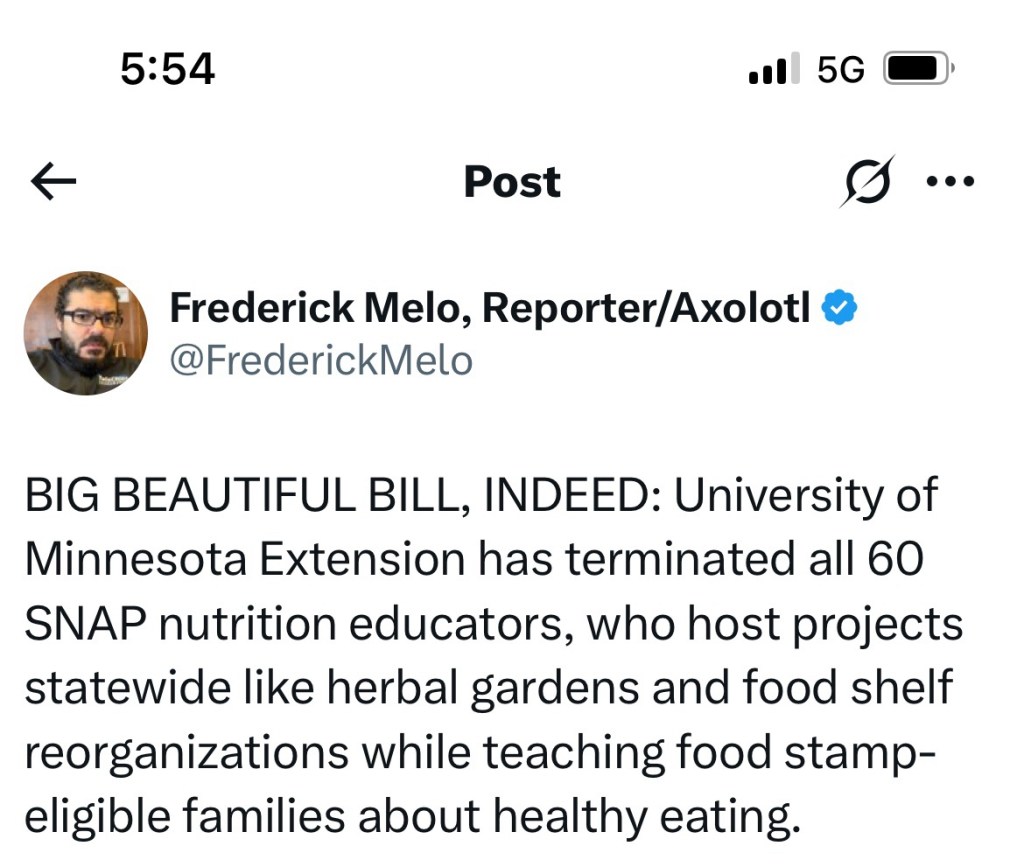
I’m usually a fan of Frederick Melo- but herbal gardens as a necessity of life? I’m a gardener, a pretty good one. I’m an active if not pretty good cook. I’ve tried to tend to herbs and they always fall away. But someone whose life is messy and needs supplemental help is going to grow herbs?

I’d love to see an outcome report from the attendees of the herbal garden classes, as down to earth and healthy as they sound.

Chris Arnade’s city terms

Chris Arnade is a city walker and a people watcher. He recounts his impressions on his Substack, Walking the World. Recently, he participated in a conversation on Conversations with Tyler, which is well worth listening to for those who travel to learn and love to travel.

There were several terms in the conversation which I will be using more frequently in references to city life. The first one is best described in a photo.

  1. Organic Street Life
  2. Localized Distribution- “Meaning there’s always a shop somewhere.”
  3. The Normal Experience- As in this passage:

Then I started saying, “Well, I should . . .” When I was in Brooklyn, I walked the entire length of the New York subway system above ground. I’ve always been into walking, and I just realized, “Hey I can just . . .” I think I was looking at a table that about 1.5 billion people live in massive cities that we really don’t know the names, these big sprawling Jakartas. I’m like, “I would like to see that.”

COWEN: Yes, agreed.

ARNADE: That’s the normal experience for most people, and so I just started. I booked a trip to Jakarta and just started walking Jakarta.

The normal experience is where all the cool data is. What’s to be done with extraordinary events? They simply are not that interesting except for daily fodder.

Who should go to the U?

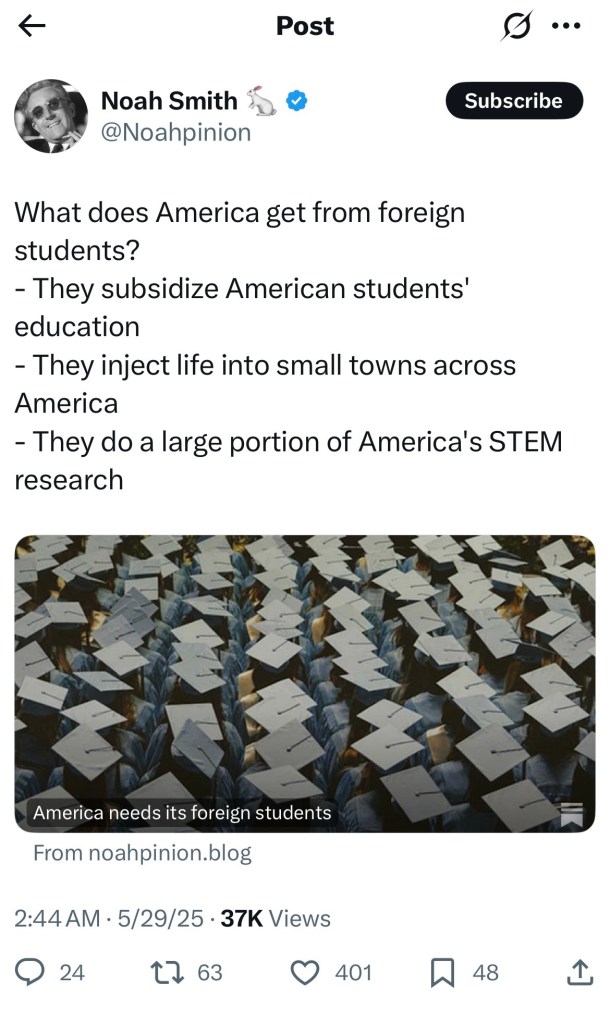
Noah thinks it’s students from foreign countries.

But when 9 out of 10 spots in a phd program are taken by foreign students from an adversarial point of origin across the seas, they are not subsidizing local students they are squeezing them out.

It is difficult to support the idea that local taxation pays for local kids to get educated when all the openings are reserved kids from abroad. (Oh and then there was the scandal that they had been fudging their test scores)

Where is the balance? I’m not sure, but that’s the issue.

Quiet Counterpoint

While Robert Moses became synonymous with concrete, expressways, and top-down urban planning, his wife, Mary Louise Sims Moses, was quietly involved in a very different kind of city-building—one that focused not on infrastructure, but on people.

Mary Louise was active in the settlement movement, a progressive social reform effort in the early 20th century that sought to improve the lives of immigrants and the urban poor. She worked with the Henry Street Settlement on Manhattan’s Lower East Side, one of the most significant institutions of the movement. Unlike her husband’s sweeping, often disruptive approach to reshaping the city, the settlement house model emphasized human-scale solutions: providing access to health care, education, vocational training, and support services within the neighborhoods they served.

The contrast between their approaches is striking. While Robert Moses believed in transforming cities from above—with highways, bridges, and housing towers—Mary Louise was engaged in transformation from the ground up. Her work involved listening to people, responding to their lived experiences, and building trust within communities. It was the kind of work that valued place not only for its physical layout, but for the lives it nurtured.

It’s hard not to notice the irony. While Mary Louise and her colleagues were helping immigrants build stable lives in New York’s dense, walkable neighborhoods, Robert Moses would later target those same areas for demolition in the name of “progress.” Entire communities—often poor and predominantly made up of people of color or recent immigrants—were displaced by projects Moses considered essential to modernization.

Whether Mary Louise’s influence ever softened her husband’s approach remains a mystery. Moses was not known for changing course once he had a vision. But her work highlights a different set of values—ones that were also championed by Jane Jacobs and others who believed that cities thrive not through sweeping master plans, but through the small, often invisible networks of daily life: neighbors talking on stoops, kids playing on sidewalks, shopkeepers who know their customers by name.

Mary Louise Sims Moses remains a lesser-known figure, but her involvement in the settlement movement offers a compelling counterpoint to her husband’s legacy. Where he reshaped the city with steel and stone, she helped build its social fabric. And in many ways, her work reminds us that the success of a city isn’t measured only by what gets built—but by who gets to stay, thrive, and belong.

Unpopular Opinion

This bill is a shame. As if our school districts aren’t already reeling to keep up with mandates under strained budgets.

Of the 49.6 million school age children in the US, according to the article, 22 thousand experience a cardiac arrest while away from a medical facility. That’s less than a half of one percent of children.

This plan would require the district to have a designated cardiac emergency response team. Those teams would, as the bill is written, be required to do a simulation 30 days before the school year begins. Coaches would also have to be CPR and automated external defibrillator trained.

It feels like a lawmaker trying to get a bill passed more than a community need clamoring for attention. Feels like a resume builder.

And yet time, regulation and responsibility is going to be mandated down across 331 school districts in MN. It turns educators into medical care providers.

The bill would also require schools to make response plans available and accessible both on the school website and in paper form. It proposes offering $3 million to schools to assist and fund these efforts.

CCX Media

This bill shouldn’t pass the use of public funds and efforts efficiency test.

O-rings in Community

The O-ring model in economics offers an explanation of a production weakness.

The O-ring theory of economic development is a model of economic development put forward by Michael Kremer in 1993,[1] which proposes that tasks of production must be executed proficiently together in order for any of them to be of high value. The key feature of this model is positive assortative matching, whereby people with similar skill levels work together.[1]

The model argues that the O-ring development theory explains why rich countries produce more complicated products, have larger firms and much higher worker productivity than poor countries.[2]

The name is a reference to the 1986 Challenger shuttle disaster, a catastrophe caused by the failure of O-rings.

WIKI

However, this model understates the possible results, as its production is thought to be positive. In communal markets, the weakest link can fail in their task and draw against the resources other teammates offer.

At Home Economics, we like to distinguish between two types of products: some are more conducive to private transactions, and others are more conducive to communal or public transactions. Those in the first category benefited greatly from the division of labor, for instance. Every worker in the chain focuses on one job, and the line produces a fabulous model T. The second category includes activities such as the ‘eyes on the street’ method of public safety, which was developed by urbanist Jane Jacobs. If a community is mindful of on-goings outside their front doors and reports as necessary, then residents benefit from reduced crime.

Now consider two forms of education delivery. Say one involves students completing modules of schoolwork from a home computer. The overall score of the class will harmed by the weakest link, but each individual performs independently. Now consider a classroom setting. Say one child often misses the bus. They regularly arrive late to class. This disrupts the teacher’s material delivery and causes friction between the students. In this communal situation, it is not only the tardy child who suffers but the whole class. This scenario is one most often given in explanation of why some high-poverty elementary schools suffer from below-average performance.

With items suited to private goods production, the o-ring model implies fewer products that meet perfection. If a company builds laptops and one worker fails to meet standards, fewer laptops are sold. But in a group scenario, where the leaders, perhaps of a certain age, are unwilling to adopt an electronic methodology, say a new accounting feature, they create more work for employees effectively pulling negative productivity.

The negative impact potential in the o-ring model for communal products is underestimated.

How’s the up-zoning going?

Not so well, according to Dr. Carol Becker. Here’s a photo excerpt from The failure of the Minneapolis 2040 plan to boost housing:

Although it is fair to keep in mind, or rather it is essential, to keep in mind that many other factors could contribute to the drop off in new housing permits in the city. If you can think back to the last time you made a housing decision, what were the core attributes of your new place to live? Perhaps safety. Crime is up in the city. What else? Perhaps schools. School performance and attendance rates are down. Perhaps proximity to work. Many employment situations went with a remote model, leaving the downtown core empty, reducing the premium to be close-in.

There are many variables that contribute to or detract from the desirability of living situations. Zoning has an impact, but it is way down the list of the core features that impact people’s daily lives.

Repricing Underway

It’s kind of silly to say markets do not like uncertainty. Markets deal with new news all the time. Who thought Nvidia was going to surge last year and then precipitously drop in January? As a market participant, you can take advantage of such speculation. Bloomberg reports this activity in a newsletter today.

People don’t want to think of aid grants as having a market, but they do. They involve needs, donors and are constrained by resources. By abruptly closing down USAID, a repricing in the market for assistance will follow. Some of the needs will rise to the level of attracting a backer. But how?

Voice is used on this side of the market to advertise demand. Here’s an interesting comment from X.

People who need help are not always in a position to voice that need loud enough to be heard. But I think Mike Benz has a point. Why isn’t the international community, or doctors and health professionals commenting on the lack of funding?

So what next? Most probably some of the projects will continue under the management of the State Department. In the meantime, a market process sifts through the various priorities of market participants. Some needs abroad may be taken over by other philanthropies. Some local organizations might have to downsize.

What’s important, is the ones that are no longer deemed worthy of funding will no longer find a match.

The wheels only turn under the push of need.

The Erdos Number

Paul Erdos, featured yesterday, chose a lifestyle that led to a striking number of shared work projects. Due to the sheer number of work friends, a number system was developed to keep track of the network that worked on shared ideas. Chat explains.

Paul Erdős, one of the most prolific mathematicians of the 20th century, collaborated with an extraordinary number of researchers throughout his life. His collaborators are often counted as part of the famous “Erdős Number” system, where Erdős himself has an Erdős Number of 0, his direct collaborators have a number of 1, their collaborators have a number of 2, and so on.

Estimated Number of Collaborators

Erdős collaborated with approximately 511 mathematicians on research papers during his lifetime. These collaborations resulted in over 1,500 papers, making him one of the most prolific authors in mathematical history.

This number of collaborators reflects Erdős’s unique approach to mathematics—he would travel extensively, visiting mathematicians worldwide, and work intensively with them on specific problems. This collaborative approach led to his reputation as a “mathematical nomad.”

Now, how do you think that work went when you think about all these math types puzzling over combinatorics or vertices of convex polygons? Did Erdos have a payroll and dole out cash? It seems it was the opposite. Collaborators and friends brought him into their home and put him up so he could work with them out of their university. This is not work compensated through pecuniary means.

So what’s in it for the collaborators? The Edos number, of course. Being in the Erdos network gives one sense of participation in the mathematical theory underway, and then their Erdos number specifies a claim to a distance from Erdos himself.

To recap, this type of work is voluntary and participatory, and the end product feeds into a jointly held asset—a school of thought in mathematics. Money is not the primary motivation for action. Membership in the network and the potential for the elevated position are the compensating factors. Every participant has access to the knowledge. It is a public good.

Here’s Chat’s visual.

Is it a public good to the whole world? In a sense, yes, but not in a practical sense. Just like it’s not practical to say the streets of Fargo, ND, are public to the whole world. The knowledge is open, but only a few will have the talents and learned knowledge to comprehend it. Only people in the geographic vicinity of Fargo will use their streets.

Is there externalizing and internalizing going on? Sure- when a new entrant learns a theorem, it becomes part of their knowledge. They have acquired the benefit, internalized, of the learned network. If a few of them collaborate on a textbook and sell it for their private pecuniary gain, they externalize knowledge and realize a gain. These actions do not conflict or reduce the network’s accomplishment. They add to the power and benefit of the group. The image you see inflates.

Paul Erdos’ life had living constraints, just as ours do. Yet the value of his research was such that he could be entertained at associates’ homes to assist in writing all 1,500 papers he left to the world.

Outsider on point, Outsider not so much

I’ve been diving into Democracy in America lately, written by a Frenchman, Alexis de Tocqueville, about a voyage to the New World in 1831. He was writing for the French government and primarily focused on public life. So, taken by the spirit of the population, it resulted in a text that shares the rhythm and enthusiasm of civic life, which makes the book popular today.

One point of fascination is the energy of governance at the township level. He ogles at the ability of a small group of men to tackle a public project, do their best (although he notes that this is often not as well done as professional bureaucrats), and see it through to completion. He notes the short distance between the man on the street and the organizer of public goods. In France, the central authority resides far from the common man. It’s a distance thing.

As an outsider, de Tocqueville was a keen observer. But this isn’t always the case. Sometimes, the outsider over-simplifies, and sometimes, they interpret to fit a convenient view.

Lately, immigration has been in the news, particularly the subset of intelligent, well-educated types. We have one such community. The tech workers from Asia gravitate to the same suburban area, the same school district, really. This public school district pulls in the highest scores in the state. It’s no coincidence. All the Tiger moms want their kids to go to the top school—not a private school, mind you, but a public one. For comparison, Asians in Minnesota make up 5% of the population.

Their contribution to raising the level of education among all those other Minnesota kids doesn’t stop there. Their interests in debate club, science club, and robotics flush out the teachers who are willing to lead the group. Inevitably, a photo of the teams winning some national prize filters into the community newspaper a few pages ahead of the sports teams and their accomplishments. These families want a lot and put in the work to get it.

This community also wanted to play cricket close to home. And voila! Our city has a cricket pitch.

The activity of this group reminds me of what de Tocqueville describes in the immigrant communities he witnessed. The profile of people who support the notion that anything is possible if you put a little elbow grease into the project. The distance between those with ambition and those able to coordinate and shepherd a favorable outcome is short.

When commentators imply otherwise, you wonder where they’ve been. If you are in the education game, it’s clear who carries the ball. It’s the families and the teachers. Corporations are so far removed from education mechanics that they might as well be on an island somewhere. General observation shows that highly educated, foreign-born tech workers result in positive externalities to their surrounding communities.

Big business and corporate America aren’t even on the same playing field. And those who think so might want to check the game’s rules.

To Your Health

If you google ‘health determinants, ‘ a bunch of stuff scrolls out in the feed, but none of it is exactly the same. For example, the World Health Organization‘s (WHO) site reports:

Determinants of Health

Many factors combine together to affect the health of individuals and communities. Whether people are healthy or not, is determined by their circumstances and environment. To a large extent, factors such as where we live, the state of our environment, genetics, our income and education level, and our relationships with friends and family all have considerable impacts on health, whereas the more commonly considered factors such as access and use of health care services often have less of an impact.

The emphasis is on a person’s situation in life more than on their genetic make-up or even access to health care services.

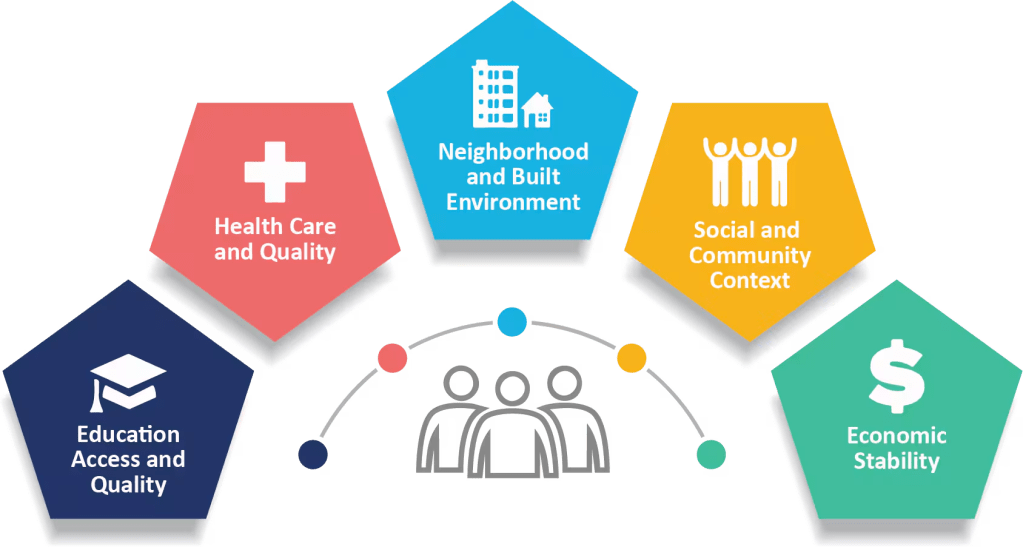
The US Center for Disease Control (CDC) offers a helpful graphic to describe their social determinants.

If you look at the hexagon you might note that the categories remind one of public goods. These goods are provided at large as they are thought to generate a universal effect that benefits everyone. If people are more educated, they will understand how to stay home with a virus so as not to pass it along to others. The availability of health care and clinics provide ease of treatment. The built environment includes transportation routes for ambulances and fire trucks to speed up a person in need. People fare better in safe communities enhanced through public provisions police services.

These categories line up nicely with the categories at Home Economics. Because the social determinants of health are also the determinants of a stable and vibrant neighborhood.

What isn’t provided at either of the sites are details. When one drills down to the street level, what can one measure that represents safety? Is it the number of pedestrian fatalities? Homicides? Or carjackings? Which number best represents safety?

Numbers meant to quantify school performance are subject to manipulation. Is the highest performer in a medium school really better off if they become a slightly above-average performer at a high-performing school? In the first instance, the student may evolve into a leader, one who expects more from themselves. Whereas in the second scenario they shrug off the duty to perform as there are so many better students in the lead. Yet competitive parents are expected to seek out the ‘top’ schools for their child- folklore says they are the best predictors of educational success.

Another factor that seems to be omitted is the level of dedication an individual, family, or community has to contribute to health issues. It’s one thing to live near a dentist, but if you never take off work to make sure your kids get in for a check-up, it does little good. Do the kids get on the school bus so they don’t trundle in late and disrupt the class? Does a neighbor ensure the octogenarian across the street gets in for their monthly treatments? How much work is going into these public health projects?

Neighborhoods are a rich source of social determinants. Combine that with a bit of information about volunteerism and who knows where that could lead us?

The rent really isn’t that high

In a recent post about time prices, the excellent Jeremy Horpedahl noted that workers are better off today than in 1924 except in the cost of housing. These comments are rooted in data compiled by Anthony Davies.

Antony Davies recently did a 100-year comparison of time prices for an average worker in the US. He compared prices in 1924 for several common food items, gasoline, electricity, movie tickets, airline tickets, an automobile, and several measures of housing costs to the best comparable thing in 2024. This following table shows his results:

Is housing really more expensive?

Rent is shown to be less expensive than in 1924 in small and medium cities, not more expensive, and by quite a bit. Living in a small city today only costs the worker 4.7 days of labor versus 1.3 weeks in days of yore.

However, consider the increase in the cost of living in a large city, shown at 2 weeks versus a week and a half. Doesn’t the proximity to work and services save workers a considerable amount of time? Many people who live in smaller towns or rural areas commute long distances to work. They drive to larger commercial centers for shopping and medical services. In an emergency, an ambulance service can run up a large bill.

Aren’t there considerably more services in the large cities than in 1924? In addition to road transit, there is access to international airports. The city is also the heart of entertainment culture, from major sports franchises to fine arts and musical venues. Conferences take place in the city, and universities are located there. Cities provide the landscape for all the restaurants and eateries where politicians and leading business figures congregate.

When you rent in a large city, part of what you pay is the capitalization of the entrance fees to many more social enterprises that were not available in 1924.

Off-setting Data

Homelessness in Minnesota is tracked once a year by the Wilder Foundation.

Homelessness is a difficult issue to quantify, but for more than three decades the Wilder Foundation has been trying to do just that through the Minnesota Homeless Study.

It’s a statewide count taken on the last Thursday in October every three years.

“We know there are more folks on any given night that are homeless and we can’t find, but it is a really comprehensive effort. We have a lot of people working to find as many people as we can on that particular night,” Michelle Decker Gerrard, Senior Research Manager/Co-Director of the Minnesota Homeless Study, said.

The latest study completed in 2023 found 10,522 Minnesotans were experiencing homelessness — down 7% from a record high in 2018 — but still, the second highest since the study started in 1991.

In an ideal world, everyone would find themselves under a roof and between four walls after dark, so they could lay down for a rest as darkness closes in. What proportion of Minnesotans are lacking this amenity? With a state population of 5.7 million, the homeless comprise less than a fifth of one percent. And shouldn’t we expect some homelessness for those who have just fled an abusive situation, for those traveling through, or for those who simply choose to remain in the open air?

One source puts the number of religious organizations in Minnesota at just under six thousand. Matching this to the homeless population, each faith group would just need to care for about one or two individuals who find themselves without shelter. Lining up the numbers in this way is insightful. It seems that the homeless people who are in need of a service, and those who are mandated to provide it, are fairly well aligned.

Yet policy types want to point ot affordable housing as the issue here, as seen in the comment in the article. “”It points to a lack of affordable housing for those communities and barriers for getting into housing,” Decker Gerrard said.”

But I don’t think the data supports this conclusion. The data suggests that these are folks in need of services and support. The catch-all ‘affordable housing’ rant is a talking point. Meanwhile the cause for people on the run goes unchecked.

Popular history

Plymouth MN’s historical Town Hall

Our parks board meeting was held at the historic Plymouth town hall this evening. The building had been decommissioned in 1960 (when everything old was out), neglected for decades and then rescued in recent time by a bunch of friends with civic spirit. Around six years ago they turned the project over to the city, their age pushing them onto another phase of life.

It’s been a huge project. The structure’s exterior was in need of significant repair. On the interior worn plank flooring, wainscoting and an elevated lectern were as thick in dust as in appeal. It was hard to see the details past the moving boxes stacked high and low. Apparently donations to the society were not turned away, nor sorted for local interest.

A fine historian has been busy for the past year doing a lot of house keeping. The walls are crisp and the flooring swept clean. There are historical vignettes throughout. The enclosed back porch is set up as a research area and study- a pleasant and inviting space. Professional cabinets hold artifacts in the lower level. He’s really brought the project forward.

He relayed the most frequent question people bring them is regarding the history of their property in Plymouth.

Goosing the Group

Say there’s been a lot of local advertising lately about universal free school lunch for children who attend public schools between kindergarten to twelfth grade. A casual observer would think this is worthwhile, admirable in fact. Now what if the statement was broken down to reflect various groups in the public schools. Disadvantaged kids whose families earn below a certain income have received free school lunch (as well as added meals like breakfast) since the 1940s. In 1946, Harry S. Truman signed into law the National School Lunch program.

The qualifications for who qualified for the subsidy has undoubtedly been expanded. But the group of children who received subsidized free lunch and those whose families were sending in checks every month to the lunch ladies were not the only two sets. There was another group of kids who were always on the verge of being turned away from eating in the cafeteria. This group belonged to the families who didn’t qualify for free and reduced lunch yet did not choose to pay for their children’s food, leaving their student in an awkward position over the lunch hour.

Occasionally, a wealthy parent or a coach would cover a bunch of unpaid lunch tabs. But universal free lunch definitely takes the plight of the cafeteria workers versus the delinquent parents off the table.

Still, to promote a policy without a proper definition of the groups is misleading. To then claim the moral high ground as if the policy were the first to feed those who are truly disadvantaged is a bit much. It’s an accounting trick. Now, rich families get free lunch too.

Group disclosures please.

Midwest Sites

Grain elevators are as prevalent in towns across the Midwest as the corner bar, the grocer, and the three local churches (Lutheran, Catholic, and Presbyterian), or at least in towns on the railroad lines. As the open prairie became home to new arrivals, farmers broke open the soil and turned it into grain fields. Upon harvest, they took their product to the elevators until it was shipped down to the grain exchanges.

This one isn’t as rustic looking as some. The interior wood planking has been covered with a shield of aluminum siding. The structures are known to burn. As they have been decommissioned, local firefighters have set them ablaze for training purposes. Once their original use was replaced by larger shiny cylinders of metal, their new purpose served the community. For one last dramatic day, the flames leap and lick at the side walls as trainees in the safety business try to tame their destructive nature.

Transaction action and Institutions

Does affordable housing vary in quality based on location? Or is it simply a category of housing no different than a category of a car or a type of breakfast cereal? If you can use the home to shelter a household whose income falls below an acceptable level, then the property adequately meets its intended value.

A group of black pastors, led by Dr. Alfred Babington-Johnson, thinks location does matter. They are suing Minnesota Housing, an agency responsible for the allocation of public funds to subsidized housing, for exacerbating a household’s access to success by predominantly building in areas serviced by weak institutions.

A prominent voice among Black Twin Cities ministers, Babington-Johnson sued Minnesota Housing and the Metropolitan Council last year, arguing that state and regional efforts to build affordable housing effectively have backfired, increasing racial segregation while concentrating poverty in poor neighborhoods.

“Whether that’s done with proven intentionality, the outcomes clearly indicate none of the disparities go away,” Babington-Johnson said in an interview Wednesday. “The educational gaps don’t close. The economic opportunities don’t materialize.”

In this quote, Babington-Johnson refers to two institutions: schooling and the workplace. Efforts to develop educated people are regarded as the path to improved employment. Yet when people reside in areas where 40-50% of the residents live below the poverty level, it is easy to imagine that the lack of informal networking and time resources available to nurture these institutions is not at hand.

The Minnesota Housing Commissioner counters:

In a letter to the state advisory committee last month, Minnesota Housing Commissioner Jennifer Ho wrote that “in the last several years, 63% of the new rental units in the Twin Cities metro area that have been awarded funds through the Agency’s Consolidated Request for Proposals have been in the suburbs while 37% have been in the central cities of Minneapolis and St. Paul.”

Which seems to contradict what people on the ground are feeling. My question, as a casual follower of the issues, is why are the numbers so hard to come by? Every time I’ve gone down the rabbit hole to try to nail down the numerical facts of these conversations, time has not allowed for a successful outcome. As public information, it seems they should be accessible. Attorneys for the pastor group put out these numbers.

Attorneys for Stairstep noted that in the Twin Cities, more than 23,000 affordable housing units received subsidies that began between 2017 and 2021. Of them, 56% — or 13,000 units — were subsidized by Minnesota Housing, the Met Council or another form of state funding.

Note the difference in verbiage between ‘new’ units versus all subsidized units. Two thirds of the new units may go to the suburbs. However, this clouds the issue, which is that most subsidies, by the structure of aid distribution, flow to neighborhoods of high poverty. The Housing Commissioner proposes work to be done to create the ideal institutions in place.

“For example,” she said, “the only avenue for lower-income parents of color to access well-resourced schools should not be making them move to a white, wealthy community, which may lack other opportunities that they value. Rather, we should invest in disinvested communities and ensure that all schools are well resourced, allowing people to achieve equity in place.”

The implications that folks could be giving up support groups in a move is a valid one. But who would be in the best position to provide voice to whether it is more feasible to relocate or to enhance institutions in high poverty areas? The pastors, or the residents if given the choice to move, or the government who holds monopoly on dictating where the housing units are located? Shouldn’t residents have a choice?

A form seen in highlights

Albert Hirshman describes an economic motion in his book Exit, Voice and Loyalty (1970). Parties can withdraw if they do not care for a product or arrangement. They may attempt to impact the process by exercising their voice. Over time, loyalties develop, which influence the superstructure of relationships.

It seems Hirshman would agree with his contemporary, Milton Friedman, about the benefits of school vouchers. Should a family be displeased with a pedantic school district, they could collect a coupon for their tax dollar input and cash it in at another more vibrant district. Since schools are tied to geographies, consumers always have the choice to relocate their homes to attend elsewhere. Vouchers make the process more fungible.

Hirschman outlined the logic of the exit option and how noted how increased competition could improve government performance. But competition didn’t solve all problems, and the exit option had several important drawbacks. The freedom to exit was often used by the most ambitious, educated, or well-to-do users of a particular service, and once they exited, those remaining were even poorer, less educated, and less demanding. Moreover, Hirschman pointed out, the possibility of exit weakened the effectiveness of voice, that is, the ability to directly change the management’s behavior through feedback, discussion, and criticism. 

As Frank Fukuyama explains in his American Interest piece, Hirshman didn’t believe vouchers were the answer to improving a school system. Unlike other commodities, the departure of the stronger students from the classroom has a negative impact on the remaining students. This observation gives a new form to education. Casting the product in this light projects a little amber glow onto all members of the school community. The mission is to educate everyone. If not an educator or a student, the role may be to voice praise or criticism.

A school does not produce widgets on an assembly line, but a group process produces educated students. Changing the composition of the pool of players can have both positive and negative effects on the outcomes. And there are roles for an audience as well.

Turns out Libraries do matter

There a new paper out supporting the capital investments in libraries: The Educational Benefits of Libraries.

The figure shows that after a boost in library capital investment, reading test scores steadily increased. In the short run, library investments increased reading scores by 0.01 standard deviations. Seven years out from a project, scores were 0.04 standard deviations higher in districts that invested in public libraries than their counterparts.

I’ll wager there are further tie-ins between libraries and the general social well-being of surrounding neighbors. Personally, I plan to brush up on my french.

Hennepin County Library

There are 41 branches of the Hennepin County Library system serving the 1.6 million residents of the county. Some are historic buildings, some have scenic views over a lake, and some have a modern flare. All are well frequented.

Mission and vision

Our mission is to inspire, facilitate, and celebrate lifelong learning.

Shaped by the information needs and aspirations of our residents, we envision the library as a shared space for enrichment and connection.

Library services are an important part of thriving and interconnected communities. We believe that every Hennepin County resident should have a library card and use it regularly.

Although visits haven’t reached the 5 million high benchmark from pre-pandemic days, borrowing has surged to 12 million items. Visitors also use library spaces for remote work or gatherings in one of the many conference rooms.

When so many people of interest site a library or a librarian as an inspiration at a younger age, I wonder why more correlations are not made between library useage and outcomes in other areas.

There’s a huge turnout for the book sale fundraisers. At this one the first couple in line put in for a 45 minute wait.

When stakes are high-

Westminister Church has a wonderful town hall forum that hosts interesting visitors in a its beautiful nave. Today’s guest was Keyu Jin whose book, The New China Playbook, Beyond Socialism and Capitalism, was recently published. I was not familiar with this professor from the London School of Economics but the title of the talk drew me in.

After the half hour talk, Prof Jin took questions from the audience. Tane Danger, the host, looks through the cards in order to group similar topics together.

One audience member asks about the nuts and bolts of the k-12 education system in China. She responded that the party originally was responsible for education and it was free to all. But the one child policy in conjunction with fierce competition to vie for the best spots in the work force, led couples to hire tutors. A high score on placement exams guarantee economic and social advancement. Thus, in response to demand, a large industry of private education providers was spawned. This led families of limited means to expend, according to Jin, as much as a quarter of their income on supplemental instruction.

Prof Jin saw this as a negative outcome to capitalism. People’s hopes and fears for their children’s success were being exploited by a private entrepreneurial spirit.

Which brings us back to a favorite topic here at Home Economics. The theory is that certain endeavors are better suited to cooperate efforts of resource providers, while others respond favorably to incentives. In the first instance, the common goal is achieved through public governance and provisions, whether informally within a group or formally via a state structure. Public education has positive impacts from all angles in a society which is undoubtedly why it was established and is still maintained as a public good in the US.

Prof Jin provides a counterfactual. When the state fails to prioritize education, private entrepreneurs jump in and fill the gap. In her example, their success in combination with the high stakes creates an inefficiency.

Three duties

Adam Smith closes out Book Four, Of Systems of Political Economy, of Wealth of Nations by telling us the duties of the sovereign.

According to the system of natural liberty, the sovereign (Commonwealth) has only three duties to attend to; three duties of great importance, indeed, but plain and intelligible to common understandings: first, the duty of protecting the society from the violence and invasion of other independent societies; secondly, the duty of protecting, as far as possible, every member of the society from the injustice or oppression of every other member of it, or the duty of establishing an exact administration of justice; and, thirdly, the duty of erecting and maintaining certain public works and certain public institutions, which it can never be for the interest of any individual, or small number of individuals, to erect and maintain; because the profit could never repay the expence to any individual or small number of individuals, though it may frequently do much more than repay it to a great society.

Wealth of Nations, Adam Smith

We no longer have sovereigns, but we can see those duties in our local governance. And thus we can expect citizens to evaluate each of them in turn.

Some goods buoyed by groups

When Obamacare was in the works I remember crossing words with someone who proclaimed, indignantly- Everyone should have the right to healthcare! I suggested that everyone in the US did have access to care. They simply had to show up to the emergency room of a public hospital, and the code of conduct would require the medical staff to provide care.

It’s nice to hear that confirmed by an expert, Amy Finkelstein, in this interview. What she says is that there are certain products and services a society will offer based on a social contract of civility. For starters, fellow human being will not be allowed to die in the street. Action will be taken to provide the frail, the vulnerable, or the simply irresponsible, with care.

What I said back fourteen years ago, and what she says now, is that it was never whether people would get care, it was how it would be paid for. People with insurance rely on the coverage to payout. People without insurance, according to her calculations paid around twenty percent of the tab. The rest was picked up by the hospitals or the public purse.

No matter the overarching accounting system that ends up allocating resources to health expenditures, this obervation once again confirms that some products are supported by social contracts. And thus they have more efficient outcomes when the group (society, neighborhood,…) devotes some concern to the cause. If you help with kids sports, you are contributing to a reduction in child obeisity. When you taxi an elderly neighbor to their routine doctors appointments, you are preventing them from requiring more expensive treatments later.

Insurance companies understand groups from an underwriting standpoint. And that’s one way to think about it. But what I’m referring to is the time and energy people devote to the habits and actions of folks they touch on a day to day bases. This energy, if you will, squarely supports (or detracts) from public goods such as health, or safety, or family cohesiveness, or local governance. This energy is the energy behind institutions.

The push and pull of public and private

It’s been a while since I’ve written a ‘what is public and what is private’ post. The premise is that goods and services fall into varying degrees of uses but what is important to note is the dynamics for their supply and demand differs.

Consider the shift from funding for higher education. Several generations ago parents were the main financiers of their childrens college education. Some kids could put themselves through school with scholarships and work programs, but those kids were particularly driven. In an effort to open higher education up to those who did not have the support of a family, the governement got into the student loan business.

Pretty soon norms shifted. No longer did parents see it as their responsibility to pay school. Kids became comfortable with taking out loans. And institutions of higher education saw a means of obtaining extra dollars for their operating expenses. And that is how we got to the point of kids graduating with large amounts of debt and schools having far more administrators on the payroll than professors.

Just to review. It used to be that kids had access to the public good education through their tribe. No kin, no school. Then government said- no here’s a way to make education public for all kids who wish to go. The outcome to this, however, was to have kids retain a private debt once they were done. Some kids under the old system may have come out debt free or with far less debt.

What maybe wasn’t considered at the time was this government intervertion not only created a demand among students but also demand from Universities and Colleges via the students. This is because the later group, although a non-profit and seemingly public in nature, is respondong like a private entity to incentives. We have expenses, here’s a source of revenue that we must pursue.

But did it work as intended? Did more kids that would not have gone to college end up getting a degree? It’s funny that no-one declares victory here. Was the public objective achieved?

Commons says Marx missed Institutional Forces

These are the grand national and social forces which have come into existence since the time of the Communist Manifesto, and have nullified what otherwise might have been accurate predictions of that Manifesto. For Karl Marx had based his calculations upon the purely mechanical, economic evolution of machinery, of tools, of markets, of supply and demand. He had not weighed these spiritual and psychological forces which have revolutionized the modern world. He had not seen beneath the economic forces. He had not seen the power of patriotism by virtue of which the divers classes of these different nations would finally unite. He had not seen the movement of trade unionism through which laborers learned to organize, learned self-control, learned to negotiate with em-ployers, learned that they need not fall back into the pauper condition that Marx predicted, but that by negotiation, by arbitration, they might make an agreement with the capitalists, that they might come to terms with the capitalists and divide the product between them.

The spirit of trade unionism, instead of being that of class struggle, is the spirit of partnership. The trade union movement looks upon itself, not as the irreconcilable opponent of capitalism, but as & member of the family. Being a member of the family it is entitled to have a row with the head of the family, and to live apart for a time, but it has not yet taken out a divorce. Trade unionists do not presume, as Karl Marx did, that the members of the family can do without the head of the family. Trade unionism is based upon that principle of partnership which we see in & different way in the home. Consequently here we have a spiritual movement which has not attacked family, religion, and property, as Karl Marx had done, but has organized itself to get a larger share of profits by negotiation, by agreement, by strikes.

Industrial Goodwill, John R Commons 1919

Why didn’t the Austrians appreciate John R Commons?

Marx thought a lot about capitalism

In the first three chapters of Capital Vol 1 Marx throws down his founding priciples of capitalism under the premis that labor time is the ubiquitous unit of measure. He does conceed that the quality of labor time, and hence its ability to be productive, is influenced by other factors.

The value of a commodity would therefore remain constant if the labour-time required for its production also remained constant. But the latter changes with every variation in the productiveness of labour. This productiveness is determined by various circumstances, amongst others, by the average amoun of skill of the workmen, the state of science, and the degree of its practical application, the social organisation of production, the extent and capabilities of the means of production, and by physical conditions

Capital Vol 1- Karl Marx

Think about this list. 1.The skill of the workmen 2. State of Sciene 3. degree of practical application 4. social organization of production 5. capabilities of means of production 6. Physical condition.

Couldn’t this list be 1. Quality of public education available to workforce 2. Technology 3. Vo-tech adaptation of technology 4. Governance of plant 5. Degree of logistical support including maintenance and transportation 6. The environment.

No matter what specifics came to Marx’s mind as he wrote this list- the list appears to point to what we now call public goods. The productivity of the labor hours invested depended on the quality of the public goods inplay at the plant.

.

David Harvey has an excellent YouTube series on Capital

Someone said YouTube is undervalued

And they are right!

YouTube as a teaching tool is amazing. Don’t know how to get your fancy dryer with all sorts of buttons that light up to just spin out your laundry? Ask YouTube. Not sure you have the experience to tackle patching a piece of ripped linoleum? Watch three clips to be sure you know what you are getting into before putting exacto knife into vinyl. Practical tips from handy people make life easier. They reduce the risk of getting in over your head on a simple repair.

Recently I’ve mosied into collegiate level material. This guy from the U of Chicago was informative, but also very entertaining. As someone raised in a different generation, it’s mind-blowing to be as good as in the classroom at a U that I could never have accessed.

All that stuff is fun and immediately useful. If YouTube weren’t around, it is information one could have gotten from a neighbor or at a leadership course. But there is more. The video hosting site gives you a key to difficult ideas as shared through people as passionate about them as their authors. I found David Harvey as I’ve never known much about Marx. And when I went looking all I ran into were those clinging to revolutionary impulses and socialist utopias. Harvey tells you that’s not really what Marx was about. Harvey will read the book Capital with you. Harvey won’t let you get sidetracked by politics because he wants you to understand the essence of what Marx had to say.

This will be my dog-walking media of choice, at least through Vol 1.

Advice to Students from Albert Einstein

TEACHERS AND PUPILS

A talk to a group of children. Published in Mein Weltbild, Amsterdam: Querido Verlag, 1934.

MY DEAR CHILDREN:

I rejoice to see you before me today, happy youth of a sunny and fortunate land.

Bear in mind that the wonderful things you learn in your schools are the work of many generations, produced by enthu siastic effort and infinite labor in every country of the world.

All this is put into your hands as your inheritance in order that you may receive it, honor it, add to it, and one day faithfuls hand it on to your children. Thus do we mortals achieve in-mortality in the permanent things which we create in common.

If you always keep that in mind you will find a meaning in life and work and acquire the right attitude toward other nations and ages.

Ideas and Opinions by Albert Einstein 1954

MN Quality of Life

Ever since Governor Wendell Anderson appeared on the cover of Time holding a (only one?) northern on a stringer, Minnesotans have carefully monitored the good life in Minnesota. Sure the winters are brutal, but we know how to make the most of things and live well.

Minnesota Compass, a data compilation service run by The Wilder Foundation, came out with a 2023 report this month entitled, More quality of life indicators trend worse than better in Minnesota.

Some of the insights are not surprising. Student achievement at the 3rd grade level is down whereas obesity is up. These seem easy to tie to the lockdowns. But a larger share of babies were born at a low birth weight is a bit distressing.

Violent crimes are at the highest level in a decade- there’s been plenty of coverage of this as it mainly involves youth. Youth volunteerism is reported as down whereas the homeless numbers are on the rise.

On a positive note the homeownership gap is closing. And this is a good thing.

Newton’s resting spot in Westminster Abbey. His visage taken from a death mask.

—Letter to Henry Oldenburg (18 Nov 1676). In H. W. Turnbull (ed.), The Correspondence of Isaac Newton, 1676-1687 (1960), Vol. 2, 182.

“I do not know what I may appear to the world, but to myself I seem to have been only like a boy playing on the seashore, and diverting myself in now and then finding a smoother pebble or a prettier shell than ordinary, whilst the great ocean of truth lay all undiscovered before me.”

Stacking priorities and coordinating benefits

Local legislators at town hall forum 2/17/23

Two legislators and one Minnesota senator gave a town hall talk last Saturday. With majorities in both the MN House and Senate, a swarm of bills has been flying through committee and onto a vote. Let’s have a look at them.

Education: The schools are still (and always) underfunded. They need dollars. The plug’s been pulled from the bathwater as there was no depth offered to describe relative priorities, to meeting public expectations, to backing winning strategies.

Abortion: Many didn’t believe abortion was on the ballot until the votes were counted. And sure enough, the topic occupied the first hours of the legislators’ work. The right to an abortion all the way through the third trimester was codified into the MN constitution (not sure what they mean by codify, it’s their word). Winners: feminists and women of childbearing age. At risk: unborn babies and paternal rights. Losers: Religious ideology

The Surplus: The promise to return a portion of the surplus to the taxpayers is echoing more and more faintly. It really never was a return but a redistribution where people of lesser means received the most, middle income some, and wealthy folk nothing. Instead, the audience at this town hall was told of failing bridges and infrastructure. When you want to spend bring up the tangibles. There is more resistance to human services than to maintaining nuts and bolts public hardware. No offer of project eval or expenditure return on public use. The pols always declare the need, and steer clear of distinctive comparisons or hierarchical demand for public dollars.

Universal School Lunch: One might wonder if it is the best use of funds to pick up the lunch tab for those who can and might still provide their children’s meals.

Paid Family Leave: I’ve never heard a peep on how it was determined that enough folks were locked out of taking care of a few personal errands during work time to make a law worthwhile. Nor is there a whisper regarding whose pocket this human resource benefit will come from. I’m sure some people live in this uncomfortable pinch between time and money. Making a universal law benefit is great if most people need it. If it is given to everyone when one a handful are struggling, you have to wonder whether the donations to public funds would be best employed in another manner.

This is where I have to give my legislator credit. Here the school districts are being given additional funding only to have it taken from them to cover the paid family leave. Schools are public only in their function to educate children. Public institutions are employers as well. The legislator acknowledged she was hearing from her friends at the MN Teacher’s Union. Turns out that publically funded entities are employers too.

Which highlights the importance of coordination. Elected officials are only exposed to very limited voice. There’s got to be a better format to express the desires of the constituents in the manner public funds are allocated.

U presidents and privatizing public dollars

So many dust-ups in the education business seem to be about an employee’s level of dedication to the public interest since their wages are paid by public dollars. The strongest union in the state of Minnesota protects school teachers from being asked too much from the public.

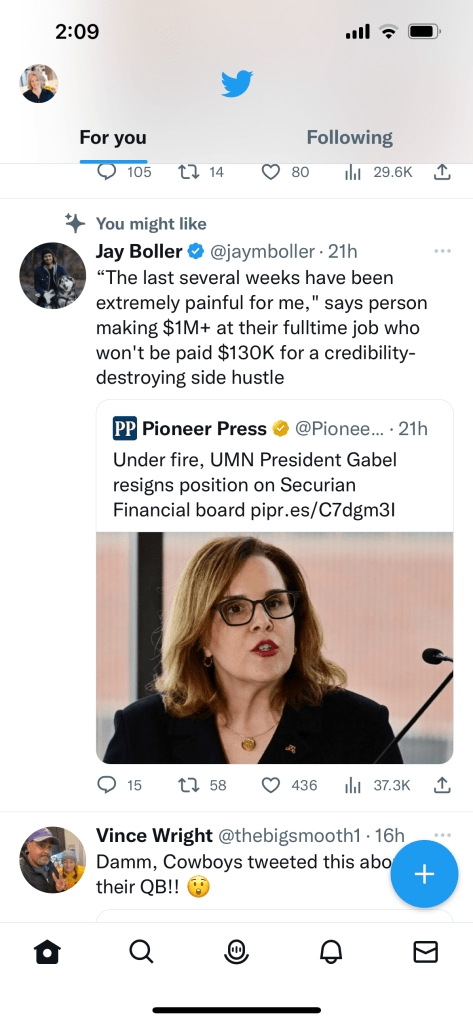
Now it is the president of the University of Minnesota, Joan Gabel, who has been forced to forgo a lucrative board position:

Even though Gabel has a five-year contract with the UMN, which is a private agreement for wages in return for labor, she does not own the cloat necessary to pick up a cool $130K as a board member. That influence still is in the hands of the public. And the public said no to the side gig.

It happens the other way around too. Teachers find themselves working amongst the public when they teach in front of the classroom. Their position is a private contract that gives clear instructions on what is to be taught in the curriculum. Yet some teachers cross all sorts of lines working in personal views on history, the family, or gender.

The point of all this is that there is not one clear-cut private transaction and one clear-cut public transaction. The private incentives among public employees work in the same way as in the private market. People are always juggling a mix of both personal reward and dedication to groups of interests.

Practical Policy

With a 17 Billion dollar surplus piling up in the Minnesota coffers, there will be a lot of public spending in the next few years. The message coming from the Governor’s office is a commitment to make Minnesota the best place to raise a family. This is actually what this state is known for and is near and dear to Minnesotans. Often young people will go explore the rest of the country after college and then return home once it’s time to raise their families.

There is a segment (a set, a group) of Minnesotans whose kids are not doing so well. In fact, they are scoring lower on standardized tests than their compatriots in Mississippi. One can quibble about whether these evaluations are a reflection on the state given how long these kids have been in our school systems. Or one can make excuses for the effects of Covid lockdowns, second language struggles, and general distractions from joy-riding friends. But one thing is for sure- a lot of people are not happy about it.

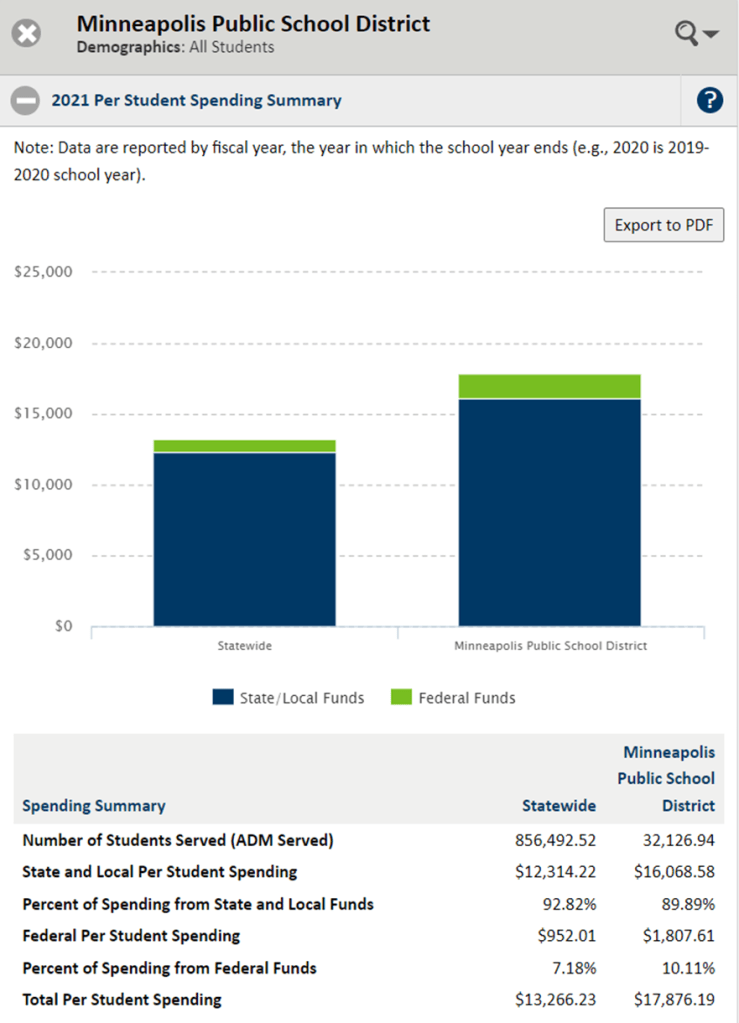
I don’t think I’m going out on a limb to say the majority of Minnesotans want these kids to do well. There is pride in not only school performance but public school performance. Most people support public schools. So there should be no problem dumping a whole bunch of cash into the schools, right? Well, no. The Minneapolis school district, educator principal for this group of children already receives $4,610 (35%) more per child than the average MN student. Putting more money into institutions that are failing to perform seems a fool’s errand.

If you ask teachers what their biggest impediment is in the classroom they will often say disruptions. Their instruction time is spent on a few instead of teaching to the crowd. Others say the disruption originates around attendance issues: either showing up late or not at all. And lastly, they express the set backs from issues of disruptive behavior.

Instead of funneling dollars through a massive bureaucracy (trickle down doesn’t work so well) why not pay the kids directly to show up and sit still for a few hours every day? Make it worth their while. Let’s say $50 is paid out every other week. That would only be $900/kid which seems like a drop in the bucket compared to the numbers seen above. Maybe they could even cluster and have special events based on who’s pulling in the best attendance records. Make it fun- kids like fun!

The average Minnesotan wants to see these kids succeed. Kids will respond to incentives. Who knows, maybe the people will even pay more, and give more of themselves and their resources if they see a glimmer of success.

Pay attention to the children

I’m not a fan of the ‘cost-burdened’ framing used when discussing housing. The resulting claims just don’t sync with the other indicators. For instance, Minnesota Compass, a research organization funded by the Wilder Foundation claims that one quarter of Minnesotans ‘pay too much for housing.’ This doesn’t square with personal experience. One in four Minnesotans cannot pay their bills, purchase cars, or pay for groceries? That’s bunk.

If you want to talk about houses, talk about houses. Why does everything need to be framed with respect to income?

I’m interested in whether there are enough physical buildings to provide shelter for each breathing body who finds themselves within the state’s boundaries. The census lists the number of units to be 2,517,248 as of July 2021, which is up 31,690 units from the 2020 Decennial census. Of course, not all of those units may be in use. Some may be vacant or second homes.

According to the 2021 census, the number of households in the state is 2,281,033. So on the face of things, it appears there are enough shelters for the residents.

But that brings up the issue of whether the physical structures are the right kind for the width and breadth of the households that are housed there. If every building is meant to accommodate a large extended family yet the population numbers denote all single individuals wanting to live independently, then there is a serious mismatch. This makes it necessary to know how many dwellings there are and what type of households they most comfortably accommodate.

And then of course one must acknowledge that the state of Minnesota is the fourteenth largest in this big USA territory. This may mean that there is a lack of structures in Worthington (down by the Iowa border) to house agricultural workers even though there is an abundance of well-built craftsman bungalows up in the mining country. So already it is clear that a more specific accounting of houses is necessary to keep on top of this issue of housing.

But what must be our most pressing concern? Who needs help today? (And not the quarter of the cost-burdened gobbly gook.) The public attention on this issue goes to the homeless with children. The estimates vary but single parents with kids need to be settled today. Not tomorrow. Those kids need to be lined up with a school district community that is dedicated to making it so worth the parent’s while to stay put, that they don’t move for the twelve remaining years necessary to get those children through the k-12 education. Those are the numbers that need the public attention.

New construction improves a neighborhood w/out price increase to entry rentals.

This is so obvious to anyone who watches real estate or is in a real estate-related industry. Renewal of a nook of a city due to capital improvements helps- not hurts- everyone down the line.

When I was in a planning session, I was taken aback when a person of just these qualifications was nodding her head that new development hurt affordable housing. If this person, who I thought well of, had this view, what was I missing?

A Theory of Baselines

I think what happens is standards are elevated and in that process, those on the lower end of the scale continue to feel left out. Real estate development and change happen slowly, over three, five, and even ten years to transform an area.

In the fifties, skid row was where affordable housing was located. Then the sixties brought about urban renewal, including bulldozing all these decrepit buildings. Without much research, I can guarantee that the housing provided to people today is far better than that in the 50s. Yet it is a far cry from standard mainstream housing.

With all public goods, there must be a baseline to measure progress. Otherwise, those who are not achieving in school or housing or health will always feel worse off than the average. But are they better off than yesteryear?

Intelligence for me but not for thee

It’s fun to hear about Hayek’s life in this interview from 1978 with Armen Alchian. For instance, A young Hayek almost ended up accepting employment as a dishwasher when he arrived in New York for a research assistant job. His prospective employer had asked his university not to disturb him. On the eve of Hayek’s debut in suds and china, the university professor had resurfaced and was in touch

But the beginning of this segment is hilarious. Alchian inquires after Vera C Smith, as she apparently was Hayek’s student. He asks about her relationship with another economist Frederick Lutz, concerning their romance in particular. Had Hayek played matchmaker. Furthermore, Alchian notes, that Vera must have been quite attractive as a younger woman (yikes). Hayek confirms but qualifies her beauty by saying she wasn’t very ‘female’ as she was very bright- “She had too much male intelligence!” HAHAHAHAHAHAHAHAHA

Sigh- there was a time three decades or more ago when I would have found this depressing. Times are changing.

Books with Maps

I love books with maps. This one is on the inside cover of Dancing at the Rascal Fair by Ivan Doig. He writes about settlers in Montana at the end of the nineteenth century. Scotts were partial to the state as its vast, remote beauty reminded them of home. At the center of the tale is a reluctant school teacher who, out of necessity, accepts the position of corraling the kids into an atmosphere of education, and plays out all the ways in which the education system reaches into family life. It’s a lovely book by a poetic writer.

Is there more to it than mincing words?

When I was in college I steered clear of philosophy. The intricate hairsplitting was more than a little off-putting. Plus the numbers and problems in my math classes were more fun than words, or at least more reliable. It is only now, later in life that I see the need for it. I still am partial to philosophers who talk through examples instead of building some analytical castle in the sky. That’s why I like Bertrand. He said:

Philosophy, like all other studies, aims primarily at knowledge. The knowledge it aims it is the kind of knowledge which gives unity and system to the body of the sciences, and the kind which results from a critical examination of the grounds of our convictions, prejudices, and beliefs.

Bertrand Russell, The Problems of Philosophy (Urbana, IL: Project Gutenberg, 2004)

Descriptive words can paint out the details of your examples, but precisely defined words are necessary to hone the edges of the properties which settle in together and erect a model of activity. And words are slippery things often showing up in other ways at other times. It truly is a project to draw it all out for people to follow.

It seems there is a renewed interest in the discipline. Instead of being the butt of any graduation party, “What are you going to do with a philosophy major? Become a barista at a Parisian cafe?” People genuinely express a desire to understand foundational principles in order to participate in the public conversation.

It would have been helpful through the years to have a little sidebar in that History of XVII Century Thought book or an Anthology of Literature from the Caribbean outlining a view of the philosophy of the day. Most centuries had predominant views on how to think and reason. If these would have been laid out alongside a history of events, I might have started getting the picture earlier that there was more to philosophy than tedious quibbling over definitions.

Being fair to your kids

There’s a lot of talk in policy discussions about fairness and how it is evaluated. One angle of the conversation that can’t be underestimated is the accounting or measure for the item at hand. There’s a propensity to measure everything in dollars. But the nature of public goods resists such restraints. Here’s an example.

Say one of your children was destined to be an engineer, and the most prestigious engineering school in your area was part of the big ten local university. The child is accepted and successfully completes a degree. Now say the second child’s career will be optimized by obtaining a liberal arts education. The top school in this regard is a private college which costs thirty percent more than the public university. The second child succeeds, as well, at completing their degree and both children are hired into their desired professions.

Does the parent owe the first child the 30% differential in tuition for the four years of private college? An argument for fairness might include an accounting of dollars spent on each child. Then child number one could make a claim for the additional funds. Some might find this manner of divvying up resources as fair.

On the other hand, both children attained the goal of a secondary education which allowed them to maximize their professional lives. In this manner, they both received the intended objective of their secondary education. In this case the fairness moves away from the money spent versus the achievement of the goal.

Note that in this story there are some assumptions made about the overarching available choices. Both chose from the surrounding area and did not compete to enter institutions farther afield at greater expense. There’s a reasonableness that the children are staying within the same zone of options. To switch to another layer of economic choices could alter the fairness consensus. Which is why this issue gets so sticky so quickly.

What’s in a house price

All we’ve heard for the last several years is how the price of housing is going up. Up. UP! And for the most part that is true. Whether it is because Millennials are finally getting on their feet and need a place to have their own families, or whether the baby boomers are not moving to the lower priced condos and giving up their family homes, there is no doubt that there is a housing squeeze.

But seriously, for as long as I can remember, except in deep recessions, people have thought housing is expensive. Because it is! It is the largest portion of people’s monthly budget. And this distraction about the cost of a home is the most uninteresting fact one can take away from home prices. House prices are a rich reflection of the revealed preferences of a community.

An economist in the early part of the twentieth century by the name of Paul Samuelson came up with the idea that when consumers chose different products, they reveal what best suits their needs. This differed from theories up to that point which placed the burden on policy makers to decide which goods provided the greatest utility to consumers.

Samuelson’s relationship with economics is lengthy. This excerpt paints the broadest brush of his brilliance. “In receiving the Nobel Prize in 1970, Mr. Samuelson was credited with transforming his discipline from one that ruminates about economic issues to one that solves problems, answering questions about cause and effect with mathematical rigor and clarity.”

One economist, his junior by twenty years, heard the clarion call for greater mathematical representation of economic theory. Zvi Griliches contributed to a publication called Economic Statistics and Econometrics published in 1968. In a paper called Hedonic Price Indexes for Automobiles: An Economic Analysis of Quality Change, Zvi pulled apart the prices for automobiles so that he could show how much consumers were paying for improved engines or length of the vehicle or other features. By comparing the components of the cost of vehicles he distinguished between inflation and consumers revealing a preference for higher quality provided by advanced technology.

But back to real estate. The economist credited for using this statistical method (taking the price of a complex product and using data to divvy out the weighted values of its various components) was Sherwin Rosen in his 1974 paper Hedonic Prices and Implicit Markets: Product Differentiation in Pure Competition. Now this is exciting! The price of a house can tell you how much one school district is favored over another. It can tell you the value effects of violent crime, or proximity to mass transit.

The implicit prices tell us that we trade in public goods as well as private goods. We shop for city services and good roads, for youth programming and parks, as well as for good schools and safe streets. The implicit prices tell us how groups of people choose bundles of public goods. Real estate prices are incredibly rich with feedback.

So can we stop with the “They are so expensive.”

Squeezed out of the house

Most coursework taught in a classroom setting under the guise of real estate is centered on one of three aspects: appraising, financing, and legal underpinnings. In fact, most of the reports generated around real estate feature these same three topics. The recent sales data is sliced and diced along with market times and the rates offered by the mortgage brokers.

Cornell University proves to be an exception in its course offerings which include a wide range of topics on all aspects of real property. In addition to the oh-so-common Finance and Investment class, there’s a taxation course and one on hospitality real estate finance. There is analysis of transaction and deal structuring, and advanced project management for real estate development. There is an emphasis on flushing out the business side to real property.

But the courses designed to teach the work which happens(ed) in the home has been severed from the neighborhood and become Policy Analysis & Management (PAM). The evolution of the 1920’s department of the Department of Household Management is depicted in the flow chart below. Clearly 1969 was a breaking point from the quaintness of home, a throwing off of the apron in favor of an upwards and onwards momentum to a more distinguished framing.

Cornell University, the History of PAM

Another course offered at Cornell is Urban Economics and Real Estate Markets. The course description reads: “A theoretical understanding of the economic forces affecting urban land market change and development is needed for decision-making in the real estate profession… The two core models at the center of the course are the model of urban spatial structure that stems from the work of Alonso, Muth and Mills…” (Alonso, William (1964) Location and Land Use. Cambridge: Harvard University Press.)

A few years before the functions of health and human services were being detached from the geography of cities and suburbs, Alonso noted that the location of a central business district (CBD) created a spatial relationship within a city which affected real estate. While a model based on jobs and income and the commuting of a workforce was used and developed in the interplay of real estate uses in a city, the jobs of a homemaker in educating and feeding and educating her children found a new home in the Health and Human Services Departments across the nation.

This was unfortunate timing.

Network Connector

We have a little suburban newspaper that shows up in the mailbox on Thursdays. It’s called the Home Town Source and runs letters to the editor about local issues, covers the city council and school board races, and devotes three spreads to high school athletics. This morning an article about a Plymouth man caught my eye. He’s a perfect example of a connector.

Students in Ghana received more than 16,000 books last week as part of a collaboration between the African Diaspora Development Institute and Books For Africa, a St. Paul-based nonprofit.

The effort was led by Plymouth resident Jote Taddese, a former Books For Africa board president and a board member of the African Diaspora Development Institute. Taddese is also director of diaspora engagement for Books For Africa and a vice president of engineering at Optum Digital, a United Health Group Company.

The common interest here is literacy, an interest that transcends geographic boundaries. And the connector not only has ties to another continent through birth, but also experienced personally the benefits of picking up a book at a young age.

“As a person who was raised in Africa and educated in the diaspora, I am a living example of when we put a book in the hands of a child, we not only help fulfill the potential of the child, but also change the impact on the lives of individuals and the global communities that child will touch,” Taddese said. “This is my life experience that always inspires me to support kids in Africa with books.”

Taddese was born and raised in Oromia, Ethiopia, and immigrated to the U.S.

Not everyone is fortunate enough to be employed by an organization whose mission parallels so nicely with their private life. And the non-profit’s accomplishments are notable.

Last year alone, BFA (Books for Africa) shipped 3.1 million books, valued at over $26.2 million, and 224 computers and e-readers containing over 650,000 digital books, to 28 African countries. More than $3.1 million was raised last year to ship these books to the people of Africa.

But this story isn’t particularly new. The living standard differences between the two continents is so significant, and the lack of basic tangible goods like books so clear, that there is little to complicate the direction of the goods and services in arriving at their destination. The books in fact are what I call idle assets, sitting amongst a community unused, available at no cost except the work to get them to their new location.

Markets become trickier when the difference between groups vary less, when resources are not idle but need to be drawn upon, when ‘need’ is voiced loudly by people other than the intended recipients. In these cases we will need to rely on benchmarks for guidance.

An example of a public acting private

The claim I make is that entities which are primarily public in nature can be transformed to act like a private enterprise. Here’s an example.

A few years after I gave birth to my son, advertisements started filtering through our postal mail claiming the accolades of a variety of schools. The Parochial schools had the upper hand on morals and strong values. The charter schools within the district offered Spanish Immersion or a science and engineering focus. The International School of Minnesota, a private school, offers a nurturing environment for a level of education geared to compete on a world stage.

I get that the Lutherans and the Catholics need to advertise to be sure people know where they are. And advertising specialty schools within a district follows the same getting-the-word-out need that is the business of ad campaigns. But it was somewhat off-putting when the public school district to the SW of us started a direct mail campaign designed to raise questions the adequacy of our own district with the objective of luring families like ours to open enroll across district lines.

In Minnesota, funding follows the child. So by recruiting kids along the neighboring district boundaries, the school district is vying for additional funding. They are acting in a private market manner, using advertising dollars to draw streams of money and the stronger family units to their enterprise.

In my mind this manifests the same economic form as the bidding on masks by state instead of as a country. The school districts are operating under a Minnesota mandate, yet by delineating the interest group to school districts, their actions outside of their district takes on a private nature.

So what’s the harm in it?

Using a private mechanism within a communal goal can gut out the ability of part of the group to be successful. If all the strong families (both in an educational sense and in an extra-time-to-help with education resources sense) shift over to the adjacent district, then the balance of talent and resources and parent time required will be substantially weakened for the families left behind.

This process works against the state mandate to educate all kids. The districts can act as private as they like outside the state mandate with entities like textbook vendors or playground equipment manufacturers. But the communal structure of all those who fall under the mandate should make it clear that direct mail marketing with the deliberate intent to shift funding dollars across district lines is counter productive to the expressed agreement.

Food deserts, and other not so silly sayings

The term food deserts is about as silly as affordable housing; both try to capture the notion of a thing instead of the understanding of a system.

A food desert is an area that has limited access to affordable and nutritious food, in contrast with an area with higher access to supermarkets or vegetable shops with fresh foods, which is called a food oasis.

The idea goes something like this. People who live in high poverty areas, which often- if not always- are high crime areas, have fewer choices in grocery shopping. Hence it is the obstacle of getting to a supermarket which causes a poor diet and resulting health problems such as obesity. The policy solution thus is to bring a product, fresh fruits and vegetables, to the neighborhoods. Problem solved!

In time of yore, or my grandmother’s generation, farm families across rural Minnesota spent the winter without access to fresh food. It isn’t until June that early lettuce comes in and can be eaten from the garden. Most vegetables are harvested July through early September. Of course strawberries are plentiful in late June, but the apple tree branches don’t bend with fruit until fall.

Tomatoes are still canned (the process of storing produce in a jar with an airtight lid for use through the winter) by many today who enjoy the fruits from their gardens for things like salsa and pasta sauce. And cabbage is converted in some mysterious process to sour kraut. The Red Wing Stoneware Company produced crock pots of various sizes for winter storage in cool cellars.

The point is that many people across the world find ways to store the makings of a balanced diet for consumption through out the year. Eating from a healthy menu depends on a process of accumulating, storing, preparing and eating. Home economics, as it was taught in school a half a century ago, was designed to address this topic.

One of the classroom experiences was to make simple meals like a hamburger goulash. A pound of ground beef, elbow macaroni noodles, a can of tomato soup are its readily available ingredients which are easy to store. You can even purchase such items at many convenience stores.

Now, it seems, we don’t want to teach lifelong skills. Problems are deemed to be the lack of a product, a purchase, a consumable good. And if the government simply puts that good in the hands of the poor, then all will be solved. Or not.

How does that verse go?  “Give a man a fish, and you feed him for a day. Teach a man to fish, and you feed him for a lifetime.” Mathew 4:19.

When math is not your friend

Let’s say everything in your life, that was summed up by numbers, did not add up in your favor. It would be like being on the team that always had to be the good sport and loose to all the other teams. At first the players might simply be happy to be on a team, out practicing and attending games. But then the scores keep starkly representing the loosing side, and it is harder and harder to keep up moral.

Or maybe you’ve tried to learn the game of golf. There’s the mulligan on the tee off shot. Then you loose your ball in the long grass. Ooops– one plops in the stream cutting across the fairway (after a dramatic twelve foot bounce off the boulder rip rap). As you approach the green there’s hope for a two put finish. But it is not to be. A couple of chip shots over and back. But who’s keeping score anyway?

Now what if everything in your life was like that. Your parents struggled when the numbers didn’t add up in their favor when it was time to pay the monthly bills. There was concern at school when the numerical representation was not favorable for your school work. How do you think you would feel about math?

Math shouldn’t be out of reach for so many of our students. God’s gifts are sprinkled around throughout a population and not divvied up by socio economic designations. If a whole group is coming up short of math majors we should really try to figure out why. It will effect their whole lives. It will make our educational system subject to the grifters who filter in when there is demand for a service and yet no supply.

Home buying and hedonic regressions

Here’s a fun game you can play if you are presently in the market for a home. One could consider a variety of home characteristics, but if you are in the market for a school district, the pricing lines should be very crisp. And you must be in the market for your own family. Speculating on what others will do just isn’t the same.

If you are not familiar with hedonic regressions, it is a mathematical process where given a set of data, which is subjected to an equation built with defining characteristics, the numbers reveal the various levels of importance of each feature. If we are looking at housing prices, the coefficient in front of the school district data will tell how much of the home price was dedicated to that selection.

But you don’t have to be a math geek with access to a bunch of data to come up with a result! I’d say any buyer who is seriously evaluating this choice can shoot from the hip (after looking, bidding and seeing the values the properties commanded at close). Ideally you want to be considering two school districts which both contain similar homes to choose from within their school boundaries– say a 90’s built two story with four bedrooms up and a nice yard for the kids.

Even non-number types of buyers will be able to discern the differences when their money is in play, or their abilities to access other ideal features. School districts can swing a home value price as much as 15%, so on a home of $450K, a $67K difference. That’s noticeable. And consistent opinions about districts, which affect a great number of buyers, filter out in the numbers.

Buyers do not need regression models to calculate the price of other features. The distance to job centers, for instance, or the premium for a prestigious neighborhood. People will pay to be closer to work in order to spend less time in the car. They will also pay for neighborhoods with corner restaurants, quaint historical business crossroads and neighbors with recognizable names. The numbers here are large enough so that no pointy pencil needs to scratch out a calculation.

But there are hundreds of neighborhood features which are priced out in the offer on a home. And many of these could be better understood with the help of a little math.

Timing a move

People move households a variety of times throughout their lives for a variety of reasons. Depending on your data source, Americans move every 7-9 years, with more frequent moves in young adulthood and more sedentary behavior in later life.

This makes sense. As folks move through different stages of life, both from an income stand point and a lifestyle standpoint, they want a different combinations of neighborhood amenities. These are not questions of ‘good’ things versus ‘bad’ things. These are simply mixtures of choices.

When you are young you may want to live near entertainment and restaurants. Once there are kids in the household, going out to shows and restaurants quickly takes a back seat to prioritizing daycare, schools, and after school activities. Stability of residence can be important at this stage as rearing children benefits from consistency.

If the norm is to move, to seek out new living arrangements that better suit new objectives, than wouldn’t incentives that lock people into a location be holding them back? Financial incentives such as rent control do exactly that. It discourages mobility.

And I’m not saying people who need help shouldn’t still receive help. I’m saying that paying people to live in the same set of living circumstance through all stages of their lives goes against the norm. Which leads one to believe it is a drawback in the long run, for a perceive protection in the short run.

Nesting, Public Goods and Price signals

Public goods often exist in a nested structure. The household, the neighborhood, the ward, the city, the state. The classroom, the elementary school, the district, the states’ Department of Education. At what point is it clear that a rung on the ladder needs help in its delivery of the good?

Earlier in the month it was reported that a charter school, Cedar Riverside Community School, would be closing. It serves a neighborhood of high rise subsidized housing nestled between downtown and the University of Minnesota. Lauded as culturally sensitive in its delivery of education to a mostly Somali immigrant community, it has been plagued with threats of closure due to poor performance for more than a decade.

There are many good intentions, hopes and aspirations at the ground level for these types of grass roots public goods to be successful. But when are the price signals strong enough to cause the rung up the ladder to engage, and supplement the production of the good. When is the loss great enough to tip the efforts away from the local level and demand services from a superior level?

With the bright flood lights of the world stage focused on our metro and its racial disparities, it’s hard not to imagine that the closure comes in the wake of last year’s events. It seems pretty costly and inefficient to wait for a crisis to fess up to the fact that these kids were not being served by their neighborhood school.

Maybe the better question is what are the powers in play which dampen or misalign the the signals of lost public good delivery? What stops the natural interactions of feedback and improvement that occur through the system elsewhere?

I can only speculate from afar, but it seems to boil down to two components: structure of (for pay) jobs and positions of power. An enterprise, whether a company or a school is composed of an interlocking group of paid employees. These are entities composed of W2 workers whose livelihoods depend on keeping the boat afloat. A company will sink if it fails to attracts consumers. As long as a school has a pool of students within its attendance boundaries, it will receive funding.

In a typical neighborhood, people with school age children will leave the neighborhood if they feel the schools are inadequate, while others would-be-buyers into the neighborhood will look to settle elsewhere. The dynamics is a little different in a neighborhood like Cedar Riverside as many of the residents are tied to their housing through subsidies. The lack of mobility creates a type of monopoly on the residents both for their support of the school as well as the political structure.

The end result is that the price signals–the signs that the pupils are failing to receive the public services which inevitably are an expense to them and their communities later in life–are muted. They are not able to exit. Their presence in the group is taken for granted by those in paying jobs and those with political power.

La Fontaine

There were a lot of things I liked about going to French schools as a youth, but one that stands out is the discipline of recitation. A student prepares a poem and delivers it in front of the class. You were graded on tone and inflection, on cadence and emphasis. The French take their language seriously, and you are to deliver the words just so.

Scratchy pencil markings on Le Rat de ville et le Rat des champs show where to slow down, where to come to a full stop. Scribbled in are indications of the rhythms. While holding the little book in front of my peers, I most likely kneaded my sweaty fingers into the cover as I plied back the binding. The activity may have alleviated some trepidations of being front of a crowd.

It is delightful to say the words just right, to have them tumble out and be heard amongst an audience. It is not the same as reading the text in one’s head, in the same way as reading a play falls short of a production. It’s really a shame that the US school system lacks this emphasis on performance and language. Completely contrary to saying there is only one way to get one’s tongue around the words, as perhaps the French do, it is about how words are articulated to add meaning. The delivery is a disclosure of more than the words themselves.

Fables, whether by Aesop or by La Fontaine or La Fontaine’s version of Aesop, are subtle in their meaning. Some might say Straussian. There are of course the sweet little creatures having adventures. The Tortoise and the Hair, or the Lion and the Mouse. Creatures not like each other interacting to tell us that outcomes are sometimes unexpected. That we should not presume to know everything.

La Fountaine along with his contemporary Moliere were well known for cloaking messages, designed to instruct without offense. Both were successful in their lifetime for although their subject matter thrived on human foibles, the ruse of concealment let each audience member interpret the piece as they desired.

An instance vs a life-time

The world of Twitter and Instagram promotes the power of a snapshot. It’s a small-package delivered to pack a punch. Not only is it how a lot of information is disseminated to audiences in the millions (in small frame, limited view, no historical placement setting) but has also become the most popular vehicle of public debate, or hollering.

Recently there has been lot of admonishing of our north star state with data claiming Minnesota has the largest achievement gap between majority and minority populations. Let’s consider how this datagram could mean something good instead of assuming it means something bad.

If Minnesota abruptly welcomed a large group of immigrants with no English language skills to the state, the state would be celebrated as humanitarian and good. But of course, for a number of years (how many? ten? a generation?) Minnesota’s numbers for minority education performance would be affected, as not knowing a language is a serious impediment to learning. That makes Minnesota a bad place for minorities.

Minnesota also achieves very high performance amongst children with long time residency, which makes Minnesota is a good place to live. But of course this exacerbates the difference between scores with those who have come more recently, less well equipped, which once again makes Minnesota a bad place for disparities.

It is like the comic strip with an angel and devil on each shoulder whispering their arguments in each ear. Each little creature gesticulating wildly while the face between them looks comically confused.

Raj Chetty is an economist at Harvard who studies, among other things, equality of opportunity over time and place. After all, what we want is a culmination of activity to produce a result. One time snapshots capture a measure at a particular time. A piece of information. They are woefully barren of any wisdom.

His research shows that the Minneapolis area is in the lead among large cities in cultivating the greatest income growth for children of poor families, by age 26.

Brookings

The issue of time and setting must be made part of any half intelligent conversation about these issues. The public goods a city provide can’t possibly be evaluated in moment-in-time snapshots. And people who to try to navigate this path are more likely activists out to promote one point of view, not for a public benefit, but for their private initiatives.

San Francisco comes to its senses

San Francisco schools have decided not to spend the time and money to rename 44 schools.

The San Francisco Board of Education will ultimately keep the names of dozens of public schools in a case of high-stakes second thoughts.

It seems we are seeing a turning point in the ridiculous posturing against ghostly foes of yore. And the objections came from a wide selection of practical folks from both sides of the aisle.

The reversal was met with relief and enthusiasm by disparate critics united in their opposition to the project. Conservatives characterized the effort as cancel culture run amok, while liberals decried the woefully poor research conducted by the blue-ribbon panel that led to the lengthy list of school names to be changed.

San Francisco School Board Rescinds Controversial School Renaming Plan : NPR

Here in Minnesota, we are experiencing an attendance problem. Now that buildings are opening up again, it’s time to try to lure the 17,000 Minnesota kids, who left public school, to get back on the yellow busses. Some may have settled into parochial schools, but the vast majority, according to reports, are being home schooled. Or at least are at home.

Let’s hope these families return to valuing our teachers, the socialization benefits of in-class learning, as well as the extra curricular activities. At an approximate revenue of $14K a pupil, there’s a $238 million dollar missing entry in the public school income ledger.

Equality at odds with Progress?

There’s a new paper, Lessons from Denmark about Inequality and Social Mobility, by James J Heckman and Rasmus Landerso. Here’s the abstract:

Many American policy analysts point to Denmark as a model welfare state with low levels of
income inequality and high levels of income mobility across generations. It has in place many
social policies now advocated for adoption in the U.S. Despite generous Danish social policies,
family influence on important child outcomes in Denmark is about as strong as it is in the United
States. More advantaged families are better able to access, utilize, and influence universally
available programs. Purposive sorting by levels of family advantage create neighborhood effects.
Powerful forces not easily mitigated by Danish-style welfare state programs operate in both
countries

What I find interesting is the framing of their analysis around neighborhoods. They find that even though teachers in Denmark are paid the same salaries, there are still different outcomes for children which appear to be a result of families sorting themselves by neighborhood.

One good example of this phenomenon is the quality of schoolteachers by clusters of parental
characteristics. In Denmark, teacher salaries by neighborhood are mandated to be equal. That is
a force for uniform quality of schools across neighborhoods. However, uniform quality is not the
actual outcome in Denmark.

The sorting continues down through to the teachers.

There is a strong positive association between the characteristics of parents, on the one hand, and the characteristics of teachers on the other, despite equality in wages.

Even with an equalization of monetary compensation to the educators, the more established families gain the preferred access to education. And thus equal opportunity to education is not being realized.

But is this one of those everything-should-be-equal that makes sense or is counter productive? Are the measures and classifications and groupings done in a way that divvies up into a state of balance?

I don’t think it is a controversial notion that those on the lower rung of academic performance are more likely to be motivated by seeing themselves in their teachers and mentors. And until those teachers and mentors are brought along into this higher level of academic delivery, the system that looks for those mentors will have unbalanced delivery systems. By choice. And this may very well be the best delivery for that moment in time.

Here is a scenario where fine tuning and focusing in on what is thought to be an issue of equality maybe sabotaging the path for greatest progress. By drilling down to the tier of the individual, one dismisses the group. To bring along the child can only be done by bringing along their larger group, including their parents and teachers.

Revolt?

It might be my imagination, but I sense a subsurface tension in the teaching community around the issue of the extended Covid school closings. It lurks like other things you can’t quite detect: a high pitched dog whistle or the floor beneath your feet right before a quake. Or even more material things like the moisture on your brow and that earthy smell in the hour or so before thundershowers roll in.

As long as the virus is still taking lives, the topic is off the table. But soon everyone will be vaccinated. Soon the teachers will be taking account of where exactly their students are at in the curriculum. Some who normally enjoy the challenge of working with the most in need, may find their charges have have slid in arrears, past due even for assignments pre-Covid.

Without the structure of school, without the routine, without the expectation of someone waiting for them, recognizing them, without the the fun as well as the drudgery of the school environment, they simply stopped paying any attention to their education.

As an outsider looking in, it seems the teacher’s union towed a tough line. The virus put teachers’ lives at risk. The end. Apparently their work is not essential to the functioning of society. Decades of negotiating wages and benefits right down to each and every minute of their instructional day has made it easy to disregard any intent of the job and only see their work from a pecuniary point of view.

How the teachers who carry an old school sense of service to the community feel about this very privatized manner of handling their chosen profession is yet to be seen. Unions deserve credit for elevating teachers’ wages, and after all, spirit or no spirit, one has to pay the bills. Still–in years gone by, teaching was more of an employment of the heart, it involved a sense of duty, and was regarded as such.

So this cocooning of teachers away from the public while grocery workers and nurses became celebrated frontline workers, this buffering of their duties to educate seven, eight and nine year olds through Zoom screens can’t possibly fulfill the desire to be in good standing within the community. Some might feel the dignity of their work has been stolen out from under them.

Maybe when they were young pups trying to figure out their career choices, they absorbed the fact that teaching would pay less than other professions in business or law, but as a counter balance, they valued the sense of contributing to a greater cause. Teachers are trusted. Teachers are a source of advice. Teachers have the ability to play the role of a connector. At least for now.

For every minute of labor, the union has monetized their job. Perhaps the process has squeezed out any compensatory allocation to good will, to the noble cause. The power of the union is to talk in one voice. Then there is little hope of those within, who oppose its direction, being heard in any way.

This is all speculation on my part, of course! Classes are resuming, and by next fall all the soldiers will be marching to the old familiar cadence. Everything will be chalked up to the unprecedented and unanticipeted year of the plague. No matter. A little inkling persists. If you strip all the community value out of a labor force who is inspired by it, has worked for it, defends it; if you monetize every last moment of their day, at some point workers will revolt.


Try something new

The drum beating earlier in the week about cancelling student loan debt was abruptly muffled by the president. In response to Chuck Schumer (D-N.Y.) and Elizabeth Warren’s (D-Mass) proposal to forgive up to $50,000 in student loans:

“I will not make that happen,” Biden said when asked at a Milwaukee town hall hosted by CNN Tuesday night if he would take executive action on loan forgiveness beyond the $10,000 his administration has already proposed.

Biden Balks At $50,000 Student Loan Debt Forgiveness Proposal | HuffPost

Some people think student loan forgiveness falls into a moral category. Society has an obligation to advance citizens through education; that college is an extension of the k-12 necessity to set a youth up for a productive life. The debt should be waived on principle. Of course this gets a little messy post grade twelve, as vocational choices, and the education they require, vary tremendously. And for this reason I think free college will always be a non-starter.

But why waste good numbers when they are out there for consumption? The debt figures can be, and should be, put to good use. When aggregated up to the federal level they loose some nuance. But at the local level it maybe possible pull some levers and leverage a few social objectives at a time. The results maybe more interesting than a simple money transfer.

Case 1. Say there were two objectives on the table: student loan debt and career advancement. One would look for organizations at this intersection. There are hundreds of business associations in Minnesota. Local Chambers of Commerce might be first to mind, but there is the Iron Mining Association or the Minnesota’s Corn Growers Association or even local PTA’s. Say an association was given access to a pool of federal funds marked for student debt relief, with a catch. There is a trade involved. Once the Mining association, or corn growers, show proof of employment of a new-to-the-profession worker (for at least x-amount of time), then they can allocate relief to the student they deem eligible.

It’s a community grant (given to an individual) in exchange for making an effort to lift a worker up and into a new stage of professional development. Many of these associations have a history of giving out scholarships, and a process in place for evaluation. They are well regarded in their communities and have a reputation to protect in the administration of debt forgiveness.

The relief recipient advances economically from the removal of the debt. The business community can justify the extra work or training necessary to bring an inexperienced employee into their field. The new employee hopefully evolves to see the rewards of elevated employment and not just feel the demands of the additional expectations in a challenging position. All those who step outside their norms to make this happen find comradery with others not like themselves.

Case 2. Here’s another example. Say an elementary school attendance area is experiencing a sharp downward trend in enrollment–and the demographics confirm the trend to be long term. The risk of school closure is high. Closing a building is not only expensive for a school district, but the loss to a neighborhood can be devastating. Short term it brings angst to the families who now send their young children to a building out of the neighborhood. Long-term it can be difficult to reverse the negative impact from the closure.

Say the federal government allocated a pool of student debt relief money to the elementary school’s attendance area. Now imagine that there is a household with young children who would qualify to purchase a home in the area if a portion of student loan debt was forgiven. The local PTA in conjunction with a local mortgage bankers’ association could be in charge of distribution. This scenario leverages three objectives: debt relief, school support and housing.

Local control over distribution of funds could refine distribution in a way which engages incentives to accomplish other objectives within communities.

Labor Wedge

Some words or phrases latch onto you like thistles while walking through blooming prairie grasses. They tag onto your pant leg until you notice them and pluck them off for a closer look. Labor wedge has such a nice visual, a separation between what a model is predicting and the empirical data, I think that’s how it wedged its way into my thoughts.

It seems to be a fairly new macroeconomic term, defined at the start of a paper by Loukas Karabarbounis, University of Chicago, as:

Do fluctuations of the labor wedge, defined as the gap between the firm’s marginal product of labor (MPN) and the household’s marginal rate of substitution (MRS), reflect fluctuations of the gap between the MPN and the real wage or fluctuations of the gap between the real wage and the MRS? For many countries and most forcefully for the United States, fluctuations of the labor wedge predominantly reflect fluctuations of the gap between the real wage and the MRS.

https://www.nber.org/system/files/working_papers/w19015/w19015.pdf

At different time periods, American households have found it advantageous to substitute out paid work for something else. They preferred to spend their time, perhaps at home, performing valued activities for their families. Or perhaps the value was found in associational life of another nature. De Tocqueville said years ago that Americans are apt at associational life.

More interesting are the measuring questions. How do we categorize where people have the opportunity to perform duties which build capital for themselves and, most probably, their communities? Where are they exerting energies in lieu of showing up for a paycheck?

Sorting by their economic benefit seems sensible. If the ambitions fall under health related activities (staying out of the workforce to care for an aging parent) then the credit goes to pubic health. If education (during these Covid times people are staying out the workforce to supervise their children’s education) is the goal then shuffle those hours to the public education column of the ledger. If governance (people are choosing to spend their time on park boards or citizen commissions instead of working) is where the hours are spent, then register the tally under civics, and so on.

A better understanding of these motives and ventures will smooth out the prickly problem of labor wedges.

The Crafter, The Contributor and The Covid Tracker

The Crafter

This week’s local neighborhood newspaper reported on a mom type volunteer doing the homey thing and stitching up masks for anyone who needs a buffer from the virus. She puts a plastic bin of them on the sidewalk in front of her home, and only asks that you donate an extra cotton shirt if you have one to spare.

On Wednesdays, Moira Knutson sets out two big plastic storage totes on the concrete walkway of her home. One is empty, for donations of 100% cotton shirts, and the second is full of patterned masks. Anyone who happens to be walking by is welcome to take a mask from the bin, free of charge.

Like many people, Knutson was first motivated to sew masks for health care workers when the pandemic began but is perhaps unique in that she never stopped. By her “guesstimate,” she’s made about 2,000 masks since March.

The Collaborator

Wikipedia was founded almost twenty years ago and has thrived on a volunteer-contributor model. A paper written by Benjamin Mako Hill while at MIT evaluates this form of collective action. His analysis studies why Wikipedia succeeded whereas seven previous attempts, which involved the general public giving of their time to build an online encyclopedia of knowledge, did not. The paper is called Almost Wikipedia: Eight Early Encyclopedia Projects and the Mechanisms of Collective Action.

Abstract: Before Wikipedia was created in January 2001, there were seven attempts to create
English-language online collaborative encyclopedia projects. Several of these attempts built sustainable communities of volunteer contributors but none achieved anything near Wikipedia’s
success. Why did Wikipedia, superficially similar and a relatively late entrant, attract a community of millions and build the largest and most comprehensive compendium of human knowledge in history? Using data from interviews of these Wikipedia-like projects’ initiators and
extensive archival data, I suggest three propositions for why Wikipedia succeeded in mobilizing
volunteers where these other projects failed. I also present disconfirming evidence for two important alternative explanations. Synthesizing these results, I suggest that Wikipedia succeeded
because its stated goal hewed closely to a widely shared concept of “encyclopedia” familiar to
many potential contributors, while innovating around the process and the social organization
of production.

Note that last line: “…because its stated goal hewed closely to a widely shared concept of “encyclopedia” familiar to many potential contributors.” The shared objective was clear.

The Covid Tracker

Bloomberg reports on the Covid tracking project which has been run mostly by volunteers -or- Data Heroes.

Since then, the Covid Tracking Project—run by a small army of data-gatherers, most of them volunteers—has become perhaps the most trusted source on how the pandemic is unfolding in the U.S. The website has been referenced by epidemiologists and other scientists, news organizations, state health officials, the White House Coronavirus Task Force, and the Biden transition team. There are other reliable sources for pandemic statistics, but the project stands out for its blend of rich, almost real-time data presented in a comprehensible way. “I think they’ve done extraordinary work and have met an important need,” says Jennifer Nuzzo, a senior scholar at the Johns Hopkins Center for Health Security, which publishes its own set of pandemic data (and draws some information from the Covid Tracking Project). “They’re tracking things that aren’t being tracked.”

And this:

The project is a demonstration of citizen know-how and civic dedication at a time when the country feels like it’s being pulled apart. Yet it’s confounding that, almost a year into the pandemic, the Covid Tracking Project is doing what might be expected of the U.S. government. “It’s kind of mind-boggling that it’s fallen to a group of volunteers to do this,” says Kara Schechtman, one of the project’s early volunteers, who’s since become the paid co-lead for data quality.

Work–Not for a salary, but for the public

The crafter, the contributor and the Covid tracker all have something in common. They engaged their services once they found a worthy goal. This, in combination with extra time on their hands, as well as a skill that could clearly be leveraged toward a windfall result, motivates the workers to step up. Notice that the goals fall into public benefits such as (pubic) health, (public) education and (pubic) governance. And this just-in-time response, especially when the need is great, out performs the established bureaucratic system.

These are all examples or work in the public sphere.

The battle for the kids

Parochial schools are doing well, from what I hear, in the battle to attract and maintain a student body. They opened on time in September with increased enrollment, and have stayed open through this Thanksgiving holiday. There will be a break in in-person learning now (like all other schools and universities in the area) until January. My sources report no sizeable outbreaks or health concerns for either the learners or learned.

The 91 Catholic schools in Minnesota compose the 4th largest district in the state. This unexpected swelling in enrollment is a benefit to their bottom line. As they do not receive the per pupil funding which finances the public schools, they are on their own to market within their faith community as well as to those who value smaller class sizes. In some cases, sports families are attracted to an increased probability that their athlete will make the varsity team.

The use of direct mailings to reach families throughout the area seems like a good fit. However, when a large public school district, where attendance is dictated by place of residence, pummels direct mail right over school boundary lines, it feels objectional. Why is that? Both the schools are in the business of delivering education, both require funds to operate. Attracting students is the same as attracting customers–no?

Customers use private funds to purchase a good or service. The parochial schools are offering a service, one that complies with the standards set by the state, but has been customized to the requirements of a specific community. The funding that follows a child to the public school district they attend is not private, it is taken from a pool of funds which is collected under mandate to educate all Minnesota kids.

Plus– it isn’t just the funding allocated per child that is lost when a family sends their offspring out of their district. Since busing is only offered within the school boundaries, it is a given that one parent is available to drive them to and from school—or will once the whole virus thing wraps up. By self-selection these parents often donate their time to school activities, fund raisers, and all those extras efforts that make an educational community stronger.

So when a school district pumps a bunch of dollars into a direct mail piece with messaging along the lines of, ‘Hey, we’re better, come on over,’ they are drawing students as well as high-social-capacity families to their district. Which means they are draining adjacent districts in an equal amount. On net, the dollars spent on this type of private business marketing is not fulfilling the state mandate to educate all students. But rather is congregating the haves and leaving behind the have-less’s.

The parochial schools are working in a private sphere even though they are fulfilling a public obligation. So it is fitting for them to use private strategies. Public schools are working in the public sphere so using private methods sets up externalities.

Put me in title

In the is-it-private-or-is-it-public game, I agree that a home is a private good. The event which makes you a home owner is a closing, which in Minnesota, is usually held at a title company. On the chosen day the buyers and sellers sit down (pre-Covid) and the buyers sign up for a mortgage to finance the purchase while the sellers sign over a warranty deed. Done deal. No take-backs. The fees include a little state tax and filing fees so the documents are filed publicly in the county recorders office.

The process almost seems trivial but it so powerful. This singing over of a title and its public recording in a government office is the most significant feature of private wealth in the US system.

Interestingly, there are a whole assortment of local norms and customs revolving around closings across the United States. Most states either close at the table or over an escrow period. In Wyoming, however, real estate agents conduct the closings. Also specified and unique to almost every state is a foreclosure process. Most weigh heavily on consumer protection. And here is an interesting table breaking down all the nit picky processes and fees.

Owning a home is a staple of the American dream. Owning a home ties you to a community where you participate in measure of all public venues: public safety, pubic schools, public transportation, parks trails and the environment, governance and civic pride.

Fireworks

In a recent post, which challenged whether national defense is a public good, I suggested that sunlight was a public resource. Then I got to thinking about height restrictions in new construction, and in particular about a luxury high-rise development that was squashed by neighboring residents. A few years ago plans were underway for two residential towers on the west side of Southdale Center which is in an up-scale suburb of the Twin Cities. When over 200 folks filed into the city council chambers, there were more opposed than in favor.

But dozens of residents spoke against the towers, listing issues with everything from its height to the shadows it would cast.

So you see sunlight can be privatized. The owners of the 50’s built one-level homes to the west argued that the new apartments would steal their sunlight. The two towers would privately claim the warm beams, leaving them in the shadows. In economic terms, the new high rise would externalize shade.

There is a cost to shade. If you sell condos you know that southern exposures are more desirable than northern (though thankfully some feel a south view is a tad too warm). Being that there is more demand for this exposure these condo garner a higher price than those pointed north.

Here’s my original post challenging the breakdown of goods into public, private, club and common. Today I’m challenging the idea that fireworks are a public good. One would think that no-one could be excluded from seeing the fireworks. At least, once you already assume that you really mean no-one who is already close enough in the first place, can’t be excluded. An assumption which in itself, makes it a private good when you live one county over.

Realizing it has this private good, say the city lures people to move to their downtown by advertising an amazing fireworks display on the Fourth of July, shot from a bridge over the Mississippi. By fall the new residents have moved into a beautiful condo overlooking the stone arch bridge which spans the mighty river. By the following summer, however, a new condo building has been built which blocks their view.

Mr. and Mrs. NewRes show up at City Hall hotter than a hornets nest and demand compensation for being denied their access to a public good. After all it was the city that approved the permit that allowed the building to steal their view of the fireworks.

Here’s where I say be careful to identify your public, be careful to know your groups. The fireworks are public to those who show-up in a public space within sight of them. And you say I am splitting hairs. But am I?

When we tell families their children have access to a uniform public education for grades K-12, are we offering fireworks that can’t be seen by everyone? We all know that there are different levels of school performance all across the districts. At least a portion of that performance can be attributed to work done in the neighborhoods which support the learners and the educators in ways that are not supported elsewhere. So when the state says all learners will be provided ‘the same’ public good, is the state committing to make-up for the difference in the neighborhood support? Because that would tally quite a hefty tab.

Who Killed Home Ec?

That’s the title of an article in Huff Post which pens some interesting history on the discipline. Go figure the first women admitted- Ellen Swallow Richards— to MIT is credited with generally credited with its development back in 1876.

Far from regressive the aim of the coursework is described here:

At the Women’s Laboratory, Richards turned her scientific attention to the study of how to make home life more efficient. According to the Chemical Heritage Foundation, “Richards was very concerned to apply scientific principles to domestic topics — good nutrition, pure foods, proper clothing, physical fitness, sanitation, and efficient practices that would allow women more time for pursuits other than cooking and cleaning.”

The categories under the umbrella of home economics today have expanded to seven: Cooking · Child Development · Education and Community Awareness · Home Management and Design · Sewing and Textiles · Budgeting and Economics · Health and Hygiene .

An enhanced understanding of these directly effect community engagement from health to housing, governance to safety. Such a shame to have lost fifty years of home focused education to a stigma.

Fungible is more Fun

What does it mean for a transaction to be fungible, or non-fungible? Here’s the dictionary’s definition for the word when googled;

fun·gi·ble/ˈfənjəbəl/Learn to pronounce adjective LAW adjective: fungible

(of goods contracted for without an individual specimen being specified) able to replace or be replaced by another identical item; mutually interchangeable.”it is by no means the worlds only fungible commodity”

Wikipedia talks about fungibilty in this way:

In economicsfungibility is the property of a good or a commodity whose individual units are essentially interchangeable, and each of its parts is indistinguishable from another part.[1][2]

For example, gold is fungible since one kilogram of pure gold is equivalent to any other kilogram of pure gold, whether in the form of coins, ingots, or in other states. Other fungible commodities include sweet crude oil, company shares, bonds, other precious metals, and currencies. Fungibility refers only to the equivalence and indistinguishability of each unit of a commodity with other units of the same commodity, and not to the exchange of one commodity for another.

In the sense of a transaction being fungible or non-fungible I offer the following understanding. If you buy your gas at a Holiday station, whether it is on the corner leaving your neighborhood, or the one near your place of work or the one half way to your vacation destination, the transaction is the same. One purchases a indistinguishable commodity which is paid for with some form of currency of consistent value. The transaction starts and ends in a matter of minutes. It is fungible.

Now consider a different type of transaction, one that happens in a neighborhood. Every morning nine to ten kids gather at a bus stop to catch a yellow bus to the local elementary school. School starts at 9am and ends at 3pm. Most kids stay for after school programming so their parents have a chance to get home and pick them up before heading home to pull something together for dinner.

Now say it is mid January in a northern climate, and a mega storm develops predicting twelve inches of snowfall. The schools close at noon before buses full of children slide into the ditch and the roads are gridlocked as the snowplows can’t keep up with the descending flakes. Afterschool programming is cancelled leaving working parents in a bind.

One of the parents, call her Amanda R, works third shift at the hospital, and has the means to contact everyone as the families went through Baby-and-Me classes together at the community center. She lets them know she’ll be at the bus stop to collect the first-through-six-graders and let them hang out at her house. “Drive safe!” emphasises the text.

If the families would have taken personal time from work to the tune of four hours each, that would have amounted to thirty-two work hours. (With an average wage in Minnesota at $58K/yr, that comes to $892). Amanda R doesn’t expect payment for her offer. She knows that over the course of their elementary school experience there will be a track and field day, and the third grade band concert (which only a parent can appreciate) and the fifth grade science fair and the list goes on. There will be plenty of opportunities for parents to stand in for each other.

The work Amanda R did to allow parents to stay at their jobs while keeping their kids safe from harm was a non-fungible transaction. She won’t receive any immediate payment or exchange for her time. She can’t trade those hours with another neighbor down the block. What she’s betting is that she will receive assistance many times throughout her kids’ school experience.

Certainly it might be more fun to work for cash and spend it on concert tickets or new clothes or a trip. But the beauty of non-fungible transactions is that they are held within the group and often engaged when the stakes are high.