When Amazon changes the name of a product and puts it out there, it has a better chance of being embraced by the market. This seems to be true with the tiny home priced at an attractive $47K.
The 30-foot-deep house has a floor plan that’s anything but tiny, despite its name. It’s made with high-quality materials like steel that, according to the brand, will stand up against harsh weather conditions. It has two stories that you can access via a staircase, and it comes prewired with electricity and plumbing, making it live-in-ready upon installation. The sleek walls are also insulated, so you’ll stay cozy and cool all year long, and they’re soundproof, providing privacy between rooms.
On the first floor, there’s a bedroom with a full-size bathroom: It has a toilet, sink with storage, and a private shower area. The kitchen has built-in cabinets while the open-concept living room has ample space for a couch, a coffee table, and a dining room table. The second floor houses the main bedroom, an en suite bathroom, and sliding glass doors that lead out to a charming deck with space for chairs, a fire pit, or a patio heater.
Trailer homes and prefab homes have been on the market for decades. The difference lies in their setting. Despite their name, the former is traditionally stationary in a trailer park. Rent is paid to a landlord who maintains the grounds and hook-up services. Prefab homes are built in a factory and shipped in pieces to the purchaser.
So far, the prefab homes are not common in the Minnesota market. Perhaps Amazon will change all that.
Liberty regards religion as its companion in all its battles and its triumphs,—as the cradle of its infancy, and the divine source of its claims. It considers religion as the safeguard of morality, and morality as the best security of law, and the surest pledge of the duration of freedom….
From Democracy in America by Alexis de Tocqueville.
The US Census has a new look. The site has improved tremendously. This might be old news, but it’s news to me. It’s worth checking out if you haven’t been there in a while. I particularly like the profile pages, like this one.
Take note of the breakdown of housing units and households. There are approximately 5.7% more housing units than households in the state. You need some vacancies as there are units under renovation or being held while a family relocates from one living situation to another. Is 5.7% in the comfortable range? It’s hard to know. Still– comparing the spread between households and units is a measure to determine how many extra spaces, if any, there are for families to live.
The county-level profiles are great too and come in several formats. Here are three to compare.
Each county has a different spread between the number of housing units and the number of households. The range is from 7% vacancy in the agricultural area of Blue Earth to a low of 1.8% in the most densely populated Hennepin County to a generous 16% in the northern lakes area of Mille Lacs County. Hennepin County is the only place we can say with certainty that there is a clear need for more housing.
Counties are large. There may be vacant structures in rural Blue Earth county while the demand for places to live is in Mankato, a nice-sized town of forty-five thousand. For that reason, it’s great that the Census even zooms into the city level.
Here’s a snapshot of Perham, a small but humming town about an hour SE of Fargo.
The point here is that housing is local. When people observe that the price of housing did not come down when new units were added, the follow-up question should be, what type of housing and where?
Say you live in a high-density, well-frequented area where lots of people come and go to visit local amenities like ballparks, restaurants, and museums. At some point, you get tired of being unable to host book club because your friends can’t find parking in front of your home, or the noise of continual foot traffic along the sidewalk is plain annoying. You decide to do something about it. After all, this is your home—right?
The voluntary action taken to rev up the neighbors, petition your city council, and air your grievances across social media platforms can, in sum, add up. It is an opportunity cost to you. You’ve engaged in volunteering and spent some of your time and talents to improve your environment. In fact, you’ve done such a good job that there is now a team of neighbors- Team A- all on the same quest.
Traditionally, streets and sidewalks are open-access town amenities. It’s too inconvenient to block passage for those from afar and those nearby. Hence, most roadways in the US are public in the most generous sense of the term. The free flow of people circulates around for their various needs, whether it be for a commercial delivery, a commuter getting to and from work, or a family out and about doing what families do. People in the know might adjust their schedule and stay off the roads at rush hour or following a Taylor Swift concert, but otherwise, it is a free-for-all, first-come-first-serve type commodity.
Team A, in the neighborhood wants more control than the anything goes, and engage their city to intervene in the spirit of preserving their neighborhood. They make a material claim to the pavement outside their doors. In order to make it official, they need the blessing of an official body with authority. The constraints change once a sign goes up on the block limiting parking hours, or requiring a parking pass.
Imposing minor inconveniences like restricted hours, passes, or even meters might make street parking more orderly. It’s a way of relaying information. A restriction might be just what someone needs to make an effort to drive through the alley and put their car away in a garage. A small charge encourages people to walk further and park on a less busy street.
The time to take note is when a restriction pushes other groups to form. Then, there are more preferences to consider than simply those of the neighbors who want ownership benefits of the street spots in front of their homes. Take the recent change implemented for those who wish to drive into Manhattan. To listen to this guy, it’s all a great success to charge $9 and discourage entrance by vehicle. He appears to speak on behalf of the commuting group.
Screenshot
What other groups are in the mix? Shoppers who would come into the city, but now the surcharge discourages them? Small shop workers like home repair people? Tourists who decide against coming in for the day? What is the cost of their behavior in the face of this new constraint? It seems that retail shops and restaurants could see a decrease in business. Less competition for small-scale home repair services results in higher prices for homeowners. Fewer tourists, as pesky as they seem, weakens the arts and museum support systems.
Time will tell. But it seems that gaining a little bit of ownership of the asphalt might cost Team A more than the time it took to lobby for the change. Commuter Team B may benefit the most, as the $9 is a fraction of the income they earn in the city. And the others—workers, shoppers, and tourists—all lose out. After all, there’s no free lunch. But more importantly, is this matrix of tradeoffs between various interest groups the desired outcome of implementing the surcharge?
It might be a bit difficult to buy this picture as a model of spontaneous order. Spontaneity, perhaps, but order?
Each little bubble is a representation of an independent actor out fulfilling their purpose of the day. Bubble wrapped, as they each get to retain their skills, talent and experiences and bring those forth in the work they do.
This is in fact their super power. No matter who you know in life or where you start, you have the power to devote your time and energy to the endeavors of your choice.
Luckily, the twentieth century is full of modeling the chores done in exchange for pay. No need to review that here. Economics is most comfortable in this environment: money for goods, services, and labor. It’s countable. The measures are used in all sorts of reports and for all sorts of comparisons.
Sometimes the numbers seem off. Sometimes, people don’t end up where someone thinks they should. And Social Welfare Economics tried to get a handle on such things. As a method, it really couldn’t pull off the knowing part. How do you know when such a group is better off than the other? Isn’t a comparison contingent on all the factors that go into the moment? This is what James M Buchanan seems to argue in Positive Economics, Welfare Economics, and Political Economy (1959)
A second major problem which has concerned theorists in welfare economics has been the possible existence of external effects in individual consumption and production decisions, sometimes called “spillover” or “neighborhood” effects. But this annoying complication also disappears in the approach to welfare economics suggested here. If, in fact, external effects are present, these will be fully reflected in the individual choices made for or against the collective action which may be proposed. External effects which are unaccounted for in the presumptive efficiency criterion of the economist and the proposal based upon this criterion will negate the prediction of consensus represented in the alternative suggested. The presence of such effects on a large scale will, of course, make the task of the political economist more difficult. His predictions must embody estimates of a wider range of individual preferences than would otherwise be the case. The compensations included in the suggested policy changes must be more carefully drawn and must be extended to include more individuals who might otherwise be neglected.®
The reader might be led to believe, in this bottom-up observation of human behavior, that consumers reflect a comprehensive analysis of the entirety of their transaction, including internalizing spillovers and externalizing expenses. The market filters through individuals’ private desires and their accommodations for public or group enterprise in a complex, yet thoughtful manner.
The graphic specifies the draw of a common cause, whether it be education, peace, or public health (and there are thousands more). It is the cause that sorts the analysis. It’s not a group being told to sign up to walk for MS. It’s the desire to be on the team fighting a deadly disease that drives the worker to devote their superpower to a cause.
In review
First principles of the model are
1. Actors are independent free agents.
2. Actors may offer work for private benefit or toward a group goal.
Everybody knows what labor is. It’s the activity performed by an individual in return for a paycheck. But what about all those other activities that are done that also benefit some or many people?
I asked Chat to list all the terms out there for unpaid work done in homes and communities. And here is what I got.
1. The Home
Unpaid labor focused on household maintenance, caregiving, and family life:
Household Production
Domestic Work
Unpaid Domestic Labor
Reproductive Labor
Invisible Labor
Social Reproduction
Home Production
Unpaid Household Services
Homemaking
Housekeeping
Child-Rearing
Elder Care
Family Caregiving
Emotional Labor (within the household)
Caregiving
Informal Care
Unpaid Childcare
Parental Care
Kin Care
2. The Office or Other Professional Settings
Unpaid or voluntary labor in organizational, administrative, or professional contexts:
Pro Bono Work
Volunteer Work (for professional organizations)
Advocacy Work (unpaid)
Mentorship (unpaid)
Internship (unpaid)
Apprenticeship (unpaid)
Emotional Labor (in workplace or professional settings)
3. The Church or Other Places of Worship
Unpaid labor related to spiritual, communal, or faith-based activities:
Charitable Work
Community Service
Faith-Based Caregiving
Volunteer Work (religious organizations)
Advocacy Work (faith-driven)
Grassroots Organizing
Altruistic Work
4. The Community Center or Public Spaces
Unpaid labor supporting community well-being and public engagement:
Mutual Aid
Neighborly Assistance
Community-Based Care
Volunteer Work
Charitable Work
Grassroots Organizing
Community Service
Non-Market Work
Social Support Work
Advocacy Work (public or civic)
5. Schools or Educational Settings
Unpaid labor supporting education, learning, and mentoring:
Unpaid Tutoring
Mentorship (unpaid)
Parent-Teacher Association Work
Volunteer Work (schools)
Advocacy for Education
6. Medical and Health-Related Facilities
Unpaid labor related to caregiving and health support:
Elder Care
Family Caregiving
Informal Care
Unpaid Childcare
Caregiving (medical settings)
Volunteer Work (hospitals and clinics)
7. Farms, Rural Settings, or Outdoor Spaces
Unpaid labor connected to food production or outdoor community support:
Subsistence Work
Self-Provisioning
Reciprocal Labor
Communal Work
Obligatory Labor (culturally expected in rural communities)
8. Government or Civic Buildings
Unpaid labor focused on governance, policy, and public service:
Advocacy Work (political or civic)
Volunteer Work (government programs)
Grassroots Organizing
Community Service
9. Museums, Theaters, and Cultural Institutions
Unpaid labor supporting arts, culture, and historical preservation:
Volunteer Work (cultural organizations)
Passion Work (for the arts)
Charitable Work (for cultural causes)
This categorization demonstrates how unpaid work is intricately woven into all aspects of society, emphasizing its importance across diverse settings. (end Chat)
Although a lengthy list, I think Chat missed a few.
A notable one is the hours tinkerers spend trying to develop new products and technologies. Did the Wright Brothers get paid for their first flight?
Duncan Ironmonger, an Australian household economist, wrote in 2001.
3.2 The New Household Economics In the mid 1960s a major theoretical development took place, known as the “new household economics” (see Becker (1981), Ironmonger (1972) and Lancaster (1971). In this theory the household is regarded as a productive sector with household activities modeled as a series of industries. In this new approach, households produce commodities that are designed to satisfy separate wants such as thirst, hunger, warmth and shelter. The characteristics, or want-satisfying qualities, of the commodities used and produced can be regarded as defining the production and consumption technology of households. With changes in incomes and prices, households still alter expenditures as in the earlier theory. However, in the new theory, households adjust their behaviour as they discover new commodities and their usefulness in household production processes. The activities approach derived from the theory of the new household economics readily combines with the earlier input-output approach of Leontief (1941) to establish a series of household input-output tables as the framework for modeling household production.
And then this in conclusion.
6 Household Production and a World of Binary Economies
The major scientific achievement of this field has been the measurement of the magnitude of household production through surveys of the uses of time. Household production is now recognised as an alternative economy to the market; in many countries the household economy absorbs more labour and at least one third the physical capital used in the market economy.
In future, national statistical organisations will produce regular estimates of GHP. Data on outputs of household production – accommodation, meals, clean clothes and the care of children and adults – will complement data on inputs of unpaid labor and the use of household capital.
Proper recognition of the household economy will have arrived when national household accounts are published each quarter alongside national accounts for the market economy. These data will enable greater scientific research on the organisation of household production, the interactions with the market economy, the role of households in building human capital, on the effects of household technology and alternative social and economic policies on gender divisions of labor and on family welfare.
Here at Home Economics, much thought is given to the distribution of labor and resources throughout all facets of life. In the twentieth century, the economy is talked about as if held in a sphere of its own nested in greater society, with the government sitting on high, ready to use its power to intervene.
Embedded is a term used to depict a feature of this model. The sphere where all the money is exchanged for goods and services, from industry to agriculture to banking and so on, is cradled in a nest. The business works logically within the sphere but is nudged and tugged at by all the pesky twigs and branches that make up the lodge that holds it. This world isn’t complicit with the education system or the family. These are subsidiary concerns present to push things along for industry. They are supports, not players, in economic affairs.
By the 1970s, the public started voicing concerns. Many objected when acid-stained river beds from industrial pollutants burned through some of the thatchings in the nest. When small farmers were displaced by large-scale operations or factory closures caused massive layoffs, the support structure thinned, and people fell right through it. Market failure was the term coined for every debacle left behind by the economic sphere, guided by the rational economic man. The dented and damaged underpinnings of greater society were left for the government to fix.
I suggest we focus on Carl Menger, a European economist (1840-1921), who proposed a different view of the economy’s driver: the actors. Introducing Ed and Frida.
Individuals make independent decisions about their welfare and needs based on their present situation. Although they look after themselves, they are directed by human impulses like fairness, justice, and altruism. They are also influenced by what polymath Michael Polanyi described as tacit knowledge since individual experiences weigh heavily on one’s judgment throughout one’s life. The bubble around the figures represents their tacit knowledge as well as their education, or human capital, and unique skills, which are inalienable.
As atomic agents, individuals cling to others who share a similar goal in producing goods and services to accomplish those goals. This may very well be in industry, family life, the care of their elderly parents, and the countless other interests people pursue and share. These groups form, merge, and reconfigure. The model becomes a dynamic structure of movement as actors group and regroup throughout the day.
Each dot under the magnifying glass is a person with agency on the move. Generally, a spontaneous order pulls and pushes contributors to various objectives. They use their time, talents, and resources together with others and then move on to do it all again.
For the most part, we think of these agents as adults with the capacity to hold a job, raise a family, make it to the doctor regularly, and so on. But we all start out in this world as vulnerable infants in need of constant care. And many of us will need care again before we die. For this reason, it makes sense, for calculation purposes, to use a household as a base unit of analysis.
Throughout 2025, the goal will be to show how individuals participating in systems of spontaneous order contribute to or deter from the viability of their household unit and how that impacts neighborhoods and the public goods found herein. This is Home Economics.
A construction guy uses X for a market survey. He was surprised when another contractor claimed the biggest regret many have is taking on a large home. A bunch more commentors piled on to confirm that big is no longer a draw and for some a detriment.
Time changes all things. What was popular will run its course. It’s not always a new technology that gives entrepreneurs a new angle. Changing views are in continuous motion and desire constant attention.
I found myself at the grocery store almost daily in the flurry of preparations leading up to Christmas. I was buzzing by the produce section when the package of pearl onions stood out from its spot in the case. Despite the pressures of the moment, my attention was lifted back to another time.
My grandmother adored pearl onions. She wouldn’t pay the grocery store price, so she cultivated her own in a shallow plot beside their country home. The dirt was dry and loose in the warm days leading up to the fall. The onions, resting just below the surface, dislodged easily to the pull of a hand. Their skins were already drying at the edges as my grandmother arranged them across a screen in the garage to dry some more.
The anticipation of her harvest was palpable. She wasn’t a fancy cook but had an acceptable rotating menu. She cooked a roast in a Dutch oven. It stewed for hours, surrounded by root vegetables. The pearl onions were served as a side dish in a creamy white sauce. It was a marriage of meat and potatoes and a refined companion.
I speculate that tradition and your family largely influence what you eat. I’m not talking about the finer distinctions, whether a dinner roll accompanies a spaghetti dinner or the fat content of the yogurt you have for breakfast. A broader perspective includes people who rarely have a home-cooked meal versus those who eat around a table at least five nights a week. And then again, those who take the time to grow their special delicacies and serve them at their table.
If you google ‘health determinants, ‘ a bunch of stuff scrolls out in the feed, but none of it is exactly the same. For example, the World Health Organization‘s (WHO) site reports:
Determinants of Health
Many factors combine together to affect the health of individuals and communities. Whether people are healthy or not, is determined by their circumstances and environment. To a large extent, factors such as where we live, the state of our environment, genetics, our income and education level, and our relationships with friends and family all have considerable impacts on health, whereas the more commonly considered factors such as access and use of health care services often have less of an impact.
The emphasis is on a person’s situation in life more than on their genetic make-up or even access to health care services.
The US Center for Disease Control (CDC) offers a helpful graphic to describe their social determinants.
If you look at the hexagon you might note that the categories remind one of public goods. These goods are provided at large as they are thought to generate a universal effect that benefits everyone. If people are more educated, they will understand how to stay home with a virus so as not to pass it along to others. The availability of health care and clinics provide ease of treatment. The built environment includes transportation routes for ambulances and fire trucks to speed up a person in need. People fare better in safe communities enhanced through public provisions police services.
These categories line up nicely with the categories at Home Economics. Because the social determinants of health are also the determinants of a stable and vibrant neighborhood.
What isn’t provided at either of the sites are details. When one drills down to the street level, what can one measure that represents safety? Is it the number of pedestrian fatalities? Homicides? Or carjackings? Which number best represents safety?
Numbers meant to quantify school performance are subject to manipulation. Is the highest performer in a medium school really better off if they become a slightly above-average performer at a high-performing school? In the first instance, the student may evolve into a leader, one who expects more from themselves. Whereas in the second scenario they shrug off the duty to perform as there are so many better students in the lead. Yet competitive parents are expected to seek out the ‘top’ schools for their child- folklore says they are the best predictors of educational success.
Another factor that seems to be omitted is the level of dedication an individual, family, or community has to contribute to health issues. It’s one thing to live near a dentist, but if you never take off work to make sure your kids get in for a check-up, it does little good. Do the kids get on the school bus so they don’t trundle in late and disrupt the class? Does a neighbor ensure the octogenarian across the street gets in for their monthly treatments? How much work is going into these public health projects?
Neighborhoods are a rich source of social determinants. Combine that with a bit of information about volunteerism and who knows where that could lead us?
This book appeared in my stocking yesterday, and after rounding the halfway mark on the page number count, I appreciate the offering.
Introducing the gift receiver to an author they’ve never read opens the door to a world they might not have entered otherwise. My preferred mystery novel is the perfect mix: a bit scientific, a little unpredictable, and off-beat enough to be intriguing without overdoing the gore. Charles Donlea pens just such a combination.
A book is the kind of gift that adapts to its surroundings—it can be enjoyed in the quiet solitude of an armchair, glowing under a reading lamp, or in brief pockets of calm amid the holiday bustle. The dishes can sit. The requests quipped out from the kids can be left unheard. For a handful of pages, the story surrounds your thoughts.
Such a gift is light in its demands but rich in its rewards. It requires little investment but shows a wealth of thoughtfulness by the giver. A novel has the unique power to distract and delight, allowing the recipient to step away from the chatter and clatter of festive gatherings and into a story that captivates their imagination. It also has the lasting joy of discovering a new favorite author or style. In this way, a novel becomes more than a gift—it’s a gateway to connection, inspiration, and the timeless magic of storytelling.
Stocking stuffers are highly leverable. Don’t miss the opportunity to bring someone at your holiday festivities a little jubilation at this merry time of year.
‘Twas the night before Christmas, when all through the house Not a creature was stirring, not even a mouse; The stockings were hung by the chimney with care, In hopes that St. Nicholas soon would be there; The children were nestled all snug in their beds, While visions of sugar-plums danced in their heads; And mamma in her ’kerchief, and I in my cap, Had just settled our brains for a long winter’s nap, When out on the lawn there arose such a clatter, I sprang from the bed to see what was the matter. Away to the window I flew like a flash, Tore open the shutters and threw up the sash. The moon on the breast of the new-fallen snow Gave the lustre of mid-day to objects below, When, what to my wondering eyes should appear, But a miniature sleigh, and eight tiny reindeer, With a little old driver, so lively and quick, I knew in a moment it must be St. Nick. More rapid than eagles his coursers they came, And he whistled, and shouted, and called them by name; “Now, Dasher! now, Dancer! now, Prancer and Vixen! On, Comet! on, Cupid! on, Donder and Blitzen! To the top of the porch! to the top of the wall! Now dash away! dash away! dash away all!” As dry leaves that before the wild hurricane fly, When they meet with an obstacle, mount to the sky; So up to the house-top the coursers they flew, With the sleigh full of Toys, and St. Nicholas too. And then, in a twinkling, I heard on the roof The prancing and pawing of each little hoof. As I drew in my head, and was turning around, Down the chimney St. Nicholas came with a bound. He was dressed all in fur, from his head to his foot, And his clothes were all tarnished with ashes and soot; A bundle of Toys he had flung on his back, And he looked like a pedler just opening his pack. His eyes—how they twinkled! his dimples how merry! His cheeks were like roses, his nose like a cherry! His droll little mouth was drawn up like a bow And the beard of his chin was as white as the snow; The stump of a pipe he held tight in his teeth, And the smoke it encircled his head like a wreath; He had a broad face and a little round belly, That shook when he laughed, like a bowlful of jelly. He was chubby and plump, a right jolly old elf, And I laughed when I saw him, in spite of myself; A wink of his eye and a twist of his head, Soon gave me to know I had nothing to dread; He spoke not a word, but went straight to his work, And filled all the stockings; then turned with a jerk, And laying his finger aside of his nose, And giving a nod, up the chimney he rose; He sprang to his sleigh, to his team gave a whistle, And away they all flew like the down of a thistle, But I heard him exclaim, ere he drove out of sight, “Happy Christmas to all, and to all a good-night.”
(of an object) fixed firmly and deeply in a surrounding mass; implanted: “a gold ring with nine embedded stones”
I’ve never followed the use of this word as a descriptor of how norms and values influence economic activity. So I asked Chat. How is it that Karl Polanyi, who wrote The Great Transformation, talks of actors navigating a dynamic system where the act of their own free will and yet somehow is fixed firmly and deeply, i.e., embedded, in pre-set cultural norms? Here’s Chat’s response.
You raise a compelling point about the term “embedded” potentially being seen as static or limiting. However, in Karl Polanyi’s usage, the term “embedded” does not imply a rigid or unchanging system. Rather, it signifies that economic activity is integrally tied to social, cultural, and political frameworks. Within this embedded system, change and enhancement by participants are entirely consistent with the concept.
Why “Embedded” Is Appropriate in Polanyi’s Framework:
Embeddedness Is About Integration, Not Inflexibility:
Polanyi uses “embedded” to describe how economies are integrated into social and cultural systems, rather than existing as separate, autonomous spheres (as in the market economy).
Embeddedness highlights that norms, values, and institutions guide economic behavior, but it does not preclude change or evolution. It acknowledges that human agency and interaction shape these systems over time.
Dynamic Nature of Embedded Systems:
An embedded system evolves as participants interact with and reinterpret the norms and institutions that structure their actions. These systems are adaptive and responsive to changing circumstances, such as shifts in resources, relationships, or external pressures.
For example, reciprocity in a small community might evolve to accommodate new technologies or trade relationships, but it remains embedded because it is still governed by the community’s social values.
The Contrast with Disembedded Economies:
Polanyi contrasts embedded economies with disembedded ones, where economic activity becomes “autonomous,” governed solely by market principles. In disembedded systems, human relationships are subordinated to market imperatives, creating a more rigid and dehumanized structure.
Embeddedness, by contrast, ensures that economic systems remain rooted in human relationships, which are inherently flexible and participatory.
Room for Agency and Innovation:
Embeddedness does not eliminate agency or pre-set participants to fixed standards. Instead, it provides a context within which people act, negotiate, and innovate. Participants are active agents in shaping the system, but their actions are always informed by their embedded relationships and cultural understandings.
A Possible Refinement: “Interwoven” or “Integrated”?
For clarity, terms like “interwoven” or “integrated” might better capture the dynamic, evolving nature of the systems Polanyi describes. These terms emphasize the mutual influence between individuals and institutions, as well as the ongoing negotiation and adaptation of norms.
Conclusion:
The term “embedded” in Polanyi’s framework is appropriate because it emphasizes the interdependence of economic, social, and cultural systems. However, it is crucial to understand that embedded systems are not static. They are enhanced and reshaped by participants, reflecting a dynamic and evolving process rather than a pre-set, unchanging standard. If the term “embedded” feels too rigid, alternatives like “interwoven” or “integrated” can convey the same idea with more emphasis on fluidity.
I still say embedded is misleading. Economic activity doesn’t sit in a nest of norms and rules. It participates in making norms and rules along the way. In the process, economic agents are continuously confronted with the choice of Exit, Voice, and Loyalty.
How about you? Does economic activity sit atop a mangle of social requirements calling out orders? Or are social needs slid in side-by-side with personal gains?
It’s been a great year at Home Economics in 2024- thank you, readers! The views and visits were double that of any prior year.
By a mile, the most-read post was How Many Homes in a Neighborhood? This is beneficial because neighborhoods will provide the backdrop for more thoughts on volunteer and wage labor combinations and the outcomes that ensue.
Looking at large data sets can lose a lot of nuance. Not all countries show step-change movement between housing starts and price—take Spain as an example. The US numbers show that prices stayed low for years after the great recession, even after building starts started to rebound.
Local numbers, in conjunction with local conditions, are far more revealing in real estate.
Say one wanted to track how much labor was available in a neighborhood. There’s the labor devoted to paid-for employment and there is volunteer labor.
Let’s call the first one W (for wage) and the second one V (for volunteer). Then, one could note the total household available labor- such as seen above.
If you have a neighborhood of five hundred houses, for instance, you could have multiple households with the same labor mix. Or many varieties of labor mixes.
But the usefulness would be to see how the time available for wage labor balanced with the time available for volunteer work usually associated with community work.
We live such casual lives– meals in front of the TV. Snacks on the run. It really hit home when a college friend invited a few of us over for a Christmas tea. To sit at a well-dressed table is a luxury these days.
The visual appeal first draws you in. The cheery winter colors of red and green are offset against a crisp white tablecloth. The greenery in the centerpiece and window wreaths softens the setting. Then, your hand grazes the linens as you pick up your water glass, and you note the quality of the textile. While reaching for the strawberries you note the warmth of the tea light. There’s an evergreen scent gently emanating from the arrangement.
The hostess has invited you to a table to enjoy fine food and linger. She offers ginger scones with cardamon and curried chicken salad. There is fresh fruit, clotted cream, and jam. The finery of her table makes you feel pampered, and you desire to stay a while in such a fine setting and enjoy the company of friends.
Randy Clark has gotten a hold of a turn-a-bout momentum, bringing the DC metro into an about-face toward ridership satisfaction. Is there a method to his madness? First, consider the background, from the Washingtonian.
Clarke arrived in Washington at a low point for Metro. In July 2022, the Omicron variant was causing a midsummer spike in Covid cases and DC had one of the highest rates of remote work in the country. Bus and rail trips were still stuck at about half their pre-pandemic levels. The previous October, a relatively new 7000-series train had derailed on the Blue Line in Arlington, leading to a rebuke from the National Transportation Safety Board.
The metro chief was not a train enthusiast from the start. But as he went through school, he became fascinated by how transport touches many other aspects of life. People need to connect with each other and travel the distances to do just that, which gives the service a public flair. This sets up the juggle between the funding flow from governing bodies and the satisfaction of the general population.
There are two sometimes conflicting areas of public-transportation management: (a) politics, or how to obtain funding and craft policy, and (b) operations, or how to make trains and buses run safely and on time. An effective transit leader has to excel at both.
The payer and the end user are disjointed. So how does a manager of such a system tie the money and the product together?
A regular rider, Clarke has a commuter’s perspective on Metro—and an executive’s fluency with how it works. Onboard, he tells me about the relative quietness of the system’s tracks (they use massive lengths of continuous welded rail, so they don’t make the loud click-clack of, for example, the New York City subway) and the stretch of track where trains travel fastest (the tunnel between Rosslyn and Foggy Bottom).
It’s hard to get payers on board when the users are unhappy with the product. Clark dedicates himself to changing that.
When the system is working poorly, Metro can feel dated, even a little sad. But when it’s working well, it’s easy to feel the pride behind its creation. Clarke’s fans credit him with restoring that feeling, and he believes vibes matter. When transit infrastructure is broken and dirty, he says, riders and local politicians get frustrated. They ride less, drive more, and—consciously or unconsciously—devalue the system. By contrast, when trains and buses run frequently and stations feel clean, riders feel more pride and lawmakers believe the system is worth supporting.
Priming the pump to lure riders back to the metro is only one side of the story. The funding side is more complicated for this public good because 1. it has no dedicated funding source, and 2. its ridership draws from Virginia, Maryland and DC. Clark must shake out the individuals who place train transit at the forefront of their priorities. He is looking for the individuals out of the three groups who share this transit goal.
For now, Clarke is riding high, the closest thing to a rock star local transit has ever known. And he’s not changing his hands-on approach. As he rides the rails, he notes any problems he sees: Recently, he pointed out a broken gate to a station manager, and repairs were soon made.
There were very, very few minority neighborhoods in the area in 1947. Hence, 98% of displaced people were plain-Jane everyday folk. Here are the demographic numbers for the time that the Interstate was built.
When you can do something this cool with data, why not stick to it and skip the drama?
Hence, economic tasks-whether aiming at the acquisition of wealth or the instruments of defence- are never rigidly given; on the contrary, the rational acceptance of an economic task must always fully weigh up its social implications.
Andrew Yang points out that money won’t always purchase what you want to buy. Despite outspending her competitor handsomely, Harris lost.
You see this in social services too. Money can be poured into some of the most deserving causes: care centers, autism learning, culturally specific food without comparative results.
In fact, the less the objective is tied to a cash response, the more likely the cash flow will be highjacked by fraudsters.
So what is the factor which better represents a price paid for results?
In a recent post, House Prices and Quality: 1971 vs. 2023, Jeremy Horpedahl points out the difference in house prices by time values, which I really like for comparison purposes. He notes, “As you can see, in 2023 it took 31 percent more hours of work to buy a square foot of the median home, compared with 1971.” Furthermore, he makes the adjustments for the extra footage most homes offer today versus when the Brady Bunch lived in their swanky multi-level Californian home.
Then he goes on to say the quality of construction in the 1970s was modern and hence met a certain threshold of acceptability. I would argue that’s not the case. The 70s was a time of experimentation with new methods driven by a desire to enhance eco-friendliness. These materials and techniques did not provide the same longevity of use as the old country techniques from earlier in the century. This article cites a variety of issues. Focusing on a few mechanical components of a home will best exemplify how the norms and standards of the time affect the durability of the product, which is internalized in price.
Homes are expensive to buy and to maintain. One justification for paying the premium for new construction is that all major mechanicals are warranted for ten years, and most, on average, will last more than that. Heating and cooling systems have an average lifespan of fifteen years and cost $12-14K. Roofs keep homeowners dry for twenty-two years or so ($15K). Windows and siding can vary significantly depending on the quality of the materials.
For instance, in the photo on the right, the windows are original to the 1912 apartment building. They are wooden double-hung sashes that protected the lower level laundry and storage area from the weather for a century, serving the purpose intended. The windows on the left are vinyl replacement windows that were installed less than fifteen years ago. The dirty-looking glass is called a broken seal. Moisture has found its way through the double-paned structure, dictating that they are a failed mechanical by industry standards.
Window repair and replacement are among the more costly repairs in a home. The insert on the left probably costs about $3,500 in our market, just for one window.
The 1970s were full of experimentation with lower-quality materials. Hardwood flooring was replaced with plywood and then covered with carpet. Whereas wood floors are sanded and refinished for a beautiful crisp feel once every twenty years, carpet wears out in about a third of the time, seven years. My hardwood flooring guy tells me they have been back to refinish quarter-inch oak in one-hundred-year-old homes. There is the esthetic appeal to this home feature but it also translates to lower upkeep.
Solid stucco exteriors (stucco is a cement-like product that lasts for thirty years or more) are another application prevalent in homes built prior to the 1970s. Exteriors were instead clad in inexpensive plywood. This fibrous product does not necessarily fail in functionality after twenty years but no longer takes paint well and hence looks thrifty. Woodpeckers tend to find it appealing for sharpening their beaks as well.
By the late 1980s, homes built in the 1970s were highly unpopular. In part, their split entry style and vaulting with dark beamed ceilings had lost their cosmetic appeal to younger buyers. Buyers also longed for quality craftsmanship. The seventies homes were built cheaply, and consumers felt it. Most people wouldn’t have verbalized their selection as a commentary on an experiment in housing gone wrong, but they showed it in their choices.
No writer yet has fully succeeded in bringing life together all in one piece. The good writer never stops trying, and he will be discovered, as Steinbeck has been, by the readers for whom he is writing, by those who recognize that he has carried, further than they have been able to carry, some of their own efforts to make life into an orderly pattern. This is what you will find in these short novels, along with much else-beauty (and ugliness), questions (and some answers), and always the high drama, the urgent flow, of fine storytelling. Which is to say you will see Steinbeck plain, and maybe your world, too, a little more plainly than you had before.
Interfaith Outreach (IOPC) is a local organization that provides social support services in the area. Their most recent newsletter encouraged readers to use the power of personal consumption to simultaneously direct funding to their programs. Here how it works.
By frequenting local businesses, a portion of the price paid for a private market transaction will go to IOPC and thus toward a public purpose. It’s all accounted for.
We do this all the time, don’t we? Environmentally friendly consumers pay extra for electric cars or solar panels. Technology-loving individuals churn the tech market by purchasing all the latest innovations and gadgets. Pro-immigration folks frequent small businesses and restaurants run by those who have recently arrived in this country. We have packed purpose and intention into many of the purchases we make daily, even if we can’t come up with a monetary accounting like the one provided above.
Some goods are best produced privately, and some perform better in the public goods market. Production in the former is enhanced by the division of labor, whereas in the latter, crowdsourcing is vital. The recent high-profile apprehension of a person of interest in the death of a local CEO is illustrative.
Let’s break down the Russian Dolls. The largest doll is the level of law enforcement, which is officially put in place by the government and funded through taxation. These forces fall under territorial boundaries. Since the attack against the healthcare executive took place on the sidewalk in front of the Hilton in Manhattan, the NYPD is in charge of the case.
These uniformed professionals went to work and quickly found the getaway route the suspected assailant took leaving the scene. He fled on foot and then jumped on an e-bike. He went through Central Park and ended up at a bus station. The officers were fortunate to find out the suspect had spent the night at a local youth hostel (Time).
A senior law enforcement official is quoted as telling the Times that the person of interest photographed used a fake New Jersey identification to book a room at a hostel, checking in on Nov. 24 after arriving in the city via bus. He then checked out of the hostel on Nov. 29, before checking back in the next day.
The real breakthrough from this local contact was a photo of the normally masked man who had been snapped in the hostel lobby. He showed his features at the friendly receptionist’s request. A citizen can contribute to an investigation simply by following the rules of their employment.
As the manhunt continued into other states, the following levels of Russian Dolls were engaged. Even though the NYPD remained in charge of the official investigation, it depended upon the work and resources of many other branches across state lines. These details remained in their reporting realm. While the media activated public interest in the case, they kept the general public interested in the pursuit.
This brings us to the McDonald’s worker who noticed a similar-looking young man in his restaurant. He could have looked the other way. Now we are down to the last Russian doll. Not everyone at this level will engage. How many others saw the perp, became suspicious, and stayed quiet? There’s a potential cost of reporting, and not everyone is willing to take the risk.
Fortunately, the greater society doesn’t need everyone to report. Only one person needs to step up. This is not pay-by-the-hour employment; it is a job one does under the influence of a shared vision when the duty shows up on the other side of your counter at McDonald’s.
Public goods respond well to this blended model of paid personnel in conjunction with a more significant population of people who follow the norms, like the youth hostel receptionist, and those willing to take risks and report. But I do hope the McDonald’s worker gets a bonus.
Crisis [ˈkrīsəs], noun, a time of intense difficulty, trouble, or danger.
Let’s consider a few housing facts to see if the state of our housing needs rise to that level in MN:
According to the US Census, Minnesota’s homeownership rate has hovered between 72% and 76% in the last four years. This is well above the national homeownership rate of 65%.
Minnesota’s foreclosure rate is down 9% from last year and ranks 27th nationwide with 370 homes in foreclosure or 1 out of 6,740. (Attomdata)
It seems that many Minnesotans can afford to own homes. Few are having difficulty maintaining their ownership positions. Crisis of homeownership averted in the far north.
That’s not to say that there may be housing issues for non-homeowners. Princeton University tracks evictions. Minnesota is third from the bottom on their list, at 4%. So renters don’t seem abnormally stressed or in crisis.
For those undergoing foreclosure or eviction, there is a crisis. Thus, they should receive the appropriate support to help them navigate their way to a solution to reestablishing shelter.
There is a crisis. It’s a crisis of wasteful regulation. So, call that out and make efforts for reform where needed.
I’ve taken to finding new viewing options by searching by actors. That’s how I found Prime Suspect, by searching the projects Helen Mirren has been involved in. And it does not disappoint.
My husband finds old movies tiresome. The dated sets and lack of technology leave him longing for more recent productions. I love seeing pleated trousers, blazers with shoulder pads, and feathered haircuts. It’s nostalgic, and I often remember owning just such a trench coat.
This story starts with DCI Jane Tennison running against the steady headwinds of 1990s sexism in the workplace. I find it invigorating to note how much a part of history’s overt disdain for women in leadership positions has become. Not gone, mind you. But certainly passé in most instances.
The quality of the scripts, actors, and productions is as strong as expected for a series that has won multiple awards. Helen Mirren is a gem set in an expansive and glittering piece of jewelry.
In a recent post about time prices, the excellent Jeremy Horpedahl noted that workers are better off today than in 1924 except in the cost of housing. These comments are rooted in data compiled by Anthony Davies.
Rent is shown to be less expensive than in 1924 in small and medium cities, not more expensive, and by quite a bit. Living in a small city today only costs the worker 4.7 days of labor versus 1.3 weeks in days of yore.
However, consider the increase in the cost of living in a large city, shown at 2 weeks versus a week and a half. Doesn’t the proximity to work and services save workers a considerable amount of time? Many people who live in smaller towns or rural areas commute long distances to work. They drive to larger commercial centers for shopping and medical services. In an emergency, an ambulance service can run up a large bill.
Aren’t there considerably more services in the large cities than in 1924? In addition to road transit, there is access to international airports. The city is also the heart of entertainment culture, from major sports franchises to fine arts and musical venues. Conferences take place in the city, and universities are located there. Cities provide the landscape for all the restaurants and eateries where politicians and leading business figures congregate.
When you rent in a large city, part of what you pay is the capitalization of the entrance fees to many more social enterprises that were not available in 1924.
If I can stop one heart from breaking,
I shall not live in vain;
If I can ease one life the aching,
Or cool one pain,
Or help one fainting robin
Unto his nest again,
I shall not live in vain.
Here at Home-Economics, we argue that there are two motivations behind every transaction. People trade to benefit the public interest, such as funding flood insurance relief at the federal level. On the other hand, people are motivated to trade for the benefit of themselves—the purchase of a private residence to house a family. A blended purchase is easily seen at a fundraiser when a guest pays an inflated price for TimberWolves tickets, obtaining the private benefit of going to a basketball game while the surcharge is kept by the non-profit.
Goods traded in private markets have certain traits and are taxed and supervised by a governing body. Non-profits and governments provide many public goods and services that are not taxed nor subject to the same level of oversight. But what about private companies that provide public goods? This seems to be at the crux of the recent kerfuffle over Google.
The issue at hand is the Google search function. Clients do not pay to use it. Clients can use any other search engine and have them appear as the default web page. The search page is access to an environment. Just as the air conditioning in the mall is paid to make the shopping experience of mall shoppers more enjoyable is an enhancement to a public space, a high-functioning search is an enhanced entrance to the internet. They are both public goods to the groups of people who access their spaces.
What would be a beneficial review of a public good? Is it available to the greater group without impediments? Google search- yes to all those who have access to the internet. (Efforts are underway to make it available to residents in rural Minnesota). Is the search function supported voluntarily with some degree of additional financial support? Yes, there has been substantial investment in R&D for the benefit of the consumer. Is it providing a beneficial service? Yes- Without a doubt.
Not all public activities can meet these thresholds with the same confidence level.
I just finished Ayaan Hirsi Ali’s Infidel, a memoir, and I was sad to see it end.
Here’s a post about the clashing commitments among her clansmen at the beginning of her life in Somalia. Later, she became famous as a politician in the Netherlands for exposing the experiences of subjugated women from her homeland mistreatment within the national boundaries of land that outlaw such things. She sorts the Russian dolls of a culture living within a culture and brings light to the injustice of old tribal traditions in high contrast to Western freedom from harm.
Her dangerous tales of uprooting ancient and crushing traditions are attention-getting, even if safely done within modern institutions. The earlier narratives, though, stirred memories from my time in the Horn of Africa in the mid-1970s. She tells of the schoolgirls in uniforms walking down the dusty roads of Nairobi. She fills in the backstories of many fellow students during my time at Lycee Gebre Mariam.
My brother and I are the only fair-haired kids in the bunch.
In our first year, we were in the Accueil class, which brought our language skills to a level where we could integrate with the mainstream kids. The group was a hodgepodge of international students from Dutch to Japanese to West African. There was no common language, which forced everyone to learn a new language.
Listening to a complainer can be tedious. Wonh, wonh, waaaa. The sun isn’t shining bright enough, their coffee isn’t hot enough, and on it goes. It can be a character trait for some. If they can’t see something off in their world, then the world itself is the object of their grief.
But some folks are constructive complainers. For the most part, they go along to get along. But then something strikes them as idiotic. These people’s opinions most probably have some merit. So let them vent! Not only is it therapeutic, but it is also valuable. Listen to Bill Maher complain to Jane Fonda about the regulatory burden on his garage door.
Now—there’s no point in complaining when the powers that be are in no mood to listen. Every kid knows to take the temperature of the room before making requests to mom or dad. A parent recovering from a rough day is bound to be a more stringent rulemaker. Biding a little time can result in greater freedom. Wait them out until their frame of mind improves.
The time seems right in America for objections to inefficiencies. If you can’t get your garage door replaced, say it out loud. If you can’t get your lot approved for a rebuild—take it to the airwaves. The mood is open to housing growth over fears of a tall building throwing shade on a neighbor for a few hours daily.
Complaining is also most productive when solutions are possible. A deep recession is not such a time, for instance. But today’s economic environment is solid. There’s money churning in the system, and workers are able to get out and about ready to tackle new projects. Set them to work by complaining!
Hopefully, the record-keeping types will jump on board with this project and collect the notes. The same folks who show up at the PTA meetings and scribble out the meeting minutes in shorthand are perfect for the job. If they could pair up with someone gifted in the data visualization field, even better. Then, the crucial complaints can be told boldly, the numbers can be tallied for depth, and the information can be shared repeatedly so all benefit from the feedback.
Don’t delay. Time is not on the complainers’ side. It will soon become unpopular to lodge criticisms, no matter how objective. Just remember, riffling through all that mud, one is bound to dig out a few precious gems.
Everyone is talking about peeling back regulations. I, too, think this is a good thing. Picking which rules should go and which should stay is the question of the day. The rules were put in place often to save folks from some harm, so those would be worth keeping, right? But where is the final test to turn for such judgement?
Every industry will be different. Perhaps people in each walk of business will have an opportunity to point out the absurd or even the slightly off base.
Real estate construction offers a wide play of potential overreach by bureaucrats. At least from the layman’s side of things, it’s a bit difficult to understand the fine nuances of a vent’s proximity to a floorboard. Can a metal heat vent ever rise to a temperature that would ignite a beam? If the vent turns at this angle it is unacceptable, yet a few degrees to that angle it passes.
AI could be one way to double-check the interpretations of safety requirements. Instead of well-intended people imposing the most stringent interpretations of what is safe, a history of events could be considered. The power of scanning large files allows thousands of cases of, say, insurance claims to detail actual construction failures that resulted in harm. If there has never been a claim involving a heat vent setting framing on fire, that should give some direction on whether the rule is worth pursuing.
The standards each community picks will reflect its risk tolerance. But if the level of acceptability has risen far above what the average person tolerates in their own dwelling, then the rule makers are stifling the construction process and adding undue expense.
In 2022, Minnesota traded a total of $6.2 billion with Mexico. With our neighbors to the north in Canada, Minnesota traded more than $21 billion.
In response to the question of who pays for tariffs, University of Minnesota professor of economics Tim Kehoe replied, “And the findings have been that somewhere between 90% and 100%– the number gets bigger over time– of the tariff revenue comes from US firms or consumers. That is, we pay more for the imports.” But this is really a follow-the-money answer. Where does the cash come from that goes into the tax revenue? The consumer who made the purchase.
This is an incomplete analysis.
The economist says Minnesotans will pay higher prices to cover the tariffs. Yet he suggests that when countries retaliate, they simply have the choice to buy goods elsewhere. It seems that a country that imposes a tariff suffers, and one that chooses a less efficient trade with another partner also suffers a loss. The question isn’t whether the less agreeable trading arrangements are costly. The question is what the cost of buying is, and is that worth it?
Consider the objectives at hand.
“Now, President-elect Donald Trump says, on day one in office, he will impose sweeping new tariffs of 25% on Canada and Mexico and another 10% tariff on China. Trump says, the Mexico-Canada tariff is to crack down on illegal immigration and drugs. “
I’d be interested in an analysis that shows how tariff penalties will incentivize these trading partners to respond to the above-mentioned objectives. Will the cost of this trade arrangement induce Mexico and Canada to put some muscle into immigration issues? How about drugs?
The American people want these issues addressed, and this implies they are willing to put resources towards this aim. Will these new trade agreements prove to be the most cost-effective compared to other enforcement options? (MPR article quoted)
Last week, a local real estate brokerage settled with the state attorney general’s office over allegedly deceiving clients about the performance of a $540 home warranty. The product is offered to both buyers and sellers on an optional basis. Every client who does business with the broker signs a disclosure about the affiliated nature of this business, as well as other businesses such as mortgage providers, title company services, and so forth.
The settlement was for $3.5 million. A paltry amount when it comes to engaging the legal profession. The option of going to court to be exonerated from such a ridiculous claim would cost the brokerage a figure in the multiples of this, and the continued press coverage predictably tilted as anti-business. Take for instance, this quote from the attorney general:
“Today’s settlement will put this money back in the pockets of Edina’s customers who were misled into purchasing HSA warranties without ever being told that Edina was being paid handsomely to promote these problematic home warranties,” Attorney General Ellison said.
Explain how a spiff off a $540 home warranty can be considered handsome in the total expense to purchase a home. Even the full $540 falls, perhaps between .1-.2% of the average total home sale cost. The spiff might be a tenth of that- hardly a game changer for any worker in the chain of events.
There’s more from the Bring Me the News article. There’s the part where government makes claims about consumers’ abilities to determine value:
The investigation by the AG’s office also alleged that HSA “confused consumers” into believing its home warranty was a valuable product that contained benefits that it didn’t actually have.
Many consumers purchase warranty products through utility providers and home warranty insurance providers to have the peace of mind that if the mechanicals in question fail, they have some sort of repair or replacement coverage. I’m not sure how offering an accepted open-market product at a relevant point of another transaction confuses the general public.
Maybe the government is confused, and consumers are actually much more intelligent than they are.
1. Declining Enrollment The district has been experiencing declining enrollment, which directly reduces general education funding and other formula-based funding. In FY2023, the district served 10,758 average daily membership, a…
Mark Gilson provides excellent service free of charge on X. He compiles findings from school board meetings into an easy-to-digest post on Twitter. I assume this search, compile, and reformat function is the result of an AI application. Getting information out to consumers, especially in the non-profit and public spheres will be greatly enhanced as a result.
How many parents have the time to attend or sift through school board meeting minutes? Do small association non-profits even post things such as minutes, financials, or filings? I don’t think so. One must either be all in and participate in board-level activities or throw up one’s hand and go along with whatever is required regarding fees and opportunities.
Lack of transparency, however, fuels skepticism and fraud. I’ve been on many a youth activities board where whispers of handing the hand in the till swirl around. There can be takings directly from paid dues. If there is food involved, people joke about how all the over-bought items end up in the tournament director’s garage. These are little annoyances and the fodder for the Debbie Downers.
Lack of tracking and documentation shortchanges the associational activity from another angle. It denies potential participants the numbers necessary to evaluate how their support will or won’t mesh with the group. Some sort of account of the organization allows shoppers for such endeavors to judge how they can fit in.
The non-profit world could bear more fruit with a bit of product labeling.
A super introductory sentence for the structural constructions emanating from a combination of labor in the traditional sense and volunteerism. From The Economist (Oct 26th-Nov 1st issue) Killing an Idea.
A second argument is structural. Before October 7th Hamas was the de facto government in Gaza, with tens of thousands of civil servants on its payroll. Hizbullah is a state within a state: it hands out patronage jobs, operates a chain of discount groceries and runs a bank. These are not just militant groups, in other words, but political and economic entities with deep roots.
There’s a certain type of contractor who shows up when an insurance-triggering event sweeps through a neighborhood. There’s a knock on the door. A fresh-looking worker type of guy is handing a brochure out to the owner as he starts a pitch on what looks like damage to the roof. We work with your insurance company, he offers with confidence.
In this scenario, the skill of working with the claim has more to do with understanding how to max out the claim and get it paid than simply roofing the home. There are incentives to work toward the company-set reimbursement schedules rather than the lowest cost for quality that is usually in play on home repairs. The money involved is often in the 15-20% surcharge range.
I’ve noticed bids given to bureaucracies have a similar play-to-the-maximum reconstruction nature. Say a county acquires a home through tax forfeiture. Most homes in this category are in tough shape, as the owners endured financial hardship for an extended period. Perhaps there’s a little mold along the bathtub caulk line and the lower edge of the sheetrock in the basement. Perhaps the major mechanicals have been patched and primped but desperately need replacement. Once the contractors are aware of the type of seller, everything is ripped down to the studs, cut up two feet off the floor, redone with green-board, and high-efficiency appliances purchased. The impulse to do it right by-passes all budget measures.
It seems to me the best remedy is to have stand-in owners who look like everyday market participants. Otherwise expect to pay and extra 20%.
Who are the actors in this model of labor for pay and volunteerism? Who are the laborers? They are individuals who act of their own free will. They are autonomous decision-makers; the labor in this theory is performed free from force.
Familiarity with labor for money makes the concept easy to accept. However, volunteerism is a newer type of work and deserves a little more attention. Volunteerism functions in conjunction with an individual’s shared interests. People are born to kin and kith; throughout their lives, they regroup with many other shared alliances. These affiliations result in obligations through reciprocity, attention to loyalties and possibly the necessity to exit.
The model requires an acceptance that an individual may pamper the ego and still consider others who fall within their life bubbles.
Suppose one were to write a symbolic notation of labor; one might start by defining L as the number of labor hours the individual allots to paid work and V as the number of hours allocated to volunteerism. If you had a couple where one worked 40 hours a week at a career and devoted 10 hours a week to help in the home, it would be shown as L subscript 40 V subscript 10. Let’s say the other partner worked 20 hours a week at a part-time job and filled in 30 hours to their home life; this would be shown as L subscript 20 and V subscript 30. Or- let’s say that both partners worked 40 and did domestic chores for 10; this could be written as 2(L subscript 40 + V subscript 10)
If one had a labor theory, where would one start sketching it out?
The first thing to know is what labor is. The traditional view would be the time and expertise an actor sells to the state, a business, or anyone who will pay. I suppose. Labor is given to fulfill a job, for pay, that is. So anyone who throws a hammer to reroof a house, counts coins at a teller window, or cares for a child in the oncology ward is earning a paycheck for their time.
The thing is, people do these very same actions without pay. A handful of buddies construct a deck as a weekend project in exchange for some beers and a BBQ. A granddaughter shows up at Grandpa’s house to sort through and pay his medical bills. A sister takes in her niece, who has the flu, so the mom can go to work. This is labor, too. Except it’s done in community and not for pay. So,we call it volunteerism.
The first premise is that people spend their time on paid labor and volunteer labor. It is measured is labor hours.
People expect their government, or governing bodies, to protect them. It’s the most basic and oldest public good. Band together in a cave or behind fortifications and put the physically strongest in charge of fending off harm. For better or worse, this placed the physically strong in high-status positions for more than several millennials.
But what does that mean to keep you safe? And here is the sticky part. There is a broad spectrum upon which the answers to that question may fall. In some cultures, women are safe when clothed from head to toe and sequestered out of the public eye. Most people and women find this a violation of individual liberty. It is not up to the group to seek a safety goal so that it impinges excessively on one or a whole section of society’s liberties.
One story in the news yesterday tells of a mom in Georgia arrested for negligence when her ten-year-old was seen walking home on a rural road. The police were notified by a neighbor. They then showed up at the family’s home and cuffed the mom in front of her kids. Last month, there was a story in the news of another ten-year-old in another part of the country who was finally detained when he drove a stolen car through his neighborhood playground. This ten-year-old had been released on numerous occasions for auto-related theft to a mother who was never held responsible in any way.
Of course, there are many more mundane questions about what is safe. How many smoke detectors does a house need? How many inches does a metal vent need from a combustible floorboard? Will that tenth detector be the one that alerts the family of smoke in the house? Can a wood rafter really catch on fire from metal only exposed to air heated to seventy degrees? Someone thought so. How high does a standard need to be to be safe enough? I’m not sure. But I expect that no one wants to be the regulator who, after a death from a fire, is thought to have been too lax.
The thing is that too much regulation can kill, too. At least, that’s the argument for those who feel there are too many restrictions in the drug industry. Failure to approve causes people to die from lack of access to a cure. Lengthy approval processes cause people to die, too. Just like too many building codes add an undue burden to housing expenses. Without housing, some people are severely disadvantaged and may even die on the streets.
So– what to do? What level of protection is requested when the people go to the government and ask? It seems like the answer would be some expected norm of the group.
If you raise the standards above the norm, people are restricted from liberties they would have enjoyed. Plus, more than likely, some people will disregard the regulation as they feel it is not worthwhile. Before you know it, the mayor of some town is caught at a party without a mask when all other good city dwellers have been putting up with the stinky things. A non-conformist attitude can then carry over to different areas, like permits for home repair. And people start getting their brother-in-law, who’s ‘handy’ to connect a gas line. Here the permit and ensuing inspection is beneficial.
Walking the fine line between setting regulations and meeting people’s expectations for safety is a balancing act worth figuring out.
There are no regulations against garage door decorating.
I checked out Francois Furet’s book (yesterday’s post) from our nationally recognized Hennepin County Library. It’s a great service to have unusual, high quality books locally available.
I was startled to find the pages profusely underlined in black ink. Throughout the whole book. And every time Furet explains a downfall of the communist system there is a sidebar note: No!
Does the defacer of a publicly owned book not see the irony in treating the volume as their own? That the blatant disregard for the fine-tuned implications of ownership is where precisely where the communist project gets ripped to shreds?
I met a guy. He’s French and smart. He’s got all these great ideas. Well— I didn’t meet him exactly, but I know what he thinks because I met him through his book, The Passing of an Illusion: The Idea of Communism in the Twentieth Century. His name is Francois Furet. His work on The French Revolution (1965) brought him fame, but in a video interview on YouTube, he says he was just doing his job. He hadn’t yet found his question, the one that would stay with him, the one that demands his concern.
In the early 1970s, Furet was involved in a large-scale, interdisciplinary initiative that combined history with statistical methods to better understand the social and political dynamics of the French Revolution. The project was highly innovative for its time, as it sought to use quantitative analysis to uncover patterns and trends in historical events, particularly in relation to the Revolution.
Furet and his collaborators were working within the framework of Annales School historiography, which emphasized the integration of social science methods, including quantitative approaches like statistics, into historical analysis. The Annales School, a major force in 20th-century historiography, had already pioneered efforts to expand the scope of historical inquiry beyond political events and figures, focusing on social and economic history, and using more “scientific” approaches to study history. (ChatGPT)
Cool, hugh? That he wanted to set out a statistical approach to the social sciences.
The project didn’t work out quite the way they anticipated. In the video he is clearly disapointed. He says math is tough. It only considers one variable. Despite all the demographic data, the results posed more questions than answers.
Yet in The Passing of an Illusion (here’s a book review to give you an overview of it), there’s a sense that the author has thought through the historical events in terms of definitions and relationships. His narrative talks of actors and associations instead of the grand sweeps of inevitable movements. He tells of individuals and the choices they make. He groups people by their shared ambitions. There is an agency to the peasants or the bourgeoisie, to the aristocrats and the intellectual class.
There’s a sense of time in his sorting as well. As soldiers took up arms under their national flags in July of 1914, he describes a sense of obligation to the past, to the generations who came before and fought to maintain national borders. The sentiments of statehood weren’t found in the moment but had built up a reserve of obligation over time.
Whereas the passion ignited on behalf of the downtrodden proletariat reached a universal appeal. The shared interest in favor of the worker found at odds with the capitalist would not be contained by political boundaries. Communism, indeed, found its footing across the globe.
Furet, rather shyly, also talks of another facet of social activity: volunteerism. It’s hard to know if he looks down and away in the video because the concept wasn’t well received. But the idea that people devote their volunteer labor to the cause is part of his theory. From Chat:
Summary of Key Ideas in Furet’s Concept of Volunteerism:
Rejection of Structuralism: Furet rejected deterministic structural explanations (such as class conflict theory) for revolutionary action, arguing instead that individuals and groups made deliberate decisions that led to the Revolution.
Ideology as Driving Force: He saw ideological commitment as the key motivator behind revolutionary action, with people acting voluntarily to advance certain political ideas and principles.
Revolutionary Agency: The French Revolution was a voluntary act of will, driven by the agency of individuals and groups who made choices based on their ideological commitments, not merely by economic conditions or social determinism.
Collective Action from Voluntary Unity: Furet explored how diverse groups, driven by shared ideological commitments, united in collective action to achieve common revolutionary goals.
Here’s how ChatGPT summed up Furet’s focus.
This approach presents the Revolution as a complex interaction of ideology, agency, and action, where individual choices play a central role in determining the outcome of collective struggles.
I couldn’t agree more. But I think we can generalize this structure across all public efforts, including all those which are much more mundane than revolution. Thankfully.
Vintage picture with Arlington Cemetery in the foreground and the Kennedy Center across the Potomac, through the trees.
Now it’s time to return to honoring the faithful, like the military personel who serve our country. Let’s hope for a while we can bring back recognition for most, instead of the few, who voluntarily support the many in lieu of the self. Let’s remember, through the year, at each holiday, to praise those tried and true workers who show up for others.
You know how during a basketball game, when the losing team comes back from halftime with new energy. All of a sudden, the three-point shots start to fall. The layups hit the glass right at the sweet spot. Turnovers help to turn the game around. The momentum has shifted, and the losers can do no wrong.
That sort of thing happens in neighborhoods too. It might start off innocent enough. One resident starts to add a few extras to their lawn maintenance routine: edging along the sidewalk and mulching the flower beds with that deep chocolate-colored mulch. Another neighbor takes note of the new look when out walking their dog, thinks to themselves how nice that looks, and evaluates how little extra time it would take; he too brings the soon-to-be new norm back home.
The satisfaction of returning home to a place that looks just a wee bit nicer acts as an accelerant. Pretty soon, a scrutinizing eye picks up on some peeling paint. The next weekend, a paint scraper, primer, paint brush, and matching paint are purchased and put to use. Others might not be able to handle the ladder work and hire it done. That’s when the cargo vans start to show up. Some have rolls of carpet peeking out of the back doors strapped shut with tie-backs. The one with a lightning bolt logo on the side deposits a worker who installs nifty spotlights over the covered porch.
And on it goes. The circulating activity of people in the trades leaves the neighborhood just a bit more polished when they leave. People enjoy the effect and start to walk their dogs more frequently to check out everyone’s progress. There’s a beautification movement underway. Residents are betting on the future.
The embers of the women’s movement championed by Gloria Steinem and Betty Friedan are cooling and turning to ash. During the last election cycle, a successful initiative was still able to galvanize women voters into one voting block through abortion rights. Similar attempts did not succeed in this year’s competition. Falling in status are pink things people wear on their heads, bra burnings, and Murphy Brown reruns.
Where will white wealthy women turn for direction?
Nancy Pelosi is without a doubt the most powerful women in American politics. She took office in the house of representatives in 1987. She was the first women to become speaker of the house in 2007. All this after she raised five children with a man she married in 1963. Despite spending nearly a quarter of a century focused on being a wife and mother, Nancy Pelosi has enjoyed an enormously successful political life.
Perhaps being part of a large, bustling family contributes to her success rather than distracts from it. Perhaps devoting the necessary energy to maintaining a life-partner garners the type of support one needs in political life. Justice Ruth Bader Ginsburg (1933-2020) also chose a very traditional family life. She raised two children with one husband, whom she married in 1954. The same can be said about Secretary of State Madeleine Albright.
As minority groups switch alliances, perhaps it’s time for a new focus for women. Perhaps there will be a rising status of all those activities in neighborhoods full of long-term partners and their kids. It seems that such efforts come back in forms of future career support later in life.
Did you know that Lewis Carroll penned more than a story about a young girl stumbling through a fantastical world of characters? I did not. I had an Alice in Wonderland doll like many of my peers. When I was a teenager, I read somewhere that Carroll was a math teacher and found that interesting. But this source of information provided no additional accolades around his professional achievements.
Perhaps it is because Lewis Carrol is a pen name for Chales Lutwidge Dodgson. Perhaps it is because we now live with never ending access to information, at least to those who wish to jump down the rabbit hole. His Wikipedia page is quite long. Here’s a bit (the youth clearly suffered from distraction).
His early academic career veered between high promise and irresistible distraction. He did not always work hard, but was exceptionally gifted, and achievement came easily to him. In 1852, he obtained first-class honours in Mathematics Moderations and was soon afterwards nominated to a Studentship by his father’s old friend Canon Edward Pusey.[19][20] In 1854, he obtained first-class honours in the Final Honours School of Mathematics, standing first on the list, and thus graduated as Bachelor of Arts.[21][22] He remained at Christ Church studying and teaching, but the next year he failed an important scholarship exam through his self-confessed inability to apply himself to study.[23][24] Even so, his talent as a mathematician won him the Christ Church Mathematical Lectureship in 1855,[25] which he continued to hold for the next 26 years.[26] Despite early unhappiness, Dodgson remained at Christ Church, in various capacities, until his death, including that of Sub-Librarian of the Christ Church library, where his office was close to the Deanery, where Alice Liddell lived.[27
The book that catches my attention is a volume on symbolic logic, Symbolic Logic and the Game of Logic. What else could the mind that offered up so many tremendous visuals in an adventure do with little drawings and abstract concepts? A visual of a fleeting concept can be quite powerful. Apparently the book is full of quirky humor.
Even prior to the election outcome, there was bipartisan interest in reducing regulations which hinder housing. Yet in 2024, efforts around housing ended up being a power struggle between different levels of government and zoning control. Traditionally, land use is determined at the local level. The political efforts were geared at removing local control through state mandates. Come to find out, residents like to control the land in their direct periphery.
With the new administration, one would anticipate this spirit of deregulation to find its way to most industries. Is there a good place start? Where would less government result in a net positive? Where are the low hanging fruit?
The market solves for social concerns. Tesla is a prominent example. If there is a mass of consumers with a shared concern, than they will demand it of the market. Looking for the majorities with shared common interest might be a start. For example a ballot measure passed in Minnesota to divert funds from the lottery to the environmental trust fund. It passed with 77.5% of the vote.
When people voluntarily allocate resources for a casue there is a better chance that mediating their interests through the market will result in a more efficient outcome. Without the surcharge of bureaucracy and the unintended outcomes of intervention, markets often are more fruitful. When it comes to the environment, the majority of Minnesotans indicate that they will spend the money to preserve and protect.
O! say can you see by the dawn’s early light,
What so proudly we hailed at the twilight’s last gleaming,
Whose broad stripes and bright stars through the perilous fight,
O’er the ramparts we watch’d, were so gallantly streaming?
And the rockets’ red glare, the bombs bursting in air,
Gave proof through the night that our flag was still there;
O! say does that star-spangled banner yet wave,
O’er the land of the free, and the home of the brave?

On the shore dimly seen through the mists of the deep,
Where the foe’s haughty host in dread silence reposes,
What is that which the breeze, o’er the towering steep,
As it fitfully blows, half conceals, half discloses?
Now it catches the gleam of the morning’s first beam,
In full glory reflected now shines in the stream,
‘Tis the star-spangled banner, O! long may it wave
O’er the land of the free, and the home of the brave.

And where is that band who so vauntingly swore
That the havoc of war and the battle’s confusion,
A home and a country, shall leave us no more?
Their blood has washed out their foul footsteps’ pollution.
No refuge could save the hireling and slave,
From the terror of flight, or the gloom of the grave,
And the star-spangled banner in triumph doth wave,
O’er the land of the free, and the home of the brave.

O! thus be it ever, when freemen shall stand
Between their lov’d home and the war’s desolation,
Blest with vict’ry and peace, may the Heav’n rescued land
Praise the Power that hath made and preserved us a nation!
Then conquer we must, when our cause it is just,
And this be our motto: “In God is our trust;”
And the star-spangled banner in triumph shall wave
O’er the land of the free, and the home of the brave.
How many over-educated, under-utilized bitter people does it take to change the role of the homemaker and mother in society? Apparently, less than 4 percent.
Hayek won the intellectual battle. Government of any sort is not be capable of planning their country’s economy. If in doubt, this animated version of Leonard Read’s famous essay, I, Pencil, will surely convince you.
Near the end of his life, Hayel published his last book The Fatal Conceit, The Errors of Socialism (1988). By now the debate had lost its salience. The Berlin Wall would fall just a year later vindicating all who opposed socialism. A reader is left to think of the FatalConceit as a remix of a brilliant mind’s famous career.
But I think Hayek was trying to advance his ideas of extended order to a new level. First note, in the clip above, that the creation of the pencil navigates hundreds if not thousands of exchanges between people. It’s a linear activity. The order is rather flat.
Hayek suggests there is more.
Moreover, the structures of the extended order are made up not only of individuals but also of many, often overlapping, sub-orders within which old instinctual responses, such as solidarity and altruism, continue to retain some importance by assisting voluntary collaboration, even though they are incapable, by themselves, of creating a basis for the more extended order. Part of our present difficulty is that we must constantly adjust our lives, our thoughts and our emotions, in order to live simultaneously within different kinds of orders according to different rules. If we were to apply the unmodified, uncurbed, rules of the micro-cosmos i.e., of the small band or troop, or of, say, our families) to the macro-cosmos (our wider civilisation), as our instincts and sentimental yearnings often make us wish to do, we would destroy it.
Yet if we were always to apply the rules of the extended order to our more intimate groupings, we would crush them. So we must learn to live in two sorts of world at once. To apply the name ‘society’ to both, or even to either, is hardly of any use, and can be most misleading (see chapter seven).
We live in two worlds. The mechanics of one would crush the other—but then again, the passions are known to be deadly as well. In this way, the actions in one must bend to the actions in the other. And in the worlds of dual ambitions, the subgroups explode into a cacophony of midlevel playing fields of interactions. He describes the replication process in Appendix C.
This is turning out to be a really good series. The writing holds. So many times the storylines start to repeat or are drawn out to slow the whole thing down. But the material here tumbles along and plays to the actors’ strengths instead of grating against them.
Mandy Patinkin, Claire Danes, and Damian Lewis are strong leads, with the supporting cast also interesting and credible in their roles. I love the way they play the idea that everyone is holding back something in their lives; everyone has a double life in a way. Claire Danes has the most opportunity with this material, and she guns it. As long as you can handle all the self-questioning, her performance has more depth than most things you see on the small screen.
Other plusses are the international themes and the DC lifestyle takes. Also, the dwellings of each of the characters are credible. The furnishings, the level of mess or trendiness, ring true in each house. Kudos to the prop people. They take their job seriously.
It was a privilege to meet sociologist Viviana Zelizer yesterday. Our No Due Date book club read her 1994 book The Social Meaning of Money and we are fortunate to have an hour live with authors to discuss their work.
I think ChatGPT provides some interesting insights into her work:
Viviana Zelizer’s work suggests that the value of social relations is not simply an external force acting on price, nor is it strictly endogenous in the sense of being fully determined within the price mechanism itself. Instead, she argues that social relations and economic transactions are deeply interwoven in a way that both shapes and is shaped by the cultural and moral contexts surrounding them.
In her framework, Zelizer contends that social values and economic exchanges co-constitute one another. That is, social relations influence economic value and practices, but these exchanges also affect the nature of social relationships. For example, in “The Social Meaning of Money,” she demonstrates that people assign specific social meanings to money and earmark it for different purposes (like gifts or household expenses), which reinforces particular social relationships. The relational context affects how money is perceived and used, indicating that social and moral values are not external to money and price but integral to how people understand and navigate economic transactions.
Zelizer’s approach thus goes beyond a simple model of “external influence” or “endogenous value,” advocating instead for a relational view. She calls this the “relational work” perspective, emphasizing that people continuously create and manage the boundaries between social and economic life. Through this process, social norms and values both influence and are influenced by economic behavior, making them mutually constitutive rather than separable or one-directional forces.
One- that this is news. Two- that actions speak far louder than words. Three- that this is considered a solution.
A Minneapolis City Council committee has approved a proposal to add two people who are currently or were previously unhoused to join its housing advisory board. (Bring Me the News)
Buyers and sellers are always feeling their way through the market process whether they are trading homes, water softeners, or landscaping services. Sellers make their products or services known, and buyers respond by coming to tour a home, requesting a bid on a water softener, or having the landscaper over to explain what could be accomplished at a certain budget.
The more complicated the product, the greater the need to investigate all the options. A home search may take six months as the homeowners-to-be seek out different areas, consider different floor plans, and evaluate the level of condition they need to fit their lifestyle. It’s a hard-earned process as it requires a fair amount of time and attention.
Appliances and smaller mechanicals are a bit less involved. There are often a couple of models the installers offer, some based on efficiency, some based on the manufacturer’s reputation. But there is more than the component to consider. There are differences amongst the installers as well. Some will ‘forget’ to pull a permit. Some will encourage the homeowners to consider a list of additional adjustments (shut-off valves, new venting, replace an access panel, and so on). Some will do the bare minimum and think that anything more is a waste. Some will go above and beyond code on the install and anything else in the area. For some picky folks this is the way to go.
The point is that there isn’t one way to buy a house or get a job done. The landscaper can pull out all the existing shrubs and rock border around a house and start over from the dirt. Or the landscaper can bring in a new stone edging, fertilize the existing plants, top it all off with some new mulch, and have it looking trim. One might hire a crew from the neighborhood to support a local business, or one might prefer the design plans, plants, and shiny equipment from the large nursery in town.
Shopping is part of the discovery process. It reveals a lot about what goes into price.
Homelessness is a difficult issue to quantify, but for more than three decades the Wilder Foundation has been trying to do just that through the Minnesota Homeless Study.
It’s a statewide count taken on the last Thursday in October every three years.
“We know there are more folks on any given night that are homeless and we can’t find, but it is a really comprehensive effort. We have a lot of people working to find as many people as we can on that particular night,” Michelle Decker Gerrard, Senior Research Manager/Co-Director of the Minnesota Homeless Study, said.
The latest study completed in 2023 found 10,522 Minnesotans were experiencing homelessness — down 7% from a record high in 2018 — but still, the second highest since the study started in 1991.
In an ideal world, everyone would find themselves under a roof and between four walls after dark, so they could lay down for a rest as darkness closes in. What proportion of Minnesotans are lacking this amenity? With a state population of 5.7 million, the homeless comprise less than a fifth of one percent. And shouldn’t we expect some homelessness for those who have just fled an abusive situation, for those traveling through, or for those who simply choose to remain in the open air?
One source puts the number of religious organizations in Minnesota at just under six thousand. Matching this to the homeless population, each faith group would just need to care for about one or two individuals who find themselves without shelter. Lining up the numbers in this way is insightful. It seems that the homeless people who are in need of a service, and those who are mandated to provide it, are fairly well aligned.
Yet policy types want to point ot affordable housing as the issue here, as seen in the comment in the article. “”It points to a lack of affordable housing for those communities and barriers for getting into housing,” Decker Gerrard said.”
But I don’t think the data supports this conclusion. The data suggests that these are folks in need of services and support. The catch-all ‘affordable housing’ rant is a talking point. Meanwhile the cause for people on the run goes unchecked.
Built in 1192, the Torpo Stave Church is the oldest building within the valley and traditional district of Hallingdal (Norway). The church was dedicated to Saint Margareta.
The Torpo Stave Church is one of two stave churches that are signed by their craftsmen, the other being the church at Ål. In both churches a runic inscription reads: Thorolf built this church.[4] The full runic inscription in the Torpo Stave Church, which is listed as N 110 in the Rundata catalog, reads:§A þorolfr : gærþi : kirku þesa ÷: askrimr ÷ hakon ÷ ælikr ÷ pal ¶ æinriþi ÷ siønti ÷ þorolfr§B þorer ÷ ræist§C olafr[5]
This translates as “Þórolfr made this church. Ásgrímr, Hákon, Erlingr, Páll, Eindriði, Sjaundi, Þórulfr. Þórir carved. Ólafr.”[5]WIKI
What are your values? They are peace, freedom, prosperity, wealth, and so on and so forth. So that any man who should, for instance, openly and knowingly act contrary to the whole of that list would, in your opinion, and in mine, too, for that matter, be an obscurantist or a plain madman, wouldn’t he? But the remarkable thing surely is this: why does it always happen that when all these statisticians, sages, and lovers of the human race reckon up human values they always overlook one value? They don’t even take it into account in the form in which it should be taken into account, and the whole calculation depends on that. What harm would there be if they did take it, that value, I mean, and add it to their list? But the trouble, you see, is that this peculiar good does not fall under any classification and cannot be included in any list. Now, I have a friend, for instance why, good gracious, gentlemen, he is also a friend of yours, and indeed whose friend is he not? In undertaking any business, this gentleman at once explains to you in high-sounding and clear language how he intends to act in accordance with the laws of truth and reason. And not only that. He will talk to you, passionately and vehemently, all about real and normal human interests; he will scornfully reproach the shortsighted fools for not understanding their own advantages, nor the real meaning of virtue, and exactly a quarter of an hour later, without any sudden or external cause but just because of some inner impulse which is stronger than any of his interests, he will do something quite different, that is to say, he will do something that is exactly contrary to what he has been saying himself: against the laws of reason and against his own interests, in short, against everything. . . . I’d better warn you, though, that my friend is a collective entity and that for that reason it is a little difficult to blame him alone. That’s the trouble, gentlemen, that there exists something which is dearer to almost every man than his greatest good, or (not to upset the logic of my argument) that there exists one most valuable good (and one, too, that is being constantly overlooked, namely, the one we are talking about) which is greater and more desirable than all other goods, and for the sake of which a man, if need be, is ready to challenge all laws, that is to say, reason, honour, peace, prosperity-in short, all those excellent and useful things, provided he can obtain that primary and most desirable good which is dearer to him than anything in the world.
Only at the end of the chapter are we informed of this desirable good- freedom.
One’s own free and unfettered choice, one’s own whims, however wild, one’s own fancy, overwrought though it sometimes may be to the point of madness-that is that same most desirable good which we overlooked and which does not fit into any classification, and against which all theories and systems are continually wrecked. And why on earth do all those sages assume that man must needs strive after some normal, after some rationally desirable good? All man wants is an absolutely free choice, however dear that freedom may cost him and wherever it may lead him to. Well, of course, if it is a matter of choice, then the devil only knows . . .
If there were a measure of the widest breath of participants in a conversation topic, the largest span measure would have to go to national sport(s) coverage. No?
In an unusual move, the mayor of the state’s capital city is publically denouncing a ballot initiave. Voters from St. Paul be able to check yea or nay to dedicated funding of daycare through property taxes. The mayor says he will not follow with the program despite the outcome of the vote.
The funding would support a “last dollar” early childhood learning program that would plug the gap left after accounting for any state or federal child care aid, but would only support roughly 150 families in the first year, according to a projection put together by a consultant on the program. By its last year, more than 4,000 kids would benefit from the program annually.
The program will require a new department with city staffin one number I heard was seven new full-time positions. Perhaps it’s the surcharge which accompanies any program run by a bureaucracy that the mayor finds objectional.
The new special tax levy would bring in $2 million in the first year and scale up to $20 million by the tenth year of implementation for a total investment of $110 million over a decade.
Perhaps the fear is that once in place, it will grow into an insatiable objective. Or perhaps it’s about asking voters to signal their preference in the distribution of one very specific piece of a system instead of the actors in play in the objective. Perhaps its about fairness when only 150 families benefit when there are perhaps 20,000 in a position to receive aid.
A French conversation group started at our library earlier this year. It met twice a month and then went to every week as the turnout was strong.
Practice truly is the path to perfecting a skill. For one hour you demand your brain to look a little deeper amongst the crevices for those vocabulary words which have not been dragged out and dusted off in a while.
The words start to glow and you surprise yourself when two consecutive sentences flow out dressed in a fairly tuned accent. It’s fun to improve and watch the improvements by other participants.
In this recent episode of Econ Talk with Russ Roberts, Bryan Caplan discusses his publication about housing. One topic that is often discussed when tackling the issue of increased housing expenses is the community’s reaction to the relationship between building more inventory and prices.
Bryan Caplan: So, I am a public choice economist. I’m right here in the building–Center for the Study of Public Choice. There’s a very common view in public choice that it’s actually interest groups and not public opinion that really drives policy. One of the main things that I’ve been saying in my career is actually democracies pay a lot of attention to public opinion. It’s just that public opinion is so different from what economists assume it would be that they just have to start looking around for other possibilities. It can’t really be that normal people want to strangle the housing industry. Why would they? Can’t really be, for example, the tenants think that it’s bad to build stuff.
Yet, a lot of what I say in this book is, I go over actual empirical public opinion. And what economists assume people would have to think, is this wrong. People do believe just the craziest things. It really is true that it’s normal for tenants in the United States to oppose new construction. And, if you’re wondering, like: Why would tenants oppose new construction? Obviously they are the beneficiaries of new construction. They are the ones that are going to enjoy the lower prices. And the answer is: most people, first of all–most people deny that allowing more construction will just cause housing prices to go down.
So, first thing is: Basically if you just survey the U.S. public on what would happen if you allow a lot more construction, you roughly have one third saying prices will go down, one third saying no effect, one third saying prices will go up. So, if that’s what people think, then it’s no wonder that they don’t favor more construction because it actually might even make the problem of high housing prices worse.
How could that be? More inventory should lead to lower prices. Why don’t they see it?
A while ago, I was part of a group designated to come up with some answers to housing costs, and I was surprised to hear a real estate peer deny the tie-in with more buildings and lower costs. Those of us who work in the market daily are sensitive to the weight shift between the buy and sell sides and how that influences pricing. More houses means better prices for buyers. And if all the numbers are aggregated, that is what they would show.
However, this individual was voicing what she saw in her corner of the city. New construction is expensive, and thus, the rental projects are often centered in the hottest parts of town. Those areas are the ones with shops, restaurants, and fun entertainment. Single-family housing occurs in the fringes, where large swaths of land are easily converted into single-family plots. When there is a steady increase in the number of new people going to the metro, they will gravitate toward these projects. They are safe choices.
If all the lovely new stuff is gobbled up by more affluent newcomers, the low-to-mid-range properties simply remain in the same market stratosphere. There is no price break in this layer of the market. As a result, these city residents witnessed a lot of public effort to enhance and renew infrastructure for these new projects while still not being able to afford the move-up nor receive a price break from the increased inventory.
If one could say that every real estate market segment in a metro experienced new construction, then it would follow that all residents would experience downward pressure in real estate prices. But if you build up a whole bunch of luxury downtown condos, don’t be surprised if large groups of consumers do not tie a building boom to lower housing costs.
Nobody knows this little Rose — It might a pilgrim be Did I not take it from the ways And lift it up to thee. Only a Bee will miss it — Only a Butterfly, Hastening from far journey — On its breast to lie — Only a Bird will wonder — Only a Breeze will sigh — Ah Little Rose — how easy For such as thee to die!
There are a pitiful number of yard signs out in the neighborhood, considering it’s a presidential election year. Fifteen to one of the signs are for local councils, mayors, and state offices. Ginny is a popular state representative. Her signs are ones that people have out and about.
Moliere (Jean-Baptiste Poquelin 1622-1673) has always been a favorite of mine, even as a young student. Look at how I marked-up this copy of Les Precieuses Ridicules with a green fountain pen, the ones with ink cartridges.
I know now what it was about his writing. He used satire and the stage to suggest unattractive social norms. It’s the best way to get around everyone’s press secretary. Entertain people while messaging their unlovely excesses. He tackled all the big institutions. Here are some of his major works:
Tartuffe (1664) – A scathing critique of religious hypocrisy, this play was initially banned by religious authorities but became one of his most famous works.
The Misanthrope (1666) – A comedy that critiques human nature and the contradictions between honesty and social niceties.
The Imaginary Invalid (1673) – A satirical look at the medical profession, mocking hypochondria and medical quackery.
The School for Wives (1662) – A comedy about marriage and the education of women, which caused scandal for its themes of control and virtue.
The vivid image of a press secretary managing one’s self-image from the real world is the best part of Robin Hanson’s (and Kevin Simler’s) book The Elephant in the Brain. The theory goes that humans trick themselves into altering the world around them by obfuscating their true intentions as they go about their daily lives. Whether it is to avoid unpleasant traits like jealousy or greed or to feel better about oneself through public displays of charity, the authors give many examples to convince us that we write our own story and stick to the script.
A little man in a suit with a press secretary badge stands at a podium, dolling out PR for all your actions. It is a great visual. It reminds me of the Devil and the Angels on shoulders graphics whispering advice to an undecided listener. But now it is a Rolex watch has been purchased, and instead of taking Veblen’s view that it is conspicuous consumption, the new owner’s press secretary justifies the expense in light of the machine’s mechanical prowess.
The power to deny the nature of one’s impulses exists also among groups. It can be set up as self-defense rather than rejecting an unattractive impulse. When hard decisions are at hand, it is helpful, even comforting, to have the support of a social norm to fall back upon. For example, whether to offer aid to those nearby or those in more desperate need further away is a moral question. Guidance of what is acceptable is often shaped by family and friends, neighbors, and parishioners. The guidance gives people a means of acting decisively while allowing the press secretary to vouch for your level of response.
Here’s more from Robin Hanson. A most interesting polymath.
Last week hundreds of supporters lined the downtown streets of Owatonna to cheer on the high school football team. The in-group here is far more significant than at most schools. The accumulated population of grades 9-12 comes to 1475, a small size compared to the ones in the metro.
The parade watchers include a broad spectrum of folks in various shapes and sizes. People turn out. People in smaller towns are connected in many different ways and thus show support to those related to those they know. Then, the whole thing turns into the best social event, which is located an hour and a half from the heartbeat of the major metropolis.
A high school rivalry is the main event. It brings a town together, where people feel part of a team jousting against others. In this community, many other common goals, complaints, and successes are shared and passed along. The activity transpires on an invisible platform, providing sure footing to the townsfolks while leaving outsiders at bay.
The On-Line Sociologist newsletter has been popping up in my mailbox recently, and today’s installment included in-group and out-group under key concepts.
In-Group: A social group an individual identifies with and sees as essential to their identity, creating feelings of loyalty and solidarity.
Example: A person who strongly identifies with their nationality may feel pride and connection with others from the same country.
Out-Group: A group that an individual does not identify with and may view as fundamentally different or opposed to their in-group.
Example: Someone with a strong religious affiliation may see members of other faiths as part of an out-group, which can lead to feelings of rivalry.
There are some great examples of in-groups and out-groups in the neighborhood setting, which also exemplify this sense that action for people within the group is altruistic, whereas action outside the group is competitive. Take school districts for instance. For activities within the district, volunteers come forward with their time and resources. The same educational supporters are more than willing to badmouth the adjacent district for being too lax, too uptight, not creative enough, and so on.
When I was young the ‘wrong side of the tracks’ was a popular framing of the other side of town that isn’t quite good enough. If you live over here, we will rideshare with you, we will look out for each other, but if you’re from the other side of the tracks, it’s not up to us. You are in the out-group.
Of course, the divide may require a nose stuck even higher in the air when discussing refined neighborhoods with famous people or the seriously affluent. And those folks want to be rated against the other ultra-rich, maybe even in another state. The competition here has reached a plateau that requires proper comparisons to reach across state lines, across to greater metropolis.
What in-group and out-group formations do you see near you? Cyclists versus auto drivers? Shift workers versus day workers?
I’m late getting to know Olivia Coleman’s (Sarah Caroline Sinclair) work. I saw her first in The Lost Daughter and was taken by her brilliance. A week ago, when browsing for something new to watch, the search by performer suggested Broadchurch. This series was released in 2013 but feels as fresh as more recent productions. The episodes are an hour long, my TV time allowance.
ChatGPT offers a nice summary.
Broadchurch is a masterclass in British crime drama, blending gripping mystery with deep emotional exploration. Set in a small coastal town, the series kicks off with the tragic death of an 11-year-old boy, Danny Latimer. As the investigation unfolds, we watch the town’s secrets unravel, exposing its residents’ hidden complexities and tensions.
What makes Broadchurch stand out is its commitment to character-driven storytelling. DI Alec Hardy (David Tennant) and DS Ellie Miller (Olivia Colman) are the heart of the show, both giving nuanced performances that elevate the series beyond a typical whodunit. Hardy, a tortured detective with a complicated past, contrasts beautifully with Miller, who is deeply embedded in the local community. Their evolving relationship—marked by tension, mutual respect, and occasional moments of humor—adds layers of emotional depth.
The series also shines in its portrayal of grief and the ripple effects of tragedy in a close-knit community. Beth and Mark Latimer (Jodie Whittaker and Andrew Buchan), as Danny’s parents, give heartbreaking performances that feel raw and real. Their struggle to cope, while facing suspicions cast upon their friends and neighbors, creates a strong emotional core that anchors the show.
Visually, Broadchurch captures the mood of the story brilliantly. The coastal landscapes, often shrouded in mist or bathed in dim, cold light, create an atmosphere that is both haunting and beautiful, mirroring the internal struggles of the characters. The pacing of the series is deliberate, building tension gradually as secrets are teased out in every episode.
If you’ve been following this site, you know the thesis in play here is that at the time of transaction, there is a settling of accounts. Both private and social ambitions are considered before cash is exchanged for a good or service. Price is a numerical representation of both selfish and communitarian aspirations and obligations.
But that’s not what you hear when externalizing costs and internalizing benefits are explained. A familiar story of social costs is a story of industrial pollution. The product is being sold at a sub-optimal level as it does not reflect the nearby communities’ detriment of absorbing manufacturing waste. Marginal Revolution University (the best place for economic education) offers this graph in their section What Are Negative Externalities.
The lines on the chart tell the story. If the cost of the good included the social cost of pollution, the price would be higher, and the company would have to survive on fewer sales. Note the efficient quantity on the horizontal axis is to the left of the market quantity.
Fortunately, the market can also be responsible for positive externalities. This occurs when a transaction leads to extra benefits for those nearby who did not contribute financially to the transaction. If a few businesses at a corner invest in surveillance equipment, the neighborhood could benefit from a drop in crime. If a wealthy family invests in a school music program so their young protege can have a venue for their talents, the whole student body benefits from access to a higher level of music education.
In this case, more of these transactions would be beneficial to groups nearby, so they are underproduced, as the graph shows. Here, you will note that the quantity most efficient is located on the right-hand side of the market quantity on the horizontal axis.
Thus, the efficient quantity, which we want for the best private/social optimization, lies along the horizontal axis from left to right. At some point, Q efficient must share a spot with Q market. That’s the price we are interested in here- the price at which the optimal level for both private and social needs and ambitions is met. Price falls on this point more often than not.
My brother told me today that Minnesota was one of the first in the game of GIS mapping. Hence, the state offers a wealth of geospatial data at Minnesota GIS and Maps.
Here’s a sample of their data on daycare providers.
This dataset is a collection of records that communicate the locations of child care, family child care and certified child care centers in Minnesota. It was created by downloading licensing information from the Minnesota Department of Human Services (DHS), geocoding the spreadsheet records and converting them to a spatial format. The approximately 10,000 records are combined into one layer, which can be queried to separate by license type. This version focuses on a smaller set of core attributes than can be found on DHS’s Licensing Information Lookup Page; see that page for all the attributes: https://licensinglookup.dhs.state.mn.us/
There’s a section called What’s in My Neighborhood?
The MPCA’s What’s in My Neighborhood contains a wide variety of environmental information about your community. This includes potentially contaminated sites, permits, licenses, registrations, inspections, and closed enforcement activities.
Potentially contaminated sites: Since the early 1980s when major federal and state cleanup programs were created, the MPCA has been aggressively searching for and helping to clean up contaminated properties, from very small to large. This website contains a searchable inventory of those properties, as well as sites that have already been cleaned up and those currently being investigated or cleaned up.
Environmental permits and registrations: This Web application also contains a searchable inventory of businesses that have applied for and received different types of environmental permits and registrations from the MPCA.
Viviana Zelizer’s sociological classic, The Social Meaning of Money, is full of historical examples of the conveyance of time and resources to those in need. The author also depicts the evolution of aid from charities to pensions from the state, from controlled expenditures to variations of individual freedom to choose how to spend.
What sort of money, then, was this new charitable cash? Rejecting the model of dole, wage, or insurance, pensions appropriated instead the forms of the middle-class domestic economy; or, more precisely, they replicated women’s housekeeping cur-rencies. Considering that most recipients of public pensions and a large number of those receiving or at least managing private cash allowances were women, charitable cash was easily transformed into a special category of domestic currency, a sort of collective pin money. Notice the vocabulary: the term “allow-ance” comfortably echoed the familiar income of middle-class wives. Pensions, of course, had been legitimized as a dignified payment by the enormously successful federal program of Civil War payments for veteran soldiers. But there was also a long tradition of pensions as a substitute income for husbandless women. And it was middle-class women who, for the most part, ran this feminized currency exchange; not only did women’s organizations become the strongest supporters of mothers’ pensions but mostly female social workers supervised both public and private forms of cash relief.
Zelizer is one of the few academics who speaks of the poor as worthy to choose. Furthermore, she repeatedly illustrates how participating in systems of trade serves to educate the participants, gives them standing, allows them to be role models to their children, and so on. Instead of the standard starting point that the poor will simply be happy to receive, Zelizer paints out in broad relief the full benefits of market participation to this group of modest means.
This video is tremendously underrated, with only 166K views in fourteen years. Filters, messes, too simple, good versus evil, a big accident, human action, uh oh, get tough, easily grasped, conflicting purposes, nudge, sway, blink, seduced, talisman, outsiders, bias, patterns are all parts of thinking in stories.
I do not understand why people look abroad when we have the best institutions right here. Secure property rights underpin the entire real estate industry. No one does it better. And yet.
Iowa is an agricultural state home to more pigs than people. The deep, dark topsoil which coats the landscape is one of the richest in the world. Its topography is ideally suited for large machinery to work across acres of flat open spaces.
Ratings are given to the productivity of each site and tracked by Iowa State University. Land rents and sales prices are also posted and often used in commerce.
I sat through an interesting presentation today at the Federal Reserve Bank of Minneapolis—a striking glass and steel building on the edge of the Mississippi River. The commentators all shared angles on the ambitions for affordable housing in their respective areas of the country. The very pragmatic Jenny Schuetz with Brookings is speaking here.
One of her messages is to pick a reasonable goal, such as downsizing parking requirements, and get that passed. Massive bills packed full of ideas are interesting only in theory.
With simplicity in mind, here’s a product idea meant to steer resources in the right direction. A few days ago I panned the idea of swaying behavior through signage- Will Signs Work? The lack of incentives is what is missing here.
Let’s think of it as a model. The man in the middle, we’ll call MN1. After all, the driver of all intentions in this endeavor is MN1. This is the person we desire to receive resources. Without this person, there is no need for the non-profit to exist to come to their aid. Without MN1, the drivers would not be tempted to pull to the side at a busy intersection and pass a few dollars through the window. The model takes the perspective of MN1.
What does MN1 want? In the news clip, the panhandler said he hoped to earn $20-30 from a day on the curb. Now we know the amount of incentive necessary to show up. What do the motorists want? They wish to satisfy their impulse to come to the aid of a fellow human in need. To give directly is very satisfying. What do the non-profits want? They wish the panhandlers would come to their sites for the services they are trying to administer. Their livelihood is based on attracting MN1’s.
If the motorists could purchase a voucher for $50 which the MN1s could redeem at the non-profits, all actors achieve satisfaction. The motorists pass aid directly into the hands of the panhandler. The cash incentive should drive MN1s to contact the non-profit. This allows face time to sell their services. Furthermore, for vouchers lost or unclaimed, the non-profit earns the face value of the donation.
The MN1 folks are able to come away with cash and hopefully additional avenues to services that alleviate their plight. The motorists appease their need to help while donating a nice amount to the local non-profit of their choice, a choice with the added benefit of a screening process. The non-profit has customer leads showing up at their door while receiving additional donations.
What should the voucher be called? A Twenty-Bucker?
The U.S. dollar has been the most widely used international currency since 1945.1 The dollar is the most traded currency on international financial markets, dollars comprise 60% of official reserves (i.e., foreign exchange reserves), and many traded goods, such as oil, are commonly invoiced in dollars. In addition to these commercial uses of the dollar and dollar-denominated assets, individuals in many parts of the world hold U.S. currency, i.e., paper money, both as a store of value and as a medium of exchange.2 This blog post3 explains the widespread use of U.S. currency and provides some simple, back-of-the-envelope calculations on the size of some of the benefits to Americans.
The rest of the world holds a great deal of U.S. currency, i.e., cash. Although the amount can’t be precisely tracked, the Federal Reserve Board of Governors recently estimated that foreigners held $950 billion in U.S. banknotes at the end of the first quarter of 2021, or about 45% of all Federal Reserve notes outstanding, including two-thirds of all $100 bills. Overall holdings of U.S. currency have grown rapidly, however, and overseas holdings of Federal Reserve notes would now be worth closer to $1.1 trillion if such holdings are still half of all U.S. currency.
CS Lewis explains in Reflections on the Psalms, “What must be said, however, is that the Psalms are poems, and poems intended to be sung: not doctrinal treatises, nor even sermons. Those who talk of reading the Bible “as literature” sometimes mean, I think, reading it without attending to the main thing it is about; like reading Burke with no interest in politics, or reading the Aeneid with no interest in Rome. That seems to me to be nonsense. But there is a saner sense in which the Bible, since it is after all literature, cannot properly be read except as literature; and the different parts of it as the different sorts of literature they are. Most emphatically the Psalms must be read as poems; as Lyrics, with all the licences and all the formalities, the hyperboles, the emotional rather than logical connections, which are proper to lyric poetry.”
The City of St. Paul is looking to curb panhandling in busy intersections. It’s looking to encourage people to donate money to organizations that help those who are unhoused instead of handing out cash. FOX 9
City leaders say they’re doing it for public safety reasons. It’s putting signs up at intersections to bring awareness to drivers on how to help those who are unhoused.
This is so Minnesotan. If we simply ask nicely, the good people of St. Paul will listen and do as we say! Let’s ignore incentives and inclinations.
There are two groups and two forces at work. The well enough to do in their cars are compelled at the sight of the need to fulfill an urge to act. Their instincts are crying to lend a helping hand. This is so easily accomplished by reaching into a wallet for a few dollars and rolling down a window. Searching for a reputable organization to direct funds to is tedious and not very rewarding. When you send in a check, you just get a thank you but no human touch.
Incentives for Group 1: Sign 0 Direct Give 1
The second group is the panhandlers. They have a need and are working to externalize cash from motorists’ desire for mutual aid. Although public policy types may rationalize that these folks really need this, and really need that, and it’s all because of X, does not eliminate the clear immediate need for cash. That’s their mission. The solution in the sign does not meet this need.
Incentives for Group 2: Sign 0 Direct Give 1
The sign idea does not work. If vouchers were given to motorists who want to reach out and touch someone to make a difference, and the panhandler could take said voucher to the organization for cash, among other things, then you would meet the incentives for both Groups 1 and 2. The organizations would also have a shot at ‘selling’ the panhandlers on their other services. If successful, the panhandlers would no longer need to hit the curbs with their stools and cardboard signs.
This time of year, the farmer’s markets are full of fresh produce. Most of the suburbs in our area have their day when a collection of vendors pitch tents in parking lots and sell their products to all who try to stop in. It’s hard to pin down the appeal of the ancient agora. Grocery stores of every stripe nearby are open at just about any hour, so it’s not about convenience. It’s not about variety, as minivans can only transport so many items. It’s not about bargaining- the people meandering by the stalls pay whatever is asked of them.
I say it’s about inspiration. The thought of all those plump tomatoes made me want to try making tomato basil soup- which I adore.
Maybe others bring home too many choices and thus force themselves to find inspiration in what they brought home. Perhaps a conversation over the bushy fresh dill led to Grnadma’s pickle recipe being pulled out and put to use.
Experiences stay with us. They teach us, and we go back to them again and again.
Busy public spaces are now setting aside a room for quiet time. People who suffer from anxiety or overstimulation can recluse themselves from the packed community center on a Saturday and shut out the activity in a sensory room until calm returns to them. These are lovely spaces. Muted colors, sound buffering panels all serve to quiet the environment.
Come to find out the airport has included this design element in their terminals.
As long as prices are ticker taping along with typical elan, most people are happy to know that the amount they would give for a good or service is agreed to spontaneously, but many others. Sure, people will complain when a touch of frost ruins the citrus crop in Florida, leading to higher prices for grapefruit, lemons, or oranges. Little fluctuations make the dinner table news but are not show-stoppers in the ever-churning commerce between vendors and consumers.
The vibe changes when a typhoon rolls into the Sunshine State. Proclamations against price gouging come from the political power at hand. Every four-by-eight piece of plywood is needed to cover glass windows. However, the market system is no longer viewed as the desirable mechanism for distribution. Profit at the hands of disaster makes people uncomfortable.
Insurance alleviates the restraints of fears for the suddenly disadvantaged. When a hail storm comes through, insurance replaces all damaged vehicles or roofs. No one cries, ” Price gouging!” Everything is all right as long as it’s on the insurance company’s tab. Insurance coverage didn’t take the repairs out of the market system, but it did change the size of the risk group.
This happened with masks during COVID. In the early days of the virus, state health departments were desperate to get masks for essential personnel. As the prices soared, administrators realized every state was bidding up the price from foreign suppliers. Changing the buyer group from the state to the federal level, tampered down the bids.
Disasters are shared concerns over more extensive groups of people. The market system is not in error; it just needs regrouping.
The War on Prices, How Popular Misconceptions About Inflation, Prices, and Value Create Bad Policy is a compilation of essays edited by Ryan A. Bourne. The twenty-four entries are organized into three sections: Inflation, Prices, and Price Controls and Value. Bourne steers the way with introductory comments.
What I like best about the book is the variety of stories in which price plays a leading role. You start to notice that the numerical representation tallied at the time of transaction in the exchange of a good or service has its own flare—a price personality.
George Mason economist Alex Tabarrok is known for describing price as ‘a signal wrapped up in an incentive.’
Here, we’re looking at the action price- a very popular one indeed. It is the price that will cause the actors in the market to take charge and make a deal. Action price is the number most serious sellers want to post to attract buyers and move some merchandise.
But there are many others. Take Chameleon Price. In the West Needs Water story, we hear about the city of LA going out into the country in search of water rights. The early Californian farmers had secured water rights, which were now more valuable in the quickly growing urban area. When the Water Board went to the rural farmers with money in hand, they wanted to purchase the land at a price derived from its agricultural value. Soon, sellers realized that they were not selling farmland; they were selling water rights and demanded a price linked to the increased property values on the receiving end of the water.
At first glance, the object in the transaction takes on one appearance only to change to another hue at a new price.
Water is a slippery issue. You can pump water from the ground if you have your own well. It costs you the electric bill. As an owner of the lot, you have rights to the water swelling through the subterranean substrate.
The farmers who arrived first in the West have rights to the water in rivers through the first possession doctrine— a similar principle to land and mineral rights. Under this doctrine, historical patterns of water use give rise to de facto property rights. Specifically, whoever historically has diverted water and put it to beneficial use gains a legal right to continue diverting water for beneficial use in the future. Farmers diverted flows from rivers and streams through dams and irrigation ditch networks. Projects by the Bureau of Reclamation, part of the U.S.
Department of the Interior, augmented these systems and after 1926 would contract only with irrigation districts for water delivery. The fact that farmers have rights to and use vast quantities of water in an arid region is not a problem, in theory, if those water rights could then be traded to urban users who might value them more. But the history of water trading in the West offers a cautionary history about how difficult it can be, in practice, to facilitate true markets and arrange trades through property rights. (The West Needs Water Markets, but Achieving That is Tough, Peter Van Doren)
When you pay a water bill in an urban area to your local municipality, you are paying for the infrastructure to pipe the water to your home, as well as the water treatment process. Private property rights determine the type of access: well, municipal, irrigation ditches… The value of the water shows up as capital in the plot of land with access rights.
To obtain Owens Valley water for the aqueduct, the Los Angeles Water Board purchased over 800 farms and the water rights that came with them. Negotiations were difficult because of bilateral monopoly. The board was the only buyer and was under pressure to buy because Los Angeles was in a drought in the early 1920s. Large farmers formed pools to collude as sellers. Sellers wanted the surplus from the increased land values in Los Angeles arising from the water availability. The city’s board offered compensation based on agricultural revenue from the farms.
The LA people wanted to buy out agricultural land based on farm use. The farmers realized they were selling access to water. Thus they based their price on the value increase of the properties receiving their water rights in LA. This makes sense.
But then there can be no complaints when the agricultural land can no longer be farmed. The property’s use value transformed, and the transaction compensated the sellers at market value.
Shoe-string organizations run valuable community services. Most employment is provided on a volunteer basis. The positions are usually stretched, leaving a few core people to bear most of the responsibility. Thus, a lot of trust is placed in the hands of folks who have just shown up for the job.
It isn’t uncommon to hear people joke about so-and-so or such-and-such, keeping a few extra concessions in their garage or pocketing some cash from the till. You wouldn’t think there would be much money in it, but a basketball tournament weekend would draw in a net of $25K back ten years ago when I ran them. That said, these thefts are typically small stuff that is not worth pursuing—except once in a while, a whale is caught.
Emily McMullin, 43, of Osseo, has been charged with felony theft by swindle. According to the criminal complaint, investigators believe McMullin stole $188,000 from the Elm Creek Elementary parent-teacher organization after becoming the group’s treasurer.https://t.co/wphojzCip9
Investigators found that she began making unauthorized withdrawals less than two months after she assumed the role of treasurer.
“The PTO debit card was also used in hundreds of personal purchases, including childcare expenses, student loan payments, groceries, and takeout food purchases,” the criminal complaint read. “The unauthorized transactions included checks written out to [McMullin] and deposited into her personal bank account. Once in [McMullin’s] personal bank account, the money was used for mortgage payments, bills, and other personal expenses. [She] also withdrew cash from the PTO bank or from ATMs. At various points, Defendant did make some nominal deposits from her personal bank account back to the PTO account.”
But only a portion of the actual loss is in the dollars pilfered. Stealing from the social side of life is a strike against shoring up losses; it’s an attack on moving people forward. Kids’ programming can set youth on the right track with competition and discipline. Kids’ programming keeps young folks doing physical activity that is known to promote long-term health. Kids’ programming puts mentors in touch mentees for guidance throughout formational years.
Fraud within the industry is a drag on participation. People tend to give up their time when they trust a system and share the ethos of the work. Suspicions of theft encourage people to take their support elsewhere.
Few things are more enjoyable than meandering on a bike trail or cruising through a state park on a beautiful sunny day. Fortunately, communities share this ethos and support the continued development of public trails.
Today’s ride followed some of the new Heart of the Lakes Trail. It doesn’t show up on all the maps yet, so it’s essential to do some research to map out the route. There are excellent services along the way, like mile markers, benches, and trailheads for parking. With a plan in hand we set out for Lakes E-Bikes to pick up our rentals.
The operation runs out of a family-owned RV dealership. A third-generation member pitched the idea of selling e-bikes with an expectation of making twenty sales or so a year. His brother informed us while helping to load the cycles into the back of the pickup, and this year, he watched 250 go out the door. Hitting the market right can make all the difference.
If you haven’t tried an e-bike yet, I highly recommend it. It’s not really biking; it’s more of a scooter. But it takes you to the most wonderful places, and that’s what matters.
Thank goodness for all those who devoted countless hours in county board meetings to make it all happen.
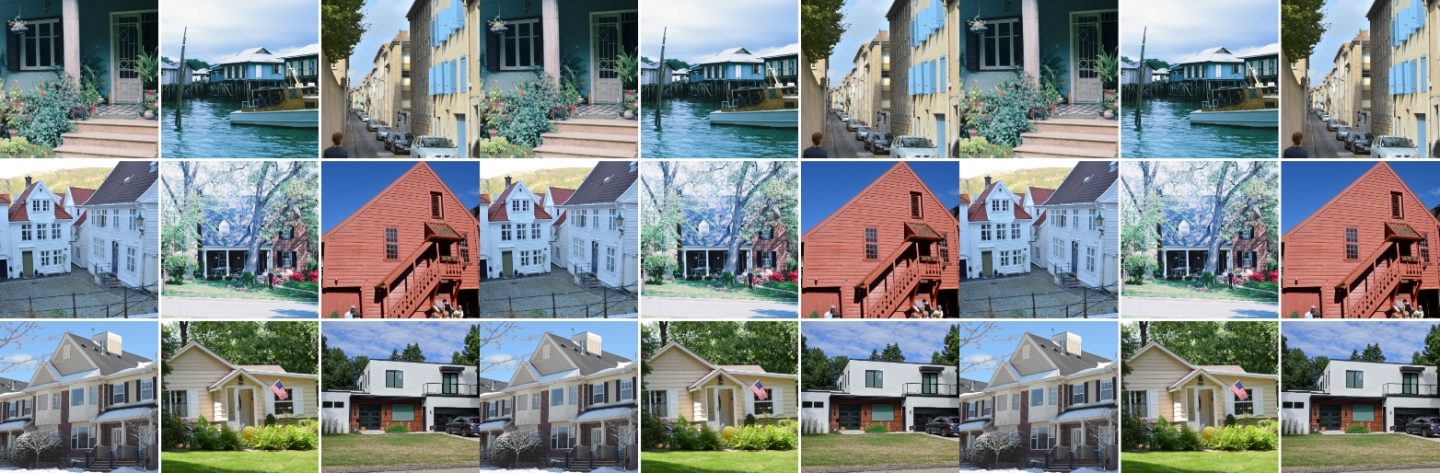


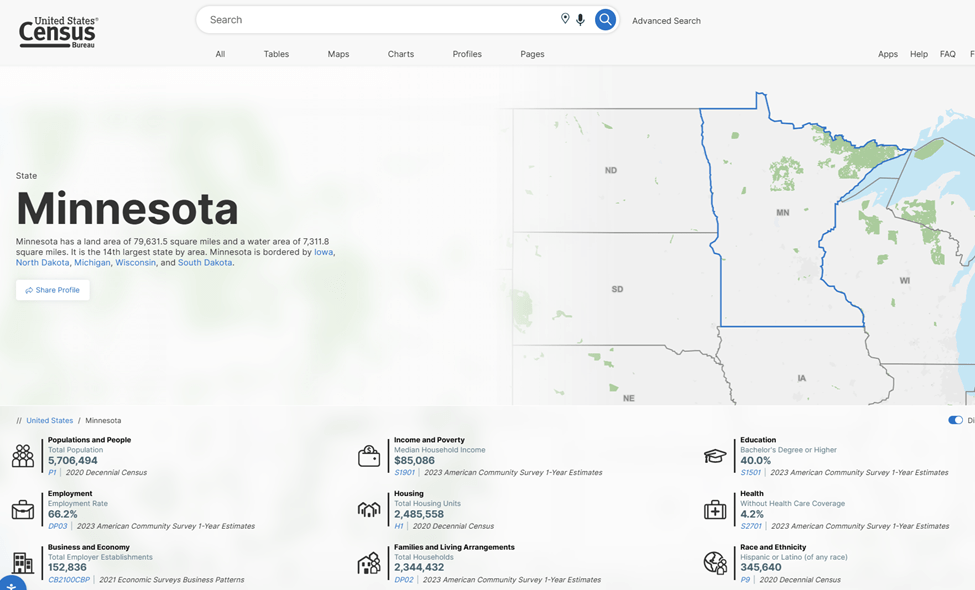
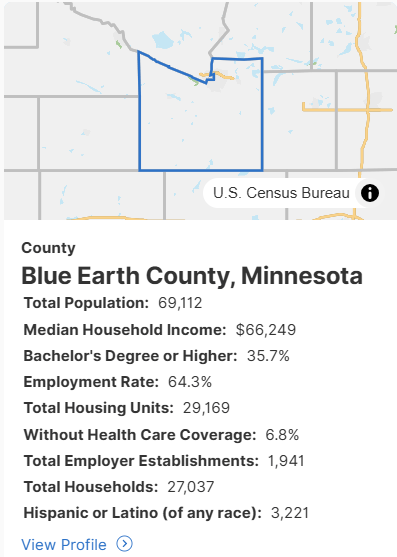

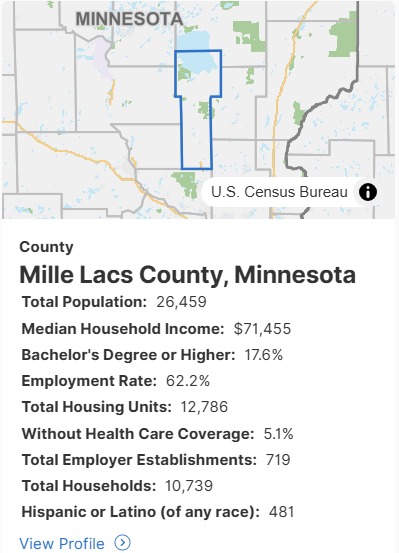


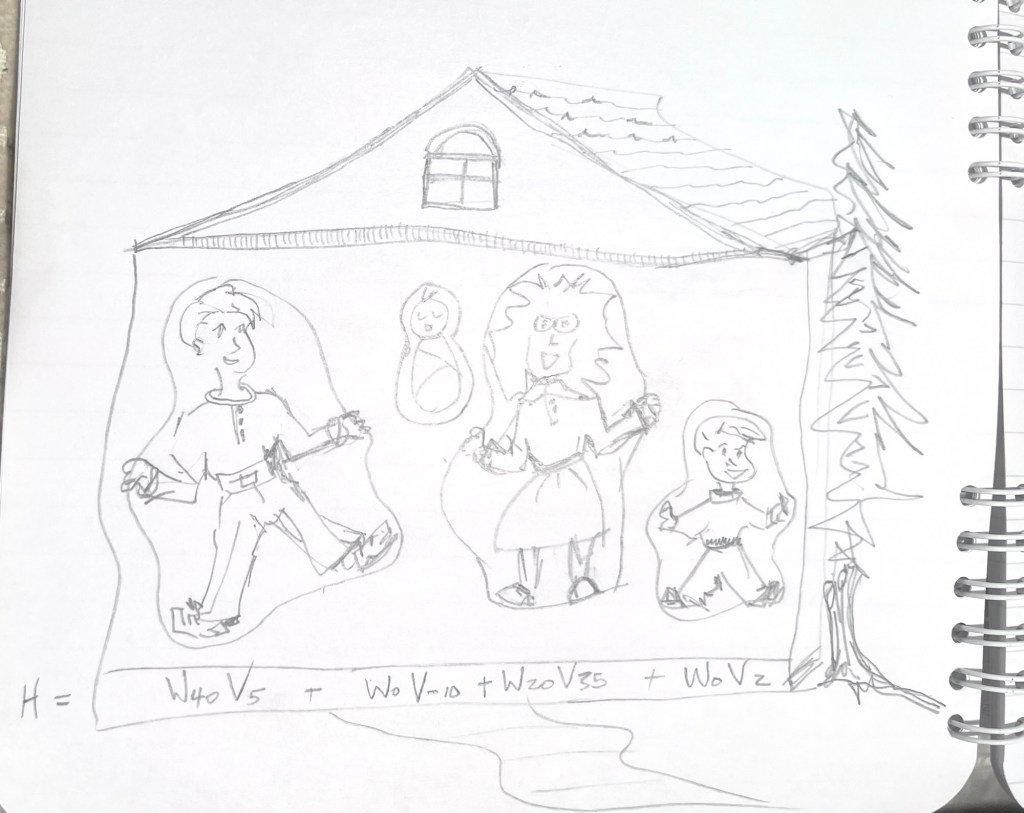









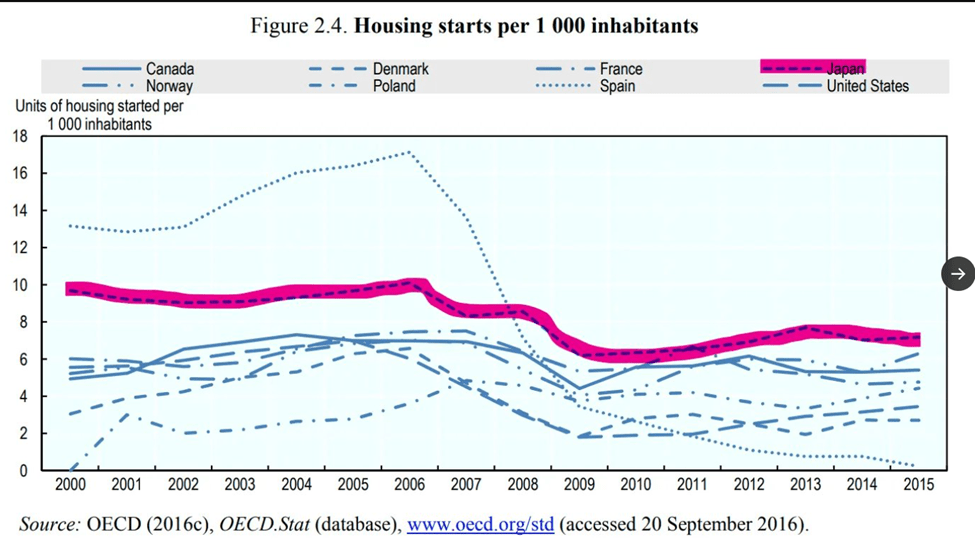


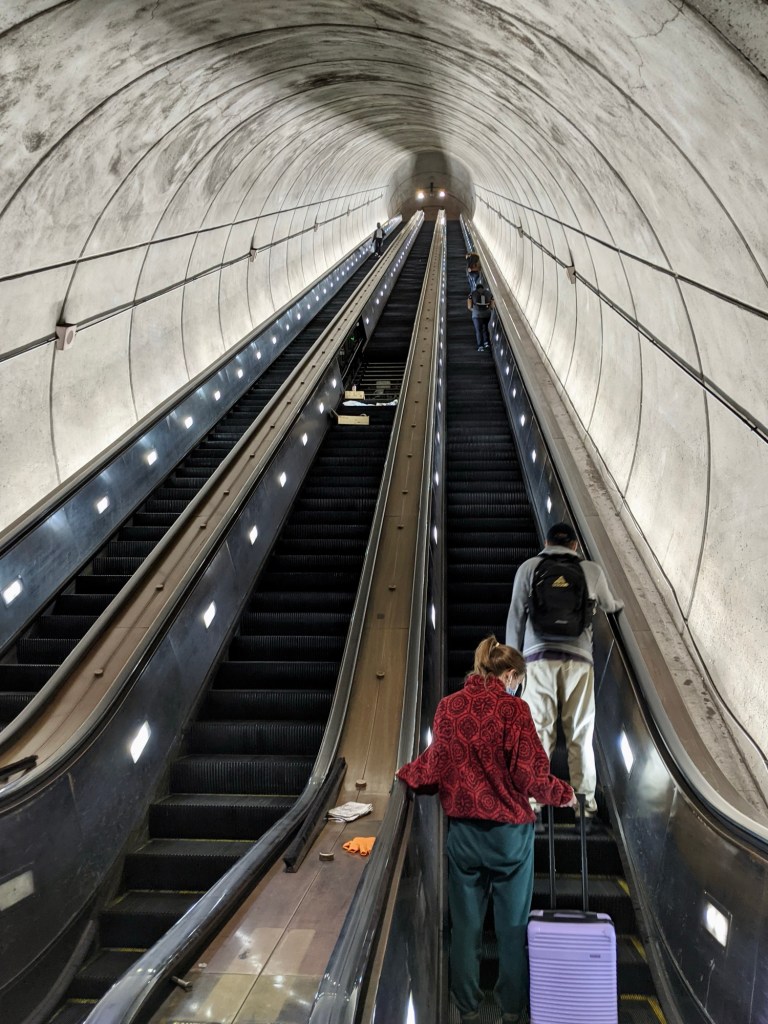






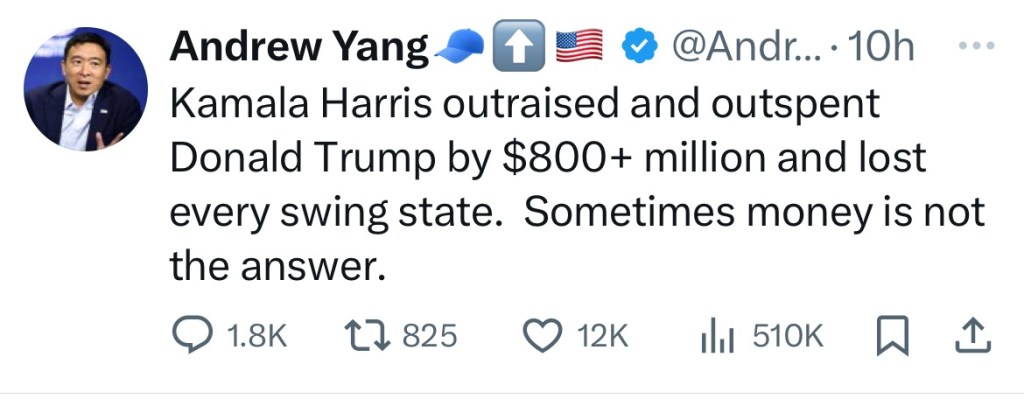








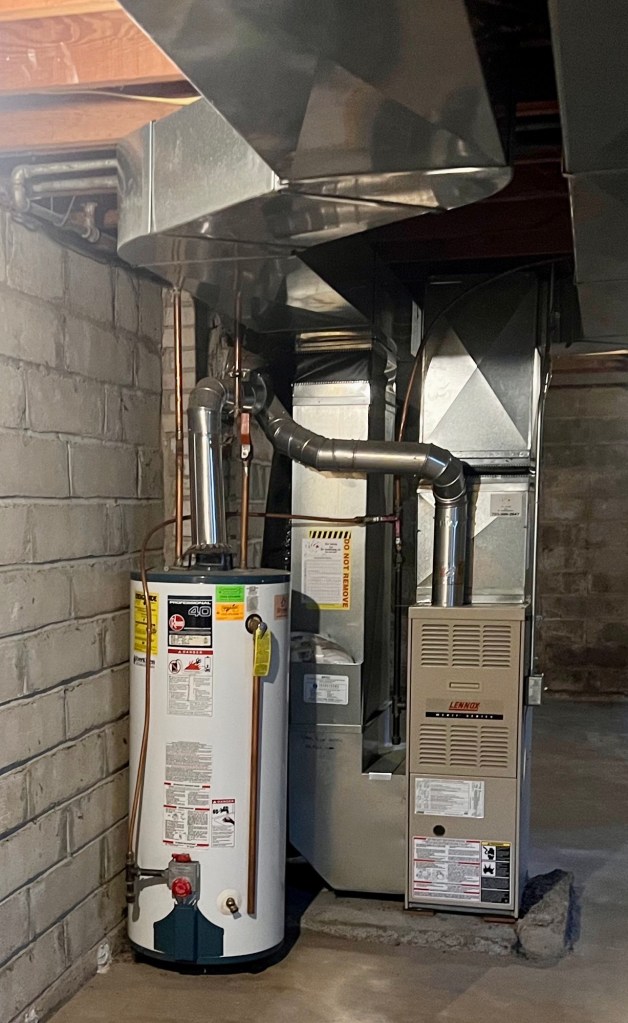






















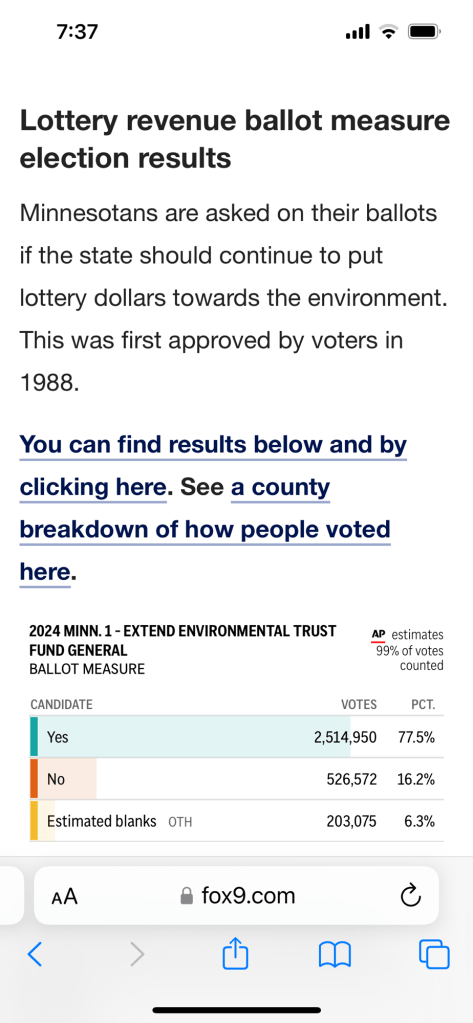





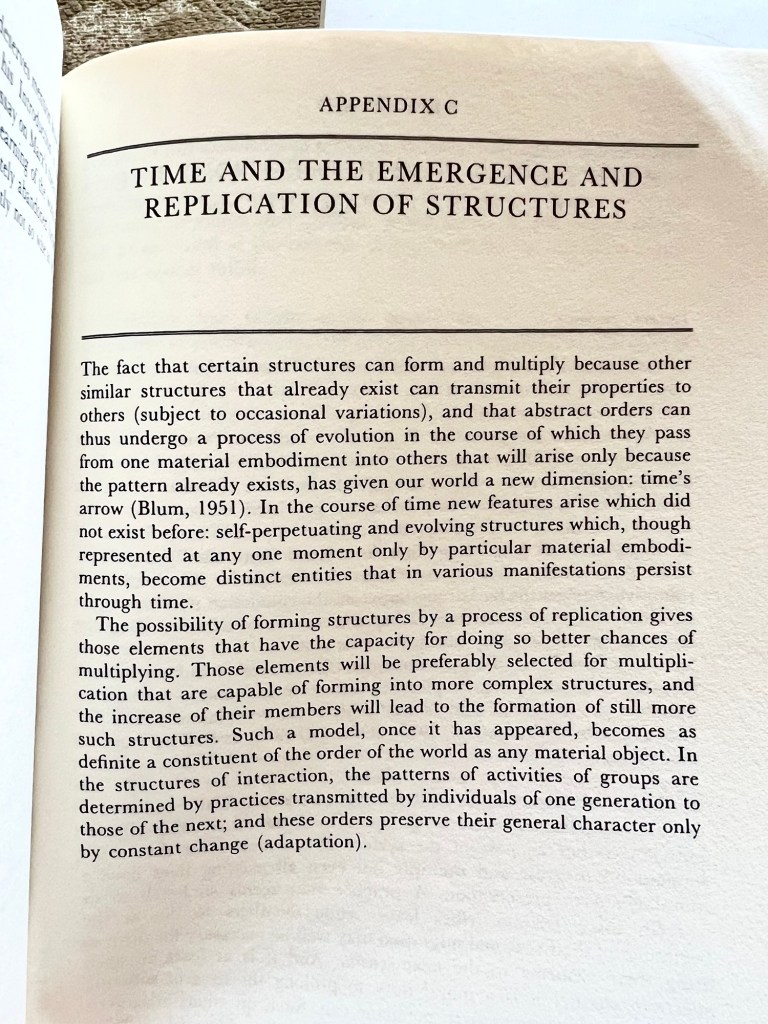

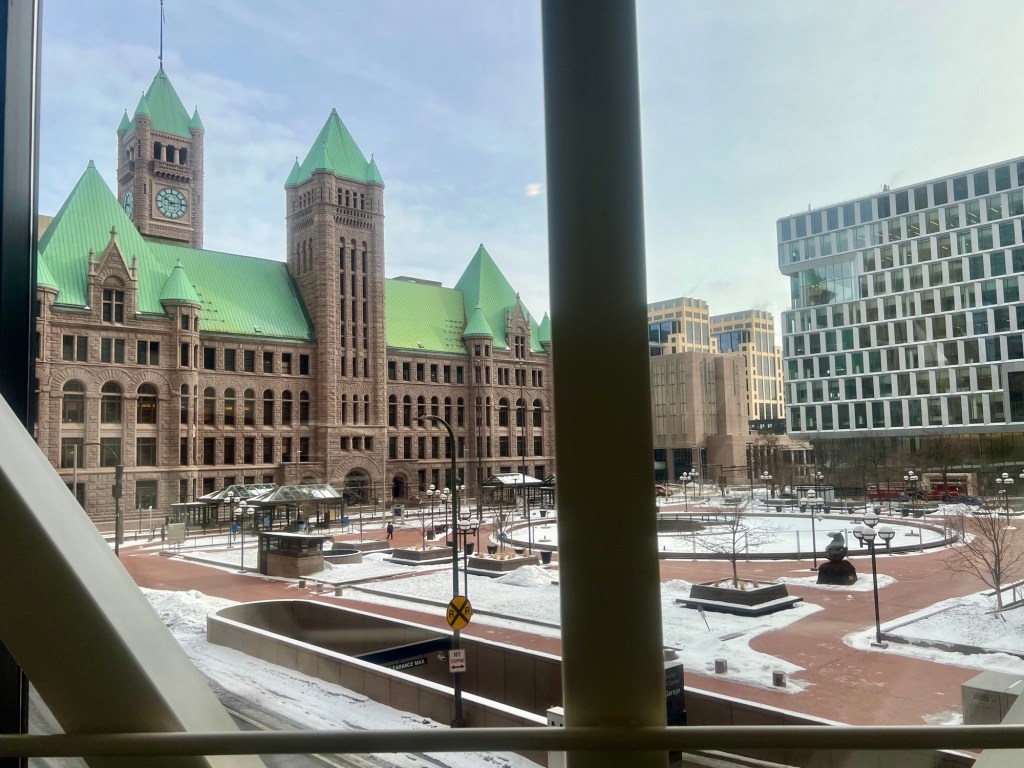


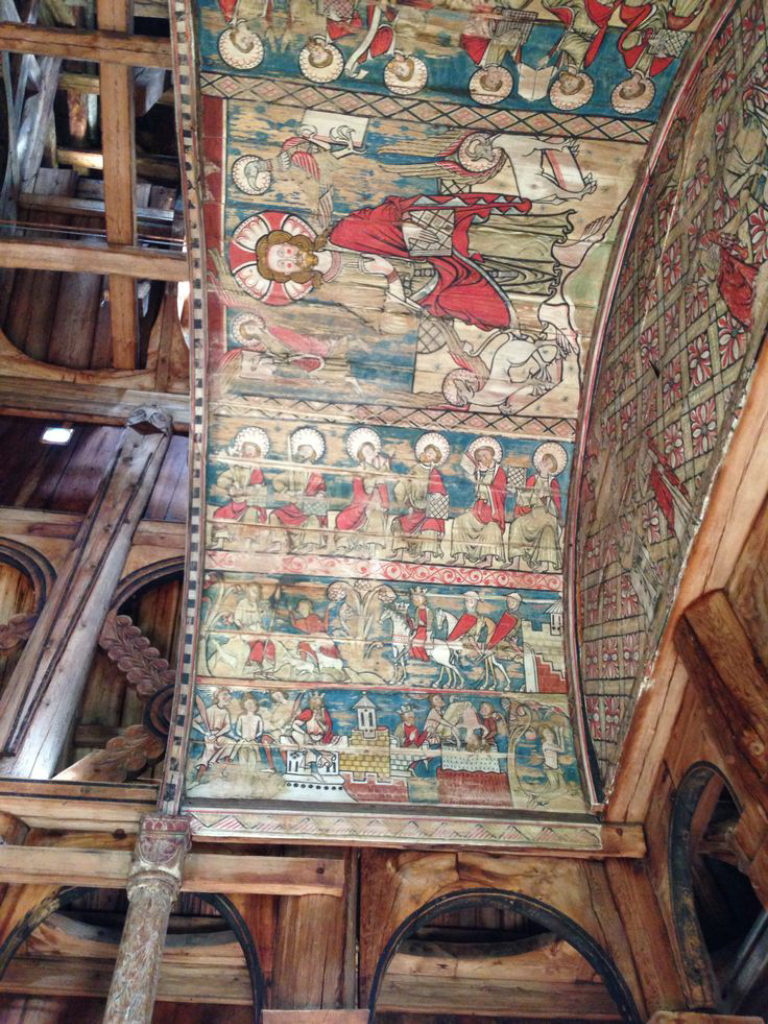








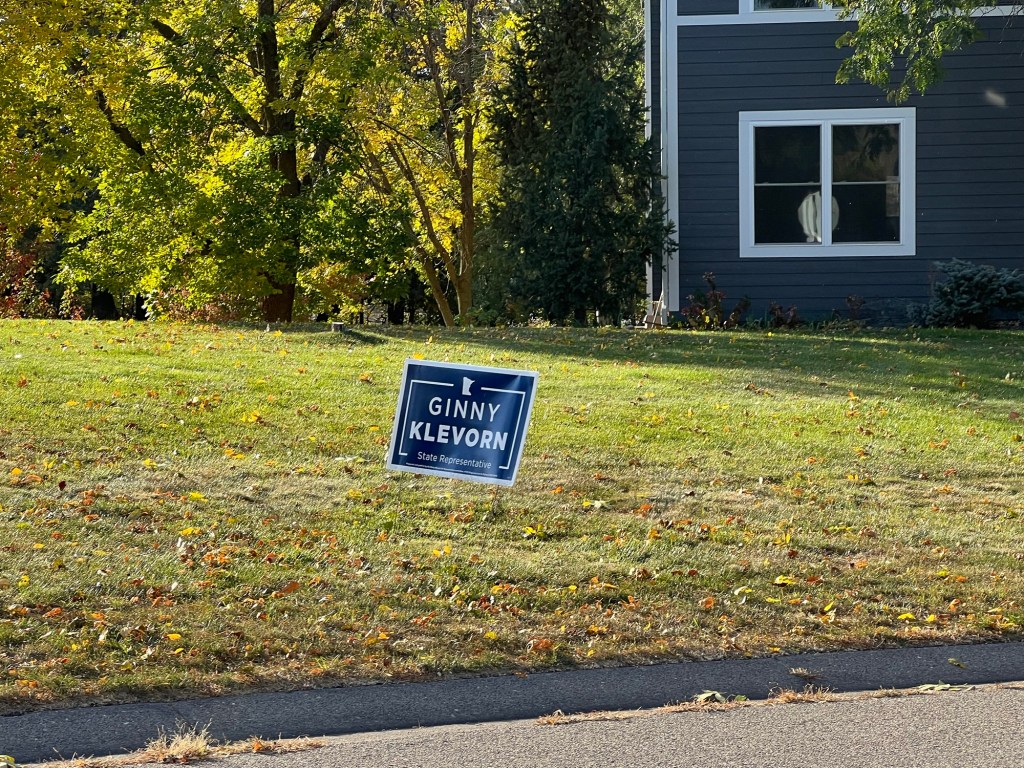
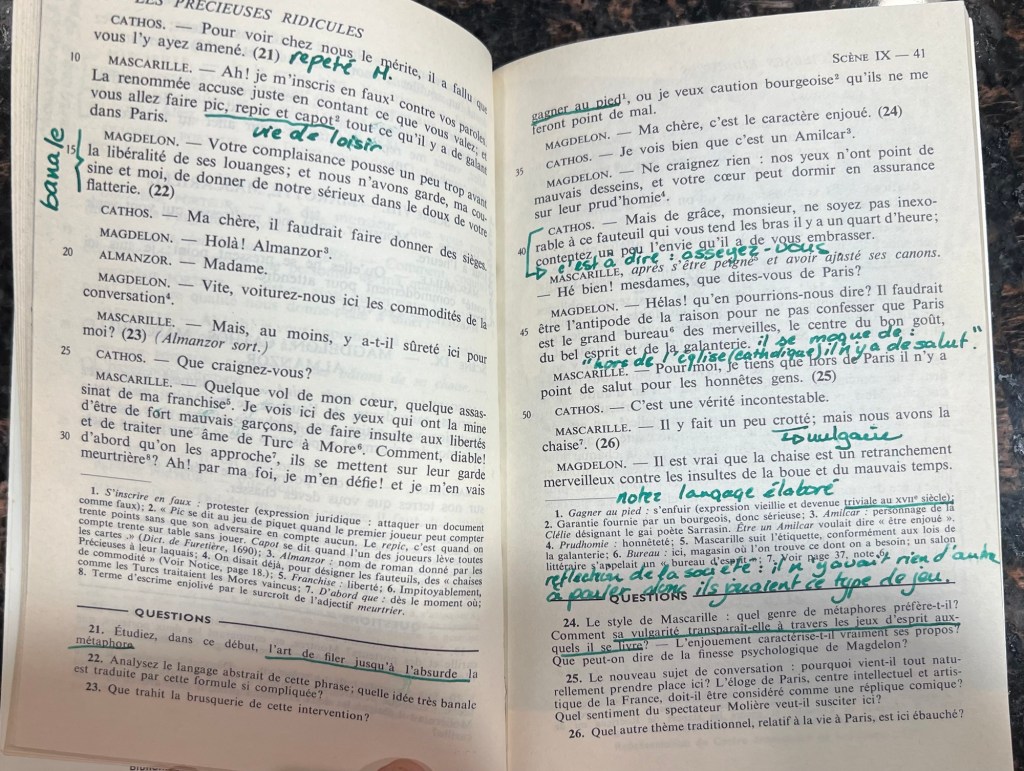

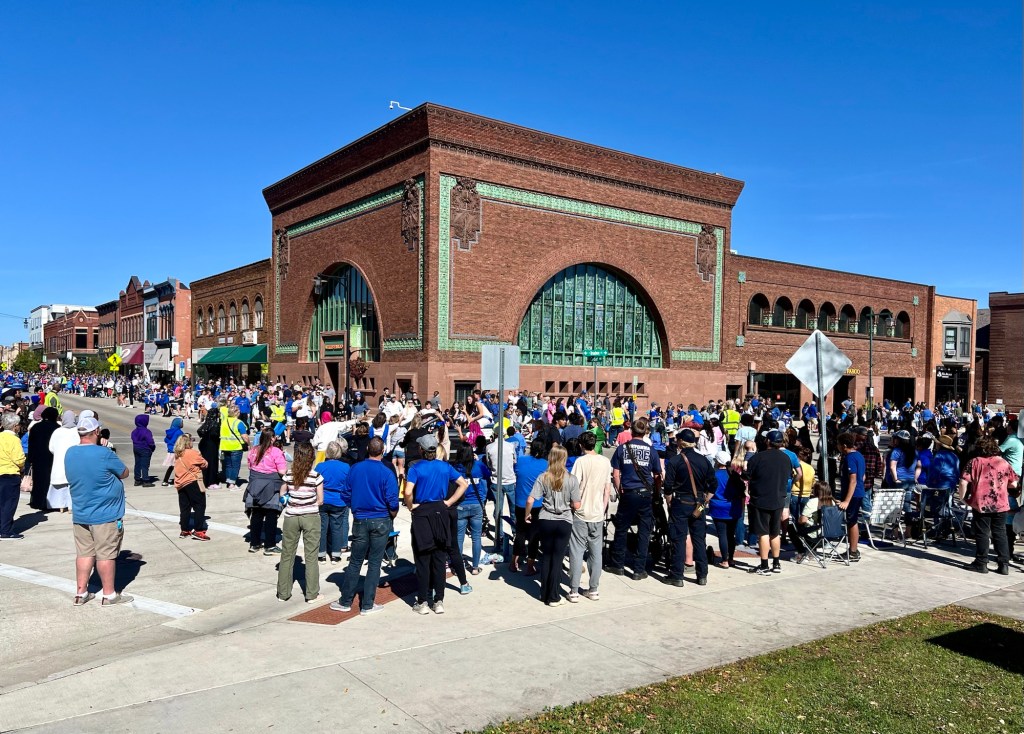

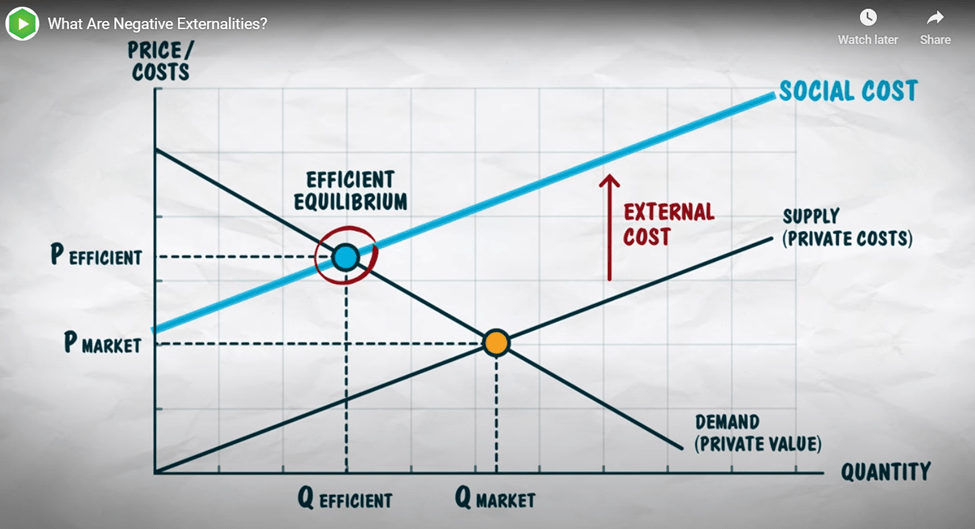
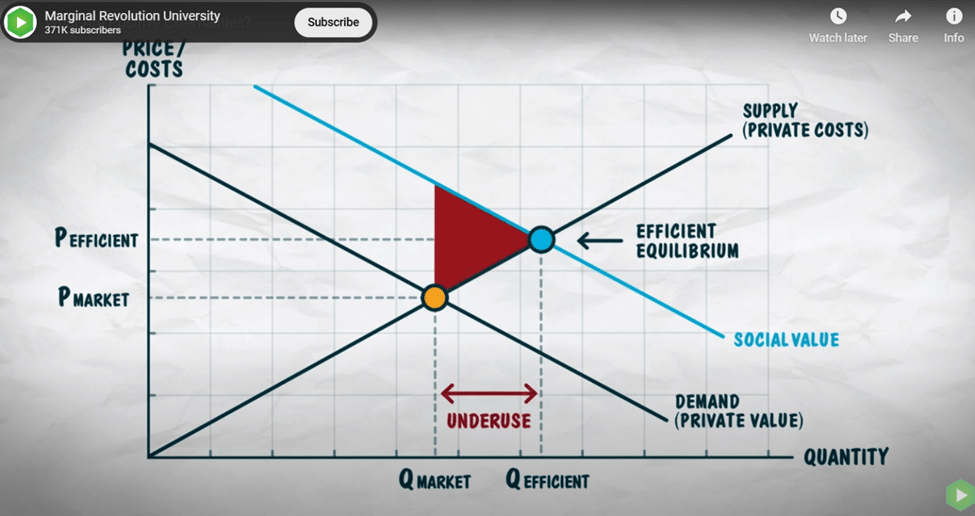
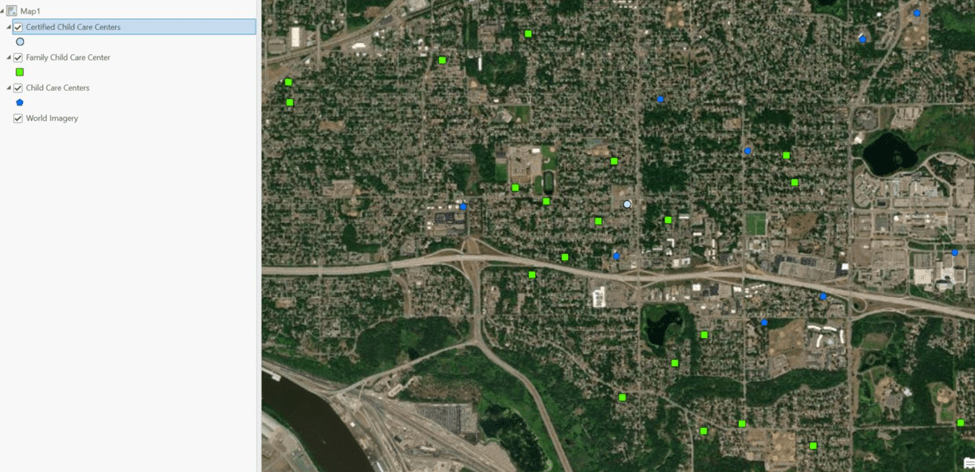


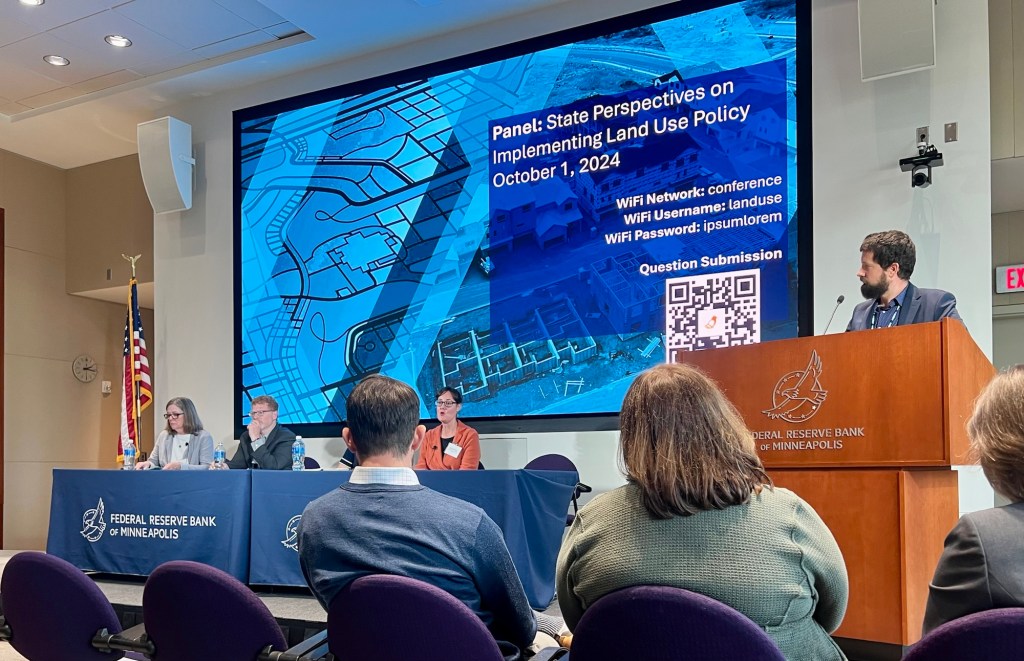



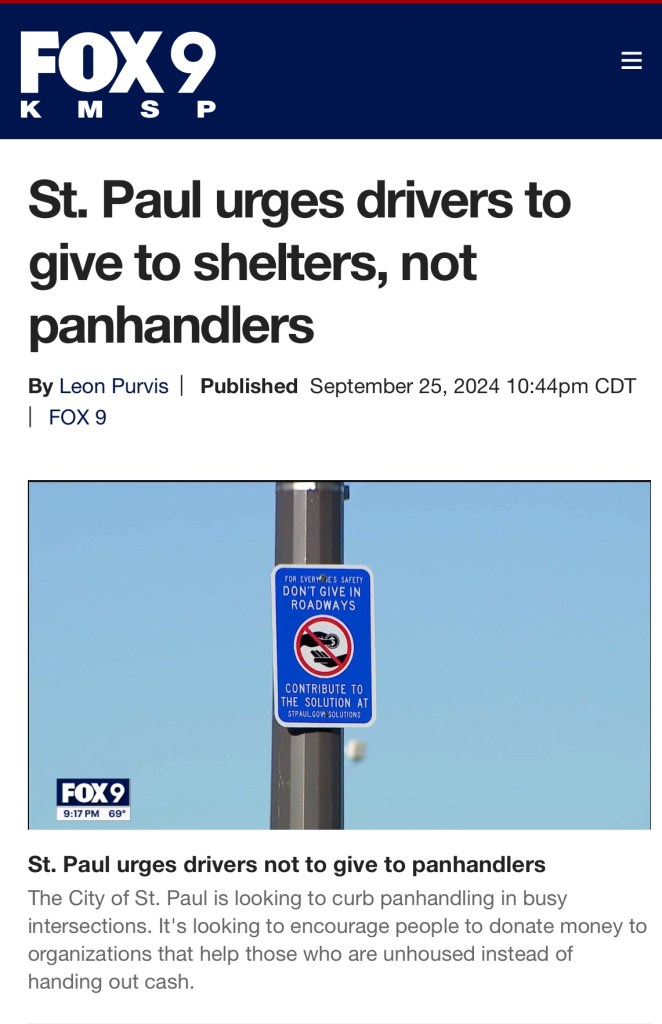








 Home Economics