In the context of car insurance pricing, a territory is a geographic area defined by insurers to group locations with similar risk profiles for setting premiums. Territories are typically defined using the following methods and delineators:
1. ZIP Codes: The most common delineator, as ZIP codes provide a standardized way to segment areas based on localized risk factors like accident rates, crime statistics, and claim frequency. Insurers may use individual ZIP codes or aggregate them into larger territories. [2][16][19]
2. Custom Territories: Insurers may create their own territories by combining ZIP codes, counties, cities, or townships into broader zones. These are designed to reflect similar loss experiences, traffic patterns, or demographic characteristics. For example, multiple adjacent ZIP codes with comparable risk may be grouped into one territory. [11][13][14]
3. Census Block Groups: For more granular analysis, some insurers use census block groups (small areas with 600-2,000 people) to define territories. These allow for precise risk assessment in densely populated or diverse areas. [16][19]
4. State-Regulated Territories: Some states impose rules on how territories are defined. For instance, Connecticut uses 18 predefined territories, while California requires territories to be at least 20 square miles and prohibits single-ZIP code territories to ensure fairness and avoid overly specific pricing. [13][14]
5. Geocoding: Insurers use geocoding tools to map a vehicle’s primary garaging address (where it’s parked most often) to precise coordinates, ensuring accurate assignment to a territory. This helps account for variations within larger geographic units. [18]
Territories are defined based on data like accident frequency, vehicle theft rates, vandalism, weather risks, traffic density, and claims history, which help insurers assess the likelihood and cost of claims in a given area. The boundaries are set to balance statistical homogeneity with practical considerations like regulatory compliance and administrative simplicity.
With nearly 500 food items, 30 carnival rides, and more than 900 free performances, there’s plenty to keep you busy throughout the Minnesota State Fair‘s 12-day run.
It’s a thing here in Minnesota. All walks of life mingle through the entrance gates in Falcon Heights. Check out the one day attendance record.
The Brief
The Minnesota State Fair saw its first record-breaking attendance day so far this year.
On Monday, 145,022 people were recorded attending the fair.
This breaks the previous record of 144,504 people set in 2017.
I showed a house this week in a modest but well-situated neighborhood. It had some problems, but mostly superficial– carpet, paint, appliances, and the like. Yet, even at a price below the comparable sales, it remains on the market. What? Uncertainty.
The property has been through a foreclosure, and as the tax records show, the bank holding the paper, Midfirst Bank, repurchased it. But this is a murky ownership situation.
At a sheriff’s sale, the buyer is not immediately given a full and clear ownership title the way they would in a normal real estate closing. Instead, the buyer typically receives one of two legal instruments depending on the state:
Sheriff’s Certificate of Sale (common in states like Minnesota)
This document shows that the buyer purchased the property at the sheriff’s sale.
It is not a deed and does not yet transfer full title.
The original owner still has a redemption period (often 6–12 months, depending on the type of property and state law) to pay off the debt and reclaim the property.
Sheriff’s Deed
If the redemption period expires without the former owner redeeming the property, the sheriff’s certificate is converted into a sheriff’s deed (sometimes automatically, sometimes requiring a filing).
The sheriff’s deed conveys whatever interest the debtor had in the property to the buyer, but it usually comes without warranties of clear title. That means the buyer takes the property subject to existing liens, unpaid taxes, or other encumbrances, unless state law says otherwise.
The property is being marketed by the owner who went through foreclosure, even though their right to the property is only through redemption. They would have to find a buyer to settle the full amount owed to Midfirst. This middle-ground ownership area makes the market uneasy. What if the bank wants more than the sheriff’s sale for fees and expenses? What if the property’s condition deteriorates between the offer and closing? Who will handle the repair? Will the title transfer be handled properly in the end?
Minnesota’s foreclosure rate is very low at one-half of one percent of the housing stock. So these sales are rare, and an investor will undoubtedly find it worthwhile to take on as a project. But in areas with insecure property rights and poor banking relations, the surcharge for uncertainty carries a hefty surcharge.
Agnes Callard: ‘Exsanguinating the bodies of people who hold an idea is not a way of getting at the idea itself, and preventing them from being exsanguinated doesn’t preserve the idea. Killing and saving don’t touch ideas: only argument does.’
Twice a year, builders in the Twin Cities Metro (and beyond) open up their model homes in an organized event to bring potential buyers out to browse.
More than 300 new homes in the Twin Cities and Rochester will be on display as part of the 2025 Fall Parade of Homes, according to Housing First Minnesota.
The event — which runs Fridays through Sundays from Sept. 5 through Sept. 28 — features homes built by 76 builders in 76 cities. Home prices range from $299,900 to more than $3 million.
Also planned is the Remodelers Showcase, which will be open on the final weekend of the tour. The showcase will feature 32 “home transformations,” including one remodeled “Dream Home” in Excelsior, according to Housing First Minnesota. (Finance and Commerce)
A lot of folks are window shopping. Builders pay designers to select the best paint colors and tile selections. It’s interesting to see if builders are betting on a new floor plan. Some years, the appliance styles make a dramatic switch, like going from stainless to white. People are curious. People are making plans for their own home improvements.
And some people really will build that brand new home they’ve always wanted.
From Your Home to the Grid: Who Owns and Operates the Power System
When you pay your monthly electric bill, you’re acting as a private consumer in the electricity market. To you, the relationship looks simple: you use electricity in your home, and you pay your local provider for it. But behind the walls of your house is a layered system of ownership and responsibility—households, retail providers, wholesale markets, and the grid itself—all working together to keep the lights on.
Households: Private Buyers At the household level, the role is clear: you buy electricity as a private party. You don’t own the power lines in your yard, the substation down the road, or the generating plant hundreds of miles away. Your responsibility begins and ends at the point where electricity enters your home. Your choice in the matter is limited—most households don’t pick their provider directly, unless they live in a state with retail competition. Still, you form judgments about reliability and cost, and those perceptions influence how you view your community’s services overall.
Retail Providers: Local Operators Your local utility—the company whose name is on your bill—owns and maintains the distribution network that connects households to the grid. These companies come in different forms:
Investor-owned utilities (IOUs): Private corporations accountable to shareholders but regulated by state commissions.
Municipal utilities: City-owned providers accountable to residents through local government.
Rural cooperatives: Member-owned organizations governed democratically by the people they serve.
Each owns the poles, wires, transformers, and meters in their service area. Their job is to ensure safe, reliable delivery of power to your home, while also balancing infrastructure costs with customer affordability.
Generators and the Wholesale Market The electricity itself originates with power plant owners—companies that run gas plants, wind farms, solar arrays, hydro dams, or nuclear stations. They sell their output into regional wholesale markets. Ownership here is diverse: it may be a private energy company, a public authority, or an independent producer. Retail utilities buy from these generators, sometimes through long-term contracts, other times through daily market transactions.
The Grid: Shared Infrastructure The “grid” refers to the transmission network that carries bulk electricity over long distances. Ownership here is shared, too. High-voltage lines and substations are owned by transmission companies, often subsidiaries of investor-owned utilities. Oversight and coordination, however, rest with regional transmission organizations (RTOs) or independent system operators (ISOs). These bodies don’t own the lines; they operate them, ensuring the system is balanced and fair access is maintained.
Above them, the Federal Energy Regulatory Commission (FERC) provides national oversight, while state commissions regulate local distribution and retail rates. In this sense, the grid is a patchwork of physical assets owned by many companies, but coordinated as a single machine for reliability.
A Household’s Place in the System So, while your home participates as a private buyer, every other level—local utilities, generators, transmission owners, and grid operators—has its own structure of ownership and accountability. The result is a complex but interdependent chain: private households at the end, backed by local, corporate, cooperative, and government players. Each layer has different incentives, but all share the responsibility of ensuring that when you flip a switch, the power is there.
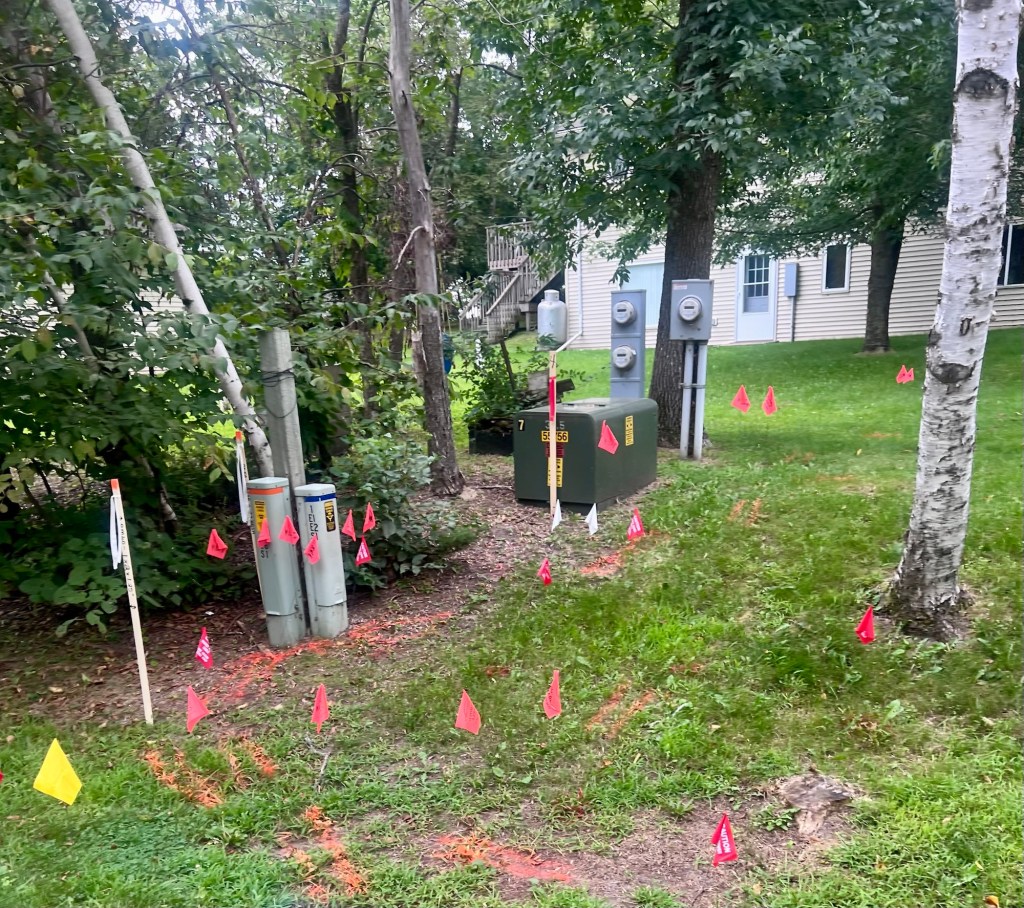
If you’ve ever had to dig in your yard, you know the first step is to call the power company. Before a shovel hits the dirt, utility crews mark the lawn with a rainbow of little flags, showing where buried lines and cables run. Those markers are a reminder that beneath every property lies a web of infrastructure you don’t own but rely on every single day. This network is owned and maintained by your local electric company—the same one that sends you a monthly bill. Whether electricity enters your home through an overhead mast or a buried cable, the reliability of service rests with these local players.
Behind the Flags: How Power Reaches Homes The electricity that hums through a house begins far away, at generating stations powered by natural gas, wind, solar, hydro, or nuclear energy. High-voltage lines move that power long distances until substations step the energy down to safer levels. From there, your local utility takes over, operating the distribution system that delivers electricity to neighborhoods and households.
For homeowners, the poles you see on the street—or the lines you don’t see underground—are not just background scenery. They are the lifelines of everyday living. Flicking on a light switch, charging a laptop, or running an air conditioner all depend on the quiet, constant work of utilities keeping those lines in good order.
Reliability and Perception While utilities don’t often feature at the top of a buyer’s checklist the way school districts or commute times do, reliability still shapes homeowner perception. Most people only notice electricity when it fails, but repeated outages or slow restoration times can quickly create frustration. Just like trash pickup or snow plowing, electricity is a municipal-style service that residents take for granted—until it stops.
In this sense, dependability forms a kind of background preference. A household may not choose a neighborhood primarily for its utility provider, but they still form judgments, even if peripheral, about whether the service is reliable, responsive, and trustworthy. When those expectations aren’t met, the dismay can be just as real as when other civic services break down.
The Household–Utility Relationship Every month, the bill you pay reflects both the energy you used and the infrastructure behind it. Rates cover not only the electricity itself but also the upkeep of poles, wires, substations, and the crews ready to respond when trouble strikes. For families on tight budgets, these costs can feel heavy, which is why many utilities offer assistance programs or rebates to help households manage expenses.
More Than Wires Ultimately, the connection between utilities and homes is about more than cables and meters. It’s about ensuring every household can reliably plug into modern life. From the flags in your lawn to the wires above your street, utilities provide the unseen backbone of comfort, safety, and opportunity—making sure that when you flip the switch, the lights always come on.
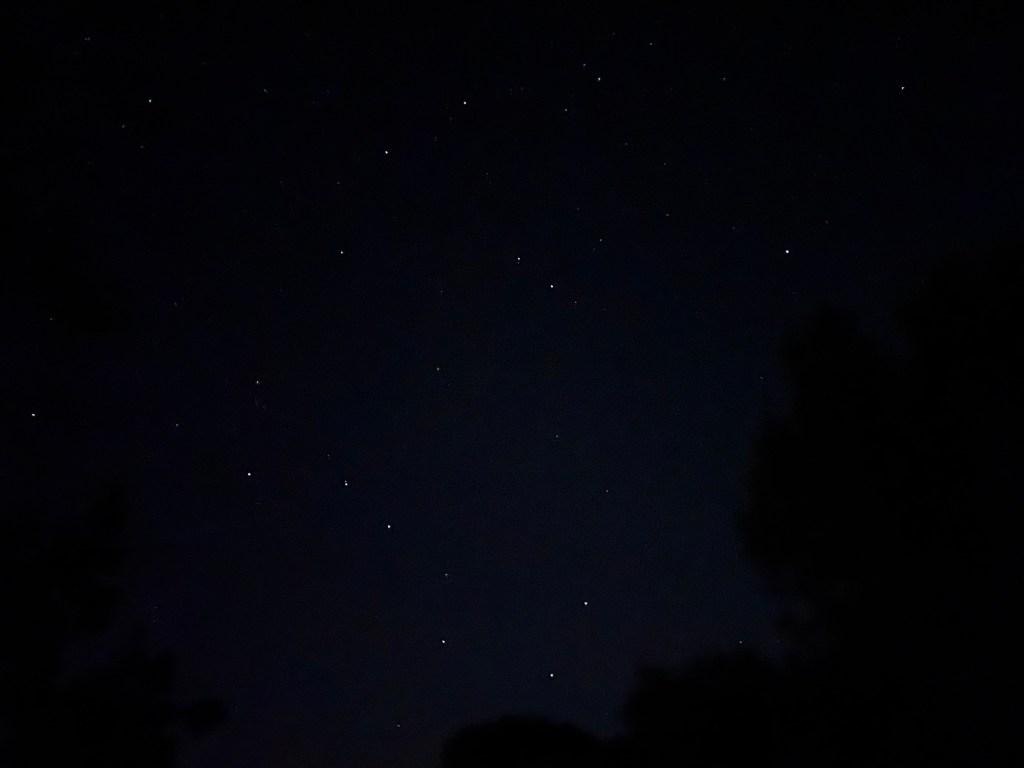
It’s dark out! So I gave my iPhone a try at constellation photography. Not outrageous, but still satisfactory.
Big Dipper on the bottom edge of the frame
According to NPR, here’s the reason for the bright lights.
There are “blood,” “super” and “blue” moons, and then there’s the “black” moon.
The “black moon,” a rare phenomenon that occurs during a new moon phase of the lunar cycle, will occur this weekend. But don’t get your hopes up too much, scientists say, because it will be technically invisible.
Big Dipper with telescope feature
It’s unclear when it was coined, but “black moon” is an unofficial astronomical term. A new moon is considered by some to be a black moon one of two ways. It can happen when a new moon appears twice in one month (new moons usually happen once per month) or when there are four new moons in one season. When there are four new moons in one season, the third new moon is called a “black moon.”
Many home builders, contractors and retailers wagered that higher U.S. tariffs on imports would boost the cost of lumber, while lower interest rates would lift demand for the building material.
But those bets have failed to pay off — and lumber prices have tallied a steep decline from a record high reached only three weeks ago. MarketWatch
Of course, there’s more than just tariffs in play in the market. Housing demand is down. Many new owners tackle renovations in the first months of home ownership. Fewer sales mean fewer renovations.
The market had rallied on classic “buy the rumor, sell the fact” action, he told MarketWatch. Prices for lumber had been higher just a few weeks ago based on the idea that tariffs were going to be attached to lumber and people were going to have to pay substantially higher costs — yet the underlying demand isn’t there, Kuta said.
People also overestimated where interest rates would be and their impact on lumber demand, which continues to slide lower, he added, with the “swing and a miss” he referred to based on housing statistics and earnings for publicly traded companies that supply lumber.
For now, the addition of tariffs has not resulted in the anticipated price increase. So what’s the takeaway? Hire contractors and get that house addition done! Lumber prices, a main component in construction, are down because demand is down, which on turn means contractors are looking for jobs– it is time to build.
Everyone can make out a mallard or spot a majestic eagle, but this chirp identifier lets you identify all the smaller or lesser know creatures perched in your backyard foliage.
Just tap on the green arrow, and a recording starts. Every time a song is picked up, the bird ID flashes below.
Then you can replay the recordings to become familiar with all the different calls.
Another free educational service brought to you through new technology and the drive for data.
Housing markets often seem mysterious, but at their core they operate as a cascading system shaped by wealth, supply, and lending rules. A recent model by Abramson and Landvoigt highlights how rising wealth inequality and slow housing supply interact to push prices upward. Their framework divides housing into quality tiers, from luxury to starter units, and shows how households with different levels of wealth compete across these tiers.
A central insight is that prices at the very top do not stay isolated. Luxury buyers are a small share of the market, and in some sense they simply bid against one another for exclusivity. One might argue that they are “fools” for paying such large premiums, while the rest of the market should remain relatively affordable. But in practice the tiers are linked. When supply of luxury units is restricted, affluent households who cannot find space at the top tier shift down into the next-best homes. That displacement triggers a chain reaction: middle-income households face stiffer competition, prices at their tier rise, and the pressure filters all the way down to lower-income renters. Economists call this the filtering or musical chairs effect, and it means that adding supply at the high end can improve affordability across the board.
This cascading dynamic is exactly what makes the market work. New supply at any tier frees up units that can be occupied by someone else, allowing households to sort themselves according to means and preferences. The danger arises when either end of the ladder is blocked. If new high-end supply is not built, the wealthy bid down-market and crowd out others. If older or more affordable stock is neglected, the bottom rungs collapse and low-income households are left without viable options.
At the same time, credit standards shape who can actually buy. A household that cannot afford the payments will not receive a loan, which protects individuals from becoming dangerously over-leveraged. But this underwriting filter does not stop prices from rising overall; it only determines who gets excluded. The clearing price is still set by those wealthier households who can obtain financing. Those priced out of ownership often remain in the rental sector, where demand pressures drive rents upward as well.
Taken together, the picture is less about a simple split between the rich and poor and more about a tightly connected cascade. Housing affordability depends not only on overall supply but also on how well each rung of the ladder is maintained and allowed to expand.
“The whole plan of our order should be founded on the training of men of character and virtue, bound together by unity of conviction and aim,— the aim of suppressing vice and folly everywhere by every means, and protecting talent and virtue, raising deserving persons out of the dust and enrolling them in our brotherhood….”
The narrative of a housing affordability crisis in Minnesota deserves scrutiny when examined against the actual data. The numbers tell a remarkably different story than the one often presented in policy discussions and media coverage.
The fundamental reality is this: 99.82% of Minnesotans are housed. With approximately 5.7 million residents and only 10,522 experiencing homelessness according to the most recent Minnesota Homeless Study, the state has achieved what many would consider a housing success story. This isn’t a marginal victory—it represents one of the most successful housing outcomes in the nation.
Supply Meeting Demand
Perhaps even more telling is the relationship between housing supply and population growth. Over the past five years, Minnesota’s housing stock increased by 3.87% while the adult population grew by 3.90%. This near-perfect alignment suggests that new construction is effectively matching new resident demand—a fundamental indicator that the housing market is functioning properly.
This supply-demand balance contradicts claims of a systemic housing shortage. When housing supply keeps pace with population growth, market forces should theoretically maintain relative affordability absent other significant economic disruptions.
The Missing Financial Stress Evidence
Claims of widespread housing-related financial distress should be accompanied by clear indicators of economic strain. Yet when we examine Minnesota’s financial stress metrics, the evidence doesn’t support a crisis narrative:
Credit Card Debt: While Minnesota residents carry an average of $6,800 in credit card debt, this represents a manageable burden for most households. Only 6.65% of Minnesotans are behind on credit card payments—a figure that, while not negligible, hardly suggests widespread financial collapse.
Payday Loans Eliminated: Rather than seeing increased desperation borrowing, Minnesota has essentially eliminated its payday loan industry through regulatory action. The state capped interest rates at 36% APR in 2024, driving out predatory lenders who previously charged an average of 202% annually. Payday America, which handled two-thirds of the state’s payday loan volume, simply stopped operating in Minnesota. If financial stress were truly endemic, we would expect to see increased demand for these services, not their market elimination.
Bankruptcy Filings: While March 2024 saw 731 bankruptcy filings—the highest since March 2020—this represents a return to pre-pandemic levels rather than an unprecedented crisis. The temporary reduction during the pandemic was likely due to federal assistance programs and eviction moratoriums, making the current numbers a return to historical norms rather than evidence of new distress.
The 30% Rule: An Arbitrary Standard
The frequently cited “30% rule”—that housing should consume no more than 30% of household income—deserves particular scrutiny. This threshold traces back to the United States National Housing Act of 1937, developed for public housing eligibility criteria nearly 90 years ago.
As household finance expert Andrés Shahidinejad notes: “There’s no scientific basis or magic reason for (30%) being a cutoff.” Fortune magazine has called the rule “arbitrary and not very helpful for policy makers.” The standard was created in an era of dramatically different household economics, employment patterns, and lifestyle choices.
Modern households make different tradeoffs than their 1937 counterparts. Some prioritize location and are willing to spend 40% or 50% of their income on housing in exchange for shorter commutes, better schools, or urban amenities. Others prefer larger homes in less expensive areas. These are choices, not evidence of crisis.
Reframing the Conversation
The data suggests Minnesota has achieved something remarkable: a housing market that houses virtually everyone while maintaining supply growth that matches population growth. Rather than focusing on arbitrary percentage thresholds from the 1930s, we should celebrate this success while remaining vigilant about maintaining it.
This doesn’t mean housing policy should be ignored. Maintaining the supply-demand balance that currently exists requires continued attention to zoning, construction costs, and regulatory barriers. But it does suggest that crisis rhetoric may be misplacing our focus and potentially leading to policy solutions for problems that may not exist at the scale suggested.
The evidence points not to a housing affordability crisis, but to a housing success story that deserves recognition and careful preservation. Minnesota’s achievement of housing 99.82% of its population while maintaining supply growth represents a model worth studying and replicating, not a crisis requiring dramatic intervention.
For 125 years, this building has been a form of low-income housing. It was a hotel for most of the time, but it is now being explicitly managed in aid of Veterans. But slowly, these types of housing are squeezed out of areas, as are trailer homes.
Rentals in single-family homes are also less common than in years gone by. Many core cities, which would benefit most from additional forms of rentals, require a variety of regulations which discourage owners from renting out part of their house. They are also held to standards that, in the past, favored an owner whereas now puts them as a disadvantage.
Yes, more homes need to be built. But many other forms of casual living situations have been squeezed out of existence by rules and regulations.
Sometimes I run a piece through Claude to see how it appears as an AI revision. It’s always much better. The one below is a rewrite of yesterday’s post. But I sometimes miss my unusual word choice and structure.
When Everyone Had the Power to Act, No One Did
Victoria Wilson August 11, 2025
US Attorney General Joe Thompson’s recent assessment of Minnesota’s fraud crisis cuts to the heart of a systemic failure. As he told the Star Tribune: “This fraud crisis didn’t come out of nowhere. It’s the result of widespread failure across nearly every level of leadership in Minnesota: Politicians who turned a blind eye. Agencies that failed to act. Prosecutors and law enforcement who didn’t push hard enough. Reporters who ignored the story. Community leaders who stayed silent. And a public that wanted to believe it couldn’t happen here.”
Thompson is describing something profound: the collapse of state capacity through a thousand small abdications of responsibility.
The Architecture of Inaction
At every decision point—what scholars call the “locus of discretion”—someone could have acted. The architecture of prevention was already in place; what failed was the will to use it.
Politicians possessed both influence and institutional knowledge. Any number could have quietly removed a questionable contractor from consideration or flagged suspicious applications. Career bureaucrats, masters of administrative friction, could have deployed their expertise differently—slowing suspicious applications rather than legitimate ones, demanding additional documentation, or simply doing their jobs by visiting the nonprofit distribution sites that journalists later discovered were empty storefronts.
But the machinery of oversight had been recalibrated around different priorities.
The Pendulum’s Swing
Law enforcement and prosecutors had internalized a new philosophy. Years of concern about overcharging and mass incarceration had created an institutional bias toward restraint. The progressive approach—emphasizing rehabilitation over punishment, empathy over enforcement—had become orthodoxy. This wasn’t necessarily wrong in principle, but it created blind spots in practice.
When the prevailing wisdom holds that harsh enforcement causes more harm than good, the institutional reflexes that might catch sophisticated fraud schemes atrophy. The very skills and instincts that prosecutors once relied upon were now viewed with suspicion, even by the prosecutors themselves.
The Fourth Estate’s Absence
Perhaps most puzzling was the media’s delayed response. Major fraud schemes leave trails—suspicious contracts, questionable nonprofits, patterns of payments that don’t match claimed activities. These stories don’t require deep investigative resources so much as basic skepticism and persistence.
Yet for years, the story went untold. What accounts for this collective editorial blind spot? The same social and ideological currents that affected other institutions likely influenced newsrooms as well. When the dominant narrative emphasizes compassion over skepticism, reporters may unconsciously avoid stories that complicate that narrative.
Social Proof and Professional Risk
The community leaders Thompson mentions—board members, nonprofit executives, civic figures—faced their own constraints. In professional networks where certain viewpoints signal virtue and sophistication, dissent carries social costs. The cocktail party circuit that shapes elite opinion had settled on particular truths about criminal justice, social services, and community empowerment.
Raising uncomfortable questions about fraud prevention or accountability could mark someone as unsympathetic, backward, or worse. When career advancement and social standing depend on maintaining good relationships within ideologically coherent networks, the incentives point toward conformity rather than vigilance.
The Paradox of Distributed Responsibility
This case illustrates a peculiar modern phenomenon: system-wide failure despite individual competence. None of these actors were incompetent or malicious. Politicians understood governance, bureaucrats knew their procedures, prosecutors understood the law, reporters could investigate, and community leaders cared about their communities.
The failure occurred because everyone was optimizing for their immediate institutional and social environment rather than the system’s overall integrity. Each actor made rational decisions given their constraints, yet the collective result was irrational—a massive fraud that continued for years despite numerous opportunities for intervention.
The Cost of Consensus
Thompson’s critique suggests something uncomfortable: that the very social and ideological consensus meant to create a more just society may have created new vulnerabilities. When preventing harm becomes conflated with avoiding enforcement, when empathy becomes synonymous with credulity, the institutions meant to protect public resources become unable to protect them.
This doesn’t argue for a return to punitive excess, but rather for institutional cultures capable of holding multiple values in tension—compassion and accountability, reform and vigilance, trust and verification.
The Minnesota fraud case reveals what happens when that balance is lost, when the locus of discretion at every level points in the same direction: away from the uncomfortable work of saying no.
“This fraud crisis didn’t come out of nowhere. It’s the result of widespread failure across nearly every level of leadership in Minnesota: Politicians who turned a blind eye. Agencies that failed to act. Prosecutors and law enforcement who didn’t push hard enough. Reporters who ignored the story. Community leaders who stayed silent,” he told the Star Tribune recently. “And a public that wanted to believe it couldn’t happen here.”
That’s from US Attorney General Joe Thompson as reported in the Minnesota Reformer.
Isn’t he talking about state capacity? At every level, at each locus of discretion, action could have been taken to deter the fraudsters. Politicians are powerful and familiar with the levers of influence. Many could have bumped a potential n’er-do-well from the contract they pursued. Bureaucrats are very familiar with slow walking. Anyone in the chain of processing payments could ask for more information, lose pieces of the application, or demand more verifications. Heck, they could have even done they’re job and gone looking for the non-profits’ distribution sites, which, as the reporters later discovered, were vacant shells.
Prosecutors and law enforcement were busy working the other side of the justice spectrum. Anxious about overcharging instead of undercharging, they were busy releasing those who in past years would have received sentences. It’s been avant-garde to look the other way and anticipate a return to the law-abiding citizenry due to this empathetic understanding. (If you haven’t been au courant, this has not been successful.)
The reporters have finally come through five or six years into this monumental fleecing of the public purse. But where or where were they a few years ago? Four years ago? Six years ago? Who’s been persuading them to look away when such a tale was left untold? And the community leader, how about you? At the same parties, I’m sure. Drinking the same cocktails. Talking the same talk of empathy for the wayward results in reduced recidivism. Even though there is no track record. But the fashion of the day prevails. And social circles are heavily influenced by the fear of being left off the invite list for the next big event.
So there you have it. A big state capacity flop. At every level, the few who might have shoved the right disclosing email on the right desk, or talked a bit too much at a party to get the right word in the right ear, all muted. All cloaked down by the desire, no, the need, to be in with the crowd du jour.
Rural folks in Namibia share a similar need to those living in the open plains of southern Saskatchewan. There is a need for ambulances and none are forthcoming.
We have lost more than five innocent lives due to poor roads and a lack of clinical facilities,” Gcugcuma village headman Kapeta Sikukutu told regional leaders during the engagement….
“People have died on their way to the hospital from remote areas because of transport problems,” the headman said.
“We use the traditional mode of transport, which is oxen, and it contributes to the loss of lives. It takes hours for one to reach the clinic, which is 30km away from where we live,” Sikukutu said. Namibian.
Meanwhile across the globe.
High call volumes and a shortage of paramedics are making for difficult situations when it comes to fast ambulance services in Saskatchewan.
Through a mutual aid agreement in Regina, fire crews are responding to ambulance calls when an ambulance can’t immediately respond.
Data collection by government is good. It is necessary. It’s as reliable as the bureaucracy that Shepards its output.
I love how this article in Bloomberg, The BLS Can’t Be Replaced by the Private Sector, by Claudia Sahm slices and dices the public nature of data collection. But I wonder about her denial of its private creation. Let’s consider her claims.
To be clear, this is the way it should be: Private companies are not in the business of creating public goods, which is what economic statistics from the government are. They are free to users, transparent in their methods, protective of the privacy of individuals and businesses, and dependable. Most private companies that create statistics charge users for access. (Some share their results publicly as a form of marketing.) Many private companies share only limited information about their methodology to deter competition.
Private companies are in the business of making a profit, and to do that they need to attract customers. Some customers are more profitable than others. As a result, a company’s data will tend to reflect the needs of its clients — it won’t capture the economy as whole.
And yet— many privately created data sets are used openly in a transparent fashion.
Here’s a list summarized by Grok of data provided by private enterprises for public consumption:
Private organizations often provide data that can function as a public good—non-excludable and non-rivalrous, benefiting society broadly. Here are some examples:
Open-Source Software Data: Companies like GitHub or Red Hat share code repositories and software documentation, enabling developers worldwide to build and innovate without restriction.
Environmental Data: Private firms, like those operating weather stations (e.g., IBM’s Weather Company), provide real-time weather and climate data, which supports disaster preparedness and agricultural planning.
Health Data Aggregates: Pharmaceutical companies or research institutions sometimes release anonymized clinical trial data or disease prevalence statistics, aiding public health research and policy.
Geographic and Mapping Data: Organizations like OpenStreetMap or Google (via public APIs) offer mapping data that supports urban planning, navigation, and disaster response.
Educational Resources: Platforms like Khan Academy or Coursera provide free or low-cost educational content, democratizing access to knowledge.
Economic and Market Data: Financial institutions like Bloomberg or trading platforms sometimes release anonymized market trends or economic indicators, informing policy and research.
Scientific Research Data: Private research labs, such as those in biotech, occasionally share datasets (e.g., genomic data) that advance collective scientific knowledge.
These datasets, while often generated for profit, can be shared in ways that make them accessible and beneficial to the public, resembling public goods.
Furthermore, there are frequent examples of bureaucratic efforts being led astray by private subgroups. The temptation for biased numbers can occur in both sectors.
Can we think of any recent Federal agencies being dismantled?
These little video clips were made by Grok Imagine from photos taken of a Finnish farm family in 1957. The animation brings out detail from the prints that went unnoticed.
The Potato Row houses were built for factory workers outside the fortifications of Copenhagen in the late 19th Century, a time when each one housed 2-3 families. Today, they are coveted single-family townhouses for the upper class, selling for $2-3 million, with a tiny backyard and street parking if you can find it.
With thanks to @copenhagenbycosedis for his hospitality, and for providing the mobile number of a good helicopter pilot.
Land use and appreciation is always in transition. Sometimes slowly, sometimes fast.
Before AI, you had to get up close and to see how things happened.
Now you just ask: Rubber cultivation from rubber trees involves planting the trees, allowing them to grow for several years, and then collecting latex from the bark. This latex is then processed into natural rubber. The process can be resource-intensive, and there are ongoing efforts to improve the sustainability of rubber production, including using degraded land for plantations and exploring more efficient extraction methods.
This carefully crafted book intertwines three tales occurring around the 1961 assassination of Rafael Trujillo, the brutal dictator of the Dominican Republic. The author’s language is beautiful and descriptive. He astutely matches the voices of each of his characters to the vernacular. There are enough historical facts to learn something without the narrative becoming pedantic. All these features make it brilliant.
But I believe the author is trying for more. It’s as if he wants to answer the question: How does a brutal dictator maintain such cruel control of a country for three decades? He is laying out how it works. First, he tells us of the agents. He gives us Urania. She returns to her homeland with the sole objective of presenting her father with a tally of her expenses for a decision he made so long ago. Then there are the insurgents, working together in a high-risk pursuit. And there is the dictator who is conflated with the state, as he has all those powers and economic means at his disposal.
The author is clear that there are more units of shared interest. Each of these agents has ties to the family. And each of these has varying fortunes depending on its ranking within the social structure.
To keep his model tight, the author does not pursue the family as agents who take action. He keeps to three stories, three positions of departure around one historical event. The first is the view of the lead character, Urania Cabal. Her story is one of private loss. One might want to point out that her upbringing in the upper echelon of society is what led to her success at Harvard and in the legal profession. Though her return after thirty-five years in the US is only to punish her father. To make it clear that his betrayal was beyond redemption.
The insurgents’ story is interesting as they tell individuals tales while collaborating in the assassination of the all-powerful leader. Their losses under the dictator’s reign are aired. There’s an ongoing tally of the wrongs against them, the losses they’ve incurred, and the potential penalties their actions could bring to them and their families, all while dangling the glory of being the crew that extinguishes the dictatorship. They work as a team. Their action influences the direction of the country.
Truiljo’s firm grip on the small Caribbean country occurred through control of the secret police, the army, and industry. His private gains were considerable. Truiljo’s ability to manipulate the interests of subordinates is significant. But the author gives us more insight. He shows, by running these stories simultaneously, how Truiljo understood the impact of corruption on other close affiliations. He led people to a point of no return, destroying collations one by one. One wonders if his fear of the church is somehow related to a fear of the levers of redemption.
I believe that Mario Vargas Llosa uses this book to break out individual agents, groups as agents, and show how they interact, how they are motivated, and where all the gains and losses occur. It shows up in his language.
On page 267, Trujillo’s girltrader and dealmaker tells Urania’s father, “He (Trujillo) will call you. He’ll return what’s been taken from you. Uranita’s future will be secure. Think of her, Agustín, and shake off your antiquated prejudices. Don’t be an egotist.” He offers a perverse message of fulfilling his family obligation, of helping out his daughter, by offering her up as a sexual morsel to the dictator.
On page 322 the author emphasizes the active reformulation of groups as agents, “As if in a dream, in the hours that followed he saw this assemblage of Trujillo’s family, relatives, and top leaders form cliques, dissolve them, and form them again as events began to connect like pieces filling in the gaps of a puzzle until a solid figure took shape.” Once the new assemblage forms, it becomes one. A solid shape.
On page 355, the brilliant Vargas Llosa reminds his readers to depend on human nature: “Doña María’s response had been predictable: her greed was stronger than any other passion.” The first lady could be depended on to prioritize personal interests over group ideals.
In this book, the audience is presented with a model of group agency, with actions for the self or for the group, with an accounting in a before-and-after setting of people’s fortunes and deficits. Vargas Llosa answers the question of how it works.
I enjoy books where one famous intellectual gives their interpretation of another’s insights. Vargas Llosa starts his history of thought with Adam Smith and his book The Theory of Moral Sentiments.
Human beings get to know each other through imagination, and a natural sense of sympathy toward one’s neighbor is what draws one individual to another, something that would never occur if human actions were exclusively governed by reason. This feeling of sympathy, and imagination, brings strangers together and establishes between them a link that breaks down mistrust and creates reciprocal bonds. The vision of man and society that permeates this book is positive and optimistic, for Adam Smith believes that, despite all the horrors that are committed, goodness-—that is, moral sentiments— prevail over evil.
The state’s acting U.S. Attorney Joseph H. Thompson provided this statement about the decision to terminate the HHS program:
“We welcome today’s news. Fraud has been eating away at Minnesota’s public programs for years, costing taxpayers billions. Ending the Housing Stabilization Services program cuts off a major source of abuse, but this is just the beginning. The fight against fraud continues, and a broader reckoning is long overdue.”





















 Home Economics