Spot Light on Street Lights

Academics continue to prove that simple improvements to street lighting reduce crime. In a new paper, Can Enhanced Street Lighting Improve Public Safety at Scale?, the authors examine a large-scale enhancement of street lighting in Philidelphia. In honor of new technology shining through on an old idea, here’s some background on the humble street lamp.

A Brief History of Street Lighting: Purpose, Progress, and Payment

The history of street lighting is deeply intertwined with the growth of cities and the need for safety, security, and functionality after dark. From ancient torches to modern LED systems, the evolution of streetlights reflects technological advancements and shifting urban priorities.

The Early Days: Fire and Flame

In ancient Rome and Greece, rudimentary street lighting consisted of torches and oil lamps, primarily used to guide travelers and deter crime. During the Middle Ages, European cities relied on lanterns carried by watchmen or hung outside homes. However, these systems were inconsistent, often dependent on individuals rather than citywide planning.

The Rise of Public Street Lighting

By the 1600s, cities like Paris and London began formalizing street lighting. Residents were required to hang lanterns outside their homes, creating a patchwork of illumination. In 1667, King Louis XIV ordered the installation of thousands of public lanterns, making Paris one of the first cities with structured street lighting.

Gaslight and Electricity: A New Era

The 19th century saw a revolution in street lighting with the advent of gas lamps. First introduced in London in 1807, gas lamps quickly spread to other major cities. These lights significantly improved nighttime visibility and were maintained by lamplighters who manually lit and extinguished them each day. By the late 1800s, electric arc lamps began replacing gas lighting, offering brighter and more reliable illumination. Cleveland, Ohio, was among the first cities to install electric streetlights in 1879, setting the stage for the widespread adoption of incandescent bulbs in the early 20th century.

Who Pays for the Light?

As street lighting became essential, cities had to find ways to fund it. Early efforts relied on:

  • Resident Contributions (1600s): Homeowners were required to provide their own lighting.
  • Taxation (1700s-1800s): Municipal governments introduced street lighting taxes, often targeting businesses and property owners who benefited most.
  • Gas Company Contracts (1800s-early 1900s): Cities partnered with private gas companies, paying for services through public funds or direct utility fees.
  • Municipal Ownership (1900s-Present): Cities took over the operation and maintenance of electric streetlights, funding them through general budgets, local taxes, and utility surcharges.
  • Modern Innovations (2000s-Present): With the rise of LED technology and smart lighting, cities are using efficiency grants, state funding, and public-private partnerships to offset costs. Some municipalities lease streetlight poles to telecom companies for 5G infrastructure, generating additional revenue.

Lighting the Future

Today, smart streetlights with sensors and adaptive brightness are transforming urban landscapes, reducing energy costs while improving safety and sustainability. The journey from candle-lit lanterns to intelligent lighting networks reflects a broader evolution of cities—constantly adapting to new technologies and the needs of their residents.


Unpopular Opinion

This bill is a shame. As if our school districts aren’t already reeling to keep up with mandates under strained budgets.

Of the 49.6 million school age children in the US, according to the article, 22 thousand experience a cardiac arrest while away from a medical facility. That’s less than a half of one percent of children.

This plan would require the district to have a designated cardiac emergency response team. Those teams would, as the bill is written, be required to do a simulation 30 days before the school year begins. Coaches would also have to be CPR and automated external defibrillator trained.

It feels like a lawmaker trying to get a bill passed more than a community need clamoring for attention. Feels like a resume builder.

And yet time, regulation and responsibility is going to be mandated down across 331 school districts in MN. It turns educators into medical care providers.

The bill would also require schools to make response plans available and accessible both on the school website and in paper form. It proposes offering $3 million to schools to assist and fund these efforts.

CCX Media

This bill shouldn’t pass the use of public funds and efforts efficiency test.

Society’s Child

Born in Farmingdale, New Jersey, Ian entered the American folk music scene while still a teenager in the mid-1960s. Most active musically in that decade and the 1970s, she has continued recording into the 21st century. She has won two Grammy Awards, the first in 1975 for “At Seventeen” and the second in 2013 for Best Spoken Word Album, for her autobiography, Society’s Child, with a total of ten nominations in eight different categories.

Ian is a columnist and science fiction author.[2]

WIKI

O-rings in Community

The O-ring model in economics offers an explanation of a production weakness.

The O-ring theory of economic development is a model of economic development put forward by Michael Kremer in 1993,[1] which proposes that tasks of production must be executed proficiently together in order for any of them to be of high value. The key feature of this model is positive assortative matching, whereby people with similar skill levels work together.[1]

The model argues that the O-ring development theory explains why rich countries produce more complicated products, have larger firms and much higher worker productivity than poor countries.[2]

The name is a reference to the 1986 Challenger shuttle disaster, a catastrophe caused by the failure of O-rings.

WIKI

However, this model understates the possible results, as its production is thought to be positive. In communal markets, the weakest link can fail in their task and draw against the resources other teammates offer.

At Home Economics, we like to distinguish between two types of products: some are more conducive to private transactions, and others are more conducive to communal or public transactions. Those in the first category benefited greatly from the division of labor, for instance. Every worker in the chain focuses on one job, and the line produces a fabulous model T. The second category includes activities such as the ‘eyes on the street’ method of public safety, which was developed by urbanist Jane Jacobs. If a community is mindful of on-goings outside their front doors and reports as necessary, then residents benefit from reduced crime.

Now consider two forms of education delivery. Say one involves students completing modules of schoolwork from a home computer. The overall score of the class will harmed by the weakest link, but each individual performs independently. Now consider a classroom setting. Say one child often misses the bus. They regularly arrive late to class. This disrupts the teacher’s material delivery and causes friction between the students. In this communal situation, it is not only the tardy child who suffers but the whole class. This scenario is one most often given in explanation of why some high-poverty elementary schools suffer from below-average performance.

With items suited to private goods production, the o-ring model implies fewer products that meet perfection. If a company builds laptops and one worker fails to meet standards, fewer laptops are sold. But in a group scenario, where the leaders, perhaps of a certain age, are unwilling to adopt an electronic methodology, say a new accounting feature, they create more work for employees effectively pulling negative productivity.

The negative impact potential in the o-ring model for communal products is underestimated.

Elegant Slumming

Who doesn’t like a wry metaphor or particularly apt simile? Tom Wolfe’s writing is rich in both. His short story Radical Chic depicts the wealthy of NY cooing over the edgy Marxist-Leninist black power organization.

For example, does that huge Black Panther there in the hallway, the one shaking hands with Felicia Bernstein herself, the one with the black leather coat and the dark glasses and the absolutely unbelievable Afro, Fuzzy-Wuzzy-scale, in fact—is he, a Black Panther, going on to pick up a Roquefort cheese morsel rolled in crushed nuts from off the tray, from a maid in uniform, and just pop it down the gullet without so much as missing a beat of Felicia’s perfect Mary Astor voice…

And this is all in one sentence. As a high schooler I would try out a few colorful comparisons just to have my paper returned marked up in red: too DRAMATIC! I guess you have to be famous to be creative.

There’s more to talk about in Radical Chic than a descriptive tableau. Perhaps we should take a cue from economist and blogger Tyler Cowen, who recently wrote about the Odyssey in economic terms. After all, the point of Radical Chic is a money transfer from the ultra-rich to a group with a cause, the Black Panthers.

In the Odyssey, the people involved are neatly tucked away on their islands. The groups are clearly delineated as a sea separates them from the others Homer meets on his journey. Fortunately, we have the clever and perceptive Tom Wolfe. He makes the reader see the affluent managing their servants in their townhomes in Manhattan. He corrals one group with descriptors and then another.

What the Bersteins will find out is that there are, in fact, many groups to consider. Many more than the radical chic who desperately needed something new and different in their lives. By the short story’s end, Wolfe lists many more economic players.

FOOLS, BOORS, PHILISTINES, BIRCHERS, B’NAI B’RITHEES, Defense Leaguers, Hadassah theater party piranhas, UJAvia-tors, concert-hall Irishmen, WASP ignorati, toads, newspaper readers-they were booing him, Leonard Bernstein, the egre-gio maestro… Boooooo.

As Leneord Berstein, a famous maestro, is booed while on stage, he learns that there were many more groups in play than the virtuous and the radicals, and this fact has led to him taking a private loss.

Negative Values

People love a villain. Sometimes, I think they need a villain. They can wrap up all their angst and anger and launch it into the world by saying mean things about them. Property owners and landlords have had targets on their backs for the last ten years. After the great recession of 2008 pulled real estate prices to new lows and held them fast under-water in prolonged recovery, the bubbling up of prices has made real estate ownership look like easy money.

The anti-capitalists appeared as if in response to a dog whistle, armed with outrage and disgust at the accumulated value through property ownership. Instead of being pleased with the improved market, which serves as the engine of continued investment in neverending maintenance and repairs, those who spend their days looking for someone with more than them proclaim foul play.

Will the critical voices show up tomorrow at the auction advertised below? A lovely downtown building is listed with a starting price of $1. No– they won’t be there. The truth is many people do not wish to carry the burden of ownership. And that’s fine, but then they can’t criticise those who do the work and reap the reward.

Voice is an essential feature in our economy. The voices I value the most are those from people with experience in the field and those with a personal stake in the experience under review. Be a good shopper. Cut through the noise and valuate the source.

I’ll tell you how the sun rose

I’ll tell you how the sun rose, -
A ribbon at a time.
The steeples swam in amethyst,
The news like squirrels ran.

The hills untied their bonnets,
The bobolinks begun.
Then I said softly to myself,
"That must have been the sun!"

But how he set, I know not.
There seemed a purple stile.
Which little yellow boys and girls
Were climbing all the while

Till when they reached the other side,
A dominie in gray
Put gently up the evening bars,
And led the flock away.

Emily Dickinson

What is public, What is private

The Minnesota Court of Appeal recently made an interesting ruling. The court concluded that a car’s interior may be a public space if it sits atop a public road.

The Minnesota Supreme Court ruled Wednesday that the interior of a vehicle is a “public place” if it is driven on public roads, in a case involving a criminal charge over a BB gun found under a driver’s seat. MSN

We at Home-Economic.com like to think through public and private spaces. Typically, what is considered public is defined by access. If anyone can stroll into a park, it is a public space. If you can walk through the doors of the public library, have a seat in a nice armchair, and read for a couple of hours, then it is a public space.

Wayzata Library is part of the Hennepin County Library System. Great views of Lake Minnetonka!

So, is public transit public in the same way? One might argue it is not. You can board the bus if you pay a fee. It is more of a service subsidized by the public and charged at a reduced rate. Is the interior of the bus a public space? In the sense that the buses are owned, usually by a metropolitan community, then it is public to the municipality. Yet- to board a passenger still needs to come up with the fee. Thus, there is a bit of the private side of life to the transaction.

In looking for perspectives on how to consider the interior space in a privately owned vehicle, the court considered this:

In trying to clearly define what exactly is a public place in relation to a person’s vehicle, McKeig’s opinion focused first on Minnesota legal statute concerning the transportation of firearms, explaining how the law allows for legal firearm possession in a vehicle: “A person may only transport a firearm in a motor vehicle under certain conditions, including in a gun case, unloaded and in the closed trunk of the vehicle, or with a valid permit.”

It seems a little unusual to me to look for the lines between what is private and what is public in a law regarding the use of firearms. But far be it for me to judge! I have no legal training.

It just seems that if a car is privately ownedand can be contained and controlled by its owner, it should be considered entirely private, even if it sits on a public road.

How’s the up-zoning going?

Not so well, according to Dr. Carol Becker. Here’s a photo excerpt from The failure of the Minneapolis 2040 plan to boost housing:

Although it is fair to keep in mind, or rather it is essential, to keep in mind that many other factors could contribute to the drop off in new housing permits in the city. If you can think back to the last time you made a housing decision, what were the core attributes of your new place to live? Perhaps safety. Crime is up in the city. What else? Perhaps schools. School performance and attendance rates are down. Perhaps proximity to work. Many employment situations went with a remote model, leaving the downtown core empty, reducing the premium to be close-in.

There are many variables that contribute to or detract from the desirability of living situations. Zoning has an impact, but it is way down the list of the core features that impact people’s daily lives.

Fancy faucet

There’s all sorts of reasons to travel. But inevitably you try something new, or experience something new, or learn something new.

Sometimes you see something new like this fancy faucet at the Kalispell airport.

If you look closely at the shiny chrome bar, the left hand side dispenses soap, water is activated under the middle and a cool hand dryer is triggered under the right hand corner.

Nifty icons prompt you while the water vanishes through the bar drain.

Touchless and efficient.

New Realtor Rules- Were they consequential for consumers?

CNN brings readers up to date on the antitrust lawsuit against the National Association of Realtors. The plaintiffs were granted $418 million last summer, not a small amount of cash. Once all the legal bills were paid, the 500 petitioners received an estimated $900.

So, did all that work and expense result in a new way of doing business?

“Paperwork has changed, and I think some really good things have happened in the way most of us discuss commissions upfront with our buyers and sellers,” said Brita Kleingartner, a Realtor in Los Angeles. “But I don’t think that business has changed in any way.”

With mortgage rates hovering around 7% for the last six months and average home prices across the US continuing to rise, the new rules, which took effect in August, had spurred hope that commissions paid to real estate professionals would plunge, making homebuying and selling less expensive for average Americans. Last year, TD Cowen Insights estimated that the new rules could cause fees paid to Realtors to fall by 25% to 50%.

Instead, commissions have remained largely unchanged since August, according to a study released this month by real estate platform Redfin. For relatively lower-priced homes that sold for under $500,000, Redfin found that the average commission has increased since the rules took effect.

As I predicted a year ago, how business is done has not changed. The lawsuit alleged a problem that did and does not exist. How do we know? Watch the consumers and what they do. If they choose not to employ two realtors (one to represent the seller and one to represent the buyer), if they decide to pay them at a different rate, then their pull in the market generates a change. If consumers, despite all the layer’s fees, publicity, and exposure, continue to desire representation by a professional licensed agent, then the market rate is being met in an open and non-coercive environment.

Is all this activism worth it? I wish someone would keep track. A legal battle of this size is expensive. Plus, the plaintiffs who were encouraged to participate spent valuable time on this versus other aspects of their lives. It tapped into some of their family capacity for civic participation. Could other causes within their immediate circles better deserve their efforts? Very possibly.

Many feel a moral superiority by fighting the good fight. But when the fight goes to show that the monsters were but mist off a lake on a cold fall morning, then one must count up the expense of it all and do an analysis.

Property Condition Ratings

Montana’s Commerce Department has an interesting rating system for property conditions. Finding parcel information with physical measures is standard fare. But this site color codes each parcel with a rating from very poor to very good.

This is important as a long list of defrayed maintenance can negatively affect older properties. The costs for windows, siding, plumbing, and so on only increase as a property ages. It would be interesting to know what metrics are used to draw the ratings. If accurate, it is helpful information. At some point, for example, the cost necessary to bring a home back to an acceptable condition exceeds the finished project’s market value. These parcels are excellent prospects for tear-downs.

Of course, homes with pet deer, like this one in Whitefish, MT, which is near the pink square on the above map, are more valuable.

Restraining fraud in non-profits

Chat gives an overview of what types of reporting are asked of non-profit organizations.

Nonprofit organizations are required to complete various types of reporting to maintain compliance with federal, state, and local regulations. These reporting requirements ensure financial transparency, accountability, and proper governance. The primary form of federal reporting is the IRS Form 990 series, which includes different versions depending on the nonprofit’s revenue and assets. Large organizations must file Form 990, while smaller ones may qualify for Form 990-EZ or the simplified Form 990-N (e-Postcard). Nonprofits with unrelated business income must submit Form 990-T, and private foundations must file Form 990-PF. Additionally, nonprofits receiving more than $750,000 in federal grants are subject to a Single Audit under OMB Uniform Guidance.

At the state level, many nonprofits must comply with charitable solicitation regulations, requiring annual registration and financial disclosures with the Attorney General’s office or another designated entity. Some states mandate additional corporate annual reports to maintain nonprofit status. Organizations with employees must also adhere to payroll tax reporting, including Form 941 for quarterly payroll taxes and W-2s for employees.

Beyond government oversight, nonprofits are reviewed by various watchdog organizations and trade associations that assess transparency, governance, and financial responsibility. Groups such as Charity Navigator, GuideStar (by Candid), BBB Wise Giving Alliance, and CharityWatch rate nonprofits based on financial health, accountability, and transparency. Many donors and grantmakers rely on these ratings when deciding which nonprofits to support.

Trade associations like the National Council of Nonprofits, Association of Fundraising Professionals (AFP), and Independent Sector provide best practices and ethical standards for nonprofit governance. Certain industry-specific organizations, such as the Council on Accreditation (COA) for human services nonprofits, the Joint Commission for healthcare-related nonprofits, and NAEYC for early childhood education nonprofits, offer accreditation programs to ensure nonprofits meet high standards in their respective fields.

Despite these oversight measures, fraud remains a concern in the nonprofit sector. Strengthening fraud prevention efforts could include stricter audit requirements, mandatory conflict-of-interest policies, and enhanced financial disclosure standards. Increasing public access to real-time financial reporting could deter misuse of funds, and whistleblower protections could encourage internal accountability. Additionally, watchdog organizations could collaborate with regulatory agencies to identify and penalize fraudulent activities more efficiently. By reinforcing these measures, nonprofits can build greater public trust while ensuring that charitable contributions are used effectively to serve their intended missions.

But something must be missing– as non-profits attract subterfuge and fraud. What other measures could be considered to validate the good works at hand? What about engagement?

When I was a young office worker, my employer supported several non-profit organizations. United Way was big at the time. Walking to raise money was a popular form of fundraising, and the presence of walkers out and about brought causes like MS into the public’s view. They were annual events.

When volunteers give their time, they implicitly endorse the activity. It’s a little vote of confidence for the cause and the folks in charge. Record volunteer participation if you want to determine an organization’s legitimacy.

Birds of a feather

For Life- Series Review

Once you’ve spent a bit of time on police dramas, it can be fun to compare by country. Watching For Life with subtitles reminds one how different Norwegian is from the latin based European languages. It’s rare when you can pick up on the words. There are only a few Anglo words remixed with an accent.

The relationship between the two lead detectives has a different strong-woman vibe than Mariska Hargitay in the long-standing US show Law and Order and is the total opposite of Brenda Blethyn, who plays Vera in the British sitcom of the same name. Then there is the very modern and Scandinavian relationship between lead detective Victoria Wolls and her older yet still teenage son.

But the fun is in the details like detective Wolls fabulous modular home and the snowy Norwegian landscape. It is a show which reflects its place of origin.

Montana fact of the day

According to Grok:

Based on the latest available data, around 3,286 Californians moved to Montana from 2021 to 2022 according to IRS data analyzed by SmartAsset.com. However, another source from the San Francisco Chronicle reported that more than 13,000 Californians moved to Montana since the beginning of the pandemic, indicating a significant influx during that period. These numbers suggest that while the annual migration might be in the thousands, the total over recent years could be higher, especially considering the broader context of population movements during the health crisis.

Montana’s population records in at 1.13 million.

A sunny day at Whitefish Mountain Resort

Now that people are talking in groups…

Robin Hanson wrote recently about his Status Circles. They start on an enormous scale with the whole universe and then life on Earth. But when most people focus on nation, acquaintances, and family, Robin distinguished his affiliations to people interested in the big questions—the intellectuals. But even within this grouping, he offers a wide range of ever-narrowing groupings.

Government structures are often thought of as falling into one another. The town is part of a county, which is part of a state, which falls under a country’s national laws and jurisdictions. Let’s call this the Russian Doll effect. By encapsulating one organization into the other, it seems a default that the interests of the smallest doll would be taken in consideration up the chain.

In Vincent Ostrom’s book The Intellectual Crisis in American Public Administration, the author uses ideas offered by de Tocqueville to suggest otherwise.

I’m reading Vincent Ostroms The Intellectual Crisis in American Public Administration. On page 80, he refers to De Tocqueville’s impressions of the US administration. Can it be said that the French man thought there was independence between various levels of US governance, and that’s a good thing?

ChatGPT said:

Yes, Alexis de Tocqueville generally viewed the decentralization of governance in the United States as a positive feature. In Democracy in America, he admired how local institutions, especially townships and states, maintained a degree of independence from the central government. Tocqueville saw this decentralization as essential to fostering civic engagement, political responsibility, and democratic stability. He believed that allowing different levels of government to function with relative autonomy helped prevent tyranny and encouraged active participation by citizens in public affairs.

Vincent Ostrom, in The Intellectual Crisis in American Public Administration, often draws from Tocqueville to critique centralized bureaucratic models. Ostrom emphasizes how polycentric governance—where multiple centers of authority operate independently but cooperatively—aligns with Tocqueville’s observations about America’s administrative structure. So yes, Tocqueville did see this independence as beneficial, particularly in reinforcing democratic habits and limiting the overreach of centralized power.

4o

You said:

If one were to take the imagery one step further, could one separate each level out by encapsulating them in a self-interest cloak- the idea being that in terms of action, each level will prioritize the interest at the local level, which can be at odds with other levels of governance.

ChatGPT said:

Yes, you could extend the imagery in that way. If each level of governance is wrapped in a “self-interest cloak,” it suggests that local, state, and federal authorities will act primarily to protect their own interests, which may sometimes conflict with other levels. This aligns with public choice theory, which Ostrom himself engages with, emphasizing that political actors—whether at the local, state, or national level—pursue their own interests rather than some idealized collective good.

Tocqueville observed that the strength of American governance lay in its decentralized structure, where local institutions had enough autonomy to make decisions that best served their immediate communities. However, this same independence could lead to friction when different levels of government pursue conflicting agendas. For example, a state might resist federal mandates that it views as intrusive, or a local government might implement policies that are at odds with state priorities.

This “self-interest cloak” metaphor also ties into the broader tension in American federalism: the push and pull between cooperation and competition among different levels of government. In practice, while decentralization fosters adaptability and local problem-solving, it can also create inefficiencies, redundancy, and legal battles when interests clash. Ostrom, like Tocqueville, would likely argue that this tension isn’t necessarily a flaw but an inherent feature of a system designed to resist centralized authority and encourage pluralism.

The benefit of this model, as opposed to the Russian Doll model, is understanding when a group becomes a competitor rather than an altruistic companion. For instance, during the COVID crisis, all the states bid up the price of masks by bidding against each other. In their actions, which were independent (cloaked in self-interest), Americans increased the costs of masks for all Americans to the benefit of those abroad. When reorganized as a bidding unit at the national level, this price effect is reduced.

The only trick, of course, is that you must trust that the greater group will, in turn, divide out the masks to everyone’s satisfaction.

Letters from Paul

Assure the weak that they can be made strong.

But he said to me, “My grace is sufficient for you, for my power is made perfect in weakness.” Therefore I will boast all the more gladly of my weaknesses, so that the power of Christ may rest upon me. For the sake of Christ, then, I am content with weaknesses, insults, hardships, persecutions, and calamities. For when I am weak, then I am strong. (2 Corinthians 12: 9-10)

Cash is not always the answer

They say some things you can’t buy. Or maybe some things are more conducive to pecuniary transactions than others. Take the Violence Interrupters. By the summer of 2020, the community wanted to try a new angle on crime prevention, as an article from September explains.

MINNEAPOLIS (WCCO) — The city of Minneapolis is sending members of the community into the streets to prevent violence that is plaguing the city.

They are called the Violence Interrupters, and they’re tasked with stopping shootings by mediating conflicts in the community, and following up with individuals to decrease retaliatory violence.

Jamil Jackson and his group of interrupters are on the move.

“Our mantra is engage, relationships, resources,” Jackson said. “We’re teachers, we’re business owners, we’re city employees, we’re park employees, we’re just individuals who came to the call and had a desire to come out here and change.”

Their bright-orange shirts stand out, so they can walk in and use their relationships within the community to stop the shootings before they happen

The idea was that if responsible people in the neighborhood could step in on demand when they saw an event unfolding, interacting with police would be avoided entirely. Neighbors helping neighbors have the advantage of, in many cases, a clearer view of the issues at hand.

Others have written about this very thing, extolling the benefits of an active community busy engaging with each other across the sidewalks and parks of a neighborhood. Here’s what Jane Jacobs wrote in The Death and Life of Great American Cities.

The first thing to understand is that the public peace the sidewalk and street peace-of cities is not kept primarily by the police, necessary as police are. It is kept primarily by an intricate, almost unconscious, network of voluntary controls and standards among the people themselves, and enforced by the people themselves.

With good intentions, an office of violence prevention was created and funding was carved into the city budget to pay people in the neighborhood to step in and prevent an incident from escalating. So what happened? Fast-forward to this week in 2025.

Some Minneapolis City Council members say the city’s Neighborhood Safety Department (NSD) has been too riddled with mismanagement to continue overseeing violence intervention programs. On Thursday, three council members proposed that more than $1.1 million be allocated to Hennepin County to temporarily take over two intervention programs. 

For more than a year, council members have routinely flagged concerns over the department that administers violence interruption programs. Several violence interruption groups reported contracts that had lapsed or gone unpaid last year, which council members say shrunk safety services in parts of the city. A 2023 lawsuit also alleged the department arbitrarily awarded millions of dollars in contracts without adequate oversight. 

Things have gotten so bad that the council people, who are most vocal against professional police, no longer want to be responsible for this new form of neighborhood quieting. But why didn’t it work? It has the right components.

It’s the money.

The eyes-on-the-street people, who help keep the peace, are many and are often never called on to intervene in any way. To meter out the job to an individual is resource misallocation as it takes a large group, a whole neighborhood, of people to monitor and, through small actions, or phone calls, or gestures, alter the course of events. There isn’t enough of a job for just one person.
When resources don’t have a direct draw against them, they become ripe for fraud. Those in charge of the money have to put it somewhere. Opportunists realize this and create a demand where none exists.

Community policing is a group thing. It does not jive with the division of labor or hourly wages. Whoever is available when the car crashes into a pole and is set on fire, whoever happens to be passing by and has the will and capacity to help, are those who step up voluntarily in times of need. For that they receive an award.

Repricing Underway

It’s kind of silly to say markets do not like uncertainty. Markets deal with new news all the time. Who thought Nvidia was going to surge last year and then precipitously drop in January? As a market participant, you can take advantage of such speculation. Bloomberg reports this activity in a newsletter today.

People don’t want to think of aid grants as having a market, but they do. They involve needs, donors and are constrained by resources. By abruptly closing down USAID, a repricing in the market for assistance will follow. Some of the needs will rise to the level of attracting a backer. But how?

Voice is used on this side of the market to advertise demand. Here’s an interesting comment from X.

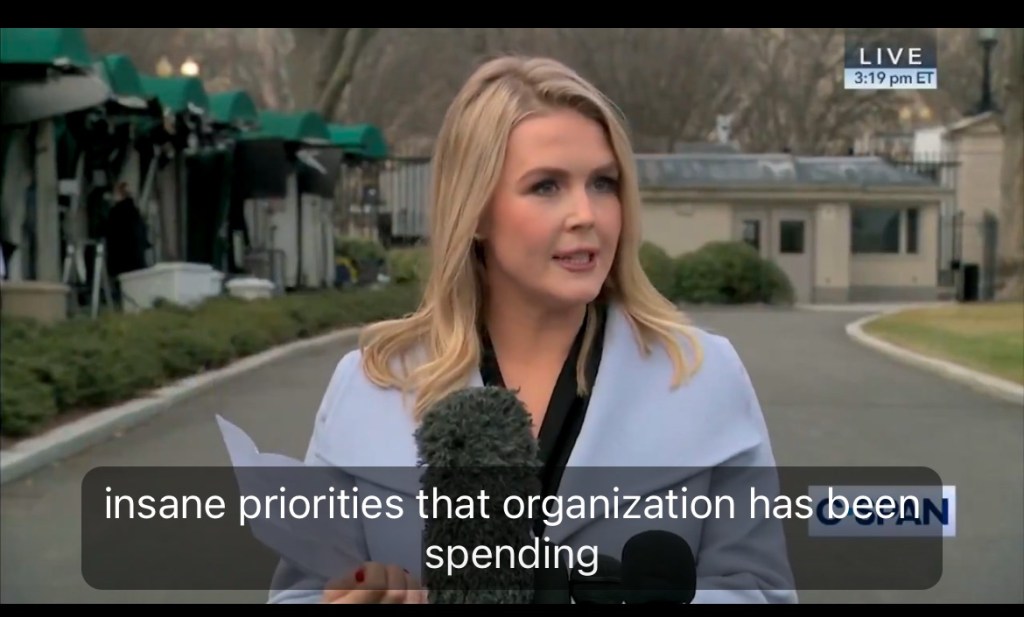
People who need help are not always in a position to voice that need loud enough to be heard. But I think Mike Benz has a point. Why isn’t the international community, or doctors and health professionals commenting on the lack of funding?

So what next? Most probably some of the projects will continue under the management of the State Department. In the meantime, a market process sifts through the various priorities of market participants. Some needs abroad may be taken over by other philanthropies. Some local organizations might have to downsize.

What’s important, is the ones that are no longer deemed worthy of funding will no longer find a match.

The wheels only turn under the push of need.

Strong Women

It’s fading now, how discouraging it was decades ago when there were so few strong women in the public sphere.

That’s all changed. Minnesotan Lisa Demuth can claim a first as speaker of the House; Nellie Bowles with The Free Press gets extra credit for her skill with humor; Karoline Leavitt is so young to be so poised. And— they are all moms.

The times they are a changing.

Buyers are the boss

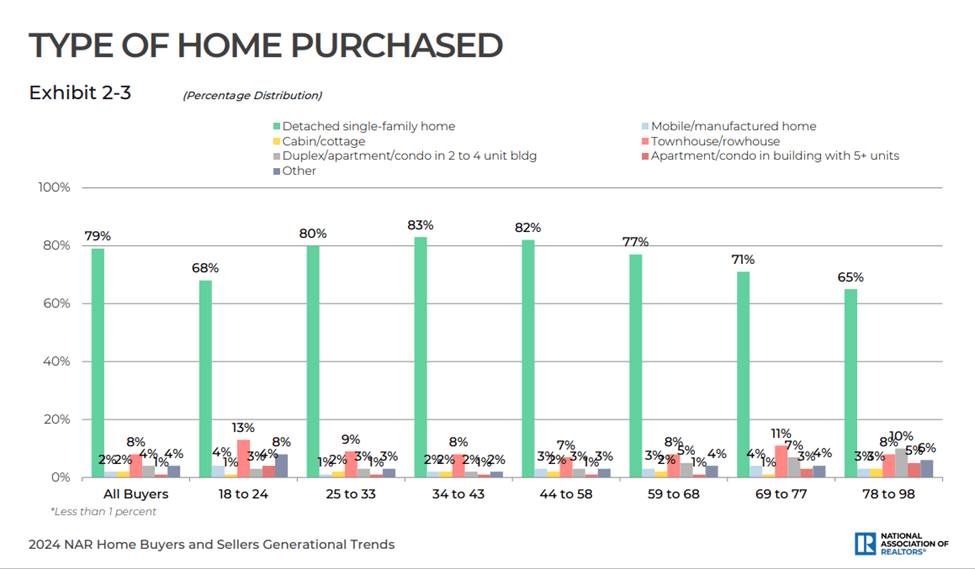
What most people want out of their homes hasn’t changed much. Most buyers are looking for a free-standing single-family dwelling with a yard in a suburban neighborhood (Slides taken from an NAR buyer report).

The most typical financing is a conservative thirty-year fixed rate mortgage.

Where do the compromises start? With money and condition, of course. Buyers will give on those and the size of the home before distancing themselves from their networks or jobs.

Planners love to come up with ideas like high density living, but in the end– the buyers are the boss.

Housing Starts & Lumber prices

Prompted from Chat

December 2024 Sees a Surge in U.S. Housing Starts

After a challenging year, U.S. housing starts saw a 15.8% surge in December 2024, reaching an annualized rate of 1.50 million units. This growth was largely driven by a 61.5% rebound in multifamily construction, while single-family starts rose 3.4%. Despite this late-year boost, overall housing starts for 2024 fell 3.9% compared to 2023, reflecting a cooling market due to higher mortgage rates and construction costs.

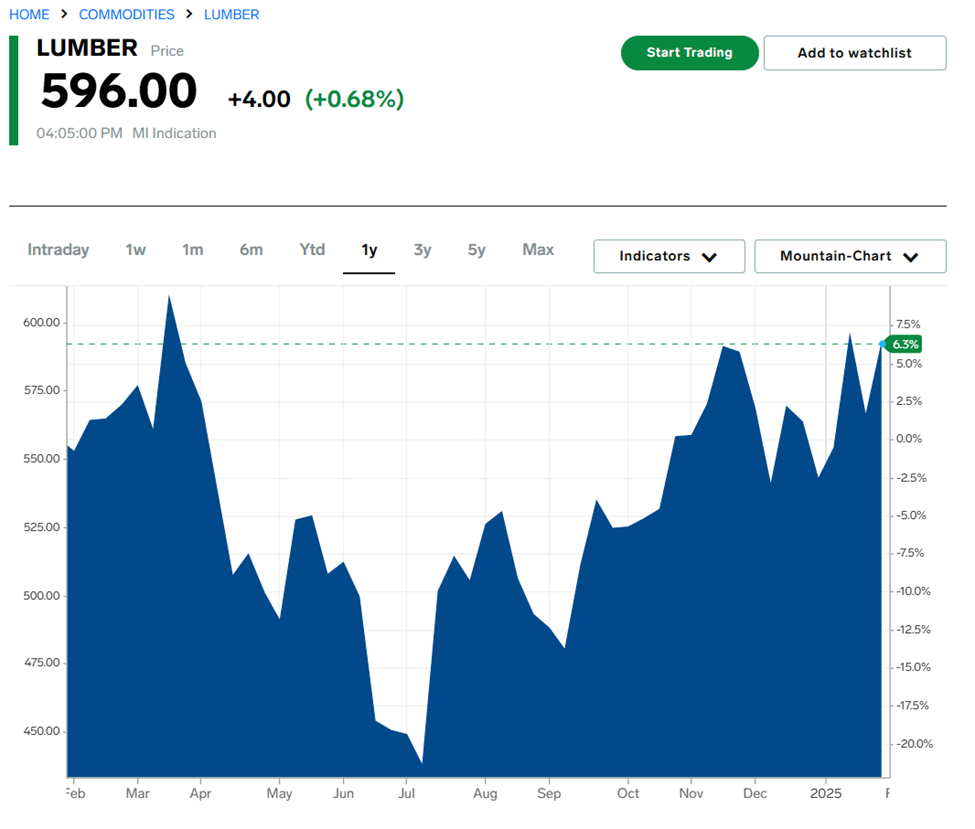
A significant portion of the lumber used for home construction in the U.S. still comes from Canada, accounting for 25-30% of total softwood lumber consumption. However, the cost of lumber has fluctuated. Over the last year, lumber prices have declined from elevated levels seen in 2022-2023, as supply chains improved and housing demand adjusted. As of early 2025, lumber prices are around $538 per thousand board feet, down from previous highs but still above pre-pandemic averages.

Trade policy remains a critical factor. In August 2024, the U.S. increased tariffs on Canadian softwood lumber from 8.05% to 14.54%. Additionally, a new 25% tariff on Canadian and Mexican imports, set to take effect in February 2025, could drive costs higher. These tariffs may slow future building starts as material costs rise, impacting affordability and overall construction activity.

While December’s surge in housing starts is promising, builders must navigate ongoing supply chain challenges and policy shifts that could influence construction costs in the months ahead.

Read Jane Jabobs with me

I’ll be hosting a reading group on the excellent Interintellect site. We’ll tackle only a few chapters at a sitting to make for an easy reading assignment and plenty of time for everyone to get in on the conversation.

The first Zoom meet-up is on March 7th.

Regulation vs Market Clearing–Knob and Tube Edition

A few months ago, I wrote about an investor who bought a property with an old style of electrical wiring called knob and tube. Their post was an example of the complexity of a rehad project. The price of the building was undoubtedly part of their decision-making. But you don’t always know what you are buying. Inspections are done to determine all the variables upfront; when it comes to real estate renovations, there are bound to be some unexpected costs. The expense of rewiring a nine-unit building was a downstroke against their profit.

Homes have so many features, which leads people to make different choices depending on their skills, what they value, and their tolerance to risk. Some homeowners, for instance, will not purchase a home with a tuck-under garage. The thought of the amount of energy loss every time the twenty-foot double garage door goes up in the winter when it is below zero makes them cringe. The energy inefficiency of this floor plan makes the home unacceptable in their eyes.

Over time, particularly when mechanicals or construction processes improve, old systems like knob and tube wiring make their way out of the market. First, the market starts to reject the item, so sellers, in preparation for sale, determine they would be best off making the improvement before going on the market. Sometimes, the insurance company will influence the market by making it more expensive to insure certain features, which provides incentives for replacing those items. Eventually, the old way of doing things becomes obsolete and unacceptable to buyers.

This process may take a couple of decades or a quarter century. Old-timers grumble about replacing perfectly feasible mechanicals, wasting funds that could be spent elsewhere. A long time ago, a local electrician advised that as long as the cylindric glass fuses supported the current demand, then all was well. When one insurance company refuses coverage, other smaller companies may step in. And around it goes until the verdict changes and most homes have been converted.

Consider this method versus a regulation. Once an empowered authority draws a line and publishes a restriction, the market no longer has the ability to evaluate this change in contrast to all the dozens of other upgrades and improvements that can go into a home. The burden falls most heavily on the more dated homes, which are often owned by people who have gotten on in years and are not keeping up on things or those of lesser means who patch and plug problems as that’s the best they can do.

A decree from above creates an acute demand for that one mechanical, which, in my experience, causes opportunistic behavior and price inflation. The market system is the kinder and gentler way to transition from one set of norms to another.