
The Savior must have been
A docile Gentleman—
To come so far so cold a Day
For little Fellowmen—
The Road to Bethlehem
Since He and I were Boys
Was leveled, but for that ‘twould be
A rugged Billion Miles—
Searching for value
The Savior must have been
A docile Gentleman—
To come so far so cold a Day
For little Fellowmen—
The Road to Bethlehem
Since He and I were Boys
Was leveled, but for that ‘twould be
A rugged Billion Miles—
Often, the merits of a transaction are given from the perspective of a single agent in the trade. An assembly line-worker lost their job when the plant was moved to another location. This is bad. The worker suffered a loss. Quickly, within sentences, the effect is generalized to all the workers in the plant, town or even region. The Experience of the middle aged white guy who is difficult to retrain and find meaningful work of the same quality is the catalyst for all sorts of feelings and demands for government intervention.
Do you see the slide? From a valid totaling up of wins and losses for one individual turned into a model involving segments of society.
It’s important to declare which model is in play as this dictates whether the players are individuals or groups, whether the tally of net benefit or loss is assigned to one or to many, and perhaps most interestingly the flow of reaction and counterreaction as value settles in the system. More interesting insights surface when consequential outcomes are looked at in a flow of events.
Think back to the time of the 2008 recession. Say one buyer purchased a home at the peak of the housing market with a three-year adjustable ARM. When the ARM recalculated in 2011, the buyer’s payment adjusted upwards to an amount beyond their ability to pay. Due to the recession, the value of the home had decreased below the mortgage balance. The buyer ends up in a familiar situation at that time and loses the property to foreclosure. This is a clear loss.
But say every other homeowner in the neighborhood had owned their homes for more than ten years. None of them were interested in selling until after 2015. These individuals realized no impact from the value changes during the recession expcept to see their assessed values decline resulting in lower property taxes. As a neighborhood the effects of the recession were uneventful.
In the plant closure story, there were most probably workers who ended up better off for the closure. Perhaps it encouraged them to return to school to achieve an updated skill. At the other end of work life, perhaps someone nearing retirement ended up with a more favorable retirement package. Getting people to think of workers as a mass might be useful for unions, but loses a finess of obeservation for analysis.
It seems, to have a profitable discussion, one must pick a playing field. If you want to pick a town, then the players are all the workers, their economic impact on local services, and the support available through the municipality’s local services. Who netted out what and where did the money settle in time periods 1, 2, and 3 following a plant closure. If there was a draw of support from a higher level of governance, maybe the playing field needs to be moved up a rung to the county level, or to the region within the state. The players then get expanded to blend in other economic agents and their positive and negative tallies.
Instead, the story is usually told like some mid-19th century Russian novel. The peasants were persecuted and the capitalists must be blamed! This is not helpful.


I say, yes, without a doubt. Home-cooked food is worth pursuing.
I got wind of a family that was going through a rough time, so I dropped off dinner: a pan of chicken alfredo in penne pasta, Brussels sprouts, buns, and a pan of blond brownies (minus a test brownie to be sure it met grade). I wasn’t even out of their neighborhood before I received a thank-you text. And then I heard later through mutual friends that the food was deemed delicious.



An unexpected gift is often a delight. A gift of a meal just as one is getting hungry is bound to taste better than reheated leftovers. Still, I believe the appreciation for the food is in part because it did not arrive in takeout boxes.
If one is a careful counter of costs, then one will be impressed by the price difference between made-from-scratch and prepared foods. It is substantial. There are lots of financial incentives to spend a little time with the church ladies’ cookbooks and fine-tune a repertoire of family-friendly options. I’d guess, on average, the ratio is 1:3 or 1:4, even with substitutes like Subway. It’s simply so much cheaper to learn to cook!
I won’t sugar coat the drugery of the educational experience. The peppering of complaints from the kitchen table of a missing this or a what if you tried that can almost push one over the edge on the right day. The hang time is worth it, though. When they return from college campuses begging you for a home cooked meal you are blessed with one more affirmation that you did something right. Vindication comes in many forms.
A local writer-comedian asks on X:
Here are some of the eighty-four responses which rolled onto the thread in just a few hours.
The benefit to volunteer hours is that at every donation an individual evaluates the worth of their time against the mission at hand. This anarchist form of dispensing goodwill will never exceed the need and hence avoids fraud. It also is given with the lowest possible overhead.
Zoning is not a taking by the government. Zoning is a means for a population to control the neighborhood where they live. Whether they bought into the single-family setting, or whether they zoned the corner bar out of their neighborhood, it’s the neighbors’ call.
There’s no shortage of desire for control. So accept zoning. It’s here to stay.

That’s what Michel de Montaigne thought about.
Montaigne was not pitying himself; rather, he was using the criticism of more ambitious contemporary works as a symptom of a deleterious impulse to think that the truth always has to lie far from us, in another climate, in an ancient library, in the books of people who lived long ago. It is a question of whether access to genuinely valuable things is limited to a handful of geniuses bom between the construction of the Parthenon and the sack of Rome, or whether, as Montaigne daringly proposed, they may be open to you and me as well.

Vacant properties are not popular with municipalities. Cities create a vacant land registry to keep a running log of properties that do not host residents. Here are directions from the town of Brookhaven New York.
There is no longer a requirement to submit a notarized application or payment through the mail – it is all available online. The cost to register is $360 for the year and can be paid through our secure online platform.
Please be advised, that any owner, or agent of an owner acting on behalf of the owner, who fails to register a vacant building or to pay any fees required to be paid pursuant to the provisions of Chapter 87, within 30 days after they become due, shall constitute a violation punishable upon conviction thereof by a fine in the amount of not less than $1,000 nor more than $15,000 for each failure to register, or for each failure to pay a required vacant building registration fee.
The amount of the fine implies that full buildings are of value to the hamlet. Perhaps, in part, this is due to the services a resident will take up once they walk up their sidewalk every day to their front door. Perhaps having people come and go in the neighborhood keeps everyone more secure. Here are the benefits as expressed by the bureaucrats.
Registrant’s point of contact will be notified by phone and/or email of issues that may arise such as:
- Property maintenance (tall grass, litter on property, etc.)
- When the Town is notified by law enforcement of unauthorized occupancy
- If property becomes unsecure.
When properties are registered, the Town will have contact information and will have the opportunity to notify the owner/property manager to correct any issues before taking action. This will save the property owner money.
The city of Miami goes one step further and requires the owners post a no-tresspassing sign and authorize their police force to enter the property should a need for their services become apparent.
Install No Trespassing Sign
Once you’ve submitted your forms, you’ll need to install a No Trespassing sign on the property (this can be any sign purchased any where).
Although it may never cross your mind, your comings and goings every day in your neighborhood and place of business are a public service.

BTW- National averages are less than helpful. The Great Recession taught us they can be outrightly deceptive.
Johann Sebastian Bach wrote four further Kyrie–Gloria Masses, BWV 233–236. These compositions, consisting of the first two sections of the Mass ordinary (i.e. the Kyrie and the Gloria), have been indicated as Missae breves (Latin for “short masses”) or Lutheran Masses.


A lake
A swing
A book
A perfect summer afternoon
All the cool kids are doing it. An externality occurs when an activity with a commercial goal creates a positive or negative impact on parties outside of the transaction. The classic example is the manufacturing plant polluting the water with their waste. The community downstream suffers a negative impact. Or consider a drug dealer taking up business alongside the playground at the local park. The neighbors no longer use the public park which is there for their use.
The plant and all those who benefit from its production internalize a gain from not properly disposing of their waste, which pushes out a cost to the people downstream. The dealer accesses a young group of clients internalizing a gain from his location while the neighbors suffer the loss. But what about the other way around? A small group forms a club to advocate literacy. They offer extra help in the local schools and give out scholarships to new high school graduates. They lose their time, which could have been spent on something else, so that the local youth may internalize the gain from extra tutoring. Perhaps a company agrees to locate to a small town under the condition the municipality brings in internet infrastructure. The townspeople internalize the benefit of the corporate relocation.
All this talk seems to suggest there are groups of people who are either on the inside or on the outside. The lines are porous, but exist. What if there were a group who had gotten a bad rap for an extended period of time – and it was considered beneficial to come to their aid in some way? Wouldn’t it make sense to place them in locations where other groups have the knack of externalizing benefits to others? That way, no direct interference messes with the balance in their lives. The positive externalities show up in the serendipitous manner of access.

When’s the last time you thought about your mattress? Probably when you were out looking to buy one. There are products like that. We are in the market for a new one so rarely that we forget they are a commodity. It turns out, mattress manufacturers are getting hit hard by the slowdown in real estate transactions.
It’s pretty common to hear about the effects of home sales on the home improvement industry. New buyers put around eighty percent of their upgrades into a new home within the first six months of ownership. No moves means no dissatisfaction with the status quo, which means far fewer trips to Menards, Home Depot, and Lowes.
As with many things, it’s a combinations of factors hitting the mattress makers. More and more buyers are purchasing on-line. Victoria Freeman at the Manhattan Institute (MI) writes:
Brick-and-mortar storefronts are suffering the most because mattress demand has recently shifted toward online sales. As shown below, the ‘mattress-in-a-box’ model has risen in popularity – while only 27% of consumers would purchase a mattress online in 2016, 47% would do so in 2020. Younger consumers, who tend to prefer online shopping, are driving this change.
A change of shopping venue has given an edge to those who ship and are able to undercut price.
In particular, Chinese exporters often sell through Amazon rather than setting up a U.S. storefront because it minimizes the length of the supply chain, cutting costs. On Amazon, a Queen size mattress from China can thus sell for less than $175 – a marked bargain compared to the average price of around $1,000. The consequence of consumers’ savings on mattresses, though, is that domestic mattress producers are losing market share and hence cutting jobs.
As someone who is often frustrated at not being able to touch and feel before I purchase, I wonder how this will go. If a mattress simply shows up at your home, will the consumer get what they want, or will the mattress be too firm or too soft? And what’s the deal with those inflatable or rather expandable mattresses? Do they really hold their shape long term?
Mostly it’s interesting to note the instigator of a shifting mattress market is the real estate sales slowdown. Markets are unpredictable, spontaneous, and fun to follow.


by Andrew Wyeth, 1947
I find this painting captivating. How can one see what cannot be seen other than through the influences it creates on surrounding elements? The frail, sheer curtain tells us the strength of the breeze. Two tire treads show us the path it blows in from the sea. If you were able to reach into the frame and touch the white hot paint on the sill, it would be warm to the touch. Shadows and darkness show us a sun high in the sky, slightly to the front of the building, the voile catching glints of light well into the dingy room.
Disclosures are often used to inform consumers in the early stages of a transaction. They are especially popular when there is thought to be an imbalance of savoir-faire between the parties. The idea is that if the consumers really knew what they were in for, they would have made another decision. This conclusion might have been drawn under suspicion that the vendors are hiding material facts. Or one might think this is a bit haughty and judgy on the part of the regulator putter-togetherers. This implies that consumers cannot do a little research and inform themselves before making a decision. Either way, all other things equal, more information is better than less information, right?
Maybe.
Gathering information is part of any worthwhile transaction. Only after a review of alternatives can a purchasers feel confident that their decision best suits their needs. At the beginning of the process they may feel confident in their priorities only to have them challenged. They may walk in thinking they’re buying a sedan and drive out in an SUV.
In addition to supporting a spirit of investigation, it is to the consumers’ benefit to learn early on that to be vigilant in their interactions. A good shopper will ask questions and compare answers. An environment of abundant disclosures might lead people to believe that they will be told what is best for them. And everytime they feel they could have done better, they will wonder why no one was there to guide them.

Imagine yourself as a living house. God comes in to rebuild that house. At first, perhaps, you can understand what He is doing. He is getting the drains right and stopping the leaks in the roof and so on; you knew that those jobs needed doing and so you are not surprised. But presently He starts knocking the house about in a way that hurts abominably and does not seem to make any sense. What on earth is He up to? The explanation is that He is building quite a different house from the one you thought of – throwing out a new wing here, putting on an extra floor there, running up towers, making courtyards. You thought you were being made into a decent little cottage: but He is building a palace. He intends to come and live in it Himself.
Mere Christianity, by CS Lewis

The Death of Stalin, set in the Soviet Union in 1953, is endlessly funny, but more absurdist than those earlier works. The story spins off from real events. When Josef Stalin suffers a stroke and collapses, guards are so fearful of entering his room that he is left on the floor in a puddle of urine for hours. In the aftermath of his death, his closest ministers, who once trembled at his every glance, begin their scramble for power. As they do, Iannucci masterfully blends dark humour about an authoritarian regime and farcical comedy performed with perfect timing.
BBC
This book is quite good. But I think I give it extra credit because of the visuals.

Milwaukee Avenue Historic District, Minneapolis

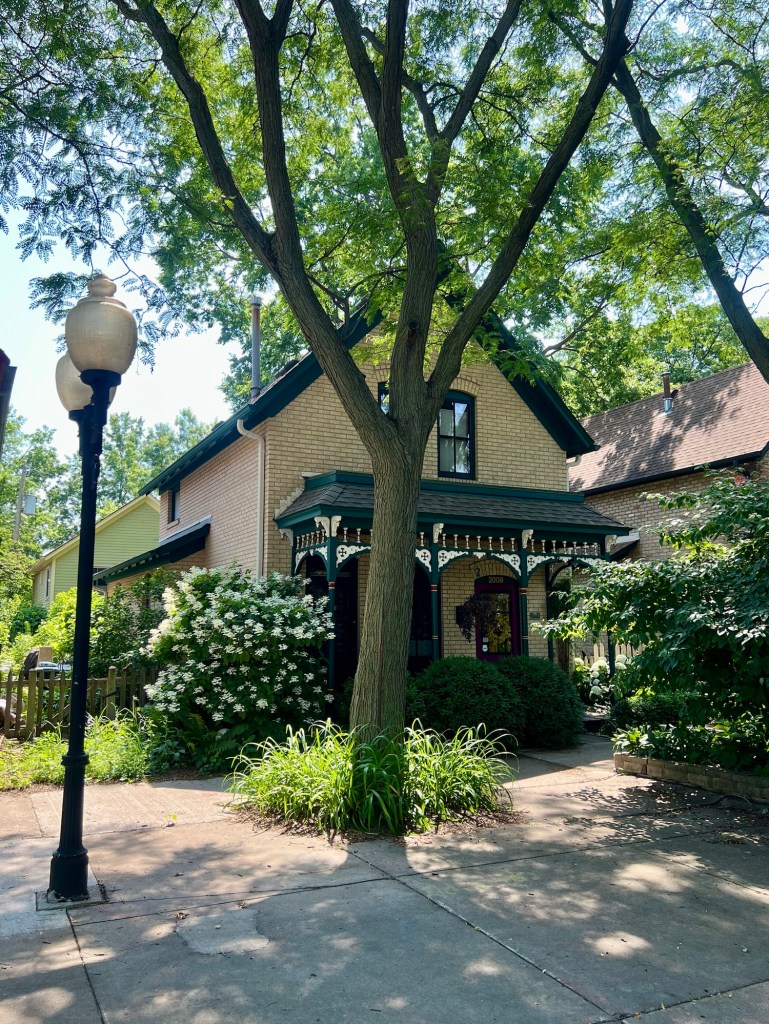

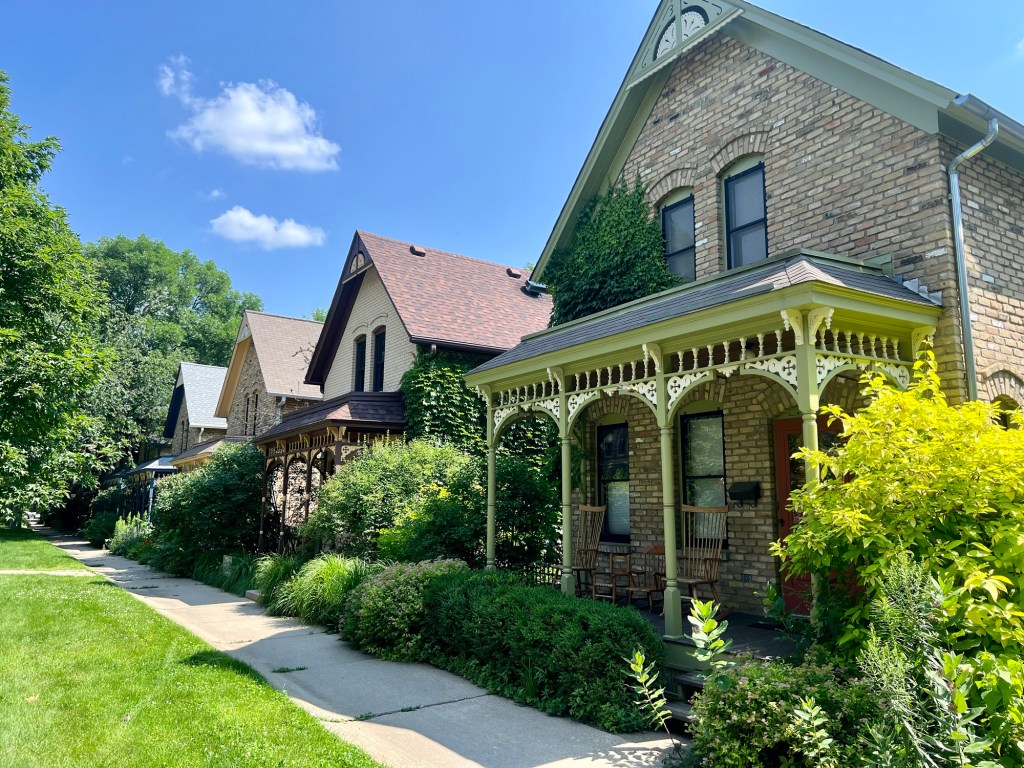
1883
Real estate agent William Ragan purchases four blocks in Minneapolis to develop high-density housing for the growing numbers of immigrant workers coming to the city.
1890
Ragan’s development, along what comes to be known as 22 ½ Avenue, is completed.
1906
The residents of 22 ½ Avenue petition for the name of their street to be changed to Woodland Avenue. It changes to Milwaukee Avenue instead, perhaps because of the nearby Milwaukee Railroad.
1970
The houses of Milwaukee Avenue are run down due to suburban growth and disinvestment in city neighborhoods since the 1950s.
1970
The Minneapolis Housing and Redevelopment Authority plans to demolish most of the western portion of the Seward Neighborhood, including Milwaukee Avenue, as part of their urban renewal plan. This inspires citizens to organize to stop demolition.
1971
Activists who oppose the renewal plan gain control of the Seward West Project Area Committee.
1973
Tense negotiations between the PAC and MHRA motivate Jeri Reilly and Robert Roscoe of the PAC to form the Milwaukee Avenue Planning Team with Bill Schatzlein and Bob Scroggins of the MHRA to discuss how to advance the redevelopment plan.
1973
The Milwaukee Avenue Planning Team launches a study to determine the feasibility of rehabilitation.
1974
Milwaukee Avenue receives its designation from the National Register of Historic Places on May 2.
1974
The MHRA gives up on its demolition plan and begins to support the Milwaukee Area Planning Team’s recommendations for rehabilitation.
1975
Rehabilitation begins on three Milwaukee Avenue houses in October.
1975
The Minneapolis Heritage Preservation Commission designates Milwaukee Avenue a historic district.
2007
Milwaukee Avenue celebrates its thirtieth anniversary of rehabilitation with a self-guided walking tour of eight of the restored homes The Preservation Alliance of Minnesota organizes the event.
2015
The Milwaukee Avenue Homeowners Association (MAHA), sponsored by the Seward Neighborhood Group (SNG), receives grant money to install a bronze plaque on Milwaukee Avenue describing the district’s evolution and historic status.
I like Frederick Melo- Reporter. He knows how to sum up a message in a few words. Here are some captions from the public at a city council meeting.

Grain elevators are as prevalent in towns across the Midwest as the corner bar, the grocer, and the three local churches (Lutheran, Catholic, and Presbyterian), or at least in towns on the railroad lines. As the open prairie became home to new arrivals, farmers broke open the soil and turned it into grain fields. Upon harvest, they took their product to the elevators until it was shipped down to the grain exchanges.
This one isn’t as rustic looking as some. The interior wood planking has been covered with a shield of aluminum siding. The structures are known to burn. As they have been decommissioned, local firefighters have set them ablaze for training purposes. Once their original use was replaced by larger shiny cylinders of metal, their new purpose served the community. For one last dramatic day, the flames leap and lick at the side walls as trainees in the safety business try to tame their destructive nature.
Back when they illustrated beautiful graphic novels.



Does affordable housing vary in quality based on location? Or is it simply a category of housing no different than a category of a car or a type of breakfast cereal? If you can use the home to shelter a household whose income falls below an acceptable level, then the property adequately meets its intended value.
A group of black pastors, led by Dr. Alfred Babington-Johnson, thinks location does matter. They are suing Minnesota Housing, an agency responsible for the allocation of public funds to subsidized housing, for exacerbating a household’s access to success by predominantly building in areas serviced by weak institutions.
A prominent voice among Black Twin Cities ministers, Babington-Johnson sued Minnesota Housing and the Metropolitan Council last year, arguing that state and regional efforts to build affordable housing effectively have backfired, increasing racial segregation while concentrating poverty in poor neighborhoods.
“Whether that’s done with proven intentionality, the outcomes clearly indicate none of the disparities go away,” Babington-Johnson said in an interview Wednesday. “The educational gaps don’t close. The economic opportunities don’t materialize.”
In this quote, Babington-Johnson refers to two institutions: schooling and the workplace. Efforts to develop educated people are regarded as the path to improved employment. Yet when people reside in areas where 40-50% of the residents live below the poverty level, it is easy to imagine that the lack of informal networking and time resources available to nurture these institutions is not at hand.
The Minnesota Housing Commissioner counters:
In a letter to the state advisory committee last month, Minnesota Housing Commissioner Jennifer Ho wrote that “in the last several years, 63% of the new rental units in the Twin Cities metro area that have been awarded funds through the Agency’s Consolidated Request for Proposals have been in the suburbs while 37% have been in the central cities of Minneapolis and St. Paul.”
Which seems to contradict what people on the ground are feeling. My question, as a casual follower of the issues, is why are the numbers so hard to come by? Every time I’ve gone down the rabbit hole to try to nail down the numerical facts of these conversations, time has not allowed for a successful outcome. As public information, it seems they should be accessible. Attorneys for the pastor group put out these numbers.
Attorneys for Stairstep noted that in the Twin Cities, more than 23,000 affordable housing units received subsidies that began between 2017 and 2021. Of them, 56% — or 13,000 units — were subsidized by Minnesota Housing, the Met Council or another form of state funding.
Note the difference in verbiage between ‘new’ units versus all subsidized units. Two thirds of the new units may go to the suburbs. However, this clouds the issue, which is that most subsidies, by the structure of aid distribution, flow to neighborhoods of high poverty. The Housing Commissioner proposes work to be done to create the ideal institutions in place.
“For example,” she said, “the only avenue for lower-income parents of color to access well-resourced schools should not be making them move to a white, wealthy community, which may lack other opportunities that they value. Rather, we should invest in disinvested communities and ensure that all schools are well resourced, allowing people to achieve equity in place.”
The implications that folks could be giving up support groups in a move is a valid one. But who would be in the best position to provide voice to whether it is more feasible to relocate or to enhance institutions in high poverty areas? The pastors, or the residents if given the choice to move, or the government who holds monopoly on dictating where the housing units are located? Shouldn’t residents have a choice?

I don’t think people will balk at the idea of dual choice, that with every transaction there are blended motivations to the self and to society. But what will be fun to pursue is the idea of a market for the social side of life. The price will set us free (or at least make a lot of decisions easier).
“And it wasn’t until much later that when I had read more carefully and maybe had some people kind of point me in certain directions or whatever, that I came to realize that what Buchanan is struggling against is fundamentally important to how we think about economics. And he points to the fact that there are two ways of doing it, as he puts it, two methodologically distinct ways of doing economics. And he says in the first one, the economist sets up a goal for the economy and for the actors within the economy.”
“And that goal, he points to efficiency as one possible goal that could be presupposed. And here’s what’s important, is you then impose that on the model, I mean, it’s part of the model, and it’s imposed on the people who are in the model. And that, he says, in the 1960s, is very different from what he’s trying to do, which is a much messier kind of economics.”
“And maybe that’s why it’s, A, both difficult to do, and B, perhaps not as appealing to some economists, which is you don’t establish the goal, rapid growth, or, as I said earlier, efficiency, but instead, you let the people within the economy, private individuals, engage, as he puts it, in the continuing search for institutional arrangements upon which they can reach substantial consensus or agreement. So that’s a very different way of doing economics. And really, the book is about how the Virginia School, led by Buchanan in this respect, tried to have this second way of doing economics as an alternative, a methodological alternative.”
From The Great Antidote: Sandra Peart on Ethical Quandaries and Politics Without Romance, Jun 28, 2004
Lots of great stuff in this podcast with Juliet Sellgren.
https://podcasts.apple.com/us/podcast/the-great-antidote/id1530247318?i=1000660538062
James Buchanan is renowned for charting a new direction in economic theory with the introduction of Public Choice Theory. This theory emerged from the realization that politicians are not solely altruistic public servants, but may also be swayed by self-interest in their political roles. It should follow then that when a politician takes action in the form of an exchange, it is possible that that behind the choices lie blended motives. And in general, people can use trades to general a gain for the self as well as the tribe.
After all, purely altruistic action is most commonly seen between parents and their children. When exerting effort during the trying toddler years of dependency or spending down savings for higher education, few formulate a cost-benefit analysis. Perhaps in the back of the parent’s consciousness there is a thought that a healthier, better-educated adult will be a kind caretaker to their elderly parent. This deep bond between parents and children often leads to countless unnoticed acts of selflessness, like a parent waking up in the middle of the night to comfort a scared child or a child sacrificing personal time to help a parent in need. These acts of love and sacrifice form the backbone of familial relationships and lay the foundation for a strong, supportive family unit. Over the years, the selfless actions of parents continue as they guide their children through life’s challenges, always putting their children’s well-being above their own. And as children grow older, they often reciprocate these selfless acts, showing love and care for their aging parents, thereby perpetuating the cycle of altruism within the family.
Blended motives are becoming increasingly prevalent in modern society, as individuals seek to align their personal goals with larger social or environmental causes. In the workplace, many employees are drawn to non-profit organizations, where they can pursue their professional ambitions while also contributing to a meaningful collective mission. Similarly, in the realm of leisure and tourism, the popularity of eco-tourism continues to grow, reflecting a desire to explore the world while supporting sustainable and environmentally friendly practices. Moreover, in the consumer market, there is demand for organic foods and battery-operated vehicles, driven by a dual concern for personal well-being and environmental responsibility. These diverse examples all underscore the complex interplay of individual and collective motivations in contemporary decision-making processes.
This holds true in institutional pursuits as well. Recently, a juror in our area promptly called the FBI instead of keeping a bag containing $120,000 in cash in exchange for an acquittal. This act of integrity serves as a testament to the essential role that individuals play in upholding the principles of justice and fairness in society. Where would we be if citizens didn’t react in a judicious and expeditious manner when confronted with such moral dilemmas? The swift and decisive action taken by this juror ensured that the would-be bribers were tracked down and held accountable for their actions. Such incidents underscore the pivotal role that individuals play in preserving the fabric of justice and upholding the rule of law.
This democracy is made up of individuals like all the ones who will share a 4th of July picnic around BBQs in backyards today. These are the folks who, in actions large and small, blend into thousands of choices made every year, work and contribute to the ever-evolving project of America.


Philip Schwartz posts a nice example of the missing middle housing. Predictably, someone in the comments doesn’t find the color nice enough.
In 2023 there were 34 of these permitted in the city core. Year to date, another 4. In Hennepin county the total of 3-4 unit multi-family permitted in 2023 came to 78.
The history of words is curious. Nobody in Mill’s time, with the possible exception of Marx, could have guessed that the word “Communism” would come to denote the military, administrative, and judicial tyranny of an oligarchy, permitting to the workers only so much of the produce of their labor as might be necessary to keep them from violent revolt. Marx, whom we can now see to have been the most influential of Mill’s contemporaries, is, so far as I have been able to discover, not mentioned in any of Mill’s writings, and it is quite probable that Mill never heard of him. The Communist Manifesto was published in the same year as Mill’s Political Economy, but the men who represented culture did not know of it. I wonder what unknown person in the present day will prove, a hundred years hence, to have been the dominant figure of our time.

 Home Economics