They’re called influencers when they hit soccial media venues peddling cosementic products and outfits. Pop mega-star Billie Eilish isn’t hawking commodities. She’s pushing for people to make a sacrifice for the environement. Instead of enjoying a new outfit, settle for a used one. Instead of going solo in a vehicle to her concert, pair up and carpool.
“Hit Me Hard and Soft,” Eilish’s third album, is due out May 17. For the tour, she is focusing on sustainability and is continuing her longtime relationship with environmental nonprofit Reverb, to which she’ll donate a portion of proceeds from ticket sales. She’s also encouraging fans to carpool or take public transportation to her concerts and to wear thrifted or borrowed clothing rather than purchasing new. Fans are also invited to bring an empty reusable water bottle as there will be free refill stations at the venue.
Reminding people to do their part toward a common goal is one way to advance its objective. Another is to pass a law. No plastic straws, for instance, was meant to help the environement.
What I wonder about is which of these to strategies has a bigger impact, and to what degree? Spitballing it I would guess that someone of Eilish’s stature teases out more action, probably a lot more action. It wouldn’t be that hard to measure the ridership of the audience memebers.
I wonder why there aren’t more efforts to nail down the results of some of these strategies. If a mega-star can generate more significant results than a law. Skip the bannings that no one pays attention to and hire the influencers to change the world.
Is volunteer the right word for unpaid labor? Afterall, in free societies jobs are done voluntarily as well. Carees are pursued on a voluntary basis. That’s the whole idea. You get to choose. ‘The difference between work that is done as service work, in the efforts to improve or maintain a common goal, and work done for private enterprise, is that in one instance you are paid through reciprocity down the road, and in the other you are paid in unfettered cash.
How you choose to spend your waking hours in labor or leisure, caring for your loved ones or idly reading a book, working for a paycheck or going to an NBA playoff game, are all done voluntarily.
The difference is not whether you choose to work, but whether you choose to work for compensation. In fact, you can blend the. You can work for a check and in conjuction with your passions. And do it entirely voluntarily!
I love this clip by Kyla about the housing market in Austin. Build more housing and prices moderate. Too true.
There’s another factor at play here. Austin is a new town which has experienced a lot of growth. And along with the growth, prosperity. So for folks in the area to be pro-expansion and in turn pro-housing growth is an easy turn.
In more established cities, there are networks of additional interests all meshing on top of the landscape. There were reasons why residents fought for and built out their cities following those rules. For new growing metros, the Austin plan would be easy to adopt. For more those with longer histories, it’s not the same game. Here it will take other strategies to urge continued housing growth.
Years had passed without me giving the FFA a second thought. If someone had asked, I would’ve bet money on their demise years ago, during the era when everyone talked about the death of small-town rural America. If it hadn’t been for stopping at a rest stop on Sunday, the organization would still be out of my sight.
As it turns out the two bus loads of kids who were shoulder to shoulder in line for the sandwiches were headed to the FFA Minnesota State Convention at the UMN. Three days of events starting at a very early 7:30am. The dairy evaluations were at 7:45am.
This organization is not lacking for members eventhough it seems to be lacking media coverage.
Minnesota’s 95th State FFA Convention was held April 21-23 at 3M Arena at Mariucci and at the Minnesota State Fairgrounds.
Speakers, awards, competitions, workshops and sessions were some of the highlights for more than 6,000 FFA members from Minnesota attending the convention, celebrating the convention theme “Achieve – What It Takes.”
Here are some stats:
4,200 FFA members 7th-12th grade are pre-registered for the state convention. 15,000 FFA members in the state. 40,000 Minnesota students are enrolled in Agriculture, Food and Natural Resources (AFNR) classes. 218 FFA Chapters in Minnesota middle and high schools. 338 Agriculture, Food and Natural Resources teachers/FFA advisors in the state
The answer to this is something like the answer Lincoln gave to the question, “How long should a man’s legs be?” Long enough to reach the ground, Lincoln said. Just so, proper city dwelling densities are a matter of performance. They cannot be based on abstractions about the quantities of land that ideally should be allotted for so-and-so many people (living in some docile, imaginary society).
Densities are too low, or too high, when they frustrate city diversity instead of abetting it. This flaw in performance is why they are too low or too high. We ought to look at densities in much the same way as we look at calories and vitamins. Right amounts are right amounts because of how they perform. And what is right differs in specific instances.
The Death and Life of Great American Cities, Jane Jacobs
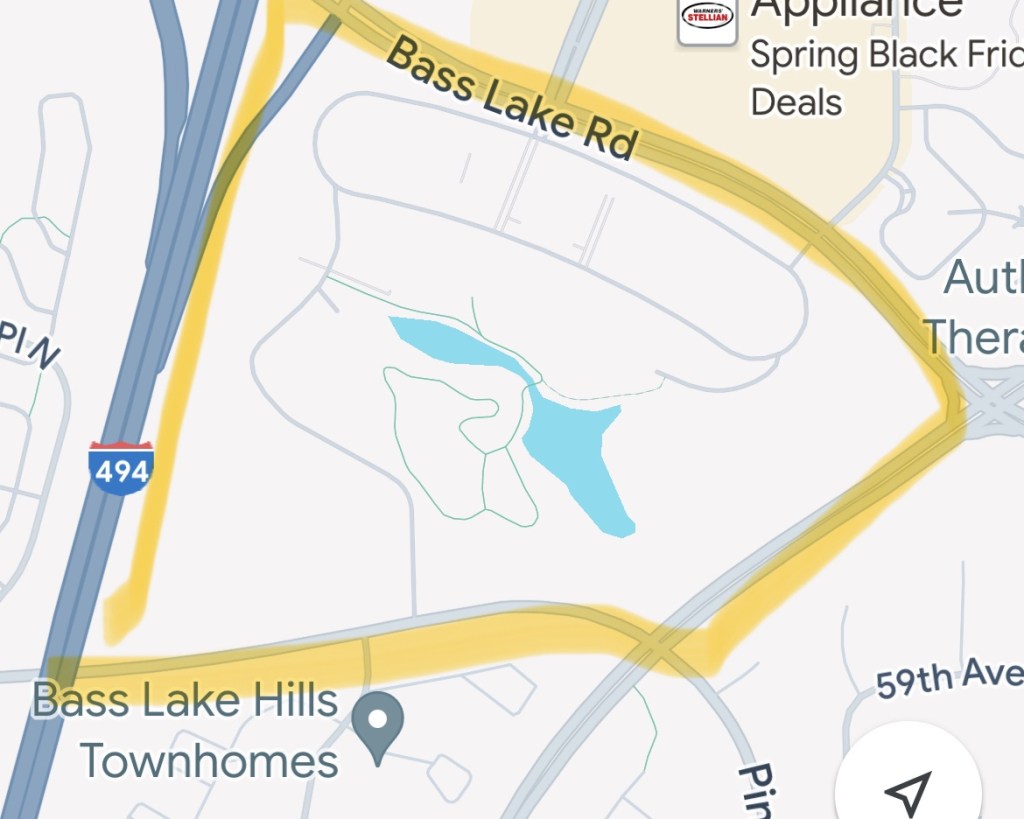
We were driving by an intersection nearby and my husband said, “I can’t see why they’re tearing down the Prudential building. It’s in such good shape.” True. The building that was the corporate headquarters for Prudential in Minnesota was only forty years old and still looked like an attractive structure. But the destruction has begun.
Although the building is still viable, it sits on 43.75 acres of land within the Hwy 494 loop around the Twin Cities. Perhaps a large corporation would still invest in a private campus of this size, but the likelyhood of a current buyer, with the money, and (perhaps most importantly) the compatibility with the structure, is improbable. Technology changes alone make a forty-year old commercial building sorely lacking.
But it’s really about the land.
In 1980, much of the surrounding land was undeveloped. There were scatterings of buildings and a few housing developments, but this was truly the outskirts of the metro area. Bass Lake Townhomes, for instances were built in 1990. The commercial strip mall across Bass Lake Road to the north was built in 2001.
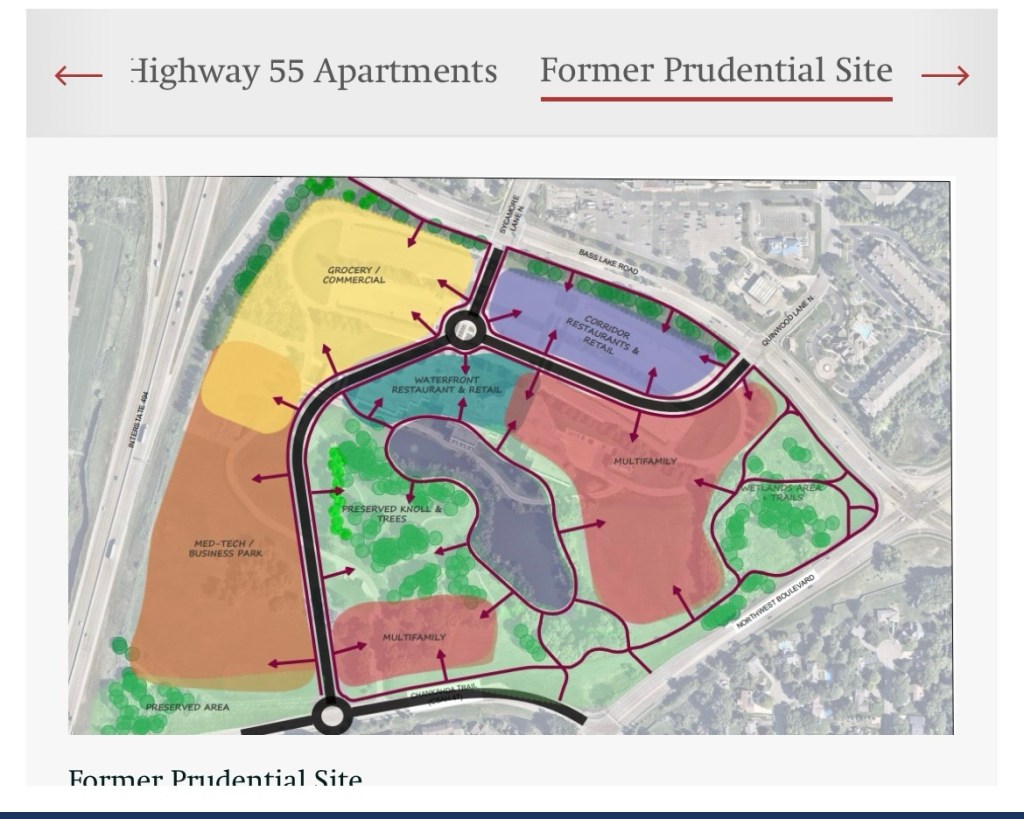
Once the present use of the Prudential site changed, and the company no longer had value in it, then value became what an outside party could do with the parcel. And this is what is proposed.
There are plans for two large apartment buildings. There is a retail and a grocery. There is space for restaurants and other commercial. The pressure to release this resource from a one-site parcel to a multi-use asset is tremendous. Thus the value of the large, seemingly viable, structure diminishes to nothing.
What’s interesting to note is that Prudential did nothing to make this happen. It occured because of neighbors.
The pleasure derived from watching sports really doesn’t make a lot of sense. Yet- there’s no doubt about it. When your team wins its second playoff game- it’s a great night.
How do you put a number on historical value? A Minnesota bill is about to put a price on the ruby slippers worn by MN native Judy Garland in the Wizard of Oz. The slippers, stolen twenty years ago, were recently returned to their owner following the completion of the trial last year. The FBI were tipped off to the where abouts and recovered the sparkly heels in a sting.
Now the owner plans to have them auctioned off after sending them on tour. Their estimated auction value is put at $3.5 million.
The state of MN is going to put in a bid but it’s a bit shy of the estimate.
How are cultural values calculated? A one-off item is difficult to determine. But other similar items come and go from the market. Properties, for instance, have been designated as historical landmarks.
The higher interest rates have cooled the residential real estate market a bit, which is nice because for a run of three years or so, every home that was in decent condition was selling in multiple offers. It was common for a buyer to bid on four, five, seven homes before they were the winners.
Recently at a sales meeting the manager pulled the topic out of his list of things to talk about at a meeting because some properties are still attracting several offers. The strategies the office came up with filled the large sheet of paper on the easel at the front of the room. There’s more than one way to write and present an offer to a seller.
This made me think of game theory as the purpose of the meeting conversation was to theorectically compare strategies amongst the active participants in the market. Like in game theory, agents develop a sense of their buyers valuation of the home. There are many angles to this, but given the process of considering other options, perhaps loosing out on other bidding situations, the agent shares the strategies discussed amongst the agents in the meeting, and advises the buyer accordingly.
While reading Isreal Kirzner work, I thought his concept of discovery best described the process buyers go through in the market to arrive at their home purchase. After repeated investigations into the various housing options, perhaps with breaks in between to go home and reassess the purpose of the move, buyers discover their best option and only then are motivated to pursue an offer to the seller.
I can see now that the game theory part is the setup for strategy, competition and cooperation with the seller once the property has been identified. The discovery part has to do solely with the buyers insights into which property has that added benefit that boosts the property ahead of others in accomodating their needs. It is more useful to them and their particular circumstances.
It’s funny beause often a buyer is attracted to a property for the some or all of the same reasons the seller has enjoyed it during their tenure. And that affinitiy for the same likes and dislikes encourages the parties toward cooperation.
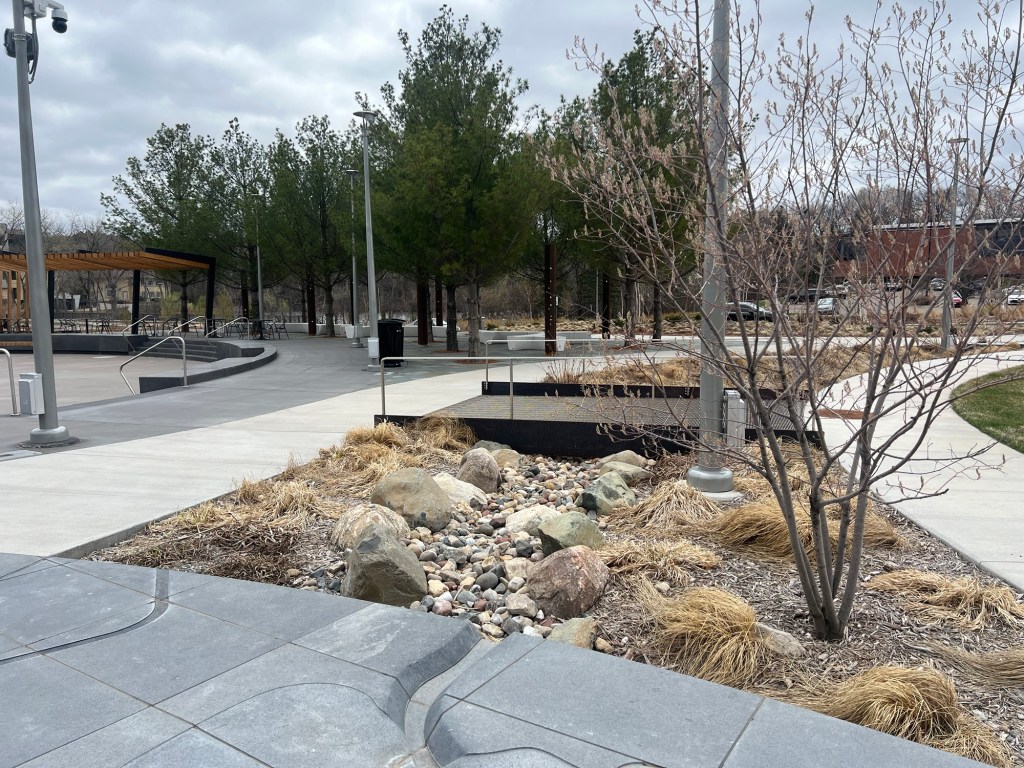
Massive suburban mall parking lots must be one of the more unattractive features in a built environment. That’s why I like this little park so much. The city of Minnetonka installed a well landscaped gathering spot in one corner of Ridgedale Mall’s lot.
A woman walking her dog mentioned that on Tuesdays in the summer months the farmer’s market sets up in the open space.
Westminister Church has a wonderful town hall forum that hosts interesting visitors in a its beautiful nave. Today’s guest was Keyu Jin whose book, The New China Playbook, Beyond Socialism and Capitalism, was recently published. I was not familiar with this professor from the London School of Economics but the title of the talk drew me in.
After the half hour talk, Prof Jin took questions from the audience. Tane Danger, the host, looks through the cards in order to group similar topics together.
One audience member asks about the nuts and bolts of the k-12 education system in China. She responded that the party originally was responsible for education and it was free to all. But the one child policy in conjunction with fierce competition to vie for the best spots in the work force, led couples to hire tutors. A high score on placement exams guarantee economic and social advancement. Thus, in response to demand, a large industry of private education providers was spawned. This led families of limited means to expend, according to Jin, as much as a quarter of their income on supplemental instruction.
Prof Jin saw this as a negative outcome to capitalism. People’s hopes and fears for their children’s success were being exploited by a private entrepreneurial spirit.
Which brings us back to a favorite topic here at Home Economics. The theory is that certain endeavors are better suited to cooperate efforts of resource providers, while others respond favorably to incentives. In the first instance, the common goal is achieved through public governance and provisions, whether informally within a group or formally via a state structure. Public education has positive impacts from all angles in a society which is undoubtedly why it was established and is still maintained as a public good in the US.
Prof Jin provides a counterfactual. When the state fails to prioritize education, private entrepreneurs jump in and fill the gap. In her example, their success in combination with the high stakes creates an inefficiency.
From behind him Madame emerged, small and wrinkled and fierce. She considered that she had created this man out of whole cloth, had thought him up, and she was sure that she could do a better job if she had it to do again. Only once or twice in her life had she ever understood all of him, but the part of him which she knew, she knew intricately and well. No little appetite or pain, no carelessness or meanness in him escaped her; no thought or dream or longing in him ever reached her. And yet several times in her life she had seen the stars.
She stepped around the Mayor and she took his hand and pulled his finger out of his outraged ear and pushed his hand to his side, the way she would take a baby’s thumb away from his mouth.
Sue Christianson watched in shock and heartbreak as Russia invaded Ukraine in 2022, and she wondered what she could do to help.
Christianson, of St. Paul, was looking for a way to donate money online when she came across a Forbes article that mentioned ENGin, a nonprofit organization that pairs Ukrainians with English-speaking volunteers for free online conversation practice.
This is how she ended up helping a Ukrainian — now living in Minnesota — practice his English via Zoom or Google meet.
Mary Divine shares more about the need for volunteers.
When people have time, and they see a need, they willingly give of their time and expertise. It’s the work we do keeping a social objective in mind.
Read about it here, as Mary Divine explains in the Pioneer Press. Perhaps you can spare some time as well?
The first author of neighborhoods points out the need for self-governance.
Let us assume (as is often the case) that city neighbors have nothing more fundamental in common with each other than that they share a fragment of geography. Even so, if they fail at managing that fragment decently, the fragment will fail. There exists no inconceivably energetic and all-wise “They” to take over and substitute for localized self-management. Neighborhoods in cities need not supply for their people an artificial town or village life, and to aim at this is both silly and destructive. But neighborhoods in cities do need to supply some means for civilized self-government. This is the problem.
The Uber/Lyft conversation in the Twin City area provides material to illustrate the dual nature of transactions. Let’s revisit the players. The drivers provide a service to riders for a fee. They also use a platform which takes a cut of the fare in exchange for technology services and national branding.
Drivers left the taxi structure back ten years ago or so. And it does not sound like they want to go back to the taxi arrangement and work for a boss, but are encouraging other ride share companies to enter the market. They are disgruntled with private pecuniary measures, yet satisfied with the soical benefits and flexibility of the job.
Riders are pleased with the services at today’s pricing. Present public transit options like the bus or metro mobility are actually cheaper but do not replace the service. The groups that would be most damaged by the loss of the ride share structure, since there is no substitute, are disabled folks and those who use it to go bar hopping. The social detriment to the first group would be internalized by loss of freedom and a reduction in trips to their medical appointments. Social detriment would be externalized through outcomes from drunken driving.
Another group of riders would have an impact on local businesses and conventions. The travelers who arrive from elsewhere in the US are familiar with Uber and Lyfts through their national presence. Their apps are already downloaded on their phones and they know the drill. The travel community is worried about how removing this transit option will be externalized onto their business.
Other ride share providers have always been able to enter the market. Drivers have always been able to seek out other work at traditional taxi oulets and other types of driver opportunities like school bus driving. (There are regular job postings for this in our districy choice.) Now that Uber/Lyft’s departure may be eminent, five other platforsm are said to be interested in the market. Yet there are regulatory costs.
Uber and Lyft’s threat to leave the Minneapolis area has sparked a lot of interest from outside players. But the cost of operating a ride share business is not for the faint of heart. It costs $37,000 for a license in Minneapolis, plus another $10,000 wheel chair accessibility fee. St. Paul’s license fee is $41,000. MSP Airport requires a $10,000 security deposit and a $500 license fee.
Separately, it costs about $150,000 to secure a commercial auto insurance policy for a rideshare company.
The issue around the driver’s fare split is presented, politically, as the wealthy corporate boss taking advantage of a punch clock worker. This isn’t the turn-of-the-century, nor are we talking about a factory. And since the platforms have yet to make a profit, that visual is difficult to sustain. But this broohaha may be the trick to get other companies to enter the market and have a go. Should they offer drivers a better cut, then the labor flow will move over to the ride share platform.
— Frederick Melo, Reporter (@FrederickMelo) March 25, 2024
The key in all this is freedom. If drivers have the freedom to work as taxi drivers, or bus drivers, or drivers for ride share platforms, then they will gravitate to the best situation for their private interests, leaving the failing apps to die off. If riders find services that better suit their needs, then their business will filter over to new options.
Picking numbers and setting up a dam in the system inadvertently sets off financial as well as social repercussions without clearing them through the numerous social structures involved.
What’s interesting about this post by psychologist Kaidi Wu is, that in debunking the myth that American are solely independent and eastern cultures are solely communal, she exposes the reality that people in general act with both types of action in mind.
One of the greatest MYTHS in cultural psychology is collectivists (e.g. Asians) don't compete––they are a kumbaya/harmonious/lovey dovey bunch who prioritize interpersonal relationships, unlike those individualistic Americans who are self-serving and competitive. 1 pic.twitter.com/ikh5ZLlwOV
So the trick to organizing our actions really revolves around acknowledging which endeavors generate the best results through competition, and which ones sort more readily to a communal response.
Some of these are easy to spot. The sales of a tangible widget is best left to competition. Once the market is saturated and the object is no longer of use, resources will stop flowing in that direction. Services which save people from harm, like firefighters, are best provided by a community.
But Kaidi Wu is absolutely correct that the historically popular criticism that Americans are solely interested in the self is simply in err.
This is one of my very favourite photographs, I love everything about it. The movement, the music, I can hear it. The expressions on their faces…I could write a whole story from his alone. But I can't remember the photographer – can anyone help? 🖤 pic.twitter.com/8kyXVwXaqX
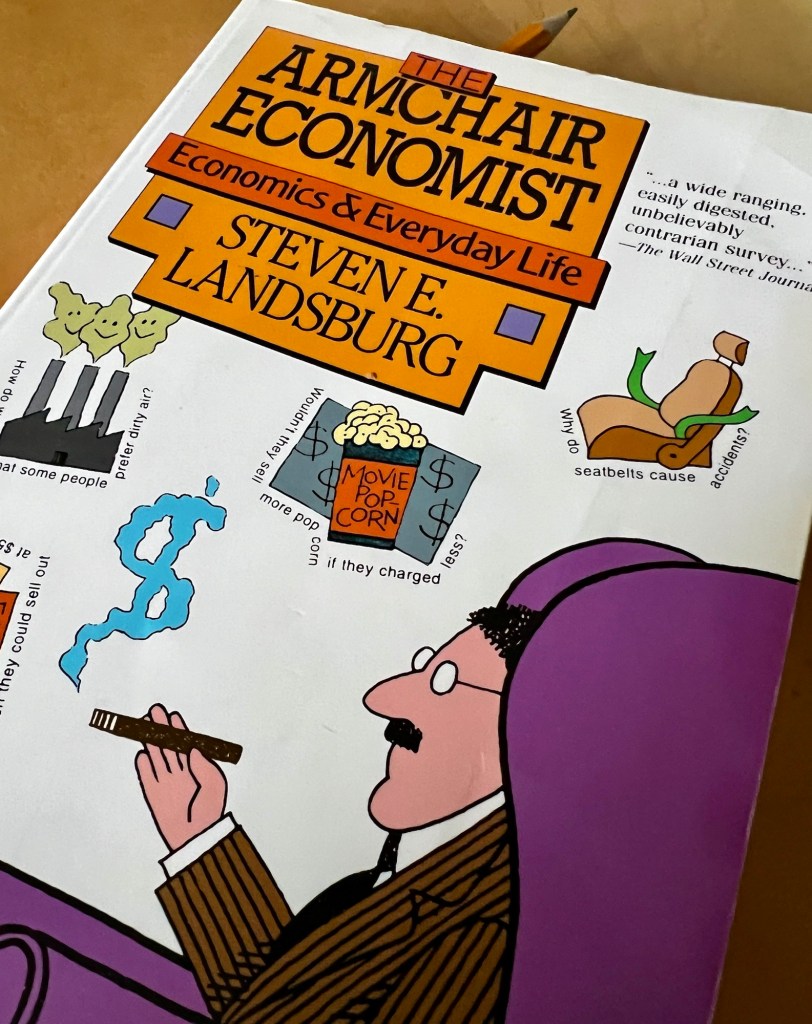
It started over 30 years ago. Steven Landsburg wrote the popular book The Armchair Economist in 1993. Through popular stories of economoc quandries and paradoxes, he challenges the long held premise of the rational agent.
Quite the opposite: Our working assumption is that whatever people do, they have excellent reasons for doing.
If we as economists can’t see their reasons, then it is we who have a new riddle to solve.
Since then the discipline has been flooded with sub-categories. There is behavioral economics, feminist economics, health economics, environment economics and so on. Perhaps there’s a thread that ties them together.
If you are buying land from an individual or a group please follow the following STEPS to avoid being CONNED.
1. Ask to see the TITLE DEED or Copy of the title deed. Then do a search at the ministry of lands to confirm who the real owners… pic.twitter.com/uLG9SLE2ly
Example of private ordering described by Anthony Downs.
The purpose of shifting services to the neighborhood level is not just to improve quality but also to encourage self-development of local residents and enhancement of their personal values. Neighborhood self-development usually occurs most effectively through spontaneous, unplanned local efforts often led by charismatic individuals. In city after city the most effective such efforts have emerged from the dramatic leadership of one or a few unique individuals who took it upon themselves to “do something” about local conditions and galvanized others into : action. Inevitably, their efforts reflect their own unique combinations of talents and are therefore difficult to replicate elsewhere.
A coalition of diverse groups, it was reported, were all coming together for a housing bill. That was sixty days ago.
(KNSI) — The Central Minnesota Builders Association is throwing its support behind a piece of legislation aimed at addressing the lack of housing and the high cost of new construction.
A coalition of housing advocates and bipartisan lawmakers joined together at the State Capitol to call for an increase in access and affordability in housing through the Minnesotans for More Homes initiative.
The bill (HF 4009/SF 3964) legalizes missing middle housing and new starter homes across Minnesota.
From the builders association to affordable housing advocates, an unlikely melange of interested parties were looking for ways to reduce housing costs. How better to lower expenses then to reduce barriers to building by rolling back the rules. This bill brought authority over what can be built where to statewide control.
Once the implications of un-zoning the neighborhood hit local communities, residents weren’t impressed. Here are some of the changes proposed.
Sets a base level for density allowed on any residential lot by right (or without needing to go through a discretionary review processes) regardless of size at 2 units statewide and 4 units in cities of the first class. If certain conditions are met, 8 units are allowed in second-, third-, and fourth-class cities and 10 units may be allowed per lot in cities of the first class.
Forces administrative approvals of projects that meet the standards in the bill language and prohibits public input in the approval process.
Limits minimum lot size requirements to no greater than 2,500 square feet for first class cities and 4,000 square feet for all other cities except for Greater Minnesota cities with populations of less than 5,000.
Requires all cities to accept Accessory Dwelling Units on all residential lots regardless of size and allows property owners to subdivide their lots by right.
Prohibits off-street parking from being required close to major transit stops and limits off-street parking minimum requirements to 1 spot per unit in other areas.
Allows multifamily buildings to be built up to 150 feet tall on any lot in a commercial zoning district.
Broadly prohibits design standards for residential development and eliminates minimum square footage and floor area ratio requirements.
The cities organized and alerted their constituents who must have followed thorugh with calls to their state representatives as the bills is no longer progressing through the chambers. I doubt constitutents will agree to handing over local property rights to the state. This seems like a heavy handed, top down approach.
So how does one encourage increased density? Why- the market of course!
A recently discovered helium reservoir in Minnesota boasts “mind-bogglingly” high concentrations of the gas that are even greater than initially thought, potentially paving the way for commercial extraction.
Resource exploration company Pulsar Helium, Inc. announced the discovery of helium stores in late February, after a drill just outside of Babbitt, in northern Minnesota, located gas deposits at depths of 2,200 feet (670 meters). Initial measurements showed helium concentrations of 12.4% — which “is just a dream,” Thomas Abraham-James, the president and CEO of Pulsar Helium, told CBS News at the time. But new laboratory readings have surpassed those results.
Normally, helium is obtained as a byproduct of natural gas production, as it accumulates underground in pockets of methane and other hydrocarbons. Minnesota is one of just a handful of locations globally where helium is known to exist without hydrocarbons — the others being in Greenland and southern and eastern Africa. These sites all feature a crust of granite rock rich in uranium and thorium, as well as a rift system that fractures the rock to expose the helium produced through radioactive decay. A dose of volcanism then releases helium atoms from the rock.
Northern Minnesota has a love/hate relationship with the extraction of natural resources from the ground. The article doesn’t address how mining methods affect, if at all, the environment.
Albert O. Hirshman is known for a treatise on the connection between loyalty, voice, and exit. What he describes is an ebb and flow in people’s actions. Whether people interact in the public sphere and use their voice to signal a challenge, or whether people remain loyal to a brand while they nudge for changes using voice in the private sphere, both possible scenarios indicate that, before leaving a relationship, most people will try to talk through change.
In a free and open society, all voices should be heard. No questions there. But some folks are more able to broadcast their voice than others. So, it seems it would be useful to have some sense of evaluating the various impacts of the topics at hand.
The possible negative outcomes of giving the societal floor, for monopolizing the social audience ready and in attendance to react with resources to causes, are as follows.
Opportunity Costs. If the airwaves are only giving voice to one group in harm’s way, then others are receiving aid.
When a subgroup is given the mike again and again, even though they represent maybe ten percent of the population, then their imagined importance seems directly proportional to the edges they tend to skate on the issues. So again, there is a misallocation of resources.
When a voice of fear is loudly promoted, then a whole generation may act in an overly protective manner.
Wouldn’t it be useful to track three items when a topic gets brought to the elevated status of statewide attention? Wouldn’t it be helpful to see the numbers of all who are harmed, or affected in some way? Does this group command more, or less the same number of resources as many others who also have legitimate claims? Are the public officials in charge of bringing forward certain voices proportional to their representative groups? Or are they heard due to their proximity to core functions? Are the restrictions placed on people in sync with the risk of missing out?
It seems that a better matrix of analysis could be done before some voices are raised above others.














 Home Economics