
Blessed are the peacemakers,
For they will be called the children of God.
Matthew 5:9
Searching for value
Blessed are the peacemakers,
For they will be called the children of God.
Matthew 5:9

The 1960s failed, I believe, partly because of unclear thinking about institutions, which it portrayed in dark, conspiratorial, Kafkaesque terms. The positive role of institutions in economically complex societies was neglected. The vast capitalist distribution network is so efficient in America that it is invisible to our affluent, middle-class humanists. Capitalism’s contribution to the emergence of modern individualism, and therefore feminism, has been blindly suppressed. This snide ahistoricism is the norm these days in women’s studies programs and chi-chi, Foucault-afflicted literature de-partments. Leftists have damaged their own cause, with whose basic principles I as a 1960s libertarian generally agree, by their indifference to fact, their carelessness and sloth, their unforgivable lack of professionalism as scholars. The Sixties world-view, which integrated both nature and culture, has degenerated into clamorous, competitive special-interest groups.
Times Literary Supplement, London, May 22, 1992
Yikes! Paglia knows how to slice and dice her impressions. And I completely agree with her analysis.

Ceiling mural in the Torpo stave church, Al Norway. Built in 1192.
Pollution was a problem in the US in the 1970’s. Passengers would throw paper wrapping out of speeding car windows, litter blew around the curbs of city streets, and a pile of various types of debris would accumulate around waste bins that were a bit too full.
A successful public service campaign was initiated with Woodsey as the star. The tunes were catchy and were broadcast across TV. It wasn’t long and the new norm of disposing of garbage properly took hold.
by Emily Dickinson
Tell all the truth but tell it slant —
Success in Circuit lies
Too bright for our infirm Delight
The Truth's superb surprise
As Lightning to the Children eased
With explanation kind
The Truth must dazzle gradually
Or every man be blind —

Adam Smith closes out Book Four, Of Systems of Political Economy, of Wealth of Nations by telling us the duties of the sovereign.
According to the system of natural liberty, the sovereign (Commonwealth) has only three duties to attend to; three duties of great importance, indeed, but plain and intelligible to common understandings: first, the duty of protecting the society from the violence and invasion of other independent societies; secondly, the duty of protecting, as far as possible, every member of the society from the injustice or oppression of every other member of it, or the duty of establishing an exact administration of justice; and, thirdly, the duty of erecting and maintaining certain public works and certain public institutions, which it can never be for the interest of any individual, or small number of individuals, to erect and maintain; because the profit could never repay the expence to any individual or small number of individuals, though it may frequently do much more than repay it to a great society.
Wealth of Nations, Adam Smith
We no longer have sovereigns, but we can see those duties in our local governance. And thus we can expect citizens to evaluate each of them in turn.

Give it all to one cause, and other causes suffer. Suffer enough, and populations exit.

Read the whole article: Why the Minneapolis school district is facing a large budget shortfall

One of the most stressful transistions for those who move to MN from out of state is adjusting to winter driving. And there is good reason for that. When the typical rumble of friction between your car’s tires and the pavement goes smooth, you know your sliding. If you panic and yank your steering wheel in an effort to regain control of the 4000 pound beast, you’re likely to spin. A smooth turn of the wheels in the direction of the slide, and then a sensing of rubber feeling the road once again, is the signal that the tires will grip and drive you out and on your way.
It’s not an easy move. If you’re new to the white outs, it’s best to stay home.
Update on the morning commute:
And why it is regressive.
The window-tax, as it stands at present (January, 1775), over and above the duty of three shillings upon every house in England, and of one shilling upon every house in Scotland, lays a duty upon every window, which, in England, augments gradually from two-pence, the lowest rate, upon houses with not more than seven windows; to two shillings, the highest rate, upon houses with twenty-five windows and upwards.
The principal objection to all such taxes is their inequality, an inequality of the worst kind, as they must frequently fall much heavier upon the poor than upon the rich. A house of ten pounds rent in a country town may sometimes have more windows than a house of five hundred pounds rent in London; and though the inhabitant of the former is likely to be a much poorer man than that of the latter, yet so far as his contribution is regulated by the window-tax, he must contribute more to the support of the state.
The Wealth of Nations, Adam Smith
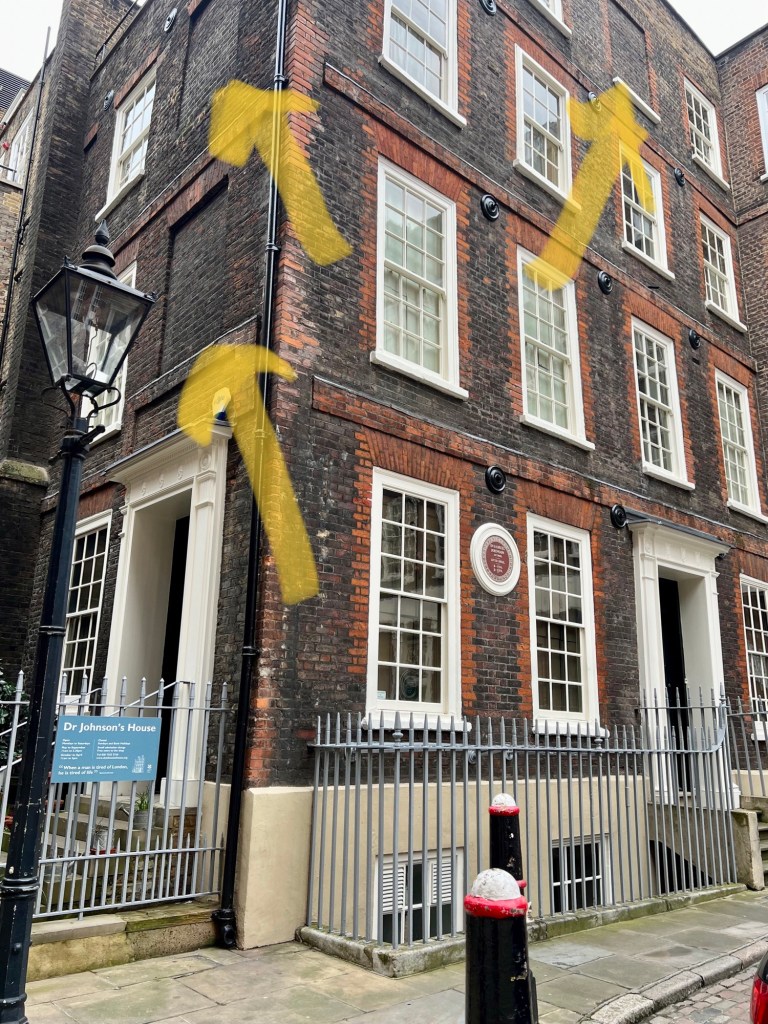
Nope.
There have been several interesting if not colorful headlines in the news
since NAR settled a lawsuit last Friday. The issue under dispute is whether the
posting of the payout commission to the selling broker (the agent who
represents the buyer) is a key point of collusion amongst Realtors to set fees. For historical reasons, the commission is based on a contract with sellers at the
time of listing, so there is a need to advertise that amount reliably. Hence,
it’s posted on an industry-supervised service.
Some people appear to believe that the agreement to not post the payout on
the multiple listing service, so that all professionals in the industry may see
what it is openly and transparently, is the same as eliminating half of the
work the profession currently carries and half of the commission. If we say it
isn’t so, and they agree not to publish it where it has always been published,
then poof! it’s gone.
Here are some things to keep in mind. The profession of bringing parties to
the table in a real estate transaction has existed in its present form for more
than one hundred years. It has always been an open process that accommodates
parties who wish to represent themselves. There is a very low bar to entry into
the profession as there is a small educational commitment and a few thousand
dollars in fees. There have always been people of all stripes coming into the
profession and trying new models of doing business. There have been menu
systems, where clients just pay for pieces of the work to be done. There have
been low-fee models. There has been full access to list a home on MLS and post
your fee for the selling broker. The real estate business is an open, low-entry
profession in which an entrepreneur can jump in and offer any type of
combination of features for any type of pricing structure to the public.
And people have. Over and over again.
The tech companies were sure they had hit a gold mine and built out a
network of information services nationwide. The clients loved it and told all
their realtor friends in and around 2010 that they were soon to go the way of
travel agents. While we sat in their homes holding them open to the public on a
Sunday afternoon, they nodded away at their future vision. While we spent
entire Saturday afternoons running them through half a dozen homes, they told
us they were going to order up their home over the internet and do all the
paperwork electronically.
But a dozen years later more people use Realtors than at any other time in
the last twenty years.
What’s interesting is a lot of people who don’t believe that there is a
market (that impersonal churning of groups of buyers and sellers who
voluntarily make choices) for real estate services, are pro-market. It’s hard
to understand how these critics believe in all other markets but not in paying
a fee for representation in one of the largest purchases the average individual
makes.
There is no collusion. There is no monopoly. There are no barriers to entry.
The market has continually supported the real estate profession all on its own,
despite persistent attempts to challenge it. For that reason, I have no reason
to believe that this will stop simply because a payout needs to be posted in a
new spot.

When this building was originally built in 1910 was used to house working folks. Not the poor.
The building was designed for middle class worker housing when demand for such housing was increasing around the beginning of the 20th century. It was billed as an “apartment hotel“,… The individual units did not have their own separate kitchens; instead, residents ate from a common restaurant in the building.
Wiki
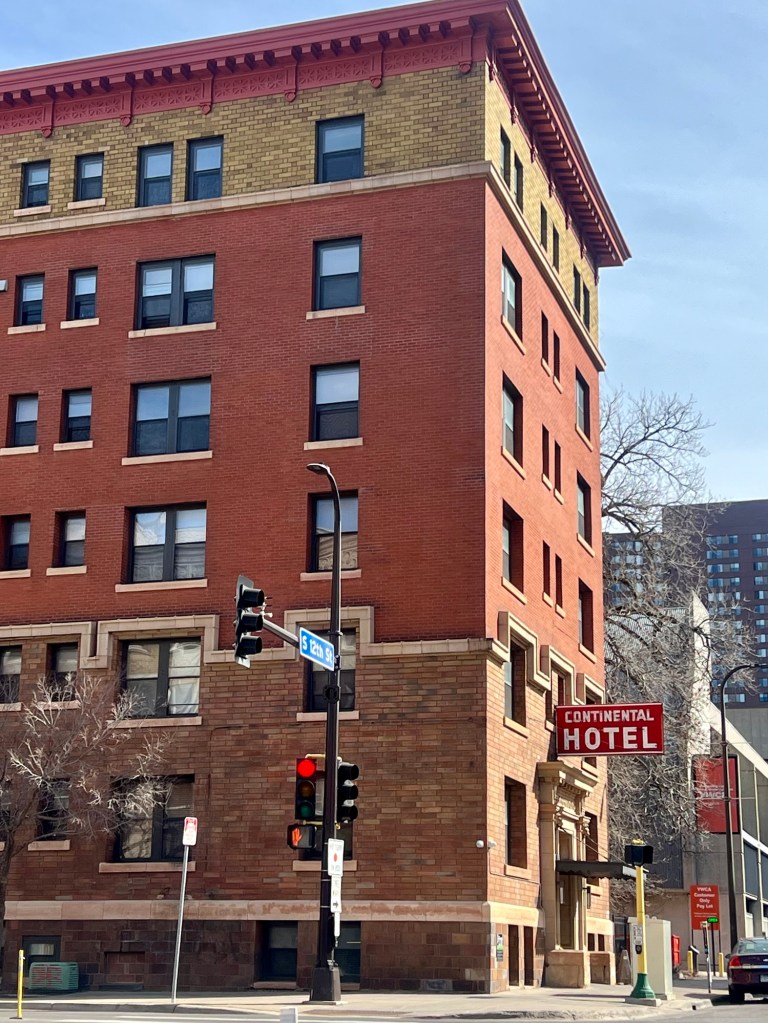
It was beautifully renovated in the 1990s and is now home to 70 previously homeless people. There are onsite services, classes and workshops.
Single occupancy rooming houses were a perfectly acceptable form of housing for many years. But not any more. Norms and standards are bound to change. It’s just that when people cry fowl on affordability, they also need to acknowledge that today’s standards are apart of the the higher expense.
Let’s investigate the claim that every job should be paid a ‘livable’ wage by
spending some time with a mom in the neighborhood. First off, livable is very
subjective. What some people claim as a bare minimum to get by in, say, NY is a
fortune to others in Ames, Iowa. Furthermore, as soon as a generation goes by, livability
inevitably has upped itself on the notches of life’s expectations. But for this
examination, let’s assume that to qualify as livable the wage must be more than all
lower paid work.
Now to say every job ‘should’ command a livable wage is the same (well
almost the same) as saying that every job that does not offer a livable wage
should be eliminated. And the intent of wanting every job to pay at least a livable
wage (although I can read what’s in the hearts of those who say should) is to
make society better.
A mom of three kids starts her day by dropping them off at school, after
feeding them a breakfast of milk over cereal. After the middle schooler catches
the bus, she delivers the first one to a before-school program where a college
student greets them. He is picking up a few hours of work (not a working wage)
to help with tuition and later he will be sitting in classrooms getting his
in-school experience. The second child is walked over to the library where a
nice grandmotherly woman sits at a low table surrounded by six mini chairs
waiting to start extra reading help. She is part of a literacy program paid for
through grants. (She does not receive a working wage).
Then the mom runs over to Target. Thanksgiving is around the corner and
there’s lots of food to buy. At the checkout, she is pleased to see her
neighbor. Her kids are a bit older, so our mom always appreciates picking up
tips from a mom who has just forged down the road of rearing her children.
Target gets busy over the holidays and hires additional workers (not a livable
wage) so that busy parents can be in and out quickly with all their supplies.
Many workers like the extra spending money around the holidays and the store
gives a discount to employees.
Once the mom gets the groceries put away and straightens out the scattered
items throughout the house, she pops over to the Y to get some ‘me’ time. After
committing to a workout routine, which keeps her sanity, she’s gotten to know
some of the instructors. Her favorite is a graduate of West Point and, a mom
herself, is using the work (not a living wage) to keep in shape and provide an
outlet to adult relationships.
Before you know it the first round of school classes are starting to let
out. Her middle school child is involved in the Scouts, and they are having a
special activity with a city recreational leader, a senior adult (not a living
wage) who will show them some features of the local park. She drops him off
before running back to the elementary school to pick up her two youngest. Once
at home, a sixteen-year-old who lives next door stops in. She is going to look
after the kindergartener (not a living wage) while our mom takes her other
child to basketball. The coach (not a living wage) is great, and mom played in
college so she stays on to help.
Our mom encounters six workers in less than eight hours who voluntarily and
willingly participate in employment that is not considered a livable wage. They
are not coerced. They are not full of regret. They play an essential role in
elevating the quality of life for families.
If someone had time on their hands, they could calculate the market rate of
each of these services and come up with the pecuniary difference. Yet this
still would not be a true reflection of the total value as the interaction
between these folks serves as a clearing house of beneficial information
throughout the networks they support. The mom receives no income for her work
to raise her children and would be at a great disadvantage to lose these
support services.
Now think of a CEO, or an accountant, or a doctor, or a stockbroker, or a veterinarian.
Do they depend on lower-wage labor to do their jobs? It seems like the people
who they depend on like the managers and nurses and financial services admins
and vet techs are all paid a living wage.
So, by eliminating the jobs paid at below a living wage the groups that get hurt are
those who also do not earn above the living wage.

Yesterday’s post revolved around Adam Pratt’s framing of the groups with a stake in Uber & Lyft’s departure from Minnesota, in his article Getting to the Big Picture on Rideshare. Today’s post tries to sort through which groups will have a thumbs up or thumbs down on their value outcome.
Pratt describes how the two tech companies were able to enter into a market and survive for a decade without making a profit.
Like some tech companies of the era, Uber was funded with billions in venture capital to allow it a path to viability. And like other tech stars of the era, that glide path lasted over a decade and allowed Uber to price its service below cost and pay drivers more than it could profitably afford.
The profit motive is important. If a private company is a going concern, then it needs to make a profit under the existing constraints. So many of the tech companies blasted through traditional ways of doing business and shut them down. Or disrupted them, as the then-popular phrase went. But in effect, only some of the new platforms delivered enterprises that ended up being profitable. And for Lift and Uber to make a go of things, part of the restraints is the objectional driver wages.
There has always been a subsidized transportation system available to the public. And this journalist, H Jiahong Pan, did a fantastic thread outlining all the options. He points out that many of them are less expensive than the ride shares. These buses don’t have routes is one of his articles about micro-transport but read his thread for all the details.
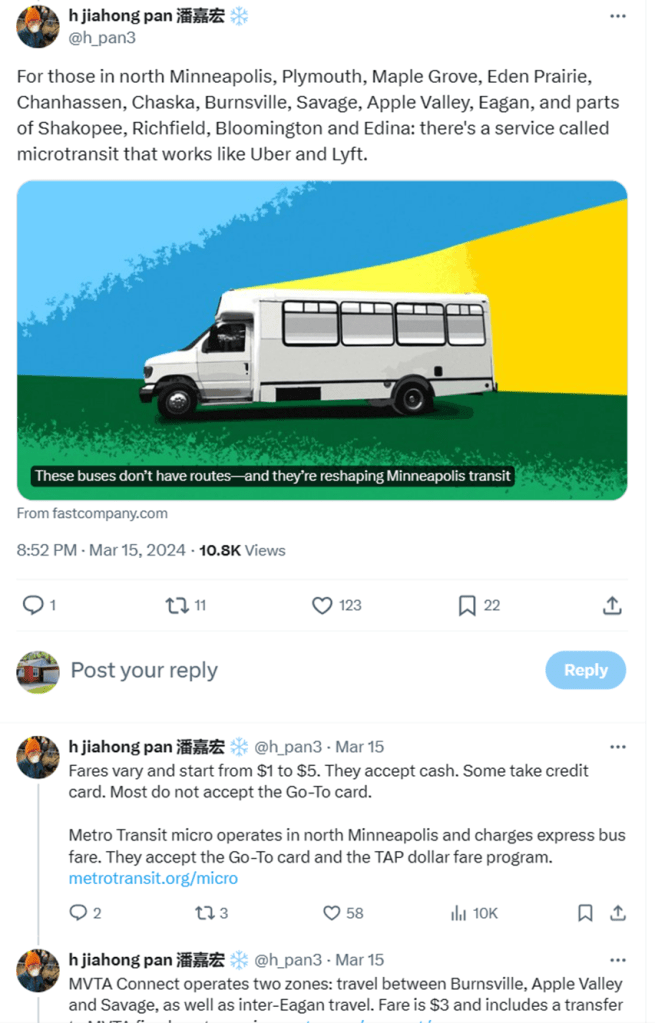
In effect, Uber & Lyft became a subsidized ride system for more than a decade. The consumers preferred it as it was timely and came to your doorstep. If you are blind, for instance, this can be world-changing. It wasn’t because it was cheaper. Others who benefit from the private subsidy (gift from private VC) are all those others who could have paid for a taxi, or driven their vehicle, but preferred a ride if they were going to throw back a few.
All riders will lose convenience with the departure. But those on the low-income scale will be most inconvenienced. Those on the mid-to-high income scale will replace the service with other for-hire drivers. Those who drink and drive could suffer, and cause suffering.
If anything, new information about the market should give public transit clear directions on what customers value. After all, even though a profit motive is not entirely in play, ridership is still a measure of the performance of the various public transit options. In many cities tracking of public transit is available online so riders can make their connections.
The drivers who need a full-time driver positions can transfer to public transit driving and earn quite a bit more money as well as benefits. The thing is, if they had wanted those jobs, they would have already made the switch. Most probably they don’t want to be committed to a boss and a schedule and they benefit in some way from the flexibility of being self-employed. All those who were doing it part-time just lost their part-time gig. Many side jobs are lower paid without benefits. It seems like this group, which is quite large, will lose out financially.
The politicians can tally a score in the win column. They went to bat on an issue and won. But to say they can account for a positive value in the people-over-profits net sheet is very much in question.

It looks like Lyft and Uber are leaving Minnesota- the tech company sent out a notice to all their customers to that effect. This was brought on by the biggest city’s city council who voted to set price controls for wages within their municipal boundaries. But the political backlash to this political control-grab is snapping quick and hard as it seems there are many other groups who value the service and price of Lyft and Uber.
Thankfully a journalist has written the whole kerfuffle all out from the view point of groups. (Perhaps he’s an institutionalist.) Here’s Adam Platt’s essay Getting to the Big Picture on Rideshare in Twin Cities Business magazine of which he is the executive editor.
The big picture refers to group 1, Minnesotans. He’s looking to break down not one issue, the issue that was the bee in the bonnet of the activists, that drivers (who fall mainly into group 2, first generation immigrants) fight to challenge the oppression of low wage labor imposed by a corporation. The political entity who has the elected power to carry out the move was chosen by group 3, the residents of the largest city.
But it turns out that even parts of group 3 find themselves together with other Lift and Uber riders, Group 4,in that they are poor, handicapped and disadvanted themselves. They use the service regularly as public transit does not accomodate their needs for a variety of reasons. And a group of other politically elected officials across the metro in particular, group 5, are putting pressure on the only person in the state who can intervene, the Governor, to put an end to this Marxist, but not really, tale of oppressed labor.
The irony of it all is that group 2 (the drivers) are independent contractors not wage earners beholden to a no-face factory-boss. They work when they want. They break when they want. They set their own plan. So what Adam Platt also elucidates is that the whole political play goes contrary to established structures of paid labor versus self-employment. It’s really a very interesting twist on villanous characterizations with the whole red march theme.
In all seriousness, this article is worth the read. Adam Platt lays out the details both with a historical perspective and with an accounting of all the groups in play. Analysis of these issues are never a dichotomy. And only with a sense of where things originated, and in what direction are they heading, can a proper analysis be done for a stab at the best outcome for the most people.

I was looking for a book. I knew it was on one of the bookcases skattered throughout the house. An older style bookcover, in deep red with a difficult to read title, was upside down so I pulled it toward me with the intention to right it to its proper placement. It slipped, tipping open as it reached the floor, and out slid a business card, my grandfather’s. The published date on the copy of The Essays of Francis Bacon was 1908- so I suspect this was a college book for him.
Now that my attention was diverted from my search, I took a moment to inspect the volume. I only grabbed a handful of books from his library when his children were clearing out his things once they had sold their parents’ home. My grandfather marked pages with little scraps of paper, ripped from pages of a used pad. Opening to one, it read.

The edge of the page was frayed as if had been held tight between the thumb and crooked index finger of the right hand. It’s as if the words had sprung into the readers thoughts and grabbed hold. That delightful igniting of the brain caused him to clutch the paper.
That’s why we read, isn’t it? Those private moments when the words bewitch us with their beauty or their truth. When we sit in our big comfy arm chairs and wonder how someone could say it so concisely, how someone could have read our thoughts which were not yet properly formed and put the fragments into words on paper. It doesn’t happen often. But when it does we stare at the page, clutch it, and enjoy the moment.
Municipalities serve all types of functions. There are the boring ones which no one talks about but that are all too relevent to people’s daily lives, like keeping the water turned on, the water mains flushed out and the roads in good repair. And then there are the controversial duties which everyone has an opinion about, like which polished developers should be able to build what, where. with what exceptions to the zoning codes.
And somewhere in between are the functions which are both useful and sometimes delightful. They happen right in the parks. Take a look at this photo and see the variety of services it is providing on a beautiful spring day.

There a youth in a tree instead of staring at a screen. A woman is on a bench, seated next to a man whose leg is in a cast is stretched out and leaning up against his crutch. There’s a cluster of three under the shade of the blooming Magnolia trees. There’s a two-some cutting across the open plaza. A bit further down a photographer is setting up a light diffuser. And in the foreground a lady in pink inspects her phone for any udates.
There are people at play, people in convalesence, people in a group and people passing through. There are people at work and people in communication. A park is a place where people doing all sorts of things mingle. It’s all capture here on a quick snap shot, on a sunny day, in Spring.
Cities provide core services like streets, police and fire. They often have a parks and recreation function as well. A goal here is to bring residents together across picnic tables or tennis courts. It’s to maintain a level of physical activity or leisure activities. This is also a spot where the volunteer community can step in with a lending hand. In this city their efforts are accounted for on the department’s budget pie chart.

Although, the number is really only half the total value. For what ever the value of the services provided by the volunteers, these folks also receive the benefit of commarderie and a sense of purpose through their action.
Despite the crucial role of incomes in the advantages enjoyed by different persons, the relationship between income (and other resources), on the one hand, and individual achievements and free-doms, on the other, is neither constant nor in any sense automatic and irresistible. Different types of contingencies lead to systematic variations in the “conversion” of incomes into the distinct “functionings” we can achieve, and that affects the lifestyles we can enjoy.
Development as Freedom, Chapter 4
Lifestyle contingencies need to feature their own conversion rates.
Furthermore, the need to discuss the valuation of diverse capabilities in terms of public priorities is, I have argued, an asset, forcing us to make clear what the value judgments are in a field where value judgments cannot be and should not be avoided. Indeed, public participation in these valuational debates— in explicit or implicit forms— is a crucial part of the exercise of democracy and responsible social choice. In matters of public judgment, there is no real escape from the evaluative need for public discussion.
Only a clearing across societal resources can a responsible choice be made.

I overheard an exchange between a mom, her two girls and a West Metro firefighter today while shopping for produce. It started all fuzzy and in the background, as I scanned the vegitables trying to recall what we’d be having for dinner. The request was quiet but the man with the large lettering across his dark navy jersey said his partner would be right back.
“One for my cousin too,” said a young voice. “We want to be fire fighters.” He replied with encouragement and said it was the best job you could have. That they would be great at it.
As I saw another uniform approach I pivoted to have a look at the voices. An athletic man was handing over stickers and hats for the girls in the shopping cart. The mom looked on. There were two communities here that have had some rough patches. It was so nice to see them getting on.
As we say here at Home Economic, context is important. Recently I heard the figure of twenty homes as a sweeping number with respect to an impact on a neighborhood. In order to evaluate an impact, it is necessary to know how many homes total constitute a typical neighborhood.
A standard city block with a sidewalk out front and an alley to the back generally has twelve to fourteen homes per city block. So if you were to think that your neighborhood was your block and two to the north, two to the east, two to the south, and then two to the west – you would have about 230 homes in total. In this case, twenty homes is about ten percent. If all these homes were in poor repair, for instance, this could be noticeable and have a negative effect on the outward appeal or from the street view.
Neighborhoods are quite a bit bigger than a cluster of two blocks to either side. Here’s a neighborhood map of Minneapolis, for example.

The USPS offers a useful tool for direct marketers which calculates the number of residential mail stops on mail carrier route (it’s called Every Door Direct Mail). We can use it here to help estimate the number of households by neighborhood. The first map is for the Armatage neighborhood. The number of homes comes in at 2620. Since the routes overlap into Fulton, let’s use a number of 2400. In this case twenty homes in the Armatage neighborhood makes up 0.83% of the total.

The Fowell neighborhood on the other side of town is know for having a larger share of corporate owned rental housing. Here, our USPS tool tells us that the neighborhood contains 2182 properties. Again rounding down is appropriate as the one route that runs on the west side of the cemetary is in the Victory neighborhood. Let’s use 2000 homes, in which case twenty porperties is 1% of the total.

It’s hard to see where one percent of a total number can have an effect on quality of life issues.
When a raw number gets tossed into a conversation as if it were a grenade ready to explode, always ask for context.
As it becomes more and more accepted that government is not the sole purveyor of public goods, but just another actor in the economy with private interests, how do we then determine: What is a public good?
Here at Home Economic, we find that people associate with groups of individuals who share a similar interest. We’ve laid out a landscape of action based on whether a participant works towards their own interests or towards the interests of a group project. When work is done for the in-group, then it is a public good for all its members. When an individual takes action in an exchange with an outgroup, then it is private only to the individual. For instance, an inventor may, on one level contribute toward the project air travel, while still retaining a portion of the new technology in the form of a grant or a patent.
The private side is more visible as it is often compensated in fungible currency. Thus the flow of money can be traced and counted. But how do we see the public side?
In How Innovation Works, Matt Ridley tells the tale of the first attempts at air travel. People in several countries were working on this idea and it is safe to say that the information which transpired from these activities fall in the basket of a public good. The American government supported an individual, Samuel Langely, with grants of $50,000 (quite a sum in 1903). Although he internalized these funds privately, Langley was unable to come up with the goods for a successful technology. It was the Wrights brothers, with their zeal and voluntary efforts, who launched the Kitty Hawk on that successful day.
They tried to privatize their invention through the patenting system so they would reap a pecuniary reward, but to no avail. The information necessary was already out in the public sphere with no way to reign it back in.
In The Invisible Hook, Peter Leeson tells us about Pirates. He tells how pirates commandeer a vessel and then set out on the seas to pillage and steal. He calls the boat a “sea going stock company” as the boat crew operated it very must like a firm. I would say, however, that the boat was a public good to the pirates who shared the common interest of pillage and plunder. Here’s why. None of the pirates could sell their share of the boat. The ownership of the pirate endeavor was non-fungible.
A public good maybe identified if the the only way to access it is through membership to a group. You can’t sell a favor you are owed from one friend to another. You relinquish all rights and benefits to the good if you leave the group. When you exit.

The praddle following Super Tuesday outcomes is still filtering through the various media sites. I just caught a headline celebrating another ‘first’ for this sexual identitiy group or that one. Isn’t it time to but this exclamatory statement of achievement behind us and admit that the barriers have been broken? It really isn’t that novel. Diversity in politics has become a political angle not a hindrance.
I do remember the old days. When Geraldine Ferraro ran for president in 1984 it was heartbreakingly awkward. A whole bunch of people put themselves out there in the last forty years and were public flogged before we’ve reached this point. But not that we are here. Now that every configuration of social group has taken position in every political party-
Can we take a moment to celebrate and then put the issue to rest?

Minnesotan Libby Larsen was inducted into the American Academy of Arts and Letters. The 73 year old was interviewed at her home in Minneapolis near Lake of the Isles.
She sees it as “an honor for Minnesota as well.” Though Larsen’s work often takes her out of state, “by choice I’ve made my life here, and I’m deeply grateful and proud of the crazy culture that supports ideas — like no other place in the country.”
Star Tribune via MSN
“People here really love to make music,” she said, “which is true everywhere, except that it seems to be more here with a smaller population.”
At one point in her busy career, packed with commissions, performances and recordings of works for orchestra, opera and band, she thought, “Where else could I make music? Just make music — instead of spending a year or two trying to get in the door to make music?”
The answer kept her here.
Star Tribune via MSN
If you have more listening time, try this piece, Mass for the Earth, from 1992.
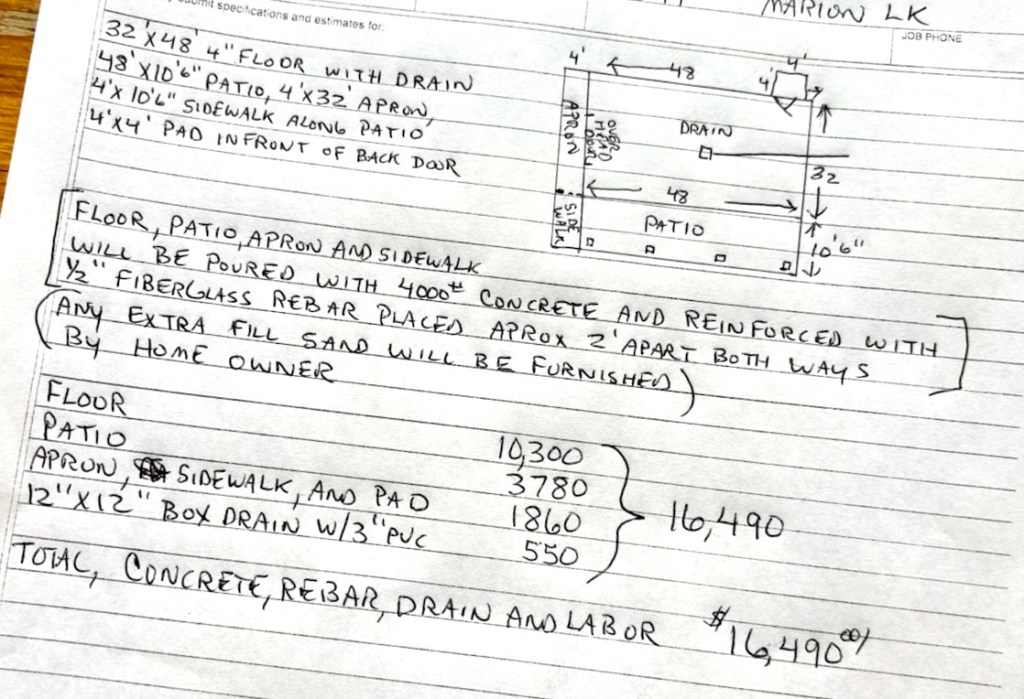
You might have gotten a recommendation to always get three bids when inviting contractors over to do work on your property. This is wise for a couple of reasons.
First off, it’s common to see a spread in the proposal amounts. I’d say on average I’ve seen a twenty percent spread on quotes for roofs, garage doors, tile remodels and so on. Of course, everyone is consious of the cost of things and twenty percent is quite a bit. But you’ll notice other differences between the bids.
The second issue concerns the type of work to be done. The proposal above is quite detailed. There are measures and a sketch to demontrate spacial relationships. It has a floor drain option, and a service door pad option, and an apron. The posts from the overhang are noted and there is a suggestion to bring the patio floor out past them for a higher quality finish. In contrast, it competes with a proposal that was received by text and just gave to figures for the floor and the patio. And that figure exceeds this one with all the extras by ten percent. There were other bids somewhere in between these two.
This isn’t a difficult project, so why would various contractors want to diverge so seriously from the standard pricing? Most trades people work for themselves. They get to choose their pricing, and some feel they are worth more money. Others feel that they don’t want the work unless they get the premium amount. And they probably don’t get the work as many consumers like to check around. But that one consumer, who is in a squeeze, with a deadline to meet, might be happy as punch to pay a little extra and get the high priced guy to come at a moments notice. There’s room in the market for this.
For as many personalities there are subs. The contractors who are detailed will be appreciated by detail oriented people. The ones that keep it simple and quick will find their niche too. Some people find details irritating. Part of what the consumer wants is a good price, but they also want to connect socially with standards and timing.
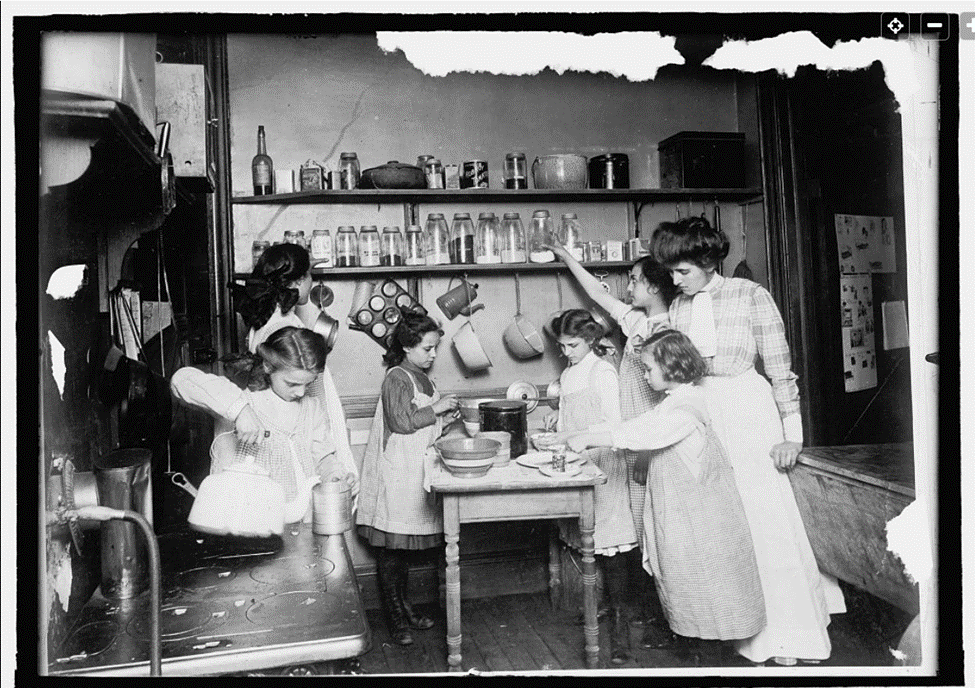
From The Library of Congress.
The image is estimated to have been taken between 1908-1919 in the New York City. A home economics class is taking place in the kitchen of a housekeeping flat.
Also from The Library of Congress.
It was the consensus of opinion of these women that the proposed plan covered the material or mechanical side of home life. On the other hand they considered it important that the less tangibic side should be emphasized. The most fundamental problems the thinking home women today involve decisions of what to do. Many agencies are telling her how to do the various household tasks, but it is equally important to give her motives for doing them and to attach to the various duties such clear-cut standards of value in relation to all the aspects and contributions of home life that she will be helped in knowing what to do and what may be left undone. Such careful weighing of values is needed by the housewife in organizing her working time, in apportioning the material resourees of the family, and in all the choices she constantly makes that bear on the material and social well-being of her family.
Report of the Chief of the Bureau of Home Economics- June 30th, 1924
The homeless have been in the local news quite a bit lately. Tent cities keep appearing and then are dismanteled only to reappear again a few blocks away on another city owned lot. The lots are filled with uncomfortable large concrete blocks, the support groups for the homesless show up with more tents, more supplies and on it goes.
The seperation of fortunes from those who, for whatever reasons in their lives, choose to live out of doors in the cold winter climate, and those who live off the average wage in MN is dramatic. It’s hard to understand or compare the circumstances on how it all comes to be. For that reason it maybe beneficial to look elsewhere in the world for strategies to a more stable existence for these folks.
There are area of the world where whole sections of slums are in the process of ameliorating into better situations for the residents (What Squatter Cities Can Teach Us). What were the aspirations that helped drive this change? How did supporting services come into play? Who were the early adopters?
WHen there is too big of a spread from those who need institutional support and those able to provide it, the cultural difference might be getting in the way of success.

With the politicians back to work in their respective capitol buildings, news of their work starts to trickle out onto the media sites. Some topics seem so tired, others seem combative and unnecessary. If politicians feel a calling to go to bat, why don’t they put their energies to places in the world that need the very basics? Over a quarter of the world’s population still does not have piped water into their home. And more than forty percent live in places with no sanitation.

Public art is underrated.




As a memorial to the first responders who were tragically killed last month, three bronze statues of the men will stand outside the Burnsville city hall.
Happy Friday Everyone!


 Home Economics