Regret emerges from a sense of loss. It’s an emotion that some think of as melancholic, sad, dismal. Yet in truth it is an emotion which helps to keep our choices in check.
One may be regretful because they failed to act.
One may be regretful because they failed to appreciate what was offered to them.
One may be regretful because the market changed while they were focused on other things
One may be regretful because they misjudged their circumstance.
If one experienced a sense of loss because they waited on the sidelines while the market took off, then they will be a more serious player the next time around. If one experienced a loss after they turned down an offer to engage in the market, then they will take the next offer more seriously. If one experiences a loss because the market changed when they were not paying attention, then they become better at watching their surroundings. If one experiences a loss because they were over confident (or under confident) about their personal circumstances thus leading to a mismatch, then they maybe more realistic the next time around.
Public Spirit shou’d engage us to love the Public, and to bear an equal Affection to all our CountryMen; not to hate one Half of them, under Colour of loving the Whole.
I was triggered on Twitter. (oops X). I saw a post that vilified suburban sprawl as ‘we all subsidize’ it. It’s been a while since I’ve heard that rally cry against the natural course of a metro area to seek out inexpensive growth. The claim, which is never followed up with any data or research, implies that the public costs to the outward growth of a city drains public resources.
But all growth or redevelopment is subsidized. Developers receive tax benefits and incentives for work in urban areas as well as suburban areas. Roads are built and maintained with funds at the local level, the county level, the state level and even the Feds drop a few bucks for the interstate system. Since employers are located all across a metro area, there is no guarantee that a city dweller commutes less than suburban dwellers, they just travel in a different direction.
The old dichotomy of the urban versus the suburban is so passe. First tier suburbs are now appraoching 80 years old, which is about how old the core city was in the 60’s when this whole vilify the middle class folks who simply wanted a nice little 1800 sqft one-and-a-half-story on a .14acre with a sidewalk lot started.
Let’s put to rest the image of a cool (yet always suffering) urban core that needs to be cherished, protected and preserved by fighting courageously against the nasty exclusionary suburbs. Instead, envision a dynamic, interesting and ever-changing melange of housing choices that serve as the dwellings for the several million people who want to cluster in a large metro area.
It’s the time of year when small coalitions are formed to answer the call for gifts for the needy. Turkeys for Thanksgiving. Toys for Christmas. And warm weather gear for the low temps which inevitably blow in from the likes of Calgary and Saskatoon.
It was quite a while ago, perhaps before the aught years, that a coat drive requested new coats only. ‘Come again?’ my grandmother, whose spending habits were forever dampened by the depression years, would have asked. I even feel self-conscious writing it out now. Standards have changed so much that it is unacceptable to donate a gently worn, yet perfectly acceptable winter coats to those in need.
But that’s what happens over time. Standards change. Donations must be store bought with the tags attached. Co-workers and the like dutifully enforce the new code with smiles, nods, eye rolls or shoulder turns. Afterall, used clothes can be gifted to the thrift store for anyone to purchase on their dime. One doesn’t need be in need to be a thrifter.
Back when I was a girl (yes a long time ago) the concern was about maintaining the recipients pride while still funnelling items to their family. The openess to receive was communicated probably through the church. But delivery was descrete and distanced, so the one neighbor did not have to acknowledge the charity from the other.
A new generation, a new mode of giving. For the times will always be a changing.
As the beautiful fall days come to a close and the forecasts include temps in the 30’s, consumers are wrestled from their automated routines and think, “I must get xyz done before the snow flies!”
Changes in temps are a definite factor in the real estate business. I suppose it is self-interest, in a way. A seller is better off to take the time to finally put an extra coat of paint on their front door, and tuck the garden hoses in the garage, and clear the gutters of all those golden leaves. A seller will be looking after themselves when they go to put their home on the market in March as the door will be a cheery greeting to a prospective buyer, and the hozes won’t look odd all covered in snow, and there won’t be an ice dam where the leaf debris would have clogged the gutters.
Buyers are also nudged along by the changing seasons. The cool crisp air reminds them that they thought they’d be in their new place before the end of the year. The passing of time draws their thoughts back over what they’ve seen so far in the market. Perhaps they regret passing on a purchase. Perhaps they realize that their demands are quite steep. Perhaps a little reflection reveals just what it is that has been holding them back.
Changing season can be the motivator to put in a little extra effort to prep a home prior to the arrival of winter winds. Or talk of Halloween candy and Thanksgiving dinner can encourage a buyer to revisit what he has learned so far about the market. In either instance, a driving rain from the north not only strips the autumn color from the trees but also plays a part in the home buying process.
One of the best things about reading with acedemics about acedemics is they use all these complicated words that are useful. Like heterogenious. I don’t know how many times I’ve looked that one up. Diverse in content or character, says the short definition. This seems to be lacking nuance given how it is used by those in the know. It’s a categorizing word decribing how something is made up. And the subparts seem to be unlike groups of things, or people, or parts. And then there is this angle: “incommensurable through being of different kinds, degrees, or dimensions.”
My latest favorite word that I must look up to remind myself (learn when you are young as the stickiness of the the brain declines with age) what it means is taxonomy. Any word with an x is a bonus for those of us who enjoy Scrabble. But the x doesn’t make it easier to remember. According to Merriam-Webster, taxonomy is the study of the general principles of scientific classification. It refers to the orderly classification of plants and animals according to their presumed natural relationships.
But it’s not just for biologist. Here’s an example from the web offered by Merriam.
The exhibition catalogue includes a taxonomy of her techniques, co-authored by Mary Broadway and Katrina Rush.—Sebastian Smee, Washington Post, 11 Oct. 20 23
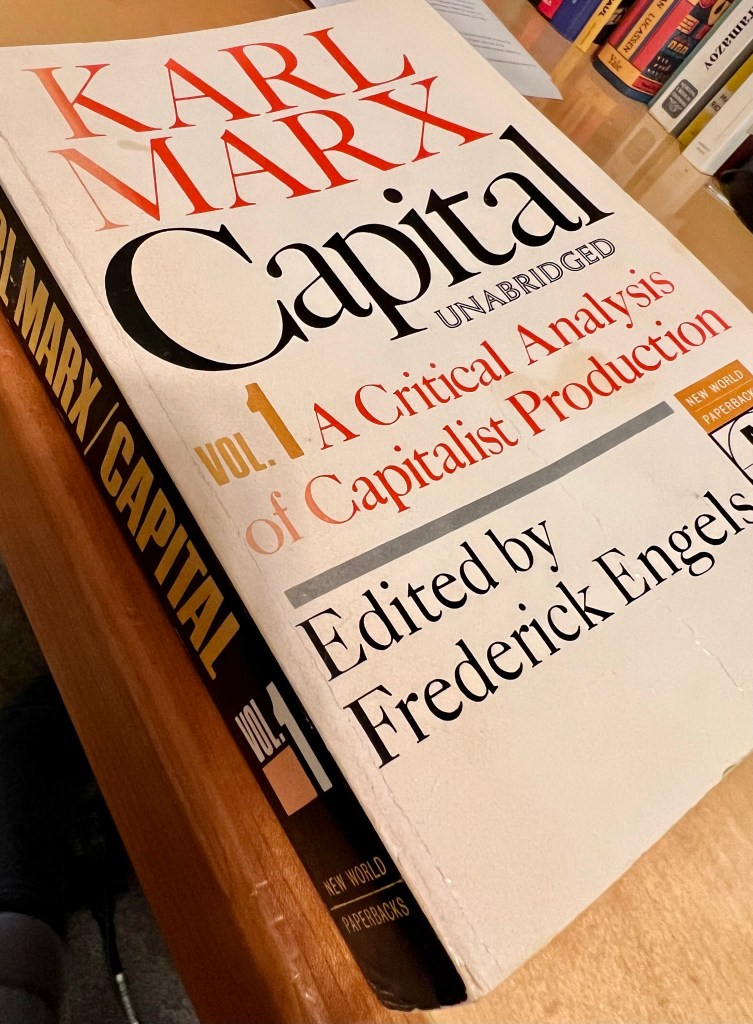
So when Marx spend the first three chapters of Capital Vol 1 defining all the working part to an economy, he is playing taxonomist. He’s labeling a bunch of the moving parts to a large, dynamic and spontaneous sytem of trade.
I mean, how can you go wrong with a match-up of Robert Redford and Brad Pitt both sporting shaggy 70’s hair and aviator glasses? Redford still has the same twinkle as he did in The Sting even if his features are more rugged. And Pitt looks rediculously boyish. They both pull off the action scenes beautifully.
But interestingly enough this is an ode to the man of action versus the bureaucrat. It’s a tribute to those in the game, taking risks, collecting information and then proceeding on the next move. It doesn’t sugar coat the pitfalls. The wins are often not pubically celebrated. Acting under the radar and with superior efficiency, those who perform push the story along.
Addendum (10/26/23) The scenes from the situation room in the film keep rolling back through my memory. The director, Tony Scott, was truly masterful in the staging. Here are the bureaucrats, all dressed in outfits, encased in a steel and glass conference room. Through the glass, we are shown a control room with blipping computer screens and underlings running hither and yon. The bureaucrats have everything at their disposal: computer power, people power, resources.
Redford is part of the group yet not. He plays by their rules. Yet he has his means of reaching beyond the room for help. He is nimble, and independent, but never arrogant. He knows how to use the yearning of being included to motivate others to help him. He knows who to pull social levers and leaves the power levers to those in the control room sitting in their three piece suits.
Tony Scott is clever in showing off the workings of Redford by spotlighting him in the situation room.
Fall is pumpkin season. Pumpkin pies at Thanksgiving. Starbucks offers Pumpkin Chai Latte while Caribou guests clamor for Pumpkin White Mocha. And then there are moist pumpkin muffins at the bakery counters in the fancy grocers. But best of all is pumpkin carving for spooky porch decor on Halloween eve.
It seems so from words written in the 1949 essay Why Socialism?
1 am convinced there is only one way to eliminate these grave evils, namely through the establishment of a socialist economy, accompanied by an educational system which would be oriented toward social goals. In such an economy, the means of production are owned by society itself and are utilized in a planned fashion. A planned economy, which adjusts production to the needs of the community, would distribute the work to be done among all those able to work and would guarantee a livelihood to every man, woman, and child. The education of the individual, in addition to promoting his own innate abilities, would attempt to develop in him a sense of responsibility for his fellow-men in place of the glorification of power and success in our present society.
Ideas and Opinions, Albert Einstein
Wait, wait, wait. The very next paragraph he catches himself up short. Socialism, he fears, has no means of constraining the state.
Nevertheless, it is necessary to remember that a planned economy is not yet socialism. A planned economy as such may be accompanied by the complete enslavement of the individual. The achievement of socialism requires the solution of some extremely difficult socio-political problems: how is it possible, in view of the far-reaching centralization of political and economic power, to prevent bureaucracy from becoming all-powerful and overweening? How can the rights of the individual be protected and therewith a democratic counterweight to the power of bureaucracy be assured?
And thus he lands back with the rest of us, navigating reality instead of some vision of what should be.
But not house prices. These continue to rise as fewer sellers are putting their homes on the market. So even though there are fewer buyers in the market who can bear the higher cost associated with higher interest rates, the lack on inventory still provides sellers with a competitive market price.
A number of industries, furniture sales and home improvement stores for example, depend on the turnover of housing. Let’s hope the Fed doesn’t drag out the anti-inflationary methods more than necessary. A 16% drop in the volume of home sales will take a toll not only on lenders, title folks, realtors but all the other services associated with new home purchases.
When government imposed restrictions are lifted on a property, does it automatically result in the property owner being better off? If a developer can has more leeway for a new project there is a sense that would create a positive income.
Say the new rules allowed for things like tightly stacked mobile homes and low-slung light industrial; neighbors that not everyone welcomes. Even without a formal acedemic review, it is possible to imagine that the neighborhood as a whole would drop a bit in value. It is even more believable should the nearby suburbs still exclude this type of land use in their geographic purview. Buyers choose the area that protects their lifestyle over the one that doesn’t and thus reducing price in the undesireable and increasing price across the city border.
And even if local government loosened some restrictions on development there is still the possibilty that the neighbors will fight a new project. In fact, it could be argued that changing the status quo is likely to drive up the prep and presentation costs for a developer. The more uncertainty, the more likely it will take longer to get through the approval process. No one likes not knowing.
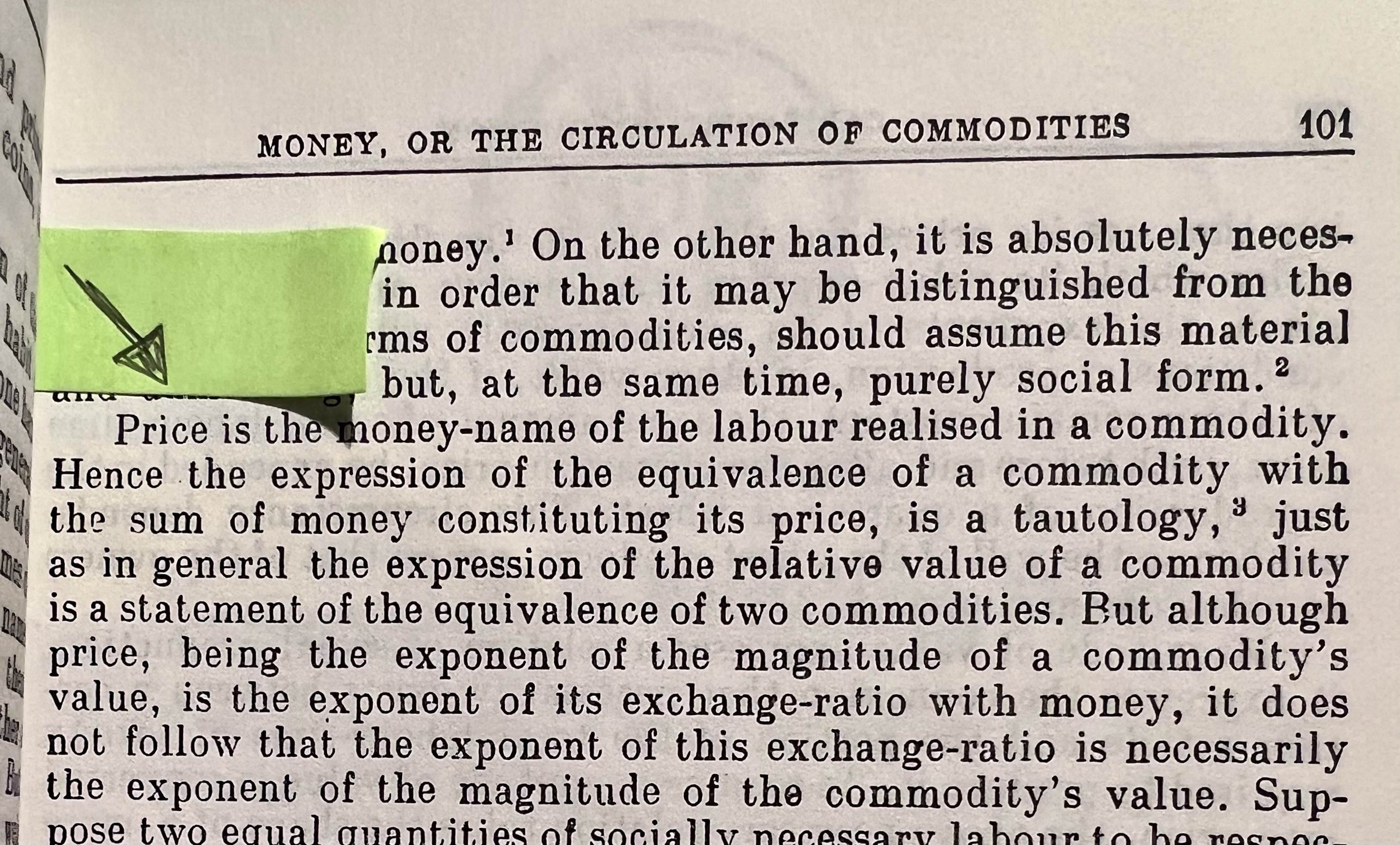
What is relevent about the above tweet is that zoning rules, parking restrictions, turn around time for approvals all affect the cost of doing business and thus the value of the property in question. The rights of the those representing the public share a portion of the underlying value of real property which is then represented in money-form in the final sales price of the parcel.
For the most part it feels like prices at the grocery store are back in the pre-covid range. Eggs are no longer over $5 a doze and you can get a package of chicken breast for 2$/pd as long as you by the large tray. Just when it feels like the stickers have settled, you reach for a bottle of your favorite shampoo only to see that it will set you back just under $13. Geez. That used to be the low end price for the fancy shapoos at the stylist’s shop.
It’s just a reminder that pricing mechanisms are fluid and always on the move. The is best able to maneuver through with proper knowledge of those items you purchase most, and nimble enough to switch to substitutes or other vendors when new opportunities arise.
Of all the dozens of features buyers look for in a home purchase, property taxes barely bubble into the conversation. Must haves are things like number of bedrooms, bathrooms and garages. A property tax rate of xx% is never a delineating factor. In part that is because people have already processed the pro’s and con’s of the various areas that attract their attention. Indirectly, the cost of property taxes has already been judged as one of the many components of a city’s attributes.
One sees property tax comparisons much more frequently in this type of format. Here it is presented as a bragging point for the city which included it in its newsletter.
As in many professions, there is a continuing education requirement to maintain a real estate license in Minnesota. Today I learned a little more about sewer line scopes (fancy tech) and blockage (not nice). It was an informative hour hosted by an inspector who knows a lot about the physical aspects of homes.
Over the years various piping products have been used for sewer lines. Old is replaced by new usually for higher durability at lower cost. But what triggers the upgrade?
Older cities struggle with this question as no one wants to leakage to seep out of cracking pipes and into the ground a half of a dozen feet below the grassy lawns. Some cities have tried to encourage voluntary assessment and replacement through public messaging. I’m told this isn’t effective. The excavation expense of replacement is quite costly, ranging at a similar price point of a new roof. (And by that comparison it’s a bargain as the waste line, which runs from the exit point of the home to the street main drain connection, typically has a lifespan of 70-90 years. A roof, maybe 25.)
But as is often the case with shared property, everyone wants to be on the receiving end of the transaction and not the paying end. Residents, especially those who do not intend a long ownership period, feel like they are getting stuck with a cost that benefits many different parties over the infrastructure’s lifetime. To them, it makes more sense for a city to tackle the project section by section in the city, collect revenue, and perform the work for replacement.
The counterargument to that process is that sections of functional pipe will be replaced which is wasteful (no pun intended). Those who feel that a public bureaucracy is unable in its structure to obtain the best pricing see an inefficiency in performance here as well. Most of all, an across-the-board tax increase is always politically unpopular. The public pushes back. The project is kicked down the road. And aging pipes get wrecked by tree roots seeking out water and nutrients.
And this is why the point-of-sale solution is put into play. The party with the most to gain from a brand new piece of city infrastructure is a new buyer. A seller is required to comply in order to move forward with their plans. If they are unhappy with city council, oh well! They are out the door. This puts two parties to the transaction in favor of sewer scope inspections upon the sale of a property and one against. This is a positive momentum to get needed upgrades completed.
The downside is that there’s still considerable uncertainty to the extent of failing piping amongst the homes that do not go to market. Instead of a method which tackles the oldest first, the selected repairs are directed at those properties which happen to sell. And that’s not a very big number, maybe 4% of a city’s dwellings. It is also concerning that that it may be enough of an impediment to stop a seller from proceeding, which has negative effects in a market.
Still- it is interesting to note that by combining payment with interests, the likelyhood of infrasturcture repair increases.
These quantities (of commodities) vary continually, independently of the will, foresight and action of the producers. To them, their own social action takes the form of the action of objects, which rule the producers instead of being ruled by them. It requires a fully developed production of commodities before, from accumulated experience alone, the scientific conviction springs up, that all the different kinds of private labour, which are carried on independently of each other, and yet as spontaneously developed branches of the social division of labour, are continually being reduced to the quantitative proportions in which society requires them. And why? Because, in the midst of all the accidental and ever fluctuating exchange-relations between the products, the labour-time socially necessary for their production forcibly asserts itself like an over-riding law of Nature. The law of gravity thus asserts itself when a house falls about our ears. The determination of the magnitude of value by labour-time is therefore a secret, hidden under the apparent fluctuations in the relative values of commodities. Its discovery, while removing all appearance of mere accidentality from the determination of the magnitude of the values of products, yet in no way alters the mode in which that determination takes place.
Capital- Vol 1, Chapter 1 Commodities
How much work do group members have to put in to maintain the social structures that enable private exchanges? Seems like an interesting question.
YouTube as a teaching tool is amazing. Don’t know how to get your fancy dryer with all sorts of buttons that light up to just spin out your laundry? Ask YouTube. Not sure you have the experience to tackle patching a piece of ripped linoleum? Watch three clips to be sure you know what you are getting into before putting exacto knife into vinyl. Practical tips from handy people make life easier. They reduce the risk of getting in over your head on a simple repair.
Recently I’ve mosied into collegiate level material. This guy from the U of Chicago was informative, but also very entertaining. As someone raised in a different generation, it’s mind-blowing to be as good as in the classroom at a U that I could never have accessed.
All that stuff is fun and immediately useful. If YouTube weren’t around, it is information one could have gotten from a neighbor or at a leadership course. But there is more. The video hosting site gives you a key to difficult ideas as shared through people as passionate about them as their authors. I found David Harvey as I’ve never known much about Marx. And when I went looking all I ran into were those clinging to revolutionary impulses and socialist utopias. Harvey tells you that’s not really what Marx was about. Harvey will read the book Capital with you. Harvey won’t let you get sidetracked by politics because he wants you to understand the essence of what Marx had to say.
This will be my dog-walking media of choice, at least through Vol 1.
We are pouring over Lavoie’s book Rivalry and Central Planning this month and it is a pleasant surprise that the text is gentle on the eyes. No squinting. No twisted eyebrows. He writes in a pleasant and forthright manner.
This page is worth reproducing as it overrides so much of what is taught in standard economics classes, the ones with the supply and demand curves settling sweetly on a set price. There is one price! And the consumer wants to know what it is. Yet…how do you tell them then that, it depends. On what? Well- one what is in the air at the moment of the transaction.
Markets exist in a fluid and dynamic system. Prices are representative of what has happened in the past. Thus they provide a guide to the future. But it is the participants of the moment who then again come to settle the new prices. And on it goes.
This film needs no introduction. Nominated for eight Academy Awards, it is considered by some to be the best movie of all time. I finally got around to watching it and it does indeed outshines current films.
Here is are a few aspects to the film that struck me as very well done.
The chase scenes through gritty NY streets are about one human hunting another. The most suspenseful cat-and-mouse chase occurs when Hackman is dogging Frog #1 through to the subway. This also foreshadows who wins in the end. (Best Director, Best Actor)
So often, the lens frames the characters in what could be a spectacular still shot. (Best Cinematography)
The camera picks up supporting characters long enough to tell a little story. There are two little boys in the window of the apartment building, for example, as Hackman edges around its foundation to stay clear of the snipper. They are having a grand time watching the action unfold. (Best Director)
The music. The orchestras used in the 70’s are superior to most contemporary film music. The sound is a strong contributor to suspenseful scenes. (Best Sound Mixing)
This is a movie I will probably watch again. There is so much quality in it, one can find new ways to enjoy it on a second go around.
In a recent Zoom conversation, a participant mentioned that he liked to organize gatherings for those interested in the Socratic Method. Most people have an idea about the ancient philosopher, Socrates, but many might not be aware of the manner in which he promoted the inquiry into ideas. So here is a summary provided by Tobias Weaver in an article entitled The Socratic Method: Think for Yourself.
The Socratic method, also known as dialectic, is a technique of philosophical investigation that emphasizes the use of conversation and inquiry to explore difficult ideas and concepts. The Socratic approach involves participants in a process of critical thinking and self-examination as opposed to providing knowledge in a simple or didactic manner. Socrates would lead his interlocutors to examine their own presumptions, convictions, and values through a series of probing inquiries, frequently exposing contradictions or inconsistencies in their thinking.
From what I gather, the idea is to ask questions. And in doing so the audience must search out what they believe to be true. Instead of shouting people down with your ideas, ask the right questions and see where they lead the conversation.
Just for fun, I decided to give it a try. John McWhorter, a linguist from Columbia, recently posted a clip about the voice of an NPR reporter. If are not familiar with John he has a popular podcast called Lexicon Valley (check it out- you will never think of language in the same way). Members of his audience had contacted him with a query. If they did not care for the voice and language of a radio reporter, a voice with a distinctive race identity, did that make them racist?
And that is exactly what I floated across the table of seven of us as we sat on the patio nibbling on Korean tacos and Cajun chicken over pasta. It was met with a thoughtful pause. Then there were a few clarification questions as to what an ethinic voice entailed. John played clips from the NPR show which I couldn’t do so I had to settled for descriptive words. A new pause. A few words wandered in one direction and then circled back before rendering any opinion at all.
I think it worked! No one dropped the hammer on any particular nailhead because one answer is not obvious. Of course, you do not have to enjoy every broadcaster’s voice. That does not mean you reject a whole race associated with manner of speaking. But it does make you question if there are underlying biases. And thus it is worth considering.
The method makes people wonder. It makes them reconsider. It draws their thoughts through their own experiences to process them for credibility. It was fun! I think I will try the Socratic Method again sometime.
Our US Rep, Dean Phillips, is willing to say it out loud. Abilities based on age should be a factor in evaluating the performance of duties for public office. He recently encouraged his party to look for a new presidential candidate instead of endorsing someone who keeps loosing track of his speeches. He’s willing to say Biden is too old for the job.
This week Senator Diane Feinstein of California died while serving in office at age 90. She had recently been ushered in and out of the chambers in a wheelchair looking old and confused. Perhaps Philips was influenced by her recent passing when he stepped down from a party leadership role today. Perhaps he is trying to gin others up to say out load what everybody knows to be true. Age matters.


















 Home Economics