What is poetry? Is it a mosaic Of coloured stones which curiously are wrought Into a pattern? Rather glass that’s taught By patient labor any hue to take And glowing with a sumptuous splendor, make Beauty a thing of awe; where sunbeams caught, Transmuted fall in sheafs of rainbows fraught With storied meaning for religion’s sake.
The last book we tackled in the No Due Date book club was Do Markets Corrupt our Morals by Virgil Storr and Ginny Choi. I really appreciate the way the book is laid out. Instead of referencing the work of others in an offhand way, expecting the reader to know the inferences intended, the authors pulled lengthy quotes. Then there is further clarification of the material. To make it even easier to follow up, bibliographies are listed at the end of each paragraph.
This makes for a useful book. One worth hanging onto.
One of the questions the book seeks to answer is why there exists an ongoing criticism of capitalism when the data seems to indicate that open and free economies generate positive returns for societies. No need for uncertainty here. If nothing else, the authors confirm through thoughtful data and analysis that economies consisting of open and free trade, with higher levels of transparency and clear property rights, out perform every other system. And yet, the nasty, opportunistic men and women of the market live out vivid roles in the minds of the public.
Storr and Choi start off Chapter 4 with a virtuous market story. An enslaved person, Boatswain, is a skilled craftsman. His owner is progressive enough to allow him to market his skills in the greater Bahamian marketplace and for Boatwain to retain some of his earnings. Here, market forces encourage the relinquishing of a social norm so that the greater community benefits, Boatswain internalizes profits and undoubtedly his owner is relieved of some maintenance expense. All parties win.
Let’s look at a few not-so-appealing market stories. Bernie Madoff was a financier of considerable skill. He also had access to individuals with large amounts of resources with seemingly no direct demands upon them. So Mr. Madoff creates a story to draw those funds out and into his pyramid scheme. Perhaps hubris kept him going. Perhaps he began to believe his own deception. Regardless of the human foibles that perpetuated the deception, when he fell, the destruction was deadly.
But also let’s consider the market for public funds. The state of Minnesota has an 18 billion dollar surplus at the moment. There is talk of large amounts of money being directed into non-profits in a disadvantaged part of the metro area. The fear is that the dollars will not have a sufficient market disbursal system and there will be pressure on the 501c3 people to internalize the liquid assets.
They are about to dump a boatload of money into Minneapolis. That’s going to do nothing because a lot of these organizations and the people who run the organization are not out to help they are out to make money so they don’t have to work a full-time job.
Or consider a situation where two markets exist in close geographic proximity. When a group of ex-pats from a wealthy country takes up residents in a country of substantially less means, it is not long before a submarket is created. Members of the host country develop surcharges on goods in open markets. There are fees imposed at gatekeeping opportunities. This extraction of funds from one group to the next is called corruption. But could it be that this is a market force for the wealthy to support the less wealthy?
Bernie Madoff was simply a sophisticated thief. But he used a network, not simply business means, to accomplish his ruse. The demand for public money in the second scenario is justified, but the mechanisms for distribution are lacking. On many past occasions, this scenario has ended with an appropriation of funds. The last situation generates the example of a secondary market, or a black market, springing up when two distinct groups, with divergent standards of living, coexist nearby.
So I agree with the authors that the Bernies of the world get an outsized airing in the media. People love a good scandal. But I also would like to suggest that some other scenarios which appear to be theft are the result of weak, unidentified, or poorly implemented markets.
Tyler Cowen is making a big deal about ChatGPT and other similar sounding boards over at Marginal Revolution. I can see why now that I’ve tried it. Applied to my circumstances, it could have changed the trajectory of my adult life had I had access to its output thirty-odd years ago.
While still in my twenties it was hard to miss the observation that funds intended for the destitute were often siphoned off by intermediaries. The people at the top wanted to respond to a call to DO SOMETHING. (sometimes they were obliged to respond as in the lawsuits directed at banks for avoiding neighborhoods). But as someone who sat on the bank floor and disbursed money to the folks deemed responsible for the distribution, it was only a matter of time before a story of theft ricocheted back through the community.
I was reminded of stories from my childhood where gifts of equipment or food were made to foreign governments with the best of intentions. But the equipment was unable to be kept serviced and unusable tractors sat in fields where farmers tilled the earth with oxen. And unfettered dollars simply drifted away into this politician’s pocket or that one’s.
There must be an academic community, I thought, interested in these types of urban questions. Why poor neighborhoods stay poor despite all their various subsidies seemed like a pressing issue. I started perusing the urban studies sections of bookstores, but the selections were limited. It was on trips to progressive cities like Portland where Powell’s bookstore actually offered more than a few titles. It lived up to its moniker the largest independent bookstore.
Yet I still didn’t find what I was looking for because all these texts had a political bent to them. It goes something like this. Strong men/women ruin everything by building too much (sprawl), building too dense (greedy), and charging too much (gentrification). You can see the contradictions here. The lack of the (hopefully) now obvious premise that to get one thing you have to give on another. Choices are connected and results are not to be gained from fiction in our imaginations.
Freezeframe. Had I met a ChatGpt at this point I would have found Thomas Sowell much more quickly. It was a handful of years through distractions of work and young children before I stumbled upon his writing, I was in my thirties by then. His work encouraged and interested me in what I now know to be public choice. With Chat, I would have met Hayek and Mises and the slew of the Austrians within the year. Instead, it has taken twenty. Or maybe more. Time is a drifty thing.
I also would have figured out that the notion expressed here of a social value being an intrinsic part of price was a philosophical take and not an economic one. I had no time for philosophy as an undergrad because none of the writers wrote for an undergraduate audience. They were too difficult to read and rarely tied their thoughts to real examples. Had I had Chat I could have discussed this shortfall and become informed on the author’s references. With Chat all sorts of missing pieces could have been colored in.
All I’ve ever wanted to is to able to show that when the current politicians dump a whole bunch of the $18B surplus into North Minneapolis they will create more moral hazard than the public good. That the flow of dollars is only one part of a transaction and that social ties are the other. To ignore the very real choices of the intermediaries, whether they be the 501c3’s or the local politicians, flushing a whole bunch of cash through their channels without a marketplace connecting to the very real needs of disadvantaged people is hopelessly flawed.
James Buchanan got that. ChatCGT would have told me with a well-directed question or two.
As usual, Tyler is right. The AI tool eliminates geographic distances. No need to run to Portland to the big boy bookstore. No need to read volumes of philosophers you can’t follow. Just ask a question or two and the service will scan the material and report back. The interactive feature of Chat is much more powerful than a Google search where information is offered up with no context.
It was more than likely through Google or Amazon that I was introduced to Adam Smith’s The Theory of Moral Sentiments, a confirmation there were inklings long ago of the tie between markets and morals. Yet the notion that a decline in home values follows persistent crime, that a home in an outstanding school district will cost more, and all the other public good impacts on real estate, required some building blocks to explain. One missing piece to the puzzle (undoubtedly the most significant) is the divergent nature of work. For the ingroup, participants give in order to shore up. For the outgroup, participants request unfettered payment in order to gain and grow.
Two different types of work. One done for the public interest of your family, community, interest group, or passion. One done for a wage from your employer, investment earnings, a business. Two types of payment. One is connected through networks of reciprocity while the other is unfettered and free to flow. But just to make everything a little crazy- the two human actions do not occur in isolation but in unison. Sure there are some transactions we have with our children which are almost entirely personal. And there are transactions of financial instruments that are almost entirely pecuniary. But not.
Real estate is interesting because many interest groups are tied by proximity. So the sale of real estate is the perfect vehicle for analyzing the outcomes of human action in both the public and the private spheres. Even ChatGPT knows this. Check out yesterday’s post. It will thus be through the analysis of housing prices in relation to the efforts people invest in private and public functions in their neighborhoods which will tell how well the politicians are doing with all that public money.
If you are a fan of Jack Nicholson you will love vintage Jack in this 1973 film. He’s very young and handsome. And all the traits that make him uniquely famous dance across the screen. The story line is a little slow. The footage of America in the 70’s, however, is interesting throughout.
The Last Detail was theatrically released in the United States by Columbia Pictures on December 12, 1973. The film received positive reviews from critics, who praised the performances of Nicholson and Quaid, as well as Towne’s screenplay. It was nominated for two Golden Globe Awards, three Academy Awards, and four British Academy Film Awards (winning two).
We will soon be hearing about food deserts (once again) due to three grocery stores vacating a segment of the city. The latest to close is the Wal-Mart in Brooklyn Center.
Walmart’s decision to leave, another blow to a neighborhood with a large Black population, comes on the heels of Aldi closing a store in North Minneapolis and a nearby Walgreens closing shortly afterwards.The Brooklyn Center location, which has been in operation since 2012, is one of 10 stores nationwide the retail giant is closing, according to USA TODAY.
“Why are they closing a Walmart in a Black neighborhood?” Kennedy said as she loaded rolls of paper towels and laundry detergent into her minivan.
She works in a group home close to Walmart and shops there for the low prices and wide array of products.
“I bring them here, it’s closer to the home and reasonable,” Kennedy said.
The Sahan Journal did not cover the reasons for the departure from this location but other news sources did.
Brooklyn Center police said Walmart made 6,177 calls for services in the last five years. That’s double the number of calls compared to surrounding businesses like Super 8 and Cub Foods with 3,270 and 3,038 calls, respectively. All three businesses top the city’s list for calls for services.
For further context, police say just six miles away, the Walmart in Brooklyn Park had 1,679 calls for services in the last five years.
City officials vow to fill the anchor store with another merchandiser. But wouldn’t it make more sense if the municipality focused on public safety and let the stores focus on business?
They are about to dump a boatload of money into Minneapolis. That’s going to do nothing because a lot of these organizations and the people who run the organization are not out to help they are out to make money so they don’t have to work a full-time job.
This comment confirms that it us still difficult to evaluate providers of public goods services. Why are there not more indicators? Why is the analysis kept under wraps? Where is the clearinghouse of market process that ruffles through the producers and shows the market who is getting business done?
Because without these feedback loops it is too tempting, as the Rev references, for people to privatize public funding.
Frost-locked all the winter,
Seeds, and roots, and stones of fruits,
What shall make their sap ascend
That they may put forth shoots?
Tips of tender green,
Leaf, or blade, or sheath;
Telling of the hidden life
That breaks forth underneath,
Life nursed in its grave by Death.

Blows the thaw-wind pleasantly,
Drips the soaking rain,
By fits looks down the waking sun:
Young grass springs on the plain;
Young leaves clothe early hedgerow trees;
Seeds, and roots, and stones of fruits,
Swollen with sap, put forth their shoots;
Curled-headed ferns sprout in the lane;
Birds sing and pair again.

There is no time like Spring,
When life's alive in everything,
Before new nestlings sing,
Before cleft swallows speed their journey back
Along the trackless track,--
God guides their wing,
He spreads their table that they nothing lack,--
Before the daisy grows a common flower,
Before the sun has power
To scorch the world up in his noontide hour.

There is no time like Spring,
Like Spring that passes by;
There is no life like Spring-life born to die,--
Piercing the sod,
Clothing the uncouth clod,
Hatched in the nest,
Fledged on the windy bough,
Strong on the wing:
There is no time like Spring that passes by,
Now newly born, and now
Hastening to die.
Christina Georgina Rossetti (1830-1894) is remembered as one of the Pre-Raphaelites – a group of 19th century artists and writers who took inspiration from works of art produced in the Middle Ages. Her brother, the painter Dante Gabriel, was one of the most prominent of this group.
The Dem trifecta in Minnesota’s state offices is leading to a flurry of bills being passed. The latest is free school lunch for all k-12 students. A well-posed media shot of the Governor being body-embraced by a cluster of elementary school kids is as tart as an artificial sweetener.
We know the school kids aren’t banging down the doors for a bureaucratic response to their midday meal, so who’s asking for this culinary delight? The neediest kids were already receiving free breakfast and lunch at their public schools. From what I can follow on social media, the desireability of universal provision of food will first off not necessitate the requirement of some to ‘ask’ for a meal through the paperwork. And secondly, it will catch the kids whose parents fail to fill out the paperwork.
MN is a pretty well-off state. The poverty rate for children is 12%. From personal experience, I can attest that well over 12% of school kids are receiving free and reduced lunch. In other words, there was already a largesse to feeding the kids. Yet- to look at the celebration in St. Paul one would think this is a breakthrough of some sort.
Some politicians are asking for the ground rules on when and how the government should take from some and give to others. A new legislator, Walter Hudson, from an NW exurban area posted this recently.
I really want to hear the argument that we're owed stuff paid for by others.
So far, all I get when asking is indignant ridicule, which I receive as a concession of intellectual defeat.
If your case was moral and rational, you could make it easily, and it wouldn't anger you.
Although everyone can feel good about putting food in the mouths of babes, if those babes don’t need the food more than some other babes need mental health assistance, housing, or some other basic need, then the tradeoffs determined by politicians are failing the system.
There’s a deeper answer to Hudson’s question. Where in the interlinked transactions of public dollars flowing to private citizens can we identify comparative needs? Where do we see the production value of public dollars invested?
To cap off coverage from the trip to London, here are a few of the culinary treats we had in London.
High tea at Fortnum and Mason
Fortnum and Mason, a department store in Piccadilly, is like a fancy wedding cake with decorations at every level. Prim and proper is exactly how you feel once you’ve reached the fourth floor, up a double staircase with gorgeous dark wood banisters. The piano player may already be laying fingertips onto the ivories, depending on when you arrive for afternoon tea or how long you’ve lingered enjoying the treats. A skeleton holder of stacked plates filled with goodies will arrive at your table. The sandwiches each have their own delicate flavor. The scones are best with tea. The aroma of the libation is so sweet you wonder if every other tea will pale into a substandard replacement from now forward. Caution- the bill is not for the faint of heart.
The India Club restaurant is tough to find. The number over the unassuming door is 143 on the busy Strand. Two flights of narrow steps will lead you to an unassuming entrance to a lovely rectangular dining room. The space is tight. The tables are small. The atmosphere is gigantic. The evening we went for dinner all the tables were edged shoulder to shoulder with a younger vibrant crowd. The noise was that comfortable hum of humans enjoying their evening. Most importantly, the curry was rich in flavor.
Cubana Restaurant Waterloo is located in a space that looks convincingly like worn unattended buildings which I imagine to be in Havana. The place is unique. Several levels create private spaces for folks to enjoy their meal and their company. The wait staff looked the part and were effusively attentive (did I say good-looking?). The pulled pork gave off a rich smokey vibe. It is as delicious. The plantains too- which is surprising because I usually steer around them. Not this time. You have to take the whole place in while you clear your plate!
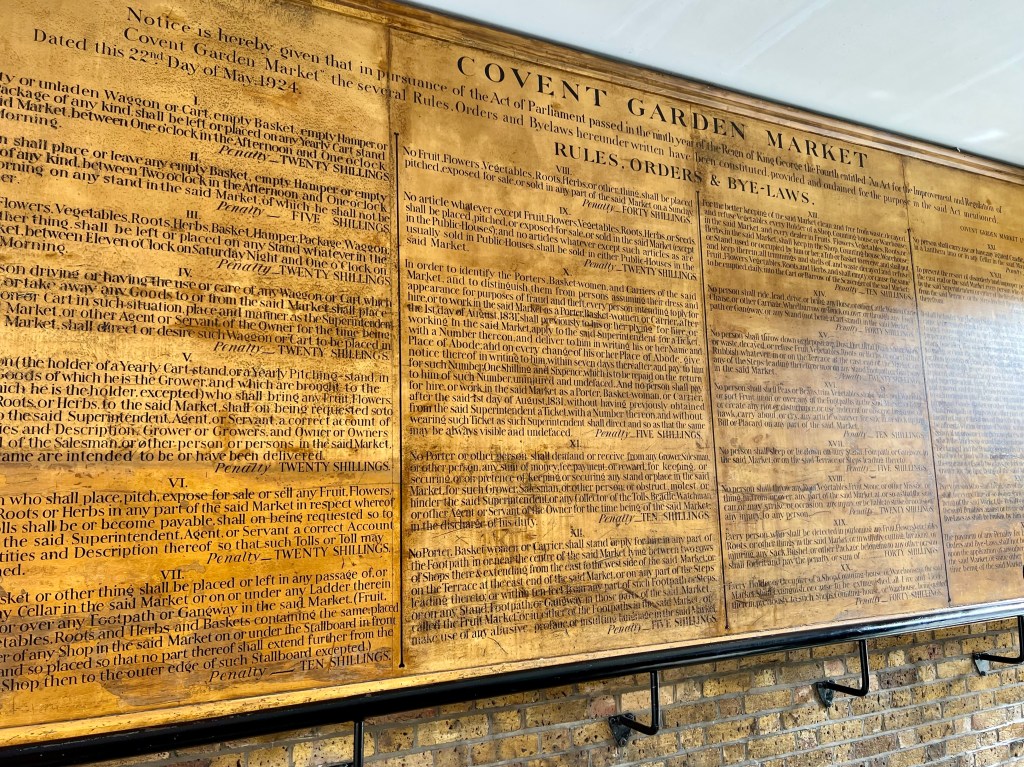
All markets have rules, even if you don’t think about them. Covent Garden was an unruly place until they thought to build the barn and write down some rules.
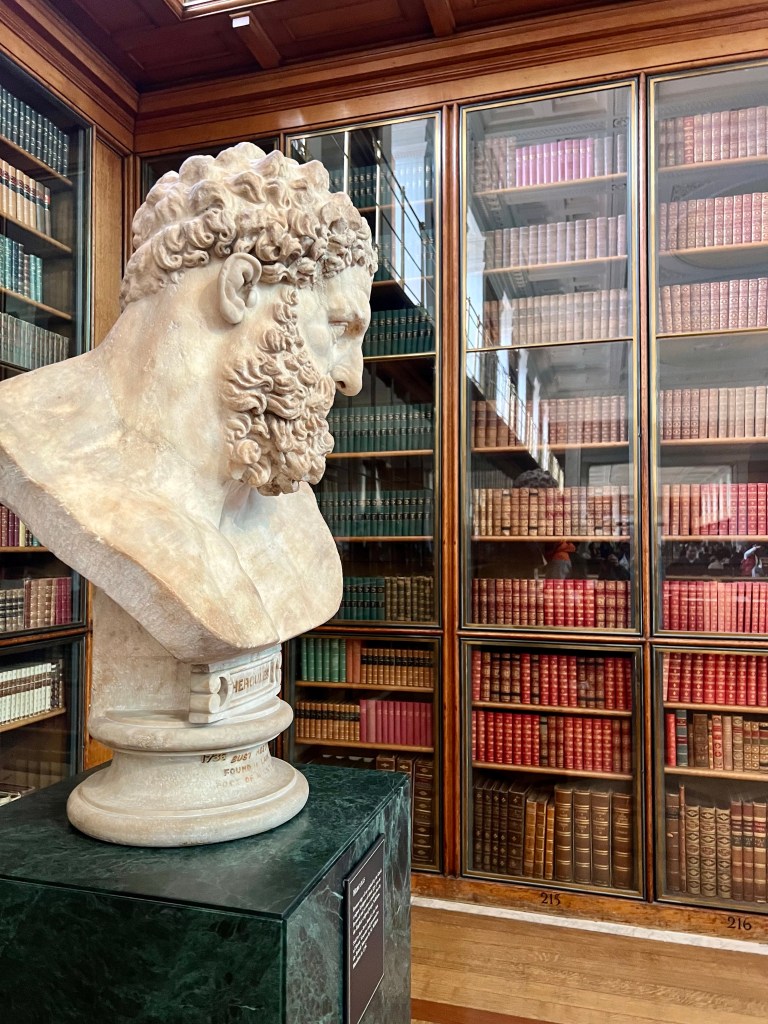
Newton’s resting spot in Westminster Abbey. His visage taken from a death mask.
—Letter to Henry Oldenburg (18 Nov 1676). In H. W. Turnbull (ed.), The Correspondence of Isaac Newton, 1676-1687 (1960), Vol. 2, 182.
“I do not know what I may appear to the world, but to myself I seem to have been only like a boy playing on the seashore, and diverting myself in now and then finding a smoother pebble or a prettier shell than ordinary, whilst the great ocean of truth lay all undiscovered before me.”
Just a mile or so down the banks of the Thames from Shakespeare’s Globe theater is the modular National Theater. The 1127 seats of its Oliver stage were filled last night for the performance of Standing at the Sky’s Edge. And it is no surprise. The performance was outstanging.
I knew it was a production full of music but did not anticipate the number and sheer quality of fantastic voices. There are solos, there are duets, and there are full troupe choruses to remarkable ends. The orchestra/band is elevated, making for an excellent view from our balcony seats. And the performers were adept at switching up the genre from melodic to rock and role with an electric guitar solo.
But it blooms into a glorious love letter indeed, revealing a big, booming heart and astonishing sound. Hawley’s music and lyrics stand front and centre of the production, characters often making first entrances through song and occasionally breaking out of a scene to perform a number, microphone in hand, as if at a gig.
The cast is uniformly strong and their singing outstanding. Faith Omole’s voice has the deep, rich timbre of Amy Winehouse’s while Maimuna Memon’s songs blast with emotion. Ensemble numbers bring shivers. Feet tap, spines tingle. We find ourselves swaying in our seats. Together with its lovely movement, the show becomes unstoppably winning, ineffably exuberant.
Step out of the theater and take in this wonderful view from the South Bank over to the lit dome of St. Paul’s Cathedral.
According to Schumpeter, the “gale of creative destruction” describes the “process of industrial mutation that continuously revolutionizes the economic structure from within, incessantly destroying the old one, incessantly creating a new one” (Capitalism,Socialism and Democracy)
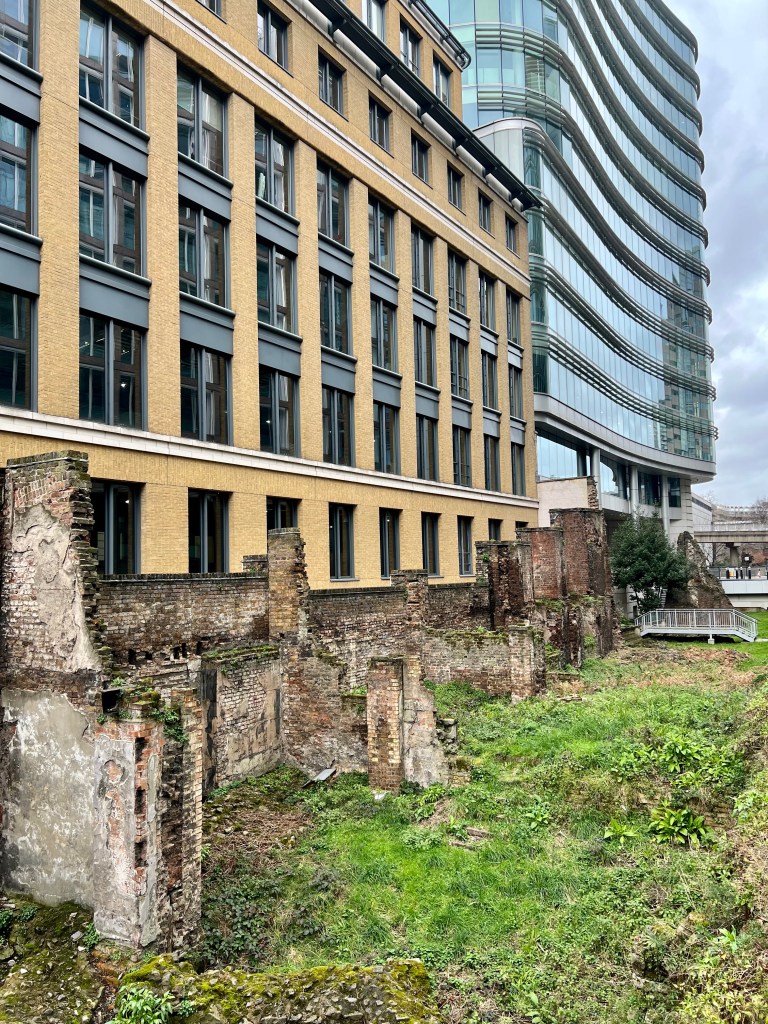
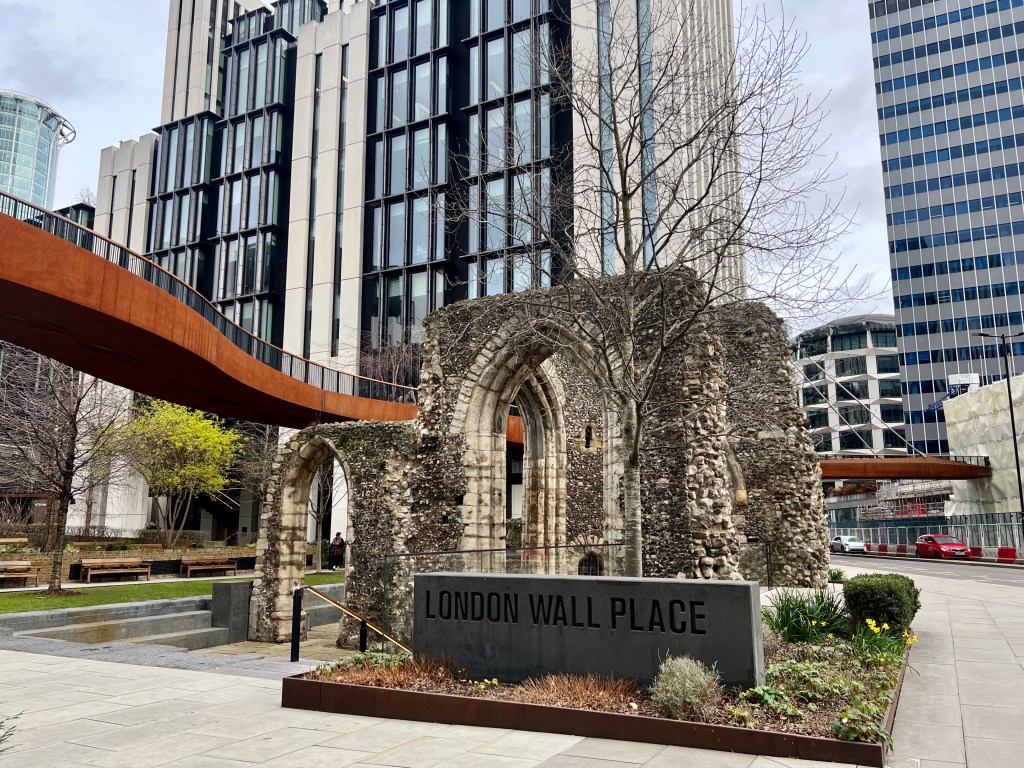
In the City of London, the remains of Roman walls juxtapose modern high rises. The destructive forces of the great fire of 1666 and the Blitz opened up windows into archiology of the ancient past. This was followed, over many generations by an energetic rebuilding.
The results of the ancient side-by-side with the modern are quite spectacular.
Most objections to markets of private goods are that, in their exuberance, they roll on by some social concerns. The industrious plant pollutes; the labor market does not support all families; the tech firm runs the table to accelerate advancements in their field. It’s thought that markets allow the power of the purse to trample on the wants of the people.
So– the people make rules.
And that is where you see the counterarguments to the objection to markets. Even though we don’t think about it, marketplaces are formed by rules. Markets are a combination of people taking action, the objects in trade, and the marketplace where it all occurs.
New rules mean a new marketplace. And in that new marketplace, with either informal norms or formal rules around the social concerns mentioned above, a new set of prices evolve. In a bubbling and ever-unfolding process, the markets renew to the will of the consumers.
The morals of some groups will keep their marketplaces at arm’s length. The Amish live a lifestyle that remains separate from mainstream America. Some people will never buy crypto or derivatives as their uncertainty about the products gives rise to a fear of being duped. Others may only allow family members to care for their children.
But the argument that the combination of people, with all their human inclinations, along with the variety of goods and services they wish to voluntarily exchange, and the meeting place where buyers and sellers are brought together is inherently a moral abyss seems unsubstantiated.
How are memories illusive and vivid at the same time? An image of the room. Scented air through the window. A beep at a distance for the gardener to open the gate. Reading. Evening fires in a hearth. Classical music from a turn table. Count the instruments says a voice.
Can you picture it? I ask my brother. Yes, absolutely.
If you were to ask people what disappoints them about markets they would say that markets carry out their business without feeling, that they focus on pecuniary profits in the short run and forget about the little guy.
It’s true. The beauty of unfetter trade is based on the ability of unrelated people to transact without forethought to social obligation. That is the feature which makes them powerful elevating nearly all of humanity to some higher level than a century ago. So what kind of quandry are we in if the secret power is the not so secret downfall?
No quandary, just a shift. Pecuniary markets handle private goods in a fine fashion. There are markets for goods carrying a varying degree of social innuendo. Here you pay to belong. You exit when you want out. You give of your time and money to foster the nurturing of the social objective. It is still through discovery and evaluation of choices that consumers choose their municipalities, their school districts, their transit option.
People are disappointed when they look for the public market amongst private goods. It’s not there. So they cry foul!
For example, the job market spans a wide range of pay from part-time coffee pourers to financial wizards a la Warren Buffet. Clocking in at a Starbucks three mornings a week might be just what a retiree wants. The money makes it worth getting up a little earlier. But they are really interested in the job to get out of the house and interact with various people in a pleasant setting. One might even go as far as to say having this minimal low stress obligation is good for their health.
It wouldn’t work well if the only employment option was a latte mixer. And this is where the trouble starts. Some individuals are only able to pull down basic jobs, and others feel this is not right. They create a rule that every head of household is entitled to employment at a living wage. In this reframing it is decided that society, or the greater group, owes the working family a living wage.
It’s rather perplexing how the liberals feel about landlords. If in doubt check out this new round of rules and fees being proposed at the Minnesota Legislature.
The bill would also restrict landlord entry and apply fees to landlords for subsequent violations. It was approved and referred to the House Judiciary Finance and Civil Law Committee.
The bill offers few exceptions while outlining well-defined penalties.
The types of fees that would be banned include those for move-in, move-out, vague administration practices, lease processing, amenity and access to rental portals.
“HF315 would prohibit those non-optional fees for non-optional services,” said Rachael Sterling, a housing attorney at HOME Line.
“This is different from a pet fee or parking fee a tenant can elect to add to their monthly costs,” she said.
Violators would pay either three times the amount of each unenforceable fee or $500, whichever is greater. In addition, the court could award reasonable attorney fees to tenants.
Landlords entering residential properties could be limited to a four-hour window between 8 a.m. and 8 p.m. and be required to give at least 24-hour notice. Instead of a civil penalty of $100, minimum penalties would have to match or exceed one month’s rent and reasonable attorney’s fees.
Are there really that many landlords entering units before 8am and after 8pm? Because it seems to me that most business people would prefer to be at home during these hours. The move-in move-out fees could be reflective of a condo building’s rules to charge accordingly. But I’m splitting hairs.
In the bigger scheme of things, I’m just not sure why progressives don’t jump into the rental business, buy some buildings and rent them out? Every time there is a market downturn I hope that one of these groups sweeps up a bunch of properties and rents them out.
Yesterday the mayors of both Minneapolis and St. Paul, Frey, and Carter, stood up with attorney general Ellison to demand that two car manufacturers recall their vehicles. Why? Because they are not contributing to the public good.
In the past few years, the public’s peace of mind has been greatly unsettled by the propensity of young folk to steal cars. Carjacking they call it. Usually, the roughians just flat-out taking the keys off a mark. The Minneapolis crime map conveys the message.
The mayors are responding to a terrific increase in the number of car thefts in 2023.
In a message released Friday, the police department said there were more than 700 car thefts in January, along with 33 carjackings and “260 Thefts from Motor Vehicle.”
And then the politicians called on Kia and Hyundai to recall all their vehicles that do not have anti-theft technology. Because- “They have an obligation to keep people safe. I have an obligation to people in this city,” said Frey.”
I think both mayors have congratulated the capitalist system in a backhanded way. Manufacturers, in the process of reading their consumers, voluntarily introduced anti-theft technology to their products. Since business is a competitive process, this will undoubtedly become a standard feature.
Markets solve the problems people demand from them. They work for the public good as well as the private good.
My college senior has already decided he would prefer a job with a minimum of two days a week in person. For the past year and a half, he has been employed as an IT intern doing web design. This work has all been done remotly. Covid pushed all these jobs out of the brick and mortar buildings.
But if a 21-year-old is anxious to be back in person, maybe work life, commutes, and happy hours will return. It’s just not that interesting, he says, to sit by himself at the computer all day.






















 Home Economics