
MN crime update
Searching for value

The Glasgow people do take pride
In their river both deep and wide,
In early times the youth and maid
Did o’er its shallow waters wade.
But city money did not grudge,
And dug it deep with the steam dredge,
And now proudly on its bosom floats
The mighty ships and great steamboats.
No wonder citizens take pride
For they themselves have made the Clyde,
Great and navigable river,
Where huge fleets will float forever.
Dunbarton’s lofty castle rock
Which oft’ has stood the battle’s shock,
The river it doth boldly guard,
So industry may reap reward.
But more protection still they deem
Is yet required so down the stream
Strong batteries are erected,
So commerce may be safe protected.
Old ocean now he doth take pride
To see upon his bosom ride
The commerce of his youngest bride,
The fair and lovely charming Clyde.

A millennial in our family is a natural story teller. He captures the room, and doesn’t disappoint. The yarn maybe local or from abroad, it may include self-ridicule and human foibles, but it will always tease out laughter from the crowd. There are the words of course, but the delivery is timed, the pauses on point, the gestures and facial animation delightful.
He’s not one of those center-of-attention people either. The ones who propel themselves forward on a wave of egocentricity. So I was a little surprised when he started ribbing his dad over his style of narration. “It’s just that you and R always dive deep into the whole relations thing. This person was related to that, then they were divorced, and those two are second cousins to this that and WHATEVER.”
“Get to the story,” the middle aged man lamented. What’s the purpose of all these relations?
His father and uncle would mull, hesitate and then correct themselves as they identified each individual, who happened into their story, by clan. And quite often there was an off-shooting telling of why they lived on this farm and no longer lived on that one, or who they were married to way back when.
This wasn’t Christmas after all, so why replicate Matthew, Chapter 1?
For people like his uncle, who had lived his entire life in a community, knowing the relations is part of the story. It fills in an understanding that otherwise leaves questions unanswered. It tallies up and equals out exchanges that only make sense against a backdrop of community history.
The urban youth has no sense of such lingering ties, except perhaps in his own immediate family. But to live in a small town is to carry a ledger of chits and repayments.
The following infographic compares total venture funding in Real Estate Technology to the number of companies in each category. Which Real Estate Technology categories do you think have the most traction and potential for growth? At Venture Scanner, we are currently tracking over 642 Real Estate Technology companies in 9 categories across 46 countries, with a total of $9.5 Billion in funding. To see the full list of 642 Real Estate Technology companies, contact us using the form on http://www.venturescanner.com.
Venture Scanner
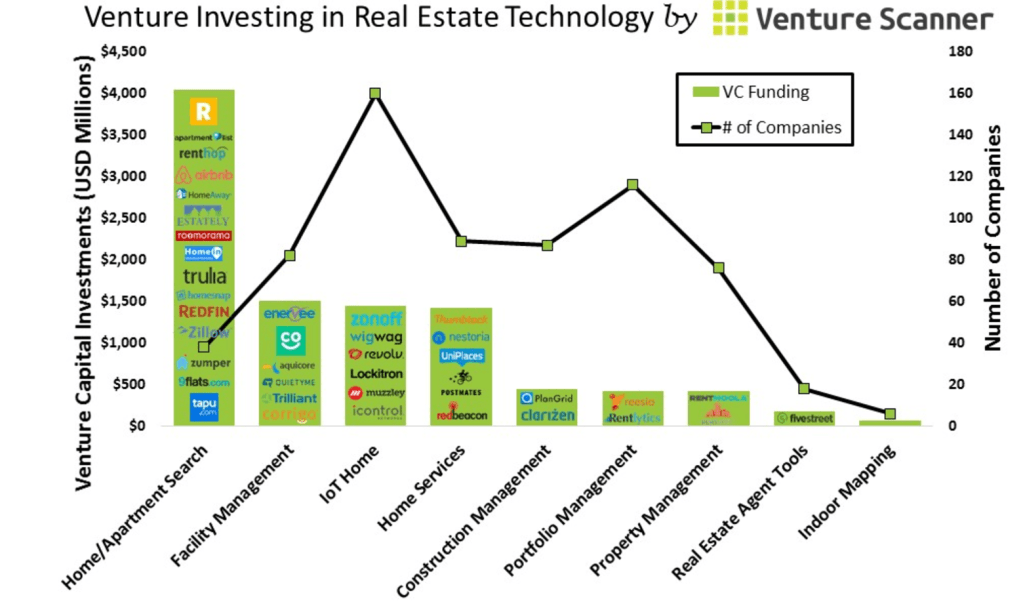
Since Zillow and Trulia became part of the real estate experience over a decade ago there has been an onslaught of technology companies attempting to disrupt the business.
Yet realtors and clients are, for the most part, going through the same processes in a move as they did in generations past. Was technology more about how information is delivered than about a new means of moving (in the purchase and sale of real estate)? Is technology providing a means of communicating and marketing instead of fundamentally changing the real estate transaction?
Maybe more on point is which of these technology companies will survive by providing a superior service and which will go to the wayside.

The husbands portrayed by Chaucer are uniformly unromantic and pathetically unheroic. Rarely in literature have males been so roundly ridiculed, so easily cajoled, and so blandly cuckolded. Chaucer’s married men are regularly henpecked, humiliated, beaten, betrayed, and exhibited as objects of defenseless servility. In a few rare instances-“The Knight’s Tale” and “The Franklin’s Tale” are two of them-Chaucer allows that marriage and love can flourish in the same bed. But the poor husband is at peace only if he relinquishes the role of master and remains a servant to his termagant spouse.
Lives of the Poet’s, Louis Untermeyer
Apparently the macho male, master of his family, is a more modern creation. From the 1300’s to today, something changed in the power structure of marriage. Domestic power in the Middle Ages swilled around the women. And Chaucer didn’t mince words on how its influence appeared in the fairer sex.
Women as women, however-and, in particular, women as wives were terrible realities. They were not merely shrewish but shameless, garrulous, greedy, disloyal, and licentious. Worse, they were united in an un written but universally recognized conspiracy to subject their husbands to every possible indignity. The husband of Philippa cannot be definitely identified with the creator of The Canterbury Tales, but it is unlikely that a happily married author would speak so scurrilously of the marital state and take obvious pleasure in so many humiliating incidents, grimly detailing the triumphs ofSo wifehood and the ignominious capitulation of the woman’s miserable partner.
In the 600 years since Chaucer is thought to have wrote The Canterbury Tales (around 1380) household power dynamics made a mighty shift. Now that women have come back into their own, maybe it’s time to be on the watch once again for the hen pecked husbands.
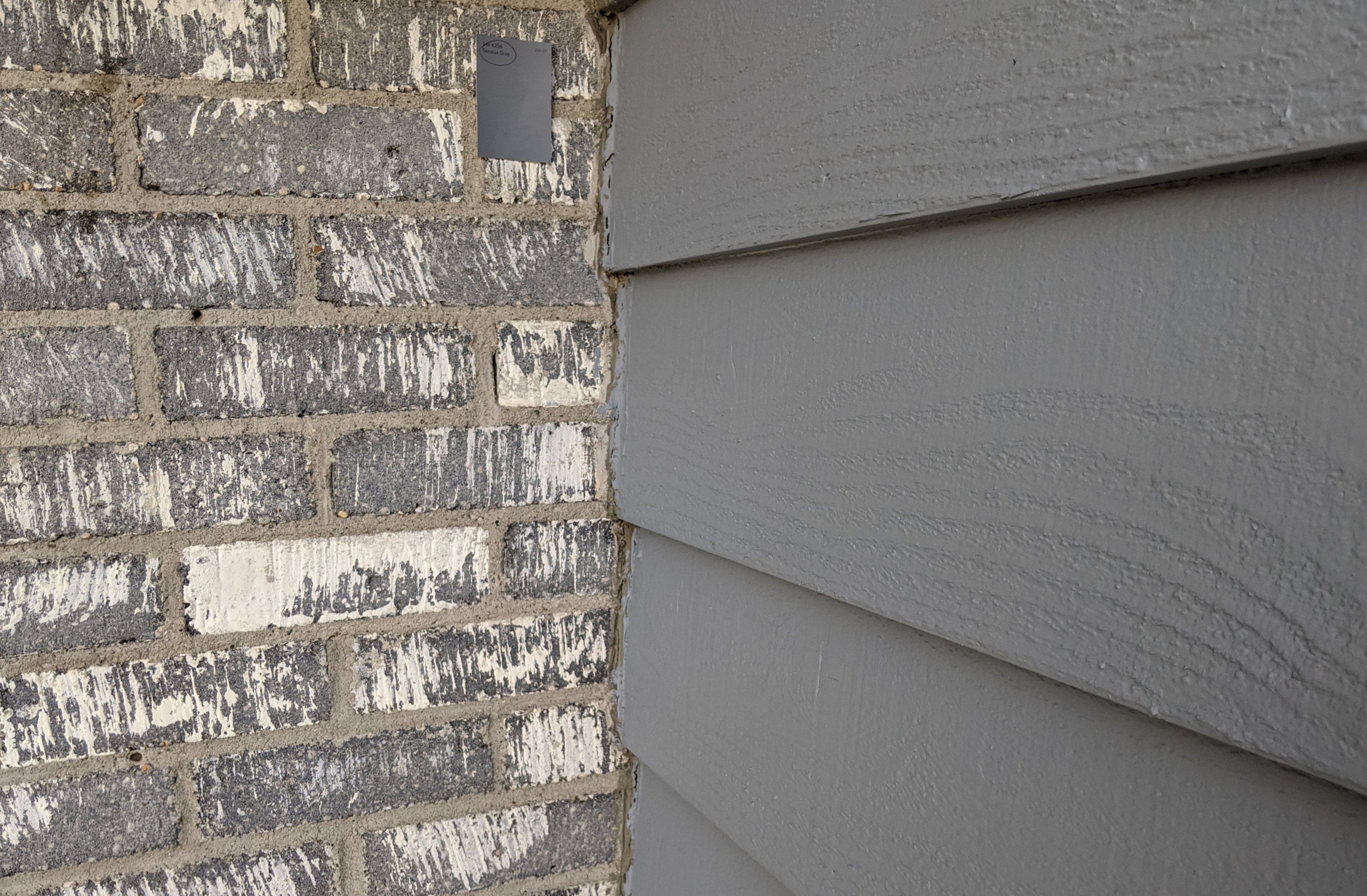
Our 33 year old home needed a complete repaint. We had painters out over the years to paint south and east side. I’d tackled the bits in the front around the brick facia. But a color change and some wood repair were in order.
This wasn’t the first year the birds had hollowed out one of the old knots in the cedar siding to nestle in a hatch of their young. The downy woodpeckers had interrupted my work day last fall and would only fly away to the nearest branches when I leaned out the window and banged on the wood.
This spring brought new visitors. Squirrels leapt from our ash tree to the roof and pried open a bit of the bargeboard to let themselves in. “That’s it!” I declared to my husband, “there are more critters living in our siding than people under this roof.” Finally, I had won the argument.
Diligently I called out three painting contractors, walked the perimeter of the home with them discussing color change, no color change and all that is paint related. The bids came in and, as often is true, there was a fair span in the numbers. The one we chose was the most economical but, perhaps more importantly, they were the only ones who did wood repair in house.
After a bit of a wait (three months- there is a shortage of workers in our fair metropolitan area) Miguel appears as a one man show. He has an extensive collection of aluminum ladders. His supplies and tools are neatly laid out on tarps. And he’s got a little paint splattered radio that belts out classic rock.
Now our house is two story on the street side dropping to two and a half in the back. I’ve been up on a ladder only three quarters of the way up, feeling sway of the rungs as I progress upward, the earie nothingness of being up in the air. Not Miguel. He’s moving up and down those metallic stepper machines. There’s at least three of them leaning against the house at any one time.
It was not always peace and Orlando and Dawn, however. One morning he I could hear the ladder knocking the side of our home as I imagine he was struggling to get the draw cord to extend it upward. “Puta!” he yelled at it more than once. Did I mention he was from Costa Rica?
Much of the time the tunes were drowned out by the pressure washer or the power saw cutting up repair pieces, or the shop vac as he vacuumed up the paint chips from off the landscape rock. The paint sprayer droned away as it coated the whole caulked up, primed over, cedar clapboard encasement. “Twenty-Seven gallons,” he bragged to me, “the wood just kept soaking in the paint!”
The guy was amazing. He was so focused on the task at hand I thought if I interrupted him it might throw his momentum. When he had pretty well wrapped things up he stood back a house away, arms folded, and took in his work from the sidewalk. It did look fantastic.
My brother stopped in from out of town the following week. As he came to the front door, he touched the siding and said, “this is what we need to do, get new siding.” Yes– Miguel had made the whole exterior feel new again.
Doesn’t it seem like people prefer to be angry at someone rather than at a situation? People want a person to blame not a set of unfortunate circumstances. There’s a need to create an visage to be on the receiving end of wrath.
Maybe it’s the awful boss instead of a mismatch of work tasks to worker. Maybe it’s the spouse who is irritating rather than an outside stress on a marriage. Maybe it’s the politician instead the vexing insatiability of social needs.
It must be more satisfying to the point the finger at a person, to shake one’s fist at them.
I suppose the desire to embody the frustration in a person, is that it makes for an easy solution. Separate from the person, and voila! the source of the rage is removed. Except it is not.
Placing the burden of anger at a person’s feet the easy. Understanding and seeking solutions to larger problems is complex and denies a quick solution.
This came across my LinkedIn feed today.

A few posts ago I mentioned the necessity to discipline ourselves a bit more before we share our opinions in public spaces.
There’s a time to be outspoken and a time to get along. This sign is requesting a ‘get along’ mindset before entering their building.
There’s an internal posting at our company for local non-profits who are looking for volunteers or resources. Here are the first several entries:
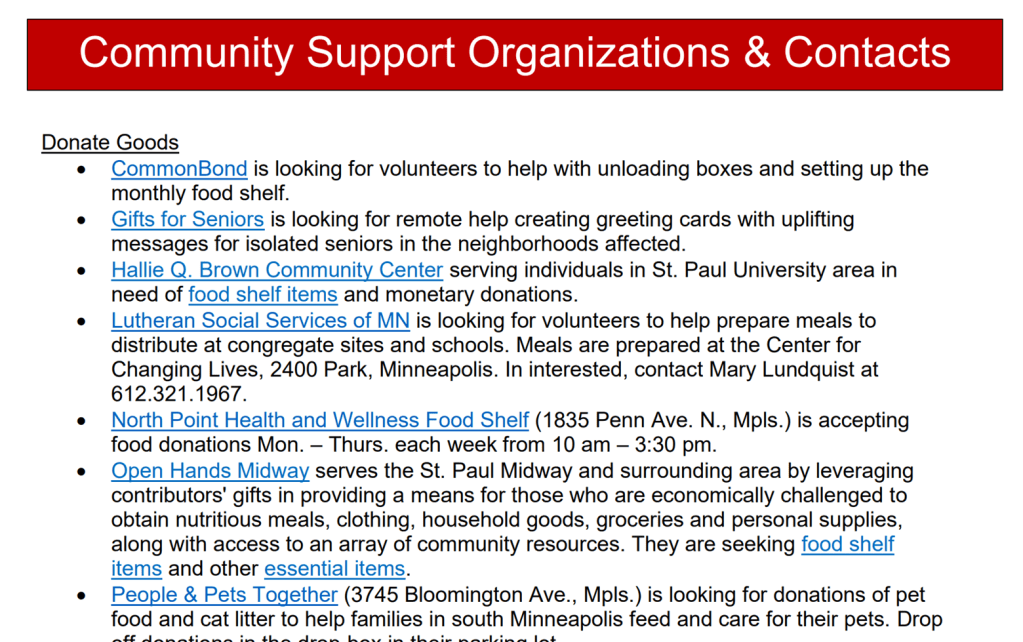
This is one way to get the word out, connecting suppliers with those in demand. I just realized where I can take some left over dog food that I’ve had in the house for a while.
But if I had my druthers, I think it would be useful to have a standardized non-profit snapshot. The information I would like to see as an investor would capture a quantification for the number of hours and dollars flowing through their system. Then it would be nice to see a rating for delivery effectiveness. Some sort of measure representing how much of the time and resources donated goes toward the services accomplished. Then there could also be a few other stats like size of paid workforce, total volunteer hours, length of time in business, service area.
A site connected to a data base with this type of information could be useful to donors and public funders alike.

It seems like July is vacation month based on the photos spanning Martha’s Vineyard to the Black Hills popping up on social media. Lots of quips about time with the family, delivered with various innuendos. Aspirations of time alone to read proffered as acceptable time off activity.
Personally, I’m dreaming of Northern Italy. Fly into Milan. Check out the fashion culture with my daughter. Find Da Vinci’s Last Supper mural painting at the refectory of the Convent of Santa Maria delle Grazie. Relocate to Verona. Bike around Lake Garda. It looks feasible to plan a day hike in the mountains just to the north.
Cap the trip off with a tour of Venice. Check out Piazzo Saint Marco, the bridges, the canals. The art. And reflect in the gold mosaics’ on the Basilica that it was the free flow of people and their goods which are responsible for the still lingering wealth.

I HOLD you at last in my hand,
— Exquisite child of the air.
Can I ever understand
— How you grew to be so fair?
You came to my linden tree
— To taste its delicious sweet,
I sitting here in the shadow and shine
— Playing around its feet.
Now I hold you fast in my hand,
— You marvelous butterfly,
Till you help me to understand
— The eternal mystery.
From that creeping thing in the dust
— To this shining bliss in the blue!
God give me courage to trust
— I can break my chrysalis too!

As a young adult I couldn’t figure out why my other liberal arts college friends rejected Wal-Mart for the more upscale Target for their basic shopping needs. Prices were better at the first (at least back then) and after living abroad where open air markets and shops with expired grocery items were common, lights, electricity and working refrigeration seemed luxury enough.
I was standing in line for the cash register one evening, after a long day at work, when it became clear. A few customers back in line, a mom taunted her toddler’s bad behavior with something intended to be discipline. Predictably, a wail spewed forth from the chunky cherub who was probably as tired as the rest of us. (It isn’t necessarily the big red carts which roll noiselessly over polished floors that make the bullseye more pleasant.)
Or, most of us have been at a social gathering where a couple simply can not contain the anguish currently residing between them. One throws an upper cut in the form of a small quip. The other gives an eye roll or swallows a guffaw. Their negative energy swills around the party on commentary and off the cuff remarks.
When I was at college we never framed each other up by political orientation. Well– almost never. There were a few jokes at the expense of the president of the Young Republicans (very ardent!). And the sandal wearing, longhaired hippy whose clothes billowed out marijuana odors might have been the butt of a joke or two. But nothing remotely similar to the angst experience on campus prior to Covid.
A mom is free to reprimand her child in public, but I’m not sure it is as productive as waiting until they get back to a quiet one-on-one setting. A couple is free to duke it out at a social gathering, but will find themselves alone with their problems once at home. Students can sign petitions, and march and jeer at the opposing parties. And here, I am sure they are ruining part of the experience that is called college.
All the hoopla around advocating for one’s political opinions has not proven to be all that productive either. If the taking of a knee, the shouting through a bull horn, the waiving of a flag is not advancing the cause, then it’s only being profitable to the petitioner. It’s really a privatization of a public concern.
Freedom of speech is precious and should be cherished. An audience can be receptive to the grifters who use it provocatively, or we can gently suggest a more appropriate place for personal conversations.
WASHINGTON (July 15, 2021) – A top official from the U.S. Department of Housing and Urban Development joined policy experts from the National Association of Realtors® on Thursday to discuss solutions for the nation’s historic housing supply shortage. The virtual policy forum went in depth on research commissioned by NAR and authored by the Rosen Consulting Group, which found that the U.S. is in the midst of an “underbuilding gap” of around 6 million housing units dating back to 2001. The report, Housing is Critical Infrastructure, has taken center stage in national conversations on housing policy, particularly after President Joe Biden last week reiterated his administration’s focus on housing as part of its broader infrastructure push.
https://www.nar.realtor/newsroom/once-in-a-generation-housing-inventory-crisis-in-focus-at-realtor-policy-forum
There is definitely a shortage of homes. Are they infrastructure? By definition infrastructure is a good which is shared by many– and for this reason it is inclined to be a public good. Bridges could all be fee based private goods with a toll booth taking up collection at either end. But they are provided in an open public manner because their nature lends itself to public consumption.
Homes lend themselves to private consumption. Every effort toward public housing has failed. Which leads us to pursue homes in a private goods market. The role of the public is to assist those who find themselves in need, by supplementing their ability to obtain housing in the neighborhoods which provide the greatest access to amenities which match their needs. Hopefully, with the long term goal of self sufficiency.
As far as the public’s role in fanning the coals on housing production, that is done by rolling back restrictions and costs involved in the home building process. The mumbled language of infrastructure and rehabbing unit dances around the two actions which would improve the lives of those without adequate shelter.
I was showing houses to a couple in the 90’s and the area they were fond of was full of split entry and bi-level homes. Abruptly Mr. Buyer spits out, “Nothing good came out of the 70’s. Not homes, nor music.” Partly he was referring to the floor plans, but the construction materials also had changed quite a bit from the plaster walls and hard wood floors of the 50’s and 60’s. Early sheetrock was not too pretty and plywood in far from hardwood.
Split entry homes have since cycled back into fashion. Pottery Barn helped out with their glossy representations of living spaces with heavy brown beams. These were standard fare in the vaulted living room ceilings of the 70’s. The dark trim thundered back into demand to edge out the new walnut stained floors. Golden oak was put to the door after a long run in the 80’s and 90’s.
I had heard the criticism of the splits before, but that my buyer would trash a decade of music all in one blow. I mean, this was the decade I received an electronic clock radio with flaps that clicked over every minute. It could wake me up for school with a song! Seasons in the Sun crooned non-stop that summer out of that little machine.
We were living abroad when someone brought Elton John records out to us. Who couldn’t like Bennie And The Jets, Rocket Man, Don’t go Breaking My Heart? I think the Boston album with a space ship on the cover was in that care package as well. What was it’s title? It’s More Than A Feeling. I don’t think I heard the Eagles until later that decade, but Hotel California is still a favorite.
By the end of the 70’s ABBA and the BEEGEES had created a whole new sound. Olivia Newton John and John Travolta brought the romantic musical to a new generation. I was in french boarding school at the time and everyone wanted a translation to You’re The One That I Want. I did what I could with the first verse:
I got chills. They’re multiplyin’. And I’m losin’ control. ‘Cause the power you’re supplyin’, it’s electrifyin’!
The words got a little easier after that.
Rodney Smith Jr has appeared in my twitter feed on more than one occasion. His tag line is: Making a difference one lawn at a time. He mows the grass that need to be mowed. A seemingly small thing, to mow a neighbor’s yard. But not only do they benefit, the neighbors benefit too.
I have no way of checking up on Rodney but he has 118K followers and his account reports over 9000 tweets. His posts are similar to the one above. Sometimes there’s a wave from the fortunate homeowner in the vicinity of Huntsville Alabama, his home location.
You might say he is the sales and promotion arm of the institution called neighborliness. There’s a story on every block of the neighbor who shovels the widow’s driveway, or clears the sidewalks before they ice over. Rodney not only has made a name in mowing, he has taken it to a new level. He created a 50 lawn challenge, and his followers are posting up and showing how they are playing along.
Two girls from Kentucky raised enough money for a trailer and advertise as You Mow Girls. A youth from Kansas signed up for the challenge and shows off his new T-Shirt. Another from Mississippi posts a photo of his first lawn. Kids from Oklahoma, South Carolina and Dayton Ohio are also in his feed, and that’s just in the last two days.
This guy is the Starbucks of lawn care. He’s taken a basic necessity and stepped up production across these wonderful United States. He’s connected with workers and their natural inclinations to help out. Rodney is handy enough with social media to show them the recognition that no one asks for, but certainly doesn’t mind getting.
There’s demand out there for more Rodney Smith Jr’s.

Am I the only one who finds it odd that there are not more books written about real estate? After all people love to talk about real estate. Yet the shelves of a national bookseller only bares a smattering of books mostly dedicated to passing a real estate licensure exam.

Lack of progress is often addressed with the ‘we can do better’ call to action. Things will get better if we just man the boat and check the weather. There is an assumption that everyone is sailing on the same winds. When in fact, there are people in the boat tacking against the wind or dropping the sails completely.
The naysayers can have the best intentions in mind. The naysayers can further the direction of the journey by making others fight for it, define it even further than they had originally considered. The naysayers help refine decisions. But sometimes the naysayer simply sink the ship.
Fences, a play written in 1985, is set in a familial scene where a father naysays his son’s ambitions of becoming a ball player. It didn’t work out so well for him, he reasons, so success will elude his son as well. He will save him the pain. Or will he? Does a father use his power as an adult out of faithfulness to old anguishes, or is he truly acting to cushion his progeny from life’s hardships?
The playwright, August Wilson, doesn’t render judgement.
But anyone who has been around a decade or more knows, to misuse a position of power is to tread away from progress not towards it. In this story, father derails a chance at a football career, so son leaves home and makes good in a military life. You might say he overcame his naysaying father, but at the expense of any further family support through early adulthood. You might say son was better off without them, but at the expense of their greater community.
Wilson, who wrote this Pulitzer prize winner while living in St. Paul, provides more examples of how social exchanges can fence in a family. In business, once the money runs out, no one shows up for work. The business shuts down. In family, chits and obligations can continue to pile up. When left outstanding others must step up to pay the bills. And then possibly others still.
South winds jostle them,
Bumblebees come,
Hover, hesitate,
Drink, and are gone.
Butterflies pause
On their passage Cashmere;
I, softly plucking,
Present them here!


The paper, Recreational and Resource Economic Values for the Peconic Estuary System, by James J. Opalueh, Thomas Grigalunas, Jerry Diamantides, Marisa Mazzotta, and Robert Johnston was written in 1999 as a study of the value of the Peconic Estuary system on the eastern end of Long Island. They used four methods to estimate value, but let’s compare just the first two: the hedonic pricing method using home values as the dependent variable, and a travel cost study. Here’s their introduction:
I.B. 1. Introduction and Overview
No single method can capture the value of the variety of services provided by the natural assets of the PES. Recognizing the many uses of PES natural resources, we designed and implemented a suite of four non-market valuation studies in order to provide estimates of the value of particular services:
(1) A Property Value study examines the contribution of environmental amenities to the market price of property. Using the Town of Southold as a case study, the Property Value study was designed to measure values of amenities to residents living in the immediate vicinity.page 11.
(2) A Travel Cost study uses original survey results to estimate outdoor recreational uses in the PES and the economic value that users have for four, key PES outdoor recreation activities: swimming, boating, fishing, and bird and wildlife viewing. This study also examines the impact that (A) water quality has on the number of trips and the value of swimming and (B) the effect of the catch rate on recreational fishing, important recreational uses of the estuary and activities much affected by water quality and resource abundance.
Now this report looks at a fairly significant natural amenity, but isn’t the idea that residents place value on any public open space going to be subject to the same analysis? Whether a park with playground equipment, a lake with a swimming beach or a ravine with hiking trails; all these open spaces are valued both by homeowners who live in close proximity as well as others who come just for a visit.
The first approach the authors use to estimate a value of the public amenity is to calculate the portion of the home sale prices which can be attributed to the proximity of the natural resource. The idea behind the process is, if you could have exactly the same home, how would the value of the home change as it moved away (or toward) the public amenity.
We apply economic methods using the property value (or “hedonic” method) to a database comprised of all Southold real estate transactions in 1996 and GIS parcel coverage data for the town. Briefly, the analysis estimates correlations between property values and levels of valued environmental attributes, including open space.
page 27
Here is a further explanation on how the regression model works:
The Property Value technique is based on the assumption that a relationship exists between the market value of a property, and the characteristics of the property. The Property Value method uses a statistical technique called “multiple regression” to assess the impact of each characteristic on the market value of the property. The technique simultaneously compares a large number of properties with different prices and different levels of each characteristic. The method establishes which characteristics are associated with higher values, which are associated with lower values, and which have no significant impact on values. The model also estimates the dollar magnitude of these impacts–that is, it estimates how large an impact is likely to be caused by a specific level of a specific characteristic. Using this technique, the impact of different environmental amenities on nearby property values can be estimated.4 The technical details of the property value model (or hedonic technique) are presented in Appendix A.
page 16
Please read further through their paper for the statistical details, but what I would like to focus on is the equity, or capital, which is captured in each home due to its association with a public amenity. Buyers and sellers in a well functioning marketplace are bidding on the homes and thus determining what the market will bare for this infrastructure (not sure why it is considered a non-market approach). There is a premium in the offer price for greater access, hence they are pricing out the desirability of the public good.
In addition to what the authors derive as dollar figures for the market value retained by residential properties, they also note that there is value to people who use the estuary from a distance. This value is derived by a second process in step two. It is done by estimating number of visits, or trips made to use the open space. In a sense it is a user fee estimation.
I think they go awry by shifting from a capital perspective to a user perspective. We pay our water bills on a user based system but that does not represent the value of having the pipes in place to pump fresh water to all residents. And certainly metro user fees do not equate with the cost of installing mass transit. Analyzing visits more appropriately syncs with management issues such as how many lifeguards to have on duty, how often the trash bins need to be emptied and so on.
I offer a platter perspective for the inclusion of the value to the greater public who use the estuary. The residents adjacent to the estuary, who enjoy a view over an open space and a walking trail out their back yard, enjoy one level of access. The group of people who live in the local town have another relationship. And people who visit from across the county may derive yet another coefficient in front of the data which represents access to natural amenities within their reach.
At each level exists in an eco system- or platter– and a data set representative of the value of these public goods.
Far and away the biggest obstacle blocking first time buyers from owing a home is fear. There are two types. Fear of the house. And fear of a poor decision.
The purchase of a home is one of the bigger commitments the average guy or gal makes in their life. And the product is a large, multifaceted, multi-mechanical type of a thing. Most people lack a thorough understanding of all that exists behind the sheetrock walls, the workings of the appliances or what exactly is, or is not, connected at the street.
But sign the papers they do. Nod at the inspector as he or she prattles off a variety of flaws in the property. It isn’t any specific understanding of a home that makes buyers secure in knowing everything will be alright. It’s that they most probably have parents and siblings who own a homes, and since they do it– hey it can be done!
When you don’t have that family background of assurances, you don’t have that same sense of security about the whole thing. If a landlord was always the one to fix something, or a management company ‘sent someone over’ then a whole bunch of conversations about ‘what do we do when this happens’, ‘what’s the best way to handle things when that happens,’ and ‘good grief we don’t call a plumber for that, do you now how expensive they are?” went missing.
And if you’ve never eavesdropped on such an analysis, then fear fills up and grows in this void, the void left by not knowing who exactly to call when this beast of a thing called a house has an issue.
Then there is fear number two. The fear of making the wrong choice and having everyone else in on the mistake besides you! For some reason there is frequently a large audience in on home buying conversations. Said audience has plenty of opinions, even when they themselves have not been in the market for over a decade. And these are generously and gratuitously provided.
Many buyers can get caught up in the moment of an objection presented in a workplace conversation, but after further vetting the issue with other homeowners they often right themselves back to an even keel. Those who have few homeowners within their networks are pressed to gather enough information. They don’t know who to trust. There are disparate levels of confidence.
Although the classic policy response to getting more renters into homes is pecuniary, my sludge audit reveals that it is social, as opposed to financial, support which is lacking.


Thanks to Praveen Wijesinghe for posting on Google maps, confirming that once upon a time I was in Polonnaruwa.
Here’s a fun game you can play if you are presently in the market for a home. One could consider a variety of home characteristics, but if you are in the market for a school district, the pricing lines should be very crisp. And you must be in the market for your own family. Speculating on what others will do just isn’t the same.
If you are not familiar with hedonic regressions, it is a mathematical process where given a set of data, which is subjected to an equation built with defining characteristics, the numbers reveal the various levels of importance of each feature. If we are looking at housing prices, the coefficient in front of the school district data will tell how much of the home price was dedicated to that selection.
But you don’t have to be a math geek with access to a bunch of data to come up with a result! I’d say any buyer who is seriously evaluating this choice can shoot from the hip (after looking, bidding and seeing the values the properties commanded at close). Ideally you want to be considering two school districts which both contain similar homes to choose from within their school boundaries– say a 90’s built two story with four bedrooms up and a nice yard for the kids.
Even non-number types of buyers will be able to discern the differences when their money is in play, or their abilities to access other ideal features. School districts can swing a home value price as much as 15%, so on a home of $450K, a $67K difference. That’s noticeable. And consistent opinions about districts, which affect a great number of buyers, filter out in the numbers.
Buyers do not need regression models to calculate the price of other features. The distance to job centers, for instance, or the premium for a prestigious neighborhood. People will pay to be closer to work in order to spend less time in the car. They will also pay for neighborhoods with corner restaurants, quaint historical business crossroads and neighbors with recognizable names. The numbers here are large enough so that no pointy pencil needs to scratch out a calculation.
But there are hundreds of neighborhood features which are priced out in the offer on a home. And many of these could be better understood with the help of a little math.

I have a little shadow that goes in and out with me,
And what can be the use of him is more than I can see.
He is very, very like me from the heels up to the head;
And I see him jump before me, when I jump into my bed.
The funniest thing about him is the way he likes to grow—
Not at all like proper children, which is always very slow;
For he sometimes shoots up taller like an india-rubber ball,
And he sometimes gets so little that there’s none of him at all.
He hasn’t got a notion of how children ought to play,
And can only make a fool of me in every sort of way.
He stays so close beside me, he’s a coward you can see;
I’d think shame to stick to nursie as that shadow sticks to me!
One morning, very early, before the sun was up,
I rose and found the shining dew on every buttercup;
But my lazy little shadow, like an arrant sleepy-head,
Had stayed at home behind me and was fast asleep in bed.
Source: The Golden Book of Poetry (1947)
I happened to pick up this novel by Graham Greene at a recent visit to an estate sale (an excellent source for interesting books). I’m sure my hand fell on it as it reminded me of so many books that floated around my childhood home. Bindings with the likes Le Carre, Mitchener, and Follett printed on the spine, littered our book shelves.
I had read a Greene book before, and enjoyed it, but the fact that I can’t recall its title is proof that it left little more of an impression. This one is a different story. It does not surprise me that BBC News listed The Quiet American in the top 100 most influential novels.
I always like a puzzle, and the first pages tell of a murdered American. But this intrigue quickly falls to the background behind group ambitions. The CIA has its objectives, the British journalist his, the French colonist theirs and the Vietcong their own. Each character acts as one but is representative of many.
And each tells of their domestic obligations. The focal point of this angle of the story is the rivalry for the affections of the beautiful Phuong. Guided by her sister’s advice, the young goddess pursues a marriage contract over loyalty, highlighting the traditional stringent norms of the Brits versus the immature brashness of the Americans.
Post world war two spy novels are one of my favorite genres. They are old fashioned now and carry a very male dominant perspective, but the international settings and inter-country conflicts will always hold my interest.


You know how you feel the same as you did when you were twenty years younger, or thirty-five years younger? The thoughts you carry are often the same, or slightly developed. So this leads us to think our physical appearance, or age, may just as well be the same too. The shock only sets in when, for example, a newscaster on the nightly news looks to be about twelve. That’ll make you straighten up.
This isn’t the only thing in life we fool ourselves about. For some inexplicable reason we all are blinded to many of our own flaws. For that matter we don’t always see our strengths very well either. As good as the mind can be at analysis and observation of others, being frank with ourselves is out of reach.
This can be a problem. Perhaps we don’t realize our potential. Perhaps we pursue the wrong things. Perhaps we get ourselves into trouble by telling ourselves we’re really not doing the things we are in fact doing.
It should be as easy as looking into a mirror. And in a way it can be. Most of you have probably noticed how we carry similar traits as our families. I didn’t grow up in close proximity to my cousins, but when we get together our phrasing can sing out the same tone and emphasis. In addition to physical traits, families carry interactive traits. And in observing these we can fit ourselves into the potential of similar activities. We can learn from it.
So when you see your families tomorrow for your Fourth of July celebration, appreciate that they are all reflecting little mirrors back at you. Take it in. Make the information useful. And thank them for this subtle unobtrusive feedback.

The soft golden color of late-in-the-day sun is nature’s best stage lighting.
 Home Economics