Blooms in DC

Searching for value


The conversation around housing always seems to be one of demand. We need more affordable housing! There are homeless people who need a safe place to live! There aren’t enough rental units!
What if, instead of demand, we thought in terms of the supply. Not even necessarily in terms of the supply of the physical structures as much as the physical structures in conjunction with the neighborhood attributes.
For instances, there are several examples in Rochester and Perham MN where businesses have banned together get involved in the process of suppling workforce housing. It came about because they had jobs to fill and potential employees could not afford to live within a reasonable driving distance of the workplaces.
There is a history of missionary types of people hosting new immigrants to our country, of supplying them with housing until they get on their feet.
Maybe if more thought was put into supply-side housing, instead of incessantly pounding the drum of demand, we could see our way to more solutions. Or maybe if we could see the constraints that are holding back the natural inclinations of supply, we could ease them to allow for more forms of shelter.

Some politicians don’t buy the idea that an additional supply of housing units, at any price point, will lead to more units of affordable housing. They do not accept that increasing the number of units overall, or greater supply, reduces costs.
What they see are swanky high end homes being built and swanky high income people moving in and absolutely nothing happening to the other end of society. So who’s to blame them?
In order to assist in smoothing out some of these misconceptions, it’s necessary to beg people to accept that housing is not an ordinary commodity, like clothing. Everyone needs housing and clothing, but that’s where the similarities ends.
Poli-types and activists talk about affordable housing as if it were one line of housing, like an evening gown is one line of a designer’s seasonal collection. If you only make evening gowns there’s nothing for the average Joleen to wear. We must sew up some practical shirtdresses! It’s that simple: Build affordable housing.
There are two conceptual problems with treating housing like clothing (just pick the right line for goodness sakes!) Housing is a good that is used and reused as opposed to being disposable. And secondly, in part due to this, over time (time is important) depending on how much maintenance it receives (maintenance is important) a home’s usefulness and hence value fluctuates.

When left unattended for too long, the structure depreciates and the land it sits on becomes disproportionately valuable.
Whereas a community doesn’t want too much time to pass with too little maintenance (which creates slums), this is often the scenario playing out for NOAH (naturally occurring affordable housing). A long time landlord may get to the point of not being energized by upgrades and flashy renovations. He or she may be riding out the property’s usefulness as long as the tenants are amicable.
But time never stops. And mechanicals get old. So these situations are only sustainable for so long. When left unattended for too long, the structure depreciates and the land it sits on becomes disproportionately valuable. Down comes the structure to make way for a swanky new one.
Since new is expensive, expensive people move-in. But as long as the new construction is adding units to the pool of housing, and not just being filled with newcomers, then homes are freed up for folks to stair step up through more choices.
The condo market continues to have growing inventory in this fast hectic market. (Or maybe part of the market is hectic because condos are being ignored.)
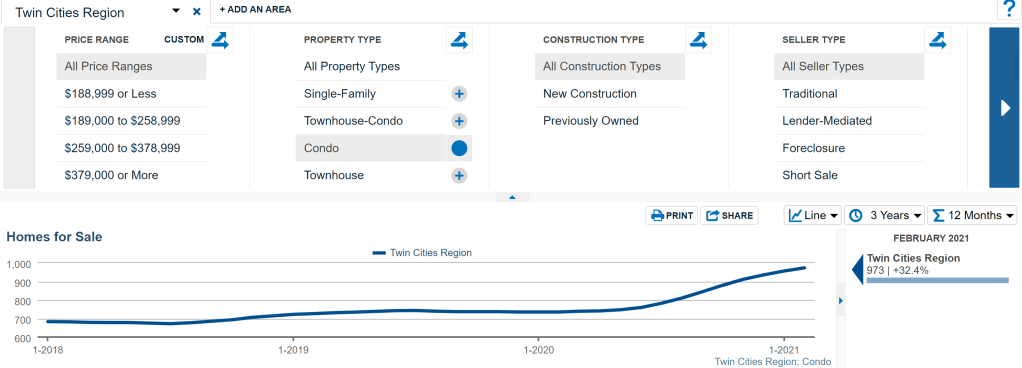
Either way, this won’t last forever folks! The extra inventory allows for better selection and better pricing. But in that funny way markets work, this opportunity will be taken for granted until it’s gone. Then there will be regrets.
I came across a new word today in James M Buchanan’s Essays on the Political Economy. In his second essay, The Public Choice Perspective, he says:
I shall refer in the following discussion to two separate and distinct aspects of elements in the public-choice perspective. The first aspect is the generalized “catallactics” approach to economics. The second is the more familiar homo economicus postulate concerning individual behavior. These two elements, as I shall try to demonstrate, enter with differing weights in the several strands of public-choice theory, inclusively defined.
He goes on to explain what the catallactic part of the economy means as used in his POV.
The approach to economics that I have long urged and am urging here was called by some nineteenth-century proponents “catallactics,” the science of exchanges. More recently, Professor Hayek has suggested the term “catallaxy,” which he claims is more in keeping with the proper Greek origins of the word. This approach to economics, as the subject matter for inquiry, draws our attention directly to the process of exchange, trade, or agreement to contract.
Then he elaborates to distinguish traditional economics as the exchange between two individuals, versus the catallactic form as an exchange between groups of people.
If we take the catallactics approach seriously, we then quite naturally bring into the analysis complex as well as simple exchange, with complex exchange being defined as that contractual agreement process that goes beyond the economist’s magic number “2,” beyond the simple two-person, two-commodity barter setting. The emphasis shifts, directly and immediately, to all processes of voluntary agreement among persons.
This seems like more than a point of view. This is the foundational understanding of the comprehensive economic apparatus.
There’s a new paper, Lessons from Denmark about Inequality and Social Mobility, by James J Heckman and Rasmus Landerso. Here’s the abstract:
Many American policy analysts point to Denmark as a model welfare state with low levels of
income inequality and high levels of income mobility across generations. It has in place many
social policies now advocated for adoption in the U.S. Despite generous Danish social policies,
family influence on important child outcomes in Denmark is about as strong as it is in the United
States. More advantaged families are better able to access, utilize, and influence universally
available programs. Purposive sorting by levels of family advantage create neighborhood effects.
Powerful forces not easily mitigated by Danish-style welfare state programs operate in both
countries
What I find interesting is the framing of their analysis around neighborhoods. They find that even though teachers in Denmark are paid the same salaries, there are still different outcomes for children which appear to be a result of families sorting themselves by neighborhood.
One good example of this phenomenon is the quality of schoolteachers by clusters of parental
characteristics. In Denmark, teacher salaries by neighborhood are mandated to be equal. That is
a force for uniform quality of schools across neighborhoods. However, uniform quality is not the
actual outcome in Denmark.
The sorting continues down through to the teachers.
There is a strong positive association between the characteristics of parents, on the one hand, and the characteristics of teachers on the other, despite equality in wages.
Even with an equalization of monetary compensation to the educators, the more established families gain the preferred access to education. And thus equal opportunity to education is not being realized.
But is this one of those everything-should-be-equal that makes sense or is counter productive? Are the measures and classifications and groupings done in a way that divvies up into a state of balance?
I don’t think it is a controversial notion that those on the lower rung of academic performance are more likely to be motivated by seeing themselves in their teachers and mentors. And until those teachers and mentors are brought along into this higher level of academic delivery, the system that looks for those mentors will have unbalanced delivery systems. By choice. And this may very well be the best delivery for that moment in time.
Here is a scenario where fine tuning and focusing in on what is thought to be an issue of equality maybe sabotaging the path for greatest progress. By drilling down to the tier of the individual, one dismisses the group. To bring along the child can only be done by bringing along their larger group, including their parents and teachers.

It might be my imagination, but I sense a subsurface tension in the teaching community around the issue of the extended Covid school closings. It lurks like other things you can’t quite detect: a high pitched dog whistle or the floor beneath your feet right before a quake. Or even more material things like the moisture on your brow and that earthy smell in the hour or so before thundershowers roll in.
As long as the virus is still taking lives, the topic is off the table. But soon everyone will be vaccinated. Soon the teachers will be taking account of where exactly their students are at in the curriculum. Some who normally enjoy the challenge of working with the most in need, may find their charges have have slid in arrears, past due even for assignments pre-Covid.
Without the structure of school, without the routine, without the expectation of someone waiting for them, recognizing them, without the the fun as well as the drudgery of the school environment, they simply stopped paying any attention to their education.
As an outsider looking in, it seems the teacher’s union towed a tough line. The virus put teachers’ lives at risk. The end. Apparently their work is not essential to the functioning of society. Decades of negotiating wages and benefits right down to each and every minute of their instructional day has made it easy to disregard any intent of the job and only see their work from a pecuniary point of view.
How the teachers who carry an old school sense of service to the community feel about this very privatized manner of handling their chosen profession is yet to be seen. Unions deserve credit for elevating teachers’ wages, and after all, spirit or no spirit, one has to pay the bills. Still–in years gone by, teaching was more of an employment of the heart, it involved a sense of duty, and was regarded as such.
So this cocooning of teachers away from the public while grocery workers and nurses became celebrated frontline workers, this buffering of their duties to educate seven, eight and nine year olds through Zoom screens can’t possibly fulfill the desire to be in good standing within the community. Some might feel the dignity of their work has been stolen out from under them.
Maybe when they were young pups trying to figure out their career choices, they absorbed the fact that teaching would pay less than other professions in business or law, but as a counter balance, they valued the sense of contributing to a greater cause. Teachers are trusted. Teachers are a source of advice. Teachers have the ability to play the role of a connector. At least for now.
For every minute of labor, the union has monetized their job. Perhaps the process has squeezed out any compensatory allocation to good will, to the noble cause. The power of the union is to talk in one voice. Then there is little hope of those within, who oppose its direction, being heard in any way.
This is all speculation on my part, of course! Classes are resuming, and by next fall all the soldiers will be marching to the old familiar cadence. Everything will be chalked up to the unprecedented and unanticipeted year of the plague. No matter. A little inkling persists. If you strip all the community value out of a labor force who is inspired by it, has worked for it, defends it; if you monetize every last moment of their day, at some point workers will revolt.

In honor of the alignment of the rising sun on the spring solstice between the ancient stones of Stonehenge, here is picture from my visit in the mid 1970’s. I do remember the now UNESCO World Heritage site as being well attended. And from the lack of grass around the ancient stones, it seems that everyone was allowed full access to the area.
“Get it in writing!’ is the advise offered when entering into a contract. Too true. In particular when the parties have no relationship. If you want the law to back up your claim in an agreement, then it is a lot simpler if the terms are written out and both parties have signed in acknowledgement.
However, things aren’t always spelled out in a contract. A while back, in small claims court, I listened to a judge pull the rental agreement between a duplex owner and a tenant, one question at a time. It was clear he had some experience ferreting out these types of arrangements, to help settle who owed what to whom. He didn’t seem aghast that the plan at hand was verbal not written.
And before you judge, how many times have you clicked through the ‘I accept’ box without taking a moment to read what it is you are accepting? Written out yet neglected. We rush around our lives assuming the best.
Sometimes no one is clear what that ‘is’ is in particular. Technology has generated some truly stunning options, options unanticipated. When facebook provided that opportunity to reconnect with childhood friends around the world, it was intoxicating. Did I click right through the user disclosures agreeing to let their algorithms stalk my life and sell the information to advertisers? Yep. (or wait–were their any concerns of data privacy at the start?)
Written or not written. It’s not practical to put every moment of our lives into a written contract. Say you wanted to ride share with another family. You divvy up the chore, one takes the girls to girl scouts, the other to lacrosse practice. Stuff happens. Things get cancelled, rearranged, people have to be flexible.
Maybe one family does bare an larger burden. There’s no official settling of accounts, but for the relationship to sustain further commitments of work towards the children’s on-going experiences, more than likely there is some sort of make-up. Interaction continues. And this pattern can be seen in workplace groups, covering for each other or coordinating on projects. Work, exchange, work.
And when this pattern continues over a long period of time, people trust it. They rely on it. Home buyers, except for rare exceptions, diligently sign the stack of documents as indicated by the manicured finger of their closing agent. There’s no flinching at the part where the bank can foreclose for non-payment. Buyers rely on the knowledge that banks are competitive, consistent and regulated.
Consumers rely on a business climate. That many thorny issues have already been washed through mediation or courts by objectors who took their time to point out injustices. How can that be? It’s certainly not true everywhere in the world. The answer might be something like, “In the US we have institutions which allow consumers to trust the mortgage financing system.”
So in effect, institutions are the culmination of work which goes to enforce unwritten contracts on how to behave in (this case) the mortgage business. We have written contracts too, of course. But the trust in the system, the cart blanche, ‘I don’t need to have an attorney review this’ part is a trust based on social behavior and outcomes. Based on the knowledge that others have gone to bat and secured enforcement or change. That people were consistently able to work toward an outcome secured in the spirit of the transaction.
People often refer to institutions as a set of rules. I see institutions as the structure which allows work to occur and be captured in a non-fungible manner within a community. The greater the repetition, the greater the trust, the stronger the institution. We may even discover the value of unwritten contracts to far exceed the value of ones spelled out in ink on paper.
If you’ve been curious about accessory dwelling units–just a fancy name for an apartment on top of the garage- there’s a home for sale in Minneapolis that has one. The market has been hesitating a little bit with it as it has been on the market a week already, which is uncharacteristically long for a home in this condition.

The listing is offered by Lake Sotheby’s Realty and a full set of photos is found here.
A few days ago I suggested that home buyers and sellers, at least while in the process of a transaction, do not place monetary value on a city’s truth-in-housing process (TISH). Whether the city mandated point-of-sale ordinance contributes to the transfer of property is not a new discussion. It’s not even controversial in the sense that the handful of cities which require the inspections are steadfast in the process and very few new cities have ventured down the road of its implementation. You can read the Minneapolis Realtor Association position statement on the matter here.
Let’s consider the expense of the regulation in a modest suburb of 23,000 households which experiences a ten percent turnover in any one year. The city collects a fee of $250 x 2300 or $575K to cover the costs of TISH. By design this fee pays inspectors on staff and the administrative burden of processing the certificates. Financially it is a wash through the city coffers.
What exactly do the residents get for the $575K? The idea, of course, is that the condition of the housing stock is elevated to some degree. As you can read in the position statement this reasoning is flawed, at least in a relative sense. The properties that come to market have been prepped and prettied up. Buyers often require sellers to do repairs before closing based on their own private inspections. Furthermore new owners, in their excitement, invest further in mechanical and cosmetic improvements. Just ask Home Depot.
The truth-in-housing process does double duty to the private process of a more comprehensive inspection. The city is perhaps better prepared to catch failures to pull or complete permits, but that is also covered in the disclosure process required my Minnesota law.
Regulations are needed. They are desired. Let’s just be as efficient with them as possible. If the objective is to elevate housing stock, I would argue that constituents may choose something other than TISH. They may choose for the $500K to be shoveled back into clearing up permits for the least advantaged households in their community. They may choose for the city to carry out TISH on properties that have not pulled a permit in the last fifteen years.
Many mechanicals have an average 15 year lifespan: appliances, hot water heaters, even furnaces. In a fifteen year window roofs might be replaced, window and doors. There’s a good chance that these households are not pulling permits because they either suffer from lack of money or the ability to tackle large projects. Wouldn’t this be a good use of half a million? To aid those who are not able to help themselves with their housing maintenance?
I don’t claim to know how a city’s population would respond. But I know the present system doesn’t even allow the conversation to happen. (And those with the most expertise in the process are quite deliberately left out on the permis they are only capable of self-interest.) Establishing a periodic rethink of regulations refreshes the figures, and the costs, the possible alternatives, and the goals.
Wouldn’t it be great if truth-in-regulations were right there, printed on glossy paper, with all the other summary reports of a city’s performance?
One of the good things that has come out of the pandemic is the speedy development of vaccines. Nothing like a threat to all of humanity to bring people together and achieve medical milestones! But short of alien invasions or another plague, what are more temperate ways to promote progress? This, it turns out, is a hard question.
I find it much easier to point out what stops progress than what ignites it. Three culprits come to mind: desire for power, inability to curb jealousy and gatekeeping (which I guess is the result of the first two human conditions). It’s no wonder successful start-ups are dubbed unicorns as the circumstances which spin out to swirl them into explosive growth are rare and magical. Any one of many fateful decisions could lead the whole project down the wrong road.
Some time ago I heard a story about one such decision made at the infancy of a present day multinational. The founder needed a place to build stuff. This was up in northern Minnesota where the land bares little more than hay and potatoes. The founder approached a local guy who had a bunch of large sheds sitting empty. He had no money, but he went to the owner and asked is he could lease the space and pay with stock certificates from his soon-to-be company.
The local guy didn’t know what to think of such a proposition. How was he to evaluate this guy from the cities and whatever it was that he would be putting together in his buildings? It wasn’t like people were banging down his door to pay him rent, but he didn’t want to play the fool (nobody wants to play the fool) either. He knew a successful real estate guy from the cities. He had done some work for him planting a nice row of Colorado Blue Spruces as a border along the drive into his lake home.
So here’s the connector part. A connector person is one who can bridge various otherwise isolated communities. The relationship is strong enough that the parties at hand trust each other and value the information being shared. Up north guy knew enough about the real estate guy: he was a college athlete, his business was successful, he was reliable. He had interacted with him enough to know he was on the up and up.
So when real estate guy leaned in and said, “Really, what do you have to loose?” Up north guy unlocked the sheds and widgets started to tumble out.
Real estate people tend to be optimistic, but what if up north guy had turn to a pessimist for advice. Instead of a ‘what have you got to loose’ response, he got a ‘those city folks are always out to take us for a ride’ response. What if there had been no one to turn to to figure out if this was a con or the real deal? What if there was a person nearby, but he was all caught up in social stature making him unapproachable?
The solution that won’t necessarily ignite progress, but would certainly set up an environment of greater potential, is the advancement of activities which encourage the mixing of people from different backgrounds, skills, and social groups.
As you probably predicted, the stock made up north guy far wealthier than the majority of other residents in the county. More than half a century later his descendants are still flush from a decision to rent or not to rent. All because he trusted sound advice and didn’t get caught up in a power play.






I didn’t know jury trials were an American thing. According to Jury | Britannica 90 percent of jury trials occur in the US. A defendant who faces a penalty in excess of a six month imprisonment has a constitutional right to have their case judged by a jury of their peers.
It seems when their are tough decisions to make, we prefer to defer to a group. A jury is interesting as their deliberations are done privately, no outside judging, no transparency. There’s an anonymity to a group. The group has to come together behind a decision and stand by it in front of the court.
This is a service done without compensation, a civic duty. Granted, many will sabotage their opportunity to sit in the jury box. Reading through this coverage of jury selection in the Derek Chauvin case provides plenty of examples. And then there are those like #52 who is compelled to participate in an historic court case.
It takes all types of people with all types of talents to round out a group.
Reporting from the Hennepin County Court house:
Chauvin’s attorney says the Court should consider: giving the defense extra strikes, delaying the trial, moving the trial outside Hennepin County, bringing back the seated jurors to ask them what they’ve heard, or immediately sequestering all the jurors.
“We’ve got a mayor who is a lawyer by trade, he should know better,” defense says of Jacob Frey. Judge Cahill: “I wish City officials would stop talking about this case.” May bring back seated jurors to inquire, motion to delay trial taken under advisement—nothing decided yet.
The first prospective juror of the day right away discloses she heard about the $27m George Floyd family civil lawsuit settlement on the radio. “When I heard it I almost gasped at the amount,” she says. She doesn’t think she can be impartial, and has been excused.
Prospective juror #52 says he doesn’t think Chauvin intended to harm anyone, but he wonders why the other officers didn’t intervene and stop him. Supports BLM. “This is the most historic case of my lifetime and I would love to be a part of it,” he says. He’s on the jury.
Prospective juror #54 in the #ChauvinTrial is 75 years old and describes being “appalled” by the video. “To exert that kind of force for that long just seemed out of line to me,” he says. After expressing doubt over whether he can be impartial, the judge excuses him.
Originally tweeted by Tony Webster (@webster) on March 15, 2021.

The housing market is marching to pomp and circumstance as apartment dwellers and condo owners are graduating to detach single family living. As this Star and Tribune weekend article announces, “In risky move, buyers waive inspections in red hot Twin Cities home market.”
Everyone benefits from an inspection. Buyers learn what it is they are buying, and sellers are far less likely to hear about conditions issues after the fact. The average home owner has somewhat limited knowledge of all the mechanicals in a house, and first time buyers are truly limited in their understanding of not only how it all works, but more importantly which items are costly.
It is risky for the average buyer to accept a home without an inspector’s professional opinion. The fear is that hidden behind some panel is a terrible crack in the foundation or behind an electrical panel cover is a box about to be set alight by over-fused breakers. So wouldn’t you think there would be some value placed on a city’s truth-in-housing process? This is a process where the city requires the soon to be seller to have a city inspector come to the property and do a less thorough review, yet still a systematic evaluation of the structural features of the home.
The city collects a permit fee somewhere in the $200-250 range, produces a report, and sometimes request repairs. Yet never once in over twenty-five years have I heard a buyer say, “I don’t need to get this home inspected because I know xyz city has done one already.” Even in these fiercely competitive times when buyers are bidding on three, four, five houses before securing a purchase, they hang onto the inspection contingency.
If the actors in the market do not value the city inspections, who is receiving a benefit from the $250 being spent on the housing market? The seller is simply complying with the rules. The buyers, even the ones who only want assurance that the home won’t collapse around them on the day of move-in, don’t value it. Anyone not involved in the transfer of property, pay no attention to it.
City officials when considering a truth-in-housing ordinance say things like, ‘preserve the housing stock,’ and, ‘get in there and look around,’ and, ‘make sure they are keeping things up.’ I doubt the money is a profit to the city, maybe a breakeven. It seems that the $250 times thousands of transactions per year is the expense to feel like something is being done.
It wouldn’t be that hard to investigate the subject, especially in this market. There is an advantage for a buyer to waive the inspection as the seller will consider the offer more favorably over another; the sellers will not have to wait a handful of days to know the transaction is finalized. Simply tracking transactions between two cities, one with a truth-in-housing and one without would determine if there is any consideration given to the report.
In the reports that city’s send out to constituents pie charting out how they spend their tax dollars, it might be beneficial if city’s also had to justify the benefits of their permitting expenses. Instead of a truth-in-housing, a truth-in-regulation.
After a steady stream of buyers came through my new listing today, it’s hard to believe some people are out preparing for what is being presented as an inevitable wave of short sales.

When I sold this mid-century modern home to my clients in 2010 the listing sheet bragged that it was not a short sale, that the folks on title as owners did not have to beg permission from a lender to sell their home. A little over a decade ago buyers in the marketplace had become weary of dealing with corporate interests who had to forego of some profits in order to allow a sale to proceed. What we call a traditional seller was a valued party to the transaction.
With demand for single family homes peaking as inventory shrinks, the days of bank owned properties are part of a foggy past. But maybe it makes sense that the reason for the inventory shortage is in part due to the protections in place for all those distressed sellers who would have had to jump in the game and let their homes go to market. Once a past due seller realizes they can live rent and payment free, why not coast it out.
If the incentives are there, that is exactly what should be anticipated.
One fellow realtor went to a class recently offered on the topic, and said the presenter had some pretty astounding numbers. They are predicting a tsunami of distressed property once Covid protections are lifted. Time will tell how demand absorbs it all.
I hadn’t given presidential addresses a lot of thought over the years. They provided so little new information over and above what was already known. I honestly didn’t appreciate being addressed by a leader until the last days of May 2020 when our city on fire.
The leaders of the largest city in this state and the state itself were eerily absent. As protestors burnt buildings and commandeered a police precinct, crickets. On Friday evening, the 4th night of the protests and the second attempt at an evening curfew there may have one tweet, something like, pleeeese stay home tonight for your own safety. So Minnesotan to be polite to folks hiding tinder in alleys to set structures ablaze.
Tonight when Joe Biden took to the TV I kept thinking–there it is. That’s how it’s done. It might be repeating old news. It might be reassuring old fears. But he’s there, concerned and unwavering, optimistic and speaking to the future. Leadership 101: don’t run and hide in times of crisis.
There’s an excellent bakery in a little strip mall down the interstate from where I live. The jumbo donut holes melt in your mouth. I’m not sure if it is the glaze on the golden globes, but the texture and flavor and softness is memorable. The store front is small. A twelve foot display counter full of long johns, and bear claws and jelly donuts (my husbands favorite) reveals the day’s offering as you walk through the door.
A middle aged guy runs the place and when he plans the baking for the next day, I’ll bet he’s trying for that ultimate mix of filling the expectations of the steady stream of regulars who filter in, yet not having any pastries left at 11 am when he flips the ‘closed’ sign on the glass door and locks up.
The point is that nothing really bad happens if he doesn’t get it quite right. He might have to take a dozen treats home or give them to the food shelf. Or he may have lost out on some sales if he was too conservative and didn’t bake enough. A few dollars either way, but no one dies because he miscounted his jumbo cinnamon rolls.
That’s why bakery goods are an ideal private good. Their production and consumption are individualized. Everyone can have their favorite. Products that tend to be well suited to public good, by contrast, usually involve groups, either because they service groups, like infrastructure, or because they require a group consensus on their production, like education standards.
To further complicate things, group opinions vary by region and demographic. In order to accommodate these features, the fine tuning of say the reopening of schools, is pushed all the way down to the school district level. The standard for how a community agrees to educate their K12 population during a pandemic is placed into, let’s call it, a first tier group. Not the county, or the state, or the region, or the country.
Unlike the provision of apple strudels, errors involving health and safety can result in physical harm. There’s more at stake than a few bills in a till. And there is often no unique measure to dictate exactly how to proceed—which is exactly why it’s been delegated to a public good. How safe is safe enough; how much school is school enough; how much protection is protection enough? And as a group we are both anonymous and participatory in the decision process.
And as this is a big messy political endeavor, it is much more difficult to ascertain whether errors of commissions, or errors of omissions occur in taking a run at the most efficient social outcome.
Whether intended or not, whether considered or not, the copyrights holders of Suess’ life work have realized a windfall. We can’t look into the hearts of men to know if they strategized for the money. Since Ted Geisel had no children of his own, we do know that these people are not his blood relatives.
I don’t think they expected the cash. They probably were horrified by the thought that they could be earning money off of anything of a systemic nature, and more than likely move in circles who feel the same way. Removing the books was a public service, a response, a tangible action.
Buyers thought otherwise. Some might say the buyers who pushed up the prices are part of ‘the problem.’ But I think most realize this is a group of people who feel this judgement-from-on-high of a beloved author is a miscarriage of cultural perspicacity. It follows a long list of similar actions that have yet to prove useful in tempering or solving this High-Stakes-Social-Issue (HSSI).
The fact remains that by withdrawing the product from the market, demand rose, and a pot of gold was found at the end of the rainbow. Indeed– signaling occurred. A signal to others who understand the social component of price and will now look for other opportunities to leverage and create their own pot of gold. It’s happened before. People were steered, profits were realized. Others found their nest egg fleeced.
Parents beware- Watch out for children’s books! First Laura Ingles Wilder’s memoires of life on the prairies of Minnesota and Wisconsin were warping young minds with an inaccurate portrayal of a free and self-reliant frontier. Now the linguistically entertaining word-strings penned by Ted Geisel are riddled with caustic racism.

Today’s price on Amazon for a copy of On Beyond Zebra is $650. What accounts for the 38 fold price increase? (Barnes and Noble still has the ‘out of stock’ hardcover listed at 16.99.) Cutting off supply seems like the traditional way to look at it. Stopping the presses from printing such offensive material indicates a future scarcity. This isn’t the first book to become dated so as to be dismissed by the publishers. Most of these tomes are simply forgotten, found for a few dollars on a table at a church sale.
In this case, the books are being withdrawn them from the market by those who hold their copyrights. On Beyond Zebra, however, is a relatively unknown Dr. Suess book. There are other discontinued books for sale by famous authors. Zane Grey’s The Vanishing America can be had for $3.79. Cass Timberlaine by Sinclair Lewis is posted at $5.39. And Pebble in the Sky by Isaac Asimov is $3 even. (So much to read–so little time)
The extra $633 dollars is the result of a social or community change. The premium for this copy, on this day in March, is a social component arrived at through the market pricing system we know as Amazon.
One way to throw a wrench into infrastructure plans in China is to refuse to move for freeway projects. It’s a thing. It has a name. Nail houses, because they are like nails that refuse to get pounded down.


Here’s an article from 2015 with several examples.
Here’s a newer sighting.

Nimbyism knows no boundaries.
I’ve taken photos since I was a kid. Framing in your subject matter back then was more important. Whatever was captured on the 35 mm negative frame, was what you got back printed on glossy paper. Now you can be as lazy as you want. You can crop a photo on your phone, reposition it, tilt it. Decades ago reframing was a luxury enjoyed by those with access to a darkroom.
Sometimes you can’t see how to frame something until you’ve given it a go. Once you’ve clip out all the surrounding noise, it’s easier to see how the subject at hand can be better positioned. Or redressed, or simplified. Most of you have probably seen before and after framing with portraiture, or with a home remodel. The first shot is flat and cluttered. The second gives the room depth, a room which is now smartened up with clean lines. Reframing makes you see things clearer.
In ninth grade my brother and I attended a boarding school in the Normandy region of France. It was just how you would imagine from portrayals of British schools: strict teachers, old manor homes for dorms, and a short distance from a quaint country village.
The student body, however, was very eclectic. Insurgencies in countries like Lebanon, Iran, Algeria and Nicaragua sent wealthy kids to safer regions of the world. Many had ties to France or relatives who lived in Paris. So a school an hour west of the capital city was a perfect refuge.

There were a few Europeans as well. One classmate was the daughter of a businessman from Milan, call her M. Her typical mode of transit to and from her northern Italian home was by personal chauffer. Where as my brother and I melded in with the general population on a flight into Charles de Gaulle, then bus transit to central Paris–if I remember right to Place des Invalides– where several greyhound style busses waited to drive students out to the country. She went executive class, while we were riding in coach.
One late Saturday afternoon I found myself going through math exercises with M in the salon of the country house that served as our dormitory. What she had in riches she lacked in scholastic aptitude. As I had already been identified by teachers as the student to pair-up with other kids who needed help in the classroom, it seems natural that I was there. The other girls were upstairs giggling and gorging on purchases from a visit to the town that afternoon.
Perhaps she said thank you. Or perhaps she made a self-deprecating remark. In response I said something I had heard throughout my childhood. That when something needs to get done, you dig in and get it done. Everyone has something to bring to the potluck so to speak. I may have listed the treats our roommates were sharing as examples. I may not have. The idea was that there was no need for thanks as tutoring was one thing I could contribute.
She froze momentarily, thinking, and looked at me with a steady gaze as we sat there at the wooden tables where we took our afternoon goute of French bread and chocolate (a most excellent tradition which unfortunately cannot be replicated without crusty baguettes from French ovens). Her first language was Italian and mine English, but it was very clear that whatever it was we were doing that damp rainy afternoon, it had no relation to material things. Nothing I was doing in that space had that type of value.
This was hardly the first time a cultural clash had caught me up short. Cultural clashes were part of my upbringing. I tutored all through high school and college. I taught French University students English during an abroad program in Avignon. But at age fourteen my classmate from Milan reframed my concept of work, clarifying the distinction between cooperative reciprocal work and that done for money.
My husband and I finally stumbled onto a movie last night that didn’t have me flicking the exit button after fifteen minutes. Netflix’s I Care a Lot twisted and turned enough to hold our attention.
It’s a battle between a nouveau riche con-woman and an established class con-man. But the story is kept au current by setting it in the middle of the how-to-care-for-aging-boomers dilemma. The portrayal of a nursing home as a lockdown facility is terrifyingly real, especially in times of covid when there has been strict control over who enters and exits through the magnetically locking entrance doors.
The protagonist is a bad ass feminist. She’s driven to out smart and out bully anyone in her path to success. She’s out to demonstrate how the work which usually falls to the domestic in a household, can instead be externalized into a lucrative business. Get the right doctor to assess memory loss and the right judge to legitimise her stewardship, and poof! She builds a portfolio of guardianships. Bend the rules a bit more, and it’s a cash cow bonanza.
The plot riffs off the ever too real issues simmering through many families. As mom and dad age, when do they become too forgetful (because being a little forgetful reaches well down into middle age)? Who gets to decide when an adult, a person of authority for decades, must forego their independence and turn everyday decisions over to another. An error of commission causes unhappy holiday gatherings. An error of omission invites scammers of all sorts to prey on the elderly.
Many free market economists are criticized for placing excessive weight on incentives. A couple of examples come to mind. If an actor finds a wallet with $1000, do they keep the money or try to return the wallet? The utility maximizing objective suggests keeping the money. Perhaps true if the actor is an individual devoid of human contact. The keeping the money answer omits that the actor is part of a community, and has an interest in promoting and participating in a group which returns lost items. Some people would call this morality. I see it as practical. The group incentive encourages action which retains capital within the community in the form of future gestures of similar goodwill.
Another example given is the story of the drowning child. Saving the child would result in the loss of an expensive suit. Does utility maximization deter the actor from saving the child? The answer that the actor bypasses the impulse to save his suit, and saves the child in order to be a better, or noble, person is an individualistic way to look at it. But what about the practicality of being the one in the group who is available for a just-in-time activity, who sets a precedent for the next person to carry out similar duties when the need arises. An insurance towards future savings of life. This seems like a a reasonable justification for the behavior. One that is also in sync with responding to incentives, group incentives that is.
But where do we see the $1000 or the reimbursement for the expensive suit? Where do we see the money? Where do we see the returns for the work of stay at home moms or senior volunteers? Where are the lifetime earnings of (est) $1mil-$2mil that a family foregoes when one partner works in the community? Are they suckers? Is it just fairy dust? I think not. But it will take me a bit to prove it to you.

Working from home will be just one of the inevitable changes that springs from the pandemic lockdown of 2020. At home, there will be a better understanding of domestic life. The demands of combining to work for pay with work for children has put in contrast two different types of work. The new perspective should facilitate tackling busy family life. But how about some others? What else will change?
Family formation appears to be on the rise amongst Millennials. Pre-pandemic Pew reports that only three in ten lived with family (a spouse and children), lagging behind other generations. But the recent mortgage application rates indicate an uptick in this cohort financing new home purchases. An extended stay with mom and dad may have hit a limit during the lockdown.
While some households are combining, others are coming apart. The New York Times ran an article in January providing testimonial of such things as the official statistics for divorce rates from last year are still unavailable. Lawyers, counselors, social workers, private judges all report an increase in activity. Perhaps the bright spot here is that 90 percent of the cases settled though mediation as a court time, in times of covid, is in short supply.
While the pandemic may extinguished the last flicker of love light for some couples, I have to think that all age groups are reflecting on the disadvantages of living alone. In Minnesota just under 30% of households are single person occupancy. Perhaps the stoic pride of self-sufficiency will take a back seat to the flat out desire for companionship. Zoom can make connections but nothing replaces the warmth of the human touch.
Human interaction plays into mental health, but I think an overall awareness of self-health will hover in everyone’s consciousness. After experiencing so much loss of life, loss aggravated by health risk factors, it seems like people will place greater value on looking after themselves. The most basic means of achieving this end is through food and diet and exercise.
An abundant use of parks and trails has opened up this avenue to fitness on several fronts. Due to all the walkers out and about, people don’t feel odd to go for a walk. People have discovered all the great trails nearby. People meet up and chat with neighbors on a walk, sometimes even cluster in driveways for that Thank God it’s Friday happy hour. It’s becoming a routine, a part of your day, a way to socialize. As well as exercise and a clearing of one’s head.
I also predict that the authority of science will no longer be given cart blanche in regulatory discussions. Whereas a loss of life used to trump all conversations, policy decisions during covid have forced the issue that there are trade-offs. It is time to unhinge the bolt across the gate which kept regulators in control of the conversations about health and welfare outcomes based on science. Many voices, particularly those in the industry at hand, deserve equal time to make a case in order for the system work properly.
It’s hard to believe we are coming up on the one year anniversary of being secluded from social life. A year, three hundred and sixty-five days, and we’re not done yet.
A recent report by LendingTree analyzed mortgage requests and offers in 2020 for borrowers across the 50 largest metros. The report ranked the metros by the percentage of total purchase mortgage requests received. The report found that millennials made up at least 50% of purchase mortgage requests in most metros.
#1: San Jose
Share of mortgage requests: 61.8%
Average down payment: $158,040
Average requested loan amount: $704,318
#2: Boston
Share of mortgage requests: 59.1%
Average down payment: $78,062
Average requested loan amount: $416,267
#3: Denver
Share of mortgage requests: 59.1%
Average down payment: $56,937
Average requested loan amount: $354,433
#4: Minneapolis
Share of mortgage requests: 58.8%
Average down payment: $38,833
Average requested loan amount: $252,163

As you can see from the graph, the inventory of homes for sale in the Twin Cities had been fairly consistent until people emerged from the Covid lockdown and started buying last June. Now we are down 31.4% over last year. Buyers are buying but not enough sellers are bringing their homes to the market.
I speculate that some sellers are waiting until herd immunity as they are not comfortable interacting with the public. Some are being sold off market to Millennial children who are just now starting family formation. And some are being protected by stays which keep people in homes until after the crisis.





 Home Economics