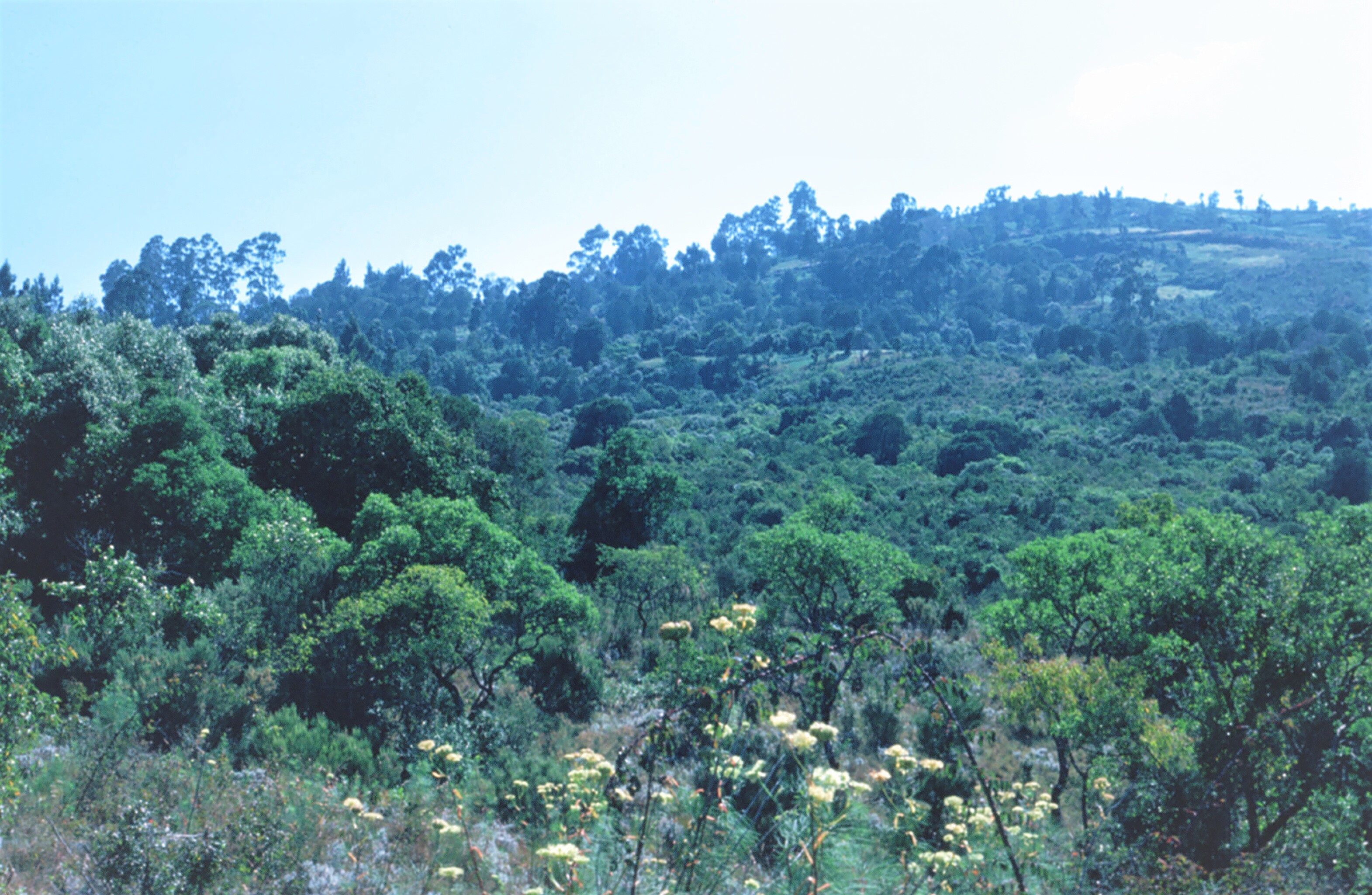
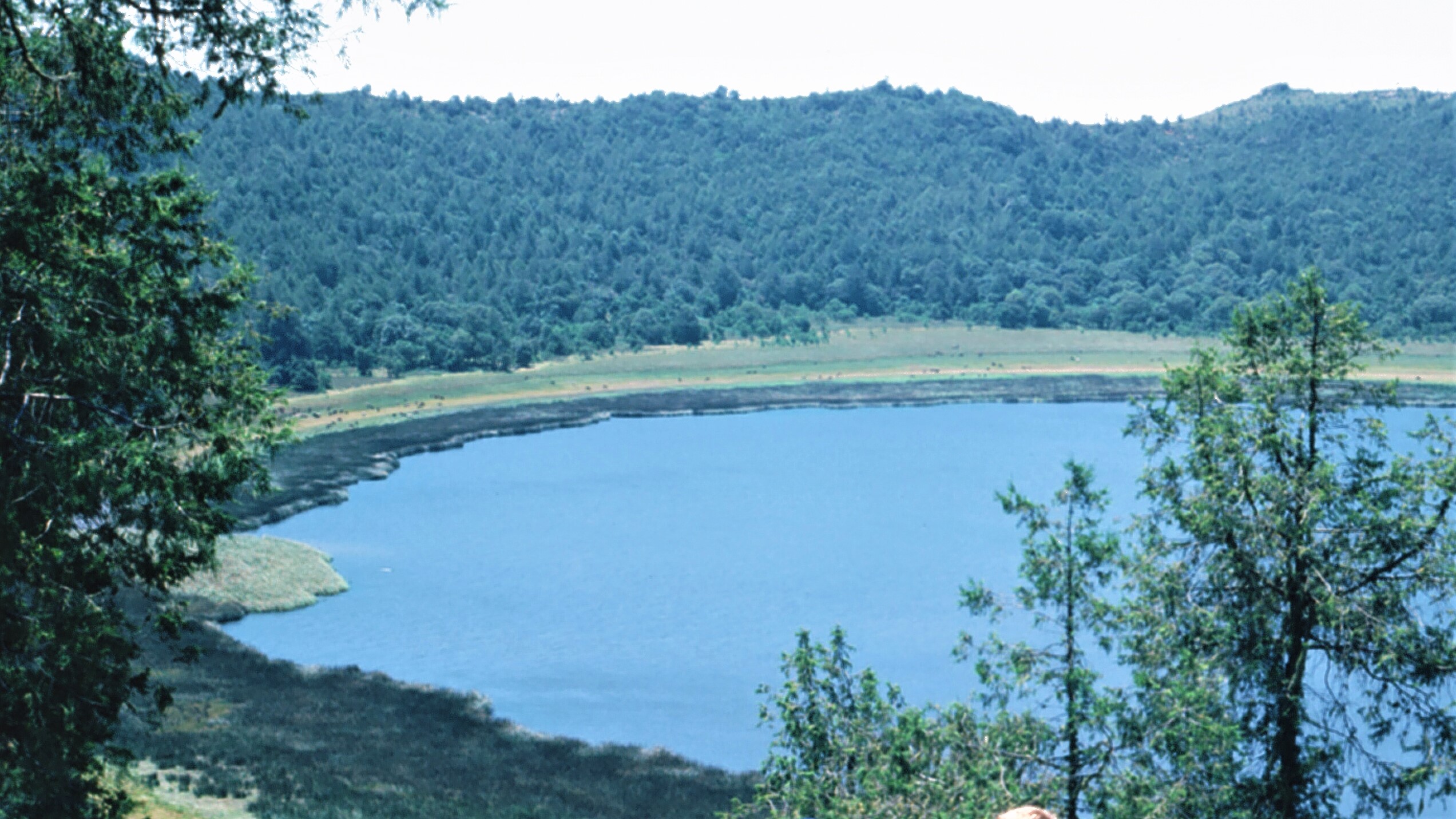
A hike up to the crater lake at Mount Zuqualla is a day trip from Addis Ababa. The drive out of the capital city and off the Ethiopian high plateau, down through the valley to the base of the extinct volcano can be done in less than a couple of hours. It is a bit of a climb up to the lake, and the road is rough. The verdure is thick right after the rainy season, and yellow flowers, similar to our tickseed, bloom throughout the countryside. Silhouetted on the ridge of the hill are oversized eucalyptus trees. They grow everywhere in the highlands and their fragrance is unmistakable.
The crater lake is not much to look at but the views back over the valley are spectacular. A 14th century monastery is visible off to the west, but we did not venture in its direction. I came across this post on twitter telling the story about how it was settled.
The British Museum has an extensive collection of Ethiopian manuscripts which are beautifully inscribed and illustrated. If you ever hear people complain that Christian art does not depict the stories of the bible in their image, send them to this resource. Ethiopians trace their Christian heritage back to King Solomon and the Queen of Sheba.
Yesterday was the day for work-from-home articles, as Bloomberg also posted this excellent article by Sarah Holder, The True Costs of Working From Home. It’s full of great information and statistics. This, for example:
Between 2013 and 2017, households with at least one adult who worked from home spent more money on housing, on average, than ones that all worked outside of the house, the study found: Remote renters spent between 6.5 % and 7.4% more of their income a month, and homeowners who worked remotely had mortgage and property taxes that were 8.4% to 9.8% greater than non-remote households.
I didn’t appreciate that, pre-pandemic, remote workers were already spending almost ten percent more on housing. That’s quite a bit. On the other hand I’m surprised the percentage of people working from home in times of Covid isn’t higher.
The study is a snapshot of the pre-coronavirus world, when only about 3% of U.S. employees did their jobs from home. By February 2020, that number had swelled by some estimates to 8%. And by May, that share had exploded, with about 35% of U.S. workers who once commuted going remote.
Still– that is about a third of the workforce. And it appears that staying in the neighborhood is popular amongst employees.
According to a Pew Research Center survey, more than half of workers who can do their jobs remotely say they will want to continue doing so after the pandemic ends. A December survey from Upwork predicted that 27% of workers in the U.S. would still be largely remote by the end of 2021.
The freedom of WFH allows people to move to new communities if they so choose. Perhaps drawn by less expensive housing, or a host of other possible benefits. A U-Haul study shows that coastal people tend to move to other states near the coasts. This article offers another view.
But sticking closer to home may be the favored path for many, especially if companies ask for some face-time each month. A San Francisco Chronicle analysis of USPS moving data showed that the majority of San Franciscans who left the city during the pandemic moved not to Florida or Texas, but to another Northern California county; a Zumper report that analyzed national rent shifts found a similar story, with “cheaper, neighboring cities” appearing to be the 2020 destinations.
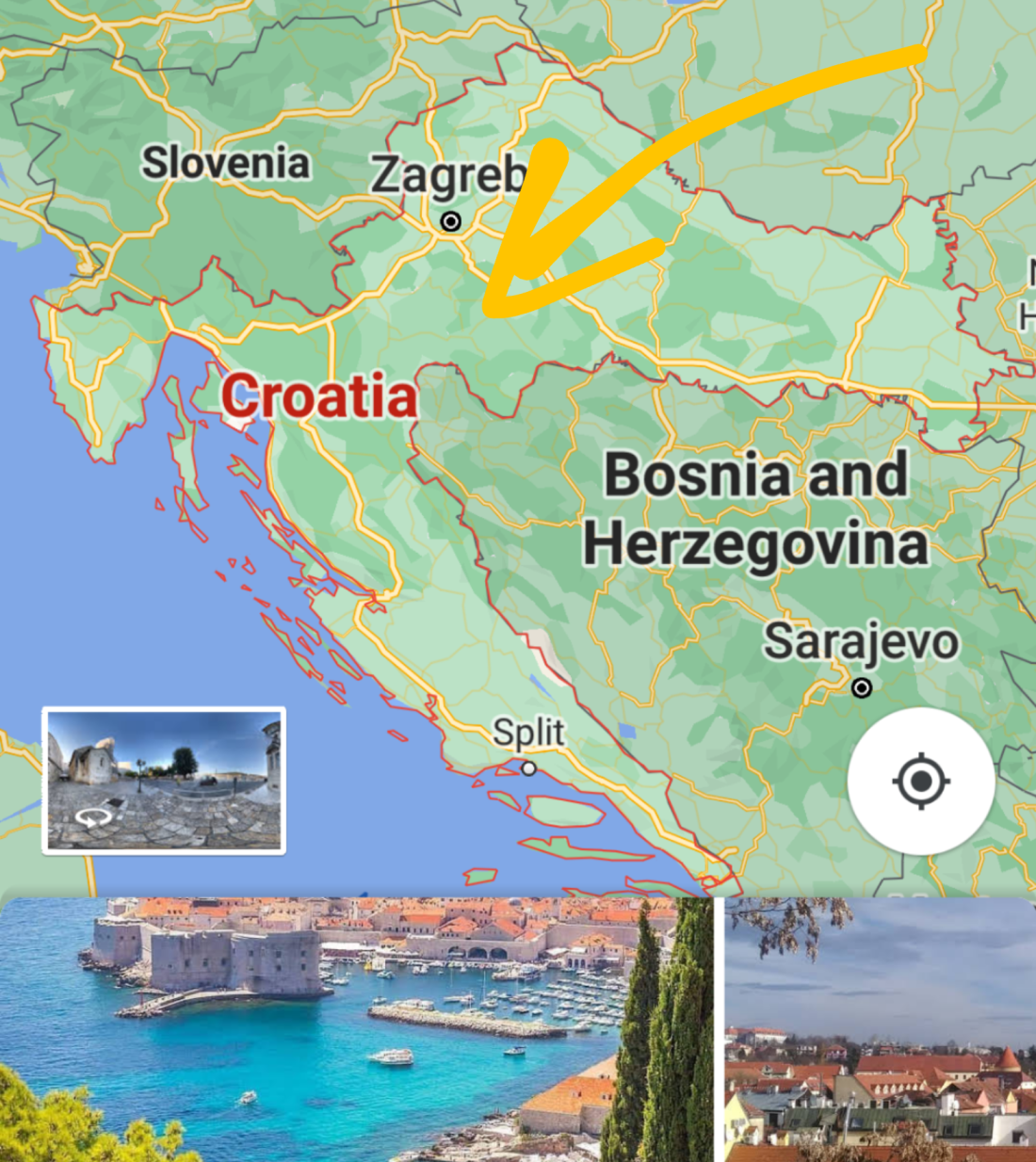
I think it’s too soon to tell how household priorities will all shake out. There are options out there that people have yet to consider. If moving half way across the country is possible, why not another continent? Croatia is just one country trying to leverage the remote work concept by offering a Digital Nomad Visa.
There are many costs and benefits to living in various communities, and the reshuffling of tradeoffs will be different for each household. Businesses also may find the transition to remote work a cost savings at first, but then an expense as it is more difficult to recruit and train a corporate culture from afar. Though as a general rule, more choices for both employers and employees are a good thing.
The pandemic will reshape our lives for years to come. One lesson learned is that company centric office space is not essential to many forms of employment. This creates inroads to the reality of paid work from home. And the benefits for families to staying in the neighborhood, close to daycare and schools and extra-curricular activities, will make it a convenient option for many employees.
When people started to re-emerge from their homes last spring, at the beginning of what ended as a boom year in real estate, we heard a lot of buyers expressing the desire for home offices. Once children return to a traditional schedule in daycare or school, the home environment will be even more ideal.
There are other options for remote work. WeWork, a US real estate company, has provided office space with shared amenities since 2010. It’s success has been muddied by an outrageous leader and a lack of market confidence in its business model. Recently its co-founder has been embroiled in a law suit with SoftBank. Sensing blood in the water, an international competitor, IWG (International Workplace Group), has made moves on WeWork’s holdings in Hong Kong.
For the third time in less than a year, IWG has opened flexible offices under the Signature brand in a Hong Kong space formerly occupied by embattled rival WeWork.
IWG is based out of Switzerland and provides space in 120 countries. Their focus is on catering to a particular environment with supportive services, access to networks while connecting companies to locations at close proximity to their clients.
Perhaps this flexible model office space is an even better fit in densely populated cities like Hong Kong. Here the average home is 484 sqft limiting space for home offices. The average American lives in a 2164 sqft. dwelling which, in comparison, sounds generous with ample room for work. Yet everything is relative. City dwellers will settle for a 1800 sqft craftsman bungalow while suburban buyers desire a full two story with double the footage and a three car garage.
Whether through a work-from-home setup, or a flexible workspace nearby, households with children will benefit by having at least one adult in the neighborhood. Being available on-demand for children is part of the deal: when daycare calls to pick-up a toddler running a fever, or there’s the school science fair to attend, or little league practice starts at 4pm. Since juggling those demands around commute times is stressful, being close to home is a social benefit employers can provide at no pecuniary cost.
I recently listened in on a presentation which was given by a respected academic to a political body. The topic is one that I know well and over decades have heard many arguments hugging all sides of the issue. I was dumbstruck by how fluidly the professor’s language navigated between academically supported information and his own opinions. Isn’t there a standard of disclosure for such things?
For instance, he would start with results from a study but then list projections which his team conjectured– as if lives could be lived twice and records kept accordingly. One politician asked specially about these projections, and there was an apology for the omission of the model, yet his dialogue kept flowing as if these figures were generated with the same standards as the peer reviewed papers.
For the average listener, including the folks who will make policy for tens of thousands of people, the distinction between actual data and estimates was muted if not eliminated. The professor’s tone, consistency, and manner of referring to the material did not distinguish between research and conjecture.
The inference of receiving information from an academic, particularly those who have cultivated a long CRV and a number of titles, is that they are communicating academically supported material. Anyone with limited knowledge of the topic will not be able to detect when the information is in fact a subjective opinion. Instead of aiding the pubic conversation around a topic professors become arms dealers for divisive public discourse.
To say I grew up in airports is a bit of an exaggeration, but only slightly. International travel in the 60’s was still rather new and exotic and susceptible to schedule changes. Long layovers to coordinate connections were common, and delays due to weather or mechanical issues were even more common. My parents were adventuresome and thought nothing of towing three young children around with them. In the photo, my brothers and I are cooperating dutifully on the luggage cart at the Colombo airport having arrived from Dhaka for a little R&R.
The vintage “where in the world” posts are from trips we took while stationed overseas with the US Diplomatic Corps. Even by foreign service standards we moved a lot, fulfilling only one DC assignment which lasted less than three years. The school years spent on Chesapeake Street between Reno Road and Connecticut were idyllic, only blocks from Murch Elementary.
On the weekends we would go for hikes off the scenic Skyline Drive or ride our Shetland ponies on an acreage in West Virginia. But this tame American experience couldn’t match hiking the terraced tea gardens of Malaysia or climbing up to the crater lake at Mount Zuqualla or even the rather urban stroll up to Victoria Peak in Hong Kong. The whole family was eager to take back to the skies. I didn’t return to live in the US until college.
With so much time on our hands at Heathrow or Narita or Charles de Gaulle my brothers and I would play games eavesdropping and then betting on the nationalities of our chosen observation subjects. Of course there was language to give us some guidance, but also mannerisms and apparel. If we were lucky they would pull out their passports to allow us to settle our bets.
Fifty years ago, as pre-covid, airports were busy places with passengers rushing anxiously to catch flights. Perhaps forgotten now, is that by 1972 a total of 150 US planes had been hijacked. Commandeering aircraft was in a golden age. Airport security was considerable. I remember the Rome airport in particular crawling with camo clad soldiers, each carrying an assault rifle. The true power, however, was held by the typically slender uniform behind the passport control counter. He (usually, but sometimes she) could question or detain you. Have your luggage searched.
The approach was straightforward. Only answer the questions when asked. Don’t offer additional information. Do nothing that could antagonize the one person who could delay your travel. I still think of these very prompts when I travel abroad.
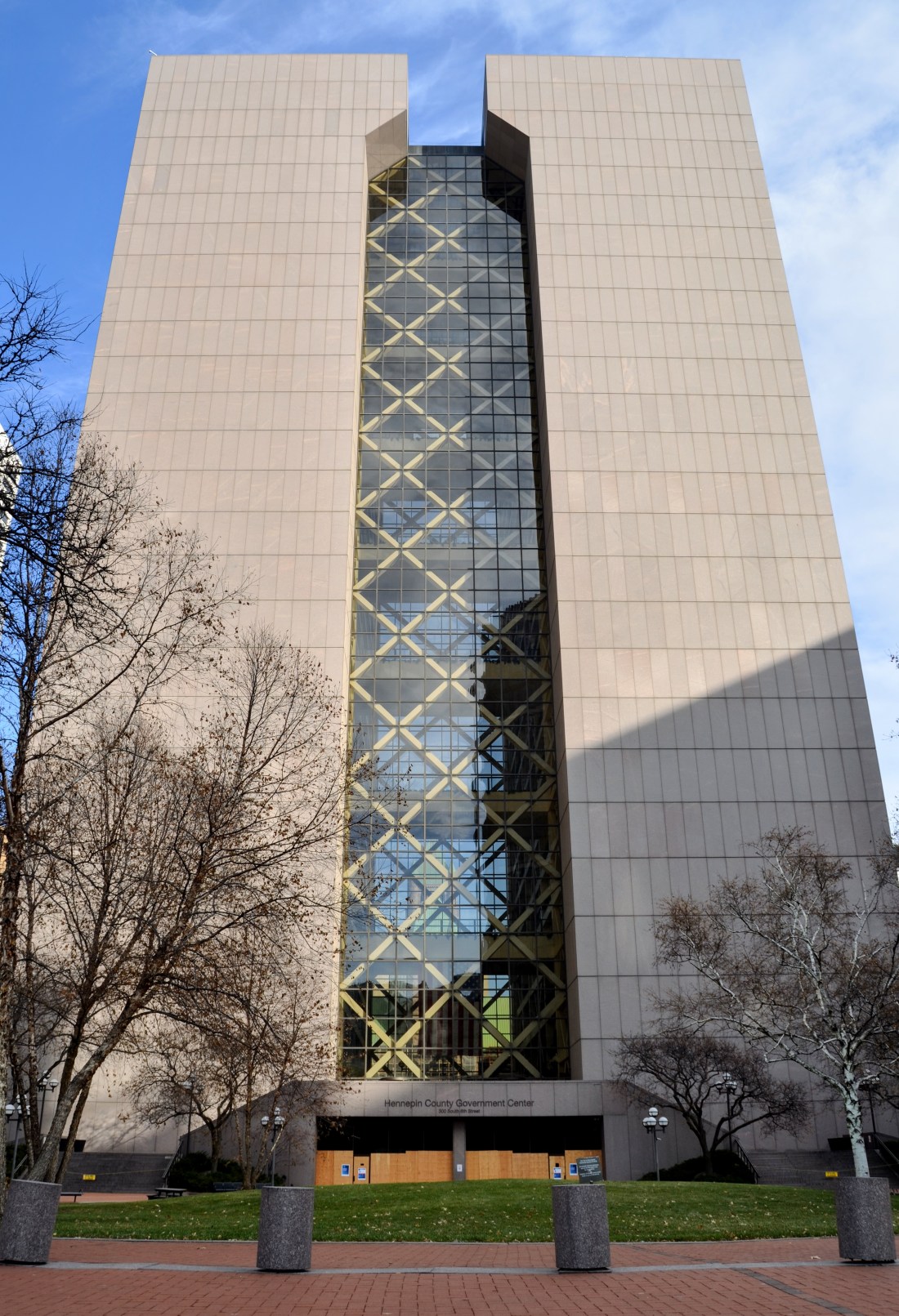
The Derek Chauvin trial starts two weeks from today, and from all the prep that is going on, it appears that folks are nervous. Concrete dividers, fencing and barb wire have joined plywood at the entrance doors of the Hennepin County Government Center building in downtown Minneapolis.
For those readers who were busy in a blow pipe making class in PNG last summer, Derek Chauvin is the former Minneapolis police officer who held his knee on George Floyd’s neck for eight minutes. With his face inches from the pavement, Floyd expressed concerns about not being able to breath before he died in police custody. This happened on a Tuesday. Protests were in full gear by Wednesday evening. Riots led to the burning of a police precinct Thursday. It wasn’t until Saturday evening that the National Guard, in full combat gear, patrolled the streets with pellets guns to keep them clear for the curfew. Black smoke from Batteries Plus and other commercial spaces hung over the Lake Street section of South Minneapolis through Sunday morning. Protestors burned or damaged upwards of 700 buildings, housing many minority owned businesses as well as national chains.
Estimates are that the Minneapolis Police Department has lost 200 of its 600 police officers to disability claims and early retirements since last year. The city council continues to hammer on the department, denying funding requests while attempting to shift responsibilities from the police department to social workers. This strategy is not garnering a lot of support outside the city limits.
In an unusual move, the speaker of the Minnesota house, Melissa Hortman (D-Brooklyn Park), brought a bill to the floor of the (DFL majority) house which, apparently, had not been vetted for votes. The governor’s proposal to create a statewide fund intended to pay for security during the trial failed as a handful of democrats voted with the GOP. It appears there is a shuffling up of groups, as who do or do not support Minneapolis’ move to reimagine public safety, and they are not all falling along party lines.
The Minnesota House rejected a bill Thursday that seeks to create a state fund to reimburse police departments from outside Minneapolis if they’re called in to help prevent civil unrest around the upcoming trial of Derek Chauvin.
One comment that was made was that outstate Minnesotans aren’t necessarily as supportive of the MPD, as they are appalled at how the police have been treated. There is a difference. The media, however, is cradling protestors sympathetically, as in this recent headline in the Minneapolis Star and Tribune. (Hollywood ready little girl in his arms et all)
The trial will be televised, but it seems like the drama already has its verdict. Just in case, there will be a lot of manpower on the ground to keep the peace.
The majority of the Greek Jews lived in the new section of the city which had sprung up on Mount Scopus outside the ancient walls, opposite the Sheep Gate. Accustomed to spacious houses, with gardens and colonnades, they could not find room in the old, crowded sections. The house of Miriam, sister of bar Naba, built in the Cypriot style, resembled a Greek temple; behind it was a garden, enclosed in a peristyle, and here she arranged frequent banquets for the leaders of the Greek-Jewish community of Jerusalem.
The drum beating earlier in the week about cancelling student loan debt was abruptly muffled by the president. In response to Chuck Schumer (D-N.Y.) and Elizabeth Warren’s (D-Mass) proposal to forgive up to $50,000 in student loans:
“I will not make that happen,” Biden said when asked at a Milwaukee town hall hosted by CNN Tuesday night if he would take executive action on loan forgiveness beyond the $10,000 his administration has already proposed.
Some people think student loan forgiveness falls into a moral category. Society has an obligation to advance citizens through education; that college is an extension of the k-12 necessity to set a youth up for a productive life. The debt should be waived on principle. Of course this gets a little messy post grade twelve, as vocational choices, and the education they require, vary tremendously. And for this reason I think free college will always be a non-starter.
But why waste good numbers when they are out there for consumption? The debt figures can be, and should be, put to good use. When aggregated up to the federal level they loose some nuance. But at the local level it maybe possible pull some levers and leverage a few social objectives at a time. The results maybe more interesting than a simple money transfer.
Case 1. Say there were two objectives on the table: student loan debt and career advancement. One would look for organizations at this intersection. There are hundreds of business associations in Minnesota. Local Chambers of Commerce might be first to mind, but there is the Iron Mining Association or the Minnesota’s Corn Growers Association or even local PTA’s. Say an association was given access to a pool of federal funds marked for student debt relief, with a catch. There is a trade involved. Once the Mining association, or corn growers, show proof of employment of a new-to-the-profession worker (for at least x-amount of time), then they can allocate relief to the student they deem eligible.
It’s a community grant (given to an individual) in exchange for making an effort to lift a worker up and into a new stage of professional development. Many of these associations have a history of giving out scholarships, and a process in place for evaluation. They are well regarded in their communities and have a reputation to protect in the administration of debt forgiveness.
The relief recipient advances economically from the removal of the debt. The business community can justify the extra work or training necessary to bring an inexperienced employee into their field. The new employee hopefully evolves to see the rewards of elevated employment and not just feel the demands of the additional expectations in a challenging position. All those who step outside their norms to make this happen find comradery with others not like themselves.
Case 2. Here’s another example. Say an elementary school attendance area is experiencing a sharp downward trend in enrollment–and the demographics confirm the trend to be long term. The risk of school closure is high. Closing a building is not only expensive for a school district, but the loss to a neighborhood can be devastating. Short term it brings angst to the families who now send their young children to a building out of the neighborhood. Long-term it can be difficult to reverse the negative impact from the closure.
Say the federal government allocated a pool of student debt relief money to the elementary school’s attendance area. Now imagine that there is a household with young children who would qualify to purchase a home in the area if a portion of student loan debt was forgiven. The local PTA in conjunction with a local mortgage bankers’ association could be in charge of distribution. This scenario leverages three objectives: debt relief, school support and housing.
Local control over distribution of funds could refine distribution in a way which engages incentives to accomplish other objectives within communities.
Last December, an artist who goes by the name “Beeple” made headlines when he set a new record for the most valuable artwork auctioned off Nifty Gateway, a marketplace for limited-edition digital items. Beeple sold 20 artworks for a total of over $3.5 million, catching the attention of those who might not previously have known about the existence of NFTs, or Non-Fungible Tokens. While just a few years ago blockchain-based art might have been considered niche, a recent development proves this is no longer the case: on Tuesday, Christie’s announced an upcoming auction featuring thousands of images created by Beeple that have been compiled into a single composition.
The actual art looks very much like regular art. And are trading amongst buyers and sellers at a nice clip. Bitcoin.com reports that in a week last August there were 14,654 sales and $1.2 million in weekly trade volume. This piece by Trevor Jones commanded a nice price.
So what about the NFT- or the non-fungible token notation.
Crypto art relies on non-fungible tokens, or NFTs, which are usually issued with an Ethereum token, ERC-721. This ensures verifiable digital scarcity; each artwork is a uniquely distinguishable digital asset—no two are the same.
At first glance it seems to be a certification of sorts, a blockchain version of an identifier to keep track of the art work’s provenance. An authentication certificate more than anything else. In the artworld the story of where a piece was produced and who has owned it since, is an integral part of preserving its authenticity. The token is attached to the piece and hence is non-fungible.
But something is missing from this conceptualization. Fungible has the quality of being able to be exchanged with other goods. The auction activity indicates a product that is very tradeable. Since these NFT’s are bought and sold freely, there seems to be a contradiction. Zoup at non-fungible.com tackles some of the issues.
zoup: I had several passionate debates during Meetups around the definition of non-fungibility. And I must confess… most of these debates turned out to be sterile but, they helped me understand something important: the definition of non-fungibility is everything but obvious.
Zoup explains that bitcoins are fungible in the same way that nickels, dimes, quarters are easily exchanged. A precious coin, however, is something different. To a collector a nickel that was mistruck during production can have significant value. To a collector the deformed nickel is non-fungible. And it is in this way the non-fungible tokens make digit art unique. Hence zoup comes to this conclusion:
It is therefore the use value that defines the fungible or non-fungible character of the asset. And not its technical characteristics. The main use of an asset and the perception that one can have of it define fundamentally if the asset is fungible or not.
It is here that I propose a clarification needs to be made. The quality of being fungible, by definition, indicates an attachment to a group, as it is the group which determines its use.
Let’s try to disprove the idea and see what happens. The mistruck nickel is non-fungible when held within the collector group, it is precious, it has a unique story. To a kid who wants a coke on a hot day, the nickel is simply five pennies towards his purchase. He pops the coins into the slot on the side of the machine without another thought. He is using the coin as a fungible asset.
The quality of non-fungibility is attached to transactions that exist within groups. NFT’s find value in the crypt-investors sphere, but I doubt you would find much interest at the local VFW. Outside of this very specific group of people who understand the crypto space, the value goes to zero. I’ve written about fungible versus non-fungible transactions. I claim that when non-fungible assets are held within a group, they are a public good. All investors share equally in the assurance that the tokens represent a unique asset.
When a group assigns a use to an object- a park bench, for example, is open to the public in a park- then the bench is a non-fungible asset (it can’t be rented out or traded by any one individual) that is held by the group. When the crypto people decide to use tokens as identifiers, they’ve created a certification process that legitimizes an artwork by the community. And that is non-fungible.
I’m a sucker for images, and these new graphic representations at the intersection of maps and data are lovely.
A consulting firm out of North Carolina, Urban3, has a new measure for assessing the productivity of land in an urban environment. It’s an interesting new twist.
Urban3 makes maps that show the value of city buildings on a per-acre basis. That last detail is the kicker.
“We make the models to provide information equity,” explained Joe Minicozzi when I asked him about his approach. “We show a financial picture of what’s going on with the cash flow. You see where the holes are, what’s doing well, what’s not doing well. You can’t see where you’re leaking your money if you don’t know what’s going on.”
The general process is to take the tax revenue on the section of land and divide it by a spatial measure. Under this calculation, downtown buildings are more ‘efficient’ than suburban malls with lots of surrounding acreage of asphalt parking spaces. And in this way the analysis has flaws. Consumer (pre-covid) enjoyed the ease of mall access. Downtowns discourage shopping traffic. So if the objective is to encourage downtown visits, an understanding of transit and traffic and parking would be more valuable.
Reframing a means of analysis is exciting, but there are many more features of the built environment than simply tax collection and land space.
Elon Musk has stated that 2021 will be a key year for the Solar Roof, with the CEO noting that its potential would be evident this year. Considering the company’s ongoing rollout of the integrated PV system and the development of better Solar Roof designs, it may only be a matter of time before more customers of Tesla’s flagship residential solar product would have more design options available.
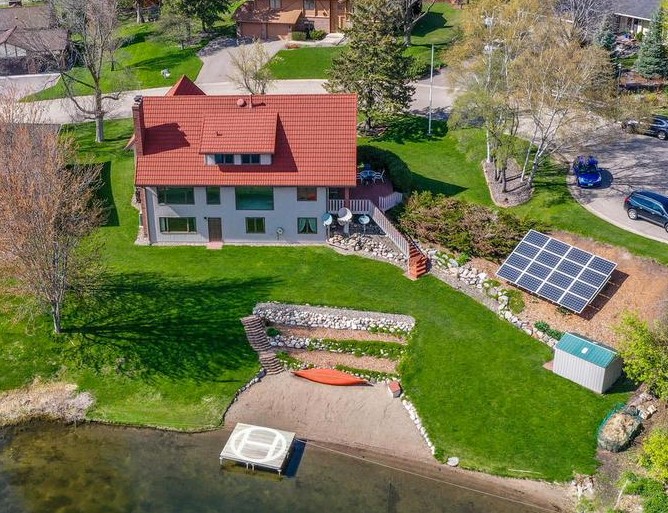
Aesthetics is one stumbling block in consumers’ embrace of solar energy. A look that blends into the standard architectural asphalt shingles, or clay roof tiles, would be more consumer friendly than panels.
NorthStar MLS
Attractive shingles will undoubtedly command greater appeal than shiny 24 x 24 inch panels set into a large framework.
Tesla’s Solarglass Roof tiles are already among the most aesthetically-pleasing PV systems in the market. A Solar Roof installation involves the setup of both PV and non-PV roof tiles, and according to Tesla, this could present some issues. Since some tiles do not have solar cells in them, there will be some angles or times when it is possible to distinguish which tiles have solar cells and which do not.
credit: Patentscope
Tesla also produces a lithium home battery, called a powerwall, which can store energy from the panels to be used after dark, during peak pricing hours.
The Tesla Powerwall pairs well with solar panel systems, especially if your utility has reduced or removed net metering, introduced time-of-use rates, or instituted demand charges. Installing a storage solution like the Tesla Powerwall with a solar energy system allows you to maintain a sustained power supply during the day or night, as long as you store enough power from your panels when the sun is shining.
With cost for the battery alone running around $8-9K, installation of an entire solar system is upwards of $20K. For comparison, a forest air furnace runs around $4-5K. That said, people pay extra for all sorts of social reasons. They use their son-in-law for their mortgage despite higher fees, they buy Girl Scout Cookies (OK, they are delicious too) and bid triple the value of a vacation package at a charity auction. There is an additional expense in buying organic vegetables and sometimes loyalty to one’s barber requires a drive across town. There are many circumstances where one pays above the going rate so that a portion of the price supports a social objective. Still- the premium has its limits. And solar power isn’t quite affordable enough to reach the mainstream concerned, yet.
In the end it is all about the payback and reliability, especially in a harsh climate. Natural gas is very affordable, but its infrastructure is not available throughout the state. Homes that rely on electric baseboard heat will most likely be the first to tackle the significant upfront investment and convert to solar.
Around 4pm this afternoon the temp in the Twin Cities creeped above zero ending a 95 hour streak of negative highs and lows. As far as I know there have been no deaths during this polar vortex. But down I35 W, past Iowa, Missouri, Kansas and Oklahoma, a tragic 133 vehicle pile up left 65 hospitalized and 6 dead in Texas. The winter weather conditions coated the interstate with glare ice jackknifing semis across the thoroughfare. Approaching cars helplessly collided into each other as they skated into the metal mangled mess.
Around the same time last week, in Minnesota, a “bridge appeared to be ice-covered when the driver crashed and nearly went over the edge…”Take a look at the video where bystanders stopped a pickup from teetering over a bridge rail into the Minnesota River. When it comes to winter weather, Minnesotans have high state capacity. As a group we have the extra skills and initiative to respond to unexpected winter weather challenges.
It’s not that the people down in the Lone Star State are hick, uneducated or inept. It’s not that they’re too poor to be responsible nor too rich so as think they’re above it all. It’s not that they are too stupid or too smart. Capacity is a combination of knowing what to do, and being able to engage when the need arises. It’s an identification process, a communication process and a step-up-if-you-are-there-and-available process.
The group has to have the expertise to distinguish the glean on the pavement as black ice, and not innocent damp asphalt. A network has strength to communicate the concern when it is reliable and trusted. Parents put in the extra ‘no’ with persistent teenagers who want to go meet their friends, errands are put off. Stories of cars sliding into holding ponds and drivers waiting through the night, half submerged, until someone comes to the rescue, are retold to confirm the nature of the situation. All these activities enforce behavioral sacrifices which lead to successful outcomes.
Our cities are well rehearsed to handle the weather, whereas the Texas Department of Transportation lacks the physical equipment to plow off the half a foot of snow from the roadways. Formal government and its preparedness are just one feature of the ability of a community to identify, communicate and respond to the challenges, or ambitions, at hand. But it’s really the coordination abilities of the whole group which delineates its capacity.
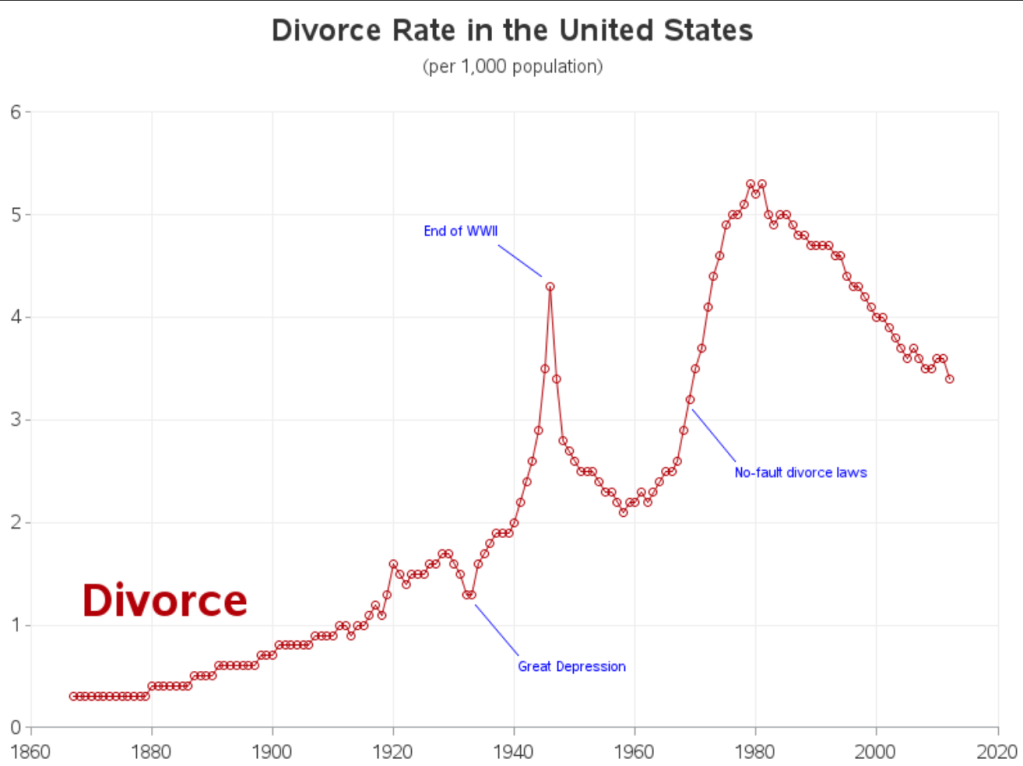
Despite all the shortfalls in American culture in the 50’s, one grossly overlooked foundational strength was community support for marital bounds. Sure– a lot of the outrage in the 60’s stemmed from strength of the marriage contract. Women were disproportionately dependent on their partners, due to male control of traditional economics within the family structure and the workplace. Cross-gender issues were squelched and hidden, leading to psychological detriments.
But as is still true today, activists needed to inflate the issues in order to have them recognized, filling the 60’s 70’s and 80’s with fervor for the dissollution of marriage.
It’s wonderful to see the rates inch down in more recent decades. But I think there is a lot more work to do. The celebration of Valentine’s Day is about new love. A celebration of anniversaries and dedication to sharing the stages of family life with one partner is not only romantic, but provides vision to navigate family life with all its stresses and demands. Here’s to the Valentiniversary!
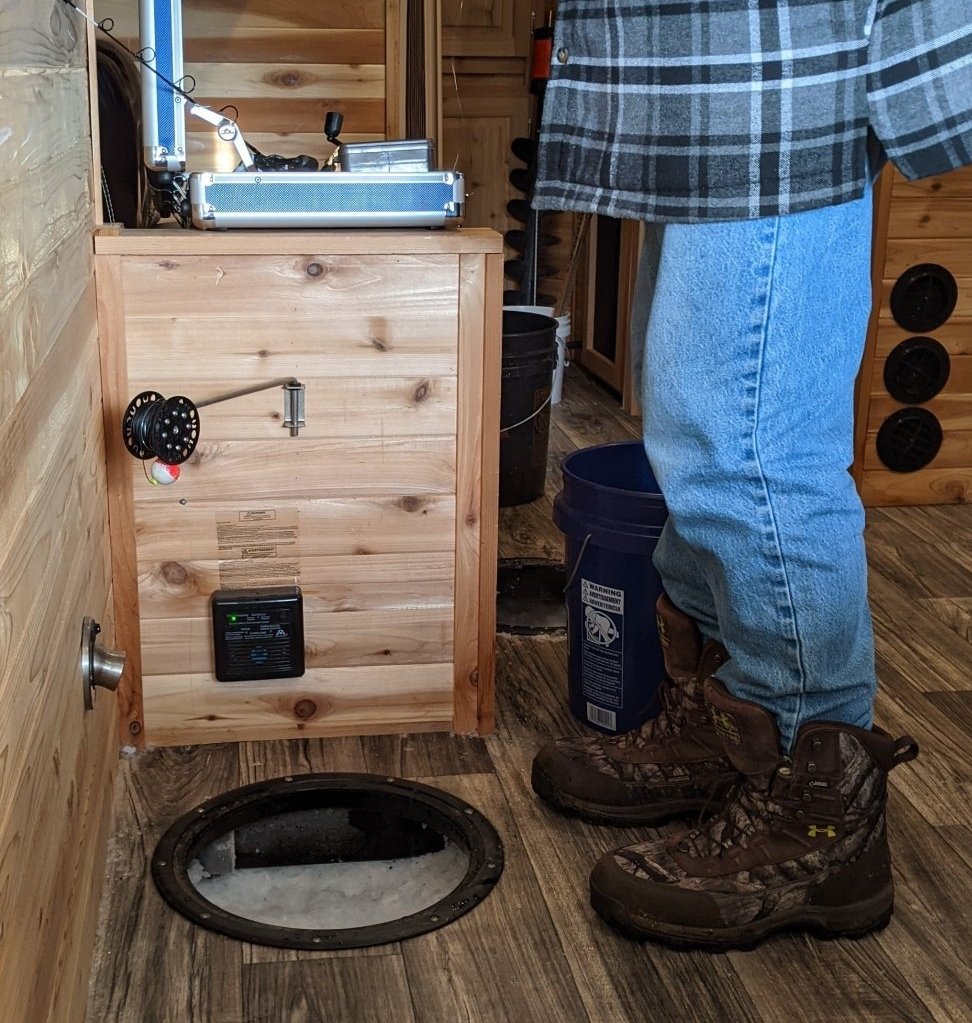
We’re hitting a record cold spell as a polar vortex nestles in over the bold north state. So what do people do when the temps don’t climb above zero and hit lows in the -30 range? Go fishing on the ice of course! (see Grumpy Old Men for the Walter Matthau, Jack Lemmon and Ann-Margaret portrayal) For those of you who never get to experience cold climate living– this is for you.
Ezra Klein: San Francisco is about 48 percent white, but that falls to 15 percent for children enrolled in its public schools. For all the city’s vaunted progressivism, it has some of the highest private school enrollment numbers in the country — and many of those private schools have remained open. It looks, finally, like a deal with the teachers’ union is near that could bring kids back to the classroom, contingent on coronavirus cases continuing to fall citywide, but much damage has been done.
Eighty percent of my motivation to write commentary was due to folks like the ones described above. There was one in particular, who loved to call everyone a racist. But where did he send his kids to school?
I remember posting my first public comment. I was nervous. I must have read through it a dozen times, and felt so exposed once I pressed enter–no edit back then. The article, Met Council: More focus on growing in place, was an opinion piece by local journalist and urban design consultant Steve Berg, writing here in MinnPost
Ten years have gone by, but the gist of what I was saying remains the same. People trade with an understanding of both a collective benefit, as well as one of self interest. At least that it what I am here to convince you of.
I loved commenting on Steve Berg’s articles because there was so much substance to target. Things have changed a bit since then. He was a classic anti-car guy, which has been toned down since Elon Musk came along. And you don’t hear people harping on sprawl as you once did. Nor market failure for that matter.
I think most people would agree that the agility with which high paid workers were able to transition to remote work with the aid of the internet was nothing short of astounding. Had it been tried without Covid, I’m sure it would have been as difficult as getting teachers back in the classrooms.
Tradespeople have also been able to keep working as their work is most often socially distanced and out of doors. Road crews, roofers, delivery workers are all busy. None of these jobs rely on a quiet space with a lap top.
It seems a natural fit to connect the low wage workers into this workforce.
Biden’s 1.9 trillion relief plan is a little too enormous for me to get my head around. The magnitude of federal numbers just makes my eyes blur over the page. There is no anchoring the size of these things to my everyday life.
But if I can’t talk about magnitude, I can talk about structure. The goal of the bill is to engage the US economy as well as shore up people’s unexpected and uncontrolled loss of income; to keep their lives right side instead of upside down (which subsequently causes an economic drag on their greater groups). And then to get them back to employment where income can be feathered back in to the economic apparatus.
I’m all in favor of transfers for the first part. They work efficiently.
But I think there is a missed opportunity in the second part. Engaging idle labor from folks who are not destitute nor in need of transfers is low hanging fruit. As explained in this post about The Crafter The Contributor and The Covid Tracker, there are high skilled individuals available to donate labor if they are enticed by the objective at hand.
There are successful national service programs like AmeriCorps and the National Guard. Would it be so hard to have a property repair civil service? Ask any builder about the shortage of construction workers. What about a write-off for plumbers and sheet-rockers and electricians who’d be willing to have an apprentice tag along to fix a faucet at the local homeless shelter, sheetrock in a storage room at the food shelf, or replace all the gym lights with LED fixtures at the community gym?
A money transfer won’t teach a trade, nor will it make a connection between a potential employer and up-coming employee.
Pioneer Press North Dakota had adopted a law, proposed by the state’s Industrial Commission that oversees oil, gas and mineral removal, that gave energy companies broad power to continue injecting salt water, an unwanted byproduct of their drilling, and added rights to pump carbon dioxide deep underground and leave it there for eternity. This is becoming important as the cheapest method of “carbon sequestration,” which is deemed vital to reducing greenhouse gas emissions.
The law was very favorable to companies wanting to inject. It stiffed owners of land overlying the areas that might be filled. This created strong opposition, and a landowners association challenged it.
North Dakota had made an environmental claim on the subterranean space, but the landowners, who felt shafted by the fracking boom, said not so fast. They wanted in on the deal that seemed to pad everyone else’s pockets. So who owns the ‘pore space’ and who gets to benefit from it economically?
In mid-January, a state judge amped up the controversy in a broad decision favoring the landowners. He struck down the whole law as violating both the North Dakota and U.S. constitutions. He ruled it was a “taking” of private property as banned by our Fifth Amendment.
One can speculate on the line of thinking the legislators in North Dakota may have been following. Since everyone would benefit from the purging of by-products into the depths of the earth, than the assignment of the use of pore space to the energy companies is fulfilling a traditional public good.
As I’ve said here many times before, I do not believe in natural public goods. And this is just another example. Although the act of burying the carbon dioxide has a positive environmental outcome for the citizens of North Dakota, it is the land and the rights attached to the land that are under discussion. The land is privately owned by the landowners.
My view is that what is pubic and what is private comes about through tradition and legislation and cultural norms. In this case the courts decided. As the author says, there will be more to follow regarding “pore space.”
Legal scholars will write scholarly papers and economists will construct mathematical models. There are precedents in water and oil laws going back decades, but compressed gases that should stay there for millenia differ enough to open new controversy and give topics to hundreds of grad students who need thesis topics. And the outcomes will affect all of us.
A little after two, yesterday afternoon, my phone made that intentionally obnoxious noise to signal an Amber Alert in our area. A grandma of nine had also gotten the notice. She happened to be watching a Jeep, through her front picture window, idling across the street. Grabbing her birding binoculars, she verified that the license plate number matched the one on her Amber Alert notice. She then called her daughter to confer, then the police.
Only 35 minutes elapsed between the alert going out and the one year old being found in an abandoned vehicle on a brutally cold day. Here’s a timeline of the events. A local journalist was in the area and was able to catch this senior on the move for an impromptu interview. (so sweet)
The woman who spotted the stolen Jeep with a kidnapped 1-year-old in it tells me an AMBER alert pushed to her phone was the key. pic.twitter.com/N8vV1xZiXT
One might label this a one-off call to action, being in the right place at the right time sort of activity. Shrug it off as happenstance instead of recognizing it as work. But you’d be wrong.
A community, a group of people who share a public safety interest, need these types of eyes-on-the-street workers. Not everyone. Just enough to have capacity around to engage as needed. As annoying as they can be to those young first-time homeowners, the older retired types, just like our grandma here, make excellent neighborhood watchers.
Note that this work didn’t require a valedictorian or a particular muscular prowess or any technical expertise; this work is done by being present and caring enough to act. There can be misunderstandings and errors in interpretations, hence it is good to check with your direct sphere, which she did when calling her daughter.
Note that the motivation here is not political or monetary or for glory. Often it is done because we would want someone to do the same for us. And we become part of groups for this reciprocal reinsurance.
The Amber Alert counts on it. Sending a message out to everyone who owns a device spreads the word, looks to reach the ears of those who are in the right place and circumstance to engage these sentiments. The system doesn’t expect any one person, just someone in the group.
If the Amber Alert hadn’t gone out with the vehicle’s description. If the birdwatcher hadn’t grabbed her field glasses to verify the license plates. If her advisor hadn’t reinforced the proper course of action in calling the police. What would have happened to a twelve month old child in the back of a white Jeep in weather where exposed skin freezes in a matter of minutes?
It just takes one out of the group. But you can only help if you are close enough to touch. This isn’t a federal public good, nor a state public good, it telescopes in further than that. But this public good, the provision of public safety, relies on eyes-on-the-street workers.
Cost burdened is the catchphrase of the day in housing. Over the last couple of years it has popped up everywhere. Articles posted on all sorts of sites use the phrase without specifics on how they came up with all their charts and graphs. Smart Asset was good enough to describe its methodology.
Data and Methodology
SmartAsset used Census Bureau data to determine the most and least severely housing cost-burdened cities. This data, which we found for 126 cities, breaks down residents into the following brackets based on the percentage of the total household income they are spending on housing: less than 20%, 20% to 24.9%, 25% to 29.9%, 30% to 34.9%, 35% to 39.9%, 40% to 49.9% and 50%. The data also lists the total number of households.
We took the number of households in each city paying more than 50% of their income on housing and divided it by the total number of households in that city in order to come up with the percentage of households that are severely housing cost-burdened. We then ranked each city based on this percentage. We also calculated the percentage of households in each city paying between 30% and 50% of their income on housing, but this did not impact the ranking.
Data comes from the U.S. Census Bureau 2017 1-year American Community Survey
You can find more about the American Community Survey here. But I’m pretty sure the information about housing expenses is self-reported by the three and half million who receive the request.
As you do with ranking lists, I checked out my own community (childhood home of Senator Klobuchar no less) to see how we stacked up in the cost burdened arena. According to an extremely well regarded source of data and information to politicians and local officials, half of all residents of Plymouth, Minnesota are cost burdened. Seriously?
I’m not sure how this could be true for one of the more affluent parts of the western suburban Minneapolis-St. Paul metro area. So I checked another affluent area on the St. Paul side, Mendota Heights. Here it is reported that 75.4% of homeowners are cost burdened. Clearly there is an implementation problem with use of the data meant to determine those in need. More alarmingly, there it sits in bold bar graphs given to lawmakers and policy people.
But even if folks choose to pay thirty or even forty percent of their monthly cashflow for housing, who is the Census Bureau or the American Survey or HUD to say that it is too much? Consider these three scenarios.
I choose to live within blocks of my parents, even though their neighborhood is a little expensive. My parents are able to provide fulltime daycare for my toddler as well as before and after school care for my two elementary school children. Living in their neighborhood saves our family upwards of $2500/month.
I choose to live in the city which is noticeably more expensive than some first ring suburbs. This location allows me to take mass transit to work, shop and recreate. It’s easy and cheap and I don’t need a car. Between insurance, a loan payment and gas, I save $400-$500 a month.
I chose to live near my congregation despite the monthly rent being high in relation to my fixed retirement income. My apartment, however, is near my church and the fellowship is such a big part of my life. I am able to share transit to and from my doctor’s office which is close-by. Plus I feel safe.
(For some back of the napkin, points of reference, average rent in Plymouth is $1300. An income that is considered non-burdened (28%) is 4643$/mo. An individual is considered cost burdened (30%) at 4333/mo in income. A difference of $310. )
Evaluating housing based solely on monetary income and rent is grossly insufficient. Consumer housing choices are influenced -think back to your own choices- by all the services found in various neighborhoods. Each of these scenarios show how access to family help, transit infrastructure, and religious communities contribute people’s home economics.
Not only is the present methodology, (which is being projected in stereo as if on a national housing agenda of some sort) yielding reports declaring the poor rich as burdened, I argue the use of pecuniary measures, as the sole means of evaluating quality of housing, is starkly erroneous. If a ratio of rent to income is used (as it has been) as the primary driver in decision making, than less advantaged people will always be pushed into the least expensive rental markets. Surprising to no one is the market reality that these neighborhoods are lacking in support structures.
Elm Creek on the multi-purpose trail, Elm Creek Reserve
It’s a frosty negative one degree Fahrenheit in the north country with a flag snapping wind. A lovely four mile walk from earlier this week, captured above, is a distant memory. It appears we’re in for a week or so of highs around zero.
There are people out walking still, mostly walking their dogs. A few are bundled from head to toe, buffering their skin from the bitter bite of the cold air. The Dutch have a word for it. Uitwaaien is the practice of jogging or walking into the wind, especially in the winter. It is invigorating, and I’m all for clearing one’s head. But if your eyelashes start to frost up into some avant-guard model look, it might be time to stay in doors.
Instead I let my thoughts flock to the bird migrations coming up next month in March. The Mississippi flyway brings a steady flow of avian creatures up from the Gulf of Mexico as they venture up to Canada and past the Hudson Bay. They seem to like our state with all our water features, including the headwaters of the famous flowing river.
Perhaps you think the whole binoculars and birdwatching thing is a little silly, but you are wrong. It’s delightful. While on a walk in the spring slush with tree branches bare of foliage, you learn the orange flash is an oriole, and a fleeting bright blue is usually a tanager. A brighter yellow-green with a bandits mask and pompous crest is a cedar waxwing, one of my favorites.
Perhaps you think that it would be frustrating to spot some small brown poof of feathers only to be bewildered in finding its identification. By the time you pulled out the green covered field guide from your back pocket, turned to the sparrow section, the details of what you saw become fuzzy. And you can’t choose from the oh so similar options.
Well there’s a new technology for that. It’s called Google Lens. Quickly capture a cell phone photo of the titmouse, chickadee or vireo, use the lens image at the base of the photo, and presto! The app identifies the bird and tells you all sorts of information about it.
Eventually you learn the difference from a yellow warbler and a goldfinch even if they both hop around in the grass looking for dinner. And you no longer confuse the black headed grosbeak with a robin as the beak (name implied) is thicker and its build a bit buffer. A swan and a Canadian goose are more than large waterfowl honking as they skim the lake’s surface.
But I digress. There’s a 20 below wind chill just outside my window, and the thought of a spring thaw luring wildlife back north is a pleasant distraction.
Years ago I called my stock broker all in a flutter as I had noticed one stock in my portfolio had taken a tumble. In a steady and calm voice he asked me to hold on, so he could bring up my account. Then he proceeded to run through the statistics which verified that, although the recent downturn in value was a setback, overall my purchase was fairing quite well.
The uniformity in his voice, one acquired from handling calls like mine a hundred of times before, undoubtedly contributed to bringing me around. But the numbers took a moment-in-time piece of information and stretched it over a larger framework. They provided some concrete reference points to mollify an emotional response.
A plunge in the value of an investment can raise one’s blood pressure, but does not compare in anyway to the response following the loss of a human life. Still– looking at loss of life as a statistic spread out over other scenarios and situations is a worthwhile endeavor when trying to subjectively evaluate a variety of circumstances.
The department of Labor and Statistics keeps track of how many workers suffer a loss of life while on the job.
Frobes: In 2018, 5,250 people sustained fatal injuries at work. To put that into perspective, an estimated 609,640 Americans died of cancer in 2018, 116 times as many as who died as a result of a workplace accident. Of those 5,250, 40% were killed as the result of a transportation accident, most of which involved roadway collisions. The second-largest category of fatal injury in 2018 was “Violence and other injuries by persons or animals” with 828 deaths, displacing 2017’s No. 2, “Fall, slip, trip.” The increase in workplace violence was driven by workplace suicides rising from 275 in 2017 to 304 in 2018. In 2011, there were 250 workplace suicides.
People also die when receiving services. The statistics for how many patients die while being treated by the medical profession are all over the place. A study by a John’s Hopkins’ team from 2016 claims the number is a quarter of a million a year, but other estimates put the number closer to ninety thousand. Given the cost and concern around malpractice insurance, the number of fatalities in the public health sector must be significant.
Now lets look at fatalities in the public safety sector. According to the Washington Post, 41 unarmed people died at the hands of the police in 2020. Not 250,000 in the care of physicians. Not 5,250 in work related accidents. 41. And let’s keep that in mind in the coming months when evaluating the service the police provide to our communities everyday.






















 Home Economics