Little Boxes goes on to be the anti-suburbia anthem.
Category: Music
St Olaf Jazz Band
At Crooners
Born to Make you Happy
Bellissimo
It’s Valentine’s Day
The Folks Back Home
Dolly’s ism
Gypsy Jazz
How to Music
In spite of ourselves
Life ain’t perfect. Neither are we.
Willie’s words
May the wind be at your back
And the world sit at your feet
May you waltz across Wyoming
With a rose clutched in your teeth
May the answers to your questions
Fall like raindrops right on cue
May you set up shop in heaven
Before the devil knows you’re due
Music
Beautiful
A Melody
dance me
The Music Professor
I like this guy. ‘Music is like a time machine.’
Barry- my first, my last
Reimagine a classic. And make it beautiful
Composers in the time of *War and Peace*
Leo Tolstoy’s epic, War and Peace, is set during a period of significant change on the European continent. During this time, the musical patronage system was also transitioning. “While the Napoleonic Wars (c. 1792–1815) and the broader European revolutions disrupted or dismantled many traditional aristocratic institutions, a handful of European courts managed to maintain strong systems of musical patronage well into the 19th century. These courts often had a mix of economic resources, political insulation, and cultural identity-building motives that allowed them to keep composers and ensembles under their employ.
Here are the royal courts that held onto the aristocratic support model longest — and why: the full link (from chat).
The stories of Napoleons voracious conquests are felt in Beethoven’s rhythms.
Here is the full playlist of music heard in the Vienna court in 1810.
Bach, always beautiful
Sounds for Sunday
Just the Way
Relaxing
Summer on the brain
God only knows what I’d do without you
Time
Dance of the Hours
Amilcare Ponchielli (1834.-1886.) was an Italian composer, mainly of operas, from which is today only regularly played ”La Gioconda”.
Peaceful Voices
Blue Moon

Society’s Child
Born in Farmingdale, New Jersey, Ian entered the American folk music scene while still a teenager in the mid-1960s. Most active musically in that decade and the 1970s, she has continued recording into the 21st century. She has won two Grammy Awards, the first in 1975 for “At Seventeen” and the second in 2013 for Best Spoken Word Album, for her autobiography, Society’s Child, with a total of ten nominations in eight different categories.
Ian is a columnist and science fiction author.[2]
Today’s Tempo
Strong Women
It’s fading now, how discouraging it was decades ago when there were so few strong women in the public sphere.
That’s all changed. Minnesotan Lisa Demuth can claim a first as speaker of the House; Nellie Bowles with The Free Press gets extra credit for her skill with humor; Karoline Leavitt is so young to be so poised. And— they are all moms.


The times they are a changing.
I sing because I’m happy
I sing because I’m free
Handling the Unexpected
Yesterday, Carrie Underwood led the high-test audience in the Capital Rotunda in singing America the Beautiful. As a professional singer, she regularly performs in front of crowds. But in this case, the room was full of dignitaries, and the background music malfunctioned, leading to an awkward minute of silence.
Her confidence to rise to the occasion was rewarded. The acapella version, where the voices near her can be heard through the mike, was gorgeous. Both former and newly inaugurated presidents of the United States thanked her.
Our House
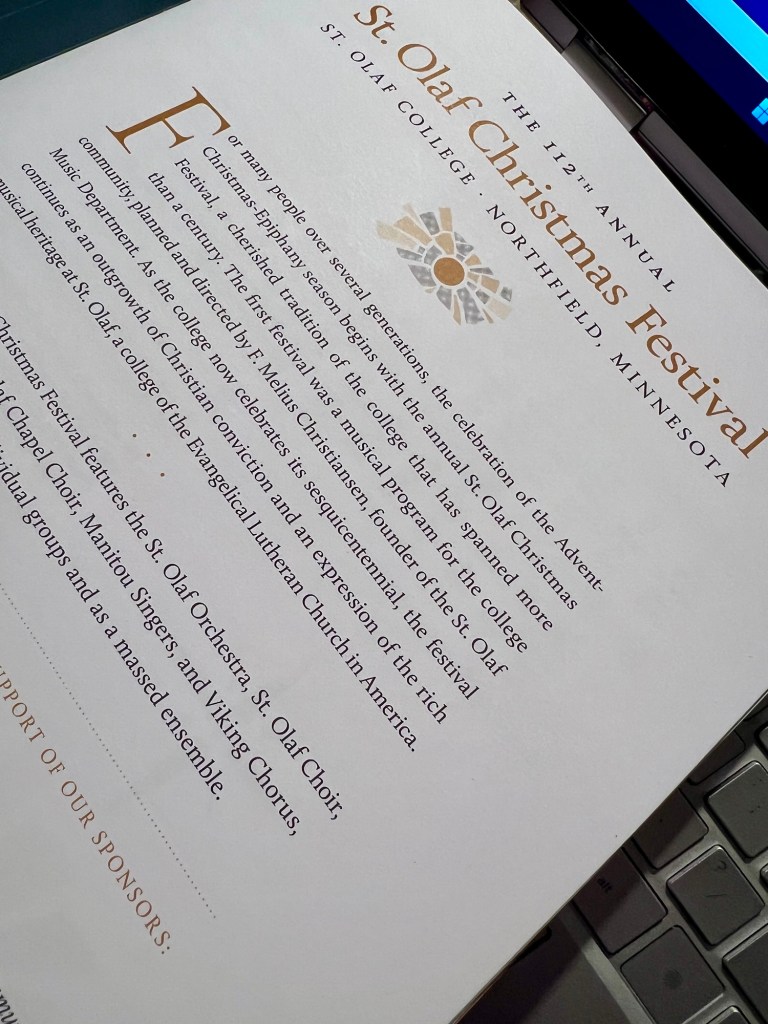
St Olaf Christmas Concert
It is an amazing experience to be engulfed by sounds of joy and seasonal cheer.
Will You Walk Among the Weak

Cliff Eberhardt- Guitarist exceptional
I never tire of it
Mass in G minor
Johann Sebastian Bach wrote four further Kyrie–Gloria Masses, BWV 233–236. These compositions, consisting of the first two sections of the Mass ordinary (i.e. the Kyrie and the Gloria), have been indicated as Missae breves (Latin for “short masses”) or Lutheran Masses.

What Might You Find?
A musician from up north wrote a beautiful song after a walk in the woods.
Debussy on Wagner
Turns out he didn’t like him so.
This verdict, made up of love and hatred, was given once more by Debussy in more graphic, less definite terms which unite, whilst contrasting them, the names of Bach and Wagner: In conclusion, Wagner’s work suggests a striking picture: Bach as the Holy Grail, Wagner as Klingsor wishing to crush the Grail and usurp its place…. Bach shines supreme over music, and in his goodness he has reserved for our hearing words as yet unknown, of the great lesson he has bequeathed us of disinterested love of music. Wagner disappears into the background… He is fading away … a black, disturbing shadow.
In his final analysis Debussy’s chief grievance against the great artist who degraded symphony to the service of his tragedies was a lack of this passion-disinterested love of music. For Debussy was above all a musician, whilst Wagner was above all a dramatist.

Cantus: Starry Messenger
By Z Randall Stroope

Sunday music
Plucky violinist plays
MN a place for music
Minnesotan Libby Larsen was inducted into the American Academy of Arts and Letters. The 73 year old was interviewed at her home in Minneapolis near Lake of the Isles.
She sees it as “an honor for Minnesota as well.” Though Larsen’s work often takes her out of state, “by choice I’ve made my life here, and I’m deeply grateful and proud of the crazy culture that supports ideas — like no other place in the country.”
Star Tribune via MSN
“People here really love to make music,” she said, “which is true everywhere, except that it seems to be more here with a smaller population.”
At one point in her busy career, packed with commissions, performances and recordings of works for orchestra, opera and band, she thought, “Where else could I make music? Just make music — instead of spending a year or two trying to get in the door to make music?”
The answer kept her here.
Star Tribune via MSN
If you have more listening time, try this piece, Mass for the Earth, from 1992.
Best Performance of the Grammys
Because Chapman is delighted by the audience’s reaction to her. And Combs is delighted to perform with one of his idols. Sincerity is priceless.
The amazing Diana Ross sings Amazing Grace
UMN dance team does Aerosmith proud
Freedom to find your dream
Thank you to all the visitors from around the world who have stop by this page for a visit. I appreciate all of you.
And here is wishing you the freedom to “Climb Ev’ry Mountain” in 2024!
Sound of Music
by Richard Rodgers
Climb Every Mountain
Climb every mountain, search high and low
Follow every by way, every path you know
Climb every mountain, ford every stream
Follow every rainbow, till you find your dream
A dream that will need, all the love you can give
Everyday of your life, for as long as you live
Climb every mountain, ford every stream
Follow every rainbow, till you find your dream
A dream that will need, all the love you can give
Everyday of your life, for as long as you live
Climb every mountain, ford every stream
Follow every rainbow, till you find your… dream…
St. Olaf Choir – “His Light In Us” – Kim André Arnesen
Route 66
A poet from the Range and a Prince from the City, both from the North
Sometimes that’s the job, to be there
Rhapsody in Blue- go girl
Nina knew something about freedom and productivity
I wish I could give
All I’m longin’ to give
I wish I could live
Like I’m longing to liveI wish I could do
All the things that I can do
And though I’m way overdue
I’d be startin’ anew
Power Women
Ella’s got the Voice
How Ray Charles got his start
In this documentary with Cint Eastwood and Ray Charles, the pianist explains how he got his start. When he was about three, he followed the sound of boogie woogie music to a local musician named Wylie Pitman playing on an upright piano at the Red Wing Cafe. Instead of telling the toddler to run and play, Wylie spent time with the young Ray and taught him bit by bit. Hear Ray Charles tell the story around min 6.
It’s hard to imagine what the world of music would have lost if Wylie Pitman had ignored the youth. As explained in the clip, the elder took time away from his own practice to nurture the talent of the youth. For nothing. It’s a miracle that the right person appeared at the right time to mentor a wayward youth.
The transaction of his time and talent isn’t something that could be predicted. It was a spontaneous response in the moment. And, as the story is told, it was tied to the level of interest the benefactor of his lessons was exhibiting. The first rule of social support is that you can’t know how much will be given until the need is revealed.
The second rule of social support is that you only need one. The whole group doesn’t need to be taxed. When the right support meets the right benefactor then the delivery of services occurs on that level. Only one person is needed to call in a crime happening on the street. Only one person is needed to make sure the kid who’s being bullied gets home from school safely. If people offer just-in-time support, then resources are used most efficiently.
It only took Wylie Pitman to step up in the moment and deliver the megastar Ray Charles to music history.
Women who collaborated
Collaborations often result in benefits for both parties. The outcome isn’t an aggregate of the two solo performances. It’s something new unto itself.
There weren’t many early collaborations with female rockstars. Only two came to mind. ABBA’s Agnetha and Anni-Frid.
Heart’s Stevie Nicks and Ann Wilson.
Tina Turner- RIP
Tina Turner put her time into liberating women. She frees herself from an adverse and abusive marital relationship to pursue her talents. She doesn’t waste time dwelling on the bad but is confident in herself and her future.
And look what she has left for everyone to enjoy.
Crooners
I can’t say that I’ve ever been to a supper club before. Years ago I went to the Dakota which was a jazz club over into St. Paul as you leave Minneapolis. It was more of a bar that specialized in live music than a club. But a supper club, that’s different. It conjures up movie clips of mafia-looking men with women companions in tight dresses and hair-sprayed updos. The smoke is thick. The stage lights are bright.

At Crooners, which is in an unromantic suburb to the north of the downtowns, the stage lights are also bright. But not a whiff of smoke is present to offend. The tables are tight and the table lights are dim. The audience is slightly staggered upwards as the seating moves to the rear of the room. It’s just the little nudge you need to still have a decent view of the stage.
Agile wait staff maneuver through amongst the guests. They must undergo training to elevate their voice level just to the point of being audible but no more. Many people were enjoying drinks and appetizers. We ordered dinner. Might as well be fed then come home to the chore of cooking.
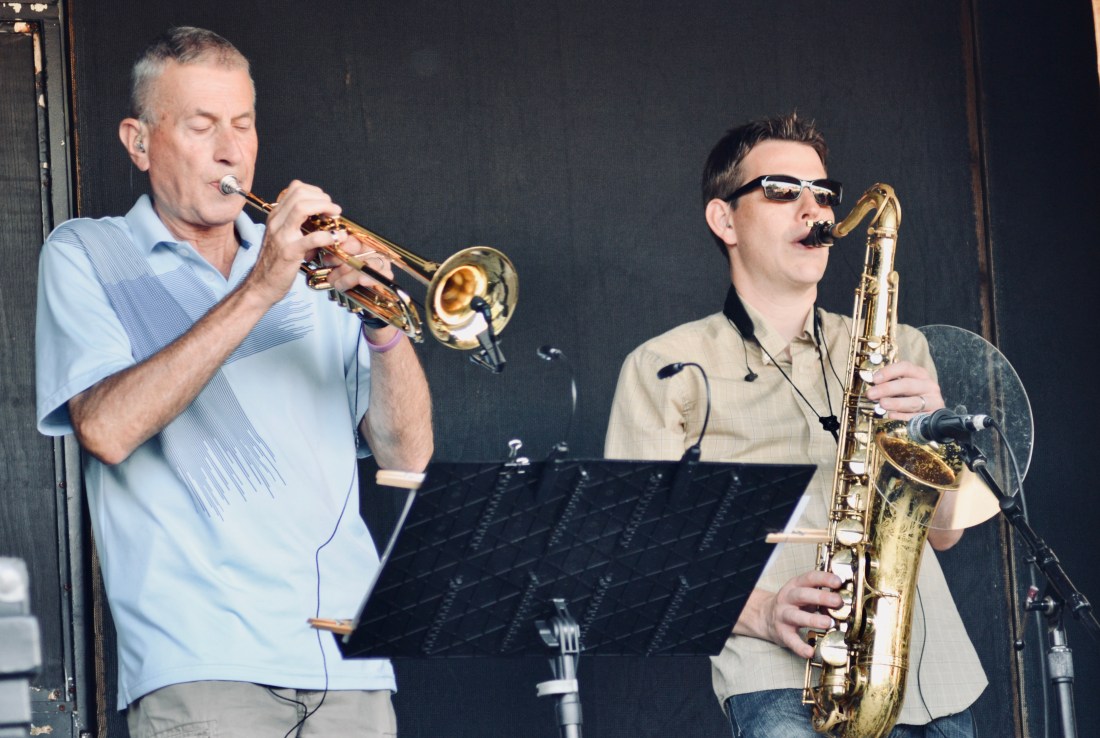
The atmosphere was a big plus but we came for the music and it did not disappoint. Jazz is like a whole bunch of musical voices barking at each other just to come together in these tremendous cacophonous surges. There are quiet moments too. The pianist had a wonderful soft accompaniment to the bass player. I’d give the trumpets the prize for having the most fun. And the saxaphonists and the trombones came through with tremendous solos.
It was fun! Here’s a taste.
Quiet nights of quiet stars

Sing because you are happy
RIP Burt Bacharach
Jilted by the Grammys
Diana Ross was nominated twelve times for a Grammy but never received one. Her first nomination was in 1964 for Baby Love. Between 1970 and 1982 hits like Upside Down, Love Hangover, Stop in the Name of Love, and Touch Me in the Morning were all overlooked.
Is Jazz Hopeful?
I didn’t use to think so. I thought jazz was heavy and sorrowful and sad. Singing the blues was what it was about. When Billie Holliday wasn’t singing the blues she was warbling Goodmorning Heartache. Ella Fitzgerald croons about her time spent in regret in Cry Me a River. And then Nina Simone’s rendition of Sinner Man is haunting but quite the opposite of cheerful.
Maybe the crackly recordings added to an unsatisfactory listening experience. Because it certainly wasn’t the quality of the voices. Heavens. The remastered versions of their performances show off the extraordinary voices which made them famous.
It wasn’t too many months ago that I was running the search on my car radio hoping desperately for a break from earworm pop and classical MPR when I stumbled on Jazz 88.5 FM. It made my day- a real DJ was selecting and talking about the cuts he or she had chosen. Some are performers themselves and give insights into their preferences. But most of all the music was joyful and upbeat.
The station operates in conjuntion with the Minneapolis Public Schools. From its website:
Listener-Driven Jazz, Roots, News and Traffic
MINNESOTA’S JAZZ STATION
Jazz88 is the Twin Cities’ source for jazz & roots music, MnDOT traffic, and BBC World News. Jazz88 is one of the highest-rated full-time jazz stations in the nation and an Ampers Station of the Year recipient. A self-supporting service of Minneapolis Public Schools (MPS), Jazz88 receives nearly half of our annual revenue from individual listeners. Your gift supports the radio and digital services, live events, and our hands-on educational program.
Fly high, fly far

The comfort of the human voice
Many schools are known for their athletics. There’s money in it. The teams bring in revenue from ticket sales at games and in exchange for their viewing rights. My alma mater is known for its choir. The St. Olaf Choir is a frequent world traveler, bringing the beauty of the human voice to places near and far.

This year’s Christmas Concert performance, Promise of Peace, was performed at Orchestra Hall. It’s a beautiful venue with spectacular acoustics. But it’s the voices of 500 choir members who perform which make the event memorable.
Beautiful Savior is a favorite. Have a listen.
Happy music
Of Our New Day

We were in Northfield this afternoon for parent’s weekend at St. Olaf College. After lunch at the Reunion on Main Street and a walk along the nature trail behind Skogland, we went to listen to the Family Music Performance. The freshmen male choir, directed by Tesfa Wondemagegnehu, formed a half moon on the risers first, and they did not disappoint. I had several friends in choir back so many years ago now, that these new fresh faces simply met their level of excellence.
Having no expectations for the St Olaf Band, however, led to a delightful sense of discovering something exceptional. The variety of instruments and tones and tempos! Well, listen for yourself.
Want to hear a guitar gently weep?
Storytelling then and now

You know how all the marketing people like to say- let the ad tell your story? The whole story method seems to crop up on LinkedIn or on how-to advice to promote businesses on social media. One simply must come up with an interesting backdrop.
Storytelling now doesn’t hold a candle to storytelling back in Bach’s day. In the 1700’s the account of the death and resurrection of Christ was sung out on Good Friday over a three plus hour service. Have a listen to the Netherlands Bach Society interpretation of the piece.
Personally, I prefer the time when a story was spun into something beautiful instead of a soft shoe move to peak the interest of a commercial audience.
The clarion quality of the French Horn
What Child is this- 1983 Edition
The St. Olaf Choir is a premier a cappella choir based in Northfield, Minnesota. Founded in 1912 by Norwegian immigrant F. Melius Christiansen, the choir has been influential to other church and college choirs for its performance of unaccompanied sacred music.[1] Conducted since 1990 by Anton Armstrong, there have been four conductors in the choir’s 109 year history.
Wiki
 Home Economics