In the high valleys of Hallingdal, where the mountains still held the old names and the rivers ran cold from the snows, the people of Torpo had long kept both the new faith and the older habits. By the closing years of the twelfth century, Christianity had reached even this inland district, carried north and west by the memory of King Olaf Haraldsson, who had fallen at Stiklestad more than a century and a half earlier. His death had turned him into a saint, and the white Christ he had forced upon the coastal chiefs and inland farmers had gradually become the God of the valleys as well.
Yet the change had not been swift or clean. In Torpo the first wooden church had been small, raised perhaps in the generation after Olaf’s son Magnus the Good had reclaimed the kingdom. Its posts were set in the earth, its doorposts carved with the interlacing beasts that still remembered the old animal styles. When that earlier building grew weak, the men of the parish decided on something stronger and higher. They sent for Torolf, a master builder known for work in the Sogn valleys and for a steady hand with the axe.
Torolf arrived with a small company of craftsmen in the spring when the timber could be felled and floated down the Hallingdalselva. The local priest, a man who held a canonry at the cathedral in Stavanger, had already secured the right to dedicate the new church to Saint Margaret of Antioch. Margaret’s story—how she had been swallowed by a dragon and had burst free by the power of the cross—was well known among the mountain folk. In a land of wolves and sudden rockfalls, a saint who defeated a monster from within was a practical intercessor.
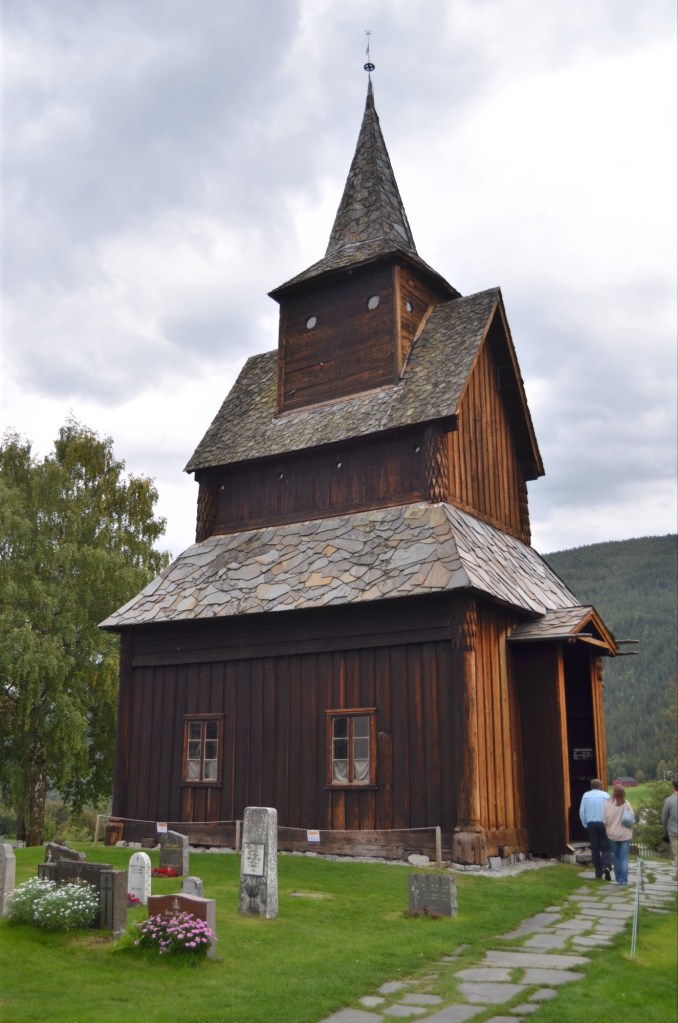
The men cut tall pines and firs from the slopes above the river. Dendrochronology would later fix the year of the main timbers near 1192, but Torolf and his crew knew only that the wood must season properly and that the great staves must be jointed so the whole structure could rise without iron nails. Fourteen upright posts would form the central chamber, braced by sills and crossed members that stiffened the walls against the winter winds. Around this high nave the builders raised lower aisles, so that the roof climbed in steps, the outer covering of wooden shingles darkening under rain and sun.
While the frame went up, the older men of Torpo told the younger workers what their grandfathers had said of the conversion. In the days of Olaf Tryggvason and then of Olaf Haraldsson, royal agents and English priests had come up the valleys with crosses and with threats of fire and outlawry. Some chieftains accepted baptism for the sake of trade and alliance; others held out until the king’s ships or his local allies made resistance costly. In Hallingdal the last open sacrifices at the old hof had ceased only after word came that Olaf’s body, recovered from the battlefield, had worked miracles. A farmer who had once carved Thor’s hammer on his doorpost now ordered a cross cut in its place, and his sons learned the Latin creed by rote.
Torolf himself carried a runic inscription that would be cut into a plank of the church: “Torolf made this church. Ásgrímr, Hákon, Erlingr, Páll, Eindriði, Sjaundi, Torolf. Thorir carved.” The names mixed the old Norse stock with Christian ones. Páll was Paul; the rest still sounded like the language of the Thing. When the main structure stood, the builders left an apse at the eastern end of the chancel and a narrow opening between nave and sanctuary. Side altars stood in the nave for the lesser saints, while the high altar faced the rising sun.
In the decades that followed, the church would receive a painted canopy over a loft in the eastern part of the nave. On that barrel vault, artists would show Christ in judgment surrounded by the symbols of the evangelists, the twelve apostles, and scenes of Margaret’s martyrdom. But in Torolf’s time the interior was still plain wood, smelling of resin and smoke from the candles the priest lit at mass. The circular openings high in the walls let in thin shafts of light. Beneath the floor, near the chancel opening, someone would later carve the outline of a shrouded figure; tradition would claim it marked the grave of a bishop from Stavanger who had died while visiting his northern parish.
On the day the church was first used for mass, the people of Torpo and the neighboring farms of Ål and Hemsedal gathered outside the west portal. The portals themselves carried carved interlacing that still echoed the older styles, yet the cross stood above them. The priest spoke the words of consecration, and the congregation answered as best they could. Outside, the river ran as it always had, and the mountains kept their old silence. Inside, under the rising wooden roof that Torolf and his men had raised, the white Christ had been given a permanent house in the valley. The stave church at Torpo would remain the oldest building in Hallingdal, standing on its original ground long after many of its sister churches had been replaced, a timber witness to the slow, uneven arrival of the new faith among the last of the inland Norse.