Year-End Update- What this site is about

This site advances a structural theory of economic organization in which societies are understood as collections of bounded groups that govern shared resources internally while competing externally through privately capturable returns. The central claim is that economic order emerges from a sorting mechanism: individuals and activities are continually reallocated between cooperative group settings and market-like domains based on the relative performance of group-public assets versus private opportunities.

Within this framework, groups are defined not merely by identity or culture, but by rule-governed access to non-divisible or imperfectly divisible assets. Such assets—landed estates, commons, institutional authority, epistemic legitimacy—function as group-public goods: they are accessible to members, governed by internal norms, and resistant to direct pricing. Participation confers benefits that are distributed through social rules rather than markets, creating a publicness that is endogenous to group membership rather than universal.

Outside these groups, individuals engage in domains characterized by alienable, liquid, and privately capturable returns. These domains—markets, trade, professional careers, or platforms—permit competition unconstrained by group obligations and reward individual optimization. The boundary between group and market is therefore not fixed; it is continuously reshaped by changes in relative returns, enforcement capacity, and legitimacy.

The theory’s explanatory power lies in showing how publicness and competition are not opposites, but complementary outcomes of the same sorting process. Internally, groups suppress price signals and individual appropriation in order to stabilize shared assets and reduce coordination costs, consistent with Ostrom’s findings on common-pool resource governance. Externally, groups compete for members, status, and influence through performance, innovation, and access to higher-return opportunities, aligning with North’s account of institutional evolution driven by differential returns and path dependence.

This mechanism also integrates Mises’s praxeological insight that all outcomes originate in individual action. Individuals are not assumed to act altruistically or selfishly in the abstract; rather, they respond to institutionally structured opportunity sets. Actions that appear cooperative within the group—maintenance of shared assets, adherence to norms, acceptance of unequal internal distribution—are rational given the group-public payoff structure. Conversely, actions that appear self-interested outside the group reflect the higher marginal returns and certainty of private capture. The theory thus avoids moralizing distinctions between cooperation and self-interest, treating them as context-dependent expressions of action under differing institutional constraints.

Historically, the theory explains periods of social transition as moments when private returns in external domains outpace the productive or legitimating capacity of group-public assets. Under such conditions, groups become custodial rather than generative: obligations persist while returns stagnate. Individuals increasingly sort into private domains, weakening internal enforcement and prompting pre-commitment maneuvering, ideological rationalization, or reform efforts. This dynamic aligns with classical coordination problems such as Rousseau’s Stag Hunt, while extending them beyond static games into historically embedded institutional change.

By framing economic structure as an evolving ecology of groups and markets linked through a sorting mechanism, this theory bridges literature on institutions, collective action, and market pricing. It accounts for why public goods are often effectively governed at intermediate group scales, why markets excel at allocating marginal resources across groups, and why systemic change is typically gradual, conflictual, and legitimacy-lagged rather than abrupt or purely efficiency-driven.

In sum, the proposed framework offers a unified explanation for how societies organize cooperation internally while sustaining competition externally, and how shifts in resource productivity drive the continual reconfiguration of social commitments and economic structures.

Blended systems of cooperation and competition

The Stag Hunt, explained as a shifting public–private balance

Imagine a small group of hunters living at the edge of a forest. Together, they can hunt a stag. A stag is large: it feeds everyone for days. But it can only be taken if all hunters cooperate, hold their positions, and act in coordination. The stag, once caught, is a group-public asset: no one hunter can claim it alone, and everyone benefits.

Individually, however, each hunter can hunt a hare. A hare is small, but it can be caught alone, quickly, and with certainty. The hare is a private asset: the hunter who catches it keeps it.

At first, cooperation dominates. The group trusts itself, norms are strong, and everyone expects the others to stay. Hunting the stag makes sense.

But conditions begin to change. Perhaps the forest becomes less predictable. Perhaps hunger becomes more acute. Or perhaps some hunters discover they are particularly good at catching hares. The private return to individual action rises, while the reliability of collective action weakens.

Now the calculation shifts. Any single hunter who abandons the stag hunt early can secure a hare for himself. If even one hunter defects, the stag escapes and the group gets nothing. As more hunters privately consider this possibility, the group-public asset becomes fragile. Trust erodes not because cooperation is irrational, but because its success depends on others remaining committed.

Eventually, everyone hunts hares. The group survives, but on less than it could have had. The stag hunt fails not because hunters become selfish in character, but because the balance between public and private returns has shifted.

Rousseau introduced the Stag Hunt in 1755, in Discourse on Inequality, as a way to illustrate how early cooperation collapses when private, individually secure options undercut fragile collective commitments. The Stag Hunt shows how cooperative systems fail not through greed, but through the gradual rise of privately secure alternatives that undercut shared commitment.

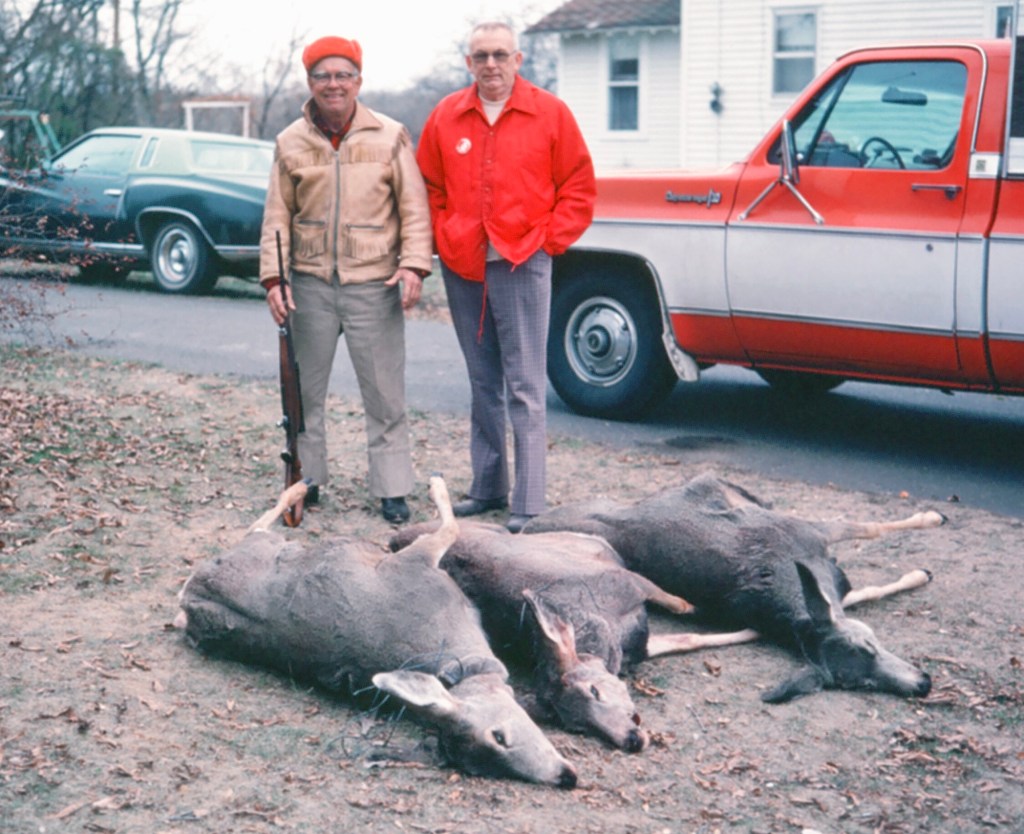
My experience is that mostly hunters group up. Partly because they share a similar interest. Partly for the camaraderie. But also because they share the work of baiting, setting up, tracking, and processing.

Paradigm Shift

In this ten-minute video, economic professor Ashley Hodgson lays out how a shift at the foundational base of a field of knowledge occurs and builds on new building blocks.

Ashley Hodgson’s New Enlightenment argues that modern societies are governed less by conscious choice than by incentive-driven systems that shape beliefs, behavior, and outcomes at scale. Drawing on behavioral economics and systems thinking, she challenges Enlightenment assumptions about rational individuals, neutral markets, and linear progress (especially GDP-centric thinking). Her central claim is that humans now function within a kind of social superorganism, where misinformation, institutional incentives, and feedback loops distort what people perceive as rational or true. A new enlightenment, she argues, requires updating our models of rationality, knowledge, and governance to reflect these systemic dynamics rather than relying on outdated economic myths.

Hodgson offers a compelling critique of Enlightenment assumptions and a sophisticated account of systemic failure, but her ‘New Enlightenment’ functions more as a diagnostic framework than as a theory of institutional emergence or system dynamics.

Religiosity of Employment

If you’ve been taking the classics for granted, if you’ve been focusing on science, you are denying yourself insights into solutions.

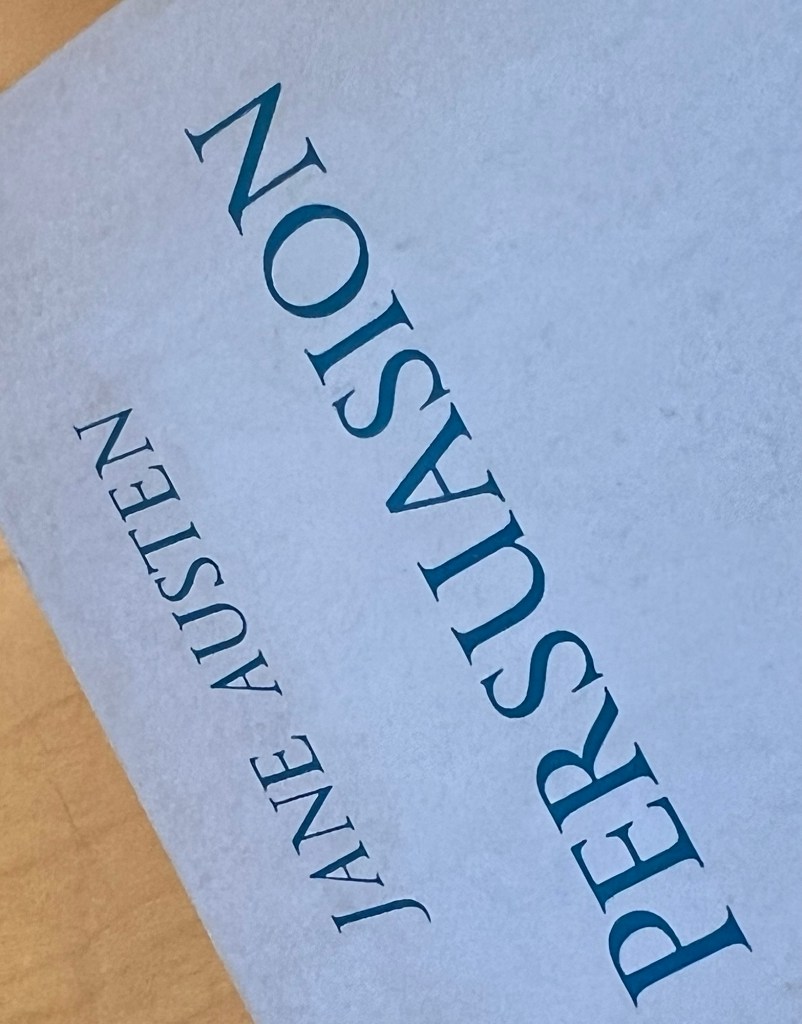
—A submissive spirit might be patient, a strong understanding would supply resolution, but here was something more; here was that elasticity of mind, that disposition to be comforted, that power of turning readily from evil to good, and of finding employment which carried her out of herself, which was from Nature alone. It was the choicest gift of Heaven; and Anne viewed her friend as one of those instances in which, by a merciful appointment, it seems designed to counterbalance almost every other want.

J Austen reviews the intricacies of social decision making under constraints both natural and real.

Lookism a la J Austen

Personal size and mental sorrow have certainly no necessary proportions. A large bulky figure has as good a right to be in deep affliction, as the most graceful set of limbs in the world. But, fair or not fair, there are unbecoming conjunctions, which reason will patronize in vain,-which taste cannot tolerate, —which ridicule will seize.

A ‘bulky figure’…c’est amusant.

Orientation-by-Institution

By “orientation-by-institution,” I refer to the way institutional arrangements function as shared interpretive frameworks that orient expectations and render individual plans mutually intelligible under conditions of uncertainty.

Chat has a story.

They were halfway through lunch—salads mostly untouched, bread already gone—when someone noticed it.

“Did you see her hair last week?” one of them said, lowering her voice even though the person in question wasn’t there. “It actually looked really good.”

“Yeah,” another replied, “but doesn’t she get it cut at Little Snips? Why does she even go over to that side of town?”

That set it off.

“Well, the cut is good,” someone said, “but it’s not like it’s magic. You can get a decent cut anywhere.”
Another leaned back and laughed. “Decent? Please. She pays way too much. That shwanky salon—what is it now, Maison Something? It’s nice, sure, but the cut is the same cut whether you pay forty dollars or two hundred.”

They all laughed, because it was true and because saying it felt good.

Then someone else chimed in, quieter but smiling. “Honestly, my sister-in-law cuts my hair in her basement. Folding chair, mirror from Target. I probably overpay her too, but at least I know where the money’s going.”

That changed the tone just a little.

“So really,” one said slowly, “we’re all paying for different things.”
“Exactly,” another added. “Not just the cut.”

They started listing it out without meaning to: paying for polish, for status, for supporting family, for convenience, for being seen in the right place, for not being seen at all. Same service, different prices—because each price bought entry into a different social arrangement.

By the time the check came, no one was talking about hair anymore. They were talking about neighborhoods, schools, reputations, obligations—about how money quietly props up the social worlds they move through every day.

And no one asked again why their friend went to Little Snips. They already knew

Wake Up Dead Man: Knives Out–Movie Review

I’m a fan of Daniel Craig, so I may be biased in this whole-hearted recommendation of the new Knives Out movie. Viewers will come away satisfied with the intrigue, the cast of characters, and the denouement of solving the crime. It’s all there. But there’s more.

In a surprising twist, this new release delves deeper. Writer Rian Johnson uses the exploration of faith as a central theme in this third incarnation of Knives Out. Somehow in this otherwise commercial entertainment vehicle, he depicts journeys of faith without condensation of suspended disbelief or mockery.

Is this the beginning of a new tolerance for ancient traditions? There was a magic in it.

Mises proposes Praxeology to show the way

Thus there are no irreconcilable conflicts between selfishness and altruism, between economics and ethics, between the concerns of the individual and those of society. Utilitarian philosophy and its finest product, economics, reduced these apparent antagonisms to the opposition of short-run and long-run interests. Society could not have come into existence or been preserved without a harmony of the rightly understood interests of all its members.

There is only one way of dealing with all problems of social organization and the conduct of the members of society, viz., the method applied by praxeology and economies. No other method can contribute anything to the elucidation of these matters.

Time tables for success

If people want effects muted they draw out terribly long time tables, muting any situational success or failure. If people want to control the narrative they clip the timetable to the period of interest.

Time matters for any proper analysis or policy considerations. In real estate, the timeframes are almost always too short.

Work and its natures

At home-economic we think of work as an activity within an analytical structure which proposes that human action is propelled by two forces. The work often associated with volunteerism percolates along, driven by the desire to help, to impact more than oneself.

This is from a lovely essay by Russ Roberts

Aristotle has a different explanation and it is quite beautiful. He says that unlike a creditor (who only cares about the recipient because he wants to be repaid), “benefactors love and are fond of those they have treated well, even though they are neither useful to them now nor likely to become so later on.” He then says something a little shocking and quite extraordinary. The bracketed phrase is Leon’s:

“The same thing also happens with craftsmen; for every craftsman loves his own work more than he might be loved by that work were it to become alive. This is especially true, perhaps, with poets, for they love exceedingly their own poems, loving them as children. This is in fact also the case with the benefactor, for the beneficiary is the work of the benefactor; thus, the benefactor is fond of him more than “the work” [that is, the beneficiary] is of its maker.”

From the Census

National vacancy rates in the third quarter 2025 were 7.1 percent for rental housing and 1.2 percent for homeowner housing. The rental vacancy rate was not statistically different from the rate in the third quarter 2024 (6.9 percent) and not statistically different from the rate in the second quarter 2025 (7.0 percent). 

The homeowner vacancy rate of 1.2 percent was higher than the rate in the third quarter 2024 (1.0 percent) and higher than the rate in the second quarter 2025 (1.1 percent). 

The homeownership rate of 65.3 percent was not statistically different from the rate in the third quarter 2024 (65.6 percent) and not statistically different than the rate in the second quarter 2025 (65.0 percent).

That was then – tenant screening

Sir Walter must face financial circumstance and lease out his country manor home. The go-between, Shepard, spouts off all the appealing characteristics of his potential tenant.

And who is Admiral Croft?” was Sir Walter’s cold suspicious inquiry.

Mr. Shepherd answered for his being of a gentleman’s family, and mentioned a place; and Anne, after the little pause which followed, added—

” He is rear admiral of the white. He was in the Trafalgar action, and has been in the bast Indies since ; he has been stationed there, I believe, several years.

One must be careful using the family word in real estate, today. Best to think of other descriptors. But not personal features as such:

Mr. Shepherd hastened to assure him, that Admiral Croft was a very hale, hearty, well-looking man, a little weather beaten to be sure, but not much; and quite the gentleman to he sure in all is notions and behaviour.

Outward characteristics are not to be asked or recorded on a rental application. But the terms of the unit can be recorded.

not likely to make the smallest difficulty about terms; only wanted a comfortable home, and to get into it as soon as possible; knew he must pay for his convenience;-knew what rent a ready-furnished house of that consequence might fetch; should not have been surprised if Sir Walter had asked more;-had inquired about the manor;

Oh- and there’s this.

—would be glad of the deputation, certainly, but made no great point of it;— said he sometimes took out a gun, but never killed ;—quite the gentleman.

And theres lots to say about the family. (Also a no-no today)

Mr. Shepherd was eloquent on the subject; pointing out all the circumstances of the admiral’s family, which made him peculiarly desirable as a tenant.

He was a married man, and without children; the very state to be wished for. A house was never taken good care of, Mr. Shepherd observed, without a lady: he did not know, whether furniture might not be in danger of suffering as much where there was no lady, as where there were many children. A lady, without a family, was the very best preserver of furniture in the world. He had seen Mrs. Croft, too;

All these rich social indicators are removed when renters seek homes in today’s market.

Good habits

Let the peace of Christ rule in your hearts, since as members of one body you were called to peace.

And be thankful.

Let the message of Christ dwell among you richly as you teach and admonish one another with all wisdom through psalms, hymns, and songs from the Spirit, singing to God with gratitude in your hearts.

And whatever you do, whether in word or deed, do it all in the name of the Lord Jesus, giving thanks to God the Father through Him.
COLOSSIANS 3:15-17

What’s considered acceptable?

Standards can change over time.

Standards can vary between cities.

Standards may vary based on taste.

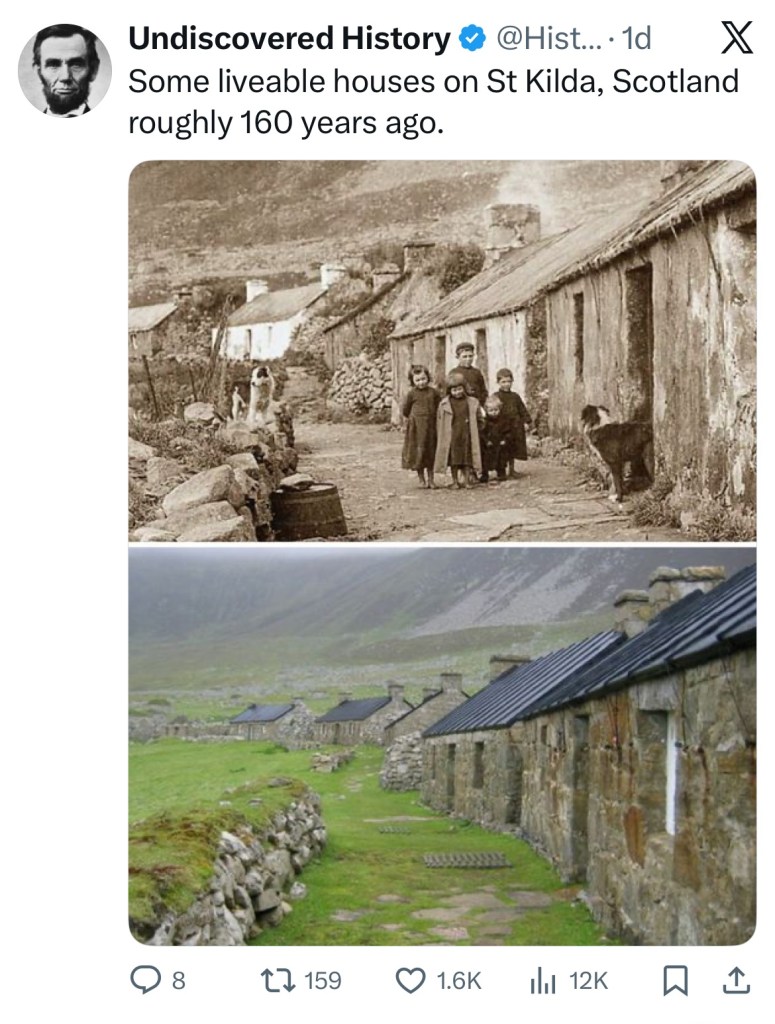
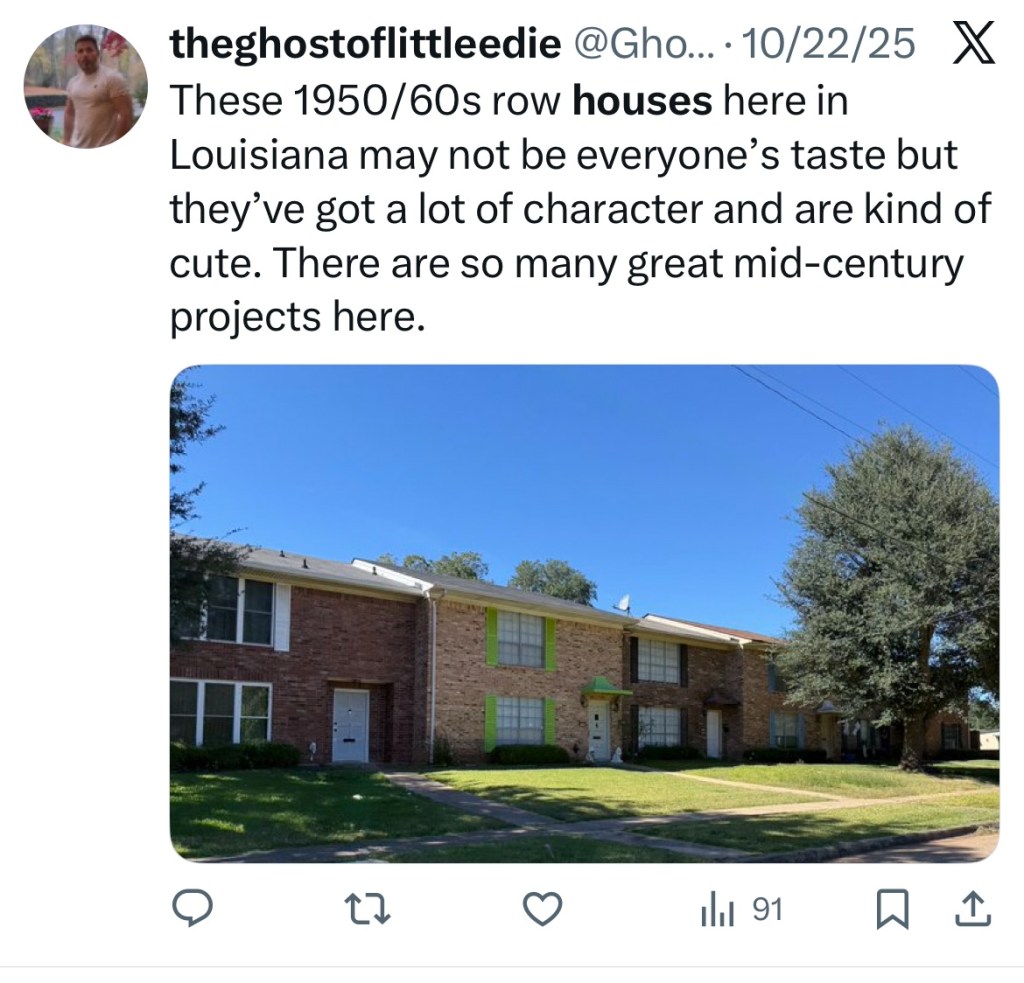
Ultimately, it is the local community that determines which options are the most suitable and which are less desirable. Which have fallen so out of favor that the structures are abandoned completely. And which ones promise a reward for rehabbing.

Real estate is local. National figures provide sparse details.

The grocery and the mountain

When should a community gather up its resources and provide a service to all members? And when should individuals be turned out into the world to navigate on their own dime? These debates cross all levels of government.

Some provisions are accepted as a government thing, like piped water or sewer. Even basic universals like education attract conversation about private options. Roads are sometimes (although truly not very often) toll roads. Bridges are mostly a public venture, as are parks. What takes a good out of private production and places it in the receivership of a bureaucracy?

Fear usually. Police and firefighters are in place to ensure personal safety. The New Deal was to alleviate fears against a repeat of depression era outcomes. When society risks a loss that compels a human response, society steps forward with a safety net.

Mamdani, New York Cities new mayor, sold the people on a fear of escalating grocery prices and thus the need for a government run store. This seems different than when a small community rounds up a helicopter rescue for a mountain climber who ventured up a nearby peak alone and unprepared.

So who gets to pick what there is to fear? Not everyone does this well. Here’s Mises (from Theory and History)

They recommend some policies, reject others, and do not bother about the effects that must result from the adoption of their suggestions.

This neglect of the effects of policies, whether rejected or recommended, is absurd. For the moralists and the Christian proponents of anticapitalism do not concern themselves with the economic organization of society from sheer caprice. They seek reform of existing conditions because they want to bring about definite effects. What they call the injustice of capitalism is the alleged fact that it causes widespread poverty and destitution. They advocate reforms which, as they expect, will wipe out poverty and destitution. They are therefore, from the point of view of their own valuations and the ends they themselves are eager to attain, inconsistent in referring merely to something which they call the higher standard of justice and morality and ignoring the economic analysis of both capitalism and the anticapitalistic policies. Their terming capitalism unjust and anticapitalistic measures just is quite arbitrary since it has no relation to the effect of each of these sets of economic policies.

Taking over a grocery is sure to fail financially without ensuring any additional food security for those who need it. It’s a vanity project. Wouldn’t it be like telling the mountaineer that a government representative would need to participate in the planning and execution of his climb? Yet here, the little community bears a disproportionate cost for the climbers’ foolishness.

It seems that the risk to persons and the community happens to various degrees. Whether the risk triggers community involvement has to do with its extreme and the distance between the risky step and all the other steps in between.

Happy Birthday Emily Dickinson

I died for Beauty - but was scarce
Adjusted in the Tomb
When One who died for Truth, was lain
In an adjoining Room -

He questioned softly "Why I failed"?
"For Beauty", I replied -
"And I - for Truth - Themself are One -
We Brethren are", He said -

And so, as Kinsmen, met a Night —
We talked between the Rooms -
Until the Moss had reached our lips -
And covered up - Our names -

How would it feel?

People speculate why young people have delayed home purchases. Only around 20% of home purchases fall in this category. A historic low. But is it that surprising? Look at the surge of foreclosures in ’07-’08 and ’09. Hundreds of thousands of people who were never meant to have financial struggles lost their homes.

Children ages 8-12, old enough to sense the stresses within their families, yet too young to analyze the impact of a national financial crisis, were bystanders to these unpleasant legal actions in the early 2000’s. These are today’s young home buyers. Uncertain of what a real estate purchase will do for them. The anxiety associated with foreclosures has often been portrayed in litterature.

In Death of a Salesman, the family’s fear of losing their home emerges gradually, revealed not through a dramatic announcement but through Linda’s quiet confession that they are barely keeping up with the mortgage. She tells Biff and Happy that Willy has been borrowing money just to make the house payments—a disclosure that reframes the entire domestic landscape. What had seemed like an ordinary family home is suddenly understood as something fragile, held together by secrecy and strain.

The looming threat of foreclosure exposes the play’s deepest emotional fractures. The mortgage becomes a symbol of Willy’s unraveling identity—his failure as a provider and his desperate clinging to the American Dream. Linda’s hushed explanations carry a mournful tenderness, showing how fear and loyalty tangle together under financial pressure. For Willy, the house is both sanctuary and burden, and the possibility of losing it turns that symbol of pride into a reminder of collapse. The family’s anxiety over the home’s instability reveals how economic pressure corrodes affection, pride, and hope, tightening around them until it shapes every gesture they make toward one another.

Capital Theory

What is Capital Theory in Economics?

Capital theory is the branch of economics that studies the nature, role, measurement, and productivity of capital — the produced means of production (machines, factories, tools, infrastructure, software, etc.) that are used to produce goods and services.

It tries to answer fundamental questions like:

  • What exactly is “capital”?
  • How should it be measured?
  • How does capital contribute to economic growth and income distribution (wages vs. profit/interest)?
  • Why does the return on capital (interest rate or profit rate) behave the way it does?

Capital theory has been one of the most controversial and technically difficult areas in economics, especially in the 20th century.

Key Concepts and Debates

  1. Capital as a homogeneous “fund” (neoclassical view)
    • Mainstream neoclassical economics (since the late 19th century) treats capital as a single, measurable quantity (like “dollars of capital” or a “stock of value”).
    • In simple production functions (e.g., Y = F(K, L)), K (capital) is treated like labor L — you can smoothly substitute one for the other.
    • The interest rate is the price that equilibrates saving and investment.
  2. The Cambridge Capital Controversy (1950s–1970s) – the big critique
    • Economists from Cambridge, UK (Joan Robinson, Piero Sraffa, Luigi Pasinetti) challenged the neoclassical view.
    • Major problems they exposed:
      • Reswitching: The same technique of production can become profitable again at lower (or higher) interest rates, destroying the simple idea that lower interest rates always lead to more “capital-intensive” techniques.
      • Capital reversing: Higher interest rates can sometimes lead to using more capital-intensive methods — the opposite of what neoclassical theory predicts.
      • Measurement problem: You cannot measure the “quantity of capital” independently of the interest rate or profit rate, because capital goods are heterogeneous (a robot ≠ a shovel). Their value depends on future profits, which depend on the interest rate — a circularity.
    • Conclusion of the critics: The aggregate production function and the idea of a downward-sloping demand curve for capital are logically flawed.
  3. Austrian view (Böhm-Bawerk, Hayek, Lachmann)
    • Capital is highly heterogeneous and time-structured.
    • Production takes time; capital goods are “intermediate goods” at different stages of completion.
    • Emphasizes the “period of production” or “roundaboutness”: more productive methods are more time-consuming.
    • Interest originates from time preference (people value present goods over future goods).
  4. Post-Keynesian / Sraffian view
    • Rejects marginal productivity theory of distribution.
    • The rate of profit is determined by monetary factors, class struggle, or growth requirements, not by the “marginal product of capital.”
    • Capital is valued in terms of its own reproduction cost (Sraffa’s “price of production”).
  5. Modern mainstream response
    • After the Cambridge controversy, most neoclassical economists largely ignored the deep logical problems and continued using aggregate production functions for practical reasons (they work reasonably well empirically in many contexts).
    • Some (e.g., “new growth theory”) shifted focus to knowledge, human capital, and ideas rather than physical capital.

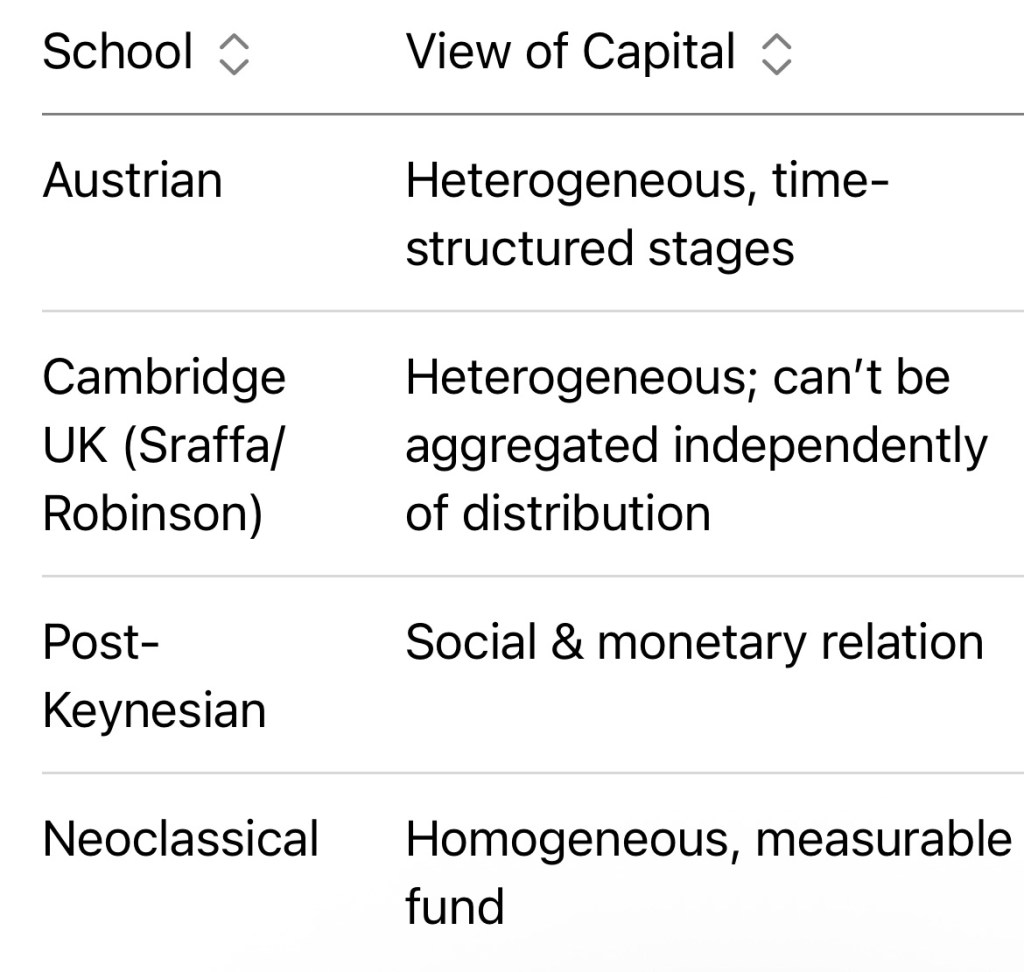
Summary Table of Major Schools

Bottom Line

Capital theory is the attempt to understand one of the most important concepts in economics — capital — and it remains unresolved. The mainstream treats capital as a simple scalar quantity for modeling convenience, but the Cambridge controversies showed that this simplification has serious logical flaws once you dig into the details. The debate is largely dormant in mainstream teaching but still very much alive among economic methodologists and heterodox economists.

That was then

Landlord portrayal in Bleak House.

As it was still foggy and dark, and as the shop was blinded besides by the wall of Lincoln’s Inn, intercepting the light within a couple of yards, we should not have seen so much but for a lighted lantern that an old man in spectacles and a hairy cap was carrying about in the shop. Turning towards the door, he now caught sight of us. He was short, cadaverous, and withered; with his head sunk sideways between his shoulders, and the breath issuing in visible smoke from his mouth, as if he were on fire within. His throat, chin, and eyebrows, were so frosted with white hairs, and so gnarled with veins and puckered skin, that he looked, from his breast upward, like some old root in a fall of snow.

I can show you

The theory proposed here, at home economics, is that there’s a nature to how people act to improve their lives. For lack of better names, activities occur in spheres with public-facing tendancies or private ones. When people operate for the group, they give to improve for an affiliated public endeavor, whereas the private sphere engages privately held resources to grow and gain.

I think this framing helps to explain the suggested paradox described in this Free Press article about a Chicago Trump supporter coming to the aid of Venezuelan migrants.

Aleah Arundale voted for Donald Trump, supports his decision to close the border, and may as well have introduced herself by singing “The Star-Spangled Banner” when we met at her front door in Chicago last month. She was wearing a white sweatshirt with “USA” plastered on the front, a sequined American flag skirt, heart-shaped red glasses, and bedazzled red and white sneakers.

She also has spent the last three years helping Venezuelan immigrants. It began when buses from Texas started dropping off people at a street corner near where Arundale’s daughter went to dance class, as part of Governor Greg Abbott’s expulsion of thousands of immigrants to sanctuary cities across the country.

When Aleah makes decisions as a Chicago resident, her choices are weighed out within that context. Her group interests lie primarily on her block or down the street. She can be pro-Trump and anti-everyone-else-outside-our-boundaries. This keeps her public dollars and work weighted to the local food shelf, her elderly parents’ care, or a literacy program at the public library. Any outside force taking resources away from these microtransactions is a competitor.

But then the immigrants are dropped off by the busloads, on the corner where kids get picked up by the school bus. They’ve switched groups. No longer are they an impersonal one of many in a faraway place; they’ve breached the group. They now rate as the most in need within this new framing. And thus, the mechanisms that drive the force for the good of the group are energized. Aleah gives the plight of the Venezuelians in some rank or fashion amongst her other commitments.

There are two things to see here. First– the framing of the group and thus its acknowledgement. Second, the lever for activating time, energy, and resources differs from the private sphere. Yet this all transpires through a juggle of tradeoffs trapped in a world of constraints.

The error of price-to-income-

The comparison of home prices to buyers’ incomes is a popular measure for assessing the health of the real estate market. Presently, that multiple seems high, and people are using it to cry, crisis! But is this true?

Amy Nixon posts on Twitter (now known as X):

All of economics is supply and demand.

The median household to median income argument makes sense only in an economy where we have built enough housing units per capita, and every housing unit is being allocated as a family shelter unit because it serves no other economic utility

The model breaks down when you have wealthy families buying 3-4 spare vacation homes. And mom and pop landlords hanging onto starter homes when they upsize. And institutions buying millions of single family homes. And single people living alone in two units instead of coupling to buy one unit. And foreign citizens buying homes. And people buying and using 2 million single family homes as hotels (Airbnbs)

So long as single family residential housing is viewed as and can be used as an investment or luxury item beyond owner-occupied shelter and we don’t build enough homes to offset all those other uses, the ratio pictured in the infographic below can (and will) go even higher over time

It’s not 1985. And it’s never going to be 1985 again.

What Amy says is that there is a mix of home-ownership types. If you are analyzing Lake Country, with many second homes, there will be a different price-to-income figure than if you consider a first-tier suburb built almost exclusively of starter homes. I like to call them platters. It’s the local eco-systems of properties that have interesting numbers. Averaging just smudges out all the details.

I’ll also note the shift in demographic mix. The number of first-time buyers is at an all-time low. From NAR:

WASHINGTON (November 4, 2025) – The share of first-time home buyers dropped to a record low of 21%, while the typical age of first-time buyers climbed to an all-time high of 40 years, according to the National Association of REALTORS®’ 2025 Profile of Home Buyers and Sellers. This annual survey of recent home buyers and sellers covers transactions between July 2024 and June 2025 and offers industry professionals, consumers, and policymakers detailed insights into homebuying and selling behavior.

Repeat buyers enter the market with equity. They do not need to take on as much debt relative to their income as first-time buyers do. Yet the sales price is the measure from which payment is extrapolated, not the actual payment. As a market rises, so does the equity, pushing this fictitious measure of debt load out of whack with reality.