A local non-profit executive recently stepped down from her post after her income, as listed on the organization’s tax form 990, was circulated publicly. The salary with bonus came to three-quarters of a million dollars. That’s a lot for around here. Claude says.
The average wage for a non-profit CEO in Minnesota is approximately $100,000-$130,000 per year, though this can vary significantly based on the organization’s size, budget, location within the state, and sector.
Larger non-profits with bigger budgets (especially in healthcare or education) tend to pay more, sometimes exceeding $200,000 for organizations with substantial operations. Small non-profits might pay significantly less, potentially in the $60,000-$80,000 range.
The Twin Cities metro area typically has higher compensation than rural Minnesota for comparable positions due to cost of living differences.
It would be one thing if the organization were a privately funded, hoity-toity type of group that brought in musicians from the Netherlands to listen to Back. If that’s what the philanthropists want ot do with their dollars, so be it. But the organization at hand is a food shelf. One that is substantially funded by tax dollars. Most of the criticism of this aggressive CEO’s salary compared it to the governor’s salary of under $ 150,000 per year. Again, justifying getting paid five times more than the lead state politician is difficult to wrap one’s analytical head around.
The thing is, the professional who run non-profits don’t view their jobs as volunteer work or civic obligations. They compete for salaries just like everyone else. Or, at least, that’s what they tell us when the salary of the University of Minnesota’s head person (I think over a million now) circulates through the news. Furthermore, group of people- usually a board of directors- must have approved the wage. Hence, there are several layers of people and opportunities to object or influence involved.
In years gone by people may have worked in social services at reduced rates with a sense of getting something in return for a discount on their labor. Soldiers are often recognized for their service in public by being allowed to board a plane early or receiving a discount at the till. The little perks of dedicating one’s life to serving others may arrive in the form of help at a time when a little extra assistance means a great deal. But the executives at the foodshelf appeared to be comparing their salaries to those of for-profit positions.
This tension between the management team, their mission, and the thousands of volunteers (16,000 according to their tax filings) who donate their time for no tangible returns is representative of a clash between the driving force of a mission versus the force of private interests. Claude will have the last word.
You’ve touched on an interesting observation about non-profit compensation, especially at the executive level. While non-profits are defined by their mission rather than generating profit for shareholders, many do operate with substantial budgets and compete in the broader labor market for talent.
Several factors contribute to the high executive compensation at some non-profits:
Market competition – Non-profits often compete with for-profit companies for skilled executives and must offer competitive salaries.
Organization size and complexity – Managing large organizations with multi-million or billion-dollar budgets, hundreds of employees, and complex operations requires significant expertise.
Fundraising ability – Boards often justify high executive pay when leaders demonstrate exceptional fundraising capabilities that bring in far more than their salary costs.
Mission impact – The argument is sometimes made that paying for top talent leads to better mission delivery and greater social impact.
That said, there’s often tension between these market realities and public expectations about non-profit compensation. Many donors and community members expect non-profit salaries to reflect a degree of sacrifice in service to the mission, particularly given the tax benefits these organizations receive.
The gap between executive pay and front-line worker compensation at some non-profits also raises questions about organizational values and resource allocation.
The chat out there is that there are too many regulations in housing, driving up the cost of building, owning, and maintaining a home. This is true. But there’s nuance missing.
The people who enforce rules have an impact on how the drag they pose. This can happen in several ways.
Holding the rule to the letter of the law when the issue at hand is not causing harm.
Frequently changing rules catch owners and practitioners off guard, leaving them to scramble and incur costs to catch up or reformulate their plans.
Enforcers, being subject to human impulses, become zealous enforcers with an overt sense of obligation to lay down the law.
The people in the mix can add costs simply by providing incorrect information. For instance, a homeowner is considering refurbishing certain items in their bathroom. Upon a preliminary call to the permitting department, they are given a lengthy list of what they should do without being provided with a reduced list of what could be done at a lower level. This discourages the homeowner to the point of throwing up their hands and not proceeding with any improvements.
Many people look into new construction over a several-year period. Many folks are hitting their maximum budget, as is easy to do with a new build. And every time they return to talk to the builder representative in the model, they are told about a new building code that adds $3-4K to the price. That’s enough to bounce some buyers out of the market.
Many inspectors are great. Some inspectors enjoy their jobs, too much so. They crane their necks around and try to find some new objection in the nearby vicinity of the project at hand. They infer there’s more to it until questioned for specifics. In effect, they feel more attached to the notion of a power broker than to the idea of helping a community maintain safe housing.
Ultimately, counting the number of regulations as a measure of the process’s drag is one indicator. But it is an underestimation. At the first step of inquiry, then during the application for a permit, and finally at the time of final approval, the individuals involved in the process can add a substantial drain on the timeline. These costs are in both time, money, and emotion.
It was a beautiful and warm day in the Twin Cities today, which had me thinking about bike rides. Here’s a post from last September- Now I just need to get set up with my own to venture out this year!
Few things are more enjoyable than meandering on a bike trail or cruising through a state park on a beautiful sunny day. Fortunately, communities share this ethos and support the continued development of public trails.
Today’s ride followed some of the new Heart of the Lakes Trail. It doesn’t show up on all the maps yet, so it’s essential to do some research to map out the route. There are excellent services along the way, like mile markers, benches, and trailheads for parking. With a plan in hand we set out for Lakes E-Bikes to pick up our rentals.
The operation runs out of a family-owned RV dealership. A third-generation member pitched the idea of selling e-bikes with an expectation of making twenty sales or so a year. His brother informed us while helping to load the cycles into the back of the pickup, and this year, he watched 250 go out the door. Hitting the market right can make all the difference.
If you haven’t tried an e-bike yet, I highly recommend it. It’s not really biking; it’s more of a scooter. But it takes you to the most wonderful places, and that’s what matters.
Thank goodness for all those who devoted countless hours in county board meetings to make it all happen.
Recently, I hosted a Zoom meeting with a group of folks I did not know. I was nervous. So, I went on YouTube and looked through the helpful how -to videos. I wanted to see where the participants would be at the start of the meeting. You can’t see the waiting room feature until they are there– as a number in the percipient box on the lower banner.
There was no need for concern. It worked precisely as intended. Run the cursor over participants, and up pops the sidebar showing the names of those in the waiting room. One by one, or all in one go, a host can let people onto the Zoom call. The YouTube tutorial said the host can just as easily pop someone back into the waiting room.
And then I started thinking. Wouldn’t it be great if someone’s voice starts irritating you, to take a moment and click them into the waiting room for a little break. Their input is valuable. You want to keep them in the conversation. You just need a pause from that screechy tone quality in their delivery. Or say you’ve got an interrupter, or a barker, or a drone on foreverer. Pop them in the waiting room!
Think how much progress could be made if a little break in the waiting room would make it easier for people to stay in communicato. Robin Hanson just wrote that he is an “adaptationist on social values, and prioritizes making my culture more adaptive, as a way to save as much of it as possible.” (Overcoming Bias)
Social capital is generally understood as the value derived from social networks and relationships, including trust and cooperation, that help individuals and groups achieve goals.
Research suggests it encompasses connections among people, norms of reciprocity, and trustworthiness, facilitating collective action.
Definitions vary, with some emphasizing economic benefits and others focusing on community and social cohesion, reflecting ongoing scholarly debate.
Definition
Social capital refers to the networks of relationships and the associated norms of trust and reciprocity that enable individuals and groups to work together effectively. It’s like the glue that holds communities together, helping people support each other to achieve common goals, whether in business, neighborhoods, or social groups.
Importance and Examples
This concept is crucial in fields like sociology and economics, where it explains how strong social ties can lead to better job opportunities, community resilience, or even lower crime rates. For instance, if you have a wide network of friends who trust each other, you might find it easier to get help during tough times, like finding a job through a referral.
Unexpected Detail
While often seen as purely beneficial, social capital can sometimes exclude outsiders, creating tight-knit groups that might not welcome new members, which can lead to social inequality.
Survey Note: Comprehensive Analysis of Social Capital
Social capital is a multifaceted concept that has been extensively explored in sociology, economics, and related fields, reflecting its importance in understanding social interactions and their outcomes. This note aims to provide a detailed examination of its definition, variations, and implications, drawing from a range of sources to ensure a thorough understanding.
Defining Social Capital: Core Concepts
At its core, social capital is understood as the value derived from social networks and relationships that facilitate collective action and mutual benefit. A widely cited definition comes from Robert D. Putnam (2001), who describes it as “connections among individuals – social networks and the norms of reciprocity and trustworthiness that arise from them” (Wikipedia). This definition highlights both the structural (networks) and cultural (trust, reciprocity) dimensions, suggesting that social capital is not just about who you know, but how these relationships function to support cooperative efforts.
The World Bank, in development contexts, often frames social capital as “the institutions, relationships, and networks that shape the quality and quantity of a society’s social interactions,” emphasizing its role in fostering community engagement and trust. This perspective aligns with efforts to enhance social cohesion in low- and middle-income countries, particularly in areas like health and environmental sustainability.
Historical and Scholarly Perspectives
The concept of social capital has evolved over time, with early uses dating back to L. J. Hanifan (1916), who defined it as “goodwill, fellowship, mutual sympathy and social intercourse among a group of individuals and families who make up a social unit” (Wikipedia). This focus on community bonds laid the groundwork for later scholars like Pierre Bourdieu (1983), who saw it as “the aggregate of the actual or potential resources which are linked to possession of a durable network of more or less institutionalized relationships of mutual acquaintance and recognition.” Bourdieu’s view introduces an economic lens, suggesting social capital as a resource that can be invested for returns, such as career advancement.
James Coleman (1988) further expanded this, defining social capital as “a variety of entities with two elements in common: they all consist of some aspect of social structure, and they facilitate certain actions of actors…within the structure” (Wikipedia). This structural focus underscores how social capital enables actions, such as improved group performance or entrepreneurial success, by leveraging existing networks.
Variations in Definition and Context
The definition of social capital varies significantly across disciplines and contexts, reflecting its adaptability but also contributing to scholarly debate. In economics, as seen in Investopedia, it is often described as “the practical outcome of informal interactions between people that can be attributed to networking in the business world,” focusing on professional gains like enhanced supply chain relations or strategic alliances (Investopedia). In contrast, sociological perspectives, such as those from the Institute for Social Capital, emphasize “social relations that have productive benefits,” highlighting community-level outcomes like improved health and education (Institute for Social Capital).
This variability is evident in a table of definitions from various scholars, as compiled from Wikipedia: Scholar Definition L. J. Hanifan (1916) “Goodwill, fellowship, mutual sympathy and social intercourse among a group of individuals and families who make up a social unit.” Pierre Bourdieu (1983) “The aggregate of the actual or potential resources which are linked to possession of a durable network of more or less institutionalized relationships of mutual acquaintance and recognition.” Thomas Sander “The collective value of all social networks (who people know), and the inclinations that arise from these networks to do things for each other (norms of reciprocity).” James Coleman (1988) “A variety of entities with two elements in common: they all consist of some aspect of social structure, and they facilitate certain actions of actors…within the structure.” Robert D. Putnam (2001) “Connections among individuals – social networks and the norms of reciprocity and trustworthiness that arise from them.” Francis Fukuyama “Generally understood rules that enable people to cooperate such as the norm of reciprocity or religious doctrine like Christianity.” Nan Lin “Investment in social relations with expected returns in the marketplace.” Robison, Schmid, Siles (2002) “Sympathy”: the object of another’s sympathy has social capital; those who have sympathy for others provide social capital. Baker (1990) “A resource that actors derive from specific social structures and then use to pursue their interests; it is created by changes in the relationship among actors.”
This table illustrates the diversity, with definitions ranging from community-focused (Hanifan) to market-oriented (Lin), reflecting the concept’s broad applicability.
Applications and Implications
Social capital has been applied to explain a range of outcomes, from superior managerial performance and the growth of entrepreneurial firms to enhanced community resilience and lower crime rates. For example, studies have found that higher levels of social capital correlate with better employment rates, academic performance, and individual health outcomes (Britannica). In business, it’s seen as valuable as financial or human capital, with networking and internet use exemplifying how social capital works to improve efficiency (Investopedia).
However, an unexpected detail is that social capital can sometimes have negative effects, such as excluding outsiders and reinforcing social inequalities. Tight-knit networks might benefit insiders but create barriers for those outside, potentially exacerbating divisions within society. This duality is noted in discussions around bonding versus bridging social capital, where bonding (within groups) can strengthen internal ties but may not connect to broader networks (ScienceDirect).
Recent Research and Ongoing Debates
Recent research, as seen in platforms like ScienceDirect, suggests that social capital remains an elusive concept, with no single definition dominating the literature (ScienceDirect). A 2019 study by the Institute for Social Capital found that definitions continue to vary, with some scholars advocating for a standardized approach, while others argue for context-specific interpretations (Institute for Social Capital). This ongoing debate underscores the complexity, with some viewing social capital as a form of capital akin to economic resources, while others criticize its measurement and application, particularly in quantifying effects on outcomes.
Public Perception and Everyday Relevance
Public understanding, as reflected in recent X posts, often simplifies social capital to the support and opportunities derived from relationships. For instance, one X post from March 20, 2025, states, “Social capital is more than just who you know—it’s about how you support and collaborate with others,” emphasizing its role in long-term success (X post). Another from the same day notes, “When you hear success isn’t just about money, but about the relationships you build, what comes to your mind?” linking it to the value of connections (X post). These perspectives align with academic definitions but highlight its practical, everyday relevance.
Conclusion
In summary, social capital is a dynamic concept defined by the networks and norms that enable cooperation and mutual benefit, with applications across personal, community, and economic spheres. Its definitions vary, reflecting disciplinary and contextual differences, but core themes of trust, reciprocity, and collective action remain central. This analysis, drawing from scholarly sources and public discourse, underscores its importance and the ongoing efforts to refine its understanding.
Minnesota lawmakers are considering a proposal to contribute state money to the Xcel Energy Center, primarily the home of the state’s hockey team, the Minnesota Wild. However, the venue is popular for all sorts of events, including mega-singing stars. It’s also one of the few large-scale attractions in the capital city, bringing thousands into town to eat and drink.
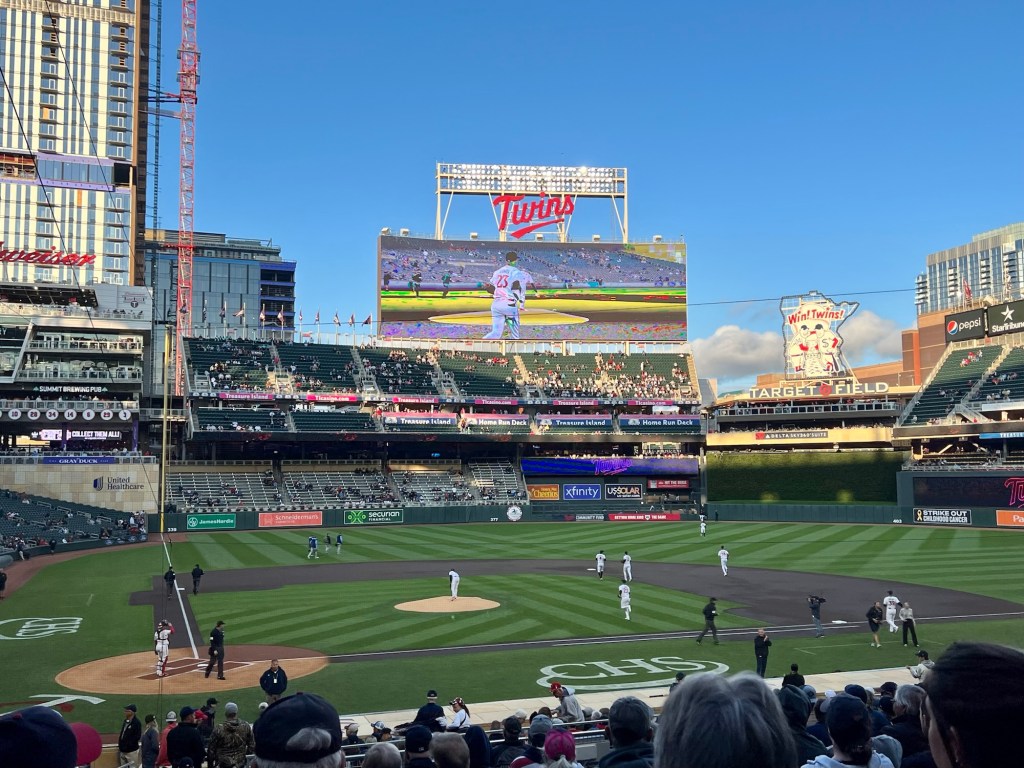
Allianz Field, home to Minnesota’s soccer team, the Loons, is also in St. Paul but not downtown. And then, of course, there is the Vikings’ stadium (US Bank stadium) in the sister city. The Timberwolves and Lynx shoot hoops at Target Center, and the Twins round the bases at Target Field. This metropolitan area is no stranger to the tug of war between owners and the public purse for stadium dollars.
All the teams draw fans from across the state, so it seems appropriate to kick in funding for taxpayers who want these distractions in their lives. Even though the structures are located within a municipality, the draw of supporters is cast widely across the state. There is a tension, however, between the fans and the hosting cities. A sense of proprietorship is accompanied by voicing demands for better policing or transit. The expected pushback is that fans are outsiders.
When the building starts topped out in the 2022s, it was impossible to get any type of tradesperson to call you back for a job.
Now that they are on the decline– it’s time to get those projects rolling. Not only will the pricing be more attractive, but you’ll also keep the industry rolling until interest rates taper.
By March, the real estate market is at one of its most substantial positions in the year. The snapshot of information below, taken from the Minneapolis Area Association of Realtors, shows that the market is running slow this Spring. Despite pended units being down around 5%, prices continue to inch up, an interesting, if not intuitively incorrect, outcome.
Would it be appropriate to say that Marx described two spheres of value creation: one held within the workforce through their hands passing over the products produced, and another in the taking to market by the capitalist and selling of the goods in exchange for money?
ChatGPT said:
Yes, it would be appropriate to describe Marx’s theory as recognizing two spheres of value creation—one rooted in labor and production, and the other in exchange and the market—but with a crucial hierarchical relationship between them.
Marx’s Two Spheres of Value Creation
The Sphere of Production (Labor as the Source of Value)
This is where real economic value is created.
Workers apply their mental and physical labor to raw materials, transforming them into useful goods.
The value of a commodity is determined by the socially necessary labor time required to produce it.
This value originates in the workforce, as their hands (and minds) shape raw materials into finished products.
The Sphere of Exchange (Market & Realization of Value)
The capitalist takes the goods to market, where they are exchanged for money.
This is where the value created in production is realized—but crucially, no new value is added here.
The price at which goods are sold can fluctuate due to supply, demand, and competition, but ultimately, the total value in society remains tied to labor.
There are lots of ways groups form in order to tackle shared interests. “In 1955, the Minnesota Legislature authorized the creation of watersheds through the Watershed Act. The intent of the Act was to develop water management policies and plans on a watershed basis, because water does not follow political boundaries.”
Water flows in the direction of the lowest point. If your neighbor’s lot sits higher than yours, then more than likely you will deal with the drainage that flows following a storm. For that reason, people in a shared drainage system collaborate to be sure adverse effects are tackled. These generally include land use planning, flood control and conservation projects.
From an analysis point of view, the watersheds are interesting as they are independent of standard governance structures. Water crosses country lines, meanders between cities, and flows around carefully surveyed property lines. They can group people and their properties over vast plains.
But where is the value in the grouping? Mainly in the flood zone analysis. Inundation and water tables effect construction prospects and insurance issues.
In Glenn Loury’s memoir, Late Admissions, the author states that he was the first to coin the term social capital as a retained value obtained through contact with social groups and activities. It appears in the following paper.
An individual’s social origin has an obvious and important effect on the amount of resources which are ultimately invested in his development. It may thus be useful to employ a concept of “social capital” to represent the consequences of social position in facilitating individual acquisition of (say) the standard human capital characteristics. While measurement problems abound, this idea does have the advantage of forcing the analyst to consider the extent to which individual earnings are accounted for by social forces outside the individual’s control. However, for precisely this reason such analysis is unlikely to develop within the confines of traditional neoclassical theory. A Dynamic Theory of Racial Income Differences(1976)
In the following decade, James S Coleman, a sociologist at the University of Chicago, writes the paper Social Capital in the Creation of Human Capital (1988). Here, the sense of the term is similar as there is a measurement of the efforts of a father put forth in the education of his son.
But in the 1990s, something changed. Putnam makes social capital a coffee table word in Bowling Alone (1995 article, 2000 book). Now, the term is morphing into a sense of access to networks. The thought is that business, or economic activity, is embedded in social life but clearly separate. Social life is a thing on the side. Benefits from social interactions arrive like electric pulses moving sporadically across a net of human connections.
Thanks to the book’s popularity, everyone grabbed hold of the term social capital from 2000 to 2010. It lost depth as it had become a marketing cliche. At about the same time, Nan Lin published Social Capital: A Theory of Social Structure in Action (1997), advancing the network theory of capital amongst relations.
Social Capital explains the importance of using social connections and social relations in achieving goals. Social capital, or resources accessed through such connections and relations, is critical (along with human capital, or what a person or organization actually possesses) in achieving goals for individuals, social groups, organizations, and communities. The book introduces a theory that forcefully argues and shows why “it is who you know,” as well as “what you know” that makes a difference in life and society.
Attempts are made to measure strong ties and weak ties, and distances between connections, but nothing really comes of it as a measurable model.
Was Glenn Loury thirty years too early with his concept of social capital? Did he bail on the theoretical world of economics too soon?
Kevin Drum proposed that in a 2022 article– and I agree entirely.
The real issue here is that America doesn’t have a housing crisis.
I’m not sure why, but I find the new urbanists one of the most annoying groups in the progressive pantheon. It’s not because they’re wrong, precisely, or because they’re meanspirited, or anything like that. There’s just a disconnect from reality that seems to motivate so much of what they say and do.
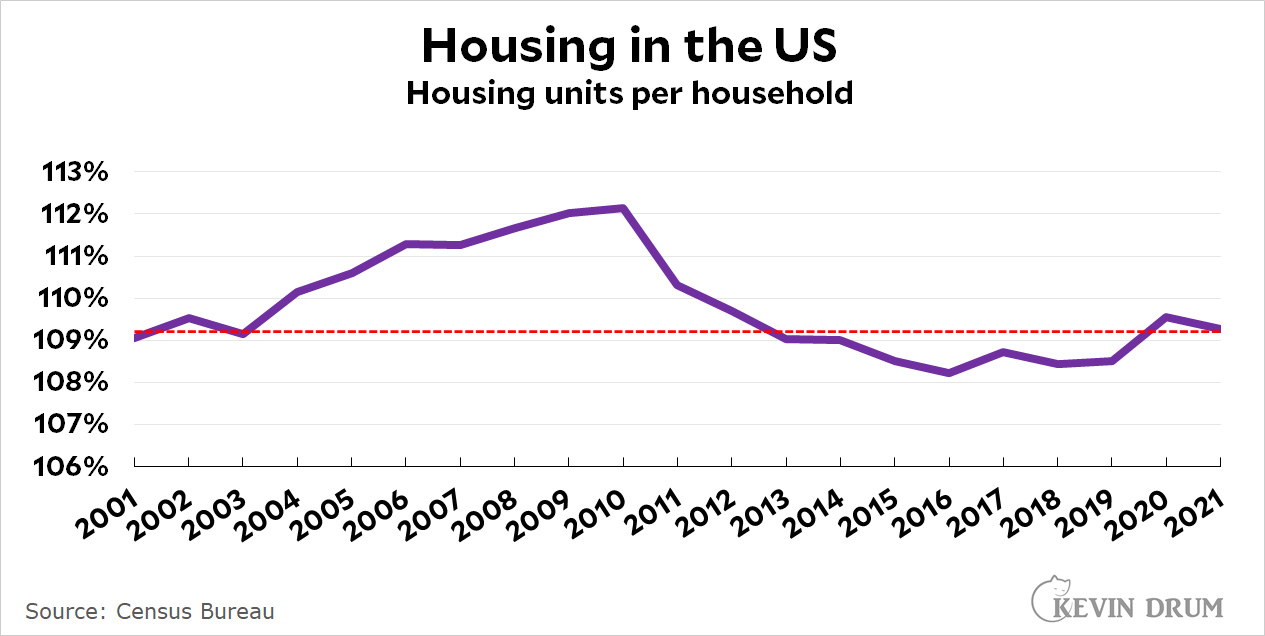
Take America’s housing crisis. Here it is:
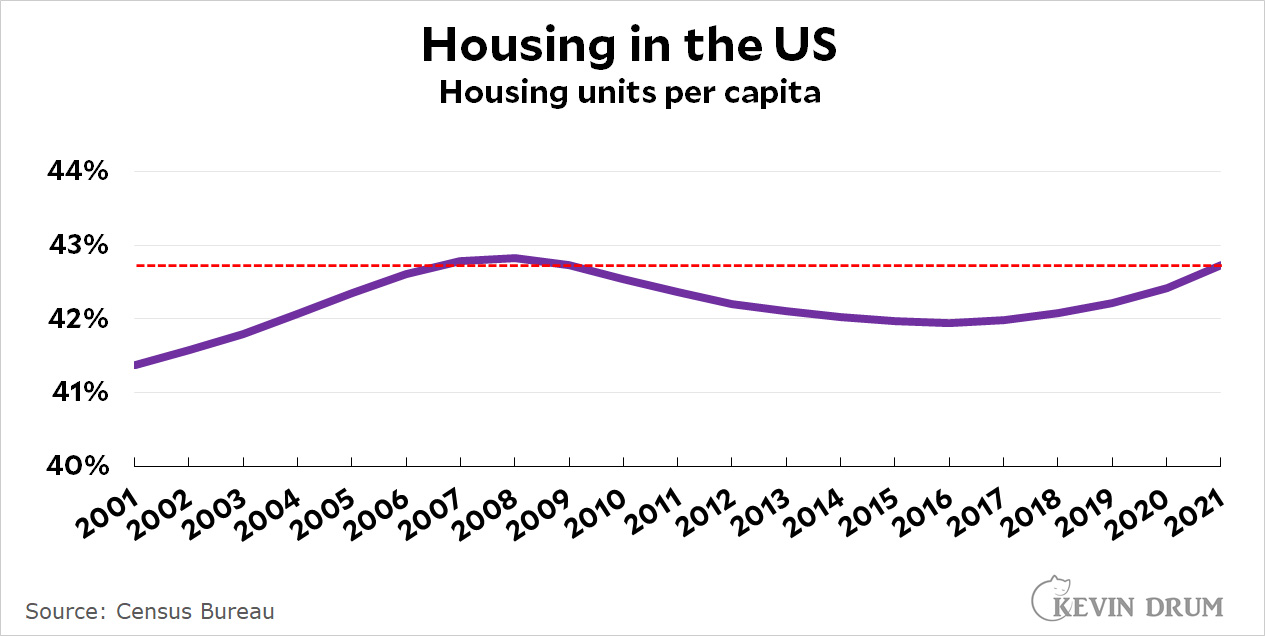
We have as much housing per household as we had in 2001. And just in case you think I’m cheating with this “household” business, here it is per person:
We have more housing per capita than we did in 2001.
Just wait and see as the market softens. Prices in some markets have already ebbed away from a peak, and the number of homes on the market is creeping up. Builders who notoriously hold on to their list prices are marking spec homes down a bit. The tight market was not due to a shortage as much as the normal pressure of people moving to changes in their lives.
But the best part of Drum’s article is how he feels about the people who try to set a national agenda on housing: the urbanists.
But this still doesn’t really explain why I find the urbanists annoying. Here’s my real beef: they are obsessed with big cities. They spend nearly all their time trying to convince us that big, crowded cities should become even bigger and more crowded. Or that suburbs should become big and crowded, just like cities. This is a fantastic waste of time. Residents of big cities don’t want to become more crowded and resident of suburbs don’t want to become more like cities. They will fight you forever on this. Absolutely forever. The game isn’t worth the candle, especially when there are so many other far more useful things we could be devoting our energy to.
So why waste time on this? The urbanists will haul out studies about economic gains, environmental impacts, mass transit, etc., but they massively oversell those benefits and completely ignore the downsides of crowding. Instead, they should be spending approximately 100% of their time promoting policies that would get people out of big cities and into smaller cities that have room to grow.
It is funny how everyone wants to talk about ‘world-class cities.’ Ho-hum cities are where it is at for understanding the baselines of success.
Jens Moeller of the Copenhagen police is stumped by a journalist’s disappearance after a ride on a mini submarine. The craft’s pilot is held on suspicion for murder but all their leads are going nowhere.
I’m enjoying this Danish detective story. The focus is on the investigative side of events with the audience only finding out outcomes as they present to the police.
Understanding flood zones is crucial because they directly affect the safety of homes, businesses, and infrastructure. Knowing whether a property is in a high-risk flood area can help individuals and communities prepare for potential disasters, take necessary precautions, and make informed decisions about insurance. Floods can cause significant property damage, disrupt lives, and even lead to loss of life, making it essential to assess and understand the risk of flooding in any given area.
This is where FEMA maps come in. These maps, created by the Federal Emergency Management Agency, provide detailed information about flood zones, identifying areas with varying levels of flood risk. They help communities plan for floods, guide building regulations, and determine where flood insurance is required. Essentially, FEMA maps serve as a vital tool for understanding and managing flood risk.
This is the search result for 183 Dana Ave, Columbus (Franklinton) Ohio.
You will note the comment on the map that references the reduced risk due to a levee. The whole area hashed over in blue and white stripes, is protected by a seven-mile flood wall completed in 2004.
This has significance for property values as it lowers the cost of homeownership. Generally, property insurance in a flood zone can run three times the cost for the same property in a low risk area.
A local guy who’s good with computer software is taking the time to match public figures with associational affiliations.
These non-profits were once thought to be nice background features in a community. But with all the misdirected funds in the news lately, some are recognizing associational work as players not bystanders.
I recently led a reading group for Jane Jacobs’s famous book, The Death and Life of the Great American City. We covered just the first two chapters, where she introduces her philosophy of how cities work and starts off the conversation with the simple yet practical sidewalk. Participants were quick to bring the conversation to present-day examples. That is how I was introduced to Franklinton, Ohio, a neighborhood of Columbus.
As I reviewed the video, I longed for more information about the area. Turning to the real estate websites, I was pleased to see how advanced they’ve become. The most thorough presentation so far goes to Homes.com. Here are some of the bits of information I found informative.
After keying in the neighborhood in the search box, this nice introductory page pops up with a map and current listing. The for-sale signs on the map give an instant feel for price and amount of inventory presently on the market.
This is an excellent snapshot of the neighborhood. There are 49 homes for sale, and 77 have been sold in the last year. Market time is thirty days, quick but not unbearable for buyers. In fact, prices have come down one percent in the last twelve months.
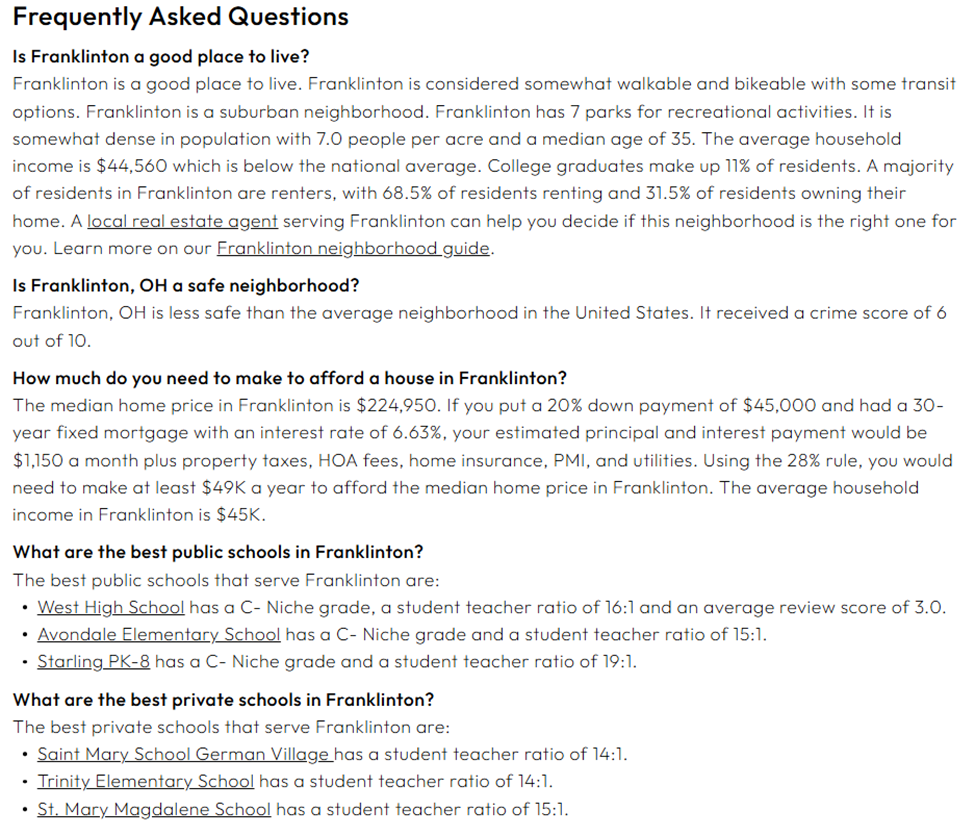
This next section gives some demographics and neighborhood amenities and addresses the most frequently asked questions about an area.
The Redfin site had some extras like this price history graph.
Back to the Homes.com site for this interesting comparison between Franklinton and greater Columbus, Ohio.
In The Uses of City Neighborhoods, Jacobs explores how urban neighborhoods and districts, including Greenwich Village in New York City and the North End in Boston, function and interact. Using these cities as examples, she examines how effective districts empower residents to advocate for improvements in their neighborhoods. Additionally, Jacobs delves into the conceptual principles that make urban areas successful. These principles include self-governance in street neighborhoods and districts, the importance of continuous networks between street neighborhoods, the role of time in fostering stability, and the necessity of a functional identity to unify a district.
At the smallest level in urban areas, street neighborhoods consist of the residents along a single road or small section of a district. To be beneficial to their residence, Jacobs argues that these neighborhoods must prioritize walkability, and interconnectedness with surrounding streets. When neighborhoods become isolated or “island-like,” they lack the size and influence needed to effectively advocate for public improvements and services, often leaving them underserved by city administrators. These isolated neighborhoods often consist of distinctive ethnic groups. Although, while they may be ethnically cohesive, these neighborhoods are not necessarily socially or politically cohesive. Without a strong functional identity and broader connections to the city, isolated neighborhoods risk instability, particularly in urban areas where racial and economic disparities are deeply entrenched.
Effective districts are one of the most important components to urban living. These districts bridge the gap between street neighborhoods and the larger city, allowing residents to leverage the public power of votes. According to Jacobs, an effective district is built upon three key elements: a starting point, physical area, and time. Like street neighborhoods, districts should not be isolated by physical barriers such as large parks or highways. In her opinion, districts are always naturally shifting its boundaries as these obstacles not only disrupt natural boundary shifts but also hinder economic stimulation from outside visitors.
Jacobs emphasizes time as a crucial factor in districtdevelopment, describing it as a substitute for self-containment, and an indispensable element of urban stability. Over time, districts cultivate both strong and weak social ties through hubs such as churches, PTAs, political clubs, and fundraising committees. These social networks create what Jacobs calls the hop and skip phenomenon, allowing individuals from self-contained settlements to connect with others through special-interest groups and bring those relationships back to their own districts. As well, time fosters trust and cooperation, enablingindividuals to gain the confidence needed to voice concern about local public issues.
The city as whole is essential, serving as the hub for administrative and policy decisions. It is the primary channel for public funding, distributing resources from state and federal coffers for the benefit of the entire urban population. Jacobs also highlights the city’s role as a center for culture, employment opportunities and political action, including protests against unjust initiatives. Her message to city planners is to foster livelystreet networks that seamlessly connect street neighborhoods, design parks as communal destination rather than physical barriers, and cultivate strong functional identities within districts. Further research on Jacobs’ sociological theories should explore how societal changes have influenced her ideology. For example, Jacobs wrote her work in the early 1960s, a time when women were largely expected to stay home and care for their families, and before the political climate became as polarized as it is today.
A key question to investigate is: How do modern factors, such as families with two working parents and the increasing complexities of racial tensions, affect Jacobs’ vision of lively integrated streets?
It was one of those late summer afternoons when people had gathered at a lake home for a shared meal and a view of the lingering summer sun rays over the water. A local farmer often included in these, mostly family get-togethers was there. The harvest was still underway, but the crops had had a plentiful year, and there was a sense of contentment around the final crop. Every year, nature threatened crop failure with late spring plantings, or vicious wind storms, or excessive rain. This year, all had gone well.
The conversation turned to local issues, and the relationships were such that it was easy to ask about the necessity of farm subsidies, especially in plentiful years. He agreed. “But if we let them go, we’ll never get them back.”
Many groups’ strategies involve lying low and being silent when times are good. They don’t remind the governing body of the flow of money. Let the benefit slide while everyone’s focus is on some new issue. Let the political energies and attention be drawn away from the fact that the farmers live large at the moment. That’s how is can be in government programs. Once in place, there’s no mechanism to pull them away once the need is no more.
Until Trump, that is. The president’s actions are described as slash-and-burn, as he closes down departments and pulls programs. He’s put foreign partners on notice that what used to be may no longer be. Critics voice that there will be more harm done than good in the outside-the-normal-way-of-doing-things model is put to the test.
But is there nothing to learn? Is there a method here?
Isn’t the President testing group structure? Every time an old way of doing things is challenged- the various groups engaged in the activity respond through multiple forms of Voice. Aren’t some surprising? Like- who knew about the tariffs Canada imposes on the US or between each province? And isn’t the quiet around the Federal workforce reduction a little deafening?
Some people will not like the new arrangements and will leave. Farmers will encourage their kids to go into other fields of work. Countries will turn to their neighbors for new alliances. It just seems like there is something to learn from each of these instances of exit, voice and loyalty.
Yes! If we apply Hirschman’s concept of exit more broadly to Trump’s first six weeks in office, we can see multiple ways in which he used exit as a strategy—moving away from established policies, norms, and agreements rather than attempting to reform them from within. Here are some key examples:
Exit from the Norm of Allowing Migrants to Enter (Immigration Restrictions)
One of Trump’s most high-profile early actions was his January 27, 2017, executive order (often called the “travel ban” or “Muslim ban”), which restricted entry from seven predominantly Muslim countries (Iran, Iraq, Libya, Somalia, Sudan, Syria, and Yemen).
This was a stark departure (or exit) from the long-standing U.S. approach to welcoming refugees and immigrants, particularly under the Obama administration, which had expanded protections for asylum seekers and refugees.
Trump framed this policy as a matter of national security, but critics saw it as an abandonment of traditional U.S. commitments to humanitarian relief and global migration norms.
Exit from Diversity, Equity, and Inclusion (DEI) Policies
Even in his first few weeks, Trump began rolling back Obama-era diversity and inclusion initiatives.
While most of his full-scale attacks on DEI came later (e.g., the 2020 executive order banning certain diversity training programs), his administration signaled early on that it would exit from the emphasis on diversity programs in government hiring, education, and federal agencies.
For example, he nominated officials to the Department of Education and the Department of Justice who were skeptical of affirmative action and federal oversight on civil rights issues.
Exit from Certain USAID (U.S. Foreign Aid) Obligations
One of Trump’s first major foreign policy moves was reinstating and expanding the “Mexico City Policy” (also called the “global gag rule”), which blocks U.S. funding to international organizations that provide or promote abortion-related services.
While previous Republican presidents had reinstated this rule, Trump expanded it to cover all U.S. global health assistance, meaning billions of dollars in USAID funds were now subject to the restriction.
This marked an exit from previous U.S. commitments to funding certain international health and reproductive rights programs.
Conclusion: Exit as a Governing Strategy
Rather than working to modify or improve existing systems from within (which would be the “voice” approach in Hirschman’s framework), Trump often used exit as a political strategy—choosing to pull the U.S. away from norms, policies, and institutions that his administration viewed as ineffective, unfair, or counter to his “America First” ideology.
It’s a little hard to believe, but the concept of recording land ownership in a centralized (and supervised) public location is a relatively new thing. In Great Britain, a nationwide mandate was not enacted until 1990. The title work! The property claims! It must have been a messy process. And what if a deed went up in a fire or was thought to have turned to ash?
Here’s a Chat overview of the history of real property titling.
1. The Era of Deeds and Legal Descriptions (Pre-19th Century – Early 20th Century)
Great Britain
Land ownership was historically recorded through deeds, private legal documents that had to be manually traced to prove ownership.
The system lacked a central registry, meaning land transactions relied on historic title chains stored by property owners and lawyers.
United States
A similar system of deed recording existed, often based on metes and bounds descriptions (especially in the Eastern U.S.) or the Public Land Survey System (PLSS) (for lands acquired after 1785).
County governments recorded deeds, but there was no standardized way to track land ownership.
2. Early Land Registries and First Steps Toward Systematic Record-Keeping (Mid-19th Century – Early 20th Century)
Great Britain
1862 – Land Registry Act established HM Land Registry, but participation was voluntary.
1875 – Land Transfer Act simplified the process, but land registration was still not compulsory.
1897 – London mandated land registration, gradually expanding nationwide.
United States
1800s – Early county plat maps and tax assessment rolls began organizing land records more systematically.
Late 19th – Early 20th Century – Cadastral surveys (especially in the Western U.S.) improved property mapping.
1920s-1930s – States and local governments began experimenting with numbered parcel systems for property taxation.
3. Systematic Land Registration and Adoption of Parcel Numbering (Mid-20th Century – 21st Century)
Great Britain
1925 – Land Registration Act made registration compulsory for land sales in designated areas, gradually covering more of England and Wales.
1990 – Almost all land transactions required registration.
2002 – Digital land registration introduced, enabling electronic transactions.
United States
1950s-1970s – Parcel Identification Numbers (PINs) were introduced in many counties to systematically track land ownership and taxation.
1970s-1990s – Geographic Information Systems (GIS) were integrated into land records, linking parcel data to maps.
2000s-Present – Digital land records became the norm, allowing online access to property information.
Key Takeaways
Both Great Britain and the U.S. started with deed-based systems requiring lengthy title searches.
Great Britain centralized land registration earlier (1862), but it became widespread only by the 20th century.
The U.S. never adopted a national land registry but instead developed county-based parcel identification systems (PINs) during the mid-to-late 20th century.
Both systems are now largely digital, enabling online property searches, tax assessments, and real estate transactions.
It was only twenty-five years ago that abstract books were still in circulation. When a property changed hands, the abstracts were located and pages were added to reflect the changes. The result multi-page pad told the parcel’s ownership story, as seen below.
We’ve all seen them. Whether in a rural area or in the heart of a depleted urban setting, homes are abandoned. The cause generally is not due to a population boom or bust, but rather a population shift. For the later half of the twentieth century, there was heavy migration into cities. Thus rural areas were littered with homes like the one in the photo.
On the other hand, inner Detroit suffered from abandonment and is still dealing with the effects. Following the auto industry’s decline, residents suffered, and the urban neighborhoods slipped from neglect. Without proper shoring up of institutional services, residents continued to escape the area, seeking more favorable suburban dwellings.
The two most impactful effects on neighborhoods are undoubtedly access to employment and street safety.
This series is entertaining. The storylines have more depth than most shows. The two lead actors are new to me and have good chemistry. Of course, there is a passion building between them, but it has been well done thus far. And– the camera lens takes the viewers into all sorts of residences, large and modest. It’s fun to see how the average worker lives in London.




































 Home Economics