Everyone is talking about peeling back regulations. I, too, think this is a good thing. Picking which rules should go and which should stay is the question of the day. The rules were put in place often to save folks from some harm, so those would be worth keeping, right? But where is the final test to turn for such judgement?
Every industry will be different. Perhaps people in each walk of business will have an opportunity to point out the absurd or even the slightly off base.
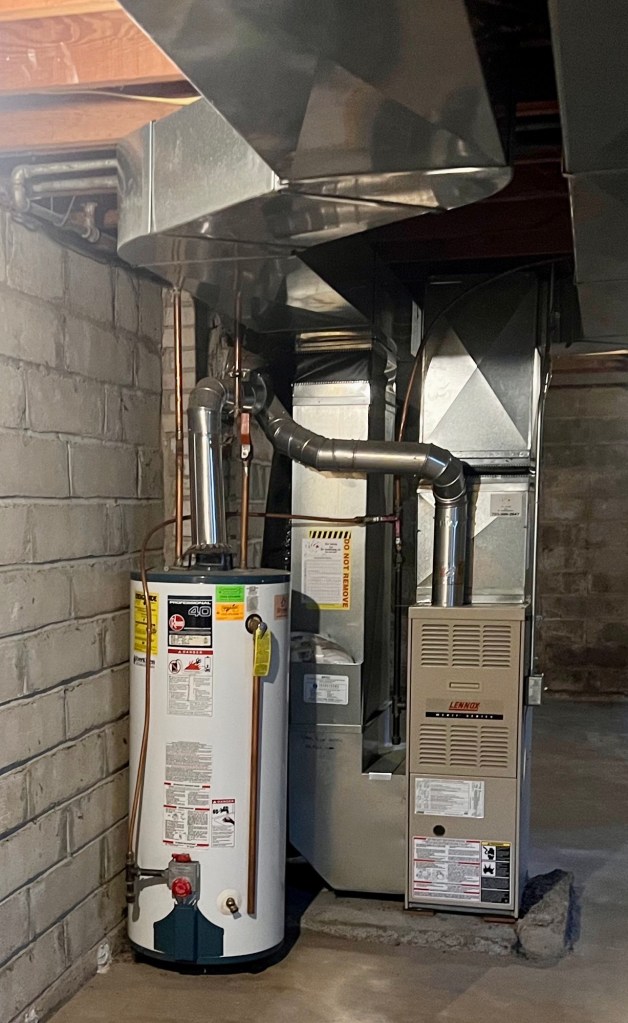
Real estate construction offers a wide play of potential overreach by bureaucrats. At least from the layman’s side of things, it’s a bit difficult to understand the fine nuances of a vent’s proximity to a floorboard. Can a metal heat vent ever rise to a temperature that would ignite a beam? If the vent turns at this angle it is unacceptable, yet a few degrees to that angle it passes.
AI could be one way to double-check the interpretations of safety requirements. Instead of well-intended people imposing the most stringent interpretations of what is safe, a history of events could be considered. The power of scanning large files allows thousands of cases of, say, insurance claims to detail actual construction failures that resulted in harm. If there has never been a claim involving a heat vent setting framing on fire, that should give some direction on whether the rule is worth pursuing.
The standards each community picks will reflect its risk tolerance. But if the level of acceptability has risen far above what the average person tolerates in their own dwelling, then the rule makers are stifling the construction process and adding undue expense.
In 2022, Minnesota traded a total of $6.2 billion with Mexico. With our neighbors to the north in Canada, Minnesota traded more than $21 billion.
In response to the question of who pays for tariffs, University of Minnesota professor of economics Tim Kehoe replied, “And the findings have been that somewhere between 90% and 100%– the number gets bigger over time– of the tariff revenue comes from US firms or consumers. That is, we pay more for the imports.” But this is really a follow-the-money answer. Where does the cash come from that goes into the tax revenue? The consumer who made the purchase.
This is an incomplete analysis.
The economist says Minnesotans will pay higher prices to cover the tariffs. Yet he suggests that when countries retaliate, they simply have the choice to buy goods elsewhere. It seems that a country that imposes a tariff suffers, and one that chooses a less efficient trade with another partner also suffers a loss. The question isn’t whether the less agreeable trading arrangements are costly. The question is what the cost of buying is, and is that worth it?
Consider the objectives at hand.
“Now, President-elect Donald Trump says, on day one in office, he will impose sweeping new tariffs of 25% on Canada and Mexico and another 10% tariff on China. Trump says, the Mexico-Canada tariff is to crack down on illegal immigration and drugs. “
I’d be interested in an analysis that shows how tariff penalties will incentivize these trading partners to respond to the above-mentioned objectives. Will the cost of this trade arrangement induce Mexico and Canada to put some muscle into immigration issues? How about drugs?
The American people want these issues addressed, and this implies they are willing to put resources towards this aim. Will these new trade agreements prove to be the most cost-effective compared to other enforcement options? (MPR article quoted)
Last week, a local real estate brokerage settled with the state attorney general’s office over allegedly deceiving clients about the performance of a $540 home warranty. The product is offered to both buyers and sellers on an optional basis. Every client who does business with the broker signs a disclosure about the affiliated nature of this business, as well as other businesses such as mortgage providers, title company services, and so forth.
The settlement was for $3.5 million. A paltry amount when it comes to engaging the legal profession. The option of going to court to be exonerated from such a ridiculous claim would cost the brokerage a figure in the multiples of this, and the continued press coverage predictably tilted as anti-business. Take for instance, this quote from the attorney general:
“Today’s settlement will put this money back in the pockets of Edina’s customers who were misled into purchasing HSA warranties without ever being told that Edina was being paid handsomely to promote these problematic home warranties,” Attorney General Ellison said.
Explain how a spiff off a $540 home warranty can be considered handsome in the total expense to purchase a home. Even the full $540 falls, perhaps between .1-.2% of the average total home sale cost. The spiff might be a tenth of that- hardly a game changer for any worker in the chain of events.
There’s more from the Bring Me the News article. There’s the part where government makes claims about consumers’ abilities to determine value:
The investigation by the AG’s office also alleged that HSA “confused consumers” into believing its home warranty was a valuable product that contained benefits that it didn’t actually have.
Many consumers purchase warranty products through utility providers and home warranty insurance providers to have the peace of mind that if the mechanicals in question fail, they have some sort of repair or replacement coverage. I’m not sure how offering an accepted open-market product at a relevant point of another transaction confuses the general public.
Maybe the government is confused, and consumers are actually much more intelligent than they are.
1. Declining Enrollment The district has been experiencing declining enrollment, which directly reduces general education funding and other formula-based funding. In FY2023, the district served 10,758 average daily membership, a…
Mark Gilson provides excellent service free of charge on X. He compiles findings from school board meetings into an easy-to-digest post on Twitter. I assume this search, compile, and reformat function is the result of an AI application. Getting information out to consumers, especially in the non-profit and public spheres will be greatly enhanced as a result.
How many parents have the time to attend or sift through school board meeting minutes? Do small association non-profits even post things such as minutes, financials, or filings? I don’t think so. One must either be all in and participate in board-level activities or throw up one’s hand and go along with whatever is required regarding fees and opportunities.
Lack of transparency, however, fuels skepticism and fraud. I’ve been on many a youth activities board where whispers of handing the hand in the till swirl around. There can be takings directly from paid dues. If there is food involved, people joke about how all the over-bought items end up in the tournament director’s garage. These are little annoyances and the fodder for the Debbie Downers.
Lack of tracking and documentation shortchanges the associational activity from another angle. It denies potential participants the numbers necessary to evaluate how their support will or won’t mesh with the group. Some sort of account of the organization allows shoppers for such endeavors to judge how they can fit in.
The non-profit world could bear more fruit with a bit of product labeling.
A super introductory sentence for the structural constructions emanating from a combination of labor in the traditional sense and volunteerism. From The Economist (Oct 26th-Nov 1st issue) Killing an Idea.
A second argument is structural. Before October 7th Hamas was the de facto government in Gaza, with tens of thousands of civil servants on its payroll. Hizbullah is a state within a state: it hands out patronage jobs, operates a chain of discount groceries and runs a bank. These are not just militant groups, in other words, but political and economic entities with deep roots.
There’s a certain type of contractor who shows up when an insurance-triggering event sweeps through a neighborhood. There’s a knock on the door. A fresh-looking worker type of guy is handing a brochure out to the owner as he starts a pitch on what looks like damage to the roof. We work with your insurance company, he offers with confidence.
In this scenario, the skill of working with the claim has more to do with understanding how to max out the claim and get it paid than simply roofing the home. There are incentives to work toward the company-set reimbursement schedules rather than the lowest cost for quality that is usually in play on home repairs. The money involved is often in the 15-20% surcharge range.
I’ve noticed bids given to bureaucracies have a similar play-to-the-maximum reconstruction nature. Say a county acquires a home through tax forfeiture. Most homes in this category are in tough shape, as the owners endured financial hardship for an extended period. Perhaps there’s a little mold along the bathtub caulk line and the lower edge of the sheetrock in the basement. Perhaps the major mechanicals have been patched and primped but desperately need replacement. Once the contractors are aware of the type of seller, everything is ripped down to the studs, cut up two feet off the floor, redone with green-board, and high-efficiency appliances purchased. The impulse to do it right by-passes all budget measures.
It seems to me the best remedy is to have stand-in owners who look like everyday market participants. Otherwise expect to pay and extra 20%.
Who are the actors in this model of labor for pay and volunteerism? Who are the laborers? They are individuals who act of their own free will. They are autonomous decision-makers; the labor in this theory is performed free from force.
Familiarity with labor for money makes the concept easy to accept. However, volunteerism is a newer type of work and deserves a little more attention. Volunteerism functions in conjunction with an individual’s shared interests. People are born to kin and kith; throughout their lives, they regroup with many other shared alliances. These affiliations result in obligations through reciprocity, attention to loyalties and possibly the necessity to exit.
The model requires an acceptance that an individual may pamper the ego and still consider others who fall within their life bubbles.
Suppose one were to write a symbolic notation of labor; one might start by defining L as the number of labor hours the individual allots to paid work and V as the number of hours allocated to volunteerism. If you had a couple where one worked 40 hours a week at a career and devoted 10 hours a week to help in the home, it would be shown as L subscript 40 V subscript 10. Let’s say the other partner worked 20 hours a week at a part-time job and filled in 30 hours to their home life; this would be shown as L subscript 20 and V subscript 30. Or- let’s say that both partners worked 40 and did domestic chores for 10; this could be written as 2(L subscript 40 + V subscript 10)
If one had a labor theory, where would one start sketching it out?
The first thing to know is what labor is. The traditional view would be the time and expertise an actor sells to the state, a business, or anyone who will pay. I suppose. Labor is given to fulfill a job, for pay, that is. So anyone who throws a hammer to reroof a house, counts coins at a teller window, or cares for a child in the oncology ward is earning a paycheck for their time.
The thing is, people do these very same actions without pay. A handful of buddies construct a deck as a weekend project in exchange for some beers and a BBQ. A granddaughter shows up at Grandpa’s house to sort through and pay his medical bills. A sister takes in her niece, who has the flu, so the mom can go to work. This is labor, too. Except it’s done in community and not for pay. So,we call it volunteerism.
The first premise is that people spend their time on paid labor and volunteer labor. It is measured is labor hours.
People expect their government, or governing bodies, to protect them. It’s the most basic and oldest public good. Band together in a cave or behind fortifications and put the physically strongest in charge of fending off harm. For better or worse, this placed the physically strong in high-status positions for more than several millennials.
But what does that mean to keep you safe? And here is the sticky part. There is a broad spectrum upon which the answers to that question may fall. In some cultures, women are safe when clothed from head to toe and sequestered out of the public eye. Most people and women find this a violation of individual liberty. It is not up to the group to seek a safety goal so that it impinges excessively on one or a whole section of society’s liberties.
One story in the news yesterday tells of a mom in Georgia arrested for negligence when her ten-year-old was seen walking home on a rural road. The police were notified by a neighbor. They then showed up at the family’s home and cuffed the mom in front of her kids. Last month, there was a story in the news of another ten-year-old in another part of the country who was finally detained when he drove a stolen car through his neighborhood playground. This ten-year-old had been released on numerous occasions for auto-related theft to a mother who was never held responsible in any way.
Of course, there are many more mundane questions about what is safe. How many smoke detectors does a house need? How many inches does a metal vent need from a combustible floorboard? Will that tenth detector be the one that alerts the family of smoke in the house? Can a wood rafter really catch on fire from metal only exposed to air heated to seventy degrees? Someone thought so. How high does a standard need to be to be safe enough? I’m not sure. But I expect that no one wants to be the regulator who, after a death from a fire, is thought to have been too lax.
The thing is that too much regulation can kill, too. At least, that’s the argument for those who feel there are too many restrictions in the drug industry. Failure to approve causes people to die from lack of access to a cure. Lengthy approval processes cause people to die, too. Just like too many building codes add an undue burden to housing expenses. Without housing, some people are severely disadvantaged and may even die on the streets.
So– what to do? What level of protection is requested when the people go to the government and ask? It seems like the answer would be some expected norm of the group.
If you raise the standards above the norm, people are restricted from liberties they would have enjoyed. Plus, more than likely, some people will disregard the regulation as they feel it is not worthwhile. Before you know it, the mayor of some town is caught at a party without a mask when all other good city dwellers have been putting up with the stinky things. A non-conformist attitude can then carry over to different areas, like permits for home repair. And people start getting their brother-in-law, who’s ‘handy’ to connect a gas line. Here the permit and ensuing inspection is beneficial.
Walking the fine line between setting regulations and meeting people’s expectations for safety is a balancing act worth figuring out.
There are no regulations against garage door decorating.
I checked out Francois Furet’s book (yesterday’s post) from our nationally recognized Hennepin County Library. It’s a great service to have unusual, high quality books locally available.
I was startled to find the pages profusely underlined in black ink. Throughout the whole book. And every time Furet explains a downfall of the communist system there is a sidebar note: No!
Does the defacer of a publicly owned book not see the irony in treating the volume as their own? That the blatant disregard for the fine-tuned implications of ownership is where precisely where the communist project gets ripped to shreds?
I met a guy. He’s French and smart. He’s got all these great ideas. Well— I didn’t meet him exactly, but I know what he thinks because I met him through his book, The Passing of an Illusion: The Idea of Communism in the Twentieth Century. His name is Francois Furet. His work on The French Revolution (1965) brought him fame, but in a video interview on YouTube, he says he was just doing his job. He hadn’t yet found his question, the one that would stay with him, the one that demands his concern.
In the early 1970s, Furet was involved in a large-scale, interdisciplinary initiative that combined history with statistical methods to better understand the social and political dynamics of the French Revolution. The project was highly innovative for its time, as it sought to use quantitative analysis to uncover patterns and trends in historical events, particularly in relation to the Revolution.
Furet and his collaborators were working within the framework of Annales School historiography, which emphasized the integration of social science methods, including quantitative approaches like statistics, into historical analysis. The Annales School, a major force in 20th-century historiography, had already pioneered efforts to expand the scope of historical inquiry beyond political events and figures, focusing on social and economic history, and using more “scientific” approaches to study history. (ChatGPT)
Cool, hugh? That he wanted to set out a statistical approach to the social sciences.
The project didn’t work out quite the way they anticipated. In the video he is clearly disapointed. He says math is tough. It only considers one variable. Despite all the demographic data, the results posed more questions than answers.
Yet in The Passing of an Illusion (here’s a book review to give you an overview of it), there’s a sense that the author has thought through the historical events in terms of definitions and relationships. His narrative talks of actors and associations instead of the grand sweeps of inevitable movements. He tells of individuals and the choices they make. He groups people by their shared ambitions. There is an agency to the peasants or the bourgeoisie, to the aristocrats and the intellectual class.
There’s a sense of time in his sorting as well. As soldiers took up arms under their national flags in July of 1914, he describes a sense of obligation to the past, to the generations who came before and fought to maintain national borders. The sentiments of statehood weren’t found in the moment but had built up a reserve of obligation over time.
Whereas the passion ignited on behalf of the downtrodden proletariat reached a universal appeal. The shared interest in favor of the worker found at odds with the capitalist would not be contained by political boundaries. Communism, indeed, found its footing across the globe.
Furet, rather shyly, also talks of another facet of social activity: volunteerism. It’s hard to know if he looks down and away in the video because the concept wasn’t well received. But the idea that people devote their volunteer labor to the cause is part of his theory. From Chat:
Summary of Key Ideas in Furet’s Concept of Volunteerism:
Rejection of Structuralism: Furet rejected deterministic structural explanations (such as class conflict theory) for revolutionary action, arguing instead that individuals and groups made deliberate decisions that led to the Revolution.
Ideology as Driving Force: He saw ideological commitment as the key motivator behind revolutionary action, with people acting voluntarily to advance certain political ideas and principles.
Revolutionary Agency: The French Revolution was a voluntary act of will, driven by the agency of individuals and groups who made choices based on their ideological commitments, not merely by economic conditions or social determinism.
Collective Action from Voluntary Unity: Furet explored how diverse groups, driven by shared ideological commitments, united in collective action to achieve common revolutionary goals.
Here’s how ChatGPT summed up Furet’s focus.
This approach presents the Revolution as a complex interaction of ideology, agency, and action, where individual choices play a central role in determining the outcome of collective struggles.
I couldn’t agree more. But I think we can generalize this structure across all public efforts, including all those which are much more mundane than revolution. Thankfully.
Vintage picture with Arlington Cemetery in the foreground and the Kennedy Center across the Potomac, through the trees.
Now it’s time to return to honoring the faithful, like the military personel who serve our country. Let’s hope for a while we can bring back recognition for most, instead of the few, who voluntarily support the many in lieu of the self. Let’s remember, through the year, at each holiday, to praise those tried and true workers who show up for others.
You know how during a basketball game, when the losing team comes back from halftime with new energy. All of a sudden, the three-point shots start to fall. The layups hit the glass right at the sweet spot. Turnovers help to turn the game around. The momentum has shifted, and the losers can do no wrong.
That sort of thing happens in neighborhoods too. It might start off innocent enough. One resident starts to add a few extras to their lawn maintenance routine: edging along the sidewalk and mulching the flower beds with that deep chocolate-colored mulch. Another neighbor takes note of the new look when out walking their dog, thinks to themselves how nice that looks, and evaluates how little extra time it would take; he too brings the soon-to-be new norm back home.
The satisfaction of returning home to a place that looks just a wee bit nicer acts as an accelerant. Pretty soon, a scrutinizing eye picks up on some peeling paint. The next weekend, a paint scraper, primer, paint brush, and matching paint are purchased and put to use. Others might not be able to handle the ladder work and hire it done. That’s when the cargo vans start to show up. Some have rolls of carpet peeking out of the back doors strapped shut with tie-backs. The one with a lightning bolt logo on the side deposits a worker who installs nifty spotlights over the covered porch.
And on it goes. The circulating activity of people in the trades leaves the neighborhood just a bit more polished when they leave. People enjoy the effect and start to walk their dogs more frequently to check out everyone’s progress. There’s a beautification movement underway. Residents are betting on the future.
The embers of the women’s movement championed by Gloria Steinem and Betty Friedan are cooling and turning to ash. During the last election cycle, a successful initiative was still able to galvanize women voters into one voting block through abortion rights. Similar attempts did not succeed in this year’s competition. Falling in status are pink things people wear on their heads, bra burnings, and Murphy Brown reruns.
Where will white wealthy women turn for direction?
Nancy Pelosi is without a doubt the most powerful women in American politics. She took office in the house of representatives in 1987. She was the first women to become speaker of the house in 2007. All this after she raised five children with a man she married in 1963. Despite spending nearly a quarter of a century focused on being a wife and mother, Nancy Pelosi has enjoyed an enormously successful political life.
Perhaps being part of a large, bustling family contributes to her success rather than distracts from it. Perhaps devoting the necessary energy to maintaining a life-partner garners the type of support one needs in political life. Justice Ruth Bader Ginsburg (1933-2020) also chose a very traditional family life. She raised two children with one husband, whom she married in 1954. The same can be said about Secretary of State Madeleine Albright.
As minority groups switch alliances, perhaps it’s time for a new focus for women. Perhaps there will be a rising status of all those activities in neighborhoods full of long-term partners and their kids. It seems that such efforts come back in forms of future career support later in life.
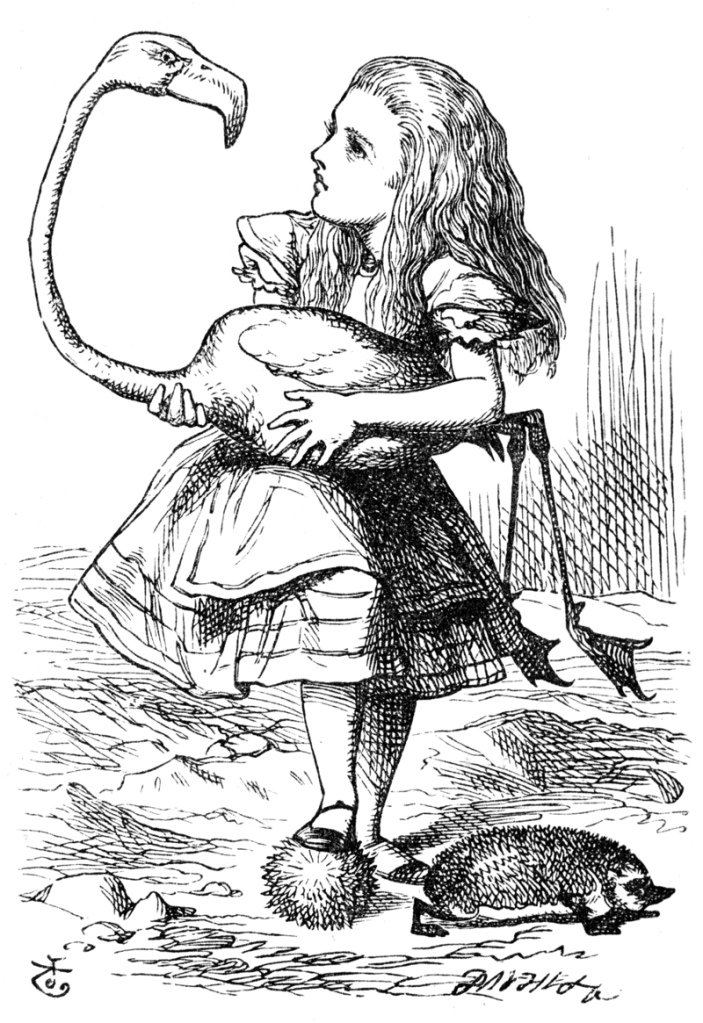
Did you know that Lewis Carroll penned more than a story about a young girl stumbling through a fantastical world of characters? I did not. I had an Alice in Wonderland doll like many of my peers. When I was a teenager, I read somewhere that Carroll was a math teacher and found that interesting. But this source of information provided no additional accolades around his professional achievements.
Perhaps it is because Lewis Carrol is a pen name for Chales Lutwidge Dodgson. Perhaps it is because we now live with never ending access to information, at least to those who wish to jump down the rabbit hole. His Wikipedia page is quite long. Here’s a bit (the youth clearly suffered from distraction).
His early academic career veered between high promise and irresistible distraction. He did not always work hard, but was exceptionally gifted, and achievement came easily to him. In 1852, he obtained first-class honours in Mathematics Moderations and was soon afterwards nominated to a Studentship by his father’s old friend Canon Edward Pusey.[19][20] In 1854, he obtained first-class honours in the Final Honours School of Mathematics, standing first on the list, and thus graduated as Bachelor of Arts.[21][22] He remained at Christ Church studying and teaching, but the next year he failed an important scholarship exam through his self-confessed inability to apply himself to study.[23][24] Even so, his talent as a mathematician won him the Christ Church Mathematical Lectureship in 1855,[25] which he continued to hold for the next 26 years.[26] Despite early unhappiness, Dodgson remained at Christ Church, in various capacities, until his death, including that of Sub-Librarian of the Christ Church library, where his office was close to the Deanery, where Alice Liddell lived.[27
The book that catches my attention is a volume on symbolic logic, Symbolic Logic and the Game of Logic. What else could the mind that offered up so many tremendous visuals in an adventure do with little drawings and abstract concepts? A visual of a fleeting concept can be quite powerful. Apparently the book is full of quirky humor.
Even prior to the election outcome, there was bipartisan interest in reducing regulations which hinder housing. Yet in 2024, efforts around housing ended up being a power struggle between different levels of government and zoning control. Traditionally, land use is determined at the local level. The political efforts were geared at removing local control through state mandates. Come to find out, residents like to control the land in their direct periphery.
With the new administration, one would anticipate this spirit of deregulation to find its way to most industries. Is there a good place start? Where would less government result in a net positive? Where are the low hanging fruit?
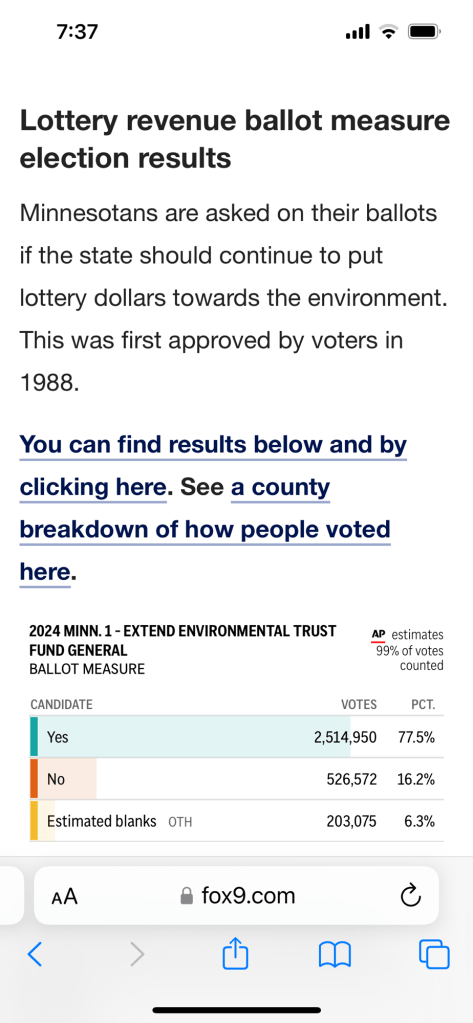
The market solves for social concerns. Tesla is a prominent example. If there is a mass of consumers with a shared concern, than they will demand it of the market. Looking for the majorities with shared common interest might be a start. For example a ballot measure passed in Minnesota to divert funds from the lottery to the environmental trust fund. It passed with 77.5% of the vote.
When people voluntarily allocate resources for a casue there is a better chance that mediating their interests through the market will result in a more efficient outcome. Without the surcharge of bureaucracy and the unintended outcomes of intervention, markets often are more fruitful. When it comes to the environment, the majority of Minnesotans indicate that they will spend the money to preserve and protect.
O! say can you see by the dawn’s early light,
What so proudly we hailed at the twilight’s last gleaming,
Whose broad stripes and bright stars through the perilous fight,
O’er the ramparts we watch’d, were so gallantly streaming?
And the rockets’ red glare, the bombs bursting in air,
Gave proof through the night that our flag was still there;
O! say does that star-spangled banner yet wave,
O’er the land of the free, and the home of the brave?

On the shore dimly seen through the mists of the deep,
Where the foe’s haughty host in dread silence reposes,
What is that which the breeze, o’er the towering steep,
As it fitfully blows, half conceals, half discloses?
Now it catches the gleam of the morning’s first beam,
In full glory reflected now shines in the stream,
‘Tis the star-spangled banner, O! long may it wave
O’er the land of the free, and the home of the brave.

And where is that band who so vauntingly swore
That the havoc of war and the battle’s confusion,
A home and a country, shall leave us no more?
Their blood has washed out their foul footsteps’ pollution.
No refuge could save the hireling and slave,
From the terror of flight, or the gloom of the grave,
And the star-spangled banner in triumph doth wave,
O’er the land of the free, and the home of the brave.

O! thus be it ever, when freemen shall stand
Between their lov’d home and the war’s desolation,
Blest with vict’ry and peace, may the Heav’n rescued land
Praise the Power that hath made and preserved us a nation!
Then conquer we must, when our cause it is just,
And this be our motto: “In God is our trust;”
And the star-spangled banner in triumph shall wave
O’er the land of the free, and the home of the brave.
How many over-educated, under-utilized bitter people does it take to change the role of the homemaker and mother in society? Apparently, less than 4 percent.
Hayek won the intellectual battle. Government of any sort is not be capable of planning their country’s economy. If in doubt, this animated version of Leonard Read’s famous essay, I, Pencil, will surely convince you.
Near the end of his life, Hayel published his last book The Fatal Conceit, The Errors of Socialism (1988). By now the debate had lost its salience. The Berlin Wall would fall just a year later vindicating all who opposed socialism. A reader is left to think of the FatalConceit as a remix of a brilliant mind’s famous career.
But I think Hayek was trying to advance his ideas of extended order to a new level. First note, in the clip above, that the creation of the pencil navigates hundreds if not thousands of exchanges between people. It’s a linear activity. The order is rather flat.
Hayek suggests there is more.
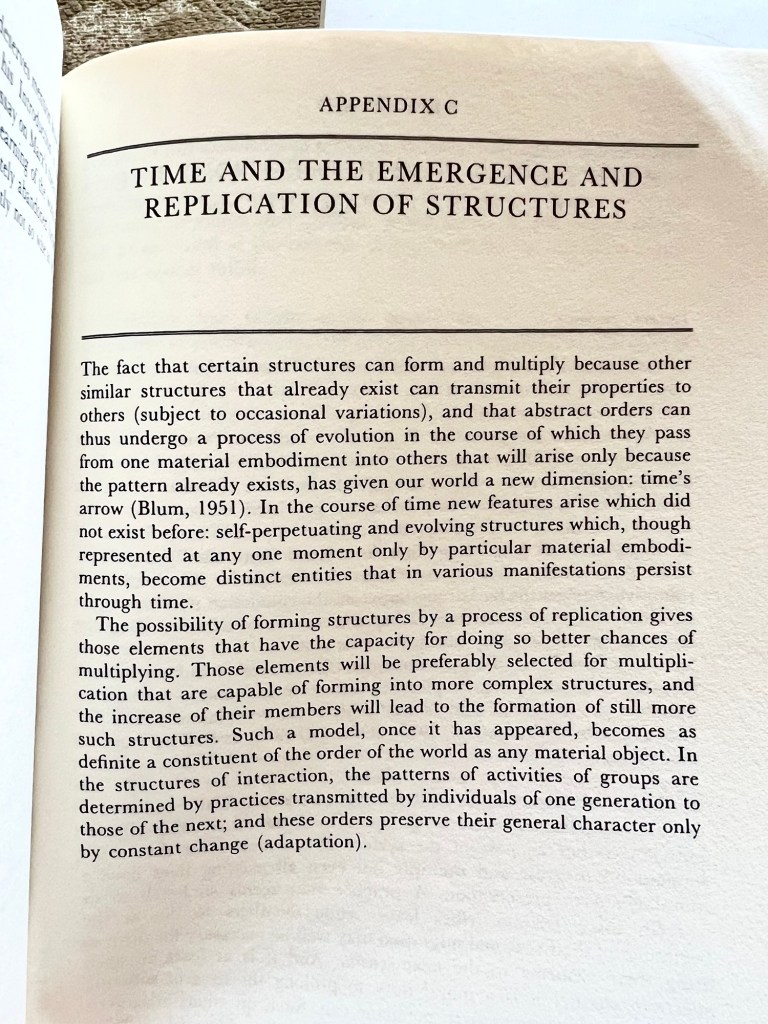
Moreover, the structures of the extended order are made up not only of individuals but also of many, often overlapping, sub-orders within which old instinctual responses, such as solidarity and altruism, continue to retain some importance by assisting voluntary collaboration, even though they are incapable, by themselves, of creating a basis for the more extended order. Part of our present difficulty is that we must constantly adjust our lives, our thoughts and our emotions, in order to live simultaneously within different kinds of orders according to different rules. If we were to apply the unmodified, uncurbed, rules of the micro-cosmos i.e., of the small band or troop, or of, say, our families) to the macro-cosmos (our wider civilisation), as our instincts and sentimental yearnings often make us wish to do, we would destroy it.
Yet if we were always to apply the rules of the extended order to our more intimate groupings, we would crush them. So we must learn to live in two sorts of world at once. To apply the name ‘society’ to both, or even to either, is hardly of any use, and can be most misleading (see chapter seven).
We live in two worlds. The mechanics of one would crush the other—but then again, the passions are known to be deadly as well. In this way, the actions in one must bend to the actions in the other. And in the worlds of dual ambitions, the subgroups explode into a cacophony of midlevel playing fields of interactions. He describes the replication process in Appendix C.
This is turning out to be a really good series. The writing holds. So many times the storylines start to repeat or are drawn out to slow the whole thing down. But the material here tumbles along and plays to the actors’ strengths instead of grating against them.
Mandy Patinkin, Claire Danes, and Damian Lewis are strong leads, with the supporting cast also interesting and credible in their roles. I love the way they play the idea that everyone is holding back something in their lives; everyone has a double life in a way. Claire Danes has the most opportunity with this material, and she guns it. As long as you can handle all the self-questioning, her performance has more depth than most things you see on the small screen.
Other plusses are the international themes and the DC lifestyle takes. Also, the dwellings of each of the characters are credible. The furnishings, the level of mess or trendiness, ring true in each house. Kudos to the prop people. They take their job seriously.


























 Home Economics