The business of Public Goods

My grandmother would tell a story of giving in their rural Iowa community. Word would get out after a Sunday service at Holmes Lutheran Church that a family was in need. A gathering of kids’ clothes or staple food supplies would be left in a neutral pickup area, maybe at the end of a driveway. Then the mother in need would later pick it up. Poverty was shameful, you see. Direct contact in the transference of aid would be a disrespectful slight on their condition.

The evolution of social welfare has come a long way since the happenings along the gravel roads squaring off sections of farmland. Provision of resources funnels through formal government channels instead of being left solely to the church aid societies of the 50s. Efforts to detach stigma from acceptance of aid are ongoing. The evolution of food stamps is a credit card with funds for the purchase. Free lunches are provided in all school buildings so there is no distinguishing between families that qualify for aid and those who don’t.

It’s hard to see how public humiliation in the face of unforeseen circumstances is profitable. However these control mechanisms were developed as a means of discouraging group members from taking more out of the communal pot of resources than needed. It was a social metering of loosely held assets. Back-up reserves are not attached to one specific individual in the group. They are intended to meet the shortfalls of the worse off.

Scolding looks are used in other ways to keep up shared appearances, When the neighbor grass is getting knee high they may feel the scorn of dogwalkers as they pass on the sidewalk. Pushing and nudging with looks, back turns, and low whispers are simply how it’s done in society when it’s thought necessary to get the word out about control of shared space.

There’s a two-fold reason these norms are swept away in the face of dire poverty. The unkindness is too harsh as the victims are too vulnerable. And furthermore who wants to discourage, in any way, a mother from taking food for their child? The desire for stigma-free acceptance of benefits for kids is simply a long-term win for the group. Healthy kids make for healthy adults.

There are those who, however, may come to an erroneous conclusion about the tapping of public benefits without those disdainful social guardrails. Some will pursue as many benefits as they can find available to them with no personal calculation of need. And others still take the pursuit of public benefits as a business model. They dreamt of being an entrepreneur, they say. This claim is being made in defiance of accusations of fraud.

When public goods and resources are formalized through government metering, then funny things happen. They no longer have the appearance of a common pool resource but rather they take on a more private form under the guise of a ‘program.’ Gone are the nuances of need-based use. Instead, they are peddled and appropriated in a coin-counting manner.

Perhaps an ingredients label is required. This is a one-hundred percent publically funded resource. It is fraudulent to transact outside its intended mission.

Turns out Libraries do matter

There a new paper out supporting the capital investments in libraries: The Educational Benefits of Libraries.

The figure shows that after a boost in library capital investment, reading test scores steadily increased. In the short run, library investments increased reading scores by 0.01 standard deviations. Seven years out from a project, scores were 0.04 standard deviations higher in districts that invested in public libraries than their counterparts.

I’ll wager there are further tie-ins between libraries and the general social well-being of surrounding neighbors. Personally, I plan to brush up on my french.

What was learned?

As the Lift/Uber kerfuffle comes to a close, it will be interesting to see what is learned from the two year process of politicians acting as labor negotiators between the independent ride share drivers and the platform owners.

The Governor singed a bill amid grandstanding to settle a set ride fare which all parties found acceptable. This is a win as the service is valued by a spectrum of riders and sectors. The negotiations, however, were lengthy. As one council member recently observed, the final horse trading involved in getting to ‘yes’ from all sides used up the political capital that could have been used to get the bonding bill done this year. No bonding bill means no bonding money for all the projects requested across the sate. The loss is all the agreements that were left unconsidered due to the distraction of a relatively small pool of workers.

Economists refer to this as opportunity costs. If your capital is doing one thing, it can’t be doing another. Some might say the politicians are constrained by the amount of time they have in a session to review, discuss, and come to terms on items of public concern. But if public officials are in the profession of providing goods and services of value to their constituents, doesn’t it follow that their choice of which products to work on is actionable? To not make time for the bonding bill is a choice not a constraint

Rosolino and Pete continue to develop this argument that “opportunity costs be regarded not as constraints to which individuals passively respond. Rather they are the reciprocal of choice itself.” Paper in the link.

Heaven on Earth

For those who love adventure and real-world challenges, body and mind. Nature is a heaven on Earth. Here, Pastor, we surely agree. The Creation, whether you believe it was placed on this planet by a single act of God or accept the scientific evidence that it evolved autonomously during billions of years, is the greatest heritage, other than the reasoning mind itself, ever provided to humanity.

The Creation, E.O. Wilson

Privatize everything!

In Jennifer Burns biography of Milton Friedman, the famous economist is portrayed as affable and polite even under duress.

Still- he had many detractors. People in this camp, I suspect, might have been turned off by the thought that every service or enterprise is done better in the private sector.

Here is a section from Milton Friedman, the Last Conservative explaining how easy it would be to charge to enter the National Parks. And there is a small fee to access the park, as there is the cost of a stamp to post a letter.

“The entrances to a national park like Yellowstone, on the other hand, are few,” continued the Friedmans. It would be easy to set up tolls at the entrance. “I the public wants this kind of an activity enough to pay for it, private enterprise will have every incentive to provide such parks,” they concluded. Similar logic extended to the post office, public housing, toll roads, and even Social Security. Each of these could be more efficiently handled by private enterprise, the Friedmans proposed, enumerating a list of fourteen “activities currently undertaken by government in the U.S.” that could not be justified by their principles. “This list is far from comprehensive,” the authors noted.

But haven’t you ever wondered why some things remain in public hands while some are replaced by private alternatives?

Why are most parks public? Why is USPS still around after all the alternative forms of communication have evolved? Why do toll roads exist only in limited markets?

History continues to challenge the Friedmans’ view that all goods and services respond best in traditional private markets.

Louis and Clark Caverns, Montana

Robert Nozick explains individual action for communal benefit

Nozick is a lesser know political philosopher who wrote Anarchy, State and Utopia in 1974. It was offered as a response to John Rawl’s theory of justice. One point of contention revolves around different methods for redistributing resources to the least advantaged. Should this be a top down imposed structure or spontaneously emerge from the churning motion of voluntary action from below?

Some fear individual action is inadequate if left to the individual. Hence the need for control. In this passage Nozick captures the essence of individual action toward communal goals. The delight of it secures its success.

Consider the members of a basketball team, all caught up in playing basketball well. (Ignore the fact that they are trying to win, though is it an accident that such feelings often arise when some unite against others?) They do not play primarily for money. They have a primary joint goal, and each subordinates himself to achieving this common goal, scoring fewer points himself than he otherwise might. If all are tied together by joint participation in an activity toward a common goal that each ranks as his most important goal, then fraternal feeling will fourish. They will be united and unselfish; they will be one. But basketball players, of course, do not have a common highest goal; they have separate families and lives. Still we might imagine a society in which all work together to achieve a common highest goal. Under the framework, any group of persons can so coalesce, form a movement, and so forth. But the structure itself is diverse; it does not itself provide or guarantee that there will be any common goal that all pursue jointly. It is borne in upon one, in contemplating such an issue, how appropriate it is to speak of “individualism” and (the word coined in opposition to it) “socialism.” It goes without saying that any persons may attempt to unite kindred spirits, but, whatever their hopes and longings, none have the right to impose their vision of unity upon the rest.

Insurance Update

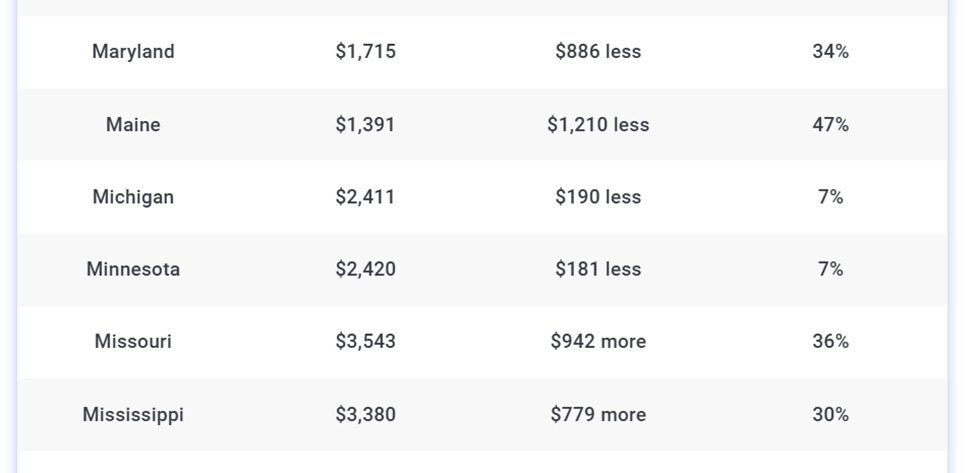
Come to find out, property insurance rates on a $300,000 home vary by state. They vary a lot. The annual premiums for a dwelling in Missouri and Mississippi are twice as much as Maryland and Maine. Minnesota is, of course, just average.

Insurance.com

If you haven’t thought about your insurance coverage in a while it might be an idea to dust off the policy and dig into what is covered. Some riders are negligible in cost yet nice to have when the situation arises. And example for coverage is on the water line from the meter in your basement to the connector at the street. Standard deductibles have also gone up from $1000 to $2500. The larger deductible may save your annual premium $200-$300.

Also, be sure to understand how the coverage works. With all the roof claims, often driven by contractors knocking on doors after a hailstorm goes through a neighborhood, companies have changed the payouts on roof replacements. Many companies will prorate the coverage once a roof is over fifteen years old. If the storm comes through in the twentieth year of the asphalt shingle life, then the homeowner only gets paid the value of the remaining years of life.

A periodic review is indeed essential for staying informed about external factors that may affect your insurance coverage. Even if you are content with your current provider, the insurance market continuously evolves, making regular evaluations crucial for ensuring that your coverage aligns with your needs and the prevailing circumstances.

Freddie Mac calculates Boomers’ Exit

As of 2022 there were 69 million Boomers, accounting for 21% of the U.S. population, and 38% of total homeowner households. Boomers are overrepresented in the homeowner demographic because homeownership rates tend to increase as households age, gradually starting to decline as households age beyond age 75 (Exhibit 4).

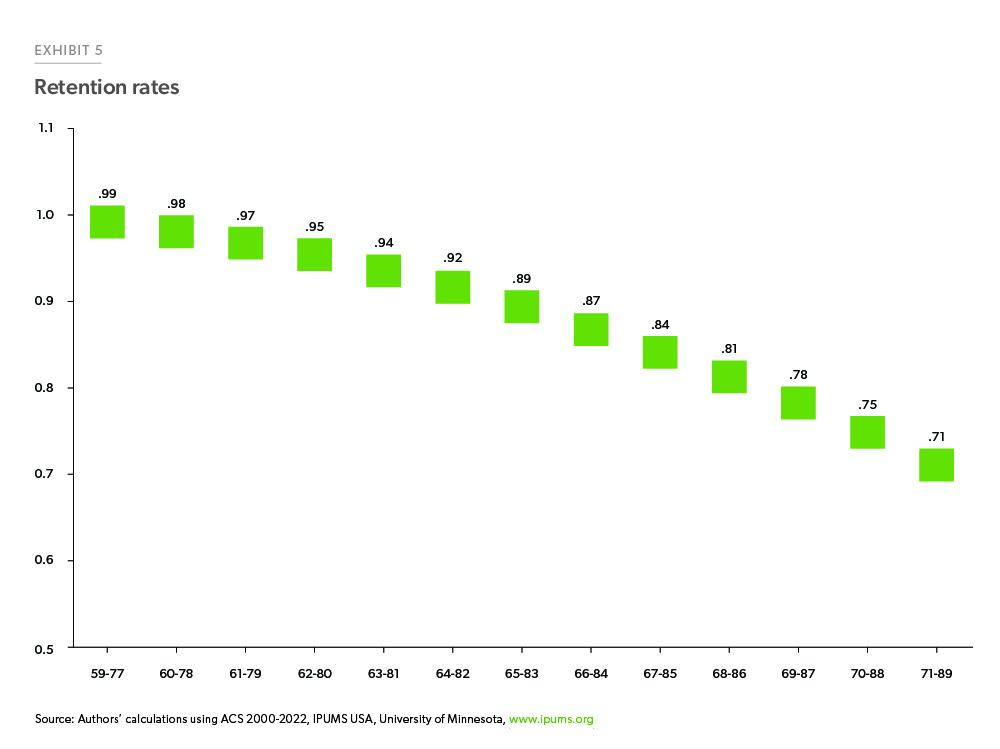
As of 2022, Boomers were between 58-76 years of age. By 2035, these Boomers will be between the ages of 71 and 89. We estimate the retention rates of these age cohorts as they age over the period from 2000-202211 (Exhibit 5).

Applying these retention rates to the Boomer households as of 2022, we estimate the number of Boomer households each year through 2035. We find a gradual decline in the number of Boomer households over time from around 32 million in 2022 to 23 million by 2035 as the oldest Boomers reach ages close to 90. Per this estimate, there will be 9.2 million fewer Boomer homeowner households by 2035 (Exhibit 6).

That’s more than 9 million homes available for the Gen Z’s who are entering into their home buying years.

Read the entire report from Freddie Mac February Outlook.

God Willing

I’ve recently crossed paths with an individual who slides in the expression God Willing as a qualifier. Whether at the beginning or the end of a sentence, there it is. You are asked to have faith that it is God’s will. It’s neither preachy nor awkward, but rather comforting the way it lines right up with the other words he uses to communicate.

Many languages and cultures incorporate similar phrases. Inshallah is an Arabic expression meaning “if God wills” or “God willing.” In Latin a signator of a letter may have closed with Deo Volento, with hopes the message has arrived to the intended recipient. And in the King James version of the Christian Bible it appears in James 4:14-4:15.

14 Whereas ye know not what shall be on the morrow. For what is your life? It is even a vapour, that appeareth for a little time, and then vanisheth away.
15 For that ye ought to say, If the Lord will, we shall live, and do this, or that.

Roberta Estes at Native Heritage Project writes about an expression she remembers from her childhood, “God Willing and the Creek Don’t Rise.”

Did you know the saying “God willing and the Creek don’t rise” was in reference to the Creek Indians and not a body of water?  We didn’t.

It turns out that the phrase was written by Benjamin Hawkins in the late 18th century. He was a politician and Indian agent. While in the south, Hawkins was requested by the President of the U.S. to return to Washington. In his response, he was said to write, “God willing and the Creek don’t rise.” Because he capitalized the word “Creek” it is deduced that he was referring to the Creek Indian tribe and not a body of water.

Have a wonderful rest of your Sunday- God Willing.

Hennepin County Library

There are 41 branches of the Hennepin County Library system serving the 1.6 million residents of the county. Some are historic buildings, some have scenic views over a lake, and some have a modern flare. All are well frequented.

Mission and vision

Our mission is to inspire, facilitate, and celebrate lifelong learning.

Shaped by the information needs and aspirations of our residents, we envision the library as a shared space for enrichment and connection.

Library services are an important part of thriving and interconnected communities. We believe that every Hennepin County resident should have a library card and use it regularly.

Although visits haven’t reached the 5 million high benchmark from pre-pandemic days, borrowing has surged to 12 million items. Visitors also use library spaces for remote work or gatherings in one of the many conference rooms.

When so many people of interest site a library or a librarian as an inspiration at a younger age, I wonder why more correlations are not made between library useage and outcomes in other areas.

There’s a huge turnout for the book sale fundraisers. At this one the first couple in line put in for a 45 minute wait.

Five Minute Real Estate

In this five minute video clip, Frederick Melo with the St. Paul Pioneer Press refers to a number of important real estate outcomes. He was invited to the weekly PBS show, Almanac, due to a recent announcement that a portfolio of commercial buildings, including the iconic First National Bank Building, is being listed for sale.

The collection of buildings are owned Madison Equities. Long time real estate developer, Jim Crockarell died in January and his heirs are not interested in being landlords. Building owners can gain emotional attachment to their properties as appears to be the case here. Some of them were half empty and some completely empty. Significant vacancies do not happen on the turn of a dime. Commercial leases are multi-year and companies have an investmest in their locations. So this recent announcement reflects activity which has been brewing for a while.

Well known architectural firm, TKDA, is also moving. They are relocating to Bloomington to keep workers happy. After 100 years, the downtown devotees are succumbing to practical desires for free parking. An added feature is scenic vistas over the Minnesota River. To attract workers back into the built environment, they are seeking out new surroundings in the third largest city in the state.

US Bank is also stepping away from downtown yet still staying in St. Paul. Workers here also say no to the densest part of the city. Melo reports that the building has had ghost leases for years. While technically under contract, the one-employee-per-floor occupancy has been a long-time indicator of what the future held.

What to do with all these vancant buildings is the question of the day. The solution under proposal is converting the office space to living space. But conversions are very expensive and the demand for residential in the capital city is not as strong as next door neighbor in her sister city. It’s a tough place to live.

Grants and tax increment financing are being proposed as public interventions. Is this a good idea? I’m not so sure. The mayor is quiet letting a non-profit alliance offer investment strategies. Their approach is to focus on one street at a time. One street a downtown does not make.

Cathy Wurzer brings in the ringer of a topic just at the end. Crime and personal safety. These are real issues that have been muted in the last four years. People don’t want to have to worry about being carjacked at knife-point when they’ve got a head full of kid’s programming and an armful of work manuals. Proximity to violence is a deal breaker for many people.

I had not heard of the study the Downtown Alliance had done around the DT Greeters pre and post pandemic. Within a district where a tax was collected to support the greeter program, quality of life crimes decreased by 40%. Whereas in the adjacent Lowertown area (where the St. Paul Saints stadium is located) crimes increased by 20%. Jim Crockarell, the real estate developer, opposed the district. This is speculation, but I’m guessing he thought greeting people and being busy maintainers of sidewalk safety was meant to be organic. It was the civic thing to do. Yet here is concrete data that an organized effort to deter crime, a significant motivator, was successful with subsidized labor.

In review, we were told about multiple exits to the city core. Be careful to note this was not a sudden occurance. We heard about emotional attachments beyond the pull of financial prudence. We heard about consumer driven needs for parking and easy access. We heard about the impracticality of retrofitting the built environment (file under why so many old buildings come down). We heard about public subsidies that will fall woefully short of the task. We heard about the big driver, safety, which is often kept on the QT so as not to implicate an area.

That’s a lot in five minutes

How many people does it take to start a protest movement?

It turns out quite a few. Tablet Magazine has an excellent article on the people behind the recent protests on campus’ across the US: The People Setting America on Fire- An investigation into the witches’ brew of billionaires, Islamists, and leftists behind the campus protests.

Not only does the article list out the actors: “This largely decentralized network of agitators is, in turn, politically and financially supported by a vast web of progressive nonprofits, NGOs, foundations, and dark-money groups ultimately backed by big-money donors aligned with the Democratic Party.”

But also gives shape to the dynamics of the interaction:

These groups, Shideler says, typically operate in a decentralized manner, using successful tactics drawn from decades of anarchist organizing and spread through left-wing activist networks via word-of-mouth, as well as through formal trainings by professionals such as Fithian or the nonprofit “movement incubator” Momentum Strategies. “If you look at Fithian,” he says, “she has consulted with hundreds of groups on how to do these things: how to organize, how to protest, how to make sure your people don’t go to jail, how to help them once they’re in jail.” There is no one decision-maker; rather, decentralized “affinity” groups work together toward a shared goal, coordinating out in the open via social media and Google Docs.

It’s worth a full read.

When do regulations work?

There’s a frequent complaint around government’s performance. Measurements for outcomes on public policies are difficult to evaluate. So how do we know when regulations meant to make things better, work?

One sense of it could be reflected by the populations adherence to the new rule. For instance, when smoking was banned from indoor areas there was a lot of grumbling. Now, a quarter-century later, it is rare to enter a home hanging heavy with the sent a-la-ashtray. The constituents agree. No smoking is great! Don’t even think about lighting up by the public entrances to buildings as perfuming oneself with the sent of Marlboros is not OK.

Some cities place permit requirements on all sorts of home improvements. I doubt there are objections to paying for an city inspector to stop out for the significant improvement projects like roof replacement or furnace upgrades. But the fees can hit smaller appliances like gas ranges or hot water heaters too. In these cases the regulatory charge adds an additional ten to twelve percent to the new appliance. After paying a sales tax and a delivery fee, people find this onerous.

As a result, people bypass the permit process. Pretty soon it becomes a known thing and nobody is following the rule. When the public ignores a regulatory process, I’d say it’s time for a reassessment.

Time- according to Alfred Marshall

Marshall proposed thinking in one of four blocks of time. The first would be a market period, where demand determines price because there is not sufficient time to alter supply. The short run, Marshall’s second period, introduced a new wrinkle: by responding to demand, firms could increase supply, but only by spending more money. So prices might go up, set by the cost of supply, working in tandem with demand.

The third period, the long run, during which firms had time to develop new efficiencies, introduced a further complication. Now rising demand might trigger falling prices as businesses benefited from economies of scale and better organization.

The fourth period, secular time, was Marshall’s nod to history it-self. Secular time was generational time, which might see huge shifts in demographics, knowledge, or political organization, completely refiguring the dynamics of supply and demand. Marshall had found a way to integrate the glacial movements of the ages, the lurches and accelerations of the present, and the universalizing clarity of economic abstraction.

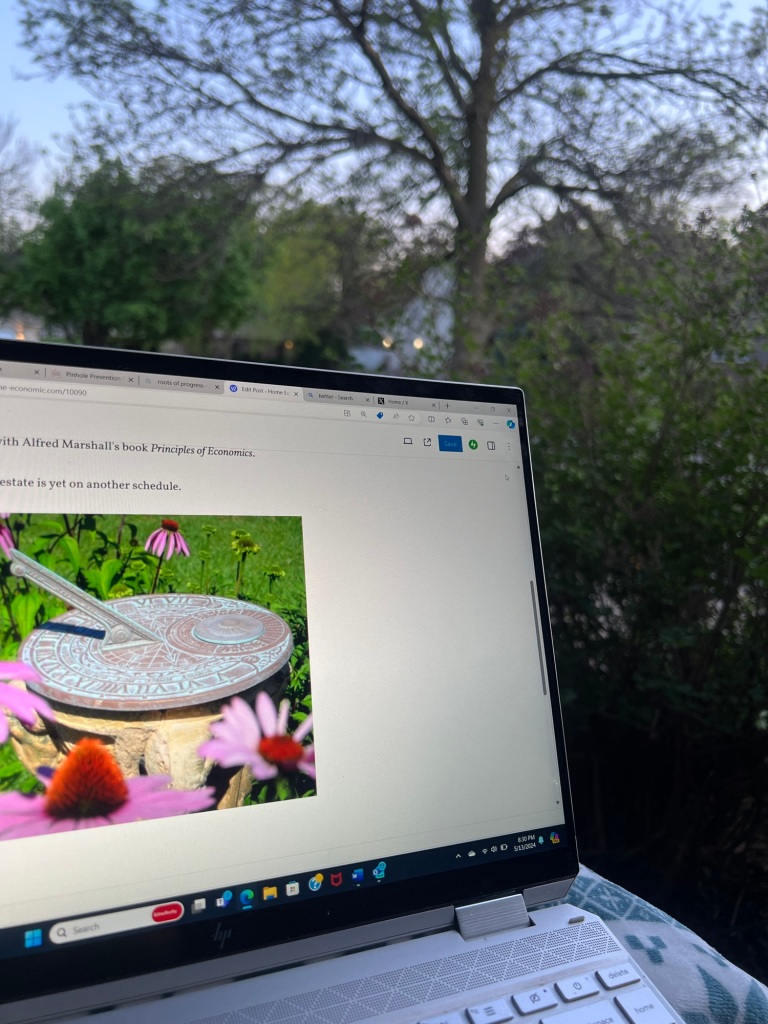
Lifted from Jennifer Burn’s book Milton Friedman: The Last Conservative. She narrates Friedman’s encounter with Alfred Marshall’s book Principles of Economics.

Time in real estate is yet on another schedule.

Paternity Leave

It’s game time for the second in a series against the Denver Nuggets and lead Timberwolves defender Rudy Gobert is taking the night off. For what you say? For the birth of his baby. My. Times have changed.

I guess the team is on-board with his decisions. As they should be.

Gobert and the Timberwolves were well aware that he might have to miss a playoff game for the birth of his child, and the team has been nothing but supportive of his choice to be at his girlfriend’s side for such an important life moment.

“I would do anything I can to be there,” Gobert told the Deseret News in March. “I don’t think there’s any debate to have. Coach Finch and every guy in this locker room, that’s what I love about them, we have a level of human connection and empathy for one another that I think is really good. And I think all the guys will be literally telling me, ‘Don’t play, go.’”

MSN

The team has tons of momentum. Let’s hope this opens up an opportunity for one more player to become a star.

Christ Church, Malacca

Christ Church is the oldest protestant church in Malaysia. It sits on the same square as the administrative buildings set up by the Dutch in the seventeenth century.

The Stadthuys (an old Dutch spelling, meaning city hall) is a historical structure situated in the heart of Malacca City, the administrative capital of the state of Malacca, Malaysia, in a place known as the Red Square.[1] The Stadthuys is known for its red exterior and nearby red clocktower. It was built by the Dutch in 1650 as the office of the Dutch governor and deputy governor. It continued to be used as the Treasury, Post Office, Government Offices, and suites of apartments for the high officials after the takeover by the British.

WIKI

The librarian who liked the beach

Many lessons were learned from the Covid lockdown, including knowing which jobs are conducive to work from afar. Employees who work primarily through an internet connection discovered that they preferred working from home as it gave their lives more flexibility. Some employers are now indifferent to where their employees sit when they earn their paychecks. But not all employers are so flexible.

A few years ago, a brouhaha flitted through the local news as it was discovered that the man in charge of our largest, and nationally recognized, library system was running the show from a downtown condo in LA. Minnesota’s weather is indeed a drawback. Still, the Hennepin County Board is in charge of this position and was not amused by someone in a key position choosing to live by the beach instead of in the land of ten thousand lakes.

There’s a consensus that if you are a public employee of stature then you should be experiencing the public environment here, along with the rest of us. You need to part of the team. You need to be in the know of the subtle and sometimes unsaid nuances of an area’s culture and aspirations. To dial in from afar was deemed unacceptable and a severance package was negotiated.

Where you choose to live tells a lot about your preferences. It’s an acceptance of the combination of features available to residents in the surrounding area. There’s an acknowledgment, by taking on the expense of the move, that there is something to gain through the relocations. Interestingly, the minority population in Minnesota is the only population that has gained ground between 2022-2024. Minnesota Compass, a non-profit research group, recently released these numbers.

People of color in the Twin Cities has increased by 34,000 in two years. It doesn’t seem to indicate the concern about policing and the justice system that some in the political realm are suggesting. Quite the opposite.

Knob and tube and deal breakers

In the early part of the last century, when electrification was new, a house wiring system called knob and tube was installed in many homes. It was a labor intensive process but the materials were less expensive. Where there were workers, knob and tube made sense. Wires ran between the interior walls and the outer shell throughout the house on the whim of the electrician. Without a plan, it is difficult to know which wires connect where. This becomes a drawback at time of a remodel. But the more significant drawbacks are the safety hazards due to overloading the system with electrical demands the system was not designed to carry.

This investor purchased a nine-unit building with k&t.

The fuse box looks funny because it doesn’t have the flip breakers. The cute green topped glass are the circuit breakers.

Insurance companies in our area will no longer cover a home with k&t. At least that’s the latest I’ve heard. They tried twenty years ago or so to make it a rule, yet it did not hold. There was enough demand in the market to over turn removing that option from their insurance offerings.

Lenders, federal mortage insurance rules, property insurance providers all play a role in real estate excahnges. In this way they feature in the price of property. It’s uncommon for a subsidary service to make a property unsaleable, but over the years there have been instances where property types have taken significant hits. Condos in the early 1990s would be another example.

Chapter 5- who does what when

Stubborn Attachments is a smart slim book by Tyler Cowen. He presents a decisive defense of society’s obligation to pursue economic growth. Although he expands his profession’s definition of wealth by bulking it out to include a larger scope of life. Wealth Plus is how he describes it.

In chapter five he wrestles around with some ideas about who should do what when. In order to not only have monetary wealth, it is valuable to sense that when something bad is on nigh, someone is around for a rescue. When the drowning girl needs to be saved, there must be a member willing to jump in the water and pull her out.

It’s not efficient if everybody were to jump in. She’d be saved by the sudden and dramatic reduction of the water level. Meanwhile no other jobs would get the attention they deserve. S0 how is it that the available labor will be in place when a task needs doing? When a crime needs reporting or an old pensioner needs protecting? That’s a great question.

It’s the question that begs the demand for benchmarking.