It has been decades since I’ve heard talk of contract-for-deeds. But lately, in-office meetings, or out working on transactions, people are proposing this seller means of financing as a way to put a transaction together.
I suppose favorable interest rates have kept private parties out of the financing business for the last dozen years or so. With mortgage rates at new highs, there is an opportunity for investors to pick up a decent return, even with the risk of getting the house back.
Years ago they were used not only for people who were unable to qualify for a conventional loan but also for timing purposes. A retiree liked the idea of selling on a contract and receiving quarterly land payments. That way their tax burden was spread out over time instead of boosting their obligation all in one year.
Overall most consumers seem to prefer the impersonal interaction of working with a commercial lender. But when a need arises, it’s nice that entrepreneurial responses crop up and fill in the gaps.
In theory, consumers are meant to have knowledge about the products they are comparing. This knowledge helps them evaluate not only the object or service but other features such as reliability, consistency, or quality. On straightforward goods which are frequently consumed, this maybe reasonable. McDonalds’ success is in part due to the franchise’s ability for a consistent product.
But many services, in particular, are not so easy to evaluate.
Take the example of obtaining a mortgage. There is a spectrum of providers from online folks like Rocket Mortgage, to brokers who place loans with investors, to in-house lenders at the national banks. And each of these outfits advertize slightly different pricing.
Consumers often check with a couple and select the one with the lowest fees and rates. But do they have full knowledge of what they are buying? Without understanding the process of collecting information, verifying the financial information, submitting the documentation through the underwriting process, and tackling any bumps along the way, the consumer may not be able to interview the service provider to understand if they can complete the task with the proficiency needed for their particular situation.
The front-end people who are mainly responsible for pulling customers into the process are likely to answer affirmatively about their capabilities and performance. Underwriting guidelines can be vigorous. If you need something to fill your time, have a look at HUD’s handbook on FHA loans. The logistics of the underwriting process is not the only step in the chain of events that leads to a successful home purchase closing. There are appraisers, processors, and title closers who also have a hand in making the mortgage possible.
A successful loan officer plays a supervising role over all these functions.
Professor Glenn Mueller gave an interesting PowerPoint at our company-wide meeting this morning. He monitors five different real estate types as they cycle through the business cycle. He shows the results for 54 US metro areas.
You can view the full report and an explanation of his theory here.
A few days ago I wrote about how snow shoveling the public sidewalks fits well into a polycentric model. Instead of one provider of snow removal for the whole city, having each residence responsible for their own removal will best use public resources. Inevitably there are situations when residents cannot shovel, but in these events, neighbors cluster together and work out arrangements or help each other out. Using local labor saves administrative overhead of filtering the work through a bureaucracy.
What about trash removal? It feels the same. Each resident needs a service at their curbside.
There are debates across city council meetings about whether their city should take charge of trash removal or allow various sanitation services to compete for the business of each household. The former is usually desired by those who feel the extra truck traffic through the neighborhoods causes wear and tear on the roads. The latter feels that competition will keep downward pressure on pricing and allow residents to purchase the extent of service they desire.
This routine neighborhood service differs from snow removal primarily in the fact that residents can’t dispose of the garbage themselves. Nor can they assist a neighbor in the task. There is no reserve of voluntary labor tucked under the rooftops for the dispensation of Hefty bags tied at the rim. In the disposal of waste, the choices are either to purchase a private provider or take charge of it through the city offices. So a polycentric model is not useful here.
As to whether to go private or public on this one, there are benefits to both. A large city can provide many extra services such as large item removal, one-time cleanout pick-ups, that are helpful to those who don’t have means a transport for such things. Thus centralized garbage pickup with additional services is particularly beneficial in areas of a significant rental population.
Our state is blessed with lots of lakes. They are well-liked for their recreational qualities as well as their aesthetics. For most people, the competition for a lake home in the metro makes this prospect unattainable. But there are many lakes at a few hours drive from the core MSA. And a collection of lakes attracts enough patrons of restaurants, retail and golf courses to produce lake districts.
Since many prefer to look out over a lake than a row of rooftops, it is not surprising that a surge of interest occurred following Covid. The work-from-home option gave people, at least for the moment, the option to live the rural life. As downtown real estate suffers the largest vacancy rates in years, pricing in Alexandria, Brainerd, and DL areas has surged above metro rates of increase.
This reversal of migration of more well-to-do people from the metro to the rural areas should also have implications in activating other types of community interests.
When you don’t have time to go on a big overseas trip you can still perfect your travel skills when planning out an enjoyable bike ride. It’s a bit of an adventure as trail maps are more vague than street maps.
Like that section of Cedar Lake Pkwy as it slides up next to Hwy 394. I’m not convinced that it is a straight easy shot into downtown. But it might be. The Midtown Greenway is an old rail bed and that one I know is all paved and free from road crossings.
The thing you don’t get off of maps like this is the elevation changes. A general sense of the mileage is helpful in deciding how far a treck you want to tackle. But the energy exertion is significantly impacted by hills and valleys.
It’s been so dry!
There are several extra benefits to biking: the views, the variety of terrain and the exercise of course!
Dusk is falling. We’re passing through that time of the year when daylight lasts the longest.
Did you learn about the movement of the planets from a mechanical model of spheres held out on wire supports? For me, it was one of those moments when the lining up of an earthly experience to a representative explanation generated a tingle of delight. The flashlight beamed its light across the spheres so one could see the crescent moon ebb and flow.
And from then on one just wants to know more, and more.
“Not from the stars do I my judgement pluck, And yet methinks I have astronomy. But not to tell of good or evil luck, Of plagues, of dearths, or season’s quality; Nor can I fortune to brief minutes tell, Or say with princes if it shall go well.”
It’s hard to remember the snow once we’re swatting away mosquitos and basking in 90-degree weather. But the white stuff will be back in less than five months’ time. Last winter was a record breaker. The season clocked in as the third snowiest on record. And this makes for disgruntled shovelers.
Property owners are responsible for clearing the sidewalks which cross their property. In a city developed before 1950, it is common for sidewalks to line every block. Homes on the corner get the double benefit of a walk on two sides. And it is an important service. Failure to clear the precipitation when it is light and fluffy can result in a coating of ice which is treacherous for pedestrians. People use the walkways to walk to school, access busses, walk their dogs, access their properties, and on it goes.
The burden was so great last season that some cities looked into taking on snow removal as a centrally provided good. Some people are disabled and are unable to do their own walks. Some people are away and not in town to chase the snow after a storm. And then some folks simply don’t pull their weight. There is a threat of a fine for these folks, but when many residents let it go, it’s difficult to keep up the policing and fining.
So why not turn over the responsibility to a central system to be sure everyone gets to walk on clear dry sidewalks? Well- the cost of it of course!
The traditional way of handling the snow is a polycentric model. One might think it is a one-on-one match between a property owner and a strip of concrete squares, but that is missing a crucial element. Not everyone is at all times available to take care of their responsibility. The polycentric model implies that groups of people band together, and either one neighbor or another will pick up the slack, and do more than their share so that all the walks are clear.
The arrangements are extensive. I can’t count how many times we’ve come home from being out of town and our drive is clear. Guys with snow blowers love to run their big machines a little bit longer when half a foot of the fluff has blanketed the neighborhood. Some people exchange the use of an unused garage space for snow removal. Whether people are motivated by safety or helping out others or have a specific deal in play, the work that is necessary to keep a micro market of snow off the sidewalks is volunteered by a cluster of neighbors.
This is free labor. To hire it all done is bound to cost everyone more money in bureaucratic overhead and extra labor. A centrally planned snow removal program lacks the voluntary social contribution the residents dedicate to the project.
There can be reasons why this type of labor is unavailable. The very first single-family home I purchased was in a neighborhood built following WWII. I was amazed at the high percentage of original owners who were still living on the block, all entering their late sixties and seventies together. These folks had the ability to pay for the snow removal, but in other areas of high concentrations of homogeneous groups, the lack of ability or resources can cut short voluntary participation.
I think analysis would easily show that shoring up these weak spots in the system would still be far more economical than pushing a program through for centralized services.
I kinda hope this proves to be true here locally. Owner-occupants are more likely to do all the necessary neighborhood work to keep everyone healthy and happy.
Institutional firms are pulling back from the U.S. housing market—just look at Starwood’s decision to shop 2,000 single-family rentals.
The Hennepin County prosecutor has never hidden her activism. Supported by many, there is a view that African American youth are incarcerated too quickly, and too young, which destines them to a life of crime and prison. And holding good to her beliefs, following her election last fall, her office has been extemely light handed in pursuing this group with legal action.
The thing is, the results have been problematic. My son lives down by the U an area fraught frequent and sometimes violent criminal activity. He said the best story he’s heard so far is a kid getting taken in for a mugging only to be arrested a second time, for the same crime, later in the evening. Once released on the first charge he didn’t go home and think through life decisions. The police are busy apprehending the same youth twice in the same night for the same crime.
Needless to say after hundreds of reports of cars filled with youths as young as twelve joyriding, even the most forgiving citizens are coming to the realization that no response to crime except ‘we believe in you’ and back out on the street you go, is not generating a beneficial outcome. At a news conference few days ago, the county prosecuter announced several collaborations to put a good face on further efforts.
The collaboration with law enforcement has three parts, including meetings in which agencies will come together to identify youth in need of intervention. Social workers will also be in contact with families to connect them with needed services. Families that accept services will be connected to the county’s Family Response and Stabilization Services, along with school-based and community resources, the HCAO says.
My only question is what does this have to do with the prosecutor’s office? Isn’t it their job to make a case against criminals according to the law and fulfill their obligations to the public whom they serve? The job of connecting people with social service resources and other response services in the event of mental crises etc is fulfilled through another county department. If you want to work in the social service side of public service, then work there. Be successful there. Reach out and make a difference in people’s lives in that capacity.
As of right now, the results are in. Not prosecuting criminals is encouraging a life of crime not discouraging it.
Watch it because it will make you laugh out loud. Watch it because the cinematography is precise and interesting. But watch it because the character Marisol will remind you of an old friend from a southern European country or Mexico. She plays her character to perfection.
The University of Wisconsin-Madison is a popular choice for ambitious students from the Twin Cities. The campus is situated on scenic Mendota Lake and the town of Madison provides a fair amount of diversion. The school has a strong reputation and graduates often go on to lucrative careers in Chicago. We toured the school not too long ago.
But my son was to be a Gopher not a Badger.
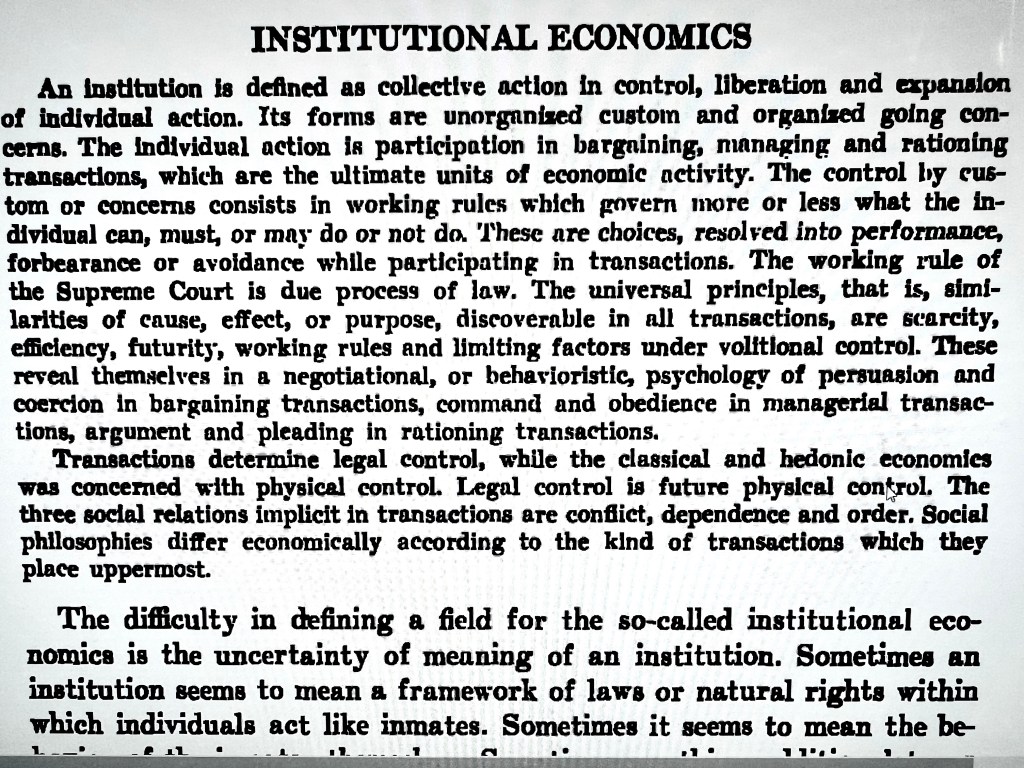
What I didn’t know at the time was that UW was the academic home to economics professor and institutional economics pioneer John R Commons for nearly thirty years. I’ve never been satisfied with the definition of of institutions as the sum of rules, laws and norms. As it turns out neither was Commons. He provides this helpful narrowing of the idea in a paper called Instituational Economics published in 1931 in the American Economic Review, Vol 21.
So many times when consumers think they are getting ‘ripped off’ it’s really a matter of not understanding the process.
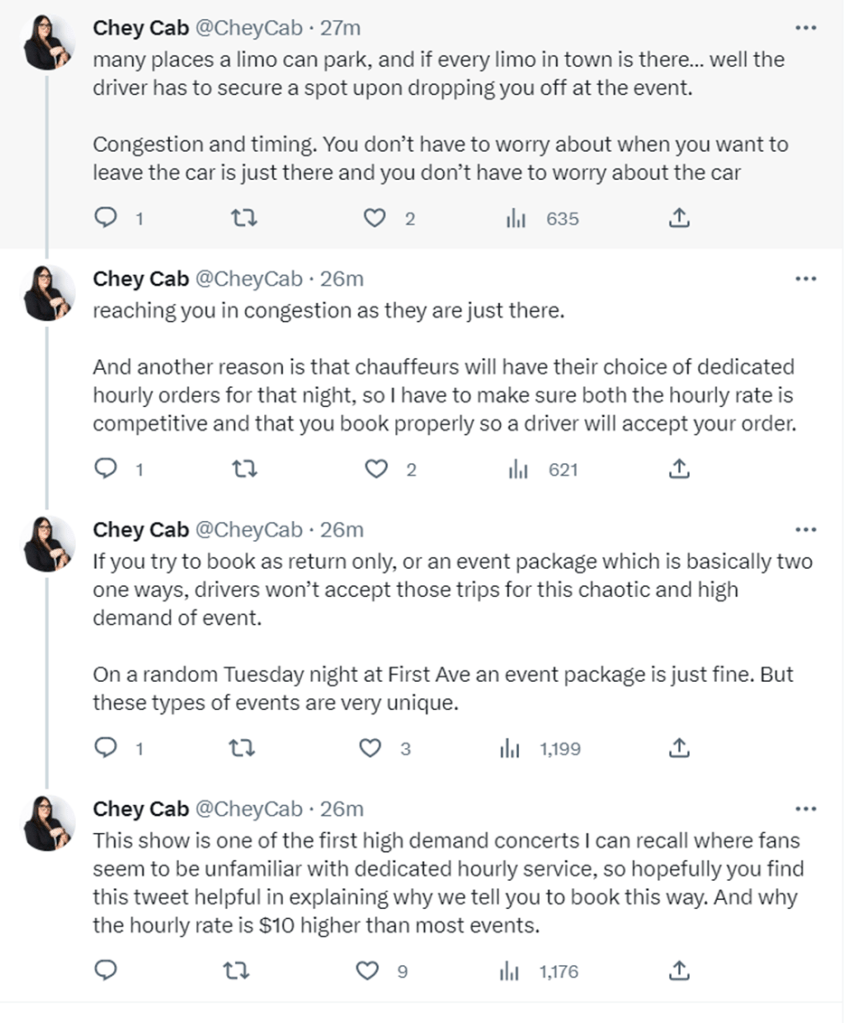
Chey Cab owns a limo service in the twin cities and she describes below why it is best to book a car for the whole evening to go to the Taylor Swift concert than to book a ride to the venue and a return cab home.
how dedicated hourly service works when booking the car.
So why do you have to hire a car dedicated for the night vs two separate one ways? One of the big reasons has to do with parking outside the stadium so you can easily walk out after the event. There’s only so
The consumer may think they are being taken for a ride (excuse the pun) when told they must book for the entire evening. They probably haven’t thought through the extent of the congestion when a megastar like Taylor Swift shows up in town. Nor have knowledge about other events happening that same weekend like the Pride Festival which is estimating an audience of 600,000. Outsiders often do not have full knowledge of the process.
Having been stuck downtown following the Aquatenial Target Fireworks display, I can vouch for the congestion following a major event. The traffic creeps one merge at a time.
The best way to be able to discover the ins and outs of the service you are requesting is to talk to several vendors. It usually becomes clear what is involved. And if they are free to enter and exit the market, the pricing they are quoting reflects the best options they can offer the consumer. Before hollaring greed or predatory pricing, check out the process.
Talk about confusing sets of interests. The secretary of the interior, Deb Haaland, who is of Native American heritage, was told to ‘go home,’ (presumably to DC) when she returned to her native state of New Mexico yesterday.
But her return to Chaco Culture National Historical Park on Sunday was derailed when a group of Navajo landowners blocked the road, upset with the Biden administration’s recent decision to enshrine for the next 20 years what previously had been an informal 10-mile (16-kilometer) buffer around the World Heritage site.
Her ethnicity is meant to guarantee that the interests of her tribe are held in the highest regard in the nation’s capital. But it appears that social connections have taken a back seat to the power players of the political process. Those in control of her day job in DC want to favor the environmentalists with a land grab.
The landowners and Navajo leaders have said Haaland and the Biden administration ignored efforts to reach a compromise that would have established a smaller buffer to protect cultural sites while keeping intact the viability of tribal land and private Navajo-owned parcels for future development.
I thought affirmative action was meant to help minority groups by offering a figurehead to look up to. But when affirmative action advances political objectives of another sort, then its days as an interventionist strategy are most probably numbered.
The struggle over property rights is an economic story.
Navajo President Buu Nygren said in a statement issued Thursday that the weekend celebration was disappointing and disrespectful. It should have been cancelled, he said.
“The financial and economic losses that are impacting many Navajo families as a result of the secretary’s recent land withdrawal are nothing to celebrate,” Nygren said. “As leaders of the Navajo Nation, we support the Navajo allottees who oppose the withdrawal of these public lands.”
In this balancing act of heritage sites for posterity versus private property rights, the cultural argument proposed to be weighted more heavily. Yet if the true objective is property control to prohibit oil extraction, then it’s hard not to be cynical about claoking the issue in Native American garb and revisiting a sensitive part of American history to make a power play.
Here are some premisses which don’t ring true to me.
People always want the bigger job. It seems like plenty of people do not wish to take on the extra step up for a measley ten percent wage. Many workers are very happy to check-in and check-out without nagging responsibilties. Pundits always infer that these types of workers are unhappy. But maybe they are really being reflective in this observation.
People would always prefer to live in ‘high productivity’ cities. Writing to you from the Midwest, I can assure you this is not the case. There are some megacities in the US, but I don’t believe the total population of the top ten cities combined surpasses ten percent of the population. That is another way of saying some significant portion of ninety percent of the population is perfectly happy where they are.
Everyone wants to go to an Ivy League school. The logic here follows the two examples above. Most of the population do not even consider the Ivy’s and are making meaningful selections of varying degrees of prestige closer to home.
Those who write about the policy may want to be at the tippy top of the corporate ladder and live an expensive life in a high-buck city. And to accomplish these two things, they care deeply about their college pedigree. But they are not most of America.
This seems like an argument to seek out policy people who understand the wants, desires, and aspirations of the rst of America.
In this documentary with Cint Eastwood and Ray Charles, the pianist explains how he got his start. When he was about three, he followed the sound of boogie woogie music to a local musician named Wylie Pitman playing on an upright piano at the Red Wing Cafe. Instead of telling the toddler to run and play, Wylie spent time with the young Ray and taught him bit by bit. Hear Ray Charles tell the story around min 6.
It’s hard to imagine what the world of music would have lost if Wylie Pitman had ignored the youth. As explained in the clip, the elder took time away from his own practice to nurture the talent of the youth. For nothing. It’s a miracle that the right person appeared at the right time to mentor a wayward youth.
The transaction of his time and talent isn’t something that could be predicted. It was a spontaneous response in the moment. And, as the story is told, it was tied to the level of interest the benefactor of his lessons was exhibiting. The first rule of social support is that you can’t know how much will be given until the need is revealed.
The second rule of social support is that you only need one. The whole group doesn’t need to be taxed. When the right support meets the right benefactor then the delivery of services occurs on that level. Only one person is needed to call in a crime happening on the street. Only one person is needed to make sure the kid who’s being bullied gets home from school safely. If people offer just-in-time support, then resources are used most efficiently.
It only took Wylie Pitman to step up in the moment and deliver the megastar Ray Charles to music history.
I think it was on Twitter today that someone said that using a social contract as an argument was a cop-out. But using efficiency as an argument was valid as it required an explanation of how the optimal outcome was being achieved. Somehow efficiency is tied to numbers and not norms, so it’s more difficult to spell out.
If you want to claim a social contract, though, I think you have to show who is involved in the contract and how it’s unfolding. People always talk in broad strokes- crime is up! crime is down! Sweeping statements are not very useful as within the purview of the speaker there are more then likely people who are isolated from crime even if crime is rising, and those who continue to experience crime even when a generalist can legitimately claim crime is down.
So the first hurdle in the usage of social contract as an explanation is to be able to isolate the groups held to the agreement. Who are the givers, and who are the benefactors? And besides the two to the party, there are a more general group of observers, or what I like to call the audience.
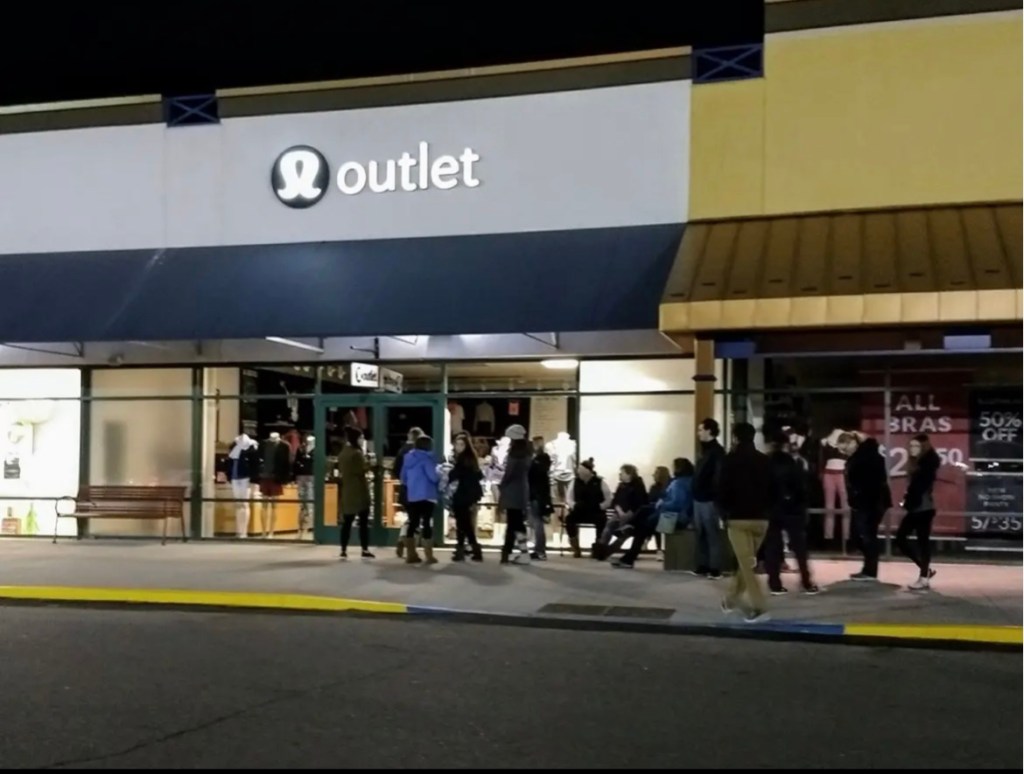
The CEO of LuluLemon recently made a show of a social contract when a handful of youths shoplifted from one of the retail stores. The benefactor from this leader’s contract of people of property were the shoplifters who faced no charges of breaking the law. The losers in this arrangement were the employees who lost their jobs as they were fulfilling the social contract they had been raised with, theft is bad and should be reported, instead of the social contract supported in a LuluLemon employee manual. The audience is the rest of us judging these interactions and evaluating how we would act should this scenario present itself.
If one is looking for efficiencies, one would have to take a closer look at the intersection of the employee’s behavior visa vie the CEO’s. If employee policy is so counter-intuitive to pre-existing social arrangements, ones that have been trained and maintained with most people since childhood, will it be efficient to expect the average worker to go against such impulses and look the other way at blatant theft? It seems there will be a brewing of backlash- or those pesky unintended consequenses.
On the other hand, if the store decides to hire a host of people who can easily ignore stealing and have no issues with criminal activity, then perhaps the social contracts between the CEO, gangster youth, and employee will be groovy. Except….if your employees feel it’s legit to operate as crooks, eventually they’ll be stealing from you themselves. And that truly can’t be very efficient.
You see, arguing optimal outcomes using social contracts requires some persuasion.
I have to say I’m one of those people who still send in payments in check form via the good old USPS. I figure the fewer people who have my credit card or debit card number the better. Why not send in a paper check and use it as a receipt in with your monthly bills?
A week or so ago I ran an errand at a neighborhood hardware store in a strip mall. An elderly woman with erratic grey hair was taken off guard when the young man, still sporting a black mask, asked her to wait while he called over the manager to approve her check. Besides telling him he can’t be understood when his mouth was covered. she gave him an earful about the approval process- you see she had been using checks at the store for decades.
The manager listened patiently while she tiraded about taking her business else, then watched her take her two items and use a cane to leave the store. But didn’t she just save them 3 percent of her purchase by writing out the check with her name and address typed neatly in the top left hand corner?
I was given the choice of paying a reduced rate by my window washers if I paid with cash or check. The savings came to $7.50. In a way it’s surprising more companies don’t offer the discount. On the other hand, the small time vendors, like estate sales folks, add the extra 3% if a buyer chooses to pay by card instead of check. This holds true for property tax payments at the county as well. If you pay with a card, plan to add on the surcharge.
I use the paper drafts out of habit and reluctance to give up the paper. But it seems as soon as you think a paper mode will vanish (think bookstores) there’s a return to the good old days.
There is a scene in the fairy tale Snow White where the Queen goes to her private chambers and summons up a mystical spirit from behind her mirror and then utters this famous question: “Mirror, mirror on the wall, who is the most beautiful of all?”
Even when I was younger I thought it was odd that a mirror was turned into an object of wisdom. I suppose while some women vie for power through their beauty, so an object that reflects one’s image can be a useful tool. Women use mirrors to primp in their bedrooms, in the bathroom, in the foyer, and even in the car visors. (Seriously– how often does one have to check on their makeup!)
But now I wonder if this is a tale about two does competing for a buck but rather of the blindness we all have to ourselves and our circumstances.
The premise that most people struggle with self-perception is not unreasonable. It’s not like we are walking around like the emperor without his clothes. But that’s because we’ve used our preception of feedback from those around us to navigate more successful reponses. Clearly it is better to have honorable and trustworthy friends than flattering advisors.
Slowly, over time, people can pull away from those who want to provide the direct and reliable feedback. This can be especially true if this is delivered in the form of a reminder, that perhaps the time has come to respond with a little work in kind. It is easier to replay the hands in a slightly different fashion so as to change the score tallied up for the rubber. And the player who can lay out each players cards and reroll the game becomes inconvenient.
So people turn away and cancel those who are inconvenient to the perceptions.
A mirror is meant to bring the reality of the moment back into view. We can all imagine that we have not aged, yet creases at our brow lines are hard to ignore when they reflect back at us. Perhaps the mirror in Snow White is not a call to compare beauty but a forecasting of a change that is already in play– an advanced warning of what is to come. But try as she might, the Queen fails to suppress the natural unfolding of events.
Getting closing gifts for my customers has been pushed down the todo list for a couple of weeks now. So today was the day that I was going to make some purchases. I stopped at a corner liquor market for one client and then onto Ingebretzen’s for another who I knew would appreciate a gift with a Nordic flare.
It was just a couple of years ago that the store celebrated its hundredth year on this busy street in Minneapolis. It originates from a time when Norwegians and Swedes were the disadvantaged new immigrants, scraping by without two dimes to rub together. You wouldn’t know it from the gifts stacking the shelves at the shop now. They are abundant and exquisit.
There is an immediately identifiable flare to Scandinavian housewares. It might be the heavy dose of primary colors with an emphasis on marine blue for dishware and cherry red for accent pieces. The elves and gnomes are peeking out from all the margins as if to give the Viking miniatures their fair due. Carl Larson captured the portraits of fair-haired women in particular; you can always find a sleeve of his notecards for purchase.
A lot of people bee line straight for the deli counter. One yelp reviewer went for the “Six types of herring. Swedish Meatball Meat. Julekage. Limpa Rye. Scandinavian sausages and cheese. Store made Lefse. Candy, Fish, Crisp Breads, Lingonberry jam.” Another noted “I also found lingonberries in syrup, lingonberry jam, lefsa, tisanes, sweaters . . . so much more.”
I had no problem picking out a little memento and card for my client. I also knew my mother would appreciate the little lamb. After my card was run for the purchases I noticed the Uf Da pins and had to add it to my gift. A pleasant sale lady with gracious hair had been talking with me through my perusings. I asked her if I could pay the two dollars in cash for the pin. “Well, there’s tax,” she said just about spitting the words. “That tax,” again, the vehement words contrasting against the gentle woman.
As long as the talk is theoretical, anything is possible and everything is agreeable. Once the toll is in place to pay, then people’s feelings are more apparent.












 Home Economics