Minneapolis is lucky to have a long-standing history of parks and trail system support. Early in its history, the city set up a connected park system throughout its neighborhoods. The green space ropes together a string of lakes which often have a walking path encircling their parameter. But despite being glorified for prescient action in the development of a great city- city leaders of yesteryear have failed the environmentalists of today.
Wild rice growing in Lake Nokomis in 1915. Theodore Wirth considered it "unsightly and unsanitary" and the Minneapolis Sunday Tribune called it a "weedy slough". Much like Hiawatha, Nokomis was extensively dredged and the existing ecosystem wiped out. pic.twitter.com/zbpAGHfYt8
Now wild rice is something to be preserved! Enshrined! Even though it is cultivated for commercial sale around the state, and grown wild under a protected status near and on Indian reservations. It’s a little hard to believe that even with this new status, the city consumer of parks and trails would be better off with a slothy body of water in lieu of what Lake Nokomis is today.
I’m not sure how far the revisionists would like to go with their return to nature. Perhaps there will be a push to revert all yards to prairie grasses. Or dig up all the asphalt roads and return them to cart trails. Nor am I sure how this shaming of the present and glorification of the past is helpful.
Another type of duty shifting happens when regulations, or rules, are made official across a group. We all want to be able to go to the Minnesota State Fair and eat from as many of the food booths as our gastronomical ambitions allow. It would be unfortunate to find out after the fact that the mini donut vendor did not change out their frying oil promptly. Even the most non-regulatory types would agree that purchasing food without the risk of food poisoning is a good thing.
If food prep regulations were weighed out, it is clear that having the rules in place allows for more people to be freer to sample the Fresh French Fries and Sweet Martha’s Cookies and Turkey on a Stick. Having the rules in place gives people confidence in interacting not only with people they know personally, or they’ve heard of from friends, but with any food truck or pop-up vendor operating with a license. The rules push the duties of edible foods on the small vittles providers because this allows for greater freedom, not less, overall.
The Minnesota State Fair is the best in the Midwest.
This feature works really well when populations are nested one inside the other. Although there may be small differences between counties, the rules reflect what is expected at the state level. And it is fairly reliable to maintain the same consumer expectations as one crosses state lines as everyone is nested in a federal suite of rules. And although there is sometimes pushback, like when the health department wants to show up at a church basement waffle breakfast for their parishioners, the system, in general, reflects efficient coordination.
Who gets to assign the duties becomes a bit more opaque when bundles of economic activity operate separately from one another. For instance, do European consumers of garments manufactured in Bangladesh owe the workers an EU evaluation of their working conditions?
Within one’s own trading system one relies on the press and complainants to expose wrongful work practices. Then consumers can make choices with consideration of brand reputation. When markets operate at a distance, it is unclear which market has a duty to established norms.
The LA city council would like to force local hotels into giving up their unrented rooms to the homeless. Every day the hotels are to report to the city the number of vacancies they have and allow the homeless to take over the room. It seems like some dream of authoritarian control over private property for the public concerns is budding in the sunshine state.
Mind you the hotelier will be paid. But everyone knows that the complexity of homelessness is not a billable problem, it is a social problem. What is really happening here is an attempt to externalize the caregiving of a disenfranchised segment of the population onto small business people.
Where else do we see political muscle transferring duties between groups?
The rent control measures in St. Paul come to mind. The risk of market fluctuations in rental prices is transferred from the lessee to the lessor, from those who do not own real estate to those who do.
The student loan debt release plan transfers the private debt of past and present students to the US taxpayers.
Our city adopted a new model for firefighters where all are paid and none are volunteers. The duties change direction here as the transfer is from the public to the private job market.
When sweet corn is in season we stop by our favorite farm and pick up a dozen or two. Pull into the semi-circular drive that swings past the farm buildings to the garage and an elderly farmer in overalls appears to serve you. He often had an assortment of vegetables as well. Three medium tomatoes might run you $1.50- the corn is pegged at $5/dozen.
I realize that eating corn off the cob is not done everywhere, so here’s how it goes. You shuck the coarse leaves encasing the cob, pull back and remove all the silky threads spinning through the shiny kernels and plop the cob into boiling water for eight minutes. Remove from the pot carefully, place the prongs into the tender ends, and butter up the golden and white nubby corn. This guy grows the best ‘peaches and cream’ variety. A little salt and you are in for a delight.
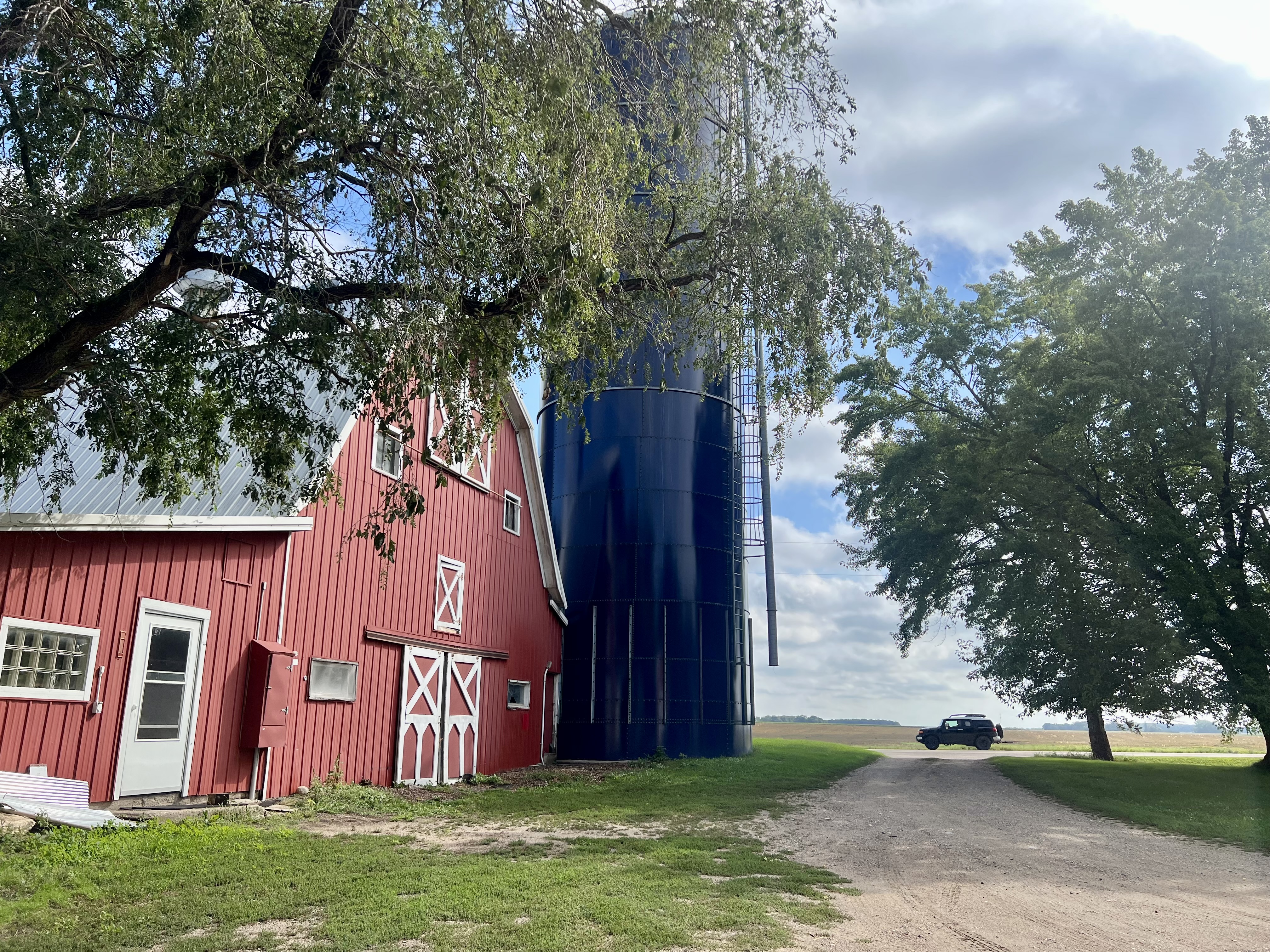
It used to be that every farm in the Midwest had a setup as our corn guy (pictured here). A great big red barn anchored by a massive blue silo. Now simple rectangular sheds have won over the landscape due to their lack of maintenance. Economics! The adversary to nostalgia. Although the dollar amount of subsidies that go to farmers indicates that there is in fact a price for hanging onto the past.
In the 80s and 90s immigration of the younger outstate population in the urban areas lead to a fear of the loss of the family farm. Dilapidated farm sites were pulled down and plowed under to lay in more valuable crops. A sense of abandonment rippled through the local communities. Then corporate buyers appeared to be buying up the open landscape. An era of homesteading and a farmsite on every 80 acres and gathering at the local churches and corn feeds every fall seemed to be all but gone.
As a result, a suite of subsidies has evolved over the years to help the farmers. And there have been many that have been in line with other types of backstops in the system to avoid failures and their subsequent negative impacts. I asked a farmer in one of the really good years how he felt about the subsidies. He responded that it was a little ridiculous to be on the receiving end of government aid given how well the year had gone, but, “if we let them go we’re not sure they’ll be there in the bad years.” People are fearful that the mechanics of support are not nimble enough to be able to respond in a price and practice sensitive motion.
Corporate America was not successful in becoming the majority owner of the great American breadbasket. “There is a popular myth out there that today’s modern food production system is being run by corporations or industrialized agriculture. But, the truth is that much of our food is grown and raised on farms by families. Iowa has roughly 88,000 farms and 129,000 farm operators. According to the U.S. Department of Agriculture’s 2012 Census of Agriculture, more than 97 percent of Iowa farms are owned by families.” This data may be a little old but still is true. Families still own farms, they just look a little different.
All this is to say that nostalgia does have a price. And the mythic corporate boogie man is always the fall guy for the uncertainty of change. And lastly- we’d all be better off and trust the system if a coordination of services were dependent on an enumeration of the cascading costs and benefits in the system instead of a bureaucracy.
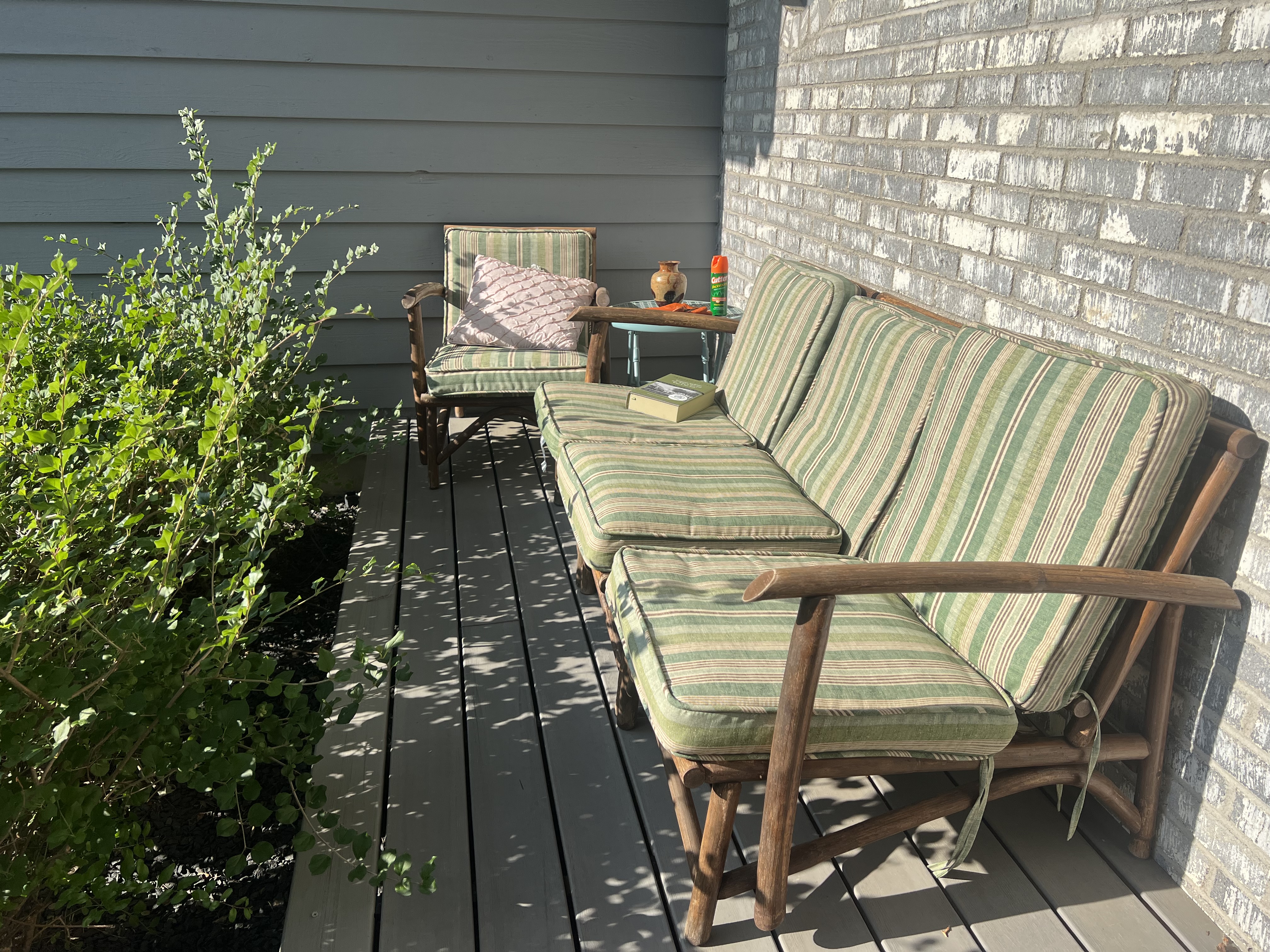
The end is drawing near for my summer reading spot. Sometime in September or October, the covers come out and are draped over the ratan to keep off the snow and ice through the winter.
Like as the waves make towards the pebbled shore,
So do our minutes hasten to their end;
Each changing place with that which goes before,
In sequent toil all forwards do contend.
Nativity, once in the main of light,
Crawls to maturity, wherewith being crown’d,
Crooked eclipses ’gainst his glory fight,
And Time that gave doth now his gift confound.
Time doth transfix the flourish set on youth
And delves the parallels in beauty’s brow,
Feeds on the rarities of nature’s truth,
And nothing stands but for his scythe to mow:
And yet to times in hope my verse shall stand,
Praising thy worth, despite his cruel hand.


—William Shakespeare
Frederic Bastiat is known for a set of essays, the most recognized is entitled, What is Seen and What is Not Seen. At time of writing, the french nineteenth-century statesman and philosopher is in the latter part of his life and is inspired to record some economic thoughts in a wry and witty manner. The language is vivid and descriptive and the text takes on many forms including dialogue and LaFontaine-like fables. He playfully names his actors M. Prohibant, M. Jacques Bonhomme, and M Blockhead.
En pays basque
His objective is to open the eyes of his fellow statesmen to take into account of the entire cycle of economic impact in the system; to note what is seen but also what is unseen. Much of his inspiration comes from the waste he sees in a heavily bureaucratic tariff industry which seems to have sprung up at crossovers between countries or every city gate. This gross abuse of skimming a bit off the top of every transaction, and the bloated civil service that supports such things, is easily exposed as inefficient.
The Collected Works of Bastiat is over 500 pages, so, for as much as there is to say about the restraints of free trade, it is only a segment of the entirety. It might be the portion that free traders have used to identify the author as their own. But the boy from the Paye Basque offers so much more. In fact, it is against his professed philosophy to pluck out but one section of the analysis and not look under the cushions for the rest of the loose change.
Bastiat does not deny the core services of government “the army, the navy, law and order, public works, the university, the national debt, etc..”(pg43) He decries all abuses of taking private profits whether through commercial fraud or abuse in the public sphere (pg123) or through the church (pg123). He denounces the fraudulent taking in any sector as “Plunder!” It is not simply across the custom’s desk that he sees waste in the system.
Through the volume and variety of writing he devotes to flushing out various aspects of exchanges, he seems to want to expose much more to the systems he sees than simply the revulsion of protectionism. For instance, he talks about the different natures of work. There is work where the value is determined in the end product, not the hours spent. For that reason ‘make work’ by the government is unproductive and should be replaced by unemployment insurance (pg160). He opposes postal rates which vary by distance, which suggests that he feels postal service is a public good to be provided at a reasonable cost no matter where you are, as told in the story of the Salt, the Mail and the Customs Service.
We could talk more about how he describes the various levels of markets (not ‘your’ market, ‘our’ market he tells the paysanne!) There are markets off the rail stops, there is the vaste city market of Paris, there are the other European markets, and just bursting on the scene is the market in Algiers which is a net loss, as it is pulling taxes out of the system (184).
Bastiat has a lot to say. His text deserves a more thorough read. He is trying to locate the whole elephant and would like everyone to stop advocting for the one angle he or she is clinging to.
The profit lies in making the best use of the resources of each country so that the same amount of work provides more satisfaction and well-being everywhere.
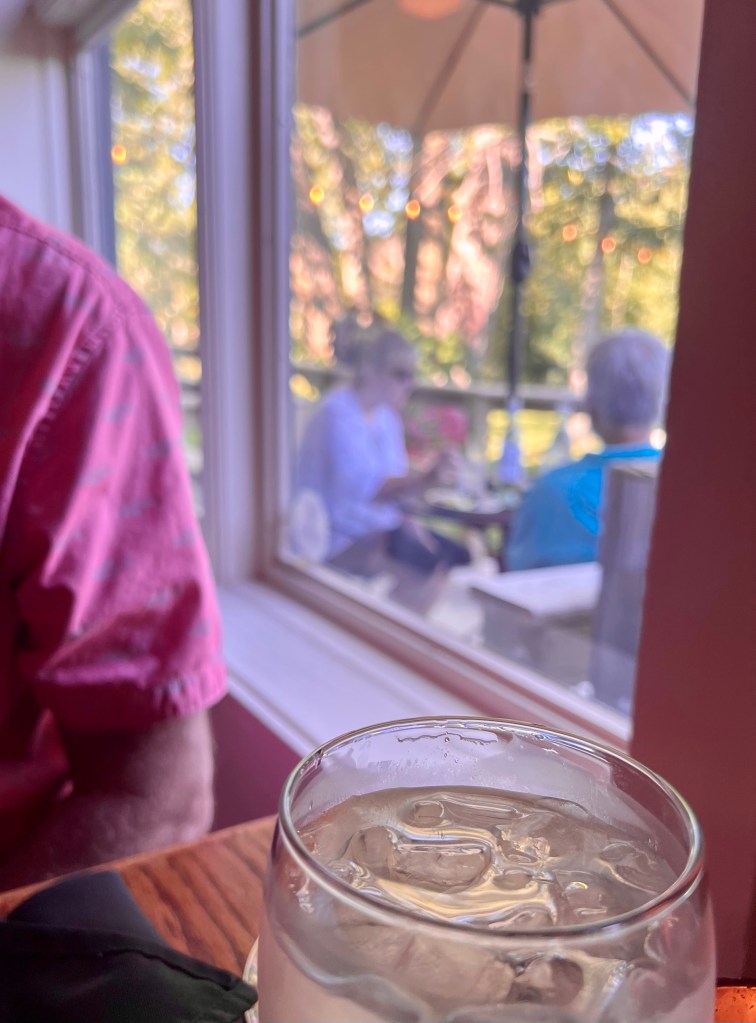
My husband and I enjoyed dinner at Blackboard, a restaurant located at the intersection of two country roads in Ottertail County. If I’m going to pay someone else to cook for me, then I prefer something I wouldn’t make myself. The walleye was scrumptious and fit the bill. I’m pretty open to the ambiance in the sense that I am more than willing to go to a dive restaurant or a street vendor if they have the goods. But this place is quaint and cozy. We sat indoors in a space that glinted and winked at you to make you feel special. The outdoor seating looked wonderful as well.
Crab stuffed walleye on a bed of asparagus and wild rice Lovely outdoor seating on a deckCosy interior atmosphereAfter much ado the county is putting in a 32 mile scenic bike trail which happens to pass Blackboard
The setting of Blackboard is a little unusual as it is truly on backroads. There are many lakes in the area and lake homeowners need restaurants. It also has the good fortune of being trimmed in by a thirty-two-mile bike trail connecting it to several communities as well as Maplewood State Park.
They have live music on Thursday evening. We’ll have to go back.
This passage is taken from Portraits from Memory by Bertrand Russell, published in 1953. He is reflecting on a change in societal structure since John Stuart Mills wrote his famous treaty On Liberty which was published almost one hundred years earlier in 1859.
What has changed the situation since Mill’s day is, as I remarked before, the great increase of organization. Every organization is a combination of individuals for a purpose; and, if this purpose is to be achieved, it requires a certain subordination of the individuals to the whole. If the purpose is one in which all the individuals feel a keen interest, and if the executive of the organization commands confidence, the sacrifice of liberty may be very small. But if the purpose for which the organization exists inspires only its executive, to which the other members submit for extraneous reasons, the loss of liberty involved may grow until it becomes almost total. The larger the organization, the greater becomes the gap in power between those at the top and those at the bottom, and the more likelihood there is of oppression. The modern world, for technical reasons, is very much more organized than the world of a hundred years ago: there are very many fewer acts which a man does simply from his own impulse, and very many more which he is compelled or induced to perform by some authority.
How about today? Are we more individualistic and atomized? Or associational and organized?
If you are a 007 fan, you will be pleased with the last appearance of Daniel Craig as the debonair James Bond. Staying true to the brand, it shows off all the great features of a sprint to save the world from treacherous evil. Car chases in fabulous cars across European mega-scapes. Amazing stunts. The intrigue of who is double-crossing who.
A notable change from Bond movies of decades ago is the number of interesting female characters. There used to be the devoted secretary playing support worker and the super attractive girl plunged in the midst of the action. That was it. For decades. This film has a spectrum of female characters from somewhat comedic, to tough but still female, to gorgeous and even motherly.
Settle in for a long film, it’s worth it. I found it fresh yet true to everything I love about Bond movies.
There's a lot of talk about "crime in the Twin Cities." The release last week of official crime figures for 2021 lets us see how it compares around the state. https://t.co/u7RtGez3Ftpic.twitter.com/YE7Y0mMqwx
This thread, from a former east coast journo who moved to MN to raise a family, has a lot of good information yet lacks some important details.
In this first map visualization, we see the measure is listed in increments of 100 violent crimes/100k people. The top level, 400, is denoted in black. Ingraham observes that two of the four top counties are in outstate MN as opposed to the Twin Cities metro area. However, if you look at the data you’ll notice that Hennepin and Ramsey counties are reporting over 500 violent crimes per 100K (ie they should have their own category) and the spread between the leader and Mille Lacs county is 25%. That’s a lot.
One negative point for visual misrepresentation. Playing on the general public’s weakness with numbers is not nice.
A few other observations that Ingraham highlights appear more oriented toward a political message than supporting his thesis that there is more nuance to crime than the urban areas have it and outstate doesn’t. A more thoughtful approach might be to point out that some of the higher rates of crime are in countries with larger cities like Duluth, St. Cloud, and Morehead. Or that the Iron Range has desperately needed jobs from mining and the lack thereof has placed a community into a slow slide to desperate times.
The best item of news in this thread is that Minnesota takes crime reporting seriously.
This story was only possible because Minnesota does some of the best crime data collection in the country. Serious thanks to@MnDPS_DPS and all the local agencies responsible for that.”
The threat of personal injury is, for most people, the most important factor in helping to navigate their choices on where to live, work and recreate. Accurate data which could be used to compare people’s choices, given levels of crime, is very valuable.
Charles de Gaulle is a busy airport. Sitting about sixteen miles to the northeast of Paris’ city center, it is a hub for Air France and inter-continental air travel.
In 2019, the airport handled 76,150,007 passengers and 498,175 aircraft movements,[4] thus making it the world’s ninth busiest airport and Europe’s second busiest airport (after Heathrow) in terms of passenger numbers. Charles de Gaulle is also the busiest airport within the European Union. In terms of cargo traffic, the airport is the eleventh busiest in the world and the busiest in Europe, handling 2,102,268 metric tonnes of cargo in 2019.[4] It is also the airport which is served by most number of airlines with more than 105 airlines operating to the airport.[5]
Bozeman Montana also has an international airport- the busiest in the state. Avid skiers who call Big Sky their main mountain account for a portion of the 1.8 million passengers who passed through the boarding gates in 2021. At BZN it wouldn’t be uncommon for a perky flight attendant to look out into the line of passengers waiting to go through security and beckon passengers on a flight with an empending departure to cut the line. The other passengers wouldn’t say a word. It is perfectly acceptable to not let a fellow traveller miss their flight!
That’s not quite the way they roll at CDG. First off the lines are horrific. A snaking string of figures and baggage step through the cordoned passageways. An agitated passenger, boarding pass in hand, attempts plunging on ahead. They are concerned they will miss their flight! The attendants look away. They will only step in for the elderly or those with babes in arms.
Is OK to push ahead in CDG when polite line waiting is the only way to go in BZN? Can a person maintain their moral standing when various environments dictate different rules? Or do you just accept that sometime you’ll miss your flight?
Aggregate numbers in real estate are best at showing large-scale trends, and that’s why I like this snapshot summary of some home sale indicators. The impact of the mortgage interest rate fluctuation a few months ago did indeed take the edge off the bidding wars that had become the norm in the past two years. Prices are rising, but at a far lesser pace. Inventory is gaining a bit of traction- even though there are still far fewer properties for sale than in past. Days on market have ticked up just a bit so buyers can take a breath before having to write an offer.
As long as rates don’t squeeze the life out of the market, the new dynamics are favorable to the home selling process.
It’s a great word. It has panache and motion. It is much better than corruption which is the word I use in Categories Explained. But I think I’ll switch to plunder, as Bastiat uses it in the way I do, and he got there first.
In the second series of Economic Sophisms, he devotes the first chapter to “The Physiology of Plunder.” Here he states that “Plunder consists in banishing by force or fraud the freedom to negotiate in order to receive a service without offering one in return.” But I am most interested in the plunder of a fraudulant nature, the theft that occurs when moving resources from one sphere to the other.
He has a lot to say about the extraction of services by the church in return for a designated spot in heaven. He acknowledges that the priest who is the instrument of religion will be “gentle, tolerant, humble, charitable…” And yet some priests are “turned in many ways so as to draw the greatest benefit for themselves.” Representatives of the public good are privately pilfering from group resources, so it would seem.
There is plunder in the commercial sector when flawed products are sold, or measures shortened. Lawyers and doctors can skim off the public goodwill by offering “disastrous advice.” And he spends a lot of time navigating the ins and outs of plunder in the name of the government.
I look forward to reading further to see how he parses all these transactions out into a structure.
'Nature' is what we see—
The Hill—the Afternoon—
Squirrel—Eclipse—the Bumble bee—
Nay—Nature is Heaven—
Nature is what we hear—
The Bobolink—the Sea—
Thunder—the Cricket—
Nay—Nature is Harmony—
Nature is what we know—
Yet have no art to say—
So impotent Our Wisdom is
To her Simplicity.
How to giveaway money is a tricky business. There are lots of worthy causes. Although I have yet to face this problem, it is fun to speculate on what a philanthropist would want to know to make a giving decision. Given the potential depth of this inquiry, this is just a starting point.
To manage expectations, I think a donor would like to understand how the funds will help. One way to get a handle on this is to consider at what level the investment will carry through a system. Bed nets for instance are life-saving one individual at a time. It is a one-to-one transaction and eventually the net needs to be replaced.
Then there is support given to ongoing activities. Many people like to give to their alma matter. Some choose to provide an annual scholarship thus contributing to a well-educated society. The efforts now affect a network, and the importance of the individual agent fades as the success of the group dominates. The analysis turns to whether the food shelf is serving the group of people in need, or whether the neighborhood clinic is improving local health outcomes.
And finally, there is the most adventuresome type of giving, the dollars spent to create something new altogether. It may be a novel medical treatment or a library system.
By 1920—less than 150 years after Benjamin Franklin first donated what would become a town’s first public library collection—there were more than 3,500 public libraries in the United States. This rapid expansion of the US public library can be traced back to another American man’s donation—steel magnate Andrew Carnegie. Carnegie’s funding had built about half of these 3,500 public libraries, earning him the nickname, the “Patron Saint of Libraries.”
These are far more risky investments as you can’t be sure that the new drug will work or that the libraries will be maintained. But in the instance of success, the public good is significant.
We are reading The Collected Works of Frederic Bastiat for the No Due Date book club, and it is quite a volume. The sheer size of the tome is daunting, and a translated text written a few centuries ago requires a careful read. Bastiat loves to reference which makes for a collection of footnotes (interesting to be sure) at the lower edge of every page. The pace is slow.
What makes it fun are the successive anecdotes which call out for a subtitle: The More Things Change, The More They Stay The Same. His primary objective in the first section is to point out the fallacies of protectionism. He talks of fears. The fear the rich will become richer and the poor will become poorer. The fear machines will replace workers. The fear workers will not receive their due for their labor. The fear that trade produces war, not peace.
There’s a section from chapter 22, Metaphores, where he discusses the impact of inflamatory language, in particular the use of the word ‘invasion.’
Take the word invasion itself.
A French ironmaster says: “May we be preserved from an invasion of iron from England.” An English landlord exclaims: “Let us reject the invasion of wheat from France!” And they propose that the barriers between the two peoples be raised. Barriers constitute isolation, isolation leads to hatred, ha tred to war, and war to invasion. “What does it matter?” say the two sophists, “is it not better to be exposed to the risk of invasion than to accept certain invasion?” And the people believe them and the barriers remain.
And yet, what analogy is there between an exchange and an invasion? What similarity can be established between a warship which comes to vomit shells, fire, and devastation on our towns and a merchant ship that comes to offer us the opportunity of exchanging goods for other goods freely and voluntarily?
Words that vomit misrepresentation. Too funny.
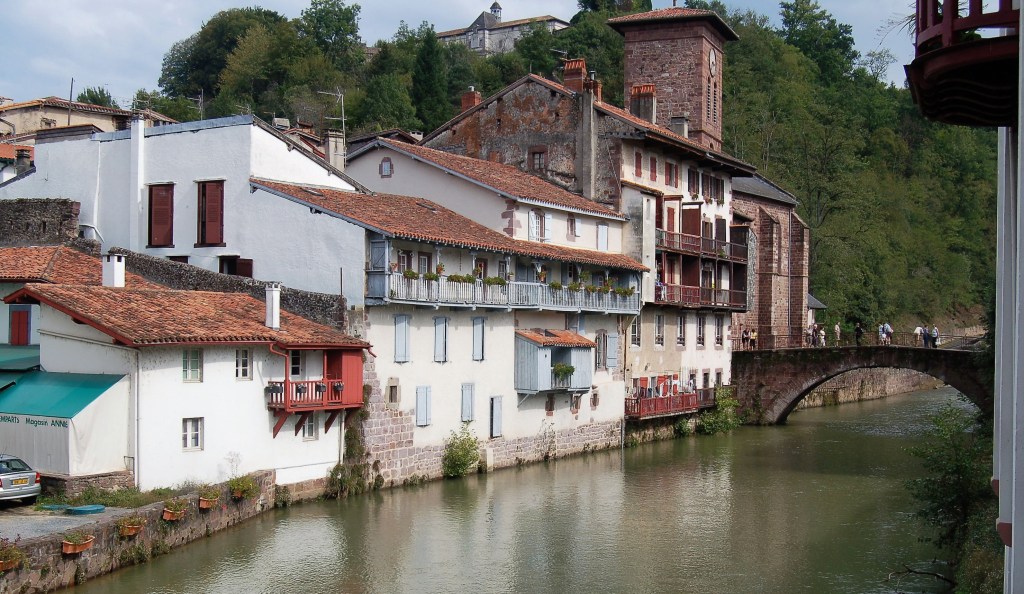
Bastiat (1801-1850) was born in Bayonne which is within ten miles of where this photo was taken.
It’s primary season in the US, which is when the field of candidates for office gets narrowed to one per party. Given that there are mainly two political parties in the US, the primary vote is an important separator of who is endorsed by a major party and who is left out of the main foray of political business. If you do not receive the endorsement of your party, you may still run as an independent. Though the chances of success as an independent are pretty low.
Tonight’s big surprise was Don Samuels’ challenge to Ilhan Omar. Although a long-time political figure in local politics, Samuels has only 697 Twitter followers compared the Omar’s 3 million. Yet he was able to muster enough support to leave the race at a 2 percent spread.
New York Times ‘Live Updates’
The message is clear. Voters are questioning the progressive agenda, leaving the door open to those who would like to take a new course of action.
“We’ve been talking for two and half years about reimagining public safety, creating a continuum of public safety, bringing all aspects of our public safety responses together in one department, and today that has happened,” Jenkins said. “After much consternation and vitriol, we have reached that day.”
I like Andrea Jenkins, who is now President of the Minneapolis City Council. In some ways this trans woman is the most conservative amongst the group of thirteen. She has also held consistent views over the past two years.
Cedric Alexander will be the first ever Commissioner of Community Safety. Here’s where he accentuates the necessity of public participation in the work if keeping the streets safe:
“We need to move policing forward and rebuild relationships in the community,” Alexander said. “We need to redesign our approach to public safety so everyone is working together.”
The first DQ restaurant was in Joliet, Illinois. It was operated by Sherb Noble and opened on June 22, 1940.[6] It served a variety of frozen products, including soft serve ice cream.[7]
The soft-serve formula was first developed in 1938 by John Fremont “J.F.” “Grandpa” McCullough and his son Alex. They convinced friend and loyal customer Sherb Noble to offer the product in his ice cream store in Kankakee, Illinois.[8] On the first day of sales, Noble sold more than 1,600 servings of the new dessert within two hours.[9] Noble and the McCulloughs went on to open the first Dairy Queen store in 1940 in Joliet, Illinois. It closed in the 1950s, but the building at 501 N Chicago Street is a city-designated landmark.[10]
Since 1940, the chain has used a franchisesystem to expand its operations globally. The first ten stores in 1941 grew to 100 by 1947, 1,446 in 1950, and 2,600 in 1955.
I get into a fair number of homes in the luxury market. And while many of their kitchens are outfitted with Wolf ranges and Sub-Zero fridges, most of the walls are unadorned with anything of value. Is it not odd that people who have $70K to spend on an outdoor space with a patterned limestone paver seating area don’t want to look at original art, even if it is not a Monet or a Pollock?
As I recently found out, there very few art dealers who work in the $5-$50K price ranges for original oils, watercolors, collages, or sculptures. The local craft fares display art in the under $1000 range, most items falling under $500. And from what I remember pre-covid, there were plenty of purchases being made. Browsers were also interested in ceramic wall hangings or display pottery.
But what about the middle? – the artwork that deserves to fetch more than a few hundred bucks, yet isn’t of the Sotheby’s caliber? There must be such things. There must be artists whose lives and careers gave importance to their life’s work. And similarly there should be a class of individuals, the ones wealthy enough to spend $60K on an appliance package, who would find pleasure at seeing their walls displaying something more beautiful than an item from the HOM store.
If someone knows of such a market- please leave me some breadcrumbs in the comments.
Frederic Bastiat makes the observation that even though Gutenberg reaped private benefits from the printing press, the more than enormous value of this technology was (and still is) reaped from its transformation into a public good.
Found on page 33 in Economic Sophisms and “What Is Seen and What Is Not Seen” (July 1845)
There’s got to be a better name for this than civic duty. Work for the community, work for free but not for nothing, work to the embetterment of my neighbors? Work3? Something?
It appears this trucker may have had a hand in stopping a pursuit of carjacking suspects a short tiime ago in north Minneapolis 👇
Girlfriend of Daunte Wright sues Kim Potter, Brooklyn Center
The girlfriend of Daunte Wright is suing former Brooklyn Center police officer Kim Potter and the city, claiming she has suffered physical and psychological injuries as a result of the fatal incident.
According to the lawsuit filed Friday, Alayna Albrecht-Payton was sitting in the passenger seat the day Wright was shot and killed during a traffic stop.
…
Wright’s family previously won a lawsuit filed against the city and police department for $3.25 million, marking the largest settlement for a city outside of Minneapolis in Minnesota’s history.
My favorite part of watching foreign Netflix series is the change of scenery. I’ve never been to Luxembourg, and probably won’t go anytime soon as it is not very high on my must-see destinations. So taking in a show can temporarily put you en scene. Capitani is a police drama which is heavy on intrigue and light on violence. There is a nice balance of male and female characters. Everyone has a past. The youth can’t be trusted. All these factors keep the audience guessing.
The first season takes place in a rural setting. Capitani happens to be close by when a call comes over the radio to investigate the death of a fifteen-year-old girl. In season two the setting shifts back to a more typical urban underbelly. Whether Capitani is still a renegade police officer is something you will have to discover.
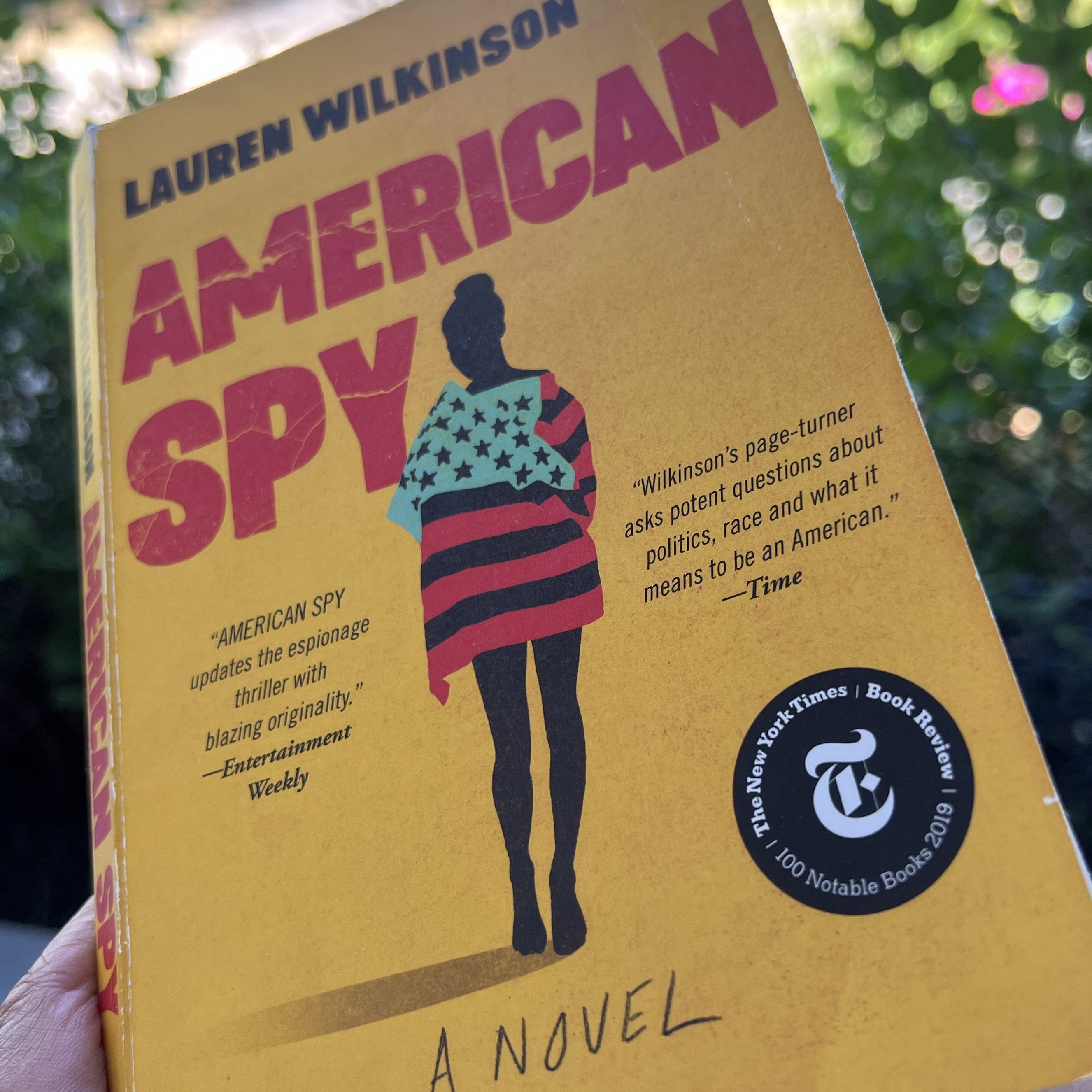
Book Review: American Spy
A new perspective on the spy novel can be found in Lauren Wilkeson’s 2019 novel American Spy. All the twists and turns and double-crossing agents can be found between the pages of this author’s first attempt at the espionage genre. But what makes it delightfully new is the perspective of a female African American. To be clear it is not a book on race or feminism. The story is true to the suspense thriller but her relationships, her family’s background, and her sense of identity when abroad feel fresh and authentic. It’s well worth the read.
Bangladesh has quite a story to tell. When I lived there as a child fifty years ago (give or take) it was an impoverished nation with few industries. At the time jute production was the most vital employer. And even today the total area under cultivation for the fiber in Bangladesh is 559,000 hectors.
Jute production circa 1970
Since then the country’s gross domestic product has surged from $4.27B in 1960 to $416.26B in 2022. This ratcheting up of financial success is all good. But ideally, a country with poor infrastructure, health, and environmental concerns would also like to make progress in public spheres.
Syncing the incentives between those with an abundance of social capital, like foreign investors, and local enterprises enjoying early success, is the puzzle destined to produce positive synergies. Who can provide what and when, and under what circumstances would they be willing to engage such resources is the type of knowledge that would be useful.
So I can only imagine their collective horror when a few years ago, in my 30s, I shacked up with a farmer schoolteacher (a male one), had two children in quick succession and sank into a quagmire of domestic drudgery in regional NSW.
There, I joined my local branch of the Country Women’s Association (CWA), arguably the nation’s most powerful and conservative women’s group.
I hesitated to mention my new membership to my staunchly feminist mother.
But it turns out that the CWA may have more in common with women’s lib than I’d imagined.
















 Home Economics