
A photo today, from where?
Searching for value

One thing that is as clear as a spring blue sky day is that there are wolves lurking amongst the sheep on both sides of the most pertinent issues in America today. With all that has happened it’s hard to deny the rogues in the public safety business. It’s also hard to deny those, who would fundamentally change America’s way of life, mingling blissfully amongst the progressives.
United Renter’s for Justice is an organization pushing locally for rent control and tenant’s right-of-first refusal should their landlord take their apartment building to market. Members think along the lines that one individual owning more than one property is some form of injustice. (Not sure how that adds up for housing those who are not in a position to house themselves).
The new angle on leveling the American playing field isn’t to be progressive about income taxes, nor to understand how to leverage opportunity, but seems now to be focused on shifting capital. The reasoning appears to be no different than that of many revolutionary governments of yesteryear: “We don’t think you acquired your capital in an appropriate fashion, so we will take it, and redistribute it ‘fairly’.”
These folks need to read history, as there is yet to be a successful outcome from such reasoning.
The capital gains tax proposal shimmers a bit from this implied sense of justice-through-acquisition. Or, we have the power to take so we will. This type of authoritarian strong arming is not very popular in a country built by people who fled from governance by arbitrary taking.
But maybe there is some truth to ponder here, that the increased value of some assets are due, in some portion, to a wider public than simply those who own the assets. It is part of the pro-tenant people’s argument. Tenants participate in local civic activities. These activities contribute to the desirability of the neighborhood, which in turn increases demand for property, putting upward pressure on property prices. Despite their lack of direct ownership in real estate, do renters participate in some community work which is left unaccounted for?
That is an excellent question. And if the answer is yes, where in other capital ownership has there been public involvement that could be offset when an owner decides to internalize profits and sell their asset?
A lot of people say they can’t do math. With a shake of the head, “No, I’m not good with numbers.” But they’re just being shy.
When you go to the grocery store and decide what goes in the cart and what stays on the shelf, you are doing math. With the background knowledge that money going out on fruit, milk, and meat has to come close to how much money is coming in, that’s a balancing act. There’s an equation in play, an equality.
You are doing math when you solve puzzles like Suduko or play strategy games like Sequence. Or when you have to meet someone across town. You are doing math when you calculate your drive time, including parking time. Maybe there is a risk of a traffic delay. Then you’re calculating the probability of an event and adding time accordingly. You have your givens: when you are suppose to be there, the speed limit, your route choices. The equation solves for how much time to allow.
The risk portion is a little more complicated. Probability is a fun one when it comes to betting on your poker hand, or figuring out the cards in your bridge partner’s hand. There’s a whole discipline devoted to probabilities. In statistics probabilities determine the likelihoods of events replicating historical data. If we know the past, we can be pretty sure about the future, to a certain probability.
There’s this weird rule called the Null Hypothesis. In Statistics for Social Data Analysis by David Knoke, the author asks: “What is the probability that the relationship observed in the sample data could come from a population in which there is no relationship between the two variables?” (the two things you are interested in comparing). You see, if you can show that this is false, or null, then voila–you’ve proven your point. Seems backwards, right? To prove a relationship, you disprove that there isn’t one.
Whether you think of it as doing math, you are in fact calculating (shrewdly I might add) every time you buy or sell a home. Buyers and sellers weigh all the features they value, do some internal calculating and sum it up to one final number: the figure they are willing to either pony up to purchase, or, exchange for a signed warranty deed. As buyers and sellers do this over and over and over again, the numbers can start to tell you things about what they prefer.
A statistician can work the data over to glean some insights, but it’s the consumers who are doing the math.
It’s in the comments!
The first surprise this morning was that Minnesota did not loose a congressional seat as feared. It appears we kept our seat whereas New York lost one. Our population keeps on growing despite the cold winters temperatures!
The second bit of surprise news is the large field of right leaning candidates in the Minneapolis city council race. All thirteen councilpersons are up for reelection this fall. The council president has chosen not to seek office.

With Non-Fungible Tokens (NFT) -digital artwork- making headlines in the art world by commanding sales of $69 million, I thought it would be interesting to ferret out other non-fungible things. Remember the NFT works of art are not retractable from the crypto space as their unique identifiers are encoded in blockchain.
Take the the Crown Jewels of England, protected safely in the Tower of London. Wikipedia says the owner of the collection of a bejeweled crown, two sceptres, an elegant orb and a ring is Elizabeth II. But can she sell them? Perhaps technically she could– but not really. They are not tradeable, hence non-fungible. So if they cannot not be exchanged for cash, does it follow that they are not worth cash?
Take another example closer to home. Say you are dividing out the belongings from your parents home and one of the possessions is grandma’s Limoge china, a place setting for twelve with serving dishes. Your brother says it’s quite valuable, so you can have it and he will take the mutual fund account. The thing is, you wouldn’t sell grandma’s china because it is part of your family history. In this sense it is not worth cash, and hence is non-fungible.
What about activities instead of objects. Say you have two people and one eats three square meals a day while the other stuffs down the occasional bar food between beer and cigarettes. By late middle age the former exercises regularly and is feeling good. The later is sporting the wrinkles of someone twenty years his senior and the voice of two packs a day. The results of choices on how to treat one’s body is non-fungible. A health condition, whether good or bad, can not be separated, traded or sold off.
You would think currency is the ultimate fungible product. It floats around through computer screens with the ease of electricity. But consider this example. You’re on a beach vacation and you offer to pay the knickknack vendor in USD or in their local currency. She opts for US cash. If you can offer both in equal value, why should that be? The strength US currency, and hence the fact that it is widely accepted as a form of payment, is non-fungible. And makes it more desirable. Even currency has portions of its value assigned to non-fungible qualities.
Have any examples of your own? Leave them in the comments!

Biden’s infrastructure plan includes $400 Billion to fund home based care for boomers so they may age in their homes. Several aspects of this expenditure strikes me as errant. Borrowing money to pay salaries is not infrastructure, it is a subsidy. It seems about as unwise as mortgaging your house to pay your gas bill. At some point your heat gets turned off and you loose your house.
Part of the plan is to extend care provisions to less wealthy people. I don’t find this problematic. It’s the part where in home care givers wages are supplemented. These folks are paid in the $12/hour range as the work is simply about oversight, and basic needs. The administration does not feel this is an adequate life wage for a worker, and for that reason it should (the moral imperative should) to be augmented with tax dollars.
Although all home care workers care in some capacity for the elderly and disabled, workers vary widely in their training and educational level. The $12 an hour wage cited in the Biden job plan refers to workers also known as home health aides, nursing assistants, and personal care aides, whose work does not require education beyond a high school diploma.
https://www.businessinsider.com/bidens-400-billion-for-home-care-wages-will-affect-the-fragmented-industry-2021-4
Creating a working wage job that does warrant being a working wage job takes on a shine of a planned economy.
Let’s consider another scenario. What if the home health workers raised their wages, and charged more to the boomers for their services. Families of the elderly may decide it’s not worth having grandma and grandpa live alone in a 3000 square foot home, and every month pay the utilities to basically store a lifetime of possessions. At this new rate of care, maybe it would be best if the eldest daughter(or the youngest son, or whoever is best suited) took in mom and dad. More than likely, when these now octogenarians were children, some lived in multigenerational homes.
Think of what happens as households combine. We have many more single family homes available to sell and the price of housing stays within reach of the moderate middle class. Instead of spending infrastructure money on salaries, spend it on helping families retrofit their homes to accommodate intergenerational living. Instead of keeping houses off the market and driving up housing costs, release the boomer’s single family homes back out into the market.

Always keep healthy food around was a pact we made to ourselves when my college roommate and I talked into the night on our lofted mattresses. It keeps a family together. It’s simple and it works.
Mealtime is a cattle call when the troops show up because they are hungry. Yes the TV is on, and people are checking their phones. But does that matter as much as everyone coming together at a designated point in the day? –I say no.
Spending time in the kitchen caught a bad rap in the ’70’s. Lurking about the measuring cups, blenders and double ovens had a status problem, it appears. I find it to be a great place, a refuge. A creative place where every year you learn how to make something new, like potstickers. Or discover how to rework the leftover pork tenderloin into a sweet and sour soup.
Then there is baking. The smell of cinnamon seeping through the house, whether from oatmeal raisin cookies, pecan rolls, or apple pie, it incapsulates the feeling of home. Why producers of such aromas were scorned for being “barefoot in the kitchen” is a bit of a mystery.
Fortunately it’s a bit passé to taunt women who choose to feed people for being weak and pathetic. In fact, women of the kitchen have linked to millions through the window of the internet. This cooker proudly entitles her site with 1500 recipes, Barefoot in the Kitchen. Thanks to technology the homey profession commands a private income as well as a familial service.
Even abroad women know the power of culinary expertise. This sweets chef has over 1.4 million subscribers and the video for a fancy treat of fine bread dough wrapped decoratively around a nut stuffing, all soaked in syrup, has 3.3 mil views. It was posted a month ago.
It appears there are many paths which lead to power and wealth.
The world of Twitter and Instagram promotes the power of a snapshot. It’s a small-package delivered to pack a punch. Not only is it how a lot of information is disseminated to audiences in the millions (in small frame, limited view, no historical placement setting) but has also become the most popular vehicle of public debate, or hollering.
Recently there has been lot of admonishing of our north star state with data claiming Minnesota has the largest achievement gap between majority and minority populations. Let’s consider how this datagram could mean something good instead of assuming it means something bad.
If Minnesota abruptly welcomed a large group of immigrants with no English language skills to the state, the state would be celebrated as humanitarian and good. But of course, for a number of years (how many? ten? a generation?) Minnesota’s numbers for minority education performance would be affected, as not knowing a language is a serious impediment to learning. That makes Minnesota a bad place for minorities.
Minnesota also achieves very high performance amongst children with long time residency, which makes Minnesota is a good place to live. But of course this exacerbates the difference between scores with those who have come more recently, less well equipped, which once again makes Minnesota a bad place for disparities.
It is like the comic strip with an angel and devil on each shoulder whispering their arguments in each ear. Each little creature gesticulating wildly while the face between them looks comically confused.
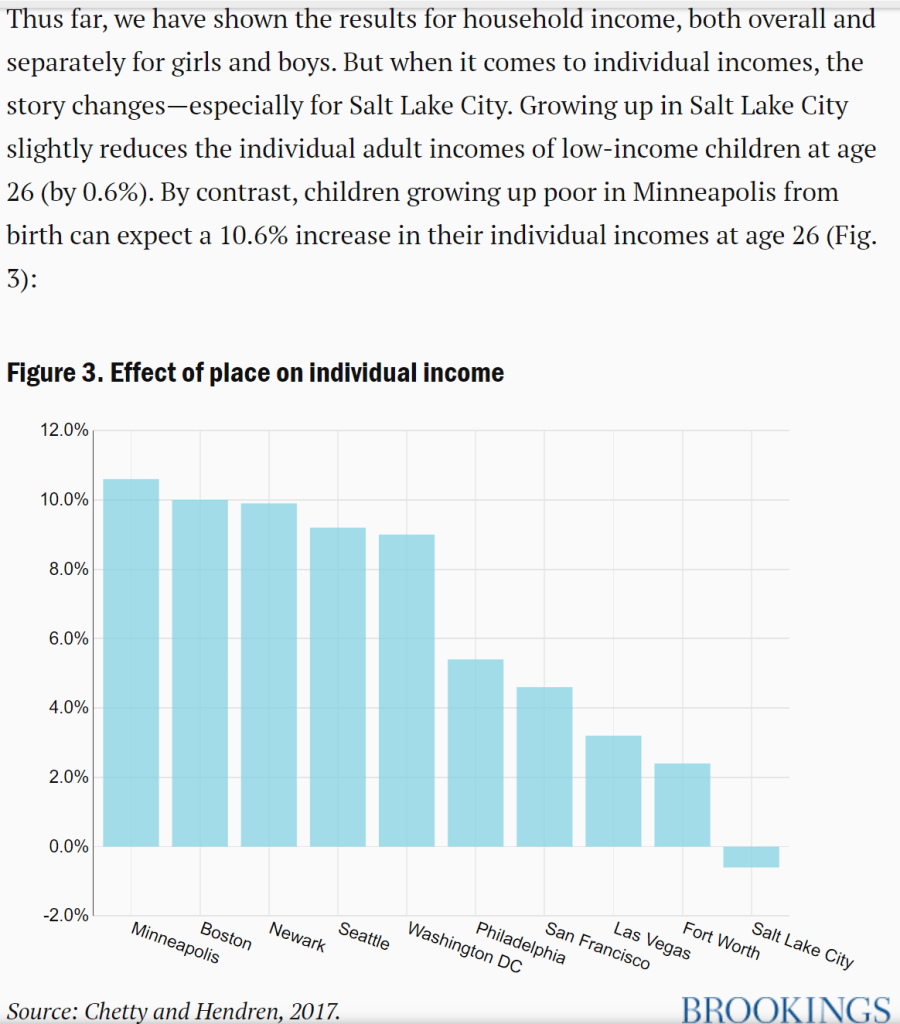
Raj Chetty is an economist at Harvard who studies, among other things, equality of opportunity over time and place. After all, what we want is a culmination of activity to produce a result. One time snapshots capture a measure at a particular time. A piece of information. They are woefully barren of any wisdom.
His research shows that the Minneapolis area is in the lead among large cities in cultivating the greatest income growth for children of poor families, by age 26.
The issue of time and setting must be made part of any half intelligent conversation about these issues. The public goods a city provide can’t possibly be evaluated in moment-in-time snapshots. And people who to try to navigate this path are more likely activists out to promote one point of view, not for a public benefit, but for their private initiatives.


I realize a lot of people wonder about bird watchers and what exactly they are up to. How can it be that interesting to catch a glimpse of an avian creature? So here are some things to consider.
Where’s Waldo has been in print for over thirty years delighting fans all over the world in finding the little man in red and white stripes. Birdwatching beats Waldo any day. First off, it can be done outside anytime, any season without any printed materials. And there are a lot more variations to look for than stripes of two colors.
Walking about in nature is pleasant in and of itself, but add to that the possibility of coming upon a devoted couple of Hooded Mergansers can make any day special. The elaborate head plumage on the drake is bright white even from across the pond. While the hen can barely be distinguished from her surroundings. Sometimes you only get a quick glance before a bird takes flight, so stand-out features are a definite plus.
Hunting is part of the fun. But the distinguishing is the real skill. You might only get a few seconds, half a minute to make some critical observations before the subject at hand flutters off to a higher limb or across the tall prairie grass. In that precious time your eyes need to take in the size, plumage markings, beak thickness and any other mannerisms that may help you with identification.
With experience, an observer can collect an impression and plop it between a range of sizes, colors and markings, then scroll the memory banks for the best possibility of what it it that flies ahead. But that’s where it gets tricky. Once out of view, the memory becomes foggy. Was it a gross beak? Was the cap black and a black bar across the wings? You learn to look for defining features.
Before you know it, your trained eye see the Flicker on the hallowed tree by the driveway, and the Orioles making their way up for the summer months, and the Crested King Fishers down by the water. Life is richer, more varied and better understood.
Now if I could only spot those darn owls.

When Zillow and various other tech companies decided to upend the real estate industry more than a decade ago, their tool of choice was information. With all their money and data skills, tech companies were able to thread together rigorous findings on every homesite. They took the mortgage data and the house features data and the tax data and the school data and wove it into a twinkling tapestry of particulars.
The public was mesmerized for years by the shiny fabric. It glistened and glowed and gave them more information than they could imagine. Like the ‘pre-foreclosure’ status, which delicately made public which one of the neighbors was behind on their payments. A little flag went up on the map to grab a scrollers attention. Many consumers interpreted this to mean that the house was for sale, and went up to the owners to inquire.
The wealth of information posted in one electronic capture was impressive. But it was only information. It was neither knowledge nor wisdom. Let me see if I can describe the differences with an analogy.
The weather is harsh in Minnesota with temperature swings from twenty below to over one hundred degrees Fahrenheit. For this reason most single family homes are built on a full basement, so the footings are below the frost line. In addition to the temperature fluctuations we have quite a bit of water. Have you heard of the land of ten thousand lakes? That’s us!
You’re most probably familiar with basements. It’s where the utility room is located, housing the furnace, hot water heater and water softener. There is probably an electrical panel on one of the walls where the service is controlled by breaker switches. And if it is an older home, the washer and dryer are most likely in a laundry room along side a utility sink where the wash water drains.
Now all this information about what’s in a Minnesota basement might be evolving past some of you. The vague sense of the utilities being in that area is known, but identifying each of the mechanicals is becoming as shadowy as the utility room before you find the string cord and give it a yank to turn on the bare bulb light. You definitely can’t tell the difference from a security panel and the electrical, or where the main water shut-off is located. You have information but you don’t have knowledge.
Say there is a bunch of water on the floor. This is a problem. If left, it could cause mold and unpleasant odors. If there is chronic seepage into the big hole that is a basement, then there can be damage to the foundation walls. The seasonal pushing of water on the concrete blocks creates movement. You have information on what is in the basement. You may even have knowledge. But it takes the wisdom of knowing how the whole structure works.
The water pipes could be culprit, or the water heater may be leaking from its bottom. The drain under the 1950’s concrete laundry sink may have cracked beyond retightening. Or maybe the wall right behind the sink is experiencing seepage because the exterior gutter is plugged and overflowing with spring rains. This last one can get nasty over time. A seemingly innocent horizontal line will darken between the cinder blocks. Then widen. And if a decade goes by, you’ll notice a definite bowing of the wall.
You can only acquire wisdom over time. Information is flat. Wisdom has dimension. Zillow will never be wise.

There’s another aspect to the platter system which deserves a little thought. The rules put into play at the higher, overarching levels need to be the most useful to the most people. If they are too specific, they set the lower platters, or ecosystems of exchange, a kilter, setting up rules to counter act the rules.
Take a subway system as an example. The governance and maintenance of the infrastructure is managed as a system for a large population. The NY subway handles over 3 million rides a day. So in terms of setting user fees, the calculation is done with inclusivity in mind, pricing so as to be accessible to the most people, in this case of upwards of 20 million residents
User fees work well in carrying the cost of water delivery, but come up short in paying for sewer line replacement. User fees in subway systems are also insufficient in maintaining the physical structure. In sewer lines it is easy to assign the replacement cost to each dwelling. In metro stops it is less clear who should pay.
As different locations benefit to different degrees from their proximity to the subway stop and the line, who benefits the most from a particular piece of the system is more difficult to identify. But those who enjoy its use the most, are also those who are most likely to be agreeable to paying a surcharge in order to preserve its use.
Similar to the example of waste water removal, the daily patrons at any metro stop are the most likely to realize a tangible benefit. Another way to put it is the people who use the property, apartment towers, businesses, shoppers, office complexes, realized a benefit and hence receive an increased value in rents, level of employee employee satisfaction, and so on. Wouldn’t it be great is there were price signals to tell us how much they would be willing to pay?
Being able to price out the maintenance expense would realize another mid-level platter efficiency. The building owners who do not value the proximity to the subway, and hence would find the maintenance assessment a burden, would be incentivized to leave the property. There maybe ten other desirable aspects to their building keeping them in place. Hence they stay put neglecting the benefits of mass transit.
But if the market value expense of subway maintenance were great enough, the building owner may move five blocks away from the subway line where some combination of the ten other features would maximize their needs. By not have to pay for the line, which they don’t value, they voluntarily relinquish that space to others who value it more.
When new construction goes in, the cost of putting in sewer lines, roads, curbs, and so on are built into the price of the purchase. Developers are only able to go forward with a project if there are buyers who would pay for the package– including infrastructure costs. Last time I checked, these ran around $25-30K per household in Minnesota.
If all the decision making is done at the largest, most encompassing level of cooperative agreements, then then there is a glossing over of the pockets where the benefits are compounded. Infrastructure is an amenity to an entire city, and those who travel to see it. But to afford such a significant amenity, the details of all the various levels of users and daily riders could be better understood.

It was a beautiful evening to enjoy this first game of spring sports over at the high school. I wasn’t raised in a sports family so for many years American’s obsession with football and baseball and basketball was a mystery to me, and even a little amusing.
As a young loan officer I worked mostly with men who each fancied their favorite sport. A very young Shaq O’Neil was scheduled to be at the Metrodome in the early ’90’s and the bunch of guys I worked with in downtown Minneapolis were excited to watch him practice. Their hearts’ pulsed visibly beneath their grey suit jackets.
Slowly I came to understand that many of them knew the histories of the final four teams; they knew statistics and coachs; they had a long term relationship with the sport. Watching the game is just one of many facets of being a sport’s fan.
In the spring, when the warmer temps are just barely taking the edge off still dormant ground, I can’t wait to climb up the metal bleachers to take in a game. It took a lot of youth sports to teach me the rules, and to understand the plays, but I have gradually grown into fan stature. Actually both my husband and I have.
Come to find out, sports are more fun to consume with someone else. When the Twins won the World Series in ’86 it was easy to jump on board as a fair weather fan and bask in the ticker tape parade through Minneapolis. But sitting on a couch comparing memories of past plays or relishing the last 90 minutes of a toe-to-toe basketball game, is also more enjoyable with a buddy.
A sport’s audience is bound in a communal relationship. People from all parts of a city can strike up a conversation with a simple, “How about them T-Wolves?” There aren’t many ways strangers can break through the social dampeners that keep people on their platter. Sports provides that venue.
The best thing about math is that it is reliable. Numbers don’t change, they don’t have nuance or inflated expectations. You can’t disappoint them. They make you think of Horton the Elephant with a little redirect, “they say what they mean and they mean what they say, numbers are faithful 100%.”
Some people find them inconvenient for that reason. They want to tell their own story and numbers get in the way. So there are all sorts of tricks to distort the numbers. Graphs that don’t start at zero, or graphics where the bars are enlarged, to imply an unsubstantiated claim. The number sits on its axis, seemingly blushing under its inflated image.
All the more reason to keep people thinking about math. I was just reviewing the statewide scores by public school district and the math scores have the greatest spread between neighborhoods. Yet I don’t think math talent divides out that way. God given gifts ignore social-economic concerns. We just don’t know how to tap that talent-yet.
But we do know a lot about mathematical relationships. There are theorems and proofs as ancient as the Greeks. Some of us who desire some concreteness in the world, find this comforting. And even if it is not your thing, the applications of their relationships have been leveraged to give us a life enhanced by science and technology.
This alone should garner respect from even those with aversions to numbers. And even when the numbers aren’t giving us the feedback we want, they will most likely represent the reality we need to hear.
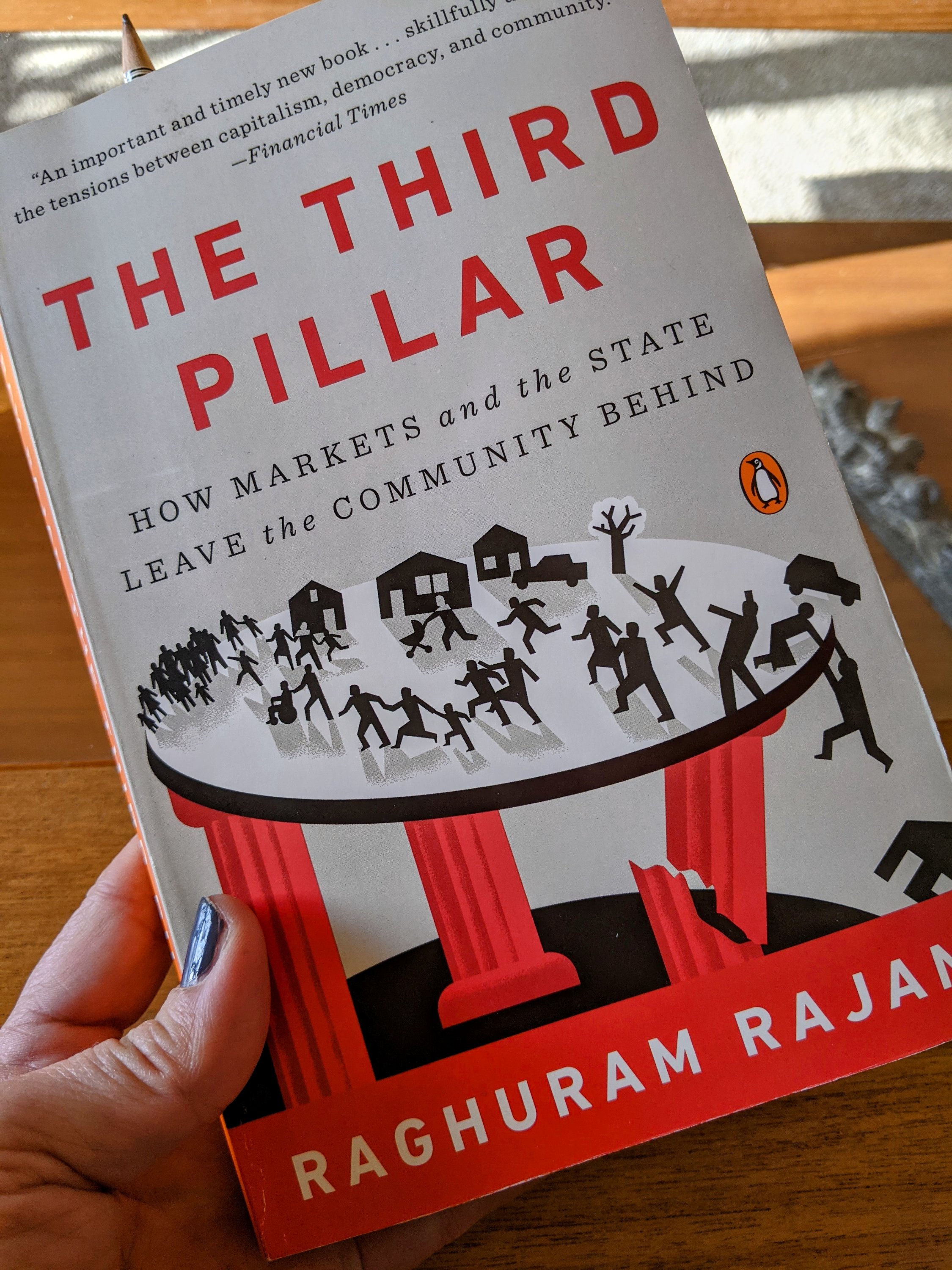
A few days ago I wrote an interpretation of a notion using an analogy to juggling plates. On the cover of Raghuran Rajan’s book, The Third Pillar, a disc is supported by three pillars. Think of these platters as holding political/economic ecosystems. The people on the plates are there voluntarily. But the more layers of plates, the easier it is to jump between them. If there is one plate up in the clouds and a bunch of plates jiggling away down by the parkay flooring, then people can only jump sideways, not upward.

On the cover of Raghuran Rajan’s book, The Third Pillar, a disc is supported by three pillars. Think of these platters as holding a political/economic ecosystem. The people on the plates are there voluntarily. But the more layers of plates, the easier it is to jump between them.
With this structure in mind, it is easier to see how societal systems require competent political figures at all levels, in turn providing greater freedom of movement between the platters. (And if you should imply from this mental drawing that those closer to the ground are somehow simpletons, you are not in my portrait, yet. Many people choose a simple rural life, for instance, regardless of their intellectual makeup)
There is, however, a natural nesting of authority, as all the plates are spinning in the same environment. So when decisions are made of an overarching nature, they come from the upper platters. A neighborhood does fine sorting out it’s dog park and garbage collection, but needs a city to set up sewers and water service. Then the county takes over with the county roads and the state with the freeways. What if there were no levels of government between caring for your own driveway and the interstate?
Here’s an example given by Raghuram Rajan in The Third Pillar.
Therefore, for example, they want him to procure a birth certificate for their child, who was delivered in their shack in a village far away from any medical clinic. The birth certificate is essential for the child to be admitted to the free government school, and no government officer will provide it with out suitable gratification, because he has no official document to rely on. The poor do not have the money to bribe so they plead for a call from the MP’s office, which will set the wheels of bureaucracy rolling. Once the child is in the local school, the child becomes the MP’s responsibility. When she gradu ates from high school, the MP has to find a college that will admit the student if her grades are modest, and when she gets a degree, he has to persuade some government office to give her a respectable secure job. And when she gets married, he will be invited to the wedding and be expected to give a suit able gift.
In a society where the typical government civil servant is neither civil nor a servant to the poor, the MP is the intermediary who will help the poor navigate the treacherous world. While the poor do not have the money to “purchase” public services that are their right, they have a vote that the politician wants. The politician does what he can to make life a little more tolerable for his poor constituents-a land right enforced here, subsidized medical services honored there. For this, he gets the gratitude of his voters, and more important, their vote. Tied to their MP via patronage, they do not really care about how the MP will vote on the bigger issues of the day, whether he supports tax-evading liquor barons, illegal miners, or industrial polluters, so long as these do not intrude directly in their already-hard lives.
The missing plates between the poor in this story and the MP causes a couple of errors in the system. Those who should be receiving support through a combination of reciprocal work and engagement have nothing to offer the person in authority but an unconditional vote. The vote contains no value in evaluating the higher level issues which do not effect their lives.
If the vote was going to an intermediary plate authority, one who could actually trade in meaningful services for the poor, social exchanges would be tested and evaluated and remediated through the system. A successful local politician, say at the city council level could become a candidate for state or county level responsibility. The omission of mid-tier ecosystems eliminates that possibility, allowing for private actors to step in and capture the needs at those levels, in fraudulent manners.

The mayor of Brooklyn Center has navigated a superb response to the on-going crisis. His feed is specific, situational and gives clear direction.
This approach appears to have general pubic support. As you read through the comments, an expression of outrage is followed by an explanation. Other voices are spelling out the agenda.
So far the extensive military force present around the city seems to be deemed appropriate to the level of potential threat. A far cry from last years repeated bolstering of the protestors, allowing the grievers “express” themselves. The sweet naivete has been swept away on winds of change.

Our metropolitan area is being tested by dark forces. To have a senseless tragedy occur midway through the legal proceedings of former police officer Chauvin feels like the doings of evil seeping up from a subterranean inferno.
Events are unfolding differently from last May. The top political figures are out front and center. The mayor of Brooklyn Center, Mike Elliot, posted a video statement in the middle of the night and today held a press conference. (We didn’t see the Mayor of Minneapolis last year until five days after the event.) The Governor also has made public statements along with John Harrington Minnesota’s commissioner of public safety.
The looting started last night so there is a four county curfew tonight from 7pm until 6am. The top politician voiced stern rhetoric against violators of the curfew and stated in no uncertain terms that they would be arrested. The national guard has been activated. So much for woke empathy.
We all received several alerts, like amber alerts, on our phones to remind us to stay home. Since it is rainy and 40 degrees outside, this won’t be much of a sacrifice. The news did show clips of businesses back out putting plywood over their windows. Someone Twitter quipped, “where’s the closest Target?”
Throughout the day newspapers and citizen journalists were out capturing bits of information and promptly posting them to social media, but it feels different. Less surprised outrage when a journalist gets hit by a rubber bullet. More disbelief that a firearm could be confused with a taser. Maybe because the officer is female, the “militarization of the police” image doesn’t quite materialize.
Lastly, this incident is different because the victim’s mother and older brother are very much of Caucasian descent. And so far the brother has acted as the family spokesperson. Whereas the TV news has found young African American talent to be the lead reporters from the streets. It’s nice to see their fresh faces report on an important issue.
There are similarities too. Both men had cause to be apprehended. Both struggled or resisted arrest. Both ended up dead at the hands of our law enforcement officers.
Now how are we going to solve this problem?

San Francisco schools have decided not to spend the time and money to rename 44 schools.
The San Francisco Board of Education will ultimately keep the names of dozens of public schools in a case of high-stakes second thoughts.
It seems we are seeing a turning point in the ridiculous posturing against ghostly foes of yore. And the objections came from a wide selection of practical folks from both sides of the aisle.
The reversal was met with relief and enthusiasm by disparate critics united in their opposition to the project. Conservatives characterized the effort as cancel culture run amok, while liberals decried the woefully poor research conducted by the blue-ribbon panel that led to the lengthy list of school names to be changed.
San Francisco School Board Rescinds Controversial School Renaming Plan : NPR
Here in Minnesota, we are experiencing an attendance problem. Now that buildings are opening up again, it’s time to try to lure the 17,000 Minnesota kids, who left public school, to get back on the yellow busses. Some may have settled into parochial schools, but the vast majority, according to reports, are being home schooled. Or at least are at home.
Let’s hope these families return to valuing our teachers, the socialization benefits of in-class learning, as well as the extra curricular activities. At an approximate revenue of $14K a pupil, there’s a $238 million dollar missing entry in the public school income ledger.

The national conversation around inequality is grounded in measuring an individual’s income or wealth. I question if this is really the way we want to sort the players in order to get down to the nuts and bolts of our concerns.
Many of those in the one percent are recent superstars: ball players, rock stars, blockbuster actors. None of the ones who come to mind are set to receive an inheritance. Derek Jeters of NY Yankees fame, qualifies as a one percenter with a reported $5 mil/year salary. His parents are not from the super rich stratosphere, nor are quarterback Russell Wilson’s (35 mil/yr), nor Serena Williams’ (78 mil/yr).
The purpose of a free and open society is for folks to be able to move between social and financial groups. If the majority of the one percenters are the first in their families to enter this income bracket, that is a win for the country not a loss.
There are plenty of examples outside of sports franchises and Hollywood too. Many of the tech giants don’t come from substantial wealth. Bill Gates, Mark Zuckerberg, Elon Musk all come from professional parents, but seemingly not one percenters. And Oprah (315 mil/yr) isn’t the only self-made woman that came from a modest background. There are plenty of self-made rich women in the US.
It is true that the wealthiest women in the US are beneficiaries of family fortunes. “Eight out of the 10 richest women in America are descendants or widows of the founders of some of the biggest companies in the country – from Walmart to Apple to Mars candy.” And I’m sure there are one percenters of the male persuasion who have lived a life of financial opulence.
It seems to me, however, that it is uncommon for family wealth to make it much past the second generation. Entrenched wealth is what we find objectional. Movement of people between the income brackets is desirable. It is the way connectors can move between groups and link resources to talent.
So I suggest we talk in terms of coupling parents and children. The greater difference between their life’s circumstance the healthier the environment. Taken together, as a grouping, and then ranked, will give a better snapshot of how income is stacking up across the country.
I realize there are already inter-generational studies of income, but these focus on upward mobility. These are concerned with lifting people out of poverty. While this is one aspect to consider, moving people up from low income to higher income bracket, I consider the reverse to be of equal importance.
Children of parents with financial means are best able to be entrepreneurs as there is greater financial security in their backgrounds. Friends and family usually fund the first round of investment in a start-up. Children of parents with means can afford to tinker in a garage, be creative, invent something new.
So as important as it is to couple generations for upward mobility, it is also important to see whether those with means are helping the next generation invest their work in progress and the arts. For all these reasons I thinking sorting bi-generationally reveals more insights into the financial status of our communities.
Watching a trial is interesting as you follow the threads left as the attorneys build their case. The witnesses are called to tell their part of the story to the jury, or contribute their expert opinion. Yet it is the attorney’s precision in introducing information to the jury that can be the difference between clarity and confusion.
Questioning the witnesses is a fine-tuned skill. There is timing and emphasis. A dance of words swirl around the courtroom, meant to land in the right order, with the right emotion. When the witness’ response chimes in agreement with the argument, the defense attorney looks down as if to review his notes. But he’s not. He’s waiting. Waiting for the sounds to resonate in the chambers a little bit longer. He wants the words to settle in each of the juror’s ears.
We all resist seeing, hearing, knowing things, especially when they tug our brains to venture down a yet unexplored path. “Stay on the rutted course” it directs us, “it’s easier, safer.”
The trial is a slow version of what happened. The process requires a review of what led up to the event. Persons from a sobbing passerby, to the off duty firefighter, to the boxer, tell what they saw, what they heard, what emotion was left on the pavement. The store clerk who called out the forged bill is shown at the curb holding his hands to his head
But just when the evidence seems irrefutable, that there is only one verdict to be had, the video footage from five other cameras is cut, reviewed, spliced into side-by-side viewings. The viral clip hides the activity behind the squad car. The body cams tell that story. The police officials discuss policy; the trainers discuss procedures; the famous pulmonologist discusses breathing.
There are diagrams, charts and examples. But caution! An exaggerated comparison might be rewarded by a nervous chuckle from the witness. The clearing of tension from the room might be appreciated, temporarily. On the redirect, facts may lay it out, hollow, a dud, a bridge too far. One point gained, two points lost, net score is negative one.
What the jurors are asked to judge is intangible. There was no decisive gun shot or stab wound through the heart. There were no marks or bruising from strangulation or force. A man’s heart and lungs stopped. An enlarged heart serviced by obstructed arteries, was supporting life to a body which had recently experienced Covid and was harboring a concealed tumor and some level of meth.
The jurors, who are thankfully out of the scrutiny of TV cameras, are responsible for the verdict. A tremendous responsibility! At least the members of the court are doing their utmost to present every possible angle of this case, thoroughly examined, through a variety of framings.

I’m finding all sorts of little mindless projects to do so I can justify listening to the Chauvin trial. My latest is sorting miscellaneous hardware left over from blind installs or picture frame mountings. Yes–I have that work ethic problem where one still needs to keep busy doing something.
In some ways it feels like Minnesota is on trial. All we’ve heard about since May 25th is the ongoing degradation of our neighbors at the hands of systematic racism and white priveledge. This truly does not seem reflective of our state. And I think the trial is vindicating that notion, regardless of the jury’s decision regarding Mr. Chauvin.
The Star Tribune offers a comprehensive list of all the witnesses to date. It is far from a clubby group of white men who hang out at the firehouse slamming women and minorities. In fact the firefighter personnel involved in the incident were evenly divided by gender. We’ve also heard from both women and minorities at various levels of seniority within the Minneapolis Police Department.
Similarly, the Bureau of Apprehension and the crime scene workers are all non-white male. But maybe more importantly I can’t help but note how consistently well spoken, careful to respond and even mannered the witnesses have been. These Minnesotans are under the glare of worldwide scrutiny and they are showing themselves to be well spoken, conscientious workers.
It’s hard to build a case of systemic oppression, imposed by from above, by a mixed group of the oppressed.
There’s a lot of chat going on about what all is included in President Biden’s infrastructure bill. Those on the right are making accusations of bad intentions as funds for social programs have been feathered into the expenditures. The left quips back that they are simply not thinking creatively enough with what it is that is necessary for a successful society.
So what is infrastructure? According to the dictionary(.com):

Well this leaves us with a lot of leeway for interpretation. But traditionalists would claim that you need to look at what has historically been considered infrastructure, like roads and bridges, water delivery systems and even mass transit.
I would humbly point out that what I refer to as public goods, those things we prefer to provide as public products to the most people within a defined grouped, is an excellent way to stack and separate infrastructure from private goods.
We choose to provide public goods when 1. It is simply more practical to pool resources and have roads available to everyone than have everyone pulling over to throw a few quarters in toll booths 2. When there are questions of safety involved, particularly personal safety. Can’t let people drink foul water–then we’d have to rescue them! 3. When the benefit of mass production provides strong upsides, like preservation of our environment. Why else would there be doggie bags on the public trails?
Biden’s bill provides several provisions for housing. “Specifically, the plan calls for the construction and rehabilitation of over 500,000 homes in low- and middle-income areas. According to Biden, two million affordable homes and commercial buildings would be built and renovated over the next decade as part of the initiative.”
This money will be pushed down to the local level through a grant making system. Typically, the final tally of actual structures touched following these types of political statements are far fewer than the aspirations. But the question perhaps is whether housing should be a public good, or infrastructure, in the first place.
The answer is no. Public housing projects, like Kabrini Green, have a long history of failure in America. The construction and maintenance of structures is best handled in the private (quasi-private) market. While the determination of which segments of society need help in the spread between their capabilities and the cost of housing should be left to the public arena.

Wouldn’t it be great if you could put a frame around a conversation so when voice(s) try get a hold of the markers and run straight off the canvas on some doodle, they’d hit the edge of it and come ricocheting back to finish the project at hand?
The ability to reframe an image quickly has taken a lot of uncertainty out of successful modern photography. Whereas one once spent time manually capturing the image through the lens, now one worries mostly about high resolution. Unhappy with tipping or cropping? A few clicks and it’s done! Take one photo and clip it four ways to tell four stories.
Framing topics of discussion is not so simple. There can be lack of guidance as to what information is admissible, as to the boundaries of the topic. And that’s just the subject matter, data, facts. Then there is the obscurity of the wealth, or limitations, of your interlocutor’s personal experiences.
Roya Hakakian, an Iranian-American poet, has a new book out: A Beginner’s Guide to America for the Immigrant & the Curious. In an interview today she explained that her writing is a way of showing the American people what is like to be an immigrant in a foreign land. And through this process help people to reframe issues.
But what if the audience in question has very few points of reference?
For instance, when I returned to the US in the early 80’s to attend a small liberal arts college, I befriended woman who had never been allowed to venture to downtown Minneapolis. The 8 mile trek from her affluent first tier suburb was considered to risky. To entertain a meaningful discussion about safety when the granular degrees of life’s experience are so excessively narrow in one instance, and so comprehensively broad (so as to include a childhood immersed in revolution and an eventual flight from one’s homeland) seems improbable.
And what is challenging in public conversation, is that more times than not, you do not know your interlocutor’s framing. Are they looking at the river in the upper left photo, concerned primarily about water quality? Are they focusing at what is going on beneath Hennepin Avenue Bridge? Do they just have the bridge in focus as a source of river crossing and transport? Or are they in those tall condos valuing the view of the river and the Minneapolis skyline beyond?
When two people fail to find common ground for the basis of a discussion, the outcome is frustration and a few slurs on Twitter. Irritating yes, but there are worse things. Here is a case where lack of framing leads to detrimental rule making.
Say a city was weathering a period of fast rising rents. Maybe this inflation was even due to a catch-up period as real estate prices had been atypically low in preceding years. But the acceleration scares people. Especially young people with short time horizons. So they rally and want action. They point to the recent data to convince the public that markets must be constrained. If not the 4%, 5% increases will continue to 6%,7%,8%!
The data over a long term, however, shows a modest increase in annual rents of, let’s say, 2%. The city council members prefer to keep their framing on the short term as this is most effective. It seems there maybe a role here for the Federal Government. If rescue funds were made available (like Covid funds are now) to the truly needy after a sharp increase in rent, then the gut reaction to impose rules would be muted. The demand for action satisfied.
Having a rescuer of last resort whose view isn’t immediate, whose view expands to a longer timeline framing, who steps in to ease the burden of those disproportionately effected, this could deter four year politicians from rewriting rules with over a century of good standing.
Whereas less rules keep us nimble in our special combination of an open economy and liberal democracy, erroneous rules take time to undo, reek havoc and prevent progress. Every tier of government can use its framing to ease demand for bad policy.

I really enjoy late-in-life reflective essays written by authors whose work is too large and too challenging to tackle head on. For example Bertrand Russell wrote Portraits from Memory and other essays, which places him in his time and space as an observer of his contemporaries. And recently I’ve been enjoying Essays on Political Economy by James M. Buchanan.
Taken in small bites, it’s easier to chew on some of the ideas they left for the world.
Consider the fourth essay in the book: The Relatively Absolute Absolutes. Buchanan tells the story of how he was invited to give a talk on the same old hum drum economic stuff when he negotiated their accord to a presentation with this somewhat Suessian title. Keep in mind this is after he won the noble prize in 1986. With celebrity prizes earned, he was free to expend some creative thought.
He explains the commitment to the talk was meant to keep him on track with the good intentions of writing a small book, to bear the same title. Yet it doesn’t appear to have been enough of a push. So we must turn to this essay to learn what this great mind was trying to impart about relativity and absolutes.
I’m sure I am going to fall short of his intentions, but here is goes. The term implies that for purposes of analysis one can pull out a segmented situation and look at interactions at that level for the absolutes that are applicable, even if those absolutes are only relative once the segment is shoved back into the extended deck of playing cards for life.
If all settings of economic activity could be held on plates swirling on sticks, like the jugglers are able to manage, then to do the analysis of just one plate of activity, you are able to temporarily ignore the other relevant factors of being part of a larger group of plates (one being that they will come crashing to the ground once the stick stop jiggling).
In his first example he considers the work of Alfred Marshall who “imposed a temporal order environment within which firms act.” As we all know there are short term decisions which can garner immediate profits, but short change long term goals. Using the relatively absolute absolutes argues that it is OK to consider the short term ignoring the overarching ‘absolutes’ or givens of long term decisions. It’s OK to analyze long tern decisions under similar circumstance. Then pull the analysis together.
The short-period and the long-period planning process may occur simultaneously. The differentiation lies, instead, in the number of variables that are allowed within the relevant choice-set relative to the number of variables that are regulated to the set of constraints.
The next example releases the individual from commitments to institutions. “The individual must reckon on the the temporal ability of the potential choice variables, and norms for rational choice required that some variables be treated analogously to fixed inputs in the Marshallian model, that is, as relatively absolute absolutes for the purpose of making short-period choices.”
He says that this is all pretty straight forward on the surface but it gets more complicated when you consider how many plates everyone is trying to spin without any falling to the ground. Things get a little more interesting when one interest has constraints placed upon it by a higher level interest. For instance the “higher” level interest of loosing weight is biased constraint against the initial impulse to select a second chocolate Easter egg.
The practical part of what he is offering with the relatively absolute absolutes is that analysis and measures can be done on just one plate. “We may, on occasion, walk on ice as if it were solid ground, even if we recognize that to do so requires that certain conditions of temperature, time and place be met.”
I think this is a very useful point of view.

Even back twenty years a go when the death kneel sounded for the end of paper books, I was skeptical. I never tried the Nook or downloaded books from the library. The feel of the printed page in my hands is part of the reading experience.
In those in between years, when national bookstore chains were shutting down, I made a point to visit Birchbark Books which is one of a handful of independent bookstores to weathered the competition from technological alternatives. It’s a sweet brick storefront with a large glass paned window, owned and run by writer Louise Erdrich.
Her shop, which is in an old money neighborhood of Minneapolis, has an eclectic inventory on its shelves with brief commentary on handwritten cards taped up so as to give you a preview of what is to be found between the pages. Quite a few shelves are devoted to her books as well as the work of other Native American writers, as this is a venue for their display.
Last week while out in DC we visited Union Market, an old grocery marketplace now being rehabilitated after a long period of decline. Politics and Prose has a cozy presence in a slim shop settled in a long row of what appears to have been food distributers. The area has that cool vibe of a place artists would like.
The redevelopment, however, is coming fast and furious. The contrast is visible as the four to seven story apartment or building space surround the street level shops.

Biden’s 2.5 trillion infrastructure plan has supply side incentives for getting additional housing up and running. The push is provided by grants to those who will eliminate restrictive zoning laws.
The fact sheet goes on to describe this zoning plan in two sentences, as follows:
CNS News
Eliminate exclusionary zoning and harmful land use policies. For decades, exclusionary zoning laws — like minimum lot sizes, mandatory parking requirements, and prohibitions on multifamily housing — have inflated housing and construction costs and locked families out of areas with more opportunities.
President Biden is calling on Congress to enact an innovative, new competitive grant program that awards flexible and attractive funding to jurisdictions that take concrete steps to eliminate such needless barriers to producing affordable housing.
The City of Minneapolis rezoned the entire city in 2019 to allow for multi-family dwellings across the city. What was discovered however, is that there are still many additional rules in place that restrict developers from completing the task. Things like height restrictions and underground parking. As most of the requests thus far have been in the high demand neighborhoods, the planners seem disinterested in working out the kinks.
The persistent thought that development for the wealthy is a negative, not a positive, continues to restrain people in power from acting.
The city gets full credit, however, for bringing back some old school methods of diversifying the composition of household formation. In November of 2019 a change in zoning was approved to allow for intentional housing clusters. This is a similar set-up to a rooming house where residents share a kitchen and one or more bathrooms.
The intentional community cluster development ordinance allows nonprofit organizations, government agencies or healthcare agencies to create collections of small housing units (tiny homes) and a common house or rooming houses with shared facilities on a city lot that is at least 10,000 square feet. The developments are allowed in any part of the city with the exception of industrial zoning districts.
Most recently, the county in conjunction with Avivo, a local non-profit, created “Avivo Village, an indoor community of 100 secure, private dwellings or “tiny houses” created to provide shelter to individuals experiencing unsheltered homelessness, has opened in Minneapolis’ North Loop Neighborhood.”
And the council continues to push through additional changes.
A few days ago “the Minneapolis Council Business, Inspections, Housing and Zoning Committee approved a provision that would remove language from the city’s Housing Code regarding occupancy requirements. Currently, the city’s Housing Code limits occupancy by restricting dwellings “to one family that must be related by blood, marriage or domestic partnership.”
All this undoing of how housing is built and used in the city is a start to allowing more people move into more space. More units leads to lower costs. But it is also necessary to keep the history of such restrictions close at hand. The reasons constituents blocked rooming houses were because they became problem spaces. So what’s the plan to prevent this from happening?
To revive old systems and proclaim them to be new solutions without any consideration of their history seems shortsighted. They do provide lesser expensive housing. But there needs to be an active and on-going companion piece to keep the public from turning on these ‘new’ solutions again, down the road.
The Derek Chauvin trial has been very distracting! There are several outlets for the live stream including the NYT and Court TV. What makes it so engaging is all the high quality video footage from multiple street cameras and police body cams.
With witnesses filling in context, there seems to be little room for Perry Mason like attorney tricks trying to sway whether someone could really see what they saw, whether someone said the menacing words, whether a bystander was really belligerent. Maybe for this reason the unfolding of events as told by the witnesses over the past few days has been relatively uncontested between the two legal teams.
At one point today the prosecutor was leading Chauvin’s supervisor to proclaim a judgement call on the event prior to having fully investigated all the evidence. Upon objection by the defense, the jury was asked to vacate the chambers so the judge could be convinced of his reasoning. Judge Cahill then allowed the prosecutor one question in this regard. The defense responded with a thorough and methodical cross examination.
The paramedics were on the stand in the afternoon along with a captain of the Minneapolis Fire Department. If you thought firefighters only put out flames, you would be as wrong as I. About 80 percent of their calls, it was testified, are support calls for EMT’s. The speed with which they responded, in minutes, has to be recognized as well above average.
Since a police officer entered the ambulance, the court was shown several still photographs from his body cam. It was all very real TV to see the photographs and then hear the paramedic’s testimony of the attempts to revive the victim who appeared to be in cardiac arrest. Only minutes later, Chauvin’s supervisor, who also activated his body cam, gave the court a look at the halls of Hennepin County Medical Center.
This trial must contain more video footage of any other yet to be presented to a jury. It’s fascinating. I’m sure I’ll get sucked into more viewing hours in the coming days.
 Home Economics