2020 is a Wrap!

This afternoon, as a lingering glow alights the World Trade Center and the lights go on at the Empire State Building, as the glimmers extinguish off the Hudson River, and the sun’s rays slide down New Jersey, Pennsylvania, Ohio, across the prairies, and silhouette the mountains of the West until finally slipping off the coast of California, Oregon and Washington, as the rays sink past Hawaii and into the Pacific, we say goodbye to 2020 with a wave. And a wish that we could give it a good kick in the petuti.

But this year allowed me to start this blog and I am very thankful for that. Readers have shown up in the hundreds, well over my expectations. I have relished every like and comment. Thanks so much for visiting.

The most popular article hands down was Is it so simple? A response to Nathaniel Rachman’s article in Persuasion allowed me to unabashedly promote the view that drives me to write this blog. These last three months have been devoted to laying some ground rules to how things work. There’s really no point to continue, if folks don’t see the definitions clearly of the economic nature of public and private transactions.

Since this is an economic philosophy I need to get around to tying it to material values, and I will get to such an accounting in due course. I could bring in the numbers, and show how they are assigned to forms of capital. But should people not accept the actors and the types of activity they do, all will be explained away, talked over. There will be references to cloaking and embedding and behavior.

For people to see the hard cash, they will have to see that private individuals employ time and resources to public endeavors everyday throughout; that governments are riddled with private transactions everyday throughout; that businesses develop goodwill on their balance sheets and accommodate labor demands everyday throughout; that associations are motivated by private ambitions while supporting the group’s goals everyday throughout. Until there is an acknowledgment of this type of dual structure–there is no point to assigning slices of material wealth to each and every activity.

Economics is not just represented with dollars. There are two natures to transactions. The value does show up in capital and dollars, most obviously when being externalized or internalize. Although-that moment is but a snapshot in time, a frozen price point, that could be simultaneously the result of the in-hand trade as well as the tapped capacity accumulated over generations. Hence the necessity to understand time.

For a generation, those who control the public purse have developed a party line, with nationwide control of talking points. They’ve developed an activist type of one issue dominance, with the devastating inability to see subtle trade-offs. They’ve basically obliterated the concept of varying degrees of importance. Covid has made this glaringly obvious.

So happily ring in the New Year! And ring out the old ways, while keeping an open mind to the new.

Cool gadgets for the home

There were a handful of gadgets clients talked about this year that are worth mentioning. (note: I don’t mean to endorse any one model–there are several choices in all cases.)

Garage Door Sensors: Ever leave on a road trip and worry that you left your garage door gapping ajar? Now your smart garage door opener will notify you, and allow you to close it en route.

Control, secure and monitor your garage door from anywhere and receive real-time notifications when your garage door is opening or closing.

You can also have it on a timer to always close by a certain hour of the evening. Super handy especially if you can’t see your garage door from a window view in your home.

Security Cameras: Little nubby camera heads have been around for a number of years but either the price point has dropped or folks are more comfortable with the technology, as they’ve become much more prevalent. They sit inconspicuously on the fireplace mantle with the thick candles or amongst the books on the wall of bookcases. Many have both audio and video capabilities.

Thermostats: Most homeowners don’t replace their thermostat until their furnace dies, which on average is every 15-17 years, so you might not know of the progress made in their construction. Wi-fi enabled thermostats allow you to track your homes temperature from afar, warming it back up as you arrive at the airport, for instance, after a long trip to the beach. One agent told me that when her in-laws visit they always crank up the heat. With her new thermostat, she just hops on her phone and resets the temp (so much for being nice to the baby sitters!). The monthly reports of energy tracking and usage are also very popular.

Lighting: You no longer have to stumble around in that back storage room or wish you had undermount lights in your kitchen. There are many LED lighting options which are bright and convenient to install. No more florescent glass tubes, no more undermount lights heating up your cabinets. One variety comes on a rope with an adhesive backing for easy installation. Ceiling mount LED’s are flat as there is no additional casing. You can light up your place or tone it down.

Keeping your garage door closed and lights on is the best way to promote safety in your neighborhood. Maintaining low temperatures in your home when you are away will save energy. Each of these gadgets are small steps towards better use of natural resources, and a more safe and secure home.

Primer Podcast for Affordable Housing

Lots of great topics covered in this Econ Talk podcast with Katherine Levine Einstein. Russ Roberts and the assistant professor of Political Science at Boston University tackle the obstacles developers face in building higher density homes, as well as affordable housing units.

Katherine explains that the title of her new book, Neighborhood Defenders, comes from the notion that people who show up at city council meetings feel they are speaking on behalf of their neighborhood; they view themselves as representatives of that public.

So, first on the motivation side, the term NIMBY implies sort of a selfish motivation. It implies, Not In My Backyard, a very individually motivated view. And, in our research, we actually find that the folks who show up to oppose the construction of new housing often view themselves as representing their community’s interests and are motivated by protecting their neighborhood, their surroundings. Right? So, their motivations are not so individualistic.

The conversation flushes out the reality that people who have time to devote to the work of public affairs do not necessarily reflect the width and breath of the constituency. In fact there are noticeable groups missing from these planning and approval meetings. As Russ says:

So, talk about that tension between the idea behind saying ‘a public hearing.’ Wouldn’t you want a public–I mean: Let the public be heard. And yet it’s not really the public.

Groups are further delineated in the failure of the California legislature to approve SB 50 which would have streamlined the approval process for developers. It seems that the environmental folks found common ground with NIMBY’s.

So, one set of interests, which doesn’t surprise anyone, would be opposed to something like this is communities like Beverly Hills. Like, very privileged places with lots of white homeowners who are strongly opposed to the construction of new housing. So, those folks were like, ‘No, we do not want to have fourplexes all over the place here.’ So, they were a natural oppositional constituency.

But, other groups also came out in opposition. So, Sierra Club and a few other environmental groups were strongly opposed because they thought this would lead to the degredation of sort of existing green spaces.

And, that I think, and this is the oppositional group that was to me most interesting, is sort of left-leaning tenants’ rights organizations and some of the socialists organizations in California that are quite powerful, especially in Los Angeles and San Francisco.

Those groups worried that this up-zoning would actually lead to gentrification. If we think about areas in Los Angeles that are near transit stops, that many of those are less -privileged areas with larger Latin X or black populations. And, that those were places that might face development pressures, and, you know, the construction of new luxury housing, should zoning codes be relaxed.

And, so those really diverse constituencies all came together. Both times they killed SB-27 and they essentially killed SB-50 as well.

As they pull apart the thorny issues around community support for affordable housing, they not only talk groups, interests and work, but also how the public’s impact on timeframes have economic consequences.

Usually it would take like three to six months, I assume, to build a grocery store–I don’t know, maybe. But, for some reason it takes forever. And, of course the answer is, ‘They didn’t get the permit yet. They’re working on it.’ But, talk about–these things, some of them are ten years. And, after the 10 years, they get a building of four units down to three. But these are often 90 units of affordable housing were planned and they end up with, like, 40, ten years later.

In addition to these public sphere definitions and mechanics, they talk externalities and corruption. Well worth a listen!

Ski Trip-Park City-Review

The overall rating for our Christmas trip to Park City was five out of five stars.

Travel and logistics: There are multiple daily flights from MSP to SLC, accommodating early risers or those who want to tick out the very last minutes of the day. The front desk at the Marriot recommended Four Seasons Concierge Service (approx $75/person round trip including stop time at Wal-Mart) to haul the four of us, and all the equipment, the 40 min drive up to Park City. We no longer have any desire to drive on icy, unfamiliar roads and use whatever bus or car service is available. This one was excellent.

Lodging and Food: Marriott Mountainside offers villas which are two bedroom suites with a kitchen and living area. So we cooked-in most all meals. Our driver pulled into Walmart parking (conveniently right on the way), where an employee loaded a week’s worth of groceries into the back of the suburban. By ordering on-line the day before departure, our groceries were ready to be picked up, all confirmed by text message. Definitely a Covid lesson I will repeat. There was only one additional stop for groceries the whole week.

Marriott Mountainside is right on the hill. You walk past the pool and hot tub with your gear, pop into your skis and slide down into the lift line. This frees up the time normally spent stomping out to an early morning bus ride up to the ski area. Park City Mountain is the largest resort in the US, but more importantly for us were the number and quality of blue runs. Skiing on a 4-out-of-5-day pass ($415/adult) we had plenty of terrain to keep us busy. Lift lines were a little long, but thanks to Covid, a reservation system kept the numbers in check.

Since we had such easy access to the room, we took a break for lunch every day. We did go into town for a nice steak dinner one evening. Prime Steak and Piano Bar lived up to its on-line accolades both for food and ambiance. You wouldn’t be able to get out of there without spending $300 (us more) for four. We felt it was well worth the money. The live vocals and piano music were particularly welcome this year.

The Town: Silver mines brought people and wealth to the area starting as early as 1868. So there are a fair number of preserved historic buildings. Main street is filled with what you would expect in a resort town: restaurants (said to have over 200), galleries, merch shops, snow wear and gear.


Weather: Average temps in December and January are between 13-32 degrees. This year the snow cover was sparse–for guaranteed depth it is best to arrive mid-January. The climate is dry which allows the snow to remain powdery despite the warmer temps. It was sunny four out of the six days.

Gifts and Gratitude

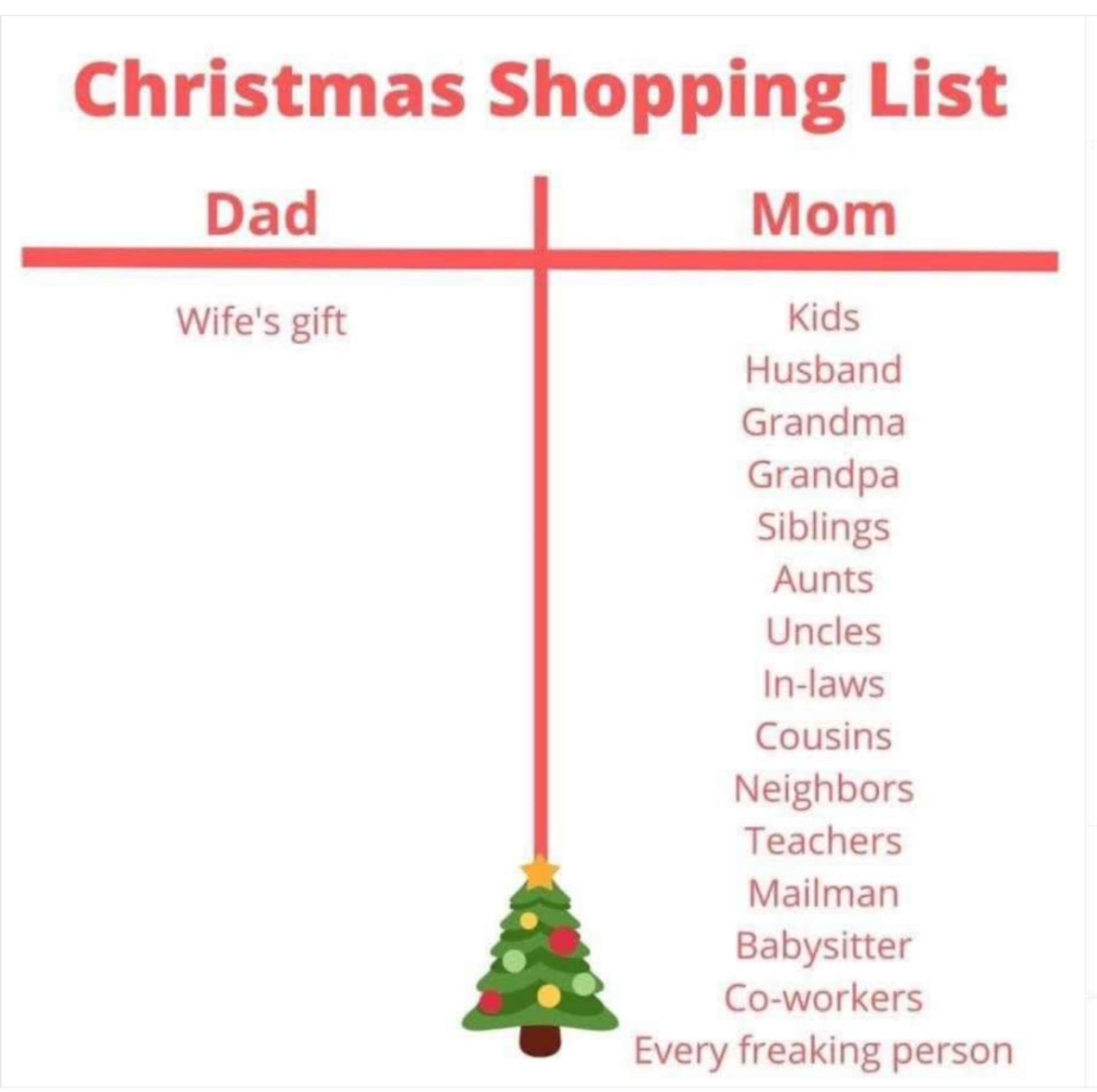
Credit due to an unknown source

There are a lot of exhausted moms out there on Christmas day. What accounts for the value they find in gift giving? To bring joy and a little material well being to your kids is within the realm of comprehension. But what about all those other gifts?

Business people see something in the cards with lots of scrolls that go out to clients, thanking them this time of year. Showing gratitude is over and above any monetary payment, even if there is a business angle to the effort to nurture their contacts.

Figuring out who makes the list is an accounting of sorts. Your very best customers may get a holiday wreath along with the message of good cheer. Teachers may receive gift cards to Caribou Coffee, whereas uncles and aunts step up to Pendleton socks and scented candles, but your secret santa pick warrants an outright custom purchase.

A gift is, by definition, something that is given with no expectation of return. Yet thankfulness is often a notion in the gift giving tradition. It’s a recognition that there is somebody out there thinking about you. Being thankful affords you a moment of recognition for all those loose and untimed interactions that structure a more pleasant life, including perhaps the $15-and-under gift put before you.

Instead of rolling your eyes when you pull back the tissue paper hiding the token of appreciation in the little gift bag, consider what type of gratitude is wrapped up in it. The gesture asks you to take the time to think and remember when that cousin picked you up after hours from the bars, or Aunt Bee was at home on that below zero day when you were locked out of your home, or how the mailman put your package in a shelter spot on the front porch.

Appreciation allows you to gauge different levels of merit. A fine tuning of need, something that seems to be sorely lacking in some of our large institutions. Gratitude is an important player in the ballgame of human interactions, right up there with empathy or greed. It is one to cultivate.

For Christians today is a day of thankfulness for the birth of Christ, the Savior. The lessons of gratitude and thankfulness are carried out through gift giving. All the others who are simply setting up a tree with presents all around are still listing out their sets of priorities. In this way they benefit from this lesson, believer or non-believer. That’s something to be thankful for.

To all of you–Merry Christmas and good night!

Book Club

One of the benefits of raising a child is that you get to follow them through their interests and endeavors. My college sophomore was required to tackle two novels for his class on colonialism: The Poor Man’s Son and God’s Bits of Wood. Feraoun is the product of French Algeria and Ousame is from Senegal, part of Afrique Occidental Francaise (AOF) until 1958. Both tell stories of the struggles of their countrymen and women during the era of New Imperialism.

Unlike the conversation of today, both authors describe many more groups than the simple division of colonial power and the colonized, of oppressor and oppressed, or of those who take what is not theirs and those who are left without. How exactly the goods, services and resources are shared and divided between all the players is a preoccupation for both men.

Details such as, 180 francs– the amount of Feraoun’s scholarship to Ecole Primere Superieure, and 100 francs–the amount he turns around and sends back to his family in Kabylia. Then there is 25 francs and a container of barley–the amount that shows his family’s extreme financial distress. And 600 francs–the amount the headmaster hands over to allow him to continue his education.

Both authors detail workplace struggles. Feraoun’s father leaves for a time to be a laborer in Paris. When a workplace accident lands him in the hospital he is able, after two attempts, to secure a settlement of $3000 francs along with a quarterly stipend. Ousame describes the 1947 railroad worker strike with specifics on pensions and wage scales and family benefits.

There is a counting amongst the women as well in the home life of the railroad workers. There is the rice that the local grocer is forbidden to sell them, and a fight with the french soldiers over a leg of mutton. Feraoun finds his financial obligations to his northern Algerian family growing as his sisters’ husbands leave them for greener pastures. He counts thirteen dependents on his teacher’s salary.

There are many groupings in these stories; there are the workers, and the women, and the missionary, and the soldiers, and the french educators, and the French who show up to help with the strike, and the elders who feel disregarded–all pulling in many different directions for people’s time, talent, and assets.

It’s as if these authors are trying to sort through two spheres of economic activity, particularly set in contrast by private affairs and public affairs, by looking after the individual and being obliged to the family, as well as by outsiders and insiders. And the good and the bad make an appearance in every cluster.

Without a doubt, the richness of these detailed accounts of choices is far more interesting than the conversations of today.

Book danger!

Some think Little House on the Prairie should be off school shelves. Yes, the toothy girl in braids bounding across the prairie and runny amuck with Nellie is surreptitiously misguiding your child’s thoughts about life in the Midwest 150 years go. Thoughts of self-reliance and hard work will only have a negative influence on your child. Although fiction, the books are used as education–and they are not accurate!!!

Seriously TPT?

Doing Laundry–Real Estate Edition

The November 2020 tally of Realtor members of the National Association of Realtors totaled 1,460,397, making it the largest trade association in the U.S. There are just shy of 21,500 Realtors in Minnesota alone. The group is nonpartisan with a stated “mission … to empower REALTORS® as they preserve, protect and advance the right to real property for all.”

Maintaining property rights, so that their clients can buy and sell homes and investments, is an unwavering shared value amongst this group. Not only because it facilitates their clients’ and in turn their own private interests, but also because stagnant unproductive real estate becomes a drain on public interests in the form of crime, blight, and inefficient use of public infrastructure.

The good and the bad of it is that once you build an open and reliable system, everyone wants to use it–including the criminals.

Globally, real estate is one of the “laundromats” of choice for criminals seeking to legitimize their ill-gotten funds. Using shell companies and other shady venues, they annually funnel more than $1.6 trillion into real estate investments around the world. Despite federal efforts to crack down on the illegal transactions in the United States, money launderers continue paying top-dollar for purchases, driving up real estate prices in many cities. 

NAR and other housing groups are urging Congress to stem the tide of dirty money by passing effective anti-money-laundering legislation. The organization is also launching an education campaign to help Realtors® identify the risks to their businesses and use best practices to protect themselves against liability.

MN Realtor

More dollars chasing real estate means higher prices. Since a pricing system is dynamic and interdependent throughout an entire network, it means higher prices across the market, not just in apartment buildings or the venue of choice for foreign or domestic racketeers. So we could say that money launders are externalizing unaffordability to lower income homeowners, while internalizing the benefits of our property rights institution–including the work done by NAR and its members.

Wouldn’t it be interesting to know the tranche of the value that illegal activity adds to the price of a home, apartment or investment property? Even if it were only an estimate. Across a metropolitan area this maybe a small amount say half a percent, or around $1500 on the Twin Cities’ median priced home. Barely perceptible with all the other costs and expenses involved in a home.

But if the criminals did their business primarily in one neighborhood, (a neighborhood where people don’t have time to wonder why a property is left vacant, nor know where to file a complaint for snow covered sidewalks) their stake could have an outsized impact. It is in these locations that a large number of REIT’s and creatively named groups tend to appear, especially since the recession of 2009. If a large sell-off of their position swung pricing, say ten percent, it would have a destabilizing effect, especially if that neighborhood was already experiencing a variety of negative externalities.

Note the groups. There is the overall housing group of buyers and sellers (personal or investors) who are buying real estate to be used as places to live. The pricing system is a reflection of the value property commands as places of residence. The criminals are not participating in that market. They bring money into the market because it is reliable environment to launder their funds. While the criminals internalize this as profits, first time buyers in the large group can no longer afford to buy a home.

The presence of washermen (and women) in the marketplace also necessitates an increase in the stream of funding used to subsidize those of the larger group who are unable to provide for their own housing. It would be useful to know some of these numbers. Knowing the financial drain of the money launderers on our real estate market tells us how much the Justice Department can spend to pursue and capture these ne’re-do-wells. This is the housing justice we need to see happen.

Photo of the day: Minneapolis City Hall

Home to the Minneapolis City Council

The building, located at 350 South Fifth Street, is an example of Richardsonian Romanesque architecture. The design is based upon Henry Hobson Richardson‘s Allegheny County Courthouse in Pittsburgh, Pennsylvania. Washington School, the first schoolhouse in Minneapolis west of the Mississippi River, was demolished to make way for the new building. Groundbreaking took place in 1889, and the cornerstone was laid (a story off the ground) in 1891. Construction did not officially end until 1906, although the structural exterior was essentially complete by the end of 1895. The county began moving in to its side (4th Ave.) in November 1895, while the city (3rd Ave.) side was not occupied until December 1902. Cost was about $3,554,000, which works out to 28¢ per cubic foot ($10/m³).

Minneapolis City Hall – Wikipedia

Home after Covid

Lots of folks are speculating about what the world will look like once people emerge from the Covid induced hibernation. Zoom, Teams and other internet mediums have shown how it is possible to run companies and services remotely. But will people use this flexible employment opportunity and choose to live elsewhere?

One way to consider this is to look at why people moved before Covid-19. Porch.com is a home remodeling site and tracks this information. On average people relocate every seven years, and people don’t take it lightly. As Porch explains:

Moving is a hassle. From boxing up one home to finding another, facing a move can feel like scaling Mount Everest. It’s no wonder Americans have been moving at decreasing rates since the 1980s. In fact, the moving rate in America reached its lowest in 2018 since 1948, when the U.S. Census Bureau began tracking moving rates.

Buyers diligently write out a list of wants and needs when they start their home search. Some of these criteria change of the course of evaluating all the amenities that different areas have to offer. One in four (on Porch’s sample of 1000) said that more space was the greatest driver for a move. Realtor Magazine broke the other reasons down by percentages:

  • Desire for a larger home: 26%
  • Desire to own, not rent: 19%
  • Downsizing: 12%
  • New job or job transfer: 11%
  • Desire for a better neighborhood: 9%
  • Separating from a significant other: 6%
  • Establishing own household (e.g. moved out of parents’ house): 6%
  • Desire to be closer to family: 5%
  • Desire for a shorter commute: 5%

Only 5 percent (said) they made a decision based on commute times. A job relocation prompts a greater response. Still–few buyers consider distance from employment as a significant determinant. Perhaps we should consider how many types of jobs are really affected by the ability to dial-in from a home office?

Anyone involved in the construction or maintenance of built structures (plumbers, sheet-rocker, bull doze drivers, HVAC contractors) will always drive to job sites. Then you have all the service providers who interact face-to-face and hence are tied to location such as k-12 school teachers and administrators, nurses and hospital staff, lab workers. People who build stuff like workers in a production plant are also anchored by their workplace location.

That leaves white collar jobs such as attorneys, accountants, mortgage underwriters, IT workers, architects, engineers and actuaries. Many of these jobs have already provided opportunities for their workers to work remotely. And as some of these jobs grow to include management and partnership opportunities, it is less clear that the full-time remote option would be available. A transition to more of a business ownership role would require better proximity to clients and/or employees.

I speculate that remote work won’t send homeowners off to new locations as much as their home’s floor plan. With more time spent at home, the functionality of their living space comes sharply into focus. Many will decide they need more space. Or it maybe the issue of how the space is distributed. An accountant might be fine with spending one day a week wedged in a cinder block space in the basement laundry room of a 50’s rambler, but becoming a full-time home office worker will demand a more comfortable office with appropriate buffers from family life.

This should make We Work types of built-place solutions more popular, especially in neighborhoods with smaller homes which are more difficult to expand due to limited lot sizes. Suburban neighborhoods may have more elbow room, but residents here may feel overwhelmed with the increased together-time. Whereas suburbanites used to enjoy their anonymity, perhaps this will diminish when a bunch of them no longer depart to their other lives across town. Those who seek the old sense of distance and privacy may shift out to the third tier suburbs and beyond.

Maybe the post-Covid environment won’t be about people moving away from their present communities as much as employers reaching across the country into a larger pool of talent. There will be community upsides to more folks working from home as well. Keeping people out of cars and airplanes will give back more time for family work, free up roads from congestion, and reduce pollution. Overall the great work-from-home experiment of 2020 will contribute to increased productivity in both the private and public spheres.

Graffiti and Barricade Building

In a recent paper, Balancing Purse and Peace:Tax Collection, Public Goods and Protests, Benjamin Krause from UC Berkley evaluates state capacity in Haiti. From the abstract:

Strengthening state capacity in low income countries requires raising tax revenue
while maintaining political stability. The risk of inciting political unrest when attempting to increase taxes may trap governments in a low-tax equilibrium, but public goods
provision may improve both tax compliance and political stability.

The author predictions are very intuitive: 1. decreasing pubic goods (in this case garbage collection) and fines decreases tax collection. 2. increasing public goods increases tax collection. What is interesting to me are the variables he chooses as benchmarks. The research measures the public willingness to pay taxes while tracking their voice as expressed in graffiti and the amount of time some members may spend on barricade building.

… I introduce two novel metrics for independently measuring political
unrest. First, to measure political speech, I conduct a census of and geo-tag the graffiti
across the city. I then use the presence, prevalence, and tone of political graffiti specifically
as outcomes of interest. Second, to measure the most violent or destructive political unrest,
I track the construction of barricades in neighborhoods which are built, and often lit on fire,
as a form of protest in this setting. Tracking both where these are constructed and which
areas are affected provide additional outcomes of interest. As a result, I am able to provide
novel experimental evidence of the effects of both tax collection and public goods on political
unrest – and on violent or destructive unrest in particular.

In my model I propose that in the public sphere, goods are provided when the voice of the group expresses a need and people are willing to do work on behalf of the objective.

In this paper the author measures voice by tracking graffiti. Lack of graffiti speaks to an endorsement of the state or a sign of favorable response to provision of garbage collection. And he measures work as the number of hours spent building barricades to protest against the state. Where lack of work is an endorsement of the state.

Exciting to see something similar appearing in an academic paper.

The purpose of public art

A bright blue rooster showed up on the Minneapolis skyline a few years back. Minnesota Public Radio ran a piece on the installation.

The rooster stands atop a brushed stainless steel plinth for a total height of almost 25 feet. An earlier edition of the sculpture stood in Trafalgar Square in London for several months. Fritsch is known for presenting everyday objects in a new and provocative light.

In 2017 the Minneapolis Sculpture Garden, home to the adult male chicken, got a complete overhaul. The garden sits between Parade Stadium and the SW side of downtown, lining up like an elaborate front yard to the Walker Art Center. You can get a glimpse of the blue bird through the garden.

Before the avian monument’s appearance, The Spoonbridge and Cherry was the iconic Minneapolis placemaker. Since 1986 this whimsical piece was a prominent feature on all the brochures meant to lure tourists to our largest city. Which makes the argument, that at least one objective for public art, is to create a photogenic avatar.

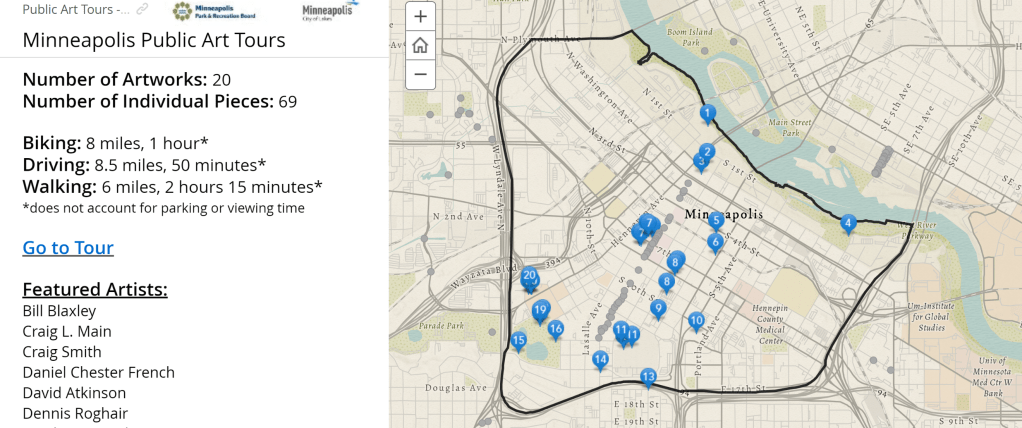
As it turns out, Minneapolis is full of public art–69 installation is all. If you visit Minneapolis you’ll have to check out the self guided tours listed on the Minneapolis Parks and Recreation site. To facilitate planning your tour, there are time estimates for walking, biking or driving. No bike? No worries, Nice Ride has all sorts of stations with bright green bikes you can rent. Here is a screenshot of just the ones in downtown.

How did the city feather a nest so full of art? By getting the public involved, of course. Here’s how it works.

Community Organizations and Private Entities

There are more than 60 artworks in the Minneapolis park system, but only half are owned by MPRB, and they are mostly historic works. The rest are owned and maintained by the City of Minneapolis, community organizations, or private entities who sponsor and care for the artwork while it is hosted on public park land. Thanks to the generous support of these partners, dozens of creative and inspiring artworks are available throughout the park system for all visitors to enjoy. If you or your organization are interested, please see the “Sponsoring Art in Minneapolis Parks” tab.

The purpose and value of public art is more than just placemaking. It signals that residents care about their story, about their environment, about putting an effort to more than just the nuts and bolts of life.

Gentrification-a swear

Not by dictionary.com’s definition: [ˌjentrəfəˈkāSH(ə)n] NOUN the process of renovating and improving a house or district so that it conforms to middle-class taste.

That doesn’t sound too controversial. People go in and clean up an area, make it more livable. There must be more to it to explain how the word gets heated up and shot out like a bullet. This popped up on the CDC site under Health Effects of Gentrification:

Definition:

Gentrification is often defined as the transformation of neighborhoods from low value to high value. This change has the potential to cause displacement of long-time residents and businesses. Displacement happens when long-time or original neighborhood residents move from a gentrified area because of higher rents, mortgages, and property taxes.

Gentrification is a housing, economic, and health issue that affects a community’s history and culture and reduces social capital. It often shifts a neighborhood’s characteristics (e.g., racial/ethnic composition and household income) by adding new stores and resources in previously run-down neighborhoods.

I’m truly not sure how the Center for Disease Control underwrote a housing topic. Gentrification= Disease? (to be fair, they do start the page with this disclosure: “This website is archived for historical purposes and is no longer being maintained or updated.”) However this definition does a great job of setting up the issues which incite a passionate response. And setting up the issues is all this first post will do for this complex scenario.

Straight off, in the first line, is the accurate observation that the process of replacing roofs, tightening wobblily rails and putting in new windows increases property values in a neighborhood. This should not be controversial–ideally owners at all levels of housing can keep up on maintenance (and if you own a home you know that this is a dependable demand). The controversy arises when the change in the value of property, and hence rents, makes it unaffordable to the current residents.

Be sure to understand that this is about value, and who ends up with it. The motivation to build equity drives, in part, the purchase and renovations of a home. A home to do with as you choose and to make your own. Property owners increase their net worth when more buyers want to move in. So gentrification is a good thing, not bad for those whose names are on the deeds.

The passionate objection to gentrification lies in the garbled mess of the second paragraph. Let’s try to pull it apart–but first understand the scenario. An investor, or a homeowner, has to receive some compensating factors to dive in and do the work to repair a home which is begging for all the big ticket items: new heating systems, siding, windows, roof. And that’s before you even get to all the interior stuff like new kitchens, bath, maybe even rewiring the old knob and tube wiring which is known to cause house fires. The compensation is a higher valued home.

To turn a whole neighborhood, where the majority of houses find themselves in a similar state of deferred maintenance, would take a while. We’re not just talking one spring sales season following a year of living with contractors coming and going. Elevating a neighborhood to a new standard is pushing a decade’s worth of work.

Gentrification is described with a sense of immediate turnover, which simply isn’t how it happens.

What is upsetting to people is that a sweeping renovation to an area produces a negative externality for the folks who were benefiting from the low cost of substandard housing. Furthermore, if these renters leave the area, they may leave behind favors accumulated through other social groups with geographic anchors. They take a loss for the chits left on the table for non-fungible work.

At the core of much of the renter’s rights activism you will find this concept of value and who gets it. There is a sense that despite contributing to their neighborhoods of their time and activity, renters fail to earn value. Only property owners do. So the policy is to divert equity from property owners to renters through initiatives like TOPA.

We can do better. But first we have to understand how to calculate value.

TOPA – Links

TOPA (Tenant Opportunity to Purchase Act), a proposal to offer renters the first right of refusal when their landlord wants to sell the property, is back on the front burner at Minneapolis City Hall. Some politicians see giving tenants part of a landlord’s property rights as a way to mitigate the expense of housing. The only perspective where this is at all rational, is from the view that property owners are simply sitting on a sack of gold coins which they refuse to share.

A story which is meant to support the tenant’s first right of refusal as a valid policy is told here: Tenants of Five Minneapolis Buildings Now Own Their Homes. Yet this suite of buildings was owned by a truly poor landlord. And because the guy was a fraud, the tenants acquired the buildings without TOPA. It will be interesting to watch the unfolding of this tale as more than likely these properties are run down and will have expensive repairs in the coming years. I’m expecting buyer’s remorse.

To understand the process and in turn the length of time a property could be tied up before sale, here are TOPA process charts from Washington DC. The financial power behind owning an asset is the ability to sell it and obtain your investment. When that ability is in question, markets do not respond well, hence value is affected. The TOPA process is considerably uncertain.

I attended this TOPA forum at the UMN presented by CURA. The presenters were Dominic T. Moulden is a longtime resource organizer at Organizing Neighborhood Equity and Michael Diamond, Professor of Law at the Georgetown University Law Center, teaches corporations, contracts, and a seminar in affordable housing. The non-profit housing community in attendance seemed skeptical.

NBC news covered how TOPA rules tie up the sale while parties arbitraged the TOPA rights to the highest bidder. (video) Although in effect since the 1980’s, it was more or less forgotten until Andrew McGuire Esq started a business ‘getting renters maximum dollar’ for their TOPA rights. He estimates it’s a 100 million a year market.

In San Francisco they call it COPA. And it is not the tenants who make the purchase but a pre-selected non-profit. Also from 2019:

If approved, the COPA would give the first right to purchase (this includes a first right to offer to purchase and a first right of refusal to match an existing offer) vacant lots or residential rental buildings with three or more units to nonprofit housing organizations.  This means that when an owner of a multi-unit building puts it up for sale or has received an offer to purchase, nonprofit housing organizations that are pre-selected by the City would have a chance to bid on the building first or to match an existing offer.

Oakland is considering something similar- January 2020.

Time and Transactions

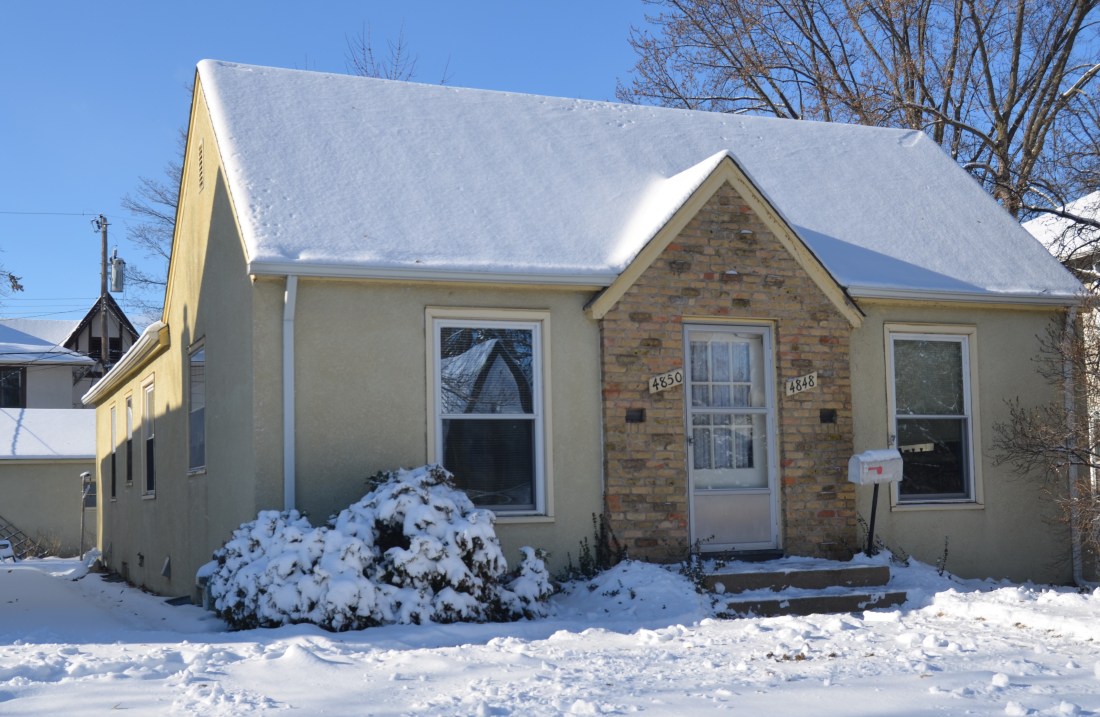
This picture may remind you of the children’s book by Virginia Lee Burton, The Little House. A home starts out on a country road and is gradually engulfed by the big city, before it is moved back out to a quiet hill in the country. Over time the land use around the home had changed, so the story puts the house back where it belongs.

Some folks decided Burton’s book was a critique of urban sprawl, despite her objections. She countered that the book, which won a Caldecott Medal in 1943, was designed to illustrate the passage of time. Over time things change. It doesn’t have to be good or bad that change happens at difference tempos. It simply is.

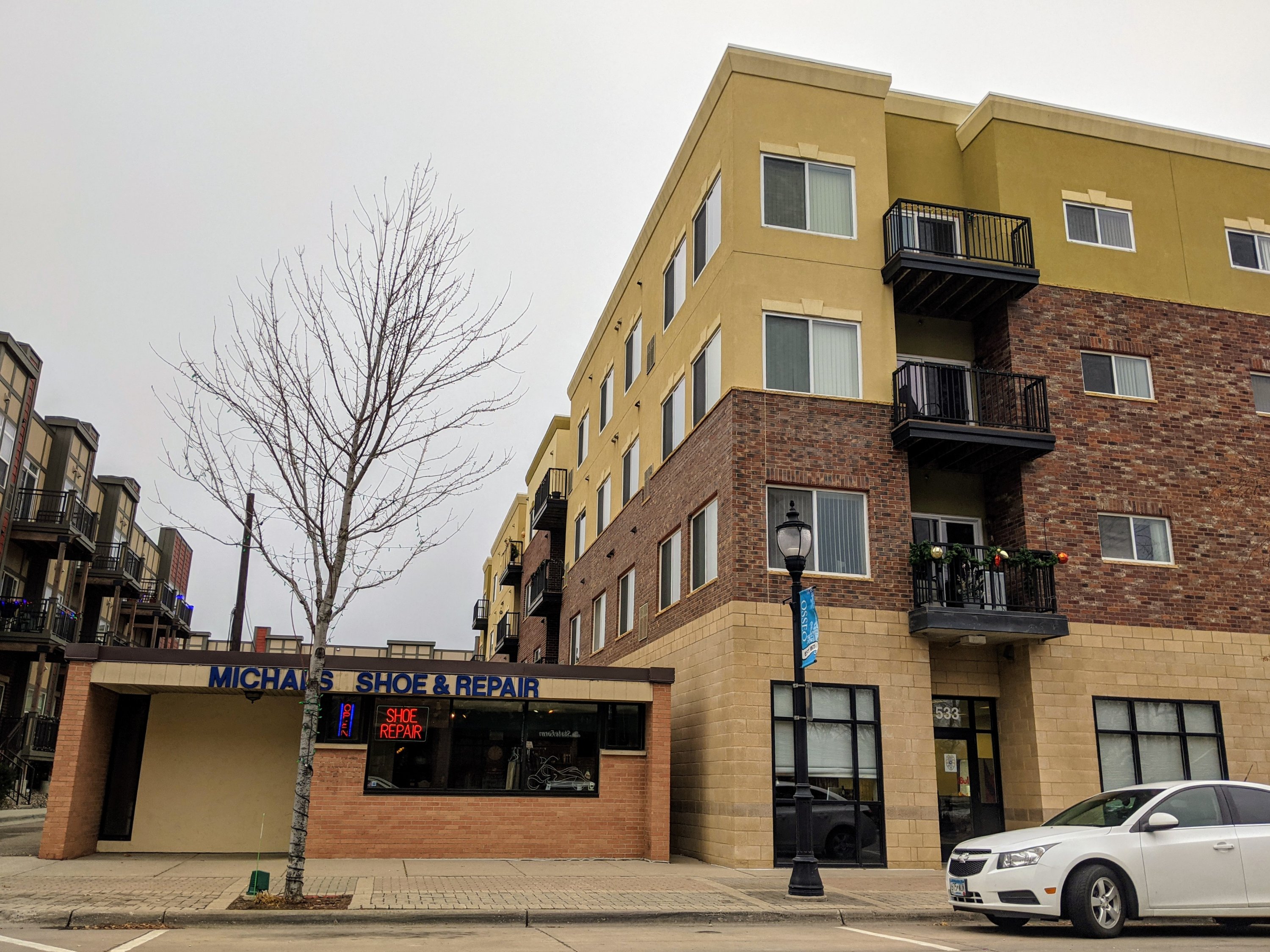
Here’s the satellite view of the 50’s built shoe repair shop, encircled by apartments built in early 2000’s.

Over time the land use around this shoe repair shop had changed as well. The whole city block was ready for something new, but not the shoe repairman. His transaction time table did not match with the everyone else’s. He must have been a hold out as the builder/developer I’m sure would have preferred to bulldoze the whole section and not have to build around the storefront.

The inside of the shop shows all the signs of a long time resident: layers of leather chaps tacked to the walls, boots stacked up on shelving, a bit of dust everywhere. Here’s a small business owner approaching the tail end of his career. Selling his shop would have been retiring, and he clearly he wasn’t ready to retire. The rest of the block might have been working on a commerce time frame, but the cobbler was working on a career time frame.

The parties must have worked out a compromise as the shop still sits on what looks to someday be parking. Someday– when the time is right.

The Crafter, The Contributor and The Covid Tracker

The Crafter

This week’s local neighborhood newspaper reported on a mom type volunteer doing the homey thing and stitching up masks for anyone who needs a buffer from the virus. She puts a plastic bin of them on the sidewalk in front of her home, and only asks that you donate an extra cotton shirt if you have one to spare.

On Wednesdays, Moira Knutson sets out two big plastic storage totes on the concrete walkway of her home. One is empty, for donations of 100% cotton shirts, and the second is full of patterned masks. Anyone who happens to be walking by is welcome to take a mask from the bin, free of charge.

Like many people, Knutson was first motivated to sew masks for health care workers when the pandemic began but is perhaps unique in that she never stopped. By her “guesstimate,” she’s made about 2,000 masks since March.

The Collaborator

Wikipedia was founded almost twenty years ago and has thrived on a volunteer-contributor model. A paper written by Benjamin Mako Hill while at MIT evaluates this form of collective action. His analysis studies why Wikipedia succeeded whereas seven previous attempts, which involved the general public giving of their time to build an online encyclopedia of knowledge, did not. The paper is called Almost Wikipedia: Eight Early Encyclopedia Projects and the Mechanisms of Collective Action.

Abstract: Before Wikipedia was created in January 2001, there were seven attempts to create
English-language online collaborative encyclopedia projects. Several of these attempts built sustainable communities of volunteer contributors but none achieved anything near Wikipedia’s
success. Why did Wikipedia, superficially similar and a relatively late entrant, attract a community of millions and build the largest and most comprehensive compendium of human knowledge in history? Using data from interviews of these Wikipedia-like projects’ initiators and
extensive archival data, I suggest three propositions for why Wikipedia succeeded in mobilizing
volunteers where these other projects failed. I also present disconfirming evidence for two important alternative explanations. Synthesizing these results, I suggest that Wikipedia succeeded
because its stated goal hewed closely to a widely shared concept of “encyclopedia” familiar to
many potential contributors, while innovating around the process and the social organization
of production.

Note that last line: “…because its stated goal hewed closely to a widely shared concept of “encyclopedia” familiar to many potential contributors.” The shared objective was clear.

The Covid Tracker

Bloomberg reports on the Covid tracking project which has been run mostly by volunteers -or- Data Heroes.

Since then, the Covid Tracking Project—run by a small army of data-gatherers, most of them volunteers—has become perhaps the most trusted source on how the pandemic is unfolding in the U.S. The website has been referenced by epidemiologists and other scientists, news organizations, state health officials, the White House Coronavirus Task Force, and the Biden transition team. There are other reliable sources for pandemic statistics, but the project stands out for its blend of rich, almost real-time data presented in a comprehensible way. “I think they’ve done extraordinary work and have met an important need,” says Jennifer Nuzzo, a senior scholar at the Johns Hopkins Center for Health Security, which publishes its own set of pandemic data (and draws some information from the Covid Tracking Project). “They’re tracking things that aren’t being tracked.”

And this:

The project is a demonstration of citizen know-how and civic dedication at a time when the country feels like it’s being pulled apart. Yet it’s confounding that, almost a year into the pandemic, the Covid Tracking Project is doing what might be expected of the U.S. government. “It’s kind of mind-boggling that it’s fallen to a group of volunteers to do this,” says Kara Schechtman, one of the project’s early volunteers, who’s since become the paid co-lead for data quality.

Work–Not for a salary, but for the public

The crafter, the contributor and the Covid tracker all have something in common. They engaged their services once they found a worthy goal. This, in combination with extra time on their hands, as well as a skill that could clearly be leveraged toward a windfall result, motivates the workers to step up. Notice that the goals fall into public benefits such as (pubic) health, (public) education and (pubic) governance. And this just-in-time response, especially when the need is great, out performs the established bureaucratic system.

These are all examples or work in the public sphere.

Wall Decor

Want to wake up on a Pacific island? Or bathe by a babbling brook? Or work at your desk with majestic mountains at your back? You can! Choose from 12,000,000 photographs to peel and stick on your walls.

Limitless Walls:

Peel & stick & reuse Our durable self-adhesive murals cling to your wall without damaging it. When you move, bring your mural with you.

Choose classic art, find famous moments, add texture and pattern, or upload your own image for a one-of-a-kind wall.

Elite-speak

I don’t remember exactly when I heard a local politician say “a budget is a moral document” but it didn’t sit right. The idea that this numerical tabulation of where funds will be spent is weighing out society’s good and evil in an oversized mechanical balance, seems a little dramatic. Sure, I understand the innuendo. If we spend on fossil fuels we’re buying environmental destruction, if we spend on the military we are just short of killing people, if we fail to spend on public health, lives are still on our hands.

And it’s not that I disagree with the concept that a portion of every price of every good or service spells out an allotment to a whole host of social goals.

As I was driving to the grocery store, my mind exploring the idea of how our family budget was a moral document, I questioned to what degree I was obligated to investigate each product we consume. At every purchase do I question the employment practices, the energy consumption, the sourcing of their suppliers; do I backtrack each and every effort that went into my consumer goods?

It seems a little impractical. More importantly, I have enough faith in the people (the butcher, the baker, the cabinet maker ) as to their choices, or rather the statistical probability that their actions fall within a range of our communal norms.

What’s off about the “budget is a moral document” phrase is that it is elite-speak. There’s a whole mount Everest of activity that is represented in a Federal Budget (or even a municipal budget). Yet the people who control this one document are considered to hold our morality in their grasp. I say have a little more faith in the rest of us.

The role of the audience

Covid has kept audiences at bay this year. There have been substitutes. The New York Mets had 5000 fan cutouts at their opening game just to the right of home plate. Talent shows are running laugh tracks that only kids who grew up in the 70’s can appreciate. Jumbotrons with a checkerboard of fans applauding just isn’t quite the same as the noise of human hands clapping.

Audiences have been taken for granted. They aren’t considered part of the game, a player in the production, but now that they’re tucked away at home, they are missed. Maybe there’s more to the group of folks that show up, past their ticket buying, and pretzel eating and merch consuming.

Zoom offers a setting for an audience versus an on-line gathering. Today I took a class via Zoom and all I was allowed to do was post in chat, raise a hand or ask a question. The moderator was a gatekeeper saying yay or nay to who got an open mike.

Agnes Callard is a philosopher at the University of Chicago and is on a mission to bring the public back into her field of study. She wants your attention, she wants your engagement, and she wants you to listen. In this recent article run in the NYT, she talks to you –the reader– directly. She challenges her audience not to pre-screen her, not be that moderator who keeps her mike muted when they don’t quite get her and what she is all about.

You are so busy trying to answer this question — trying to serve as judge in the pain/suffering/disadvantage Olympics — that you cannot hear anything I am trying to tell you. And that means I can’t talk to you. No one can sincerely assert words whose meaning she knows will be garbled by the lexicon of her interlocutor. I don’t want privacy, but you’ve forced it onto me.

She counts on you to be her interlocutor, to provide her with a venue to continue her discovery of the truth and the fulfilment of her life.

Isn’t that what the audience at a high school graduation is meant to do? While they listen to pomp and circumstance as the graduates make their way to the podium to receive their diplomas– isn’t the audience saying, “Hey, you did great! You made it this far, we’ll be there with you as you continue this journey.”? It seems like there used to be more of such events, more baptisms, confirmations, more 50th wedding anniversaries. More opportunities to stand behind a couple and as a community say we are behind you; we are here to remind you of the good times so you can endure the hard times; we are here to cook for you when you cannot do for yourself; we are here to be your neighbor.

The audience taking in the Thai boxers sometimes in the ’60’s knows what to do. They watch, they cheer, they make signs of encouragement or reproach towards the refs. You see, the audience is very much a player in all we do. They observe and filter in mitigating ways, they support or fail to show, they filter through all those social cues so we can gradually moderate our behavior. So we can continue to process where and how to spend our time without everything escalating into a protest.

Audiences need a refresher course on how to do their job, and Zoom doesn’t offer it.

It’s not A Field of Dreams

According to NorthStar MLS, of the 699 duplexes or triplexes sold in the last year in Minneapolis only 14 of them were built after 1970. For fifty years this simple multi-family form of housing has more or less been ignored. They are few and far between in suburbs, undoubtedly for the same reason.

The numbers work in favor of affordability. Here is a developer’s breakdown:

So significant were the feelings against this type of housing that, despite having lifted single family zoning in Minneapolis earlier in the year, additional obstacles are preventing their creation. Restrictions such as building heights and parking throw enough of a question mark into the approval process, that developers are bailing on the idea before even approaching the planning commission.

Over the years I’ve heard of individuals using duplexes as their first steps to becoming real estate investors; then there was a story of elderly sisters going in together on a building so they could live out the remainder of their lives as neighbors. Small multi-family buildings fit right in with single family homes unobtrusively. It would be nice to see more of them.