The externality of overdoses

Externalities can be difficult to calculate. What is the cost per person to a community exposed to smog, or the damages from water laced with lead in Flint? Often times these figures are settled in court. But management consulting companies can also be in on the game. Take this story about Purdue Pharma as reported in the New York Times.

When Purdue Pharma agreed last month to plead guilty to criminal charges involving OxyContin, the Justice Department noted the role an unidentified consulting company had played in driving sales of the addictive painkiller even as public outrage grew over widespread overdoses.

Documents released last week in a federal bankruptcy court in New York show that the adviser was McKinsey & Company, the world’s most prestigious consulting firm. The 160 pages include emails and slides revealing new details about McKinsey’s advice to the Sackler family, Purdue’s billionaire owners, and the firm’s now notorious plan to “turbocharge” OxyContin sales at a time when opioid abuse had already killed hundreds of thousands of Americans.

Later in the article they tally those deaths up to 450,000 since 1999. Those, of course, are just the fatalities. There are no numbers offered for the hours that went into counseling the addicts before they OD’ed, or all the lost productivity an addict can bear on their support group. Neither of these costs were the costs concerning the McKinsey accountants. The number crunchers were concerned with the amount necessary to buy Purdue Pharma’s distributers, the local pharmacies like CVs or Walgreens, out of the discomfort of grieving mothers.

The presentation estimated how many customers of companies including CVS and Anthem might overdose. It projected that in 2019, for example, 2,484 CVS customers would either have an overdose or develop an opioid use disorder. A rebate of $14,810 per “event” meant that Purdue would pay CVS $36.8 million that year.

I’m not sure how one of the most prestigious consulting company in the world came up with $14,810. I’d truly be curious to know what went into the formula to calculate this externality. What dollar transfers were tracked between the group of heartbroken survivors and their pharmacies following an overdose that added up to $14,810? How did the rebate get summed up and presented to Pharma’s management as a viable expenditure in the form of a rebate?

Maybe the point is that an accounting of this nature is already in play. If a market price was calculated for a social cost buyout in this scenario, most probably it is a frequent calculation. So what is the McKinsey method? Inquiring minds want to know.


Systemic

The word systemic keeps getting worked into the conversation these days. Like when kale was in fashion. Some healthy new food that all of a sudden is made part of every dish but you’re not really sure what you think about it. Systemic–it’s put out there in a more or less free standing sort of way without any follow-up examples or stories to prop-up exactly what the speaker means by it. What we are dished up is a description of a (negative) social outcome, one that occurred due to systemic issues.

Dictionary.com offers this: [səˈstemik] ADJECTIVE. 1. relating to a system, especially as opposed to a particular part. It seems we need to understand more about systems. A system is not the sum of its parts. Here is what Lebanese born author Nassim Taleb offers from his book Skin in the Game:

The main idea behind complex systems is that the ensemble behaves in way not predicted by the components. The interactions matter more than the nature of the units. Studying individual ants will never (one can safely say never for most such situations), never give us an idea on how the ant colony operates. For that, one needs to understand an ant colony as an ant colony, no less, no more, not a collection of ants. This is called an “emergent” property of the whole, by which parts and whole differ because what matters is the interactions between such parts.

from Skin in the Game

So this Thing, that is socially detrimental, happens across a system. But what exactly? What happens that lies beyond the responsibility of one individual, and that echoes within a larger group of activity, that culminates into whatever it is being voiced as systemic? The gist is the Thing is a series of inter-related activities erupting into the highly objectional scenario at hand.

But why settle for gists and innuendo? Why not name this Thing? Why not fully flush out what it is that stair steps its way through households and into communities, through vendors and corporations, through bureaucracies and governments?

Take the Enron Corporation story for example.

At the end of 2001, it was revealed that Enron’s reported financial condition was sustained by an institutionalized, systemic and creatively planned accounting fraud, known since as the Enron scandal. Enron has since become a well-known example of willful corporate fraud and corruption. The scandal also brought into question the accounting practices and activities of many corporations in the United States and was a factor in the enactment of the Sarbanes–Oxley Act of 2002. The scandal also affected the greater business world by causing the dissolution of the Arthur Andersen accounting firm, which had been Enron’s main auditor for years.[2]

There’s that word systemic again. At this (formally) worldwide energy company, accountants at all levels could have called out questionable practices but did not. Through failure to act the organization was complicit at all levels of covering up fraudulent accounting practices.

A contrarian might say, is that really fair? The employee’s contract is to fulfill their job description for a bi-weekly check. Today, in the bright of day, the deceit is clear. But in the rush of the workday was it muddled? When did the private contract between employer and employee take on a public obligation? If an employee calls out their supervisor, the writing is on the wall and the pink slip is in their in-box.

The systemic promoters are talking about failure within an entire organization. They’re saying that a weighting of choices throughout an energy company, or a government agency, or a group of neighbors, have social implications. That the cascading of choices of each ant in the system can allow for a horrific result. That each actor has a varying degree of control, of an ability to say no, of the choice to turn on the group and change its course.

So let’s name that little portion of something that could be done to stop a social ill, let’s call it work. The employee enters into a private contract for employment but carries a public obligation to disrupt actions which are contrary to established social compacts. The portion of obligation is tied to the level of ability to have an impact (you can’t really do much as a first year junior accountant). This is also work–it is work in the pubic sphere.

These systemic issues not only occur within private work life, but also the time we devote to our families and communities. When insufficient attention is paid to the elderly, we hear of abuses in nursing homes. When insufficient resources are paid to depression, there are suicides. These too are due to a piece-by-piece failure within the entirety to respond. These too are systemic.

The Thing is work, or housework if you prefer. Not the type of inflammatory action that the cancel culture takes to achieve their thoughts on their social need du jour. The work of stopping over and taking your depression prone niece out for a daily bout of fresh air; the work of maintaining the ballfields for the little leaguers; the work of staying late one day to scrutinize the accounting that seemed awry but you had to really take a few minutes to double check for inconsistencies. It’s the small bits of work by hundreds (of millions) of employees and community members to maintain a certain standard of established norms.

It’s fine to start the conversation with, “All these xyz bad things happened and it’s Systemic!” But we can’t exactly tackle the correcting measures without understanding where and how in the system work can be done to achieve a better future.

Arthur Rimbaud-French Poet

I jumped on Wikipedia to look up information on Arthur Rimbaud after reading a reference to Rimbaudian savagery. I’m somewhat of a Francophile and know a lot of things French and was a little surprised the name didn’t ring a bell. Happily I read through the entry filling a gaping hole of knowledge about a premier poet. But when I came to this section of the article the photo put my brain into a bell tower at high noon.

I visited Harar as a child so I went digging, and sure enough.

There it was there amongst the shots of winding streets, colorfully scarves vendors in the marketplace and city gates that lead into this ancient walled city on the eastern edge of Ethiopia.

The mind is an awesome and perplexing thing. More often than not it won’t recall a name at a gathering, leaving me, once again, socially awkward. But then–out of the blue, it will recognize an image from deep in the past.

Hillbilly Elegy

Like many Americans on Thanksgiving, we laid a rollicking fire in the hearth and watched a movie on an absurdly large TV. The feature film was Hillbilly Elegy, a Ron Howard film based on a true story. There is so much material here that is relevant to this blog: groups, public and private transactions, the externalities and the weighing of choices. The threads run fast and thick in this tale strung through several generations. I could fill a month of posts dissecting it all, but instead I’ll stick to just one scene.

JD Vance, the story’s author and lead character, has a tumultuous relationship with his mother played by Amy Adams (who did an excellent job as usual). The middle schooler asks to live with his widowed grandmother, Mamaw. The matriarch quickly starts to clip away at his juvenile delinquent friends and his poor school performance. But it isn’t the yelling nor the screaming nor the fist throwing that changes JD Vance’s perspective on his life and his future. It isn’t a hoo-ha in a shop over an expensive calculator or a potential run-in with the law.

The turning point for this youth, who eventually works his way to Yale Law School, occurs when he overhears a quite negotiation between his Mamah and the Meals-on-Wheels volunteer. JD listens as Mamaw makes a case to the volunteer for extra help in the care of her grandson. This plying of goodwill results in a handful of grapes, a pear and a snack size bag of chips. She brings the bounty back to their dinner table, slices a small chicken breast in two and tosses the chips his direction.

If you know anything at all about teenage boys, you know their stomachs are always begging for a refill. When the calculation of their predicament was tallied up in terms he understood, terms that made common and physical sense to him, the youth engaged. JD’s subsequent actions worked toward the goals that had been laid out for him, but only now he intrinsically understood.

The point is that everyone has to come to terms with their own trade offs and choices. No matter how much others (out of genuine concern or some protectorate fantasies) want to step-in and speak for another person, or another group; to make claims about what people need and all the should’s in the world that they should have; they simply can’t. To make productive choices, people have to understand the alternatives on their own terms.

Apparently the film is getting negative reviews (here and here) by many substantial outlets. I like what Amy Adams has to say in response:

Everybody has a voice and can use it how they choose to use it.

Maybe the open minded need to listen a little more closely.

The battle for the kids

Parochial schools are doing well, from what I hear, in the battle to attract and maintain a student body. They opened on time in September with increased enrollment, and have stayed open through this Thanksgiving holiday. There will be a break in in-person learning now (like all other schools and universities in the area) until January. My sources report no sizeable outbreaks or health concerns for either the learners or learned.

The 91 Catholic schools in Minnesota compose the 4th largest district in the state. This unexpected swelling in enrollment is a benefit to their bottom line. As they do not receive the per pupil funding which finances the public schools, they are on their own to market within their faith community as well as to those who value smaller class sizes. In some cases, sports families are attracted to an increased probability that their athlete will make the varsity team.

The use of direct mailings to reach families throughout the area seems like a good fit. However, when a large public school district, where attendance is dictated by place of residence, pummels direct mail right over school boundary lines, it feels objectional. Why is that? Both the schools are in the business of delivering education, both require funds to operate. Attracting students is the same as attracting customers–no?

Customers use private funds to purchase a good or service. The parochial schools are offering a service, one that complies with the standards set by the state, but has been customized to the requirements of a specific community. The funding that follows a child to the public school district they attend is not private, it is taken from a pool of funds which is collected under mandate to educate all Minnesota kids.

Plus– it isn’t just the funding allocated per child that is lost when a family sends their offspring out of their district. Since busing is only offered within the school boundaries, it is a given that one parent is available to drive them to and from school—or will once the whole virus thing wraps up. By self-selection these parents often donate their time to school activities, fund raisers, and all those extras efforts that make an educational community stronger.

So when a school district pumps a bunch of dollars into a direct mail piece with messaging along the lines of, ‘Hey, we’re better, come on over,’ they are drawing students as well as high-social-capacity families to their district. Which means they are draining adjacent districts in an equal amount. On net, the dollars spent on this type of private business marketing is not fulfilling the state mandate to educate all students. But rather is congregating the haves and leaving behind the have-less’s.

The parochial schools are working in a private sphere even though they are fulfilling a public obligation. So it is fitting for them to use private strategies. Public schools are working in the public sphere so using private methods sets up externalities.

Coming together

Politically outstate Minnesotans and Twin Cities urbanites maybe diverging, but demographically there are converging trends. Here’s #4 from MN Compass:

One theory offered to explain the tight housing market is that Covid has made it more precarious for this age group to complete a move; boomers who may have relocated to a new stage-of-life housing have stayed put. If true, then there should be a wave of availability coming up here in a few years in Roseville, Edina, Golden Valley and Mendota Heights.

Real estate in times of Covid

All things considered, it has been an incredibly strong market for residential real estate sales in 2020. The spring started strong but was shut down along with everything else in March when the virus leapt the oceans and appeared in great numbers on the US coasts. Home sales were considered an essential service, but the apprehension of allowing strangers into sellers’ homes for showings slowed down the process.

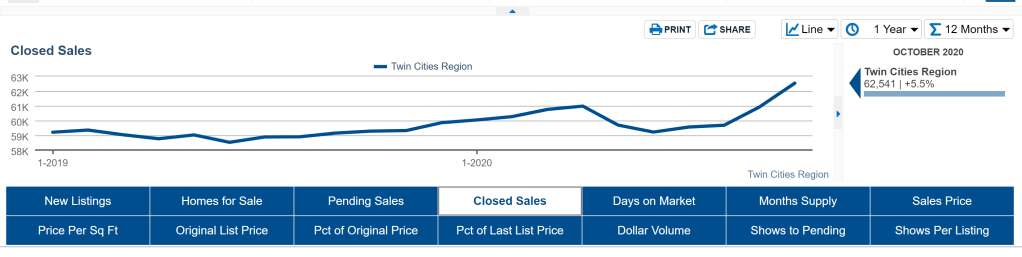
This data from Northstar MLS shows the dip in April and then the take off of activity starting in June.

Issues that seemed to be on buyers minds when they came through open houses were 1. room for home offices 2. new flexibility in distance to job location 3. downsizing out of larger homes to avoid maintenance concerns. This broad range of interests led to almost all types of properties being snatched up, often in competitive bidding. Which has led to a sharp decline in properties available for sale.

In almost all markets, except the downtown Minneapolis condo market which is up 21.3%.

I think there is little dispute that Covid has dampened the amenities which a downtown offers. The lack of night life and restaurants, the lack of need to be blocks from work or near light rail for a quick trip to the airport. By displacing the relative value that residents place on these features versus a whole host of other variables that go into a home purchase decision (including square footage, proximity to family and so on), more owners are exiting the downtown community than joining it.

Nailing down the market prices on each of these amenities one-by-one would take data that is not readily available. Data sets for the performance of public sector goods would have to be statistically spun out to reveal levels of significance. An analysis of prices of these and other amenities which overlap through a variety locations would provide an opportunity for index setting. Due to the extraordinary living conditions in 2020, there is an opportunity to obtain counter factual data for many core neighborhood utilities. It is a unique opportunity.

No Voice? Exit

From the Pioneer Press:

Two longtime state senators from Minnesota’s Iron Range broke with Democratic-Farmer-Labor ranks on Wednesday to form an independent caucus in the narrowly divided chamber.

Sens. Tom Bakk, of Cook, and David Tomassoni, of Chisholm, said in a statement they would venture out on their own after finding both political parties to be too polarizing. The lawmakers had frequently broken with DFL party lines to vote what they felt best represented their districts.

A walk a day..

According to the Mayo Clinic: regular brisk walking can help you:

  • Maintain a healthy weight
  • Prevent or manage various conditions, including heart disease, high blood pressure and type 2 diabetes
  • Strengthen your bones and muscles
  • Improve your mood
  • Improve your balance and coordination

The faster, farther and more frequently you walk, the greater the benefits.

After a section about technique and goals and progress, Mayo says, ‘Starting a walking program takes initiative. Sticking with it takes commitment.’ You see this costless effort toward your health takes work. Work because if you don’t do it you will lose out.

Scenery and wildlife keep me motivated.

Brass and Tin Pots

My son is an engineering student, but for his liberal arts requirement he is taking a course on Imperialism. The course work tells the tale of western European economies growing so that they ventured past their countries boundaries to extract resources from Africa and Indo China and the Caribbean. The model describes a dominant group taking hold of a subservient group to help themselves to resources for commercial gains. Extraction isn’t just for the history books. Consider this fictitious story.

Let’s say there is a fairly large association for a trade group. It has a sizable staff and a fair number of members volunteers. There is also a multi-decade volunteer–let’s call him/her Jo Johnson– who through time and understanding has proven agile in eliminating dissenting voices and bullying staff. There are also dues, and committees, and boards, and political action.

The associational group has clout in a community due to its size and ability to organize. It also has some resources to pledge toward those seeking local office. Jo Johnson’s influence at the association serves to direct funds to candidates who, in turn, respond with business referrals. This action of using a group resource and trading for a private commercial gain describes a process of internalizing a public asset into a private, fungible transaction.

Now some may say–this shouldn’t be so! There are ethics to think about.

But– this judgement, this evaluation of the trades in play, is best evaluated by members of the group–not outsiders. Some members maybe thrilled that Jo Johnson is able to devote countless hours wage-free to the association, and thus, any extracting done is small compensation. The members of the group may feel the clout of the group is maximized in this very fashion, giving each member the best possible slice of the overall pie.

It is really all about transparency. If members knowingly make the decision to defer to Jo, then all is right in the world. If decisions have been made for them because Jo Johnson has become so skilled at shaking loose the opposition by throwing up all sorts of meeting delays and rescheduling (it is a volunteer activity after all), and has the power to develop allegiances by promising titles like a board position (a dusty old king of sorts selling titles), then the peasants should revolt.

The process of extracting value from a group and in doing so moving a resource from a public sphere to a private transaction occurs all the time, in many different scenarios. It is a trade. Whether a trade is in equilibrium requires, not moral judgement, but transparency and an ability to evaluate the options at hand.

Judging tin pots from afar is a risky business.

A model to consider

Given this is my 55th post I’d like recap the home-economics model. As explained on the About page, this site addresses the mechanics of value creation in the pursuit of pubic goods. In order to show these features, I must persuade you to shrug off a few established notions. The first is that the nature of goods is not public, nor club, common, or private (the purpose of the What is Public-What is Private posts). All goods can be employed in either the public or the private sphere. The second is that there is no such thing as market failure.

To start at the beginning, all of economic life is restricted by the resources this crusty old orb offers us along with what we can make of them with our time and talents. Limited resources applies both to goods employed in a private environment as well as those contributed toward community needs. Within these confines there are two types of activity creating a public sphere and a private sphere. One looks inward, behaving with a public (non-exclusionary) nature and the other activity looks beyond the group behaving in predatory fashion. This private sphere is well studied.

Let’s work backwards on some posts. Yesterday’s topic–Money and Safety— centered around the city’s approval process to fund more police force hours. Consider the groups. The defunders would argue that city money for police has resulted in providing safety for the racial majority (Gr 1) of the citizens (Gr 3) yet is failing to do the same for the minority groups (Gr 2). In light of this objection these city council members refuse to fund the police.

As an aside, this claim does not hold true. For the past five months the political climate in the city has severely limited the police’s capacity to maintain peace. The result has been a tragic loss of life primarily in Gr 2. This a new set of data contained in Gr 3 shows that it is group Gr2 which reaps greater (despite severe flaws) benefits than Gr 1. In addition to loss of life, Gr 2 has also disproportionately experienced a loss to businesses, where it is estimated 200 businesses burned or were damaged during the riots. The businesses suffered an externality from (lack of) services from the public sphere.

Consider the post A table set for adversaries. The outdoors women and men (Gr 1) are often at odds with urban arts people (Gr 2) over issues like gun control which increases the cost to own firearms without a clear benefit in reduction in crime, and funding for cultural events which requires subsidies to be viable, and outstate regulation of the environment which cuts jobs. Although Gr 1 and Gr 2 are often competing for resources they hold together in conjunction with all Minnesotans (Gr 3), by showing where Gr 1 and Gr 2 had a common interest, a funding stream was extracted from two very different associational groups.

Fire Station 2 speaks to the structure of firefighters (Gr 1) who devote their time and expertise at a reduced rate to protect the lives of property of their community (Gr 2). They get paid a below average hourly rate, which is a private transaction. The firefighters’ extra wage potential is community (Gr 2) work. Their services are made available to everyone (Gr 2) which makes this a public service.

Having established the need to look for groups, and identify whether the groups are engaging public or private economic activity, I’ll be posting more on externalities and internalizing. Both of these terms describe the appearance of positive or negative effects which show up in one sphere from a transaction in the other (Ex. private corporation pollutes the water causing a negative expense to a public good owned by the surrounding community). Then we can get to the fall of market failure.

Money & Safety

On Friday the Minneapolis City council voted 7-6 to fund hiring outside police from the Hennepin County Sheriff’s department to assist with the crippling crime increases within the city. This pecuniary decision to support the MPD is the first since the defund announcement in June. The discussion between the council members and Chief Medaria Arradondo was tense. You can find a recording of the full meeting here.

Fortunately, reporter Mark Vancleave with the Star Tribune, reduce the two hour meeting down to a 9min video clip of highlights:

The council members come at the discussion for approving the funds from a variety of viewpoints. The strongest defund voices place all the work of street safety at the policeman’s door. Money is raised through taxes, salaries are paid to cops, crime statistics measures their performance. The deterioration in safety is all on the police so there is no economic reason to purchase more of a failing service.

The mid-road view is best expressed by Lisa Goodman. She provides several examples of her constituents being assaulted and carjacked and being afraid to leave their homes. She mentions some of the extenuating circumstances following George Floyd’s death including the riots and the retirement of a large segment of the force. In her view, they are purchasing more police power for better response times and general police work.

The wholistic view of policing is voiced by Andrea Jenkins (8min). She maintains that the community must engage with the police force. That the community is also involved in the work to maintain order and safe streets. She is probably the only one who could have voiced this view when put at odds with the defunders.

This view isn’t new. Back in the 1960’s Jane Jacob’s spoke to eyes on the street. Although it is accepted informally that community participation makes a difference, there is no accounting for this type of work. National night out, block watch groups and such are one of those ‘oh isn’t that neighborly’ things that people do. Not a hard cash-in-your-hand transaction.

If public safety was accounted for not only by city budgets to pay officers, precincts, detectives and administrators, as well as by public participation, prevalence of criminal elements, then we would have a universal accounting of the forces that contribute to safety. We would not only want to considered the time people put into surveillance but also the losses people incur when they go back on their group and turn in a criminal.

Instead, some council members are accused of being disingenuous for trying to deny this very real system. They deny it in order to advance another objective which lays beyond their power. But whilst they hijack one economic process in order to engender a social outcome elsewhere, Minneapolitans are getting shot.

A table set for adversaries

Today is the last day of Minnesota’s gun deer season. My husband texted me an update from his deer stand a week or so ago. The warm weather has made the pre-dawn wake-up calls tolerable and allowed for an extended time hunkered down in camo gear. He reported seeing over fifty deer, almost all does and fawns.

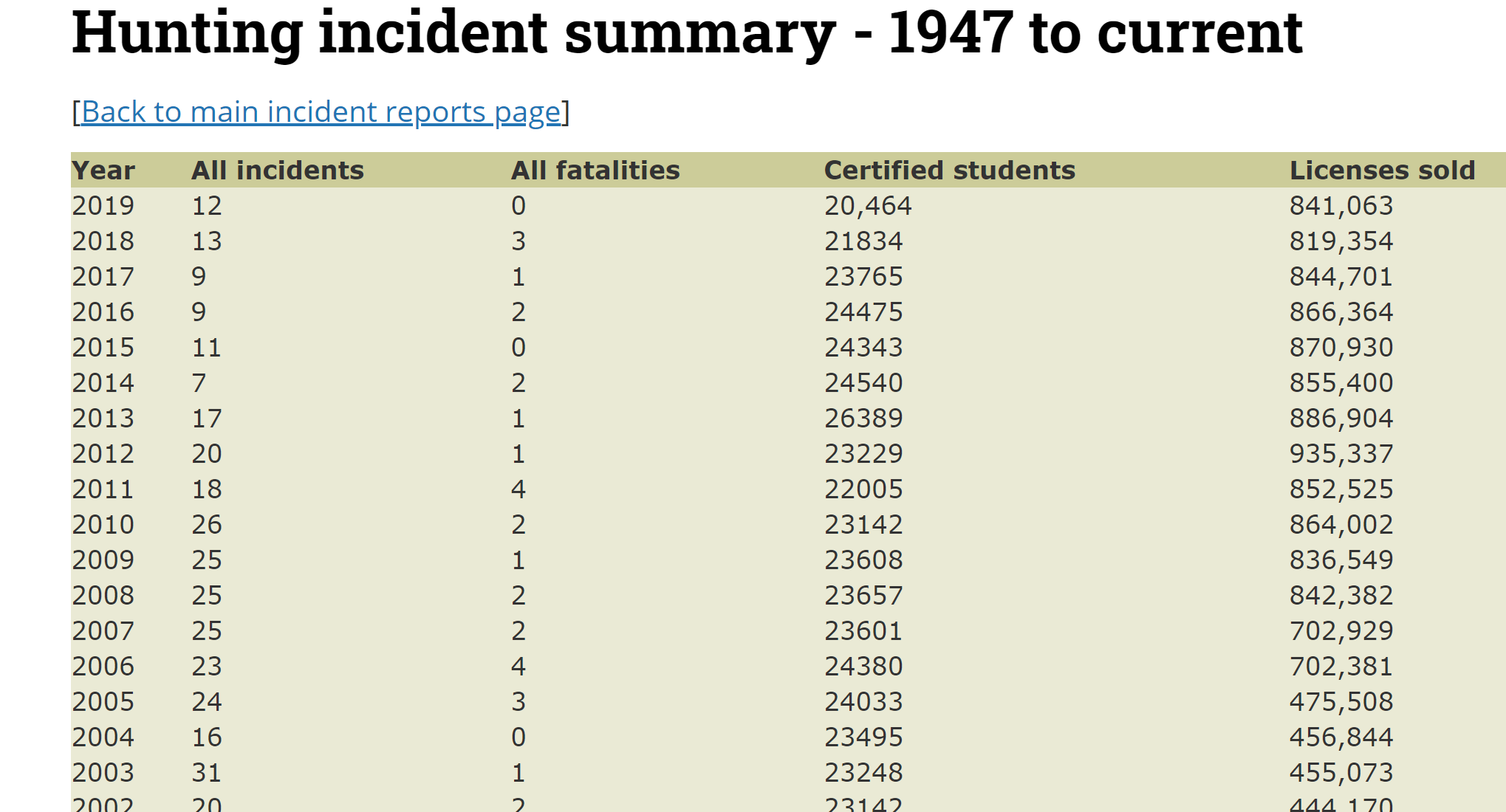
Folks who never leave the urban centers and only experience gun ownership through violence and crime, view hunters as an odd breed. They are a blaze orange part-of-their-problem, an obstacle in tamping down the waywardness of youth. Hunting, however, barely contributes to MN mortality rates. The numbers show that fatalities from car collisions with deer are several times higher than death by fire arm while hunting. In 2019 there were 3 deaths on the roads, yet no deaths amongst the 841,063 individuals who bought deer hunting licenses.

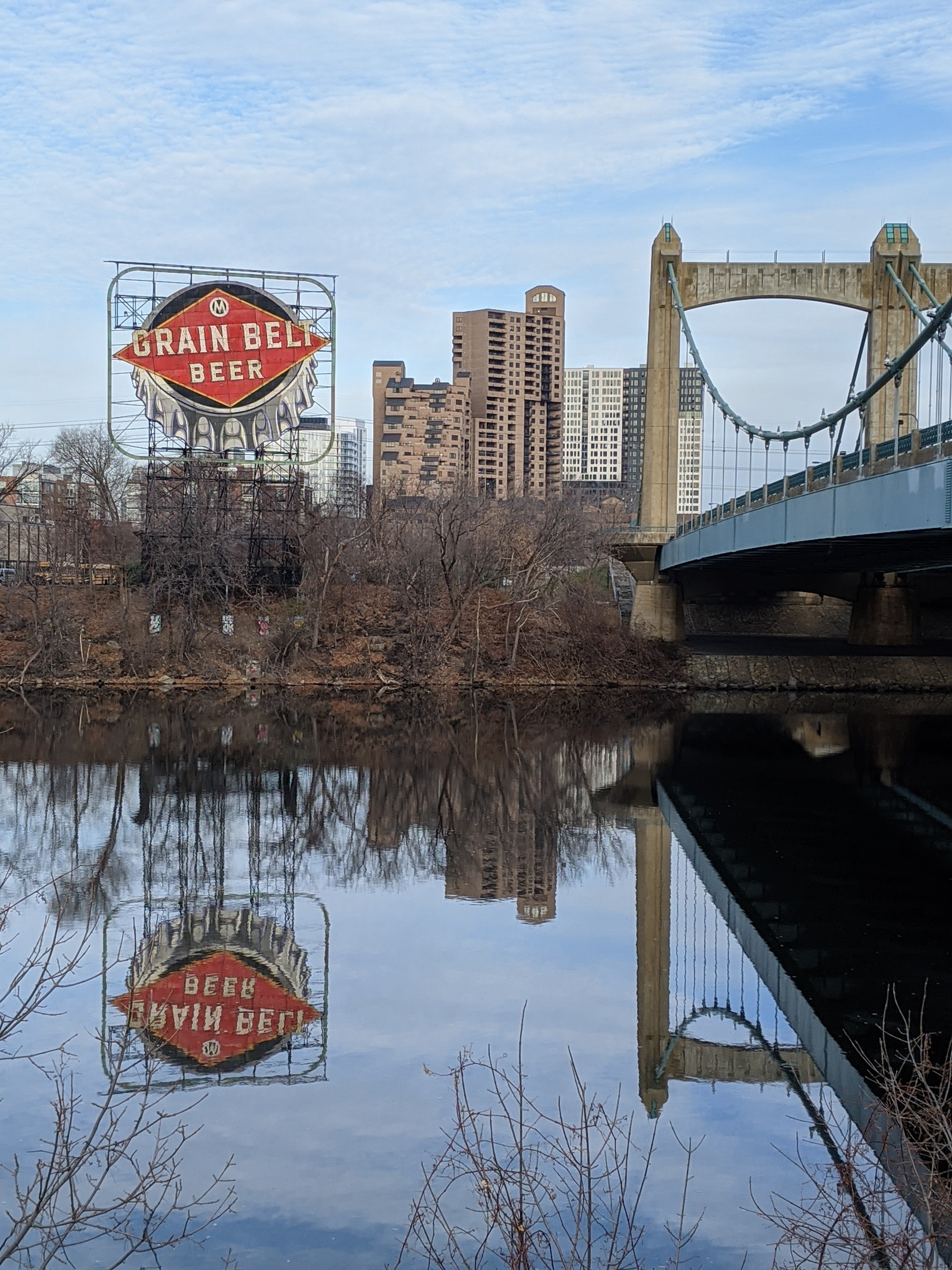
The sport is safe enough to be conducted on a limited bases amongst the old growth oaks and quaking aspen in the 136,900 acres of parkland in the greater Minneapolis/St. Paul metropolitan area. Most of the deer hunts in the urban parks are for archery hunters (including crossbow if you are old enough, seniors get the priveledge of extra power). It is noted that the parks and trails remain open except during the few opportunities to rifle hunt, in which case the entire park closes.

It is the fortieth anniversary of the Minnesota Deer Hunters Association which attracts 20,000 members throughout the state. They “ensure that the culture of deer hunting in Minnesota is being upheld by improving opportunities through: Habitat, Education, Legislation/Advocacy.” Their on-line calendar is full of meetings, 7-gun raffles and holidays parties across the 400 chapters with names like Snake River, Crow River, Sturgeon River and Smokey Hills.

You wouldn’t think these gun toting outstaters would find themselves politically aligned with folks who wish to fund the MN Opera, Walker Art Center or Guthrie Theater. You wouldn’t think that they would sit at a table with earnest faced, clipboard toting environmentalists. But politically these two groups aligned on the matter of the health and welfare of our lakes and streams.

Minnesota voters approved the Clean Water, Land and Legacy Amendment to the state constitution in 2008. Beginning in 2009 and continuing through 2034, the Amendment increases the sales and use tax rate by three-eighths of one percent. Amendment dollars are dedicated to four separate funds, one of which is the Clean Water Fund.

The amendment was passed with 56% of the vote. The hunters weren’t going to let the deer herd drink from contaminated ditches, even if they think regulations on other commercial concerns are a bridge too far. And the urban activists simply had to put their resist impulses away for awhile and ignore their other objections to their fellow Minnesotans.

In the first year following the approval, the cash infusion was a little over $213 million, and to date the Minnesota Legacy has appropriated $2.9 billion. Basically there have been very few controversies with the implementation of the fund which allocates money into four pools: Arts and Cultural Heritage, Clean Water, Outdoor Heritage and Parks and Trails. All of the projects are listed for the public to see by the legislature.

So how do you find the adversaries to invite to your next dinner party? Look to where your guests spend their time and efforts. Don’t only invite the vocal ones, the emphatic chirpers. Look for the quiet ones too, doing the work of community. When the cause at hand intersects their activities, a stream of resources can be engaged, even among long standing rivals.

New city, new energy

From the BBC:

On the edge of the Saudi Arabian desert beside the Red Sea, a futuristic city called Neom is due to be built. The $500bn (£380bn) city – complete with flying taxis and robotic domestic help – is planned to become home to a million people. And what energy product will be used both to power this city and sell to the world? Not oil. Instead, Saudi Arabia is banking on a different fuel – green hydrogen. 

The Judge vs. Embrace

Alex Tabarrok recognized the passing of WV Judge Richard Neely on his blog site today. He credits the judge’s candor with getting his first paper published in 2003 in a good journal. His paper, written with Eric Helland, argued:

We argue that partisan elected judges have an incentive to redistribute wealth from out‐of‐state defendants (nonvoters) to in‐state plaintiffs (voters). We first test the hypothesis by using cross‐state data. We find a significant partisan effect after controlling for differences in injuries, state incomes, poverty levels, selection effects, and other factors. One difference that appears difficult to control for is that each state has its own tort law. In cases involving citizens of different states, federal judges decide disputes by using state law. Using these diversity‐of‐citizenship cases, we conclude that differences in awards are caused by differences in electoral systems, not by differences in state law.

But it is the judge’s very own words that confirm his economic motivation in his rulings.

As long as I am allowed to redistribute wealth from out-of-state companies to injured in-state plaintiffs, I shall continue to do so. Not only is my sleep enhanced when I give someone’s else money away, but so is my job security, because the in-state plaintiffs, their families, and their friends will reelect me. (Neely 1988, p. 4).

So what does this have to do with a post I recently wrote about Embrace, a women’s shelter in Wisconsin? The shelter’s director set up a GoFundMe page after she alienated local police by prominently advertising BLM signs around the facility. The goal was to replace $25K in funding that was pulled by the county. As of this morning the kitty is over $100K with a stated goal of $112K. I’m not sure how she picked that number, if there has been some sort of marketing strategy, to keep ratcheting up the goal as long as donors respond.

What I want people to see is the structure of the groups and the motivations for the economic activity between them. (It’s all about the group) In both cases there is a greater federal group. In both cases there is a smaller group; for judge Neely it was comprised of the citizens of WV, for the shelter it is the community which is within their service area. Both the judge and the director are extracting money from the larger group. One is unabashedly leveraging the law for the benefit of his constituents.

I question whether the other is providing full disclosure about the economic transaction that is still underway. Is there an assumption on the part of the greater public that their dollars are supporting an organization which serves a public effected by the concerns of BLM (whereas only a fifteenth of one percent of the population in this county is African American)? Or does the greater group understand they are funding a director who simply shares a similar ideology but has no power to actively contribute to the welfare of BLM?

In order to detect deceit or inefficiencies one must delineate the groups. One must also acknowledge the public nature of the motivations which drives the activity within the group–that anyone within the group receives access to the benefit. The judge, for example, rules in this way for all his constituents who found themselves in a similar conflict. That the services of the shelter are open to anyone within its service area.

Neither the judge nor the director evaluate whether the taking of resources from the greater group harm or diminishes services in some way to other members of the greater group. Their pursuit for funds is fulfilled under the nature of a private transaction, no different than how a corporation pursues funds for their services. This mode of competitive behavior happened recently when states bid against each other for PPE’s in the early days of the covid-19 crisis. Although they work as agents for a public, their obligation for such is only to the inner group.

Judge Neely was one of those confident individuals who scoffed at the traditional method of holding group norms behind a cloak of anonymity. For this we can be thankful, as his words confirm this social economic group structure and the motivation that drives its behavior.

Is it Public or is it Private-Corporate Addition

I’ve been working my way through a list which claims that economic goods fall into four categories– private, club, common and purely public– in order to debunk a misconception on how we sort economic activity. Web oriented services such as Wikipedia, NetFlix and website design hold a variety of placements in the groupings. I think it is safe to say that all three of these goods are private, since, according to a UN report more than half the world’s population is without internet service. Any good provided via the web is private to only the wealthy half of the world.

A resorting mindset is needed in order to tackle vision centered around corporate responsibilities to stakeholders, such as those described in a recent article on the American Purpose by Robert Madsen and Curtis J. Milhaupt:  The Expansion of Corporate Responsibility.

Increasingly, advocates of reform argue that businesses should be concerned about their “stakeholders”—not just shareholders but also workers, suppliers, customers, and society at large. The new movement, which is often termed “ESG” (Environmental, Social and Governance issues), is not limited to progressives and liberals, but has made substantial inroads in the commercial and financial community as well. After decades of espousing shareholder capitalism, for instance, in 2019 the Business Roundtable declared a “fundamental commitment to all of our stakeholders” in order to better reflect the way corporations can and should operate today.”

Stakeholders capitalism, “ESG” or benefit corporations are all a grappling to give this movement a name. What is it that corporations, which are intentionally private organizations, accomplish towards larger societal goals? Madsen and Milhaupt point out that corporate America has a history of such ventures, though most of us do not need convincing that capitalism works favorably upon social concerns. Even the most fervently socially-minded agree.

Yet the authors go onto express trepidation over who sets the agenda and whether expectations can be met.

Although hopes are high for what corporations and institutional investors can achieve through greater emphasis on stakeholder needs as opposed to narrower shareholder benefit, few of the ESG reformists have bothered to define what the movement’s precise goals should be. This matters because in the absence of a concrete agenda people tend to assume more than is possible, and the inexorable failure to meet those expectations generates dissatisfaction and the possibility of political backlash.

Here’s the thing– there is an entire marketplace of social concerns out there to choose from. No matter what the corporate entity decides to take on, the important step is to collect the data and account for it.

*Decide to devote its social ambitions to rectify labor inequity? Account for the extra training and support and follow the employees long-term gains.

*Decide to devote their legal staff to ironing out the thorny wrinkles in cross-country trade and all the implications of contract defaults? Account for time logged while on the company dollar, and the losses taken when the contracts fall through. Track how establishing standards allowed smaller firms to enter the market with confidence.

*Decide to use the idle time of their tradespeople and send them to a financially strapped public schools to tighten up all those leaky faucets? Account for the hours spent and estimate the savings in city water running down the drain.

The opportunities are everywhere and the beauty of the system is not to be hampered by a particular agenda, but to attack the issues which are most readily facilitated by the business and the people who make it up. To find the passion which galvanizes the employees to give of their time and expertise.

But-this is important- we can’t know how it all shakes out until it shows up in a tabulation somewhere. The trick is that the mechanics are different for social activities versus the mechanics of for profit transactions. That doesn’t mean they can’t be held to account. Already things like ‘good will’ show up on balance sheets. Think of the possibility of two colors of ink on the net income statement; one for profit and one public profit. The former total is by far the lion’s share, as by definition corporations exist to produce financial gain. Yet knowing the later, being able to track, tally, and compare it, will be empowering.

Tracking will also play into Milton Friedman’s emphasis on transparency. Through open disclosure, reports identify the social goals tackled and the benefits of eventual outcomes. It also provides signals where possible excesses, corruptions and silly virtue signaling are occurring, if not out and out fraud.

The task at hand is to identify what counts as work towards a public objective. And see how assets are used, stored and accounted for. To identify this concept of capacity and give it a number. Where do the tradeoffs get revealed so individuals will make choices with their time and energy? How could they be engaged by benefiting from a personal social objective while participating with fellow employees? The angles are multifold.

So I say– do not hold expectations in check. Run with them, write them down and see how they all add up.

This would never happen in MN

I’m not tuned-in to how new construction is done in China, but I can say why this would never happen in Minnesota. Clients are on a time-line. They would not proceed with a purchase agreement until a somewhat (within 30 days or less) firm closing and occupancy date was clearly possible. The project would have to be far enough through the city approval process to be assured of no delays. With the hint of a builder’s lack of ability to retain tradespeople, buyers will shift to a builder that has deep enough pockets to hang onto good workers.

In a very hot market, buyers will put down money to hold lots or condo units pre-construction. This dollar amount is a small fraction of the total cost of the unit. If the developer went bust, those funds could be at risk. Only in the relatively small number of custom built single-family homes do clients risk a construction loan, where the builder receives disbursements from the bank over the six month period it takes to build a home. But the timing would never put the buyer on the hook for the full amount of the mortgage.

Fire Station 2

Our fire station, Fire Station 2, is getting a brand new building next year. The thirty-five year old building is being razed, so new beefed-up accommodations can better respond to calls and better house the firefighters. There’s been a shift change, from shorter 3-6 hour ones to overnighters which necessitates a dormitory.

Firefighting is an entirely voluntary service in some cities. We have a paid-on-call system where active time (training, call response, equipment maintenance…) is paid at an hourly rate. We’re not talking a lot of money, the present range is from $12-15/hour–about half of the per capita income.

So what’s that called, that missing $12/hour? What accounts for the difference in what the firefighter could earn and their paid-on-call wage? Here’s how Ron Roy, the division chief for Douglas County Fire District #2 in East Wenatchee, Washington, put it:

So why do we do what we do? It is about our communities and the hometowns in which we have elected to live and raise our families. We should care about all of those around us and recognize their needs. When they are having health issues, mow their lawn, shovel their snow, or take out their trash. We are the lifeblood that makes it a community. We all need to step up and provide some of our time and talents to help make our community a better place. Sometime, somewhere, you or a loved one will need the services provided by community members.

What he is describing is a just-in-time system of providing services to neighbors who unexpectedly find themselves in need. There is no chit system, there is no direct tit-for-tat. It’s an all-on-your-honor type of deal. This is work in the public sphere.

But back to the missing $12/hr. It doesn’t just vanish. It is a measure of the city’s capacity to respond, in this case, to extinguishing fires, and in doing so saving lives and property. City capacity measures the on-call storehouse of the residents’ ability to step up and provide some of their time and talent in order to advance a public objective.

Buildings that walk and roll

In Shanghai a five story primary school building walked to its new location some 200 meters away.

Back in 1985 the Fairmount Hotel was moved in San Antonio. The clip is 17:47 minutes in length but contains lots of details including a two week halt to dig up artifacts from the Battle of the Alamo, maps, bridge crossing, groups involved ( and great 80’s theme music!). Take a look at the renovated Fairmont Hotel.

I remember when the Schubert Theater was relocated, lifted and rolled, in downtown Minneapolis in 1999. It took twelve days to move the 5.8 million pound structure, originally built in 1910. But it took a decade more and upwards of 38 million dollars (not all public), to transform it into the Cowles Center for Dance and the Performing Arts. How a city comes to terms with spending that kind of money involves achieving multiple objectives. The Star Tribune explains:

Meanwhile, restoration of the Shubert will create 150-plus construction and permanent jobs, bring tens of thousands of dance patrons downtown, complete the performing-arts vision for the successful Hennepin theater district and alleviate a loitering and crime problem that has moved from busy Block E to the lonely stretch of the avenue on which sit the Shubert and the Hennepin Center for the Performing Arts. At least that’s the official pitch. The cops and the new urbanists say having people on the street trumps crime. The arts crowds frequent local bistros and they don’t make trouble.

In 1995 Minneapolis was nicknamed Murderapolis after the New York Times wrote a story pointing out that the city had a higher murder rate per capita than New York. This particular spot in downtown struggled with crime. The jobs were also successfully filled by minority tradespeople.

CEO Louis King of Summit Academy OIC on the North Side, which trains dozens of young minority folks for good-paying jobs in the construction trades, is near agreement with McGough Construction and the city. Up to one-third of the workers on the Shubert project will be women, minority apprentices and skilled minority craftsmen. The jobs will pay $18.50 to $40 an hour for months. That’s a good thing.

Wouldn’t it be interesting to see some sort data estimate and geographic tie-in to how the public investment performed? What proportion of the presence of a renovated and vibrant building on that section of the block helped with crime reduction? Did the minorities and women who worked the jobs progress in their profession? Is there an index to say x- proportion of the investment was preservation, and x-amount inflated into other community value?

7 Billion for a Transportation Revolution

That’s the election news from Austin, Texas. A pretty hefty purchase for a metro of 2.2 million people. More on the deets from the local Patch:

The project came in two separate parts for voters, Proposition A and Proposition B — both of which gained support from the majority of registered voters. The former, which passed with 59 percent of the vote, calls for an 8.75-cent increase per $100 valuation to the city’s property tax rate, resulting in around a 4 percent increase to the total bill, toward a high-capacity transit system known as Project Connect. Prop B, which passed with 68 percent of the vote, provides for $460 million in debt issuance toward transportation improvements —sidewalks, bikeways, urban trails, safety projects and the like.

This wasn’t the first run at a rail transportation package in the capital of Texas. It wasn’t for lack of need. The urban’s center’s population growth for the decade ending in 2018 was 37%. Yet two prior funding attempts had failed. This time things were different.

“There were three main arguments that were made,” says Austin mayor Steve Adler. “One was congestion. One was climate change. One was mobility equity in our city.”

This time the city was all in. The focus was not only on light rail to improve commute times and to connect various parts of the city, goals which appeal to those who could better use the hour from a daily commute, and to those who prioritize emission reduction. But the plan also provides for “transportation infrastructure including sidewalks, transportation-related bikeways, urban trails, transportation safety projects (Vision Zero), safe routes to school and substandard streets.”

Let’s count the public objectives: transit, health, environment, access to jobs, recreation, safety. And lest you think they forgot about housing:

The plan, funded by an increase in property taxes, also includes $300 million to help make sure that as transportation improves in some neighborhoods and housing values rise, residents aren’t displaced from their homes due to gentrification. They’ll do this by offering rent subsidies, building more affordable housing, and giving financial assistance to home buyers. 

Austin’s business success and hence population boom has put it in the enviable position of having a need for all these public projects as well as the financial ability to fund them, which they have tied directly to the assessed values of real estate.

But what about cities that just need one of those amenities, or even just a leg of light rail, or upgrades to a suite of bridges, or replacement of a water treatment facility? What are the standard pricing mechanisms and what are they tied back to in such a way that is financially acceptable to all those who support the improvement? What are the combinations that upsell a project and close the deal, such as this one in Austin?

Minnesota passed a 1.87 billion bonding at the fifth special session held in 2020. Two years of touring and evaluating worthy projects, and still the delays and posturing and addon’s. The beauty of a standardized pricing mechanism is that the crazy haggling is reduced to more amenable swings. And more importantly people don’t feel the hazy disbelief that I did when I walked away from a souk off the central square in Marrakesh after paying $20 for two sad sticks of incense.

In other election news

The presidential race gets the lion’s share of election attention, but communities all over the US are taking care of business. Barber Township sits down on the Iowa border and needed to establish who was responsible for the ditches on the town roads.

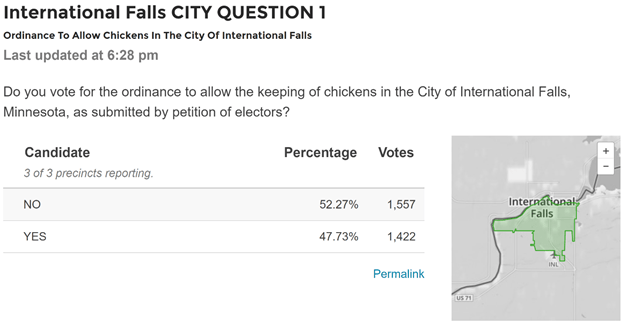
Straight north to the Canadian border, International Falls said yeah to chicken coops out back.

Drop down past Black Duck and Leech Lake Reservation to Rogers Township where they pulled a draw on whether or not to appoint a treasurer. Four votes, split 50-50.

All ballot questions are here, at Minnpost

Rain drops

‘At least the weather has been nice’ has been a passing phrase in 2020; a Minnesota nice way of putting a positive spin on a dreadful year. The stretch of sunny 60 degree days in our forecast has me deciding which outdoor tasks I can still accomplish. Some readers may not appreciate these temps, but just a few weeks ago an early storm wrapped the landscape in a four inch blanket of white, catching the Autumn Blaze Maples startled with all their leaves yet to drop.

The proper order of things is for the leaves to turn their brilliant oranges and golds and reds, then drop, then get raked up before the snow flies. It’s not the end of the world if the leaves don’t get raked up but blow around in the back yard until snow covers the landscape for a good chunk of the calendar. Come spring, however, when the thaw comes out of the ground, you’ll contend with a soggy mess. There’s the possibility that south winds will dry them out over the course of March, April and May. But the grass will emerge yellow and thin.

Having a patchy pelouse doesn’t make your home inhabitable. It doesn’t come under the must-respond-immediately-and-fix like a furnace when twenty below temps are testing your weather stripping. Heat is essential in a Minnesota winter. Water drips are up there with heat. As water on the loose tends to leave unsightly stains and make things moldy. There are things that you can’t do without and there are things that do damage if you pay them no mind.

A whole host of chores nag at you even though only a few are desperate. Take cleaning the gutters, for example. With an Indian Summer rolling in I get a second chance to get out the ladder and use rubber gloved hands to dig out the leafy debris. Otherwise a stream of snow melt off the roof will overflow, dripping persistently right next to the foundation. A few years of neglect does little damage, but eventually water digs its passage, and seeps through the foundation. Decades go by and the whole foundation wall starts to bow due to the water drops hitting like bullets into the soil and down against the walls. Something as simple as not cleaning the gutters can cause the foundation to collapse.

Community work shares this housework feature, that there are different levels of need that pull one into service. There are those tasks that need immediate attention and receive it. You can’t very well drive by an abandoned crying child at the side of the road. That’s a pull over no-matter-where-you-are-supposed-to-be and help moment.

Then there are those itty bitty items that get pushed aside like the intersections that really need a stop sign. Busy people have yet to get down to city hall and insist on better measures. When a tragedy rustles neighbors into action, there’s a lot of head shaking as to how that risk hadn’t been better assessed.

Assessing long term risks and drawing them all the way back to the present day, into the everyday lives of busy moms and dads, takes the memories of grandmas and grandpas. A shared knowledge of what eventually could happen if you put off the small maintenance items is vital. Only tackling the immediate emergencies, and burning all other time on cosmetics will pull you up short. At the worst time (inevitably) you discover that all the mechanics in your house need replacing, and the foundation is about to blow. Communities are like houses.

It takes decades to run down a house to the point of it being a tear-down. At any juncture, owners can jump in with enough willpower and enough resources to set it straight again. The better path is for people to evaluate all the long term risks, and use this knowledge to divvy up the present day work. Estimating the relative value and effort necessary to maintain and build-on what is already in place. It’s better when several generations supervise and assess the risks and rewards of the work which needs attention.

Links to Textiles

Cute Scott in a beret shows how to make linen fabric from flax seed. Join 1.3 million viewers of this video.

Acrylic on Textile, by Novikov, $25,000.

The Weavers Guild of Minnesota is the largest of its kind in the US.

Barkcloth is a textured woven, usually printed cotton fabric that was popular in the 1930s-40s and 50s as an interiors fabric. It is great for upholstery and drapery.

Remote real estate

Saint Helena hangs in the Atlantic between the eastern reaches of South America and the west shores of Africa.

It is one of the most isolated islands in the world and was uninhabited when discovered by the Portuguese in 1502. It was an important stopover for ships sailing to Europe from Asia and Southern Africa for centuries.

A five day ferry ride from Cape Town takes Napoleon buffs to his final resting place on the island. See more great photos from The Atlantic.