London- a late bloomer in the water department

No one in the western world really questions whether water provision is best suited to the public or private spheres. Being hooked up to city water and sewer is unanimously considered a good thing. Was it always that way? Well- no. Londoners purchased water from private suppliers through the end of the nineteenth century.

John Broich gives an excellent history of how the desire for water provision shaped London.

His account tells how secondary cities in the British Isles adopted a municipal water system decades before the great capital on the Thames. In fact, the continued delays in accomplishing this civic feat help exemplify the many facets of interests and the levers in play. There are issues of pollution and health concerns, there are networks of private providers, and the wealthy who buy their way to what they want. There is petty jealousy and the pride of belonging to an international city. And most astonishing, there is no government structure to handle such infrastructure outside of the walls of ancient London.

For provincial water reformers, the principles on which the administration of water was based-as well as the engineering principles on which water provision was based-were meant to make their cities more modern in the sense expressed by Avery, the Birmingham councilor.

“When water is under the control of private companies, the chief desire of the directors is to obtain good dividends,” said a Bradford town councilor in 1852. “When the Town Council possesses the works,” he continued, “their chief object is to make the works instrumental to the promotion of cleanliness, the health, and the comfort of all classes of citizens.”57

Water administration by a directly representative body was to provide an obvious contrast to the commercial companies that made independent decisions about water quality, abundance, and price based on the profit motive.

It is an excellent story depicting the nature of what is public and what is private. For a literary companion piece, consider reading Dickens’s Bleak House.

Listen to Grumpy (con’t)

The biggest losers of rent control are the young, the mobile, the ambitious, immigrants, and people without a lot of cash. If you want to move from Fresno to take a job in San Francisco and move up, and you donโ€™t have millions lying around to buy, you need rentals. Rent control means they are not available. Income inequality, opportunity, equity, all get worse.

In this paragraph, John Cochrane begins to draw lines around groups of people who will lose out under a rent-control, a policy that favors those who have established leases with landlords.

The reader can quickly imagine a young person being squeezed out of houisng by the combination of entry-level pay and bulked-up rent. The surcharge is necessary to balance out the rent-controled units. That’s the persona that comes to mind and it is the one the author intends to convey. But wait. What about the just-out-of-school coders and engineers that are swooped up by the tech companies?

These kids are paid a lot money. They are can choose where to live without much concern as, most often, they have no other attachments. They all live together in some big tech hub, often times leaving their childhood communties behind. They no longer have other points of reference like a brother who took up plumbing, or grandparents on fixed income. Not only do the have the cash flow to spend they are not being reminded that others do not.

One descriptor is not enough to form a group. To say the population of Minnesota has remained constant is light on details. Susan Bower, the state demographer, explains some of the demographic breaks down in Eden Prairie, a SW suburb of the Twin Cities. At the presentation she notes the the state loses 5,000-10,000 people a year but it is made up through international immigration. In other words, the people who leave have no concerns regarding rent control are replaced by a group who are disadvantaged by rent control.

To be efficient, matching people in consideration of their stage in life with their housing needs is best. Policies which keep people in place or discourages them from moving up, moving closer to employment, moving to a stronger school district, moving closer to support systems and so on are detrimental.

Mobil Homes

There continue to be mobile home parks across the metro offering one of the most affordable form of housing. The structure is considered a vehicle and licensed as such. The home is anchored on a lot in a mobile home park and rent is due every month in a similar fashion to association dues. People like to talk about tiny homes now. Still, manufactured homes can be reasonably constructed in a factory and meet the same quality and amenities as RV’s, another acceptable form of shelter.

:Here are some current listings and recent sales:

Few mobile home parks rise to the level of civic engagement that can be seen in Landfall Terrace, a community on the eastern side of the metro. As with many good things it starts with its history.

James and Mitzi Olson used to own all of the land in Landfall. They moved here in 1953 into a cottage that was hardly better than a log cabin.ย …The Olsons had lived in a mobile home during World War ll and knew that there was a shortage of affordable housing, so they developed their site into a mobile home park. As it was on the early highway between St. Paul and Hudson, Landfall developed several businesses, including a truck stop, restaurant and nursery, most of which left when Interstate 94 was put through and access became limited.

Often successful things are born out of a basic need of local people. But it is only through nurturing and ongoing maintenance that group projects survive. Especially one a s successful as this.

Landfall is a city in Washington County, Minnesota, United States. The population was 843 at the 2020 census and it is the smallest community in Washington County in terms of area. It lies on the eastern shore of Tanner’s Lake on Interstate 94.

Landfall is an incorporation of a manufactured home community, contributing to its reputation as the most affordable community in the Twin Cities. In 2008 & 2010, the city was named one of the 100 best communities for young people by America’s Promise.

Landfall is one of only two incorporated cities in America that consist primarily of manufactured housing. 

Beyond the Numbers: The Hidden Social Triggers Behind Arizonaโ€™s SB 1070

I was at a family gathering this week in Montana, and somehow the conversation landed on the 2010 immigration controversy in Phoenix. Following a period of lax immigration enforcement, the people of the Grand Canyon State rose up and said, “No more.” They passed the most restrictive immigration legislation, SB 1070. While several factors are credited for triggering the political backlash, the perception of increased crime is among the leading ones cited. Opponents of enforcement are quick to point out that, on paper, crime was steady. But does that tell the whole story?

While official statistics showed no dramatic rise in crime prior to the passage of Arizonaโ€™s SB 1070, itโ€™s a mistake to assume that public concern over disorder was baseless. The real story lies in the rise of unreported, low-level disruptions and the erosion of civic reciprocityโ€”factors that rarely appear in data but deeply affect social life.

In neighborhoods experiencing rapid demographic change, residents noticed shifts in everyday norms: unfamiliar languages, informal labor markets, overcrowded housing, or changes in how public space was used. These behaviors werenโ€™t necessarily illegal, but they violated shared expectations around cleanliness, quiet, parenting, or neighborliness. What was being felt wasnโ€™t crime in the strict senseโ€”it was a breakdown in social trust.

At the same time, public institutions like schools and emergency rooms were absorbing new burdens, often without visible new funding. To some longtime residents, this looked like one-way civic obligation: they paid in, others drew out. Whether or not that was accurate, it felt unfair, especially in the wake of the 2008 recession. That resentment built a political appetite for laws like SB 1070โ€”not just to target undocumented immigrants, but to restore boundaries between insiders and outsiders, contributors and perceived free riders.

Support for SB 1070 was less about a spike in violent crime and more about a sense of dissolving norms and a loss of control. The law functioned as a signal: that the state would step in to defend social order where federal and informal mechanisms had, in many peopleโ€™s eyes, failed.

About Buchanan, faith in people, and self-governance

Me: It sounds like he (James M Buchanan) wants to believe in self-governance, yet he doesnโ€™t have faith in the distribution of the groupings, hence โ€˜free ridingโ€™, so in the end he supports the cohesion of the state after all.

Grok:

Your observation captures a tension in James M. Buchananโ€™s work thatโ€™s worth unpacking. Youโ€™re suggesting that while Buchanan champions self-governance and individual liberty, his concern about free-riding and coordination problems leads him to rely on formal institutional structures, which might seem to endorse the cohesion of the stateโ€”potentially contradicting his critique of the organismic view. Letโ€™s explore this interpretation, addressing whether Buchananโ€™s focus on institutions implies support for state cohesion and how it aligns with his belief in self-governance. Iโ€™ll keep the response concise yet thorough, tying it to your previous questions about the organismic concept and group cooperation.

Buchananโ€™s Commitment to Self-Governance

Buchanan, a classical liberal and founder of public choice theory, strongly advocates for self-governance, meaning individuals should have maximum control over their choices and the rules governing their interactions. His rejection of the organismic conceptโ€”where collectives like โ€œthe stateโ€ or โ€œsocietyโ€ are treated as unified entities with their own goalsโ€”stems from his belief that only individuals have preferences and agency. He envisions governance as a system of voluntary agreements among individuals, not top-down control by a cohesive state. Key points:

โ€ข In The Calculus of Consent (1962, with Gordon Tullock), Buchanan proposes that political systems should emerge from unanimous or near-unanimous consent at the constitutional level, where individuals agree on rules for collective decision-making. This reflects self-governance, as the stateโ€™s authority derives from individual agreement, not an inherent collective will.

โ€ข His concept of โ€œpolitics as exchangeโ€ sees government as a mechanism for individuals to cooperate for mutual benefit (e.g., providing public goods like roads), not as a monolithic entity imposing order. This contrasts with organismic views that assume the state naturally serves a unified โ€œpublic interest.โ€

The Free-Rider Problem and Institutional Needs

Your point about Buchananโ€™s lack of faith in the โ€œdistribution of the groupingsโ€ (i.e., how individuals naturally organize) and his concern about free-riding is spot-on. Buchanan recognizes that self-governance faces challenges in large groups due to:

โ€ข Free-Riding: Individuals may benefit from collective goods (e.g., clean air, defense) without contributing, undermining cooperation. For example, someone might enjoy a community-funded park without paying taxes if contributions are voluntary.

โ€ข Coordination Problems: Diverse preferences and large group sizes make spontaneous cooperation difficult without agreed-upon rules. Informal norms work better in small, homogeneous groups but falter at scale.

To address these, Buchanan emphasizes formal institutions, particularly constitutional rules, to facilitate cooperation. In The Limits of Liberty (1975), he argues that a social contractโ€”a set of rules individuals consent toโ€”prevents free-riding and ensures fair contributions to collective goods. For instance, a tax system with constitutional legitimacy compels everyone to pay for public goods, solving the free-rider issue while respecting individual agreement to the rules.

Does this mean Buchanan lacks faith in self-governance? Not quite. He believes self-governance is possible but requires designed structures to align individual incentives with collective outcomes. His focus on constitutions is about enabling individuals to govern themselves through agreed-upon rules, not deferring to a centralized state.

Does Buchanan Support State Cohesion?

Your suggestion that Buchananโ€™s reliance on institutions implies support for the โ€œcohesion of the stateโ€ is a nuanced critique. Letโ€™s break it down:

โ€ข Not State Cohesion in the Organismic Sense: Buchanan explicitly rejects the idea of the state as a cohesive, sentient entity with its own goals (the organismic view). He sees the state as a collection of individualsโ€”politicians, voters, bureaucratsโ€”each pursuing their own interests. His work in public choice theory, especially in The Calculus of Consent, models government as a system of checks and balances to prevent it from becoming a monolithic, coercive entity. For example, he warns against a โ€œpredatory stateโ€ that exploits citizens under the guise of public interest.

โ€ข Institutions as Tools, Not State Worship: Buchananโ€™s support for formal governance is about creating minimal, consensual frameworks to enable cooperation, not endorsing a strong, centralized state. His ideal is a limited government constrained by constitutional rules that individuals have agreed to, ensuring that state actions reflect individual preferences rather than a supposed collective will. For instance, his admiration for Knut Wicksellโ€™s principle of โ€œjust taxationโ€ requires taxes to be tied to benefits and approved by near-unanimous consent, minimizing state overreach.

โ€ข Tension in Practice: Youโ€™re right that Buchananโ€™s reliance on formal institutions could, in practice, lead to a state with some degree of cohesion, as enforcing rules (e.g., tax collection) requires authority. Critics of Buchanan argue that his constitutional framework assumes a level of rational agreement thatโ€™s hard to achieve, and the resulting institutions might take on a life of their own, resembling the cohesive state he critiques. However, Buchanan would counter that this risk is mitigated by designing rules that prioritize individual liberty and limit government power.

Reconciling Self-Governance and Institutional Reliance

Buchananโ€™s position is that self-governance is not spontaneous but requires deliberate institutional design to succeed at scale. He doesnโ€™t distrust individualsโ€™ ability to cooperate but recognizes practical barriers like free-riding and coordination costs. His solution is a two-level governance framework:

1. Constitutional Level: Individuals agree on rules (e.g., voting systems, tax policies) to structure cooperation. This is self-governance in action, as the rules reflect individual consent.

2. Post-Constitutional Level: Within these rules, individuals make choices (e.g., voting, paying taxes) that produce collective outcomes. Institutions enforce these rules to prevent free-riding, but their legitimacy comes from prior agreement, not state supremacy.

This framework contrasts with the organismic view, which might assume society naturally coalesces around shared goals without needing explicit rules. Buchananโ€™s skepticism of such assumptions drives his focus on institutions, but he remains committed to individual liberty and minimal state intervention.

Addressing Your Critique

Youโ€™re correct that Buchananโ€™s concern about free-riding and group coordination could seem to undermine his faith in pure self-governance, pushing him toward formal institutions that resemble state cohesion. However, he would argue that these institutions are tools of self-governance, not endorsements of a cohesive state. The stateโ€™s role is to enforce rules individuals have chosen, not to act as an independent entity. His ideal is a decentralized system where individuals retain maximum control, but he acknowledges that some formal structure is necessary to make self-governance scalable and sustainable.

Conclusion

Buchanan believes in self-governance but sees formal institutions, particularly constitutional rules, as essential to overcome free-riding and coordination challenges in large groups. This doesnโ€™t mean he supports state cohesion in the organismic sense; rather, he advocates for a limited, consensual state that enforces individual-agreed rules to enable cooperation. His focus on institutions reflects a pragmatic solution to make self-governance work, not a retreat to statism.

Airport Expansion- Missoula Edition

I flew into Missoula today and the Montana Airport is wrapping up a major multi-phase expansion that reshapes regional travel and brings broader economic shifts in its wake. Here are some of the details:


The Physical Build-Out

  • Total Cost: Over $110 million for the full terminal expansion.
  • What’s New: New gates, expanded baggage claim, rental car lanes, security upgrades, and room for new routes and carriers.
  • Who’s Paying: a combo of the Feds and private interests
    • Federal: More than $50 million in grants, mostly from the Bipartisan Infrastructure Law.
    • State & Local: Matched funds from the Missoula Economic Partnership, businesses, and banksโ€”no local tax dollars used.
    • Recent Boost: A $6M federal grant (2024) will help complete the next terminal phase.

Skyward Travel Growth

  • Missoula set a passenger record in 2024: Over 1 million flyers, up nearly 12% from the year before.
  • Targeting 1.5 million by 2044 as travel demand soars.
  • Now offering more frequent flights and year-round service to Chicago, thanks to an $875k federal grant.

The Ripple Effects

๐Ÿ“š University of Montana Perks

  • Easier access = stronger recruitment, research partnerships, and conference travel.
  • Out-of-state students now find Missoula more reachable and appealing.

๐Ÿ˜๏ธ Housing Pressures

  • Expansion is fueling demand for housing, especially near the university and airport.
  • Rent hikes are real: Locals report steep increases, with โ€œaffordableโ€ now starting near $1600/month.
  • Development impact fees (passed on to buyers) may also be contributing to rising costs.

๐Ÿ’ผ Local Economy

  • Jobs during construction and in airport operations.
  • Tourism boost: More flights mean more visitors spending at hotels, restaurants, and shops.
  • Stronger air links help regional business and health access.

๐Ÿšง Challenges Ahead

  • Affordability squeeze: Residents and students are feeling the pinch from rising rents.
  • Infrastructure stress: More travelers and new residents will test city roads, utilities, and services.
  • Equity concerns: Growth must be balanced to include long-term residents and low-income communities.

Final Approach

Missoulaโ€™s airport expansion is more than a construction project โ€” itโ€™s a gateway to growth. With smart federal funding and local vision, the region is positioning itself for a more connected future. But keeping Missoula livable as it grows will take coordination on housing, transportation, and community needs. How would one go about making some projections? Estimates of impacts and time frames could be interesting to local public leaders.

Empty Houses

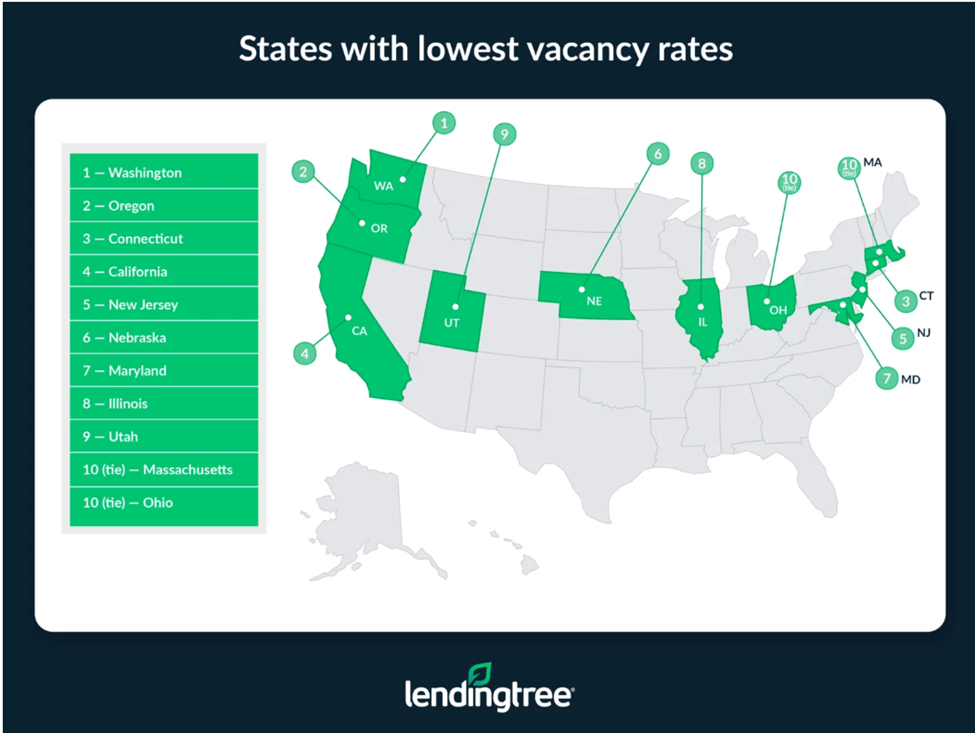
Some claim a housing crisis is underway, but I’m not so sure. If the pressure for homes were severe, one would expect most properties to be occupied, leaving others stranded without a place to go. Vacancy rates provide us with additional information. An article by LendingTree, 14.9 Million Homes Are Vacant in the US โ€” Here Are the States With the Highest Vacancy Rates, provides a great overview of the topic.

Vacancy rates differ significantly depending on where you look in the country. If youโ€™re looking at Maine, youโ€™ll find the highest vacancy rate in the country โ€” 21.09% (157,467 vacant homes), according to our analysis of the U.S. Census Bureau 2023 American Community Survey (ACS) with five-year estimates. Following Maine at the top is Vermont, with a 20.06% vacancy rate (67,606 vacant homes), and Alaska, with an 18.24% vacancy rate (59,745 vacant homes). 

Together, these three states account for nearly 285,000 vacant homes โ€” out of 14.9 million vacant homes nationwide.

Nationally, the vacancy rate is much lower than that of these three states, with the U.S. average sitting at 10.43% โ€” a figure that translates into nearly 15 million vacant homes. While that may sound like a lot, it may not feel like it if youโ€™re searching for a place to live. Thatโ€™s because not all of those properties are available to rent or buy. 

In addition to seasonal and vacation homes, others are classified as vacant because theyโ€™re in transition โ€” those that are rented but not occupied and sold but not occupied. Homes for migrant workers, which they occupy during crop season, are also classified as vacant.

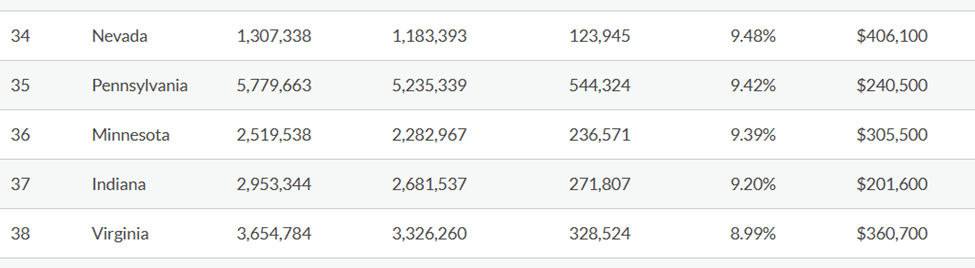
Minnesota, as is often the case, is just average. There are 236,571 homes vacant, which, in percentage terms, is 9.39%

The article cites a list of reasons why a home could be vacant. It might be a second home or vacation property. It might be in a transition state from either a remodel or a relocation of residents. Sometimes people hang onto properties for emotional reasons, such as a family tie to the land.

But note, in any case, that there is a variation between the states. Real estate is local. National generalizations about the state of housing are often dumbed down and not particularly helpful.

What is public, What is private

The Minnesota Court of Appeal recently made an interesting ruling. The court concluded that a car’s interior may be a public space if it sits atop a public road.

The Minnesota Supreme Court ruled Wednesday that the interior of a vehicle is a โ€œpublic placeโ€ if it is driven on public roads, in a case involving a criminal charge over a BB gun found under a driverโ€™s seat. MSN

We at Home-Economic.com like to think through public and private spaces. Typically, what is considered public is defined by access. If anyone can stroll into a park, it is a public space. If you can walk through the doors of the public library, have a seat in a nice armchair, and read for a couple of hours, then it is a public space.

Wayzata Library is part of the Hennepin County Library System. Great views of Lake Minnetonka!

So, is public transit public in the same way? One might argue it is not. You can board the bus if you pay a fee. It is more of a service subsidized by the public and charged at a reduced rate. Is the interior of the bus a public space? In the sense that the buses are owned, usually by a metropolitan community, then it is public to the municipality. Yet- to board a passenger still needs to come up with the fee. Thus, there is a bit of the private side of life to the transaction.

In looking for perspectives on how to consider the interior space in a privately owned vehicle, the court considered this:

In trying to clearly define what exactly is a public place in relation to a personโ€™s vehicle, McKeigโ€™s opinion focused first on Minnesota legal statute concerning the transportation of firearms, explainingย how the lawย allows for legal firearm possession in a vehicle: โ€œA person may only transport a firearm in a motor vehicle under certain conditions, including in a gun case, unloaded and in the closed trunk of the vehicle, or with a valid permit.โ€

It seems a little unusual to me to look for the lines between what is private and what is public in a law regarding the use of firearms. But far be it for me to judge! I have no legal training.

It just seems that if a car is privately ownedand can be contained and controlled by its owner, it should be considered entirely private, even if it sits on a public road.

Now that people are talking in groupsโ€ฆ

Robin Hanson wrote recently about his Status Circles. They start on an enormous scale with the whole universe and then life on Earth. But when most people focus on nation, acquaintances, and family, Robin distinguished his affiliations to people interested in the big questionsโ€”the intellectuals. But even within this grouping, he offers a wide range of ever-narrowing groupings.

Government structures are often thought of as falling into one another. The town is part of a county, which is part of a state, which falls under a country’s national laws and jurisdictions. Let’s call this the Russian Doll effect. By encapsulating one organization into the other, it seems a default that the interests of the smallest doll would be taken in consideration up the chain.

In Vincent Ostrom’s book The Intellectual Crisis in American Public Administration, the author uses ideas offered by de Tocqueville to suggest otherwise.

I’m reading Vincent Ostroms The Intellectual Crisis in American Public Administration. On page 80, he refers to De Tocqueville’s impressions of the US administration. Can it be said that the French man thought there was independence between various levels of US governance, and that’s a good thing?

ChatGPT said:

Yes, Alexis de Tocqueville generally viewed the decentralization of governance in the United States as a positive feature. In Democracy in America, he admired how local institutions, especially townships and states, maintained a degree of independence from the central government. Tocqueville saw this decentralization as essential to fostering civic engagement, political responsibility, and democratic stability. He believed that allowing different levels of government to function with relative autonomy helped prevent tyranny and encouraged active participation by citizens in public affairs.

Vincent Ostrom, in The Intellectual Crisis in American Public Administration, often draws from Tocqueville to critique centralized bureaucratic models. Ostrom emphasizes how polycentric governanceโ€”where multiple centers of authority operate independently but cooperativelyโ€”aligns with Tocquevilleโ€™s observations about Americaโ€™s administrative structure. So yes, Tocqueville did see this independence as beneficial, particularly in reinforcing democratic habits and limiting the overreach of centralized power.

4o

You said:

If one were to take the imagery one step further, could one separate each level out by encapsulating them in a self-interest cloak- the idea being that in terms of action, each level will prioritize the interest at the local level, which can be at odds with other levels of governance.

ChatGPT said:

Yes, you could extend the imagery in that way. If each level of governance is wrapped in a “self-interest cloak,” it suggests that local, state, and federal authorities will act primarily to protect their own interests, which may sometimes conflict with other levels. This aligns with public choice theory, which Ostrom himself engages with, emphasizing that political actorsโ€”whether at the local, state, or national levelโ€”pursue their own interests rather than some idealized collective good.

Tocqueville observed that the strength of American governance lay in its decentralized structure, where local institutions had enough autonomy to make decisions that best served their immediate communities. However, this same independence could lead to friction when different levels of government pursue conflicting agendas. For example, a state might resist federal mandates that it views as intrusive, or a local government might implement policies that are at odds with state priorities.

This “self-interest cloak” metaphor also ties into the broader tension in American federalism: the push and pull between cooperation and competition among different levels of government. In practice, while decentralization fosters adaptability and local problem-solving, it can also create inefficiencies, redundancy, and legal battles when interests clash. Ostrom, like Tocqueville, would likely argue that this tension isn’t necessarily a flaw but an inherent feature of a system designed to resist centralized authority and encourage pluralism.

The benefit of this model, as opposed to the Russian Doll model, is understanding when a group becomes a competitor rather than an altruistic companion. For instance, during the COVID crisis, all the states bid up the price of masks by bidding against each other. In their actions, which were independent (cloaked in self-interest), Americans increased the costs of masks for all Americans to the benefit of those abroad. When reorganized as a bidding unit at the national level, this price effect is reduced.

The only trick, of course, is that you must trust that the greater group will, in turn, divide out the masks to everyone’s satisfaction.

Cash is not always the answer

They say some things you can’t buy. Or maybe some things are more conducive to pecuniary transactions than others. Take the Violence Interrupters. By the summer of 2020, the community wanted to try a new angle on crime prevention, as an article from September explains.

MINNEAPOLIS (WCCO) — The city of Minneapolis is sending members of the community into the streets to prevent violence that is plaguing the city.

They are called the Violence Interrupters, and they’re tasked with stopping shootings by mediating conflicts in the community, and following up with individuals to decrease retaliatory violence.

Jamil Jackson and his group of interrupters are on the move.

“Our mantra is engage, relationships, resources,” Jackson said. “We’re teachers, we’re business owners, we’re city employees, we’re park employees, we’re just individuals who came to the call and had a desire to come out here and change.”

Their bright-orange shirts stand out, so they can walk in and use their relationships within the community to stop the shootings before they happen

The idea was that if responsible people in the neighborhood could step in on demand when they saw an event unfolding, interacting with police would be avoided entirely. Neighbors helping neighbors have the advantage of, in many cases, a clearer view of the issues at hand.

Others have written about this very thing, extolling the benefits of an active community busy engaging with each other across the sidewalks and parks of a neighborhood. Here’s what Jane Jacobs wrote in The Death and Life of Great American Cities.

The first thing to understand is that the public peace the sidewalk and street peace-of cities is not kept primarily by the police, necessary as police are. It is kept primarily by an intricate, almost unconscious, network of voluntary controls and standards among the people themselves, and enforced by the people themselves.

With good intentions, an office of violence prevention was created and funding was carved into the city budget to pay people in the neighborhood to step in and prevent an incident from escalating. So what happened? Fast-forward to this week in 2025.

Some Minneapolis City Council members say the cityโ€™s Neighborhood Safety Department (NSD) has been too riddled with mismanagement to continue overseeing violence intervention programs. On Thursday, three council members proposed that more than $1.1 million be allocated to Hennepin County to temporarily take over two intervention programs. 

For more than a year, council members have routinely flagged concerns over the department that administers violence interruption programs. Several violence interruption groups reported contracts that had lapsed or gone unpaid last year, which council members say shrunk safety services in parts of the city. A 2023 lawsuit also alleged the department arbitrarily awarded millions of dollars in contracts without adequate oversight. 

Things have gotten so bad that the council people, who are most vocal against professional police, no longer want to be responsible for this new form of neighborhood quieting. But why didn’t it work? It has the right components.

It’s the money.

The eyes-on-the-street people, who help keep the peace, are many and are often never called on to intervene in any way. To meter out the job to an individual is resource misallocation as it takes a large group, a whole neighborhood, of people to monitor and, through small actions, or phone calls, or gestures, alter the course of events. There isn’t enough of a job for just one person.

When resources don’t have a direct draw against them, they become ripe for fraud. Those in charge of the money have to put it somewhere. Opportunists realize this and create a demand where none exists.

Community policing is a group thing. It does not jive with the division of labor or hourly wages. Whoever is available when the car crashes into a pole and is set on fire, whoever happens to be passing by and has the will and capacity to help, are those who step up voluntarily in times of need. For that they receive an award.

Housing Starts & Lumber prices

Prompted from Chat

December 2024 Sees a Surge in U.S. Housing Starts

After a challenging year, U.S. housing starts saw a 15.8% surge in December 2024, reaching an annualized rate of 1.50 million units. This growth was largely driven by a 61.5% rebound in multifamily construction, while single-family starts rose 3.4%. Despite this late-year boost, overall housing starts for 2024 fell 3.9% compared to 2023, reflecting a cooling market due to higher mortgage rates and construction costs.

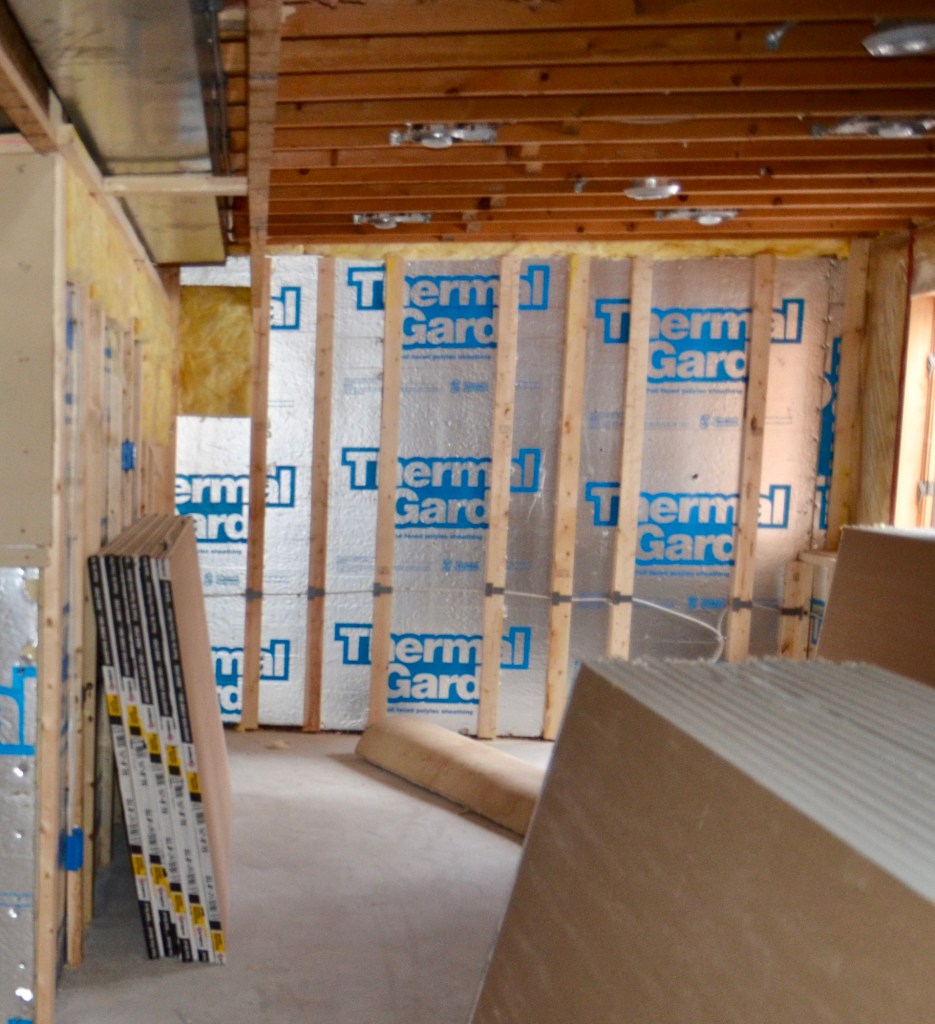
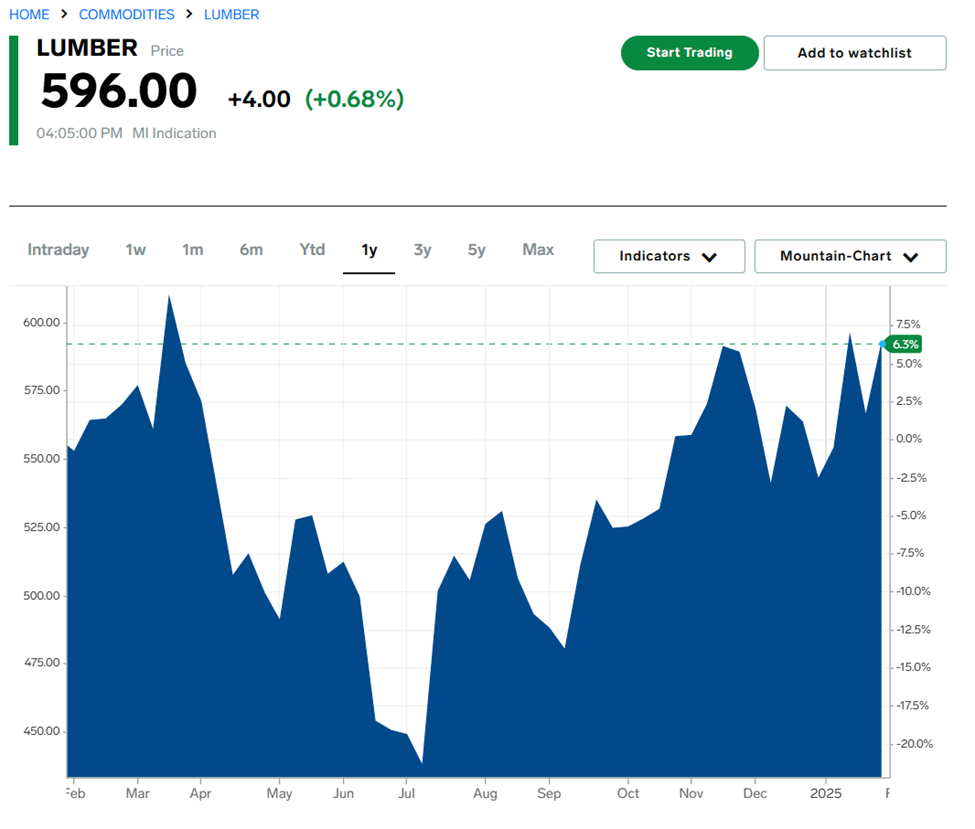
A significant portion of the lumber used for home construction in the U.S. still comes from Canada, accounting for 25-30% of total softwood lumber consumption. However, the cost of lumber has fluctuated. Over the last year, lumber prices have declined from elevated levels seen in 2022-2023, as supply chains improved and housing demand adjusted. As of early 2025, lumber prices are around $538 per thousand board feet, down from previous highs but still above pre-pandemic averages.

Trade policy remains a critical factor. In August 2024, the U.S. increased tariffs on Canadian softwood lumber from 8.05% to 14.54%. Additionally, a new 25% tariff on Canadian and Mexican imports, set to take effect in February 2025, could drive costs higher. These tariffs may slow future building starts as material costs rise, impacting affordability and overall construction activity.

While Decemberโ€™s surge in housing starts is promising, builders must navigate ongoing supply chain challenges and policy shifts that could influence construction costs in the months ahead.

Outsider on point, Outsider not so much

I’ve been diving into Democracy in America lately, written by a Frenchman, Alexis de Tocqueville, about a voyage to the New World in 1831. He was writing for the French government and primarily focused on public life. So, taken by the spirit of the population, it resulted in a text that shares the rhythm and enthusiasm of civic life, which makes the book popular today.

One point of fascination is the energy of governance at the township level. He ogles at the ability of a small group of men to tackle a public project, do their best (although he notes that this is often not as well done as professional bureaucrats), and see it through to completion. He notes the short distance between the man on the street and the organizer of public goods. In France, the central authority resides far from the common man. It’s a distance thing.

As an outsider, de Tocqueville was a keen observer. But this isn’t always the case. Sometimes, the outsider over-simplifies, and sometimes, they interpret to fit a convenient view.

Lately, immigration has been in the news, particularly the subset of intelligent, well-educated types. We have one such community. The tech workers from Asia gravitate to the same suburban area, the same school district, really. This public school district pulls in the highest scores in the state. It’s no coincidence. All the Tiger moms want their kids to go to the top schoolโ€”not a private school, mind you, but a public one. For comparison, Asians in Minnesota make up 5% of the population.

Their contribution to raising the level of education among all those other Minnesota kids doesn’t stop there. Their interests in debate club, science club, and robotics flush out the teachers who are willing to lead the group. Inevitably, a photo of the teams winning some national prize filters into the community newspaper a few pages ahead of the sports teams and their accomplishments. These families want a lot and put in the work to get it.

This community also wanted to play cricket close to home. And voila! Our city has a cricket pitch.

The activity of this group reminds me of what de Tocqueville describes in the immigrant communities he witnessed. The profile of people who support the notion that anything is possible if you put a little elbow grease into the project. The distance between those with ambition and those able to coordinate and shepherd a favorable outcome is short.

When commentators imply otherwise, you wonder where they’ve been. If you are in the education game, it’s clear who carries the ball. It’s the families and the teachers. Corporations are so far removed from education mechanics that they might as well be on an island somewhere. General observation shows that highly educated, foreign-born tech workers result in positive externalities to their surrounding communities.

Big business and corporate America aren’t even on the same playing field. And those who think so might want to check the game’s rules.

Super Power

It might be a bit difficult to buy this picture as a model of spontaneous order. Spontaneity, perhaps, but order?

Each little bubble is a representation of an independent actor out fulfilling their purpose of the day. Bubble wrapped, as they each get to retain their skills, talent and experiences and bring those forth in the work they do.

This is in fact their super power. No matter who you know in life or where you start, you have the power to devote your time and energy to the endeavors of your choice.

Luckily, the twentieth century is full of modeling the chores done in exchange for pay. No need to review that here. Economics is most comfortable in this environment: money for goods, services, and labor. It’s countable. The measures are used in all sorts of reports and for all sorts of comparisons.

Sometimes the numbers seem off. Sometimes, people don’t end up where someone thinks they should. And Social Welfare Economics tried to get a handle on such things. As a method, it really couldn’t pull off the knowing part. How do you know when such a group is better off than the other? Isn’t a comparison contingent on all the factors that go into the moment? This is what James M Buchanan seems to argue in Positive Economics, Welfare Economics, and Political Economy (1959)

A second major problem which has concerned theorists in welfare economics has been the possible existence of external effects in individual consumption and production decisions, sometimes called “spillover” or “neighborhood” effects. But this annoying complication also disappears in the approach to welfare economics suggested here. If, in fact, external effects are present, these will be fully reflected in the individual choices made for or against the collective action which may be proposed. External effects which are unaccounted for in the presumptive efficiency criterion of the economist and the proposal based upon this criterion will negate the prediction of consensus represented in the alternative suggested. The presence of such effects on a large scale will, of course, make the task of the political economist more difficult. His predictions must embody estimates of a wider range of individual preferences than would otherwise be the case. The compensations included in the suggested policy changes must be more carefully drawn and must be extended to include more individuals who might otherwise be neglected.ยฎ

The reader might be led to believe, in this bottom-up observation of human behavior, that consumers reflect a comprehensive analysis of the entirety of their transaction, including internalizing spillovers and externalizing expenses. The market filters through individuals’ private desires and their accommodations for public or group enterprise in a complex, yet thoughtful manner.

The graphic specifies the draw of a common cause, whether it be education, peace, or public health (and there are thousands more). It is the cause that sorts the analysis. It’s not a group being told to sign up to walk for MS. It’s the desire to be on the team fighting a deadly disease that drives the worker to devote their superpower to a cause.

In review

First principles of the model are

  • 1. Actors are independent free agents.
  • 2. Actors may offer work for private benefit or toward a group goal.

Unpaid Work and More

Everybody knows what labor is. It’s the activity performed by an individual in return for a paycheck. But what about all those other activities that are done that also benefit some or many people?

I asked Chat to list all the terms out there for unpaid work done in homes and communities. And here is what I got.

1. The Home

Unpaid labor focused on household maintenance, caregiving, and family life:

  • Household Production
  • Domestic Work
  • Unpaid Domestic Labor
  • Reproductive Labor
  • Invisible Labor
  • Social Reproduction
  • Home Production
  • Unpaid Household Services
  • Homemaking
  • Housekeeping
  • Child-Rearing
  • Elder Care
  • Family Caregiving
  • Emotional Labor (within the household)
  • Caregiving
  • Informal Care
  • Unpaid Childcare
  • Parental Care
  • Kin Care

2. The Office or Other Professional Settings

Unpaid or voluntary labor in organizational, administrative, or professional contexts:

  • Pro Bono Work
  • Volunteer Work (for professional organizations)
  • Advocacy Work (unpaid)
  • Mentorship (unpaid)
  • Internship (unpaid)
  • Apprenticeship (unpaid)
  • Emotional Labor (in workplace or professional settings)

3. The Church or Other Places of Worship

Unpaid labor related to spiritual, communal, or faith-based activities:

  • Charitable Work
  • Community Service
  • Faith-Based Caregiving
  • Volunteer Work (religious organizations)
  • Advocacy Work (faith-driven)
  • Grassroots Organizing
  • Altruistic Work

4. The Community Center or Public Spaces

Unpaid labor supporting community well-being and public engagement:

  • Mutual Aid
  • Neighborly Assistance
  • Community-Based Care
  • Volunteer Work
  • Charitable Work
  • Grassroots Organizing
  • Community Service
  • Non-Market Work
  • Social Support Work
  • Advocacy Work (public or civic)

5. Schools or Educational Settings

Unpaid labor supporting education, learning, and mentoring:

  • Unpaid Tutoring
  • Mentorship (unpaid)
  • Parent-Teacher Association Work
  • Volunteer Work (schools)
  • Advocacy for Education

6. Medical and Health-Related Facilities

Unpaid labor related to caregiving and health support:

  • Elder Care
  • Family Caregiving
  • Informal Care
  • Unpaid Childcare
  • Caregiving (medical settings)
  • Volunteer Work (hospitals and clinics)

7. Farms, Rural Settings, or Outdoor Spaces

Unpaid labor connected to food production or outdoor community support:

  • Subsistence Work
  • Self-Provisioning
  • Reciprocal Labor
  • Communal Work
  • Obligatory Labor (culturally expected in rural communities)

8. Government or Civic Buildings

Unpaid labor focused on governance, policy, and public service:

  • Advocacy Work (political or civic)
  • Volunteer Work (government programs)
  • Grassroots Organizing
  • Community Service

9. Museums, Theaters, and Cultural Institutions

Unpaid labor supporting arts, culture, and historical preservation:

  • Volunteer Work (cultural organizations)
  • Passion Work (for the arts)
  • Charitable Work (for cultural causes)

This categorization demonstrates how unpaid work is intricately woven into all aspects of society, emphasizing its importance across diverse settings. (end Chat)

Although a lengthy list, I think Chat missed a few.

A notable one is the hours tinkerers spend trying to develop new products and technologies. Did the Wright Brothers get paid for their first flight?

Claims about Housework

Duncan Ironmonger, an Australian household economist, wrote in 2001.

3.2 The New Household Economics
In the mid 1960s a major theoretical development took place, known as the โ€œnew
household economics” (see Becker (1981), Ironmonger (1972) and Lancaster (1971).
In this theory the household is regarded as a productive sector with household
activities modeled as a series of industries.
In this new approach, households produce commodities that are designed to satisfy
separate wants such as thirst, hunger, warmth and shelter. The characteristics, or
want-satisfying qualities, of the commodities used and produced can be regarded as
defining the production and consumption technology of households. With changes in
incomes and prices, households still alter expenditures as in the earlier theory.
However, in the new theory, households adjust their behaviour as they discover new
commodities and their usefulness in household production processes.
The activities approach derived from the theory of the new household economics
readily combines with the earlier input-output approach of Leontief (1941) to
establish a series of household input-output tables as the framework for modeling
household production.

And then this in conclusion.

6 Household Production and a World of Binary Economies

The major scientific achievement of this field has been the measurement of the
magnitude of household production through surveys of the uses of time. Household
production is now recognised as an alternative economy to the market; in many
countries the household economy absorbs more labour and at least one third the
physical capital used in the market economy.

In future, national statistical organisations will produce regular estimates of GHP.
Data on outputs of household production – accommodation, meals, clean clothes and
the care of children and adults – will complement data on inputs of unpaid labor and
the use of household capital.

Proper recognition of the household economy will have arrived when national
household accounts are published each quarter alongside national accounts for the
market economy. These data will enable greater scientific research on the
organisation of household production, the interactions with the market economy, the
role of households in building human capital, on the effects of household technology
and alternative social and economic policies on gender divisions of labor and on
family welfare.

Full paper: Houshold Production and the Household Economy.

To Your Health

If you google ‘health determinants, ‘ a bunch of stuff scrolls out in the feed, but none of it is exactly the same. For example, the World Health Organization‘s (WHO) site reports:

Determinants of Health

Many factors combine together to affect the health of individuals and communities. Whether people are healthy or not, is determined by their circumstances and environment. To a large extent, factors such as where we live, the state of our environment, genetics, our income and education level, and our relationships with friends and family all have considerable impacts on health, whereas the more commonly considered factors such as access and use of health care services often have less of an impact.

The emphasis is on a person’s situation in life more than on their genetic make-up or even access to health care services.

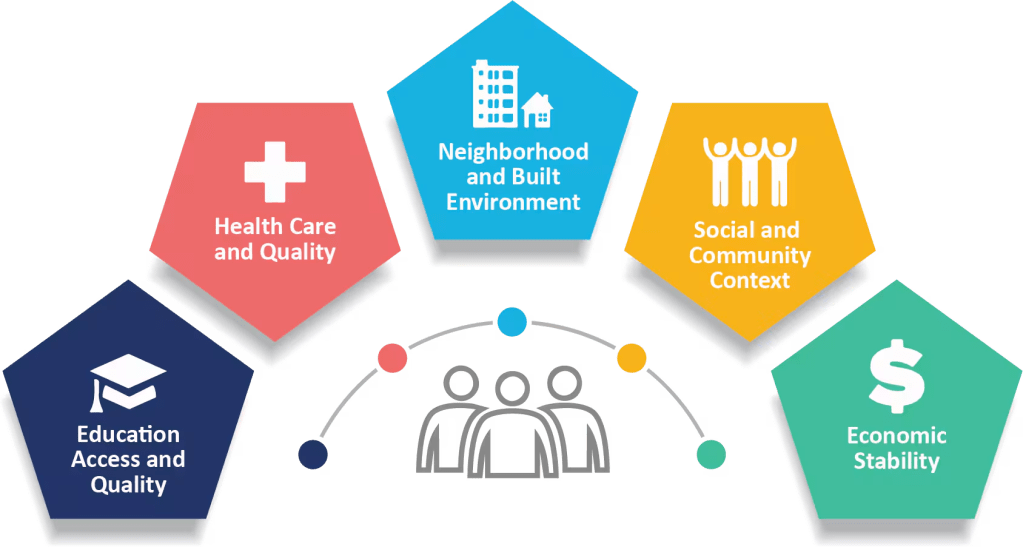
The US Center for Disease Control (CDC) offers a helpful graphic to describe their social determinants.

If you look at the hexagon you might note that the categories remind one of public goods. These goods are provided at large as they are thought to generate a universal effect that benefits everyone. If people are more educated, they will understand how to stay home with a virus so as not to pass it along to others. The availability of health care and clinics provide ease of treatment. The built environment includes transportation routes for ambulances and fire trucks to speed up a person in need. People fare better in safe communities enhanced through public provisions police services.

These categories line up nicely with the categories at Home Economics. Because the social determinants of health are also the determinants of a stable and vibrant neighborhood.

What isn’t provided at either of the sites are details. When one drills down to the street level, what can one measure that represents safety? Is it the number of pedestrian fatalities? Homicides? Or carjackings? Which number best represents safety?

Numbers meant to quantify school performance are subject to manipulation. Is the highest performer in a medium school really better off if they become a slightly above-average performer at a high-performing school? In the first instance, the student may evolve into a leader, one who expects more from themselves. Whereas in the second scenario they shrug off the duty to perform as there are so many better students in the lead. Yet competitive parents are expected to seek out the ‘top’ schools for their child- folklore says they are the best predictors of educational success.

Another factor that seems to be omitted is the level of dedication an individual, family, or community has to contribute to health issues. It’s one thing to live near a dentist, but if you never take off work to make sure your kids get in for a check-up, it does little good. Do the kids get on the school bus so they don’t trundle in late and disrupt the class? Does a neighbor ensure the octogenarian across the street gets in for their monthly treatments? How much work is going into these public health projects?

Neighborhoods are a rich source of social determinants. Combine that with a bit of information about volunteerism and who knows where that could lead us?

Embedded bugs

embedded [ษ™mหˆbedษ™d, emหˆbedษ™d] adjective

  1. (of an object) fixed firmly and deeply in a surrounding mass; implanted: “a gold ring with nine embedded stones”

I’ve never followed the use of this word as a descriptor of how norms and values influence economic activity. So I asked Chat. How is it that Karl Polanyi, who wrote The Great Transformation, talks of actors navigating a dynamic system where the act of their own free will and yet somehow is fixed firmly and deeply, i.e., embedded, in pre-set cultural norms? Here’s Chat’s response.

You raise a compelling point about the term “embedded” potentially being seen as static or limiting. However, in Karl Polanyiโ€™s usage, the term โ€œembeddedโ€ does not imply a rigid or unchanging system. Rather, it signifies that economic activity is integrally tied to social, cultural, and political frameworks. Within this embedded system, change and enhancement by participants are entirely consistent with the concept.

Why “Embedded” Is Appropriate in Polanyiโ€™s Framework:

  1. Embeddedness Is About Integration, Not Inflexibility:
    • Polanyi uses “embedded” to describe how economies are integrated into social and cultural systems, rather than existing as separate, autonomous spheres (as in the market economy).
    • Embeddedness highlights that norms, values, and institutions guide economic behavior, but it does not preclude change or evolution. It acknowledges that human agency and interaction shape these systems over time.
  2. Dynamic Nature of Embedded Systems:
    • An embedded system evolves as participants interact with and reinterpret the norms and institutions that structure their actions. These systems are adaptive and responsive to changing circumstances, such as shifts in resources, relationships, or external pressures.
    • For example, reciprocity in a small community might evolve to accommodate new technologies or trade relationships, but it remains embedded because it is still governed by the communityโ€™s social values.
  3. The Contrast with Disembedded Economies:
    • Polanyi contrasts embedded economies with disembedded ones, where economic activity becomes โ€œautonomous,โ€ governed solely by market principles. In disembedded systems, human relationships are subordinated to market imperatives, creating a more rigid and dehumanized structure.
    • Embeddedness, by contrast, ensures that economic systems remain rooted in human relationships, which are inherently flexible and participatory.
  4. Room for Agency and Innovation:
    • Embeddedness does not eliminate agency or pre-set participants to fixed standards. Instead, it provides a context within which people act, negotiate, and innovate. Participants are active agents in shaping the system, but their actions are always informed by their embedded relationships and cultural understandings.

A Possible Refinement: “Interwoven” or “Integrated”?

For clarity, terms like โ€œinterwovenโ€ or โ€œintegratedโ€ might better capture the dynamic, evolving nature of the systems Polanyi describes. These terms emphasize the mutual influence between individuals and institutions, as well as the ongoing negotiation and adaptation of norms.

Conclusion:

The term “embedded” in Polanyiโ€™s framework is appropriate because it emphasizes the interdependence of economic, social, and cultural systems. However, it is crucial to understand that embedded systems are not static. They are enhanced and reshaped by participants, reflecting a dynamic and evolving process rather than a pre-set, unchanging standard. If the term “embedded” feels too rigid, alternatives like โ€œinterwovenโ€ or โ€œintegratedโ€ can convey the same idea with more emphasis on fluidity.

I still say embedded is misleading. Economic activity doesn’t sit in a nest of norms and rules. It participates in making norms and rules along the way. In the process, economic agents are continuously confronted with the choice of Exit, Voice, and Loyalty.

How about you? Does economic activity sit atop a mangle of social requirements calling out orders? Or are social needs slid in side-by-side with personal gains?

Another Labor Theory- Autonomous decision makers

Who are the actors in this model of labor for pay and volunteerism? Who are the laborers? They are individuals who act of their own free will. They are autonomous decision-makers; the labor in this theory is performed free from force.

Familiarity with labor for money makes the concept easy to accept. However, volunteerism is a newer type of work and deserves a little more attention. Volunteerism functions in conjunction with an individual’s shared interests. People are born to kin and kith; throughout their lives, they regroup with many other shared alliances. These affiliations result in obligations through reciprocity, attention to loyalties and possibly the necessity to exit.

The model requires an acceptance that an individual may pamper the ego and still consider others who fall within their life bubbles.

Suppose one were to write a symbolic notation of labor; one might start by defining L as the number of labor hours the individual allots to paid work and V as the number of hours allocated to volunteerism. If you had a couple where one worked 40 hours a week at a career and devoted 10 hours a week to help in the home, it would be shown as L subscript 40 V subscript 10. Let’s say the other partner worked 20 hours a week at a part-time job and filled in 30 hours to their home life; this would be shown as L subscript 20 and V subscript 30. Or- let’s say that both partners worked 40 and did domestic chores for 10; this could be written as 2(L subscript 40 + V subscript 10)

Broadchurch- Series Review

I’m late getting to know Olivia Coleman’s (Sarah Caroline Sinclair) work. I saw her first in The Lost Daughter and was taken by her brilliance. A week ago, when browsing for something new to watch, the search by performer suggested Broadchurch. This series was released in 2013 but feels as fresh as more recent productions. The episodes are an hour long, my TV time allowance.

ChatGPT offers a nice summary.

Broadchurch is a masterclass in British crime drama, blending gripping mystery with deep emotional exploration. Set in a small coastal town, the series kicks off with the tragic death of an 11-year-old boy, Danny Latimer. As the investigation unfolds, we watch the town’s secrets unravel, exposing its residents’ hidden complexities and tensions.

What makes Broadchurch stand out is its commitment to character-driven storytelling. DI Alec Hardy (David Tennant) and DS Ellie Miller (Olivia Colman) are the heart of the show, both giving nuanced performances that elevate the series beyond a typical whodunit. Hardy, a tortured detective with a complicated past, contrasts beautifully with Miller, who is deeply embedded in the local community. Their evolving relationshipโ€”marked by tension, mutual respect, and occasional moments of humorโ€”adds layers of emotional depth.

The series also shines in its portrayal of grief and the ripple effects of tragedy in a close-knit community. Beth and Mark Latimer (Jodie Whittaker and Andrew Buchan), as Danny’s parents, give heartbreaking performances that feel raw and real. Their struggle to cope, while facing suspicions cast upon their friends and neighbors, creates a strong emotional core that anchors the show.

Visually, Broadchurch captures the mood of the story brilliantly. The coastal landscapes, often shrouded in mist or bathed in dim, cold light, create an atmosphere that is both haunting and beautiful, mirroring the internal struggles of the characters. The pacing of the series is deliberate, building tension gradually as secrets are teased out in every episode.

Will signs work?

I say no.

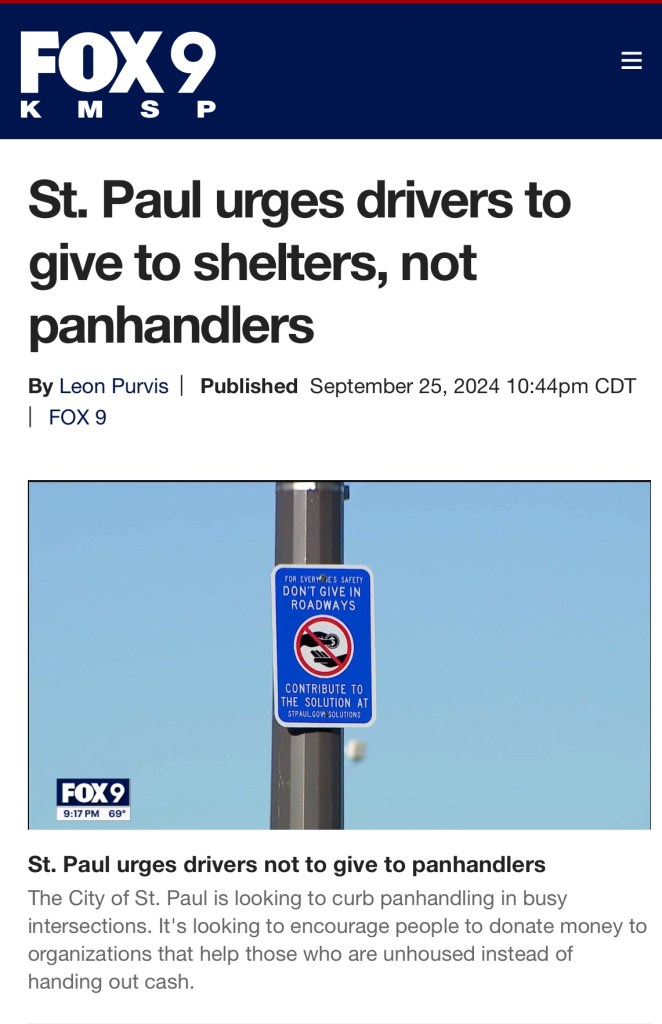
The City of St. Paul is looking to curb panhandling in busy intersections. It’s looking to encourage people to donate money to organizations that help those who are unhoused instead of handing out cash. FOX 9

City leaders say theyโ€™re doing it for public safety reasons. It’s putting signs up at intersections to bring awareness to drivers on how to help those who are unhoused. 

This is so Minnesotan. If we simply ask nicely, the good people of St. Paul will listen and do as we say! Let’s ignore incentives and inclinations.

There are two groups and two forces at work. The well enough to do in their cars are compelled at the sight of the need to fulfill an urge to act. Their instincts are crying to lend a helping hand. This is so easily accomplished by reaching into a wallet for a few dollars and rolling down a window. Searching for a reputable organization to direct funds to is tedious and not very rewarding. When you send in a check, you just get a thank you but no human touch.

Incentives for Group 1: Sign 0 Direct Give 1

The second group is the panhandlers. They have a need and are working to externalize cash from motorists’ desire for mutual aid. Although public policy types may rationalize that these folks really need this, and really need that, and it’s all because of X, does not eliminate the clear immediate need for cash. That’s their mission. The solution in the sign does not meet this need.

Incentives for Group 2: Sign 0 Direct Give 1

The sign idea does not work. If vouchers were given to motorists who want to reach out and touch someone to make a difference, and the panhandler could take said voucher to the organization for cash, among other things, then you would meet the incentives for both Groups 1 and 2. The organizations would also have a shot at ‘selling’ the panhandlers on their other services. If successful, the panhandlers would no longer need to hit the curbs with their stools and cardboard signs.

Vacant Land Registries

Vacant properties are not popular with municipalities. Cities create a vacant land registry to keep a running log of properties that do not host residents. Here are directions from the town of Brookhaven New York.

There is no longer a requirement to submit a notarized application or payment through the mail โ€“ it is all available online. The cost to register is $360 for the year and can be paid through our secure online platform.

Please be advised, that any owner, or agent of an owner acting on behalf of the owner, who fails to register a vacant building or to pay any fees required to be paid pursuant to the provisions of Chapter 87, within 30 days after they become due, shall constitute a violation punishable upon conviction thereof by a fine in the amount of not less than $1,000 nor more than $15,000 for each failure to register, or for each failure to pay a required vacant building registration fee.

The amount of the fine implies that full buildings are of value to the hamlet. Perhaps, in part, this is due to the services a resident will take up once they walk up their sidewalk every day to their front door. Perhaps having people come and go in the neighborhood keeps everyone more secure. Here are the benefits as expressed by the bureaucrats.

Registrantโ€™s point of contact will be notified by phone and/or email of issues that may arise such as:

  • Property maintenance (tall grass, litter on property, etc.)
  • When the Town is notified by law enforcement of unauthorized occupancy
  • If property becomes unsecure.

When properties are registered, the Town will have contact information and will have the opportunity to notify the owner/property manager to correct any issues before taking action. This will save the property owner money.

The city of Miami goes one step further and requires the owners post a no-tresspassing sign and authorize their police force to enter the property should a need for their services become apparent.

Install No Trespassing Sign

Once you’ve submitted your forms, you’ll need to install a No Trespassing sign on the property (this can be any sign purchased any where).

Although it may never cross your mind, your comings and goings every day in your neighborhood and place of business are a public service.

It’s not the structure-

Allison Shertzer takes issue with the headline’s cryptic economic message. If there is enough housing, then the price for occupancy should settle to the price each resident can afford. If there are fifty homes in a settlement and fifty households, then those who can pay the most pick first, and down the line, the pricing match shuffles until the last match of the least desirable to the household to those with the least resources. This simplified balance market omits nuances like how two homes are tied up when people transition from one property to another. Or that when major renovations are underway, it is difficult to live on the property, so it is vacant.

The basic premise, however, is that when there are sufficient structures to shelter every household, the price to live in those structures is pushed through the system to reflect consumers’ ability to pay. After all, even at the lowest end of the scale, it would be better for the property owner to receive some income from a less advantaged person than to let the property sit vacant.

Or is it?

It is refreshing to see a study confirming that dwellings are, in the big picture, available in
sufficient numbers. “The numbers showed that from 2010 to 2020, household
formation did exceed the number of homes available. However, there was a large
surplus of housing produced in the previous decade. In fact, from 2000 to 2020,
housing production exceeded the growth of households by 3.3 million units. The
surplus from 2000 to 2010 more than offset the shortages from 2010 to
2020.”

This article tries more than most to zero in on what is concerning. It’s not affordability in general. When ten parties are bidding on a house, that tells us there are plenty of households who find the price within their range of acceptability. When houses are selling, and apartments are rented, then folks have the funds to make those arrangements work.

What is of concern, and has always been of concern, is sheltering those at the very lowest of means. This brings us back to the question: If there are open units to occupy, is there a reason why they would be left vacant instead of settling for some cash flow? Yes, there is a reason. In some cases, the net monthly cash flow is negative. The issue is being talked about as if it concerns the building, but it’s really about the necessity of support services.

It would be even more refreshing if the conversation went in that direction instead of
hammering away about building affordable housing, which is another cryptic
economic fallacy.

Five Minute Real Estate

In this five minute video clip, Frederick Melo with the St. Paul Pioneer Press refers to a number of important real estate outcomes. He was invited to the weekly PBS show, Almanac, due to a recent announcement that a portfolio of commercial buildings, including the iconic First National Bank Building, is being listed for sale.

The collection of buildings are owned Madison Equities. Long time real estate developer, Jim Crockarell died in January and his heirs are not interested in being landlords. Building owners can gain emotional attachment to their properties as appears to be the case here. Some of them were half empty and some completely empty. Significant vacancies do not happen on the turn of a dime. Commercial leases are multi-year and companies have an investmest in their locations. So this recent announcement reflects activity which has been brewing for a while.

Well known architectural firm, TKDA, is also moving. They are relocating to Bloomington to keep workers happy. After 100 years, the downtown devotees are succumbing to practical desires for free parking. An added feature is scenic vistas over the Minnesota River. To attract workers back into the built environment, they are seeking out new surroundings in the third largest city in the state.

US Bank is also stepping away from downtown yet still staying in St. Paul. Workers here also say no to the densest part of the city. Melo reports that the building has had ghost leases for years. While technically under contract, the one-employee-per-floor occupancy has been a long-time indicator of what the future held.

What to do with all these vancant buildings is the question of the day. The solution under proposal is converting the office space to living space. But conversions are very expensive and the demand for residential in the capital city is not as strong as next door neighbor in her sister city. It’s a tough place to live.

Grants and tax increment financing are being proposed as public interventions. Is this a good idea? I’m not so sure. The mayor is quiet letting a non-profit alliance offer investment strategies. Their approach is to focus on one street at a time. One street a downtown does not make.

Cathy Wurzer brings in the ringer of a topic just at the end. Crime and personal safety. These are real issues that have been muted in the last four years. People don’t want to have to worry about being carjacked at knife-point when they’ve got a head full of kid’s programming and an armful of work manuals. Proximity to violence is a deal breaker for many people.

I had not heard of the study the Downtown Alliance had done around the DT Greeters pre and post pandemic. Within a district where a tax was collected to support the greeter program, quality of life crimes decreased by 40%. Whereas in the adjacent Lowertown area (where the St. Paul Saints stadium is located) crimes increased by 20%. Jim Crockarell, the real estate developer, opposed the district. This is speculation, but I’m guessing he thought greeting people and being busy maintainers of sidewalk safety was meant to be organic. It was the civic thing to do. Yet here is concrete data that an organized effort to deter crime, a significant motivator, was successful with subsidized labor.

In review, we were told about multiple exits to the city core. Be careful to note this was not a sudden occurance. We heard about emotional attachments beyond the pull of financial prudence. We heard about consumer driven needs for parking and easy access. We heard about the impracticality of retrofitting the built environment (file under why so many old buildings come down). We heard about public subsidies that will fall woefully short of the task. We heard about the big driver, safety, which is often kept on the QT so as not to implicate an area.

That’s a lot in five minutes

When stakes are high-

Westminister Church has a wonderful town hall forum that hosts interesting visitors in a its beautiful nave. Today’s guest was Keyu Jin whose book, The New China Playbook, Beyond Socialism and Capitalism, was recently published. I was not familiar with this professor from the London School of Economics but the title of the talk drew me in.

After the half hour talk, Prof Jin took questions from the audience. Tane Danger, the host, looks through the cards in order to group similar topics together.

One audience member asks about the nuts and bolts of the k-12 education system in China. She responded that the party originally was responsible for education and it was free to all. But the one child policy in conjunction with fierce competition to vie for the best spots in the work force, led couples to hire tutors. A high score on placement exams guarantee economic and social advancement. Thus, in response to demand, a large industry of private education providers was spawned. This led families of limited means to expend, according to Jin, as much as a quarter of their income on supplemental instruction.

Prof Jin saw this as a negative outcome to capitalism. People’s hopes and fears for their children’s success were being exploited by a private entrepreneurial spirit.

Which brings us back to a favorite topic here at Home Economics. The theory is that certain endeavors are better suited to cooperate efforts of resource providers, while others respond favorably to incentives. In the first instance, the common goal is achieved through public governance and provisions, whether informally within a group or formally via a state structure. Public education has positive impacts from all angles in a society which is undoubtedly why it was established and is still maintained as a public good in the US.

Prof Jin provides a counterfactual. When the state fails to prioritize education, private entrepreneurs jump in and fill the gap. In her example, their success in combination with the high stakes creates an inefficiency.

How many homes in a Neighborhood?

As we say here at Home Economic, context is important. Recently I heard the figure of twenty homes as a sweeping number with respect to an impact on a neighborhood. In order to evaluate an impact, it is necessary to know how many homes total constitute a typical neighborhood.

A standard city block with a sidewalk out front and an alley to the back generally has twelve to fourteen homes per city block. So if you were to think that your neighborhood was your block and two to the north, two to the east, two to the south, and then two to the west – you would have about 230 homes in total. In this case, twenty homes is about ten percent. If all these homes were in poor repair, for instance, this could be noticeable and have a negative effect on the outward appeal or from the street view.

Neighborhoods are quite a bit bigger than a cluster of two blocks to either side. Here’s a neighborhood map of Minneapolis, for example.

The USPS offers a useful tool for direct marketers which calculates the number of residential mail stops on mail carrier route (it’s called Every Door Direct Mail). We can use it here to help estimate the number of households by neighborhood. The first map is for the Armatage neighborhood. The number of homes comes in at 2620. Since the routes overlap into Fulton, let’s use a number of 2400. In this case twenty homes in the Armatage neighborhood makes up 0.83% of the total.

The Fowell neighborhood on the other side of town is know for having a larger share of corporate owned rental housing. Here, our USPS tool tells us that the neighborhood contains 2182 properties. Again rounding down is appropriate as the one route that runs on the west side of the cemetary is in the Victory neighborhood. Let’s use 2000 homes, in which case twenty porperties is 1% of the total.

It’s hard to see where one percent of a total number can have an effect on quality of life issues.

When a raw number gets tossed into a conversation as if it were a grenade ready to explode, always ask for context.

The power of Zone control

A new bill is being introduced in St. Paul concerning zoning. An eclectic mix of backers from builders to affordable housing advocacy groups, from the National Association of Realtors to progressive politicians, are in support eliminating exclusive zoning of single family homes across the state of Minnesota. Here’s are some of the highlights of the bill as provided by Edina Realty’s president Sheri Schmid- who did a nice job of presenting all sides of the issue at today’s company wide sales meeting.

The first bullet point is interesting. The public is denied the right to speak to their city council. It seems to me that there is an effort to take the NIMBY’s out of the conversation. Yet aren’t many, many city council meetings filled with advocacy groups doing their best to talk the loudest? Are they to be muted as well? This might be a public service.

I am an advocate for missing middle housing. In a 50s built neighborhood, it is common to see nice looking duplexes mixed in with single family homes. They blend in well and come at all levels of housing from a modest one bedroom to significant four bedroom units. They are also the main means of aquiring investment property for those entry entrepreneurs who would like to give rental property a try. I just wonder if these multifamily buildings sync with people today. The buyers in the 50s were still feeling the effects of the depression and thought of a little rental income on the side as comforting. Also families would buy a two unit property for siblings to live side by side, for instance. You just don’t hear those same demands anymore.

Let’s leave the next few points about building heights and parking for another time. Here are the points given that necessitate a shift of control from the very local level of the municipality to the state level.

The first bullet point in valid. There are too many regulations in the building process. But regulating by zoning is only one of the areas in question. Even after this is removed, said building would need to meet a whole host of other building regulations and set backs and still fit on the lot. Furthermore, these plans need to go through a planning approval process. It seems like whenever a change goes into effect on complicated process it takes the bureaucracies years to smooth out their systems.

Last I heard, considering the second bullet point, the production of new housing was on track to meet the Governor’s Task Force recommendation of 300,000 additional dwellings by 2030.

Do we need more affordable housing? Sure- the most disadvantaged in society will always, simply on a comparison scale, need to be accomodated to catch-up to the average. Minnesota has a poverty rate of just under 10 percent and folks in that income bracket have real and pressing needs. But what are the best housing opportunities for these families, and more importantly where are they?

Building more housing brings down the overall cost of housing. But helping people in need of housing as well as all the other components to a good life is a multidemential problem. I don’t think we’ve tackled all of the aspects involved. But I do think cities are at a much better vantage point to connect people to housing than the state.