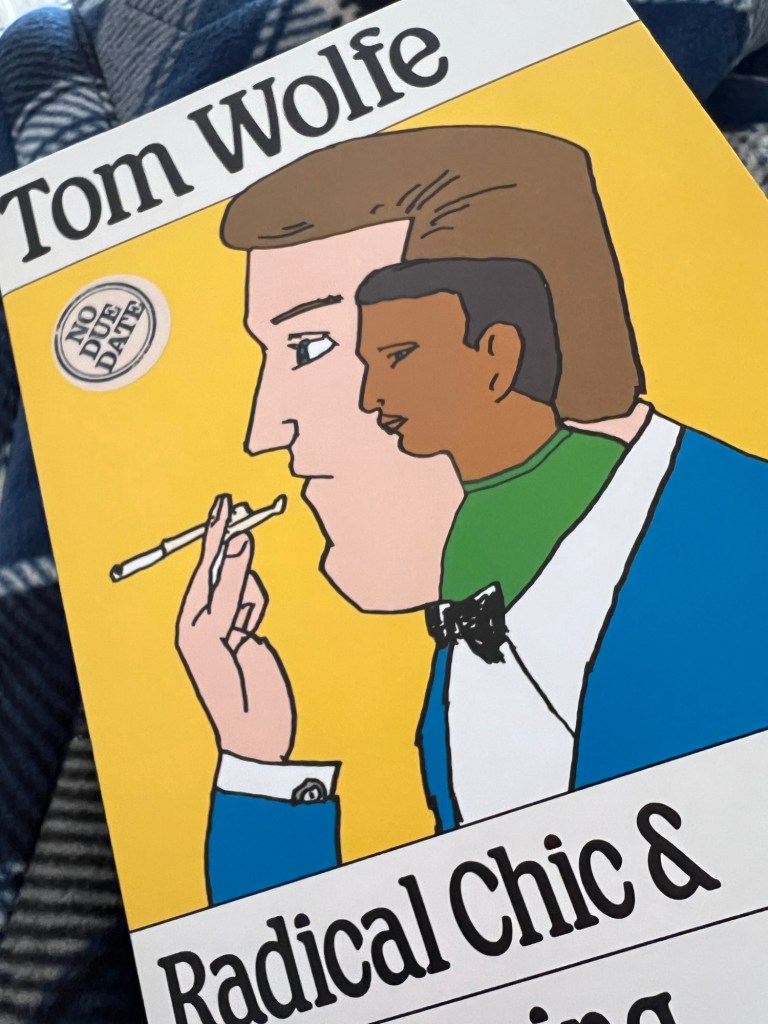
Who doesn’t like a wry metaphor or particularly apt simile? Tom Wolfe’s writing is rich in both. His short story Radical Chic depicts the wealthy of NY cooing over the edgy Marxist-Leninist black power organization.
For example, does that huge Black Panther there in the hallway, the one shaking hands with Felicia Bernstein herself, the one with the black leather coat and the dark glasses and the absolutely unbelievable Afro, Fuzzy-Wuzzy-scale, in fact—is he, a Black Panther, going on to pick up a Roquefort cheese morsel rolled in crushed nuts from off the tray, from a maid in uniform, and just pop it down the gullet without so much as missing a beat of Felicia’s perfect Mary Astor voice…
And this is all in one sentence. As a high schooler I would try out a few colorful comparisons just to have my paper returned marked up in red: too DRAMATIC! I guess you have to be famous to be creative.
There’s more to talk about in Radical Chic than a descriptive tableau. Perhaps we should take a cue from economist and blogger Tyler Cowen, who recently wrote about the Odyssey in economic terms. After all, the point of Radical Chic is a money transfer from the ultra-rich to a group with a cause, the Black Panthers.
In the Odyssey, the people involved are neatly tucked away on their islands. The groups are clearly delineated as a sea separates them from the others Homer meets on his journey. Fortunately, we have the clever and perceptive Tom Wolfe. He makes the reader see the affluent managing their servants in their townhomes in Manhattan. He corrals one group with descriptors and then another.
What the Bersteins will find out is that there are, in fact, many groups to consider. Many more than the radical chic who desperately needed something new and different in their lives. By the short story’s end, Wolfe lists many more economic players.
FOOLS, BOORS, PHILISTINES, BIRCHERS, B’NAI B’RITHEES, Defense Leaguers, Hadassah theater party piranhas, UJAvia-tors, concert-hall Irishmen, WASP ignorati, toads, newspaper readers-they were booing him, Leonard Bernstein, the egre-gio maestro… Boooooo.
As Leneord Berstein, a famous maestro, is booed while on stage, he learns that there were many more groups in play than the virtuous and the radicals, and this fact has led to him taking a private loss.

 Home Economics