Unpaid Work and More

Everybody knows what labor is. It’s the activity performed by an individual in return for a paycheck. But what about all those other activities that are done that also benefit some or many people?

I asked Chat to list all the terms out there for unpaid work done in homes and communities. And here is what I got.

1. The Home

Unpaid labor focused on household maintenance, caregiving, and family life:

  • Household Production
  • Domestic Work
  • Unpaid Domestic Labor
  • Reproductive Labor
  • Invisible Labor
  • Social Reproduction
  • Home Production
  • Unpaid Household Services
  • Homemaking
  • Housekeeping
  • Child-Rearing
  • Elder Care
  • Family Caregiving
  • Emotional Labor (within the household)
  • Caregiving
  • Informal Care
  • Unpaid Childcare
  • Parental Care
  • Kin Care

2. The Office or Other Professional Settings

Unpaid or voluntary labor in organizational, administrative, or professional contexts:

  • Pro Bono Work
  • Volunteer Work (for professional organizations)
  • Advocacy Work (unpaid)
  • Mentorship (unpaid)
  • Internship (unpaid)
  • Apprenticeship (unpaid)
  • Emotional Labor (in workplace or professional settings)

3. The Church or Other Places of Worship

Unpaid labor related to spiritual, communal, or faith-based activities:

  • Charitable Work
  • Community Service
  • Faith-Based Caregiving
  • Volunteer Work (religious organizations)
  • Advocacy Work (faith-driven)
  • Grassroots Organizing
  • Altruistic Work

4. The Community Center or Public Spaces

Unpaid labor supporting community well-being and public engagement:

  • Mutual Aid
  • Neighborly Assistance
  • Community-Based Care
  • Volunteer Work
  • Charitable Work
  • Grassroots Organizing
  • Community Service
  • Non-Market Work
  • Social Support Work
  • Advocacy Work (public or civic)

5. Schools or Educational Settings

Unpaid labor supporting education, learning, and mentoring:

  • Unpaid Tutoring
  • Mentorship (unpaid)
  • Parent-Teacher Association Work
  • Volunteer Work (schools)
  • Advocacy for Education

6. Medical and Health-Related Facilities

Unpaid labor related to caregiving and health support:

  • Elder Care
  • Family Caregiving
  • Informal Care
  • Unpaid Childcare
  • Caregiving (medical settings)
  • Volunteer Work (hospitals and clinics)

7. Farms, Rural Settings, or Outdoor Spaces

Unpaid labor connected to food production or outdoor community support:

  • Subsistence Work
  • Self-Provisioning
  • Reciprocal Labor
  • Communal Work
  • Obligatory Labor (culturally expected in rural communities)

8. Government or Civic Buildings

Unpaid labor focused on governance, policy, and public service:

  • Advocacy Work (political or civic)
  • Volunteer Work (government programs)
  • Grassroots Organizing
  • Community Service

9. Museums, Theaters, and Cultural Institutions

Unpaid labor supporting arts, culture, and historical preservation:

  • Volunteer Work (cultural organizations)
  • Passion Work (for the arts)
  • Charitable Work (for cultural causes)

This categorization demonstrates how unpaid work is intricately woven into all aspects of society, emphasizing its importance across diverse settings. (end Chat)

Although a lengthy list, I think Chat missed a few.

A notable one is the hours tinkerers spend trying to develop new products and technologies. Did the Wright Brothers get paid for their first flight?

To Your Health

If you google ‘health determinants, ‘ a bunch of stuff scrolls out in the feed, but none of it is exactly the same. For example, the World Health Organization‘s (WHO) site reports:

Determinants of Health

Many factors combine together to affect the health of individuals and communities. Whether people are healthy or not, is determined by their circumstances and environment. To a large extent, factors such as where we live, the state of our environment, genetics, our income and education level, and our relationships with friends and family all have considerable impacts on health, whereas the more commonly considered factors such as access and use of health care services often have less of an impact.

The emphasis is on a person’s situation in life more than on their genetic make-up or even access to health care services.

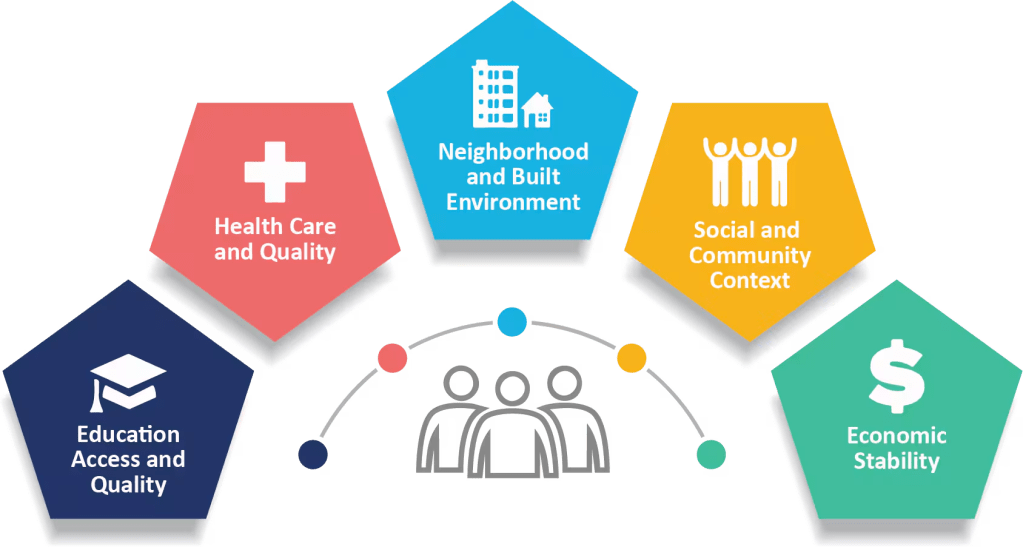
The US Center for Disease Control (CDC) offers a helpful graphic to describe their social determinants.

If you look at the hexagon you might note that the categories remind one of public goods. These goods are provided at large as they are thought to generate a universal effect that benefits everyone. If people are more educated, they will understand how to stay home with a virus so as not to pass it along to others. The availability of health care and clinics provide ease of treatment. The built environment includes transportation routes for ambulances and fire trucks to speed up a person in need. People fare better in safe communities enhanced through public provisions police services.

These categories line up nicely with the categories at Home Economics. Because the social determinants of health are also the determinants of a stable and vibrant neighborhood.

What isn’t provided at either of the sites are details. When one drills down to the street level, what can one measure that represents safety? Is it the number of pedestrian fatalities? Homicides? Or carjackings? Which number best represents safety?

Numbers meant to quantify school performance are subject to manipulation. Is the highest performer in a medium school really better off if they become a slightly above-average performer at a high-performing school? In the first instance, the student may evolve into a leader, one who expects more from themselves. Whereas in the second scenario they shrug off the duty to perform as there are so many better students in the lead. Yet competitive parents are expected to seek out the ‘top’ schools for their child- folklore says they are the best predictors of educational success.

Another factor that seems to be omitted is the level of dedication an individual, family, or community has to contribute to health issues. It’s one thing to live near a dentist, but if you never take off work to make sure your kids get in for a check-up, it does little good. Do the kids get on the school bus so they don’t trundle in late and disrupt the class? Does a neighbor ensure the octogenarian across the street gets in for their monthly treatments? How much work is going into these public health projects?

Neighborhoods are a rich source of social determinants. Combine that with a bit of information about volunteerism and who knows where that could lead us?