The Erdos Number

Paul Erdos, featured yesterday, chose a lifestyle that led to a striking number of shared work projects. Due to the sheer number of work friends, a number system was developed to keep track of the network that worked on shared ideas. Chat explains.

Paul Erdős, one of the most prolific mathematicians of the 20th century, collaborated with an extraordinary number of researchers throughout his life. His collaborators are often counted as part of the famous “Erdős Number” system, where Erdős himself has an Erdős Number of 0, his direct collaborators have a number of 1, their collaborators have a number of 2, and so on.

Estimated Number of Collaborators

Erdős collaborated with approximately 511 mathematicians on research papers during his lifetime. These collaborations resulted in over 1,500 papers, making him one of the most prolific authors in mathematical history.

This number of collaborators reflects Erdős’s unique approach to mathematics—he would travel extensively, visiting mathematicians worldwide, and work intensively with them on specific problems. This collaborative approach led to his reputation as a “mathematical nomad.”

Now, how do you think that work went when you think about all these math types puzzling over combinatorics or vertices of convex polygons? Did Erdos have a payroll and dole out cash? It seems it was the opposite. Collaborators and friends brought him into their home and put him up so he could work with them out of their university. This is not work compensated through pecuniary means.

So what’s in it for the collaborators? The Edos number, of course. Being in the Erdos network gives one sense of participation in the mathematical theory underway, and then their Erdos number specifies a claim to a distance from Erdos himself.

To recap, this type of work is voluntary and participatory, and the end product feeds into a jointly held asset—a school of thought in mathematics. Money is not the primary motivation for action. Membership in the network and the potential for the elevated position are the compensating factors. Every participant has access to the knowledge. It is a public good.

Here’s Chat’s visual.

Is it a public good to the whole world? In a sense, yes, but not in a practical sense. Just like it’s not practical to say the streets of Fargo, ND, are public to the whole world. The knowledge is open, but only a few will have the talents and learned knowledge to comprehend it. Only people in the geographic vicinity of Fargo will use their streets.

Is there externalizing and internalizing going on? Sure- when a new entrant learns a theorem, it becomes part of their knowledge. They have acquired the benefit, internalized, of the learned network. If a few of them collaborate on a textbook and sell it for their private pecuniary gain, they externalize knowledge and realize a gain. These actions do not conflict or reduce the network’s accomplishment. They add to the power and benefit of the group. The image you see inflates.

Paul Erdos’ life had living constraints, just as ours do. Yet the value of his research was such that he could be entertained at associates’ homes to assist in writing all 1,500 papers he left to the world.

Outsider on point, Outsider not so much

I’ve been diving into Democracy in America lately, written by a Frenchman, Alexis de Tocqueville, about a voyage to the New World in 1831. He was writing for the French government and primarily focused on public life. So, taken by the spirit of the population, it resulted in a text that shares the rhythm and enthusiasm of civic life, which makes the book popular today.

One point of fascination is the energy of governance at the township level. He ogles at the ability of a small group of men to tackle a public project, do their best (although he notes that this is often not as well done as professional bureaucrats), and see it through to completion. He notes the short distance between the man on the street and the organizer of public goods. In France, the central authority resides far from the common man. It’s a distance thing.

As an outsider, de Tocqueville was a keen observer. But this isn’t always the case. Sometimes, the outsider over-simplifies, and sometimes, they interpret to fit a convenient view.

Lately, immigration has been in the news, particularly the subset of intelligent, well-educated types. We have one such community. The tech workers from Asia gravitate to the same suburban area, the same school district, really. This public school district pulls in the highest scores in the state. It’s no coincidence. All the Tiger moms want their kids to go to the top school—not a private school, mind you, but a public one. For comparison, Asians in Minnesota make up 5% of the population.

Their contribution to raising the level of education among all those other Minnesota kids doesn’t stop there. Their interests in debate club, science club, and robotics flush out the teachers who are willing to lead the group. Inevitably, a photo of the teams winning some national prize filters into the community newspaper a few pages ahead of the sports teams and their accomplishments. These families want a lot and put in the work to get it.

This community also wanted to play cricket close to home. And voila! Our city has a cricket pitch.

The activity of this group reminds me of what de Tocqueville describes in the immigrant communities he witnessed. The profile of people who support the notion that anything is possible if you put a little elbow grease into the project. The distance between those with ambition and those able to coordinate and shepherd a favorable outcome is short.

When commentators imply otherwise, you wonder where they’ve been. If you are in the education game, it’s clear who carries the ball. It’s the families and the teachers. Corporations are so far removed from education mechanics that they might as well be on an island somewhere. General observation shows that highly educated, foreign-born tech workers result in positive externalities to their surrounding communities.

Big business and corporate America aren’t even on the same playing field. And those who think so might want to check the game’s rules.

To Your Health

If you google ‘health determinants, ‘ a bunch of stuff scrolls out in the feed, but none of it is exactly the same. For example, the World Health Organization‘s (WHO) site reports:

Determinants of Health

Many factors combine together to affect the health of individuals and communities. Whether people are healthy or not, is determined by their circumstances and environment. To a large extent, factors such as where we live, the state of our environment, genetics, our income and education level, and our relationships with friends and family all have considerable impacts on health, whereas the more commonly considered factors such as access and use of health care services often have less of an impact.

The emphasis is on a person’s situation in life more than on their genetic make-up or even access to health care services.

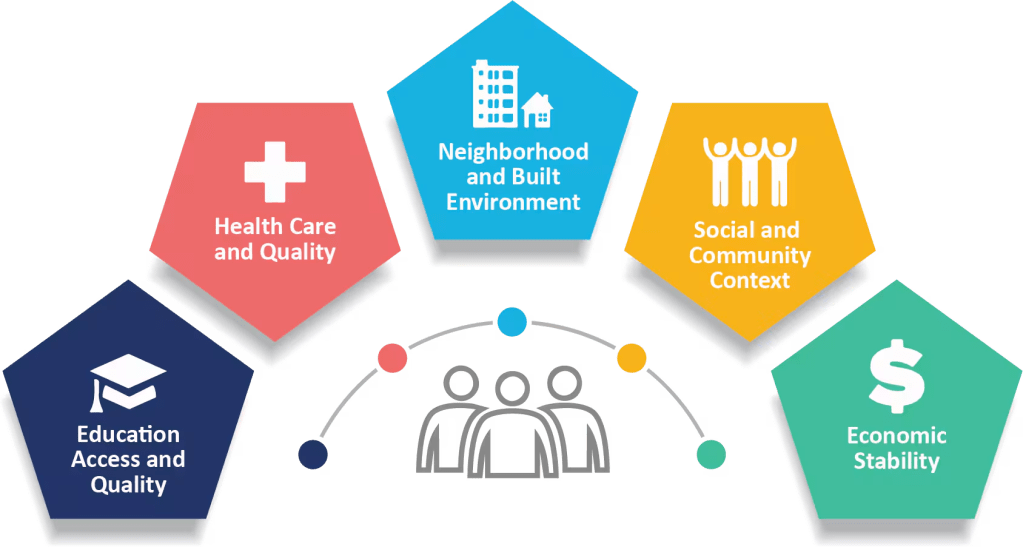
The US Center for Disease Control (CDC) offers a helpful graphic to describe their social determinants.

If you look at the hexagon you might note that the categories remind one of public goods. These goods are provided at large as they are thought to generate a universal effect that benefits everyone. If people are more educated, they will understand how to stay home with a virus so as not to pass it along to others. The availability of health care and clinics provide ease of treatment. The built environment includes transportation routes for ambulances and fire trucks to speed up a person in need. People fare better in safe communities enhanced through public provisions police services.

These categories line up nicely with the categories at Home Economics. Because the social determinants of health are also the determinants of a stable and vibrant neighborhood.

What isn’t provided at either of the sites are details. When one drills down to the street level, what can one measure that represents safety? Is it the number of pedestrian fatalities? Homicides? Or carjackings? Which number best represents safety?

Numbers meant to quantify school performance are subject to manipulation. Is the highest performer in a medium school really better off if they become a slightly above-average performer at a high-performing school? In the first instance, the student may evolve into a leader, one who expects more from themselves. Whereas in the second scenario they shrug off the duty to perform as there are so many better students in the lead. Yet competitive parents are expected to seek out the ‘top’ schools for their child- folklore says they are the best predictors of educational success.

Another factor that seems to be omitted is the level of dedication an individual, family, or community has to contribute to health issues. It’s one thing to live near a dentist, but if you never take off work to make sure your kids get in for a check-up, it does little good. Do the kids get on the school bus so they don’t trundle in late and disrupt the class? Does a neighbor ensure the octogenarian across the street gets in for their monthly treatments? How much work is going into these public health projects?

Neighborhoods are a rich source of social determinants. Combine that with a bit of information about volunteerism and who knows where that could lead us?

Public motives, Private motives

Here at Home-Economics, we argue that there are two motivations behind every transaction. People trade to benefit the public interest, such as funding flood insurance relief at the federal level. On the other hand, people are motivated to trade for the benefit of themselves—the purchase of a private residence to house a family. A blended purchase is easily seen at a fundraiser when a guest pays an inflated price for TimberWolves tickets, obtaining the private benefit of going to a basketball game while the surcharge is kept by the non-profit.

Goods traded in private markets have certain traits and are taxed and supervised by a governing body. Non-profits and governments provide many public goods and services that are not taxed nor subject to the same level of oversight. But what about private companies that provide public goods? This seems to be at the crux of the recent kerfuffle over Google.

The issue at hand is the Google search function. Clients do not pay to use it. Clients can use any other search engine and have them appear as the default web page. The search page is access to an environment. Just as the air conditioning in the mall is paid to make the shopping experience of mall shoppers more enjoyable is an enhancement to a public space, a high-functioning search is an enhanced entrance to the internet. They are both public goods to the groups of people who access their spaces.

What would be a beneficial review of a public good? Is it available to the greater group without impediments? Google search- yes to all those who have access to the internet. (Efforts are underway to make it available to residents in rural Minnesota). Is the search function supported voluntarily with some degree of additional financial support? Yes, there has been substantial investment in R&D for the benefit of the consumer. Is it providing a beneficial service? Yes- Without a doubt.

Not all public activities can meet these thresholds with the same confidence level.

Cracking the kid’s question

My husband and I both come from families with five kids. Even then, ours were larger families, as the average US woman bore 3.6 children. Big families were those with ten or more children. A college friend with twelve siblings scored top prize in the mega family category.

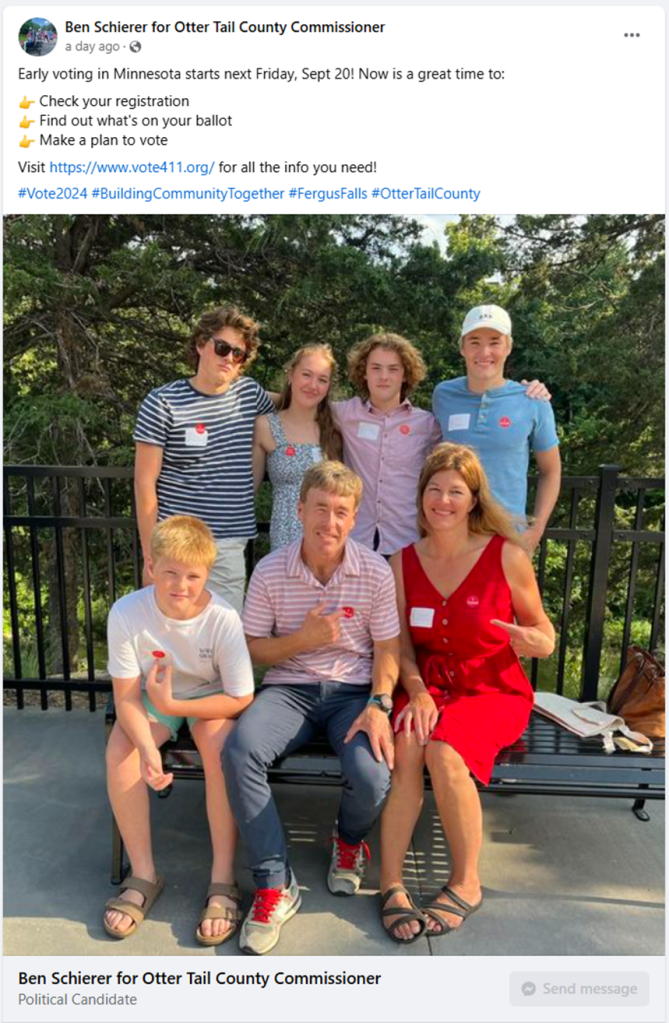
Today’s fertility rates are not even up to replacement numbers. So, what can be done to make large families fun again? One approach may be to consider them in election choices. Here’s a father of five kids running for a county commissioner position. People who live a lifestyle conducive to a gaggle of kids are bound to favor programs and support services geared that way.

Most people want similar things, such as personal safety, good schools, and adequate health care, all within the reach of decent employment. However, a large families’ focus is undoubtedly skewed to their preferences. Safety means kids can navigate city roads to and from schools and parks without harm. In contrast, a family with a musical prodigy may be perfectly willing to buffer themselves against some urban crime so their child can be within reach of the top ballet school. One wants ubiquitous small town the other wants access to specific cultural activities.

Good schools, for instance, mean good public schools in the large family scenario. It can also mean a school that isn’t too elite so that their kids have a chance to dabble in varsity sports or theater or debate without being squeezed out by intense competition. Large families form a buying group of public services. Figuring out how to match the most likely who desire a large family with the mix of services that enriches their lives is the best way to grow the population.

Transaction action and Institutions

Does affordable housing vary in quality based on location? Or is it simply a category of housing no different than a category of a car or a type of breakfast cereal? If you can use the home to shelter a household whose income falls below an acceptable level, then the property adequately meets its intended value.

A group of black pastors, led by Dr. Alfred Babington-Johnson, thinks location does matter. They are suing Minnesota Housing, an agency responsible for the allocation of public funds to subsidized housing, for exacerbating a household’s access to success by predominantly building in areas serviced by weak institutions.

A prominent voice among Black Twin Cities ministers, Babington-Johnson sued Minnesota Housing and the Metropolitan Council last year, arguing that state and regional efforts to build affordable housing effectively have backfired, increasing racial segregation while concentrating poverty in poor neighborhoods.

“Whether that’s done with proven intentionality, the outcomes clearly indicate none of the disparities go away,” Babington-Johnson said in an interview Wednesday. “The educational gaps don’t close. The economic opportunities don’t materialize.”

In this quote, Babington-Johnson refers to two institutions: schooling and the workplace. Efforts to develop educated people are regarded as the path to improved employment. Yet when people reside in areas where 40-50% of the residents live below the poverty level, it is easy to imagine that the lack of informal networking and time resources available to nurture these institutions is not at hand.

The Minnesota Housing Commissioner counters:

In a letter to the state advisory committee last month, Minnesota Housing Commissioner Jennifer Ho wrote that “in the last several years, 63% of the new rental units in the Twin Cities metro area that have been awarded funds through the Agency’s Consolidated Request for Proposals have been in the suburbs while 37% have been in the central cities of Minneapolis and St. Paul.”

Which seems to contradict what people on the ground are feeling. My question, as a casual follower of the issues, is why are the numbers so hard to come by? Every time I’ve gone down the rabbit hole to try to nail down the numerical facts of these conversations, time has not allowed for a successful outcome. As public information, it seems they should be accessible. Attorneys for the pastor group put out these numbers.

Attorneys for Stairstep noted that in the Twin Cities, more than 23,000 affordable housing units received subsidies that began between 2017 and 2021. Of them, 56% — or 13,000 units — were subsidized by Minnesota Housing, the Met Council or another form of state funding.

Note the difference in verbiage between ‘new’ units versus all subsidized units. Two thirds of the new units may go to the suburbs. However, this clouds the issue, which is that most subsidies, by the structure of aid distribution, flow to neighborhoods of high poverty. The Housing Commissioner proposes work to be done to create the ideal institutions in place.

“For example,” she said, “the only avenue for lower-income parents of color to access well-resourced schools should not be making them move to a white, wealthy community, which may lack other opportunities that they value. Rather, we should invest in disinvested communities and ensure that all schools are well resourced, allowing people to achieve equity in place.”

The implications that folks could be giving up support groups in a move is a valid one. But who would be in the best position to provide voice to whether it is more feasible to relocate or to enhance institutions in high poverty areas? The pastors, or the residents if given the choice to move, or the government who holds monopoly on dictating where the housing units are located? Shouldn’t residents have a choice?

A form seen in highlights

Albert Hirshman describes an economic motion in his book Exit, Voice and Loyalty (1970). Parties can withdraw if they do not care for a product or arrangement. They may attempt to impact the process by exercising their voice. Over time, loyalties develop, which influence the superstructure of relationships.

It seems Hirshman would agree with his contemporary, Milton Friedman, about the benefits of school vouchers. Should a family be displeased with a pedantic school district, they could collect a coupon for their tax dollar input and cash it in at another more vibrant district. Since schools are tied to geographies, consumers always have the choice to relocate their homes to attend elsewhere. Vouchers make the process more fungible.

Hirschman outlined the logic of the exit option and how noted how increased competition could improve government performance. But competition didn’t solve all problems, and the exit option had several important drawbacks. The freedom to exit was often used by the most ambitious, educated, or well-to-do users of a particular service, and once they exited, those remaining were even poorer, less educated, and less demanding. Moreover, Hirschman pointed out, the possibility of exit weakened the effectiveness of voice, that is, the ability to directly change the management’s behavior through feedback, discussion, and criticism. 

As Frank Fukuyama explains in his American Interest piece, Hirshman didn’t believe vouchers were the answer to improving a school system. Unlike other commodities, the departure of the stronger students from the classroom has a negative impact on the remaining students. This observation gives a new form to education. Casting the product in this light projects a little amber glow onto all members of the school community. The mission is to educate everyone. If not an educator or a student, the role may be to voice praise or criticism.

A school does not produce widgets on an assembly line, but a group process produces educated students. Changing the composition of the pool of players can have both positive and negative effects on the outcomes. And there are roles for an audience as well.

When stakes are high-

Westminister Church has a wonderful town hall forum that hosts interesting visitors in a its beautiful nave. Today’s guest was Keyu Jin whose book, The New China Playbook, Beyond Socialism and Capitalism, was recently published. I was not familiar with this professor from the London School of Economics but the title of the talk drew me in.

After the half hour talk, Prof Jin took questions from the audience. Tane Danger, the host, looks through the cards in order to group similar topics together.

One audience member asks about the nuts and bolts of the k-12 education system in China. She responded that the party originally was responsible for education and it was free to all. But the one child policy in conjunction with fierce competition to vie for the best spots in the work force, led couples to hire tutors. A high score on placement exams guarantee economic and social advancement. Thus, in response to demand, a large industry of private education providers was spawned. This led families of limited means to expend, according to Jin, as much as a quarter of their income on supplemental instruction.

Prof Jin saw this as a negative outcome to capitalism. People’s hopes and fears for their children’s success were being exploited by a private entrepreneurial spirit.

Which brings us back to a favorite topic here at Home Economics. The theory is that certain endeavors are better suited to cooperate efforts of resource providers, while others respond favorably to incentives. In the first instance, the common goal is achieved through public governance and provisions, whether informally within a group or formally via a state structure. Public education has positive impacts from all angles in a society which is undoubtedly why it was established and is still maintained as a public good in the US.

Prof Jin provides a counterfactual. When the state fails to prioritize education, private entrepreneurs jump in and fill the gap. In her example, their success in combination with the high stakes creates an inefficiency.

Downs called it Dual Rationality

As Chat GPT explains:

In Chapter 2 of “An Economic Theory of Democracy,” Anthony Downs introduces the concept of dual rationality, which he suggests characterizes individuals’ decision-making processes, particularly in economic and political contexts. This dualism reflects the idea that individuals often consider not only their narrow self-interests but also broader social concerns when making choices.

Here’s a breakdown of the dual rationality concept as outlined by Downs:

  1. Narrow Self-Interest: Downs acknowledges that individuals typically act to maximize their own utility or self-interest. This aspect of decision-making is rooted in traditional economic theory, which assumes that individuals are rational actors who seek to maximize their personal well-being. In economic choices, individuals often weigh the costs and benefits to themselves personally.
  2. Social or Broader Concerns: However, Downs also recognizes that individuals may take into account broader social or altruistic considerations when making decisions. This broader concern may include considerations for the welfare of others, societal values, or long-term societal well-being. In the context of political decision-making, voters may consider not only how policies directly affect themselves but also how they impact society as a whole or specific groups within society.

Downs argues that individuals exhibit this dual rationality in both economic and political spheres. While they may prioritize their narrow self-interest in many situations, they also incorporate social considerations into their decision-making process. This dualism reflects the complexity of human motivations and the interplay between individual and societal concerns.

By acknowledging this dual rationality, Downs provides a more nuanced understanding of decision-making processes in both economics and politics. He highlights the importance of considering not only individual self-interest but also broader societal implications when analyzing human behavior in various contexts.

Methods for meals

Talking about methods, I noticed one method pop up on Twitter around the value of providing free school meals (breakfast and lunch) to all school children. There has always been provisions to feed children in poverty at schools across the state of Minnesota. So about 12% of school age children’s families were not charged and 88% were billed by the school. Or moms prepared lunchs and sent them out in backpacks.

In actions reflective of an exuberant majority, the law makers passed a bill to cover meals for all children. (We feed kids instead of banning books! was a slogan this year) On the face of things it sounds like a wonderful thing to do. In the world of constraints it shouldn’t be a surprise anyone that the cost of the program is bulging well past the initial number. Listen to little onion. 

Is it valid to compare the cost of free meals to the cost of police misconduct settlements? On the one hand government decided to pay food bill for families who could afford to buy their kids lunch. On the other hand there’s a number for mismanagement of a police force and the subsequent fallout. One is for sustenance, the other is for public security. The only thing to grab onto here is that taxpayer money settles the tab. Method Grade: F-.

Here’s another method to present whether the cost of increasing the school meal tab to cover all students is justified.

We note a pattern here between those who support free lunch- they value it more than funding the police. Public safety is a concern for all. Lunches are covering less than 20 percent of the population. Lack of public safety results in a loss of some kind to all citizens. Lack of school meals, in this case, means a few more PB&J’s and carrots sticks for some families. As a method, these comparisons, well, are weak. Method Grade: F-.

The Gov thinks the program is worth it since a mom wrote to him and said she appreciated not having to pack lunchs ever morning for her three kids.

At least in this method a politician was listening to a constituent. Method Grade: F+.