Market Failure was used as the signal– but what now?

In days of yore, there was the market and the state. Two separate spheres of activity coexisted. And when private industry did not come through for the people, in the way they thought it should, market failure was the name given to assign blame. When the market failed, it was up to the state to address the lack of supply in areas such as medical care, poverty alleviation, housing, and the like.

One of economist Tyler Cowen’s first books addresses this trigger for state action in a compilation of thoughts on The Theory of Market Failure: A Critical Examination. But he isn’t convinced. He seems to say that when you look so closely at a tiny segment of a large system, you don’t see anything at all.

Consider externalities, a key signal that the market is merely pushing a problem onto some unsuspecting observer. He claims that (nearly) every single transaction has a positive or negative external effect. And, if you think about it, it’s true. We are social creatures. Although many consumptions are deeply personal, in the end, we always touch the lives of others.

The scope of the externalities/nonexcludability issue is vast. Nearly every concern of economic policy, from environmental considerations to research and development, involves externality problems. No one would claim that every instance of an externality warrants state intervention. There is no doubt, however, that the existence of externalities is one of the most powerful arguments for public sector involvement in the provision of public goods.

This isn’t the proper trigger for government intervention.

What about when the price seems too high, as in housing, or too low, as in wages? Whether a good is mediated through the private or public sector, prices still carry the most valuable form of comparative value information.

As noted earlier, the theory of public goods and externalities implies that if a good is characterized by nonrivalrous consumption, allowing additional individuals to consume it entails zero marginal cost. Demsetz’s arguments (1964; 1970) imply that this is only true in the presence of perfect information. Otherwise, allowing additional individuals to consume a good free of charge results in the abandonment of the price system in that sphere of activity. Since the publication of Hayek 1945, the role of prices in communicating information has been well known. In the provision of public goods as well as private goods, sacrificing such information may entail significant costs.

Prices are the most critical form of encapsulation of what groups of exchangers say about an exchange. We may not always conduct a thorough analysis of prices. That might be where the problem lies.

For instance, the exchange might be telling something vital about a group of people that others are simply not attuned to. People join various clubs throughout their lives. And these associations create structures of value.

The next two selections in section 2 of this volume discuss the nature of local public goods. Because such goods, by definition, can be provided to only a segment of a nation or community, determining which individuals will receive them becomes part of the economic problem. Once club or community membership becomes endogenous, many of Samuelson’s conclusions do not hold.

When people leave or join a club, when they exit or stay loyal, they impact how much of a surcharge the group of people in the club can charge.

The Tiebout model avoids the preference revelation problem; an individual’s preferences are revealed by his choice of location. It also avoids the free-rider problem; those who choose to belong to a given community are subject to the taxes or user fées that finance the provision of goods. Nor is pricing inefficiency a problem. If an individual is inefficiently excluded from the use of a public good or service, he can simply move to a community where that exclusion is not practiced.

The introduction written by Tyler Cowen is comprehensive. To the engaged observer, he dispels the dichotomy between industry and the state. There’s something pluristic out there. It’s big, messy, and complicated. It dovetails into many of the things people talk about under the titular of institutions. But it has structure– once you stand back and take a look.

That’s the project of the moment: a unified theory of price.

The Cascade Effect: Unlocking Housing Affordability

Housing markets often seem mysterious, but at their core they operate as a cascading system shaped by wealth, supply, and lending rules. A recent model by Abramson and Landvoigt highlights how rising wealth inequality and slow housing supply interact to push prices upward. Their framework divides housing into quality tiers, from luxury to starter units, and shows how households with different levels of wealth compete across these tiers.

A central insight is that prices at the very top do not stay isolated. Luxury buyers are a small share of the market, and in some sense they simply bid against one another for exclusivity. One might argue that they are “fools” for paying such large premiums, while the rest of the market should remain relatively affordable. But in practice the tiers are linked. When supply of luxury units is restricted, affluent households who cannot find space at the top tier shift down into the next-best homes. That displacement triggers a chain reaction: middle-income households face stiffer competition, prices at their tier rise, and the pressure filters all the way down to lower-income renters. Economists call this the filtering or musical chairs effect, and it means that adding supply at the high end can improve affordability across the board.

This cascading dynamic is exactly what makes the market work. New supply at any tier frees up units that can be occupied by someone else, allowing households to sort themselves according to means and preferences. The danger arises when either end of the ladder is blocked. If new high-end supply is not built, the wealthy bid down-market and crowd out others. If older or more affordable stock is neglected, the bottom rungs collapse and low-income households are left without viable options.

At the same time, credit standards shape who can actually buy. A household that cannot afford the payments will not receive a loan, which protects individuals from becoming dangerously over-leveraged. But this underwriting filter does not stop prices from rising overall; it only determines who gets excluded. The clearing price is still set by those wealthier households who can obtain financing. Those priced out of ownership often remain in the rental sector, where demand pressures drive rents upward as well.

Taken together, the picture is less about a simple split between the rich and poor and more about a tightly connected cascade. Housing affordability depends not only on overall supply but also on how well each rung of the ladder is maintained and allowed to expand.

Trump- shock think

Trump is irritating, bombastic, and a general pain in the patuti to all spectrums of political ideology– but you must admit that his unconventional methods get people looking at issues from new angles. Who would have thought that those on the left would become free traders? They oppose Trump’s tariffs meant to protect the American worker (or let’s avoid reading too much into the mind of the art of the deal maker).

And there’s more to see of the unseen. Writers are unveiling things like ‘hidden costs.’ In this super article by Luis Garicano, The Myth of the Single Market, the author proposes that national customs have always charged an override on goods and services that move across European borders.

The IMF puts the hidden cost of trading goods inside the EU at the equivalent of a 45% tariff. For services the figure climbs to 110%, higher than Trump’s “Liberation day” tariffs on Chinese imports—measures many saw as a near-embargo.

We advocate for the idea that social costs are part of the price at Home-Economic. They are hidden only in the sense that they are not talked about. It’s not polite to say to someone that they paid a luxury/status surcharge for their watch because they want to show off, even if Veblen said it was so a hundred years ago. People don’t want to think about whether they selected a bigger house at the expense of a longer commute, which takes their time away from their children. These trades in social commitments are sheltered from the glaring eyes of sharpened pencils and numerical analysis.

But that doesn’t mean they aren’t there. Social costs and surpluses have always been a part of price. Tariffs are just the name for the formalized process of collecting and directing them.

Thank Trump for that bit of awareness.

Keeping track of Tariffs

With all this tariff talk, I’m breaking some misconceptions. For instance, I thought China was our top trading partner. I had no idea that Canada charges tariffs between provinces —sounds laborious to keep track of! Nor did I realize the extent and amount of the tariffs charged worldwide.

Top Ten U.S. Trading Partners and Tariffs Charged Prior to April 1, 2025

  1. Mexico
  • Trade Context: Mexico was the U.S.’s top trading partner in 2023, with total trade valued at approximately $776 billion (goods only). Under the U.S.-Mexico-Canada Agreement (USMCA), most U.S. goods entered Mexico duty-free prior to April 1, 2025.
  • Tariffs Charged: For USMCA-compliant goods, tariffs were generally 0%. For non-USMCA goods, Mexico applied MFN rates, averaging around 7% for industrial products and higher for certain agricultural goods (e.g., up to 20-25% on some items like dairy or poultry under supply management systems). Specific rates depended on the product.

2. Canada

  • Trade Context: Canada was the second-largest U.S. trading partner, accounting for 14.3% of U.S. trade in 2023. Like Mexico, it operates under the USMCA.
  • Tariffs Charged: Most U.S. goods entered Canada duty-free under USMCA prior to April 1, 2025. For non-USMCA goods, Canada’s MFN tariff averaged 4.1%, with higher rates on protected sectors like dairy (up to 200-300% on certain products due to supply management) and softwood lumber (subject to duties averaging 10-20% depending on market conditions).

3. China

  • Trade Context: China was the third-largest U.S. trading partner, with a 10.9% share of U.S. trade in 2023 and a significant trade deficit ($295.4 billion in 2024).
  • Tariffs Charged: Prior to April 1, 2025, China’s average MFN tariff rate was around 7.5% for U.S. goods, but retaliatory tariffs from the first Trump administration’s trade war (2018-2020) raised rates on many U.S. products to 20-25% or higher (e.g., soybeans, autos). The “Phase 1” trade deal in 2020 reduced some tensions, but specific rates varied widely by product.

4. Germany

  • Trade Context: Germany, as part of the EU, contributed 4.4% of U.S. trade in 2023. The EU as a whole is a major U.S. trading partner.
  • Tariffs Charged: Prior to April 1, 2025, the EU applied an average tariff of 5.1% on U.S. goods under MFN rules (no U.S.-EU free trade agreement existed). Specific rates included 10% on autos, 25% on certain steel products (retaliatory), and higher rates on agricultural goods (e.g., 15-20% on some food items).

5. Japan

  • Trade Context: Japan is a significant U.S. trading partner, with a trade deficit noted in 2024 data.
  • Tariffs Charged: Under the U.S.-Japan Trade Agreement (effective 2020), many U.S. goods entered Japan duty-free or at reduced rates prior to April 1, 2025. Japan’s average MFN tariff was 4.3%, but agricultural products faced higher rates (e.g., 38.5% on beef, 15% on some fruits). The Trump administration later claimed Japan charged 46% equivalent when factoring in non-tariff barriers.

6. South Korea

  • Trade Context: A key U.S. trading partner in Asia, South Korea had a free trade agreement (KORUS FTA) with the U.S.
  • Tariffs Charged: Prior to April 1, 2025, most U.S. goods entered South Korea duty-free under KORUS FTA. The average MFN tariff was 6.2%, with higher rates on agriculture (e.g., 40% on some rice products). The Trump administration later cited a 50% equivalent rate including non-tariff barriers.

7. UK

  • Trade Context: The UK ran a trade surplus with the U.S. in 2023 ($14.5 billion per U.S. data).
  • Tariffs Charged: Post-Brexit, the UK applied an average MFN tariff of 5.7% on U.S. goods prior to April 1, 2025, with most rates mirroring the EU’s (e.g., 10% on autos). No U.S.-UK free trade agreement was in place, though negotiations were ongoing.

8. India

  • Trade Context: India is an emerging U.S. trading partner with a notable trade surplus.
  • Tariffs Charged: Prior to April 1, 2025, India’s average MFN tariff on U.S. goods was high, around 13.8%, with significant variation (e.g., 20% on electronics, 100% on some alcoholic beverages). The Trump administration later claimed a 52% equivalent rate including non-tariff barriers.

9. Taiwan

  • Trade Context: Taiwan is a key supplier of electronics to the U.S.
  • Tariffs Charged: Prior to April 1, 2025, Taiwan’s average MFN tariff was 7.1% on U.S. goods, with lower rates on industrial products and higher rates on agriculture (e.g., 15-20% on some items). The Trump administration later cited a 64% equivalent rate with non-tariff barriers.

10. Vietnam

    • Trade Context: Vietnam has grown as a U.S. trading partner, especially for consumer goods.
    • Tariffs Charged: Prior to April 1, 2025, Vietnam’s average MFN tariff on U.S. goods was around 9.6%, with higher rates on specific sectors (e.g., 20-30% on some agricultural products). The Trump administration later claimed a 92% equivalent rate, halved to 46%, factoring in trade imbalances and barriers.

Notes and Context

  • Data Sources: Trade partner rankings are based on 2023/2024 data from sources like the U.S. Census Bureau and Euronews. Tariff rates reflect pre-April 1, 2025, conditions, primarily MFN rates unless a trade agreement applied.
  • Limitations: Exact tariff schedules for every product aren’t fully detailed here due to variability. The listed averages are indicative, and specific rates could be higher or lower depending on the good.
  • Trump’s Reciprocal Tariffs: On April 2, 2025, President Trump announced new U.S. tariffs effective April 5 (10% baseline) and April 9 (country-specific rates), calculated as half the perceived “charge” (trade deficit divided by exports, plus non-tariff barriers). Pre-April 1 tariffs from trading partners didn’t directly align with these calculations, which included non-monetary factors like currency manipulation.

This list reflects the top U.S. trading partners and their general tariff policies toward U.S. goods before the significant policy shift on April 2, 2025.

Sincerely, Grok

O-rings in Community

The O-ring model in economics offers an explanation of a production weakness.

The O-ring theory of economic development is a model of economic development put forward by Michael Kremer in 1993,[1] which proposes that tasks of production must be executed proficiently together in order for any of them to be of high value. The key feature of this model is positive assortative matching, whereby people with similar skill levels work together.[1]

The model argues that the O-ring development theory explains why rich countries produce more complicated products, have larger firms and much higher worker productivity than poor countries.[2]

The name is a reference to the 1986 Challenger shuttle disaster, a catastrophe caused by the failure of O-rings.

WIKI

However, this model understates the possible results, as its production is thought to be positive. In communal markets, the weakest link can fail in their task and draw against the resources other teammates offer.

At Home Economics, we like to distinguish between two types of products: some are more conducive to private transactions, and others are more conducive to communal or public transactions. Those in the first category benefited greatly from the division of labor, for instance. Every worker in the chain focuses on one job, and the line produces a fabulous model T. The second category includes activities such as the ‘eyes on the street’ method of public safety, which was developed by urbanist Jane Jacobs. If a community is mindful of on-goings outside their front doors and reports as necessary, then residents benefit from reduced crime.

Now consider two forms of education delivery. Say one involves students completing modules of schoolwork from a home computer. The overall score of the class will harmed by the weakest link, but each individual performs independently. Now consider a classroom setting. Say one child often misses the bus. They regularly arrive late to class. This disrupts the teacher’s material delivery and causes friction between the students. In this communal situation, it is not only the tardy child who suffers but the whole class. This scenario is one most often given in explanation of why some high-poverty elementary schools suffer from below-average performance.

With items suited to private goods production, the o-ring model implies fewer products that meet perfection. If a company builds laptops and one worker fails to meet standards, fewer laptops are sold. But in a group scenario, where the leaders, perhaps of a certain age, are unwilling to adopt an electronic methodology, say a new accounting feature, they create more work for employees effectively pulling negative productivity.

The negative impact potential in the o-ring model for communal products is underestimated.

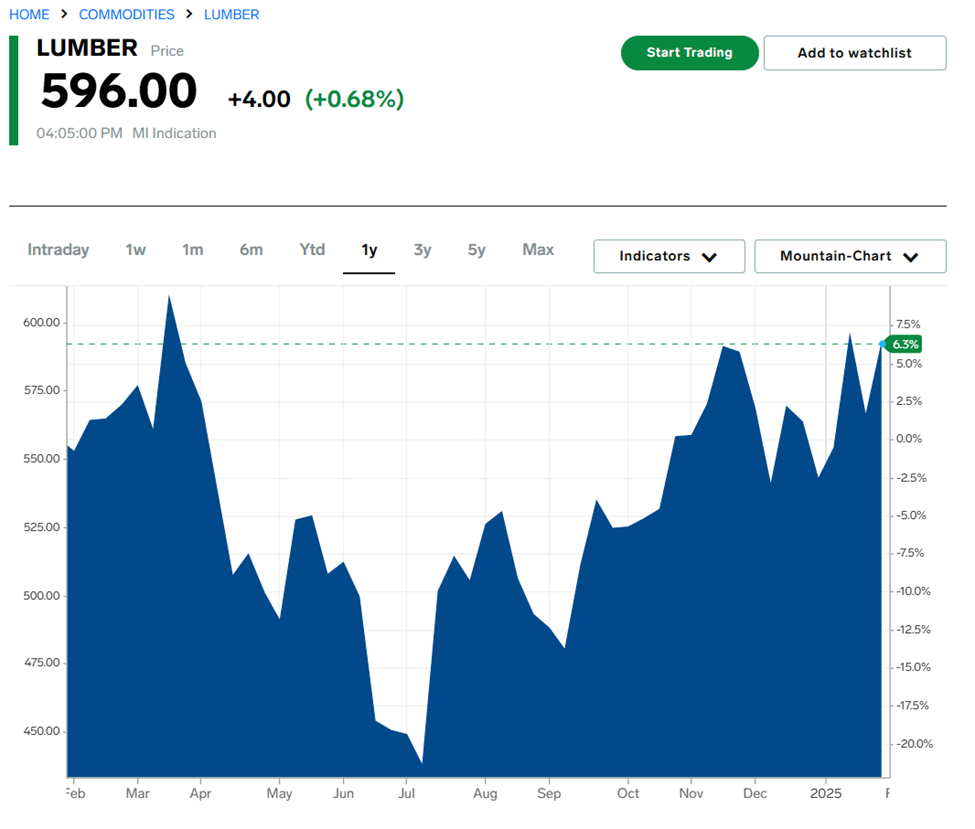
Housing Starts & Lumber prices

Prompted from Chat

December 2024 Sees a Surge in U.S. Housing Starts

After a challenging year, U.S. housing starts saw a 15.8% surge in December 2024, reaching an annualized rate of 1.50 million units. This growth was largely driven by a 61.5% rebound in multifamily construction, while single-family starts rose 3.4%. Despite this late-year boost, overall housing starts for 2024 fell 3.9% compared to 2023, reflecting a cooling market due to higher mortgage rates and construction costs.

A significant portion of the lumber used for home construction in the U.S. still comes from Canada, accounting for 25-30% of total softwood lumber consumption. However, the cost of lumber has fluctuated. Over the last year, lumber prices have declined from elevated levels seen in 2022-2023, as supply chains improved and housing demand adjusted. As of early 2025, lumber prices are around $538 per thousand board feet, down from previous highs but still above pre-pandemic averages.

Trade policy remains a critical factor. In August 2024, the U.S. increased tariffs on Canadian softwood lumber from 8.05% to 14.54%. Additionally, a new 25% tariff on Canadian and Mexican imports, set to take effect in February 2025, could drive costs higher. These tariffs may slow future building starts as material costs rise, impacting affordability and overall construction activity.

While December’s surge in housing starts is promising, builders must navigate ongoing supply chain challenges and policy shifts that could influence construction costs in the months ahead.

Super Power

It might be a bit difficult to buy this picture as a model of spontaneous order. Spontaneity, perhaps, but order?

Each little bubble is a representation of an independent actor out fulfilling their purpose of the day. Bubble wrapped, as they each get to retain their skills, talent and experiences and bring those forth in the work they do.

This is in fact their super power. No matter who you know in life or where you start, you have the power to devote your time and energy to the endeavors of your choice.

Luckily, the twentieth century is full of modeling the chores done in exchange for pay. No need to review that here. Economics is most comfortable in this environment: money for goods, services, and labor. It’s countable. The measures are used in all sorts of reports and for all sorts of comparisons.

Sometimes the numbers seem off. Sometimes, people don’t end up where someone thinks they should. And Social Welfare Economics tried to get a handle on such things. As a method, it really couldn’t pull off the knowing part. How do you know when such a group is better off than the other? Isn’t a comparison contingent on all the factors that go into the moment? This is what James M Buchanan seems to argue in Positive Economics, Welfare Economics, and Political Economy (1959)

A second major problem which has concerned theorists in welfare economics has been the possible existence of external effects in individual consumption and production decisions, sometimes called “spillover” or “neighborhood” effects. But this annoying complication also disappears in the approach to welfare economics suggested here. If, in fact, external effects are present, these will be fully reflected in the individual choices made for or against the collective action which may be proposed. External effects which are unaccounted for in the presumptive efficiency criterion of the economist and the proposal based upon this criterion will negate the prediction of consensus represented in the alternative suggested. The presence of such effects on a large scale will, of course, make the task of the political economist more difficult. His predictions must embody estimates of a wider range of individual preferences than would otherwise be the case. The compensations included in the suggested policy changes must be more carefully drawn and must be extended to include more individuals who might otherwise be neglected.®

The reader might be led to believe, in this bottom-up observation of human behavior, that consumers reflect a comprehensive analysis of the entirety of their transaction, including internalizing spillovers and externalizing expenses. The market filters through individuals’ private desires and their accommodations for public or group enterprise in a complex, yet thoughtful manner.

The graphic specifies the draw of a common cause, whether it be education, peace, or public health (and there are thousands more). It is the cause that sorts the analysis. It’s not a group being told to sign up to walk for MS. It’s the desire to be on the team fighting a deadly disease that drives the worker to devote their superpower to a cause.

In review

First principles of the model are

  • 1. Actors are independent free agents.
  • 2. Actors may offer work for private benefit or toward a group goal.

Claims about Housework

Duncan Ironmonger, an Australian household economist, wrote in 2001.

3.2 The New Household Economics
In the mid 1960s a major theoretical development took place, known as the “new
household economics” (see Becker (1981), Ironmonger (1972) and Lancaster (1971).
In this theory the household is regarded as a productive sector with household
activities modeled as a series of industries.
In this new approach, households produce commodities that are designed to satisfy
separate wants such as thirst, hunger, warmth and shelter. The characteristics, or
want-satisfying qualities, of the commodities used and produced can be regarded as
defining the production and consumption technology of households. With changes in
incomes and prices, households still alter expenditures as in the earlier theory.
However, in the new theory, households adjust their behaviour as they discover new
commodities and their usefulness in household production processes.
The activities approach derived from the theory of the new household economics
readily combines with the earlier input-output approach of Leontief (1941) to
establish a series of household input-output tables as the framework for modeling
household production.

And then this in conclusion.

6 Household Production and a World of Binary Economies

The major scientific achievement of this field has been the measurement of the
magnitude of household production through surveys of the uses of time. Household
production is now recognised as an alternative economy to the market; in many
countries the household economy absorbs more labour and at least one third the
physical capital used in the market economy.

In future, national statistical organisations will produce regular estimates of GHP.
Data on outputs of household production – accommodation, meals, clean clothes and
the care of children and adults – will complement data on inputs of unpaid labor and
the use of household capital.

Proper recognition of the household economy will have arrived when national
household accounts are published each quarter alongside national accounts for the
market economy. These data will enable greater scientific research on the
organisation of household production, the interactions with the market economy, the
role of households in building human capital, on the effects of household technology
and alternative social and economic policies on gender divisions of labor and on
family welfare.

Full paper: Houshold Production and the Household Economy.

Talk of Tariffs- MN Edition

In 2022, Minnesota traded a total of $6.2 billion with Mexico. With our neighbors to the north in Canada, Minnesota traded more than $21 billion.

In response to the question of who pays for tariffs, University of Minnesota professor of economics Tim Kehoe replied, “And the findings have been that somewhere between 90% and 100%– the number gets bigger over time– of the tariff revenue comes from US firms or consumers. That is, we pay more for the imports.” But this is really a follow-the-money answer. Where does the cash come from that goes into the tax revenue? The consumer who made the purchase.

This is an incomplete analysis.

The economist says Minnesotans will pay higher prices to cover the tariffs. Yet he suggests that when countries retaliate, they simply have the choice to buy goods elsewhere. It seems that a country that imposes a tariff suffers, and one that chooses a less efficient trade with another partner also suffers a loss. The question isn’t whether the less agreeable trading arrangements are costly. The question is what the cost of buying is, and is that worth it?

Consider the objectives at hand.

“Now, President-elect Donald Trump says, on day one in office, he will impose sweeping new tariffs of 25% on Canada and Mexico and another 10% tariff on China. Trump says, the Mexico-Canada tariff is to crack down on illegal immigration and drugs. “

I’d be interested in an analysis that shows how tariff penalties will incentivize these trading partners to respond to the above-mentioned objectives. Will the cost of this trade arrangement induce Mexico and Canada to put some muscle into immigration issues? How about drugs?

The American people want these issues addressed, and this implies they are willing to put resources towards this aim. Will these new trade agreements prove to be the most cost-effective compared to other enforcement options? (MPR article quoted)

Social influence on price- Endogenous or External?

It was a privilege to meet sociologist Viviana Zelizer yesterday. Our No Due Date book club read her 1994 book The Social Meaning of Money and we are fortunate to have an hour live with authors to discuss their work.

I think ChatGPT provides some interesting insights into her work:

Viviana Zelizer’s work suggests that the value of social relations is not simply an external force acting on price, nor is it strictly endogenous in the sense of being fully determined within the price mechanism itself. Instead, she argues that social relations and economic transactions are deeply interwoven in a way that both shapes and is shaped by the cultural and moral contexts surrounding them.

In her framework, Zelizer contends that social values and economic exchanges co-constitute one another. That is, social relations influence economic value and practices, but these exchanges also affect the nature of social relationships. For example, in “The Social Meaning of Money,” she demonstrates that people assign specific social meanings to money and earmark it for different purposes (like gifts or household expenses), which reinforces particular social relationships. The relational context affects how money is perceived and used, indicating that social and moral values are not external to money and price but integral to how people understand and navigate economic transactions.

Zelizer’s approach thus goes beyond a simple model of “external influence” or “endogenous value,” advocating instead for a relational view. She calls this the “relational work” perspective, emphasizing that people continuously create and manage the boundaries between social and economic life. Through this process, social norms and values both influence and are influenced by economic behavior, making them mutually constitutive rather than separable or one-directional forces.

Fact of the Day

How much US cash is held out of the country? A lot. Christopher Neely at the St. Louis federal Reserve explains:

The U.S. dollar has been the most widely used international currency since 1945.1 The dollar is the most traded currency on international financial markets, dollars comprise 60% of official reserves (i.e., foreign exchange reserves), and many traded goods, such as oil, are commonly invoiced in dollars. In addition to these commercial uses of the dollar and dollar-denominated assets, individuals in many parts of the world hold U.S. currency, i.e., paper money, both as a store of value and as a medium of exchange.2 This blog post3 explains the widespread use of U.S. currency and provides some simple, back-of-the-envelope calculations on the size of some of the benefits to Americans.

The rest of the world holds a great deal of U.S. currency, i.e., cash. Although the amount can’t be precisely tracked, the Federal Reserve Board of Governors recently estimated that foreigners held $950 billion in U.S. banknotes at the end of the first quarter of 2021, or about 45% of all Federal Reserve notes outstanding, including two-thirds of all $100 bills. Overall holdings of U.S. currency have grown rapidly, however, and overseas holdings of Federal Reserve notes would now be worth closer to $1.1 trillion if such holdings are still half of all U.S. currency.

Flow

Often, the merits of a transaction are given from the perspective of a single agent in the trade. An assembly line-worker lost their job when the plant was moved to another location. This is bad. The worker suffered a loss. Quickly, within sentences, the effect is generalized to all the workers in the plant, town or even region. The Experience of the middle aged white guy who is difficult to retrain and find meaningful work of the same quality is the catalyst for all sorts of feelings and demands for government intervention.

Do you see the slide? From a valid totaling up of wins and losses for one individual turned into a model involving segments of society.

It’s important to declare which model is in play as this dictates whether the players are individuals or groups, whether the tally of net benefit or loss is assigned to one or to many, and perhaps most interestingly the flow of reaction and counterreaction as value settles in the system. More interesting insights surface when consequential outcomes are looked at in a flow of events.

Think back to the time of the 2008 recession. Say one buyer purchased a home at the peak of the housing market with a three-year adjustable ARM. When the ARM recalculated in 2011, the buyer’s payment adjusted upwards to an amount beyond their ability to pay. Due to the recession, the value of the home had decreased below the mortgage balance. The buyer ends up in a familiar situation at that time and loses the property to foreclosure. This is a clear loss.

But say every other homeowner in the neighborhood had owned their homes for more than ten years. None of them were interested in selling until after 2015. These individuals realized no impact from the value changes during the recession expcept to see their assessed values decline resulting in lower property taxes. As a neighborhood the effects of the recession were uneventful.

In the plant closure story, there were most probably workers who ended up better off for the closure. Perhaps it encouraged them to return to school to achieve an updated skill. At the other end of work life, perhaps someone nearing retirement ended up with a more favorable retirement package. Getting people to think of workers as a mass might be useful for unions, but loses a finess of obeservation for analysis.

It seems, to have a profitable discussion, one must pick a playing field. If you want to pick a town, then the players are all the workers, their economic impact on local services, and the support available through the municipality’s local services. Who netted out what and where did the money settle in time periods 1, 2, and 3 following a plant closure. If there was a draw of support from a higher level of governance, maybe the playing field needs to be moved up a rung to the county level, or to the region within the state. The players then get expanded to blend in other economic agents and their positive and negative tallies.

Instead, the story is usually told like some mid-19th century Russian novel. The peasants were persecuted and the capitalists must be blamed! This is not helpful.

Convo with Stiglitz

I have been introduced to so many interesting (and famous!) people through Tyler Cowen’s podcast, Conversations with Tyler. This last one with Joseph Stiglitz is no exception. Tyler knows exactly the tempo to keep the clip of information at a perfect speed. The written follow-up provides links to referenced papers. It’s truly a wonderful service.

The breath of Stiglitz career leaves many areas open for further review. But this comment stumped me a little.

STIGLITZ: Today, the critical issue in trade policy is US CHIPS Act and the IRA. The CHIPS Act was, we had lost the ability to make chips. That meant that if anything happened to Taiwan or Korea, we were in a very vulnerable position. Markets don’t take into account that kind of defense concern, or even the resilience. That goes back to some of my earlier work that markets aren’t very good at assessing risk and pricing risk into the decision-making process.

How does he mean that the market does not take into account national defense? Undoubtedly the chips made in Taiwan are produced at a lower cost than in the US, hence the benefit from trade. But where is the documentation to show the accounting of that price drop? Surely people think that a portion of the discount is from the difference in state governance?

When US retailers buy from a textile plant in Bangladesh, they are aware of the different standards imposed (or not imposed) on the building facilities. Surely they factor that into the the price difference? The US retailers could choose to pay a bit more under the conditions that the building and machinery were held to a high standard, should they choose.

The dynanism of the market will adjust to new circumstances and knowledge as it surfaces under changing conditions.