Let’s hope local politicians take note of the failure of the people to endorse expanding the power of local governments to use rent control, known as Prop 21 in California, which failed on a ballot measure by a 59.72%-40.28% vote.
Category: Voice
In other election news
The presidential race gets the lion’s share of election attention, but communities all over the US are taking care of business. Barber Township sits down on the Iowa border and needed to establish who was responsible for the ditches on the town roads.

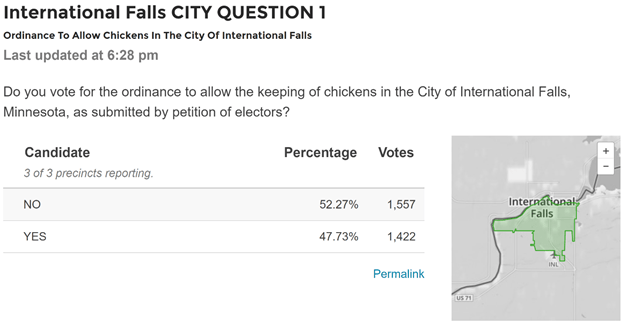
Straight north to the Canadian border, International Falls said yeah to chicken coops out back.
Drop down past Black Duck and Leech Lake Reservation to Rogers Township where they pulled a draw on whether or not to appoint a treasurer. Four votes, split 50-50.

All ballot questions are here, at Minnpost
Messing with Time- Disney
Disney has added a warning at the beginning of its classic films (Lady and the Tramp, The Aristocats, Dumbo to mention a few) to pre-empt them from being torn down, ripped up or cancelled in some fashion. The disclosure is basically a reminder that society changes over time.
While these cartoons do not represent today’s society, they are being presented as they were originally created, because to do otherwise would be the same as claiming these prejudices never existed.
Does Disney have the cultural capital to quell the mob? To take away the quills from the Robespierres before they write another dozen orders of destruction?
As groups decide how to proceed with the statues that were gingerly removed after 90 odd years of barely any note, I hope they look to Disney for more than just entertainment. Because remembering the past is vital to understanding the work that needs to be done to step up the stakes for tomorrow.
I’m not sure if Disney’s common sense approach will work. To point out that one might not agree with the actions of decades gone by seems too simple. To remind people that, should they feel embarrassed, disappointed, or enraged with the habits of their forefathers, they can use those sentiments to forge a better future; that the future is in their hands, not the dead guy on the pedestal.
Time will tell.
Is it so simple?

Nathaniel Rachman writes in Persuasion about how the simpleton manifestos originated in the 60’s and 70’s.
In their 1970 classic The Politics of Unreason, the sociologists Seymour Lipset and Earl Raab coined a word for this black-and-white thinking: “simplism.” They defined it as “the unambiguous ascription of single causes and remedies for multifactored phenomena.”
He notes that these one line policy responses were clung to by the political extremes. Whereas now it is fashionable to reduce all policy to a slogan. In the same way that it is now fashionable to be an activist.
If I retell the last four years as a simple story, it would go something like this. America’s Heartland felt sold out and left behind so they hired Trump to shake things up to make fun of the sharply educated, networked and shined-up coastal internationalists. They demanded that the nation refocuse on the nation itself. As a counter-response the 60’s political types went into a high-gear-radical-simpleton response, unleashing their swarm of buzzing bees on all the social media electronic waves.
For months following the election an acquaintance on Facebook spewed like a fire breathing dragon, reposting every negative commentary topped off with an acidic remark. But her sphere was at odds recently when a well funded Melton-Meaux challenged incumbent Ilhan Omar in the primaries and lost. Suddenly her tone changed to high school counselor sorting out a cat fight in the hallway. This was as refreshing as a spritz of Evian water poolside at a Four Seasons Hotel (we can only dream about such things these days) and gave me hope that we’ve reached an exhaustion point on activism.
Have we finally stripped down the old ways so we can rebuild? Because there is evidence all around us that things are not so simple, that the system is complex. It relies on a vast network of interlinked groups freely interacting to produce value. For instance, the simple response to the virus is to lock everyone down, to deny them access to all the networks they rely on in the social structure of their lives. So high school kids are out carjacking cars and dying in high speed police chases, and suicides are on the rise, and who even knows what amount of domestic battery is going unreported.
As Nathan goes onto say in his piece:
Perhaps the greatest danger is that simplism feasts on its failures. Its ineffective policies will not solve America’s problems, so calls for radical action will intensify. In this mood of crisis, norms are obstacles rather than boundaries. Politics becomes two unshakeable poles, which paralyzes Congress and halts the passage of policy fixes. As long as simplism reigns, America’s problems will worsen—and so the process will repeat itself.
Understanding a more complex system, no relying on a more complex system is our path to a free society. The problem is that the old guard is not letting go. The very natural tendency to hold onto the prestige and power they’ve gained over the last fifty years, by fighting off opponents, has us stuck in a Ground Hog’s Day movie. Their implicit power makes it necessary for them to gracefully exit stage right. In the meantime we wait.
How are things going in Minneapolis?
Personal safety is a deal breaker for most residents. If they do not feel safe in their own home do to gun violence, car jackings and even break-ins, they will move.
It’s all in the comments. Here are just a few from this post.


Changing Priorities in the Neighborhood

Crime has been on the rise since May of 2020. In Minneapolis more than 400 people have been shot and 64 killed so far this year. It’s common to hear residents say they know more people that have been carjacked in broad daylight than have contracted Covid-19.
One neighborhood is organizing to do something about it. When a building in their neighborhood was slated to become a Salvation Army run women’s shelter, the moms went into high gear. Their priorities had changed and the folks in Near North weren’t going to have bureaucrats telling them what they needed.
Residents were vigorously opposed. A Mother’s Love went door-knocking in a multi-block radius of the Gordon Center and found no one knew about the proposal. The Northside Residents Redevelopment Council—the official neighborhood association—filed an injunction to halt the process.
Council member Ellison showed up. Elected in 2017 on the promise “to imagine a future for the North Side authored by North Siders,” he apologized for poor public engagement and encouraged constituents to lay out their concerns. “I don’t at all take skepticism of this project as, like, an attack on homeless women,” he assured them.
Frustrated residents pulled no punches. There were already three homeless shelters within a mile of the Gordon Center, yet the North Side had been without a sanctuary for at-risk youth since the 1980s, they said. Many community-led proposals for the Gordon Center had been rejected over the years.
The residents, who were organizing on their own time, objected to the shelter not because they weren’t sympathetic to the cause. It’s just that in the ever changing landscape of neighborhood needs, the effect of increased crime was more damaging to the youth than the needs of the women.
“I’ve lived here for 43 years,” said Willard Hay resident Esther Adams. “I’ve seen kids shot on this corner, I’ve seen kids killed on this corner. We’re just trying to help the kids here.”
In addition to the granular differentiation of need, the resources necessary for a youth center is thought to be considerably less than the homeless shelter.
The Gordon Center (homeless shelter) will cost more than $4 million to convert into a shelter, but peace activists like Clemons’ group, A Mother’s Love, believe it would cost considerably less for a youth center because of the way the building is designed. For one, it already has a playground.
In this case the system worked. The neighborhood did the work to voice a preference between services for their group. It was close though. The building permit had already been approved for the homeless shelter. If the moms had been too busy to put in the time, or their council member too distance from his constituents or the county’s ambition too strong, there could have been four shelters and no youth center.
It just seems like there should be some general tracking of these things by neighborhood. A hospital wouldn’t go into an area with three other hospitals. Even a McDonald’s wouldn’t have four franchisees within a mile of each other. Some sort of indexing of the mix of services provided to not only serve residents, but also to be sure that various age groups and household formations are being supported.
Messing with Time
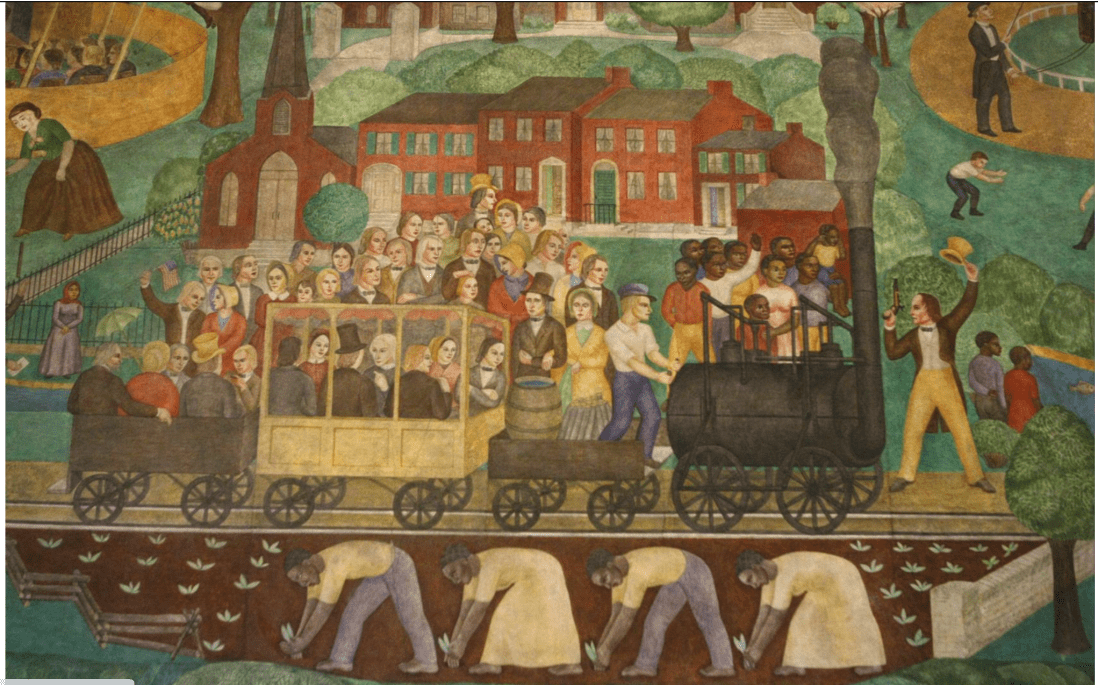
Such a long list of public statues have been pulled down, defaced, and parkways and buildings have been renamed, that the whole culturally sensitive activity has become banal. Standing in line to do their part are student activists at the University of Kentucky who have been demanding the removal of a mural from the 1930’s, one depicting the settling of the Commonwealth of Kentucky. But not everyone is sympathetic. Long time climate activist, writer and poet, Wendell Berry, is suing.
Now, Wendell Berry — the writer, farmer and longtime Kentuckian — is suing the university over its decision to remove the mural, arguing that because it was created through a government program, it is owned by the people of Kentucky and cannot be removed by the university. (Mr. Berry knew the artist of the mural through his wife, who is a niece of Ms. O’Hanlon. Mr. Berry’s wife, Tanya Berry, is also a plaintiff in the lawsuit.)
Perhaps it is time that the courts weigh in on the issue. The period where the passion of the moment, the outrage, perhaps has expired. Voicing a need for change is acceptable, it is desirable. The public square, whether physical or over electronic media, is part of the system. Yet at some point the voicing process is over. At some point destruction to emphasize the severity of the issue becomes destruction to feel powerful. At some point attention to the issue at hand starts to itself erode other worthy causes.
The Minnesota Court of Appeals recently issued an opinion regarding the appropriateness of alining time with the crime. Even if the law changes at a later date, it ruled that the perpetrator cannot be exonerated if the deed was unlawful at time of conviction.
A defendant is not exonerated within the meaning of Minn. Stat. § 590.11, subd.
1(c)(2) (Supp. 2019), when his conviction has been vacated based on a later clarification
of the law, when the conduct violated the law under existing precedent at the time the
offense was committed.
Shouldn’t it follow that the reverse should also not be allowed? That today’s cancel culture cannot convict based on revisions to laws dictating new standards which make historical actions unlawful? Those artists (in this case a woman-which in and of itself should be revered) and their subjects and the commissions which hired the work be done were operating within the guidelines of their time. Not some future reality yet to be conceived.
If anything these artifacts should be kept around because they are there to tell our story. Sir Bertrand Russell wrote an essay offering some ideas on what history should do for the general reader. Here is a section that points out that a history is needed precisely to address the ever changing nature of ‘human affairs.’ It appears in Portraits from Memory and Other Essays.
Our human story is ever evolving. We operate on a time continuum. Thus it seems, that if for no other reason than to avoid making complete fools out of ourselves, we must evaluate events under the conditions in which they occurred.
Meet the Met
The Metropolitan Council was conceived a little over fifty years ago with the foresight that the Twin City Metropolitan Area of Minneapolis and St. Paul would benefit from a multi-county planning entity. Large infrastructure projects like transit and water/sewer in particular would be best coordinated regionally in lieu of by an aggregation of cities. The 17 member council serves at the pleasure of the sitting governor. Here is a nice fact sheet providing an overview of the council’s latest accomplishments.
The council wields a tremendous amount of power for an unelected body. Over the years objections to this structure have been voiced by champions of both the left and the right. But for the time being, it is a structure which continues to influence the growth of residential settlement through patterns of transportation provided by bus and light rail, and through the provision of city and water.
In a presentation last week, Charlie Zelle, the chair of the council stressed that his agency is responsible for planning. In light of this spirit, I would like to propose a new way to frame up some of the research.
There are two new infrastructure projects which will offer circulation options for residents. First off, a new interchange off interstate I94 will provide direct access to the city of Dayton, a third tier suburb. Dayton, with a population of 6,302, was bypassed for development and become donut hole to suburban expansion while the populations of neighboring communities grew: Maple Grove to 71k, Champlin to 25k and Rogers to the NW to 13K. The mayor of Dayton touts the economic potential that will be unlocked by the anticipated increase in vehicle traffic from the off ramp.
The second infrastructure project is the Southwest Light Rail which recently received its Full Funding Grant Agreement from the Federal Transit Administration. This transit option links the four SW suburbs of St. Louis Park, Hopkins, Minnetonka, and Eden Prairie to the City of Minneapolis.
Excitement around Southwest LRT in not just confined to transportation advocates, already the alignment has seen hundreds of millions of dollars of private investments along the line. From affordable housing to commercial centers, Southwest LRT is making an impact on the state’s economy a trend which will continue far into the future.
Both of these projects will allow a new pattern of circulation for residents. One will experience growth and transformation from rural low density to suburban. The other will allow a built community to circulate more readily to and from the downtown core.
Whereas commuters and businesses are often the focus of the benefits to transit, I would be interested in seeing how all pubic goods in these communities fare following the completion of these two projects. Are there effects to public safety? Are the public schools over-loaded or better-funded? Are people healthier due to better access to medical care?
Maybe part of the concern regarding representation within the Metropolitan Council is for this reason; for the need to voice both the positive and negative impacts of transit and water/sewer infrastructure (restrictions) on the suite of public goods underwritten by a city. Elected officials, especially mayors, manage a boutique of goods for their residents, and they are not seeing the Council take all of them into consideration
Here’s the deal 101
Our local NBC news outlet recently ran a story about an elderly couple receiving help from neighbors after being criticized for not keeping up the exterior paint on their home. It totaled $67,000 worth of help. There is no name given to this transfer of money. When a private party helps themselves to $67,000 from their employer it is called embezzlement. When a politician helps themselves to $67,000 from their campaign fund it is called corruption.
The old school explanation for this activity is to denote it as a form of charity. But is it really a gift? Neighborliness is a term that shows up on surveys. But what does that mean? I see this exchange between the neighbors of Gloucester is the most basic transaction in a economy of groups. Let’s pull it apart.
It all started with an anonymous note left for the couple which read, “Please Paint Me! 😦 Eye sore – Your Neighbors. Thanks.” Although clearly written by one individual, the message is presented as a community concern. Signed, your neighbors. You’ve probably heard this type of chatter before. A house on a main road is dilapidated, or decorated with eccentric siding. Comments like, ‘I really wish someone would do something about that place.’ Or, ‘Some people are bringing down the neighborhood!’ So although one neighbor wrote the note, thoughts of this nature were undoubtedly mulled over by many a passerby.

A personal residence is deemed the bastion of private property, and property rights are a keystone feature of our economic system. But the note indicates that there is a hazy area not reflected in the legal deed, filed in the county records, which spells out the owners names. The area residents feel they have a right to demand that the exterior meet their expectations. This is not a novel idea. In fact cities even have ordinances which address the exteriors of properties regarding thresholds for debris removal and grass mowing.
The couples’ daughter took to social media to voice her response to the note. She points out that her parents had lived in community for the past 50 years. And that during this long history they had maintained their home, and hence contributed many years of service towards an acceptable streetscape. “My family for many years took care and maintained this house as best they could…”
The reason for the disrepair could happen to anyone, it was an act of nature. The article reports that “Marilyn, 72, developed multiple sclerosis about 30 years ago and is mostly confined to her bed, and Jimmy, 71, recently recovered from a quadruple bypass…” Health concerns take time and resources away from the couples ability to comply with the norms of the neighborhood.
Once the word got out about the need, once demand for goods and services was established, a voluntary response from the community resulted in a $67,000 balance in a GoFundMe account. Currency is very liquid, yet these funds are not fungible. As the report confirms the money is “to be used for new siding on their home, new windows, roof and stairs.”
There is no reporting of free riding or extortion, even though funds are seemingly extracted from a greater group to a private party. Nor is this activity portrayed in a religious or moral sense. The voluntary transfer of resources to improve the exterior of the home is held together by a communal objective, one that the recipients contributed to over. This transparent and voluntary activity is the most basic transaction in economy of groups.
“People look out for each other in Gloucester,” he said. “If somebody needs some help, we just get together and do it. It’s all just very heartwarming.” What I hear him saying is that Gloucester is a town with a free an open economy. And yes, that is heartwarming.
 Home Economics