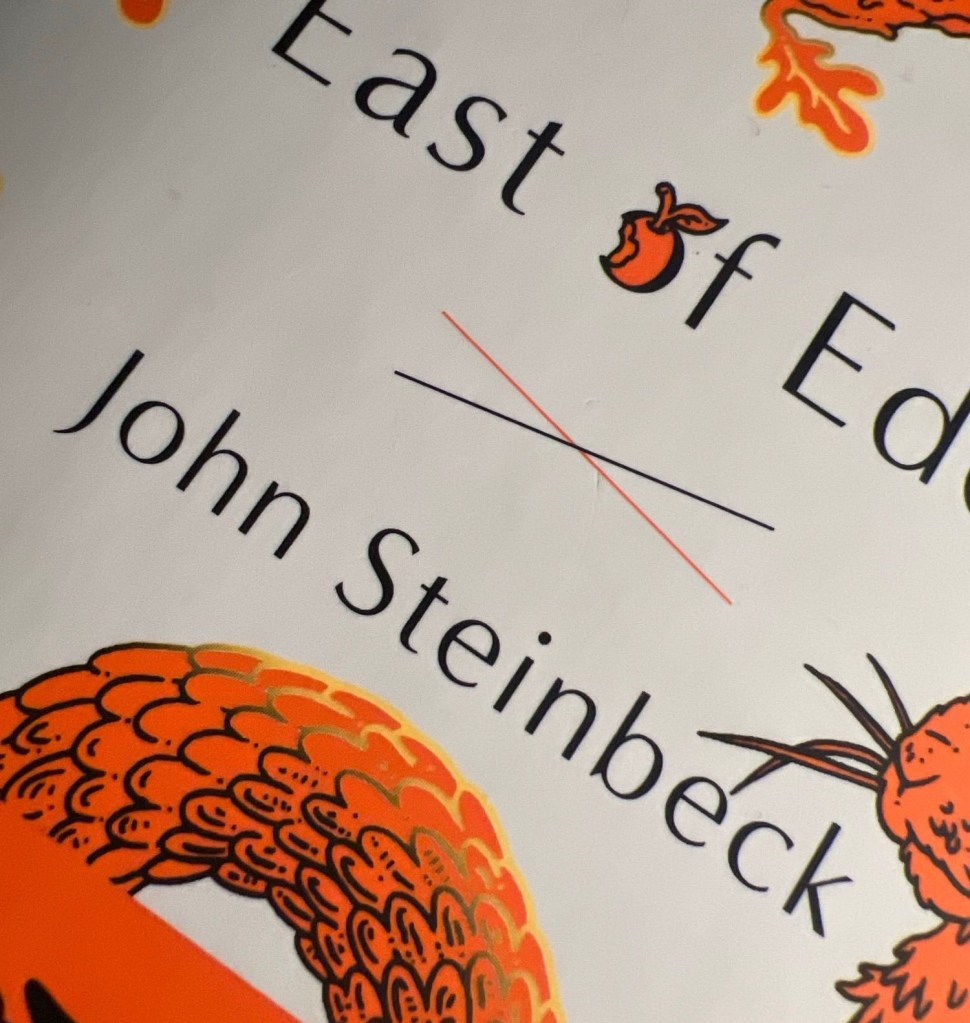
East of Eden is a picture book of landscapes and characters. It’s as if Steinbeck wants you to be taken by what you can see before he leads you to what is unseen. Take this description of Sheriff Horace Quinn:
We knew he was intrepid, for he had held his own in various gunfights; besides, he looked like a sheriff-the only kind we knew about. His face was broad and pink, his white mustache shaped like the horns of a longhorn steer. He was broad of shoulder, and in his age he developed a portliness which only gave him more authority. He wore a fine Stetson hat, a Norfolk jacket, and in his later years carried his gun in a shoulder holster. His old belt holster tugged at his stomach too much. He had known his county in 1903 and he knew it and controlled it even better in 1917. He was an institution, as much a part of the Salinas Valley as its mountains.
Now most people say institutions are a set of rules. To say the sheriff is known as the rule might seem redundant. After all he’s the law by employment.
But most people understand a more expansive interpretation. The story leads us to explain how Quinn handles the whore houses in town— there were rules to be followed even if they weren’t the ones on the books. An off-book set up with an equal expectation of respect.
And it isn’t just about the understood rules but also about the objections and enforcing of such things. Once the law man had been around, and assuming the locals bought into his efforts, the levers of voice and exit are also in play to maintain the rules.
Steinbeck wants us to see workings of the extended play as well.