I went to listen to a few city council people at a nice get toegether in a local Brew Pub. It’s a nice way to hear about what’s on people’s mind and where the direction of their interests are going. This was no different. The two pictured here, one from an urban area and one from a suburban area, seemed well intune and genuinly interested in their residents. Those are the folks who voted them in, afterall.

But in the hour plus conversation there was not one mention of the business base in their neighborhoods, neither retail, restaurant or employer. That’s a bit perplexing to me as businesses pay between 22-35% of the property taxes, the money used to pay the bills of public good provision. And as council members they are in fact the managers of the pipeline that keeps those public services in motion. So why don’t they care about those dollars?
Here are some local breakdowns property taxes paid by business.
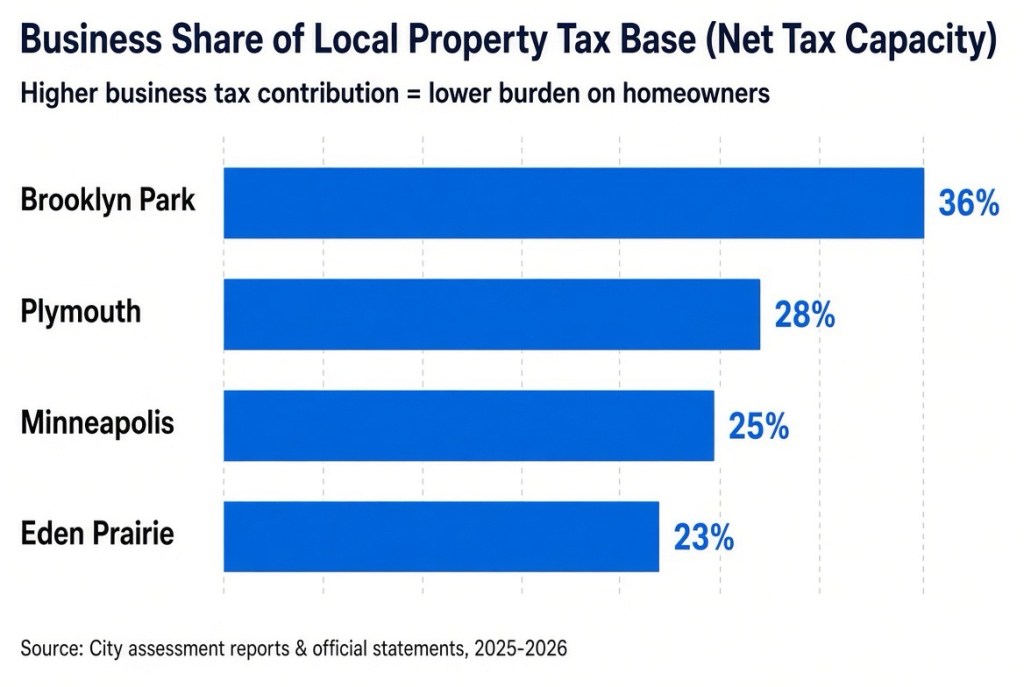
Although elected by residents, if councilmembers only listen to residential voices, they will miss the math that keeps their property taxes lower. In Minnesota, commercial and industrial properties are taxed at higher class rates than homes. That means a stronger business tax base directly reduces the share of the levy that falls on homeowners.
Here’s the local reality:
Brooklyn Park businesses carry about 36% of the local tax capacity.
Plymouth ~28%.
Minneapolis ~25%.
Eden Prairie ~23%.
The more businesses pay, the less residents do. Supporting policies that attract and retain employers is not “pro-business.” It is pro-homeowner.
Ignore the commercial tax base and you are choosing higher residential tax bills. Higher tax bills and some of those consistutents that voted for you will exit to more affordable cities.


