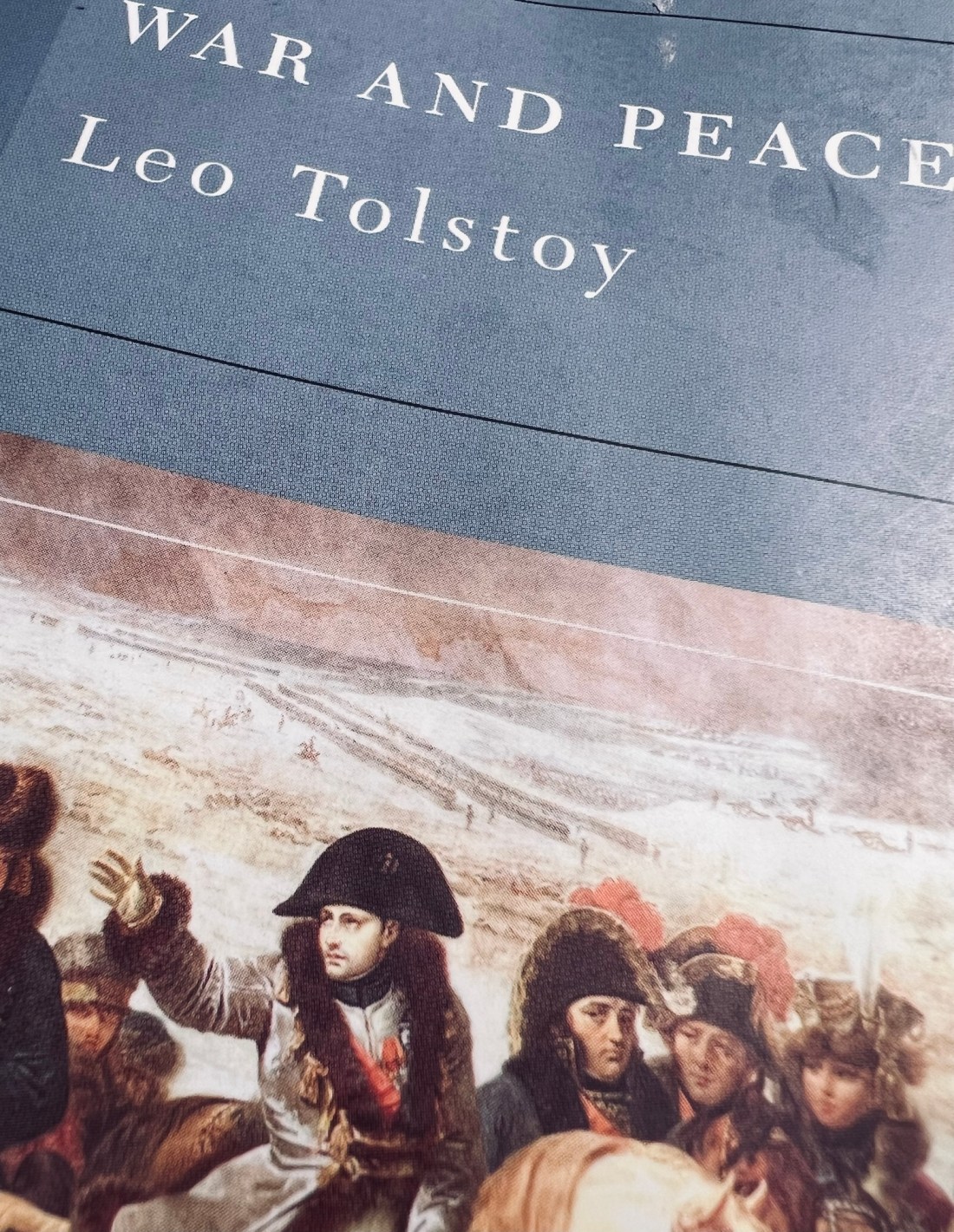
Tolstoy, and the X side of warfare

A topic under examination that runs through War and Peace is the analysis of warfare. What were the keys to Napoleon’s success? The size of the army, or the genius of the man? Or something else.

In Part 15, chapter II Tolstoys starts us we thinking in terms of individual agents.

ONE OF THE MOSt conspicuous and advantageous departures from the so-called rules of warfare is the independent action of men acting separately against men huddled together in a mass. Such independent activity is always seen in a war that assumes a national character.

The author then tells us the accepted view is that it is about counting soldiers, guns, and supplies.

Military science assumes that the relative strength of forces is identical with their numerical proportions. Military science maintains that the greater the number of soldiers, the greater their strength.

But…

Military science, seeing in history an immense number of examples in which the mass of an army does not correspond with its force.

And thus Tolstoy suggests there is something else. He wants to be scientific about this thing. He calls it X.

One has but to renounce the false view that glorifies the effect of the activity of the heroes of history in warfare in order to discover this unknown quantity, x.

X is the spirit of the army, the greater or less desire to fight and to face dangers on the part of all the men composing the army, which is quite apart from the question whether they are fighting under leaders of genius or not, with cudgel or with guns that fire thirty times a minute.

It seems that what is important here is that soldiering with X is something different than soldiering in general. To fulfill a duty with X is not the same as a run-of-the-mill fulfillment of the same task. It does not quantify in the same way or lead to the same results. Labor with a purpose or a shared ambition deserves a subscript of x.

Warfare commitment 200 years gone by

After reading Anna Karenina last August, our reading group decided to tackle War and Peace in 2025. It’s a behemoth. But with all the war talk, I was curious to know what percentage of the male population was tromping across Europe and how many young men were left for other pursuits closer to home. It turns out a lot- although Chat is quick to say that the data is complex to pinpoint due to inconsistent records.

Summary

France: ~50–60% of males aged 18–55 served, driven by universal conscription and mass mobilization (2–2.4 million from 3.6–4 million).

Russia: ~20–30% served, with serf-based levies mobilizing 1–1.5 million from 3.5–5 million, supplemented by militias in 1812.

Austria: ~40–60% served, with 1–1.5 million mobilized from 2–2.6 million, using selective conscription.

Prussia: ~40–65% served, with 500,000–800,000 mobilized from 1–1.25 million, increasing after 1813 reforms.

Britain: ~25–40% served, with 400,000–500,000 mobilized from 1.2–1.5 million, relying on volunteers and naval press-ganging.

In the Context of War and Peace

The novel reflects these varying conscription rates through its portrayal of Russian serf-soldiers and officers like Andrei and Nikolai, contrasted with the French Grande Armée’s mass-conscripted forces. Russia’s lower percentage reflects its selective serf levies, while France’s high rate underscores the levée en masse’s impact, as seen in the exhausted French troops during the 1812 retreat. The differences in mobilization rates highlight the social and military dynamics Tolstoy explores, with Russia’s feudal system and France’s revolutionary conscription shaping their respective armies.

Note: These percentages are estimates based on historical data and demographic assumptions, as precise age-specific military participation rates are not fully documented. Variations across campaigns and years (e.g., 1812–1814 being the deadliest) affect the figures.


Conscription is a type of forced labor. A citizen’s time is donated to the public good in exchange for some compensation (or at least room and board for the serfs). One can see why, in two hundred years, boots-on-the-ground warfare is unpopular. Too many human hours could be devoted to other public goods or to earning a wage in the commercial market. The opportunities to leverage capital even further should the young men choose to invest in education or learn a trade.

War also produces wounded. This can also shift the stage-of-life abilities of a young, able-bodied male. The labor costs of war are too dear.