Methods- it’s always been there

This is an excerpt from my working paper which examines how contemporary economic realities challenge conventional price formation models. Traditional price theory, rooted in neoclassical equilibrium models, struggles to explain modern markets characterized by digital platforms, behavioral anomalies, and network effects. Rather than viewing prices solely as equilibrium outcomes, this section explores price as an information system and coordination mechanism shaped by institutional contexts and evolutionary market processes, proposing alternative approaches that better capture the dynamic nature of pricing in today’s economy.

III. Methodological Framework

A. Philosophical Methodology

This research engages with the critical realist tradition in economic philosophy (Lawson, 1997; Fleetwood, 2017) while incorporating elements of pragmatist inquiry (Dewey, 1938; Hodgson, 2004) to examine how social outcomes are intrinsically embedded within price mechanisms. By adopting this philosophical stance, the investigation transcends the positivists’ limitations that have dominated mainstream economic methodology and artificially separated social dimensions from market valuation processes.

Methodological Rationale and Research Design

The methodology employs a dual approach combining narrative explication and formal econometric analysis—a mixed-methods design that aligns with what Downward and Mearman (2007) term “critical triangulation.” This approach recognizes that economic phenomena exist in open systems characterized by complex causality that cannot be adequately captured through purely deductive or inductive methods alone.

Narrative methodologies in economics have been increasingly recognized for their capacity to reveal dimensions of economic reasoning that formal models often obscure (McCloskey, 1990; Morgan, 2012). As Akerlof and Snower (2016, p. 23) argue, “Narrative economics provides a framework for understanding how stories that may have little grounding in reality nevertheless influence economic behavior.” This research employs narrative not merely as illustration but as a methodological tool to uncover how social dimensions are intrinsically incorporated into economic decision-making rather than treated as external considerations.

The research design progresses through three methodological stages:

  1. Narrative case analysis of micro-level economic decisions where social costs and benefits are endogenously incorporated into price mechanisms
  2. Systematic examination of market-level pricing phenomena that demonstrate social valuation integration
  3. Econometric analysis using hedonic pricing models to formalize and quantify the incorporation of purported “externalities” within price

This triangulated approach provides methodological robustness by examining the phenomenon across multiple scales and through complementary epistemological lenses.

Market Integration of Health and Productivity Benefits

Consider the small business owner contemplating providing flu vaccinations for all employees at a cost of $50 per person. This case exemplifies what Hodgson (2013) identifies as the “reconstitutive downward causation” between institutional structures and individual agency. Conventional economic framing, following Williamson’s (1979) transaction cost analysis, might characterize this as either addressing an externality or reducing monitoring costs. However, this framework artificially separates the transaction into discrete “economic” and “social” components.

Following Sen’s (1977) critique of the rational fool construct, we can observe that the business owner engages in a multi-dimensional calculation that already incorporates social costs and benefits into their decision-making process. The owner calculates that seasonal influenza typically results in X hours of lost labor annually, representing not only direct wage costs but also diminished productivity, potential transmission to other employees, and compromised service to customers.

This integration happens not through external regulatory mandates but through what Davis (2003, p. 974) terms the “socially embedded individual” making decisions that intrinsically incorporate both private and social dimensions. The methodological significance of this observation lies in recognizing that the rational economic actor has not abandoned self-interest but rather operates with what Etzioni (1988) terms “I & We” paradigm that transcends artificial boundaries between private and social benefits.

Consumer Valuation of Production Standards

The organic food market provides another methodologically significant case. When consumers willingly pay premium prices for organic products, conventional economics often characterizes this through what Vatn and Bromley (1997) identify as the “commodification of externalities.” However, this methodological framing imposes an artificial separation that does not reflect the actual valuation process.

Following Callon’s (1998) analysis of market devices and Zelizer’s (2012) work on valuation practices, we can recognize that consumers paying a surcharge for organic certification are expressing a valuation that inherently includes both private benefits and social benefits. The price differential between conventional and organic products represents what Anderson and Holcombe (2013) term “integrated social valuation”—a comprehensive valuation where social dimensions are not external to the market but constitute an intrinsic component of the value proposition itself.

Methodologically, this challenges the ontological separation between “market values” and “social values” that has dominated economic analysis since Pigou’s (1920) formulation of externality theory. The organic certification standard operates as what Star and Griesemer (1989) identify as a “boundary object” that allows coordination between different social worlds without requiring consensus about precise meanings—a methodological perspective that permits more nuanced understanding of how social values become embedded in price mechanisms.

Natural Integration of Health, Environmental, and Safety Considerations

These examples illustrate a methodological approach to understanding markets not as fundamentally incomplete systems requiring external correction but as complex valuation mechanisms capable of incorporating multiple dimensions of value. This approach aligns with MacIntyre’s (1984) critique of compartmentalization in modern social thought and Polanyi’s (1944/2001) concept of embeddedness, challenging the philosophical premise that social costs and benefits exist outside market mechanisms.

This methodological perspective diverges from both neoclassical approaches that treat social factors as externalities and from heterodox approaches that reject market valuation altogether. Instead, it aligns with recent developments in socio-economics (Etzioni, 2003; Hodgson, 2019) that recognize the inherent integration of social and economic dimensions in human decision-making.

Formal Analytical Approach: Hedonic Pricing Models

The narrative understanding outlined above finds formal analytical complement in hedonic pricing models, following Rosen’s (1974) foundational work. This methodological approach decomposes price into its constituent value components without imposing artificial separations between “economic” and “social” factors.

Anderson’s recent study, “Wind Turbines, Shadow Flicker, and Real Estate Values” (2024), provides empirical evidence of how economic actors endogenously incorporate what conventional economics would term “externalities” directly into price mechanisms. The methodological significance of this approach lies in its capacity to quantify valuation components without presuming their ontological separation.

This research employs the hedonic pricing methodology with particular attention to what Heckman and Singer (2017) identify as “causal pluralism”—recognizing that price adjustments for social factors represent not market failures but rather evidence of markets’ capacity to incorporate complex, multi-dimensional valuations. Following Mäki’s (2009) discussion of models as isolations and surrogate systems, the hedonic approach allows us to isolate and examine specific components of valuation while recognizing their inherent integration within actual market processes.

Methodological Limitations and Reflexivity

This methodological approach is not without limitations. The narrative cases, while illustrative, cannot capture the full range of market behaviors, and there remains the potential for selection bias in the cases examined. The hedonic pricing models, while powerful, rely on assumptions about market efficiency and information availability that may not fully hold in practice (Bartik & Smith, 1987; Kuminoff et al., 2010).

Additionally, as Bourdieu (1990) emphasizes, researcher reflexivity must acknowledge that the conceptual frameworks we employ shape the phenomena we observe. The methodological challenge lies in distinguishing between artificially imposed conceptual separations and meaningful analytical distinctions—a challenge this research addresses through methodological triangulation and critical engagement with underlying philosophical assumptions.

In summary, this research employs a methodologically pluralist approach that combines narrative explication and formal hedonic pricing analysis within a critical realist philosophical framework. This approach enables a reconstruction of our understanding of how price mechanisms already incorporate social dimensions of value, challenging the artificial separation between private and social components that has dominated economic thought.

What about Marx Matters?

For anyone younger than 50, it might be hard to imagine the zeal and inflammatory context wrapped in the calling out of Marxism or Communism. There was a time when it triggered fear, fear of ostracism, loss of employment, or any many other adverse physical or social outcomes. Now that history has sorted itself out, the source of terror stemmed from the madmen who adopted Marx’s writings as their intellectual endorsement. Most agree that Marx would oppose the outcomes done under his philosophical banner. Most don’t bother to read the text to find out for themselves.

Last week, an English professor, Alex Moscowitz, suggested that Marx’s work is foundational for economics. The economists objected, debunking the validity of his work. Business people are particularly offended by his Labor Theory of Value, which the nineteenth-century thinker penned in Das Capital.

“The value of a commodity, therefore, is determined by the quantity of labor expended to produce it, but only of labor that is socially necessary. Socially necessary labor time is the labor time required to produce any use-value under the conditions of production normal for a given society and with the average degree of skill and intensity of labor prevalent in that society.”
(Das Kapital, Volume I, Chapter 1)

Everyone knows that in the commercial world, one gets paid the market rate for labor.

Noah Smith types up an interesting overview of the topic in Should Economists Read Marx. He chews through a lot of the interesting aspects of the topic, including listing out the foundational economic material he was required to tackle while a PhD student. Each work tussles with market failures or public goods. The greats like Paul Samuelson and Kenneth Arrow devoted intellectual energy to issues on the cusp of private and public sectors, two sectors each with their own structure.

It’s just that people who came after Marx took his text to initiate disruption and then exert social control. Noah closes with a reminder to his contemporaries that accuracy is not everything. An impassioned sweep and forceful embellishment of an errant study can end in tragedy.

This should serve as a warning to economists — a reminder of why although narrow theories about auctions or randomized controlled trials of anti-poverty policies might seem like small potatoes, they’re not going to end with the skulls of thousands of children smashed against trees. Modern economics, with all of its mathematical formulae and statistical regressions, represents academia appropriately tamed — intelligence yoked to the quotidian search for truth, hemmed in by guardrails of methodological humility. The kind of academia that Alex Moskowitz represents, where the study of Great Books flowers almost instantly into sweeping historical theories and calls for revolution and war, embodies the true legacy of Marx — something still fanged and wild.

But what about the labor theory of value? Is there anywhere in life where there is a pooling value to the work at hand? Consider intellectual property. Is there some pool of work hours necessary to accomplish a new way of thinking about a technology? Scientists in twos and threes or on their own throw their time into advancing an idea. Isn’t the idea behind a patent that the inventor doesn’t get his labor time paid for in the idea development process, so he has a claim to future benefits from the product as a reimbursement mechanism?

What about founders and startup folks. Don’t they calculate the labor hours they think they’ll need to put into a new venture and then figure out whether they’ll be able to recoup their labor time?

Internalize, Externalize, Optimize

If you’ve been following this site, you know the thesis in play here is that at the time of transaction, there is a settling of accounts. Both private and social ambitions are considered before cash is exchanged for a good or service. Price is a numerical representation of both selfish and communitarian aspirations and obligations.

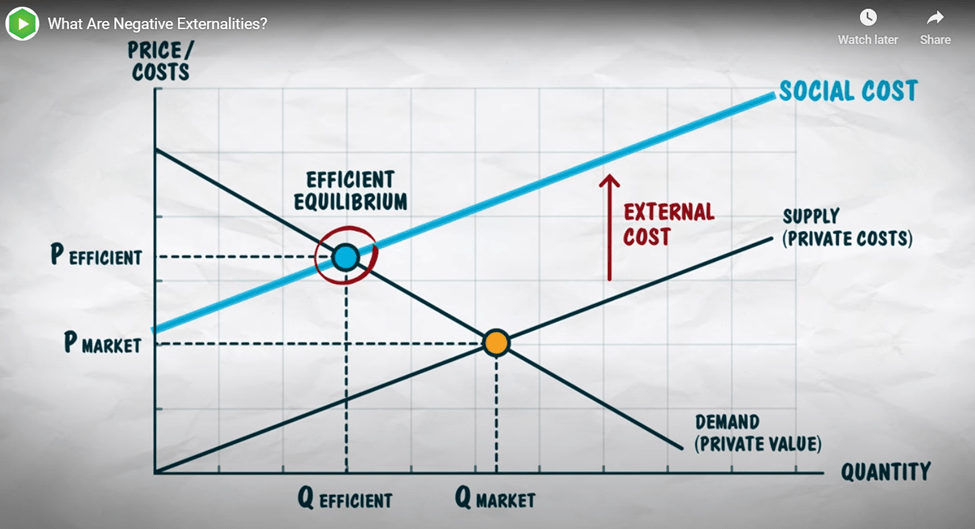
But that’s not what you hear when externalizing costs and internalizing benefits are explained. A familiar story of social costs is a story of industrial pollution. The product is being sold at a sub-optimal level as it does not reflect the nearby communities’ detriment of absorbing manufacturing waste. Marginal Revolution University (the best place for economic education) offers this graph in their section What Are Negative Externalities.

The lines on the chart tell the story. If the cost of the good included the social cost of pollution, the price would be higher, and the company would have to survive on fewer sales. Note the efficient quantity on the horizontal axis is to the left of the market quantity.

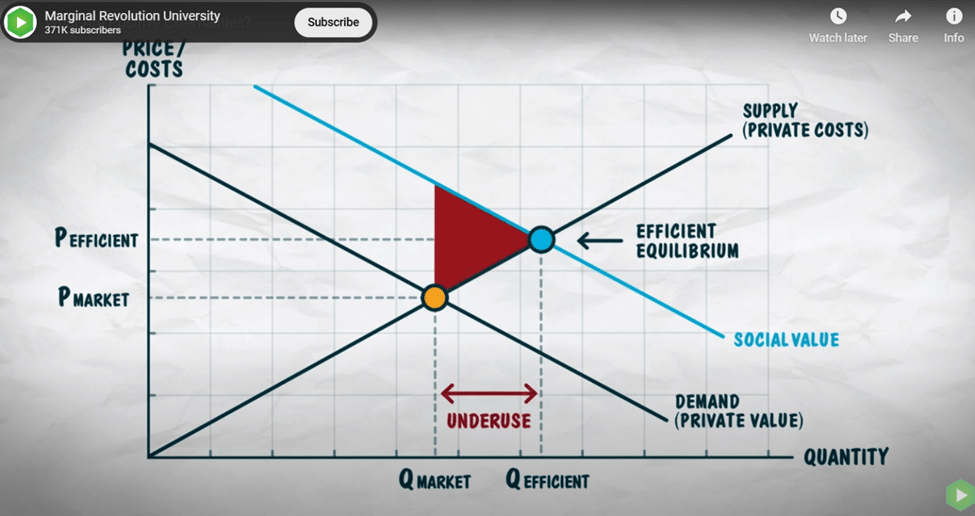
Fortunately, the market can also be responsible for positive externalities. This occurs when a transaction leads to extra benefits for those nearby who did not contribute financially to the transaction. If a few businesses at a corner invest in surveillance equipment, the neighborhood could benefit from a drop in crime. If a wealthy family invests in a school music program so their young protege can have a venue for their talents, the whole student body benefits from access to a higher level of music education.

In this case, more of these transactions would be beneficial to groups nearby, so they are underproduced, as the graph shows. Here, you will note that the quantity most efficient is located on the right-hand side of the market quantity on the horizontal axis.

Thus, the efficient quantity, which we want for the best private/social optimization, lies along the horizontal axis from left to right. At some point, Q efficient must share a spot with Q market. That’s the price we are interested in here- the price at which the optimal level for both private and social needs and ambitions is met. Price falls on this point more often than not.

Let’s talk Internalizing Externalities

All the cool kids are doing it. An externality occurs when an activity with a commercial goal creates a positive or negative impact on parties outside of the transaction. The classic example is the manufacturing plant polluting the water with their waste. The community downstream suffers a negative impact. Or consider a drug dealer taking up business alongside the playground at the local park. The neighbors no longer use the public park which is there for their use.

The plant and all those who benefit from its production internalize a gain from not properly disposing of their waste, which pushes out a cost to the people downstream. The dealer accesses a young group of clients internalizing a gain from his location while the neighbors suffer the loss. But what about the other way around? A small group forms a club to advocate literacy. They offer extra help in the local schools and give out scholarships to new high school graduates. They lose their time, which could have been spent on something else, so that the local youth may internalize the gain from extra tutoring. Perhaps a company agrees to locate to a small town under the condition the municipality brings in internet infrastructure. The townspeople internalize the benefit of the corporate relocation.

All this talk seems to suggest there are groups of people who are either on the inside or on the outside. The lines are porous, but exist. What if there were a group who had gotten a bad rap for an extended period of time – and it was considered beneficial to come to their aid in some way? Wouldn’t it make sense to place them in locations where other groups have the knack of externalizing benefits to others? That way, no direct interference messes with the balance in their lives. The positive externalities show up in the serendipitous manner of access.

The best conversation

The Uber/Lyft conversation in the Twin City area provides material to illustrate the dual nature of transactions. Let’s revisit the players. The drivers provide a service to riders for a fee. They also use a platform which takes a cut of the fare in exchange for technology services and national branding.

Drivers left the taxi structure back ten years ago or so. And it does not sound like they want to go back to the taxi arrangement and work for a boss, but are encouraging other ride share companies to enter the market. They are disgruntled with private pecuniary measures, yet satisfied with the soical benefits and flexibility of the job.

Riders are pleased with the services at today’s pricing. Present public transit options like the bus or metro mobility are actually cheaper but do not replace the service. The groups that would be most damaged by the loss of the ride share structure, since there is no substitute, are disabled folks and those who use it to go bar hopping. The social detriment to the first group would be internalized by loss of freedom and a reduction in trips to their medical appointments. Social detriment would be externalized through outcomes from drunken driving.

Another group of riders would have an impact on local businesses and conventions. The travelers who arrive from elsewhere in the US are familiar with Uber and Lyfts through their national presence. Their apps are already downloaded on their phones and they know the drill. The travel community is worried about how removing this transit option will be externalized onto their business.

Other ride share providers have always been able to enter the market. Drivers have always been able to seek out other work at traditional taxi oulets and other types of driver opportunities like school bus driving. (There are regular job postings for this in our districy choice.) Now that Uber/Lyft’s departure may be eminent, five other platforsm are said to be interested in the market. Yet there are regulatory costs.

Uber and Lyft’s threat to leave the Minneapolis area has sparked a lot of interest from outside players. But the cost of operating a ride share business is not for the faint of heart. It costs $37,000 for a license in Minneapolis, plus another $10,000 wheel chair accessibility fee. St. Paul’s license fee is $41,000. MSP Airport requires a $10,000 security deposit and a $500 license fee.

Separately, it costs about $150,000 to secure a commercial auto insurance policy for a rideshare company.

MSN.com

The issue around the driver’s fare split is presented, politically, as the wealthy corporate boss taking advantage of a punch clock worker. This isn’t the turn-of-the-century, nor are we talking about a factory. And since the platforms have yet to make a profit, that visual is difficult to sustain. But this broohaha may be the trick to get other companies to enter the market and have a go. Should they offer drivers a better cut, then the labor flow will move over to the ride share platform.

The key in all this is freedom. If drivers have the freedom to work as taxi drivers, or bus drivers, or drivers for ride share platforms, then they will gravitate to the best situation for their private interests, leaving the failing apps to die off. If riders find services that better suit their needs, then their business will filter over to new options.

Picking numbers and setting up a dam in the system inadvertently sets off financial as well as social repercussions without clearing them through the numerous social structures involved.