Trump- shock think

Trump is irritating, bombastic, and a general pain in the patuti to all spectrums of political ideology– but you must admit that his unconventional methods get people looking at issues from new angles. Who would have thought that those on the left would become free traders? They oppose Trump’s tariffs meant to protect the American worker (or let’s avoid reading too much into the mind of the art of the deal maker).

And there’s more to see of the unseen. Writers are unveiling things like ‘hidden costs.’ In this super article by Luis Garicano, The Myth of the Single Market, the author proposes that national customs have always charged an override on goods and services that move across European borders.

The IMF puts the hidden cost of trading goods inside the EU at the equivalent of a 45% tariff. For services the figure climbs to 110%, higher than Trump’s “Liberation day” tariffs on Chinese imports—measures many saw as a near-embargo.

We advocate for the idea that social costs are part of the price at Home-Economic. They are hidden only in the sense that they are not talked about. It’s not polite to say to someone that they paid a luxury/status surcharge for their watch because they want to show off, even if Veblen said it was so a hundred years ago. People don’t want to think about whether they selected a bigger house at the expense of a longer commute, which takes their time away from their children. These trades in social commitments are sheltered from the glaring eyes of sharpened pencils and numerical analysis.

But that doesn’t mean they aren’t there. Social costs and surpluses have always been a part of price. Tariffs are just the name for the formalized process of collecting and directing them.

Thank Trump for that bit of awareness.

Circuits and Tariffs

At least a couple of decades ago, when I’d help a client purchase a home that happened to be along an open field, I’d remind them that the view may not always stay that way. The Twin City metro was growing and fields just like the one adjoining their new home were being plowed in and repurposed into neighborhoods of single-family homes. They would nod in acknowledgement and yet still feel a loss when a crop of dwellings soldiered up outside their windows.

There are more situations like that– where the surrounding circumstances change and present residents feel like a cost is imposed on them. Take that lightning rod word: gentrification. In certain circles, it is spit out with as much vehemence as the title capitalist. In reality, gentrification implies that a neighborhood is getting cleaned up, crime is being brought down, structures are being fixed up, and truancy is being pushed out. But when you spruce up the place, more people want to live there. This is distressing to longtime residents who don’t want to see rent prices rise in response to higher demand. The situation is changing around them without their consent!

Or consider an elderly couple who own a large, beautifully situated parcel of land on Flathead Lake. In the years they moved to northwestern Montana, it was remote. Desolate even. Over time, others discovered their paradise and passed the word along to still more people who appreciate views of the rugged snow-capped Rockies. As people arrive, more services are necessary which pushes up property taxes. Is it fair for the elderly to endure the increases? They did nothing to give rise to these new obligations, and now the expense may make their living choice beyond their reach.

Tariffs are a response to the same issue. When the pool of labor is opened up to a global market, should the loss of work in the Midwest manufacturing industries fall solely to die-cutters and assemblymen? They did nothing to change the circumstances, yet they bear the burden. Wall Street profits, labor abroad profits, and they are told to adapt.

What is the proper cycle of protection for the renter affected by gentrification? How long would the elderly be eligible for lower property taxes? Is there a natural circuit for these things to enable an easing of the effects of changing circumstances to all involved?

Keeping track of Tariffs

With all this tariff talk, I’m breaking some misconceptions. For instance, I thought China was our top trading partner. I had no idea that Canada charges tariffs between provinces —sounds laborious to keep track of! Nor did I realize the extent and amount of the tariffs charged worldwide.

Top Ten U.S. Trading Partners and Tariffs Charged Prior to April 1, 2025

  1. Mexico
  • Trade Context: Mexico was the U.S.’s top trading partner in 2023, with total trade valued at approximately $776 billion (goods only). Under the U.S.-Mexico-Canada Agreement (USMCA), most U.S. goods entered Mexico duty-free prior to April 1, 2025.
  • Tariffs Charged: For USMCA-compliant goods, tariffs were generally 0%. For non-USMCA goods, Mexico applied MFN rates, averaging around 7% for industrial products and higher for certain agricultural goods (e.g., up to 20-25% on some items like dairy or poultry under supply management systems). Specific rates depended on the product.

2. Canada

  • Trade Context: Canada was the second-largest U.S. trading partner, accounting for 14.3% of U.S. trade in 2023. Like Mexico, it operates under the USMCA.
  • Tariffs Charged: Most U.S. goods entered Canada duty-free under USMCA prior to April 1, 2025. For non-USMCA goods, Canada’s MFN tariff averaged 4.1%, with higher rates on protected sectors like dairy (up to 200-300% on certain products due to supply management) and softwood lumber (subject to duties averaging 10-20% depending on market conditions).

3. China

  • Trade Context: China was the third-largest U.S. trading partner, with a 10.9% share of U.S. trade in 2023 and a significant trade deficit ($295.4 billion in 2024).
  • Tariffs Charged: Prior to April 1, 2025, China’s average MFN tariff rate was around 7.5% for U.S. goods, but retaliatory tariffs from the first Trump administration’s trade war (2018-2020) raised rates on many U.S. products to 20-25% or higher (e.g., soybeans, autos). The “Phase 1” trade deal in 2020 reduced some tensions, but specific rates varied widely by product.

4. Germany

  • Trade Context: Germany, as part of the EU, contributed 4.4% of U.S. trade in 2023. The EU as a whole is a major U.S. trading partner.
  • Tariffs Charged: Prior to April 1, 2025, the EU applied an average tariff of 5.1% on U.S. goods under MFN rules (no U.S.-EU free trade agreement existed). Specific rates included 10% on autos, 25% on certain steel products (retaliatory), and higher rates on agricultural goods (e.g., 15-20% on some food items).

5. Japan

  • Trade Context: Japan is a significant U.S. trading partner, with a trade deficit noted in 2024 data.
  • Tariffs Charged: Under the U.S.-Japan Trade Agreement (effective 2020), many U.S. goods entered Japan duty-free or at reduced rates prior to April 1, 2025. Japan’s average MFN tariff was 4.3%, but agricultural products faced higher rates (e.g., 38.5% on beef, 15% on some fruits). The Trump administration later claimed Japan charged 46% equivalent when factoring in non-tariff barriers.

6. South Korea

  • Trade Context: A key U.S. trading partner in Asia, South Korea had a free trade agreement (KORUS FTA) with the U.S.
  • Tariffs Charged: Prior to April 1, 2025, most U.S. goods entered South Korea duty-free under KORUS FTA. The average MFN tariff was 6.2%, with higher rates on agriculture (e.g., 40% on some rice products). The Trump administration later cited a 50% equivalent rate including non-tariff barriers.

7. UK

  • Trade Context: The UK ran a trade surplus with the U.S. in 2023 ($14.5 billion per U.S. data).
  • Tariffs Charged: Post-Brexit, the UK applied an average MFN tariff of 5.7% on U.S. goods prior to April 1, 2025, with most rates mirroring the EU’s (e.g., 10% on autos). No U.S.-UK free trade agreement was in place, though negotiations were ongoing.

8. India

  • Trade Context: India is an emerging U.S. trading partner with a notable trade surplus.
  • Tariffs Charged: Prior to April 1, 2025, India’s average MFN tariff on U.S. goods was high, around 13.8%, with significant variation (e.g., 20% on electronics, 100% on some alcoholic beverages). The Trump administration later claimed a 52% equivalent rate including non-tariff barriers.

9. Taiwan

  • Trade Context: Taiwan is a key supplier of electronics to the U.S.
  • Tariffs Charged: Prior to April 1, 2025, Taiwan’s average MFN tariff was 7.1% on U.S. goods, with lower rates on industrial products and higher rates on agriculture (e.g., 15-20% on some items). The Trump administration later cited a 64% equivalent rate with non-tariff barriers.

10. Vietnam

    • Trade Context: Vietnam has grown as a U.S. trading partner, especially for consumer goods.
    • Tariffs Charged: Prior to April 1, 2025, Vietnam’s average MFN tariff on U.S. goods was around 9.6%, with higher rates on specific sectors (e.g., 20-30% on some agricultural products). The Trump administration later claimed a 92% equivalent rate, halved to 46%, factoring in trade imbalances and barriers.

Notes and Context

  • Data Sources: Trade partner rankings are based on 2023/2024 data from sources like the U.S. Census Bureau and Euronews. Tariff rates reflect pre-April 1, 2025, conditions, primarily MFN rates unless a trade agreement applied.
  • Limitations: Exact tariff schedules for every product aren’t fully detailed here due to variability. The listed averages are indicative, and specific rates could be higher or lower depending on the good.
  • Trump’s Reciprocal Tariffs: On April 2, 2025, President Trump announced new U.S. tariffs effective April 5 (10% baseline) and April 9 (country-specific rates), calculated as half the perceived “charge” (trade deficit divided by exports, plus non-tariff barriers). Pre-April 1 tariffs from trading partners didn’t directly align with these calculations, which included non-monetary factors like currency manipulation.

This list reflects the top U.S. trading partners and their general tariff policies toward U.S. goods before the significant policy shift on April 2, 2025.

Sincerely, Grok

Housing Starts & Lumber prices

Prompted from Chat

December 2024 Sees a Surge in U.S. Housing Starts

After a challenging year, U.S. housing starts saw a 15.8% surge in December 2024, reaching an annualized rate of 1.50 million units. This growth was largely driven by a 61.5% rebound in multifamily construction, while single-family starts rose 3.4%. Despite this late-year boost, overall housing starts for 2024 fell 3.9% compared to 2023, reflecting a cooling market due to higher mortgage rates and construction costs.

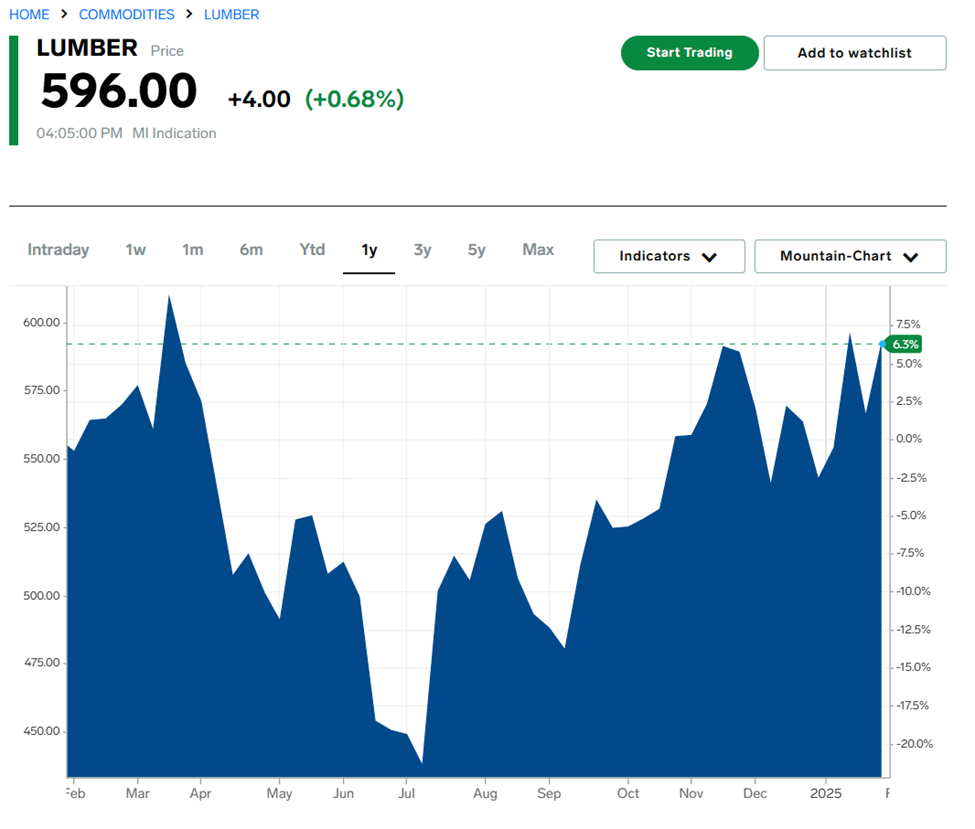
A significant portion of the lumber used for home construction in the U.S. still comes from Canada, accounting for 25-30% of total softwood lumber consumption. However, the cost of lumber has fluctuated. Over the last year, lumber prices have declined from elevated levels seen in 2022-2023, as supply chains improved and housing demand adjusted. As of early 2025, lumber prices are around $538 per thousand board feet, down from previous highs but still above pre-pandemic averages.

Trade policy remains a critical factor. In August 2024, the U.S. increased tariffs on Canadian softwood lumber from 8.05% to 14.54%. Additionally, a new 25% tariff on Canadian and Mexican imports, set to take effect in February 2025, could drive costs higher. These tariffs may slow future building starts as material costs rise, impacting affordability and overall construction activity.

While December’s surge in housing starts is promising, builders must navigate ongoing supply chain challenges and policy shifts that could influence construction costs in the months ahead.

Talk of Tariffs- MN Edition

In 2022, Minnesota traded a total of $6.2 billion with Mexico. With our neighbors to the north in Canada, Minnesota traded more than $21 billion.

In response to the question of who pays for tariffs, University of Minnesota professor of economics Tim Kehoe replied, “And the findings have been that somewhere between 90% and 100%– the number gets bigger over time– of the tariff revenue comes from US firms or consumers. That is, we pay more for the imports.” But this is really a follow-the-money answer. Where does the cash come from that goes into the tax revenue? The consumer who made the purchase.

This is an incomplete analysis.

The economist says Minnesotans will pay higher prices to cover the tariffs. Yet he suggests that when countries retaliate, they simply have the choice to buy goods elsewhere. It seems that a country that imposes a tariff suffers, and one that chooses a less efficient trade with another partner also suffers a loss. The question isn’t whether the less agreeable trading arrangements are costly. The question is what the cost of buying is, and is that worth it?

Consider the objectives at hand.

“Now, President-elect Donald Trump says, on day one in office, he will impose sweeping new tariffs of 25% on Canada and Mexico and another 10% tariff on China. Trump says, the Mexico-Canada tariff is to crack down on illegal immigration and drugs. “

I’d be interested in an analysis that shows how tariff penalties will incentivize these trading partners to respond to the above-mentioned objectives. Will the cost of this trade arrangement induce Mexico and Canada to put some muscle into immigration issues? How about drugs?

The American people want these issues addressed, and this implies they are willing to put resources towards this aim. Will these new trade agreements prove to be the most cost-effective compared to other enforcement options? (MPR article quoted)