My husband and I both come from families with five kids. Even then, ours were larger families, as the average US woman bore 3.6 children. Big families were those with ten or more children. A college friend with twelve siblings scored top prize in the mega family category.
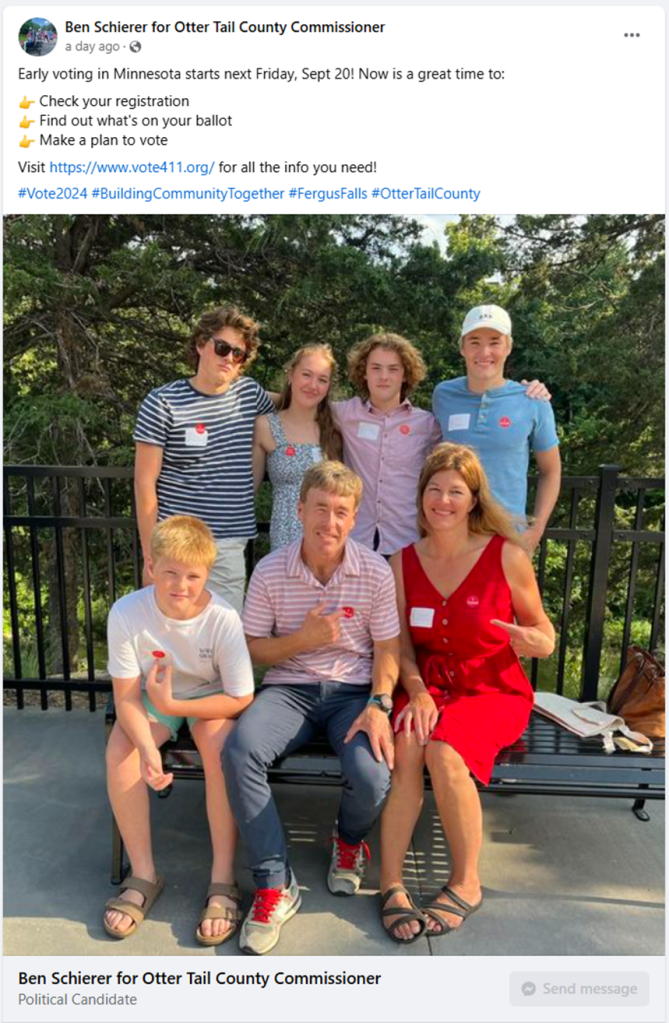
Today’s fertility rates are not even up to replacement numbers. So, what can be done to make large families fun again? One approach may be to consider them in election choices. Here’s a father of five kids running for a county commissioner position. People who live a lifestyle conducive to a gaggle of kids are bound to favor programs and support services geared that way.
Most people want similar things, such as personal safety, good schools, and adequate health care, all within the reach of decent employment. However, a large families’ focus is undoubtedly skewed to their preferences. Safety means kids can navigate city roads to and from schools and parks without harm. In contrast, a family with a musical prodigy may be perfectly willing to buffer themselves against some urban crime so their child can be within reach of the top ballet school. One wants ubiquitous small town the other wants access to specific cultural activities.
Good schools, for instance, mean good public schools in the large family scenario. It can also mean a school that isn’t too elite so that their kids have a chance to dabble in varsity sports or theater or debate without being squeezed out by intense competition. Large families form a buying group of public services. Figuring out how to match the most likely who desire a large family with the mix of services that enriches their lives is the best way to grow the population.
James Buchanan is renowned for charting a new direction in economic theory with the introduction of Public Choice Theory. This theory emerged from the realization that politicians are not solely altruistic public servants, but may also be swayed by self-interest in their political roles. It should follow then that when a politician takes action in the form of an exchange, it is possible that that behind the choices lie blended motives. And in general, people can use trades to general a gain for the self as well as the tribe.
After all, purely altruistic action is most commonly seen between parents and their children. When exerting effort during the trying toddler years of dependency or spending down savings for higher education, few formulate a cost-benefit analysis. Perhaps in the back of the parent’s consciousness there is a thought that a healthier, better-educated adult will be a kind caretaker to their elderly parent. This deep bond between parents and children often leads to countless unnoticed acts of selflessness, like a parent waking up in the middle of the night to comfort a scared child or a child sacrificing personal time to help a parent in need. These acts of love and sacrifice form the backbone of familial relationships and lay the foundation for a strong, supportive family unit. Over the years, the selfless actions of parents continue as they guide their children through life’s challenges, always putting their children’s well-being above their own. And as children grow older, they often reciprocate these selfless acts, showing love and care for their aging parents, thereby perpetuating the cycle of altruism within the family.
Blended motives are becoming increasingly prevalent in modern society, as individuals seek to align their personal goals with larger social or environmental causes. In the workplace, many employees are drawn to non-profit organizations, where they can pursue their professional ambitions while also contributing to a meaningful collective mission. Similarly, in the realm of leisure and tourism, the popularity of eco-tourism continues to grow, reflecting a desire to explore the world while supporting sustainable and environmentally friendly practices. Moreover, in the consumer market, there is demand for organic foods and battery-operated vehicles, driven by a dual concern for personal well-being and environmental responsibility. These diverse examples all underscore the complex interplay of individual and collective motivations in contemporary decision-making processes.
This holds true in institutional pursuits as well. Recently, a juror in our area promptly called the FBI instead of keeping a bag containing $120,000 in cash in exchange for an acquittal. This act of integrity serves as a testament to the essential role that individuals play in upholding the principles of justice and fairness in society. Where would we be if citizens didn’t react in a judicious and expeditious manner when confronted with such moral dilemmas? The swift and decisive action taken by this juror ensured that the would-be bribers were tracked down and held accountable for their actions. Such incidents underscore the pivotal role that individuals play in preserving the fabric of justice and upholding the rule of law.
This democracy is made up of individuals like all the ones who will share a 4th of July picnic around BBQs in backyards today. These are the folks who, in actions large and small, blend into thousands of choices made every year, work and contribute to the ever-evolving project of America.

 Home Economics