Hayek won the intellectual battle. Government of any sort is not be capable of planning their country’s economy. If in doubt, this animated version of Leonard Read’s famous essay, I, Pencil, will surely convince you.
Near the end of his life, Hayel published his last book The Fatal Conceit, The Errors of Socialism (1988). By now the debate had lost its salience. The Berlin Wall would fall just a year later vindicating all who opposed socialism. A reader is left to think of the Fatal Conceit as a remix of a brilliant mind’s famous career.
But I think Hayek was trying to advance his ideas of extended order to a new level. First note, in the clip above, that the creation of the pencil navigates hundreds if not thousands of exchanges between people. It’s a linear activity. The order is rather flat.
Hayek suggests there is more.
Moreover, the structures of the extended order are made up not only of individuals but also of many, often overlapping, sub-orders within which old instinctual responses, such as solidarity and altruism, continue to retain some importance by assisting voluntary collaboration, even though they are incapable, by themselves, of creating a basis for the more extended order. Part of our present difficulty is that we must constantly adjust our lives, our thoughts and our emotions, in order to live simultaneously within different kinds of orders according to different rules. If we were to apply the unmodified, uncurbed, rules of the micro-cosmos i.e., of the small band or troop, or of, say, our families) to the macro-cosmos (our wider civilisation), as our instincts and sentimental yearnings often make us wish to do, we would destroy it.
Yet if we were always to apply the rules of the extended order to our more intimate groupings, we would crush them. So we must learn to live in two sorts of world at once. To apply the name ‘society’ to both, or even to either, is hardly of any use, and can be most misleading (see chapter seven).
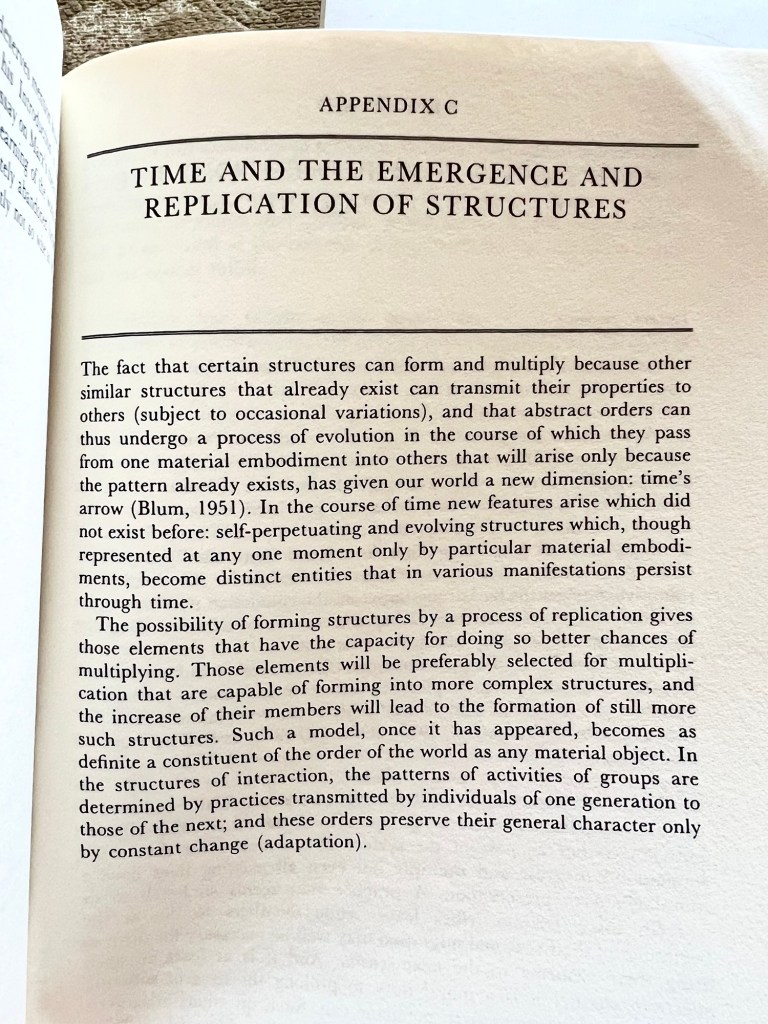
We live in two worlds. The mechanics of one would crush the other—but then again, the passions are known to be deadly as well. In this way, the actions in one must bend to the actions in the other. And in the worlds of dual ambitions, the subgroups explode into a cacophony of midlevel playing fields of interactions. He describes the replication process in Appendix C.
 Home Economics