A book about risk

I’m quite enjoying Allison Schrager’s accounts of how people navigate risk in their lives. The book is full of stories about poker players and surfers, as well as bankers and bond traders.

Although the framework follows the model of an individual making a decision, in the background there are many communal references. This passage is about the paparazzi partnerships.

Since the best shots come down to being in the right place at the right time, photogs often form teams or alliances to share tips and sometimes royalties to increase the odds or payoffs they’ll be in that place. In 2003, Baez founded a group called PACO, “like the jeans,” combining the words “paparazzi” and “company.”

PACO consisted of ten experienced photographers. They traded tips on where certain celebrities hung out and when. So if Baez spotted a celebrity eating lunch at a trendy restaurant, he would alert the other PACO members. He says, beaming with pride, “Back in the day when we’d show up, the other guys would say, ‘Oh no, here comes PACO, because we were the best.”

Family ties show up in several of the vignettes. Somehow the prospects of his first love trump a degree from Stanford. When talking about the business executive Arnold Donald, she recounts.

It was a way to get both worlds: the liberal arts experience he wanted and the Stanford engineering degree.

During his sophomore year at Carleton, Donald married his college sweetheart, who also received a place at Stanford’s engineering school but no scholarship. Rather than take on the financial risk of student loans, they went to Washington University in St. Louis, where they both had scholarships.

And background players can even accumulate into a whole world of their own. For the poker player, there’s a benefit to syncing with the subculture.

The world of professional poker is a unique subculture-complete with special outfits and lingo-that appears foreign to outsiders. Its obsessive fan base watches games on television or in person for hours, is preoccupied with stats, and gambles on the players and games. Winning at poker comes down to luck and skill. Luck is being dealt a winning hand. Skill is knowing how and when to bet, and having the discipline and ability to infer what other players are doing.

Although not explicitly described or measured in terms of their influence, social relations, network effects, family ties, and workplace mechanics are ever-present in Schrager’s stories on risk.
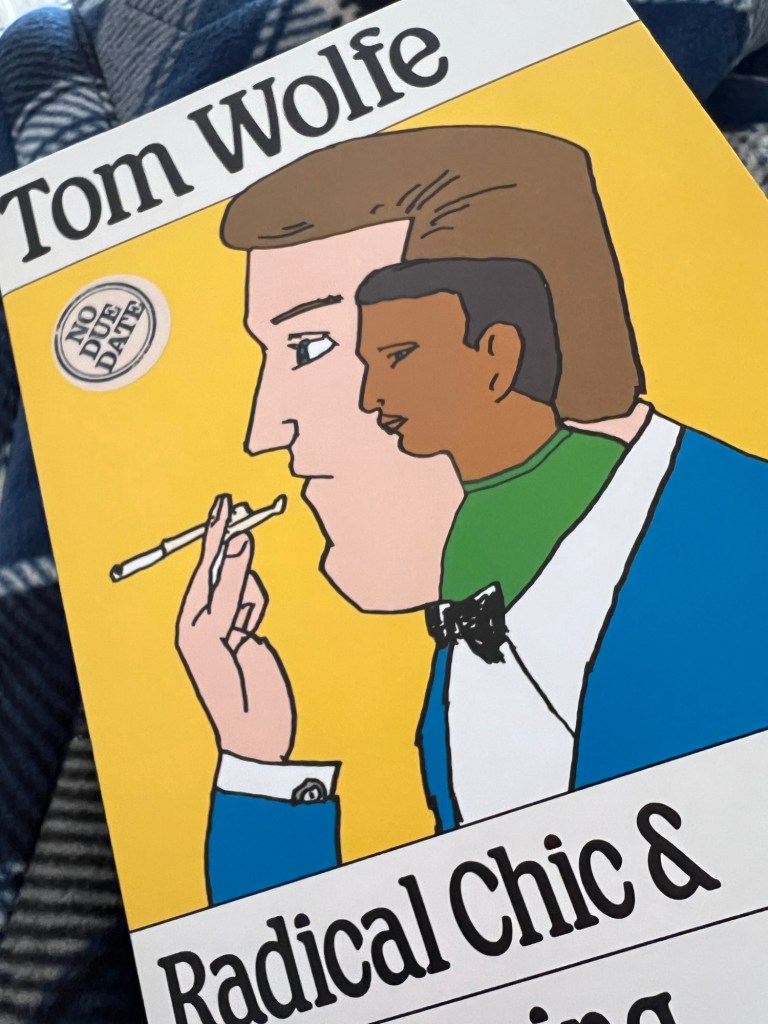
Elegant Slumming

Who doesn’t like a wry metaphor or particularly apt simile? Tom Wolfe’s writing is rich in both. His short story Radical Chic depicts the wealthy of NY cooing over the edgy Marxist-Leninist black power organization.

For example, does that huge Black Panther there in the hallway, the one shaking hands with Felicia Bernstein herself, the one with the black leather coat and the dark glasses and the absolutely unbelievable Afro, Fuzzy-Wuzzy-scale, in fact—is he, a Black Panther, going on to pick up a Roquefort cheese morsel rolled in crushed nuts from off the tray, from a maid in uniform, and just pop it down the gullet without so much as missing a beat of Felicia’s perfect Mary Astor voice…

And this is all in one sentence. As a high schooler I would try out a few colorful comparisons just to have my paper returned marked up in red: too DRAMATIC! I guess you have to be famous to be creative.

There’s more to talk about in Radical Chic than a descriptive tableau. Perhaps we should take a cue from economist and blogger Tyler Cowen, who recently wrote about the Odyssey in economic terms. After all, the point of Radical Chic is a money transfer from the ultra-rich to a group with a cause, the Black Panthers.

In the Odyssey, the people involved are neatly tucked away on their islands. The groups are clearly delineated as a sea separates them from the others Homer meets on his journey. Fortunately, we have the clever and perceptive Tom Wolfe. He makes the reader see the affluent managing their servants in their townhomes in Manhattan. He corrals one group with descriptors and then another.

What the Bersteins will find out is that there are, in fact, many groups to consider. Many more than the radical chic who desperately needed something new and different in their lives. By the short story’s end, Wolfe lists many more economic players.

FOOLS, BOORS, PHILISTINES, BIRCHERS, B’NAI B’RITHEES, Defense Leaguers, Hadassah theater party piranhas, UJAvia-tors, concert-hall Irishmen, WASP ignorati, toads, newspaper readers-they were booing him, Leonard Bernstein, the egre-gio maestro… Boooooo.

As Leneord Berstein, a famous maestro, is booed while on stage, he learns that there were many more groups in play than the virtuous and the radicals, and this fact has led to him taking a private loss.

I Care a Lot – Movie Review

My husband and I finally stumbled onto a movie last night that didn’t have me flicking the exit button after fifteen minutes. Netflix’s I Care a Lot twisted and turned enough to hold our attention.

It’s a battle between a nouveau riche con-woman and an established class con-man. But the story is kept au current by setting it in the middle of the how-to-care-for-aging-boomers dilemma. The portrayal of a nursing home as a lockdown facility is terrifyingly real, especially in times of covid when there has been strict control over who enters and exits through the magnetically locking entrance doors.

The protagonist is a bad ass feminist. She’s driven to out smart and out bully anyone in her path to success. She’s out to demonstrate how the work which usually falls to the domestic in a household, can instead be externalized into a lucrative business. Get the right doctor to assess memory loss and the right judge to legitimise her stewardship, and poof! She builds a portfolio of guardianships. Bend the rules a bit more, and it’s a cash cow bonanza.

The plot riffs off the ever too real issues simmering through many families. As mom and dad age, when do they become too forgetful (because being a little forgetful reaches well down into middle age)? Who gets to decide when an adult, a person of authority for decades, must forego their independence and turn everyday decisions over to another. An error of commission causes unhappy holiday gatherings. An error of omission invites scammers of all sorts to prey on the elderly.