
If you’ve been following this site, you know the thesis in play here is that at the time of transaction, there is a settling of accounts. Both private and social ambitions are considered before cash is exchanged for a good or service. Price is a numerical representation of both selfish and communitarian aspirations and obligations.
But that’s not what you hear when externalizing costs and internalizing benefits are explained. A familiar story of social costs is a story of industrial pollution. The product is being sold at a sub-optimal level as it does not reflect the nearby communities’ detriment of absorbing manufacturing waste. Marginal Revolution University (the best place for economic education) offers this graph in their section What Are Negative Externalities.
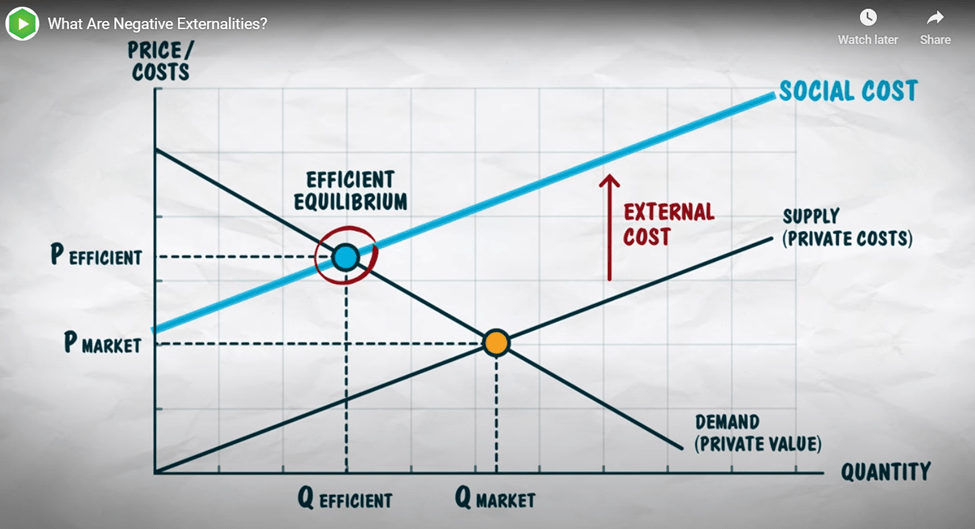
The lines on the chart tell the story. If the cost of the good included the social cost of pollution, the price would be higher, and the company would have to survive on fewer sales. Note the efficient quantity on the horizontal axis is to the left of the market quantity.
Fortunately, the market can also be responsible for positive externalities. This occurs when a transaction leads to extra benefits for those nearby who did not contribute financially to the transaction. If a few businesses at a corner invest in surveillance equipment, the neighborhood could benefit from a drop in crime. If a wealthy family invests in a school music program so their young protege can have a venue for their talents, the whole student body benefits from access to a higher level of music education.
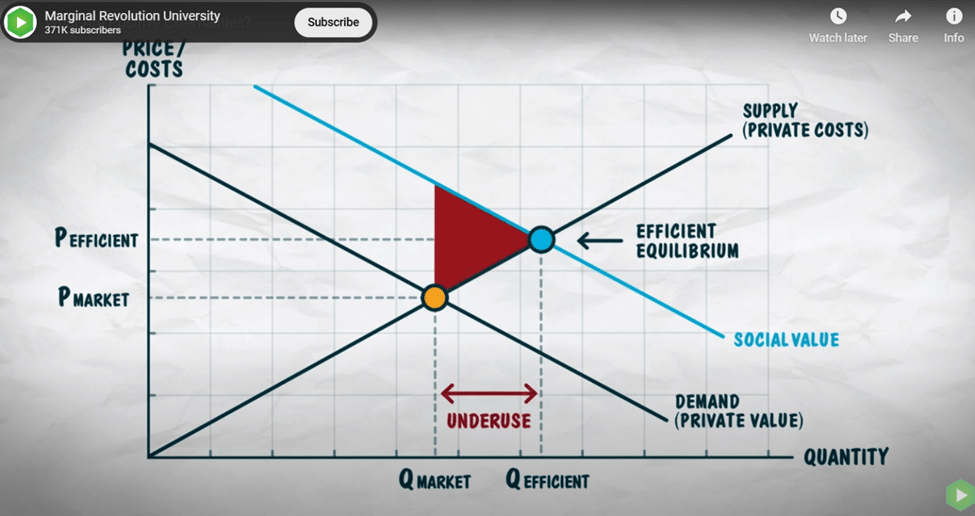
In this case, more of these transactions would be beneficial to groups nearby, so they are underproduced, as the graph shows. Here, you will note that the quantity most efficient is located on the right-hand side of the market quantity on the horizontal axis.
Thus, the efficient quantity, which we want for the best private/social optimization, lies along the horizontal axis from left to right. At some point, Q efficient must share a spot with Q market. That’s the price we are interested in here- the price at which the optimal level for both private and social needs and ambitions is met. Price falls on this point more often than not.

