A book about risk

I’m quite enjoying Allison Schrager’s accounts of how people navigate risk in their lives. The book is full of stories about poker players and surfers, as well as bankers and bond traders.

Although the framework follows the model of an individual making a decision, in the background there are many communal references. This passage is about the paparazzi partnerships.

Since the best shots come down to being in the right place at the right time, photogs often form teams or alliances to share tips and sometimes royalties to increase the odds or payoffs they’ll be in that place. In 2003, Baez founded a group called PACO, “like the jeans,” combining the words “paparazzi” and “company.”

PACO consisted of ten experienced photographers. They traded tips on where certain celebrities hung out and when. So if Baez spotted a celebrity eating lunch at a trendy restaurant, he would alert the other PACO members. He says, beaming with pride, “Back in the day when we’d show up, the other guys would say, ‘Oh no, here comes PACO, because we were the best.”

Family ties show up in several of the vignettes. Somehow the prospects of his first love trump a degree from Stanford. When talking about the business executive Arnold Donald, she recounts.

It was a way to get both worlds: the liberal arts experience he wanted and the Stanford engineering degree.

During his sophomore year at Carleton, Donald married his college sweetheart, who also received a place at Stanford’s engineering school but no scholarship. Rather than take on the financial risk of student loans, they went to Washington University in St. Louis, where they both had scholarships.

And background players can even accumulate into a whole world of their own. For the poker player, there’s a benefit to syncing with the subculture.

The world of professional poker is a unique subculture-complete with special outfits and lingo-that appears foreign to outsiders. Its obsessive fan base watches games on television or in person for hours, is preoccupied with stats, and gambles on the players and games. Winning at poker comes down to luck and skill. Luck is being dealt a winning hand. Skill is knowing how and when to bet, and having the discipline and ability to infer what other players are doing.

Although not explicitly described or measured in terms of their influence, social relations, network effects, family ties, and workplace mechanics are ever-present in Schrager’s stories on risk.

Disaster! Price

As long as prices are ticker taping along with typical elan, most people are happy to know that the amount they would give for a good or service is agreed to spontaneously, but many others. Sure, people will complain when a touch of frost ruins the citrus crop in Florida, leading to higher prices for grapefruit, lemons, or oranges. Little fluctuations make the dinner table news but are not show-stoppers in the ever-churning commerce between vendors and consumers.

The vibe changes when a typhoon rolls into the Sunshine State. Proclamations against price gouging come from the political power at hand. Every four-by-eight piece of plywood is needed to cover glass windows. However, the market system is no longer viewed as the desirable mechanism for distribution. Profit at the hands of disaster makes people uncomfortable.

Insurance alleviates the restraints of fears for the suddenly disadvantaged. When a hail storm comes through, insurance replaces all damaged vehicles or roofs. No one cries, ” Price gouging!” Everything is all right as long as it’s on the insurance company’s tab. Insurance coverage didn’t take the repairs out of the market system, but it did change the size of the risk group.

This happened with masks during COVID. In the early days of the virus, state health departments were desperate to get masks for essential personnel. As the prices soared, administrators realized every state was bidding up the price from foreign suppliers. Changing the buyer group from the state to the federal level, tampered down the bids.

Disasters are shared concerns over more extensive groups of people. The market system is not in error; it just needs regrouping.

Insurance Update

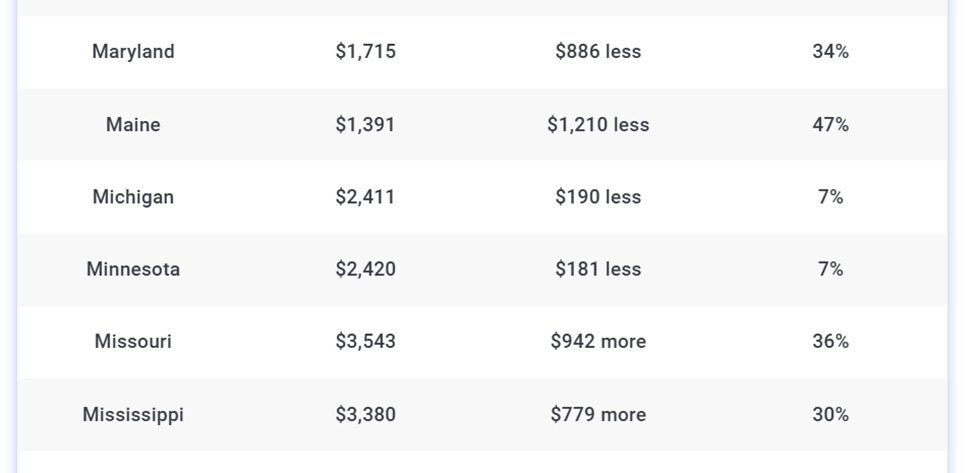
Come to find out, property insurance rates on a $300,000 home vary by state. They vary a lot. The annual premiums for a dwelling in Missouri and Mississippi are twice as much as Maryland and Maine. Minnesota is, of course, just average.

Insurance.com

If you haven’t thought about your insurance coverage in a while it might be an idea to dust off the policy and dig into what is covered. Some riders are negligible in cost yet nice to have when the situation arises. And example for coverage is on the water line from the meter in your basement to the connector at the street. Standard deductibles have also gone up from $1000 to $2500. The larger deductible may save your annual premium $200-$300.

Also, be sure to understand how the coverage works. With all the roof claims, often driven by contractors knocking on doors after a hailstorm goes through a neighborhood, companies have changed the payouts on roof replacements. Many companies will prorate the coverage once a roof is over fifteen years old. If the storm comes through in the twentieth year of the asphalt shingle life, then the homeowner only gets paid the value of the remaining years of life.

A periodic review is indeed essential for staying informed about external factors that may affect your insurance coverage. Even if you are content with your current provider, the insurance market continuously evolves, making regular evaluations crucial for ensuring that your coverage aligns with your needs and the prevailing circumstances.